The H-Invitational Database (H-InvDB),
a comprehensive annotation resource for
human genes and transcripts
Received September 16, 2007; Revised October 20, 2007; Accepted October 22, 2007
ABSTRACT
Here we report the new features and improvements in our latest release of the H-Invitational Database (H-InvDB; http://www.h-invitational.jp/), a compre-hensive annotation resource for human genes and transcripts. H-InvDB, originally developed as an integrated database of the human transcriptome based on extensive annotation of large sets of full-length cDNA (FLcDNA) clones, now provides annota-tion for 120 558 human mRNAs extracted from the
International Nucleotide Sequence Databases
(INSD), in addition to 54 978 human FLcDNAs, in the latest release H-InvDB_4.6. We mapped those human transcripts onto the human genome sequences (NCBI build 36.1) and determined 34 699 human gene clusters, which could define 34 057 (98.1%) protein-coding and 642 (1.9%) non-protein-coding loci; 858 (2.5%) transcribed loci overlapped with predicted pseudogenes. For all these transcripts and genes, we provide comprehensive annotation includ-ing gene structures, gene functions, alternative splicing variants, functional non-protein-coding RNAs, functional domains, predicted sub cellular localizations, metabolic pathways, predictions of protein 3D structure, mapping of SNPs and micro-satellite repeat motifs, co-localization with orphan diseases, gene expression profiles, orthologous genes, protein–protein interactions (PPI) and anno-tation for gene families. The current H-InvDB annota-tion resources consist of two main views: Transcript view and Locus view and eight sub-databases: the
DiseaseInfo Viewer, H-ANGEL, the Clustering
Viewer, G-integra, the TOPO Viewer, Evola, the PPI view and the Gene family/group.
INTRODUCTION
Human transcripts represent a biologically and function-ally rich format for examining the structure of human genes and alternative splicing isoforms. In particular, cloning and sequencing of full-length cDNAs (FLcDNAs) that cover all exons but no introns can facilitate the precise determination of human gene structure (1). Studies
on human transcripts have thus been systematically and extensively carried out to draw the outline of the human transcriptome (2–6). The human transcriptome consists of protein-coding mRNAs and non-coding functional RNAs. Analysis of these sequences will provide insights into how genomic information is transformed into higher order biological phenomena. By comparative analysis of the transcriptome with the human genome, we will be able to determine the transcribed regions of the genome and better understand the regulatory machinery of transcrip-tion (7, 8). It is therefore of great significance to collect information about human transcripts as well as their annotations. We thus held the first international workshop entitled ‘Human Full-length cDNA Annotation Invitational’ (abbreviated as H-Invitational or H-Inv) in Tokyo, Japan from 25th August to 3rd September 2002, and constructed a novel, integrative database of the human transcriptome, called H-InvDB (9,10). This con-sists of the annotation of 42 421 human FLcDNAs, collected from six high-throughput producers of human FLcDNAs in the world human gene collections.
To cover the increased number of human FLcDNAs since the initial release of H-InvDB, we held the second international annotation meeting entitled ‘H-Invitational 2 Functional Annotation Jamboree’ (abbreviated as H-Invitational 2 or H-Inv2) in Tokyo, Japan from 15th to 20th November 2003. The second major release of H-InvDB (release 2.0) was based on the annotation carried out at the H-Inv2 annotation jamboree. After H-Inv2, we initiated the Genome Information Integration Project (GIIP) and held the third and fourth annotation meetings in October 2005 and October 2006. The products of those two annotation meetings comprised releases 3.0 and 4.0 of H-InvDB. The increases in the number of entries in H-InvDB are summarized in Table 1.
THE ANNOTATION IN OUR LATEST UPDATE, H-InvDB 2007
In our latest release H-InvDB_4.6, we annotated 120 558 human mRNAs extracted from the International Nucleotide Sequence Databases (INSD) in addition to 54 978 human FLcDNAs that were available on 15th June 2006. We mapped those human transcripts onto the human genome sequences (NCBI build 36.1) and determined 34 699 human gene clusters, which could define 34 057
*A complete list of authors appears at the end of this article.
ß2007 The Author(s)
(98.1%) protein-coding and 643 (1.9%) non-protein-coding loci, while 858 (2.5%) transcribed loci overlapped with predicted pseudogenes. We basically followed the mapping technique we described previously (9,10). We updated annotation for the mitochondrial transcripts since the previous major release, H-InvDB_4.0, which resulted in a slightly decreased number for the transcripts and clusters. Then we assigned a standardized functional annotation to each H-Inv transcript by human curation, based on the results of similarity searches and InterPro-Scan (11). The numbers of manually curated human proteins in each category are summarized in Table 2.
For these transcripts and genes, we provide compre-hensive annotation including descriptions of their gene structures, alternative splicing isoforms, functional non-protein-coding RNAs, functional domains of proteins, predicted sub cellular localizations, metabolic pathways, predictions of protein 3D structure, mapping of SNPs and microsatellite repeat motifs, co-localization with orphan diseases, gene-expression profiles, orthologous genes and evolutionary features in model animals, protein–protein interaction (PPI) and annotation for gene families. We have also annotated several new features related to transcript quality.
NEW ANNOTATED FEATURES IN H-InvDB
Classification of ncRNA
We annotated the transcripts that do not have homology to known protein-coding genes or InterPro-domain-containing
genes as non-protein-coding transcript candidates. We classified 1216 non-protein-coding transcripts into ‘Identical to known ncRNA’ (124), ‘Similar to known ncRNA’ (74) and ‘Putative ncRNA’ (1018) by homology with known ncRNA databases and discrimination analysis
Sequence quality features: nonsense-mediated decay (NMD), read-through, reverse orientation
A total of 269 transcripts were annotated as candidates of read-through and 2731 as targets of NMD by the extended sequence quality annotation.
Category VII: pseudogene candidates
To annotate transcribed pseudogene candidates, we did the following: First, we filtered out the functional protein-coding genes by only targeting representative category II transcripts and those identified to have frame shifts and/or nonsense mutations; Second, we predicted transcribed pseudogene candidates based on a support vector machine (SVM) method. In the current release, we annotated 1112 transcribed pseudogene candidates (Category VII).
Annotation of gene families/groups
We annotated four selected gene families/groups: T-cell receptor (TCR), Immunoglobulin (Ig), Major Histocompatibility Complex (MHC) or Human Leukocyte Antigen (HLA) and Olfactory receptor (OR) using the original pipeline based on sequence analysis against genome and protein databases complemented by a text-mining approach. In the current release, we identified 15 TCR, 21 Ig, 72 MHC and 122 OR gene clusters.
All the annotation items and features of H-Inv transcript sequences are stored and shown in the main views or sub-databases in H-InvDB.
COMPREHENSIVE ANNOTATION RESOURCES IN H-InvDB
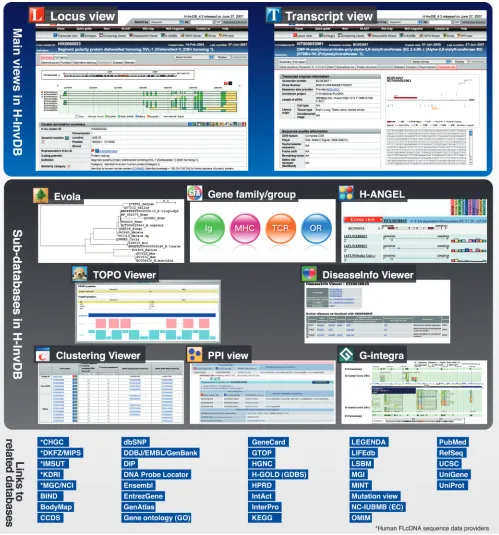
[image:2.612.43.559.86.177.2]The current H-InvDB annotation resources consist of two main views, Transcript view and Locus view, and eight sub-databases: the DiseaseInfo Viewer, H-ANGEL, the Clustering Viewer, G-integra, the TOPO Viewer, Evola, the PPI view and the Gene family/group view with the appropriate cross-links. An overview of the compre-hensive annotation resources of the human gene and transcripts in H-InvDB is shown in Figure 1.
Table 1. Statistics of H-InvDB entries
H-InvDB release Date of release
Number of transcripts (HIT)
Number of gene clusters (HIX)
Number of proteins (HIP)
Human genome Date of sequence data-fix
1.0 2004/4/20 41 118 21 037 – NCBI build 34.1 2002/7/15
2.0 2005/8/31 56 419 25 585 – NCBI build 34.1 2003/9/1
3.0 2006/3/31 167 992 35 005 – NCBI build 35.1 2005/3/1
4.0 2007/3/30 175 542 34 701 116 228 NCBI build 36.1 2006/6/15
4.6 2007/9/27 175 536 34 699 116 142 NCBI build 36.1 2006/6/15
Table 2. Statistics of manually curated representative H-Inv proteins
Category Definition Number of
representative HITs
%
I Identical to knownahuman protein (98% identity, =100% coverage)
12 404 36.42
II Similar to knownaprotein (50% identity,50% coverage)
3165 9.29
III InterPro domain containing protein
3056 8.97
IV Conserved hypothetical protein 4210 12.33
V Hypothetical protein 5124 15.05
VI Hypothetical short protein (20–79 amino acids)
5250 15.42
VII Pseudogene candidates 858 2.52
Total 34 057 100
[image:2.612.42.291.207.371.2]Transcript view
The transcript view shows all the annotation of the H-Inv transcript in 12 section tabs: (i) gene structure, (ii) gene function, (iii) gene ontology, (iv) predicted CDS,
[image:3.612.65.564.70.605.2](v) functional motif, (vi) sub cellular localization, (vii) protein structure information, (viii) gene expression, (ix) disease/pathology, (x) evolutionary information, (xi) polymorphism (SNP, indel and microsatellite) and
interspersed repeat information and (xii) transcript and sequence quality information. As seen in the example of a transcript view shown in Figure 1, this view also has links to many external public databases including DDBJ/ EMBL/GenBank, RefSeq, UniProtKB, HGNC, InterPro, Ensembl, EntrezGene, PubMed, dbSNP, GO and GTOP and to web sites of the original data producers of the FLcDNA clones and sequences including the Chinese National Human Genome Center (CHGC), German cDNA Consortium (DKFZ/MIPS), Helix Research Institute, Inc. (HRI), the Institute of Medical Science in the University of Tokyo (IMSUT), the Kazusa DNA Research Institute (KDRI), the Mammalian Gene Collection (MGC/NCI) and NEDO. This view was previously known as the cDNA view (mRNA view).
Locus view
The Locus view shows all the annotation of a locus in six section tabs: (i) gene structure and location in the human genome, (ii) gene function, (iii) alternative splicing pattern, (iv) gene expression, (v) disease/pathology and (vi) cluster member information. As seen in the example of a Locus view shown in Figure 1, it shows links to external public databases including DDBJ/EMBL/GenBank, RefSeq, EntrezGene, GeneCards, HGNC and OMIM.
DiseaseInfo Viewer
The DiseaseInfo Viewer is a database of known and orphan genetic diseases and their relation to H-Inv clusters with EntrezGene and OMIM cross-links. The DiseaseInfo Viewer provides two kinds of disease infor-mation related to H-Inv clusters: known disease-related genes and co-localized orphan diseases. An orphan disease is defined as a disease mapped on a chromosomal region, but for which the responsible gene has not been identified yet. Co-localization does not necessarily mean a direct relationship between gene and disease; however, genes that are cytogenetically co-localized with a disease could be possible candidate genes for that disease. The co-localized H-Inv clusters are chosen by computing the physical range of each cytogenetic band with a 1 Mbp margin.
Human anatomic gene expression library (H-ANGEL)
H-ANGEL is a database of expression patterns that we constructed to obtain a broad outline of such patterns for human genes (12). We collected gene-expression data in normal and adult human tissues that were generated by three types of methods and in seven different platforms, including: iAFLP, a PCR-based quantitative expression profiling method; DNA arrays (long oligomers, short oligomers and cDNA microarrays); and cDNA sequence tags (SAGE, EST, BodyMap and MPSS). The H-ANGEL database comprises the largest and most comprehensive collection of gene expression patterns so far, which also provides a classification of human genes in terms of their expression.
Clustering Viewer
The Clustering Viewer facilitates the comparisons of different clustering. It allows users to see whether H-Inv transcripts are consistently clustered by different clustering methods. It also displays multiple alignments of tran-scripts by using CLUSTALW (13). The Clustering Viewer shows all the member transcripts of an H-Inv cluster to which a query sequence belongs.
G-integra
G-integra is an integrated genome browser, in which we can examine the genomic structures of the transcripts. As seen in an example view in Figure 1, the location in the human genome and gene structure of H-Inv transcript (green), and the corresponding RefSeq and Ensembl entries are shown. The structures of the genes and transcripts for 11 non-human species, Pan troglodytes (chimpanzee), Macaca sp. (macaque), Mus musculus (mouse), Rattus norvegicus (rat), Canis familiaris (dog), Bos taurus (cow), Monodelphis domestica (opossum), Gallus gallus (chicken), Danio rerio (zebrafish), Tetraodon nigroviridis (tetraodon) and Takifugu rubripes (fugu) can be optionally displayed for comparison. Other options allow the, the results of gene prediction programs such as GenScan (14), HMMgene (15), FGENESH (16) and JIGSAW (17) to be displayed.
TOPO Viewer
The TOPO Viewer is a tool for viewing subcellular targeting signals predicted by TargetP (18) and the presence of transmembrane helices predicted by SOSUI (19) and TMHMM(20). The probabilities that a protein may be delivered to up to nine distinct sub cellular locations are predicted by WoLF PSORT (21). TargetP predicts whether a protein contains a signal peptide, a mitochondrial targeting signal or any other type of signal. The TOPO Viewer consists of four tab pages: TABLE, MAP, FILE and GFP. The TABLE tab page displays the prediction results for all the programs used.
Evola
Evola is a database of evolutionary annotation of human genes (22). It provides sequence alignments and phyloge-netic trees of manually curated orthologous genes among human and 11 model organisms, Pan troglodytes (chim-panzee), Macaca sp. (macaque), Mus musculus (mouse), Rattus norvegicus(rat), Canis familiaris(dog),Bos taurus (cow), Monodelphis domestica (opossum), Gallus gallus (chicken), Danio rerio (zebra fish),Tetraodon nigroviridis (tetraodon) and Takifugu rubripes (fugu). Sequence alignments and phylogenetic trees of the orthologous genes and homologous genes are shown in Evola.
PPI view
databases based on their sequence similarities and integrated them with the H-Invitational proteins.
Gene family/Group view
The Gene family/Group view provides human-curated annotation datasets for the selected gene families/groups at http://www.jbirc.aist.go.jp/hinv/ahg-db/geneFamily Index.jsp. For H-InvDB release 4.0, we provided detailed annotations for four selected gene families/groups: TCR, Ig, MHC and OR. Each page provides the list of genes, gene names, definitions and links for the appropriate H-InvDB views.
H-InvDB New Identifier
We defined and assigned a unique identifier for each annotation unit, transcript, protein or cluster (7,8). The identifier for H-Invitational transcript is ‘HIT’, prefix HIT plus nine digit numbers (e.g. HIT000000001) and for H-Invitational cluster is ‘HIX’, prefix HIX plus seven digit numbers (e.g. HIX0000001). In order to identify the modification in sequence or annotation of an H-Inv entry, a version is assigned to each ID and always stated with the ID. Additionally, we now provide a new identifier for each H-Invitational protein, ‘HIP’, prefix HIP with nine digit numbers (e.g. HIP000000001).
H-InvDB Data Availability
H-InvDB is freely available for both academic and commercial use and can be accessed online at http:// www.h-invitational.jp/(or hinv.jp). Annotated data can also be downloaded in FASTA sequence files, the original-format flat files or XML files at HTTP and FTP servers. The mirror database is also available at http:// hinvdb.ddbj.nig.ac.jp/. Minor updates are released every three months and major updates are released once a year.
ACKNOWLEDGEMENTS
We acknowledge all the members of the H-Invitational 2 consortium and Genome Information Integration Project (GIIP), especially the staffs of JBIRC for construction of H-InvDB, Ryo Aono, Tomohiro Endo, Yukie Makita, Hiromi Kubooka, Yuji Shinso, Harutoshi Maekawa, Yasuhiro Fukunaga, Hajime Nakaoka, Yoshito Ueki, Yoshihide Mimiura, Ryuzou Matsumoto, Seigo Hosoda, Yo Takahashi, Taichirou Sugisaki, Hiroki Hokari, Hiroaki Kawashima, Yasuhiro Imamizu, Makoto Ogawa for their technical assistance. This research is financially supported by the Ministry of Economy, Trade and Industry of Japan (METI), the Ministry of Education, Culture, Sports, Science and Technology of Japan (MEXT) and the Japan Biological Informatics Consortium (JBIC). Also, this work is partly supported by the Research Grant for the RIKEN Genome Exploration Research Project from MEXT to Y.H. and the Grant for the RIKEN Frontier Research System, Functional RNA research program. Funding to pay the
Open Access publication charges for this article was provided by JBIC.
Conflict of interest statement. None declared.
REFERENCES
1. Ota,T.et al. (1997) Full-length cDNA project toward a high throughput functional analysis.Microb. Comp. Genomics,2, 204–205.
2. Yudate,H.T.et al. (2001) HUNT: launch of a full-length cDNA database from the helix research institute.Nucleic Acids Res.,29, 185–188.
3. Wiemann,S. et al. (2001) Toward a catalog of human genes and proteins: sequencing and analysis of 500 novel complete protein coding human cDNAs. Genome Res.,11, 422–435.
4. Strausberg,R.L.et al. (2002) Generation and initial analysis of more than 15,000 full-length human and mouse cDNA sequences. Proc. Natl Acad. Sci. USA,99, 16899–16903.
5. Kikuno,R.et al. (2002) HUGE: a database for human large proteins identified in the Kazusa cDNA sequencing project.Nucleic Acids Res.,30, 166–168.
6. Carninci,P.et al. (2005) The transcriptional landscape of the mammalian genome.Science,309, 1559–1563.
7. Frith,M.C.et al. (2006) Pseudo-messenger RNA: phantoms of the transcriptome. PLoS Genet,2, p. e23.
8. Gingeras,T.R.et al. (2007) Origin of phenotypes: genes and transcripts.Genome Res.,17, 682–690.
9. Imanishi,T.et al. (2004) Integrative annotation of 21,037
human genes validated by full-length cDNA clones.PLoS Biol.,2, 856–875.
10. Yamasaki,C.et al. (2005) Investigation of protein functions through data-mining on integrated human
transcriptome database, H-Invitational database (H-InvDB).Gene,
364, 99–107.
11. Mulder,N.J.et al. (2007) New developments in the InterPro database. Nucleic Acids Res.,35(Database issue), D224–D228.
12. Tanino,M.et al. (2005) The human anatomic gene expression library (H-ANGEL), the H-Inv integrative display of human gene expression across disparate technologies and platforms.Nucleic Acids Res.,33(Database Issue), D567–D572.
13. Thompson,J.D., Higgins,D.G. and Gibson,T.J. (1994) CLUSTAL W: improving the sensitivity of progressive multiple sequence alignment through sequence weighting, position-specific gap penalties and weight matrix choice.Nucleic Acids Res.,22, 4673–4680.
14. Burge,C. and Karlin,S. (1997) Prediction of complete gene structures in human genomic DNA. J. Mol. Biol.,268, 78–94. 15. Krogh,A. (1997) Two methods for improving performance of an
HMM and their application for gene finding.Proc. Int. Conf. Intell. Syst. Mol. Biol.,5, 179–186.
16. Salamov,A.A. and Solovyev,V.V. (2000) Ab initio gene finding in Drosophila genomic DNA. Genome Res.,10, 516–522.
17. Allen,J.E. and Salzberg,S.L. (2005) JIGSAW: integration of multiple sources of evidence for gene prediction.Bioinformatics,21, 3596–3603.
18. Emanuelsson,O.et al. (2000) Predicting subcellular localization of proteins based on their N-terminal amino acid sequence.J. Mol. Biol.,300, 1005–1016.
19. Hirokawa,T., Boon-Chieng,S. and Mitaku,S. (1998) SOSUI: classi-fication and secondary structure prediction system for membrane proteins.Bioinformatics,14, 378–379.
20. Krogh,A.et al. (2001) Predicting transmembrane protein topology with a hidden Markov model: application to complete genomes.
J. Mol. Biol.,305, 567–580.
21. Horton,P.et al. (2007) WoLF PSORT: protein localization predictor.Nucleic Acids Res.,35(Web Server issue), W585–W587. 22. Matsuya,A.et al. (2008) Evola: ortholog database of all human
genes in H-InvDB with manual curation of phylogenetic trees.
LIST OF AUTHORS FOR THE GENOME INFORMATION INTEGRATION PROJECT AND H-INVITATIONAL 2 CONSORTIUM
Chisato Yamasaki1,2, Katsuhiko Murakami1,2, Yasuyuki Fujii3, Yoshiharu Sato1,2, Erimi Harada1,2, Jun-ichi Takeda1,2, Takayuki Taniya1,2,
Ryuichi Sakate1,2, Shingo Kikugawa1,2, Makoto Shimada1,2, Motohiko Tanino4, Kanako O. Koyanagi5, Roberto A. Barrero6, Craig Gough1,2, Hong-Woo Chun1,2,
Takuya Habara1, Hideki Hanaoka7, Yosuke Hayakawa1,8, Phillip B. Hilton1,2, Yayoi Kaneko9, Masako Kanno1,2,
Yoshihiro Kawahara1,2, Toshiyuki Kawamura10, Akihiro Matsuya1,11, Naoki Nagata12,
Kensaku Nishikata1,13, Akiko Ogura Noda1,2, Shin Nurimoto14, Naomi Saichi1,2,
Hiroaki Sakai15, Ryoko Sanbonmatsu1,2, Rie Shiba1,2, Mami Suzuki1,2,
Kazuhiko Takabayashi8, Aiko Takahashi1,2, Takuro Tamura16, Masayuki Tanaka1,2, Susumu Tanaka17, Fusano Todokoro1,18, Kaori Yamaguchi1, Naoyuki Yamamoto1,19, Toshihisa Okido20, Jun Mashima20,
Aki Hashizume20, Lihua Jin20, Kyung-Bum Lee20, Yi-Chueh Lin20, Asami Nozaki20,
Katsunaga Sakai20, Masahito Tada20, Satoru Miyazaki21, Takashi Makino22, Hajime Ohyanagi20,23, Naoki Osato20, Nobuhiko Tanaka20, Yoshiyuki Suzuki20, Kazuho Ikeo20, Naruya Saitou24,
Hideaki Sugawara20, Claire O’Donovan25, Tamara Kulikova25, Eleanor Whitfield25, Brian Halligan26, Mary Shimoyama26, Simon Twigger26, Kei Yura27,
Kouichi Kimura28, Tomohiro Yasuda28, Tetsuo Nishikawa28,29, Yutaka Akiyama30, Chie Motono30, Yuri Mukai30,
Hideki Nagasaki15,30, Makiko Suwa30,
Paul Horton30, Reiko Kikuno31, Osamu Ohara31, Doron Lancet32, Eric Eveno33,34,
Esther Graudens33,34, Sandrine Imbeaud33,34,35, Marie Anne Debily33,34,36,
Yoshihide Hayashizaki37,38, Clara Amid39, Michael Han39, Andreas Osanger39, Toshinori Endo5, Michael A. Thomas40, Mika Hirakawa41, Wojciech Makalowski42, Mitsuteru Nakao43, Nam-Soon Kim44, Hyang-Sook Yoo44, Sandro J. De Souza45, Maria de Fatima Bonaldo46,
Yoshihito Niimura47, Vladimir Kuryshev48, Ingo Schupp48, Stefan Wiemann48,
Matthew Bellgard6, Masafumi Shionyu49, Libin Jia50, Danielle Thierry-Mieg51, Jean Thierry-Mieg51, Lukas Wagner51, Qinghua Zhang34,52, Mitiko Go53,
Shinsei Minoshima54, Masafumi Ohtsubo54,
Kousuke Hanada55, Peter Tonellato56, Takao Isogai29, Ji Zhang34,57, Boris Lenhard58, Sangsoo Kim59, Zhu Chen34,60,61, Ursula Hinz62, Anne Estreicher62,
Kenta Nakai63, Izabela Makalowska64, Winston Hide65, Nicola Tiffin65,
Laurens Wilming66, Ranajit Chakraborty67, Marcelo Bento Soares68, Maria Luisa Chiusano69, Yutaka Suzuki70, Charles Auffray33,34,
Yumi Yamaguchi-Kabata2, Takeshi Itoh2,15, Teruyoshi Hishiki2, Satoshi Fukuchi20,
Ken Nishikawa20, Sumio Sugano2,70, Nobuo Nomura2, Yoshio Tateno20, Tadashi Imanishi2,5,yand
Takashi Gojobori2,20
1
Japan Biological Information Research Center, Japan Biological Informatics Consortium,2Biological
Information Research Center, National Institute of Advanced Industrial Science and Technology, Tokyo,
3
Graduate School Medicine, Dentistry and
Pharmaceutical Sciences, Okayama University, Okayama,
4
DNA Chip Research Inc., Kanagawa,5Hokkaido University, Hokkaido, Japan,6Centre for Comparative Genomics, Murdoch University, WA, Australia,
7
Biotechnology Research Center, The University of Tokyo,8Hitachi Software Engineering Co., Ltd.,
9
Mitsubishi Kagaku Institute of Life Sciences,10Fujitsu Limited, Tokyo, 11Hitachi, Co., Ltd., Saitama,12Japan Science and Technology Agency, 13NEC Soft, Ltd.,
14
Mitsui Knowledge Industry Co., Ltd, Tokyo,15National Institute of Agrobiological Sciences, Ibaraki,16BITS Co., Ltd., Shizuoka,17Tokyo Institute of Psychiatry, Tokyo,
18
DYNACOM Co., Ltd., Chiba,19C’s Lab Co., Ltd., Hokkaido,20Center for Information Biology and DNA Data Bank of Japan, National Institute of Genetics, Shizuoka, 21Tokyo University of Science, Chiba, Japan,
22
University of Dublin, Trinity College, Dublin, Ireland,
23
Mitsubishi Space Software Co., Ltd., Ibaraki,24Division of Population Genetics, National Institute of Genetics, Shizuoka, Japan,25EMBL Outstation-Hinxton, European Bioinformatics Institute, Cambridge, UK,
26
Bioinformatics Research Center, Medical College of Wisconsin, WI, USA,27Center for Computational Science and Engineering, Japan Atomic Energy Agency, Kyoto,
28
Central Research Laboratory, Hitachi Ltd.,29Reverse Proteomics Research Institute, CO., Ltd.,
30
Computational Biology Research Center, National Institute of Advanced Industrial Science and Technology, Tokyo,31Department of Human Gene, Kazusa DNA Research Institute, Chiba, Japan,32Department of Molecular Genetics, Weizmann Institute of Science, Rehovot, Israel,33Genexpres, Functional Genomics and Systems Biology for Health (CNRS and Pierre & Marie Curie University - Paris VI), Villejuif, France,
34
Sino-French Laboratory in Life Sciences and Genomics, Shanghai, China,35Centre de Ge´ne´tique Mole´culaire, CNRS and Gif/Orsay DNA Microarray Platform, Gifs/ Yvette,36Laboratory of Genomes Functional
Exploration, CEA, DSV, IRCM, Evry, France,
37
Genomic Sciences Center, RIKEN Yokohama Institute, Kanagawa,38Genome Science Laboratory, Discovery and Research Institute, RIKEN Wako Institute, Saitama, Japan,39GSF - National Research Center for
Neuherberg, Germany,40Idaho State University, ID, USA,
41
Institute for Chemical Research, Kyoto University, Kyoto, Japan,42Institute of Bioinformatics, University of Muenster, Muenster, Germany,43Kazusa DNA Research Institute, Chiba, Japan,44Korea Research Institute of Bioscience & Biotechnology, Taejeon, Korea,45Ludwig Institute for Cancer Research, Sao Paulo, Brazil,
46
Medical Education and Biomedical Research Facility, University of Iowa, IA, USA,47Medical Research Institute, Tokyo Medical and Dental University, Tokyo, Japan,48Molecular Genome Analysis, German Cancer Research Center, Heidelberg, Germany,49Nagahama Institute of Bio-Science and Technology, Shiga, Japan,
50
National Cancer Institute, National Institutes of Health, MD,51National Center for Biotechnology Information, National Library of Medicine, National Institutes of Health, MD, USA,52National Engineering Center for Biochips at Shanghai, Shanghai, China,53Ochanomizu University, Tokyo,54Photon Medical Research Center, Hamamatsu University School of Medicine, Shizuoka,
55
Plant Science Center, RIKEN Yokohama Institute, Kanagawa,56Harvard Medical School, MA, USA,
57
Shanghai Institutes for Biological Sciences, Chinese Academy of Sciences, Shanghai, China,58Center for Genomics and Bioinformatics, Karolinska Institute,
yTo whom correspondence should be addressed. Tel: +81-3-3599-8800;
Fax: +81-3-3599-8801; E-mail: [email protected]
Correspondence may also be addressed to Takashi Gojobori. Tel: +81-55-981-6847; Fax: +81-55-981-6848; Email: [email protected] Stockholm, Sweden,59Soongsil University, Seoul, Korea,
60
State Key Laboratory of Medical Genomics, Shanghai Institute of Hematology, Rui Jin Hospital, Shanghai Jiao Tong University School of Medicine, 61Chinese National Human Genome Center at Shanghai, Shanghai, China,
62
Swiss Institute of Bioinformatics, Geneva, Switzerland,
63