doi:10.1136/bmj.326.7379.22
2003;326;22-
BMJ
Bonnie Sibbald, Chris Bojke and Hugh Gravelle
England
intentions among general practitioners in
National survey of job satisfaction and retirement
http://bmj.com/cgi/content/full/326/7379/22
Updated information and services can be found at:
These include:
References
http://bmj.com/cgi/content/full/326/7379/22#otherarticles
4 online articles that cite this article can be accessed at:
http://bmj.com/cgi/content/full/326/7379/22#BIBL
This article cites 9 articles, 5 of which can be accessed free at:
Rapid responses
http://bmj.com/cgi/eletter-submit/326/7379/22
You can respond to this article at:
http://bmj.com/cgi/content/full/326/7379/22#responses
free at:
10 rapid responses have been posted to this article, which you can access for
service
Email alerting
the top right corner of the article
Receive free email alerts when new articles cite this article - sign up in the box at
Topic collections
(74 articles)
Combining life and work
•
articles)
(118
Getting and changing jobs (including job descriptions and contracts)
•
Doctors' morale and well being
(249 articles)
•
Health Services Research
(432 articles)
•
Occupational Health
(862 articles)
•
Sociology
(269 articles)
•
Articles on similar topics can be found in the following collections
Notes
http://bmj.bmjjournals.com/cgi/reprintform
To order reprints of this article go to:
go to:
BMJ
To subscribe to
on 22 September 2004
bmj.com
Primary care
National survey of job satisfaction and retirement
intentions among general practitioners in England
Bonnie Sibbald, Chris Bojke, Hugh Gravelle
Abstract
ObjectivesTo measure general practitioners’ intentions to quit direct patient care, to assess changes between 1998 and 2000, and to investigate associated factors, notably job satisfaction.
DesignAnalysis of national postal surveys conducted in 1998 and 2001.
SettingEngland.
Participants1949 general practitioner principals, of whom 790 were surveyed in 1998 and 1159 in 2001.
Main outcome measuresOverall job satisfaction and likelihood of leaving direct patient care in the next five years.
ResultsThe proportion of doctors intending to quit direct patient care in the next five years rose from 14% in 1998 to 22% in 2001. In both years, the main factors associated with an increased likelihood of quitting were older age and ethnic minority status. Higher job satisfaction and having children younger than 18 years were associated with a reduced likelihood of quitting. There were no significant differences in regression coefficients between 1998 and 2001, suggesting that the effect of factors influencing intentions to quit remained stable over time. The rise in intentions to quit was due mainly to a reduction in job satisfaction (1998 mean 4.64, 2001 mean 3.96) together with a slight increase in the proportion of doctors from ethnic minorities and in the mean age of doctors. Doctors’ personal and practice characteristics explained little of the variation in job satisfaction within or between years.
ConclusionsJob satisfaction is an important factor underlying intention to quit, and attention to this aspect of doctors’ working lives may help to increase the supply of general practitioners.
Introduction
Professional leaders and government believe that the general practitioner workforce in England is too small to meet current demand. Supply has been reduced by the increased proportion of female doctors (whose lifetime labour supply is lower than that of men), a trend towards early retirement, and the move towards part time working among men as well as women.1The
principal strategies for addressing the shortage are to increase recruitment and retention and to shift work from general practitioners to other health professions,
notably nurses.2 Policies for enhancing recruitment
include the expansion of medical school places and the recruitment of doctors from overseas.2 Policies for
enhancing retention include introducing more flexible working arrangements and financial rewards to doctors who defer retirement until age 65 years (Department of Health, press release 2001/0128, 13 March 2001).3
Our interest centres on policies to increase the supply of general practitioners by reducing the rate at which they retire before the age of 65 years. The trend towards early retirement among general practitioners reflects wider societal trends towards early retirement.4
However, it may also be due partly to other factors, notably job dissatisfaction, which is known to be an important factor contributing to early retirement
among medical and other workforces.5 6 As job
dissatisfaction is potentially amenable to intervention, it is important to understand the extent to which it may affect early retirement among general practitioners. We therefore surveyed general practitioners’ intentions to quit direct patient care and investigated the factors that could be associated with this, particularly job satisfaction.
Participants and methods
We drew a random sample of 2000 general practitioner principals in England from the 1999 data-base of doctors maintained by the Department of Health. We measured overall job satisfaction using a standardised instrument with a seven point scale in which high scores represent high satisfaction.7Doctors
rated the likelihood of their leaving direct patient care (primary or hospital) within five years on a five point scale, ranging from 1=none to 5=high. Those scoring 4 or 5 on the scale were classified as intending to quit. Information was collected on doctors’ personal and practice characteristics. Questionnaires were posted to doctors in March 2001. Non-responders were sent the questionnaire up to two more times at intervals of four weeks. Completed questionnaires were received from 1332(67%) doctors.
We compared data from the 2001 survey with those from a national survey of 2064 general practitioner principals conducted in June 1998, which used identi-cal questions. A response rate of 47% was achieved, with the final sample comprising 974 doctors. Details
have been published elsewhere.8 After we dropped
National Primary Care Research and Development Centre, University of Manchester, Manchester M13 9PL Bonnie Sibbald professor of health services research National Primary Care Research and Development Centre, Centre for Health Economics, University of York, York YO10 5DD Chris Bojke research fellow Hugh Gravelle professor of economics
Correspondence to: B Sibbald Bonnie.Sibbald@ man.ac.uk
respondents for whom there was incomplete infor-mation or who had reported extreme values for some variables (such as hours of work in excess of 100 a week), we had 790 questionnaires for analysis from 1998 and 1159 from 2001.
Changes over time in the proportion of the workforce intending to quit may be due to changes in the values of the variables (such as job satisfaction) affecting intentions to quit or to changes in the effect of such variables on intentions to quit. In order to investi-gate the factors influencing intentions to quit and the reasons for any change in the proportion intending to quit we combined the data from the two surveys. We used a multiple logistic regression of intention to quit on personal and job characteristics and job satisfac-tion. To investigate whether there had been any changes in the effects of variables between the two years, we used a dummy variable for the year of the survey and measured its interaction with the explana-tory variables. To investigate the determinants of job satisfaction we did ordinary least squares and ordered logit multiple regressions on personal and practice characteristics. Again, we included a year dummy vari-able interacted with the explanatory varivari-ables to detect
any difference in the determinants of job satisfaction between the two years.
Results
Both samples are representative of the populations from which they were drawn in terms of age, sex, and partnership size. Table 1 shows the percentages of doc-tors intending to quit by age. The proportion of general practitioners who were under 65 years of age and intending to quit direct patient care in the next five years rose from 14% in 1998 to 22% in 2001. Table 2 summarises the personal and job characteristics of the samples. Mean job satisfaction declined from 4.64 in 1998 to 3.96 in 2001. There were only small differences in the characteristics of the samples in the two years.
Table 3 shows the regression coefficients for inten-tion to quit on overall job satisfacinten-tion and doctors’ per-sonal and practice characteristics for 1998 and 2001. The reference general practitioner, against which com-parisons are made, is a single, white woman, aged 35 or under, located in a rural practice with deprived patients. Positive regression coefficients indicate that the factor is associated with an increased likelihood of quitting relative to the reference general practitioner, all other factors being held constant. In both surveys, intention to quit increases with age. Higher overall job satisfaction and having children under 18 years of age were associated with a reduced likelihood of quitting. Doctors from ethnic minorities in both 1998 and 2001 were more likely than white doctors to intend quitting, although the effect was significant only in 2001.
The signs and magnitudes of the coefficients are similar in the two years, suggesting that the effect of the variables influencing intentions to quit did not change. There were no significant differences between years in the individual regression coefficients, and a joint likeli-hood ratio test on all the differences did not reject the null hypothesis of no significant difference in the model between the two years (÷2=25.68, df=25; P=0.42).
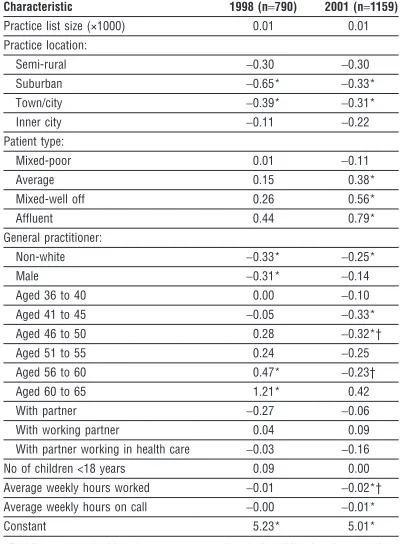
Thus, the increase in the proportions intending to quit is due to changes in the values of the variables, not their effects. As table 2 shows, there was an increase in the proportion of ethnic minority doctors and in the mean age of doctors and a reduction in job satisfaction. Table 4 shows the ordinary least squares regression coefficients of overall job satisfaction on doctors’ personal and practice characteristics. The results from the ordered logit regression were qualitatively very similar and are not reported. In 1998, higher job satis-faction was associated with a rural practice location, being white, female, older, and without children under 18 years of age. In 2001, the picture was slightly differ-ent. Higher job satisfaction was associated with serving populations with low deprivation, working fewer hours, and being white and young. Only the coefficients for working hours and age were significantly different between years, suggesting that their relation to job sat-isfaction had changed over time. No other significant differences in the coefficients were found, showing that the factors affecting job satisfaction were broadly simi-lar in 1998 and 2001.
Table 1 Proportions of general practitioners intending to quit direct patient care by age, 1998 and 2001
Age (years)
1998 survey 2001 survey
No of doctors
No (%) intending to quit
No of doctors
No (%) intending to quit
<35 113 4 (4) 151 9 (6)
36 to 40 187 8 (4) 242 22 (9)
41 to 45 195 18 (9) 275 30 (11)
46 to 50 125 9 (7) 208 31 (15)
51 to 55 102 28 (27) 194 87 (45)
56 to 60 53 34 (64) 76 66 (87)
60 to 65 15 12 (80) 13 9 (69)
[image:3.612.64.337.488.739.2]All ages 790 113 (14) 1159 254 (22)
Table 2 Characteristics of practices and general practitioners in 1998 and 2001 surveys. Values are numbers (percentages) of doctors unless stated otherwise
1998 (n=790) 2001 (n=1159) Mean (SD) overall job satisfaction 4.64 (1.26) 3.96 (1.41) Mean (SD) practice list size 8814 (4249) 8704 (4231) Practice location:
Rural 75 (9.5) 98 (8.5)
Semi-rural 201 (25.4) 276 (23.8)
Suburban 209 (26.5) 299 (25.8)
Town/city 226 (28.6) 348 (30.0)
Inner city 79 (10.0) 138 (11.9)
Patient type:
Deprived 31 (3.9) 75 (6.5)
Mixed-poor 168 (21.3) 285 (24.6)
Average 360 (45.6) 482 (41.6)
Mixed-well off 216 (27.3) 302 (26.0)
Affluent 15 (1.9) 15 (1.3)
General practitioner characteristics:
Non-white 88 (11.1) 156 (13.5)
Male 543 (68.7) 818 (70.6)
Mean (SD) age (years) 43.75 (7.60) 44.35 (7.55) With partner/spouse 726 (91.9) 1054 (90.9) With working partner 521 (73.3) 825 (71.2) With partner working in health care 354 (44.8) 519 (44.8) Median (interquartile range) No of children aged
<18 years
2 (0-2) 2 (0-2)
Median (interquartile range) hours worked/week 45 (39-50) 48 (40-55) Median (interquartile range) hours on call/week 11.5 (6-20) 10 (6-18)
Discussion
The proportion of general practitioners intending to quit direct patient care in the next five years rose from 14% in 1998 to 22% in 2001. Our findings suggest that the most important factors associated with intention to quit in both 1998 and 2001 were increased age, job dissatisfaction, having no children under 18 years of age, and ethnic minority status. Doctors’ other personal and practice characteristics had no significant effect. There were no significant differences between years in the regression coefficients, suggesting that the factors affecting intentions to quit were broadly similar in 1998 and 2001. Hence, the increase in intentions to quit was due to the fall in job satisfaction and a slight increase in the proportion of non-white doctors and in the average age of doctors.
The high proportion of general practitioners intending to retire early is likely to be a source for con-cern to the NHS but at least partly reflects wider soci-etal trends.4 5 The relative affluence of doctors may
enable those who want to quit work to act on this wish, and the greater financial demands placed on those with young children may be one reason why such doc-tors were less likely than others to intend leaving. The finding that increased job dissatisfaction was associated with an increase in intentions to quit accords with pre-vious research.5 6 8Unlike other factors affecting
inten-tions to quit, job dissatisfaction is potentially amenable to policy intervention.
Job satisfaction
Job satisfaction was related to several personal and practice characteristics. Longer reported working
hours were associated with lower levels of satisfaction. This is consistent with previous research suggesting that high workload is the principal source of job related discontent among British doctors, including general practitioners.8 9As in previous research, men
generally experienced higher levels of job dissatisfac-tion than women.8Our findings also show that ethnic
minority doctors and those serving urban and deprived populations may experience lower job satisfaction.
Doctors’ personal and practice characteristics, how-ever, explained only a small part of the overall variance in job satisfaction. This suggests that the principal causes of general practitioner discontent lie within the wider environment. The organisation and governance of general practice has greatly changed in recent years, and doctors may be experiencing difficulty in adapting to these changes. Previous large scale reorganisation of British general practice in 1990 provoked widespread discontent, and dislike of NHS reforms has been cited by many doctors as a reason for quitting practice.8 10
Job dissatisfaction among general practitioners may additionally reflect a more global discontent of doctors with their changing role in society.11 Strategies for
improving satisfaction and hence retention require better alignment of employers’ expectations and job characteristics with doctors’ job aspirations.11 12
Reliability of results
[image:4.612.65.264.87.370.2]The results need to be treated cautiously as doctors’ intentions to quit may not translate into action. However, other research has shown that there is a strong association between intention to quit and actu-ally quitting, with typical correlations of 0.50.13If as few
Table 3 Logistic regression of intention to quit direct patient care in 1998 and 2001 surveys
Characteristic 1998 (n=790) 2001 (n=1159) Overall job satisfaction −0.54* −0.70* Practice list size (×1000) 0.01 −0.04 Practice location:
Semi-rural −0.34 0.03
Suburban −0.05 −0.37
Town/city 0.34 −0.23
Inner city 0.37 −0.03
Patient type:
Mixed-poor 0.07 −0.01
Average −0.35 0.06
Mixed-well off −0.69 0.06
Affluent 0.50 −0.92
General practitioner:
Non-white 0.21 0.59*
Male −0.03 0.01
Aged 36 to 40 0.34 0.51
Aged 41 to 45 1.39* 0.56
Aged 46 to 50 1.07 0.81
Aged 51 to 55 2.34* 2.42*
Aged 56 to 60 4.19* 4.84*
Aged 60 to 65 5.26* 3.93*
With partner 1.04 0.30
With working partner −0.43 0.13 With partner working in health care 0.02 −0.30 No of children <18 years −0.38* −0.19* Average weekly hours worked −0.02 −0.00 Average weekly hours on call −0.00 −0.01
Constant −0.32 0.41
*P<0.05 compared with reference category of a single, white, female general practitioner aged<35, located in a rural practice with deprived patients.
Table 4 Regression of overall job satisfaction on doctors’ personal and practice characteristics
Characteristic 1998 (n=790) 2001 (n=1159) Practice list size (×1000) 0.01 0.01 Practice location:
Semi-rural −0.30 −0.30
Suburban −0.65* −0.33*
Town/city −0.39* −0.31*
Inner city −0.11 −0.22
Patient type:
Mixed-poor 0.01 −0.11
Average 0.15 0.38*
Mixed-well off 0.26 0.56*
Affluent 0.44 0.79*
General practitioner:
Non-white −0.33* −0.25*
Male −0.31* −0.14
Aged 36 to 40 0.00 −0.10
Aged 41 to 45 −0.05 −0.33*
Aged 46 to 50 0.28 −0.32*†
Aged 51 to 55 0.24 −0.25
Aged 56 to 60 0.47* −0.23†
Aged 60 to 65 1.21* 0.42
With partner −0.27 −0.06
With working partner 0.04 0.09 With partner working in health care −0.03 −0.16 No of children <18 years 0.09 0.00 Average weekly hours worked −0.01 −0.02*† Average weekly hours on call −0.00 −0.01*
Constant 5.23* 5.01*
[image:4.612.276.477.445.717.2]as half those reported here actually leave, this would still be cause for concern given the current shortage of general practitioners. A second limitation of the study was the omission of health status—a factor known to predict work effort and early retirement. Ill health is likely to explain early retirement in only a minority of cases and very unlikely to explain the marked increase in intentions to quit from 1998 to 2001. A third limita-tion is the low response rate, particularly in 1998. Responders may have been more dissatisfied with their jobs than non-responders, leading to exaggerated esti-mates of both dissatisfaction and intentions to quit. However, as the direction of any response bias is likely to have been the same in the two surveys, both the time trends and the relation between job satisfaction and intention to quit are unlikely to be artefacts. A final consideration is that, although doctors may leave direct patient care, they may remain actively involved in medicine through teaching, research, and clinical management.
Actions
Our findings point to the benefit of a greater focus on strategies to enhance retention as part of the wider range of initiatives for increasing the workforce in
gen-eral practice. Job satisfaction is an important factor underlying intention to quit, and attention to this aspect of doctors’ working lives may help to increase the supply of general practitioners to the NHS.
We thank the general practitioners who participated in this research.
Contributors: BS participated in the study design and project management and drafted the article. CB was involved in data management and analysis. HG participated in the study design, supervised CB, and drafted the article. BS is the guarantor. Funding: The study forms part of the core research programme of the National Primary Care Research and Development Cen-tre, which is funded by the Department of Health. The views expressed are those of the authors and do not necessarily reflect those of the Department of Health.
Competing interests: None declared.
1 Taylor DH, Leese B. Recruitment, retention, and time commitment change of general practitioners in England and Wales 1990-4: a retrospective study.BMJ1997;314:1806-10.
2 Department of Health.The NHS plan. London: Department of Health, 2000.
3 Department of Health.Improving working lives. London: Department of Health, 2000.
4 Jacobs K, Kohli M, Rein M. The evolution of early exit: a comparative analysis of labour force participation patterns. In: Kohli M, Rein M, Gul-lemard AM, van Gunsteren H, eds.Time for retirement. Comparative studies of early exit from the labour force.Cambridge: Cambridge University Press, 1991.
5 Mein G, Martikainen P, Stanseld SA, Brunner EJ, Fuhrer R, Marmot MG. Predictors of early retirement in British civil servants. Age Ageing
2000;29:529-36.
6 Lichenstein RL. The job satisfaction and retention of physicians in organised settings: a literature review.Med Care Rev1984;41:139-79. 7 Warr P, Cook J, Wall T. Scales for the measurement of some work attitudes
and aspects of psychological well-being.J Occup Psychol1979;52:129-48. 8 Sibbald B, Enzer I, Cooper C, Rout U, Sutherland V. General practitioner job satisfaction in 1989, 1990 and 1999: lessons for the future.Fam Pract
2000;17:364-71.
9 Health Policy and Economic Research Unit.Work related stress among sen-ior doctors.London: British Medical Association, 2000.
10 Davidson JM, Lambert R, Parkhouse J, Evans J, Goldacre MJ. Retirement intentions of doctors who qualified in the United Kingdom in 1974: postal questionnaire survey.J Pub Health Med2001;23:323-8. 11 Edwards N, Kornacki MJ, Silverstein J. Unhappy doctors: what are the
causes and what can be done?BMJ2002;324:835-8.
12 Young R, Leese B, Sibbald B. Imbalances in the GP labour market in the UK: evidence from a postal survey and interviews with GP leavers.Work Employment Soc2002;15:699-719.
13 Steel RP, Ovalle NK. A review and meta-analysis of research on the rela-tionship between behavioural intentions and employee turnover.J Appl Psychol1984;69:673-86.
(Accepted 19 September 2002)
What is already known on this topic
Early retirement is one of the factors contributing to a shortage of general practitioners in the NHS
What this study adds
The proportion of general practitioners intending to quit direct patient care within five years rose from 14% in 1998 to 22% in 2001
A decrease in overall job satisfaction is the most important factor underlying this rise
Improving the quality of doctors’ working lives might help improve retention