This is a repository copy of Data Augmentation in the Bayesian Multivariate Probit Model.
White Rose Research Online URL for this paper:
http://eprints.whiterose.ac.uk/9887/
Monograph:
León-González, R. (2004) Data Augmentation in the Bayesian Multivariate Probit Model.
Working Paper. Department of Economics, University of Sheffield ISSN 1749-8368
Sheffield Economic Research Paper Series 2004001
Reuse
Unless indicated otherwise, fulltext items are protected by copyright with all rights reserved. The copyright exception in section 29 of the Copyright, Designs and Patents Act 1988 allows the making of a single copy solely for the purpose of non-commercial research or private study within the limits of fair dealing. The publisher or other rights-holder may allow further reproduction and re-use of this version - refer to the White Rose Research Online record for this item. Where records identify the publisher as the copyright holder, users can verify any specific terms of use on the publisher’s website.
Takedown
If you consider content in White Rose Research Online to be in breach of UK law, please notify us by
Sheffield Economic Research Paper Series
SERP Number:
2004001
Roberto León González
Data Augmentation in the Bayesian Multivariate Probit Model
January 2004
Department of Economics University of Sheffield 9 Mappin Street Sheffield S1 4DT
United Kingdom
Data Augmentation in the Bayesian Multivariate Probit
Model
∗
Roberto Le´
on Gonz´
alez
Department of Economics
University of Sheffield
January 2004
Abstract
This paper is concerned with the Bayesian estimation of a Multivariate Probit
model. In particular, this paper provides an algorithm that obtains draws with low
correlation much faster than a pure Gibbs sampling algorithm. The algorithm consists
in sampling some characteristics of slope and variance parameters marginally on the
latent data. Estimations with simulated datasets illustrate that the proposed algorithm
can be much faster than a pure Gibbs sampling algorithm. For some datasets, the
algorithm is also much faster than the efficient algorithm proposed by Liu and Wu
(1999) in the context of the univariate Probit model.
∗This paper was circulated before as part of the discussion paper 09/02 of the Department of Economics
1
Introduction.
Data augmentation (Tanner and Wong, 1988) was an important development in the
field of Markov Chain Monte Carlo algorithms. When it is combined with the pioneer
works of Metropolis et al. (1953) and Hastings (1970) it makes the Bayesian analysis
of more complex models possible. Data augmentation consists in regarding latent
and missing data as parameters to estimate. Although this introduces many more
parameters, the conditional densities became much easier to sample from.
Although data augmentation facilitates the design of an algorithm, convergence
might be slow due to high correlation between model parameters and latent data.
Large autocorrelations imply that the chain moves slowly along the parameter space.
Slow movement causes three types of problem. Firstly, a large number of iterations
is needed for the chain to converge. In addition, a large number of iterations will be
needed to obtain a representative sample of the posterior density. Furthermore, an
even larger number of iterations are needed to be able to determine whether the chain
has converged. A representative sample from the posterior density can be obtained
after the chain has traveled along the parameter space just once. However, evidence
of convergence requires that the chain has recovered the same region repeatedly. For
these reasons it is advised (e.g. Raftery and Lewis 1992, Gilks and Roberts 1995) that
when a chain is very slow an alternative algorithm must be designed.
The aim of this paper is to provide new tools to reduce the autocorrelations of the
chain and hence enhance the reliability of the calculations in the Bayesian Multivariate
Probit model. These strategies can potentially be applied to a wider range of Bayesian
models.
The algorithm proposed in this paper combines both the Gibbs sampling and the
Metropolis algorithm. Although data augmentation is used, some characteristics of
slope and variance parameters are updated marginally on the latent data. These
characteristics are sampled using a re-parameterisation of the posterior density.
Estimation with a simulated dataset shows that the proposed algorithm can produce
draws with low correlation much faster than a pure Gibbs sampling algorithm. In the
with the PX-DA algorithm designed by Liu and Wu (1999). It is shown that the
proposed algorithm substantially outperforms the PX-DA algorithm for some datasets.
The plan of the paper is as follows. Section 2 describes the Multivariate Probit
model and the prior density. Section 3.1 and 3.2 outline the proposed algorithm for
the Univariate and Multivariate Probit model, respectively. Section 4 uses simulated
data to illustrate the performance of the proposed algorithm in comparison with a pure
Gibbs sampling algorithm (Leon-Gonzalez, 2003) and the PX-DA algorithm (Liu and
Wu, 1999). Section 5 draws some conclusions.
2
The Multivariate Probit Model
The Multivariate Probit model can be described as follows. LetYi be a vector of zeros
and ones. Each componentyit of Yi is determined by a continuous unobserved latent
variabley∗
it generated according to the following process,
y∗
it=Xitβt+eit i= 1, ..., N t= 1, ..., T (1)
the vector ei = (ei1, ..., eiT)T is normally distributed with zero mean and covariance
matrix Σ = (σjk). The binary variable yit is equal to one if and only ifyit∗ ≥ 0, and
is equal to zero otherwise. Xit is a 1×kt vector of regressors and βt is a vector of
parameters.
The most common normalisation in the literature (e.g. Chib and Greenberg, 1998)
is to fix:
σ11=σ22=...=σT T = 1 (2)
However, with this normalisation Σ cannot be sampled directly from its conditional
density, and a Metropolis step is necessary (Chib and Greenberg, 1998). It is possible
to avoid this by following the normalisation restriction and the prior density proposed
by Leon-Gonzalez (2003). In this way, it is possible to sample Σ directly from its
conditional posterior, and hence it is possible to use a pure Gibbs sampling algorithm.
Thus, we use the following normalisation:
where σT T·12...(T−1) =V ar
³
eiT|ei(T−1), ..., ei1
´ .
Let the prior for Σ be an Inverted Wishart IWT (df0, K0) distribution conditional
to restriction (3). That is, the kernel of the prior for a matrix Σ that verifies restriction
(3) is:
|Σ|−df0/2
exp³−1/2tr³Σ−1K 0
´´
(4)
It can be shown that normalisation (3) is equivalent to fixing the diagonal elements
of the Cholesky decomposition of Σ equal to 1 (Leon-Gonzalez, 2003). Hence,
normalisation (3) guarantees that the matrix Σ is positive definite. Hence, no further
restriction holds on the parameters in Σ.
Let us assume that the vector of slope parameters nβ1T, β2T, ..., βTToT is a priori
independent of Σ and follows a normal density with meanβ0 and variance-covariance
matrixV0.
The conditional posterior of Σ given parameters β and latent data {y∗
it : t = 1, ... , T}Ti=1 is an inverted Wishart IWT (df, K) conditional to restriction (3). The
parameters of this inverted Wishart are df = df0 +N and K = K0 +PNi=1eieTi .
A draw from this density can be obtained with a simple algorithm (Leon-Gonzalez
2003).
Note that the MCMC sample from the posterior density under normalisation (3)
can be transformed to obtain a sample from the posterior of the parameters under
normalisation (2) (Leon-Gonzalez, 2003). Hence, the use of normalisation (3) in the
calculations does not preclude us from obtaining estimates according to restriction (2).
3
Data
Augmentation
in
the
Multivariate
Probit Model.
For simplicity in the exposition, we first focus in the case of the probit model, that is
3.1
The Univariate Probit.
The algorithm proposed in this section results from adding one step to the Gibbs
sampling algorithm. The additional step proposes a move of model parameters that is
carried out without conditioning on the latent data. In particular, slope parameters
are multiplied by a random factor, and this random factor is sampled marginally on
the latent data. The random factor is one variable from a re-parameterisation of the
model.
Assuming that there are k1 explanatory variables in the equation, let β1 =
(β11, ..., β1k1)
T, and consider the following re-parameterisation of the model,
β1 =
µ β11,
β12
β11
,β13 β11
, ...,β1k1 β11

=³β11, β12, ..., β1k1
´
y∗
i1 = Xi11β11+Xi12β12β11+Xi13β13β11+...+Xi1k1β1k1β11+ei1
The posterior distribution of β1, denoted by πM(.), is derived from the posterior
density ofβ1 (πM) in this way:
πM ³
β11, β12, ..., β1k1|Y1, ..., YN
´ =πM
³
β11, β12β11, ..., β1k1β11|Y1, ..., YN
´
|β11|k1−1
where¯¯¯βk1−1
11
¯ ¯
¯ is the Jacobian of the transformation. The proposed algorithm is:
Algorithm 1
Step 1: Sample ³β11, β12, ..., β1k1
´
conditional on (Y∗
1, ..., YN∗)
Step 2: Sample β11 conditional on
³
β12, ..., β1k1
´
Step 3: Sample (Y∗
1, ..., YN∗) conditional on ³
β11, β12, ..., β1k1
´
Note that Algorithm 1 is the same as a Gibbs algorithm, with an additional step
2. Hence, it is just a Gibbs sampling algorithm in which all slope parameters (of the
original parameterisation) might be multiplied by a random factor. Whenever a new
value is drawn in the second step, all slope parameters move in the same direction.
Step 2 accelerates the algorithm because it proposes a change of all parameters that is
unconditional on the latent data. Conditioning on latent data makes the parameters
move substantially more slowly.
The conditional distribution of (Y∗
1, ..., YN∗) is the same as in the algorithm proposed by Chib and Greenberg (1998). The vector ³β11, β12, ..., β1k1
´
generating (β11, β12, ..., β1k1) conditional on (Y1∗, ..., YN∗) and then transforming the
variables in this way: ³β11, β12, ..., β1k1
´
= (β11, β12/β11, ..., β1k1/β11).
The conditional distribution of β11 given
³
β12, ..., β1k1
´
does not have a standard
form. Hence, a metropolis step can be used to generateβ11. The proposal density for
the Metropolis step could be a normal with mean and variance equal to the Maximum
Likelihood estimation ofβ11. Alternatively,β11 can be generated with a random walk.
Step 2 can be repeated a number of times to increase the probability of accepting a
new value. A more detailed description of the algorithm can be found in the Appendix.
3.2
The Multivariate Case
The algorithm for the multivariate case proposed in this section adds T steps to the
Gibbs sampling algorithm. Each of these steps proposes to move slope and
variance-covariance parameters for one equation jointly and without conditioning on the latent
data for the corresponding equation. This move consists in multiplying the parameters
by a random factor. This random factor is a variable from a re-parameterisation of the
model and it is sampled marginally on the latent data.
Consider the following parameterisation of the multivariate probit model.
y∗
it=Xit1βt1+Xit2βt2βt1+Xit3βt3βt1+...+Xitktβtktβt1+eit t= 1, ..., T (5)
where:
βt = µ
βt1,
βt2
βt1
,βt3 βt1
, ...,βtkt
βt1

=³βt1, βt2, ..., βtkt
´
t= 1, ..., T
Σ2 = (σ12/(β11β21), σ13/(β11β31), ..., σ1T/(β11βT1)) = (σ12, σ13, ..., σ1T)
Σ3 = σ23/(β21β31), σ24/(β21β41), ..., σ2T/(β21βT1) = (σ23, σ24, ..., σ2T)
...
ΣT = σ(T−1)T/ ³
βT1β(T−1)1
´
=σ(T−1)T
With this parameterisation, the covariance matrix of (ei) is equal to:
Σ =
σ11 σ12β11β21 ... σ1Tβ11βT1
σ12β11β21 σ22 ... σ2Tβ21βT1
...
where (σ11, σ22, ..., σT T) are determined by normalization (3) (e.g. σ22 = 1 +
(σ12β11β21)2).
Let {(βt)n:t= 1, ..., T}, (Σ)n be the nth value of {βt:t= 1, ..., T}, Σ in the
proposed MCMC chain. The following algorithm describes how to obtain this value.
Algorithm 2.
Step 1: Sample ³β1, β2, ..., βT ´
conditional on (Y∗
1, ..., YN∗,Σ).
Step 2: Sample nΣt:t= 2, ..., T o
conditional on ³β1, β2, ..., βT, Y1∗, ..., YN∗ ´
Step 3: For t= 1, ..., T do:
• Generate βt1 conditional on {y∗ik:k6=t}i=1,...,N,
n
βtk :k6= 1 o
, nβj :j6=t o
,
n
Σt:t= 2, ..., T o
.
• Sample {y∗
it}i=1,...,N conditional on the most recent values of ³
β1, β2, ..., βT ´
,
n
Σt:t= 2, ..., T o
and {y∗
ik :k6=t} i=1,...,N
Step 4: Fix
(βt)n = (βt1, βt1βt2, ..., βt1βtkt) f or t= 1, ..., T
(Σ)n =
σ11 σ12β11β21 ... σ1Tβ11βT1
σ12β11β21 σ22 ... σ2Tβ21βT1
...
σ1Tβ11βT1 σ2Tβ21βT1 ... σT T
where (σ11, σ22, ..., σT T) are determined by normalization (3)
The first part of Step 3 uses a Metropolis step to update the slope parameters
and covariance terms (of the original parameterisation) jointly and marginally on the
latent data. It can be repeated several times to increase the likelihood of acceptance
of a new value. In the simulations of Section 4, the proposal density in the Metropolis
step is a random walk. Alternatively, it is possible to specify a normal density centered
on Maximum Likelihood estimates. These Maximum Likelihood estimates could be
obtained before the MCMC chain is started from separate estimation of the T equations
using univariate Probit models.
Step 1 is carried out by sampling first (β1, β2, ..., βT) as explained in Chib and
Greenberg (1998) and transforming the values to obtain³β1, β2, ..., βT ´
Step 2 is carried out by sampling first Σ and transforming the values to obtain n
Σt:t= 2, ..., T o
. The density of Σ is an inverted Wishart subject to restriction (3).
This density can be sampled directly (Leon-Gonzalez 2003).
The latent data in the second part of Step 3 are sampled as described by Chib and
Greenberg (1998): from truncated normals and according to equations (5) and (6).
4
Comparing
the
Performance
of
the
Algorithms.
4.1
Univariate Probit Model.
This section compares Algorithm 1 with a standard Gibbs Sampling algorithm and
the PX-DA algorithm (Liu and Wu, 1999). Algorithm 1 is implemented with step 2’
repeated 4 times. 8400 observations for seven explanatory variables were generated
independently from a standard normal distribution. Slope coefficients are:
β11= 1, β12= 2, β13= 0.5, β14=−0.2, β15=−1, β16= 0.8, β17= 0.8
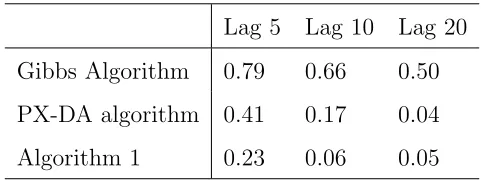
Table 4.1 shows the value of the highest correlation for lags 5, 10 and 20.
Auto-correlations in the chain are calculated using 29000 iterations after discarding the
first 1000 iterations. The initial value of parameters was equal to zero.
Auto-correlations in Algorithm 1 are the lowest, being less than half the autoAuto-correlations
in the PX-DA algorithm. In the Gibbs sampling algorithm, 80 lags are necessary
for the autocorrelations of all parameters to be below 0.1. The PX-DA algorithm
achieves the same with 20 lags. Algorithm 1 needs the lowest amount of lags, 10, for
all correlations to be below 0.1.
The highest correlation for all algorithms, except for Algorithm 1, correspond to
β12. As noted by Liu and Wu (1999), autocorrelations in the probit model increase
with the absolute value of the coefficients. In contrast, the autocorrelation of β12 in
Algorithm 1 is the lowest, and the highest correspond to parameter β14, that has the
Lag 5 Lag 10 Lag 20
Gibbs Algorithm 0.79 0.66 0.50
PX-DA algorithm 0.41 0.17 0.04
[image:11.595.185.427.79.170.2]Algorithm 1 0.23 0.06 0.05
Table 1: Maximum Autocorrelation of the Parameters
Large auto-correlations make it more difficult to determine whether the chain has
converged. With 29000 Gibbs sampling iterations, after discarding the first 1000
iterations, the Geweke test (1992) rejects the null hypothesis of convergence for 3
out of 7 parameters. With the same number of iterations, the test accepts the null
hypothesis of convergence of all the parameters in the other two algorithms.
The Gibbs algorithm and the PX-DA algorithm have similar computation
time. However, Algorithm 1 needs approximately double computing time with this
implementation. Taking this into account, Algorithm 1 produces 2 draws with
correlation smaller than 0.1 four times faster than a Gibbs Sampling algorithm.
However, there is almost no advantage over the PX-DA algorithm, since similar
values for correlations can be obtained with approximately the same computing time.
However, as the following example shows, when slope parameters have a larger value
the gains in autocorrelation clearly outweigh the losses in computation time.
A similar exercise is carried out, with the same number of observations, but letting
the value of the parameters be:
β11= 3, β12= 3, β13= 3, β14=−3, β15=−3, β16=−3, β17= 3
Table 2 shows the maximum autocorrelation of the parameters. The PX-DA
algorithm needs at least 50 lags for all autocorrelations to be below 0.1. Algorithm
1 has all autocorrelations below 0.1 with just 5 lags. Hence, the substantial gains
in smaller autocorrelations in Algorithm 1 more than compensate for the additional
computation time per iteration. That is, with this dataset Algorithm 1 obtains two
Lag 5 Lag 10 Lag 30 Lag 40 Lag 50
PX-DA Algorithm 0.76 0.57 0.23 0.15 0.07
[image:12.595.139.475.83.147.2]Algorithm 1 0.09 0.04 0.02 0.05 0.01
Table 2: Auto-correlations when parameters have a large value
4.2
Multivariate Probit Model.
This section compares the performance of Algorithm 2 with a standard Gibbs
algorithm. Two versions of Algorithm 2 are implemented: in one the first part of
step 3 is repeated 3 times (Algorithm 2a), and in the other it is carried out just once
(Algorithm 2b).
The data was generated according to the following random-effects type process:
y∗
it = 1∗x1i+ 2∗x2i+ 0.5∗x3i−0.2∗x4i−1∗x5i+ 0.8∗x6i +0.8∗x7i+ui+eit
i = 1, ...,1200 t= 1, ...,7
where (ei1, ..., eiT) follows aN(0, I),ui follows a N(0,1), and it is independent ofeit.
The regressors are invariant witht and are generated independently from a standard
normal distribution. The prior for the slope parameters is a normal distribution with
zero mean and covariance matrix equal to 10000I. The prior for the free parameters in
Σ is a restricted inverted Wishart withK0 =I and df0 = 2∗T+ 1 = 15.
Hence, in this specification, 49 slope parameters plus 21 covariance parameters are
estimated. For simplicity, only the autocorrelations of the 7 slope parameters in the first
equation and 7 covariance parameters are analysed. Autocorrelations are calculated
with 9000 iterations after discarding the first 1000.
Table 3 shows that autocorrelations for slope parameters vanishes more quickly in
Algorithm 2. From Table 4, the Gibbs sampling algorithm has at least one covariance
parameter with a correlation as high as 0.13 after 100 lags. In fact, the Gibbs algorithm
needed 120 lags for the maximum autocorrelation to be below 0.1. In contrast, in
Algorithms 2a and 2b the maximum correlation for covariance parameters vanishes
The computing time per iteration in Algorithm 2a and 2b is 2.6 and 1.9 times
larger than in the Gibbs algorithm, respectively. The gains in lower autocorrelations
more than compensate for the extra computing time, since the number of iterations
needed for the Gibbs autocorrelations to be below 0.1 is about 4 and 3 times the
number of iterations needed in Algorithm 2a and 2b, respectively. In addition, unlike
the Gibbs Sampling algorithm, the chains produced by Algorithm 2a and 2b passed
the convergence test proposed by Heidelberg et al. (1983), hence further increasing the
reliability of the calculations.
Lag 10 Lag 20 Lag 30 Lag 40 Lag 50 Lag 100
Gibbs Algorithm 0.54 0.40 0.34 0.29 0.23 0.13
Algorithm 2a 0.29 0.13 0.08 0.04 0.04 0.007
[image:13.595.112.500.253.340.2]Algorithm 2b 0.44 0.23 0.12 0.08 0.06 0.004
Table 3: Autocorrelations for covariance parameters
5
Conclusions
The motivation underlying the algorithms proposed in this paper is that a pure
Gibbs sampling algorithm moves slowly due to sampling separately variables that are
highly correlated. For this reason, the algorithms in this paper propose to sample
characteristics of model parameters not conditioning on the latent data. This is
Lag 10 Lag 20 Lag 30 Lag 40 Lag 50
Gibbs Algorithm 0.57 0.37 0.28 0.20 0.13
Algorithm 2a 0.33 0.17 0.09 0.06 0.04
Algorithm 2b 0.43 0.24 0.15 0.09 0.04
[image:13.595.141.474.574.661.2]achieved by sampling from a re-parameterisation of the model. In this way, parameters
in the original parameterisation are updated marginally on the latent data.
Using simulated data, the previous section shows that Algorithm 2 can produce
two draws with low correlation faster than a pure Gibbs sampling algorithm. In the
simpler case of the univariate Probit model, the proposed Algorithm 1 was compared
with the efficient algorithm proposed by Liu and Wu (1999). It was shown that for
some datasets Algorithm 1 is substantially much faster.
The type of re-parameterisations considered in this paper facilitates the updating
of large numbers of parameters jointly and marginally on the latent data. This is
potentially applicable to many models with complex likelihoods, where conventional
Appendix
Let ³βn
11, β12n, ..., βn1k1
´
denote the nth value of (β
11, β12, ..., β1k1) in the chain. If a random walk is used, the algorithm to generate the (n+1)th value of (β11, β12, ..., β1k1)
is:
Algorithm 1
Step 1. Sample (β11, β12, ..., β1k1) from a N(µp, Vp), where µp =
Vp³PNi=1XiT1Yi∗+V0−1β0
´
, and Vp=³PNi=1XiT1Xi1+V0−1
´−1
.
Step 2. Fix ³β12, ..., β1k1
´
= (β12/β11, ..., β1k1/β11). Generate a random scalar v
from a distribution with density function f(v). Fix
β11n+1 =vβ11, β12n+1 =vβ11β12, ..., β1nk+11 =vβ11β1k1
with probability
γ = min
½L(Y|vβ
11, vβ12, ..., vβ1k1)π(vβ11, vβ12, ..., vβ1k1) L(Y|β11, β12, ..., β1k1)π(β11, β12, ..., β1k1)
f(1/v) f(v)
¯ ¯ ¯vk1¯¯
¯,1 ¾
and fix
βn11+1 =β11, β12n+1=β11β12, ..., β1nk+11 =β11β1k1
with probability (1−γ), where L(Y|β11, β12, ..., β1k1) is the likelihood function:
L(Y|β1) =
N Y
i=1
³
Φ (−Xi1β1)1−Yi(1−Φ (−Xi1β1))Yi
´
and π(β11, β12, ..., β1k1) is the prior density.
Step 3. Sample Y∗
i from a truncated
N³Xi11β11n+1+Xi12βn12+1+...+Xi1k1β
n+1 1k1 ,1
´
for all i= 1, ..., N.
Step 2 of the algorithm can be repeated a number of times to increase the likelihood
of acceptance of a new value.
The functionf(v) might be centred at 1, so that new candidates are drawn from a
to positive values, hence forcing new candidates to have the same sign as the previous
value. An inverted gamma would play this role.
Alternatively, the Metropolis step could use a normal density calibrated with the
Maximum Likelihood estimates of β11. If φN ³
x;βd11,sdd1
´
is the density function of
a N³dβ11,sdd1
´
centered at the maximum likelihood estimates, then Step 2 can be
implemented as:
• Step 2’. Fix ³β12, ..., β1k1
´
= (β12/β11, ..., β1k1/β11). Generate a random scalar
v from a distribution with density function φN ³
v;dβ11,sdd1
´
. Fix
β11n+1=v, βn12+1 =vβ12, ..., βn1k+11 =vβ1k1
with probability
γ′ = min
1,
L³Y|v, vβ12, ..., vβ1k1
´
π³v, vβ12, ..., vβ1k1
´
L(Y|β11, β12, ..., β1k1)π(β11, β12, ..., β1k1) φN
³ βn
11;βd11,sdd1
´
φN ³
v;βd11,sdd1
´ × ¯ ¯ ¯ ¯ ¯ µ v β11
¶k1−1¯¯
¯ ¯ ¯ )
and fix
β11n+1 =β11, βn12+1 =β11β12, ..., β1nk+11 =β11β1k1
References
Chib., S. and Greenberg, E. (1998) ”Analysis of Multivariate Probit Models,”
Biometrika 85, 347-361.
Geweke, J., (1992) ”Evaluating the Accuracy of Sampling-Based Approaches to the
Calculation of Posterior Moments,” inBayesian Statistics, 4 (ed. J. M. Bernardo,
J. Berger, A. P. Dawid, and A. F. M. Smith) Oxford University Press, Oxford,
169-193.
Gilks, W. R., and Roberts, G. O. (1995) ”Strategies for improving MCMC,” In
Markov Chain Monte Carlo in Practice, (ed. W.R. Gilks, S. Richardson and
D.j. Spiegelhalter) Oxford University Press, Oxford, 89-114.
Hastings, W. K., (1970) ”Monte Carlo sampling methods using Markov chains and
their applications,”Biometrika, 57, 97-109.
Heidelberg, P., and Welch, P. D. (1983) ”Simulation Run Length Control in the
Presence of and Initial Transient,”Operations Research, 31, 1109-1144.
Leon-Gonzalez, R. (2003) ”Sampling the Variance-Covariance Matrix in the Bayesian
Multivariate Probit Model,” Discussion Paper SERP2003008, Department of
Economics, University of Sheffield
Liu, J. S., and Wu, Y. N., (1999) ”Parameter Expansion for Data Augmentation,”
Journal of the American Statistical Association, 94, 448, 1264-1274.
Metropolis, N., Rosenbluth, A. W., Rosenbluth, M. N., Teller, A. H. and Teller, E.
(1953) ”Equation of state calculations by fast computing machine,” Journal of
Chemical Physics 21, 1087-91.
Raftery, A. L. and Lewis, S. (1992) ”How many iterations in the Gibbs sampler?,” In
Bayesian Statistics 4, (ed. J. M. Bernardo, J. O. Berger, A. P. Dawid, and A. F.
M. Smith), 763-74. Oxford University Press, Oxford.
Tanner, T. A., and Wong, W. H. (1988) ”The Calculation of Posterior Distributions
by Data Augmentation,”Journal of the American Statistical Association 82,