White Rose Research Online URL for this paper:
http://eprints.whiterose.ac.uk/84642/
Version: Accepted Version
Article:
Wadud, Z Decomposing the drivers of aviation fuel demand using simultaneous equation
models. Energy, 83. 551 - 559. ISSN 0360-5442
https://doi.org/10.1016/j.energy.2015.02.061
[email protected] https://eprints.whiterose.ac.uk/ Reuse
Unless indicated otherwise, fulltext items are protected by copyright with all rights reserved. The copyright exception in section 29 of the Copyright, Designs and Patents Act 1988 allows the making of a single copy solely for the purpose of non-commercial research or private study within the limits of fair dealing. The publisher or other rights-holder may allow further reproduction and re-use of this version - refer to the White Rose Research Online record for this item. Where records identify the publisher as the copyright holder, users can verify any specific terms of use on the publisher’s website.
Takedown
If you consider content in White Rose Research Online to be in breach of UK law, please notify us by
Decomposing the drivers of aviation fuel demand using simultaneous equation models
Zia Wadud
Centre for Integrated Energy Research University of Leeds, LS2 9JT
+44(0)113 343 7733
This is the accepted manuscript, there could still be minor changes in the finally published version
Decomposing the drivers of aviation fuel demand using simultaneous equation models
Abstract
Decomposition analysis is a widely used technique in energy analysis, whereby the growth in energy demand is attributed to different components. In this paper the decomposition analysis is extended in a system econometric modelling framework in order to understand the drivers of each of the components in the decomposition analysis. The growth in aviation fuel demand is decomposed into five components: population, passenger per capita, distances per passenger, load factor and fuel efficiency, and then seemingly unrelated regression methods is applied in order to model each of these. Results show that the fuel demand in the US air transport sector most closely follows the trend of passenger per capita. The growth in fuel demand is slowed by improvements in fuel efficiency and usage efficiency (load factor). Increases in income affects both passengers per capita and distances per passenger. However, increases in travel costs have opposite effects on passenger per capita (decreases) and distance per passenger (increases). Increases in jet fuel prices improves both the load factor and fuel efficiency.
Keywords
Fuel demand, aviation, decomposition analysis, econometric model, simultaneous equation model
1. Introduction
Aviation is responsible for a modest 2% of all anthropogenic carbon emissions and around 5% of global radiative forcing (Owen et al. 2010). Yet demand for global passenger and cargo transport by air and subsequent demand for aviation fuel and carbon emissions have been growing at a higher rate compared to other economic sectors. Even in as mature a market as the US, which accounts for almost 40% of global aviation carbon emissions, carbon emissions are set to quadruple in absolute terms by 2050 (McCollum et al. 2009). However, due to a lack of alternate energy carriers to power aircrafts, liquid fuel remains the only viable aviation fuel and the carbon mitigation options often boil down to reduction in fossil fuel use through technological means or replacement of fossil fuels by renewable biofuels (McCollum et al. 2009). For both of these options, demand for aviation fuel is an important metric for mitigation planning and policy making. At the same time, fuel costs
In the aviation sector, fuel demand is often modelled using hybrid econometric-engineering models. Aggregate econometric methods are used to model or forecast demand, which may or may not be divided among different travel segments (e.g. business vs. leisure, short haul vs. long haul etc.). Projected aggregate demand in passenger or passenger-mile is then allocated to different aircraft types or sizes to determine aircraft-miles and number of aircrafts. An engineering-economic fleet turnover model along with technologies available (or projected) is then used to determine the fleet fuel efficiency and overall fuel consumption. Details vary, but models used by EIA (2013) for USA, DfT (2013) for UK or Owen et al. (2010) for global aviation fuel demand and carbon emissions all follow the same hybrid modelling approach. These models are quite data intensive, and are particularly useful to simulate the effects of new technologies on aggregate fuel consumption or carbon emissions, yet the feedback loop from technology to demand is often absent, making them less useful to understand the effects of some of the demand drivers or policy initiatives.
On the other hand, decomposition analysis is a retrospective modelling approach: the method decomposes energy consumption in an economy into various component elements and seeks to explain the co-evolution of energy demand and these components on a temporal scale. In aviation, Andreoni and Galmarini (2012) have recently applied the method directly to analyze the evolution of air transport fuel use in the European Union, while Schafer et al. (2009) also implicitly follow the decomposition framework to explain historical determinants of aviation fuel use. The advantage of the decomposition method is that it reveals the relative effect of the components on aviation fuel demand. These components often include items like energy intensity of the sector, the contribution of the sector to overall economy, the economic growth, etc. However, traditional decomposition analysis stops at explaining energy demand at the component level and any understanding of the drivers of these individual components are often qualitative in nature. For example, a decomposition analysis will be able to allocate the growth in aviation fuel demand due to a growth in activity (travel), but it cannot explain the factors that leads to the growth in activity. On the other hand, policy tools generally address the drivers instead of the components directly. For example, policies cannot directly target the number of passengers flying (unless by rationing), but would rather use taxes or duties to affect the demand and thus energy consumption. Therefore it is important to understand the quantitative impacts of the drivers of these components which gives a more comprehensive picture of the underlying factors affecting aviation energy consumption.
equation framework. To the author's knowledge, such an approach has not been applied in the area of energy decomposition or aviation fuel demand before. The paper is laid out as follows: section 2 describes the decomposition techniques, applies it to aviation fuel consumption in the US and presents the findings of decomposition analysis. Section 3 presents the simultaneous equation modelling approach to each of the decomposed components of section 2, presents the econometric detail and results. Section 4 links the decomposition analysis with the econometric model while section 5 concludes.
2. Decomposition Analysis
2.1 Brief literature review
Index Decomposition Analysis (IDA) is a widely used technique to separate out the impacts of structural change (changes in the mix of economic sectors, modes of transport etc.) and energy intensity/efficiency change in an economy. The technique, in various formats, is applied in national energy efficiency monitoring in several countries such as the US, the UK and New Zealand. Although primarily used for understanding the aggregate energy consumption or carbon emissions of an economy, the method has been applied to individual sectors or subsectors of the economy as well. For example, Ang and Xu (2012) applied the technique for industrial energy demand in Canada, while Nie and Kemp (2004) used it for residential energy demand in China. In the transportation sector, Timilsina and Shrestha (2009) used decomposition analysis for the entire transport energy use in 12 countries in Asia, while Kveiborg and Fosgerau (2007) applied it to the energy used in road freight in Denmark.
The indices used for IDA can be divided into two major types - Divisia and Laspeyer - with several variations possible under each type. Laspeyer-type indices have an easier interpretation as they are based on simple per cent changes. The impact of a specific component is determined by changing that component, while keeping others constant. On the other hand, Divisia indices, first introduced by Boyd et al. (1987), are based on logarithmic changes and offer some theoretical advantages over Laspeyer indices. These include a complete decomposition with no residuals and the symmetry of the indices (Ang, 2004). Therefore Divisia indices are used more in recent literature. Among the different Divisia indices Ang (2004) recommends the use of Log Mean Divisia Index type I (LMDI-I). A description of different indices used IDA and there advantages and disadvantages are available in Ang (2004).
is analyzed. This simplified approach is a multiplicative Divisia method in essence but is often known in other popular names such as the KAYA method or ASIF method. The multiplicative Divisia
approach dominates the decomposition analysis in transport energy or transport carbon emissions, although additive decomposition methods can be found occasionally too (e.g. Timilsina and
Shrestha, 2009 for carbon analysis).
So far, the only study that explicitly apply the IDA technique for energy or carbon emissions in aviation is Andreoni and Galmarini (2012), who conduct the analysis for several European Union countries (and the European Union as a whole) for the period 2001-2008. That analysis was carried out using the Laspeyer type index, and it is not clear why such a choice was made, given the superiority of Divisia type indices and their dominance in recent literature. The time period used is also quite small and misses the growth in aviation demand and thus aviation carbon emissions pre-2001, or the reduction during the recession post-2008.
2.2 Decomposition of aviation fuel demand
The first stage of any decomposition analysis is to select the decomposition components and the identity structure. There is no precise scientific rule governing the choice of the components and often policy relevance, research questions and data availability dictates this choice. A larger number of components generally allow a better understanding of the evolution of fuel demand, however too many components can lead to a difficulty in interpretation. The only previous work on decomposing aviation fuel consumption by Andreoni and Galmarini (2012) used three components: total GDP in a country, contribution of aviation to total GDP and energy intensity of aviation industry output
MJ H egated and detailed
understanding of the components and their drivers - especially drivers that can be addressed by policy tools (such as income or price) to influence energy demand. Thus, aviation's fuel consumption has been decomposed into the following five components:
(1)
Each of the five components on the right hand side is directly measurable or computable and has a physical meaning. The first three items together generates the traditional measure of demand in aviation: revenue passenger miles (RPM). However, decomposing the revenue passenger miles into three components allows us to understand the impact of each of these three components on
passenger miles to available seat miles, whereas technical efficiency is expressed as fuel required per available seat mile. The advantage of these five components over a traditional GDP based decomposition of Andreoni and Galmarini (2012) is that these have useful meanings in transport literature as well. Especially, the chosen components are able to link travel and energy consumption together, which was missing in a GDP based decomposition. Linking air travel to energy consumption is also important since the energy consumption is a direct result of air travel.Eq. 1 is derived from the following identity relationship, which also provides the definition of the five components:
(2)
Note that this decomposition is a little different from traditional decomposition analysis where many of the efficiency or activity components are expressed in relation to GDP. In an additive
decomposition, the absolute change in aviation fuel consumption is attributed to the different components in an additive format as follows:
(3)
where, and and so on.
Subscript 0 refers to the base year, whereas t refers to the year for which the analysis is being
undertaken. The logarithmic differences in fuel and population makes it an LMDI-I decomposition. The multiplicative LMDI decomposition is fairly straight forward as only one sector - passenger aviation - is considered here. The multiplicative decomposition is a direct extension of the identity in Eq. (1):
(4)
2.3 Data
The primary source of data for the analysis is Bureau of Transport Statistics (BTS). Annual revenue passenger miles, revenue passenger enplanement and available seat mile for US carriers from 1979 to 2012 are collected from T1 schedule of BTS. US annual average domestic airfare and yield per mile are collected from Airlines for America (2014), which in turn sources its data from BTS T100 ticket prices. Disposable income per capita and population data are from National Income and Product Account of Bureau of Economic Analysis (BEA 2014). Airfare, yield and disposable income per capita
US B L S C P
Index (CPI-All urban). Load factor was calculated as the ratio of revenue passenger miles to available seat miles. Annual fuel consumption by US air carriers was obtained from the Transportation Energy Data Book (Davies et al. 2013). However, this fuel consumption data is for both passenger and freight aircrafts and disaggregated data for passenger and freight aircrafts are available only for recent years. Around 90% of the fuel consumption is by the passenger aircrafts, therefore fuel per available seat mile is overestimated by around 10% in this study if it is assumed that the trend of efficiency will be the same for passenger and freight aircrafts.
2.4 Decomposition results
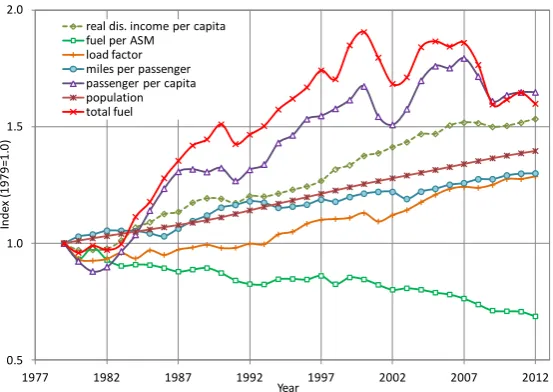
Fig. 1 presents the evolution of passenger aviation fuel consumption for US carriers, along with the five decomposition components and real disposable income per capita. The curves have all been normalized with respect to each variable's 1979 values. In 1979 the fuel consumption for US air passenger carriers was 10.7 billion gallons. Jet fuel consumption peaked in 2000 at 20.4 billion gallons, which was almost double that of 1979 consumption, but has since fallen to 17.1 billion gallons by 2012. This represents around 60% increase in fuel consumption between 1979 and 2012.
Fig. 1 reveals that fuel consumption most closely tracks the series of passenger per capita. This does not necessarily mean that the number of passengers has more influence on fuel consumption since
all five components of the decomposition analysis have equal influence on fuel consumption (in economics terms, the elasticity of fuel consumption with respect to any of the five components is 1). Therefore the close coupling of fuel demand with passenger per capita is rather the result of
relatively large fluctuations in passengers per capita during the period.
30% between 1979 and 2012. Increases in population, passengers per capita and miles per passenger contributed toward an increase in fuel demand.
Fig. 1 Indexed evolution of fuel consumption and its components for US passenger air transport
The increasing trend in fuel consumption is countered by substantial improvements in load factor and fuel efficiency. Between 1979 and 2012, the average load factor on US air carriers have
improved by 28%, while the fuel consumption per available seat-mile has improved (i.e. decreased) by 32%. These operational and technical improvements had substantial influence in slowing the growth in jet fuel consumption. The improved load factor is not only a result of higher passenger demand (thus allowing existing aircraft to fill) but also of air travel liberalization, availability of more aircrafts of different sizes, improvements in airlines' fleet assignment capabilities, pricing
management through the internet, etc. (Schafer et al. 2009). Improvement in fuel consumption per available seat mile is generally a result of improved engine efficiency, larger aircrafts flying longer stages and other operational improvements.
Discussions on the changes between two end points of 1979 and 2012 miss important subtle differences in periods in between. Therefore the study time period is divided into 5-year bands backward from 2012.1 Both an additive and multiplicative decomposition analysis are then carried out for each 5-year band, the results of which are presented in Figs. 2 and 3. In additive
decomposition the absolute difference in fuel consumption is decomposed into five components, while in multiplicative decomposition it is the ratio that is of interest. The additive decomposition in Fig. 2 presents the changes in fuel consumption (the diamond markers) during the time bands, and the contribution of the different components (the colour-coded or patterned columns) to these
1
Therefore the first band is a 3-year one 1979-1982. 0.5
1.0 1.5 2.0
1977 1982 1987 1992 1997 2002 2007 2012
In d e x (1 9 7 9 = 1 .0 ) Year real dis. income per capita
changes. For example, the 4 billion gallons increase in fuel consumption during 1982-1987 is a result of increases due to a growth in population (0.5 billion gallons), passengers per capita (4.6 billion gallons) and miles per passenger (0.1 billion gallons) and of reductions due to improved load factor (0.5 billion gallons) and fuel efficiency (0.7 billion gallons). Note that the sum of effects of
population, passengers per capita and miles per passenger (i.e. 5.2 billion gallons) is the total effect of increases in overall revenue passenger miles on fuel demand. Fig. 3 presents the results of multiplicative decomposition in a spider-diagram, as suggested by Ang (2005), whereby the growths in different components for each time-band are presented as ratios with respect to the values at the initial period of that time-band.2
[image:10.595.74.339.474.671.2]The additive decomposition reveals the differences in relative importance of the five components during the selected time periods. The two components which showed consistent growth during all time bands are population and miles per passenger. Passengers per capita showed cycles of increases and decreases: it increased substantially during 1982-1987, 1992-1997 and 2002-2007, marginally during 1987-1992, and reduced during the rest of the time bands. The passenger per capita largely traced that of income, except during 1997-2002 when income was still rising, but air passenger demand was adversely hit by the 9-11 terrorist attacks. Passenger growth was the largest during 1982-1987 (Figs. 2-3), which was not only due to robust growth of the economy during that period but also possibly due to the slightly delayed effects of airline deregulation in the US, which made air travel more accessible and affordable.
Fig. 2. Additive decomposition of fuel demand for US passenger air transport
2
Note that we present inverse of load factor since an increase in load factor reduces fuel consumption. -6 -4 -2 0 2 4 6
1979-1982 1982-1987 1987-1992 1992-1997 1997-2002 2002-2007 2007-2012
C h a n g e s in f u e l co n su m p ti o n ( B il li o n g a ll o n s) Time period fuel per ASM
Growth in passengers per capita was the primary driver to changes in fuel demand during four of the seven time periods. Improvements in technical efficiency (1997-2002 and 2007-2012) and increases in miles per passenger (1987-1992) were the primary drivers for the other three periods. The decomposition charts hint at an interesting phenomenon: it appears that when the contribution from passenger per capita falls, demand due to increased miles per passenger increases. Although the effects of increases in miles per passenger on fuel consumption generally cannot overturn the effects of decreasing passenger number during the years they have opposite signs, in 1997-2002 it was different: increases in miles per passenger substantially increased fuel demand so as to wipe out the effects of reduced passenger numbers. This opposite correlation between miles per passenger and number of passengers is further investigated in the econometric modelling section.
Fig. 3 Multiplicative decomposition of fuel demand for US passenger air transport
3. Econometric Modelling
3.1 Brief description
Unlike decomposition modelling, econometric models use statistical techniques to reveal the relationship between a dependent variable and various explanatory factors. Modelling demand by econometric methods is fairly standard for petrol or diesel consumption in the road transport sector and there is an abundance of studies in this area. These models represent petrol, diesel or oil demand as a function of income, fuel price and a host of other explanatory variables and quantifies the relationship between fuel demand and these explanatory factors. However, in the area of aviation fuel demand the application of econometric modelling technique is generally limited to passenger demand or travel demand (revenue passenger miles), which then inform the hybrid engineering-economic models. This section describes how a structural econometric approach can be
0.8 1 1.2 1.4 population
miles per passenger
passenger per capita inverse load factor
fuel per ASM
used to inform the decomposition methods above to further enhance the understanding of aviation fuel demand.
Note that Eq. (1) is an identity; therefore, no econometric estimation is necessary in order to determine the quantitative relationship of aviation fuel demand with any of the right hand side components. However, most of the right hand side components are intermediate drivers of aviation fuel consumption, and there are other independent factors that determine how these intermediate components, and thus how fuel demand evolves over time. Therefore each of the right hand side components, except population, is modelled using a simultaneous equation modelling framework.
3.2 Explanatory factors
The metric total revenue passenger miles has earlier been decomposed into three components: population, revenue passenger miles per capita and miles per passenger. Of these, population (POP) is exogenous and therefore not modelled further. Revenue passenger enplanement per capita (PPC) represents the propensity of people to travel by air: this is primarily a function of (financial) ability to travel, which is proxied by disposable income per capita (INC) following recent literature (Bhadra and Kee 2008, FAA 2012). In order to incorporate possible diminishing marginal effects of income, a squared income per capita variable is added. In addition, unemployment rate (UNEM) is included as another potential explanatory factor for PPC. Air fare (FARE) is the third explanatory factor as air travel decreases with an increase in real air fare as shown in prior studies (Wadud 2014, 2015). US annual average round trip domestic air fare is used to to represent this. Although the share of domestic and international travel changed over the years, the trend of air fare remains similar for domestic and international fare. In addition, the terrorist attacks in September, 2001 had a profound effect on US aviation growth, which is modelled via a dummy variable (D911). The most recent recession also hit the US air carriers substantially more than before, and another dummy (D0809) is added to account for this.
endogenous for air travel distances. Hence yield per mile (YLD) is chosen as an explanatory factor for average flying distances.
Average load factor (LF) represents how full an aircraft is during flying. This is a function of number of passengers (RPENP), which in turn depends on income (INC). Size of the aircraft (reflected by average number of seats per aircraft in operation, SEAT) is another important determinant of load factor as, for a given passenger number, larger aircrafts lead to a smaller load factor. Given the highly competitive nature of air passenger transport business, airlines have a strong incentive to reduce their costs and increasing load factor is an important way to reduce these costs. The
operating costs are proxied by jet fuel prices (JFP). In addition, air travel liberalization, availability of more aircrafts of different sizes, improvements in airlines' fleet assignment capabilities, pricing management through the internet etc. have all contributed to improved load factor over the years (Schafer et al. 2009). Since all of these factors had gradual impact in the businesses, a time trend (TIME) can be used to capture these additional factors. However, since income and time trend are very highly correlated - with a correlation coefficient of 0.989 - only income is used. Also, since 2001, there has been a number of mergers and bankruptcies among major US air carriers, which has led to substantial restructuring and consolidation of the airline industry, which is likely to have some effect on load factor. Therefore a dummy (D2001) is added for post 2001 time periods.
Technical efficiency (FSM) is expressed as fuel required for one available seat mile. This is the measure that reflects the technical progress made in new engines or new aircraft technologies or innovations in other operational procedures. Over the years engine and aircraft technologies have been improving (Peeters et al. 2005) and a time trend (TIME) is included to reflect this
improvement. As mentioned earlier, the fuel consumption variable includes the fuel consumption for the small share (<10%) of freight aircrafts and a change in that share also affects the FSM
variable. The time trend will capture that effect as well. There is an increasing return to scale with respect to aircraft size, as larger aircrafts are more fuel efficient on a per passenger basis. Therefore aircraft size (average number of seats per aircraft, SEAT) is our second explanatory factor. Jet fuel prices (JFP) is also included as an explanatory factor to reflect the external push toward more fuel efficiency.
3.3 Econometric model specification
variable or time trend). This is a widely used specification in many demand models and results in an elasticity which remains constant for different values of the dependent or explanatory variables. The specification also has the advantage of interpretation as the parameter estimates directly represent the corresponding elasticities (except for dummy variables and time trend).
Given our dataset is time series, an autoregressive dynamic modelling approach is applied, as opposed to a static one. In an autoregressive dynamic model, the time-lagged dependent variable is also included as an explanatory factor along with other explanatory factors. The econometric model specifications for the four decomposition components, thus are:
lnPPCt = 1+ 2lnPPCt-1+ 3lnINCt+ 4(lnINCt)2 + 5lnFAREt+ 6lnUNEMt+ 7D911t+ PPC,t (5)
lnMPPt 1+ 2lnMPPt-1+ 3lnINCt+ 4lnYLDt+ MPP,t (6)
lnLFt 1+ 2lnLFt-1+ 3lnINCt+ 4lnSEATt+ 5lnJFPt+ 6D2001t+ LF,t (7)
lnFSMt = 1+ 2lnFSMt-1+ 3lnSEATt+ 4lnJFPt+ 5TIMEt+ FSM,t (8)
where, the 's, 's, 's and 's are parameters to be estimated and represent the elasticities of the dependent components with respect to the relevant independent variables. The i,t's - where i=PPC,
MPP, LF and FSM - are the errors of the respective models, with the subscripts used to separate the errors of the different equations. Subscript t represents the period of the observation and t-1
represents the lagged observation.
3.4 Model estimation
As long as each of Eqs. 5-8 is independent of each other, they can be estimated separately. In such a case, each of the equations can be estimated by using ordinary least squares (OLS) technique if the errors are independent, serially uncorrelated and normally distributed. However, it is possible that these four equations are related to each other through their error terms. For example, load factor can be a direct function of the number of passengers, and although income is included in order to account for this, there could be other omitted variables that affect both of these (e.g. consistently bad weather over a year). In that case the errors in the two equations will not be independent of each other and will be correlated (i.e. for this specific example, E[ PPM,t LF,t T
of the four equations as a system allows the utilization of the full information potentially contained in the data as a whole and generally results in a more efficient estimation of the parameters as compared with OLS. Statistical tests can then be used to test if such cross-equation correlation among the errors exists or not.
In addition, time series data can be often non-stationary, i.e. their mean and variance do not remain constant over time. Regression of non-stationary variables can be spurious unless there exists at least one combination of the variables that is stationary. In such cases, the variables are said to be cointegrated and there exists a valid long-run relationship among the variables. Engle and Granger (1987) suggested that the OLS estimate of a static equation involving the cointegrating variables will be valid for the long-run relationship of the non-stationary variables (and stationary, if any) and it is a widely used technique in time-series multivariate econometrics. However, Hendry (1986) argued that such OLS estimation from the static models can leave substantial autocorrelation in the
residuals, and thus the inference on the parameter estimates can be misleading. Therefore, Banerjee et al. (1986) suggest that the long run parameters should be determined from a dynamic model. As long as the dynamics are specified such that the residuals are not autocorrelated, then the inference on the parameter estimates are valid, provided a long-run cointegrating relationship exists
(Patterson 2000). Our choice of a dynamic autoregressive model is therefore appropriate in this context, too. Whether -run relationship from the dynamic model is spurious or not is then tested.
3.5 Econometric modelling results
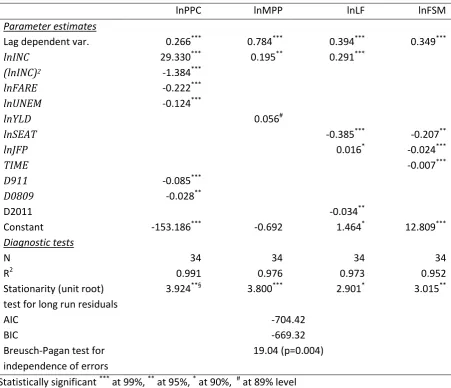
Table 1 presents the parameter estimates and relevant diagnostic tests in the SUR framework. For each individual equation one lagged dependent variable produces residuals without serial
correlation. Residuals of the 'implied' long run relationship for each equation show that there exists a valid cointegrating relationship in each equation, ensuring that the findings are not spurious. The Breusch-Pagan test for the presence no-cross correlation among the errors of the different
equations is rejected, justifying the use of SUR framework.3
All of the explanatory factors are statistically significant at 99% confidence level for passengers per capita. As expected, income has a positive effect and this effect decreases as income rises, which reveals the diminishing marginal effects of income on air passenger travel. The short run elasticity of
3
While Eqs. 5-8 are the chosen specifications, a number of alternate specifications are also estimated and tested against the chosen model. These alternate specifications include dropping squared INC and replacing
passengers per capita with respect to income is 0.78 at the mean income of the sample. A 10% increase in trip air fare reduces passenger per capita by 2.2% in the short run. Increases in
[image:16.595.74.526.210.598.2]unemployment rate also reduce passengers per capita. Both the dummies are statistically significant and negative, indicating a reduction in passengers per capita as a result of the 9-11 terrorist attacks and the additional effects of the recent recession.
Table 1. Parameter estimates using SUR
lnPPC lnMPP lnLF lnFSM
Parameter estimates
Lag dependent var. 0.266*** 0.784*** 0.394*** 0.349***
lnINC 29.330*** 0.195** 0.291***
(lnINC)2 -1.384***
lnFARE -0.222***
lnUNEM -0.124***
lnYLD 0.056#
lnSEAT -0.385*** -0.207**
lnJFP 0.016* -0.024***
TIME -0.007***
D911 -0.085***
D0809 -0.028**
D2011 -0.034**
Constant -153.186*** -0.692 1.464* 12.809***
Diagnostic tests
N 34 34 34 34
R2 0.991 0.976 0.973 0.952
Stationarity (unit root) test for long run residuals
3.924**§ 3.800*** 2.901* 3.015**
AIC -704.42
BIC -669.32
Breusch-Pagan test for independence of errors
19.04 (p=0.004)
Statistically significant *** at 99%, ** at 95%, * at 90%, # at 89% level §
has an outlier, so requires Vogelsang's (1999) correction on DF-GLS method
M
evident from the largest parameter estimate for the lagged dependent variable. An increase in income increases the average distances flown by each passenger. Unlike in passenger per capita, the effect of yield per mile on miles per passenger was positive and significant at 89%; however
confidence level. It is therefore highly likely that the effect of yield per mile on miles per passenger is positive, which may appear to contradict the expectations.
There are two potential responses of miles per passenger to air travel costs per mile. The first is that people fly shorter distances in order to reduce their overall costs of air travel. This is likely for leisure travel where holiday makers may opt for a closer destination. However, it is also possible that as air travel costs increase, marginal users of short-haul flights shift to other transport modes (most likely road), which makes the average miles flown of the remaining users larger. In reality both of these are likely to occur, and the estimation results show that the second effect is more likely to govern. The larger price elasticity of short haul air traffic compared to long haul ones provide anecdotal evidence in support of this finding (Smyth and Pearce 2008). The earlier observation from
decomposition analysis that miles per passenger tend to increase when passenger per miles tend to decrease can be explained by this possibility.
Load factor increases with an increase in disposable income - which increases passenger patronage - as evident from the statistically significant positive parameter estimate. Load factor has also been increasing over the years due to the reasons mentioned earlier, and therefore the variable disposable income picks up not only the effects of increasing passenger numbers but also these other time trending external factors. Aircraft size has an inverse relationship with load factor: ceteris paribus, a 10% increase in aircraft size reduces the load factor by 3.9% in the short run. An increase in jet fuel prices results in a statistically significant improvement in the load factor, which is also expected. The post 2001 dummy is also statistically significant and negative.
The statistically negative parameter estimate for the time trend confirms the improvement in the efficiency of the aircrafts over the years. Larger aircraft size also lead to lower fuel consumption per available seat-mile. An increase in jet fuel prices has statistically significant effect on improving the fuel consumption. Aircrafts do not become fuel efficient instantly as fuel prices increase since there is a long lead time for the delivery of new, more efficient aircrafts and engines. Therefore the statistically significant effect of fuel prices may be representing the reduction of FSM through other operational procedures such as single engine taxiing, reduced thrust take-offs etc. in response to increased prices.
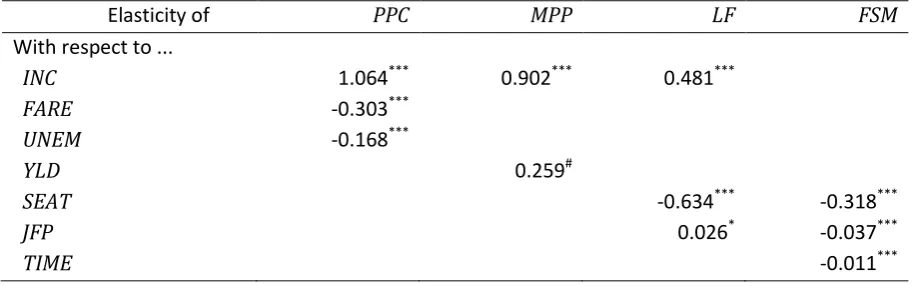
Table 2. Long run elasticities
Elasticity of PPC MPP LF FSM
With respect to ...
INC 1.064*** 0.902*** 0.481***
FARE -0.303***
UNEM -0.168***
YLD 0.259#
SEAT -0.634*** -0.318***
JFP 0.026* -0.037***
TIME -0.011***
# statistically significant at 85% level
4. Decomposition and econometric modelling
The decomposition of aviation fuel demand as in Eq. (1) can also be expressed in the logarithmic form as follows:
lnFUEL = lnPOP + lnPPC + lnMPP - lnLF + lnFSM (9)
Each of the right hand side components (except population) in Eq. (9) has been further modelled using the econometric technique, and thus it is possible to determine the elasticities of aviation fuel demand with respect to the relevant explanatory factors directly using Eqs. 5-9. For example, the income elasticity of aviation fuel demand will be
INC= 3+ 2 4lnINC + 3- 3
At the mean income of the sample, the short-run income elasticity of aviation fuel demand becomes 0.684 (p=0.00). While the income (or other) elasticity could have been determined directly from a 'reduced form' single-equation models, the decomposition and subsequent structural equation format provides more insight into how different components making up the aggregate fuel demand responds to the same external stimulus (here income), which can be useful while designing policies. The technique also allows the determination of elasticities of passenger demand with respect to, say, income or air fare. Noting that RPM = POP × PPC × MPP, the following relationship also holds:
lnRPM = lnPOP + lnPPC + lnMPP (10)
Hence the income elasticity of air travel demand is 3+ 2 4lnINC + 3. For the present work this is 0.976 (p=0.00), which falls within the range of existing literature on air transport demand.
SEAT= 4+ 3
This is evaluated to be 0.177 in the short run, but is statistically insignificant (z=1.22, p=0.22) at conventional confidence levels. Therefore changes in aircraft size has no visible effect on the fuel consumption for air travel in the US although it may individually affect load factor and fuel consumption per available seat mile. This finding agrees with Schafer et al. (2009) as well.
Jet fuel prices can affect aviation fuel demand through a number of pathways. Increases in jet fuel prices improve the load factor and fuel efficiency per available seat mile. The joint effect therefore is
5+ 4, which equals to 0.04 and is statistically significant at 99%. However, jet fuel prices can also
indirectly affect fuel consumption through increasing the air fare (since additional costs are generally passed on to the consumers in a highly competitive industry like air transport) and its subsequent effects on passenger demand. The effects of fuel prices on air fare are beyond the scope of current work though.
5. Conclusions
In this paper energy decomposition analysis is linked with econometric modelling to understand the demand for aviation fuel in the USA. In the first stage, aviation fuel demand has been decomposed into five components - population, passengers per capita, miles per passenger, load factor and fuel efficiency, which were then each further modelled using econometric techniques. Seemingly unrelated regression technique is then applied for estimating the parameters in a system context in order to allow for cross-equation correlation among the errors of different equations. Extension of the decomposition analysis with econometric modelling of the individual components also allow the quantitative understanding of the link between air travel demand and its drivers, as well as energy efficiency and its drivers.
substantially contributed to slowing the growth in fuel demand. The decomposition analysis also revealed that a dip in passengers per capita is generally associated with an increase in miles per passenger. This has been further substantiated by the econometric model, which show that the miles per passenger can indeed increase in response to an increase in per mile cost of air travel, while passengers per capita decreases as air fare increases.
The opposite impact of travel prices on passengers per capita and miles per passenger presents with an apparent dilemma for price-based policies to control aviation fuel consumption or carbon
emissions by managing air passenger demand. Although a definitive conclusion cannot be made, it appears in the short run the effects of travel costs on passengers per capita is larger in magnitude than on miles per passenger - therefore the price based policies can still be effective. However, the net long run effects require further investigation in future as the long run effects of increased air travel costs on miles per passenger is still inconclusive.
Increases in jet fuel prices reduce fuel consumption by improving load factor and fuel efficiency per available seat mile. This indicates both operational and technical improvements take place in response to cost increases. Jet fuel prices can also affect the fuel demand indirectly by increasing air fare and thus most likely reducing total revenue passenger miles. However, the effects of air fare or fuel prices are smaller than the effects of increasing income. Therefore any demand side market based policies should be designed considering the counter-effects of income on demand.
Because of the nature of the annual time series data, it was not possible to include all potential explanatory factors in the econometric model (high correlation among some explanatory factors). A monthly dataset, which offers more variation, may be useful to provide further insight in future. Decomposing the fuel demand into contributions from passenger and freight air traffic can also be a useful avenue of future research.
References
Airlines for America 2014 [online]. Annual round trip fares and fees: Domestic, available: http://www.airlines.org/Pages/Annual-Round-Trip-Fares-and-Fees-Domestic.aspx, accessed: February
Ang BW 2004. Decomposition analysis for policymaking in energy: Which is the preferred method? Energy Policy, Vol. 32, pp. 1131-1139
Ang BW 2005. The LMDI approach to decomposition analysis: A practical guide, Energy Policy, Vol. 33, pp. 867-871
Ang BW and Xu XY 2013. Tracking energy efficiency trends using index decomposition analysis, Energy Economics, Vol. 40, pp. 1014-1021
ATAG (Air Transport Action Group) 2014 [online]. Facts and figures, available at: http://www.atag.org/facts-and-figures.html, accessed: May
Banerjee A, Dolado JJ, Hendry DF and Smith GW 1986. Exploring equilibrium relationships in
econometrics through static models: some Monte Carlo evidence, Oxford Bulletin on Economics and Statistics, Vol. 48, pp. 253-277
Bhadra D and Kee J 2008. Structure and dynamics of the core US air travel markets: A basic empirical analysis of domestic passenger demand, Journal of Air Transport Management, Vol. 14, pp. 27-39 Boyd G, McDonald JF, Ross M and Hanson DA 1987. Separating the changing composition of US manufacturing production from energy efficiency improvements: a Divisia index approach, Energy Journal, Vol. 8, pp. 77-96
Bureau of Economic Analysis 2013 [online]. National Income and Product Account, Table 2.6: Personal income and its deposition, monthly, available: www.bea.gov, accessed: October
Bureau of Labor Statistics 2014 [online]. Consumer price index-All urban consumers, US city average, available: www.bls.gov, accessed: January
Bureau of Transport Statistics 2013 [online]. Air carrier summary data: T1: US air carrier traffic and capacity summary by service class, available: www.transtats.bts.gov, accessed: October
Bureau of Transport Statistics 2014 [online]. Air fares, available:
http://apps.bts.gov/xml/atpi/src/datadisp_table.xml, accessed: January
Bureau of Transport Statistics 2014 [online]. Historical fuel consumption, available: http://www.transtats.bts.gov/FUEL/Fuel_Hist.aspx, accessed: January
Davies S, Diegel S and Boundy RG 2013. Transportation Energy Data Book, Edition 32, Oak Ridge National Laboratory, TN
EIA (US Energy Information Administration) 2013. Transportation sector demand module of the national energy modeling system: Model documentation, Washington DC
Engle RF and Granger CWJ 1987. Cointegration and error correction: representation, estimation and testing, Econometrica, Vol. 55, pp. 251-276
FAA (US Federal Aviation Administration) 2012. FAA aerospace forecast: Fiscal years 2013-2033, Washington DC
Geslin C 2006. Pricing and competition in US airline markets: Changes in air travel demand since 2000, MSc Thesis, Massachusetts Institute of Technology, Cambridge, MA
Hendry DF 1986. Economic modelling with cointegrated variables: An overview, Oxford Bulletin on Economics and Statistics, Vol. 48, pp. 201-212
Kveiborg O and Fosgerau M 2007. Decomposing the decoupling of Danish road freight traffic growth and economic growth, Transport Policy, Vol. 14, pp. 39-48
Lim C, Min JCH and McAleer M 2008. Modelling income effects on long and short haul international travel from Japan, Tourism Management, Vol. 29, pp. 1099-1109
McCollum D, Gould G and Greene D 2009. Greenhouse gas emissions from aviation and marine transportation: Mitigation potential and policies, Pew Center on Global Climate Change, Arlington, VA
Nie H and Kemp R 2014. Index decomposition analysis of residential energy consumption in China: 2002-2010, Applied Energy, Vol. 121, pp. 10-19
Owen B, Lee DS and Lim L 2010. Flying into the future: Aviation emissions scenarios to 2050, Environmental Science and Technology, Vol. 44, pp. 2255-2260
Patterson K 2000. An Introduction to Applied Econometrics: A Time Series Approach, Palgrave, New York.
Peeters PM, Middel J and Hoolhorst A 2005. Fuel efficiency of commercial aircraft: An overview of historical and future trends, NLR-CR-2005-669, National Aerospace Laboratory, The Netherlands Schafer A, Heywood JB, Jacoby HD and Waitz I 2009. Transportation in a climate-constrained world, MIT Press, Cambridge
Timilsina GR and Shrestha A 2009. Transport sector CO2 emissions growth in Asia: Underlying factors and policy actions, Energy Policy, Vol. 37, pp. 4523-4539
Tsekeris T 2009. Dynamic analysis of air travel demand in competitive island markets, Journal of Air Transport Management, Vol. 15, pp. 267-273
Vogelsang TJ 1999. Two simple procedures for testing for a unit root when there are additive outliers, Journal of Time Series Analysis, Vol. 20, No. 2, pp. 237-252
Wadud Z 2014. The Asymmetric Effects of Income and Fuel Price on Air Transport Demand, Transportation Research Part A: Policy and Practice, Vol. 65, pp. 92-102