Classical Processes
Robert Atkey
MSP Group, University of Strathclyde [email protected]
Abstract. Classical Linear Logic (CLL) has long inspired readings of its proofs as communicating processes. Wadler’s CP calculus is one of these readings. Wadler gave CP an operational semantics by selecting a subset of the cut-elimination rules of CLL to use as reduction rules. This semantics has an appealing close connection to the logic, but does not resolve the status of the other cut-elimination rules, and does not admit an obvious notion of observational equivalence. We propose a new operational semantics for CP based on the idea of observing communi-cation. We use this semantics to define an intuitively reasonable notion of observational equivalence. To reason about observational equivalence, we use the standard relational denotational semantics of CLL. We show that this denotational semantics is adequate for our operational seman-tics. This allows us to deduce that, for instance, all the cut-elimination rules of CLL are observational equivalences.
1
Introduction
Right from Girard’s introduction of Classical Linear Logic (CLL) [16], it has ap-peared to offer the tantalising hope of a “Curry-Howard for Concurrency”: a log-ical basis for concurrent computation, analogous to the standard Curry-Howard correspondence between intuitionistic logic and sequential computation in typed λ-calculi [10,18]. To realise this hope, Abramsky proposed a programme of “Pro-cesses as Proofs” [2] in the early nineties. Abramsky [1] and Bellin and Scott [7] interpreted CLL proofs as terms in process calculi, matching (Cut)-reduction to process reduction. However, these correspondences interpret CLL proofs in an extremely restricted set of processes – those which never deadlock and never exhibit racy or nondeterministic behaviour – and so their correspondences could reasonably be criticised as not really capturing concurrency. Ehrhard and Lau-rent [14] attempted to remedy this problem by demonstrating a correspondence between a finitaryπ-calculus and Differential Linear Logic. However, their work was forcefully criticised by Mazza [23], who points out that there are crucial differences in how both systems model nondeterminism, and further states:
remotely resembling the perfect correspondence between functional lan-guages and intuitionistic logic. In our opinion, we must simply accept that linear logic is not the right framework for carrying out Abramsky’s “proofs as processes” program (which, in fact, more than 20 years after its inception has yet to see a satisfactory completion).
Despite the apparent failure of Abramsky’s programme for concurrency, there has recently been interest in using Linear Logic as a basis for calculi of struc-tured communication, also known assession types. Session types were originally proposed by Honda [17] in the context of the π-calculus as a way to ensure that processes conform to a protocol. The linear logic-based study of session types was initiated by Caires and Pfenning [9], who presented an assignment of π-calculus terms to sequent calculus proofs of Intuitionistic Linear Logic (ILL) that interprets the connectives of ILL as session types in the sense of Honda. The fundamental ideas of Caires and Pfenning were later adapted by Wadler to CLL [35,36], yielding a more symmetric system of “Classical Processes” (CP).
Wadler presents CP as a calculus with an associated reduction relation, and shows that there is a type preserving translation into Gay and Vasconcelos’ functional language with session-typed communication [15]. This translation was later shown to also preserve reduction semantics, and to be reversible, by Lindley and Morris [20], establishing that CP can be seen as a foundational calculus for session-typed communication.
In this paper, we take a more direct approach to CP. We treat CP as a programming language in its own right by endowing it with an operational se-mantics, a notion of observational equivalence, and a denotational semantics. We do this for several reasons:i)if CLL is intended as a logical foundation for programming with structured communication, there ought to be a way of inter-preting CP processes as executable artefacts with observable outputs, which, as we argue below, Wadler’s reduction semantics does not;ii)establishing a theory of observational equivalence for CP resolves the status of the (Cut)-elimination rules on non-principal cuts by reading them as observational equivalences; and iii) we can use the rich theory of denotational semantics for CLL (see, e.g., Melli`es [25]) to reason about observational equivalence in CP. We further envis-age that the introduction of denotational semantics into the theory of CP and session types will lead to further development of CP as a foundational calculus for session-typed communication.
1.1 Problems with Wadler’s Reduction Semantics for CP
Our starting point is in asking the following question: What is the observable output of a CP process?
The semantics proposed by Wadler [36] defines a reduction relation between CP processes, derived from theCut-elimination rules for principal cuts. For example, processes that transmit and receive a choice interact via the following rule:
Here, a shared communication channel is established by theνx.(− | −) construct, which is the syntax for the (Cut) rule. Thex[i].P emits a bitialong channelx and continues asP, whilex.case(Q0, Q1) receives a bit alongxand proceeds as Q0 orQ1according to the value of that bit.
A problem arises with CP processes that have free channels that are not connected to any other process. Since CP uses π-calculus notation, there is a relatively rigid left-to-right sequentialisation of actions. This means that the presence of attempts to communicate along unconnected channels can block other communication. An example is the following process, where communication along the unconnectedx0 channel blocks the communication acrossx:
νx.(x0[0].x[1].P |x.case(Q0, Q1))
This arrangement corresponds to (Cut)-elimination for a “non-principal” cut, i.e. the formula being cut in is not the last one introduced on both sides. In these cases, (Cut)-elimination commutes the offending rule past the (Cut) rule:
x0[0].νx.(x[1].P |x.case(Q0, Q1))
The rules that perform these rearrangements that do not correspond to any actual communication are referred to as “commuting conversions”. They serve to bubble “stuck” communication to the outermost part of a process term.
With the reduction rules as proposed, we have two answers to our question. If a CP processP has no free channels, then we can always apply reduction rules corresponding to actual interaction, but we will never see the results of any of these interactions. Since CP is strongly normalising (a property it inherits from CLL [3]), all closed processes have the same termination behaviour, so this does not distinguish them. (CP, as presented by Wadler, does not admit completely closed processes unless we also include the (Mix0) rule, as we do here.)
Alternatively, if a CP process P has free channels, then we can use the commuting conversion rules to move the stuck prefixes to the outermost layer. We could then either proceed to eliminate all (Cut)s deeper in the process term, or we could halt immediately, in the style of weak reduction in theλ-calculus.
This approach is appealing because it corresponds to the similar approach to defining the result ofλ-calculus/proof-term reduction in sequential program-ming. We could also define a natural equivalence between CP processes in terms of barbed bisimulations [26], using the topmost action as the barb. However, in a multi-output calculus like CP, we run into ambiguity. The process:
νx.(y[0].x[1].P |z[0].x.case(Q0, Q1)) can be converted in two steps to:
correlate communication over the channels y and z and to determine the dif-ference between these processes. We could treat all CP processes quotiented by these permutations, but that would presuppose these equivalences, rather than having them induced by the actual behaviour of CP processes. (Bellin and Scott do such an identification in [7], pg. 14, rule (1).) If we were to define obser-vational equivalence of CP processes via barbed bisimulation of CP processes up to permutations, then we would be effectively building the consequences of linearity into the definition of equivalence, rather than deducing them.
Another approach to resolving the non-determinism problem is to restrict processes to having one free channel that is designated as “the” output channel. With only one channel there can be no ambiguity over the results of the ordering of commuting conversions. This is the path taken in Caires and Pfenning’s [9] ILL-based formalism. P´erez et al. [27] define a notion of observational equiva-lence for Caires and Pfenning’s system based on a Labelled Transition System (LTS) over processes with one free channel. CLL, and hence CP, do not have a notion of distinguished output channel. Indeed, it is not immediately obvious why a process dealing with multiple communication partners ought to designate a particular partner as “the one” as Caires and Pfenning’s system does.
1.2 A Solution: Observed Communication Semantics
We appear to have a tension between two problems. CP processes need partners to communicate with, but if we connect two CP processes with the (Cut) rule we cannot observe what they communicate! If we leave a CP process’s channels free, then we need reduction rules that do not correspond to operationally justified communication steps, and we admit spurious non-determinism unless we make ad-hoc restrictions on the number of free channels.
Our solution is based on the idea that the observed behaviour of a collection of processes is the data exchanged between them, not their stuck states. In se-quential calculi, stuck computations are interpreted as values, but this viewpoint does not remain valid in the world of message-passing communicating processes. We propose a new operational semantics for CP on the idea of “visible” applications of the (Cut) rule that allow an external observer to see the data transferred. We define a big-step evaluation semantics that assigns observations to “configurations” of CP processes. For example, the configuration:
`cx[1].x[]|xx.case(x().0, x().0) ::· |x: 1⊕1
consists of a pair of CP processesx[1].x[] andx.case(x().0, x().0) that will com-municate over the public channelx, indicated by the|xnotation. The split typing
context on the right hand side indicates that there are no unconnected channels,
·, and one observable channelx: 1⊕1.
Our semantics assigns the observation to (1,∗) to this configuration: (x[1].x[]|xx.case(x().0, x().0))⇓(1,∗)
Observations in our operational semantics are only defined for configurations with no free channels. Hence we do not have the problem of processes getting stuck for lack of communication partners, and the rules of our operational se-mantics (Figure 3) are only concerned with interactions and duplication and discarding of servers. There is no need for non-operational steps.
Our operational semantics enables us to define observational equivalence be-tween CP processes in the standard way: if two processes yield the same observed communications in all contexts, then they are observationally equivalent ( Defi-nition 1). We will see that the (Cut)-elimination rules of CLL, seen as equations between CP terms are observational equivalences in our sense (Section 5).
Proving observational equivalences using our definition directly is difficult, for the usual reason that the definition quantifies over all possible contexts. Therefore, we define a denotational semantics for CP processes and configu-rations, based on the standard relational semantics for CLL (Section 3). This denotational semantics affords us a compositional method for assigning sets of potential observable communication behaviours to CP processes and configura-tions. InSection 4 we show that, on closed configurations, the operational and denotational semantics agree, using a proof based on ⊥⊥-closed Kripke logi-cal relations. Coupled with the compositionality of the denotational semantics, adequacy yields a sound technique for proving observational equivalences.
1.3 Contributions
This paper makes three contributions to logically-based session types:
1. InSection 2, we define a communication observing semantics for Wadler’s CP calculus. This semantics assigns observations to “configurations” of processes that are communicating over channels. The data communicated over these channels constitutes the observations an external observer can make on a network of processes. Our semantics enables a definition of observational equivalence for CP processes that takes into account the restrictions imposed by CP’s typing discipline.
2. In Section 4, we show that the standard “folklore” relational semantics of CLL proofs (spelt out inSection 3) is adequate for the operational seman-tics via a logical relations argument. Adequacy means that we can use the relational semantics, which is relatively straightforward to calculate with, to reason about observational equivalence. An additional conceptual contribu-tion is the reading of the relacontribu-tional semantics of CLL in terms of observed communication between concurrent processes.
3. We use the denotational semantics to show that all of the standard Cut -elimination rules of CLL are observational equivalences in our operational semantics, in Section 5. This means that the Cut-elimination rules can be seen as a sound equational theory for reasoning about observational equiva-lence. We also show that permutations of communications along independent channels are observational equivalences.
2
Observed Communication Semantics for CP
2.1 Classical Processes
Wadler’s CP is a term language for sequent calculus proofs in Girard’s Classical Linear Logic (CLL), with a syntax inspired by the π-calculus [31].
Formulas The formulas of CLL are built by the following grammar: A, B::= 1| ⊥ |A⊗B|A`B|A⊕B|A&B|!A|?A
The connectives of CLL are collected into several groupings, depending on their proof-theoretic behaviour. As we shall see, these groupings will also have rele-vance in terms of their observed communication behaviour.
The connectives 1,⊥,⊗and`are referred as themultiplicatives, and⊕and & are the additives. Multiplicatives correspond to matters of communication topology, while the additives will correspond to actual data transfer. The ! and ? connectives are referred to as theexponential connectives, because they allow for unrestricted duplication of the multiplicative structure. Another grouping of the connectives distinguishes between the positive connectives 1, ⊗, ⊕, and ! that describe output, and thenegative connectives⊥,`, & and ? that describe input. Positive and negative are linked viaduality: eachAhas a dualA⊥:
1⊥=⊥ ⊥⊥= 1
(A⊗B)⊥=A⊥`B⊥ (A`B)⊥=A⊥⊗B⊥ (A⊕B)⊥=A⊥&B⊥ (A&B)⊥=A⊥⊕B⊥
(!A)⊥= ?A⊥ (?A)⊥= !A⊥
The key to the structure of the CP calculus is that CLL formulas are types assigned to communication channels. Duality is how we transform the type of one end of a channel to the type of the other end. Hence the swapping of positive and negative connectives: we are swapping descriptions of input and output. Example The additive connective ⊕indicates the transmission of a choice be-tween two alternative sessions. Using the multiplicative unit 1 to represent the empty session, we can build a session type/formula representing transmission of a single bit, and its dual representing the receiving of a single bit:
Bit= 1⊕1 Bit⊥=⊥&⊥
With these, we can build the type of a server that accept arbitrarily many requests to receive two bits and return a single bit:
Server= !(Bit⊥`Bit⊥`Bit⊗1)
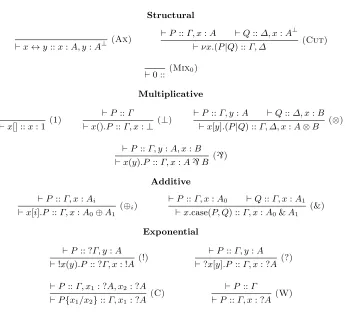
Structural
`x↔y::x:A, y:A⊥ (Ax)
`P ::Γ, x:A `Q::∆, x:A⊥
`νx.(P|Q) ::Γ, ∆ (Cut)
`0 :: (Mix0)
Multiplicative
`x[] ::x: 1(1)
`P::Γ
`x().P::Γ, x:⊥(⊥)
`P::Γ, y:A `Q::∆, x:B
`x[y].(P|Q) ::Γ, ∆, x:A⊗B (⊗)
`P ::Γ, y:A, x:B
`x(y).P ::Γ, x:A`B (`)
Additive
`P ::Γ, x:Ai
`x[i].P::Γ, x:A0⊕A1 (⊕i)
`P ::Γ, x:A0 `Q::Γ, x:A1
`x.case(P, Q) ::Γ, x:A0&A1 (&)
Exponential
`P :: ?Γ, y:A
`!x(y).P :: ?Γ, x: !A (!)
`P ::Γ, y:A
`?x[y].P::Γ, x: ?A (?)
`P::Γ, x1: ?A, x2: ?A
`P{x1/x2}::Γ, x1: ?A (C)
`P ::Γ
[image:7.612.137.482.104.429.2]`P ::Γ, x: ?A (W)
Fig. 1.Classical Processes
bits, transmit a bit, and then signal the end of the session. We obtain the type of a compatible client by taking the dual of this type:
Client =Server⊥= ?(Bit⊗Bit⊗Bit⊥`⊥)
We read this as requirements that are dual to those on the server: the ? indicates that it can use the server as many times as necessary, whereupon it must transmit two bits, receive a bit and receive an end of session signal.
Processes Processes in CP communicate along multiple named and typed chan-nels, which we gather into contexts Γ =x1:A1, . . . , xn:An where the channel
namesxi are all distinct, and we do not care about order.
The syntax of processes in CP is given by the grammar: P, Q::=x↔x0|νx.(P|Q)|0|x[]|x().P |x[x0].(P|Q)|
x(x0).P |x[i].P |x.case(P, Q)|?x[x0].P |!x(x0).P wherei∈ {0,1}
The rules are divided into four groups. The first group are the structural rules: (Ax) introduces a process linking two channels, note the use of duality to type the two ends of the link; (Cut) establishes communication between two processes via a hidden channel x, again note the use of duality; and (Mix0) is
the nil process which performs no communication over no channels.
The second group contains the multiplicative rules. Following Wadler’s no-tation, square brackets [· · ·] indicate output and round brackets (· · ·) indicate input. Thus (1) introduces a process that outputs an end-of-session signal and dually (⊥) introduces a process that inputs such. Likewise, (⊗) introduces a pro-cess that outputs a fresh channel name for a forked-off propro-cessPto communicate on, and dually (`) inputs a channel name for it to communicate on in the future. Neither of these pairs communicates any unexpected information. By duality, if a⊗process is going to send a channel and fork a process, then it is communicat-ing with a `process that is ready to receive a channel and communicate with that process. In our semantics in Section 2.3, multiplicative connectives affect the structure of observations, but not their information content.
Processes that communicate information are introduced by theadditiverules in the third group. The process introduced by (⊕i) transmits a biti along the channelx, and continues usingxaccording to the typeAi. Dually, (&) introduces
processes that receive a bit, and proceed with eitherP or Qgiven its value. The final group covers the exponential rules. The rule (!) introduces an in-finitely replicable server process that can communicate according to the typeA on demand. To ensure that this process is infinitely replicable, all of the chan-nels it uses must also be connected to infinitely replicable servers, i.e., chanchan-nels of type ?Ai. We indicate the requirement that all the channels in Γ be of ?’d
typed by the notation ?Γ. Processes introduced by the (?) rule query a server process to obtain a new channel for communication. The exponentials are given their power by the structural rules (C) and (W). Contraction, by rule (C) allows a process to use the same server twice. Weakening, by the rule (W) allows a process to discard a channel connected to a server.
Example As a programming language, CP is very low-level. We make use of the following syntactic sugar (from [4]) for transmitting and receiving bits along channels of typeBit andBit⊥:
x[0].P def= x[y].(y[0].y[]|P) x[1].P def= x[y].(y[1].y[]|P) casex.{07→P;17→Q}def= x.case(x().P, x().Q)
Using these abbreviations, we can write an implementation of ourServer type that computes the logical AND of a pair of bits:
`!x(y).y(p).y(q).casep.{
07→caseq.{07→y[0].y[];17→y[0].y[]};
`P ::Γ
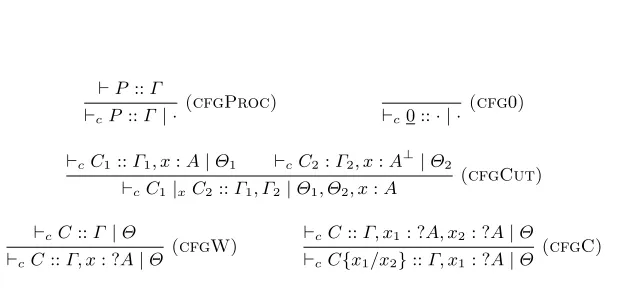
`cP ::Γ | · (cfgProc) `c0 ::· | · (cfg 0)
`cC1::Γ1, x:A|Θ1 `cC2:Γ2, x:A⊥|Θ2 `cC1|xC2::Γ1, Γ2|Θ1, Θ2, x:A
(cfgCut)
`cC::Γ |Θ
`cC::Γ, x: ?A|Θ(cfgW)
`cC::Γ, x1: ?A, x2: ?A|Θ
[image:9.612.156.469.86.232.2]`cC{x1/x2}::Γ, x1 : ?A|Θ(cfgC)
Fig. 2.Configurations of Classical Processes
This process creates an infinitely replicable server via (!), receives two channels via (`), receives two bits along them, and in each case transmits the appropriate returned value and signals end of session. A dual client process is written so:
`?x[y].y[1].y[1].casey.{07→y().0;17→y().0}::x:Client
This process contacts a server, sends the bit 1twice, and then, no matter the outcome, receives the end of session signal and halts.
2.2 Configurations
The well-typed process judgement `P ::Γ relates processes P to unconnected channels Γ. When processes communicate via the (Cut) rule, that commu-nication is invisible to external observers: the common channel x is removed from the context. In order to make communication visible, we introduce con-figurations of processes. A configuration `c C :: Γ | Θ has unconnected
chan-nels Γ and connected but observable channelsΘ. Observable channel contexts Θ = x1 : A1, . . . , xn : An are similar to normal channel contexts Γ, except
There are no contraction or weakening rules for observable contexts Θ. Such contexts record connected channels, which cannot be discarded or duplicated.
We define a structural congruenceC1 ≡C2 on configurations, generated by commutativity and associativity (where permitted by the typing) for|x, with 0
as the unit. Structural congruence preserves typing.
A configuration with no unconnected channels,`c C::· |Θ, is called aclosed
configuration of type Θ. Closed configurations will be our notion of complete systems: the observed communication semantics we define below inSection 2.4
is only defined for closed configurations.
Example Continuing our example from above, we can connect the server process ServerP to the client processClientP in a configuration with a visible commu-nication channelx, using the (cfgCut) rule:
`cServerP |xClientP ::· |x:Server
Note that this configuration also has typing`c ServerP|xClientP ::· |x:Client
due to the conflation of dual types in observation contexts.
2.3 Observations
Our observed communication semantics assigns observations to closed configu-rations. The range of possible observations is defined in terms of the types of the channels named inΘ. As stated above, observations only track the data flowing across a communication channel, not the direction. Therefore, the positive and negative connective pairs each have the same sets of possible observations:
J1K =J⊥K ={∗} JA⊗BK =JA`BK =JAK×JBK JA0⊕A1K=JA0&A1K=Σi∈{0,1}.JAiK J!AK =J?AK =Mf(JAK)
whereMf(X) denotes finite multisets with elements fromX. We will use the∅
for empty multiset, ]for multiset union, and*a1, . . . , an+for multiset literals. The sets of possible observations for a given observation contextΘ = x1 : A1, . . . , xn:Anare defined as the cartesian product of the possible observations
for each channel:JΘK=Jx1:A1, . . . , xn :AnK=JA1K× · · · ×JAnK.
2.4 Observed Communication Semantics
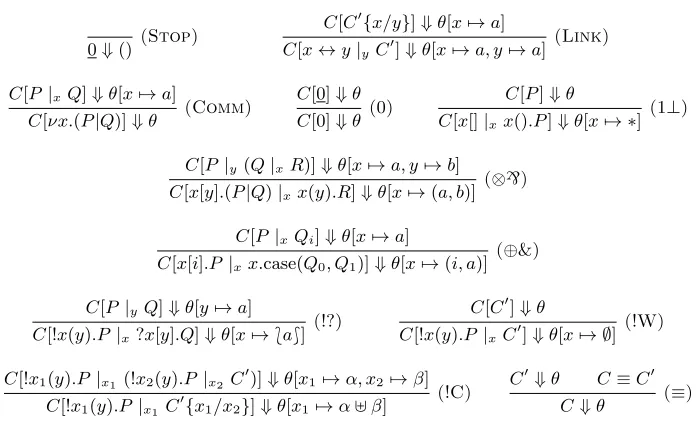
[image:10.612.221.389.428.479.2]Observable evaluation is defined by the rules inFigure 3. These rules relate closed configurations `cC::· |Θ with observations θ∈JΘK. To derive C⇓θ is to say that execution ofCcompletes with observed communicationθ. For convenience, in Figure 3, even though observationsθare tuples with “anonymous” fields, we refer to the individual fields by the corresponding channel name. The rules in
0⇓()(Stop)
C[C0{x/y}]⇓θ[x7→a]
C[x↔y|yC0]⇓θ[x7→a, y7→a](Link)
C[P |xQ]⇓θ[x7→a]
C[νx.(P|Q)]⇓θ (Comm)
C[0]⇓θ C[0]⇓θ (0)
C[P]⇓θ
C[x[]|xx().P]⇓θ[x7→ ∗] (1⊥)
C[P |y(Q|xR)]⇓θ[x7→a, y7→b]
C[x[y].(P|Q)|xx(y).R]⇓θ[x7→(a, b)] ( ⊗`)
C[P |xQi]⇓θ[x7→a]
C[x[i].P|xx.case(Q0, Q1)]⇓θ[x7→(i, a)] ( ⊕&)
C[P|yQ]⇓θ[y7→a]
C[!x(y).P|x?x[y].Q]⇓θ[x7→*a+] (!?)
C[C0]⇓θ C[!x(y).P|xC
0
]⇓θ[x7→ ∅](!W)
C[!x1(y).P|x1(!x2(y).P|x2 C
0
)]⇓θ[x1 7→α, x27→β]
C[!x1(y).P |x1C
0
{x1/x2}]⇓θ[x17→α]β] (!C)
C0⇓θ C≡C0
[image:11.612.134.482.119.331.2]C⇓θ (≡)
Fig. 3.Observed Communication Semantics
The first rule, (Stop), is the base case of evaluation, yielding the trivial observation () for the empty configuration. The next three rules, (Link), (Comm), and (0) describe the behaviour of the processes introduced by the (Ax), (Cut) and (Mix0) rules respectively. (Link) evaluates links via substitution of channel names; and the observed communication across the link is shared between the two channels. (Comm) evaluates two processes communicating over a private channel by evaluating them over a public channel and then hiding it. (0) evaluates the empty process 0 by turning it into the empty configuration 0.
The rules (1⊥), (⊗`), (⊕&) and (!?) describe how processes introduced by dual pairs of rules interact across public channels, and the observed communica-tion that results. For (1⊥), the trivial message∗is sent. For (⊗`), communication that occured across two independent channels is grouped into one channel. For (⊕&), a single bit,iis transmitted, which is paired with the rest of the commu-nication. For (!?), an observation arising from a single use of a server is turned into a multiset observation with a single element.
Example Our operational semantics assigns the following observation to the configuration we built at the end ofSection 2.2:
(ServerP|xClientP)⇓(*((1,∗),(1,∗),(1,∗),∗)+)
We observe the two 1-bits sent by the client, the 1-bit returned by the server, and the final∗ indicating end of session. The additional∗s accompanying each bit are an artifact of our encoding of bits as the formula 1⊕1.
2.5 Observational Equivalence
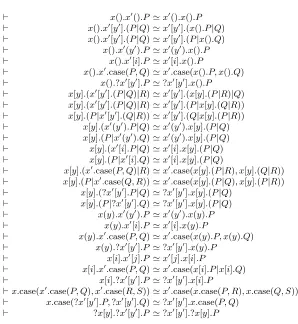
Observational equivalence between a pair of processes is defined as having the same set of observations in all typed contexts. By its definition in terms of typed contexts CP[−], our definition of observational equivalence takes into account the (in)abilities of typed processes to interact with each other. In particular, the inability of CP processes to distinguish permutations of actions on distinct channels yields a family of observational equivalences (Figure 8).
Our definition of observational equivalence is defined in terms of typed con-textsCP[−], which consist of configurations and processes with a single (typed) hole. Compared to the configuration contexts C[−] in Figure 3, configuration-process contexts allow the hole to appear within a configuration-process.
Definition 1. Two processes`P1, P2::Γ are observationally equivalent, writ-ten P1'P2, if for all configuration-process contexts CP[−] where`c CP[P1] ::
· |Θ and`cCP[P2] ::· |Θ, and all θ∈JΘK, CP[P1]⇓θ⇔CP[P2]⇓θ.
Reasoning about observational equivalence is difficult, due to the quantification over all contexts. In the next two sections, we present a denotational semantics of CP which is sound for reasoning about observational equivalence.
3
Denotational Semantics of CP
which enforce the invariant that distinct channels are completely independent. A trace-based semantics would impose an ordering on actions performed by pro-cesses which is not observable by a CP context. This “temporal-obliviousness” speaks to the point that CP is about structured communication determined by types, not about concurrency. We return to this inSection 5when we discuss the observational equivalences between processes that permute independent actions. InSection 4, we will see that on closed configurations the operational seman-tics and the denotational semanseman-tics agree.
3.1 Semantics of Formulas
The semantics of formulas does not take into account whether data is being transmitted or received; the relational semantics of CLL is sometimes referred to as “degenerate” in this sense. We discuss this further inSection 3.4. For now, we use the same interpretation of formulas as we did for observation contexts in
Section 2.3:
J1K =J⊥K ={∗} JA⊗BK =JA`BK =JAK×JBK JA0⊕A1K=JA0&A1K=Σi∈{0,1}.JAiK J!AK =J?AK =Mf(JAK)
The sets of possible observations for a given context Γ =x1 : A1, . . . , xn : An
are again defined as the cartesian product of the sets for each of theAi:
JΓK=Jx1:A1, . . . , xn :AnK=JA1K× · · · ×JAnK 3.2 Semantics of Processes
The basic idea of the semantics of processes is that if (a1, . . . , an)∈J`P ::ΓK, then (a1, . . . , an) is a possible observed behaviour of P along its unconnected
channels. So, to every`P::Γ, we assign a subset of the interpretation ofΓ:
J`P ::ΓK⊆JΓK
by induction on the derivation of`P ::Γ. The (Ax) rule is interpreted by the diagonal relation, indicating that whatever is observed at one end of the linked channels is observed at the other:
J`x↔y::x:A, y:A
⊥
K={(a, a)|a∈JAK}
The (Cut) rule is interpreted by taking observations from both processes that share a common observation along the shared channel:
J`νx.(P|Q) ::Γ, ∆K={(γ, δ)|(γ, a)∈J`P ::Γ, x:AK, (δ, a)∈J`Q::∆, x:A
⊥
K}
The (Mix0) rule is interpreted as the only possible observation in an empty
context:
The multiplicative units observe trivial data:
J`x[] ::x: 1K ={(∗)}
J`x().P ::Γ, x:⊥K={(γ,∗)|γ∈J`P::ΓK}
For the multiplicative binary connectives, the (⊗) rule is interpreted by combin-ing the interpretations of its two subprocesses into a scombin-ingle observation; while the (`) rule is interpreted by pairing the observations on two channels into one.
J`x[y].(P|Q) ::Γ, ∆, x:A⊗BK={(γ, δ,(a, b))|(γ, a)∈J`P::Γ, y:AK, (δ, b)∈J`Q::∆, x:BK}
J`x(y).P ::Γ, x:A`BK={(γ,(a, b))|(γ, a, b)∈J`P ::Γ, y:A, x:BK} For the additive connectives, sending bits via the (⊕i) rules is interpreted by prepending that bit on to the observation on that channel; and receiving a bit via (&) is interpreted by taking the union of possible observations:
J`x[i].P ::Γ, x:A0⊕A1K={(γ,(i, a))|(γ, a)∈J`P::Γ, x:AiK} J`x.case(P0, P1) ::Γ, x:A0&A1K
=S
i∈{0,1}{(γ,(i, a))|(γ, a)∈J`Pi::Γ, x:AiK}
For the exponential connectives, a “server” process introduced by the (!) rule is interpreted as the multiset of k-many observations of its underlying process, taking the union of their auxillary observations on the context ?Γ. A “client” process introduced by (?) makes a singleton multiset’s worth of observations:
J`!x(y).P :: ?Γ, x: !AK={(
Uk j=1α
1
j, . . . ,
Uk j=1α
n
j,*a1, . . . , ak+)|
∀i∈ {1, . . . , k}. (α1
i, . . . , αni, ai)∈J`P:: ?Γ, y:AK} J`?x[y].P ::Γ, x: ?AK={(γ,*a+})|(γ, a)∈J`P ::Γ, y:AK}
The exponential structural rules dictate how singleton observations from client processes are combined, or channels are discarded. Contraction (C) is interpreted via multiset union, and weakening (W) is interpreted by the empty multiset:
J`P{x1/x2}::Γ, x1: ?AK={(γ, α1]α2)|
(γ, α1, α2)∈J`P ::Γ, x1: ?A, x2: ?AK}
J`P ::Γ, x: ?AK={(γ,∅)|γ∈J`P ::ΓK}
When these rules are put into communication with servers generated by (!) they will dictate the multiplicity of uses of the server process.
Example We compute the denotation of the processServerP from our running example to be the set of arbitrarily sized multisets of possible interactions with the the underlying process:
where the underlying process’s denotation includes all possible 22 possibilities for inputs and relates them to the corresponding output (their logical AND):
S={((b1,∗),(b2,∗),(b1∧b2,∗),∗)|b1∈ {0,1}, b2∈ {0,1}}
The client’s denotation is a singleton multiset (recording the fact that it uses the server only once). Dually to the server’s denotation, the first two bits are determined but the last one is completely undetermined because we cannot know what the response from the server will be.
JClientPK={*((1,∗),(1,∗),(b,∗),∗)+|b∈ {0,1}} 3.3 Semantics of Configurations
The denotational semantics of configurations extends the semantics of processes to include the connected channels. Configurations`cC::Γ |Θare assigned
sub-sets ofJΓK×JΘK. The idea is that, if ((a1, . . . , an),(b1, . . . , bn))∈J`cC::Γ |ΘK, then (a1, . . . , an) and (b1, . . . , bn) are a possible observed behaviour ofC along
its unconnected and connected channels respectively. We assign denotations to each configuration by structural recursion on their derivations:
J`c0 ::· | ·K={(∗,∗)}
J`cP ::Γ | ·K={(γ,∗)|γ∈J`P ::ΓK} J`cC1|xC2::Γ1, Γ2|Θ1, Θ2, x:AK=
{((γ1, γ2),(θ1, θ2, a))|((γ1, a), θ1)∈J`cC1::Γ1, x:A|Θ1K, ((γ2, a), θ2)∈J`cC2::Γ2, x:A⊥|Θ2K} J`cC::Γ, x: ?A|ΘK={((γ,∅), θ)|(γ, θ)∈J`cC::Γ |ΘK}
J`cC{x1/x2}::Γ, x1: ?A|ΘK=
{((γ, a1]a2), θ)|((γ, a1, a2), θ)∈J`c C::Γ, x1: ?A, x2: ?A|ΘK} The interpretation of (cfg0), (cfgC), and (cfgW) are similar to the analogous rules for processes. The interpretation of (cfgCut) is also similar, except that the observation on the shared channel is retained. The interpretation of (cfgProc) lifts interpretations of processes up to configurations with no connected channels. Example Using the above rules, we compute the denotation of our example configuration linking our server to its client:
J`cServerP|xClientP ::· |x::ServerK={*((1,∗),(1,∗),(1,∗),∗)+} The denotation is the set with the single observation we computed inSection 2.4
for this configuration. In Section 4, we will see that this is no accident.
3.4 More precise semantics?
the semantics of formulas do not model the direction of data flow for inputs and outputs. The logical relations we will define in Section 4 will refine the semantics of formulas to identify subsets of the observations possible for each formula that are actually feasible in terms of the input/output behaviour of connectives, but it is also possible to perform such a refinement purely at the level of the denotational semantics. Girard’s motivating semantics for CLL was coherence spaces [16], which can be seen as a refined version of the relational semantics where particular distinguished subsets, cliques, are identified as the possible denotations of processes. The defining property of coherence spaces is that for every clique α in a coherence space and every clique β in its dual, the intersection α∩β has at most one element. The coherence space semantics can be extended to configurations by stipulating that subsets X assigned to configurations must satisfy the property that if (γ1, θ1) and (γ2, θ2) are both in X, then wheneverγ1andγ2are coherent (i.e.,{γ1, γ2}is a clique), thenθ1=θ2. The semantics for configurations in Section 3.3 satisfies this property, and the adequacy proof in the next section goes through unchanged.
Operationally, this means that CP processes can only interact in at most one way. Therefore, using a coherence space semantics would consistute a semantic proof of determinacy for CP with our semantics. It might be possible to go further and use Loader’stotality spaces [22], which stipulate that cliques in dual spaces have exactly one element in their intersection, to also prove termination. However, the construction of exponentials in totality spaces is not clear.
4
Adequacy
We now present our main result: on closed configurations, the operational and de-notational semantics agree. Consequently, we can use the dede-notational semantics to reason about observational equivalences between CP processes (Section 5). Theorem 1. If `cC::· |Θ, thenC⇓θ iffθ∈J`cC::· |ΘK.
The forwards direction of this theorem states that if an observation can be gener-ated by the evaluation rules, then it is also within the set of possible observations predicted by the denotational semantics. This is straightfoward to prove by in-duction on the derivation of C⇓θ. The backwards direction, which states that the denotational semantics predicts evaluation, is more complex and occupies the rest of this section.
4.1 Agreeability via ⊥⊥-Closed Logical Relations
We adapt the standard technique for proving adequacy for sequential languages [28] and use a logical relation to relate open configurations with denotations. For each channel name xand CLL formulaA, we use ternary relations that relate observable contexts, denotations, and configurations, which we call agreeability relations:
whereObsCtxtis the set of observable contexts,P is the power set, and Cfg(x: A|Θ) is the set of well-typed configurations`cC::x:A|Θ. We are interested
in special agreeability relations: those that are closed under double negation. Negation Given an agreeability relation X for a channel x : A, its negation X⊥ is an agreeability relation for x : A⊥. Intuitively, if X identifies a set of configurations and denotations with some property, thenX⊥ is the set of
con-figurations and denotations that “interact well” with the ones in X. For our purposes, “interact well” means that the communication we observe when the two configurations interact is predicted by their associated denotations.
Definition 2 (Negation). LetX be a relation forx:Aas in (1). Its negation X⊥ is a relation for x:A⊥, defined as:
X⊥={(Θ0, α0, C0)| ∀(Θ, α, C)∈X, θ, θ0, a.
(a, θ)∈α∧(a, θ0)∈α0⇒(C|xC0)⇓(θ, θ0, a)}
We are interested in agreeability relations that are⊥⊥-closed:X⊥⊥=X. These
are related denotations and configurations that “interact well with anything that interacts well with them”. This kind of double-negation closure was used by Girard [16] to construct the Phase Space semantics of CLL and to show weak normalisation. Ehrhard notes that double-negation closure is a common feature of many models of CLL [13]. Double-negation, (·)⊥⊥, has the following properties, which mean that it is a closure operator [12]:
Lemma 1. 1. X ⊆X⊥⊥; 2. IfX ⊆Y, thenY⊥⊆X⊥; 3. X⊥⊥⊥=X⊥.
By (3),X⊥⊥ is automatically⊥⊥-closed for any agreeability relationX. Duplicable and Discardable We generalise the duplicable and discardable capa-bility of !’d processes (the (!C) and (!W) rules) to arbitrary configurations with one free channel of !’d type:
Definition 3 (Duplicable and Discardable). A configuration `c C :: x :
!A|z1: !B1, . . . , zn : !Bn is
1. duplicableif, for all `cC0::Γ, x: ?A⊥, x0 : ?A⊥ |Θ,
D[(C0 |xC)|x0 C{x0/x, z01/z1, . . . , z0n/zn}]⇓
θ
x7→α, z17→α1,. . . ,zn7→αn,
x07→α0,z10 7→α01,. . . ,z0n7→αn0
implies
D[C0{x/x0} |xC]⇓θ[x7→α]α0, z17→α1]α01, . . . , zn7→αn]α0n]
2. discardable if, for all `c C0 :: Γ | Θ, D[C0]⇓ θ implies that D[C0 |x C] ⇓
Jx: 1K ={(·,{∗}, C)|C≡x[]}
⊥⊥
Jx:⊥K =Jx: 1K
⊥
Jx:A⊗BK ={((Θ
0
, Θ), α, C)|C≡(· · ·(x[x0].(P0|P)|y01 D
0
1)· · · |ynDn),
α={((a, b), θ0, θ)|(a, θ0)∈β0,(b, θ)∈β},
(Θ0, β0,(· · ·(P0|y10 D
0 1)· · · |y0
nD
0
n))∈Jx
0
:AK,
(Θ, β,(· · ·(P |y1 D1)· · · |ynDn))∈Jx:BK}
⊥⊥
Jx:A`BK =Jx:A
⊥⊗ B⊥K⊥
Jx:A0⊕A1K={(Θ, α, C)|C≡(· · ·(x[i].P|y1D1)· · · |ynDn),
α={((i, a), θ)|(a, θ)∈β},
(Θ, β,(· · ·(P |y1 D1)· · · |ynDn))∈Jx:AiK}
⊥⊥
Jx:A0&A1K=Jx:A
⊥
0 ⊕A
⊥ 1K
⊥
Jx: !AK ={(?Θ, α, C)|C≡(· · ·(!x(x
0
).P |y1 D1)· · · |ynDn),
α={(*a1, . . . , ak+, Uk
i=1θi)|(ai, θi)∈β},
(?Θ, β,(· · ·(P |y1 D1)· · · |ynDn))∈Jx
0
:AK, C duplicable and discardable}⊥⊥
Jx: ?AK =Jx: !A
⊥
K
⊥
Fig. 4.⊥⊥-Closed Agreeability Relations relating denotations and configurations
The definition of duplicability uses the (cfgC) rule to ensure that the second configuration is well-typed. Likewise, discardability uses the (cfgW) rule. The next lemma states that configurations built from duplicable and discardable parts are themselves duplicable and discardable. We will use this in the proof of
Lemma 4, below, when showing that processes of the form !x(y).P agree with their denotations after they have been closed by connecting their free channels to duplicable and discardable configurations.
Lemma 2. Let ` P :: x1 : ?A1, . . . xn : ?An, x0 : A be a process, and let h`c
Ci ::xi : !Ai |?Θii1≤i≤n be duplicable and discardable configurations. Then the
configuration
`c(· · ·(!x(x0).P |x1 C1)· · · |xnCn) ::x: !A|?Θ1, x1: ?A1,· · · ,?Θn, xn: ?An is duplicable and discardable.
Interpretation of Process Types Figure 4defines a⊥⊥-closed agreeability relation on x : A for each CLL proposition A by structural recursion. We only need definitions for the positive cases, relying on negation for the negative cases. We ensure that all the positive cases are⊥⊥-closed by explicitly doing so. The negative cases are the negations of the positive cases, and hence are automatically
⊥⊥-closed byLemma 1.
and B (processes P, P0 plus their associated support processesDi and D0i). In
thex:A0⊕A1 case, ideal inhabitants are processes that are inhabitants ofAi
after outputing somei. For the exponentials,x: !A, the ideal inhabitant is one whose auxillary resources are all duplicable and discardable (indicated by the ?Θ). In each case, the associated denotations are determined by the denotational semantics defined inSection 3.
Agreeable Processes The definition ofJx:AKdefines what it means for configu-rations with one free channel to agree with a denotation. We use this definition to define what it means for a process to agree with its denotation by connect-ing it to configurations and denotations that are related and statconnect-ing that the communications predicted by the denotations is matched by evaluation: Definition 4. A process`P::x1:A1, . . . , xn:An is agreeableif for all
(Θ1, α1, C1)∈Jx1:A1K
⊥, . . . ,(Θ
n, αn, Cn)∈Jxn :AnK
⊥,
if (a1, . . . , an)∈ J`P :: x1 :A1, . . . , xn : AnK and (a1, θ1)∈ α1, . . . ,(an, θn)∈ αn, then
(· · ·(P |x1 C1)· · · |xnCn)⇓(θ1, a1, . . . , θn, an)
Closing an agreeable process so that it has one free channel yields an inhab-itant of the semantic type of the free channel:
Lemma 3. If the process`P ::x1:A1, . . . , xn:An, x:Ais agreeable, then for
all (Θ1, β1, C1)∈Jx1:A1K⊥, . . . ,(Θn, βn, Cn)∈Jxn:AnK
⊥, it is the case that
((Θ1, x1:A1, . . . , Θn, xn:An), α,(· · ·(P |x1 C1)· · · |xnCn))∈Jx:AK where
α={(a, θ1, a1, . . . , θn, an)|(a1, . . . , an, a)∈JPK,(a1, θ1)∈β1, . . . ,(an, θn)∈βn} For all processes, when connected to well-typed configurations, their denotational semantics predicts their behaviour:
Lemma 4. All processes`P ::Γ are agreeable.
Proof. (Sketch) By induction on the derivation of ` P :: Γ. The structural rules ((Ax), (Cut), (Mix0)) all involve relatively straightforward unfoldings of
the definitions. The rest of the rules follow one of two patterns, depending on whether they are introducing a negative or positive connective. For the negative connectives,⊥,`,&,?, and for the contraction and weakening rules, we are using (cfgCut) to connect the configuration composed ofP and configurations for the other free channels with a triple (Θ, α, C) that is a semantic inhabitant of the negation of a negative type. To proceed, we use the fact that the positive types are all defined via double-negation closure to deduce the following:
∀(Θ0, α0, C0).
(∀(Θ00, α00, C00)∈“ideal”.(Θ0, α0, C0)⊥(Θ00, α00, C00))⇒
where “ideal” indicates the defining property of the negation of the formula being introduce, as defined in Figure 4, and −⊥−indicates the property that the denotational semantics correctly predicts the operational semantics when Cut-ing two configurations. Thus we can reasonas if the triple (Θ, α, C) is an “ideal” inhabitant of the negation of the introduced type.
For the positive connectives, 1,⊗,⊕,!, the situation is slightly simpler. By point (3) ofLemma 1, we deduce that, if (Θ, α, C) is the interacting process of the negation of the introduced type, then:
∀(Θ0, α0, C0)∈“ideal”.(Θ0, α0, C0)⊥(Θ, α, C)
Therefore, our job is to prove that the newly introduced process conforms to the “ideal” specification introduced inFigure 4. This is mostly straightforward, save for the (!) case, where we need an auxillary induction over the context ?Γ to deduce that all the configurations connected to these channels are themselves duplicable and discardable.
Agreeable Configurations We now extend the definition of agreeability from pro-cesses to configurations. After we show that all configurations are agreeable, the special case of this definition for closed processes will give us the backwards direction ofTheorem 1(Corollary 1).
Definition 5. A configuration `c C :: x1 : A1, . . . , xn : An | Θ is
agree-able if for all (Θ1, α1, C1) ∈ Jx1 : A1K⊥, . . . ,(Θn, αn, Cn) ∈ Jxn : AnK
⊥, and
(a1, . . . , an, θ)∈ J`c C ::x1 : A1, . . . , xn : An |ΘK and (a1, θ1)∈ α1, . . ., and (an, θn)∈αn, then(· · ·(C|x1 C1)· · · |xnCn)⇓(θ, θ1, a1, . . . , θn, an).
Lemma 5. All configurations`cC::Γ |Θ are agreeable.
Proof. By induction on the derivation of`cC::Γ |Θ.Lemma 4is used to
han-dle the (cfgProc) case, and all the other cases are similar to the corresponding case in the proof ofLemma 4.
WhenΓ is empty,Lemma 5yields the backwards direction ofTheorem 1: Corollary 1. If `c C::· |Θ andθ∈J`c C::· |ΘK, thenC⇓θ.
5
Observational Equivalences
Theorem 1 enables us to predict the behaviour of processes without having to first embed them in a closing configuration. In particular, we can use it as a method for proving observational equivalences:
Corollary 2. If `P1, P2::Γ andJP1K=JP2K, then P1'P2.
Proof. For any closing configuration contextCP[−] and observationθ, we have: CP[P1]⇓θ⇔θ∈JCP[P1]KbyTheorem 1
⇔θ∈JCP[P2]KsinceJP1K=JP2K
`P ::Γ, x:A
`νx.(P|x↔y)'P{y/x}::Γ, y:A
`P ::Γ, x:A `Q::∆, x:A⊥, y:B `R::Σ, y:B⊥
`νx.(P|νy.(Q|R))'νy.(νx.(P|Q)|R) ::Γ, ∆, Σ
`P::Γ, x:A `Q::∆, x:A⊥
[image:21.612.183.432.108.233.2]`νx.(P|Q)'νx.(Q|P) ::Γ, ∆
Fig. 5.Observational Equivalences arising from permutation of cuts
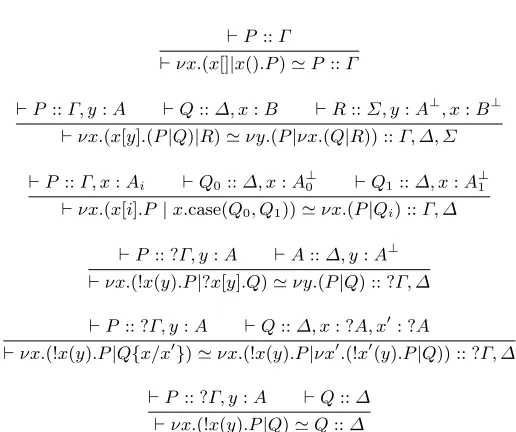
We now use this corollary to show that the cut elimination rules of CLL and permutation rules yield observational equivalences for our operational semantics. Since we have used the standard relational semantics of CLL, which is known to be equationally sound for cut-elimination [25], all these statements are immedi-ate. The force of Corollary 2 is that these rules also translate to observational equivalences for our independently defined operational semantics.
Cut-elimination Rules Figure 5shows the rules arising from the interaction of (Cut) with itself and the (Ax) rule: (Cut) is associative and commutative, and has (Ax) as an identity element. These rules amount to the observation that one can construct a category from CLL proofs (see Melli`es [25], Section 2).
Figure 6shows the rules arising from elimination of “principal cuts”: (Cut) rule applications that are on a formula and its dual that are introduced by the two immediate premises. Oriented left-to-right, and restricted to top-level (i.e., not under a prefix), these are the rules that are taken as the reduction rules of CP by Wadler. They are also the inspiration for our evaluation rules inFigure 3. However, here these rules are observational equivalences, so we can use them anywhere in process to replace two communicating processes with the result of their communication.Figure 7 presents the rules for eliminiating non-principal cuts: (Cut) rule applications where the cut formula is not the most recently in-troduced one. These rules are also called “commuting conversion” rules because they commute input/output prefixes with applications of the (Cut) rule in or-der to expose potential interactions. The fact that these are now observational equivalences formalises the informal statement given by Wadler in Section 3.6 of [36] that these rules are justified for CP. Note that the semantics we presented in
Section 2.4does not make use of commuting conversions. It only requires imme-diate interactions between process. Since there are no channels left unconnected, there is no way for a process to get stuck.
`P ::Γ
`νx.(x[]|x().P)'P ::Γ
`P ::Γ, y:A `Q::∆, x:B `R::Σ, y:A⊥, x:B⊥
`νx.(x[y].(P|Q)|R)'νy.(P|νx.(Q|R)) ::Γ, ∆, Σ
`P::Γ, x:Ai `Q0::∆, x:A⊥0 `Q1::∆, x:A ⊥ 1
`νx.(x[i].P |x.case(Q0, Q1))'νx.(P|Qi) ::Γ, ∆
`P :: ?Γ, y:A `A::∆, y:A⊥
`νx.(!x(y).P|?x[y].Q)'νy.(P|Q) :: ?Γ, ∆
`P :: ?Γ, y:A `Q::∆, x: ?A, x0: ?A
`νx.(!x(y).P|Q{x/x0})'νx.(!x(y).P|νx0.(!x0(y).P|Q)) :: ?Γ, ∆
`P :: ?Γ, y:A `Q::∆
[image:22.612.178.436.112.328.2]`νx.(!x(y).P|Q)'Q::∆
Fig. 6.Observational Equivalences arising from elimination of principal cuts
observations on a process. If a process has a access to a pair of channels, the processes connected to the other ends of those channels must be independent, and so cannot communicate between themselves to discover which one was com-municated with first. This is why the denotational semantics of CP that we defined inSection 3does not explain processes’ behaviour in terms of traces as is more common when giving denotation semantics to process calculi [30]. The typing constraints of CP mean that there is no global notion of time: the only way that a CP process can “know” the past from the future is by receiving a bit of information via the (&) rule. Everything else that a CP process does is pre-ordained by its type.
There are a large number of equations inFigure 8due to the need to account for the permutation of each kind of prefix with itself and with every other prefix. The (⊗) rule is particularly bad due to the presence of two sub-processes, either of which may do perform the permuted action.
6
Related Work
`P ::Γ, y:A, z:C `Q::∆, x:B `R::Σ, z:C⊥
`νz.(x[y].(P|Q)|R)'x[y].(νz.(P|R)|Q) ::Γ, ∆, Σ, x:A⊗B
`P ::Γ, y:A `Q::∆, x:B, z:C `R::Σ, z:C⊥
`νz.(x[y].(P|Q)|R)'x[y].(P|νz.(Q|R)) ::Γ, ∆, Σ, x:A⊗B
`P ::Γ, y:A, x:B, z:C `Q::∆, z:C⊥
`νz.(x(y).P|Q)'x(y).νz.(P|Q) ::Γ, ∆, x:A`B
`P::Γ, x:Ai, z:C `Q::∆, z:C
⊥
`νz.(x[i].P|Q)'x[i].νz.(P|Q) ::Γ, ∆, x:A0⊕A1
`P::Γ, x:A, z:C `Q::Γ, x:B, z:C `R::∆, z:C⊥
`νz.(x.case(P, Q)|R)'x.case(νz.(P|R), νz.(Q|R)) ::Γ, ∆, x:A&B
`P:: ?Γ, y:A, z: ?C `Q:: ?∆, z: !C⊥
`νz.(!x(y).P|Q)'!x(y).νz.(P|Q) :: ?Γ,?∆, x: !A
`P ::Γ, y:A, z:C `Q::∆, z:C⊥
`νz.(?x[y].P|Q)'?x[y].νz.(P|Q) ::Γ, ∆, x: ?A
`P ::Γ, z:C `Q::∆, z:C⊥
`νz.(x().P|Q)'x().νz.(P|Q) ::Γ, ∆, x:⊥
Fig. 7.Observational Equivalences arising from elimination of non-principal cuts (com-muting conversions)
Just as the Iron Curtain during the Cold War lead to the same work being done twice, once in the East and once in the West, the existence of two logically-based session-typed concurrency formalisms, one logically-based on Intuitionistic Linear Logic (ILL) [9], and one based on Classical Linear Logic, means that analogous work is performed on both sides. (Indeed, ILL has both left and right rules for each connective, meaning that working with ILL-based formalisms already dou-bles the amount of work one needs to do.) Notions of observational equivalence and logical relations for πDILL have already been studied by P´erez et al. [27]. P´erez et al. use logical relations to prove strong normalisation and confluence for their session-typed calculus based on ILL, and define a notion of observational equivalence between session-typed processes, based on bisimulation. They prove observational equivalences based on the (Cut)-elimination rules of their calculus, analogous to ones we proved in the previous section.
equiv-` x().x0().P 'x0().x().P
` x().x0[y0].(P|Q)'x0[y0].(x().P|Q) ` x().x0[y0].(P|Q)'x0[y0].(P|x().Q) ` x().x0(y0).P 'x0(y0).x().P
` x().x0[i].P 'x0[i].x().P
` x().x0.case(P, Q)'x0.case(x().P, x().Q) ` x().?x0[y0].P '?x0[y0].x().P
` x[y].(x0[y0].(P|Q)|R)'x0[y0].(x[y].(P|R)|Q) ` x[y].(x0[y0].(P|Q)|R)'x0[y0].(P|x[y].(Q|R)) ` x[y].(P|x0[y0].(Q|R))'x0[y0].(Q|x[y].(P|R)) ` x[y].(x0(y0).P|Q)'x0(y0).x[y].(P|Q) ` x[y].(P|x0(y0).Q)'x0(y0).x[y].(P|Q) ` x[y].(x0[i].P|Q)'x0[i].x[y].(P|Q) ` x[y].(P|x0[i].Q)'x0[i].x[y].(P|Q)
` x[y].(x0.case(P, Q)|R)'x0.case(x[y].(P|R), x[y].(Q|R)) ` x[y].(P|x0.case(Q, R))'x0.case(x[y].(P|Q), x[y].(P|R)) ` x[y].(?x0[y0].P|Q)'?x0[y0].x[y].(P|Q)
` x[y].(P|?x0[y0].Q)'?x0[y0].x[y].(P|Q) ` x(y).x0(y0).P 'x0(y0).x(y).P
` x(y).x0[i].P 'x0[i].x(y).P
` x(y).x0.case(P, Q)'x0.case(x(y).P, x(y).Q) ` x(y).?x0[y0].P '?x0[y0].x(y).P
` x[i].x0[j].P 'x0[j].x[i].P
` x[i].x0.case(P, Q)'x0.case(x[i].P|x[i].Q) ` x[i].?x0[y0].P '?x0[y0].x[i].P
`x.case(x0.case(P, Q), x0.case(R, S))'x0.case(x.case(P, R), x.case(Q, S)) ` x.case(?x0[y0].P,?x0[y0].Q)'?x0[y0].x.case(P, Q)
[image:24.612.157.455.113.437.2]` ?x[y].?x0[y0].P '?x0[y0].?x[y].P
Fig. 8.Permutation of communication along independent channels
alences requires the construction of the appropriate bisimulation relation. In contrast, our denotational technique for proving equivalences is much more ele-mentary, involving only simple set theoretic reasoning. Moreover, their technique requires additional proofs that their definition of observational equivalence is a congruence, a fact that is immediate in our definition.
P´erez et al. go further than we have done in also proving that their calculus is strongly normalising and confluent, using a logical relations based proof. As we discussed inSection 3.4, it is possible to use a coherence space semantics to prove determinacy, and we conjecture that totality spaces can prove termination.
7
Conclusions and Future Work
We have introduced an operational semantics for Wadler’s CP calculus that agrees with the standard relational semantics of CLL proofs. We have been able to show that the (Cut)-elimination rules of CLL are precisely observational equivalences with respect to our operational semantics. We view this work as a crucial step in treating CP as a foundational language of structured communi-cation. We now highlight some areas of research that we have opened up. Refined Denotational Semantics for CP As we discussed in Section 3.4, there is a close connection between semantics of CLL that assign cliques to proofs and the operational properties of the corresponding processes. Further refine-ments of the relational semantics, beyond coherence spaces, such as Loader’s totality spaces [22] and Ehrhard’s Finiteness spaces [13], should yield insights into the operational behaviour of CP and its extensions with features such as non-determinism. Laird et al. [19]’s weighted relational semantics interprets pro-cesses as semiring-valued matrices. This could be used to model a variant of CP with complexity measures. Probabilistic Coherence Spaces, introduced by Danos and Ehrhard [11], are another refinement that model probabilistic computation. Recursive Types for CP In this paper, we have only investigated the basic fea-tures of CP. Extensions of CP with recursive types, based on the work in CLL by Baelde [5], have been carried out by Lindley and Morris [21]. Extension of our operational semantics and the denotational semantics with recursive types is an essential step in turning CP into a more realistic language for structured communication. Constructing concurrency features on CP may be possible by allowing racy interleaving of clients and servers expressive via recursive types. Dependent Types for CP More ambitiously, we intend to extend CP with de-pendent types. Dede-pendent types for logically-based session-typed calculi have al-ready been investigated by Toninho, Caires and Pfenning [33] and Toninho and Yoshida [34]. However, these calculi enforce a strict separation between data and communication: there are session types Πx:τ.A(x) and Σx:τ.A(x) which correspond to receiving or transmitting a value of value type τ. Taking inspi-ration from McBride’s investigation of the combination of linear and dependent types [24], we envisage a more general notion of session-dependent session type (x:A)BB, where the value ofxinBis determined by the actual observed data transferred in the session described byA. This type is a dependent generalisation of Retor´e’s “before” connective [29]. To make this idea work, we need a notion of observed communication in CP, which the observed communication semantics proposed in this paper provides.
Acknowledgements
References
1. S. Abramsky. Computational interpretations of linear logic. Theoretical Computer Science, 111:3–57, 1993.
2. Samson Abramsky. Proofs as processes. Theor. Comput. Sci., 135(1):5–9, April 1992.
3. Beniamino Accattoli. Linear logic and strong normalization. In24th International Conference on Rewriting Techniques and Applications, RTA 2013, June 24-26, 2013, Eindhoven, The Netherlands, pages 39–54, 2013.
4. Robert Atkey, Sam Lindley, and J. Garrett Morris. Conflation confers concurrency. In Sam Lindley, Conor McBride, Phil Trinder, and Don Sannella, editors,A List of Successes That Can Change the World: Essays Dedicated to Philip Wadler on the Occasion of His 60th Birthday, Lecture Notes in Computer Science, 2016. 5. David Baelde. Least and greatest fixed points in linear logic.ACM Trans. Comput.
Logic, 13(1):2:1–2:44, January 2012.
6. Michael Barr. *-autonomous categories and linear logic. Mathematical Structures in Computer Science, 1(2):159–178, 1991.
7. Gianluigi Bellin and Philip J. Scott. On theπ-Calculus and linear logic.Theoretical Computer Science, 135(1):11–65, 1994.
8. Martin Berger, Kohei Honda, and Nobuko Yoshida. Genericity and the pi-calculus. InProc. FOSSACS’03, 2003.
9. Lu´ıs Caires and Frank Pfenning. Session types as intuitionistic linear propositions. InCONCUR. Springer, 2010.
10. Haskell B. Curry. Functionality in combinatory logic. Proceedings of the National Academy of Science, 20:584–590, 1934.
11. Vincent Danos and Thomas Ehrhard. Probabilistic coherence spaces as a model of higher-order probabilistic computation. Inf. Comput., 209(6):966–991, 2011. 12. B. A. Davey and H. A. Priestley. Introduction to Lattices and Order. Cambridge
University Press, 2nd edition, 2002.
13. Thomas Ehrhard. Finiteness spaces. Mathematical Structures in Computer Sci-ence, 15(4):615–646, 2005.
14. Thomas Ehrhard and Olivier Laurent. Interpreting a finitary pi-calculus in differ-ential interaction nets. Inf. Comput., 208(6):606–633, 2010.
15. Simon J. Gay and Vasco T. Vasconcelos. Linear type theory for asynchronous session types. Journal of Functional Programming, 20(01):19–50, 2010.
16. Jean-Yves Girard. Linear logic. Theoretical Computer Science, 50:1–101, 1987. 17. Kohei Honda. Types for dyadic interaction. InCONCUR. Springer, 1993. 18. William A. Howard. The formulae-as-types notion of construction. In Jonathan P.
Seldin and J. Roger Hindley, editors,To H.B. Curry: Essays on Combinatory Logic, Lambda Calculus and Formalism, Boston, MA, 1980. Academic Press.
19. Jim Laird, Giulio Manzonetto, Guy McCusker, and Michele Pagani. Weighted relational models of typed lambda-calculi. In28th Annual ACM/IEEE Symposium on Logic in Computer Science, LICS 2013, New Orleans, LA, USA, June 25-28, 2013, pages 301–310, 2013.
20. Sam Lindley and J. Garrett Morris. A semantics for propositions as sessions. In ESOP 2015, pages 560–584, 2015.
21. Sam Lindley and J. Garrett Morris. Talking bananas: structural recursion for session types. InICFP, 2016. To appear.
23. Damiano Mazza. The true concurrency of differential interaction nets. Mathemat-ical Structures in Computer Science, 2015. To appear.
24. Conor McBride. I got plenty o’ nuttin’. InA List of Successes That Can Change the World - Essays Dedicated to Philip Wadler on the Occasion of His 60th Birthday, pages 207–233, 2016.
25. Paul-Andr´e Melli`es. Categorical semantics of linear logic. In Pierre-Louis Curien, Hugo Herbelin, Jean-Louis Krivine, and Paul-Andr´e Melli`es, editors, Interac-tive Models of Computation and Program Behavior, number 27 in Panoramas et Synth`eses. Soci´et´e Math´ematique de France, 2009.
26. Robin Milner and Davide Sangiorgi. Barbed bisimulation. In W. Kuich, edi-tor,Automata, Languages and Programming: 19th International Colloquium Wien, Austria, July 13–17, 1992 Proceedings, pages 685–695, Berlin, Heidelberg, 1992. Springer Berlin Heidelberg.
27. Jorge A. P´erez, Lus Caires, Frank Pfenning, and Bernardo Toninho. Linear logical relations and observational equivalences for session-based concurrency.Information and Computation, 239:254 – 302, 2014.
28. Gordon D. Plotkin. LCF considered as a programming language. Theor. Comput. Sci., 5(3):223–255, 1977.
29. Christian Retor´e. Pomset logic: a non-commutative extension of classical linear logic. In In proceedings of TLCA’97, volume 1210 of Lecture Notes in Computer Science, pages 300–318, 1997.
30. A. W. Roscoe. The Theory and Practice of Concurrency. Prentice Hall, 1998. 31. Davide Sangiorgi and David Walker.The Pi-Calculus - a theory of mobile processes.
Cambridge University Press, 2001.
32. Ian Stark. A fully abstract domain model for the pi-calculus. InProceedings, 11th Annual IEEE Symposium on Logic in Computer Science, New Brunswick, New Jersey, USA, July 27-30, 1996, pages 36–42, 1996.
33. Bernardo Toninho, Lu´ıs Caires, and Frank Pfenning. Dependent session types via intuitionistic linear type theory. In Proceedings of the 13th International ACM SIGPLAN Conference on Principles and Practice of Declarative Programming, July 20-22, 2011, Odense, Denmark, pages 161–172, 2011.
34. Bernardo Toninho and Nobuko Yoshida. Certifying data in multiparty session types. InA List of Successes That Can Change the World - Essays Dedicated to Philip Wadler on the Occasion of His 60th Birthday, pages 433–458, 2016. 35. Philip Wadler. Propositions as sessions. InProceedings of the 17th ACM SIGPLAN
![Figure 3 makes use of the shorthand notation C[−] to indicate that the matchedprocesses involved in each rule may appear anywhere in a configuration.](https://thumb-us.123doks.com/thumbv2/123dok_us/1430233.95597/10.612.221.389.428.479/figure-shorthand-notation-indicate-matchedprocesses-involved-appear-conguration.webp)