Back in June 2008, the ZHAW Centre Alternative Investments & Risk Management launched its first survey on single hedge funds in Switzerland, which was then updated in September 2010. With the present report, by way of a major innovation, the authors have tried to assess the structure and development of the Swiss hedge fund industry not so much from the perspective of an investor, but in terms of market content and outlook. In order to provide comprehensive insight into the overall world of hedge funds in Switzerland, the managers of funds of hedge funds and the managers of single hedge funds operating out of Switzerland were asked to complete a detailed questionnaire. The ZHAW Centre Alternative Investments & Risk Management has ensured that the survey is independent and that the results of the individual questionnaires have been kept strictly confidential.
This comprehensive report was made possible through a dedicated financial contribution from Banque Privée Edmond de Rothschild S.A., Geneva. Our thanks are addressed to the representatives of this bank as well as to the members of the TCF (The Swiss Council of Hedge Funds) and the TCQ (Transparency Club FoHF for Qualified Investors), who have made it possible to maintain a high and persistent level of public transparency for hedge funds since 2002.
25 September, 2012
Research and analysis
Regina Anhorn Peter Meier
Statistical support
Patrick Dütsch Christian Räber
ZHAW Zurich University of Applied Sciences School of Management and Law
Table of Contents
Executive Summary
1
Chapter I: Hedge Fund Industry - Facts and Figures
3
1.
Global context
3
2.
The hedge fund industry in Switzerland
5
Chapter II: Swiss Hedge Fund Survey 2012
15
1.
Survey approach
15
2.
Who are the Swiss hedge funds?
17
3.
Who are the clients of the Swiss hedge funds?
19
4.
What has changed after the 2008 crisis?
23
5.
What are the implications for the financial centre of Switzerland?
24
6.
What is the impact of regulation?
29
7.
Where to go from here?
33
Conclusion
37
Appendix
A.
Questionnaire
39
B.
About Banque Privée Edmond de Rothschild S.A., Geneva
46
About ZHAW Centre Alternative Investments & Risk Management
46
C.
Glossary
47
D.
Bibliography
48
Abbreviations
AIF Alternative Investment Fund
AIFM Alternative Investment Fund Managers
AIFMD Alternative Investment Fund Managers Directive
AIMA Alternative Investment Management Association
AuM Assets under Management
CISA Collective Investment Schemes Act
CISO Swiss Collective Investment Schemes Ordinance by the Federal Council
CTA Commodity Trading Advisor (hedge fund strategy)
CVaR Conditional Value at Risk
EEA European Economic Area
ESMA European Sales and Marketing Association
FINMA Swiss financial market supervisory authority
FoHF Fund of hedge funds
FSA Financial Services Authority (UK)
FCP Investment Fund with a Variable Number of Units
HFR Hedge Fund Research, Inc.
KIID Key Investor Information Document
NAV Net Asset Value
Q.I. Qualified Investor
Reg. (Swiss) registered
SFA Swiss Funds Association
SFoHFI hedgegate Swiss FoHF Index (SFoHFI)
SICAF Société d’Investissement à Capital Fixe (Investment Company with Fixed Capital)
SICAV Société d’Investissement à Capital Variable (Investment Company with Variable Capital) SHF Single hedge funds
SIX Swiss Exchange (Schweizer Börse)
SIC Swiss investment company
SIF Specialized investment fund
TCF The Swiss Council of Hedge Funds
TCQ Transparency Club FoHF for Qualified Investors
Executive Summary
FoHF market share maintained; no progress (yet) on the SHF front
In spite of the negative impact of the financial crisis, we estimate that the “Swiss content” of the 50 largest funds of hedge funds (FoHF) providers as per January 2012 remained at around the 30% level. If we take into consideration only those institutions which are listed or headquartered in Switzerland, the Swiss market share stands at 22%. The position of the Swiss single hedge funds (SHF) within Europe, on the other hand, with a market share of only 5% (source: Eurohedge/TheCityUK estimates) has remained unchanged for the last few years.
Hedgegate - information platform for funds of hedge funds in Switzerland
The number of Swiss-registered funds of hedge funds listed on Hedgegate has nearly halved from its peak and has levelled off at a figure of 170 (June 2012). By contrast, the number of FoHF for qualified investors registered on Hedgegate nearly doubled between year-end 2008 and June 2012 to stand at 339. As per mid-year 2012, the top five institutions for Swiss-registered FoHF managed 65% of the total peer group assets, which is comparable to what we see within the global hedge fund industry.
The ZHAW survey – reflecting FoHF assets of USD 130 billion
In order to provide comprehensive insight into the overall world of hedge funds in Switzerland, the managers of funds of hedge funds and the managers of single hedge funds operating out of Switzerland were asked to complete a detailed questionnaire. The results of the survey reflect the weight of some of the major hedge fund representatives in the (Swiss) FoHF industry. Given the challenging financial environment and the complexity of the questionnaire, the FoHF response rate of over 80% of FoHF assets with a major Swiss content can be judged as good.
In the single hedge fund area, participants in the ZHAW survey manage a total of USD 85 billion worth of assets. This amount not only reflects Swiss activity in the single hedge fund area, but also the global activities of the providers.
Institutionalization is high on the agenda
For 90% of the participants “Marketing and Sales” are the key functions carried out in Switzerland, followed by “Fund Management” and “Client Services” (response rates at 80%).
The survey confirms the trend towards growing institutionalization. Nearly two-thirds of the participants in the survey are charging their institutional clients a management fee of a maximum of 1%, against 1.5% on the private client side. Sometimes there is a substantial bandwidth, indicating further room for negotiation with the investors.
New products, more staff as an answer to financial and regulatory pressure
The growing regulatory pressure was cited as the key challenge influencing the respondents' business following the financial crisis. Additional key factors were the lack of confidence on the retail/private client side, the increasing demand for liquid products and the growing need for operational infrastructure.
From the long list of possible company and fund changes following the financial crisis, the setting up of new funds or the offering of new products (mainly UCITS structures) were the changes cited most frequently. Increasing the headcount was also fairly high on the agenda.
Respondents ask for more constructive regulatory framework in Switzerland
The proximity to investors has been identified as the key reason why Switzerland has attracted hedge funds. Personal reasons and the quality of life play a major role as well.
When asked which factors might help to increase the attractiveness of Switzerland, the verdict was clear: 90% of respondents ask for a more constructive regulatory framework for hedge fund operations in Switzerland.
With an overwhelming majority of votes, the AIFMD (Alternative Investment Fund Managers Directive) and its impact on Switzerland represents the key uncertainty on the regulatory side. The role of the Swiss regulator in general constitutes a key uncertainty as well.
Patchy pattern in terms of AuM development among the individual institutions
The pattern of AuM development since 2008 has been a fairly patchy one. On the other hand, respondents expressed their optimism for future growth: 47% of the respondents expect AuM to grow by over 20% over the next three years.
Key worries: instable markets and scepticism vis-à-vis FoHF
Overall, what worries Swiss hedge fund managers most at this stage is the current instability of the financial markets. Nearly equally as challenging are the lack of confidence from investors in general and the growing scepticism from investors vis-à-vis funds of hedge funds in particular.
Market consolidation to continue; SHF expected to grow more than FoHF
80% of the Swiss hedge fund managers questioned are convinced that, over the next three years, single hedge funds will grow faster than funds of hedge funds, as institutional investors have become more sophisticated, thus preferring direct investments with better control and lower fees. There is a general conviction that the consolidation trend in the industry will continue.
Chapter I: Hedge Fund Industry - Facts and Figures
1. Global context
1.1. Assets under management
As per year-end 2011, the assets under management of the global hedge fund industry amounted to USD 1,902 billion, down 3% on 2011. However, the net asset inflow seen during 2011 was more than offset by a 4.6% performance loss, the first year of negative returns in the last three years.
The number of hedge funds totalled over 9,800 at the end of 2011, with new hedge fund launches outpacing fund liquidations for the second year in a row. Three quarters of the funds were single hedge funds and the remainder funds of hedge funds. The 2011 total was still below the peak of more than 10,000 in 2007.
Fig. 1: Global hedge fund industry
Source: TheCityUK estimates based on Eurekahedge data for 2011
1.2. Management location
Hedge funds are predominantly managed from onshore locations. The US is the dominating location for hedge funds, managing around 70% of global assets in 2011. Over the past decade Europe has nearly doubled its share, whereas the share of assets from other regions has remained more or less unchanged.
Fig. 2: Management location of global hedge fund assets
1.3. Funds of hedge funds
At the end of 2011, the assets of global funds of hedge funds amounted to USD 520 billion, or 27% of the global hedge fund assets under management. This represented a 5% decline compared with 2010 and is around 40% below the peak reached in 2007. The breakdown by manager location shows that 25% of the assets were managed from the UK. The US was the most popular location with around 30% of the market. The still impressive “Swiss content” of FoHF providers is illustrated in greater detail on page 7.
Fig. 3: Global funds of hedge funds industry
Source: TheCityUK estimates, 2012
1.2. Asset flows
2011Hedge funds experienced a USD 70 billion inflow of new capital during 2011. There was some USD 150 billion in fund inflows during the first half of the year, representing a continuation of the trend seen in the latter part of 2010. The second half of 2011, however, saw a net outflow of USD 80 billion, largely a result of increasing concerns about the European debt crisis.1
H1 2012
According to the HFR Global Hedge Fund Industry Report for Q2 2012, investors continued to allocate new capital to the hedge fund industry in H1 2012, with a clear preference for strategies with a fairly low exposure to global equity markets, allocating USD 4.1 billion in net new capital. This brought the net inflows in H1 2012 to over USD 20 billion. However, because of the negative performance experienced in Q1 2012 (HFRI Fund Weighted Composite Index down 2.7%), total hedge fund assets decreased by 1.3% to USD 2.10 trillion, despite the inflow. Inflows in H1 2012 exceeded the USD 8.5 billion inflow in H2 2011 but represented only approximately one-third of the USD 62 billion in net inflows for H1 2011. Inflows have been concentrated in the industry’s largest firms for a number of quarters already: in Q2 2012 alone, USD 11 billion was allocated to firms with an AuM base of over USD 5 billion. On the other hand, providers with less than USD 5 billion in assets suffered net redemptions amounting to USD 6.9 billion.
1
2. The hedge fund industry in Switzerland
2.1. Swiss hedge fund centres
As a result of Switzerland’s rather decentralised structure, the domestic hedge fund industry is concentrated in three centres spread over the country. These are: • Zurich, Pfäffikon, Zug and surrounding areas in the German-speaking region • Geneva, Nyon and Lausanne in the French-speaking part of Switzerland
•
Lugano in the Italian-speaking region•
Others: St. Gallen, Schaffhausen, Neuhausen2.1.1. Zurich, surrounding area
According to the Swiss Bankers Association, the value of services created by the finance sector in the Zurich region amounts to CHF 30 billion (2010). As a result, Zurich is the third-largest financial centre in Europe, behind London (CHF 94 billion) and Paris (CHF 65 billion). The value added represents 22% of the regional GDP, compared to a Swiss average of 12%. This means that the region is highly dependent on the financial sector. Only Luxembourg has a higher regional concentration (26%).2
According to a study on the “Financial Centre Zurich 2011”, initiated by the Economics Department of the Canton of Zurich and edited by BAK BASEL, the region of Zurich has attracted many financial service organisations in past years, and, in particular, a disproportionately high number of investment funds and representatives of foreign funds. Among these, we have identified a growing number of hedge funds, which has resulted in the gradual creation of a “critical mass” of institutions. These “clusters” have managed to boost the development. One of the latest arrivals is the London/Oxford-based hedge fund company, Winton Capital Management, whose flagship fund was one of the most popular products in Europe in 2011. The fund manager aims is to expand its scientific research activity.3
However, according to this same report (in which the ZHAW Centre of Alternative Investments & Risk Management has been involved in an advisory capacity), the outlook for the financial centre of Zurich hardly sounds optimistic, especially not for 2012. In the basis scenario, growth is expected to be 1% p.a. only, which would be clearly below the growth rate of other industries in Switzerland. As far as employment is concerned, BAK BASEL even expects shrinkage of 0.3% p.a. This means that, for the foreseeable future, the financial sector would only grow to a disproportionately low level in the Zurich region in terms of value added and employment.
2.1.2. Pfäffikon, surrounding area
According to a study conducted by the BAK BASEL in 2011 on behalf of the Office of Economic Affairs of Canton Schwyz, the financial sector in Schwyz has, over the past decade, been able to increase its gross added value by 6.1% annually. Compared to the national average rate of a modest 0.6%, this growth rate looks rather impressive.4 By comparison with the other five cantons of relevance in terms of the financial sector (Zurich, Zug, Geneva, Ticino, Basel), the financial sector in Schwyz looks very strong. This above-average growth in the financial sector is mainly the result of the rapid development of the fund sector. Between 2000 and 2010, the sector “Other financial services”, to which investment funds belong, grew by 20% annually between 2000 and 2010. As already illustrated for the Zurich region, these growth rates are not sustainable for the foreseeable future, however.
2
Swiss Bankers Association, July 2012 3
Kanton Zürich, January 2012 4
In terms of employment, the financial sector in Schwyz also demonstrated superior development compared to Switzerland as a whole: the number of persons employed in the financial sector in Schwyz increased by 6.3% on average between 2000 and 2010, whilst the national average for the industry rose by 1.5%. Again, fund management experienced strong expansion over the last ten years.
Pfäffikon has one of the lowest tax rates in Switzerland (see page 28 for details), which is regarded as one of the key factors for the local growth of the fund industry over the past decade.
2.1.3. Zug and Baar
Today, Zug is the richest canton in Switzerland, with a low cantonal unemployment rate. Zug offers pronounced fiscal attractions, its educational level is above average, and it enjoys good transportation links by virtue of its location on the north/south routes. It is a highly international canton: about a quarter of the canton’s population are non-Swiss, and 88% of these come from Europe, mainly from Germany. The opening of the A4 highway in Knonaueramt in November 2009 brought Zug closer to the metropolis of Zurich. The tax levy on corporate profits is 15% for ordinary companies and 8.8% for privileged companies. This compares to 21% in Switzerland overall. Certain companies qualify for tax privileges.
2.1.4. Geneva, Lausanne, Nyon, St-Blaise, Chambesy and Chebres
Industry specialists estimate that approximately 40% of the USD 3,000 billion of assets managed in Switzerland are directly or indirectly controlled from Geneva. Some 35% of the world's private assets deposited outside the country of domicile are managed from Switzerland. The two major Swiss banks have the largest proportion of their assets under management in Geneva.
Until recently, in terms of migration, Geneva had been the destination of choice for a number of major hedge fund institutions. In 2007, Phillippe Jabre opened a new hedge fund in Geneva. The fund was one of the largest new launches in recent years. Alan Howard, the founder of Brevan Howard Asset Management, Europe’s largest hedge fund, moved to the firm’s newly opened Geneva office in 2010. Brevan Howard manages almost USD 30 billion, making it the fourth-largest hedge fund manager in the world. Brevan Howard is not alone in opening offices abroad. BlueCrest Capital (AuM: USD 19 billion) has also opened a Geneva office. The momentum has cooled down of late, however, not least as a result of the regulatory uncertainty.
2.1.5. Ticino (Lugano)
Lugano is the 10th largest financial centre in the world. Assets under management by hedge fund managers operating in the Canton of Ticino total an estimated CHF 10 billion, almost half of which is in single hedge funds.5 The tax treatment applicable to a hedge fund manager varies as a function of how its activities are legally structured. The considerable flexibility of the “Ticino system” enables new taxpayers to get in touch with the tax authority, evaluate their positions as taxpayers, and then determine ad hoc solutions through the agreement of the parties. This means that, on the whole, managers can benefit from a tax treatment that is highly competitive by comparison with many other European and international environments, as well as from the flexibility and efficiency that the Swiss tax system guarantees.
5
Rank Firm AuM Rank Firm AuM
in USD bn in USD bn
1 Blackstone Alternative Asset Mgmt 39.0 25 EnTrust Capital 7.2
2 HSBC Alternative Investments 29.7 25 GAM 7.2
3 UBS, Alt. and Quantitative Investments 27.0 28 Fauchier Partners 7.0 4 Goldman Sachs Hedge Fund Strategies 22.8 29 Rock Creek Group 7.0
5 Grosvenor Capital Mgmt 22.7 30 Arden Asset Mgmt 6.8
6 Permal Group 20.0 31 Crestline Investors 6.4
7 BlackRock Alt. Advisors 16.8 32 Hall Capital Partners 6.4
8 Pacific Alt. Asset Mgmt Co. 15.1 33 Aetos Alt. Mgmt 6.2
9 Mesirow Advanced Strategies 14.3 34 E.I.M. 6.2
10 Morgan Stanley Alt. Inv. Partners 13.0 35 Axa Inv. Managers 6.0
11 Man Group 12.9 36 SkyBridge Capital 5.9
12 Lyxor Asset Mgmt 12.0 37 Silver Creek Capital Mgmt 5.8
13 Union Bancaire Privée 11.7 38 Lighthouse Partners 5.6
14 Credit Suisse Asset Mgmt 10.7 39 Diversified Global Asset Mgmt Corp. 5.6
15 Aurora Inv. Mgmt 10.2 40 Brummer & Partners 5.3
16 Edmond de Rothschild Group 10.0
17 K2 Advisors 10.0 41 Banca del Ceresio 5.1
18 Amundi Alt. Investments 9.6 42 LGT Capital Partners 5.0
19 Pictet Alt. Investments 9.4 43 Aberdeen Asset Mgmt. 4.9
20 Morgan Creek Capital Mgmt 8.8 44 Schroders NewFinance Capital 4.5
21 J.P. Morgan Alt. Asset Mgmt 8.7 45 Notz, Stucki & Cie 4.4
22 Financial Risk Mgmt 8.7 46 Abbey Capital 4.3
23 Prisma Capital Partners 7.4 48 Harcourt Investment Consulting 4.2
24 Gottex Fund Mgmt 7.3 49 Archstone Partnerships 4.1
25 BlueCrest Capital Mgmt 7.2 50 Unigestion 3.7
Total top 50: USD 503 bn Major Swiss content in top 50: 32% of the total Market share of firms listed/headquarter in Switzerland: 22%
2.2. Swiss funds of hedge funds
2.2.1. Market position
Funds of hedge funds have been a major business in Switzerland since the first of these funds was launched offshore by Banque Privée Edmond de Rothschild S.A. in 1969, and the first structures onshore were launched in the early 1980s. What still differentiates Switzerland from other centres is the established culture of institutional asset management, private banking and family offices.
According to the annual ranking of the “Institutional Investor”, the world’s 50 biggest funds of hedge funds represent a combined asset base of over USD 500 billion (as per January 2012).6 USD 220 billion was in the hands of the 10 largest FoHF managers, only marginally down on January 2011. According to the list, Blackstone has emerged as the largest fund of hedge funds group in the world, whereas UBS ranks in third place, as was the case in the previous year already. Five major institutions – either Swiss or with a high Swiss content – exceed the USD 10 billion level. In spite of the negative impact of the financial crisis, we estimate that the Swiss “content” of worldwide funds of hedge funds has remained at around the 30% mark. If we take into consideration only those institutions which are listed or headquartered in Switzerland, then the Swiss market share stands at 22% billion (see table 1).
Tbl. 1:Swiss content of the 50 largest FoHF providers as per January 2012
Source: Institutional Investor, estimates ZHAW
6
Number of funds of hedge funds (FoHF) Dec. 07 Dec. 08 Dec. 09 Dec. 10 Dec.11 June 12
Swiss registered FoHF 244 305 224 184 182 169
Investment foundations 5 4 4 4 4 4
Investment companies 6 4 3 3 3 3
FoHF for qualified investors 116 178 138 187 268 339
TOTAL active funds 371 491 369 378 457 515
TOTAL funds in database (incl. liquidated FoHF) 480 630 652 782 829 1003
2.2.2. Hedgegate
The Hedgegate web portal (www.hedgegate.com) has established itself as THE information platform for Swiss funds of hedge funds. Hedgegate has been authorized by FINMA as an official publication organ.
The database takes in the following product categories:
Approved domestic funds in Switzerland (other funds with a special risk) Foreign funds allowed to be distributed in Switzerland (other funds with a
special risk)
Investment companies (traded at the Six Swiss Exchange)
FoHF for qualified investors (not permitted for public distribution in Switzerland) Between 1996 and 2008, the number of Swiss-registered FoHF grew steadily to 305, thus trebling over the last four years of the period. However, as a result of numerous liquidations in the aftermath of the financial crisis, the number of funds has nearly halved from its peak, levelling off at a figure of 170 (June 2012).
On the other hand, requests for registration on hedgegate by FoHF for qualified investors started to increase again in 2010, with an accelerated trend in H1 2012. Since year-end 2009, the number has nearly doubled and stood at 339 as per June 2012. As per mid-year 2012, the number of active funds as a percentage of total funds in the database was only 51%, reflecting the sharp increase in liquidated funds over the last three years (see table 2 for details).
Tbl. 2: Hedgegate listings
Source: ZHAW/Hedgegate
2.2.3. Legal form of Swiss-registered FoHF
As Fig. 4 illustrates, foreign funds of hedge funds represent 72% of total AuM, against a modest 16% in Swiss FoHF. Only three years ago, the breakdown was considerably more balanced, with foreign funds representing less than 50% of total AuM. This indicates that among the Swiss funds the number of liquidations was significantly higher than among the foreign funds.
Fig. 4: AuM breakdown Swiss-reg. FoHF by legal form
Source: ZHAW/Hedgegate
The three remaining investment companies, Castle Alternative Invest AG, Altin AG and Absolute Invest AG, are still listed on the Swiss Stock Exchange. As per year-end 2011, they represented 9% of Swiss industry assets, which represents a sharp loss of market share over the last decade. At the start of 2001 they had represented over 40% of industry assets.
2.2.4. Domicile
Among the Swiss-registered FoHF, the preferred fund domicile back in 2003 used to be Switzerland, representing over 60% of assets under management. This is no longer the case: the weighting has diminished to a modest 28% of assets under management, while, over this same period, the importance of Luxembourg has more than doubled to nearly 49%. In the case of FoHF for qualified investors, the Cayman Islands are the preferred domicile, with a share of 47%.
Fig. 5: AuM breakdown Swiss-reg. FoHF according to domicile
Swiss-registered FoHF FoHF for qualified investors
The rapid decline in Switzerland’s position as a fund domicile for Swiss-registered FoHF is not really a big surprise. Luxembourg and Ireland are by far the largest foreign domiciles of funds authorized in Switzerland. Following the financial crisis, an increasing number of fund managers have no longer opted for Switzerland as a domicile for their new funds; this even more so as getting registered became increasingly difficult.
2.2.5. Assets under management - Swiss-registered FoHF
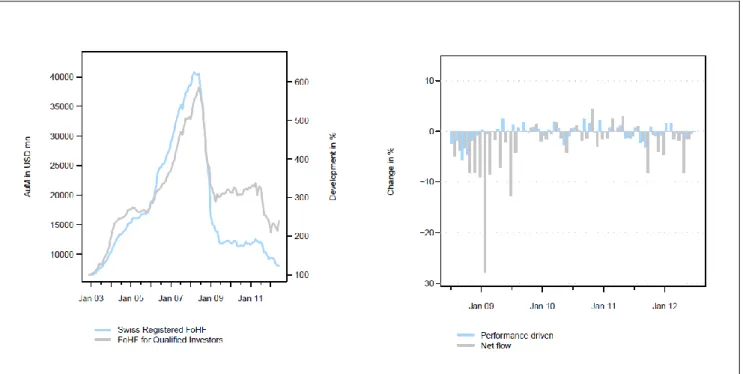
While 2010 was marked by a stabilization of the asset base, at albeit rather low levels, the downsizing process started in 2011. According to our estimates, this resulted in a more than 20% reduction in AuM, two thirds of which was due to net capital outflows. In H1 2012, assets have continued to shrink by over 10% and now amount to clearly below USD 10 billion. This development has been driven exclusively by net outflows, especially in the month of April 2012. This does not mean, however, that Swiss investors and providers are remaining passive, as activities have increasingly been shifted towards FoHF products for qualified investors and to non-visible managed accounts, hedge fund platforms or UCITS. Fig. 6: AuM and net flows of Swiss FoHF
2.2.6. Top Ten providers of FoHF in Switzerland
As per mid-year 2011, the top five institutions for Swiss-registered FoHF represented 65% of total industry assets, and the “top two” controlled 53% of these. This is comparable to what we see within the global hedge fund industry. According to Hedge Fund Research, Inc. (December 2011), 5% of the global universe of hedge fund managers control over 78% of all assets invested in hedge funds.
Fig. 7: Swiss registered FoHF: Top Ten providers by AuM
Source: ZHAW/Hedgegate
In the case of Swiss-registered FoHF, the gap between the “top two” and the other providers has become significant, as is illustrated by Fig. 7. But only Banque Privée Edmond de Rothschild has managed to grow its asset base since the beginning of 2009. As a result, the Geneva-based institution now represents over 36% of the asset base of Swiss-registered FoHF. Thus, the financial centre of Geneva continues to play an important role as a centre for hedge funds. Interestingly enough, we see that Reichmuth & Co. Investmentfonds AG, Lombard Odier Darier Hentsch & Cie., UBS, PKB Privatbank SA and Banque Bonhote & Cie. SA are all about the same size in terms of AuM in Swiss-registered FoHF.
2.2.7. Liquidity
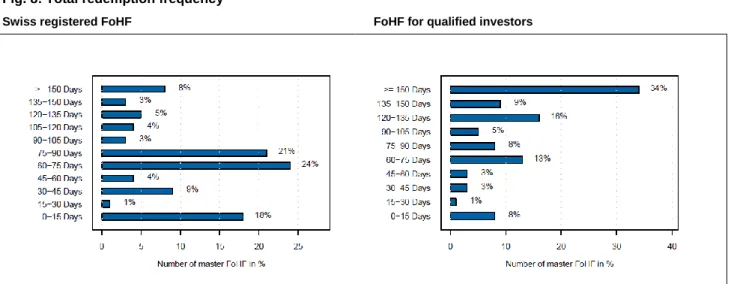
Following the financial crisis, we have not been able to detect any significant change in liquidity terms among the Swiss-registered master FoHF, with the number of funds with a total redemption frequency of a maximum of 75 days representing 56% of the total (mid-year 2012). This is close to the level as per year-end 2008. Among the products for qualified investors, the comparable ratio is even lower, amounting to only 30%. On the other hand, as Fig. 8 illustrates, the percentage of master FoHF with a total redemption frequency of 150 days or more is also considerably higher than the comparable ratio for Swiss-registered products.
We believe that what looks like a disappointment at first sight can be explained convincingly: the liquidity terms of existing products have not been adjusted, but new products in the form of UCITS, which are more liquid, have increasingly been offered. This trend is confirmed by the result of the ZHAW hedge fund survey 2012 (see page 23 for more details).
Fig. 8: Total redemption frequency
Swiss registered FoHF FoHF for qualified investors
2.3. Swiss single hedge funds
2.3.1. Market shares EuropeWhereas Switzerland has maintained its strong position for fund of hedge fund products on a worldwide basis, its position in the single hedge fund area is far less convincing. The fact that the Collective Investment Schemes Act initiated in 2006 established the limited partnership vehicle to make Switzerland more attractive as a location for hedge funds obviously did not help: So far, only a fairly small double-digit number of these limited partnerships have been established. Most hedge funds distributed in Switzerland operate on a private placement basis, as funds for qualified investors (“offshore” funds).
London continues to be the largest centre in Europe for the management of hedge funds. At the end of 2011, close to 70% of European single hedge fund assets totalling around USD 395 billion were managed out of the UK, the vast majority from London. Including fund of funds, London might even represent over 85% of hedge fund assets managed in Europe. In terms of individual funds, there were over 1,200 European-based hedge funds in 2011, some two-thirds of which were located in London. The position of the Swiss single hedge funds (SHF) within Europe, on the other hand, falls well short of this: with a market share of 5%, Switzerland ranks third, behind Sweden, where the bulk of assets are in onshore funds (Fig. 9).7
Fig. 9: European based hedge fund market
Source: Eurohedge; TheCityUK estimates, based on Eurekahedge data for 2011
What are the possible reasons for this disappointing market share? Based on our research into Swiss single hedge funds over the last five years, we have identified the following factors:
Investors seem to prefer investing in a US- or UK-based vehicle rather than in a Swiss fund. Key investment banking activities (like for instance proprietary trading) were transferred to London years ago already. Thus there might be, at least to some extent, a certain cultural gap.
Not all new hedge fund launches succeeded; some of them had to be liquidated within the first five years or had to redefine their strategy, becoming a traditional asset manager.
Many hedge fund managers claim that it is rather difficult to find specialized talents in Switzerland.
7
SHF universe estimated by ZHAW1)
Number of individual funds2) 130
Number of management companies 87
AuM in USD billion2) 24
1) Data taken as per end of March 2012, based on Eurohedge 2) Master funds only
2.3.2. Swiss Universe
Table 3 illustrates the Swiss universe of single hedge funds, based on Eurohedge numbers. Because of a lack of accessibility we have not been able to identify all funds and fund managers. Obviously, transparency is poorer than on the FoHF side. As the results of the individual questionnaires are strictly confidential, the table does not provide any indication about the participants in our survey.
Tbl. 3: Universe of single hedge funds in Switzerland
Source: Eurohedge, ZHAW estimates
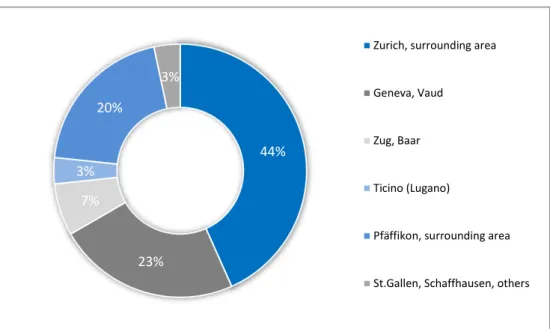
Fig. 10: Location of Swiss SHF – number of fund management companies
Source: ZHAW estimates, based on Eurohedge data
Fig. 10 illustrates the SHF clusters in terms of the number of fund management companies. According to this database, the French-speaking area outdoes Zurich in terms of the number of fund management companies. However, some of the heavyweights, like the big banks or Man Group, operate from Zurich or Pfäffikon, which puts the German-speaking part of Switzerland in a strong position.
44% 23% 7% 3% 20% 3%
Zurich, surrounding area
Geneva, Vaud
Zug, Baar
Ticino (Lugano)
Pfäffikon, surrounding area
St.Gallen, Schaffhausen, others
Chapter II: Swiss Hedge Fund Survey 2012
1. Survey approach
Back in June 2008, the ZHAW Centre Alternative Investments & Risk Management launched its first survey on single hedge funds in Switzerland, which was updated in September 2010. With the present report, as a key innovation, the authors have tried to assess the structure and development of the Swiss hedge fund industry not so much from the perspective of an individual investor, but in terms of market content and outlook. In order to provide comprehensive insight into the overall world of hedge funds in Switzerland, the managers of funds of hedge funds and of single hedge funds operating out of Switzerland were asked to complete a detailed questionnaire. The ZHAW Centre Alternative Investments & Risk Management ensured that the survey was independent and that the results of the individual questionnaires have been kept strictly confidential.
1.1. Questionnaire
The survey was conducted in the months of July and August 2012 with a questionnaire distributed by electronic mail (see appendix A on page 39 for a copy). The first reply was received on 4 July, and the last one on 27 August 2012. The questionnaire left ample scope for valuable individual remarks and suggestions on the part of the managers, which we have integrated into the report.
Fig. 11: Number of participants in the survey; breakdown according to location
Source: Hedge fund survey 2012 ZHAW
As Fig. 11 illustrates, the three major geographical hedge fund centres in Switzerland are reflected to a reasonable extent by the participants in the survey. The fact that Zurich accounts for over 40% of the number of participants in the survey reflects the presence not only of some of the large hedge fund institutions, but also of the encouraging number of Swiss offices of foreign hedge fund providers. Four years ago, in the context of the speculation about the potential arrival of London-based hedge fund managers in Switzerland, Geneva was regarded as the “hot spot”, attracting the likes of Brevan Howard. In the meantime, with less of a to-do, Zurich has attracted a number of new Zurich hedge fund offices, some of them within the FoHF area.
2% 2% 2%
19%
75%
AuM USD -500 mn AuM USD 501-1,000 mn AuM USD 1'001-5'000 mn AuM USD 5'001-10'000 mn AuM >USD 10'000 mn
1% 1%
12%
27% 59%
AuM USD -500 mn
AuM USD 501-1,000 mn
AuM USD 1'001-5'000 mn
AuM USD 5'001-10'000 mn
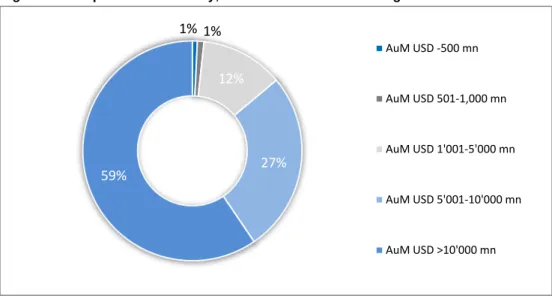
AuM USD >10'000 mn
Fig. 12: Participants in the survey; FoHF breakdown according to AuM
Source: Hedge fund survey 2012 ZHAW
The results of the survey reflect an FoHF asset base of USD 130 billion, mirroring the weight of some of the major providers. Given the challenging financial environment, the FoHF response rate of over 80% of FoHF assets with a major Swiss content can be judged as good.
Fig. 13: Participants in the survey; SHF breakdown according to AuM
Source: Hedge fund survey 2012 ZHAW
Fig. 13 mirrors the phenomenon of asset concentration in the hands of a few single hedge fund providers. This is typical for the hedge fund industry, which we have already shown in the context of Swiss-registered FoHF (page 11). The participants in our survey manage a total of USD 85 billion worth of SHF assets. This amount reflects not only the Swiss activity in the single hedge fund area but also the global activities of these providers.
Apart from the big players, average assets per company are still relatively low since the Swiss SHF industry is still in its infancy, and small teams of up to ten individuals are the key drivers of this industry.
2.
Who are the Swiss hedge funds?
2.1. Inception date and legal structure
Nearly two-thirds of the hedge fund management companies interviewed were established before 2005, reflecting their strong embedment in Switzerland. No inceptions have been recorded in the last 18 months. This is in marked contrast to the period of 2009/10, when 17% of the current companies were set up. The current standstill is cause for concern and could be due to the uncertainties related to regulation, on the one hand, and the instability of financial markets, on the other. Fig. 14: Inception date
Source: Hedge fund survey 2012 ZHAW
Fig. 15: Legal set-up of the Group
Source: Hedge fund survey 2012 ZHAW
Over half of the institutions interviewed have been set-up as independent boutiques or partnerships. And nearly a quarter represent the Swiss banking sector. As far as the Swiss offices are concerned, over 80% of the respondents
affirmed that the Swiss office had been structured as a separate legal entity, in most cases in the form of an AG (public limited company).
2.2. Functions carried out of Switzerland
Fig. 16: Which functions do you cover mainly out of Switzerland?
Source: Hedge fund survey 2012 ZHAW
Nearly 90% of the respondents stated that they run their marketing/sales functions from Switzerland. Thus, Marketing and Sales (90%), Client Services (80%) and Fund Management (80%) are the key functions carried out in Switzerland. On the other hand, other core functions such as administration and legal support are typically outsourced or conducted elsewhere.
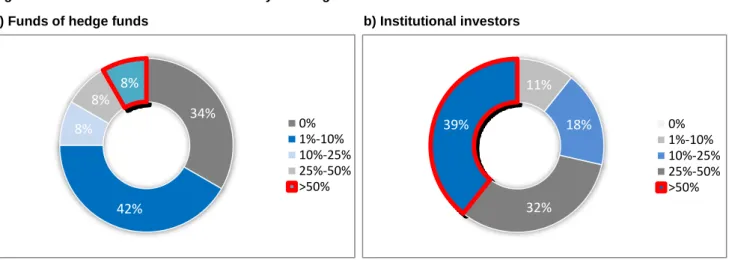
Fig. 17: What percentage of the funds’ assets belongs to the principal?
34% 42% 8% 8% 8% 0% 1%-10% 10%-25% 25%-50% >50% 11% 18% 32%
39% 0%
1%-10% 10%-25% 25%-50% >50%
The majority of the participants confirmed the entrepreneurship of their institution, investing money of their own in their hedge funds.
2.3. Fee structures
In the context of mounting criticism regarding the fee levels charged in the hedge fund industry, critics sometimes seem to operate with unrealistic numbers. In the survey we have therefore assessed the significant gap that exists between fees charged for institutional clients and those charged for private clients.
Institutional tranche: According to our survey, nearly two-thirds of the institutions providing any numbers are charging a management fee of a maximum of 1%. Only 16% are charging 2%. And over 60% have a varying performance fee of a maximum of 10%. This indicates that the “fee formula” is “1+10”. On the institutional side, we noticed that sometimes there is a substantial bandwidth, indicating further room for negotiation with the investors.
Private client tranche: Here the management fee is less advantageous: more than three-quarters of the respondents providing an input are charging a management fee of a maximum of 1.5%. On the performance fee side, there is no major gap, however, but fees tend to be fixed, contrary to the institutional tranche.
3.
Who are the clients of the Swiss hedge funds?
3.1. Breakdown of investors
Fig. 18: What is the investor breakdown in your hedge funds?
a) Funds of hedge funds b) Institutional investors
More than one third of the respondents confirmed that institutional clients represent over 50% of their client base (Fig. 18 b). On the other hand, only 14% of the respondents indicated that private clients represent over 50% of their client base. The weight of the institutional client base is pretty much in line with what we see on a global basis as well.
3%
29%
29% 25%
14%
0% 1%-10% 10%-25% 25%-50% >50%
c) Private clients
Source: Hedge fund survey 2012 ZHAW
Nearly 40% of the respondents confirmed that institutional clients represent over 50% of their client base (Fig. 18 b). On the other hand, only 14% of the respondents indicated that private clients represent over 50% of their client base. The weight of the institutional client base is pretty much in line with what we see on a global basis as well.
Survey results versus industry trends
On a global basis, institutional investors represent the biggest source of capital for hedge funds, accounting for roughly 50% of their assets under management. A more detailed breakdown as per November 2011 (see Fig. 19) indicates that funds of hedge funds represented 20% of AuM, followed by endowment plans (15%), public pension funds (13%) and private pension funds (also 13%). The growing level of institutionalization also has implications for the operational infrastructure - a more demanding clientele would like to see this as being more robust than in the past.
Fig. 19: Global hedge funds by source of capital
15% 15%
35%
35% 0%
1%-10% 10%-25% 25%-50% >50% 16% 20% 40% 24% 0% 1%-10% 10%-25% 25%-50% >50% 52% 38% 5% 5% 0% 1%-10% 10%-25% 25%-50% >50%
According to the 2012 KPMG/AIMA Global Hedge Fund Survey, institutional investors are representing 57% of the industry’s AuM. Following the crisis, their share in industry assets has grown substantially.8 The growing institutionalization has also implications on the operational infrastructure, which a more demanding clientele wants to see more robust than in the past.
3.2. Geographical breakdowns
Fig. 20: Where are your investors based?
a) Swiss client base b) Client base in the EU
c) US client base
Source: Hedge Fund Survey 2012 ZHAW
Over one third of the respondents have more than 50% of their client base in Switzerland. And for a total of 70% of the respondents well over 25% of their clients are based in Switzerland. Nearly as significant is the client base in the EU: Here, for 24% of the institutions participating in the survey, the EU represents the major client base, and another 40% of the respondents confirmed that this region represents 25% to 50% of their total clients.
On the other hand, as Fig 20 c) illustrates, more than 50% of the hedge fund representatives have no clients in the US. So far, the client base in the Asia-Pacific region has hardly been developed. However, according to the respondents’ expectations for the future, this region should be gaining far more momentum over the years to come.
8
3. Investment styles
Fig. 21: What are the main investment styles of your hedge fund products?
Source: Hedge fund survey 2012 ZHAW
The most popular investment styles are Equity Hedge, followed by Multistrategy and (Global) Macro. Within the “Others” category the investment style “Managed Futures/CTA” has been cited most frequently, representing 20% of the sample. Additional investment styles specifically highlighted relate to FX, Fixed Income or Tail Risk Management strategies.
Survey results versus industry trends
The investment strategies of hedge funds vary enormously. (Global) Macro and CTA/Managed Futures had the biggest inflows in 2011. The trend experienced in 2011 already, namely that of avoiding strategies with a high exposure to global equity markets, continued in H1 2012, according to the HFR Global Hedge Fund
Industry Report. HFR data shows that, in the second quarter of 2012, investors
withdrew USD 20.3 billion from equity hedge funds, allocating USD 1.4 billion to Macro hedge funds.
Fig. 22: Asset flows by sector
4. What has changed after the 2008 crisis?
4.1. Challenges influencing the business model
Fig. 23: Which challenges have influenced your business following the financial crisis?
Source: Hedge fund survey 2012 ZHAW
The growing regulatory pressure is the key challenge which has influenced the business, as is cited by nearly three quarters of the respondents. Additional key factors influencing business are the lack of confidence on the part of retail clients, the increasing demand for liquid products and the growing need for operational infrastructure (the latter is required as a result of more demanding institutional clients). The key topics of the future, such as the lack of growth in funds of hedge funds compared to single hedge funds, have not figured high on the agenda as yet.
4.2. Initiatives following the crisis
Fig. 24: Have you initiated major company/fund changed following the financial crisis?
From the long list of possible company and fund changes following the crisis, setting up new funds or offering new products (mainly UCITS structures) have been cited most often. To our surprise, increasing the headcount, rather than cutting it back, was also fairly high on the agenda. This might be the result of the growing regulatory requirements.
5. What are the implications for the financial place Switzerland?
5.1. Swiss domicile – pros and cons
Fig. 25: What are the main reasons for choosing Switzerland as a domicile?
Source: Hedge fund survey 2012 ZHAW
Clearly, the proximity to investors has been identified as the key reason why Switzerland turns out to be the first choice for the respondents. Personal reasons and the quality of life play a major role as well. Apart from these two outstanding factors, no other clear “pro” emerged, however. The competitive tax environment, which was named by nearly half the participants in our survey among Swiss single hedge fund managers two years ago, has lost momentum in our broad-based survey in 2012.
Survey results versus industry trends
Qualified workforce
According to the IMD World Competitiveness Yearbook 2011, Switzerland has the highest percentage of skilled foreign workers in Europe, ranks as the number one for language skills and takes 4th position in terms of the quality of infrastructure. And according to the World Economic Forum 2010, the country ranks as the number 2 behind Singapore as far as its liberal labor law (providing employers with
Rank 2011 City Country
1 Vienna Austria
2 Zurich Switzerland
3 Auckland New Zealand
4 Munich Germany
5 Düsseldorf Switzerland
5 Vancouver Australia
6 Frankfurt Germany
7 Geneva Switzerland
8 Bern Switzerland
9 Copenhagen Denmark
much flexibility) is concerned. As a result, the prerequisites for the availability of talent are there.
Quality of living
In Mercer’s 2011 “Quality of Living Survey”, Switzerland‘s three largest cities Zurich, Geneva and Bern all rank within the top ten. The survey is based on different criteria, including leisure and relaxation, safety, cleanliness, political and economic stability and medical care. From 2001 to 2008, Zurich was the top rated city with the highest standard of living for seven years in succession. In 2012, Zurich was rated second and Geneva seventh.
Tbl. 4: Mercer, Quality of Living Survey 2012
Source: Mercer, Nov. 2011
5.3. Factors to increase the attractiveness of Switzerland
Fig. 26: Which factors might help to increase the attractiveness of Switzerland?
Source: Hedge fund survey 2012 ZHAW
When asked which factors might help to increase the attractiveness of Switzerland, the verdict was very clear: 90% of the respondents ask for a more constructive regulatory framework for hedge fund operations in Switzerland. Better cooperation with the Swiss regulator is also high on the agenda, representing a clear signal to the FINMA. In position number three already, respondents would prefer to operate within a better tax framework. Again, this contrasts with our survey of SHF
providers are less attracted by the fact that the Swiss tax system looks competitive within Europe.
Survey results versus industry trends
Tax system
In Switzerland corporate income tax is levied on three levels (federal, cantonal and communal). The average corporate income tax rate is about 21%. Although in Switzerland the VAT rate was increased from 7.6% to 8% as per the beginning of 2011, the standard rate is still one of the lowest in Europe. The Swiss tax system is transparent and competitive, and some cantons are offering very low corporate and individual income tax rates. Both the federal and the cantonal tax authorities, can be approached with a complex structure and the tax consequences agreed on in a binding ruling. Dividend income and capital gains on participations are generally tax exempt. There is no withholding tax on interest and royalties. As Fig. 27 a illustrates, not only do we see international tax competition, but also tax competition between the Swiss cantons.
Fig. 27 a: Corporate taxes; cantonal comparison (excl. mgmt. companies)
Source: Canton Lucerne, Finance Dept., Corporate Tax Unit
Fig. 27b illustrates that Switzerland does not have to be uncomfortable about its corporate taxes. Within the EU, the downward trend experienced in 2011 is expected to level out. In Switzerland this might only happen at a later stage.
Fig. 27 b: Corporate taxes; European comparison
16%
42% 29%
13%
Increasing Decreasing Unchanged No answer
5.4. Growth prospects of Switzerland as a fund location
Fig. 28: How do you judge the growth opportunities for Switzerland as a fund location?
Source: Hedge fund survey 2012 ZHAW
Figure 28 reflects a rather heterogeneous picture: More than 40% of the participants judge the growth opportunities for Switzerland as a fund location negatively. These negative views have been illustrated as follows:
Disadvantage compared to providers from the EU / EEA
Regulation going way too far beyond global (IOSCO) or EU (AIFMD) standards Assumption that Swiss authorities have not seen the shift of funds from the UK
to Switzerland as a real opportunity for the country to reinvent itself, moving from offshore private banking business to asset management.
Assumption that a political consensus is needed to attract hedge funds before Switzerland will be able to compete with domiciles like London.
On the other hand, 45% of the respondents believe that the growth opportunities might either remain unchanged or even improve, highlighting, for instance, the decreased tax attractiveness of other fund hubs such as London.
Survey results versus industry trends
The decoupling of fund management and fund administration, on the one hand, and fund domicile, on the other, is the result of a division of labour in the global financial world. However, it seems that until recently the Swiss regulator only regarded the fund domicile as a subordinated element in the value chain. While Switzerland is an important location for the distribution and management of funds of hedge funds, it is rather unattractive as a domicile for collective investment schemes. Some 90% of value added is generated in the areas of asset management and distribution, whereas production (administration) is largely conducted abroad.
1.7%
9.7%
-0.3% -0.3% 0.3%
-2.0% 0.0% 2.0% 4.0% 6.0% 8.0% 10.0% 12.0%
B anks Ins urers F inanc ial s ec tor O verall ec onomy O ther financ ial s ervic e providers
5.2. Headcount
In many cases we have not had any success with our investigation regarding the development of the headcount in Switzerland since the establishment of the company in Switzerland. Those institutions that did respond, however, affirmed in most cases that the development over the last ten years has been clearly positive. We assume that, over the past decade, more than 1,000 jobs have been created in the Swiss hedge fund industry. On the other hand, two major institutions have confirmed a serious cut in their staff levels.
Survey results versus industry trends
Value added
According to the State Secretariat for Economic Affairs SECO, the financial sector accounts for 10.3% of value added in Switzerland (CHF 59.4 billion). At CHF 260,000 per employee, productivity is almost two times the Swiss average. According to a report issued by the Swiss Bankers Association on the importance of the Swiss banking sector following the financial crisis that started in 2007, the value added in the banking sector increased by an average of 0.3 percentage points per year from 2000 to 2011.
The rapid growth of “Other financial service providers” from 2000 to 2011 is striking (see Fig. 29). Today this sub-industry accounts for around 10% of the financial sector, including independent asset managers, securities traders and hedge funds. The reasons for this significant growth lie in the settling of new hedge funds, outsourced insurance activities and higher share prices.9
Fig. 29: Real gross value added in the financial sector
Average growth 2000-2011
Source: BAKBASEL
9
More than 195,000 people, or 5.7% of the entire Swiss workforce are employed in the financial sector. Of these,
– 108,100 work for banks and securities dealers,
– 34,700 work for other financial services providers (e.g. independent asset managers, hedge funds, etc.10
The share of Switzerland's financial centre in the GDP (2011) is significantly higher than in Germany, however compared to Luxembourg it is considerably lower. Taking the longer-term average, its share of Switzerland's total gross added value is 11%. In the Canton of Zurich, the quota is somewhat higher than 20%.
BAKBASEL forecasts that, in future, banks and other financial service providers will grow at a similar rate to the overall economy, at 1.9% per year. In terms of employment, despite the heavy growth recorded in the early years after 2000, the share of employment in the economy as a whole is less than 1%. Viewed over the longer term, however, the financial sector has been one of the most important growth drivers for the economies of both Switzerland and Zurich. This makes a competitive regulatory framework all the more necessary.
6.
What is the impact of regulation?
6.1 Key uncertainties for Swiss business
Fig. 30: Which regulatory issues are representing key uncertainties for your Swiss business? you initiated major company
Source: Hedge fund survey 2012 ZHAW
With an overwhelming majority of the votes the AIFMD and its impact on Switzerland, constitutes the dominant uncertainty. The role of the Swiss regulator (FINMA) in general represents a key uncertainty as well. The partial update of the Swiss Collective Investment Act was cited in third place.
10
Fig. 31: What are the possible implications of the AIFM Directive for the HF industry?
Source: Hedge fund survey 2012 ZHAW
One (positive) implication of the new AIFM Directive has been stated by well over 40% of the participants in the survey, namely that the fund managers will bring offshore hedge funds onshore.
6.3. Implications of the adjusted CISA
Fig. 32: What are the possible implications of the adjusted CISA for your Group?
Source: Hedge fund survey 2012 ZHAW
As a result of the uncertainty in the context of the partial revision of the CISA (Collective Investment Schemes Act), the feedback related to the possible consequences was rather vague. The effect cited most often was the potential increased effort to be made in terms of risk management and compliance.
Survey results versus industry trends
EU: The AIFMD
The European parliament adopted the Directive on Alternative Investment Fund Managers (AIFMD) on 11 November 2010. It includes a European Passport scheme, which will enable hedge fund managers to conduct business in all member states through a single registration. The AIFMD is expected to be implemented in 2013. Nearly one third of the hedge fund managers of almost 90% of EU-domiciled hedge funds’ assets will be affected by the Directive. It covers all non-UCITS funds domiciled or marketed in the EU with assets exceeding EU 100 million in the case of open-ended hedge funds.
However, it was only in July 2012 that twenty major fund management companies were warning that the AIFMD is threatening to increase costs sharply, undermining the EU single market at the same time. Criticism focused on hurdles for non-EU member rules and liability rules. The twenty fund managers are also worried that, under the AIFMD, it would be illegal for an investment management company to delegate the bulk of its staff to other countries. A final version of the rules is expected to be released in September.
Switzerland - Key Investor Information Document (KIID)
CISA does not contain any specific provisions that would restrict local investors investing in a hedge fund. Any local investor can invest in alternative investments and investments with special risks, regardless of whether they are a qualified or a non-qualified investor. However, the risks associated with alternative investments or investments with special risks must be explicitly addressed in the prospectus and the simplified prospectus, (KIID).
On 15 July 2011, the revised Collective Investment Schemes Ordinance (CISO) entered into force. This requires the publication of a Key Investor Information Document (KIID) (as provided for in Directive 2009/65/EC on undertakings for collective investment in transferable securities by issuers of open-end collective investment schemes investing in securities and other traditional investments (both foreign and Swiss)). The KIID replaces the simplified prospectus by reducing the content to only the most important information, which must be presented on only two A4 sheets.
Switzerland – partial revision of the CISA
Switzerland is currently in the process of revising its Collective Investment Scheme Act (CISA) in order to bring it into line with the AIFMD. Currently, asset managers of foreign funds do not yet need to obtain a license. Under the updated CISA it will become possible, for the first time, for managers of foreign alternative investment funds (AIFs) to obtain a license from the FINMA. Under the new CISA it might also become more difficult to place AIFs with Swiss qualified investors, as the definition will be narrowed and active placement among investors will require a Swiss representative. The latter will have to guarantee that the products are consistent with Swiss standards. Swiss entities will obviously fall under the Swiss regulation. Additionally, however, foreign funds being distributed in Switzerland will also be subject to regulation. Generally, a foreign fund may only be distributed to qualified investors in Switzerland and out of Switzerland if a representative domiciled in Switzerland is appointed (subject to FINMA supervision).
Currently, most Swiss-based hedge fund managers are typically domiciled in an offshore jurisdiction. This ensures flexibility regarding their investment strategy and taxation. Traditionally, the asset management unit has also been based offshore, leaving the Swiss unit an advisory function. Under the revised CISA, the activities which are regarded as fund management are specifically defined. In order to be regarded as AIFMD-compliant, managers need to obtain a license from an approved jurisdiction. As a result, Swiss based managers who are currently acting as advisors might consider becoming licensed in Switzerland.
The authorization process currently takes up to one year and is rather expensive (minimum CHF 100,000 a year). In 2011, the average application process lasted 249 days.11
Switzerland – the political process
Switzerland’s Federal Council approved the dispatch on the partial revision of the CISA on 2 March 2012. The Committee on Economic Affairs and Taxation of the Council of States dealt with the partial revision of the CISA on 20 March 2012. And, at its meeting in June 2012, the Swiss Council of States dealt with the partial revision of the CISA as the first chamber. The Council of States’ Committee on Economic Affairs and Taxation proposed several amendments to the text proposal from the Federal Council, which, in most cases, have now been approved. The Council of States’ decision brings improvements with regard to management and distribution, and also for Switzerland as a production location. The Committee on Economic Affairs and Taxation of the National Council dealt with the draft bill on 18 June 2012. The matter is to be put before the National Council in its autumn session.
Implications of the partial revision of the CISA - SWOT analysis Strengths
Possibility to get a license from the FINMA for non-Swiss AIFs Weaknesses
Placements: more restrictive Opportunities
AIFMs not targeting Europe might welcome the chance to avoid the restrictions of the AIFM Directive.
Threats
The low level of regulation has represented a major factor in Switzerland constituting a preferred location of AIFMs in the past. Under the new CISA, Switzerland might suffer a loss of market share should the “Swiss finish” turn out to be too restrictive. Reason: AIFMs seeking light regulation will avoid Switzerland in the future.
Small, highly automated managers might find it difficult to obtain a license, which would limit innovation.
Costs
Damage because of the major uncertainty regarding the final version of the new CISA.
Source: ZHAW analysis
11
10% 10% 17% 6% 27% 27%
3% Decreased more than 50%
Decreased 26%-50% Decreased 1-25% Remained unchanged Increased 1-25%
Increased more than 25% No answer 3% 7% 17% 23% 47% 3% Negative development Remain unchanged Increase 1-10% Increase 11-20% Increase more than 20% No answer
7. Where to go from here?
7.1. Growth of assets under management
Fig. 33: How have the firm’s AuM developed since 2008? Fig. 34: What are your expectations for the next 3 years?
Source: Hedge fund survey 2012 ZHAW
The pattern of AuM development since 2008 is fairly patchy: on the one hand, 17% of the respondents had to report a decrease of up to 25%, and another 20% even a decrease of more than 25%. On the other hand, over a quarter of the respondents managed to grow their asset base by 25%, and another 25% even grew it by more than 25%.
On the other hand, there is overall optimism for future growth: 47% of the respondents expect AuM to grow by over 20% over the next three years, and another 23% expect to see growth of 11-20%.
7.2. Net new money flows
Fig. 35: Please indicate, in which regions net new Fig. 36: Where do you expect the net new money flows to money flows have been biggest since 2008? be the biggest over the next three years?
Source: Hedge fund survey 2012 ZHAW
Since 2008, net new money flows have been biggest in the EU and in Switzerland. This pattern is expected to change: 40% of the respondents take the view that over the next three years net new money growth in the Asia-Pacific region ought to accelerate, offering the biggest momentum among all the geographic regions.
80% 3%
17%
Yes No
No clear trend
7.3. Key challenges
Fig. 37: On a scale of 1 to 10, which are the key challenges for you over the next three years?
Source: Hedge fund survey 2012 ZHAW
Overall, what worries Swiss hedge fund managers most at this stage is the current instability of the financial markets. But nearly equally as challenging are the lack of confidence of investors in general and, more specifically, the growing scepticism from investors vis-à-vis FoHF. Surprisingly enough, the threat from other financial centres is generally judged as far less critical.
7.4. Expected growth: single hedge funds vs. funds of hedge funds
Fig. 38: Overall, do you expect SHF to grow faster than FoHF over the next three years?
Source: Hedge fund survey 2012 ZHAW
This question achieved the highest rate of additional feedback on the part of those participating in the survey. A high 80% of the Swiss-based hedge fund managers questioned are convinced that, over the next three years, single hedge funds will