City, University of London Institutional Repository
Citation
:
Thurman, N. (2018). Mixed methods communication research: Combining qualitative and quantitative approaches in the study of online journalism. SAGE Research Methods Cases, doi: 10.4135/9781526428431This is the accepted version of the paper.
This version of the publication may differ from the final published
version.
Permanent repository link:
http://openaccess.city.ac.uk/16652/Link to published version
:
http://dx.doi.org/10.4135/9781526428431Copyright and reuse:
City Research Online aims to make research
outputs of City, University of London available to a wider audience.
Copyright and Moral Rights remain with the author(s) and/or copyright
holders. URLs from City Research Online may be freely distributed and
linked to.
City Research Online: http://openaccess.city.ac.uk/ [email protected]
1
Mixed methods communication research: Combining qualitative and
quantitative approaches in the study of online journalism
Neil Thurman
Abstract
The purpose of this case is to introduce and evaluate the methods used during seven years of research into the form, production, and consumption of online news at national and local websites in the UK, the US, and Finland. The general methodological approach was inductive and exploratory, with the work based mainly on semi-structured research interviews with journalists and editors and on content analysis. Quantitative internet audience measurement, and observation and document analysis in the field were also used, although less frequently. Most of the work took a broad survey approach, although two in-depth case studies were also conducted. Forty per cent of the work included longitudinal data collection in order that the analyses could integrate evidence from across historical periods. As well as providing examples of how content analysis and interviewing can be operationalised, and quantitiative internet audience data can be used, this case demonstrates the value of mixed methods and longitudinal analysis in media research.
Learning Outcomes
By the end of this case students should be able to:
Evaluate the strengths and weaknesses of semi-structured interviewing in the context of media research.
Explain quantitative internet audience measurement.
Describe how content analysis is adapting to the increased interactivity of media platforms.
Recognise the benefits of mixed methods.
2
Case Study
Project Overview and Context
The case reflects on seven years of investigation into the production, consumption, and form of online journalism at times when the various manifestations of that medium were novel, often just a few years old. As a consequence, there was a relative paucity of studies when the work discussed here began. The research that did exist focused almost exclusively on the American experience of online news publishing (for example: Boczkowski, 2004; Brannon, 1999; Murrie, 2001; Singer, 2004; and Stepno, 2003). Empirical research into British online journalism was virtually non-existent. The main academic data service providers’ collections had no relevant data sets and there was little published research. One of the only studies was Cottle and Ashton’s (1999) ‘From BBC Newsroom to BBC Newscentre’, which, although touching on the practice of online news publishing, had, as its primary focus, how new communication technologies contribute to the transformation of broadcast news production. For these reasons an approach based exclusively on an established theoretical framework was rejected. Instead, the approach was mainly inductive, seeking to infer principles from
particular cases rather than to test hypotheses. This approach would engage in description, generate original data sets, and develop questions for further research. Explanation and, to a lesser extent, theorizing would take place, but they would be a lower priority.
3 (Neuman, 1991). For this reason, seven of the ten studies were cross-sectional, providing ‘snapshots’ of the phenomena. However, as data was acquired, longitudinal comparisons were made.
The exploratory, inductive, and mainly mixed-methods approach was compatible with both broader thematic surveys and in-depth case studies. Although two of the ten studies discussed here focused on single cases, the majority were thematic, covering: news personalization, media convergence, online newspapers’ business models, and user-generated content. It was felt that thematic surveys would offer a greater level of generalization than case-based research. This said, the thematic studies sought to include some of the detail and rich description that case study research excels at. This detail was able to shed some light on the “contingent nature of media production in all its complexity” (Hansen, Cottle, Negrine, & Newbold, 1998, p. 46) and challenge the emphasis that journalism scholarship has given to the supposed commonality of “organizational routines and practices” (Ryfe, 2006).
Where the case study approach was used, there were particular reasons. In the study of the Finnish newspaper Taloussanomat (Thurman & Myllylahti, 2009), the phenomenon under investigation—newspapers dropping their print edition and going online-only—was too uncommon to support a wider comparative study. The case study approach offered a means to describe, in some detail, this novel case, and to analyse its implications for the future of news in print. The case study approach also allowed a detailed examination of the
commercial hyperlocal news network that featured in the study ‘Can Big Media Do “Big Society”?’ (Thurman, Pascal, & Bradshaw, 2011). The size of the network—40 websites, ten of which were studied—meant that there was no time to widen the survey to include the hyperlocal offerings of other local news publishers. Furthermore, the case study data was compared, as space allowed, with observations of independent equivalents in order that generalizations could be made, with particular attention paid to policy issues.
Methods Employed
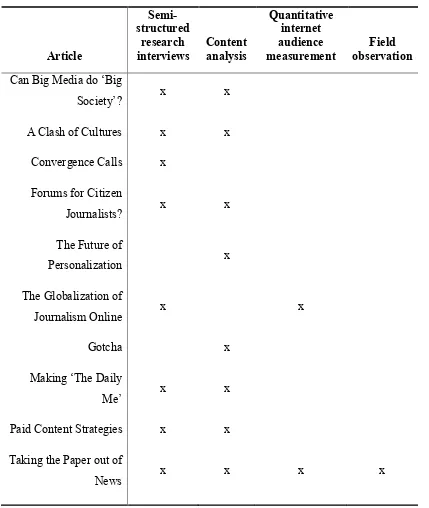
4 measurement informed most of the studies, only two papers utilized this method as a major data source. Finally, field observation was employed once. The three most commonly used methods will be discussed in the sections that follow in order to demonstrate how the research design and implementation provided a solid foundation on which the studies could build, ultimately generating new knowledge and understanding.
Table 1: Major methodologies used
Article
Semi-structured
research interviews
Content analysis
Quantitative internet audience measurement
Field observation
Can Big Media do ‘Big
Society’? x x
A Clash of Cultures x x
Convergence Calls x
Forums for Citizen
Journalists? x x
The Future of
Personalization x
The Globalization of
Journalism Online x x
Gotcha x
Making ‘The Daily
Me’ x x
Paid Content Strategies x x
Taking the Paper out of
5
Semi-Structured Research Interviews
Reasons for Choosing Approach
Semi-structured interviews were used in eight of the ten research projects. This approach was chosen for several reasons:
to gain access to research participants and data
to facilitate deep inquiry
to investigate the past as well as the present
to gauge perceptions and motivations as well as actions
to enable timely data collection, analysis, and publication
Interviewing was one of the few methods that allowed accessto the senior editors and news executives who made up the majority of the interview subjects. Such an “elite group”, Hansen et al. (1998) argue, are well “equipped to resist surveillance” (p. 36), being unlikely to agree to lengthy observation (p. 47) or take the time to fill out extended questionnaires. Their elite positions presented both problems and opportunities. As Kvale and Brinkmann (2009) suggest, “obtaining access ... is a key problem” (p. 147). Although this was the case, the problem of access was overcome through a thorough and persistent recruitment strategy. For example, in order to secure the 11 interviews conducted in one summer, 24 potential interviewees were contacted, and the initial contacts followed up with further emails and phone calls. The result was that the number of participants recruited matched or exceeded McCracken’s (1998) suggestion that “for many research projects, eight respondents will be perfectly sufficient” (p. 17).
6 and audience metrics. The detail the data contained was often unexpected, revealing themes that were not anticipated by the literature reviews or during the initial content surveys that informed the semi-structured interview guides.
The interviews, in contrast to observation or content surveys alone, were able to consider the past as well as the present and to investigate respondents’ motivations and attitudes, not simply their actions (Berger, 2000, p. 138). Another advantage of the interview approach was the speed with which it was possible to gather data. The time it takes to conduct research based on observation, often weeks or months in a single location (see: Lindlof & Taylor, 2002), means that studies based on this methodology tend to be about a single case and published a considerable time after the initial fieldwork (see, for example, Dupagne & Garrison, 2006). Given the rapidly changing nature of the phenomenon under study, and the desire to take, in most cases, a thematic approach using multiple perspectives, it was
important to use a method that was capable of rapid data collection from multiple sources. The qualitative research interview provided such a method.
Dealing with the Limitations of the Method
As with any method, qualitative interviewing has its limitations. As Berger (2000) writes, “people don’t always tell the truth ... [or] remember things accurately” (p. 124). The
7
Importance of Ability to Deviate from Script
However suitable a method is to a particular research project, its effectiveness relies on competent implementation. Qualitative research interviewing demands the ability to depart from the interview script in order to progress with the interview “in a fruitful way” (King & Horrocks, 2010, p. 53). Such probing questioning demands the ability to listen actively, that is, to be “sensitive and attentive to ... situational cues” (King & Horrocks, 2010, p. 53), and is, according to Lindlof and Taylor (2011), “probably the hardest and most important ‘work’ ... in an interview” (p. 198). During the course of the interviews, hundreds of thousands of words were uttered by the interviewees, heard and processed, and appropriate probing
questions devised. Although such departures from the interview scripts are not evident from a reading of the published papers, a number of the themes that emerged were a result of
probing secondary questions. It is out of the scope of this case study to analyse,
retrospectively, all the themes that emerged this way, so a single illustrative example will be given.
One of the first interviews was with Martin King, the then editor of Independent.co.uk. His response to a question about RSS feeds included the remark that:
If [the Drudge Report] ever said we are only taking newspaper websites that give us RSS feeds, long term it could be a bit of a pain for us to miss out from [traffic from] the Drudgereport.com because it does match our image (personal communication, 16 December, 2004).
The comment was interesting in two ways. Firstly, in that the Drudgereport.com, whose founder and editor Matt Drudge called his own politics libertarian and has been described as having a “dedicated right-of-center following” (Pachter, 2003), was seen by the left-of-centre
Independent as matching their image; and secondly, in that Drudgereport.com, a website with an amateur staff of two, could be such an important source of traffic to Independent.co.uk that the editor would think that losing its referrals would be “a bit of a pain”. Consequent to this remark, a number of follow-up questions were posed in this and subsequent interviews, and the theme was further examined using quantitative audience data from
8 British news websites had on aggregating sites like Drudgereport.com, which was responsible for referring 25 per cent of US visitors to UK news websites.
Anonymity
Anonymity was provided in two of the eight research projects that used qualitative interviews as a method: the case studies of Taloussanomat and of the ‘Local People’ websites (Thurman, Pascal, & Bradshaw, 2011). In the ‘Local People’ project, although not all participants
requested anonymity, it was felt that, given their relatively junior positions in the
organization, it would be better if their identities were not revealed in case their identification caused disadvantage. The participants had all agreed to talk in their personal capacities, and not as official representatives of the company, Northcliffe Media. Indeed the company, uninterested in or wary of the research project, had declined to offer any management representatives as participants. In the case study of Taloussanomat, although the company had sanctioned the research, allowing access to management, interviews with staff, and a week’s observation in the newsroom, two of the participants requested and were given anonymity.
In the remaining six studies that utilized qualitative research interviews, the respondents were named. As senior editors and news executives, most of whom had themselves been
journalists, the respondents were not considered to be vulnerable, having considerable experience as interviewers and interviewees. Given their position, and their willingness to speak on the record, respondents were identified in the research. Indeed, the fact that they discussed the specifics of the organization they worked for meant that anonymity would have been very difficult to provide.
Data Collection, Storage, and Transcription
All the interviews, which were conducted mostly face-to-face but also via telephone, were recorded digitally to eliminate the loss in quality inherent in analogue-digital conversion and stored using standard file formats (mp3 or .wav) on hard disc. Informed consent and
confidentiality concerns were addressed prior to data collection via email correspondence. All interviews were fully transcribed (either by myself, my co-authors, or a research transcription specialist) in order that a written record was available for detailed analysis. Where
9 the transcriptions of the Finnish language interviews conducted for the study of
Taloussanomat, which were checked by my co-author. As the analysis of the interview material focused on the content of the conversations rather than the language or intonation used, full ‘simple’ verbatim transcription was carried out, with pauses, intonation, emphasis, and facial expressions not recorded. These paralinguistic features were not relevant to the analysis, which did not focus on discourse and narrative analysis, social interaction, or the participant’s “lived experience” (King & Horrocks, 2010, p. 142). Although, during transcription, the transcribers were careful not to ‘tidy up’ the spoken word, when quotes were presented to support the analyses a small amount of tidying up was carried out to aid comprehension. As King and Horrocks (2010) suggest, this was done with great care to “minimize any distortion of meaning” (p. 149).
Coding and Analysis
Although some initial superficial analysis took place during data collection in order that the results of early interviews could inform those that followed, the bulk of the analysis took place once data collection had finished. In total the transcriptions yielded hundreds of thousands of words of interview data, with each of the eight projects that utilized qualitative research interviews based on an average of 50,000 words of transcribed data. Although substantial, this quantity of data was, mostly, able to be managed and manipulated using a number of Microsoft Word files. For a small number of the projects the ‘HyperRESEARCH’ software application was used to code and retrieve text, build theories, and conduct data analyses. The coding and analysis followed a fairly standard process, such as described by Weiss (1994, p. 151–182) and Creswell (1994), of iterative issue identification, mark-up, and theme development.
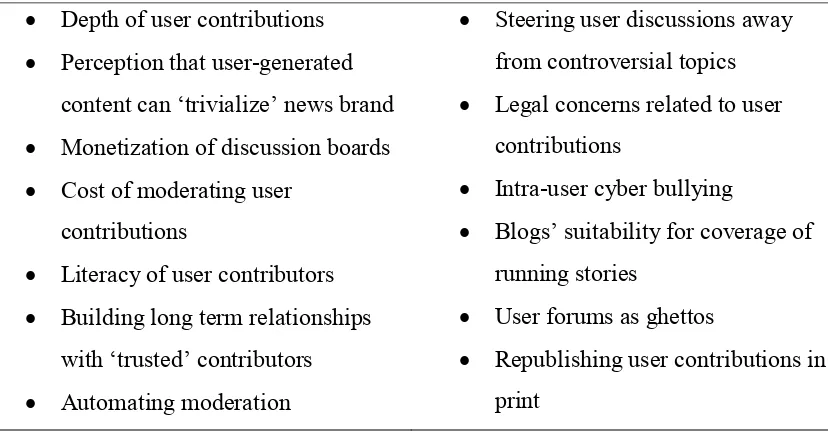
10 topics were progressively refined into a smaller number of more descriptive themes that related to the mainstream media’s adoption of user-generated content initiatives. These broader themes included: the maintenance of news values and standards, legal and commercial topics, editorial systems, human factors, and reader incentives.
Table 2: Example issues from interview coding for ‘Forums for Citizen Journalists?’
(Thurman, 2008)
Depth of user contributions
Perception that user-generated content can ‘trivialize’ news brand
Monetization of discussion boards
Cost of moderating user contributions
Literacy of user contributors
Building long term relationships with ‘trusted’ contributors
Automating moderation
Steering user discussions away from controversial topics
Legal concerns related to user contributions
Intra-user cyber bullying
Blogs’ suitability for coverage of running stories
User forums as ghettos
Republishing user contributions in print
Topics that occurred just once were not, however, routinely ignored. An exclusive focus on the more abstract themes would have disconnected the analysis from local contingencies of the particular organizations under investigation. For example, in ‘Forums for Citizen
11
Content Analysis
Focus on Communication Channels
Much of the research discussed here was informed by an examination of—in the broadest sense—the textual qualities of online news. The methods used are classified here as content analysis. However, more often than not, my focus differed from traditional content analysis in the attention it gave to communication channels—themselves part of larger networked
computational systems—rather than to the words, sounds, and moving and still images distributed through those channels. Such attention is in line with contemporary developments in content analysis, which transcend “traditional notions of symbols” (Krippendorff, 2004, p. xviii), recognize that the “simplistic notion of ‘content’ has outlived its explanatory
capabilities” (p. xix), and bring the “minutiae of communication ... [including] interfaces” (p. xvii) into the centre of researchers’ investigations.
Although my use of content analysis was contemporary in its operationalization of ‘content’, I deployed the method for some of the same reasons that have motivated its use for at least 60 years. Like Berelson (1952), I was interested in describing trends in communication content, disclosing international differences in communication content, comparing media, discovering stylistic features, identifying the intentions and other characteristics of the communicators, and describing behavioural responses to communications.
12 Such a focus on the enabling and networked properties of communication media
characterizes the content analyses undertaken in most of the other studies discussed here. Two of these studies analysed how news websites enabled forms of content personalization: comparing media, disclosing international differences, and ultimately describing trends over a three-and-a-half year period. Three other studies analysed how news websites enabled users to participate in content production, comparing national media over a three-year period. I attributed textuality to these types of user participation and personalization functionality because they were created not for the purposes of my research, but to be used by readers.
Operationalizing Content Analysis
I will now summarize how the content analysis for these five studies was operationalized. Firstly, I systematically developed recording/coding units that enabled me to distinguish between distinct forms of user participation and content personalization. Making these
categorical distinctions was time-consuming but ultimately useful, providing a foundation not only for my own subsequent longitudinal analyses but also for studies by other researchers (for example, Hermida, 2011, p. 17).
I took the decision early on in my research to—where possible—utilize content analysis in combination with a complementary method—semi-structured research interviews—and to analyse trends over time. As has already been described, the challenges of recruiting the ‘elite’ subjects for the research interviews were such that, in the end, the sample of
interviewees was one of convenience rather than being probabilistic. The sampling units used in the content analyses were the news websites my interview subjects represented: a sample also, therefore, based on convenience—but purposive too. Convenience (and purposive) sampling are open to the criticism that the sampling units do not adequately represent what is being analysed. In this case I would suggest that there are two factors that compensate for this potential bias. Firstly, as described, all of the studies that utilized content analysis either used a complementary method and/or assessed evidence over time. Secondly, because the
13 In the initial studies of user participation and content personalization, the recording/coding stages of the content analyses were almost inseparable from the processes of unitizing the units to be recorded/coded. This was an inevitable result of the absence of adequate
taxonomies and coding rules to describe and detect the phenomena under investigation. Once the initial studies had been completed the subsequent studies were able to utilize their
recording/coding frameworks.
To make efficient representations of the data gathered, various forms of tabulation were used. These tables presented whether a particular recording/coding unit was found at a news
website (adding counts in some instances) and also provided contextual information in footnotes. The later studies were able to show changes over time.
The content analyses performed in the studies discussed here did not undergo formal
reliability testing. The dynamic nature of the sampling units—websites that evolve over time and are not easily captured for subsequent repeated analysis—meant that the sort of test-retest assessments that can be used to establish the stability of the data collection processes would have been difficult to carry out. Although no formal reproducibility tests—with measured intercoder reliability—were performed, I do have confidence in the reliability of the results. Firstly, because in the one study where other coders were used (Thurman & Schifferes, 2012), the coders and I shared a common framework of knowledge and experience—they were MSc students of mine—and my informal checks of the results of their independent coding gave me a high degree of confidence in their work. Secondly, because the aim of the content analyses was to measure the presence of certain forms of Web functionality rather than more subjective categories (such as levels of violence in media content). Therefore, operationalizing the recording/coding units and measuring their occurrences was a relatively objective process that, I would argue, produced reasonably reliable and incontestable results.
Quantitative Internet Audience Measurement
14
The description and analysis of the size and significance of the American audience for British news websites, the characteristics of the stories they read, and how they found their way to those sites in the first place.
The description and analysis of changes to the audience for the Finnish financial newspaper Taloussanomat when it stopped printing and went online-only, including comparisons with its print and online rivals, such as Kauppalehti. In ‘The Globalization of Journalism Online’, the primary data source was
Nielsen//Netratings’ panel-based internet audience measurement service, NetView. Nielsen has a long history of providing audience measurement, including for television, and although access to their data usually requires subscription, at substantial cost, I was able to negotiate access free-of-charge. The NetView data was selected over the alternatives because it provided access to data generated using a single methodology about a wide range of news sites for comparative purposes.
Disadvantages of Server Log Data
Online audiences can also be measured via the server log data recorded by most websites. This method utilizes the largest possible sample (every visitor is recorded, an advantage over panel-based measures), but has disadvantages. Firstly, the method does not provide reliable demographic data and can over-count users who visit websites from multiple computers, for instance at home and at work, or who delete cookies. Visits from search engine robots and other software can also inflate visitor numbers. The most important disadvantage, however, is that server log data is often closely guarded by news organizations. At the time the research for ‘The Globalization of Journalism Online’ was undertaken, not all of the news websites studied released audience figures. Many of those that did chose to release their data through ABC Electronic (http://www.abc.org.uk/), but the ‘audited’ figures that the ABC made available did not include geographical breakdowns of users—data that was an essential part of the study’s research method. As a result, the publicly available data that existed did not allow for meaningful comparisons to be made between news providers.
Disadvantages of Panel-Based Data
15 especially for websites with small audiences. However, the sites that were studied were well-trafficked and data on their use was considered statistically robust by the provider. As with any panel-based measure, however, the results provide useful indications of trends and behaviours rather than absolute accuracy. In the case of ‘The Globalization of Journalism Online’, the NetView data provided the means to investigate the topic by looking at a range of online news providers in some detail. As such, and despite its limitations, it was the best data available.
Use of Server Log Data
Quantitative internet audience measurement was also a key methodology in my case study ‘Taking the Paper out of News’. Because of the relatively small audience size of
Taloussanomat and its main competitor Kauppalehti—which provided a point of comparison in the study—the use of panel-based data such as that provided by Nielsen would not have provided sufficiently accurate readership estimates to allow an examination of the changes to
Taloussanomat’s readership that came about as a result of the change from print and online to online-only distribution. Instead, data came from Taloussanomat and Kauppalehti’s own servers via Taloussanomat’s Google Analytics account and TNS Gallup’s Metrix service. This ensured a high degree of accuracy and allowed, when compared against equivalent data from the UK, some conclusions to be drawn about the effects on a newspaper’s Web traffic when it stops printing and goes online-only. These conclusions, broadly summarized, were that going online-only did not result in an increase in Web traffic over and above other online newspapers that had retained a print edition.
Concluding remarks
16 7). It is hoped that the work presented here has demonstrated the promise of such a “realist model of science” (Jensen, 2002a, p. 254), which uses a “wide range of means” and “rejects skepticist positions” while acknowledging the importance of “perceptions, cognitions, and inferences” (p. 268). I have found the complementary nature of the qualitative and
quantitative approaches to be particularly striking. The quantitative measures of content features and audiences revealed the existence of particular patterns of technological adoption and consumption, but could not adequately account for, or explain, their presence. The qualitative investigations made developing such explanations possible, but the ‘perceptions, cognitions, and inferences’ inherent in the qualitative data acquired meant that the original quantitative measures were essential in order that the explanations could be adequately questioned, and subsequently rejected or revised.
Exercises and Discussion Questions
1. The research described in this case study utilized interviews with those in ‘elite’ professional positions. Contrast the methods used by the researcher to recruit, analyse, and quote his interviewees with the methods you would use with those in more
vulnerable positions.
2. In communication research, content analysis has traditionally been applied to media ‘texts’ such as books and article, still images, and movies. How has the development of interactive digital media changed the notion of the ‘content’ to be analysed used content analysis?
17
Publications discussed in this case
Herbert, J., & Thurman, N. (2007). Paid content strategies for news websites: An empirical study of British newspapers’ online business models. Journalism Practice, 1(2), 208–226. doi:10.1080/17512780701275523
Thurman, N. (2007). The globalization of journalism online: A transatlantic study of news websites and their international readers. Journalism: Theory, Practice & Criticism, 8(3), 285–307. doi:10.1177/1464884907076463
Thurman, N. (2008). Forums for citizen journalists? Adoption of user generated content initiatives by online news media. New Media & Society, 10(1), 139–157.
doi:10.1177/1461444807085325
Hermida, A., & Thurman, N. (2008). A clash of cultures: The integration of user-generated content within professional journalistic frameworks at British newspaper websites.
Journalism Practice, 2(3), 343–356. doi:10.1080/17512780802054538
Thurman, N., & Lupton, B. (2008). Convergence calls: Multimedia storytelling at British news websites. Convergence: The International Journal of Research into New Media Technologies, 14(4), 439–455. doi:10.1177/1354856508094662
Thurman, N., & Myllylahti, M. (2009). Taking the paper out of news. A case study of
Taloussanomat, Europe’s first online-only newspaper. Journalism Studies, 10(5), 691–708. doi:10.1080/14616700902812959
Thurman, N., & Hermida, A. (2010). Gotcha: How newsroom norms are shaping
participatory journalism online. In S. Tunney & G. Monaghan (Eds.), Web journalism: A new form of citizenship (pp. 46–62). Eastbourne: Sussex Academic Press. Retrieved from
http://openaccess.city.ac.uk/179/
Thurman, N. (2011). Making ‘The Daily Me’: Technology, economics and habit in the mainstream assimilation of personalized news. Journalism: Theory, Practice & Criticism,
18 Thurman, N., Pascal, J.-C., & Bradshaw, P. (2011). Can big media do ‘big society?’ A
critical case study of commercial, convergent hyperlocal news. International Journal of Media & Cultural Politics, 8(2–3), 269–285. doi:10.1386/macp.8.2-3.269_1
Thurman, N., & Schifferes, S. (2012). The future of personalization at news websites: Lessons from a longitudinal study. Journalism Studies, 13(5–6), 775–790.
doi:10.1080/1461670X.2012.664341
Further Readings
Bermejo, F. (2007). The Internet Audience: Constitution and Measurement. New York: Peter Lang Publishing.
Fielding, N. G., Lee, R.M., & Blank, G. (2017). The Sage Handbook of Online Research Methods (2nd ed.). London: Sage Publications.
Jensen, K. B. (2002a). The complementarity of qualitative and quantitative methodologies in media and communication research. In K. B. Jensen (Ed.), A handbook of media and
communication research: Qualitative and quantitative methodologies (pp. 254–272). Abingdon, Oxon: Routledge.
Krippendorff, K. (2004). Content analysis: An introduction to its methodology.Thousand Oaks, CA: Sage Publications.
19
References
Berelson, B. (1952). Content analysis in communication research. New York: Free Press.
Berger, A. A. (2000). Media and communication research methods: An introduction to
qualitative and quantitative approaches. Thousand Oaks, CA: Sage Publications.
Boczkowski, P. (2004). Digitizing the news: Innovation in online newspapers. Cambridge,
MA: MIT Press.
Brannon, J. (1999). Maximizing the medium: Assessing impediments to performing
multimedia journalism at three news web sites (Unpublished doctoral dissertation).
University of Maryland, College Park.
City University London. (n.d.). Online communities and content management [University
module description]. Retrieved from http://www.city.ac.uk
Cottle, S., & Ashton, M. (1999). From BBC newsroom to BBC newscentre: On changing
technology and journalist practices. Convergence: The International Journal of Research into
New Media Technologies, 5(3), 22–43. doi:10.1177/135485659900500304
Creswell, J. W. (1994). Research design: Qualitative and quantitative approaches. Thousand
Oaks, CA: Sage.
Dupagne, M., & Garrison, B. (2006). The meaning and influence of convergence: A
qualitative case study of newsroom work at the Tampa News Center. Journalism Studies
20 Gove, P. B. (Ed.). (1961). Webster's third new international dictionary. Springfield, MA: G.
& C. Merriam Co.
Hansen, A., Cottle, S., Negrine, R., & Newbold, C. (1998). Mass communication research
methods.Basingstoke: Macmillan.
Hermida, A. (2011). Mechanisms of participation: How audience options shape the
conversation. In J. B. Singer, D. Domingo, A. Heinonen, A. Hermida, S. Paulussen, T.
Quandt, … M. Vujnovic, Participatory journalism: Guarding open gates at online
newspapers (pp. 13–33). Chichester: Wiley-Blackwell.
Jensen, K. B. (2002a). The complementarity of qualitative and quantitative methodologies in
media and communication research. In K. B. Jensen (Ed.), A handbook of media and
communication research: Qualitative and quantitative methodologies (pp. 254–272).
Abingdon, Oxon: Routledge.
Jensen, K. B. (2002b). Introduction: The state of convergence in media and communication
research. In K. B. Jensen (Ed.), A handbook of media and communication research:
Qualitative and quantitative methodologies (pp. 1–14). Abingdon, Oxon: Routledge.
King, N., & Horrocks, C. (2010). Interviews in qualitative research. London: Sage
Publications.
Klesges, R. C., Eck, L. H., Mellon, M. W., Fulliton, W., Somes, G. W., & Hanson, C. L.
(1990). The accuracy of self-reports of physical activity. Medicine & Science in Sports &
Exercise, 22(5), 690–697. doi:10.1249/00005768-199010000-00022
Krippendorff, K. (2004). Content analysis: An introduction to its methodology.Thousand
21 Kvale, S., & Brinkmann, S. (2009). Interviews: Learning the craft of qualitative research
interviewing (2nd ed.). Los Angeles: Sage Publications.
Lindlof, T. R., & Taylor, B. C. (2002). Qualitative communication research methods (2nd
ed.).Thousand Oaks, CA: Sage Publications.
Lindlof, T. R., & Taylor, B. C. (2011). Qualitative communication research methods (3rd
ed.). Los Angeles: Sage Publications.
McCracken, G. (1998). The long interview. Thousand Oaks, CA: Sage Publications.
Murrie, M. (2001). Local web news: Case study of nine local broadcast internet news
operations: A first look at the editorial, staffing and strategic practices of US local radio and
television station news websites. Retrieved from http://www.rtndf.org/study/casestudy.shtml
Neuman, W. R. (1991). The future of the mass audience. Cambridge: Cambridge University
Press.
Pachter, R. (2003, September 1). Linking news sites, Matt Drudge creates an internet success.
The Miami Herald. Retrieved from www.miamiherald.com
Ryfe, D. M. (2006). Guest editor’s introduction: New institutionalism and the news. Political
Communication23(2), 135–144.
Singer, J. B. (2004). Strange bedfellows? The diffusion of convergence in four news
organizations. Journalism Studies, 5(1), 3–18.
Stepno, R. (2003). Presenting Happy Valley: A case study of online newswork roles, design
and decision-making at WRAL-TV.com, 1996–1999 (Unpublished doctoral dissertation). The
22 Thurman, N. (2007). The globalization of journalism online: A transatlantic study of news
websites and their international readers. Journalism: Theory, Practice & Criticism, 8(3),
285–307. doi:10.1177/1464884907076463
Thurman, N. (2008). Forums for citizen journalists? Adoption of user generated content
initiatives by online news media. New Media & Society, 10(1), 139–157.
doi:10.1177/1461444807085325
Thurman, N. (2011). Making ‘The Daily Me’: Technology, economics and habit in the
mainstream assimilation of personalized news. Journalism: Theory, Practice and Criticism,
12(4), 395–415. doi:10.1177/1464884910388228
Thurman, N., & Myllylahti, M. (2009). Taking the paper out of news. A case study of
Taloussanomat, Europe’s first online-only newspaper. Journalism Studies, 10(5), 691–708.
doi:10.1080/14616700902812959
Thurman, N., & Schifferes, S. (2012). The future of personalization at news websites:
Lessons from a longitudinal study. Journalism Studies, 13(5–6), 775–790.
doi:10.1080/1461670X.2012.664341
Thurman, N., Pascal, J.-C., & Bradshaw, P. (2011). Can big media do ‘big society’? A
critical case study of commercial, convergent hyperlocal news. International Journal of
Media and Cultural Politics, 8(2–3). doi:10.1386/macp.8.2-3.269_1