Vol.56, No. 3 JOURNAL VIROLOGY, Dec. 1985, 691-700
0022-538X/85/120691-10$02.00/0
Copyright © 1985, American SocietyforMicrobiology
Normal Expression of
Polymorphic Endogenous
Retroviral RNA
Containing Segments
Identical
to
Mink
Cell
Focus-Forming
Virust
DAVID E. LEVY,1 2t RICHARD A. LERNER,2 AND MICHAELC. WILSON2*
Division of Biology, California Institute of Technology, Pasadena, California 91125,1 andDepartment ofMolecular Biology, Research Instituteof Scripps Clinic, LaJolla, California 920372
Received 24April 1985/Accepted 16 August1985
Inthe absence ofinfectiousvirus,strains ofmiceexpresspolyadenylatedRNAtranscriptshomologoustothe
genome of murine leukemia virus. In addition to transcripts consistent with full-length and spliced env retroviral RNAs, several unique RNA species which lack the env sequence accumulate in a tissue-specific manner. These RNA species are presumed to be transcribed from endogenous retroviral sequences that constitute the bulk of the murine leukemia virus-relatedsequences inthemurine genome. To determine the relationship of theseRNAtranscriptstoinfectiousmurine leukemia virus and theprecisestructural basis of the heterogeneity observed for the env-lacking transcripts, we isolated and sequenced cDNA recombinants representing the RNAs expressed in strain 129 GIx+ mice. Comparisons of the nucleotide sequences
demonstratedthattheendogenousretroviraltranscriptsdiffered inpol,pl5E,andR-peptide regions by single nucleotide changes.In contrast,thegp7O-coding regionsoftwocDNA clones derived fromepididymisand liver were completely homologous over a 599-nucleotide overlapping sequence. The structures of env-lacking transcriptswereexamined intwoindependentcDNAclones, and eachwasfoundtocontainadifferent deletion thatwaspotentiallymediatedbyseven-basepairdirect repeats in the intactsequence.Theextensivesequence
homology between cDNAs allowed construction of a cumulative sequence map of the 3' end of an intact endogenous retroviral transcript. A comparison of this sequence with infectious ecotropic and mink cell focus-forming viruses revealed that the endogenous transcripts are highly homologouswith the substituted portions of leukemogenic mink cell focus-forming viruses and therefore further define the boundaries of recombination requiredto generate these viruses.
InfectioustypeC retrovirusesof inbred micedisplaythree
distinct host ranges, which aremediated through their viral
envelopeglycoproteinsbycell receptorrecognition.
Ecotro-pic, xenotroEcotro-pic, and dualtropic viral isolates have been classifiedonthebasis oftheabilitytoinfect primarilymouse
cells, only nonmouse cells, and cells of both mouse and nonmouse origin, respectively. Members of the third class,
the dualtropic viruses, are more commonly referred to as
mink cell focus-forming (MCF) viruses because of their
ability to cause characteristic alterations in the cellular
morphology of infected mink cells.Infectious ecotropic and
xenotropic viruses can be induced directly from proviruses integrated within the genomes of various mouse strains.
However, MCF viruses are formed de novo by
recombina-tion between an exogenous, infectious ecotropic virus and endogenous viral sequences related to xenotropic virus,
resulting inthereplacementofvariableportions of the 3' end of the ecotropic genome with endogenous information
en-coding altered envelope proteins. It is viruses of this type which are generally associated with the development of
leukemia in mice (see reference 38 for a review).
Endogenous viralsequences, distinctfrom ecotropic and
xenotropic proviruses, are present in multiple copies in the
murine genome (7, 17, 19); however, their transcriptional activity in normal, nonviremic mice has not been fully documented. Even in the absence of the ability to produce
infectious virus, strains of mice express antigens thought to be encoded from such endogenous viral sequences
(re-* Correspondingauthor.
t Publication 3655-MB oftheDepartmentof MolecularBiology, ScrippsClinic and Research Foundation.
tPresentaddress: RockefellerUniversity,NewYork,NY10021.
viewed in reference 26). The precise relationship between activelytranscribed viral sequences and sequences involved inthegeneration of recombinant MCF viruses isnotknown. In different strains considerable heterogeneity exists in the levels and structures of the viral proteins, and there is evidence that this expression is regulated in specifictissues (32). This regulation ofendogenous retroviral gene expres-sion appears tobe distinct from the geneticallydefined loci
governing theinducibility ofinfectiousvirus, which include both proviral structural genes themselves and regulatory genes distinct from the induced virus(15, 20, 21).
Geneticanalysis ofendogenous retroviral gene expression has been greatly facilitated by the generation of congenic partnerstrains of strain 129mice,
Glx+
andGlx-,
whichare characterized byhighandlowlevels ofvirus-relatedantigen production, respectively(43,44).Recently, wereportedthatexpressionofmultiplebutdistincttissue-specificRNA
tran-scriptswhichare thoughtto encodetheseendogenousviral
antigens is under coordinate regulation by a trans-acting
product of the Gv-J locus (25).
Todetermine the structuralbasis for thisheterogeneity,to document the number ofindependent transcription unitsthat encode these transcripts, and to define the relationship between the normal cellular components and the productsof exogenous viruses, the nucleotide sequences of cDNA clones corresponding to endogenous virus-related
tran-scripts expressed in strain 129
GIx+
micewere determined. Thepolymorphism previouslydetected in the RNA popula-tion was foundto be due to deletions of varying lengths of retroviral sequencesaccompaniedby scattered single nucle-otide differences between different transcripts. Thesefind-ingsdemonstrate theactivity of multiple genomic
transcrip-tion units in the origin of these regulated RNA species. 691
on November 10, 2019 by guest
http://jvi.asm.org/
MoMCF
MCF 247
-gag
U3 U5
.I
pol
envgp70 p15E U3 U5
I a
I I..I III I . II
'I
IEl, _
L511 t1
L510 ,
E119 1
L622 S13,
E2 (
1kb
cDNA
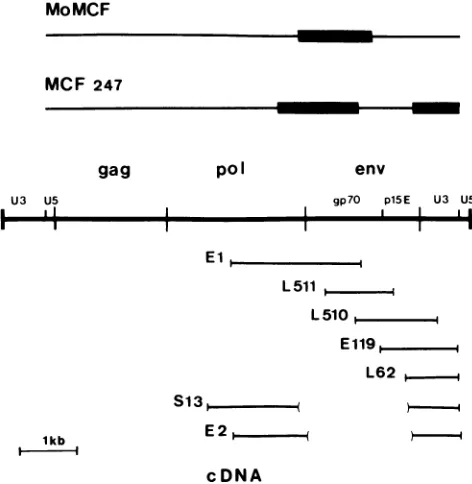
FIG. 1. Structure ofretroviral cDNA clones. The cDNA
inser-tionsofretroviral clones derived from strain 129Glx+
polyadenyl-ated RNA were aligned with the Mo-MuLV proviral structure
(middle) by restriction enzyme mapping, hybridization, and DNA
sequencing. The vertical bars in the cDNA clones indicate the positions of junctions of eucaryoticsequences withplasmid DNA. Parenthesesenclose deletedregionsof the retroviralsequence. The
designation of each clone includes aninitial letterwhich indicates
thetissue fromwhich the RNAwasderived,asfollows: E, epidid-ymis; L, liver; S,spleen. At thetopare diagrams of Mo-MCF and
MCF247 viralgenomic RNAs. The thin linesrepresent regions of ecotropic sequences, while the thick lines represent regions of nonecotropic information substituted into thegenomeby
recombi-nation.The MCF247 virus diagram is basedontherestrictionmaps ofChattopadhyayetal.(7) and thesequencesdescribedby Kelleyet
al.(16)andHollandetal.(14). The diagram of Mo-MCFis basedon the dataof Bosselmanetal. (6). kb, Kilobase.
Furthermore, the structure of these transcripts establishes that thenormalcellularcomponentsaremostlikelyencoded byendogenous proviruses rather than by homologous cellu-lar genes, as opposed to the cellular counterparts of the oncogenes acquired by acutely transforming retroviruses (46). Comparisons with known viral sequences have re-vealed a striking similarity between the viral RNA
tran-scripts normally expressed in strain 129 mice and the
sequences of the substituted portions of leukemogenic dualtropic MCF viruses. These similarities delineate the minimal recombination points necessary to create MCF virus andsuggestapossible relationshipbetween transcrip-tionally activeprovirusesand thegenerationofrecombinant viruses. Protein products translated from the ens' sequence reported here should display the dualtropic determinants associated with MCF virus gp7O.
(This research was conducted by D. E. Levy in partial fulfillment of the requirements for a Ph.D. degree from California Institute ofTechnology, Pasadena.)
MATERIALS AND METHODS
The constructionand characterization of cDNA libraries from various tissues of strain 129
Glx+
mice have beendescribed previously (25). Briefly, total cell RNAs were obtained fromlivers,thymuses,spleens, and epididymides of 6- to8-week-old malemice bypulverization of frozen tissues, treatmentwithsodium dodecyl sulfate and proteinase K, and phenol-chloroform extraction. cDNA synthesis was initiated on poly(A)-enriched RNAby oligo(dT) priming, and cDNA was rendered double stranded by treatment with the large fragment of Escherichia coli DNA polymerase I and ultimately inserted into pBR322 by G-C tailing. Clones representing virus-related RNAwereselected by
hybridiza-tion with radioactive probes derived from cloned Moloney murineleukemiavirus (Mo-MuLV), asdescribedpreviously
(24).
Selected cloneswere sequencedby thechain termination method of Sanger et al. (40) after subcloning into M13 vectors (30). The resulting sequences were analyzed with the aid of computer programs supplied by the National Biomed-ical Research Foundation, Washington, D.C. (34).
RESULTS
Thetranscripts of expressedproviruses in strain 129mice constitute apolymorphic family of sequences that differ by deletions of viral sequences of variable length (24, 25) accompanied by scattered single base differences among individual members (see below). Although no single cDNA
containing a sequence homologous to an entire pol or env gene open reading frame was isolated (Fig. 1), enough
overlapping sequence with a high degree of nucleotide
homology wasobtainedtoconstruct acumulative sequence map of the 3' end ofan intact viral transcript. This recon-structed sequence allowed comparisons with AKR endoge-nousproviral clone A-12(17), AKR MCF247virus (14, 16), Moloney MCF (Mo-MCF) virus (6), and AKV ecotropic virus (12, 22).
pol gene. An analysis of restriction enzyme sites and
hybridization to cloned Mo-MuLV sequences (3, 24, 25) indicated that clones El, E2, and S13 contained pol region
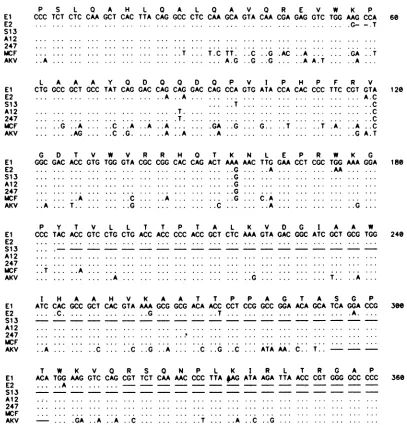
sequences(Fig. 1). The 360-nucleotide sequence from the 3' end of thepolgeneof clone El and the sequences from the
corresponding regions of clones E2 and S13 are shown in
Fig. 2along with thepredictedamino acid sequence of clone El. The sequence heterogeneity of the endogenous retrovi-raltranscripts of strain129G6x+ micewasclearlyillustrated
by these clones. First, sequence heterogeneity occurred
within the overlapping regions of these clones. Of the 315 nucleotides aligned between clonesElandE2, therewere15 mismatches andone two-nucleotide gapat positions 57and 58 (a 4.8% difference). Between clones El and S13, there were five differences, resulting in differences of 3.2 and
5.3%,
respectively. Second, clones E2 and S13 exhibited large deletions which eliminated the 3' portion of the pol gene described here. These deletions extended through themajority of the
ens'
gene, resulting in fusion of the pol sequence with the 3' end ofthepiSE
codingsequence(Fig.3). Theactualendpointsfor these deletionswereambiguous
due toseven-basepairdirectrepeatsatthesedeletionpoints
inthe undeletedsequence(25). The deletion in S13 extended fromthe sequence GGACCCTatpositions 178 to 184 tothe secondoccurrenceof this sequenceatpositions478to484in
pl5E
(Fig. 3), retaining a single copy of the repeat and thereby deleting 1,977 nucleotides. A similar deletion in E2 began at nucleotide 316 (Fig. 2) afterthe sequence GGTC CAG and likewise extendedthroughthe second copyof this repeatatpositions501 to 507ofp1SE,thuseliminating 1,817nucleotides.Transcripts displaying analogousdeletionshave beendetectedbySImappingin avarietyof tissuesofstrain
on November 10, 2019 by guest
http://jvi.asm.org/
[image:2.612.71.307.72.314.2]SEQUENCE
P S L 0 A H L 0 A L 0 A V O R E V W K P
CCC TCT CTC CAM GCT CAC TTA CAG GCC CTC CAA GCA GTA CAA CGA GAG GTC TGG AMG CCA
... ... ... ... ... ... ... ... ... ... ... ... ... ... ... .. ... ... .G- -.T
60
.. ... . . .. ... ... ... ... .. ... . . ... . . ... . .. .. . .. ... ... ... . . ... ... . .. . . . ... .. ... . . . .
... ... ... ... ... ... ... ... ..T ... T.C TT. ..C ..G.AC ..A ... ... .GA ..T
... ... ... ... ... ... ... ... ... ... A.G ..G ..G ... ..A A.T ... ..A ...
L A A A Y 0 D O 0 D O
CTG GCC GCT GCC TAT CAG GAC CAG CAG GAC CAG 4
... ... ... .... .... ... ... ..A ..A..,F .,r ... ...
... ... ... ... ... .T. ... ...
... ... ... ... ... .T. ... ...
... ..C ..A ..A . ... ... .GA
... ..C G. ... ..A ..A ... ..A
P V I P H P F R V
CCA GTG ATA CCA CAC CCC TTC CGT GTA
... ... ... ... ... ... ... ... A.C
..T ... ... ... ... ... ... ... ..C ... ... ... ... ... ... ... ... ..C
... ... ... ... ... ... ... ... ..C
..G ... G.. .T ... ..T .A. ..A ..C
... ... ... ... ... ... ... ..G A.T
G D T V W V R R H 0 T K N L E P R W K G
GGC GAC ACC GTG TGG GTA CGC CGG CAC CAG ACT AAA AAC TTG GMA CCT CGC TGG AAA GGA
... ... ... ... ... ... ... ... ... ... ... ..G .A. .AA ... ...
... ... ... ... ... ... ... ... ... ... ... ..G ... ... ... ... ... ... ... ... ... ... ... ... ... ... ... ... ... ... ... ..G ... ... ... ... ... ... ... ...
... ... ... ... ... ...6 ... ... ... ... ... ..G ... ... ... ... ... ... ... ...
... ... ..A ... ... .. ... 'AA ..G ... C.A ... ... ... ... ... ...
..G... T.. ... ... ..G ... ... C ... ...A... ... ... ... ..G ...
P Y T V L L T T P T A L K V D G I A A W
CCC TAC ACC GTC CTG CTG ACC ACC CCC ACC GCT CTC AAA GTA GAC GGC ATC GCT GCG TGG
... ... ... .. ... .. ... ... ... ... ... ... . ... . .. .. . ...
... ... ... ... ... ... .. ... ... . .. ... .. ... . ... ... ... ...
... ... ... ... ... ... ... ... ... ... ... ... ... ... ... ... ... ... ... ...
..T ... ..A ... ... ... ... ... ... ... ... ... ... ... ... ... ...
... ... ... ... ..A ... ... ... ... ... ... ... ..G ... ... ... ... T.. ..A ...
120
180
240
I H A A H
ATC CAC GCC GCT CAC
... .C. ... ... ...
V K A A T T P P A G T A S G P
GTA AAA GCG GCG ACA ACC CCT CCG GCC GGA ACA GCA TCA GGA CCG
... ..G ... ... ... ..T ... ... ... ... ... ... ... .A. ...
... .. . . .. . . . .. ... .. ... .. . .. . . .
. .. . .. . .. ... . .. . .. . .. . .. . .! . . . ... . . .. . . .. ... ...
*.. ... . . ... . . .. ... ... . . .. ... ... ... .. ... . C.. ... ..C.G ..A C .G C ..ATAA C..T
-T W K V R S N P L K I R L T R G A P
300
El ACA TGG AMG GTC CAG CGT TCT CAM AAC CCC TTA
#AG
ATA AGA TTA ACC CGT GGG GCC CCC 360E2 A.... ... ...
S13
A12 . ... ... ... ... ... ... ... ... ... ... ... ... ... ... ... ... ... ... ...
247 ... ... ... ... ... ... ... ... ... ... ... ... ... ... ... ... ... ... ... ...
MCF ... ... ... ... ... ... ... ... ... ... ... ... ... ... ... ... ... ... ... ...
[image:3.612.100.507.63.488.2]AKV - .. GA ..A ..A ..C ... ... ... ..T ... .. ..C ..G ... ... ... ... ... ...
FIG. 2. Sequence comparison of thepol region. The DNAsequencesandpredicted amino acidsequencefor 360 nucleotides from the3' end of thepolgene openreading frame of endogenous transcript clone Elareshown. This nucleotidesequenceiscompared withsequences
of clones E2 and S13 from strain 129Glx1 mice, proviralgenomicclone A12 from AKR mice(17),AKRMCF 247 virus(247) fromanAKR
thymoma (14), Mo-MCF virus (MCF) fromaBALB/Mothymoma (6), and AKV virus, the endogenousecotropicvirusof AKR mice(12, 22).
Dots indicate nucleotides identicaltonucleotides in the sequenceof cloneEl,dashes indicategapsintroduced in thesequencestoincrease thealignment with El, and blankspaces arepresentwherenosequencedataareavailable. The numbersontheright indicate the nucleotides of the Elsequence. Asingle-letter code is used for the translated amino acidsequence,which is indicated above the codons.
129
Glx+
mice (25). The nucleotide sequence of clone El predicted a 120-amino acid openreading frame ending with an ochre codon immediately after nucleotide 360 (nucleo-tides 59to 61 [Fig. 4]). Thisopen reading frame overlapped theenv open readingframefor58 nucleotides, encoding 19 amino acids ofpoland 19 amino acids ofgp7O in different triplet reading frames (Fig. 4). The methionine initiation codon for env began with nucleotide 303 (Fig. 2). Suchsequenceoverlap atthepol-env junction is characteristic of murinetype C viruses. The sequences of the endogenously expressed RNA also differed with respect to the viral
se-quences shown in Fig. 2 (Table 1). Clone El differed from AKRsequencesA12 and MCF 247(whichwereidentical in this region) in 3 of 360 nucleotides, leading to a single
predicted amino acid change (Glu to Leu at positions 85 to 87). El differed from Mo-MCF at 36 of 360 nucleotides, resulting in seven predicted amino acid differences, and varied from AKV at53 of348 nucleotides, requiring intro-duction of a gap of four codons to increase sequence
similarity. It should be noted thatMo-MCF contained both ecotropic and endogenousinformation in this regionofpol since therecombinationprobablytookplaceatposition 210 (Fig. 2) (6). Allofthedifferences between El and Mo-MCF occurred 5' to this probable recombination point between Mo-MCF and the parental virus, Mo-MuLV. Thus, the substitutedregionsofpolinbothof these recombinantMCF viruses were virtually identical to the El sequence, even thoughthese viruses arose indifferent mouse strains(AKR
El E2 S13 A12 247 MCF AKV
.. .. . . ... ... ...
... ..G ..A
... ... .AG
El E2 S13 A12 247 MCF AKV
El E2 S13 A12 247 MCF AKV
El E2 S13 A12 247 MCF AKV
El
E2 S13 A12 247 MCF
AKV VOL. 56,1985
... . .
on November 10, 2019 by guest
http://jvi.asm.org/
E P V S L T L A L L L G G L T U G D A L510 GAGOCCG GTG TCA TTA ACT CTG GCC CTG CTG TTG GGAGGA OTT ACT ATGG00 GAC ATAGOT 60
E2 S13
247 .A .0C .C..0 C0 .A ..A .A C...0. GA .T 0C
MCF .A 0. .cC ... ..A T.A ... ..T .A .0C 0. CA .T -C
AKV .A .0C 0C 0C. .A .A .A 0. .GA T -C
A G V G T G T T A L V A T K Q F E 0 L 0
L510 GCA GGA GTA GGA ACC GGG ACT ACAGCCCTAGTG GCC ACCAAACAA TTC GAGCAG CTCCAG 120 E2
S13
247 .T ..A 0....C.. .TO-G -G .. CA .AT.
MCF ..T...A.. .A.. ...T..T .TOCG ... 0... .A
AKV .T ...G .A ...C..TOG _G -CA -A..
A A 0 T D L G A L E K S V S A L E K s
L510 GCA GCC ATACAAACA GAO OTT GGG GOT TTA GAA AAG TOAGTC AGT GCCCTA GAA AAG TOT 180
E2 S13
247 ..T .. .G0 GGAT...AAA .AA G.T ... 0...A C. AAT A
MCF -C .AG.. _GGAT ..T .C A.. AGG.T...A .. A. TC.AA...
AKV .T 0.0. GAT...AAA .AAG.T ... 0- A- 0 AAT A
L T S L S E V V L 0 N R R G L 0 L L F L
L510 CTG ACC TOG TTG TOT GAG GTG GTCCTA CAG AACCGGAGG GGA TTA GAT CTA CTGTTC CTA 240
E2
S13
247 T.. .C ....C.A .A..GT... .T..T .A 00C .A
MCF 0. .T 00C. .. .A..T -T .A. CC00 COTOGTA T
AKV T. 0.0....c .A .A ..GT. .T ..T .A C00C
K E G G L C A A L K E E 0 0 F Y A D H T
L510 AAA GAAGGA GGA TTA TGTGOT GCC CTAAAAGAA GAA TGC TGT TTC TAO GCG GAO CAC ACT 300
S13
247 .. ..G T..G T .T 0. A
MCF G.O... .GCG...T. ...T..0 .T -... ... .A
AKV ....G .T..G ..T 0C .A
G V V R D S M A K L R E R L N 0 R 0 K L
L51e GGCGTA GTA AGAGAT AGO ATG GCA AAGCTAAGAGAA AGGTTG AACCAG AGA CAA AAA TTA 360
S13 . . .
--247 .A T.G C.G ...C ..A ..T .. ...A -GT .G C.C
MCF ..AOC.. .G ..C...C. .ATG.. .G COT .T ...G C.OG
AKV .ATG ..OCG .. ,.C -A .T- A GT G C
D S K S G 0 G W F E G L F N R S P W F T
L51O GAT TOG AAATCA GGACAA GGGTGG TTT GAGGGA CTGTTT AAC AGG TOO CCA TGG TTC ACG 420
513 . . .
--MOtF TT.-G.G -ACT .A .A ...T .T -C
AKV TT.- G. -CCA ... .A ..G T A .T
T L S T M G P L L L L- L L F G
L510 ACC TTA ATA TOO ACCATT ATG GGC COO TTA ATA ATA OTT TTA TTAATCCTA CTC TTC004 480
E2 S13
247 ... 0.G .. .0.... .TO..CG 0...0C 0 TT- .T G
MCF ...G. ..T .. ...A... 0.0 .TG. CC.VG00 .G TOTG..
AKV CG 0... .. .T.. C0G ... 0. 0 G .TT .T G
P Co L N R L V 0 F V K D R S V V 0 A
L51e COO TOT ATT CTCAAC COO TTG GTCCAG TTT GTA AAAGAO AGA ATT TOO OTAGTGCAAGCC 540
S13 --.0.. .G
247 ..T...T...
MCF .0..C. .T ..T A..A...AA ..T G A A G 0 0- T
AKV ..T ...T-C.0... AX 0 0
LIV LI T 0 0 Y H 0 L K S D P E K V E S
L510 CTAGTT TTG ACCCAACAG TAT CACCAACTC AAATCA ATAOATCCAGAA AAA 010 GAATCA 600
62 .G ... C... A A.
S13 ...0.... 0.
247 .0.G 0..C...G.0 .A 0.
MCF T.... ..T . .A..0...0. .0 C.T ..--GT.C A.A CO. AG
AK~V .0. 0 .A....T ....T..G A. -GTTGTA...
R E
1510 COT GAATAA
E2 S13
247
MCF ATAA.. AKV
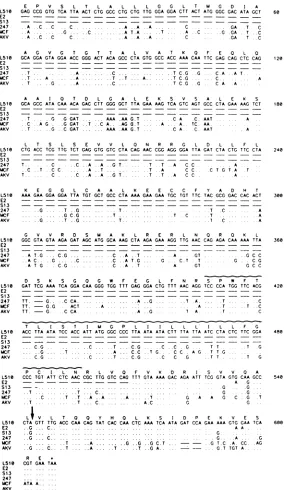
FIG. 3. Sequencecomparison ofthe p15E-coding region. The DNA sequence andpredicted amino acid sequence for the p15E-coding regionofstrain 129
Glx'
cDNAclone L510arecompared with thecorrespondingse-quences ofcDNAclones E2 and S13 and of infectious viruses MCF247, Mo-MCF, and AKVasdescribed in thelegendto Fig. 2. Thefirst nucleotideisonenucleotide 3'tothe last nucleotide in Fig.4.The wavyline indicatesahighlyconserved,potentiallytransmembranedomain.Thearrowindicates thepredicted cleavagesite which generates the R-peptide.and BALB/c) and were derived from distinct ecotropic parental viruses (AKV and Mo-MuLV).
Sequence homology between endogenous retroviral env
re-gions
and recombinant MCF sequences. cDNA clones El, L511, and L510 sharedregions
of sequenceoverlap,
with 100% nucleotideidentity
over thesequenced regions.
Be-cause of this extensive homology, it is reasonable that the
sequence
presented
reflectsthe sequenceofasingle,
contin-uousRNA
transcript.
Twootherindependent
clones fromaportion
of this region (E119andi
L62) also shared '100%identity with the sequence presented over the 600 and 200
nucleotides,
respectively,
for which.- their sequences weredetermined(datanot shown). This sequence,
(Flig.
3 and 4)contained a 1,932-nucleotide open
triplet reading
framewhich predicted a
potential
protein sequence of644 amino acidsrepresenting
the gp7O-pl5Epolyprotein
precursor.gp7Orcoding
region.
The sequenceof the strain 129endog-enous
gp7O-coding region
more closely resembled thegp7O-coding
regions of recombinant viruses than those ofecotro-pic ~or
xe'notropic
viruses. Two recombinant MCF viralon November 10, 2019 by guest
http://jvi.asm.org/
[image:4.612.173.460.67.557.2]RNA TRANSCRIPTS OF ENDOGENOUS RETROVIRAL SEQUENCE
M E P A F S X P L K D K N P C P L ATGGAAOCTCCAGCCC TTCTCAAMACCCCTTAAA CATAACATTAAC CCGTOGGCCCCCCTA so ATAGCO CTC OGAG TI ATA OCAGGAGTATCA CTACMACATGACACCCCTCATCAG
A
F W T L N1 T T A CTCTTC GTOTC ALA OTTACC MACTTAATGACA CGACMAACA CCT
S L L T M T D A F P K L F D C L
TCCCTCCTGCCGACAATGACC CAT CCCTTTCCTAMACTC TACTTT CACTTC TCC CATTTA
I D0 OW D EC CG C R OP CR KR ATAGCC GACGCAC CAT CAGAGO CGACTCGCC OCTCCCACT CCCCCGOGGA AGAAMAACC
A 0 F V C P H P C
El CCA ADATOO GAG TOC OAT TCCCCCGCC CATAGO GTACCAACA OCTGGA 51 1
A12
247
McF
P E C K C E A Y W K
El CCC ADAGAG CCCTAG OCT CCCAMA TCC GCC OCT CAGACCACTOGACAG CCATAG AAG 15 11
A
247
P S S S K S L K R P N T P N G
Cl CCA OCATCA TCA TCC GAG CTAATT ICCCOO AAGCCAAGA MACACCCCTCAG MATCAGGCC
1511
A
247 .G
cr G
P C TODSSS A V SSO0 1 KG A T P CR
El CCC OCTTATGAT 0CCTCA CCG GTC0CCAGO GAG ATC AAG CCCCCCAGACCC CCA .
A12
247
C ON P L V IL DA K A D0 P
IE TCC MAT COCTADOCCOCG"C TOO AGO GAG OCG GGCAMAAAG CCCACC GATOOCCOCC
K V KG L L G P V R F S
El AAA OTATOGOCACOAADACOD TAG CDA 0CCADACCC.ACCGAG CCC COGACCCCC TIC OCT
A12 247 .T. NCF 0.T. El 1511I Al2 247 iCF 120 El L511I Al2 247 MCF ISO El1 1511I Al2 447 MCF
T D P P s R P V M L P R P P P
ACT CACCAGTTACCCCCCTCCCCACCCGTG CAGATCATC CTCCCCAGGCCTCCTCAGCCT 780
P P P A A S T V P E T A P P S P
CCTCCTCCA CCCOCA TCTACA CTCCCT CAGACT CCCCCACCTTCTCMA CMACCTGCG 840
T D R L N L V D A A L S
ACC CCAGAG AGO CTGCTA MACCTGCTACAT CGA TAG CMA GOCTCTC ~ ~ AGO
p AK 0 E C W L C V A P P L E
240 El CCI GCAGA ACCCMACAG TCG 0CTOOT OCTCOGGTA CC
OCA CCCCCC OATCTAAGO GAM
Al2
247 .T .A.C ..A .T ..A .CTAC G- CG
icFr ..C TA
G--300 El 1511 Al? 247
bicr
V A V N TI A P Afm -I
CCC COG CCC COCCIAGOTAGO TAO 0CC MACCATACCTCTOCCC CCA GOCT MACTOC 0CCGTG
T .C C
~ A S K L S V C V A
CCC 0CCCMACAG AAG CTC ACCCTC ICCGMA AGC CCACAGGCACTC TCCGTAOGA CCA
A1?
247 0.T.. AT... T.. ...A...
V P 'K D0 A CfN T K S D
420 El
L5I1 CCCAMAACCCATCAGGCCCOO OCT MOTACCACCCAGAAGACGAOCGAG 0CCTAG
A12
247
MCF
1140
.A T .A .A T
...A... A CAGO ..TCGA ...T
400 L A A P P P A C N P C L
El
LS11 TAO COGOCCI OCCI CCCCCC GGACCAAOT GOCT ICC MACA CCM CTCAGO CCC ICCCIA
Al?
247 T..C C A.A A.TCC T 0. .A 0. TAC
McF .A .C .TA.A T AC C. .T G T. .A A.C
V L Y C V L V E 0W P
540 El
1511 OCTACCADO COGCOCGAD CTC ACC. ACC CATTAG OCTGTCCOG GAGCOO CCAAMG
Al?
247 ..A C A A C 0.C..G
McF ..C CA A C.GA 0.T 0. T 0. .C..A GA
V S P V F E R K K K
fEl
1511 DOGACCTAD CAD 0CCCCT GOT OATGOTTAO CAGTOTGAG AGAAMACC AM OATAM Al?
247 ..TA .CCA .A .A CCCGG.
icF ..C .0T .C AC .C 0.T. TCC.A.CG C.C
6ff El 1511 AGA Al? 247 icr 12ff 12Nf 320
LTOO VIM I PO VP I P OP V
El TOG AC CCCCM GOC CTCAAT0ATA CO CCOCG CCC ATTOMCCCCT MOTCCC COGATC 720
A12
247
T
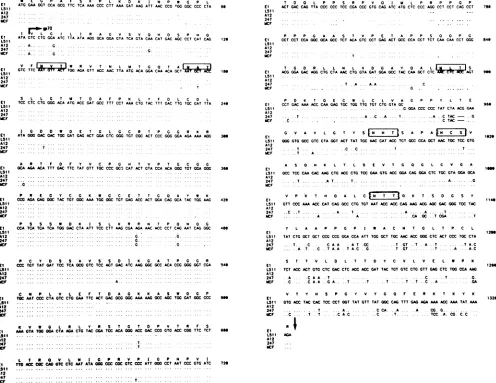
FIG. 4. Sequence comparison of the gp7O-coding region. The DNA sequence and predicted aminoacid sequence forthe gp7O-coding region ofstrain 129 Glx' endogenous transcripts were derived from two overlapping cDNA clones, El and L511. These sequences are
comparedwith thoseof AKRendogenous proviralclone A12, MCF 247 virus, and Mo-MCFvirusasdescribedin thelegend to Fig.2.This
sequencebegins withnucleotide 303(see Fig.2) due totheoverlapping, out-of-frame codingregions ofpol andenv. Maturegp7Oproteinis
predictedto begin withthe valine residue at positions 97to 99 aftercleavage from the 31-amino acidpotential signal peptide. The boxes indicatepotentialglycosylation sites, and thearrowa't the end of thesequence indicates the predicted site ofcleavagefrom p15E. sequences which showed considerable similarity to this
RNA sequenceare shown in Fig. 4. Asimilarhigh degreeof nucleotide homology was found for two MCF viruses in-duced from C3H mouse cell lines (28), as well as for the sequencesoftworecombinant spleen focus-formingviruses,
Friend spleen focus-forming virus (1) and Rauscher spleen
focus-formingvirus (4) (data notshown). However, toalign the predicted endogenous gp7Osequence with the sequence
ofecotropic Mo-MuLV (42), four insertions and five dele-tions would be required tojuxtapose similarregions.
Like-wise, alignment with the available nucleotide sequences of
NFS and NZB xenotropic gp7O-coding regions (33, 37)
would require insertion of four codons and deletion ofone
codon in the aminoportion and deletion ofone codoninthe carboxy region. Although functional data are lacking for endogenously expressed enm' proteins, since they are not
associated with viral particles, these structural comparisons
classifythem with the dualtropicor MCFfamily ratherthan ecotropic orxenotropic virus.
A sequence comparisonof1.323 nucleotides of the
endog-enous strain 129 gp7O-coding region with' the homologous
regions of recombinant virus MCF 247 and Mo-MCF virus
revealed that although there were 74 and 78 nucleotide
differences, respectively, these differences were not
ran-domly distributed but clustered toward the 3' end of the sequence. Thus, the sequenceof this transcribed enm' region
is nearly identical to the corresponding 5' two-thirds of the
gp7O-coding region of MCF viruses that is postulated to
resultfromrecombination of the ecotropicparent viruswith
endogenous genomic DNA. Within this conserved region only 4 of 859 nucleotides are different, resulting in three amino acid changes compared with MCF 247 virus.
Simi-larly, when this strain 129 sequence wascompared with the
sameregionofthe Mo-MCFgenome, nine nucleotide
differ-ences were observed, seven of which led to changes in
amino acidts. The endogenous strain 129 gp7O sequencewas
also very similar to that of the endogenous proviral
se-quence, A12, which was cloned from the murine AKR
El 1511I Al2 247 MCF ElI L51I Al? 247 MCF ElI 1511I A12 247 icF El 1511I A12 247 McF ElI 1511I Al? 247 MCF 695
on November 10, 2019 by guest
http://jvi.asm.org/
[image:5.612.55.551.72.455.2]TABLE 1. Summary of homologous relationships between the strain 129endogenous contiguous sequence and viral sequences"
No. of No.of
nucleotide
diffes nucleotide Nucleotide amino No.ofno.
ofgapsRegion Nucleotide Seune differences differences dfencaidlged introduced to
Region position Sequence wtiwthn difference acid aligned create
position ~~~within within (% difference nucleotides cralinent
synonymous different (7) alignments
codons" codons
po/ 1-360 E2 (15)' 4.8 313 1
S13 (3)' 3.2 94 0
A12 2 1 0.8 0.8 360 0
MCF247 2 1 0.8 0.8 360 0
Mo-MCF 24 12 10.0 5.8 360 0
AKV 33 20 15.2 10.3 348 1
gp7O 1-801 A12 1 3 0.7 1.6 564 0
MCF 247 1 3 0.5 1.1 801 0
Mo-MCF 2 7 1.1 2.6 801 0
802-1323 MCF247 44 26 13.5 8.7 519 1
Mo-MCF 29 40 13.3 12.7 519 1
plSE 1-543 E2 (3)' 5.1 59 0
S13 (3)' 8.3 36 0
MCF 247 75 33 20.0 10.0 540 1
Mo-MCF 94 30 23.0 10.0 540 1
AKV 76 34 20.1 10.0 540 1
R-peptide 544-606 E2 (3)' 4.8 63 0
S13 (1)' 1.6 63 0
MCF 247 3 1 6.3 4.8 63 0
Mo-MCF 7 12 33.3 31.6 57 1
AKV 6 7 22.8 21.1 57 1
"A contiguous sequence forthe strain 129endogenoustranscriptwasassumedbyusingthelongestsequences shown inFig.2through4. Number ofnucleotide differencescomparedwith the strain 129 sequence.
Deletedendogenous sequencesE2and S13 do not containopenreadingframes; therefore, thetotal numbers of nucleotidedifferencesarereported.
genome(17) but is notknowntobe transcriptionally active. Of the nucleotide sequence available for this proviral ele-ment, only 4 differences among 564 nucleotides were ob-served. Interestingly, of these differencesbetween the A12 and strain 129 sequences only one nucleotide difference at
position 457 (Fig. 4) was shared with the MCF 247 virus sequence, indicating that this region of the MCF 247 genome,whichwasderivedfromtheendogenous sequence, ismoresimilartothetranscribed strain 129 sequence thanto the AKRendogenous sequence.Incomparison,
alignment
of the same region of the gp7O-coding sequence of NZBxenotropic virus (33) demonstrated8.4%nucleotide
dissim-ilarity after allowing for a 12-nucleotide insertion and two
3-nucleotide deletions (datanot shown).
The differences that do distinguish the nucleotide se-quencesof theseendogenoustranscripts fromthoseof MCF
viruses (Fig. 5) accumulate abruptly 3' to the probable recombinationpointof MCF 247atposition856(Fig.4)(14).
Thesedifferences between the strain 129 sequence and the sequenceofthe ecotropicgp7O-encoding regionofMCF 247 account for70 of the 74 overall nucleotide differences and result in 15 amino acid differences. Furthermore, in this portionof theenvgene theintroduction ofaone-codon gap isrequired in the MCF virus sequence foralignment,
result-ing in the addition ofa strain 129 transcript-specific threo-nine residue at positions 952 to 954. Similarly, 69ofthe 78 nucleotide differences between the
gp7O-coding
regions of thestrain 129transcripts and the Mo-MCF genome clusterat the 3' end of the sequence, past the presumed site of recombination and within the ecotropic-derived region of Mo-MCFgp7O,
and also require the same threonine codon insertion for sequence alignment.The comparisons described above (Table 1) demonstrate that there is99%orgreater sequence homology between the regions substituted in the generation of the recombinant viruses and the strain 129 transcribed sequence presented here. Therefore, the comparisons help define the region of ecotropic sequence that is not substituted in thegp70-coding region of MCF viruses and thus distinguished by 13.5% dissimilarity compared with the corresponding strain 129 sequence. The clustering of these differences is relevant to themapping of potential sites of therecombinational events thatpresumably gave rise to Mo-MCF virus. Bosselman et al. (6) indicated that this recombination took place at posi-tion 1073 (Fig. 4) on the basis ofsimilarity with Mo-MuLV. However, our data imply that recombination more likely took place further 5', closer to the region implicated for MCF 247 recombination (position 856). Therefore, the re-gion 3' to thispotential recombination point may actually be ecotropic in origin, the differences between Mo-MCF and Mo-MuLV in this region having been introduced by muta-tion rather than by recombination. Interestingly, of the differences between Mo-MCF and the strain 129 sequence, 31 aresilent while 48 leadtocodonchanges; in MCF247, 46 changes are silent while 28 lead to amino acid differences. This preponderance ofcoding changes may be indicative of aselective pressurefavoringanaltered protein sequence for Mo-MCF.
pl5E-coding region. As shown in Fig. 3, the beginning of plSE is defined by analogy with Rauscher MuLV, with which it shares the amino-terminal protein sequence. The sequence shown is from clone LS10, which contains the entire 606-nucleotide plSE open reading frame (202 amino acids, predicting a protein having a molecular weight of
on November 10, 2019 by guest
http://jvi.asm.org/
RNA TRANSCRIPTS OF ENDOGENOUS RETROVIRAL SEQUENCE
-I 1 - 360
* * * 0 * . . 0 00. * * 00 0*
AKV 00* * 00 * * 0 *000 *300 000 00.
AKV () 1-360
+ + + + + + + +-+ +
++
B. gp7O
*~~~~~~~~~~ * * *
+ + +
0***~* 0 0** * * *** 0 0
'I0 :* ***: * * ***0* ** 0 *** *** ****** ***0 * *0**
- ()
+ + + + + + +. . + ++ +
+ +
AKV ()
4-4-4 +4 4444 iifii + + H Ii + + ++ ++ + ++ +
+ +
C. pl5E
+ I44I+4+4+
4++
+
. * ...Z X
0* ...I.. ...
fL
4+
+44
* *
...
***. ... . * .. 0* . ...
**** ..***.** 00*4* ...*.* ....** . .. ...0 .*...**0
() {
+ + F+ + + +~~~~~~~~-()-I
+
+
1 - 609
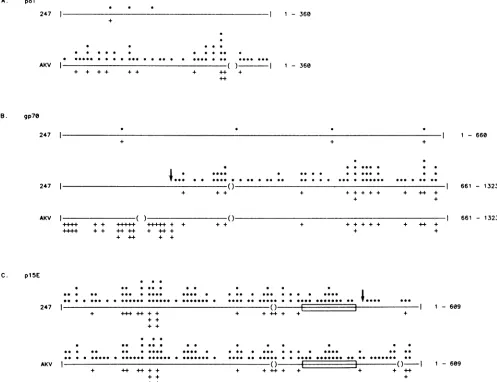
FIG. 5. Histogram display ofsequencesimilarities.Thehistogramsrepresentnucleotide and amino acid differences between thesequence
indicated and thecompositesequencederived for the strain 129Glx+endogenous transcript (see text).The linesrepresentidentitywith the strain 129endogenoussequence,while asterisks above the line andplus signsbelow the line indicate theapproximatepositionsof nucleotide
and amino acid differences, respectively, in the sequence indicated at the left. Parentheses indicategaps introduced in the sequence to
increasealignment with the strain129endogenoussequence. (A)polregion from Fig.2. (B) gp7Oopenreadingframe fromFig. 4.(C)plSe openreadingframe fromFig. 3. Sincethe first half of AKVgp7Oisextremelydissimilar, onlythesecond half of thegp7O regionfrom AKV
iscompared in panel B. The arrowsinpanelsBand C indicatetwopredictedrecombinationpointsfor thegenerationof MCF 247 virus(see text). Theboxes inpanel C indicate the predicted transmembranedomain.
22,000). This clone overlaps L511, and, for the approxi-mately 400 nucleotides determined, their sequences are identical. Furthermore, clone E119 also has the same
se-quence as L510 for approximately 350 nucleotides of the
sequencedetermined(datanot shown). However, the over-lapping portion of clone S13 contains 4 differencesoutof122 nucleotides, and that of clone E2 shows 6differences outof 99 nucleotides 2 of which are shared with S13. Further
sequence heterogeneity was detected in a pl5E-coding re-gion clone from thymus, which showed five nucleotide differences in the3' one-half ofp1SE, leadingto twoamino acidchanges (GlntoLeuatpositions 535 to537 and Lysto
Gluatpositions 588to 600).
Thestrain 129endogenous transcript sequencesencode a protein that is oneamino acid longer than piSE from MCF 247 virus due to a codon insertion at positions 364 to 366, resultingintheaddition ofaserine residue. This endogenous
transcript-specificcodonwasalsopresentinclone E119and inthethymus clonesequences.Theendogenous transcriptis threecodonslongerthanthepiSE region of Mo-MCFdueto
a second insertion (two codons at positions 580 to 585 [Asp-Pro]). This insertion is alsopresent in MCF 247virus, as well as in feline leukemia virus (9). Overall, MCF 247 virus has112nucleotide differencescomparedwiththe L510
sequenceshown, 34 of themleadingtochanges in 19 amino acid residues. Similarly, Mo-MCF has 142differences,with 38leadingto changesin 24 codons. These dataare summa-rized inTable 1 forcomparison oftherelativedifferencesin nucleotide andamino acid sequences. AKV is almost
iden-tical with MCF 247 virus over this region until the 3' terminus, whereMCF247 virus ismoresimilartothestrain 129 sequence, and was probably derived from a nonecotropicparentduetoanotherrecombinationalevent at
aboutposition 500(16) (Fig. 1). VOL.56, 1985
A. pol
247
l-+
697
247
247
1 - 660
661 - 1323
+ . . . .
247
I-+ 44 +
-| 661 - 1323
.-** *
AKV
I-1 - 609
0 *** 0 * ****** ****** ** *
** *
* * 0 0 * * 0 0 * * 0 0 0 * 0 * 0 * * *0*0*00 0 **** ** ***** * 0
1 1
*0 0
+
* 0 0 0 * *0 0 0 s * 0 0* * 0 * 0 0 0 *
** * * ** 0 *
on November 10, 2019 by guest
http://jvi.asm.org/
[image:7.612.55.552.75.457.2]DISCUSSION
The sequences ofactivelytranscribed, endogenous retro-virus-related RNA transcripts described here contain
char-acteristic features demonstrating their close homology to
infectious viruses, particularly recombinant MCF
leukemo-genic virus. In particular, the env region contains an open
reading frame which potentially encodes a protein product
closely resembling typical viral gp70 and pl5E proteins, predicting that this RNA species is responsible for the serologically detected viral antigens of strain 129 mice (31, 45). This protein, derived from an open reading frame partially overlapping that of the pol gene, would be derived from a precursor containing a typical N-terminal signal peptide (5), allowing placement at the cell surface, and
cleavage from pl5E by a trypsin-like activity after the
lysine-arginine doubletatpositions1318 to 1323(Fig.4). The maturepredicted protein is 441 amino acids long and
con-tains sixattachmentsitesforN-linkedglycosylation(29), all
of which are conserved in MCF 247 and Mo-MCF gp70 proteins.
This endogenous env region transcript allows precise definition of the substituted sequences acquired by
patho-genic MCF viruses. From these data, together with the
partial nucleotidesequenceofagenomiccopyofthe
endog-enous provirus-likesequence obtained fromthe AKRstrain (17), it is clear that MCF 247 virus acquired an endogenous sequence similar to that constitutively expressed in strain 129
Glx+
micefor the 3' portion of pol, the 5' two-thirds ofgp70, and the extreme 3'-terminal region of pl5E while
retaining ecotropic sequences for the remaining regions
between these substitutions. Sequence comparisons in the U3 region indicate the presence ofyetanothersubstitution ofnonecotropic informationin thecreationof MCF 247 virus (18, 35; D. E. Levy, R. McKinnon, J. W. Gautsch, and M. C. Wilson, manuscript in preparation).
Theportion of the pol sequence described here is derived
from the 3' end ofthat gene, a region thought to encode a
function necessary for the establishment of a productive viralinfection(41). The major difference between ecotropic virusand the endogenous transcript withinthis region isthe
absence from ecotropicpolof fourcodonsattheextreme3'
end, accompanied by aclustering of amino acid differences (Fig. 2).Recombinant leukemogenicviruses shareextensive homologywith theendogenoustranscriptwithinthisregion. Interestingly, similar differences were observed between Mo-MuLV(42), which also exhibitsleukemogenic activity, and nonpathogenic AKV (12). This portion of pol may contribute some leukemogenic potential to recombinant vi-ruses (13).
The structural data reported here suggest that the strain 129 cellular gp70 proteins display dualtropic determinants
similar to those ofMCF viruses. The acquisition by MCF viruses of a similar endogenous sequence encoding the amino-terminalportionofgp70ispresumably responsiblefor theirexpanded host rangescomparedwithecotropic viruses and may influence their tissue tropism (8). The carboxy-terminalportionofgp70andthe bulkof
pl5E
differfrom thecorresponding regions of MCF viruses, which derive these
codingsequencesfrom theecotropicparent. The reasonfor thisreturn totheecotropic sequence in MCF viruses is not
clear, although this feature has been found to be a major
determinant ofleukemogenesis in recombinant viruses (13, 23, 27).
The nucleotide sequence of the endogenous transcript
differsuniformlyfrom the sequences ofinfectiousecotropic
virus and MCF virus throughout the 3' portion ofthe env gene
(approximately
13 and 20% nucleotide differences[Table 1] forcarboxy-terminal gp7O and pl5E,respectively). However, the
predicted
amino acid sequence displaysre-gions which have been highly conserved, punctuated
by
segments ofclustered amino acid differences (Fig. 5). For
example, the probable membrane-spanning, hydrophobic domain ofecotropic pl5E(10,22) is completelyconservedin the endogenous protein at the amino acid level butexhibits
19and 22%dissimilarity compared with MCF 247 virus and
Mo-MCF virus at the nucleotide level (nucleotides 406 to 495) (Fig. 3). However, anotherhydrophobic domainat the amino terminus of AKV pl5E, which may produce
mem-brane-fusing activity (47), is disrupted by three
charged
residues (Asp, Lys, and Glu) in the endogenous protein, possibly resulting in altered activity. Regions in which the protein sequence hasdriftedcomparedwith infectious virusmayaffecttheinteractionofendogenous gp7O and pl5Eand
couldresult in the release ofgp7O as a secretedformfound
in seraandepididymidesofnormal mice (11). Alternatively,
the carboxy portion of gp7O could contribute to tropism determinantsofpotentialvirusesexpressing theentirestrain 129 endogenous gp7O. Because of the availability of these cloned sequences we have begun to test thefunction of these regionsdirectly by replacing the env components of gp7O and pl5E, as well as the long terminal repeat of infectious virus, with the analogous regions of the endogenous strain 129 sequence.
The biological consequence of the normal expression of MCF-like envelope proteins in strain 129 mice may be the blockage of the specific MCF cell surface receptors (36),
leading to resistance to MCF viral infection (2). Since the MCF viruses are strongly implicated in the incidence of leukemia, such resistance mayimpart a significant selective advantage to theanimal (39). The close sequence similarity
between these RNA species andMCF virus also suggests a relationship between activeexpression of the proviruses and thegeneration ofleukemogenic viruses. It is interesting that
ofthe manyproviral sequences of the AKR genome, theone found to be most similar to the substituted region of MCF 247 virus (17) is also highly homologous to the expressed copy in strain 129. Furthermore, the large env deletions detected in clones S13 and E2 are strikingly similar to the substituted region of MCF virus. The 5' breakpoint of S13 correspondsexactly tothe5' recombination point identified for MCF virus CI-3 (28), while the 3' breakpoint of E2 matches the recombination point in the pl5E region of MCF 247virus (16).
ACKNOWLEDGMENTS
Wethank R. OgataandE. Rothenbergforhelpfuldiscussions;J. Elder, J. G. Sutcliffe, and P. Policastro for comments on the manuscript; and P. Graber and A. McDonald for expert help in manuscript preparation.
This work was supported in part by Public Health Service Predoctoral Training Grant GM-07616 from the National Institutes ofHealth to D.E.L. andbyPublic Health ServicegrantsCA-27489 andCA-33730 from the National Institutes of HealthtoR.A.L. and M.C.W., respectively.
LITERATURECITED
1. Amanuma, H., A. Katori, M. Obata, N. Sagata, and Y. Ikawa. 1983.Complete nucleotide sequenceof thegeneforthespecific glycoprotein (gp55) ofFriendspleenfocus-forming virus. Proc. Natl. Acad. Sci. USA 80:3913-3917.
2. Bassin, R. H., S. Ruscetti, I. Ali, D. Haapala, andA.Rein. 1982.
on November 10, 2019 by guest
http://jvi.asm.org/
RNA TRANSCRIPTS OF ENDOGENOUS RETROVIRAL SEQUENCE
Normal DBA/2 mouse cells synthesize a glycoprotein which interferes with MCF virus infection. Virology 123:139-151. 3. Berns, A. J., M. H. T.Lai,R. A.Bosselman, M. A.McKennett,
L. T. Bacheler, H. Fan, E. C. Robanus Maandag, H. van der Putten, andI. M. Verma. 1980. Molecular cloning of uninte-grated and a portion of integrated Moloney murine leukemia viral DNA inbacteriophage lambda. J. Virol. 36:254-263. 4. Bestwick, R. K., B. A. Boswell, and D. Kabat. 1984. Molecular
cloning of biologically active Rauscher spleen focus-forming virus and thesequencesof its env gene and longterminalrepeat. J. Virol. 51:695-705.
5. Blobel, G., and B.Dobberstein. 1975. Transfer ofproteinsacross membranes. J. Cell Biol. 67:835-851.
6. Bosselman, R. A., F. van Straaten, C. Van Beveren, I. M. Verma, and M. Vogt. 1982. Analysis of the env gene of a molecularly cloned and biologically active Moloney mink cell focus-forming proviral DNA. J. Virol. 44:19-31.
7. Chattopadhyay, S. K., M. R.Lander, S. Gupta, E. Rands, and D. R. Lowy. 1981. Origin of mink cytopathic focus-forming (MCF) viruses: comparison with ecotropic and xenotropic murineleukemia virus genomes. Virology 113:465-483. 8. Devare, S. G., U. R. Rapp, G. J. Todaro, and J. R.Stephenson.
1978. Acquisition ofoncogenicitybyendogenous mousetype C viruses: effects ofvariations in env and gag genes. J. Virol. 28:457-465.
9. Elder, J.H., and J.I.Mullins. 1983. Nucleotide sequence ofthe envelope gene of Gardner-Arnstein feline leukemia virus B reveals unique sequence homologies with a murine mink cell focus-forming virus. J. Virol. 46:871-880.
10. Green, N., T. M. Shinnick, 0. Witte, A. Ponticelli, J. G. Sutcliffe, and R. A. Lerner. 1981. Sequence-specific antibodies show that maturation of Moloney leukemia virus envelope polyprotein involves removal of a COOH-terminal peptide. Proc. Natl. Acad. Sci. USA78:6023-6027.
11. Hara, I., I. Shozo, and F. J. Dixon. 1982. Murine serum glycoprotein gp70 behaves as an acute phase reactant. J. Exp. Med. 155:345-357.
12. Herr, W. 1984. Nucleotide sequence of AKV murine leukemia virus. J. Virol. 49:471-478.
13. Holland, C. A., J. W. Hartley, W. P. Rowe, and N. Hopkins. 1985. Atleastfourviral genescontribute to the leukemogenicity of murine retrovirus MCF 247 in AKR mice. J. Virol. 53:158-165.
14. Holland, C. A., J. Wozney, and N. Hopkins. 1983. Nucleotide sequence of the gp7O gene ofmurine retrovirus MCF 247. J. Virol. 47:413-420.
15. Horowitz, J., and R. Risser. 1982. A locus that enhances the induction of endogenous ecotropic murine leukemia viruses is distinct from genome-length ecotropic proviruses. J. Virol. 44:950-957.
16. Kelley, M., C. A. Holland, M. L. Lung, S. K. Chattopadhyay, D. R. Lowy, and N. H.Hopkins. 1983. Nucleotidesequence of the 3' end of MCF 247 murine leukemia virus. J. Virol. 45:291-298.
17. Khan, A. S.1984. Nucleotide sequence analysis establishesthe role of endogenous murine leukemia virus DNA segments in formation of recombinant mink cell focus-formingmurine leu-kemia viruses.J. Virol. 50:864-871.
18. Kahn, A. S., and M. A. Martin. 1983. Endogenous murine leukemia proviral long terminal repeats contain a unique 190-base-pair insert. Proc. Natl. Acad. Sci. USA80:2699-2703. 19. Khan, A. S., W. P. Rowe, and M. A. Martin. 1982. Cloning of
endogenous murine leukemia virus-related sequences from chromosomalDNA of BALB/c andAKR/J mice: identification of an env progenitor of AKR-247 mink cell focus-forming proviral DNA. J. Virol. 44:625-636.
20. Kozak, C. A., and W. P. Rowe. 1980. Genetic mapping of xenotropic murine leukemia virus-inducing loci in five mouse strains. J. Exp. Med. 152:1419-1423.
21. Kozak, C. A., and W. P. Rowe. 1982. Genetic mapping of ecotropic murine leukemia virus-inducing loci in six inbred strains.J. Exp. Med. 155:524-534.
22. Lenz, J., R. Crowther, A. Straceski, and W. Haseltine. 1982.
Nucleotide sequence of the Akv env gene. J. Virol. 42:519-529.
23. Lenz, J., and W. A. Haseltine. 1983. Localization ofthe leuke-mogenic determinants of SL3-3, an ecotropic, XC-positive murine leukemia virus of AKR mouse origin. J. Virol. 47:317-328.
24. Levy, D. E., R. A. Lerner, and M. C. Wilson. 1982. A genetic locus regulates the expression of tissue specific mRNAs from multiple transcription units. Proc. Natl. Acad. Sci. USA 79:5823-5827.
25. Levy, D. E., R. A. Lerner, andM. C. Wilson. 1985. The Gv-1 locus coordinately regulates the expression of multiple endoge-nous murine retroviruses. Cell 41:289-299.
26. Levy, J. A. 1978. Xenotropic type C viruses. Curr. Top. Microbiol. Immunol. 79:109-213.
27. Lung, M. L., J. W. Hartley, W. P. Rowe, and N. H. Hopkins. 1983. Large RNaseTi-resistant oligonucleotides encodingplSE
and the U3 region of the long terminal repeat distinguish two biological classes of mink cellfocus-forming type C viruses of inbred mice. J. Virol. 45:275-290.
28. Mark, G. E., and U. R. Rapp. 1984. Envelope gene sequenceof two in vitro-generated mink cell focus-forming murine leukemia viruses which contain the entiregp7O sequence of the endoge-nous nonecotropic parent. J. Virol. 49:530-539.
29. Marshall, R. D. 1974. The nature and metabolism of the carbo-hydrate-protein linkages of glycoproteins. Biochem. Soc. Symp. 40:17-26.
30. Messing, J., and J. Vieira. 1982. A new pair of M13 vectors for selecting either DNA strand of double-digest restriction frag-ments. Gene 19:269-276.
31. Obata, Y., H. Ikeda, E. Stockert, and E. A. Boyse. 1975. Relation ofG,x antigen of thymocytes to envelop glycoprotein of murine leukemia virus. J. Exp. Med. 141:188-197.
32. Old, L. J., and E. Stockert. 1977. Immunogenetics of cell surface antigens of mouse leukemia. Annu. Rev. Genet. 11:127-160.
33. O'Neill, R. R., C. E. Buckler, T. S. Theodore, M. A. Martin, and R. Repaske. 1985. Envelope and long terminal repeat sequences of acloned infectious NZB xenotropic murine leukemia virus. J. Virol. 53:100-106.
34. Orcutt, B. C., M. 0. Dayhoff, and W. C. Barker. 1982. User's guide for the alignment score program. Report 820501-08710. National Biomedical Research Foundation, Washington, D.C.
35. Quint, W., W. Boelens, P. van Wezenbeek, T. Cuypers, E. R. Maandag, G. Selten, and A. Berns. 1984. Generation of AKR mink cell focus-forming viruses: a conserved single-copy xenotropic-like provirus provides recombinant long terminal repeat sequences. J. Virol. 50:432-438.
36. Rein, A., and A. Schultz. 1984. Different recombinant murine leukemia viruses use different cell surface receptors. Virology 136:144-152.
37. Repaske,R., R. R. O'Neill, A. S. Khan, and M. A. Martin. 1983. Nucleotide sequence of the env-specific segment of NFS-TH-1 xenotropic murine leukemia virus. J. Virol. 46:204-211. 38. Risser, R.,J.M. Horowitz, and J. McCubrey. 1983. Endogenous
mouse leukemia viruses. Annu. Rev. Genet. 17:85-121. 39. Ruscetti, S., L. Davis, J.Feild,andA. Oliff. 1981. Friend murine
leukemiavirus-induced leukemia is associated with the forma-tion ofmink cellfocus-inducing viruses and is blocked in mice expressing endogenous mink cell focus-inducing xenotropic viralenvelope genes.J. Exp. Med. 154:907-920.
40. Sanger, F., S.Nicklen, and A. R. Coulson. 1977. DNA sequenc-ing with chain terminating inhibitors. Proc. Natl. Acad. Sci. USA74:5463-5476.
41. Schwartzberg,P., J.Colicelli, and S. P. Goff. 1984. Construction andanalysis of deletion mutations in thepol gene of Moloney murine leukemia virus: a new viral function required for pro-ductiveinfection. Cell37:1043-1052.
42. Shinnick, T. M., R. A. Lerner, and J. G. Sutcliffe. 1981. Nucleotide sequence of Moloney murine leukaemia virus. Na-ture(London)293:543-548.
43. Stockert, E., E. A. Boyse,Y.Obata,H.Ikeda,N. H. Sarker, and VOL.56, 1985
on November 10, 2019 by guest
http://jvi.asm.org/
H. A.Hoffman. 1975. New mutantand congenic mousestocks
expressing the murine leukemia virus-associated thymocyte surface antigen Gix. J. Exp. Med. 142:512-517.
44. Stockert, E., L. J. Old, and E. A. Boyse. 1971. TheGlxsystem.
A cell surface allo-antigen associated with murine leukemia virus; implications regarding chromosomal integration of the viralgenome.J. Exp. Med. 149:200-215.
45. Strand, M., F. Lilly, and J. T. August. 1974. Host control of
endogenous murineleukemia virusgeneexpression:
concentra-tions of viral proteins in high and low leukemiamouse strains.
Proc. Natl. Acad. Sci. USA 71:3682-3686.
46. Varmus,H. E. 1984. The moleculargenetics of cellular
onco-genes. Annu. Rev. Genet. 18:553-612.
47. White,J.,M.Kielian,and A. Helenius.1983. Membranefusion proteins of enveloped animal viruses. Q. Rev. Biophys. 16:151-195.