Copyright © 1984,AmericanSocietyforMicrobiology
Envelope Gene Sequence of
Two In
Vitro-Generated
Mink Cell
Focus-Forming Murine Leukemia
Viruses Which Contain the Entire
gp7O
Sequence of the Endogenous Nonecotropic
Parent
GEORGE E. MARKt* ANDULF R. RAPP
Laboratory of Viral Carcinogenesis, National Cancer Institute, Frederick, Maryland21701 Received13 June1983/Accepted4October 1983
The mink cell focus-forming (MCF) class of recombinant murine leukemia viruses (CI-1 to 4) were isolated from iododeoxyuridine-induced C3H/MCA 5 cells in culture and molecularly cloned. These genomesincludedinfectious (CI-3) and defective (CI-4)recombinants. A total of 2,408 nucleotides of CI-3 virus DNA, including the MCF envelope gene, were sequenced and compared with ecotropic, dual-tropic, and xenotropic sequences.The extent of recombinationalexchange in CI-3 wasfrom 145 nucleotides 3' of the splice acceptor site for the envelope mRNA to nucleotide 1,722, between the end of gp7O and the
beginning of Prpl5E.Thus,the entiregp7Osequenceof the endogenous nonecotropic parent was present in this recombinant. The nature and location of the recombinant junctions were consistent with a mechanism involving DNA exchange during reverse transcription. Comparison of the substituted sequence in CI-3 with thatof Moloney MCF virus suggests a very close relationship, if not identity, between the endogenous dual-tropicprovirusesfromwhich they werederived.Anonidentity ofxenotropic and MCF gp70s was observed,
suggestingthatxenotropic murine leukemia viruses are not thenonecotropic parent of the env gene of MCF murine leukemia viruses. The replication-defective virus CI-4 had a684-nucleotide deletion present in the
envgene, eliminatingthe hydrophobic regionswithin the gp7Ocarboxy end and the pl5Eaminoend. This sequence was bordered by an 11-nucleotide direct repeat in CI-3 viral DNA.
Mink cell focus-forming murine leukemia viruses
(MCF-MuLVs) are recombinants between ecotropic and
endoge-nous xenotropic related MuLV (2, 4, 8, 31) sequences. The
recombinationoccursin vivo during thepreleukemic period
inhigh-leukemic strains ofmice (31) andaffectstheenvelope
gene(2, 4,8,19)aswellasthelongterminal repeat(LTR) of
the ecotropic parent virus (13, 38). The envelope gene substitution introduces agp7O with a new receptor binding
site(28) which, perhaps togetherwith new LTR sequences (13, 38), alters the viral host range in vitro from eco- to
amphotropic and mightalso affectits tissue tropismin vivo (7). Some MCF viruses accelerate leukemia development
uponintrathymic inoculationinto young mice of their strain
of origin. The resulting tumors are monoclonal (11) and
contain MCF provirus(es) integrated in
specific
chromo-somal regions(40). Ittherefore appears likely that the final
step in transformation by MCF-MuLV involves insertional
mutagenesis in specific target cells, such that a resident oncogeneis activated.
We have reported previously the isolation and molecular
cloning (27) of MCF-MuLV from cultures of
iododeoxyuri-dine-inducedC3H/1OT1/2cells. One of the molecularclones,
CI-3, inducedanchorage-independent growth
ofepithelial
minklung cells in vitro (27). Thislatteractivity requiredthepresence of nontransforming helper MuLV and epidermal growthfactor (27). UnintegratedDNAintermediates present in cultures of in vitro-transformedepithelial mink lungcells
were also the source of the molecular clone CI-4, a variant form of CI-3 virus, whichcontained a deletion in the pl5E region of the envelope gene as does spleen focus-forming virus(SFFV) (17).
*Correspondingauthor.
tPresentaddress:Laboratoryof HumanCarcinogenesis, Nation-alCancer Institute,Bethesda, MD 20205.
The altered env gene productsofMCF-MuLVs have been
implicated as determinants of pathogenicity for both thy-moma-inducing (9, 32) and erythroleukemia-inducing iso-lates (17). Proposed mechanisms include (i) a mitogenic activity ofthese envelope gene products mediated through
their binding to specific immune receptors (22), or as a
consequence of their cross-reactivity with normal tissue-specific growth factor receptors (26); (ii) lack of
superinfec-tion interference in sensitive target cells due to sluggish processing ofthe
gp7O
precursor(Prgp85), whichultimatelyleads to the accumulation of proviral DNA available for integrationinto sensitive sites (28, 37);or(iii) growth
stimu-lation ofinfected immune cells by the host's immune
re-sponse to viral envelope antigens present on their cell
surface (15).
Theviralenvelopegenecodes fortwomembraneproteins,
gp7O
andpl5E,
which are proteolytically cleaved from aglycosylated precursor(Prgp85) (10). Whereas both
ecotro-pic MuLVenvelope gene products have beenobtained and
partially sequenced (23), little information is available for MCF viralenvelope proteins.Todetermine theexact nature
of the in vitro-acquired envsequences in CI-3 and tomore
precisely define the extent ofrecombinational exchange in CI-3aswellasthedeletion inCI-4,wehavedetermined the
envelopegene sequencefrom CI-3 and CI-4 andcomparedit with thatofecotropic AKR-MuLV (16). The MCF-specific
substitution present in CI-3 wasalsocompared with that of
Moloney-MCF (Mo-MCF) (1), a pathogenic recombinant MuLVderived from aBALB/Mo mouse.
MATERIALS AND METHODS
Plasmid DNA preparation. The isolation, molecular
clon-ing,and subcloninginpBR322ofthe MCF-MuLV genomes
pCI-2, pCI-3, andpCI-4from invitro-transformed
epithelial
mink lung cells (Mv-lLu) have been previously described(27). Plasmid DNAs, prepared by the procedure of Clewell
530
on November 10, 2019 by guest
http://jvi.asm.org/
IN VITRO GENERATION OF MCF-MuLVs 531
1- ' I BarnHI , n j-.]
pCI
4Rv Smal
BamHI
Hpal BamHISail
SmaI
IHv
Kpnl
PvuIIXholPvull
PvullPstl
KpnI
Bgal
SaHamHISaall
SmlSmlRvRI
Sa pCI2/pCI
3Pstl KpnI BamnHl HpalKpnl PvulI XhoI PVuIBaHBl KpnlBIi XbaIBgIIIPstKR5
RvSmaIl
BamHI SaltSmal
HIm' XBglll
IRvSSma
I B l l I I B , ba I
0 1 2 3 4 5 6 7 8 9
Kilobase Pairs
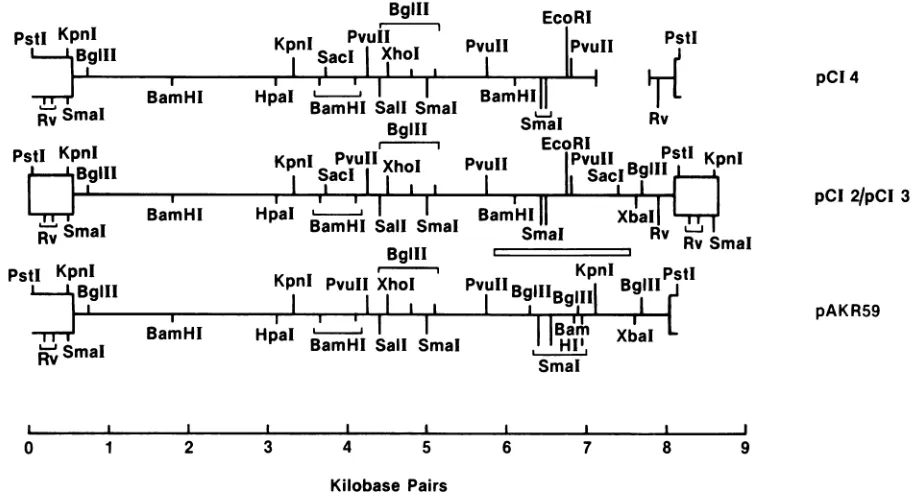
FIG. 1. Partialrestriction endonuclease mapsofthepCIand AKV DNAclones.Theprovirusesareorientedsuch that the 5'endsare at theleft andthe 3'endsare attheright.Largeboxesorpartialopen boxes represent LTR sequences.Clone pCI-4containsadeletion in itsenv geneshownby thegapin thehorizontal line. The MCF-MuLV-clonedgenomespCI-2 andpCI-3 differ in restriction endonuclease sites from those ofanecotropic AKV(pAKR59) genome asindicatedby theboxed areabetweentherespective linedrawings.Therestrictionenzymes shown arewritten intheirentirety exceptEcoRVis abbreviatedas Rv.
and Helinski (5), were purified by two successive cesium
chlorideisopycniccentrifugations. Aftertreatmentwith pro-teinase K (Beckman) at 100 ,ug/ml for60 min at 37°C, the DNAs were phenol extracted and concentrated by ethanol
precipitation.
DNAsequence determination andanalysis. DNA(-10
tLg)
to be sequenced was digested with the appropriate restric-tion endonuclease (New England Biolabs or Bethesda Re-searchLaboratories)underconditions recommendedby
themanufacturer. To exposethe5'-phosphates ofthe StuI- and
SmaI-cleavedDNAs,their 3' endswereresected
by
incuba-tionat37°C for30 min with 0.15UofExolllnuclease
(Miles
Laboratories) in 0.05 M Tris-hydrochloride (pH 8.1)-0.005M
MgCI2-0.01
M 2-mercaptoethanol. Bacteriophage T4polynucleotide kinase (Bethesda Research Laboratories) and
[_y-32PIATP (>5,000 Ci/mmol;
Amersham Corp.) wereusedtolabelfragmentswithextended 5'ends, subsequentto
theirdephosphorylationwith bacterial alkalinephosphatase
(Bethesda Research Laboratories), asdescribed by Maxam
and Gilbert (21). Terminal
deoxynucleotide
transferase (Boehringer Mannheim) and[a-32P]ATP
(3,000 Ci/mmol;AmershamCorp.) wereusedtolabel
fragments
with extend-ed 3' ends(21). DNAfragmentscontaining
uniquely labeled ends were isolated fromSeaplaque
(Seakem)
agarose gels(6). The chemical modification method ofDNAsequencing
described by Maxam and Gilbert (21) was used except the
guanine-plus-adeninereactionwascarried outby incubation
at20°Cfor 8 min in62.5% formicacid and thenstopped with
HZ stop buffer (21). Products were separated in 8 or 20%
polyacrylamide-8 M urea sequencing gels, 0.4 mm thick,
andvisualizedbyautoradiography, usingKodak XAR-5film
at -70°C. DNA sequenceswere compiledandanalyzed for protein sequenceby the programof Queen and Korn (25).
RESULTS
Localization ofthe recombinant env gene sequences. Re-striction maps of the viral genomes usedforDNA
sequenc-ing are shown in Fig. 1 compared with that of AKV clone pAKR59, asubcloneof AKR-623 (18), whose ecotropic env sequence has been determined by Lenz et al. (16). This
comparison, aswell asprevious heteroduplexanalyses (27), suggeststhattherecombinationalborders were in the vicini-tyofthe BamHI siteat6.1kilobases and the Sacl site at 7.4 kilobases. Althoughapparently complete viral genomes had been cloned (pCI-2 and pCI-3), only pCI-3 DNA produced
infectious virus upon transfection of NIH 3T3 cells (27). Thus, this DNA was chosen as the subject of nucleotide sequence analysis.
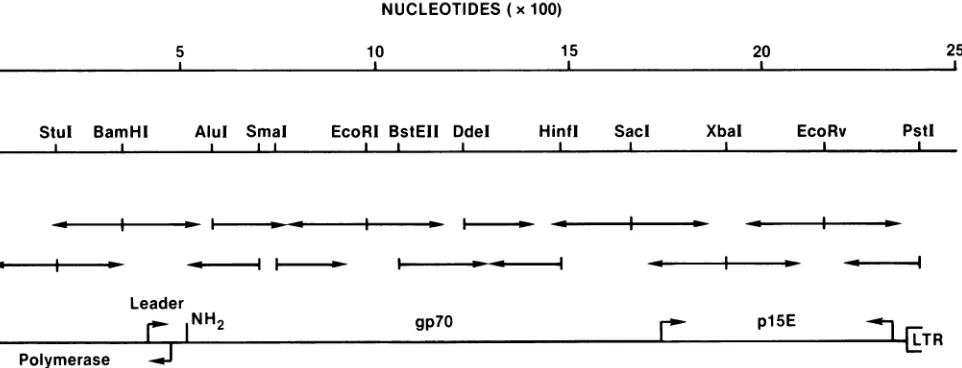
DNA sequence analysis. All DNA sequences were deter-mined by the method of Maxam and Gilbert (21). The strategy used to obtain the nucleotide sequence of the recombinant env geneofclone pCI-3 DNA is shown in Fig.
2. The sequence of 2,408 nucleotides, generated by this
approach,contained473 nucleotides ofthe 3' endofthepol gene,anopenreading frame of1,917nucleotides,
represent-ing the entire env gene, and sequences which stretch 39 basesinto the U3 region oftheLTR(Fig. 3). To determine
thelocation oftherecombinant junctions, this sequence was
comparedwith corresponding sequences obtained by Lenz
et al. (16) for AKR-MuLV. Although these authors do not present extensive sequence information 5' of the ecotropic
envgene,acomparison (Fig. 4A) suggests that the 5' end of the recombinantenv gene in pCI-3 DNA lies just upstream from the BamHI site located at nucleotides 349 to 354. A recently obtained sequence of this region in MCF-247 (Nan-cyHopkins, personal communication) compared with pCI-3 VOL. 49,1984
on November 10, 2019 by guest
http://jvi.asm.org/
[image:2.612.81.541.76.324.2]NUCLEOTIDES (x 100)
0 5 10 15 20 25
Stul BamHI Alul Smal EcoRI BstEII Ddel Hinfl Sacl Xbal EcoRv PstI
I I I I I I I I I I I I I
I o- do isoIso I No
gp7O
FIG. 2. Strategy for sequencing cloned pCI-3 DNA. Arrows show the direction ofsequencing fromauniquely labeled end, indicated bya horizontal line. Boundaries of the polymerase and envelope genes and LTR sequences were determined from the sequence. Nucleotide numberingwasderived from thesequence presented in Fig. 3.
reveals extensive base pair mismatch 5' from this site,
consistent with the interpretation that these sequences are
endogenousMCFparental inMCF-247 andecotropic paren-tal in pCI-3. Thus, the substitution began in the carboxy
terminus of the pol gene, approximately 130 nucleotides
before the initiatorAUG ofthepCI-3ens' geneand 140to150
nucleotides afterthe ens' splice acceptor sequence (nucleo-tides 126to 135; Fig. 3). The same region was reported by
Bosselman et al. (1) to be the beginning of a Mo-MCF
recombinantenvgene.
The 3' limit of thepCI-3 env,genesubstitution appears to be 14 nucleotides before the amino terminus ofplSE (Fig. 4B). Comparison of the ecotropic pAKR59 sequences with
thoseofpCI-3DNAshowextensive mismatch untilposition 1,722inCI-3,afterwhich thereare only six basechangesin
theremaining687nucleotidessequenced. Inadditiontobase
pair substitutions, pCI-3 DNA contains a three-nucleotide
insertion at the 3' junction between MCF and ecotropic sequences. The noninfectious pCI-2 DNA also contains an
insertion at the same location; however, significantly more
nucleotides are involved. A translation frameshift would
occur as aconsequence of the pCI-2DNAsequence,
result-ing in the termination ofpolypeptide synthesis five codons into the pl5E coding region. This would account for the noninfectious natureof the pCI-2 genome.
Thus,the extentofrecombinantsequences inpCI-3DNA
spans 1,400+ nucleotides from a position near nucleotide
300 toposition 1,722, encompassing the entire gp7O portion
ofthe env gene. The discrepancy between this finding and
heteroduplex observations which underestimated thesize of the substitution is largely the result of the presence of a
guanine plus cytosine-rich region followed by highly
con-served ecotropically related sequences (84% nucleotide
ho-mology) from nucleotide 1,262 to the 3' recombinant junc-tion (those sequences defined as "Eco" in Fig. 5 and 7).
Prior electron microscopic analysis of pCI-3 DNA
du-plexed with AKV DNA had revealed two major regions of nonhomologyseparated by approximately 130nucleotides of partial homology (27). These conserved sequences were
found, as predicted, more than 1,600 nucleotides 5' of the terminal PstI site (Fig. 4C and 5). The homology of this
region degenerates toward its central core. An identical
region of partial homology is alsofoundinthe Moloney(35)
and Friend (3, 14) ecotropic envelope genes, as well as in
NFS-Th-1, a xenotropic virus(30).
The nucleotide sequence of Prpl5EpCI-3 reveals only a
1%divergence fromthe AKR-MuLV ecotropic sequence(a
differenceof 6of 600 nucleotides) andachange intwoamino
acids (Fig. 7). Missing inthe pCI-3 DNA sequence are the
six base insertions and five base substitutions described as
uniquetothe leukemogenic MCF-247 Prpl5E coding region,
as wellasthenucleotidechanges responsible for the
genera-tion ofthe "MCF-specific" Ti oligonucleotide 101 (13). Of
the 73 nucleotides sequenced beyond the Prpl5E termina-tioncodon,including the plus-strand initiation region and the proximal U3 LTR region, the homology is100and 93% with
respect to AKV and MCF-247, respectively. Thus, pCI-3
does not contain the additional sequences of MCF-247
obtained from some as yet to be defined nonecotropic
parent.
Predicted amino acidsequence.Thenucleotidesequenceof
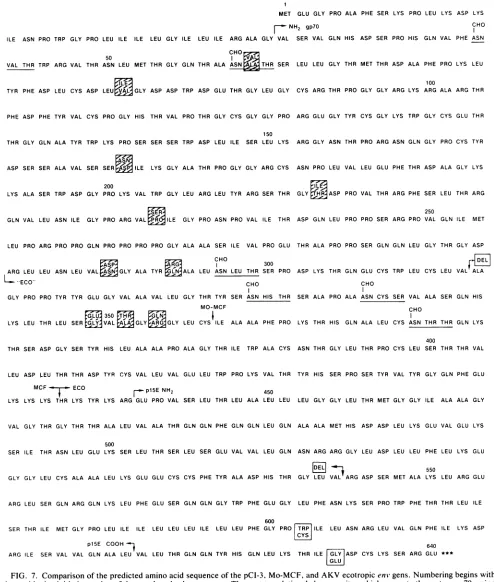
pCI-3 predicts the envgene product to be 640 amino acids
long (Fig. 7). This is 29 amino acids shorter than the sequence predicted for the ecotropic envgeneof AKV (16)
and1aminoacidlongerthan thatpredicted fortheMo-MCF
env,gene(35). The firstAUG codon(nucleotides413to415; Fig. 3) is found 279 nucleotides downstream from the
putativeenvgenespliceacceptorsequence (nucleotides126 to 135). It is this methionine which initiates the only long openreadingframe dictatedbythe DNA sequence.The 30-amino acid signal peptide, cleaved from the N terminus of the primarygene product, is 1 amino acid shorter than the
equivalent ecotropic peptideand exhibitsonlya50% homol-ogywith the lattersequence. Thelocation ofthisand other
post-translational processing sites which define the amino and carboxy termini of the env gene proteins has been deduced by comparison with the known amino acid
se-quences ofMo-MuLV (35), Rauscher MuLV (23, 33), and
Friend MuLV (14, 23).
The MCF-gp7Odomain contains six canonicalsequences, Asn-X-ThrorAsn-X-Ser(20),whichcan serve assites of
N-glycosylation (underlined in Fig. 7; CHO in Fig. 5). An
-o I
Leader
r
I
NH2
Polymerase a
pl5E
-L[
TRad i
go
on November 10, 2019 by guest
http://jvi.asm.org/
[image:3.612.73.554.76.260.2]IN VITRO GENERATION OF MCF-MuLVs 533
CCCGGAACAC TCCGGGCCCC AACTAATAGC CCATCTCTCC
CAACCAGTGA TACCGCACCC TCCTGCTGAC CACCCCCACC
m e g ATCAGGACCG ACATGGAAGG
g_NH2
g
fIv
s v q h d GAGTATCAGT ACAACATGACg t m t d a
AGGGACAATG ACCGATGCCT
g r k r a r t
GGAAGAAAAA GGGCGAGAAC
g c e t t g q
GCTGTGAGAC CACTGGACAG
d s s a v s
TGATTCCTCA GCGGTCTCCA
w d g p k v w
TGGGATGGCC CCAAAGTATG
p r v p g p
CCCGCGTCCC CATTGGGCCT
g a a s v
AGGCGCAGCC TCTATAGTCC InPIg? s p d k AACCTCACCA GTCCCGACAA
S
aN
'sh\WtK
s aATACCTCTGC
h q a
CCACCAGGCC
p c
CCCTGCCTAT
g q f e
GCCAGTTTGA
v g t
AGTGGGAACA
n e
AATCTAGAAA k e e
TAAAAGAAGA
s q q
ATCCCAACAA
f
TTACTCTTTG k t TTAAGACAAT
p a
'K\
CCCAGCTAAC Icc'RZ\$ CTGTGTAACAs t t v
CTACCACTGT
MCF
--k k k GAAAAAAAAA
CATGGATTGA CTCCGTATGA AATCTTGTAC GGGGCGCCCC CGCCCCTTGT splice acc.
AAGCTCACTT ACAGGCCCTC CAAACGGTGC AGCGAGAAAT TTGGAGACCA CTTCCGGACT GGAGACTCCG TGTGGGTGCG CCGGCACCAG ACCAAAAACT GCTCTCAAAG TAGACGGCAT CGCTGCGTGG ATCCACGCCG CTCACGTAAA
p a f s k p k d k n p w g p
TCCAGCGTTC TCAAAACCCC TTAAAGATAA GATTAACCCG TGGGGCCCCC
s p h q v f 'fl\\v,\Zt w r v t n m t
AGCCCTCATC AGGTCTTCAA TGTTACTTGG AGAGTTACCA ACTTAATGAC
f p k y f q c d v g d d w d
TTCCTAAACT GTACTTTGAC TTGTGCGATT TAGTAGGGGA CGACTGGGAT
f d f y v c p g h t v p t g c g
ATTTGACTTC TATGTTTGCC CCGGGCATAC TGTACCAACA GGGTGCGGAG
a y w k p s s s w d s r r g
GCATACTGGA AGCCATCATC ATCATGGGAC CTAATTTCCC TTAAGCGAGG
s d k g a t p g g r c n p I v
GTGACATCAA GGGCGCCACA CCGGGGGGTC GATGCAATCC CCTAGTCCTA
g r y r s t g t d p v t r f
GGGACTAAGA CTGTACCGAT CCACAGGGAC CGACCCGGTG ACCCGGTTCT
n p v t d q p p s r p v q m
AATCCCGTGA TCACTGACCA GTTACCCCCC TCCCGACCCG TGCAGATCAT
p e t a p p s q q g t g d r
CTGAGACTGC CCCACCTTCT CAACAACTTG GGACGGGAGA CAGGCTGCTA
t q e c w c v a g p p y y e
AACCCAAGAG TGCTGGTTGT GTCTGGTAGC GGGACCCCCC TACTACGAAG
\,\
\\'sv a s q h k t s g v a g rTGCTCCGTGG CCTCCCAACA CAAGCTGACC CTGTCCGGGG TGGCCGGGCG
Z\\\$ q k t s d g s y h a a p a g
CCACCCAAAA GACGAGCGAC GGGTCCTACC ATCTGGCTGC TCCCGCCGGA
d t t d y c v v e w p k
ACTCGACCTC ACCACCGATT ACTGTGTCCT GGTTGAGCTC TGGCCAAAGG
a Eco p15ENH2
It
k y k rre
p v s t a II gACCAAATATA AAAGAGAGCC GGTGTCATTA ACTCTGGCCC TACTATTAGG
g t t a v a
GGGACTACCG CCCTAGTGGC
k s t s s
AATCTTTGAC CTCCTTGTCC
c c f y a d
ATGCTGTTTC TATGCCGACC
g w f e g f
GGGTGGTTTG AAGGGCTGTT
g p w n r
GGCCTTGGAT TCTCAATCGC
g d c k s r
AGGAGATTGT AAATCACGTG
t q q t q q
CACTCAGCAG TTCCAACAAC
e v v q n r
GAAGTAGTGT TACAGAATCG
h t g v r d
ACACAGGATT GGTACGGGAT
n k s p w f
TAATAAGTCC CCTTGGTTCA
v q f k d
CTGGrCCAGT TTATCAAAGA e *
AATAAAAGAT TTTATTCAGT
q a a
TCCAGGCTGC r g TAGAGGCCTA
s m a
AGCATGGCCA t t CCACCCTGAT r s CAGGATTTCG TTACAGAAAG 100 CAACTTCCAT GACCCCGACA TGTCAGAATT 200 CTGGCCGAGG CCTACCGGGA CCGACTAGAC
5' junction 300
CAGAACCTCG CTGGAAAGGA CCCTACACCG AGCGGCGACA
TAATAATCCT g q t
AGGACAAACA e t g
GAGACTGGAC
g p r e
GGCCGAGAGA n t p AAACACCCCT
e f t GAATTCACTG
s t r
CTTTGACCCG
p r
GCTCCCCAGG
n v
AACCTGGTAA
g v a v
GGGTTGCCGT
g c
GGGACTCTGC
t w
ACCATTTGGG
v t y h
TGACCTACCA
g t
AGGACTCACT
m h d d k
CATGCACGAT GACCTTAAAG
d f k e
GATCTACTAT TCCTAAAAGA
k r e r s
AACTTAGAGA AAGATTGAGT
s t m g p
ATCCACCATC ATGGGTCCCC p15E COOH
v v q a I v
GTAGTGCAGG CCCTGGTTCT LTR
AGGGGGGA+
GAAAGACCCC 400 ACCCCTCCGG CCGGAACAGC ag r 500
GGGGATCTTA ATAAGGGCAG a \\a'\\\\t s 600 GCTAATGCTA CCTCCCTCCT 9 g c r t p 700 TCGGGTGTCG CACTCCCGGG
w
g y c g k 800
GGGCTACTGT GGCAAATGGG y r n q g p c 900 CGGAATCAGG GCCCCTGTTA
s
d a g k k a lO00 ACGCGGGCAA AAAGGCCAGC 9
q v n i1100
CCAGGTCCTC AATATAGGGC p P p q P P P 1200 CCTCCTCAGC CTCCTCCTCC n g a y q a 1300 ATGGAGCCTA CCAAGCTCTC :n\ g t y s 1400 CCTAGGTACT TATTCCAACC t a a f p k1500 ATAGCAGCGT TCCCCAAAAC t
a c n t 9 1600
CTTGCAACAC CGGGCTCACT y
s p s y v 1700
CTCCCCTAGT TATGTTTATG 9
m g g a a1800
ATGGGCGGAA TTGCCGCTGG t
e v e k s 1900
AAGTTGAAAA GTCCATCACT a
g g c a 2000
GGGAGGTTTG TGTGCTGCCT e
q r q k t 2100
CAGAGACAAA AGCTCTTTGA 2200 TGATAATCCT CTTGTTAATT
q t q q y h 2300 GACTCAACAA TATCATCAAC 2400 TTCATAAGGC TTAGCCAGCT
AACTGCAG
FIG. 3. Nucleotidesequence anddeducedamino acidsequence determinedfor thepCI-3
eni'
gene. Numberat the right of each line refer tothe numberof nucleotides from the beginning of thepresentedsequence. Lowercase letters above the sequence show the predicted amino acid sequence. Also indicatedare thelocation of: the env gene splice acceptor site (splice acc.); the presumed 5' recombinantjunction (overlined); post-translational cleavage sites; potential glycosylation sites (shaded boxes); the presumed 3' recombinant junction (MCF <- -> Eco); and the 11-base pair direct repeats which define the deleted regions of pC-4 (underlined).additional site ofpossible N-glycosylation is located in the
pl5Esequence (amino acids 574 to 576). This site does not
seemtobe glycosylated, sinceplSEcannotbe labeled with
radioactive glucosamine (24). Five of the six potential
N-glycosylation sites are shared with the presumptive
ecotro-picAKV-MuLV (16) parent(Fig.5)as well asFriend MuLV
(14, 23) and ecotropic Mo-MuLV (35) env gene sequences.
Conservation of additional ecotropic gp7O polypeptide
fea-tures are evident from the deduced MCF gp7O protein sequence(Fig. 5) and will be referred to as"Eco"-like. The overall amino acid homology to AKR of this Eco-like domain is 87%. This is in contrast to the amino-terminal
VOL.49, 1984
on November 10, 2019 by guest
http://jvi.asm.org/
534 MARK AND RAPP J. VIROL.
S
Ui
0 Q
4 U)
174 U)7 N
0L C0 0
0 U 0_
UOU
-4
0z-et 0 0 4
0-0) 0
0
(AQ _O C
0-0
4 Q
0U
4 0)
0nU-0
er
w4 4_
0)
0 -4
0-0-a 3
0)0 -0 0)U
O-O
u- 0)
Q'-0 o Q
0 U
CU) 0. a).C
O-O
0-0 )0-0 0)
00 0
CU) -( Y
=
U a
O 0)C -a
am L o0 ) _< s) -Cz CL -L)C
Cy0- LIS
0 -a
L) - F)
CL -u
u L-)
L-CDa
3
-
cc-UXQ < cD
o
<) U
q
sq
r s
q
!;
et
q
q
o
o
sq srq
q
q
q
v
q
et
s
r
U E_ e
fq X
q q q
r
q q
s
q
C)
cr
s
U A,
U U
* ) u
_ v Q
on November 10, 2019 by guest
http://jvi.asm.org/
IN VITRO GENERATION OF MCF-MuLVs 535
2
Amino Acid (x 100) 3
RI Pvull Bcil
4
Sacl
5 6
Xbal Bglll
ATG {
i
pCI3 l
jolymerase Hpartial
PoyeaELlco"
homolo;y
, ,
I
pAKR59 Li i
TAA
I
,,,
m
00 000
ZIZ
p15E
TAA
I
-T- M WIa IIII I {X I II
(E)
Hpal Bgill Smal
(Smal)
BamHI Bgll
Smal
000 KIpn Kpni
LI1Z1Z1 IZI L
Xbal Bgill
CHO = $ Proline = Hydrophobic = m Insertion = 7
A
5
159
B
Form 1
3'
c
Form
2
3
650 Base Pairs
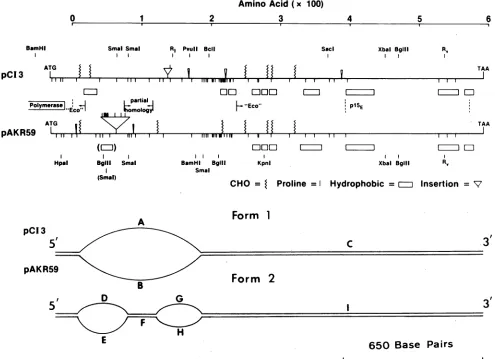
FIG. 5. Schematiccomparisons of the MCF envelope sequenceofpCl-3 and the ecotropic envelope sequence of AKV. Amino acid
sequences were aligned so as to maximize structural similarities. Post-translational cleavage sites are shown as vertical dashed lines; characteristicswithin insertedregionsarewithinparentheses; and ecotropic-likesequencesaredesignated"Eco." Restriction endonuclease sitesare shown (RI, EcoRI;RV, EcoRV), as arethe location ofglycosylation sites (CHO), proline residues, andextensive hydrophobic regions. Amino acidnumbering beginsatthe,matureNH2terminus ofPrgp85and isnot influencedbythepresenceofinsertedsequences.
Belowareinterpretive drawings of thetwoforms ofpCI-3/ARV heteroduplexed DNAseenpreviously (27). Cont,our lengths (in kilobases)
were asfollows: A, 0.69±0.06; B, 0.83±0.12;C, 1.32±0.09;D, 0.32±0.03; E, 0.49±0.04; F,0.13±0.02,G, 0.25 0.02; H,0.26±0.03; 1, 1.28 0.07.
portion,whichexhibitsonlysmallsequencehomologieswith its ecotropic relatives. Adjacent to the Eco-like
carboxy-terminal half of the MCF gp7O, the position of apolar
stretchesand prolineandcysteine (not shown)residuesare
conserved. These latter featuresmaybe dictatedby structur-al requirements intrinsic to env glycoproteins (16). The
Prp15E portion of the pCI-3 DNA was not substantially
altered(197identitiesof 199aminoacids) comparedwiththe
AKV-MuLV sequence (Fig. 7). Unlike MCF-247, where
recombinationaltered thecarboxyterminusto -Ser-Ile-Asp-Pro-Glu-Glu-Val-Glu-Ser-Arg-Glu-COOH, pCI-3 contained
a two-amino acid-shortened sequence (-Thr-Ile-Gly-Asp-Cys-Lys-Ser-Arg-Glu-COOH) which differs from that of AKV (16) only byaGlu->Gly alteration (Fig. 7).
Location of the SFFV-like deletion in the defective MCF virus genome represented by clone pCI-4. One of the MCF virus genomes (CI-4) cloned from the Hirt DNA ofan in vitro-transformed minkepithelial lungcell culturewas defec-tive for replication (27). It was found to contain a deletion
judged by DNAheteroduplexing to be coincident with the
envgenedeletion inFriendSFFVgenomes(34). Theidentity
ofrestriction enzyme sites between pCI-4 DNA and pCI-3 DNAsuggestedthatthe deletion in the formergenomemay
1330 1350
CAAGAGTGCTGGTTGTGTCTGGTAGCGGG CCCCCCTACT
CAAGAGTGCTGGTTGTGTCTGGTA-CGGG TAGCATGGCC 11111111 111 1111111 II TATGCCGACCACACAGGAT TGGTA-CGGG TAGCATGGCC
2030 2050
pCI3
pCI4
[image:6.612.63.558.77.436.2]pCI3
FIG. 6. Location of the deletion within the env gene ofclone pCI-4. DNA sequences of pCI-3, numbered as in Fig. 3, are compared with those obtained from clone pCI-4. Vertical lines representhomologous nucleotides. The directrepeatis enclosed ina
box.
0 I
BamHI Smal Smal
pCI3
pAKP
5
1 D G
H E
VOL.49, 1984
I
on November 10, 2019 by guest
http://jvi.asm.org/
MET GLU GLY PRO ALA PHE SER r NH2 gp7O
ILE ASN PRO TRP GLY PRO LEU ILE ILE LEU GLY ILE LEU ILE ARG ALA GLY VAL SER VAL GLN HIS ASP SER
50
ASN LEU MET THR GLY GLN THR ALA ASN THR SER
LEU YLGLY ASP ASP TRP ASP GLU THR GLY LEU GLY
PRO GLY HIS THR VAL PRO THR GLY CYS GLY
THR GLY GLN ALA TYR TRP LYS PRO SER SER SER TRP ASP LEU ILE SER
ASP SER SER ALA VAL SER SER ILE LYS GLY ALA
200
LYS ALA SER TRP ASP GLY PRO LYS VAL TRP GLY LEU
GLN VAL LEU ASN ILE GLY PRO ARG VAL ILE GLY
LEU PRO ARG PRO PRO GLN PRO PRO PRO PRO GLY ALA
ARG LEU LEU ASN LEU VAL A GLY ALA TYR ALA
-ECO
GLY PRO PRO TYR TYR GLU GLY VAL ALA VAL LEU GLY
r;350
LYS LEU THR LEU SER VAALAGLY ARGLY LEU
THR SER ASP GLY SER TYR HIS LEU ALA ALA PRO ALA
LEU ASP LEU THR THR ASP TYR CYS VAL LEU VAL GLU
MCF T ECO r pl5E NH2
LYS LYS LYS THR LYS TYR LYS ARG GLU PRO VAL SER
VAL GLY THR GLY THR THR ALA LEU VAL ALA THR GLN
500
SER ILE THR ASN LEU GLU LYS SER LEU THR SER LEU
GLY GLY LEU CYS ALA ALA LEU LYS GLU GLU CYS CYS
ARG LEU SER GLN ARG GLN LYS LEU PHE GLU SER GLN
THR PRO GLY GLY
ARG LEU TYR ARG
PRO ASN PRO VAL
ALA SER ILE VAL CHO LEU ASN LEU THR
CHO THR TYR SER ASN
MO-MCF CYS ILE ALA ALA
GLY THR
LEU TRP
LEU THR
I GLN PHE
SER GLU
i PHE
GLN
SER THR ILE MET GLY PRO LEU ILE ILE LEU LEU LEU ILE
ILE TRP i
PRO LYS
LEU ALA
GLN GLN
VAL VAL
TYR ALA ASP
GLY TRP PHE
LEU LEU PHE
p15E COOH
-ARG ILE SER VAL VAL GLN ALA LEU VAL LEU THR GLN GLN TYR HIS GLN LEU
LEU LEU (
CYS ARG GLY
THR
GLY PRO ARG GLU GLY
150
LEU LYS ARG GLY ASN
ARG CYS ASN PRO LEU
SER THR GLY T ASP
ILE THR ASP GLN LEU
PRO GLU THR ALA PRO
300
SER PRO ASP LYS THR
HIS THR SER ALA PRO
PHE PRO LYS THR HIS
ALA CYS
VAL THR 450
ASN THR
TYR HIS GLY
SER
LEU LEU LEU GLY GLY LEU THR
LEU GLN ALA ALA MET HIS ASP
LEU GLN ASN ARG ARG GLY LEU
ER3 5
HIS THR GLY LEU VAL ARG ASP
GLU GLY LEU PHE ASN LYS SER
600
GLY PRO T ILE LEU ASN ARG
THR MET THR
PRO GLY GLY
TYR CYS GLY
THR PRO ARG
VAL LEU GLU
PRO VAL THR
PRO PRO SER
PRO SER GLN
GLN GLU CYS CHO
LYS PRO LEU LYS ASP LYS
CHO
PRO HIS GLN
ASP ALA PHE
100
ARG LYS ARG
LYS TRP GLY
ASN GLN GLY
PHE THR ASP
ARG PHE SER
250
ARG PRO VAL
GLN LEU GLY
TRP LEU CYS
VAL PHE ASN
PRO LYS LEU
ALA ARG THR
CYS GLU THR
PRO CYS TYR
ALA GLY LYS
LEU THR ARG
GLN ILE MET
THR GLY ASP
LEU VAL ALA
ALA ASN CYS SER VAL ALA SER GLN CHO
GLN ALA LEU CYS ASN THR THR GLN 400
LEU THR PRO CYS LEU SER THR THR
PRO SER TYR VAL TYR GLY GLN PHE
MET GLY (
ASP LEU
ASP LEU
SER MET
PRO TRP
iLEU VAL
LYS THR ILE [GLY ASP CYS LYS SER
GLY ILE ALA ALA
LYS GLU VAL GLU
LEU PHE LEU LYS
550
ALA LYS LEU ARG
PHE THR THR LEU
GLN PHE ILE LYS
640
ARG GLU ***
HIS
LYS
VAL
GLU
GLY
LYS
GLU
GLU
ILE
[image:7.612.62.556.82.664.2]ASP
FIG. 7. Comparisonofthepredictedaminoacidsequenceof thepCI-3, Mo-MCF,and AKVecotropicenm' gens. Numberingbeginswith themethionineinitiationcodon oftheenvelopeleadersequence.Thepost-translational cleavagesites whichgeneratethematuregp7Oamino terminusand thep15aminoandcarboxy terminiareindicated witharrows,asarethebeginning oftherecombinantecotropic-like sequences
("Eco"), the beginning and end of thesequence deleted inclone pCI-4 (boxed DEL),and the locations of the envelope 3' recombinant junctionsofMo-MCF(1) andclonepCI-3 shownhere(MCF<- ->Eco). Sequencedifferences within the MCFprotionof thepCI-3env,gene
relativetoMo-MCFareshown in shaded boxes. Differenceswithin theecotropic plSEsequencesrelativetoAKVareshown inopenboxes. Potentialglycosylationsites areunderlined and containtheabbreviation CHOabove.
VAL THR TRP
TYR PHE ASP
PHE ASP PHE
ARG VAL THR
LEU CYS ASP
TYR VAL CYS
I
-11- --- --l. --.. -11- --..
on November 10, 2019 by guest
http://jvi.asm.org/
IN VITRO GENERATION OF MCF-MuLVs 537
have been due to an event subsequent to the env gene
recombination analyzed in the pCI-3 DNA clone. The EcoRV site (nucleotides 2,158 to 2,163; Fig. 3) present inthe carboxyhalfof Prp15E was utilized to obtain thenucleotide
sequence upstream from this site in pCI-4 DNA. The
dele-tion found in pCI-4, calculated to be 684 nucleotides long,
was presumably bordered by a nearly perfect direct repeat (10 of 11 nucleotides) seen in the pCI-3 sequence (Fig. 3). The sequence comparison suggests that the actual crossover event occurred between the repeated TGGTA sequences (Fig. 6). Translationof the pCI-4 env gene is notprematurely terminated by the deletion since the reading framere-entered was that coding for
p1SE.
The mutated protein thus formed is 408 amino acids long, lacking three of the six env gene glycosylation sites and the extensive hydrophobic domains which flank thegp70/pl5E
cleavage site. Since this deletion presumably occurred by homologous recombination be-tween directly repeated sequences, it should be noted thatasearch of the ecotropic
gp70
sequence did not reveal the TGGTA-GCGGGA sequence or other extensive directly repeated regions. We infer, therefore, that a nonecotropic gp70 is a prerequisite of the deletion mutant.Wolff et al. (39) have recently located the large deletion present in the
env
gene of the polycythemia-inducing formof SFFV. The proposed termini of this deletion are within 60 nucleotides of those described above for pCI-4 DNA. Align-ment of the analogous sequences in pCI-3 DNA reveals that smaller, less perfect direct repeats (six of eight nucleotides) flank the coding region deleted from SFFV.DISCUSSION
We have described here the envelope gene sequences of two in vitro-generated MCF-MuLVs. Comparison on these sequences with those of ecotropic AKR-, Mo-, and Friend MuLV as well as with Mo-MCF revealed several important features. (i) The extent of recombinational exchange in CI-3 is from 145 nucleotides 3' of the splice acceptor site for the envelope mRNA to nucleotide 1,722, between the end of
gp7Oand the beginning ofPrp15E.No evidence for addition-al recombinationaddition-al addition-alteration was obtained. (ii) The env gene substitution in CI-3 was virtually identical in sequence (18 changes out of 1,158 nucleotides) to that present in Mo-MCF. The major difference was the location of the 3' MCF/ecotropic junction (see below). (iii) Comparison of the deduced amino acid sequence of the CI-3 MCF
gp7O
with that of ecotropicgp70s
(either AKV shown in Fig. 5 or Mo and Friend) reveals extensive conservation of the primary sequence (ecotropic-like carboxy half of the molecule) as well as a centrally located polyproline domain which may confer a flexiblea-helical
conformation to this region (3). Two regions of substantive differences are found on either side of the region of partial homology (see Fig. 5). The CI-3 MCFgp7Osequence contains an additional glycosylation site and an insertion relative to the ecotropicgp70
sequence. Relative to the MCF sequences in CI-3, the ecotropic gp7Ocontains a polyproline-rich insertion upstream of the partial homology region and an additional glycosylation site down-stream. The similarities seen throughout the remainder of the envelope gene suggest that either or both of these two variable regions may encode the receptor specificity and consequently the host range of these viruses. Recently, Repaske et al. (30) reported the sequence of the env gene amino terminus from an infectious xenotropic MuLV (NFS-Th-1). The predicted amino acid sequence was 87% homolo-gous to that of CI-3, with the major differences residing in
the25to
30
amino acidsoneither sideof theregion
ofpartial
homology.
Thesechanges
mayinterfere with thepenetration
of mouse cells
by
xenotropic
MuLVs. Thenonidentity
ofxenotropic
and MCFgp70s
also suggests thatxenotropic
MuLVs are not the nonecotropic parent of the env gene of
MCF-MuLVs.
(iv)
the
deletion present in thereplication-defective CI-4 virus is bordered
by
an 11-nucleotide direct repeatin CI-3 viral DNA and may thereforebe theresult ofeither
slippage during
reversetranscription
orhomologous
recombination withinorbetweenCI-3-likeDNA
proviruses.
On the basis of restriction endonuclease maps, different
AKV-MCF viruses exhibit variation in the extent of the
envelope gene substitution (2). In CI-3 the limit of the
substitution waslocatedatits3' endto14nucleotides before
the amino terminus of
Prpl5E.
The 5' border was moredifficult to pinpoint and probably was between 100 to 130
nucleotidesupstreamfromtheAUG ofPrgp85. Ourprevious
measurements of the gp7O substitution in CI-3, as derived from DNA heteroduplexing studies, were shorter at the 3'
end,
presumably due to the fact that thecarboxy-terminal
half of this region contains DNA sequences which areguanine plus cytosine rich (the conserved proline-rich
do-main) and hybridized toecotropic AKV viral DNA in spite of
only
a 53% homology. Thus, it appears that the entiregp7O
in CI-3 was derived from an endogenousdual-tropic
provirusandtherecombinational exchangewasinitiatedandterminated within conserved sequences showing
consider-able(>90%at the5' border)or atleast notable (-80%atthe
3' border) homology between endogenous and exogenous
envelope genes. The sequence ofthe
Prpl5E
portion oftheenv gene was probably derived from the ecotropic parent
and was not part of the endogenous dual-tropic provirus
(only
six base changes out of 600 nucleotides were ob-served).TheMCFsubstitution in Mo-MCF showed asimilarlocation of its 5' border but did not extend to the carboxy
terminus
ofgp70;
instead it terminated at nucleotide 1,480ofthe pCI-3 sequence.
Comparison ofthe substituted sequence inCI-3 with that
of Mo-MCF suggests a very close relationship if not
identity
between the endogenous dual-tropic proviruses from whichthey were derived. Thus, itappears that one specific
provi-rus out of a large number of endogenous nonecotropic
MuLVs is used for the formation of a recombinant MCF-MuLV, independent of whether the recombination occurs in lymphoid tissuein vivo or in fibroblast cells in vitro, or even
indifferentmouse strains (C3H/He versus BALB/Mo). This
apparent selectivity may indicate that there is only one very homogeneous family of endogenous MuLV that canprovide
a dual-tropic host range. Alternately, these endogenous env genes may be heterogeneous, and only one can endow the recombinant MCF-MuLV with the cell tropism selected in vivo or in vitro. The cose relatedness of MCF gp7O se-quences in different MCF-MuLVs is consistent with the
finding that several independent isolates of MCF-MuLV appear toutilize the same cell surface receptor for infection (29).
Mechanism of envelope gene substitution. Two major mech-anisms for the formation of MCF-MuLVs may be envisaged;
oneinvolesrecombination between unintegrated DNA inter-mediates representing an exogenous viral genome and an endogenous dual-tropic proviral sequence. Alternatively, the recombination event may proceed through theformation of H structures during reverse transcription ofheterozygous genomic RNAs (12). We feel that this displacement-assimila-tion mechanism is consistent with the envelope sequences of the pCI-2 and pCI-3 DNAs (shown here) and their compari-VOL. 49, 1984
on November 10, 2019 by guest
http://jvi.asm.org/
son to theMo-MCF envelope sequences (1). Mechanistical-ly, the initial step requires formation, between replicating
genomes, of a single-stranded DNA branch (anchored by
homologous sequences) as a consequence of plus-strand
DNA displacement. This predicts that there are multiple
plus-strand initiation sites during reversetranscription, and gaps occurbetween these sites. The largestheteroduplexed
(i.e., recombinant) region would be dictated in part by the
distance betweenplus-strand DNAinitiation sites. In accor-dance with this model, the5' recombinant junction of the
CI-3 and Mo-MCF genomes representssimilaroridenticalDNA plus-strand initiationsites upon thedual-tropicgenome.The
3' recombinantjunction would be withinaregion of partial
homology which precededa site of DNA plus-strand
initia-tion. There is a paucityofinformationconcerning DNA plus-strandinitiationsites. The onesite which hasbeen described
is preceded by a polypurine sequence (36). The 3' recombi-nant junctions of the CI-2 and CI-3 genomes areprecededby purine stretches of 17 and 14 nucleotides, respectively.
These junctions, as well as the Mo-MCF/Mo-MuLV 3'
junction, show aclustering of base changes, relative tothe
CI-3 MCF sequences, which may be the consequence of
resolution of closely related but nonidentical sequences
followingrecombinant strandassimilation. Utilizinga proce-dure which we have shown generates MCFrecombinants in
vitro (27), we are now in a position to testin vitro some of the predictions of this and otherrecombination models.
LITERATURE CITED
1. Bosselman, R. A., F. van Straaten, C. Van Beveren, I. M. Verma, and M. Vogt. 1982. Analysis of the env gene of a molecularly clonedand,biologically active Moloney mink cell focus-forming proviral DNA. J. Virol. 44:19-31.
2. Chattopadhyay, S. W., M. W. Cloyd, D. L. Linemeyer, M. R. Lander, E. Rands, and D. R. Lowy. 1982. Cellular origin and role of mink cell focus-forming viruses in'murinethymic lym-phomas. Nature (London) 295:25-31.
3. Chen, R. 1982. Complete amino acid sequence and glycosyla-tion sites of glycoprotein gp71A of Friend murine leukemia virus. Proc. Natl. Acad. Sci. U.S.A. 79:5788-5792.
4. Chien, Y.-H., I. M. Verma, T. Y.Shih,E. M.Scolnick, and N. Davidson. 1978. Heteroduplex analysis of the sequencerelations between the RNAs of mink cell focus-inducing and murine leukemia viruses. J. Virol. 28:352-360.
5. Clewell, D. B., and D. R. Helinski. 1969. Supercoiledcircular DNA-protein complexes in Escherichia coli: purification and induced conv'ersion to an open circular DNA focus. Proc. Natl. Acad. Sci. U.S.A. 62:1159-1166.
6. Cummings, I. W., J. K. Browne, W. A. Salser, G. V. Tyler, R. L. Synder, J. M. Smolec, and J. Summers. 1980. Isolation, characterization, and comparison of recombinant DNAs de-rived from genomes of human hepatitis Bvirus andwoodchuck hepatitis virus. Proc. Natl. Acad. Sci. U.S;A. 71:1842-1846. 7. Devare, S. G., U. R. Rapp, G.J.Todaro, and J. R.Stevenson.
1978. Acquisition of oncogenicitybyendogenous mousetype C viruses: effects of variation in env and gag genes. J. Virol. 28:457-465.
8. Elder, J.H., J. W. Gautsch, F. C. Jensen, R. A. Lerner,J.W. Hartley, and W. P. Rowe.' 1977.Biochemical evidencethat MCF murine leukemia viruses are envelope(env) generecombinants. Proc. Natl.Acad. Sci.'U.S.A. 74:4676-4680.
9. Famulari, N. G. 1983. Murine'leukemia viruses with recombi-nant env genes: a discussion oftheir role in leukemogenesis. Curr.Top; Microbiol. Immunol. 103:75-108.
10. Famulari, N. G., D. L. Buchhagen, H. D. Klenk, and E. Fleissner. 1977. Presence of'murine leukemia virus envelope proteins gp7Oandpl5(3) in acommon polyprotein ofinfected cells. J. Virol. 20:501-508.
11. Herr, W., and W.Gilbert.1983.Somatically acquired recombi-nant murine leukemia provirusesinthymic leukemiasof AKR/J
mice. J. Virol.46:70-82.
12. Junghans, R. P., L. R.Boone,and A. M. Skalka. 1982. Retro-viral DNA H structures: displacement-assimilation model of recombination.Cell30:53-62.
13. Kelly, M., C. A. Holland, M. L. Lung, S. K. Chattopadhyay, D.R. Lowy, and N. Hopkins. 1982. Nucleotidesequenceofthe 3'end of MCF247 murine leukemia virus. J. Virol. 45:291-298. 14. Koch, W., G. Hunsmann, and R. Friedrich. 1983. Nucleotide sequenceof theenvelopegeneofFriend murine leukemia virus. J.Virol. 45:1-9.
15. Lee, J. C., and J. N.IhIe.1981. Chronic immune stimulation is requiredforMoloneyleukemia virus-inducedlymphomas. Na-ture(London)289:407-408.
16. Lenz, J., R. Crowther, A. Straceski, and W. Haseltine. 1982. Nucleotide sequence of the AKV envgene. J. Virol. 42:519-529.
17. Linemeyer,D.L.,J.G.Menke, S.K.Ruscetti,L.H.Evans,and E.M.Scolnick. 1982. Envelopegenesequences whichencode thegpS2 protein of spleenfocus-forming virusarerequiredfor the induction oferythroid cell proliferation. J. Virol. 43:223-233.
18. Lowy, D. R., E. Rands, S. K. Chattopadhyay, C. Garon, and G.L. Hager. 1980. Molecularcloningofinfectious, integrated
murine leukemia virus DNA from infected mouse cells. Proc. Natl. Acad. Sci. U.S.A. 77:614-618.
19. Lung, M. L., C. Hering, J. W. Hartley, W. P. Rowe, and N. Hopkins. 1980. Analysis of the genomes of mink cell focus-inducing murinetypeC viruses: aprogress report.ColdSpring
HarborSymp. Quant. Biol. 44:1269-1274.
20. Marshall, R. D. 1974. The nature and metabolism of the carbohydrateprotein linkages ofglycoproteins. Biochem. Soc. Symp. 40:17-26.
21. Maxam, A., and W. Gilbert. 1980. Sequencing end-labeled DNAwithbase-specific chemicalcleavages. MethodsEnzymol.
65:499-560.
22. McGrath,M. S., and I. L. Weissman. 1979. AKR
leukemogene-sis:Identification and biological significanceofthymic
lympho-mareceptors forAKRretroviruses. Cell 17:65-76.
23. Oroszlan, S.,'and R. Gilden. 1980.Primarystructureanalysis of retrovirus proteins, p. 299-343. In J. R. Stevenson (ed.),
Molecular biology of RNA tumor viruses. Academic Press,
Inc., New York.
24. Pinter, A., and E. Fleissner. 1977. The presence of disulfide-linked gp70-plS(E) complexes inAKR murine leukemia virus. Virology 83:417-422.
25. Queen, C. L., and L. J. Korn. 1980. Computer analysis of nucleicacids andproteins. Methods Enzymol. 65:595-609. 26. Rapp, U. R. 1980. Isolation of viruses that induce leukemia,
sarcoma andcarcinoma frommousefibroblast cell lines chroni-callyinfected withendogenousmurineleukemiavirus,p. 1005-1020. In M.Essex,G.Todaro,and H.zurHausen(ed.), Viruses innaturally occurringcancers.ColdSpring Harbor Conferences on CellProliferation, vol. 7. Cold Spring Harbor Laboratory, Cold Spring Harbor, New York.
27. Rapp, U. R., E. Bjrkenmeier, T.I. Bonner, M. A. Gonda, and M. Gunnell.1983. Genomestructureof mink cell
focus-forming
murine leukemia virus inepithelialminklungcells transformed in vitro by iododeoxyuridine-induced C3H/MuLV cells. J. Virol.45:740-754.
28. Rapp, U. R., and T. H. Marshall. 1980. Cell surface receptors
forendogenousmousetypeC virus
glycoproteins
andepidermal
growthfactor: tissue distribution in vivo andpossibleparticipa-tion inspecific cell-cellinteraction. J.Supramol. Struct. 14:343-352.
29. Rein, A. 1982. Interferencegroupingofmurineleukemia virus-es: a distinct receptor for the MCF-recombinant viruses in mousecells.Virology 120:251-257.
30. Repaske,R., R. R.
O'Neill,
A.S.Khan,and M. A.Martin.1983. Nucleotide sequence ofthe env-specific segment of NFS-Th-1 xenotropic murine leukemia virus. J. Virol.46:204-211. 31. Rommelaere,J., D.V.Faller,and N.Hopkins. 1978.Character-ization and mapping of RNAse Ti-resistant
oligonucleotides
derived fromthe genomes ofAKv and MCF murineleukemia
on November 10, 2019 by guest
http://jvi.asm.org/
IN VITRO GENERATION OF MCF-MuLVs 539 viruses. Proc. Natl. Acad. Sci. U.S.A. 75:495-499.
32. Rowe, W. P., M. N. Cloyd, and J. W. Hartley. 1979. Status of theassociation of mink cellfocus-forming viruses with leukemo-genesis. ColdSpring Harbor Symp. Quant. Biol. 44:1265-1268. 33. Schultz, A., A. Rein, L. Henderson, and S. Oroszlan. 1983. Biological, chemical, and immunological studies of Rauscher ecotropic and mink cell focus-forming viruses from JLS-V9 cells. J. Virol. 45:995-1003.
34. Schultz,A.M., S. K. Ruscetti, E. M. Scolnick, and S. Oroszlan. 1980. The env-gene of the spleen focus-forming virus lacks expression ofp15(E) determinants. Virology 107:537-542. 35. Shinnick, T. M., R. A. Lerner, and J. G. Sutcliffe. 1981.
Nucleotidesequenceof Moloney murine leukemia virus. Nature (London) 293:543-548.
36. Swanstrom, R., W. J. DeLorbe,J. M. Bishop, and H. E.
Var-mus. 1981. Nucleotide sequence ofcloned unintegrated avian
sarcoma virus DNA: viral DNA contains direct and inverted
repeats similarto those in transposable elements. Proc. Natl.
Acad. Sci. U.S.A. 78:124-128.
37. Temin, H. M., E. Keshet, and S. K. Weller. 1979. Correlation of transient accumulation oflinear unintegrated viral DNA and transient cellkillingby avian leukosis and reticuloendotheliosis viruses. Cold Spring Harbor Symp. Quant. Biol. 44:773-778. 38. Thomas, C. Y., and J. M. Coffin. 1982. Genetic alterations of
RNA leukemia viruses associated with the development of spontaneousthymicleukemiain AKR/J mice. J. Virol. 43:416-426.
39. Wolff,L., E.Scolnick, and S. Ruscetti. 1983. Envelopegeneof the Friendspleen focus-forming virus: deletion and insertions in the 3' gp7O/pl5E-encoding region have resulted in unique fea-turesin theprimarystructureof its protein product. Proc. Nat]. Acad. Sci. U.S.A. 80:4718-4722.
40. Yoshimura, F. K., and K. L. Levine. 1983. AKR thymic lympho-masinvolving mink cellfocus-inducing murine leukemia viruses
havea commonregion ofprovirus integration. J. Virol.
45:576-584. VOL. 49, 1984