Copyright C) 1986,American Society for Microbiology
Genetic
Complementation
among
Poliovirus Mutants Derived
from
an
Infectious cDNA Clone
HARRIS D. BERNSTEIN, PETER SARNOW,t ANDDAVID BALTIMORE*
WhiteheadInstitutefor Biomedical Research, Cambridge, Massachusetts 02142, andDepartment of Biology, MassachusettsInstituteof Technology, Cambridge, Massachusetts 02139
Received16 May 1986/Accepted 25 August 1986
Weconstructed several well-defined mutations in thenonstructuralportion of the poliovirustypeI (Mahoney
strain)genomebymaking small insertionsinaninfectious cDNAclone. Thederivedviral strains carrying the
mutations exhibited a variety of distinct plaque phenotypes. Thus, we were able to examine genetic
complementation between different pairs ofmutantsby comparingthe yieldsofprogeny virus in mixed and
single infections. Twomutantsbearing lesionsin the 2A and 3A regions ofthegenome,whicharedefectivein theinhibition ofhostcell translationand the synthesisof viralRNA,respectively, couldbe rescuedefficiently by geneticcomplementation;threereplication-deficientmutantscontaining insertionsin the2B, 3D(replicase),
and3'-untranslated regions couldnot.Both the2Aand3Amutantscouldberescuedby each other and byall
of the othermutantstested. Becauseyieldenhancementwas apparentwell beforethe completionofa single infectious cycle, it is likely that complementation of both mutants involved early diffusion of functional
products. These dataprovide the first unambiguous evidencethatthe nonstructural portion of the poliovirus genomecontains multiple complementationgroups.The dataalsosuggestthatcertainnonstructural functions
actonly in cis.
There is alonghistoryofgenetic study ofpicornaviruses
by means of temperature-sensitive mutants obtained by
treating infectedcellswithchemical mutagens (for a review,
seereference 11). These mutants have beenthought to cover the entiregenetic map of each virus. In general, however, it hasbeen difficultto demonstratesignificantgenetic
comple-mentation between pairs of these mutants by comparing
yields ofprogeny virusin mixed and single infections (7, 9, 15). Amodest butreproducible enhancement of yield at high temperature has been reported for two such mutants, but
only in mixed
infections
with a particular partner (1, 9).There areseveral possible explanations fortheoverall lack
ofcomplementationamongthese mutants. First, it could be that because the picornavirus genome is translated as a
single polyprotein,defects which affectthe structureof one segment ofthe polyprotein alter the structure of multiple viral polypeptides(11). Asimilarexplanation is that
multiple
segments ofthe polyprotein fold together into a complex
beforeprocessing, suchthatsubstitution ofafaultycleavage
productcannotoccur. Evenif
the
variouscleavage productsof the polyprotein fold separately, they might associate rapidly and not freely dissociate. There is substantial
evi-dencethat theindividual capsid proteinsarenotreleased as
independent polypeptides after cleavage from the capsid
precursor (reviewed in reference 22); hence, it would be
predicted that capsid mutants cannot complement each other. Furthermore, it is also possible that some events in theviral life cycle occur in isolated structures or compart-ments, such that thereis not free mixing of products trans-lated from different RNA molecules. Anequivalent situation would be obtained if each newly synthesized polyprotein (or segments of each polyprotein) binds immediately to the RNA molecule from which it has been translated and func-tions in association with thatRNA.
* Correspondingauthor.
tPresent address: DepartmentofBiochemistry,Biophysics, and
Genetics, Universityof Colorado, Denver, CO80262.
Complementationhasalso been studied inexperimentson
defective interfering particles and phenotypic mixing. The
existence of defective interfering particles containing large
deletions in thecapsid regionof their genomes andrequiring
asource ofwild-type capsid proteins for growth (8) implies
that the structural proteins can be provided in trans. This
finding is supported by repeated demonstrations of free
mixing of structural subunits in mixed infections with serologically distinct enteroviruses (12, 16, 29). In these
casesitislikelythat theentirecapsidprecursor,rather than
individualcapsid proteins,wassupplied(11). Theinability of investigators to find defective interfering particles with
de-letions outside of the capsid region is consistent with the
suggestion raised by the above complementation
experi-ments that thenonstructural functions act in cis or at least
acteffectivelyincisduringtheearly phase ofthe
replicative
cycle (17).
Althoughthesegeneticexperimentshaveraisedanumber ofquestionsabout the
picornavirus
life cycle, thereliability ofthe results obtained with thetemperature-sensitive
mu-tantsis unclear. Specificnucleotide sequence changes have
never been correlated with specific defects in any of the
mutants. It is not at all clear that the phenotype of these
mutants canbe attributedto asingle lesion. Infact, thereis
evidence thatat leastsome of the mutantscontain
multiple
defects(5,10, 15).The presenceofmultiplemutations
might
helptoexplain why,eventhough many studies have shown
clearly that capsid proteinscan be
supplied
in trans,com-plementation
ofatemperature-sensitive
mutant which con-tains structural defects has neverbeen reported.The construction ofan infectious cDNA copyof
poliovi-rus (23) hasnowmade itpossibletoobtainmutantsthat can be precisely definedand then usedtodetermine which viral functions can be complemented. Moreover, because it is
possible
tomakedifferent typesofspecific
alterations in the viral sequence and then to examine the phenotypes of theresulting mutants, it should be possible to isolate mutants withavarietyof differentplaque phenotypes (e.g., temper-1040
on November 10, 2019 by guest
http://jvi.asm.org/
GENETIC COMPLEMENTATION AMONG POLIOVIRUS MUTANTS
12B-2011
3913
GTTAAC
3690 ATT
""f
cDNA
r3A-27
AGT
t43
13NC-202
7387 CGGTTAAC
13D-<
7048 ACT
7370Is7440
POLYPROTEIN CAPSID 1- --P2 1 P3
PROTEINS I I
I-2AiI- 2BC 1 3CD -I
AB
2IC 4 I 3D
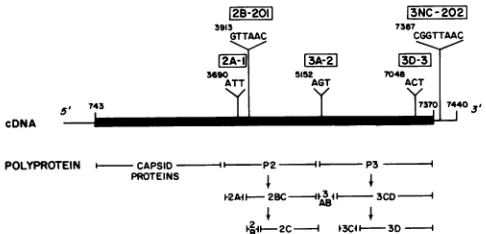
FIG. 1. Sequence ofmutants used inthis study. Mutants were
generated by making small insertions at restriction endonuclease
recognition sites of pSV2-polio, a derivative of the mammalian
expression vector pSV2 (19) which contains an infectious type I
(Mahoney strain)polioviruscDNAinsert. The lesionsweremapped by restriction enzyme digestion, and the sequence of a fragment
which contains the mutation was determined by the method of
Maxam and Gilbert (18). The genomic location of each lesion is
shown.
aturesensitive, coldsensitive, host range). Mixed infections can be performed withphenotypically distinct pairs of
mu-tants,and theprogeny canbedistinguished by plaqueassay.
We obtained poliovirus mutants which display avariety of
phenotypes by making small insertions in the infectious
cDNA. Complementation experiments with these mutants providedirect evidence thatsome,though apparentlynotall, of the nonstructuralfunctionsoftheviruscanbeprovided in
trans.
MATERIALSAND METHODS
DNA procedures. The plasmid from which all mutants
werederived, pSV2-polio,wasobtained fromV.Racaniello.
The cloning procedures used to construct the mutants and the transfection procedures used to obtain virus have been described previously (6, 24).
Cells and viruses. CV-1 cells (African green monkey kid-ney cells) were maintained in Dulbecco modified Eagle
mediumsupplemented with 10% fetal calfserum(Hazleton).
HeLa cells were grown in suspension in the Joklik modifi-cation of minimal essential medium supplemented with 7%
horse serum (GIBCO Laboratories).
Allofthemastervirus stocksused(exceptthe2A-1 stock)
were produced by isolating a single plaque from a
pSV2-polio transfection and expanding it on HeLa cells by con-ventional means. The 2A-1 stockwas obtained asdescribed
in a previous publication (6), in which it was designated
HF121.
Mutant nomenclature. We have adopted a systematic
nomenclature for poliovirus mutants. Mutants are
desig-nated by the ultimate cleavage product ornoncodingregion
in which their lesion resides(e.g., 2A indicates analteration
in protein P2-2A, and 3NC indicates a mutation in the 3'-untranslated region) and by anarbitrary cardinal number
(1, 2, 3, 100, etc.). Hence, 2A-1 is amutant which contains
a mutation in the region of the genome which codes for
protein 2A and which has been assigned the number 1. In
publications in which mutants from other laboratories are
used,wewillusethe prefixBforourmutants;whenmutants
of different strains of poliovirusareusedwewill affixa1 (for
type 1)before the laboratory designation. The full name of
2A-1 willthen be 1B-2A-1.
Virus infections and measurement ofprogeny virus yields.
CV-1 infections were performed in 60-mm (diameter) petri
dishes as previouslydescribed(6), exceptthatafter
adsorp-tion cells were washed threetimes to remove excess virus. HeLa cell infections were also
performed
as previouslydescribed (6), but after adsorption cells were collected by
centrifugation andwashed. Theincubationtemperature after adsorption was that at which the growth of all mutants was restricted.
At various times after infection, we harvested cells to measure the yield of progeny virus. CV-1 cells were placed
on ice, scraped into the medium with a rubber policeman,
and thenfrozen. AportionofeachinfectedHeLa cell culture (100
,ul
containing 3 x10⁵
cells) was addedto 1 ml of cold minimal essential medium and then frozen. These sampleswere subjected to three freeze-thaw cycles, and dilutions
were prepared so that virus titers could be determined
by
plaque assay.
The complementation index (CI) was defined as follows. For plaque size mutants (i.e., 2A-1, 2B-201, and 3D-3), CI
for mutant A = (titer of mutant A inmixedinfection)/(titerof mutant A in single infection), where thetiters are measured at the same temperature. For temperature-dependent mu-tants (i.e., 3A-1 and 3NC-202), CI for mutant A = (titer of mutant A in mixed infection)/(virus yield in single infection atpermissive temperature - yield at nonpermissive
temper-ature), where the titer of mutant A in the mixedinfection is
determined by counting plaques arising at the temperature
which is permissive for the growth of thatmutant. Because the background of apparent revertants (i.e., variants which grew at all temperatures) often represented a verysignificant
fraction of the total virus obtained in singleinfections, itwas necessary to subtract this value from the denominator to assess the level of complementation accurately.
RESULTS
Description of mutants used in this study. Three of the mutants used in this study, 2A-1 (formerly designated
HF121), 3A-2, and 3D-3, were generatedbyamethod which
has been described previously (6), in whichHinflsites inthe plasmid pSV2-polio were filled in with DNA polymerase to create single-codon insertions. Byrestrictiondigest
analysis,
the mutations were found to reside inregions which encode
the 2A, 3A, and Pol (3D) portions of the
polyprotein,
respectively (see Fig. 1). The other two mutants were constructed by insertion of synthetic DNA linkers into
restriction sites. Mutant 2B-201 was generated by
lineariza-tion of pSV2-polio by partial digeslineariza-tion with the restriction
endonuclease
HincII
and subsequent ligation of syntheticHpaI
linkers containing the sequence GTTAAC. This mu-tant contains two extra amino acids in the 2B region of thepolyprotein (see Fig. 1). The construction of 3NC-202
(for-merly designated PTH7387), a mutant which contains a lesion in the 3'-untranslated region, has been described
previously in detail (24). Briefly, a TaqI sitewasfilled in with
DNA polymerase, and HpaI linkers wereattached to create
a net insertion of eight base pairs (Fig. 1). To show that the
insertion, rather than an accidental second
alteration
intheDNA, was responsible for thephenotypeofeachmutant,we exchanged a restriction fragment of mutant DNA which
contained the insertion with the equivalent
wild-type
frag-ment. We then showed that only those clones which
con-tained the insertion gave rise to the mutant
phenotype.
In addition, we checked the nucleotide sequenceof the mutantrestriction fragment and showedthatthe only
alteration
was the insertion (data not shown).Each of the mutants used in these
experiments
has a unique plaque phenotype and distinctphysiological
proper-.7 .M- 0
1041 VOL.60, 1986
on November 10, 2019 by guest
http://jvi.asm.org/
[image:2.612.49.292.78.195.2]ties (Table1). Mutant 2A-1 has beendescribedpreviously in
detail(6). This mutant makes minute plaques at all
temper-atures onmonolayers of m'onkey kidney (CV-1) and HeLa
cells. The plaques are so small that they can not be clearly
visualized until the day following that on which wild-type
and othermutant plaques areordinarilyscored. Mutant 2A-1
lacks the ability tomediate the selective inhibition ofhost
celltranslation which normallyoccurs in the first few hours
after infection.Anapparent consequenceofthisdefect is the
synthesis
of only a very small amount of viral protein. Although enough protein is made in CV-1 cells to allow anormalcourseofRNAsynthesis,theproductionofprogeny
virus is very low. In HeLa cells, where less viral RNA is
made, the production ofprogeny virus is even lower. Mutant2B-201produces smallplaques atalltemperatures
on both HeLa and CV-1 cells. Although the plaques are
considerably smaller than those produced by wild-type
vi-rus,if scored attimes after wild-type plaques have reached amoderate size, theyordinarily increase only in size andnot
innumber. This mutantproduces only about 10%as much
RNAaswild-type virus. Viral protein synthesisisreducedto
approximately the same extent asviral RNAsynthesis,but the cleavage of the polyprotein appears to be normal. In
addition, the number of infectious particles produced in a
single cycle of infection is reduced about 10-fold (Sarnow andBaltimore, unpublished data).
Mutant 3A-2
contains
an insertion in a region of thepolyprotein
which has beenproposedto have arole in the initiationofpoliovirus
RNAsynthesis (4, 26).This mutantis coldsensitive in monkey kidney cells. Nearly wild-type size plaquesareproducedat39.5°C, whereas only small plaques, reduced in numberatleast100-fold, aremadeat32.5°C. Atthenonpermissive temperature, RNA
synthesis
ispoor. Asexpected,
very littleprotein issynthesized,
and theyield ofparticles
in a singlecycle
of infection is at least severalTABLE 1. Phenotypesofmutants used in thisstudy Mutant Plaque Descriptionofphenotype
designation phenotype
2A-1 Minuteplaque Atall temperatures, mutantplaques
clearly visibleonly 1day after all otherplaquesscored
2B-201 Smallplaque Atall temperatures,mutantplaques
muchsmaller thanwild-type plaques but scoredatsametime 3A-2 Coldsensitive At39.5°C,mutantplaques
some-whatsmaller thanwild-type plaques;at32.5°C, >100-fold reduction in number ofplaquesa 3D-3 Smallplaqueb Atall temperatures, mutantplaques
somewhat smaller thanwild-type
plaques
3D-3ts Temperature- At32.5°C,mutantplaques
some-sensitive what smaller thanwild-type variant of plaques;at39.5°C,uptofivefold
3D-3 reduction in number of
plaques-mutantplaques much smaller
thanwild-typeplaquesbutscored
at sametime
3NC-202 Temperature At32.5°C, mutantplaques
some-sensitive whatsmaller thanwild-type
plaques;at39.5°C,>1,000-fold
reduction in number ofplaques
aObservedonmonkeykidney cells; cold sensitivitywasmuch less marked
onHeLa cells.
bPhenotypeobservedonlyonmonkeykidneycells.
. .l!!-.
E
,
B
D
F
FIG. 2. Distinction ofmutantsbyplaque phenotype. HeLa cells
wereinfectedat anMOIof 5 withwild-type virus, 2B-201, 2A-1,or
amixture ofthe twomutants, eachat anMOI of5, andincubatedat
37°C. Titers of virus stocks made from infected cells were deter-minedby plaqueassay atthesametemperature.Duplicate dishesof HeLacellswerestainedapproximately40h(day2)or65 h(day 3)
afterinoculation with virus. (A) 2B-201, day 2;(B) 2B-201,day 3; (C)2A-1,day 2; (D)2A-1,day 3;(E) mixed,day 2;(F)mixed, day
3;(G) wild type, day2.The mixedstockcontainedprimarily2A-1 virus,asindicatedby the appearance ofmostoftheplaquesonday 3 and as confirmed by analysis of the phenotype of the virus contained in the plaques. (The plaques in C were apparent revertants.)
hundredfold below the
wild-type
level(Bernstein
andBalti-more, unpublished data).
Mutant3D-3produce plaqueswhicharesomewhatsmaller
than wild-type plaques at all temperatures on CV-1 cell monolayers. In cells infected by this mutant, viral RNA
synthesis
reaches normal levels but is somewhatdelayed.
(At39.5°C, onlyaboutone-thirdtoone-halfasmuchRNA is made, but this result may be duetoactivation ofanuclease
athightemperatureat atimeafter
wild-type
RNAsynthesis
is complete[13].)
Proteinsynthesis
andparticle
formationappear to be normal, but because of the
delay
in RNA synthesisthenumber ofvirionsproduced by
themiddle ofaninfectious cycle can be as much as 100-fold below the wild-type level. In some experiments, we used a
tempera-ture-sensitive variant of3D-3
(3D-3ts)
which aroseon November 10, 2019 by guest
http://jvi.asm.org/
[image:3.612.325.562.68.448.2] [image:3.612.67.310.460.705.2]GENETIC COMPLEMENTATION AMONG POLIOVIRUS MUTANTS
c
2 C'j o E 3
3CD
IAB,30
tw - -2C
Ic
-2A
2 3 4 5
FIG. 3. Pattern ofprotein synthesisinsinglyanddoublyinfected CV-1 cellsat32.5°C.CV-1 cellswereinfectedatanMOI of 10 with
asinglevirus strainorwithamixture of 2A-1and3A-2,eachatan
MOI of 10.At5 hpostinfection, cellswerepulse-labeledfor 25min with [35S]methionine. Labeling, preparation of cell extracts, and
analysisofproteinsby sodiumdodecyl sulfate-polyacrylamide gel electrophoresiswereperformed essentiallyasdescribedpreviously (6).Lanes: 1, mock-infectedcells; 2, 2A-1-infected cells; 3,
3A-2-infected cells; 4,cellsdoublyinfected with 2A-1 and 3A-1(MIX); 5, wild-type(WT)-infected cells.
neously during the production ofa3D-3 stock. Thisvariant
has the same physiology as itsparent, except that at high
temperatures a second(apparently unrelated) lesion affects theproduction of infectious particles and consequently the size and number ofplaques.
Mutant3NC-202 isahighlytemperature-sensitive mutant onall celltypes;itproduces almostnoRNA and10-3to10-4
of thewild-typeyield of infectious particles inasingle cycle of infectionat39.5°C (24). Most oftheplaques generated by this mutantatthe nonpermissive temperature are apparent revertants(presumably generated by second-site mutations). Some of the normal cleavages of the polyprotein are not made because ofthe inability of the virus toreplicate and because of the reduction in the level of virally encoded
proteases (Sarnow and Baltimore, manuscript in prepara-tion).
The number of wild-type viral particles produced in a single cycle of infection wasnotsignificantly reduced when CV-1 cells were coinfected withwild-type virus and 2A-1,
3A-2, or 3D-3, even ifeight times more mutant than
wild-type virus was added. In addition, a wild-type, and not a mutant, level of viral RNA was produced in HeLa cells infected with equal amounts of wild-type and 2A-1 virus (datanot shown). These results indicate that the lesions in these three mutantsarenot dominant.
Detection ofgenetic complementation betweenmutants. In theexperiments described here, the principal assayfor the
rescue ofone mutant by another depends on the abilityto distinguish plaques of the two mutants. The distinctive plaque phenotypes of the mutants which we constructed
enabledustoperform mixed infections oftwo types. First,
we could doubly infect cells with mutants which produce plaques of clearly different sizes. Second, we could infect
cells with a mutant which grows wellonlyat one tempera-turealong with another which hasadefinedplaque sizeatall temperatures. Anexample of results obtained from the first
type of experiment is shown in Fig. 2. On HeLa cell
monolayers, plaques of mutant 2B-201 appeared on day 2
after infection (Fig. 2A; compare withthe wild typein2G) and increased in size (but not number) by day 3 (Fig. 2B). With the exception of variants of themutantwhich behaved
like wild-type virus (here designated revertants, although they areprobablythe result of second-sitemutations), 2A-1
plaques were not visible on day2 but becameapparentonly on day 3 (Fig. 2C and D). Examination of theprogenyof a
mixed infectionwith the two mutants showed that the titer of virusyieldingvisibleplaqueson day2 was not greater than that produced in the 2B-201 infection (Fig. 2E; the virus
dilution was 4-fold greater than in 2A), but approximately 60-fold more virusyielding plaques onday 3 wasproduced than in the 2A-1 infection (Fig. 2F; the virus dilution was
40-fold greater than in 2D). We confirmed thatmost of the
plaques producedbymixed stocks whichappearedonday2
were2B-201 plaques,whereas most thatappearedonday 3 were 2A-1 plaques, by showing that when the virus
con-1000
100
-i w 0
CL-10
1.0
0.1
Wild-type a
Mixed: mir
a
dIaaues
nute
2B-201 Mixed:small
plaques
2A-1
3.5
4.5
5.5
HOURS POST- INFECTION
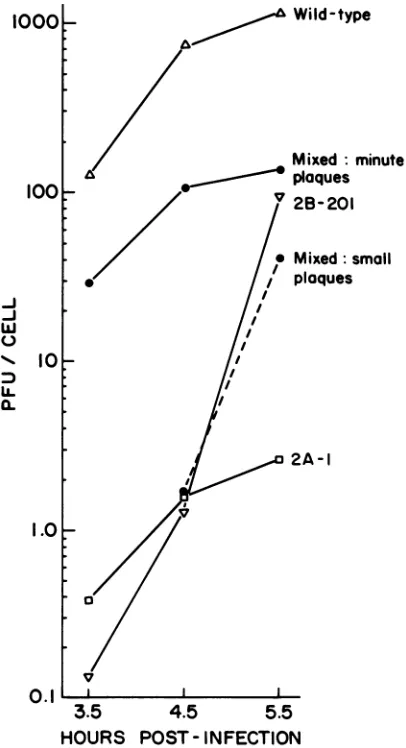
FIG. 4. Complementation test between mutants 2A-1 and 2B-201. Virustiters of stocks madeat3.5, 4.5, and5.5 h postinfec-tion in theexperiment described inthelegendtoFig.2 are shown. We determined the 2B-201 titer in the mixed stock by counting plaques whichappearedonday2after inoculation and measured the
2A-1 titerbycounting only theminuteplaques whichappearedon day3. The titer of 2B-201 virusinthe 3.5-hmixed stock couldnotbe accurately determined because ofthe background created by the muchgreaternumberof2A-1 particles.
1043 VOL. 60,1986
_ . .
I
on November 10, 2019 by guest
http://jvi.asm.org/
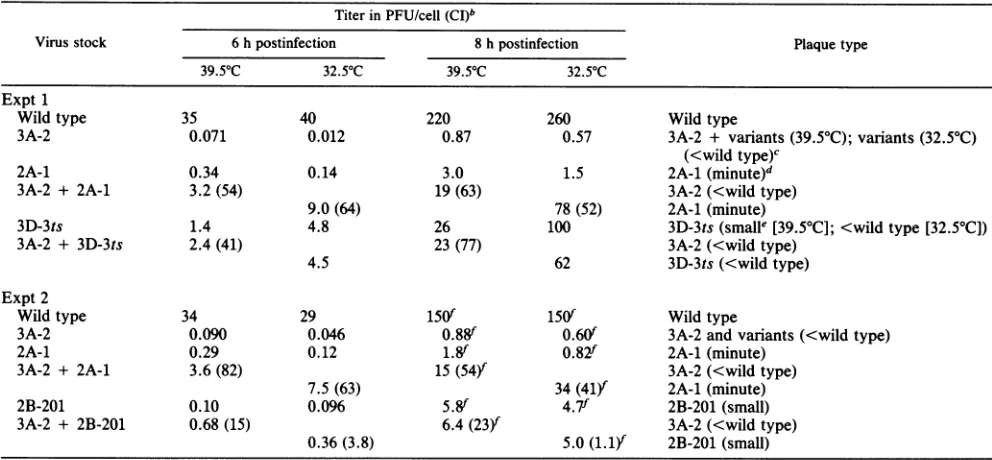
[image:4.612.117.222.79.252.2] [image:4.612.325.528.274.648.2]TABLE 2. Complementation tests between mutants 3A-2 and 2A-1, 3D-3ts, or 2B-201a
Titer inPFU/cell (CI)b
Virus stock 6 h postinfection 8 h postinfection Plaque type
39.5°C 32.5°C
39.50C
32.5°CExpt 1
Wild type 35 40 220 260 Wild type
3A-2 0.071 0.012 0.87 0.57 3A-2 + variants(39.50C); variants (32.5°C)
(<wild type)c
2A-1 0.34 0.14 3.0 1.5 2A-1 (minute)d
3A-2 + 2A-1 3.2 (54) 19 (63) 3A-2 (<wildtype)
9.0(64) 78 (52) 2A-1 (minute)
3D-3ts 1.4 4.8 26 100 3D-3ts (smalle[39.50C]; <wild type [32.50C])
3A-2 + 3D-3ts 2.4(41) 23 (77) 3A-2 (<wildtype)
4.5 62 3D-3ts(<wild type)
Expt 2
Wildtype 34 29 150f 150f Wildtype
3A-2 0.090 0.046 0.88f 0.60f 3A-2 and variants(<wild type)
2A-1 0.29 0.12 1.8f 0.82f 2A-1 (minute)
3A-2 + 2A-1 3.6(82) 15(54/ 3A-2 (<wildtype)
7.5(63) 34(41/ 2A-1(minute)
2B-201 0.10 0.096 5.8f 4.7f 2B-201 (small)
3A-2 + 2B-201 0.68 (15) 6.4 (23) 3A-2 (<wild type)
0.36(3.8) 5.0(1.1f 2B-201 (small)
a CV-1 cells were infected withwild-type virusor a mutant atanMOI of5 or with a mixture of two mutants, each at an MOI of 5, and then incubated at32.50C. Cellswereharvested at various times after infection, and virus stocks were made as described in Materials and Methods.
bTheCIvalues (shown in parentheses) were calculated asdescribed inMaterialsand Methods.
cIntermediate-size plaques which were somewhat smaller than those produced by wild-type virus.
d Extremely small plaques whichwereclearly visible only1day afterallothers were scored.
ePlaques much smaller than thoseof wild-type virus but scored at the same time as wild-type plaques.
fAt7.5 hpostinfection.
tainedin the plaqueswas replated on afresh monolayer, it hadtheexpectedmutantphenotype(datanotshown). More-over, because no more than 2 to 3% of the total virus produced in the mixed infection in this and all other
exper-iments described here was phenotypically wild-type virus (i.e., revertant or recombinant virus), it was clear that recombination betweenmutantsdidnotsignificantly
contrib-utetovirus yield.
Rescue ofone mutant by another, as measured by
en-hancement of virus yield, was strongly correlated with physiological differences between singlyanddoubly infected
cells.Under conditionsinwhich the mutantsdescribedhere grew poorly, induction of the dramatic morphological changesinadherent cells whichnormally precedecell death
(thecytopathic effect)wasgreatly delayed. When eitherone or both mutants in a mixed infection were rescued, the
cytopathic
effect proceeded at a rate which was similar tothat seen after infection with wild-type virus. Rescue of
mutants also correlated with changes in the pattern of macromolecular
biosynthesis.
Anexample
is shown inFig.
3, which illustrates proteinsynthesisininfectedCV-1 cells at the onsetofthe linearphase ofRNAreplication. Because mutant 2A-1failed to inhibit host celltranslation,thepattern
ofproteins produced 5 hpostinfection at 32.5°C was very
similartothat seen inmock-infected cells(Fig.3, lanes 1 and
2).Mutant3A-2,onthe otherhand, producedvery little viral
proteinbecause itsynthesized RNApoorly at this tempera-ture; nevertheless sufficient protein was made to effect inhibition ofhost celltranslation(Fig. 3, lane3). When cells wereinfected with the two mutants together, however, the
pattern
of protein synthesis was very similar to that ob-served in wild-type-infected cells (Fig. 3, compare lanes 4 and5).Host celltranslationwasinhibited,and ahighlevelof virus-specific protein was produced. It should beempha-sized that although these physiological changes correlated
with virus rescue, they gave no indication as to which
mutanthad beenrescued.
Rescue of mutant2A-1 by other cDNA-derived mutants.By taking advantage of the observation that 2A-1 plaques ap-pearunusuallylateafterinfection and that the virus grows at all temperatures, whereas some other mutants do not, we found that the titer of mutant 2A-1 increased dramatically
when eitherHeLa or CV-1 cells werecoinfected with any other cDNA-derived mutant. Figure4 shows the complete
data of theexperimentfrom which the results displayed in
Fig. 2 weretaken. HeLacells were infected withwild-type virus, 2A-1, 2B-201, or amixture ofthe two mutants. The titer of2A-1 stocks made at different times after infection was several hundredfoldbelow that ofwild-typevirus. In a
mixed infectionwith2B-201,however,anincrease in titerof
50-to100-fold wasapparent bothat
midcycle
(3.5h postin-fection),whensignificant accumulationof progeny virions isfirst observed (3),andtoward the end of theinfectiouscycle (4.5 and 5.5 h
postinfection).
Inaddition,
the level of apparent revertants of 2A-1 was substantially reduced instocksmade from the mixed infection(datanotshown).The five- tosevenfold-lower titer of 2A-1 in themixed infection comparedwiththat ofwild-type viruswasprobablyinpart an experimental artifact. The
slightly
lower particlelPFUratiooftenfoundfor2A-1 stocksplatedonHeLacells(data
not shown) suggested that plaque assays on this cell line gave an underestimate of the virus titer because of the relativeinability ofthe mutant toform visibleplaques.
Mutant 2A-1 could also be
complemented
by
the cold-sensitive mutant 3A-2 (Table 2, experiment 1). CV-1 cellswereinfected withwild-type virus, 2A-1, 3A-2, or anequal
mixture ofthe two mutants and then incubated at
32.5°C.
Virusstocksweremade bothat
midcycle
(6hpostinfection)
on November 10, 2019 by guest
http://jvi.asm.org/
GENETIC COMPLEMENTATION AMONG POLIOVIRUS MUTANTS
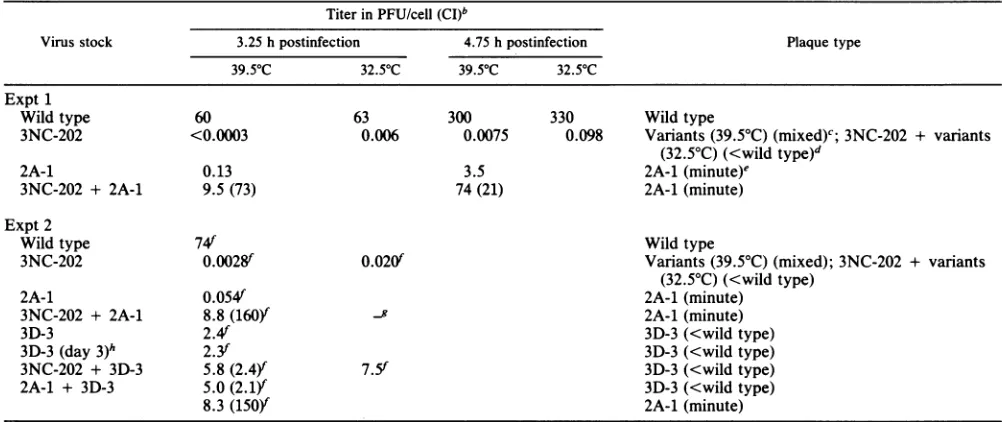
TABLE 3. Complementation tests amongmutants2A-1, 3D-3, and3NC-202a
Titer inPFU/cell(CI)b
Virus stock 3.25 hpostinfection 4.75 h postinfection Plaque type
39.5°C 32.5°C 39.5°C 32.5°C
Expt1
Wildtype 60 63 300 330 Wildtype
3NC-202 <0.0003 0.006 0.0075 0.098 Variants(39.5°C) (mixed)c; 3NC-202 + variants
(32.50C) (<wild type)d
2A-1 0.13 3.5 2A-1 (minute)e
3NC-202 + 2A-1 9.5(73) 74(21) 2A-1 (minute)
Expt 2
Wildtype 74f Wildtype
3NC-202 0.0028f 0.020f Variants(39.5°C)(mixed); 3NC-202 + variants
(32.5°C) (<wild type)
2A-1 0.054f 2A-1 (minute)
3NC-202 + 2A-1 8.8(160) £ 2A-1 (minute)
3D-3 2.4" 3D-3 (<wild type)
3D-3 (day 3)h 2.3f 3D-3 (<wild type)
3NC-202 + 3D-3 5.8
(2.4)f
7.5f 3D-3 (<wild type)2A-1 + 3D-3 5.0
(2.1)f
3D-3 (<wild type)8.3
(150)f
2A-1 (minute)aCV-1cellswereinfected withwild-typevirusor a mutant at anMOIof5 orwithamixture of mutants, eachat anMOI of5,and then incubatedat39.5'C.
Cellswereharvestedatvarioustimes afterinfection,and virus stocksweremadeasdescribed in MaterialsandMethods.
ITheCIvalues(shown in parentheses)werecalculatedasdescribed inMaterials and Methods.
cPlaques of mixedsize,ranging from very smalltowild-typesize.
d Intermediate-size plaques whichweresomewhatsmallerthanthoseproducedbywild-type virus.
eExtremely small plaques whichwereclearlyvisible only1day after all otherswerescored.
fAt3hpostinfection.
g-,3NC-202 titer could not be calculated. Themutanttitermusthave been smallcompared with thebackgroundofrecombinant andrevertantplaquesbecause therewasnosignificant increase in the number of relatively large plaques which appearedat32.5'C.
h Plaques counted1day later thanusual,atthesametime that minuteplaqueswerescored.
and lateafterinfection (8h). The2A-1 titerinthe2A-1and
mixed stockswasscoredby allowing plaquestodevelopfor
4 days at 32.5°C. In the mixed stock,
virtually
no plaques appeared before 4 days because 3A-2 produces very few plaques at 32.5°C and evidently also because very fewapparent revertants of eithermutant aroseduringthe mixed
infection. Calculation ofthe CI revealed that atboth time points the titerof2A-1 was increased 50- to 70-fold inthe mixedinfection, such that the number of infectious particles
was only a fewfold below that produced in a wild-type infection. Titration of the 2A-1 stock at 39.5°C, however, revealed atwofold cold sensitivity of the mutant (Table 2). This observation suggested that the amount of2A-1 virus produced in the mixed infectionmayhave been evencloser
to the
wild-type
level than wasevidentby
measurement of the titer at low temperature. (A secondexperiment
which yieldedvery similar results is showninTable2, experiment 2.)Wealso assessed theability of the temperature-sensitive
mutant 3NC-202 to complement 2A-1 in experiments
per-formed at 39.5°C. CV-1 cells were infected with wild-type virus, 2A-1i 3NC-202, or an equal mixture of the two mutants (Table 3,experiment 1). Virus
stocks
were madeatmidcycle (3.25hpostinfection) and late after infection
(4.75
h).At39.5°Cthe mixed stockyieldedprimarily2A-1plaques
which could be visualized on day 3. A small number of plaques appeared on day2, but these were all of wild-type
size andcontained viruswhich had a wild-type phenotype; the same number ofsuchplaques arose if theplaque assay was performed at 32.5°C. These plaques were apparently
generatedby eitherrevertantorrecombinant viruses.At the
early time point, coinfection with both 2A-1 and 3NC-202 enhancedthe titer of2A-1progeny about 70-fold. At 4.75h, the increasewasabout20-fold,but thereductionin
enhance-mentwas aconsequence of thedifferenceingrowthkinetics in the 2A-1 and mixed infections. Whereas production of progeny tapered off between the two time points in the
mixedinfection (asin the wild-type infection), the increase in new virus in cells infected with 2A-1 alone was more
marked. It was clear, however, that in a mixed infection
3NC-202couldincrease theburst sizeof 2A-1by the endof acycleof infection to a levelonlyafewfold lower thanthat ofwild-type virus.
In anotherexperiment performedat39.5°C, it was possi-ble to demonstrate that 3D-3 also complemented 2A-1. Because the linearphase ofRNAsynthesisand the
concom-itantassembly ofmostof theprogenyvirionsaredelayed in
3D-3-infected cells, there is a short period during which 3D-3-infected cells contain 30- to 100-fold fewer infectious particlesthan wild-typecells. To perform complementation experiments with 3D-3, it was necessary to harvest cells
duringthisperiod. Infected CV-1cells were harvested at 3 h
(Table 3, experiment 2). Both 2A-1 and 3D-3 grew at this
temperaturebut, bythetime2A-1plaqueswereobservable,
3D-3 plaques were relatively large and could be easily distinguished. The titer of minute (2A-1) plaques in the
mixed stockwasover100-foldgreater than thatfound inthe 2A-1 stock. 3D-3 rescued 2A-1 to approximately the same extent as 3NC-202 did in the same experiment. In both mixedstocks,the 2A-1titer waseight-toninefold lower than the wild-type titer but, given the potential differences in
growth curves, this number might have been reduced if a latertime point could havebeen taken.
Rescue of mutant 3A-2 by other cDNA-derived mutants.
Thedistinctive cold sensitivity of3A-2enabled us to
dem-onstrate its rescue by genetic complementation. In the
experiments in which it was possible to test the
ability
of 3A-2 tocomplement2A-1bydeterminingthetiters ofmixed1045 VOL.60, 1986
on November 10, 2019 by guest
http://jvi.asm.org/
[image:6.612.55.556.88.299.2]TABLE 4. Complementation test between mutants 3NC-202 and 2B-201a
Titer inPFU/cell(CI)b
Virus stock 3 h postinfection 4 h postinfection 5 h postinfection Plaque type 39.50C 32.5°C 39.5°C 32.50C 39.50C 32.50C
Wild type 57 53 230 240 410 340 Wildtype
3NC-202 <10-4 0.0053 0.0046 0.013 0.0070 0.022 Variants (39.5°C) (mixed)c; 3NC-202 + variants
(32.50C)(<wild-type)'
2B-201 0.017 0.013 2.7 2.4 28 26 2B-201 (small)e
3NC-202 + 2B-201 .f f 5.8 (2.1) 7.8 49(1.8) 41 2B-201 (small)
aHeLa cells were infected with wild-type virus or a mutant at an MOI of 5 or with a mixture of the two mutants, each at an MOI of5,and then incubated at
39.5'C.Cells were harvested at 3, 4, and 5 h afterinfection, and virus stocks were prepared as described in Materials andMethods. bTheCI values (shown in parentheses) were calculatedasdescribed inMaterialsand Methods.
cPlaques of mixed size, ranging from very small towild-type size.
IIntermediate-size plaqueswhich were somewhat smaller than those produced by wild-type virus.
ePlaques much smaller than those of wild-type virus but scored at the same time as wild-type plaques.
f-, The titers of both mutants were relatively small compared with thebackground of revertants and recombinants. stocks generatedatlowtemperature at32.5°C,we werealso
ableto determine whether 2A-1 could complement 3A-2 by determining the titers of thesame stocksat 39.5°C (Table 2, experiment 1). At low temperature, 3A-2 grew poorly and
the virus population in the 3A-2 stocks was composed
largely of apparent revertants. Calculation of the CI indi-cated a greater than 50-fold increase in the 3A-2 titer in mixed stocks prepared atboth 6 and 8 h postinfection. The relatively large plaques which appearedathightemperature did not appear at the lower temperature and contained cold-sensitive virus; hence, it could be concluded that they were produced by 3A-2 particles and not by revertants or
recombinants. Even after rescue by genetic complementa-tion, however, the titer of 3A-2was 10-fold lower than that
of wild-type virus and a fewfold lower than that of the
mutantit had rescued (2A-1). (A second experiment which yielded verysimilar results is shown in Table 2, experiment
2.)
Itwasof interesttodetermine whether 3A-2 could also be complemented by other mutants. In principle, analogous experiments can be performed with the other small-plaque mutants described above. Attempts to assess the ability of 3D-3torescue3A-2byusingonly the methods outlined here, however, were hampered by a combination of two diffi-culties. First, the plaques produced by 3A-2 and 3D-3 at 39.5°C were notdistinguishable by inspection. Second, the
titersof mixed stocks at39.5°Cwere only afewfold higher
than those of3D-3 stocks, evenif the cellswere harvested
relatively early after infection (data not shown). Such a
result did not exclude a substantial rescue of 3A-2. To circumvent theproblem of distinguishing plaques produced bythetwomutants, weperformed complementation exper-iments withatemperature-sensitive variant of 3D-3 (3D-3ts).
Stocks of 3D-3ts yielded fewer plaques at 39.5°C than at 32.5°C, andtherelatively tiny plaques whichwereproduced could be distinguished from those made by 3A-2 (though, unlike 2A-1plaques, 3D-3ts plaqueswerevisible when3A-2
plaques were scored). We assessed the ability of 3D-3ts to
rescue3A-2 in the sameexperiments in whichweexamined
complementation between 2A-1 and 3A-2 (Table 2, experi-ment 1). At both midcycle and late after infection, the 3A-2 titer was very similar to that obtained from virus stocks made from cells coinfected with 2A-1 and 3A-2. Thus, it appeared that 3D-3ts rescued 3A-2aseffectivelyas2A-1 did. We also tested the ability of 2B-201 tocomplement 3A-2 (Table 2, experiment 2). The problems described in the preceding experiment did not occur because the titer of
2B-201throughmostof the infectious cyclewasmuch lower
than that of 3D-3 and because the plaques produced by 2B-201 on CV-1 monolayers at 39.5°C, like those of 3D-3ts, were much smaller than 3A-2 plaques. Infected cells were harvested at 6 and 7.5 h postinfection; the latter time was
chosen because it was the latest at which there was a substantial (30- to50-fold) differenceintiter between 2B-201 andwild-typevirus. Forcomparison,rescueof3A-2by2A-1 was assessed in parallel. Rescue of 3A-2 by 2B-201 was apparent atboth time points;the titerof3A-2, however, was
clearly severalfold less than that obtained in the mixed
infection with 2A-1. Hence, it appeared that 3A-2 was rescued lesseffectively by2B-201 thanbytheothermutants
described here.
Evidence that othercDNA-derivedmutants cannot be
com-plemented. It was also possible to determine whether
2B-201, 3D-3, and 3NC-202 could be complemented by exploiting their unique plaque phenotypes. We found that
2B-201 could not be rescued by any other mutant. HeLa
cells infectedwithboth2B-201 and 2A-1andthenincubated
at 37°C did not yield a higher 2B-201 titer than did cells infected with 2B-201 alone (Fig. 4). Less than a twofold enhancement of 2B-201 titer wasobservedwhenHeLacells
were infected with 2B-201 and 3NC-202 and incubated at
39.5°C (Table 4). Inthisexperiment, wedetermined2B-201
titers by performing plaque assays at 39.5°C. The small increasein 2B-201titermaysimplyhavebeenaconsequence
ofmorerapid viral growth resulting fromthe use ofatotal multiplicity of infection(MOI) of10in thedouble infections
(5for eachmutant) comparedwith 5 inthesingleinfections.
Virus stocks were alsomadefrom CV-1 cells infected with 2B-201and 3A-2 or with 2B-201 aloneandthenincubatedat
32.5°C (Table 2, experiment 2). Despiteanapparentfewfold enhancement ofthe 2B-201 titer in the mixed stock at 6 h
postinfection,
little enhancementwasobservedby
7.5 h.3D-3was also notcomplemented to asignificantextentby
other mutants. To determine whether the lagin the devel-opment of 3D-3 titer could be eliminated ina mixed
infec-tion, it was necessary to harvest cells relatively early after
infection. In one experiment, 3D-3 titers in virus stocks
prepared from CV-1
cells
infected with 2A-1 and 3D-3,3NC-202 and3D-3,or3D-3 alone andincubatedat39.5°C for
3 h were compared (Table3,experiment2). The 3D-3 titers were determinedby performing plaqueassays at39.5°C.The twofold enhancement of the 3D-3 titer observed in both mixed infections was not regarded as significant and again may havemerelybeenanMOIeffect.Inother
experiments,
CV-1 cells were infected with both 3D-3 and the cold-sensitive mutant 3A-2 and incubated at32.5°Cfor 6 h. When
on November 10, 2019 by guest
http://jvi.asm.org/
GENETIC COMPLEMENTATION AMONG POLIOVIRUS MUTANTS
plaque assays were performed at 32.5°C, there was no significant difference in virus titer between the 3D-3 and mixed stocks (data not shown).
We also tested the ability of the plaque size mutants to rescue 3NC-202. Intheseexperiments, 3NC-202 titers were determined by plaque assay at 32.5°C. Stocks made from CV-1cells infected with both 3NC-202 and 2A-1containeda small amount of virus which yieldedrelatively large plaques at low temperature, but the same number ofplaques also formed at high temperature (data not shown). These plaques were produced primarily byvariantswhichwere presumably either revertants or recombinants. Although relativelylow, the level ofsuchvariants wasalwayshigherthan the level of virus in 3NC-202 stocks. For example, at 4.75 h
postinfec-tion (Table 3, experiment 1), variants amountedto approxi-mately 2 PFU per cell, a level which exceeded the titer of virus in the 3NC-202 stock by 20-fold. As a consequence,
this methodology would not have been sensitive to a very low level of 3NC-202 rescue. It is clear, however, that substantialrescue of themutant did notoccur. It was more difficult to test complementation of 3NC-202 by 3D-3 be-causethe3D-3 titer inmixed stocks was more than 2 orders of magnitude greater than the titer of 3NC-202 in single-infection stocks(Table 3, experiment 2).Anything less than a several-hundredfold rescue of 3NC-202 would not have been detected by plaque assay. A slightly higher titer was observed in the mixed stock at 32.50C than at 39.50C. Twenty-five plaques produced at low temperature were picked, however, and none had a temperature-sensitive
phenotype. Finally, mixed infections were performed in HeLa cells to test the ability of 2B-201 to rescue 3NC-202
(Table 4). Thetiter of virus obtained from the mixed stocks was very similar at both high and low temperatures, and plaques almost exclusively of the 2B-201 phenotype were
observed. Because of thelarge difference in titer of the two mutants, however, only dramatic rescue of3NC-202 could have beenobserved.
DISCUSSION
We studied the rescue of five well-defined mutants of poliovirus type I primarily by comparing virus yields in single and mixed infections. In contrast to many results obtained with unmapped mutants, we obtained strong evi-dence that defects in at least two of the nonstructural functions of the virus can be complemented to a very
significantextent. This finding implies that thenonstructural
portion ofthe polyprotein contains multiple
complementa-tion groups. The unambiguous rescue of mutants which contain lesions in regions encoding proteins 2A and 3A implies that the protein whichmediates inhibitionofhost cell
translation and one of the components involved in RNA
synthesis can beprovided in trans. The rescue ofpoliovirus
mutants which we observed is distinct from previousreports
ofmutant rescue in two important respects. First, both 2A and 3A mutants were rescued in mixed infections with all other mutants which contain lesions in other parts of the genome andwhicharenot transdominant, ratherthan in just one particular mixed infection. Second, the titer of both mutants was enhanced in mixed infections at a time when
significantaccumulation ofprogeny virus was firstdetected,
not just at the end of a full cycle ofgrowth. These
observa-tions help to support the notion that the rescue weobserved involved true genetic complementation, that is, compensa-tionfordefects bythediffusion of functional gene products,
and was not due to anonspecificeffect. Our studies are also
distinct from
previous
work in that we corroborated thevirus yield data with independent evidence of complemen-tation. We correlated enhancement of virus titer with
in-creases in the synthesis of virus-specific macromolecules and in the progression of the cytopathic effect. We also
foundthat mutant rescuecorrelated withareduction inthe
proportion ofapparent revertants in virus stocks prepared frommixed as
compared
withsingle
infections. Thisobser-vation suggests that complementation reduces theselective pressure which favors variants that grow better than the
parental strain. Moreover, these studies describe the first
example oftwo-way rescue ofpoliovirus mutants.
In addition to demonstrating complementation of two nonstructural mutants, we also found that two mutants which are defective in RNA synthesiscouldnot be comple-mented to asignificantextentby othermutants. Althougha
low level of complementation cannot be completely
ex-cluded, the titer ofa mutant which contains an insertion in the 3'-untranslated region ofthe RNA wasalso notgreatly enhanced in mixed infections withothermutants.
Comparison ofthe rescue of 2A-1 and 3A-2. The titers of both 2A-1 and 3A-2, which contain single amino acid
inser-tions in the 2A and 3A regions of the polyprotein,
respec-tively, could be increased greater than 50-fold in mixed infections with other mutants. In both cases, the levels of complementation observed both at midcycle and late after infection were similar. Presumably, either diffusion ofthe
functional product was continuous or production of a small amount offunctional protein early afterinfection was suffi-cient to effect rescue. There were two respects, however, in which the complementation patterns ofthese two mutants differed. First, the rescue of2A-1 was more complete than thatof3A-2. That is, the titer of 2A-1 which resulted from a mixed infection was only a fewfold lower than that of wild-type virus,whereas thetiter of3A-2was approximately 10-fold lower. Second, although complementation of 2A-1 always brought the yield of that mutant to the same level relative towild-type virus, the degree of rescue of 3A-2 was more variable.
A consideration of the functions impaired by the two lesions suggests an explanation for these differences in complementation pattern. Experiments with guanidine, an inhibitor ofviral replication, have shown that at an MOI of 10 or more, the small amount of proteinproduced by input RNAis sufficient to mediate effective inhibition ofhost cell translation (20). In addition, mutants such as 3A-2 and 3NC-202, which synthesize RNA in a highly
temperature-dependent manner, are capable ofinhibiting host cell trans-lation at the nonpermissive temperature in the absence of significant viral protein synthesis (Fig. 3, lane 3; reference 24). Hence, the observation that effective rescue of 2A-1 is
relatively independent of the amount of protein or RNA produced by theother mutant in mixed infections is consis-tent with the notion that only small amounts of the transla-tionalinhibitor are required. Thishypothesisisreinforcedby a report that a 3NC-202 cDNA-bearing cell line partially
complements themutant underconditionsin which the cells produce too little viralproteintobe easily detectedby other
means (24; Sarnow and Baltimore, unpublished data). Fur-thermore, effective rescue of 2A-1 by mutants such as 3NC-202 implies thatthe functionwhich mediates inhibition ofhost celltranslation probablydoes not work byselectively
promoting virus-specific translation, since such a function would almost certainly be required in higher amounts than the rescuing mutant can provide.
By contrast tothe mutation in 2A-1, the insertionin 3A-2
VOL.60, 1986 1047
on November 10, 2019 by guest
http://jvi.asm.org/
disrupts
a function involved inreplication
which may berequired
in substantialamounts.This notionappearspartic-ularly
attractivegiven
that thelesion maps to a segmentofthe
polyprotein
which is contained inprecursorsof VPg (4,26),
the shortprotein
which is found atthe 5' endofeverypoliovirus
RNAmolecule,
andtherefore may affectafunc-tion
associated withVPg.
Theextentof 3A-2rescueinmixedinfections
correlated with theamount ofprotein ordinarily
synthesized by
the othermutant.The bestcomplementation
was
obtained
with3D-3ts,
whichnormally produces
wild-type levels ofprotein,
and2A-1,
whichcansynthesize high
levels of viral
protein
oncehost-specific
translation is inhib-ited. The least effectiverescue wasobtained with2B-201,
amutantthat
produces only
asmallfractionasmuchRNAand
protein
as doeswild-type
virus. These dataare consistent with the notion that rescue of 3A-2 is at least in partdependent
onthe levelofvirus-specific
products synthesized
by
thecomplementary
mutant. What is more difficult toexplain
is theobservation thatrescue of3A-2 wasnever ascomplete
as rescue of 2A-1. It has been shown thatpoliovirus
cansynthesize
a normalamountofRNAevenifvirus-specific protein synthesis
isgreatly depressed (6).
Hence,
inmixed infectionsinvolving
3A-2and,
say,3D-3ts,
the
synthesis
of thecomplementary
geneproduct probably
far exceeded the
theoretical
amountrequired
forfull
rescueof
the mutant. Apossible explanation
for theincomplete
rescueof 3A-2 isthattherequired
geneproduct
might
notbeuniformly
distributed, presumably because
of acompart-mentalization
problem
or because of hindrance of freediffusion
(see
alsobelow).
Lack ofrescue of three nonstructural mutants. We were
unable to demonstrate
significant
rescue of three mutantswhich contain
replication
defects.Although partial
rescueofoneof these mutants,
3NC-202,
isnottotally
excludedby
thedata,
it seemsunlikely that
amutantwhich hasalesion inanoncoding region
of thegenome could be rescued in trans.One
possible explanation
for ourinability
to demonstratecomplementation
of the 2B and 3D mutants is that theinsertions
donotalterproteinfunction but ratherdisrupt
thestructure of theRNAand
thereby
createcis-acting
defects.This
explanation
isnotlikely, however, given
thatatleastatagross level
comparative
sequenceanalysis
doesnotyield
evidence of
important
RNA structures within thecoding
region. The RNA sequence isclearly
conserved amongdifferent strains of
poliovirus
(28)
and different picorna-viruses(2, 14, 27)
at the 5' and 3' ends of the genome, butonly
theamino acidsequence appearstobeconserved in thecoding region.
Theexplanation
that themutationsappear cisacting
becausethey
affectcleavage
of thepolyprotein
is alsounlikely
becausenogross alteration of thecleavage
pattern
wasobserved in either 2B-201-or
3D-3-infected
cells. Afarmore
likely explanation
is that the defective functions in 2B-201 and 3D-3simply
cannotbesupplied
intrans. If thisexplanation
holds true, and ifthe insertions weintroduced
do not alter functions which reside in distant parts ofthe
polyprotein,
then the overallpicture
ofcomplementation
presented
heresuggeststhat thetrans-acting
functions ofthevirus do notreside in
adjacent
segments ofthepolyprotein
but ratherare
interspersed
amongcis-acting
functions.Such
a
suggestion
is notincompatible
with the notion that thenonstructural
portion
of thepolyprotein
mustfoldas asingle
unit for somesegments
to befunctional. Butit doesimply
that removal of internal segments of thepolyprotein
can occur withoutdisruption
of the other nonstructural func-tions. Ofcourse, thelack ofcomplementation
of 2B-201 and 3D-3 may not be related topolyprotein folding
at all butrathermaybedue to some phenomenon whichresults inthe effectivecompartmentalization of the defectiveproteins.
Onehypothesistoexplainthecis-acting behavior ofthese mutations is that the RNAreplicaseis acomplexof
proteins
which uses the specific plus-strand molecule from which it
wastranslated as atemplatetosynthesize a minusstrand. If proteins 2B and 3D are part of this complex, it would be understandable why lesions thatdestroy their function are notcomplementableevenby mutant 2A-1,which shouldbe
abletomakethefunctional formsof allproteinsdownstream from 2A (6). Given evidence that guanidine sensitivity is
poorly complemented (K. Kirkegaard and D. Baltimore, unpublished data), protein 2C,towhich this genetic marker
maps(21, 25), might also beacis-activepartofthecomplex.
Evenprotein 3A might be partof the complex initially,but
thecomplementation of 3A-2 bymutantscontaininglesions in 2B and 3D argues that it must be reversibly
bound,
whereas the other elements are effectively irreversibly boundtothe complex and the RNA.
Natureof the poliovirus genome. One implication of these
experiments is that the noncapsid region of the poliovirus
genome cannotbe consideredto consistofa singlegenetic unitwhereby all functions reside inasingle posttranslation-ally processed polypeptide. Our results show that at least two of the segments ofthe polyprotein act as independent genetic units. Perhapspartof the reasonthat the poliovirus
genome consists of a single polyprotein is that certain
segments mustbeproducedas partof alargerprecursor or
needtofold together into a complex to function properly. But clearly this is not the only reason, because some segments canfunctionindependently (althoughtheirfolding
maybedirected by otherpartsof the polyprotein).
Presum-ably, the virus has adopted a polyprotein genome in part because of the
efficiency
ofgeneexpression
which sucha strategyaffords.This study establishes the minimum number of "cistrons" in the nonstructural
region
atthree. Manymorewell-definedmutants will have to be constructed before a complete complementation mapof the virus can be derived. Such a map may provide clues as to how the virus replicates its genomeand
performs
other functions and mayalsohelp toexplain
whythevirususes aunique genetic strategy.ACKNOWLEDGMENTS
We thank Karla Kirkegaard for helpful suggestions during the
courseof this workand for criticalreading of the manuscript. This workwassupported by Public Health Service grant A122346 from the National Institute forAllergy and Infectious Diseases.
LITERATURECITED
1. Agut, H., C. Beliocq, S. van derWerf, and M.Girard. 1984. Recombination and rescuebetweentemperature-sensitive mu-tantsofpoliovirustype1.Virology139:393-402.
2. Argos,P.,G. Kamer,M.J.H. Nicklin,and E. Wimmer. 1984. Similarity in gene organization and homology between proteins of animal picornaviruses andaplant comovirus suggest com-mon ancestry of these virus families. Nucleic Acids Res.
12:7251-7267.
3. Baltimore, D., M. Girard,andJ.E. Darnell. 1966. Aspects of the synthesis of poliovirus RNA and the formation of virus
particles.Virology29:179-189.
4. Baron,M. H., and1D. Baltimore. 1982. Antibodies againstthe chemically synthesized genome-linked protein of poliovirus
reactwithnativevirus-specific proteins.Cell 28:395-404.
5. Bellocq. C., H. Agut, S. van derWerf, and M. Girard. 1984. Biochemical characterization ofpoliovirustype1 temperature-sensitivemutants.Virology139:403-407.
on November 10, 2019 by guest
http://jvi.asm.org/
GENETIC COMPLEMENTATION AMONG POLIOVIRUS MUTANTS
6. Bernstein, H. D., N. Sonenberg, and D. Baltimore, 1985. Poliovirus mutant that does not selectively inhibit host cell protein synthesis. Mol. Cell. Biol. 5:2913-2923.
7. Bond, C. W.,and H. E. Swim. 1975. Physiological characteriza-tion of temperature-sensitive mutants of mengovirus. J. Virol. 15:288-296.
8. Cole, C. N., and D. Baltimore. 1973. Defective interfering particles of poliovirus. II. Nature of the defect. J. Mol. Biol. 76:325-343.
9. Cooper, P. D. 1965. Rescue ofonephenotype in mixed infec-tions with heat-defective mutants of type 1 poliovirus. Virology 25:431-438.
10. Cooper, P. D. 1968. A genetic map ofpoliovirus temperature-sensitive mutants. Virology 35:584-596.
11. Cooper, P. D. 1977. Genetics ofpicornaviruses, p. 133-207. In H. Fraenkel-Conrat and R. R. Wagner (ed.), Comprehensive virology, vol. 9.Plenum Publishing Corp., New York. 12. Cords, C. E., and J. J. Holland. 1964. Alteration of the species
and tissue specificity of poliovirus by enclosure of its RNA within the protein capsid of Coxsackie Bi virus. Virology 24:492-495.
13. Fiszman, M. Y., D. Bucchini,M.Girard, andA.Lwoff. 1970. Inhibition of poliovirus RNA synthesis by supraoptimal temper-atures. J.Gen. Viol. 6:293-304.
14. Kandolf, R., and P. H. Hofschneider. 1985.Molecular cloning of the genome of a cardiotropic Coxsackie B3 virus: full-length reverse-transcribed recombinant cDNA generates infectious virus in mammalian cells. Proc. Natl. Acad. Sci. USA 82:4818-4822.
15. Lake, J. R., R. A. J. Priston, and W. R. Slade. 1975. Agenetic recombination map of foot-and-mouth disease virus. J. Gen. Virol. 27:355-367.
16. Ledinko, N.,and G. K. Hirst. 1961. Mixed infection of HeLa cells withpolioviruses types 1and 2. Virology 14:207-219.
17. Lundquist, R. E., M. Sullivan, and J. V. Maizel, Jr. 1979.
Characterization ofa newisolate of poliovirus defective inter-fering particles. Cell 18:759-769.
18. Maxam, A. M.,and W. Gilbert. 1980. Sequencing end-labeled DNA withbase-specificchemicalcleavages. Methods Enzymol.
65:499-560.
19. Mulligan, R. C., and P. Berg. 1981. Selection for animal cells that express the Escherichia coli gene coding for xanthine-guaninephosphoribosyltransferase. Proc. Natl. Acad. Sci. USA
78:2072-2076.
20. Penman, S.,andD. Summers. 1965. Effects on host cell metab-olism following synchronous infection with poliovirus.Virology 27:614-620.
21. Pincus, S. E., D. C. Diamond, E. A. Emini, and E. Wimmer.
1986. Guanidine-selected mutants of poliovirus: mapping of point mutations to polypeptide 2C. J. Virol. 57:638446. 22. Putnak, J. R., and B. A. Phillips. 1981. Picornaviral structure
andassembly. Microbiol.Rev. 45:287-315.
23. Racaniello, V. R., and D. Baltimore. 1981. Clonedpoliovirus complementary DNA is infectious in mammalian cells. Science 214:916-919.
24. Sarnow, P., H. D. Bernstein, and D. Baltimore. 1986. A
poliovirus temperature-sensitive RNA synthesismutantlocated in a noncodingregion of the genome. Proc. Natl. Acad. Sci. USA 83:571-575.
25. Saunders, K., and A. M. Q. King. 1982. Guanidine-resistant mutants of aphthovirus induce the synthesis of an altered nonstructuralpolypeptide, P34. J. Virol. 42:389-394.
26. Semler,B. L.,C.W.Anderson, R.Hanecak,L. F. Dorner, and
E. Wimmer. 1982. A membrane-associated precursor to polio-virus VPg identified by immunoprecipitation with antibodies directed against a synthetic heptapeptide. Cell 28:405-412. 27. Stanway, G.,P. J. Hughes, R. C.Mountford,P. D.Minor, and
J.W. AMmond. 1984. The complete nucleotide sequence ofa common cold virus: humanrhinovirus 14. Nucleic Acids Res. 12:7859-7875.
28. Toyoda, H., M.Kohara, Y. Kataoka, T. Suganuma, T. Omata, N.Imura,andA. Nomoto. 1984.Complete nucleotide sequences of all threepoliovirus serotype genomes. Implication for genetic relationship, gene function andantigenic determinants. J. Mol. Biol. 174:561-585.
29. Wecker, E., and G. Lederhilger. 1964. Genomic masking pro-duced by double-infection of HeLa cells with heterotypic polioviruses. Proc. Natl. Acad. Sci. USA 52:705-709.
VOL.60, 1986 1049