This is a repository copy of Curriculum Learning for Cumulative Return Maximization
.
White Rose Research Online URL for this paper:
http://eprints.whiterose.ac.uk/147036/
Version: Published Version
Proceedings Paper:
Foglino, F, Coletto Christakou, C, Luna Gutierrez, R et al. (1 more author) (2019)
Curriculum Learning for Cumulative Return Maximization. In: Proceedings of the 28th
International Joint Conference on Artificial Intelligence. International Joint Conference on
Artificial Intelligence, 10-16 Aug 2019, Macao, China. IJCAI , pp. 2308-2314. ISBN
978-0-9992411-4-1
10.24963/ijcai.2019/320
© 2019, International Joint Conferences on Artificial Intelligence. All rights reserved. No
part of this book may be reproduced in any form by any electronic or mechanical means
(including photocopying, recording, or information storage and retrieval) without
permission in writing from the publisher. Reproduced in accordance with the publisher's
self-archiving policy.
[email protected] https://eprints.whiterose.ac.uk/ Reuse
Items deposited in White Rose Research Online are protected by copyright, with all rights reserved unless indicated otherwise. They may be downloaded and/or printed for private study, or other acts as permitted by national copyright laws. The publisher or other rights holders may allow further reproduction and re-use of the full text version. This is indicated by the licence information on the White Rose Research Online record for the item.
Takedown
If you consider content in White Rose Research Online to be in breach of UK law, please notify us by
Curriculum Learning for Cumulative Return Maximization
Francesco Foglino
,
Christiano Coletto Christakou
,
Ricardo Luna Gutierrez
and
Matteo
Leonetti
University of Leeds, United Kingdom
{
scff,mm18ccc,scrlg,m.leonetti
}
@leeds.ac.uk
Abstract
Curriculum learning has been successfully used in reinforcement learning to accelerate the learning process, through knowledge transfer between tasks of increasing complexity. Critical tasks, in which suboptimal exploratory actions must be minimized, can benefit from curriculum learning, and its abil-ity to shape exploration through transfer. We pro-pose a task sequencing algorithm maximizing the cumulative return, that is, the return obtained by the agent across all the learning episodes. By max-imizing the cumulative return, the agent not only aims at achieving high rewards as fast as possi-ble, but also at doing so while limiting suboptimal actions. We experimentally compare our task se-quencing algorithm to several popular metaheuris-tic algorithms for combinatorial optimization, and show that it achieves significantly better perfor-mance on the problem of cumulative return max-imization. Furthermore, we validate our algorithm on a critical task, optimizing a home controller for a micro energy grid.
1
Introduction
[image:2.612.315.555.219.313.2]Curriculum learning (CL) has gained popularity in reinforce-ment learning as a means to guide exploration in complex tasks [Shao et al., 2018; Wu and Tian, 2017]. The agent is led to learn, in simple tasks, knowledge that can be suc-cessfully generalized and exploited in larger tasks. A cen-tral aspect of curriculum learning is task sequencing, since the order in which the tasks are executed is a major factor in the quality of a curriculum. The goal of automatic cur-riculum generation, so far, has been to reach the optimal pol-icy faster, with sequencing algorithms minimizing a transfer learning metric calledtime-to-threshold [Taylor and Stone, 2009]. Time-to-threshold measures the total training time, along the whole curriculum, to achieve a given performance threshold (in terms of cumulative reward). Therefore, having an estimate of the quality of the optimal policy, it is possible to obtain a curriculum which reaches the optimal policy faster than learning from scratch. However, in this setting, while the time to reach the optimal policy is minimized, the behavior of the agentduringlearning is not taken into account.
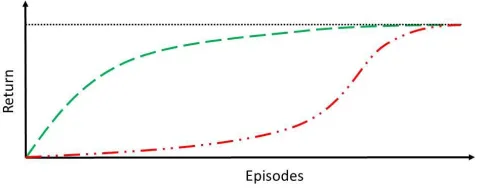
Figure 1: Two learning curves with the same time-to-threshold. The curve above is preferable in critical tasks.
We consider the novel case, for CL, in which an agent needs to learn online in a critical task, in which exploration is costly, and therefore the number of suboptimal actions during exploration should be minimized. An example of this setting is control for smart-grid agents, which while learning con-sume real energy from the grid. For this class of problems, it is desirable not only to learn the optimal policy quickly, but also to reach it with the smallest possible amount of subopti-mal exploration. By means of illustration, consider the graph in Figure 1. The two learning curves have the same time-to-threshold, but one achieves a higher return than the other in every episode. Such a learning behavior is preferable, and is the objective of our optimization.
In this paper, we introduce a novel use of curriculum learn-ing, in order to provide the optimal initial knowledge result-ing in the minimum amount of exploration in critical tasks. We propose to adopt thecumulative return, rather than time-to-threshold, as the objective function for task sequencing. Furthermore, we introduce a novel heuristic search algorithm tailored for the resulting sequencing problem, and we ex-perimentally show that it outperforms three popular meta-heuristic algorithms, on several tasks. Lastly, we validate our method on a real critical domain: the optimization of a home controller for a micro-grid environment. We show that through curriculum learning, the agent can save a consider-able amount of energy during exploration.
2
Related Work
Wuet al., 2018], real-time strategy games [Shaoet al., 2018], and real-world robotics applications [Riedmilleret al., 2018]. Curricula can be considered within a particular environ-ment, where the curriculum is obtained, for instance, by sequencing the initial and goal states [Asada et al., 1996; Sukhbaataret al., 2018; Florensaet al., 2018], or by defining additional auxiliary tasks [Riedmiller et al., 2018]. Curric-ula can also be generated at the task level, where the tasks to be scheduled may have different environment dynamics, and the agent learns in one environment, before moving on to the next. Our sequencing approach is designed for the latter case. In task-level CL, the knowledge transfer between differ-ent environmdiffer-ents plays a crucial role. Similar problems have been considered in multi-task reinforcement learning [Wilson et al., 2007], and lifelong learning [Ruvolo and Eaton, 2013], where the agent attempts to maximize its performance over the entire set of tasks, which may not all be related to one another. Conversely, in curriculum learning, the intermediate tasks are generated specifically to be part of the curriculum, and the curriculum is optimized for a pre-specified set of final tasks.
The automatic generation of curricula [Da Silva and Costa, 2019] has been divided into two sub-problems: task genera-tion [Narvekaret al., 2016; Da Silva and Costa, 2018], that is the problem of creating a set of tasks such that transfer-ring from them is most likely beneficial for the final task; and task sequencing [Svetliket al., 2017; Narvekaret al., 2017; Da Silva and Costa, 2018; Foglinoet al., 2019], whereby pre-viously generated tasks are optimally selected and ordered. Current methods for task sequencing attempt to determine the optimal order of tasks either with [Narvekaret al., 2017; Baranes and Oudeyer, 2013] or without [Svetliket al., 2017; Da Silva and Costa, 2018] executing the tasks. All task se-quencing methods mentioned above are heuristic algorithms tailored to the minimization of time-to-threshold. In this pa-per, we propose to maximize the cumulative return instead, and propose a novel heuristic algorithm for the resulting op-timization problem.
3
Background
3.1
Reinforcement Learning
We model tasks as episodic Markov Decision Processes. An MDP is a tuplehS, A, p, r, γi, whereSis the set of states,A
is the set of actions,p:S×A×S →[0,1]is the transition function,r:S×A→Ris the reward function andγ∈[0,1] is the discount factor. Episodic tasks haveabsorbingstates, that are states that can never be left, and from which the agent only receives a reward of0.
For each time step t, the agent receives an observation of the state and takes an action according to a policy π :
S ×A → [0,1]. The aim of the agent is to find the opti-malpolicyπ∗that maximizes the expected discounted return
G0 =
PtM
t=0γtr(St, At), wheretM is the maximum length
of the episode. Sarsa(λ) is a learning algorithm that takes advantage of an estimate of the value function qπ(s, a) =
Eπ[Gt | St =s, At = a]. We represent the value function
with either a linear function approximator, or a deep neural network.
Curriculum learning leverages transfer learning to transfer knowledge through the curriculum, in order to benefit a final task. Transfer takes place between pairs of tasks, referred to as thesourceand thetargetof the transfer. We use a transfer learning method based on value function transfer [Taylor and Stone, 2009], which uses the learned source q-values, repre-senting the knowledge acquired in the source task, to initialize the value function of the target task.
3.2
Combinatorial Optimization
Combinatorial Optimization (CO) problems are characterized by the goal of finding the optimal configuration of a set of discrete variables. The most popular approaches in this field, calledmetaheuristics, areapproximatealgorithms, that do not attempt to search the solution space completely, but give up global optimality in favor of finding a good solution more quickly. Metaheuristics are applicable to a large class of optimization problems, and are the most appropriate meth-ods for black-box combinatorial optimization, when a par-ticular structure of the objective function (for instance, con-vexity) cannot be exploited. Task sequencing is one such black-box problem, therefore we selected three of the most popular metaheuristics algorithms for comparison with our search method: Tabu Search [Glover, 1989], Genetic Algo-rithm [Goldberg, 1989], and Ant Colony Search [Dorigoet al., 1991]. Tabu Search is atrajectory basedalgorithm, which starting from a single random instance searches through the neighborhood of the current solution for an improvement. Genetic Algorithm and Ant Colony Search are population basedalgorithms, that start from a set of candidate solutions, and improve them iteratively towards successive areas of in-terest.
4
Problem Definition
LetT be a finite set of MDPs constituting the candidate in-termediate tasks. We define, in the context of this work, a curriculum as a sequence of tasks inT without repetitions: Definition. [Curriculum]Given a set of tasksT, a curricu-lumoverT of lengthlis a sequence of tasksc = hm1, m2,
. . . , mliwhere eachmi ∈ T, and∀i, j ∈ [1, l] i 6= j ⇒
mi6=mj.
We assume that the agent learns each task until conver-gence, and that each task serves the purpose of learning one additional skill. LetFbe a finite set of MDPs constituting the finaltasks. These are the tasks of interest, and for a curricu-lum to be valuable, it must provide an advantage over learning the final tasks directly.
4.1
Critical Task Scenario
setting is common to many real-world applications, where simulators are available, and real-world exploration is costly. For instance, it largely applies to robotics.
4.2
Optimization Problem
For the setting described above, we consider the most appro-priate objective function to be the expectedcumulative return
J :T × F →R:
J(c, mf) := N
X
i=1
E[Gif], (1)
whereGi
f is the return obtained by the agent in the final task
mf ∈ F at episode i, andN is the maximum number of
episodes executed in the final task. Analogous objectives have been considered in the literature in the case of single-task exploration (regret [Jaksch et al., 2010]), and transfer learning (area under the curve [Taylor and Stone, 2009], and area ratio [Lazaric, 2012]).
LetCT
l be the set of all curricula overT of lengthl. In the
rest of this paper we will drop the superscript wherever the set of candidate tasks is implicit. We defineC≤L:=SLl=1Cl as the set of all curricula of length at mostL.
We consider the problem of finding an optimal curriculum
c∗of a given maximum lengthL, maximizing the cumulative
return over all final tasks,P(c,F) =Pmf∈FJ(c, mf):
maxP(c,F) s.t. c∈ C≤L
(2)
This optimization problem is entirely solved in simulation, that is, all tasks, including the final ones, are simulated tasks. Simulated final tasks are models of the expected real tasks, and having more than one prevents the curriculum from over-fitting to a particular simulated task.
The returnGi
f obtained by the agent in each episode for a
given final task is a random variable, which depends on the dynamics of the task, the initial knowledge of the agent, and the exploration algorithms employed. The expectation cannot be computed exactly, and must be estimated from a number of trials. The resulting objective function does not have an explicit definition, therefore Problem 2 is black-box, and it is in general nonsmooth, nonconvex, and even discontinuous. Furthermore, the optimization problem is constrained to a combinatorial feasible set. These characteristics do not allow us to resort to methods for general Mixed-Integer NonLinear Programs, or standard Derivative-Free methods. The most appropriate class of optimization algorithms for this type of problem is the class of metaheuristc algorithms, introduced in Section 3.2.
5
Heuristic Algorithm for Task Sequencing
While metaheuristc algorithms are quite general and broadly applicable, it is possible to devise specific heuristic methods targeted at particular problems. In this section, we introduce Heuristic Task Sequencing for Cumulative Return (HTS-CR). We take advantage of the following insight: the quality of a particular task sequence is strongly affected by the efficacy
Algorithm 1HTS-CR
Input: T,F, andL
Output: curriculumc∗and its valuev∗ 1: I←1,J ←1
2: hheads, tails, Vi ←EvaluatePairs(T,F)
3: forrfrom 1 to2(|T | −1)do
4: if(rmod2)= 1then
5: I=I+ 1
6: else
7: J =J+ 1
8: end if
9: H ←Best(heads,I) //Itasks with lowest score
10: T ←Best(tails,J) //Jtasks with lowest score
11: forlfrom 3 toLdo
12: for¯h∈Hand¯t∈T s.t.¯h6= ¯tdo
13: B ←H∪T \ {¯h,¯t}
14: B←Permutations(B, l−2)
15: forb∈Bdo
16: c← h¯h, b,¯ti
17: ifc /∈V then
18: v← P(c,F)
19: V ←P∪ {hc, vi}
20: end if
21: end for
22: end for
23: end for
24: end for
25: return hc∗, v∗i ∈V s.t.∀hc, vi ∈P, v≤v∗
of knowledge transfer, and transfer between certain pairs of tasks is much more effective than others. Therefore, our algo-rithm starts by considering all pairs of tasks, in order to assess which ones are good sources for which targets. It also deter-mines which tasks are the best candidates to beheadof the curriculum, ortail, that is, the last task before the final tasks. The method is shown in Algorithm 1.
This first phase, expanded in Algorithm 2, consists in eval-uating all curricula of length2(Line 4), and sort them (Line 5), with the best curriculum first. At Line 9 and 10 the al-gorithm assignes a score to each task: the better the length-2 curriculum it belongs to, the lower the score. These scores are returned by the functionEvaluatePairs.
After this initial phase, Algorithm 1 uses the computed scores to determine the order in which curricula are evaluated. The underline intuition is the following: the most promising head and tail tasks are tried first, and shorter curricula are evaluated before longer ones. At each roundr(Line 3), one more task is added to the set of candidate heads (Line 9) or tails (Line 10) alternatively. For each length up to the max-imum length (Line 11), and for all pairs of tasks, one from the head set H,¯h, and one from the tail setT,t¯, the algo-rithm generates all the permutations of the remaining tasks in
H∪T (Line 14). It then appends¯hat the beginning, and¯tat the end, creating a full curriculum, which, if not considered before (Line 17) is evaluated by running the corresponding simulation, estimating the cumulative return (Line 18).
Algorithm 2EvaluatePairs
Input: T andF
Output: hheads, tailsi
1: D, V ← ∅
2: heads =tails = [{m1,0}, . . . ,{m|T |,0}]// dictionary
// from tasks to integers
3: D←AllPairs(T)
4: V ← {hd, vi|d∈D∧v=P(d,F)}// evaluate all pairs
5: V ←Sort(V)// sort wrt cumulative return, best first.
6: forifrom1to|V|do
7: hd, vi ←Vi// i-th best curriculum in V
8: hh, ti ←d// head and tail ofd 9: heads[h]←heads[h] +i 10: tails[t]←tails[t] +i 11: end for
12: return hheads, tails, Vi
of the curricula to be searched, which can be exchanged for a different stopping criterion, such as a maximum budget of curricula evaluations. We intentionally left out all curricula of length1, since our heuristic would not have any meaningful order among them. They could be evaluated in a preliminary phase in any order. We will show experimentally in the next section that, after the initial cost of evaluating all curricula of length2, the solutions found are quickly close to optimal.
6
Heuristic Search Evaluation
We organize the experimental evaluation into two parts. The first part, described in this section, has the aim of evaluating our heuristic search against some of the most popular opti-mization algorithms applicable to our problem formulation: Tabu Search, Genetic Algorithm, and Ant Colony Search. We compare against general metaheuristics because all previous algorithms for task sequencing are designed for a different objective function, time-to-threshold, and cannot be applied to cumulative return maximization.
6.1
Metaheuristic Adaptation
Despite the generality of metaheuristc algorithms, all the ones we chose must be adapted to the particular problem at hand. In this section we describe how each one has been tailored to the problem of task sequencing.
In Tabu Search (TS) [Glover, 1989], we create the neigh-borhood of a current curriculum by: generating a list of cur-riculaRcomposed of all the curricula obtained by removing from, or adding to, the last task in the current best curricu-lum; and generating all curricula resulting from any pairwise swap of any two tasks of a curriculum inR. We empty the tabu list of sizeT, when full, following a FIFO strategy. In our experimentsT = 30.
For Genetic Algorithm (GA) [Goldberg, 1989], we set the initial population asQrandomly sampled curricula from
C≤L. At each iteration we select two parent curricula with a
roulette wheel selection. Given two parent curricula we gen-erate a new population ofQcandidate curricula by applying a standard single point cross over at randomized lengths along each parent gene (sequence of intermediate tasks). Each cross
over step produces two children curricula and the process is repeated untilQchildren curricula are created. We also in-cluded a form of elitism in order to improve the performance of the algorithm by adding the parents to the population they generated. Genetic algorithms also include the definition of a mutation operator. In our implementation this acts on each candidate curriculum in the newly generated population with probabilitypm. The mutation can be of two equally probable
types: task-wise mutation, which given a candidate curricu-lum of lengthl, changes each of its intermediate tasks with probability equal to1/l; length-wise mutation, where equal probability is given to either dropping or adding a new source at a randomly selected position of a candidate curriculum. In our experimentsQ= 50andpm= 0.5.
For Ant Colony Optimization (ACO) [Dorigoet al., 1991], each agent in the colony moves towards the goal by adding a new intermediate task to the current candidate curriculum
c which represents the trail walked by the ant. Given a source taskmiits probability of being selected isP(mi) =
[(τmi+K)
α+Iβ mi]/[
P
E[(τmj +K)
α+Iβ
mj]]withE =
{mj ∈ T |mj∈/ c}. The variableτmirepresents the quantity of pheromone on taskmiwhile following the current
candi-date curriculumc. The visibilityImi is calculated as the per-formance improvement obtained by adding taskmito the
cur-rent candidate curriculum when positive, and zero otherwise. Parameters αandβ control the influence of the pheromone versus the improvement, while K is a threshold to control from what pheromone value the search starts to take it into account. The pheromone evaporation rate is specified with the parameterρwhile the maximum level of pheromone to be accumulated over a candidate solution is set tofmax. In our
experimentsα = 1, β = 1.2, K = 5, fmax = 50, ρ = 0.2
and the number of ants is20. The parameters of all algorithms have been fine-tuned manually across all experiments.
6.2
Domains
We use two domains implemented within the software library Burlap1. Both domains have been previously used for CL
[Svetlik et al., 2017; Narvekar et al., 2017; Da Silva and Costa, 2018; Foglinoet al., 2019].
GridWorld
GridWorld is an implementation of an episodic grid-world domain. Each cell can be free, or occupied by afire,pit, or treasure. The agent can move in the four cardinal directions, and the actions are deterministic. The reward is −2500for entering a pit,−500for entering a fire,−250for entering the cell next to a fire, and200for entering a cell with the treasure. The reward is−1in all other cases. The episodes terminate under one of these three conditions: the agent falls into a pit, reaches the treasure, or executes a maximum number of ac-tions.
BlockDude
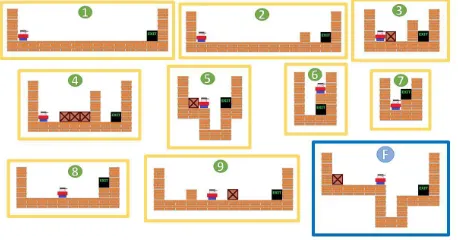
BlockDude is a puzzle game (Figure 2) where the agent has to stack boxes in order to climb over walls and reach the exit. The available actions are moving left, right, up, pick up a box and put down a box. The agent receives a reward of−1for
1
Figure 2: Intermediate (in yellow) and final task (in blue) of the second experiment in the BlockDude domain. The global optimum is the curriculum7-1-5.
each action taken, and an episode terminates when a maxi-mum number of actions is executed.
6.3
Experiments
For both domains we computed and analyzed all curricula within the given maximum length, so that, for each experi-ment, we know the globally optimal curriculum.
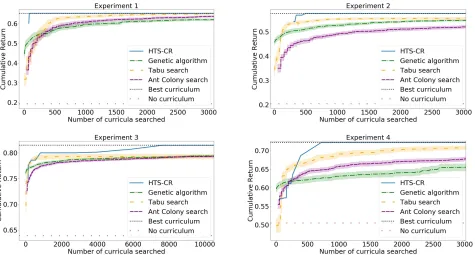
We ran two sets of experiments per domain, one in which the number of tasks is high and the maximum length is low, and one in which, on the contrary, the number of tasks is low, but the maximum length is high. For BlockDude, Experiment 1(Figure 3) has parametersn= 18andL= 3, while in Ex-periment2n= 9andL= 5. For GridWorld, Experiment3 (Figure 3) has parametersn:=|T |= 12andL= 4, while in Experiment4n= 7, andL= 7. For both domains, the inter-mediate tasks have been generated manually using methods from Narvekaret al.[2017], by varying the size of the envi-ronment, and adding and removing elements (pits and fires in GridWorld, and columns and movable blocks in BlockDude). We intentionally created both tasks that provide positive and negative transfer towards the final task, in order to test the ability of the sequencing algorithm to choose the most appro-priate ones. In Figure 2 we show, as an example, the interme-diate tasks and relative final task for the second experiment in the BlockDude domain. Each of the four experiments has a different final task and set of intermediate tasks. All tasks are run for a number of episodes that ensures that the agent has converged to the optimal policy, determined at the time of task generation. Each curriculum was repeated for10epochs, and expected cumulative return approximated with the aver-age. The agent learns with Sarsa(λ) using Tile Coding, while exploring withǫ-greedy2.
In Figure 3 we compare HTS-CR against the metaheuris-tic methods described in Section 6.1. The four plots, one for each experiment, show the value of the best curriculum over the number of curricula evaluated by each algorithm. Curric-ula were evaluated by having the agent learn each one mul-tiple times, and averaging the results to estimate the objec-tive in Equation 1. The cumulaobjec-tive return was normalized in
2
The complete source code of all our experiments can be found at https://github.com/francescofoglino/Curriculum-Learning
[0,1]for ease of comparison across the experiments, where 1 is the return accumulated by the optimal policy at every episode. As Tabu Search, Genetic Algorithm and Ant Colony Optimization are stochastic methods, their performance were averaged over70 runs and plotted showing the95% confi-dence interval. In all the experiments HTS-CR has an initial offset ofn(n−1)evaluations spent to consider all the pos-sible pairs of tasks, whereas all the metaheuristics immedi-ately start finding possible solutions. Nevertheless, HTS-CR quickly outperformed all the other algorithms, and always found the globally optimal curriculum the fastest, showing the benefit of the initial pair evaluations. Furthermore, our approach is deterministic and has no parameters.
7
Real-world Validation
The second experiment is aimed at validating the proposed use of curriculum learning in a realistic scenario. We set out to show that an appropriate curriculum can “prepare” the agent better than the traditional approach of learning the op-timal policy in the simulated task and then transfer it.
7.1
MGEnv Domain
MGEnv is a simulated micro-grid domain modeled out of real data from the PecanStreet Inc. database. The domain in-cludes historical data about hourly energy consumption and solar energy generation of different buildings from January 2016 to December 2018. A task in this domain is defined by the combination of three elements: the model of the electrical device to optimize; the user’s monthly schedule, specifying the days in which the user wishes to run the device; the month of simulation, with the energy generation and consumption of the given building. The device we used behaves as a time-shifting load: once started it runs for several time steps and cannot be interrupted before the end of its routine. This is the most challenging type of device present in the database. The goal is to find the best time of day to run the given device, optimizing direct use of the generated energy, while respect-ing the user’s device schedule. The agent receives a reward of 30when the device energy consumption is fully covered by the energy generated by the building,−10when energy not generated by the building is used and−200if the device is not run accordingly to the user schedule.
7.2
Experiments
We developed a DeepRL agent for the MGEnv domain with an Actor-Critic architecture, using Proximal Policy Optimiza-tion [Schulman et al., 2017], and Progressive Neural Net-works [Rusuet al., 2016], for value function transfer.
All the tasks in this domain are for the control of the same electric device. We created 10 final tasks using the same month and user schedule, but different buildings. We divided them into a training and test set of5tasks each. Without CL, a natural approach would be to learn the optimal policy for one of the source tasks in the training set, and transfer the optimal value function to a target task in the test set.
Figure 3: The results of the four experiments on the BlockDude (top) and Gridworld (bottom) domains. HTS-CR quickly outperforms the other algorithms finding the globally optimal curriculum.
[image:7.612.316.535.373.482.2]to learn than others, providing the basis for the curriculum. We optimized the curriculum with HTS-CR over the training set with a maximum lengthL= 4, repeating each evaluation 5times to estimate the cumulative return. The best curricu-lum was found after37curriculum evaluations. We then took the value function after the tail of the curriculum, before the final tasks, and transferred it to each of the5tasks in the test set. We evaluated the performance of the agent initialized from the curriculum, and compared it to the behavior of the agent initialized from single-target transfer.
Figure 4 shows the results of this experiment. The curricu-lum was generated using all the training tasks together, and evaluated over each one of the5test tasks separately. There-fore, the plotted results are the average over5runs with95% confidence intervals. Single-task transfer, on the other hand, was trained on each one of the training tasks and evaluated on each test task, resulting in the average over25runs. We show that, on average, initializing the learning from the cur-riculum achieves a higher cumulative return than initializing from the optimal value function of one of the source tasks. Our approach used54%less energy, on average, from exter-nal sources. The results show that a curriculum generated from simulated tasks can indeed generalize to similar, real, tasks (recall that all the data in these simulations is from real buildings) and provide a significant improvement of the be-havior during learning.
8
Conclusions
We introduced a novel setting for curriculum learning in re-inforcement learning, with the aim of shaping exploration in
Figure 4: Average return over the test tasks in the MGEnv domain
critical tasks. Furthermore, we introduced HTS-CR, a heuris-tic algorithm for task sequencing, and experimentally demon-strated that it outperforms several popular metaheuristc al-gorithms. We validated our approach on a home micro-grid controller, based on real data, showing that the knowledge provided by the curriculum is on average a more appropriate initialization than the optimal policy of a simulated task.
Acknowledgments
References
[Asadaet al., 1996] Minoru Asada, Shoichi Noda, Sukoya Tawaratsumida, and Koh Hosoda. Purposive behavior ac-quisition for a real robot by vision-based reinforcement learning. Machine learning, 23(2-3):279–303, 1996. [Baranes and Oudeyer, 2013] Adrien Baranes and
Pierre-Yves Oudeyer. Active learning of inverse models with in-trinsically motivated goal exploration in robots. Robotics and Autonomous Systems, 61(1):49–73, 2013.
[Da Silva and Costa, 2018] Felipe Leno Da Silva and Anna Helena Reali Costa. Object-oriented curriculum genera-tion for reinforcement learning. InInternational Confer-ence on Autonomous Agents and Multiagent Systems (AA-MAS), 2018.
[Da Silva and Costa, 2019] Felipe Leno Da Silva and Anna Helena Reali Costa. A survey on transfer learning for mul-tiagent reinforcement learning systems. Journal of Artifi-cial Intelligence Research, 64:645–703, 2019.
[Dorigoet al., 1991] Marco Dorigo, Vittorio Maniezzo, and Alberto Colorni. The ant system: An autocatalytic opti-mizing process, 1991.
[Florensaet al., 2018] Carlos Florensa, David Held, Xinyang Geng, and Pieter Abbeel. Automatic goal gener-ation for reinforcement learning agents. In International Conference on Machine Learning (ICML), 2018.
[Foglinoet al., 2019] Francesco Foglino, Christiano Co-letto Christakou, and Matteo Leonetti. An optimization framework for task sequencing in curriculum learning. In Proceedings of 9th Joint IEEE International Conference on Development and Learning and on Epigenetic Robotics (ICDL-EpiRob), 2019.
[Glover, 1989] Fred Glover. Tabu search—part i. ORSA Journal on computing, 1(3):190–206, 1989.
[Goldberg, 1989] David E Goldberg. Genetic algorithms in search. Optimization, and MachineLearning, 1989. [Jakschet al., 2010] Thomas Jaksch, Ronald Ortner, and
Pe-ter Auer. Near-optimal regret bounds for reinforce-ment learning. Journal of Machine Learning Research, 11(Apr):1563–1600, 2010.
[Lazaric, 2012] Alessandro Lazaric. Transfer in reinforce-ment learning: a framework and a survey. In Reinforce-ment Learning, pages 143–173. Springer, 2012.
[Narvekaret al., 2016] Sanmit Narvekar, Jivko Sinapov, Matteo Leonetti, and Peter Stone. Source task creation for curriculum learning. In International Conference on Au-tonomous Agents and Multiagent Systems (AAMAS), 2016. [Narvekaret al., 2017] Sanmit Narvekar, Jivko Sinapov, and Peter Stone. Autonomous task sequencing for customized curriculum design in reinforcement learning. In(IJCAI), The 2017 International Joint Conference on Artificial In-telligence, 2017.
[Riedmilleret al., 2018] Martin Riedmiller, Roland Hafner, Thomas Lampe, Michael Neunert, Jonas Degrave, Tom
van de Wiele, Vlad Mnih, Nicolas Heess, and Jost To-bias Springenberg. Learning by playing solving sparse re-ward tasks from scratch. InProceedings of the 35th Inter-national Conference on Machine Learning, pages 4344– 4353, 2018.
[Rusuet al., 2016] Andrei A Rusu, Neil C Rabinowitz, Guillaume Desjardins, Hubert Soyer, James Kirkpatrick, Koray Kavukcuoglu, Razvan Pascanu, and Raia Had-sell. Progressive neural networks. arXiv preprint arXiv:1606.04671, 2016.
[Ruvolo and Eaton, 2013] Paul Ruvolo and Eric Eaton. Ella: An efficient lifelong learning algorithm. InIn Proceedings of the 30th International Conference on Machine Learn-ing, pages 507–515, 2013.
[Schulmanet al., 2017] John Schulman, Filip Wolski, Pra-fulla Dhariwal, Alec Radford, and Oleg Klimov. Prox-imal policy optimization algorithms. arXiv preprint arXiv:1707.06347, 2017.
[Shaoet al., 2018] K. Shao, Y. Zhu, and D. Zhao. Starcraft micromanagement with reinforcement learning and cur-riculum transfer learning.IEEE Transactions on Emerging Topics in Computational Intelligence, pages 1–12, 2018. [Sukhbaataret al., 2018] Sainbayar Sukhbaatar, Zeming
Lin, Ilya Kostrikov, Gabriel Synnaeve, Arthur Szlam, and Rob Fergus. Intrinsic motivation and automatic curricula via asymmetric self-play. InInternational Conference on Learning Representations (ICLR), 2018.
[Svetliket al., 2017] M Svetlik, M Leonetti, J Sinapov, R Shah, N Walker, and P Stone. Automatic curriculum graph generation for reinforcement learning agents. In Thirty-First AAAI Conference on Artificial Intelligence. Association for the Advancement of Artificial Intelligence, 2017.
[Taylor and Stone, 2009] Matthew E Taylor and Peter Stone. Transfer learning for reinforcement learning domains: A survey. Journal of Machine Learning Research, 10(Jul):1633–1685, 2009.
[Wilsonet al., 2007] Aaron Wilson, Alan Fern, Soumya Ray, and Prasad Tadepalli. Multi-task reinforcement learn-ing: a hierarchical bayesian approach. InProceedings of the 24th international conference on Machine learning, pages 1015–1022. ACM, 2007.
[Wu and Tian, 2017] Yuxin Wu and Yuandong Tian. Train-ing agent for first-person shooter game with actor-critic curriculum learning. In International Conference on Learning Representations (ICLR), 2017.