R E S E A R C H
Open Access
Mildly elevated lactate levels are associated
with microcirculatory flow abnormalities
and increased mortality: a microSOAP post
hoc analysis
Namkje A. R. Vellinga
1,2*, E. Christiaan Boerma
2, Matty Koopmans
2, Abele Donati
3, Arnaldo Dubin
4,
Nathan I. Shapiro
5, Rupert M. Pearse
6, Peter H. J. van der Voort
7, Arjen M. Dondorp
8, Tony Bafi
9, Michael Fries
10,
Tulin Akarsu-Ayazoglu
11, Andrius Pranskunas
12, Steven Hollenberg
13, Gianmarco Balestra
14, Mat van Iterson
15,
Farid Sadaka
16, Gary Minto
17, Ulku Aypar
18, F. Javier Hurtado
19, Giampaolo Martinelli
20, Didier Payen
21,
Frank van Haren
22, Anthony Holley
23, Hernando Gomez
24, Ravindra L. Mehta
25, Alejandro H. Rodriguez
26,
Carolina Ruiz
27, Héctor S. Canales
28, Jacques Duranteau
29, Peter E. Spronk
30, Shaman Jhanji
31, Sheena Hubble
32,
Marialuisa Chierego
33, Christian Jung
34,35, Daniel Martin
36, Carlo Sorbara
37, Jan Bakker
1, Can Ince
1and for the
microSOAP study group
Abstract
Background:
Mildly elevated lactate levels (i.e., 1
–
2 mmol/L) are increasingly recognized as a prognostic finding in
critically ill patients. One of several possible underlying mechanisms, microcirculatory dysfunction, can be assessed
at the bedside using sublingual direct in vivo microscopy. We aimed to evaluate the association between relative
hyperlactatemia, microcirculatory flow, and outcome.
Methods:
This study was a predefined subanalysis of a multicenter international point prevalence study on
microcirculatory flow abnormalities, the Microcirculatory Shock Occurrence in Acutely ill Patients (microSOAP).
Microcirculatory flow abnormalities were assessed with sidestream dark-field imaging. Abnormal microcirculatory
flow was defined as a microvascular flow index (MFI) < 2.6. MFI is a semiquantitative score ranging from 0 (no flow)
to 3 (continuous flow). Associations between microcirculatory flow abnormalities, single-spot lactate measurements,
and outcome were analyzed.
Results:
In 338 of 501 patients, lactate levels were available. For this substudy, all 257 patients with lactate levels
≤
2 mmol/L (median [IQR] 1.04 [0.80
–
1.40] mmol/L) were included. Crude ICU mortality increased with each lactate
quartile. In a multivariable analysis, a lactate level > 1.5 mmol/L was independently associated with a MFI < 2.6 (OR
2.5, 95% CI 1.1
–
5.7,
P
= 0.027).
(Continued on next page)
* Correspondence:[email protected]
1
Department of Intensive Care Adults, Erasmus MC University Medical Center, Rotterdam, The Netherlands
2Department of Intensive Care, Medical Center Leeuwarden, P.O. Box 888,
8901 BR Leeuwarden, The Netherlands
Full list of author information is available at the end of the article
(Continued from previous page)
Conclusions:
In a heterogeneous ICU population, a single-spot mildly elevated lactate level (even within the reference
range) was independently associated with increased mortality and microvascular flow abnormalities. In vivo microscopy
of the microcirculation may be helpful in discriminating between flow- and non-flow-related causes of mildly elevated
lactate levels.
Trial registration:
ClinicalTrials.gov, NCT01179243. Registered on August 3, 2010.
Keywords:
Lactate, Microcirculation, SDF imaging, Intensive care, Prevalence
Background
An elevated lactate level, classically defined as an arterial
lactate level > 2 mmol/L, is a well-known predictor of
adverse outcome in terms of organ dysfunction and
mortality in different subgroups of critically ill patients
[1
–
3]. Surviving Sepsis Campaign guidelines consider a
threshold of 1 mmol/L as an indicator of tissue
hypoper-fusion, but they suggest resuscitation to normalize
arterial lactate levels in patients with lactate levels >
4 mmol/L in order to improve outcome, based on the
principles of early goal-directed therapy [4
–
6]. Similarly,
in nonseptic patients, the value of lactate levels in
goal-directed resuscitation, as well as the additive value of
serial lactate measurements, is recognized [7
–
10].
Recent studies indicate that small increases in lactate
levels are already associated with an unfavorable clinical
course. This association has been demonstrated for
“
relative hyperlactatemia
”
with thresholds as low as
1.1 mmol/L [11
–
14]. Although lactate is easily measured
in daily practice, unraveling the underlying causative
mechanism
is often much
more difficult.
Organ
hypoperfusion is regarded as an important cause of
hyperlactatemia, although several other mechanisms also
play a significant role, ranging from accelerated aerobic
glycolysis to decreased lactate metabolism and
mito-chondrial and microcirculatory dysfunction [15].
Sublin-gual direct in vivo microscopy is a suitable method of
detecting microcirculatory derangements at the bedside
[16]. Several studies have demonstrated an association
between lactate levels and microcirculatory alterations in
subgroups of critically ill patients as well as in
experi-mental settings [17
–
25]. We previously demonstrated
that both microcirculatory derangements and arterial
lactate levels were independent predictors of mortality
in selected high-risk patients [26].
The aforementioned studies were primarily focused on
the early phase of intensive care unit (ICU) admission.
The significance of minimally elevated lactate levels as
well as concomitant microcirculatory dysfunction at a
later time point is unclear. Therefore, we aimed to
inves-tigate the significance of a single-spot arterial lactate
measurement and simultaneous in vivo microscopy in a
heterogeneous ICU population recruited from 36 ICUs
worldwide.
Methods
Patients and setting
This study was a post hoc analysis of a prospective
observational point prevalence study of the prevalence
and significance of microcirculatory alterations in a
heterogeneous ICU population (Microcirculatory Shock
Occurrence in Acutely ill Patients [microSOAP;
Clinical-Trials.gov identifier NCT01179243; registered on August
3, 2010 [26]). Thirty-six ICUs worldwide participated in
this study. Being a point prevalence study, data
collec-tion on patient characteristics and laboratory values, as
well as simultaneous sublingual sidestream dark-field
(SDF) imaging, was performed on a single day for all
pa-tients in a given ICU or ICU subunit. Lactate levels were
measured within a maximum of 4 h before or after SDF
imaging. For this substudy, patients with an arterial
lactate level
≤
2 mmol/L were included.
Ethics approval
Every participating center obtained ethics approval
according to local legislation. A copy of the ethics
approval was sent to the study coordinator before the
start of the study (
see
Additional file 1). Written
in-formed consent was obtained from all included subjects,
unless the local ethics committee specifically allowed a
waiver in this respect.
SDF imaging
three sublingual SDF image sequences of 10
–
20 seconds
was obtained for every patient. SDF imaging as well as
subsequent image analysis were performed in line with
international consensus [27, 28].
Statistical analysis
Analysis was focused on associations between lactate
levels, mortality, organ dysfunction, and
microcircula-tory alterations. An abnormal microcirculamicrocircula-tory blood
flow was predefined as a sublingual MFI < 2.6 for vessels
< 20
μ
m, being the lowest reported lower bound of the
95% CI of healthy volunteers. We defined this value a
priori for the analysis of the original microSOAP data. A
post hoc analysis confirmed this cutoff value as the
Youden index in an ROC curve [26]. This cutoff value
has been validated as clinically relevant [26, 29]. To
determine cutoff values for lactate levels for both
abnor-mal MFI and mortality, the AUC was calculated. These
cutoff values were subsequently tested in logistic
regres-sion analysis.
Backward stepwise logistic regression was employed to
detect determinants of a capillary MFI < 2.6. Predictors
with
P
< 0.25 in univariable logistic regression were used
for multivariable modeling (
see
Additional file 2 for
additional information on the statistical analysis). Tested
predictors included Sequential Organ Failure
Assess-ment (SOFA) score on the day of SDF imaging, Acute
Physiology and Chronic Health Evaluation II (APACHE
II) score on ICU admission, length of stay in the ICU
prior to SDF imaging (
≤
24 h and > 24 h), admission
diagnosis, the presence of sepsis at the time of SDF
imaging, Hb
≤
5.37 mmol/L, arterial lactate level >
1.5 mmol/L, heart rate, mean arterial pressure, fluid
balance, and vasopressor use. In case of nonlinearity
of the logit, variables were dichotomized. The
result-ing models were tested for multicollinearity. Hosmer
and Lemeshow goodness of fit was used to test the
fit of the model. Furthermore, the associations
be-tween lactate levels, microcirculatory dysfunction,
mortality, and organ dysfunction (SOFA, cumulative
vasopressor index [CVI] [30]) were described by
dividing the lactate measurements into quartiles. To
test for differences between normally distributed
variables, Student
’
s
t
test or the Mann-Whitney
U
test was performed. To compare dichotomous
vari-ables, Fisher
’
s exact test was applied. Distributions
across more than two groups were tested using the
nonparametric Kruskal-Wallis test. The data were
analyzed using IBM SPSS Statistics version 23.0
(IBM, Armonk, NY, USA) and Prism 5.04
(Graph-Pad Software, Inc., La Jolla, CA, USA) software and
are presented as the median [IQR] or mean ± SD,
unless indicated otherwise.
P
< 0.05 was considered
statistically significant.
Results
General characteristics
Out of 501 patients, arterial lactate levels were available
for 338 (67%) of patients. In 257 out of these 338
patients (76%), arterial lactate levels were
≤
2 mmol/L.
These patients, with median APACHE of 16 [10
–
23] and
median SOFA of 5 [3
–
8], were included for further
ana-lysis (Table 1). Surgery (35.4%) and sepsis (17.5%) were
the main reasons for ICU admission. Median arterial
lactate levels were 1.04 [0.80
–
1.40] mmol/L. ICU and
hospital mortality were 20.6% and 27.2%, respectively.
Lactate levels and mortality
Increases in ICU mortality were observed for every
lac-tate quartile (
≤
0.80 mmol/L, 12.9%; 0.81
–
1.04 mmol/L,
15.3%; 1.05
–
1.40 mmol/L, 15.4%; > 1.40 mmol/L, 39.7%;
P
< 0.001). Similar trends were observed for hospital
mortality (24.3% in the lowest quartile, 44.4% in the
highest quartile;
P
= 0.005) (
see
Fig. 1). The AUC was
0.65 (95% CI 0.56
–
0.73,
P
= 0.001) with a cutoff value of
1.42 mmol/L for ICU mortality (sensitivity 40%,
specifi-city 81%). The same cutoff value was seen for hospital
mortality with a sensitivity of 47% and a specificity of
81% (AUC 0.59, 95% CI 0.51
–
0.67,
P
= 0.025). Mortality
was at least almost twice as high for patients with an
ar-terial lactate level > 1.5 mmol/L as compared with
patients with a lower lactate level (ICU mortality 41.2%
vs. 15.5%,
P
< 0.001; hospital mortality 45.1% vs. 22.9%,
P
= 0.001).
Lactate levels and microcirculatory flow abnormalities
Patients with a capillary MFI < 2.6 (14%) had slightly
but nonsignificantly higher lactate levels than patients
with a higher MFI (1.11 [0.90
–
1.60] vs. 1.00 [0.80
–
1.40] mmol/L,
P
= 0.117). A nonsignificant trend
toward a higher prevalence of an abnormal
microcir-culation in the highest lactate quartile was observed
(
P
= 0.169) (Fig. 1). Hb was significantly lower in
pa-tients with an MFI < 2.6 (Hb 5.4 [5.2
–
6.8] vs. Hb 6.3
[5.5
–
7.1],
P
= 0.011). No significant differences with
respect to illness severity scores, hemodynamics,
vasopressor use or dose, reason for ICU admission, or
time in ICU prior to SDF imaging were observed.
Comparing patients with lactate levels
≤
1.5 mmol/L
and > 1.5 mmol/L, no significant differences were
ob-served for small vessel MFI; large vessel MFI; and
small vessel TVD, PVD, PPV, (perfused) De Backer
score, and heterogeneity index.
Multivariable logistic regression analysis for MFI < 2.6
CI 1.3
–
6.6,
P
= 0.008), and an arterial lactate level >
1.5 mmol/L (OR 2.5, 95% CI 1.1
–
5.7,
P
= 0.027). The AUC
for this three-variable model was 0.74 (95% CI 0.65
–
0.83,
P
= 0.001). The Hosmer and Lemeshow chi-square
statistic was 2.015 (
P
=0.847) (
see also
Additional file 2).
Lactate levels and organ dysfunction
A higher lactate level was not accompanied by a
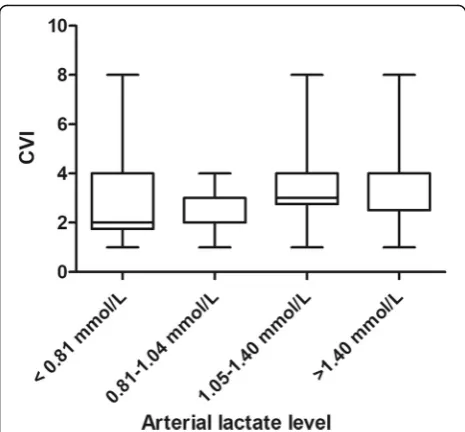
signifi-cantly higher SOFA score or CVI (
P
= 0.078 and
P
= 0.063,
respectively) (Figs. 2 and 3).
Different phenotypes
[image:4.595.303.542.87.226.2]Although an abnormal MFI and elevated lactate levels
appear to be associated, several different phenotypes
exist. For individual patients, a higher lactate level
was not necessarily associated with adverse outcome
or an abnormal microcirculation or vice versa,
point-ing toward a multifactorial etiology and significance
of both hyperlactatemia and microvascular
derange-ments (Fig. 4).
Table 1
Patient characteristics
Characteristics Data
Age, years 64 [52–74]
Male sex,n(%) 156 (61)
APACHE II scorea 16 [10–23]
SOFA scoreb 5 [3–8]
ICU mortality,n(%) 53 (20.6)
In-hospital mortality,n(%) 70 (27.2)
Time in ICU before SDF imaging, days 4.0 [0.8–9.0]
<24 h in ICU before SDF imaging,n(%) 79 (30.7)
Reason for ICU admission,n(%)
Surgery 91 (35.4)
Sepsis 45 (17.5)
Cardiac disease 18 (7.0)
Neurological disorders 27 (10.5)
Trauma 30 (11.7)
Respiratory insufficiency 21 (8.2)
Other 25 (9.7)
Arterial lactate, mmol/L 1.04 [0.80–1.40]
Hemoglobin, mmol/L 6.2 [5.4–7.0]
Vasopressor drugs
Patients treated,n(%) 89 (34.6)
Cumulative vasopressor indexc 3 [2–4]
Mechanical ventilation,n(%) 161 (63)
Abnormal microcirculationd,n(%) 36 (14)
MFI small vessels, AU 2.9 [2.7–3.0]
MFI large vessels, AU 3.0 [2.9–3.0]
TVD, mm/mm2(small vessels) 18.9 [15.7–21.2] PVD, mm/mm2(small vessels) 18.1 [15.0–20.6]
PPV, % (small vessels) 98 [95–99]
De Backer score (small vessels) 11.3 ± 2.5
De Backer score (perfused small vessels) 10.9 ± 2.4
Heterogeneity index (small vessels) 0.07 [0.00–0.25]
Abbreviations: APACHE IIAcute Physiology and Chronic Health Evaluation II,ICU
Intensive care unit,MFIMicrovascular flow index,PPVPercentage of perfused
vessels,PVDPerfused vessel density,SDFSidestream dark-field imaging,SOFA
Sequential Organ Failure Assessment,TVDTotal vessel density
Values are mean ± SD or median [IQR] unless specified otherwise. Cutoff value for small vessels < 20μm
a
APACHE II scores range from 0 to 71, with higher values indicating more severe disease
b
SOFA scores range from 0 to 4 for each organ system, with higher scores indicating more severe organ dysfunction
c
Trzeciak et al. [30] d
Abnormal microcirculation defined as small vessel MFI < 2.6
Fig. 1Arterial lactate levels (quartiles) and distribution of intensive care unit (ICU)/hospital mortality and abnormal microvascular flow index (MFI < 2.6).P< 0.001 for ICU mortality,P= 0.005 for hospital mortality,P= 0.169 for abnormal MFI for distributions over quartiles
[image:4.595.57.290.94.545.2] [image:4.595.305.538.488.704.2]Discussion
In the present study, a single-spot arterial lactate level >
1.5 mmol/L was associated with increased mortality as
well as with microcirculatory abnormalities and organ
dysfunction. This
“
relative hyperlactatemia
”
is an
emer-ging concept [11
–
14, 31]. Lactate levels on admission as
low as 1.1 mmol/L already appeared to be associated
with adverse outcome [12]. Our observations add to the
idea that the prognostic relevance of mildly elevated
lactate levels is not restricted to the early phase of ICU
admission. The twofold increase in mortality in patients
with a lactate level > 1.5 mmol/L is in agreement with
results of previous studies focused on the first day of
ICU admission [13, 14]. Researchers in a few studies
have reported lactate levels and their association with
outcome during the later phase of ICU stay, showing
contradictory results. Some have observed an association
between hyperlactatemia after initial stabilization with
higher mortality rates, whereas others found that not
lactate itself but impaired lactate clearance was
associ-ated with adverse outcome [32, 33]. In this respect, it is
notable that we were able to demonstrate this
associ-ation in a highly heterogeneous study populassoci-ation, in
terms of both the timing of the lactate measurement as
well as the underlying diagnosis and disease severity.
Not only mortality but also organ dysfunction in terms
of SOFA score appeared to be more severe for increasing
lactate levels, albeit that this was statistically
nonsignifi-cant. A previous study was able to show associations
between incremental lactate levels > 2 mmol/L and
SOFA scores [2]. However, in that study, the
investiga-tors evaluated the time course of lactate measurements,
whereas in the present study, we evaluated the
implica-tions of a single lactate measurement.
Several mechanisms may be involved in the increase of
lactate levels. One of these, microcirculatory flow
abnor-malities, was indeed associated with mildly elevated
lactate levels in the present study. PVD, and therefore
effective diffusion distance, did not differ between
pa-tients with and without mildly elevated lactate levels.
Therefore, impaired convective oxygen transport, but
not diffusion distance, might have contributed to
anaer-obic glycolysis. Several researchers have also observed an
association between impairment of microvascular flow
and elevations in arterial lactate, whereas others have
been able to demonstrate associations between lactate
levels and parameters of vessel density in a variety of
disease states [17, 19
–
25].
Alternatively, several non-flow-related factors may
lead to increased nonanaerobic lactate formation
under conditions of stress by promoting conversion
of glucose to lactate via pyruvate instead of pyruvate
entering the citric acid cycle [15, 34]. Indeed, lactate
formation in endotoxemia results predominantly from
increased aerobic lactate formation [35]. On top of
that, exogenous adrenergic stress resulting from
β
-adrenergic drugs can also increase aerobic lactate
for-mation [36].
Besides ongoing lactate formation, impaired lactate
clearance has to be kept in mind as a cause of mildly
el-evated lactate levels. Levraut and coworkers observed
that in stable septic patients in whom arterial lactate
levels were < 2 mmol/L after the initial resuscitation
phase, impaired clearance of exogenous sodium lactate
but not baseline lactate values could discriminate
between survivors and nonsurvivors [32, 37]. It is
con-ceivable that a similar mechanism was involved in our
patients.
Fig. 3Cumulative vasopressor index (CVI) per arterial lactate quartile.
P= 0.063 for distributions over quartiles
[image:5.595.57.290.86.302.2] [image:5.595.58.291.537.703.2]Altogether, the direct observation of the
microcircu-lation in conjunction with lactate measurements
con-firms the idea that impaired organ perfusion is only one
of many explanations for elevated lactate levels with
potential consequences for therapeutic strategies in the
ICU [29, 38].
Our study has several limitations. At first glance, the
absolute numbers of lactate and MFI seem to indicate
that the study population was not severely ill. However,
owing to the design of the study, patients with a longer
stay in the ICU before study inclusion were
overrepre-sented. Therefore, the median APACHE II score of 16
seems to be a better indicator of considerable severity
of illness of the population at ICU admission. The lack
of macrohemodynamic monitoring limited in-depth
statistical analysis of factors associated with relative
hyperlactatemia. Furthermore, no detailed information
on factors influencing lactate clearance or drugs
influ-encing lactate metabolism (e.g., metformin) was
avail-able. In addition, the presence of microvascular flow
abnormalities in other organs not detected by
sublin-gual in vivo microscopy cannot be ruled out [39]. Serial
measurements of both microcirculation and lactate
could have shed more light on the time course of organ
dysfunction in patients with relative hyperlactatemia
[30, 40, 41]. Although independently associated in the
multivariate analysis, it is conceivable that a factor not
accounted for in our model influenced both lactate and
MFI. Last, it should be stated that the observed
associ-ation between relatively low lactate levels and outcome
does not automatically imply clinical relevance. Not
only is the predictive value of this multivariate model
relatively low with an AUC of 0.74, but it also remains
to be established whether interventions aimed at
achieving a further reduction of lactate will be
benefi-cial to patients.
Conclusions
Our data indicate that even single-spot lactate levels
within the usual reference range are associated with an
unfavorable clinical course. However, the question
remains how the clinician must incorporate these
find-ings into an individualized approach to treating
other-wise seemingly stable ICU patients. In vivo microscopy
of the (sublingual) microcirculation may be helpful for
detection of organ perfusion-related causes of mildly
elevated lactate levels with potential consequences for a
therapeutic strategy.
Additional files
Additional file 1:Declarations of ethical approval. (DOCX 23 kb)
Additional file 2:Supplemental material. (DOCX 14 kb)
Abbreviations
APACHE II:Acute Physiology and Chronic Health Evaluation II;
CVI: Cumulative vasopressor index; Hb: Hemoglobin; ICU: Intensive care unit; MFI: Microvascular flow index; microSOAP: Microcirculatory Shock Occurrence in Acutely ill Patients; PPV: Percentage of perfused vessels; PVD: Perfused vessel density; SDF: Sidestream dark-field imaging; SOFA: Sequential Organ Failure Assessment; TVD: Total vessel density
Acknowledgements
We thank Prof. J. L. Vincent, Department of Intensive Care, Erasme University Hospital, Brussels, Belgium, for allowing us to use the SOAP acronym in our study; F. Messie, Osix, Huizen, The Netherlands, for software engineering; A. Carsetti, MD, R. Domizi, MD, and C. Scorcella, MD, Department of Biomedical Sciences and Public Health, Università Politecnica delle Marche, Ancona, Italy; G. Veenstra, MD, and B. Scheenstra, MD, ICU, Medical Center Leeuwarden, Leeuwarden, The Netherlands, for their contributions to SDF analysis; D. M. J. Milstein, PhD, and K. Yuruk, MD, Department of Translational Physiology, Academic Medical Center, Amsterdam, The Netherlands for their help with SDF imaging; P. Ormskerk, RN, and D. van Duijn, RN, Intensive Care Adults, Erasmus MC University Medical Center Rotterdam, The Netherlands, for their help with study logistics; and D. S. Martin, MD, PhD, P. Meale, RGN, University College London, ICU, Royal Free Hospital, London, UK, and A. Vivian-Smith, RGN, ICU, Royal London Hospital, London, UK, for their assistance with UK ethics approval.
Participating centers and members of the microSOAP study group:
ICU, Medical Center Leeuwarden, Leeuwarden, The Netherlands (E. C. Boerma, MD, PhD, M. Koopmans, RN; N. A. R. Vellinga, MD)
ICU, St. Antonius Hospital, Nieuwegein, The Netherlands (M. van Iterson, MD, PhD)
ICU, Onze Lieve Vrouwe Gasthuis, Amsterdam, The Netherlands (P. H. J. van der Voort, MD, PhD)
ICU, Erasmus Medical Center, Rotterdam, The Netherlands (J. Bakker, MD, PhD; J. van Bommel, MD, PhD)
ICU, Gelre Ziekenhuizen, Apeldoorn, The Netherlands (P. E. Spronk, MD, PhD, FCCP)
Departamento de Medicina Intensiva, Escuela de Medicina, Facultad de Medicina, Pontificia Universidad Católica de Chile, Santiago, Chile (C. Ruiz, MD; G. Hernandez, MD, PhD)
Departamento de Anestesiologia, Dor e Terapia Intensiva, Hospital Sao Paulo, Universidade Federal de São Paulo Sao Paulo, Brazil (F. R. Machado, MD, PhD; A. T. Bafi, MD)
Servicio de Terapia Intensiva, Sanatorio Otamendi y Miroli, Buenos Aires, Argentina (A. Dubin, MD, PhD; V. S. Kanoore Edul, MD)
ICU, Hospital San Martín, La Plata, Argentina (H. S. Canales, MD)
ICU, Hospital Español‘Juan J Crotoggini’, Montevideo, Uruguay (F. J. Hurtado, MD; G. Lacuesta, MD; M. Baz, MD)
ICU, Cooper University Hospital, Cooper Medical School of Rowan University, Camden, NJ, USA (S. M. Hollenberg MD, FACC, FCCM, FAHA, FCCP; U. Patel, MD) ICU, Beth Israel Deaconess Medical Center/Harvard Medical School, Boston, MA, USA (N. I. Shapiro, MD, MPH)
Critical Care Medicine, University of Pittsburgh, Pittsburgh, PA, USA (H. Gomez, MD; M. Pinsky, MD, CM, Dr hc, MCCM, FCCP)
Critical Care Medicine/Neurocritical Care, Mercy Hospital St. Louis/St. Louis University Hospital, St. Louis, MO, USA (F. G. Sadaka, MD; K. Krause, RN) ICU, University of California, San Diego, San Diego, CA, USA (R. Mehta, MD, PhD)
Department of Internal Medicine I, Universitätsklinikum Jena, Friedrich-Schiller-University, Jena, Germany (C. Jung, MD)
Department of Surgical Intensive Care, University Hospital Aachen, Aachen, Germany (M. Fries, MD, PhD)
Adult Critical Care Unit, Royal London Hospital, London, UK (R. M. Pearse, MBBS, FRCA, FFICM; A. Smith, RGN)
ICU, Royal Free Hospital, London, UK (D. S. Martin, MD, PhD; P. Meale, RGN) ICU, The Royal Marsden Hospital, Chelsea, London, UK (S. Jhanji, MD, PhD) ICU, Derriford Hospital, Plymouth University Peninsula School of Medicine, Plymouth, UK (G. Minto, MD, FRCA)
ICU, New Cross Hospital, Wolverhampton, UK (G. Martinelli, MD; M. Lombrano, MD)
ICU, Royal Devon and Exeter Hospital, Exeter, UK (S. M. A. Hubble, MD; C. Thorn, PhD)
Care Centre, Corporacio Sanitaria I Universitaria Parc Tauli–Hospital de Sabadell, Barcelona, Spain])
Department of Intensive Care Medicine, Waikato Hospital, Hamilton, New Zealand (F. M. P. van Haren, MD, PhD [current affiliation: Intensive Care Unit, Canberra Hospital, Canberra, Australia])
Intensive Care Department, Lithuanian University of Health Sciences, Kaunas, Lithuania (A. Pranskunas, MD, PhD; V. Pilvinis, MD, PhD)
Clinica di Anestesia e Rianimazione, Azienda Ospedaliera-Universitaria Ospedali Riuniti, Ancona, Italy (A. Donati, MD)
Dipartimento di Anestesia, Rianimazione e Terapia Intensiva, Azienda Unità Locale Socio Sanitaria 9 (ULSS 9) Veneto, Treviso, Italy (C. Sorbara, MD; A. Forti, MD, A. Comin, PhD)
ICU, Santa Maria degli Angeli Hospital, Pordenone, Italy (M. L. Chierego, MD; T. Pellis, MD)
ICU, The University of Queensland and Royal Brisbane and Women’s Hospital, Brisbane, Australia (A. Holley, MD, FACEM, FCICM; J. Paratz, MD, PhD) Departement d’Anesthesie-Reanimation, Hôpitaux Universitaires Paris-Sud, Univer-sité Paris-Sud, Hôpital de Bicêtre Assistance Publique–Hôpitaux de Paris (AP-HP), Le Kremlin-Bicêtre, France, Paris, France (J. Duranteau, MD, PhD; A. Harrois, MD) Department of Anesthesiology, Critical Care and Mobile Emergency and Resuscitation Service (SMUR), Hôpital Lariboisière (AP-HP)/Université Paris 7 Diderot, Paris, France (D. Payen, MD, PhD; C. Damoisel, MD)
Medical ICU, University Hospital Basel, Basel, Switzerland (G. M. Balestra, MD; E. Bucher, MD)
Ispat Hospital, Rourkela, Orissa, India (R. Pattnaik)
Faculty of Tropical Medicine, Mahidol University, Bangkok, Thailand (A. M. Dondorp, MD, PhD; M. T. Herdman, MD, PhD)
ICU, Hacettepe University, Ankara, Turkey (U. Aypar MD, B. Ayhan, MD) ICU, Kosuyolu University, Istanbul, Turkey (T. Ayazoglu-Akarsu, MD) The work was performed in the ICUs of the hospitals named above in the microSOAP study group affiliations and was coordinated from the ICU of Medical Center Leeuwarden, Leeuwarden, The Netherlands.
Collaborating authors:
J. van Bommel G. Hernandez F. Machado V. Kanoore Edul G. Lacuesta M. Baz U. Patel M. Pinsky K. Krause A. Smith P. Meale M. Lombrano C. Thorn I. Martin-Loeches V. Pilvinis A. Forti A. Comin T. Pellis J. Paratz A. Harrois C. Damoisel E. Bucher R. Pattnaik M. T. Herdman B. Ayhan
Funding
This study was supported in part by an unrestricted grant from the local hospital fund, Medical Center Leeuwarden, Leeuwarden, The Netherlands. The funder had no role in the study design; data acquisition, analysis, interpretation, and review; or approval of the manuscript. No financial compensation was received by participating centers or persons who made additional contributions.
Availability of data and materials
The datasets generated during and/or analyzed during the present study is not publicly available, owing to further research based on this dataset, but they are available from the corresponding author on reasonable request.
Authors’contributions
NARV, ECB, MK, ADo, ADu, NIS, RMP, JB, and CI conceived of and designed the study. NARV, ECB, MK, ADo, ADu, NIS, MRP, TB, MF, TAA, AP, SHo, GB, MvI, PHJvdV, FS, GMi, UA, FJH, GMa, DP, FvH, AH, AMD, HG, RLM, AHR, CR, HSC, JD, PES, SJ, SHu, MC, CJ, DM, CS, JB, CI acquired data. NARV, ECB, MK, and CI were responsible for data analysis. NARV, ECB, MK, ADo, ADu, NIS, RMP, JB, and CI interpreted the data. NARV, ECB, and CI wrote the manuscript draft. All authors revised the manuscript for important intellectual content. All authors read and approved the final manuscript.
Ethics approval and consent to participate
All centers obtained medical ethics approval via their local ethics committees. Written informed consent (or a waiver, if applicable) was obtained in accordance with local applicable law.
Consent for publication
Not applicable.
Competing interests
The institution of NARV and ECB has received grant support from a local hospital fund (Medical Center Leeuwarden, unrestricted grant). NIS has served as a board member for the Cumberland Data and Safety Monitoring Board. The institution of NIS has received grant support from Biosite, Cheetah Medical, Rapid Pathogen Screening, and Thermo Fisher Scientific. RMP has consulted for Massimo and Edwards Lifesciences and has lectured for Nestle Health Sciences. The institution of RMP has received grant support from Nestle Health Sciences, LiDCO, and Cephalon (some are equipment loans, not funding). DP has consulted for Vygon Italia. RLM has consulted for AbbVie, CSL Behring, AM-Pharma, Grifols, Ardea Biosciences, and GlaxoSmithKline; has provided expert testimony for Nell DyMott; has lectured for AbbVie; and has stock options with Astute Medical. The institution of RLM has received grant support from Spectral Medical, AlloCure, and Eli Lilly. AHR has served as a board member for MSD; has consulted and lectured for Pfizer, Astellas Pharma, Novartis, and Brahms; and has received support for travel from Pfizer, MSD, Astellas Pharma, Novartis, and Brahms. HSC has disclosed government work. The institution of JD has lectured for LFB Biopharmaceuticals. SHu is employed by Royal Devon and Exeter Hospital NHS Trust (intensive care consultant). CJ reports receiving (all outside the submitted work) grants and per-sonal fees from Actelion Pharmaceuticals, Bayer Healthcare, and ZOLL Medical, as well as personal fees from Boehringer Ingelheim, Vifor Pharma, Pfizer, Abbott Vas-cular, Boston Scientific, and Novartis. CS has disclosed government work. CI has developed SDF imaging and is listed as inventor on related patents commercial-ized by MicroVision Medical (MVM) under a license from the Academic Medical Center, Amsterdam, The Netherlands. CI has been a consultant for MVM in the past but has not been involved with this company for more than 5 years, except for still holding shares. Braedius Medical, a company owned by a relative of CI, has developed and designed a handheld microscope called CytoCam-IDF imaging. CI has no financial relationship with Braedius Medical of any sort (i.e., has never owned shares or received consultancy or speaker fees from Braedius Medical).
Publisher
’
s Note
Springer Nature remains neutral with regard to jurisdictional claims in published maps and institutional affiliations.
Author details
1Department of Intensive Care Adults, Erasmus MC University Medical Center,
Rotterdam, The Netherlands.2Department of Intensive Care, Medical Center Leeuwarden, P.O. Box 888, 8901 BR Leeuwarden, The Netherlands.
3Department of Biomedical Science and Public Health, Università Politecnica
delle Marche, Ancona, Italy.4Sanatorio Otamendi y Miroli, Servicio de Terapia
Intensiva, Azcuénaga 870, Buenos Aires, Argentina.5Department of Emergency Medicine and Center for Vascular Biology Research, Beth Israel Deaconess Medical Center, Boston, MA, USA.6Barts and The London School
of Medicine and Dentistry, London, UK.7Department of Intensive Care, Onze
Lieve Vrouwe Gasthuis, Amsterdam, The Netherlands.8Faculty of Tropical Medicine, Mahidol University, Bangkok, Thailand.9Dor e Terapia Intensiva,
Universidade Federal de São Paolo, São Paolo, Brasil.10Department of
Anesthesia and Surgical Intensive Care, St. Vincenz Krankenhaus, Limburg, Germany.11S.B. Medeniyet University Göztepe Education and Research Hospital Kadıköy, Istanbul, Turkey.12Intensive Care Department, Lithuanian
University of Health Sciences, Kaunas, Lithuania.13Section of Cardiology,
University Hospital Basel, Basel, Switzerland.15Department of Anesthesiology,
Intensive Care and Pain Management, St. Antonius Hospital, Nieuwegein, The Netherlands.16Critical Care Medicine/Neurocritical Care, Mercy Hospital St.
Louis, St. Louis University Hospital, St. Louis, MO, USA.17Derriford Hospital, Plymouth University Peninsula School of Medicine, Plymouth, UK.18Intensive
Care Unit, Hacettepe University, Ankara, Turkey.19Intensive Care Unit,
Hospital Español-State Health Administration Service, School of Medicine, University of the Republic, Montevideo, Uruguay.20Department of Perioperative Medicine, Barts Heart Centre, St. Bartholomew’s Hospital, London, UK.21Department of Anesthesiology, Critical Care and Mobile
Emergency and Resuscitation Service (SMUR), Hôpital Lariboisière Assistance Publique–Hôpitaux de Paris (AP-HP)/Université Paris 7 Diderot, Paris, France.
22Intensive Care Unit, Canberra Hospital, Canberra, Australia.23Department of
Intensive Care Medicine, Royal Brisbane & Women’s Hospital, Brisbane, Australia.24Critical Care Medicine, University of Pittsburgh, Pittsburgh, PA,
USA.25School of Medicine, University of California, San Diego, San Diego, CA, USA.26Critical Care Department, Joan XXIII University Hospital, Tarragona,
Spain.27Departamento de Medicina Intensiva, Escuela de Medicina, Facultad
de Medicina, Universidad Católica de Chile, Santiago, Chile.28Intensive Care
Unit, Hospital San Martín, La Plata, Argentina.29Departement d’Anesthesie-Reanimation, Hôpitaux Universitaires Paris-Sud, Université Paris-Sud, Hôpital de Bicêtre Assistance Publique–Hôpitaux de Paris (AP-HP), Le Kremlin-Bicêtre, Paris, France.30Intensive Care Unit, Gelre Ziekenhuizen,
Apeldoorn, The Netherlands.31Intensive Care Unit, The Royal Marsden Hospital, London, UK.32Intensive Care Unit, Royal Devon and Exeter Hospital,
Exeter, UK.33Intensive Care Unit, Santa Maria degli Angeli Hospital,
Pordenone, Italy.34Department of Cardiology, Universitätsherzzentrum
Thüringen, Clinic of Internal Medicine I, Friedrich Schiller University Jena, Jena, Germany.35Division of Cardiology, Pulmonology, and Vascular
Medicine, Medical Faculty, University Düsseldorf, Düsseldorf, Germany.
36Intensive Care Unit, Royal Free Hospital, London, UK.37Dipartimento di
Anestesia, Rianimazione e Terapia Intensiva, Azienda Unità Locale Socio Sanitaria 9 (ULSS 9) Veneto, Treviso, Italy.
Received: 8 September 2016 Accepted: 15 September 2017
References
1. Trzeciak S, Dellinger RP, Chansky ME, Arnold RC, Schorr C, Milcarek B, et al. Serum lactate as a predictor of mortality in patients with infection. Intensive Care Med. 2007;33:970–7.
2. Jansen TC, van Bommel J, Woodward R, Mulder PGH, Bakker J. Association between blood lactate levels, Sequential Organ Failure Assessment subscores, and 28-day mortality during early and late intensive care unit stay: a retrospective observational study. Crit Care Med. 2009;37:2369–74. 3. Singer M, Deutschman CS, Seymour CW, Shankar-Hari M, Annane D, Bauer
M, et al. The Third International Consensus Definitions for Sepsis and Septic Shock (Sepsis-3). JAMA. 2016;315:801–10.
4. Dellinger RP, Levy MM, Rhodes A, Annane D, Gerlach H, Opal SM, et al. Surviving Sepsis Campaign: international guidelines for
management of severe sepsis and septic shock, 2012. Intensive Care Med. 2013;39:165–228.
5. Rivers E, Nguyen B, Havstad S, Ressler J, Muzzin A, Knoblich B, et al. Early goal-directed therapy in the treatment of severe sepsis and septic shock. N Engl J Med. 2001;345:1368–77.
6. Puskarich MA, Trzeciak S, Shapiro NI, Arnold RC, Heffner AC, Kline JA, et al. Prognostic value and agreement of achieving lactate clearance or central venous oxygen saturation goals during early sepsis resuscitation. Acad Emerg Med. 2012;19:252–8.
7. Jansen TC, van Bommel J, Schoonderbeek FJ, Sleeswijk Visser SJ, van der Klooster JM, Lima AP, et al. Early lactate-guided therapy in intensive care unit patients: a multicenter, open-label, randomized controlled trial. Am J Respir Crit Care Med. 2010;182:752–61.
8. Blow O, Magliore L, Claridge JA, Butler K, Young JS. The golden hour and the silver day: detection and correction of occult hypoperfusion within 24 hours improves outcome from major trauma. J Trauma. 1999;47:964–9.
9. Pölönen P, Ruokonen E, Hippeläinen M, Pöyhönen M, Takala J. A prospective, randomized study of goal-oriented hemodynamic therapy in cardiac surgical patients. Anesth Analg. 2000;90:1052–9.
10. Vincent JL, Quintairos e Silva A, Couto Jr L, Taccone FS. The value of blood lactate kinetics in critically ill patients: a systematic review. Crit Care. 2016;20:257. 11. Wacharasint P, Nakada TA, Boyd JH, Russell JA, Walley KR. Normal-range
blood lactate concentration in septic shock is prognostic and predictive. Shock. 2012;38:4–10.
12. Nichol AD, Egi M, Pettila V, Bellomo R, French C, Hart G, et al. Relative hyperlactatemia and hospital mortality in critically ill patients: a retrospective multi-centre study. Crit Care. 2010;14:R25.
13. Smith I, Kumar P, Molloy S, Rhodes A, Newman PJ, Grounds RM, et al. Base excess and lactate as prognostic indicators for patients admitted to intensive care. Intensive Care Med. 2001;27:74–83.
14. Rishu AH, Khan R, Al-Dorzi HM, Tamim HM, Al-Qahtani S, Al-Ghamdi G, et al. Even mild hyperlactatemia is associated with increased mortality in critically ill patients. Crit Care. 2013;17:R197.
15. Bakker J, Nijsten MW, Jansen TC. Clinical use of lactate monitoring in critically ill patients. Ann Intensive Care. 2013;3:12.
16. Wilson RF, et al. Shock. In: Wilson RF, editor. Critical care manual: applied physiology and principles of therapy. Philadelphia: F.A. Davis; 1992. p. 223–86. 17. De Backer D, Creteur J, Dubois MJ, Sakr Y, Koch M, Verdant C, et al. The
effects of dobutamine on microcirculatory alterations in patients with septic shock are independent of its systemic effects. Crit Care Med. 2006;34:403–8. 18. Dubin A, Pozo MO, Ferrara G, Murias G, Martins E, Canullán C, et al. Systemic
and microcirculatory responses to progressive hemorrhage. Intensive Care Med. 2009;35:556–64.
19. Hernandez G, Boerma EC, Dubin A, Bruhn A, Koopmans M, Edul VK, et al. Severe abnormalities in microvascular perfused vessel density are associated to organ dysfunctions and mortality and can be predicted by
hyperlactatemia and norepinephrine requirements in septic shock patients. J Crit Care. 2013;28:538.e9–14.
20. De Backer D, Dubois MJ, Schmartz D, Koch M, Ducart A, Barvais L, et al. Microcirculatory alterations in cardiac surgery: effects of cardiopulmonary bypass and anesthesia. Ann Thorac Surg. 2009;88:1396–403.
21. De Backer D, Creteur J, Dubois MJ, Sakr Y, Vincent JL. Microvascular alterations in patients with acute severe heart failure and cardiogenic shock. Am Heart J. 2004;147:91–9.
22. Yeh YC, Wang MJ, Chao A, Ko WJ, Chan WS, Fan SZ, et al. Correlation between early sublingual small vessel density and late blood lactate level in critically ill surgical patients. J Surg Res. 2013;180:317–21.
23. Hernandez G, Bruhn A, Castro R, Pedreros C, Rovegno M, Kattan E, et al. Persistent sepsis-induced hypotension without hyperlactatemia: a distinct clinical and physiological profile within the spectrum of septic shock. Crit Care Res Prac. 2012;2012:536852.
24. Jung C, Ferrari M, Rödiger C, Fritzenwanger M, Goebel B, Lauten A, et al. Evaluation of the sublingual microcirculation in cardiogenic shock. Clin Hemorheol Microcirc. 2009;42:141–8.
25. Filbin MR, Hou PC, Massey M, Barche A, Kao E, Bracey A, et al. The microcirculation is preserved in emergency department low-acuity sepsis patients without hypotension. Acad Emerg Med. 2014;21:154–62. 26. Vellinga NAR, Boerma EC, Koopmans M, Donati A, Dubin A, Shapiro NI, et al.
International study on microcirculatory shock occurrence in acutely ill patients. Crit Care Med. 2015;43:48–56.
[image:8.595.302.537.96.732.2]27. De Backer D, Hollenberg S, Boerma C, Goedhart P, Büchele G, Ospina-Tascon G, et al. How to evaluate the microcirculation: report of a round table conference. Crit Care. 2007;11:R101.
28. Boerma EC, Mathura KR, van der Voort PHJ, Spronk PE, Ince C. Quantifying bedside-derived imaging of microcirculatory abnormalities in septic patients: a prospective validation study. Crit Care. 2005;9:R601–6. 29. Pranskunas A, Koopmans M, Koetsier PM, Pilvinis V, Boerma EC.
Microcirculatory blood flow as a tool to select ICU patients eligible for fluid therapy. Intensive Care Med. 2013;39:612–9.
30. Trzeciak S, McCoy JV, Phillip Dellinger R, Arnold RC, Rizzuto M, Abate NL, et al. Early increases in microcirculatory perfusion during protocol-directed resuscitation are associated with reduced multi-organ failure at 24 h in patients with sepsis. Intensive Care Med. 2008;34:2210–7.
31. Walker CA, Griffith DM, Gray AJ, Datta D, Hay AW. Early lactate clearance in septic patients with elevated lactate levels admitted from the emergency department to intensive care: time to aim higher? J Crit Care. 2013;28:832–7.
33. Khosravani H, Shahpori R, Stelfox HT, Kirkpatrick AW, Laupland KB. Occurrence and adverse effect on outcome of hyperlactatemia in the critically ill. Crit Care. 2009;13:R90.
34. Robergs RA, Ghiasvand F, Parker D. Biochemistry of exercise-induced metabolic acidosis. Am J Physiol Regul Integr Comp Physiol. 2004;287:R502–16. 35. Michaeli B, Martinez A, Revelly JP, Cayeux MC, Chioléro RL, Tappy L, et al.
Effects of endotoxin on lactate metabolism in humans. Crit Care. 2012;16:R139. 36. Day NP, Phu NH, Bethell DP, Mai NT, Chau TT, Hien TT, et al. The effects of
dopamine and adrenaline infusions on acid-base balance and systemic haemodynamics in severe infection. Lancet. 1996;348:219–23. 37. Levraut J, Ciebiera JP, Chave S, Rabary O, Jambou P, Carles M, et al. Mild
hyperlactatemia in stable septic patients is due to impaired lactate clearance rather than overproduction. Am J Respir Crit Care Med. 1998;157:1021–6. 38. Hanson JP, Lam SWK, Mohanty S, Alam S, Pattnaik R, Mahanta KC, et al.
Fluid resuscitation of adults with severe falciparum malaria: effects on acid-base status, renal function, and extravascular lung water. Crit Care Med. 2013;41:972–81.
39. Boerma EC, van der Voort PHJ, Spronk PE, Ince C. Relationship between sublingual and intestinal microcirculatory perfusion in patients with abdominal sepsis. Crit Care Med. 2007;35:1055–60.
40. Bakker J, Gris P, Coffernils M, Kahn RJ, Vincent JL. Serial blood lactate levels can predict the development of multiple organ failure following septic shock. Am J Surg. 1996;171:221–6.
41. Lee TR, Kang M, Cha WC, Shin TG, Sim MS, Jo I, et al. Better lactate clearance associated with good neurologic outcome in survivors who treated with therapeutic hypothermia after out-of-hospital cardiac arrest. Crit Care. 2013;17:R260.
• We accept pre-submission inquiries
• Our selector tool helps you to find the most relevant journal • We provide round the clock customer support
• Convenient online submission • Thorough peer review
• Inclusion in PubMed and all major indexing services • Maximum visibility for your research
Submit your manuscript at www.biomedcentral.com/submit