3,4-Dimethylphenyl benzoate
Rodolfo Moreno-Fuquen,a* Mauricio Rendo´naand Alan R. Kennedyb
a
Departamento de Quı´mica - Facultad de Ciencias, Universidad del Valle, Apartado 25360, Santiago de Cali, Colombia, andbWestCHEM, Department of Pure and Applied Chemistry, University of Strathclyde, 295 Cathedral Street, Glasgow G1 1XL, Scotland
Correspondence e-mail: [email protected]
Received 16 January 2014; accepted 17 January 2014
Key indicators: single-crystal X-ray study;T= 123 K; mean(C–C) = 0.002 A˚; Rfactor = 0.048;wRfactor = 0.112; data-to-parameter ratio = 19.0.
In the title compound, C15H14O2, the terminal rings form a
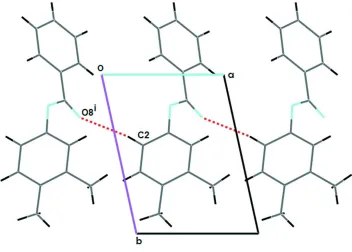
dihedral angle of 52.39 (4). The mean plane of the central ester group [r.m.s. deviation = 0.0488 A˚ ] is twisted away from the benzene and phenyl rings by 60.10 (4) and 8.67 (9), respectively. In the crystal, molecules are linked by weak C— H O hydrogen bonds, formingC(6) chains which run along [100].
Related literature
For similar structures, see: Gowda et al. (2008a,b). For hydrogen-bonding information, see: Nardelli (1995) and for hydrogen-bond motifs, see: Etteret al.(1990).
Experimental
Crystal data
C15H14O2 Mr= 226.26 Triclinic,P1
a= 6.0293 (4) A˚
b= 7.8506 (3) A˚
c= 13.1163 (9) A˚
= 88.592 (4)
= 77.020 (5)
= 77.680 (4)
V= 590.87 (6) A˚3
Z= 2
MoKradiation
= 0.08 mm 1
T= 123 K
0.330.250.06 mm
Data collection
Oxford Diffraction Xcalibur E diffractometer
Absorption correction: multi-scan (CrysAlis PRO; Oxford Diffrac-tion, 2010)
Tmin= 0.977,Tmax= 1.000
5782 measured reflections 2965 independent reflections 2196 reflections withI> 2(I)
Rint= 0.021
Refinement
R[F2> 2(F2)] = 0.048 wR(F2) = 0.112 S= 1.04 2965 reflections
156 parameters
H-atom parameters constrained
max= 0.28 e A˚ 3 min= 0.24 e A˚ 3
Table 1
Hydrogen-bond geometry (A˚ ,).
D—H A D—H H A D A D—H A
C2—H2 O8i
0.95 2.47 3.3710 (18) 157
Symmetry code: (i)x 1;y;z.
Data collection: CrysAlis PRO(Oxford Diffraction, 2010); cell refinement: CrysAlis PRO; data reduction: CrysAlis PRO; program(s) used to solve structure: SHELXS97 (Sheldrick, 2008); program(s) used to refine structure: SHELX97 (Sheldrick, 2008); molecular graphics: ORTEP-3 for Windows (Farrugia, 2012) and Mercury(Macraeet al., 2006); software used to prepare material for publication:WinGX(Farrugia, 2012).
RMF thanks the Universidad del Valle, Colombia, for partial financial support.
Supporting information for this paper is available from the IUCr electronic archives (Reference: TK5288).
References
Etter, M. (1990).Acc. Chem. Res.23, 120–126. Farrugia, L. J. (2012).J. Appl. Cryst.45, 849–854.
Gowda, B. T., Foro, S., Babitha, K. S. & Fuess, H. (2008a).Acta Cryst.E64, o844.
Gowda, B. T., Tokarcˇı´k, M., Kozˇı´sˇek, J., Babitha, K. S. & Fuess, H. (2008b).
Acta Cryst.E64, o1280.
Macrae, C. F., Edgington, P. R., McCabe, P., Pidcock, E., Shields, G. P., Taylor, R., Towler, M. & van de Streek, J. (2006).J. Appl. Cryst.39, 453–457. Nardelli, M. (1995).J. Appl. Cryst.28, 659.
Oxford Diffraction (2010).CrysAlis PRO. Oxford Diffraction Ltd, Yarnton, England.
Sheldrick, G. M. (2008).Acta Cryst.A64, 112–122. Acta Crystallographica Section E
Structure Reports Online
supplementary materials
Acta Cryst. (2014). E70, o194 [doi:10.1107/S1600536814001299]
3,4-Dimethylphenyl benzoate
Rodolfo Moreno-Fuquen, Mauricio Rendón and Alan R. Kennedy
1. Introduction
2. Experimental
2.1. Synthesis and crystallization
The reagents and solvents for the synthesis were obtained from Aldrich Chemical Co., and were used without additional
purification. The title molecule was synthesized using equimolar quantities of 3,4-dimethylphenol and benzoyl chloride.
3,4-Dimethylphenol (0.50 g, 4.10 mmol) was added to a solution of anhydrous aluminum chloride (0.40 g, 3.00 mmol) in
anhydrous dichloromethane (25 mL). The resulting solution was cooled and benzoyl chloride (0.57 g) was added slowly
at 0-5°. After complete addition, the mixture was left under stirring at room temperature for 0.5 h, and then it was heated
(reflux) to 50° C for 1 h. The reaction mixture was poured onto ice (100 g). The crude product was isolated by extraction
with dichloromethane, and it was separated. The solution was dried over Na2SO4 and it was evaporated at room
temperature. The obtained amorphous product was dissolved in methanol and the solution was left to slow evaporation.
Colourless crystals of good quality were obtained with M.pt = 322 (1) K.
2.2. Refinement
All H-atoms were positioned at geometrically idealized positions with C—H distance of 0.95–0.98 Å, and with Uiso(H) =
1.2–1.5Ueq of the C-atoms to which they were bonded.
3. Results and discussion
In order to obtain more detailed information about the effect of substitution of the methyl groups on the structure of
benzoate system, the structure determination of 3,4-dimethyl phenyl benzoate (I) has been carried out. Two very similar
molecular structures, 2,3-dimethylphenyl benzoate, DMPB1 (Gowda et al., 2008a), and 2,4-dimethylphenyl benzoate,
DMPB2 (Gowda et al., 2008b), were taken for comparison with the structure (I). The rings of (I), Fig. 1, form a dihedral
angle of 52.39 (4)° while in DMPB1 and DMPB2 they form dihedral angles of 87.36 (6)° and 80.25 (5)°, respectively.
The other bond lengths and bond angles of DMPB1 and DMPB2 are close to the title system. The central ester moiety
(C1—O7—C7(O8)—C8) is twisted away from the dimethyl-substituted benzeneand phenyl rings by 60.10 (4) and
8.67 (9)°, respectively. The crystal packing shows no classical hydrogen bonds and it is stabilized by weak C—H···O
intermolecular hydrogen bonds, forming C(6) chains (Etter, 1990) along [100] (see Fig. 2). The C2 atom acts as
hydrogen-bond donor to O1 atom at (x-1, +y, +z) (Nardelli, 1995); see Table 1.
Computing details
Data collection: CrysAlis PRO (Oxford Diffraction, 2010); cell refinement: CrysAlis PRO (Oxford Diffraction, 2010);
data reduction: CrysAlis PRO (Oxford Diffraction, 2010); program(s) used to solve structure: SHELXS97 (Sheldrick,
(Farrugia, 2012) and Mercury (Macrae et al., 2006); software used to prepare material for publication: WinGX (Farrugia,
[image:3.610.121.486.105.258.2]2012).
Figure 1
Molecular conformation and atom numbering scheme for the title compound with displacement ellipsoids drawn at the
50% probability level. H atoms are shown as spheres of arbitrary radius.
Figure 2
Part of the crystal structure of (I), showing the formation of chains which running along [100]. Symmetry code: (i) x-1,
+y, +z.
3,4-Dimethylphenyl benzoate
Crystal data
C15H14O2 Mr = 226.26 Triclinic, P1 Hall symbol: -P 1
a = 6.0293 (4) Å
b = 7.8506 (3) Å
c = 13.1163 (9) Å
α = 88.592 (4)°
β = 77.020 (5)°
[image:3.610.129.481.310.562.2]V = 590.87 (6) Å3 Z = 2
F(000) = 240
Dx = 1.272 Mg m−3
Melting point: 322(1) K Mo Kα radiation, λ = 0.71073 Å
Cell parameters from 2013 reflections
θ = 3.1–29.6°
µ = 0.08 mm−1 T = 123 K Plate, colourless 0.33 × 0.25 × 0.06 mm
Data collection
Oxford Diffraction Xcalibur E diffractometer
Radiation source: fine-focus sealed tube Graphite monochromator
ω scans
Absorption correction: multi-scan
(CrysAlis PRO; Oxford Diffraction, 2010)
Tmin = 0.977, Tmax = 1.000
5782 measured reflections 2965 independent reflections 2196 reflections with I > 2σ(I)
Rint = 0.021
θmax = 29.8°, θmin = 3.1°
h = −8→8
k = −10→10
l = −18→18
Refinement
Refinement on F2
Least-squares matrix: full
R[F2 > 2σ(F2)] = 0.048 wR(F2) = 0.112 S = 1.04 2965 reflections 156 parameters 0 restraints
Primary atom site location: structure-invariant direct methods
Secondary atom site location: difference Fourier map
Hydrogen site location: inferred from neighbouring sites
H-atom parameters constrained
w = 1/[σ2(F
o2) + (0.0425P)2 + 0.1253P]
where P = (Fo2 + 2Fc2)/3
(Δ/σ)max < 0.001
Δρmax = 0.28 e Å−3
Δρmin = −0.24 e Å−3
Special details
Geometry. All esds (except the esd in the dihedral angle between two l.s. planes) are estimated using the full covariance
matrix. The cell esds are taken into account individually in the estimation of esds in distances, angles and torsion angles; correlations between esds in cell parameters are only used when they are defined by crystal symmetry. An approximate (isotropic) treatment of cell esds is used for estimating esds involving l.s. planes.
Refinement. Refinement of F2 against ALL reflections. The weighted R-factor wR and goodness of fit S are based on F2,
conventional R-factors R are based on F, with F set to zero for negative F2. The threshold expression of F2 > σ(F2) is used
only for calculating R-factors(gt) etc. and is not relevant to the choice of reflections for refinement. R-factors based on F2
are statistically about twice as large as those based on F, and R- factors based on ALL data will be even larger.
Fractional atomic coordinates and isotropic or equivalent isotropic displacement parameters (Å2)
x y z Uiso*/Ueq
O7 0.50750 (18) 0.19314 (11) 0.74671 (8) 0.0239 (2)
O8 0.74671 (18) 0.27031 (12) 0.83880 (8) 0.0262 (3)
C1 0.4447 (2) 0.36566 (16) 0.71295 (11) 0.0202 (3)
C2 0.2126 (2) 0.44540 (17) 0.74124 (11) 0.0227 (3)
H2 0.1032 0.3888 0.7848 0.027*
C3 0.1425 (3) 0.61121 (18) 0.70426 (11) 0.0236 (3)
H3 −0.0171 0.6682 0.7231 0.028*
C4 0.3009 (3) 0.69544 (17) 0.64030 (11) 0.0218 (3)
C5 0.5366 (2) 0.61144 (17) 0.61281 (11) 0.0213 (3)
C6 0.6075 (2) 0.44503 (17) 0.64949 (11) 0.0211 (3)
C7 0.6508 (2) 0.16320 (16) 0.81492 (10) 0.0184 (3)
C8 0.6695 (2) −0.01620 (16) 0.85620 (10) 0.0182 (3)
C9 0.8327 (2) −0.07177 (17) 0.91616 (11) 0.0226 (3)
H9 0.9322 0.0019 0.9267 0.027*
C10 0.8508 (3) −0.23504 (18) 0.96080 (12) 0.0257 (3)
H10 0.9613 −0.2727 1.0025 0.031*
C11 0.7073 (3) −0.34264 (17) 0.94426 (11) 0.0252 (3)
H11 0.7192 −0.4542 0.9748 0.030*
C12 0.5461 (3) −0.28836 (17) 0.88330 (11) 0.0241 (3)
H12 0.4495 −0.3635 0.8716 0.029*
C13 0.5251 (2) −0.12484 (16) 0.83937 (11) 0.0205 (3)
H13 0.4135 −0.0872 0.7982 0.025*
C14 0.2186 (3) 0.87556 (18) 0.60106 (13) 0.0314 (4)
H14A 0.0507 0.9147 0.6291 0.047*
H14B 0.2509 0.8716 0.5244 0.047*
H14C 0.3010 0.9570 0.6242 0.047*
C15 0.7122 (3) 0.6999 (2) 0.54453 (12) 0.0292 (3)
H15A 0.8692 0.6291 0.5400 0.044*
H15B 0.7010 0.8151 0.5748 0.044*
H15C 0.6807 0.7130 0.4743 0.044*
Atomic displacement parameters (Å2)
U11 U22 U33 U12 U13 U23
O7 0.0319 (6) 0.0159 (4) 0.0298 (6) −0.0087 (4) −0.0163 (5) 0.0063 (4)
O8 0.0332 (6) 0.0197 (5) 0.0327 (6) −0.0133 (4) −0.0150 (5) 0.0059 (4)
C1 0.0273 (8) 0.0157 (6) 0.0211 (7) −0.0066 (5) −0.0112 (6) 0.0045 (5)
C2 0.0236 (7) 0.0247 (7) 0.0220 (7) −0.0100 (6) −0.0057 (6) 0.0049 (6)
C3 0.0222 (7) 0.0248 (7) 0.0240 (7) −0.0035 (6) −0.0071 (6) 0.0014 (6)
C4 0.0283 (8) 0.0189 (6) 0.0206 (7) −0.0050 (6) −0.0111 (6) 0.0028 (5)
C5 0.0256 (8) 0.0232 (7) 0.0181 (7) −0.0097 (6) −0.0074 (6) 0.0033 (5)
C6 0.0204 (7) 0.0226 (7) 0.0207 (7) −0.0041 (5) −0.0058 (6) 0.0001 (5)
C7 0.0194 (7) 0.0174 (6) 0.0188 (7) −0.0051 (5) −0.0043 (5) 0.0016 (5)
C8 0.0216 (7) 0.0147 (6) 0.0175 (7) −0.0042 (5) −0.0025 (5) −0.0001 (5)
C9 0.0261 (8) 0.0196 (6) 0.0249 (7) −0.0067 (5) −0.0097 (6) 0.0012 (6)
C10 0.0303 (8) 0.0225 (7) 0.0241 (7) −0.0013 (6) −0.0098 (6) 0.0030 (6)
C11 0.0322 (8) 0.0147 (6) 0.0251 (8) −0.0034 (6) −0.0012 (6) 0.0034 (5)
C12 0.0278 (8) 0.0183 (6) 0.0264 (8) −0.0094 (6) −0.0024 (6) −0.0003 (6)
C13 0.0217 (7) 0.0182 (6) 0.0225 (7) −0.0053 (5) −0.0056 (6) 0.0002 (5)
C14 0.0376 (9) 0.0237 (7) 0.0361 (9) −0.0062 (6) −0.0161 (7) 0.0080 (6)
C15 0.0323 (9) 0.0324 (8) 0.0270 (8) −0.0145 (7) −0.0087 (7) 0.0101 (6)
Geometric parameters (Å, º)
O7—C7 1.3609 (16) C8—C13 1.3950 (18)
O7—C1 1.4145 (15) C9—C10 1.3892 (19)
O8—C7 1.2008 (16) C9—H9 0.9500
C1—C2 1.3755 (19) C10—C11 1.384 (2)
C1—C6 1.383 (2) C10—H10 0.9500
C2—H2 0.9500 C11—H11 0.9500
C3—C4 1.391 (2) C12—C13 1.3867 (18)
C3—H3 0.9500 C12—H12 0.9500
C4—C5 1.402 (2) C13—H13 0.9500
C4—C14 1.5133 (18) C14—H14A 0.9800
C5—C6 1.3943 (19) C14—H14B 0.9800
C5—C15 1.504 (2) C14—H14C 0.9800
C6—H6 0.9500 C15—H15A 0.9800
C7—C8 1.4871 (17) C15—H15B 0.9800
C8—C9 1.3872 (19) C15—H15C 0.9800
C7—O7—C1 117.97 (10) C8—C9—H9 120.0
C2—C1—C6 122.09 (13) C10—C9—H9 120.0
C2—C1—O7 116.62 (12) C11—C10—C9 119.75 (14)
C6—C1—O7 121.17 (12) C11—C10—H10 120.1
C1—C2—C3 118.16 (13) C9—C10—H10 120.1
C1—C2—H2 120.9 C10—C11—C12 120.31 (13)
C3—C2—H2 120.9 C10—C11—H11 119.8
C2—C3—C4 121.48 (14) C12—C11—H11 119.8
C2—C3—H3 119.3 C11—C12—C13 120.32 (13)
C4—C3—H3 119.3 C11—C12—H12 119.8
C3—C4—C5 119.23 (12) C13—C12—H12 119.8
C3—C4—C14 120.13 (13) C12—C13—C8 119.38 (13)
C5—C4—C14 120.64 (13) C12—C13—H13 120.3
C6—C5—C4 119.46 (13) C8—C13—H13 120.3
C6—C5—C15 120.11 (13) C4—C14—H14A 109.5
C4—C5—C15 120.43 (13) C4—C14—H14B 109.5
C1—C6—C5 119.57 (13) H14A—C14—H14B 109.5
C1—C6—H6 120.2 C4—C14—H14C 109.5
C5—C6—H6 120.2 H14A—C14—H14C 109.5
O8—C7—O7 123.50 (12) H14B—C14—H14C 109.5
O8—C7—C8 125.00 (13) C5—C15—H15A 109.5
O7—C7—C8 111.50 (11) C5—C15—H15B 109.5
C9—C8—C13 120.17 (12) H15A—C15—H15B 109.5
C9—C8—C7 117.48 (12) C5—C15—H15C 109.5
C13—C8—C7 122.32 (12) H15A—C15—H15C 109.5
C8—C9—C10 120.06 (13) H15B—C15—H15C 109.5
C7—O7—C1—C2 −115.77 (14) C1—O7—C7—O8 −8.5 (2)
C7—O7—C1—C6 67.97 (17) C1—O7—C7—C8 170.72 (11)
C6—C1—C2—C3 −0.1 (2) O8—C7—C8—C9 −8.7 (2)
O7—C1—C2—C3 −176.31 (12) O7—C7—C8—C9 172.01 (12)
C1—C2—C3—C4 0.1 (2) O8—C7—C8—C13 169.10 (14)
C2—C3—C4—C5 −0.2 (2) O7—C7—C8—C13 −10.15 (18)
C2—C3—C4—C14 179.75 (13) C13—C8—C9—C10 −0.8 (2)
C3—C4—C5—C6 0.4 (2) C7—C8—C9—C10 177.06 (13)
C14—C4—C5—C6 −179.59 (13) C8—C9—C10—C11 0.7 (2)
C3—C4—C5—C15 −179.47 (13) C9—C10—C11—C12 0.1 (2)
C2—C1—C6—C5 0.3 (2) C11—C12—C13—C8 0.7 (2)
O7—C1—C6—C5 176.31 (12) C9—C8—C13—C12 0.1 (2)
C4—C5—C6—C1 −0.4 (2) C7—C8—C13—C12 −177.65 (12)
C15—C5—C6—C1 179.46 (13)
Hydrogen-bond geometry (Å, º)
D—H···A D—H H···A D···A D—H···A
C2—H2···O8i 0.95 2.47 3.3710 (18) 157