EF Special Issue: Evidence for a role of executive functions in learning biology
Abstract
Executive functions are widely believed to be a compendium of constructs comprising three core, dissociable components; inhibition, working memory and set-shifting (Diamond, 2013; Lehto, Juujärvi, Kooistra & Pulkkinen, 2003; Miyake et al., 2000), and a number of higher level functions such as planning and problem solving
(Diamond, 2013). Separation into these three core components has been identified in both child (Hughes, Dunn & White, 1998; Lehto et al., 2003; Schoemaker et al., 2012) and adult samples (Miyake et al., 2000), although some argue that inhibition and working memory is a single system (Pennington, Bennetto, McAleer & Roberts, 1996). Of the core constructs, most research that has examined executive functions and science learning has focused on the role of working memory. Researchers examining science learning have varied in how working memory has been defined with some examining ‘mental capacity’ (e.g. Danili & Reid, 2004) and others
referring specifically to ‘working memory’ (St-Clair Thompson & Gatherole, 2006). A recent study (St-Clair Thompson, Overton & Bugler, 2012) reported dissociation between the cognitive resources underlying performance on tests of mental capacity and working memory with the latter highlighted as the best predictor of problem solving and science grades. The current paper will therefore focus on studies that have assessed working memory. Numerous models of working memory have been
It is now well established that working memory develops across childhood and into adolescence (De Luca et al., 2003; Luciana and Nelson, 1998; Rhodes, Murphy & Hancock, 2011). Gathercole and colleagues (Gathercole, Pickering, Ambridge & Wearing, 2004) for example, reported increases in working memory performance between ages 4 and 15. Rhodes et al. (2011) also reported that children were not at adult levels of verbal or spatial working memory at the age of 11. Furthermore, Luciana, Conklin, Hooper and Yarger (2005) found that performance on complex spatial working memory tasks, such as self-ordered search tasks, continues until 16 years of age. The development of strategic working memory into mid-adolescence suggests implications for learning of science subjects into the middle secondary school years. There is indeed an established link between working memory and other areas of academic learning such as reading (Christopher et al., 2012), language (Daneman & Merickle, 1996) and mathematics (Bull & Scerif, 2001).
old pupils question the significance of more basic short-term memory processes in science learning.
Research that has examined central executive aspects of working memory (i.e. with tasks that measure storage and processing) has provided much more consistent evidence than studies examining storage only for a role of central executive processes in science learning. A study which examined verbal executive working memory in a sample of 101 Scottish biology school pupils (aged 16-17 years) revealed that those with superior working memory were more accurate on a biology grid assessment (Bahar & Hansell, 2000). The task used in the study required pupils to store and manipulate phonological information in memory and thus went beyond simple storage processes assessed in previous studies. Danili and Reid (2004) similarly examined the relationship between science learning and performance on a verbal executive working memory task (in this case a backward digit span task). The authors reported a
significant correlation between verbal working memory and performance on a chemistry test in Greek pupils aged 13-15 years. A recent study examined the relationship between both storage tasks and storage and processing tasks and algorithm problem solving from a chemistry exam paper in undergraduate students (St-Clair Thompson et al., 2012). The storage and processing task employed (counting recall) but not the storage only tasks (digit and block recall) correlated with problem solving. These findings, on biology and chemistry assessments, suggest that a
relationship between executive working memory and science learning may be evident across science disciplines.
between verbal short-term and central executive working memory and science achievement in a UK sample of pupils aged 14-15 years. While correlations were observed between science level and both short-term (on a digit recall task) and executive working memory (on a backwards digit recall task), the relationship was stronger for the executive task. A number of other studies have indeed emphasised the role of executive working memory in science learning (Jarvis & Gathercole, 2003; St Clair-Thompson & Gathercole, 2006).
executive working memory was similarly predictive of conceptual learning of biology where pupils had to show their understanding and application of the concepts learned.
Recent research suggests a broader set of aspects of executive function contribute to science learning than working memory. As with the development of working memory, there is consistent evidence for profound changes in other aspects of executive functions across the period of adolescence (Anderson, Northam, Jacobs & Catroppa, 2001; DeLuca et al., 2003, Levin, Eisenberg & Benton, 1991; Luciana & Nelson, 1998). Anderson et al., (2001) reported the most significant age-related changes in attentional flexibility between 7-9 and 15 years of age and Davidson, Amso, Anderson and Diamond (2006) showed that cognitive flexibility was still not at adult levels at 13 years of age. Planning ability also appears to mature around this age with reports of maturation around 12 years of age (Davidson et al., 2006). Research on the development of inhibition has been more inconsistent; one study reported that inhibition develops up to age 17 (Leon-Carrion, Garcia-Orza & Perez-Santmaria, 2004). As science learning requires strategic thinking – from the ability to plan solutions to problems, to engage in hypothesis making, to examine and evaluate data, to think flexibly between different options, and to speculate on the influence of experimental manipulations – it seems likely that continued development of these processes will influence science learning into the secondary school years.
Elkovitch, Young, & Clark, 2010). Rhodes et al. (submitted) reported correlations between planning ability and both performance on a generic science exam and on a chemistry specific assessment. Linear regression analyses revealed that attention set-shifting predicted performance on a chemistry assessment that required the 12-13 year old pupils to show understanding of and apply the knowledge they had gained from a chemistry practical. These findings suggest the role of executive functions in science learning may be broader than the historical focus on working memory in the literature. Most research in this area has examined science learning on generic science exams that are not discipline specific and which will involve a combination of factual and conceptual understanding of science material. The current study will investigate whether inhibition, attention set-shifting and planning, in addition to working memory predict performance in the area of biology, and will examine both retrieval of factual knowledge and conceptual understanding of the discipline in early adolescence.
The principal aim of the current study was to examine the relationship
between core aspects of executive function and the factual and conceptual learning of biology. In the current study, we assess aspects of executive functions considered as core in the literature, namely inhibition, working memory and attention set-shifting. As there have been reports in the literature of a role for planning in science learning we also included an assessment of planning ability. Planning is of course central to key aspects of science learning such as the experimental process. We chose to assess science learning and executive functions in a young adolescent sample as working memory and other aspects of executive function are still under development at this stage. Adolescents who participated in the study were aged 12-13 years old and had been attending secondary level education for approximately 18 months.
Executive, 2004). The curriculum focuses on active learning and peer collaboration and the use of a broad range of approaches (labelled ‘experiences and outcomes’) are emphasised which allow children to demonstrate what they ‘know, understand, and can do’. In relation to science, the focus of the curriculum within the primary school years (up to age 12) is on investigative aspects of science, but in the early secondary years shifts more to content and skills, including both acquiring knowledge through learning facts, planning investigations, and examination and evaluation of data. We will focus on conceptual learning which requires the pupil to think flexibly about the knowledge they acquire weighing up multiple options, each of which may be
complex, to arrive at a solution and would therefore seem likely to rely more heavily on executive function skills than basic retention of facts. The current study
hypothesised that executive functions would specifically predict conceptual understanding rather than factual learning. Relatively few studies in this area have examined executive functions in relation to biology and those that have focus on working memory. We therefore sought to examine this gap in the literature. Based on existing literature, it was predicted that performance on the biology assessment would be predicted by working memory. A lack of data on broader aspects of executive function made prediction difficult, but based on previous research (Latzman et al., 2010; Rhodes et al., submitted; St Clair-Thompson & Gathercole, 2006), we
hypothesised that inhibition, planning and attention set-shifting would predict biology learning. In particular we predicted that executive functions would relate to
Method Participants
Sixty-three pupils (aged 12-13 years) were recruited to the study from four secondary schools within the North Lanarkshire Council area of Scotland. Schools were all located in urban areas spread across the authority and followed the National Curriculum independently. The schools were chosen as they are representative of having an average level of deprivation (average deprivation score indicated by free school meal data is 16% versus Scotland average of 19.8%). The study received ethical approval from the Departmental Ethics Committee and consent was obtained from parents of all participating adolescents. No pupils refused to participate. Teachers of all consenting pupils completed the Strengths and Difficulties Questionnaire (SDQ, Goodman, 2001) to screen for any potential
psychiatric/behavioural disorder known to be associated with impaired executive functions (e.g. the common developmental disorder ADHD). Fifty-six pupils were rated within the normal range (Total Difficulties score < 15) on the SDQ (N=20 boys, 36 girls) and their data were included in the statistical analyses. Pupils had a mean age of 13.38 (S.D. = 0.35). All pupils also completed the British Picture Vocabulary Scale II (Dunn, Dunn, Whetton, & Burley, 1997) to provide a measure of general ability that is known to be less heavily confounded with executive function skills. All pupils scored within the normal range on this verbal ability test.
Materials Cognitive Tasks
Stockings of Cambridge (planning), Stop-Signal (inhibition) and ID/ED (attention set-shifting). These tasks were chosen because they have been extensively validated in both child and adult populations (Curtis, Lindeke, Georgieff & Nelson, 2002; Luciana & Nelson, 1998; Rhodes, Coghill, Matthews, 2004, 2005, 2006; Robbins et al., 1994) and typical developmental trajectories of performance have been reported (Curtis et al., 2002; Luciana & Nelson, 1998; Robbins et al., 1994). Tasks are performed on a touch-screen computer and are highly suitable for use with children and adolescents (Rhodes et al., 2005; Rhodes, Riby, Matthews & Coghill, 2011).
Working Memory:
The Spatial Working Memory (SWM) task places heavy demands on central executive functioning. It is a self-ordered searching task (Petrides & Milner, 1982) that assesses the participant’s ability to retain spatial information and to store and simultaneously manipulate information in working memory while working towards a goal. Participants are required to ‘search through’ a spatial array of coloured boxes presented on the screen to collect ‘blue tokens’ hidden inside the boxes. Returning to a box where a token has already been found constitutes a ‘Between Search Error’ (BSE). Participants must keep searching through all the boxes until they find the blue token at which point they proceed to find the next hidden blue token. The task
therefore requires the participant to hold information in working memory (storage) while simultaneously continually updating their memory (additionally requiring processing). Ultimately participants will find a blue token behind each of the boxes. Experimental trials commence with a four box search and the highest difficultly level involves eight box trials. Participants can use a (self-initiated) strategy to aid
across to bottom right. A higher error (BSE) score indicates poorer working memory performance.
Inhibition:
The Stop-Signal task provides an assessment of response inhibition. This task measures the ability of an individual to inhibit a prepotent motor response, requiring participants to respond or withhold responding dependent on receiving an auditory signal. This test consists of two parts. In the training component, the participants are told to press the left hand button when they see a left-pointing arrow and the right hand button when they see a right pointing arrow. In the experimental component, the participants are told to continue pressing the buttons on the press pad when they see the arrows, as before, but if they hear an auditory signal (a beep), they should withhold their response and not press the button. The stop-signal paradigm allows a sensitive estimate of inhibitory control—the stop-signal reaction time (SSRT)— reflecting the time it takes to suppress a response. Longer SSRT reflects poorer inhibitory control.
Attention set-shifting:
to choose the stimulus they think is the correct one after which they receive feedback. Once the participant correctly chooses the same stimuli over six trials the task moves to the next stage. The intra-dimensional stages involve shifting from one solid shape to another whereas the executive extra-dimensional stages require shifting from one type of stimulus to another (a solid shape to a line). The key measure on this task is the Stage Reached Score; reaching the final stages indicates the ability to engage in executive set-shifting (reaching stage eight). Participants are also required to show reversal of this rule whereby the correct exemplar (the line they have chosen) changes to another shaped line presented (reaching stage nine). A higher Stage Reached score reflects superior attention set-shifting ability.
Planning:
The Stockings of Cambridge task measures planning ability and makes substantial demands on executive function. This task was derived from the ‘Tower of Hanoi’ task (Shallice , 1982). Participants must move balls to match a ‘goal’
arrangement. The balls hang in ‘socks’ akin to snooker balls in pockets. Problems can be solved in a certain ‘Minimum Number of Moves’ (two, three, four or five moves). Initial and Subsequent ‘Thinking’ Times during trials are recorded to provide
estimates of cognitive speed during the preparatory and execution phases of task performance. Participants need to plan out the full set of moves prior to executing a move to be successful on trials (particularly at the harder 4 and 5 move stage problems). For each trial, a yoked control condition is also executed to enable estimates of ‘movement times’ in order to provide an estimate of cognitive
Procedure
The pupils in the current study were enrolled in a number of science specific classes at school, namely: physics, chemistry and biology. In order to establish whether executive functions underlie the acquisition of factual knowledge about science and/or the ability to conceptually understand and apply knowledge to new problems, we conducted a biology teaching session on the topic of DNA with an associated practical and assessment. This biology session required the pupils to show retention of the facts they had acquired in addition to the ability to apply their
knowledge to show understanding of the topic on a conceptual level. Participants completed the cognitive tasks and approximately 3 weeks later took part in the biology teaching session and practical. A related assessment was undertaken immediately after the practical (see Appendix). Performance on the practical
assessment was also related to performance on a recent school generic science exam (across the areas of biology, chemistry and physics) conducted 1 month prior to the current study. This exam mainly involved retrieval of fact based scientific knowledge.
Cognitive Testing:
The order of the executive function tasks was counterbalanced across participants. Testing was conducted in a quiet room in the participant’s school. Biology Teaching Session and Practical:
another; the definition of an amino acid sequence and enzymes being “chemical scissors” that recognise certain sequences; how DNA is isolated from cells and how much DNA we have in our cells and body; basics about how DNA bands obtained using enzymes are unique to individuals and the importance of these in forensic science. The presentation was followed by a detailed description of the practical task to be completed and accompanied by a step-by-step set of instructions for isolation of DNA from biological material (bananas in the case of this class). Pupils were shown how DNA would be run on an agarose gel (on a PowerPoint slide) and how patterns of the bands would have to be matched, to find, for example, DNA found at a murder scene and matched to the DNA from several different suspects. From the results, pupils had to decide which pattern of bands from different individuals matched the pattern found at the scene.
The class was divided into small groups for the practical which was supervised by three research assistants (facilitators). The pupils were supplied with a package containing all the materials required to isolate DNA using common household items such as salt, washing up detergent and alcohol. DNA isolation was completed by the pupils who: mashed up a banana and added it to a water solution; added salt and washing up detergent; filtered the mixture through a coffee filter paper; and finally, alcohol was added to observe visible DNA strands. The facilitators circulated through the groups, encouraging discussion on the observations that were being made and questioning whether they understood the presented material. The pupils were then brought together and the teaching facilitators discussed the results of the practical.
Biology Assessment:
practical requiring a basic level of conceptual understanding. Part 2 (Questions 5-7) assessed conceptual understanding of the material presented in the practical requiring the participant to work out and solve problems based on the information learned (see Appendix 1 for full list of questions).
Statistical Analyses
The four outcome measures from the CANTAB have been described as key measures within a wealth of research studies including those with adolescent samples (e.g. Curtis et al., 2002; Luciana & Nelson, 1998; Rhodes et al., 2005). With a sample of 56 participants, the use of four key measures was within the recommended
guidelines for sufficient power to detect significant effects within a regression analysis (Tabachnick & Fidell, 2007).
In order to assess relationships between the key measures of executive function and performance of the study specific biology assessment, Pearson correlation analyses (two-tailed) were conducted. Performance on each part of the biology assessment was also correlated with performance on a recent school science exam (which assessed biology, physics and chemistry) to examine the relationship between the assessments developed in relation to the practical and routine school science exams. A multiple linear regression analysis was also conducted adjusting for age and with one key outcome measure for each of the four executive function tasks (SWM: Total BSE; SOC: Min Moves; Stop-Signal: SSRT; ID/ED: Stage Reached) in order to examine whether executive function is predictive of science achievement at this age.
Results
differ between girls and boys for either Part 1 (fact based) (girls: 55.2%, range = 29-100%; boys: 50%, range = 43-86%) or Part 2 (conceptual based) (girls: 68.7%, range = 22-100; boys: 63.6%, range = 0-89%) (all p >.05). Participants were therefore treated as one group for all subsequent analyses.
Correlational Analyses:
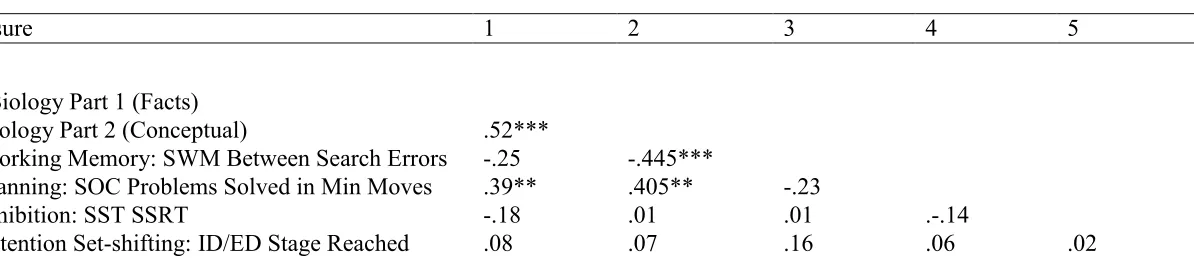
Pearson correlations revealed a significant relationship between performance on the factual section (Part 1) of the biology assessment and number of Problems Solved in the Minimum Number of Moves on the Planning task alone (r=0.39, p=.003). Correlational analysis between performance of Part 2 of the biology
assessment which required conceptual understanding revealed significant correlations between performance on this assessment and both the number of Problems Solved in the Minimum Number of Moves on the Planning task (r = 0.41, p =.002) and Between Search Errors on the Spatial Working Memory task (r = -0.45, p <.001).
In addition, a significant positive correlation emerged between a recent school devised science test and Part 1 of the biology assessment (r=0.30, p=0.028). However, while a positive correlation emerged between the school science assessment and part 2 of our biology assessment, this was not statistically significant (r=0.16, p >0.05) therefore demonstrating the largely factual content of standard school assessments at this stage.
Regression Analyses
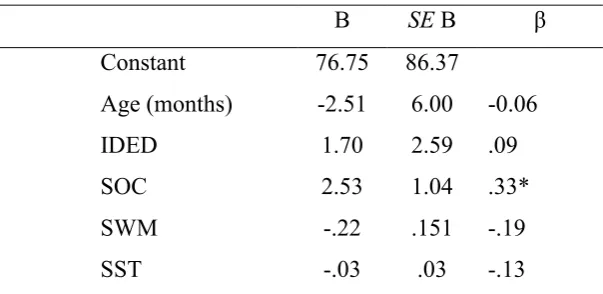
performance (R2 = 0.21, Adjusted R² = 0.13). Performance on the factual part of the
biology assessment was predicted by the number of Problems Solved in Minimum Moves on the Planning task alone (β =0.33, p=0.02, R2 change = 0.15).
A multiple linear regression analysis conducted with biology performance Part 2 (conceptual part) as the dependent variable with age and the four key measures of executive function as predictors revealed there was a significant model [F(5, 54) = 4.48, p =.002]. This model explained 24% of the variance in biology Part 2
performance (R2 = 0.31, Adjusted R² = 0.24). Performance on the conceptual part of
the biology assessment was predicted by both Spatial Working Memory total number of Between Search Errors (β = -0.40, p=.002, R2 change =0.15) and the number of
Problems Solved in Minimum Moves on the Planning task (β = 0.31, p=.02, R2
change =0.16). See Table 3 for details of the final model.
Discussion
This study reveals that conceptual understanding of biology is significantly predicted by the executive function abilities of working memory and planning. Both working memory and planning were predictive of a conceptual understanding of biology when other aspects of executive functions were controlled. Planning also predicted science learning in relation to an assessment that required retrieval of facts learned in the biology practical, showing that this executive ability may be important in learning facts but that a broader set of executive functions are critical when
results contrast a recent study which highlighted the role of attention set-shifting in chemistry learning (Rhodes et al., submitted) suggesting that different aspects of executive functions may be important in the learning of different science subjects.
The findings of the present study build on reports in the literature of a
relationship between executive working memory and science learning in a number of ways (Gathercole et al., 2004; Jarvis & Gathercole, 2003; Rhodes et al., submitted; St Clair-Thompson & Gathercole, 2006). First, the findings support reports in the
literature of a relationship between spatial executive working memory and science learning (Jarvis & Gathercole, 2003; Rhodes et al., submitted; St Clair-Thompson & Gathercole, 2006), here showing that spatial executive working memory indeed predicts biology learning. Previous studies have linked working memory to performance on generic science class tests. Rhodes et al. (submitted) reported that spatial executive working memory selectively predicted conceptual learning of chemistry with no significant relationships observed on an assessment requiring retrieval of facts. The current findings build and extend this finding – here we
similarly report that spatial executive working memory selectively predicts conceptual learning of biology. In the current study, however, planning ability predicted both factual and conceptual learning of biology.
The current findings do not support previous reports of a relationship between inhibition and science learning. St Clair-Thompson and Gathercole (2006) and
current study and St Clair-Thompson and Gathercole (2006) were of similar ages. There are two clear differences between the studies that may explain the discrepant findings. While both studies employed a Stop-Signal task, they varied in the modality tested. The current study employed an entirely non-verbal task whereas the task employed in St-Clair Thompson and Gathercole (2006) was verbally based requiring the participants to categorise words presented as animals and non-animals. As the science assessments in both studies require processing of verbal instructions and a verbal response this could explain the differential findings. The current study also examined learning of a science discipline whereas St-Clair Thompson and Gathercole (2006) examined attainment on a generic school science exam. Further research exploring different aspects of inhibition is warranted to clarify its role and the impact of task requirements in science learning.
Previous studies have highlighted the role of attention set-shifting in relation to generic science achievements (Latzman et al., 2010) and conceptual learning of chemistry (Rhodes et al., submitted). This relationship was not observed in the current study and suggests the possibility that different aspects of executive function are important in relation to different science disciplines. The current study instead highlights the role of cognitive planning in learning biology, whether this involves learning factual information or applying that information and showing an
understanding of the subject. In the current study, linear regression analysis revealed that planning was predictive of performance on the biology assessment when other aspects of executive function were controlled. This builds on previous research
research that has highlighted the role of executive/strategic aspects of cognitive functioning in academic learning (e.g. Bull & Scerif, 2001; St Clair-Thompson & Gathercole, 2006; Christopher et al., 2012), and highlights the need for further research in a range of science disciplines in this area.
Accumulating evidence suggests that inhibition, working memory and shifting are separable processes (Diamond, 2013, Lehto et al., 2003; Miyake et al., 2000). The current findings support this providing further evidence from child/adolescent samples (e.g. Lehto et al., 2003). The current findings also suggest that planning is a separable process from other aspects of executive function. Clearly, the planning task employed in the current study (CANTAB Stockings of Cambridge task) requires the participant to hold a plan in short-term memory while executing that plan. The lack of significant correlation between the two tasks, however, suggests that this working memory component is different to that required in the Spatial Working Memory task which requires the participant to hold and simultaneously update information in working memory involving additional processing of information in memory.
The current study has implications for science learning in classrooms, in relation to both teaching materials and practice. Participants in the current study were aged 12-13 years and in their second year of secondary school. Research suggests that the cognitive performance on executive function tasks of young people of this age are not yet at adult levels of (e.g. Anderson et al., 2001). Importantly, we found that planning was predictive of factual learning of biology and both planning and working memory were predictive of conceptual learning of this subject. The current findings suggest that in order to ensure optimal learning, developmental restrictions in working memory and planning should be taken into account when designing science
learning in the classroom in children with poor working memory (Holmes, Gathercole & Dunning, 2009). The children in the Holmes et al. (2009) study undertook intensive working memory training involving adaptive training that maximally taxed working memory for 35 minutes within each school day for at least 20 days. The children showed significant improvements in working memory over this time which was still evident at six months post-training assessment. The improvements further generalised to independent working memory tasks and the study also reported a significant
improvement in mathematics ability six months post training. A recent study similarly reported improvements in working memory following working memory training, but found that these improvements did not extend to academic learning assessed on standardised tests of reading, arithmetic, and mathematics five months after training (St-Clair-Thompson, Stevens, Hunt & Bolder, 2010). The authors concluded that the standardised tests used may not, however, have particularly loaded working memory. Research is warranted to examine the relationship between working memory training and science learning. It has been noted in the literature that science assessments can be particularly taxing on working memory (e.g. Danili & Reid, 2004) suggesting that training may improve performance on science tests.
While evidence is inconsistent for the role of working memory training on academic learning, the current findings suggest the possibility that a targeted
intervention on discrete aspects of executive functions may improve science learning. In particular, the current study suggests that the areas that seem to be related to science learning include: the ability to store and concurrently manipulate information and to think out solutions to problems before attempting to answer a problem.
pupils of this age may not yet have the ability to plan expected of adults and may not be able to hold and manipulate a series of information in memory at the same time, to the same degree, as adults. Visual and written aids can help compensate
developmental limitations in working memory. Planning limitations may be
compensated for by encouraging pupils to stop and spend time working out a problem prior to carrying out a task when for example undertaking stages of an experiment.
Limitations
The current study was conducted at one developmental time-point in early adolescence. Children commence learning science prior to the age at which the current study assessed (aged mostly 13 years). Further research is warranted to identify if different aspects of executive functions, that are of course known to develop across childhood and into adolescence, are important at different developmental stages for science learning. In the current study, we specifically examined learning of biology in relation to executive functions. Findings of a role for planning in the current study may be specific to the biology discipline given a
previous report that planning did not predict chemistry understanding or performance on a generic science grade exam when other aspects of executive function were controlled. Further research can identify if learning of different science disciplines is associated with different executive function requirements. The current study was able to go beyond the existing literature to show that a broader set of executive functions are important for strategic application and understanding of information learned in science classes.
References
Anderson, V. A., Anderson, P., Northam, E., Jacobs, R., & Catroppa, C. (2001). Development of executive functions through late childhood and adolescence in an Australian sample. Developmental Neuropsychology, 20, 385–406.
Baddeley, A. D. (1986). Working memory. Oxford, England: Oxford University Press.
Baddeley, A. D., & Hitch, G. J. (1974). Working memory. G. Bower (Ed), The psychology of learning and motivation (Vol. 8, pp. 47–90). New York: Academic Press.
Baddeley, A.D. (2006). Working memory: An overview. In S. J. Pickering (Ed),Working memory and education. Oxford: Academic Press.
Bahar, M., & Hansell, M. (2000). The relationship between some psychological factors and their effects on the performance of Grid Questions and Word Association Tests, Educational Psychology. An International Journal of Experimental Educational Psychology, 20, 349-363.
Bull, R., & Scerif, G. (2001). Executive functioning as a predictor of children’s mathematics ability: Inhibition, shifting and working memory. Developmental Neuropsychology, 19(3), 273–293.
Chen, W. C., & Whitehead, R. (2009). Understanding physics in relation to working memory. Research in Science and Technological Education, 27(2), 151-160. Christopher, M. E., Miyake, A., Keenan, J. M. Pennington, B., DeFries, J. C.,
Wadsworth, S. J., Willcutt, E., & Olson, R. K. (2012). Predicting word reading and comprehension with executive function and speed measures across
development: A latent variable analysis. Journal of Experimental Psychology: General, 141(3), 470-488.
Cowan, N. (1995). Attention and memory: An integrated framework. New York: Oxford University Press.
Cowan, N. (1999). An embedded-processes model of working memory. In Models of working memory: Mechanisms of active maintenance and executive control, (Ed.) A. Miyake, & P. Shah. New York: Cambridge University Press. Curtis, W. J., Lindeke, L. L., Georgieff, M. K., Nelson, C. A. (2002).
Neurobehavioural functioning in neonatal intensive care unit graduates in late childhood and early adolescence. Brain, 125(7), 1646–1659.
Daneman, M., & Merikle, P. M. (1996). Working memory and language
Danili, E., & Reid, N. (2004). Some strategies to improve performance in school chemistry based on two cognitive factors. Research in Science and Technological Education, 22, 203–223.
Davidson, M. C., Amso, D., Anderson, L. C., & Diamond, A. (2006). Development of cognitive control and executive functions from 4 to 13 years: Evidence from manipulations of memory, inhibition, and task switching. Neuropsychologia, 44, 2037–2078.
DeLuca, C., Wood, S. J., Anderson, V., Buchanan, J. A., Proffitt, T. M., Mahony, K., & Pantelis, C. (2003). Normative data from CANTAB: Development of executive function over the lifespan. Journal of Clinical and Experimental Neuropsychology, 25(2), 242–254.
D'Esposito, M. (2007). From cognitive to neural models of working memory.
Philosophical Transactions of the Royal Society B: Biological Sciences, 362, 761-772.
Diamond, A. (2003). Executive Functions. Annual Review of Psychology, 64(1), 135-168.
Dunn, L., Dunn, L., Whetton, C., & Burley, J. (1997). British Picture Vocabulary Scale II. GL Assessment: London.
Gathercole, S. E., Pickering, S. J., Ambridge, B., & Wearing, H. (2004). The structure of working memory from 4 to 15 years of age. Developmental Psychology, 40(2), 177-190.
Gathercole, S. E., Pickering, S. J., Knight, C., & Stegmann, Z. (2004). Working memory skills and educational attainment: Evidence from National Curriculum assessments at 7 and 14 years of age. Applied Cognitive Psychology, 18, 1-16.
Goodman, R. (2001). Psychometric properties of the strengths and difficulties questionnaire. Journal of the American Academy of Child and Adolescent Psychiatry, 40(11), 1337-1345.
Holmes, J., Gathercole, S. E., & Dunning, D. L. (2009). Adaptive training leads to sustained enhancement of poor working memory in children. Developmental Science, 12(4), F9-15
Hughes, C., Dunn, J., & White, A. (1998). Trick and Treat?: Uneven Understanding of Mind and Emotion and Executive Dysfunction in ‘Hard-to-manage’ Preschoolers. The Journal of Child Psychology and Psychiatry and Allied Disciplines, 39(7), 981-994.
Jarvis, H. L., & Gathercole, S. E. (2003). Verbal and nonverbal working memory and achievements on national curriculum tests at 11 and 14 years of age.
Latzman, R. D., Elkovitch, N., Young, J., & Clark, L. A. (2010). The contribution of executive functioning to academic achievement among male adolescents. Journal of Clinical and Experimental Neuropsychology, 32, 455-462. Lehto, J. E., Juujärvi, P., Kooistra, L., & Pulkkinen, L. (2003). Dimensions of
executive functioning: Evidence from children. British Journal of Developmental Psychology, 21(1), 59-80.
Leon-Carrion, J., Garcia-Orza, J., & Perez-Santamaria, F. J. (2004). Development of the inhibitory component of the executive functions in children and
adolescents. International Journal of Neuroscience, 114, 1291–1311. Levin, H. S., Eisenberg, H. M., & Benton, A. L. (1991). Frontal lobe function and
dysfunction. New York: Oxford University Press.
Luciana, M., Conklin, H. M., Hooper, C. J., & Yarger, R. S. (2005). The Development of Nonverbal Working Memory and Executive Control Processes in
Adolescents. Child Development, 76(3), 697-712
Luciana, M., & Nelson, C. A. (1998). The functional emergence of prefrontally-guided WM systems in four- to eight-year-old children. Neuropsychologia, 36, 273–293.
Miyake, A., Friedman, N. P., Emerson, M. J., Witzki, A. H., Howerter, A., & Wager, T. D. (2000). The unity and diversity of executive functions and their
contributions to complex “frontal lobe” tasks: A latent variable analysis. Cognitive Psychology, 41, 49–100.
Miyake, A., Friedman, N. P., Rettinger, J. A., Shah, P & Hegarty, P. (2001). How are visuospatial working memory, executive functioning, and spatial abilities related? A latent variable analysis. Journal of Experimental Psychology: General, 140, 621–640.
Morris, R. G., Evendon, J. L., Sahakian, B. J., & Robbins, T. W. (1987). Computer-aided assessment of dementia: Comparative studies of neuropsychological deficits in Alzheimers-type dementia and Parkinson’s disease. In S. M. Stahl, S. D. Iverson, & E. C. Goodman (Eds.), Cognitive Neurochemistry (pp. 21– 36). Oxford: Oxford University Press.
Oberauer, K. (2009). Chapter 2: Design for a Working Memory. Psychology of Learning and Motivation, 51, 45-100.
Pennington, B. F., Bennetto, L., McAleer, O., & Roberts R. J. (1996). Executive functions and working memory: Theoretical and measurement issues. In G. R. Lyon, & N. A. Krasnegor (Eds), Attention Memory and Executive Function (pp. 327-348). Baltimore: Paul H. Brookes.
Petrides, M., & Milner, B. (1982). Deficits on subject-ordered tasks after frontal- and temporal-lobe lesions in man. Neuropsychologia, 20, 249–262.
Rhodes, S. M., Coghill, D. R., & Matthews, K. (2004). Methylphenidate restores visual memory, but not working memory function in attention deficit-hyperkinetic disorder. Psychopharmacology, 175, 319-330.
Rhodes, S. M., Coghill, D. R., & Matthews, K. (2005). Neuropsychological
functioning in stimulant-naive boys with hyperkinetic disorder. Psychological Medicine, 35, 1109-1120.
Rhodes, S. M., Coghill, D. R., & Matthews, K. (2006). Acute neuropsychological effects of methylphenidate in stimulant drug-naive boys with ADHD II – broader executive and nonexecutive domains. Journal of Child Psychology and Psychiatry, 47(11), 1184–1194.
Rhodes, S. M., Murphy, D. & Hancock, P. J. B (2011). Developmental changes in the engagement of episodic retrieval processes and their relationship with working memory during the period of middle childhood. British Journal of Developmental Psychology, 29(4), 865-882.
Rhodes, S. M., Riby, D. M., Matthews, K., & Coghill, D. R. (2011). ADHD and Williams syndrome: shared behavioural and neuropsychological profiles. Journal of Clinical and Experimental Neuropsychology, 33(1), 147-156. Robbins, T. W., James, M., Owen, A. M., Sahakian, B. J., McInnes, L., & Rabbitt, P.
(1994). Cambridge Neuropsychological Test Automated Battery (CANTAB): A factor analytic study of a large sample of normal elderly volunteers.
Dementia, 5, 266–281.
Schoemaker, K., Bunte, T., Wiebe, S. A., Espy, K. A., Dekovic, M., & Matthys, W. (2012). Executive function deficits in preschool children with ADHD and DBD. Journal of Child Psychology and Psychiatry, 53(2), 111-119. Scottish Executive (2004). A curriculum for excellence: The Curriculum review
group.
Shallice, T. (1982). Specific impairments of planning. Philosophical Transactions of the Royal Society of London B, 298, 199-209.
St Clair-Thompson, H. L., & Gathercole, S. E. (2006). Executive functions and achievement in school: shifting, updating, inhibition and working memory. The Quarterly Journal of Experimental Psychology, 59(4), 745- 759. St Clair-Thompson, H., Overton, T., & Bugler, M. (2012). Mental capacity and
working memory in chemistry: algorithmic versus open-ended problem solving. Chemistry Education Research and Practice, 13(4), 484-489. St Clair-Thompson, H., Stevens, R., Hunt, A., & Bolder, E. (2010). Improving
children’s working memory and classroom performance. Educational Psychology, 30(2), 203-219.
Table 1
Summary of Executive Function Data (Means, S.D.)
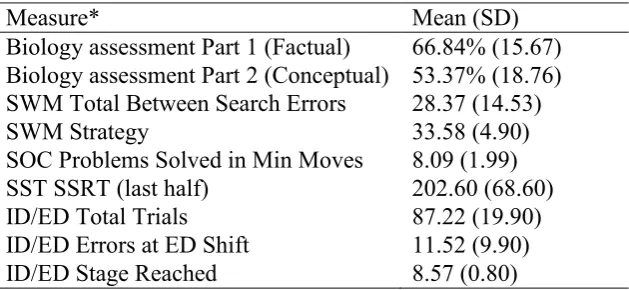
Measure* Mean (SD)
Biology assessment Part 1 (Factual) 66.84% (15.67) Biology assessment Part 2 (Conceptual) 53.37% (18.76) SWM Total Between Search Errors 28.37 (14.53)
SWM Strategy 33.58 (4.90)
SOC Problems Solved in Min Moves 8.09 (1.99) SST SSRT (last half) 202.60 (68.60)
ID/ED Total Trials 87.22 (19.90)
ID/ED Errors at ED Shift 11.52 (9.90)
ID/ED Stage Reached 8.57 (0.80)
Table 2
Correlational Data for Key Measures
Measure 1 2 3 4 5
1) Biology Part 1 (Facts)
2) Biology Part 2 (Conceptual) .52***
3) Working Memory: SWM Between Search Errors -.25 -.445***
4) Planning: SOC Problems Solved in Min Moves .39** .405** -.23
5) Inhibition: SST SSRT -.18 .01 .01 .-.14
6) Attention Set-shifting: ID/ED Stage Reached .08 .07 .16 .06 .02
Table 3a
Standardised regression coefficients predicting biology factual scores.
Note: * indicates significance at p<.05; ID/ED: attention set-shifting task; SOC: Stockings of Cambridge; SWM: Spatial Working Memory; SST Stop-Signal Task.
B SE B β
Constant 76.75 86.37
Age (months) -2.51 6.00 -0.06
IDED 1.70 2.59 .09
SOC 2.53 1.04 .33*
SWM -.22 .151 -.19
Table 3b
Standardised regression coefficients predicting biology conceptual scores.
Note: * indicates significance at p<.05 ;** p<.01; ID/ED: attention set-shifting task; SOC: Stockings of Cambridge; SWM: Spatial Working Memory; SST Stop-Signal Task.
B SE B β
Constant -14.65 96.14
Age (months) 2.36 6.68 0.04
IDED 3.00 2.89 .13
SOC 2.89 1.15 .31*
SWM -.55 .17 -.40**
Appendix 1
Q1 DNA is a mix of which bases? Please circle the right answer: a) A and C
b) T and G c) A, T, and C d) A, C, T, and G
Q2 What do we use chemical scissors for?
Q3 How long is your DNA? Please circle the right answer: a) From here to George Square
b) From here to Motherwell c) From here to next classroom d) From here to the moon and back Q4 Name four things you can use DNA for a)
b) c) d)
Q5 During World War II, there was displacement of children all around the UK. After the War, in order to match siblings to their parents, DNA was extracted and run on a gel to match brothers and sisters. Only identical twins have 100% DNA match, everyone else has 99.9% similarity. When the scientists analysed the data, they concluded several things. Please help them out!
i) Name 3 ingredients that scientists can use to extract DNA a)
b) c)
ii) Which sets of twins are identical? Please circle the correct answers