Volume 1
Thesis
Selective impairment in executive functions: a test of the
selective executive deficit hypothesis in adults with
treatment-discontinued Phenylketonuria
ProQuest Number: U643961
All rights reserved
INFORMATION TO ALL USERS
The quality of this reproduction is dependent upon the quality of the copy submitted.
In the unlikely event that the author did not send a complete manuscript and there are missing pages, these will be noted. Also, if material had to be removed,
a note will indicate the deletion.
uest.
ProQuest U643961
Published by ProQuest LLC(2016). Copyright of the Dissertation is held by the Author.
All rights reserved.
This work is protected against unauthorized copying under Title 17, United States Code. Microform Edition © ProQuest LLC.
ProQuest LLC
789 East Eisenhower Parkway P.O. Box 1346
A cknowledgements
I would like to thank Shelley Channon, D r Philip Lee, M aggie Lilburn and Eleni Owen f o r a ll their help and support and to a ll the volunteers who were involved in
Volume 1: Table of Contents
Section Title
Abstract
Pages
1.0 Introduction 1
Summary 1
1.1 Phenylketonuria (PKU) 1
1.1.1 Importance of early diagnosis and treatment of PKU 2
1.1.2 Duration of dietary treatment 4
1.1.3 Outcome in PKU 5
1.1.4 Social and emotional functioning in PKU 7
1.1.5 The executive deficit hypothesis o f PKU 8
1.2 Executive functioning 13
1.2.1 Active monitoring and manipulation o f information in working memory as a distinct function linked to the dorsolateral PEG
18
1.2.2 Dissociations between functions relying on the dorsolateral PEG and those relying on the orbitomedial PEG
22
1.2.3 Dopaminergic lesions lead to more selective impairments than structural lesions
25
1.2.4 Dopamine depletion and working memory impairments in PKU 28
1.3 Main findings and limitations of existing studies 30
1.4 Aims of present study and hypotheses 36
1.4.1 Hypotheses 37
2.0 Method 38
2.1 Design 38
2.2 Participants 38
2.2.1 PKU group 38
2.2.2 Gontrol group 40
2.2.3 Sample characteristics 40
2.2.4 Gharacteristics of the PKU group 41
2.3 Procedure 41
2.4 Measures 42
2.4.1 Screening measures 42
2.4.2 Neuropsychological measures 45
3.0 Results 49
3.1 Normality of distribution of the data 49
3.2 Demographic profiles of the two groups 51
3.3 Performance on the unpaced working memory task 53
3.4 Performance on the paced working memory task 55
3.5 Gomparing group performance on the reward-based learning task 57
3.6 Gomparing group performance on the perceptual task 58
3.7 Gorrelating performance on the tasks with Phe levels o f the PKU group
59
4.0 Discussion 61
4.1 Summary of the main findings 61
4.2 Issues with regards to the internal and external validity o f the findings
64
4.2.1 Gharacteristics of the PKU group sampled in this study 64
4.3 Performance on the two working memory tasks 69
4.4 Performance on the Object Alternation task 74
4.5 Performance on the perceptual tasks 76
4.6 Relationship between dietary history, Phe levels and 77
performance on cognitive tasks
4.7 Theoretical implications of the findings of the current study 80
4.8 Clinical implications o f the findings o f the present study 83
4.9 Limitations o f the current study and suggestions for future 85
research
4.10 Conclusions 86
References 88
Appendices 109
A Questionnaires
Health Screen Interview Beck Depression Inventory Beck Anxiety Inventory
DEX questionnaires for self- and independent-rater SF-36v2 Health Survey
B Ethics Approval Notices
Approval for wider study (1995)
Request and approval for blood testing (2001) Request and approval for named researcher (2001) C: Recruitment and correspondence to participants
Letter of invitation to participants Thank you letter
Information sheet Consent form
Advertisement for volunteers
Volume 1: L ist of Tables
Table no. Title Pages
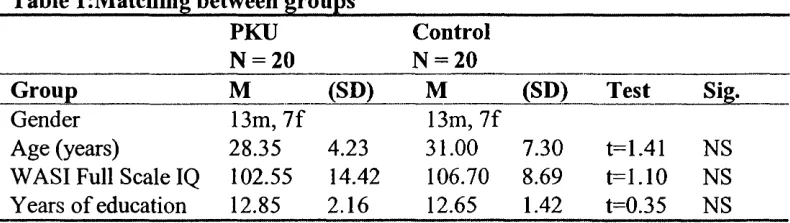
1 Matching between groups 40
2 Age off diet and concurrent Phe levels of PKU group 41
3 Summary of self-report mental health and quality of life data 51
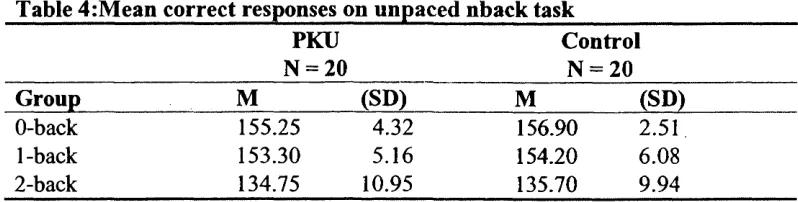
4 Mean correct responses on unpaced nback task 53
5 ANOVA analysis o f accuracy on the unpaced nback task 53
6 Reaction times to correct trials on the unpaced nback task 53
7 ANOVA analysis o f reaction times on the unpaced nback task 54
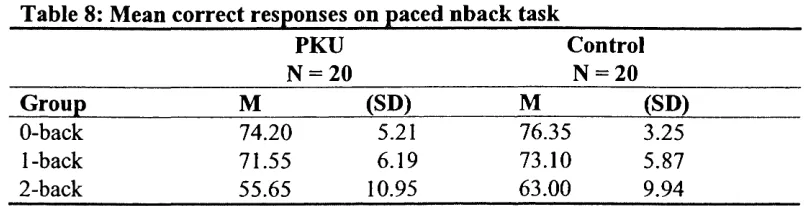
8 Mean correct responses on paced nback task 55
9 ANOVA analysis o f accuracy on the paced nback task 56
10 Reaction times to correct trials on the paced nback task 56
11 ANOVA analysis o f reaction times on the paced nback task 57
12 Analysis of speed and accuracy performance on the
alternation task
57
13 Comparison of speed and accuracy performance on the
perceptual tasks
ABSTRACT
Executive functions are processes involved in the everyday control of thoughts and
actions and have been linked to the prefrontal cortex. Recent models of cognitive
functioning in Phenylketonuria (PKU) have linked it to selective impairment in
executive functions due to depleted dopamine levels in the prefrontal cortex. This is
caused, in part, by elevated levels of Phenylalanine in the blood. Dopamine is
thought to play a central role in fiinctions linked with the lateral prefrontal cortex and
associated pathways. The selective executive deficit hypothesis of PKU suggests that
measures that place high demands on active working memory and sustained attention
are likely to be sensitive to any impairments mediated by dopamine depletion. These
functions have been linked to the dorsolateral prefrontal cortex, which is particularly
sensitive to fluctuations in dopamine in the brain.
This study compared performance of a group o f treatment-discontinued adults with
PKU to a group o f healthy controls matched for age, sex, IQ and educational
background on tasks sensitive to dorsolateral prefrontal cortex functioning, in
comparison to another test of executive functioning, reward-based learning, and a
control task, considered to make minimal demands on executive functions. Adults
with PKU were shown to be selectively impaired on tasks requiring monitoring of
information in the context of processing of higher working memory loads, but not on
the alternative executive task or the control task, in comparison to healthy control
1.0 INTRODUCTION
Summary
Phenylketonuria (PKU) is a disorder which affects dopamine levels in the brain. The
aim of this study is to establish whether adults with treatment-discontinued PKU
display selective executive impairments in tasks with a high attention and working
memory load, in accordance with selective executive deficit hypothesis o f PKU.
Although aspects of this hypothesis have been supported by evidence fi-om a handful
of published studies with children & adolescents, it has not been thoroughly tested in
adults with untreated PKU. From a clinical perspective, this is relevant to those
suffering with PKU who remain unsure whether to return to the burdensome dietary
treatment and clinicians have little evidence-base fi-om which to advise them.
Additionally, fiom a theoretical perspective, evidence of selective executive deficits
in this population is important for the evaluation of recently-developed theories of
aspects of executive functioning and their anatomical and neurochemical basis.
Evidence of selective executive deficits may also help to shed light on possible
dissociations between different functions and may therefore inform theories of
executive functioning.
1.1 PHENYLKETONURIA (PKU)
In this section the clinical presentation, treatment, and neurobiological basis o f the
disorder. Phenylketonuria, will be described. Furthermore, evidence on the outcome
of treatment, with respect to cognitive functioning, will be assessed with reference to
impairments in PKU. In summary, this hypothesis suggests that dopamine
neurotransmission in PKU is impaired and that this has a particular impact on the
dorsolateral prefrontal cortex, where neurons are especially sensitive to mild
fluctuations in dopamine. Thus, it is argued that altered modulation o f dopamine in
the dorsolateral prefrontal cortex may be the neurobiological basis of the particular
deficits apparent in PKU.
1.1.1 Importance of early diagnosis and treatment of PKU
Phenylketonuria (PKU) is a relatively common hereditary metabolic disorder, with an
incidence o f approximately 1 in every 10,000 newborn infants (Guttler, 1988). It was
first described clinically by Foiling in 1934. PKU is believed to be caused by a
mutation o f a gene on chromosome 12 (Woo, Lidsky, Guttler, Chandra & Robson,
1983) which leads to a deficiency of the enzyme Phenylalanine hydroxylase (PAH).
PAH converts the amino acid. Phenylalanine (Phe) into another amino acid. Tyrosine
(Tyr) which is a precursor o f dopamine. This deficiency results in excessively high
levels o f Phe in the blood and depleted levels of dopamine, which is important in
neurotransmission.
In people with untreated PKU, blood Phe levels can rise to over 10 times normal
levels (Diamond, Prevor, Callender & Druin, 1997). The toxic effects o f such high
Phe levels and restricted supply of dopamine to the brain results in irreversible severe
mental retardation which becomes evident within the first year of life. Intelligence of
those with untreated PKU tends to plateau from around the age o f 3 and adults
addition to severe mental retardation, untreated individuals with PKU have also been
shown to manifest a range o f behavioural impairments, including hyperactivity,
attention and perceptual-motor problems, aggressiveness, negative mood, and motor
disturbance (MacLeod, Munro, Ledingham & Farquhar, 1983; Paine, 1957; Primrose,
1983). Cognitive and behavioural problems seen in late-treated children are similar
but less extreme (Margolin et al., 1978; McKean, 1971). Thus, the specific cognitive
impairments o f untreated and late-treated PKU appear to be related mostly to
executive function processes, such as problem-solving, attention, and perceptual-
motor functioning, than to non-executive function processes.
Effective screening for the disorder in newborn infants became possible from around
1970 with the introduction o f the blood spot bacterial inhibition test (Guthrie & Susi,
1963). If diagnosed with PKU, newborn infants are usually started on treatment
within the first month o f life. Treatment consists of a specially formulated diet with
the aim o f reducing the level of blood Phe to an acceptable range, which varies
according to age (Medical Research Council, 1993b). The amount of natural protein
in the diet is severely restricted so as to reduce further intake of Phenylalanine. The
diet is supplemented with low protein food substitutes and Phe-free amino acids,
vitamins and minerals to ensure well-balanced nutrition is maintained despite the
restrictions o f the diet.
At present, UK guidelines indicate that blood Phe should rise to no more than 5 times
the normal levels in order to protect the developing brain (Medical Research Council,
1993a). Regular monitoring of blood Phe levels is necessary to establish whether
home using a finger-prick blood spot onto a strip which is sent into the laboratory.
The clinical team check the person's blood Phe levels and also try to ensure that the
person is maintaining a well-balanced diet in other respects.
1.1.2 Duration of dietary treatment
The age at which it is recommended that people can come off the diet has increased
progressively to 8, 10, 12 and 16 years o f age, as evidence emerged about some
negative effects o f stopping diet. In Britain, there is now a ‘diet for life’ policy.
Policies have also changed with regard to the optimal blood Phe level at which a
person maintained on diet should aim to achieve. Current U.K. guidelines now
recommend upper limits of blood plasma Phe at 360 pmol/L for young children, 480
pmol/L for school-age children, and 700 pmol/L for adolescents above school age
and adults (Medical Research Council, 1993b). Although medical advice has changed
over the years in the light of new evidence, many people were previously advised to
come off the diet in adolescence and they continue to remain untreated in adulthood.
Given that it has been many years since these people have been on the diet, many are
poorly motivated to return to the restrictions o f the diet, even though clinicians now
1.1.3 Outcome in PKU
Early screening and effective dietary treatment beginning in the first month of life
have altered the outcome o f PKU considerably. Children who are treated early can
now expect to go to mainstream schools and achieve normal developmental
milestones. In evaluating the success o f dietary treatment, studies have typically used
standardised scales o f general intelligence such as the Stanford-Binet scales and the
Wechsler scales. Evidence accrued using IQ scores as an outcome measure suggests
that children with early and continuously-treated PKU typically achieve IQ scores
within the normal range (e.g. Holtzman, Kronmal, van Doominck, Azen & Koch,
1986; Koch, Azen, Friedman & Williamson, 1982, 1984). However, the IQ scores of
both children and adults with early-treated PKU typically remain lower than their
parents and unaffected siblings, and lower than the mean of the general population
(Berry, O'Grady, Perlmutter & Bofinger, 1979; Dobson, Kushida, Williamson &
Friedman, 1976; Hudson, Mordaunt & Leahy, 1970; Koch et al., 1984; O’Flynn &
Hsia, 1968; Williamson, Koch, Azen & Chang, 1981).
However, when treatment was first introduced it was not clear for how long it should
be continued. Initially, dietary therapy was stopped at 5 years of age, but it later
became apparent that this was not sufficient to prevent cognitive impairment. Larger
scale studies found a relationship between length o f time on diet and IQ scores. For
example, the North American Collaborative Study examined a cohort of early-treated
children with PKU over several years using standardised IQ scales. At the age of 4
years, they found that the mean IQ of children with PKU was 93 (using the Stanford-
scores (Dobson, Williamson, Azen & Koch, 1977). At the age of 8 years, IQ was on
average 100 for the children with PKU compared to 107 for their non-PKU siblings
(using the Wechsler Intelligence Scale for Children) (Koch et ah, 1984). At the age of
12 years, further assessment showed that IQ scores correlated with dietary control
(Smith, Beasley & Ades, 1990).
In the UK, the PKU registry has produced similar data, suggesting that patients with
PKU on average have IQ scores that are 4 points lower for each month’s delay after
birth until treatment onset for each 300 pmol/L rise in average blood Phe level
(Seashore, Friedman, Novelly & Bapat, 1985). Thus, treatment history, dietary status
and blood Phe levels are all important indicators used to indirectly estimate the extent
to which this disorder is having a deleterious impact on the brain. Furthermore, on
the basis of neurological investigations, small white matter abnormalities have been
identified, even in early and continuously-treated individuals with PKU, but there is
little evidence o f any other lasting neurological damage (Lou et al., 1992). In
summary, it has been well established that early diagnosis and continuous careful
treatment of PKU with a well-controlled diet is essential in order to secure the best
1.1.4 Social and emotional functioning in PKU
Most of the evidence on social and emotional functioning in PKU has a
developmental focus and is based on studies with children and families. Thus, there
is little evidence on such aspects of outcome in adults. A review o f the studies with
children and adolescents suggests that early and continuously-treated children do not
show a higher risk for emotional and social problems (Sullivan, 1999; Weglage et al.,
1996), but that they do appear to be more likely to experience cognitive problems
such as poorer concentration, but without the negative social behaviour seen in
disorders such as Attention-Deficit Hyperactivity Disorder (Kalverboer et al., 1994).
However, some studies have suggested that parents feel that their parenting style is
affected by the disorder. Parents have described difficulties with issues such as their
need to be protective about what is eaten by their children, helping their children
cope with feeling different from others and with the practical stresses associated with
having to maintain a restrictive diet and take regular blood tests for example
(Hendrikx et al., 1994).
There is also evidence of difficulties with regards to adolescents. There is some
evidence that adolescents with early and continuously-treated PKU show a greater
vulnerability to psychiatric disturbance and psychosocial problems, which they
describe as stress resulting from the burdensome diet (Weglage et al., 1996).
Furthermore, adolescents with PKU have been shown in one study to be
characterised by less autonomy, a greater likelihood o f making a negative evaluation
o f their scholastic ability, less achievement motivation, low frustration tolerance, a
comparison to their non-PKU peers (Weglage et al., 1992). It is interesting to note
that there has been found to be no evidence of an association between mean blood
Phe level over the first 13 years of life and level of disturbance in 13 year old
adolescents (Burgard, 1994). Instead these difficulties may be mediated by the
problems maintaining dietary compliance during adolescence, when the need to be
seen as ‘fitting in’ with the social peer group appears to exercise a greater impact on
behaviour (Zemen et al., 1996). The problems described may also be influenced by
stressors associated with having a chronic disorder, rather than having PKU in
particular, which could be examined further in studies where functioning is compared
with age-peers with different chronic disorders affecting their health. Thus there are
several issues which have not yet been explored in the published literature to date.
1.1.5 The executive deficit hypothesis of PKU
Direct measurement o f cognitive functioning with IQ tests appears to have been the
simplest means of measuring outcome for people with PKU. However, the reliance
IQ as an index of outcome may have underestimated the effects of PKU in early and
continuously-treated individuals, since IQ tests such as the Wechsler scales are
known to be relatively insensitive to impairments in ’executive' functions. Executive
functions are processes involved in the everyday control of thoughts and actions, and
have been linked to the prefrontal cortex (PFC) o f the brain.
Recent models o f cognitive functioning in PKU have linked it to selective
impairments in executive functions (Diamond, Ciaramitaro, Dormer, Djali &
Pennington, Ozonoff, Rouse & McCabe, 1990; 1996) such as in monitoring
information with a high working memory load, attentional and inhibition processes
(Diamond et al., 1997; Weglage, Schmidt, Flinders, Pietsch & Ullrich, 1996; Welsh
et al., 1990). In general, research has found basic language, perception, memory and
gross-motor functions to be normal in individuals with early-treated PKU. However,
there is substantial evidence of executive deficits in early-treated children with PKU.
These have demonstrated deficits in attentional and working memory processes, and
speed o f information processing (Brunner, Berch & Berry, 1987; Diamond et al.,
1997; Faust, Libon & Pueschel, 1986; Krause et al., 1985; de Sormeville, Schmidt,
Michel & Batzler, 1990; Welsh et al., 1990).
Several authors have put forward an explanation for these apparent selective
executive deficits in children with early and continuously treated PKU (Diamond et
al., 1997; Weglage et al., 1996; Welsh, 1996). These authors have argued that
dopamine neurons in the ventral tegmental area projecting to the PFC are
differentially sensitive relative to a mild reduction in Tyr compared to other
dopamine neurons in the brain. Tyr is the precursor of dopamine. Most brain regions
receiving dopaminergic input are unaffected by small changes in Tyr levels within
the Central Nervous System (CNS). Dopamine neurons that project to the PFC fire
more rapidly and turn over dopamine more quickly than other parts o f the brain
(Bannon, Bunney & Roth, 1981; Tam, Elsworth, Bradberry & Roth, 1990; Theirry et
al., 1977; Wurtman, Hefii & Melamed, 1981). Thus, in PKU increased Phe levels are
thought to impede the transport of other amino acids to the brain. This in turn leads
to selectively depleted dopamine levels in the PFC, which can result fi-om even
the lateral PFC due to their special characteristics (Bannon et al., 1981; Bradberry,
Karasic, Deutch, & Roth, 1989; Diamond, 1998; Thierry et al., 1977).
Diamond (1998) has argued that evidence from animal studies supports this theory as
it demonstrated impairments in the ability to make a delayed response (which
requires working memory) when blood plasma Phe levels were experimentally raised
(Diamond et al., 1994). This is similarly found with ablation of the prefrontal cortex
(e.g. in rats Bubser & Schmidt, 1990; Larsen & Divac, 1978; Wikmark, Divac &
Weiss, 1973; in monkeys Bâttig, Rosvold, & Mishkin, 1960; Jacobsen & Nissen,
1937; Kubota & Niki, 1971). As predicted, lower levels of dopamine and the
dopamine metabolite, HVA, were found in the PFC in PKU-model animals
compared to controls. This is supported by earlier work built on modelling the
untreated PKU condition (Brass & Greengard, 1982; Greengard, Yoss & Del Valle,
1976).
Given this explanation for executive deficits in patients with PKU, levels of Phe in
the blood may be expected to be associated with extent o f cognitive impairment, with
higher levels being related to poorer functioning. Although several studies have
demonstrated such a relationship (Diamond et al., 1997; Pietz et al., 1998; Ris,
Williams, Hunt, Berry & Leslie, 1994; Smith, Klim, Mallozzi & Hanley, 1996;
Weglage et al., 1996; Welsh et al., 1990), others have not (Griffiths, Campbell &
Robinson, 1998; Griffiths, Tarrini & Robinson, 1997).
However, there are several factors confounding the comparison between different
there are different levels of blood Phe recommended for different age groups,
comparing blood Phe levels between different samples studied is not straightforward.
Furthermore, the effects o f blood Phe levels on cognitive performance is complicated
by levels of IQ, the age at which diet was started and stopped, the level of adherence
to diet, and individual differences in the extent to which dietary control is able to
reduce blood Phe levels. For example, treatment continuity has been shown to make
a difference to problem-solving ability (Brunner, Jordan & Berry, 1983) and reaction
times (Krause et al., 1985; Lou, Lykkeluind, Bruhn & Niederwieser, 1987; Schmidt
et al., 1994), but there are exceptions to this (Jordan et al., 1985). Blood Phe levels
have been shown to be more strongly related to performance than IQ (Diamond et al.,
1997; Welsh et al., 1990). However, the lower the IQ, the less the effect on
performance after reducing Phe levels (Krause et al., 1985). Additionally, there is
some evidence to suggest that cognitive impairments in adults are mediated in part by
lifetime blood Phe levels (Pietz et al., 1998; Ris et al., 1994; Smith et al., 1996). For
example, Pietz et al., (1998) demonstrated that both concurrent Phe levels and Phe
levels from the age o f 12 onwards were related to performance on an attention task. It
may be the case that for adults with PKU lifetime blood Phe levels bear a closer
relationship to performance than concurrent blood Phe levels. This may be because
when concentration of Phe in the blood reaches a saturation point, which varies
between individuals, there are additional toxic effects of the accumulation of Phe
(Seakins, Ersser & Hjelm, 1982). This may make concurrent blood Phe levels less
straightforward as an indication o f the extent of effect o f high Phe levels on the brain.
The equivocal findings on this issue o f the relationship between blood plasma Phe
levels are only an indirect measure o f brain Phe levels (see e.g. Koch et al., 2000) and
the technology to measure brain Phe levels directly is still being developed.
However, stopping the diet or Phe loading has been shown to lead to decreased levels
in the neurotransmitter metabolite 5-HIAA (Lou et al., 1985) and dopamine (Krause
et al., 1985) in patients with PKU. These decreases have been shown to be related to
slower reaction times on tests of sustained attention and higher integrative functions.
There is a body of evidence supporting the conclusion that a decrease in sustained
attention ability may be due a decrease in neurotransmitter synthesis.
Overall, there are only a handful o f studies investigating selective deficits in
adolescents and adults and so far these findings have been more mixed (Clarke,
Gates, Hogan, Barrett & MacDonald, 1987; Griffiths et al., 1998b; Mazzocco, Nord,
van Doominck, Greene & Kovar, 1994; Ris et al., 1994; Smith et al., 1996;
Stemerdink et al., 1994). Group differences have been found in some studies but not
in others. There are several factors which complicate the comparison of these
different studies. Firstly, the samples have varied in age, gender, IQ and dietary
history, all o f which could affect task performance (Waisbren, Brown, de Sonneville
& Levy, 1994). Secondly, the studies have employed a variety of measures. Some of
the measures used have not been well-validated by previous research as good
measures for tapping particular aspects o f executive functioning, nor as reliably
associated with functioning of the lateral prefrontal cortex. Thirdly, many studies
have employed very small sample sizes, which can affect statistical power, and
therefore the validity o f the findings.
In summary, the selective executive deficit hypothesis of PKU predicts that the
executive functions which are linked to the lateral PFC of the brain, such as attention
and manipulation of information with a high working memory load. There are several
studies based on children with PKU which have confirmed this prediction, but the
evidence in adults is more mixed. This may be due, in part, to the difficulty
measuring performance on tasks which can tap particular aspects of executive
functioning, and the relative lack o f well-controlled studies in this area. In addition,
such cognitive impairments have been shown to be associated with high blood
plasma Phe levels, which are an indirect measure of brain Phe, but the findings with
regards to this relationship are also equivocal.
1.2 EXECUTIVE FUNCTIONING
Executive functions are higher, goal-directed mental activities that are organisational
and supervisory in nature and heavily dependent on good attentional control. They
entail planning, selecting or maintaining complex behavioural routines, often in
novel contexts (Kelly et al., 1996). The term ‘executive’ is derived from Baddeley’s
(1986, 1999) model in which a ‘central executive’ plays a major role in attention,
planning strategies, co-ordinating behaviour and the suppression of irrelevant
information. According to this model the central executive integrates information
from other sources within the brain and it has an over-arching co-ordination function
for different processes, but does not store information (Richardson, 1996a, 1996b). In
everyday activities the central executive helps a person decide what to do and enables
them to keep focused towards achieving a particular goal. This has some similarities
to Shallice and Burgess’s (1991) conceptualisation o f a ‘supervisory system’ which
Such processes may be used in deciding how to tackle a problem, selecting an
appropriate strategy and monitoring ongoing performance. This is especially
important when a person is tackling a novel problem or situation.
There has been a continuing debate about whether there is such a unitary system or
whether ‘executive’ processes are heterogenous in nature and function. This has led
to attempts to define what can be considered ‘executive’ versus ‘non-executive’
processes. The criteria for making such a definition has long been discussed in the
literature and some have even argued that what others describe as executive
processes are simply descriptions of task demands. Thus the construct validity of
using the term ‘executive’ to describe cognitive processes has been questioned
(Burgess, 1998). Yet there is some agreement that the term executive is a way of
describing behaviour in novel situations, where automatic control o f behaviour on the
basis of past experience cannot be used, where allocation of attentional resources
allowing sustained attention or divided attention between different tasks is necessary,
and in the prevention of responses that are inappropriate in a particular context
(Rabbitt, 1998).
The frontal lobes, particularly the PFC, and associated pathways are believed to be
central to our ability to respond adaptively to the environment in a goal-directed
manner, which involves such executive functions (see e.g. Norman & Shallice,
1986). Poor judgement, planning and decision-making were recognisable
characteristics in people with damage to the PFC, yet it has been difficult to
conceptualise the psychological processes which contribute to these complex
Central Executive which has an overall control and monitoring function which
processes inputs from two slave systems; the phonological loop and the visuo-spatial
scratchpad (Baddeley, 1996). Shallice and Burgess (1993) have described a
Supervisory System which is used purely for coping with novel situations, in
comparison to Contention Scheduling processes which control more habitual
behaviours. Alternatively, Domasio (1996) has described a Somatic Marker
hypothesis in which a stimulus sets off a somatosensory pattern which boosts
attention and working memory. This in turn triggers associations on the basis of
previous experience which are integrated in reasoning and decision-making
processes.
There are also models o f executive processes which are intricately linked to the
cortical architecture which is believed to be involved. These researchers have drawn
on existing evidence from animal and human studies to identify dissociations
between different brain regions and systems of neuronal and neurochemical activity.
These are argued to be evidence for dissociable executive processes, such as
Petrides’ (1994) distinction between monitoring and active retrieval o f information,
or Rolls’ (1999) theory about the role of the orbitoffontal cortex in reward-based
learning, given its links to the striatum which is implicated in neurochemical
modulation. There is no general consensus about the most valid approach to
understanding such cognitive processes and this is an area of continuing active
debate.
To help examine evidence for these different explanations of how such functions are
drawn upon evidence from a variety of sources. These include both animal and
human experiments involving lesions, brain imaging, electrophysiological and
neurochemical recordings. Studies in the field o f human neuropsychology have been
focused on the fractionation o f executive processes, which are argued to be subserved
by particular regions of the frontal cortex. One paradigm employed is examining how
particular brain lesions of the PFC in humans and primates can disrupt their
performance on a range of executive tasks (see e.g. D'Esposito & Postle, 1999). In
such studies behaviour and electro-physiological activity o f particular neurons are
measured. The results are used to draw conclusions about the specific ways in which
areas of the brain are associated with inability to carry out tasks which are
hypothesised to demand the operation of specific cognitive processes. From
observations of ability to perform a particular task, but not another, theories are
derived about dissociations between cognitive functions and associated brain regions
(Rabbitt, 1991).
Much of the recent evidence on localisation within the PFC is also based on
functional imaging work. In these studies, the brain is scanned for patterns of
activation whilst the subject o f the experiment performs a particular task. In deriving
theories o f cognitive functioning and activity in the PFC, imaging and lesion studies
rest on the assumption that a task taps a particular cognitive operation or process.
However, there has been considerable debate about such processes and whether it is
valid to discuss functional independence when it comes to so-called ‘executive
processes’. Some researchers have taken a ‘local approach’ in which they look for
consistent patterns o f activation across individuals which they argue can be
and inconsistencies in areas of activation that may show that some tasks have a set of
common lower-order task demands that prompt activation of these areas or shared
areas of activation which suggest a broader functional conceptualisation o f how the
brain works. Alternatively, others have used a ‘network approach’ to study the
pattern of interactions across areas of the brain, which they argue are mores
significant than looking at each brain region separately.
There are methodological difficulties in all the methods described. For example,
associations between brain activation and cognitive processes do not provide direct
evidence of causation. Also task demands may be associated with certain cognitive
processes but this rests on an assumption that a particular task taps a particular
cognitive process or function. One way of improving the strength these assumptions
is to use lines of converging evidence from different methodologies but which are
suggesting similar interpretations. For example, where patterns of preserved and
impaired performance in a task have been shown to be associated reliably with
lesions to a particular area of the brain in both animal and human studies as well as
functional imaging studies and those using electrophysiological recording it may be
argued that it is reliably associated with function of a particular brain region. This
does not resolve the problem that such studies rest on such assumptions but measures
can be taken to provide evidence for the validity o f such assumptions as much as
possible. Furthermore, studies incorporating reliable controls improve the possibility
of hypotheses being robustly tested against different interpretations of the findings.
Lines of converging evidence and evidence supporting the validity of relevant tasks
investigation. That is active working memory, which can be described as the ability
to hold information in mind, and manipulate that information in the short term. This
may be linked to the ability to sustain attention to a task so as to take in ongoing
relevant information that needs to be held in working memory. These abilities are
important in everyday life, such as in complex tasks where information is held ‘on
line’ so as to direct activity towards a particular goal.
Theories are beginning to emerge about the relationship between the dorsolateral
prefrontal cortex (PFC) and aspects o f working memory. Recent reviews of
functional imaging studies (e.g. Caboza & Nyberg, 2000; Duncan & Owen, 2000)
have implicated mid-dorsolateral, mid-ventrolateral and anterior cingulate areas as
key regions in a range o f higher-level tasks. These include working memory,
attentional control, and inhibition of habitual or prepotent responses. The following
section describes evidence linking the lateral PFC and active working memory.
1.2.1 Active monitoring and manipulation of information in working memory
as a distinct function linked to the dorsolateral PFC
There is considerable evidence that the frontal cortex plays a critical role in certain
aspects o f working memory. This evidence comes from the study of patients with
excisions to the prefrontal cortex (Owen, Downes, Sahakian, Polkey & Robbins,
1990; Owen, Sahakian, Semple, Polkey & Robbins, 1995; Petrides & Milner, 1982)
and from lesion and electrophysiological recording work on nonhuman primates
(Goldman-Rakic, 1987). For example, there is some evidence to suggest that damage
impairment on self-ordered and externally ordered non-spatial working memory tasks
(Petrides, 1991; 1995b) whilst other basic memory processing remains intact such as
recognition memory. Thus, it is suggested that the dorsolateral PFC is implicated in
tasks which require holding and manipulating information in working memory.
This function may be separable from other memory functions which require short
term memory span but do not require active processing of information. In monkeys,
lesions confined to Brodmann’s area 46 o f the dorsolateral preffontal cortex result in
severe impairments on tests of spatial working memory. For example, monkeys with
dorsolateral frontal lesions perform well on delayed matching to sample tasks in
which they have to recognise which one o f two constantly recurring stimuli was most
recently presented (Passingham, 1975) and on a delayed object alternation task in
which they have to alternate their responses between two stimuli (Mishkin, Vest,
Waxier & Rosvold, 1969; Petrides, 1995a). These tasks require mnemonic
judgements based on the relative recency or primacy of stimuli. Such studies suggest
that this kind o f functioning need not be affected by dorsolateral frontal damage.
Petrides has shown that for those with such damage memory only fails when the task
becomes more challenging and requires self-ordered or externally ordered
sequencing. Such tasks could be said to require remembering a number of stimuli
which need to be actively monitored as responses are made. This monitoring function
appears to be impaired in people with damage to the mid-dorsolateral area of the PFC
(Petrides, 1995b).
Furthermore, evidence has accrued from PET studies with humans in which brain
review o f PET and MRI studies, Caboza & Nyberg (2000) have demonstrated that
tasks requiring sustained attention, or continuous monitoring o f different kinds of
stimuli, have consistently been linked to activation in the pre-ffontal cortex. Several
studies have demonstrated the role of the PFC in attentional modulation (e.g. Rees,
Frackowiak & Frith, 1997), especially in tasks where the attentional load is high, and
in working memory, which has been shown to be associated with increased activity
in the PFC. This activity is typically found in areas 6, 44, 9 and 46, which are in the
lateral PFC.
In these imaging studies, different patterns of activation have been shown to be
associated with the performance of particular tasks. These studies are used to argue
for dissociations between different executive functions and the areas which subserve
them. For example, Petrides has proposed a model (Owen, 1997; Petrides, 1994,
1995b) suggesting that the mid-dorsolateral PFC (areas 46 and 9/46) is a specialised
region for the on-line monitoring and manipulation of cognitive representations
within working memory, as opposed to the ventrolateral PFC which is associated
with active selection, comparison and judgement of stimuli held in short and long
term memory. He has argued that these represent two levels of executive control
which are probably involved in several tasks and often simultaneously. In support of
this model, studies have demonstrated activation in areas of the ventrolateral PFC but
not in areas o f the dorsolateral PFC on a spatial memory span task (Petrides,
Alivisatos, Meyer & Evans, 1993b), and activation of the dorsolateral PFC but not
the ventrolateral PFC in a non-spatial self-ordered memory task (Petrides et al.,
However, there are some limitations to the conclusions that can be drawn from such
studies. For example, investigations have used a variety of tasks purported to tap
working memory and have produced a variety o f results which may suggest that such
tasks may not be equivalent and may be tapping different functional deficits. For
example, a distinction should be made between short term memory and working
memory. Short term memory refers to temporary storage of information and short
term memory problems are primarily associated with posterior cortical damage
(Baddeley & Hitch, 1974). In contrast, working memory refers to a type of online
processing of information which requires active monitoring and manipulation of
information. This function may be processed quite differently from that of the storage
component and there is evidence that simple short term spatial memory processes
remain intact after dorsolateral PFC lesions (Diamond, 1990).
Most working memory studies have employed three types of tasks: delayed response,
nback and self-ordered response. In each trial o f delayed response tasks, subjects are
presented with items which they are required to hold in short-term memory for a few
seconds, and then make a response to a probe. The tasks generally require
maintaining information in short-term memory. In the nback task (Rosvold, Mirksy,
Sarason, Bransome & Beck, 1956), subjects must indicate whether or not each letter
in a continuous stream of letters matches a letter that occurred one, two or more back
in the series. This task involves not only short-term maintenance but also constant
updating, which is an operation that is attributed to the central executive according to
Baddeley’s working memory model (Baddeley, 1986, 1998). This nback task has
been shown to be particularly sensitive to processes o f monitoring information in
make up the mid-dorsolateral PFC (O'Esposito et al., 1998; D'Esposito & Postle,
1999).
Furthermore, the nback task can be used to measure speed o f response as well as
accuracy (Braver, Cohen & Servan-Schreiber, 1995). This is helpful in addressing the
issue of the speed-accuracy trade-off in measuring performance on timed tasks. This
refers to differences between individuals in how they choose to trade-off speed and
accuracy in their patterns of performance, which can make understanding the
performance o f a group as a whole quite complicated. One way of making these
issues clearer is to contrast performance on paced and unpaced versions o f a task. In
the unpaced version the participant tends to maintain accuracy by taking longer to
respond, and in the paced version, the participant has much less time to respond so
accuracy is more likely to be sacrificed.
As described earlier, there is evidence that executive aspects o f working memory are
selectively impaired in people with PKU, particularly on tasks tapping the
dorsolateral PFC where neurons are considered to be especially sensitive to
dopamine depletion. Thus, people with PKU are expected to show impaired
performance in a task such as the nback described above. However, in order to
understand the selectivity o f executive impairments in PKU, one would need to
contrast performance on a task such as the nback with performance in another area of
executive functioning which is not thought to be so reliant on the dorsolateral PFC
and its associated dopamine pathways. One cognitive model has recently suggested
that there is a dissociation between monitoring of information in working memory,
orbitomedial PFC. The evidence for this dissociation is evaluated in the section
1.2.2 Dissociations between functions relying on the dorsolateral PFC and
those relying on the orbitomedial PFC
Orbital and medial PFC regions have been linked to goal-oriented behaviour. In
particular, these areas are thought to detect changes in reward-related information
used to modify ongoing performance, including the guidance of social and emotional
behaviour. Empirical studies using human and primate participants with brain lesions
provide some support for a distinction between functions associated with the lateral
PFC and those associated with orbital and medial areas (e.g. Bechara, Damasio,
Tranel & Anderson, 1998; Dias, Robbins & Roberts, 1996a; Rolls, Homak, Wade &
McGrath, 1994). For example, strategic components of executive functions have
been shown to be separate from online processing (Owen, Morris, Sahakian, Polkey
& Robbins, 1996; Robbins, 1998). The evidence for this dissociation has mostly
come from animal studies. For example, Dias, Robbins & Roberts (1996a)
demonstrated a double dissociation between functions associated with lesions to the
lateral PFC (area 9) and those associated with lesions to the orbitofrontal cortex
(areas 11,12 and 13). Furthermore, other recent studies have shown orbital lesions in
monkeys are associated with impaired associative learning irrespective of working
memory load (Bussey, Wise & Murray, 2001) and a dissociation was found between
working memory and stimulus-response learning in rats (Galea et al., 2001).
Most recently, O ’Reilly, Noelle, Braver & Cohen (2002) have put forward a
computational model which proposes a dissociation between the orbitomedial PFC as
the anatomical basis o f associative learning aspects of executive functioning, and the
information in working memory. Evidence has accrued which supports the
hypothesis o f dissociable neurochemical systems as well as anatomical systems in
respect o f the distinction made above, particularly in studies comparing the
performance of patients with Alzheimer's disease (which is thought to be associated
with the orbitoffontal system) and Parkinson's disease (which is thought to be
associated with the dorsolateral system) (Freedman, 1990; Freedman & Oscar-
Berman, 1986).
The task which appears to be most sensitive to intact functioning of the orbitomedial
PFC is the Object Alternation task (Abbruzzese, Ferri & Scarone, 1997; Chorover &
Cole, 1966; Curtis, Zald, Lee & Pardo, 2000; Freedman, 1990; Freedman, Black,
Ebert & Binns, 1998; Freedman & Oscar-Berman, 1986; Gansler, Covall, McGrath
& Oscar-Berman, 1996; Mishkin et al., 1969; Seidman et al., 1995; Zald, Curtis,
Folley & Pardo, 2002). In this task, participants are presented with two objects and a
reward (usually a coin) is hidden under one o f the objects. Participants are required to
try to make consistently correct responses, in which they choose the object under
which the coin is hidden. Successful performance on this task requires the subject to
learn a strategy or rule, such as that the coin alternates from one object to the other,
or from one side to the other. Success is measured by the number of consecutively
correct responses the subject makes.
There is also an element of delay in the task as there is a fixed period of time between
presentations of the stimuli, requiring the subject to hold information in mind in the
short-term. To date, this task has been administered manually. Preserved
the orbitomedial PFC in animal studies (Mishkin et ah, 1969). This has also been
found in human studies with samples of patients with brain lesions or neurological
diseases, such as Parkinson’s Disease (Chorover & Cole, 1966; Freedman, 1990;
Freedman, Black, Ebert & Binns, 1998; Freedman & Oscar-Berman, 1986; Gansler,
Covall, McGrath & Oscar-Berman, 1996), clinical disorders such as Obsessive-
Compulsive Disorder and Schizophrenia (Abbruzzese, Ferri & Scarone, 1997;
Seidman et al., 1995), and in PET studies (Curtis, Zald, Lee & Pardo, 2000; Zald,
Curtis, Folley & Pardo, 2002).
Furthermore, functioning within the orbitoffontal cortex, on the basis of performance
on similar alternation tasks, has been shown to be dissociable from functioning in
tasks tapping the dorsolateral preffontal cortex (Rolls, 2000). This is consistent with
the hypothesis that the neurochemical effects observed in PKU may not lead to
impaired functioning within the orbitomedial PFC, which has been shown to be less
sensitive to fluctuations in dopaminergic neurotransmission (Rolls, 2000).
Furthermore, stimulus-reinforcer association memory has been demonstrated to be
distinct ffom the type of working memory implemented in the dorsolateral and
inferior convexity prefrontal areas (Rolls, 2000; Rolls & Treves, 1998) which is
supported by evidence that shows dissociations between performance on delayed
response and inhibition tasks as opposed to alternation tasks which require
associative learning (Bardenhagen & Bowden, 1998; Gansler et al., 1996). Thus, it
may be argued that patients with PKU are unlikely to demonstrate impairments on an
associative learning task, given the hypothesised specificity o f cognitive deficits and
1.2.3 Dopaminergic lesions lead to more selective impairments than structural
lesions
Dopamine is thought to play a central role in functions linked with the lateral PFC
and associated pathways. However, primate evidence suggests that dopaminergic
lesions may be associated with more selective impairment than structural lesions to
the lateral PFC. For example, the removal of the dopaminergic input to the PFC in
monkeys only disrupts performance on preffontal tasks requiring active memory, but
not those requiring inhibitory control (Collins, Roberts, Dias, Everitt & Robbins,
2000; Roberts et al., 1994). Detailed investigations o f the differing processes
contributing to performance revealed that dopaminergic lesions were associated
specifically with reduced efficiency in processing higher working memory loads, but
were not associated with reduced inhibitory control. This differed ffom the
excitotoxic lesion group, where impairment was found both in active working
memory and inhibitory control (Collins, Roberts, Dias, Everitt & Robbins, 1998).
This suggests that dopaminergic lesions are associated with more selective deficits
than structural lesions of the PFC.
There is also recent evidence to suggest that dopamine is important in the ability to
make a delayed response, which is arguably reliant on bolding information in
working memory. For example, studies involving a neurocbemical intervention have
shown relationships between altered dopamine neurotransmission and poor
performance on delayed response tasks (Aujla, & Beninger, 2001; Hironaka, Tanaka,
Izaki, Hori & Nomura, 2001; Morrow, Roth & Elswortb, 2000; Sawaguchi & Iba,
with the ability to make delayed responses (Constantinidis, Francowicz, Goldman-
Rakic, 2001; Diekamp, Kalt, Guentuerkuen, 2002; Druzin, Kurzina, Malinina &
Kozlov, 2000; Floresco, Braaksma & Phillips, 1999; Murphy, 2001), and with the
ability to manipulate and integrate information (Funahashi & Inoue, 2000).
Furthermore, in studies measuring animals’ patterns of brain activation, the dorsal
anterior cingulate lesions (part of the noradrenergic system) has been implicated in
behavioural sequencing (Delatour & Gisquet, 2001), and areas thought not to be
involved in such dopaminergic pathways have been shown to be associated with
normal performance on working memory tasks (Delatour & Gisquet, 2000). Only
delayed response has been found to be impaired in primates with large dopamine and
noradrenaline depletions (Roberts, Robbins, Everitt & Muir, 1992; Roberts et al.,
1994). This suggests that there may be an association between dopaminergic
functioning in the preffontal cortex and working memory functions in particular.
However, there is very little evidence examining dopaminergic neurotransmission
and task performance in humans. Extrapolating animal evidence to human cognitive
models involves making assumptions about the comparability o f human and animal
brains and the relevance of the tasks given to animals for human performance.
Nevertheless, studies are emerging in particular with relation to Schizophrenia and
ADHD, as it has been suggested that altered dopaminergic systems may be
implicated in some o f the cognitive deficits observed in these conditions. For
example, the activity o f certain dopamine receptors have been shown to be related to
selective impairments in people with Schizophrenia on a delayed response task
(Goldman-Rakic, 1999). Also, there is some evidence linking Schizophrenia to an
working memory functioning (Cannon, van Erp, & Glahn, 2002; Weinberger, Egan,
Bertolino & Callicott, 2002). Furthermore, an animal model of ADHD has been
developed in which it is suggested that behavioural problems result ffom an
imbalance between noradrenergic and dopaminergic systems in preffontal cortex
(Russell, 2002). However, the evidence in this area is only just beginning to accrue.
There is evidence to suggest that preffontal dopamine systems have specific effects
on working memory processes, but the relationship between working memory
functions and dopaminergic systems within the PFC is complex. For example, low
doses of dopamine receptor antagonists in the PFC have been suggested to lead to
behavioural improvements (Williams & Goldman-Rakic, 1995), rather than deficits,
whilst high levels o f PFC dopamine activity are associated with poorer delayed
performance in the rat (Murphy, Amsten, Goldman-Rakic & Roth, 1996; Sahakian et
al., 1985; Zahrt, Taylor, Matthew & Amsten, 1997). These results suggest that the
relationship between mesoffontal dopamine function and efficiency of working
memory may be characterised by an inverted U-shaped function (Amsten, 1998;
Robbins, 1985; Zahrt et al., 1997), with dopaminergic activity also having been
shown to have a modulatory role in attentional performance. However, Robbins
(2000) has suggested that such modulation and its effects will depend many factors
such as the nature o f the task under study, as it has been shown that the effect of
mesocortical dopamine depletion varies as a function o f the task which is evident in
impaired performance on a spatial delayed response task, unaffected performance in a
spatial sequencing task, and improved performance on an extra-dimensional shift
task, all of which are considered to tap executive components of working memory
There is evidence for the impact of these factors on performance in the nback task.
For example, Cohen & Servan-Schreiber (1997) demonstrated a distributed network
of regions involved in nback performance with greater prefrontal activation as the
working memory span demands of the task increased, yet loci within the dorsolateral
PFC evinced exclusively an inverted-U shaped neurophysiological response ffom
lowest to highest load, consistent with a capacity-constrained response. The results of
this study were used to suggest that regionally specific nodes within the working
memory network are capacity-constrained in the physiological domain, providing a
missing link in current explorations o f the capacity characteristic o f working memory
(Callicott et al., 1999). There is further evidence that working memory emerges ffom
the formation o f a dynamic cortical network linking task-specific processes with non
specific, capacity-limited, higher-order attentional processes (McEvoy, Smith &
Gervins, 1998). Thus, there appear to be a number of processes involved in nback
task performance, some of which are affected by working memory capacity and
others which are not. It may be the case that the demonstrated activation in particular
regions o f the dorsolateral preffontal cortex interacts with the modulatory effects of
dopamine in such a way that there is not a straightforward relationship between
dopamine depletion and deficits in capacity for processing information with a high
working memory load.
1.2.4 Dopamine depletion and working memory impairments in PKU
The executive deficit hypothesis o f PKU suggests that measures that place high
mediated by dopamine depletion. Thus, given that depletion o f dopamine in the
dorsolateral PFC has been linked with both PKU and impairments in active working
memory processes, we may expect people with untreated PKU to be relatively
impaired in the efficiency with which they can process information with higher
working memory loads. On the nback task mentioned above, this would be evident in
their performance from a greater number of errors, and longer reaction times to
stimuli than healthy control participants.
Thus, the dorsolateral PFC has been shown to be more sensitive to mild fluctuations
in the level o f dopamine than other parts o f the PFC and the brain. The dorsolateral
PFC and its associated dopaminergic neurotransmission systems have been shown to
be associated with executive functions of monitoring information in working
memory and attentional control. Thus, one might expect a task that has been shown
to be associated with the dorsolateral PFC, such as the nback, to be sensitive to
impairments mediated by dopamine depletion in adults with early and continuously-
treated PKU, who have been off-diet since early adolescence. To test the selectivity
of such executive impairments in PKU, performance would need to be contrasted
with an alternative executive measure, reliant on dissociable systems within the PFC,
in which functioning is expected to be preserved. The evidence reviewed above
suggests that processes reliant on the orbitomedial PFC can be dissociated from those
relying on the dorsolateral PFC. Reward-based learning has been shown to be
dependent on intact functioning of the orbitomedial PFC and there is consistent
1.3 MAIN FINDINGS AND LIMITATIONS OF EXISTING STUDIES
Research into the effect o f dopamine depletion in PKU has so far demonstrated that
starting treatment early and maintaining it well throughout childhood is likely to lead
to better outcomes in terms of comparable levels of IQ, compared with healthy
controls and unaffected family members. Furthermore, research has suggested that,
notwithstanding such treatment with a well-controlled diet, children display selective
executive deficits in the efficiency with which they can process information with a
high working memory load. It has been hypothesised that this is due to the effects of
dopamine depletion on the dorsolateral preffontal cortex, where neurons are
especially sensitive to mild fluctuations in dopamine, compared to other areas of the
brain. This is consistent with evidence fi*om localisation studies which have shown
an association between the dorsolateral preffontal cortex and performance in tasks
requiring processes of active working memory.
Attempts to test the selective executive deficits hypothesis in PKU have mostly been
in studies with children. Here the findings have been mixed. For example, Griffiths et
al. (1998b) found that the early and continuously treated children with PKU did not
show any impairment on either the one-back or two-back versions of the task in
comparison to healthy controls. This concurs with the findings o f Mazzocco et al.
(1994) and Stemerdink et al. (1994) who found no significant executive function
deficits in school-age children with treated PKU. However, other studies have
demonstrated selective deficits in children with PKU on tasks sensitive to executive
(Diamond et al., 1997; Weglage et al., 1996; Welsh et al., 1990; Welsh &
Pennington, 2000).
There are a number of possible explanations for these mixed findings. One difficulty
interpreting the differences across studies is caused by the use of different measures
sensitive to executive functions. It is therefore uncertain whether the differences in
findings are due to task differences. Measurement issues become particularly
complicated when working with children because there are no executive tasks that
have been neurologically validated, such as where selective deficits have been
demonstrated in children with known ffontal-lobe dysfunction. In many instances,
tasks are purported to be measures of ffontal-lobe function because their demands are
similar to the demands of the tasks used with adults who have ffontal-lobe lesions
(Smith, Kates & Vriezen, 1992). For example, Stemerdink et al. (1994) used tasks
sensitive to information processing deficits; however, it is unclear to what extent
these tasks had an executive component, as the authors recognise “the tasks used
made only a small demand on higher-order cognitive processes” (p. 107).
In contrast. Diamond (Diamond, 1994; Diamond et al., 1997) chose a very different
set o f tasks, developed not only ffom the literature on the effects of fiontal-lobe
lesions on human adults but also ffom the literature based on animal studies. In
Diamond’s studies two groups of measures were used. One was developed from
measures shown empirically in studies of adults or monkeys to be dependent on the
prefrontal cortex, and the other to be dependent on parietal or temporal cortex.
Deficits were observed in the former only, thus being specific to the prefrontal
is an experimental test which the authors argue has been shown to be sensitive to
information processing deficits in PKU (Berry, Brunner, Hunt & White, 1990). These
authors also found significant group differences between a PKU and a control group
in reaction times on this measure.
However, these studies have used a variety of different cognitive measures. To
examine the hypothesised selectivity o f executive deficits in PKU careful choice of
tasks is necessary, including the use of control tasks which appear to be sensitive to
different executive processes. In the literature on PKU so far, some studies have used
tasks supported by the human and primate lesion and imaging evidence and some
have not. It is therefore argued that the selective executive deficit hypothesis in PKU
has not yet been robustly tested. Also, many studies have used small sample sizes
which may have reduced the statistical power of analyses. Furthermore, there are very
few published studies which have attempted to test the hypothesis in adults with
PKU, who have been treated early and continuously throughout childhood, but who
have been exposed to higher than normal Phe levels in adulthood. Thus, there is
presently scant knowledge about the effects of exposure to elevated Phe
concentrations on executive skills, particularly in adolescence and beyond (Griffiths,
Campbell & Robinson, 1998; Zetterstrom, 1995).
Thus, the selective executive deficit hypothesis has not been tested in adults with
PKU. Such information would be highly relevant to clinicians working with such
patients, who presently have little evidence on which to base decisions as to whether
or not to return to diet. As many have previously been advised to come off diet, the