City, University of London Institutional Repository
Citation: Hunt, S. and Clark, D. (2008). Non-interference for deterministic interactive
programs. Paper presented at the 5th International Workshop on Formal Aspects in Security
and Trust (FAST2008), Oct 2008, Malaga, Spain.
This is the unspecified version of the paper.
This version of the publication may differ from the final published
version.
Permanent repository link: http://openaccess.city.ac.uk/198/
Link to published version:
Copyright and reuse: City Research Online aims to make research
outputs of City, University of London available to a wider audience.
Copyright and Moral Rights remain with the author(s) and/or copyright
holders. URLs from City Research Online may be freely distributed and
linked to.
Non-Interference for Deterministic Interactive Programs
David Clark1and Sebastian Hunt2
1
King’s College London [email protected]
2
City University, London [email protected]
Abstract. We consider the problem of defining an appropriate notion of non-interference (NI) for deterministic interactive programs. Previous work on the security of interactive programs by O’Neill, Clarkson and Chong (CSFW 2006) builds on earlier ideas due to Wittbold and Johnson (Symposium on Security and Privacy 1990), and argues for a notion of NI defined in terms of strategies modelling the behaviour of users. We show that, for deterministic interactive programs, it is not necessary to consider strategies and that a simple stream model of the users’ behaviour is sufficient. The key technical result is that, for deterministic programs, stream-based NI implies the apparently more general strategy-based NI (in fact we consider a wider class of strategies than those of O’Neill et al). We give our results in terms of a simple notion of Input-Output Labelled Transition System, thus allowing application of the results to a large class of deterministic interactive programming languages.
1
Introduction
We consider the problem of defining an appropriate notion of non-interference (NI) [8] for deterministic interactive programs. By interactive programs we mean programs which perform channel-based IO, reading and writing primitive values on named channels over time, as the system executes, in contrast to the simple “batch-processing” style of computation assumed by much of the work in language-based security. Moving away from the simple batch-processing model introduces a number of complications and subtleties. Even so, in this paper we show that a relatively simple stream-based model of interaction may be adequate for the special (but common) case of deterministic programs.
Previous work on the security of interactive programs by O’Neill, Clarkson and Chong [14] builds on earlier ideas due to Wittbold and Johnson [16], and argues for a notion of NI defined in terms of strategies modelling the behaviour of users. We show that, for deterministic interactive programs, it is not necessary to consider strategies and that a simple stream model of the users’ behaviour is sufficient. The key technical result is that, for deterministic programs, stream-based NI implies the apparently more general strategy-based NI (in fact we consider a wider class of strategies than those of O’Neill et al). We give our results in terms of a simple notion of Input-Output Labelled Transition System, thus allowing application of the results to a large class of deterministic interactive programming languages.
2
Overview
We start by considering some motivating examples. These examples show that interactive programs may enable quite subtle covert channels, in which attackers can exploit information gained from previous out-puts in order to leak information via later outout-puts. Moreover the examples show that a simple stream-based model of user behaviour may not suffice to reveal the presence of such channels. We also argue that such channels are significant even outside the typical “military” scenario in which an insider collaborates to send secrets to an outsider, by showing how a trusted user may be duped into sending information on such channels without knowing it.
Following [16] and [14] we then show how such channels can be guarded against by requiring a more sophisticated notion of NI, one defined in terms of userstrategiesrather than input streams.
streams can be represented as a special class of strategy and then showing that defining NI over this re-stricted class of strategies is equivalent to the more general notion when the system (though not necessarily the environment) behaves deterministically. Rather than tie our results to a specific programming language, we define a simple notion of Input-Output Labelled Transition System (IOLTS) and sate our definitions and results for any IOLTS. To illustrate how programming languages can be modelled in such a setting, we give an IOLTS semantics for a simple deterministic interactive language.
We conclude with a discussion of the scope and limitations of the chosen definition of NI and, more generally, of the use of strategies to model a program’s environment.
3
Information flow in interactive programs
We start with two simple examples of interactive programs illustrating ways in which such programs may be insecure.
The first program is insecure because there is a direct flow from High input to Low output:
x := 0;
input y from H;
output (x XOR y) to L;
The second program is an example of indirect flow from High to Low. If we consider that Low and High are feeding a stream of inputs to the program, information about the High stream can be deduced from the way in which the program is consuming Low’s inputs:
input x from H;
if (x = 0) then input y from L; input z from L;
output z to L;
For example, suppose the Low input stream starts01. Then the Low output will be1 if High inputs0, otherwise the Low output will be0.
3.1 Two approaches to defining security
Users interact with the programs via input and output on named channels each of which is associated with a security level in a Denning-style multi-level security classification system, whereby security levels form a lattice,hL,vi,L={a, b, c, . . .}[6]. For simplicity’s sake we identify a channel’s name with its security level. We write↓afor the set of channels visible to users at levela, ie↓a={a0∈L|a0va}.
Consider two users with access to channelsaandbrespectively wherea 6vb, i.e. the security policy specifies that no information should flow from channelato channelb. We might reasonably try to capture this requirement in two alternative ways:
All outputs on channelbare consistent with all possible inputs on channela. (1) Users of channelacannot send messages to the users of channelb. (2) These both seem reasonable, but are they equivalent? First, observe that 2⇒1: if some outputs seen by Bob are inconsistent with some possible inputs from Alice, then Bob can deduce something about the values input by Alice so Alice clearlycansend messages to Bob, hence (by contraposition) 2 implies 1. At first sight it seems as though 1⇒2 should also hold. After all, if what Bob sees tells him nothing about what Alice has input, surely she cannot send him a message. In fact, as Wittbold and Johnson show in [16], this reasoning is unsound: some systems which satisfy property 1 allow Alice to send Bob messages.
while (true) do x := 0 | 1; input y from H; output x to H;
output (x XOR y) to L;
Here|is a non-deterministic choice operator, so0 | 1evaluates to either0or1, with the choice being made in a way which is unpredictable to any observer of the running program. Writing output of valuev
on channelaasa!vand input asa?v, the possible traces for the first iteration of the loop are:
H?0 H!0 L!0 H?0 H!1 L!1 H?1 H!0 L!1 H?1 H!1 L!0
Observation of the firstL-output thus reveals nothing toL-users about the value of the firstH-input:L -users cannot observe theH-outputs and hence, whetherL-users see0or1, both0and1are possible values for the input onH. This clearly holds for longer traces as well: no matter how much of the stream ofL -outputs is observed, nothing is learned about which values have been input onH. Program 1a thus satisfies property 1 and, indeed, would seem to be a secure program.
Now consider the variantProgram 1b:
while (true) do x := 0 | 1; output x to H; input y from H;
output (x XOR y) to L;
In this example, the value ofxis outputbeforetheH-input is demanded. The possible traces for the first iteration of this variant are:
H!0 H?0 L!0 H!0 H?1 L!1 H!1 H?0 L!1 H!1 H?1 L!0
It clearly remains the case that, in ignorance of the value ofx, any observation of an output on channel
Lis consistent with both possible inputs onH, and thus property 1 holds also for Program 1b. Crucially, though, with Program 1b,H-users can exploit their knowledge ofxtocontrolwhat is output onL. This allowsH-users to send messages toL-users, thus violating property 2. For example, if anH-user wants to send a particular message toL, sayx1. . . xn, behaving as follows will suffice:
for (i = 1 to n) do
input k from H;
output (k XOR xi) to H;
When composed with Program 1b, this behaviour results in the messagex1. . . xn being delivered onL without error.
much earlier in a paper by Shannon [15]. In this paper Shannon showed how, in certain cases, making “side information” available at the transmitting point may increase the capacity of a communication channel.)
Using Program 1b, anH-user is able deliberately to communicate secrets toL-users. But, even when a user does notintendto leak a secret, such covert channels can still pose a security risk, since one user’s “cooperation” with another may be unwitting. Suppose we have two users, Alice and Bob, at incomparable security levelsAandB, respectively. The following example is originally due to David Sands [11].
Alice is interacting with a web site. Alice is assured by the site that her credit card details are never sent to Bob, and this assurance is backed up by a proof of property 1. The web site requests Alice to input her credit card and then offers her a “special offer” code, inviting her to input this code at a later time to obtain a discount or free gift. Unbeknownst to Alice, this code is actually her own credit card number in encrypted form. If Alice does enter the code when requested, the system simply decrypts it and sends it to Bob. In simplified form (a boolean credit card number!), this may be coded asProgram 2:
input x from A;
k := 0 | 1;
output (k XOR x) on A; .
. .
input y from A;
output (k XOR y) on B;
The possible traces for this system are:
A?0 A!0 A?0 B!0 (*)
A?0 A!0 A?1 B!1 A?0 A!1 A?0 B!1
A?0 A!1 A?1 B!0 (*)
A?1 A!0 A?0 B!1 (*)
A?1 A!0 A?1 B!0 A?1 A!1 A?0 B!0
A?1 A!1 A?1 B!1 (*)
Now, since Bob cannot see channelA, both outputs0 and1are consistent with all four possible input sequences by Alice, hence property 1 is satisfied. Clearly, though, if Alice behaves as expected - the traces marked (*) - her credit card number is leaked to Bob.
These examples illustrate that a simple security property based on consistency of one user’s observed outputs with another user’s possible inputs may not be adequate to provide desirable security guarantees. In particular, it seems that the problem with property 1 is that it fails to take account of theinteractivenature of such systems, whereby a user’s inputs may depend on previously seen outputs. Wittbold and Johnson [16] proposed instead a property stated in terms of consistency of observed outputs with user’sbehaviours, modelling behaviours as thestrategies by which users provide inputs based on their observations of the system so far.
3.2 Input-Output Labelled Transition Systems (IOLTS)
As illustrated by the examples above, we are interested in security properties of programs written in lan-guages with input and output primitives. However, our treatment is not specific to a given language. Instead we express security properties at the level of input/output traces.
Definition 1. An Input-Output Labelled Transition System (IOLTS) is aninput-neutrallabelled transition system with a set of labels given by
A::=τ|a?v|a!v
wherea∈Landv ∈V(whereVis some unspecified non-empty set of possible values). Byinput-neutral we mean that branching on inputs is never restricted for a state in which input is possible, i.e. for a states
of the LTS: if∃v.sa→?v then∀v.sa→?v.
Letsrange over the states of IOLTSs. LetTrdenote the set of all possible IOLTS traces:Tr =A∗. Lett, u
range overTr. Fort=`1· · ·`n ∈Trwe writes t
s0to mean that there exist statess1, . . . , sn such that
s `1 →s1· · ·
`n
→sn=s0. We writes t
to mean that there existss0such thatst s0. Definition 2. An IOLTS isdeterministiciff:
1. Ifs `1
→s1ands
`2
→ s2and`1 6=`2then`1 =a?v1and`2 =a?v2, for some channelaand values
v1, v2.
2. Ifs→` s1ands
`
→s2thens1=s2.
3.3 IOLTS example: a simple interactive imperative language
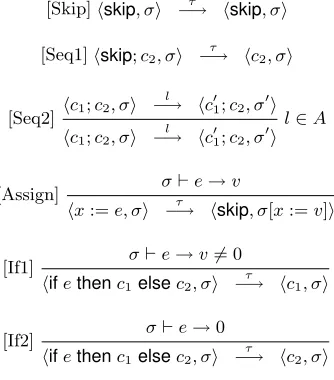
The simple interactive imperative language used for the examples above is essentially the same language defined in [14]. To demonstrate one possible instantiation of an IOLTS at the language level, we present a semantics for this language and observe that it does indeed define an IOLTS (see Figure 1). Note that the IOLTS for this particular language will be deterministic iff the expression evaluation relation is single valued (which will not be the case if the|operator is admitted).
4
Strategies and Non-Interference
We assume that a user at levelacan only observe input/output events on channelsb vaand that no user can seeτ actions (modelling internal state transitions), making this a timing insensitive model. Different traces may thus appear the same to a given user. We writet =a t0 to mean that two traces look the same to a user at levela. More generally, for a subset of security levelsA ⊆L, we writet =A t0to mean that
tA=t0A, wheretAistwith allτevents removed and with all IO eventsb?vandb!vremoved except those for whichb∈A. Each such=Ais clearly an equivalence relation on traces. Note that, since users at levelacan see events at levelaand below,=ais shorthand for=↓arather than={a}(wherever we actually
intend={a}we will write this explicitly).
4.1 Strategies
Each user provides inputs on the channel corresponding to his or her security level and is aware of the history of usage (both inputs and outputs) on all channels at or below that level. The behaviour of a user in choosing inputs on a channel may be influenced by this knowledge of the history (as when High uses Program 1 as a covert channel) and is modeled as a channel strategy: a function from what the user knows to the user’s choice of the next input on the channel. We allow strategies to be nondeterministic, thus we define them to be functions from traces to non-empty sets of values:
[Skip]hskip, σi −→ hτ skip, σi
[Seq1]hskip;c2, σi
τ
−→ hc2, σi
[Seq2]hc1;c2, σi
l
−→ hc01;c2, σ
0
i hc1;c2, σi
l
−→ hc01;c2, σ0i
[image:7.612.218.385.102.292.2]l∈A
[Assign] σ`e→v
hx:=e, σi −→ hτ skip, σ[x:=v]i
[If1] σ`e→v6= 0
hifethenc1elsec2, σi
τ
−→ hc1, σi
[If2] σ`e→0
hifethenc1elsec2, σi
τ
−→ hc2, σi
[While]hwhileedoc, σi −→ hτ ifethen(c;whileedoc)else skip, σi
[In]hinputxfroma, σi −→ ha?v skip, σ[x:=v]i
[Out] σ`e→v
houtputetoa, σi −→ ha!v skip, σi
Fig. 1.IOLTS semantics for a simple language
In the special case thatωais deterministic, we will writeωa(t) =vas shorthand forωa(t) ={v}. We use
ωfor arbitrary (ie possibly nondeterministic) strategies andδfor deterministic strategies.
A strategy modeling the behaviour of the program’s whole environment is a collection of individual channel strategies indexed by the security lattice. We say two strategies are equivalent with respect to a given security level if the channel strategies at and below that level are identical.
Definition 4. Astrategyωis anL-indexed family such that eachωais ana-strategy. LetStratdenote the set of all strategies. We writeω=a ω0to meanωb =ω0bfor allbva.
The interaction between a program and its environment is modelled by playing a strategy against a state of an IOLTS to produce a trace of input and output events. Letsbe a state of an IOLTS. Playing strategy
ωagainst statesmay produce tracet, writtenω |=st, iftis apossibletrace forsand, for every input eventa?vint,vis a value which may be chosen byωawhen applied to the sequence of events leading up to the input event. Formally:
Definition 5. ω|=st iffst andv∈ωa(t0)for allt0.a?v≤t, where≤is the prefix ordering on traces. We define three interesting sub-classes of strategy:
DS The deterministic strategies.
NS The “narrow” strategies. This is the class of strategies considered in [14] (the term “narrow” is ours; in [14] they are simply called strategies). These are deterministic strategies such that the user’s choice is influenced only by events on that particular channel, not by events on channels at lower security levels. The formal definition is as follows:
Definition 6 (Narrow Strategy).A strategyωisnarrowiff it is deterministic and, for alla, ift={a}t0
Strat
Narrow Strategies Deterministic Strategies
[image:8.612.165.437.97.373.2]Stream Strategies SS NS DS
Fig. 2.An inclusion hierarchy of strategies
SS The “stream” strategies. A stream strategy is just a family of streams (one for each channel) presented as a strategy. Concretely, each time a stream strategy is asked for an input on a channel it simply returns the next item in the stream for that channel. Each channel strategy in such a strategy returns a value which depends only on the number of inputs which have been requested on that channel so far, since this number is precisely the position in the stream which has been reached. For a channelawe say that tracest, t0 area-stream-pointer equivalent, writtent ./a t0, ifftandt0 contain the same number of
a-input events. A stream strategy is thus a family of channel strategies each of which respects stream-pointer equivalence:
Definition 7 (Stream Strategy).A strategyωis astream strategyiff it is deterministic and, for alla, ift ./a t0thenωa(t) =ωa(t0)
Figure 2 illustrates how these sub-classes form an inclusion hierarchy. It is straightforward to verify that the inclusions shown do indeed hold and are, in fact, strict:SS⊂NS⊂DS⊂Strat.
4.2 Non-Interference
Our definition of non-interference [8] is framed in terms of strategies and traces. It is a generalisation of Definition 1 from [14]. The definition says that a statesof an IOLTS is non-interfering for a given set of strategies if, for each user, any two strategies drawn from the set which look the same, also produce sets of traces which look the same, when played againsts.
Definition 8. LetW be a set of strategies. A statesof an IOLTS isnon-interfering forW (orW-NIfor short) iff
∀ω1, ω2∈W .(ω1=aω2 ∧ ω1|=s
t1
) ⇒ (∃t2. t2=a t1 ∧ ω2|=s
t2
)
We now explore the relationship between the NI properties corresponding to the sub-classes of strategy shown in Figure 2. We start with the obvious fact that inclusion of sub-classes of strategy implies reverse-inclusion of the corresponding NI properties:
Lemma 1. LetW1, W2⊆Strat. IfW1⊆W2thenW2-NI⇒W1-NI.
We thus immediately have a sequence of inclusions of NI properties which mirrors the inclusions shown in Figure 2:
Proposition 1. NI⇒DS-NI⇒NS-NI⇒SS-NI.
In Section 4.3, we establish that DS-NI and NI are actually equivalent. We conjecture that NS-NI is also equivalent to NI but verifying this is left for future work.
Note that SS-NI is essentially “property 1” from Section 3.1. By considering the sets of possible traces for the various programs in Section 3.1 it can be established, for example, that Program 1a is NI, whereas Program 1b is SS-NI but not NI. It is clear, therefore, that SS-NI is, in general, a strictly weaker property than NI. Nonetheless, we are able to show (Section 4.4) that fordeterministicIOLTS, SS-NI and NI are equivalent.
4.3 Non-Interference for Deterministic Strategies
The following theorem says that, to establish non-interference, it is only necessary to consider deterministic strategies.
Theorem 1. DS-NI⇐⇒NI.
By Proposition 1, to prove the theorem it is sufficient to show that ifsis DS-NI thensis NI. We prove the contrapositive.
Letsbe a state of an IOLTS and suppose thatsdoesnothave the NI property. Thus there must be two (possibly nondeterministic) strategiesw,w0, levelband tracetsuch thatw=bw0and:
1. w|=st
2. For allt0, ifw0|=s t 0
thent0 6=bt.
The key proof idea is to construct twob-equivalent deterministic strategies which, when played againsts, result in the same NI-violating behaviours asw,w0.
First, we derive a deterministic strategyθ(w)fromw, as follows. Letχ : (℘(V)− ∅)→Vbe some
function such thatχ(X)∈X. Then:
θ(w)a(u) =
v if∃u0=
a u. u0a?v≤t
χ(wa(u)) otherwise
It is necessary to show thatθ(w)is well-defined. In particular, we must show: a) ifu0=auandu00=auandu0a?v≤tandu00a?v0≤t, thenv=v0;
b) ifu=au0thenθ(w)a(u) =θ(w)a(u0). First we need the following technical lemma:
Lemma 2. Lett1a?v≤t2`be such thatt1./a t2. Thent2=t1and`=a?v.
Proof. Letni be the number ofa-input events in ti. Sincet1 ./a t2, we haven1 = n2. Now suppose
towards a contradiction thatt1a?v6=t2`, hencet1a?v≤t2. But then we would haven1+ 1≤n2, which
contradictsn1=n2. ut
Now we can established well-definedness ofθ(w).
Proposition 2. θ(w)is a well defined deterministic strategy.
a) By assumption ofu0 =
a uandu00 =a uwe haveu0 =a u00. Clearlyu0 =a u00 implies thatu0, u00 have the same number ofa-input events. Furthermore, by assumption thatu0a?vandu00a?v0 are both prefixes oft, one must be a prefix of the other. Thus, by Lemma 2,a?v=a?v0, hencev=v0. b) Supposeu=au0. If the first case in the definition ofθ(w)aapplies touthen, by essentially the same
argument as in a), it must also apply tou0and give the same result. If the second case applies, then,
sincewais ana-strategy,wa(u) =wa(u0), henceχ(wa(u)) =χ(wa(u0)).
u t
Next we derive a deterministic strategyλ(w0)from
w0. In this case we must ensure thatλ(w0)
a =
θ(w)afor allavb, since we wantθ(w) =bλ(w
0). We define: λ(w0)a(u) =
θ(w)a(u) ifavb
χ(w0a(u)) otherwise
The proof thatλ(w0)is a well-defined deterministic strategy is essentially as forθ(
w)and is omitted. It is immediate from the definition ofλ(w0)thatθ(w) =bλ(w0).
It remains to show that this pair of strategies constitute a counterexample to DS-NI and, for this, it suffices to show that:
1. θ(w)producestwhen played againsts.
2. The set of traces produced byλ(w0)is a subset of those produced byw0.
For the first of these, it is given thatst, so we need only show thatθ(w)a(u) =vwheneverua?v ≤t, and this is clear from the definition ofθ(w)a, sinceu =a u. For the second, say that strategyω0 refines strategyωiffω0a(u)⊆ωa(u), for alla,u. It is then immediate from Definition 5 that the refining strategy produces a subset of the traces of the original when played against the same state. Formally:
Lemma 3. Ifω0refinesωandω0|=su thenω|=su.
It is straightforward to verify that θ(w)refinesw and hence that λ(w0)refinesw0. This completes the proof that DS-NI⇒NI.
4.4 Non-Interference for Deterministic IOLTS
Here we establish our main result. That,for deterministic IOLTS, to establish NI it is only necessary to consider stream strategies. Thus, for deterministic systems, when reasoning about information flow it can suffice to work with a simple based semantic model of the environment and a corresponding stream-based definition of NI, rather than strategies.
Theorem 2. A statesof a deterministic IOLTS is NI iff it is SS-NI.
Corollary 1. For deterministic IOLTS: NI, DS-NI, NS-NI and SS-NI are all equivalent.
Given Proposition 1 and Theorem 1, to prove Theorem 2 it suffices to show that, for any state s of a deterministic IOLTS, ifsis SS-NI thensis DS-NI. Again, we prove the contrapositive.
Letsbe a state of a deterministic IOLTS and suppose thatsdoesnothave the DS-NI property. Thus there must be two deterministic strategiesd,d0, levelband tracetsuch thatd=bd0and:
1. d|=st
2. For allt0, ifd0|=s
t0
thent06=bt.
The proof mimics the one above for DS-NI⇒NI, but this time we derive stream strategies from determin-istic strategies. We derive the stream strategyφ(d)fromdas follows:
φ(d)a(u) =
(
v if∃u0 ./
au.d|=s
u0a?v
k otherwise
wherekis some (arbitrary) constant inV.
a) Ifu0./
a uandu00./a uandd|=s u0a?v
andd|=s
u00a?v0
, thenv=v0.
b) Ifu ./a u0thenφ(d)a(u) =φ(d)a(u0).
Part b) follows immediately from the definition ofφ(d)once we have shown a).
To show a) we make use of a lemma which states an expected consequence of determinism: if we play a deterministic strategy against any state of a deterministic IOLTS, there will be no branching in the set of traces produced.
Lemma 4. Letsbe a state of a deterministic IOLTS and letδbe a deterministic strategy. Ifδ|=st1 and
δ|=st2 then eithert1≤t2ort2≤t1.
Proof. Suppose, without loss of generality, thatlength(t1)≤length(t2). Proceed by induction onlength(t1)
to show thatt1≤t2.
Iflength(t1) = 0thent1=≤t2.
Iflength(t1)>0thent1has the formt01`1ands
t01
s01 `1
→s001. Thenlength(t01)<length(t2)and by
IHt01 ≤ t2, hencet01 < t2. Thus, for some`2,t01`2 ≤ t2 ands
t01
s02 `2
→ s002. Part 2 of the definition of deterministic IOLTS (Definition 1) entails (by a simple induction on the length oft01) thats02=s01. It thus remains to show that`1=`2. Suppose towards a contradiction that`1 6=`2. By part 1 of Definition 1 we
must have`1=a?v1and`2=a?v2. Then, sinceδ|=s
t01a?v1
andδ|=st 0 1a?v2
, we havev1∈δa(t01)and
v2∈δa(t01). But then, sinceδis deterministic,v1=v2, a contradiction. ut
Well-definedness ofφ(d)then follows:
Proposition 3. φ(d)is a well-defined stream strategy.
Proof. It remains to show that condition a) holds. That is, ifu0 ./a uandu00./a uandd |=s u0a?v
and
d|=s
u00a?v0
thenv=v0. Nowsis a state of deterministic IOLTS anddis deterministic, so, by Lemma 4, eitheru0a?v≤u00a?v0oru00a?v0≤u0a?v. Fromu0./auandu00./a uwe also haveu0./au00. Hence by
Lemma 2,v=v0. ut
Next we derive a stream strategyψ(d0)fromd0. Foravbwe defineψ(d0)a=φ(d)aand fora6vb
we deriveψ(d0)fromd0exactly as we derivedφ(d)fromd:
ψ(d0)a=
φ(d)a ifavb
φ(d0)a ifa6vb
The proof thatψ(d0)is a well-defined stream strategy is essentially as forφ(d)and is omitted. It is imme-diate from the definition ofψ(d0)thatφ(d) =bψ(d0).
For the final step in the proof that SS-NI⇒DS-NI we introduce the notion ofa-prefix: Definition 9. Traceuis ana-prefixofu0, writtenua u0, iffu=au00for someu00≤u0. We state without proof some obvious properties ofa:
– Ifa1va2thena2⊆ a1.
– Ifu≤u0au00thenua u00. – Ifu=a u0thenuau0.
We will use these freely in the remainder of the proof.
The proof is now essentially completed by the following lemma, which says that, when played against
s,φ(d)anddproduce exactly the same sets of traces (including, in particular,t), whereas every trace produced byψ(d0)is either also produced byd0or is not ab-prefix oft.
Lemma 5. 1. φ(d)|=su iffd|=s
u
Proof. The lemma holds vacuously ifuis not a trace ofs, so we need only show that it holds for allusuch thatsu. Let#I(u)denote the number of input events inu. We proceed by induction on#I(u). Take the
two parts in turn:
1. For#I(u) = 0we have bothφ(d)|=s
u
andd|=s
u
by assumption thats
u
.
In the inductive case, #I(u) = n+ 1, hence u0a?v ≤ ufor some u0 with#I(u0) = n. By IH
φ(d)|=s u 0
iffd|=s u 0
. Note that, sincea?vis the last input event inu, we have: (i) d|=s
u
iff(d|=s
u0
)∧(da(u0) =v) (ii) φ(d)|=su iff(φ(d)|=s u
0
)∧(φ(d)a(u0) =v) Thus it suffices to show that, ifd |= s u
0
thenda(u0) = φ(d)a(u0).Letda(u0) = w. Then, since
s
u0a?v
and the IOLTS is input-neutral, we havesu
0a?w
. Hence, sinceu0./au0, by definition ofφ(d)a we haveφ(d)a(u0) =w.
2. Assumeψ(d0)|=s
u
andubt. The base case is as for part 1. In the inductive case, again we have
#I(u) =n+ 1, henceu0a?v ≤ufor someu0with#I(u0) =n. By assumption ofub twe have
u0bt, hence by IHd0 |=s
u0
. Thus it suffices to showd0a(u0) =v. We proceed by cases according to whetheravb.
Ifa6vb, letw=d0a(u0). Then, sinces u0a?v
and the IOLTS is input-neutral, we haves
u0a?w
. Thus, by definition ofψ(d0),ψ(d0)a(u0) =w. But, by assumption ofψ(d0)|=s
u
, we haveψ(d0)a(u0) =v, hencew=v.
Ifavbthen, fromubt, we haveu0a?vat. Thusu00a?v ≤tandu00=au0, for someu00. Thus
da(u00) =da(u0) =v. But, sinced=bd0andavb, we haved0a=da, henced0a(u0) =v.
u t
Proposition 4. φ(d), ψ(d0)are a counterexample to SS-NI.
Proof. By part 1 of Lemma 5,φ(d)|=st. Now supposeψ(d0)|=s
t0
andt0 =b t. But thent0 b t
and hence, by part 2 of Lemma 5, d0 |= s
t0
, contradicting the original assumption that d,d0 are a
counterexample to NI. ut
This concludes the proof of Theorem 2.
5
Conclusions
We have defined a notion of Input-Output Labelled Transition System (IOLTS) suitable for modelling interactive programming languages. Following previous work by Wittbold and Johnson [16] and O’Neill, Clarkson and Chong [14] we have defined a notion of non-interference (NI) for IOLTS, modelling the users’ input behaviours as strategies. Our main result has been to show that, for deterministic IOLTS, a simpler definition of NI, based on a stream model of user input, is equivalent.
5.1 Non-interference and Nondeterminism
we prefer to differentiate: the use of nondeterminism to allow under-specification, and the use of nonde-terminism as a programming construct, essentially as a source of deliberate “noise” intended to disrupt information flows. It is this latter use which is relevant in the covert channel examples described above.
But there is a possible weakness in the security delivered by our version of NI for nondeterministic programs. Consider the following example:
input x from H if (1 | x) then
output 0 to L else
while (true) do skip
(Recall that|here is nondeterministic choice.) This program is NI by our definition. Whether it should be regarded as secure depends on our assumptions about the observability of non-termination in the presence of nondeterminism. If we wish to make the definition of NI sensitive to the possibility of non-termination in this example, we might use a more sophisticated definition based, for example, on a form of bisimu-lation rather than trace-equivalence. This approach would suggest transposing the problem into a process algebraic setting, as explored in [7] (see Section 5.2 for further discussion on this point). Alternatively, we might considerweakeningthe definition of NI to make it, more generally, termination insensitive. In the latter case it would be interesting to try to adapt the work of [5] to establish computational bounds on the rate at which information could be leaked.
5.2 Future work
Our longer term goal is to be able to reason about the security properties of programs in interaction with their environments in a compositional way. Ideally we do not want to treat these two actors differently. One stumbling block we face in achieving this is that a very common environment for a program is another program or even a set of programs. What is the relationship between programs and strategies?
A strategy is defined in Wittbold and Johnson [16] as a map from the history of inputs and outputs on a given channel to the next input on that channel. There is no computational content in that definition and, in general, a strategy could be non-computable (and clearly not representable by a program). On the other hand, not every program has a semantics which can be characterised as providing an appropriate input to another program whenever it is required. In fact the setting in which Wittbold and Johnson introduce strategies is a purely synchronous one in which inputs are always supplied to the program. So, in particular, a program written in the interactive core imperative language defined in this paper will not in general define a strategy for another program written in the same language, or even define a strategy at all. Consider for example a program which only updates its internal state and never engages with input or output at all.
If we assume the programs are interacting in an asynchronous fashion, a program which expects input on a given channel may never get it from the other programs in its environment. Even supposing a pro-gram is structured correctly so that it acts as a strategy for another propro-gram (and presumably vice versa) termination problems may mean that it never produces an expected output. For example:
P1:
input x from H; input z from L;
output (z XOR x) on H;
P2:
Program P2 will provide input for Program P1 onLonly some of the time. It could be described as a partial strategy. Any reasoning about environments formed from programs would have to take partiality into account.
There are two directions in which we could take this work.
We could continue to model environments as strategies and ask what kinds of systems could be strate-gies for each other and ask what kinds of constraints on the systems would that require. We have discussed some of the issues above but an interesting enquiry along these lines is the possibility of modelling the interaction using game semantics [1, 2, 9].
On the other hand, why constrain the model of the environment to be a strategy? Our use of IOLTS suggests some more general formal process model might be a suitable setting for extending our results, building on the foundational work of [7]. A potential issue to be addressed in this case would be that se-quentialityseems to be an essential characteristic of the deterministic programs on which we have focused. It may be that security properties such as NDC and BNDC as defined in [7] are so strong as to effectively rule out many sequential systems of interest.
Orthogonal to these two lines of enquiry is the question of probabilistic models of the the behaviour of the environment. With respect to strategies, for example, J¨urjens has shown [13] that Gray’s security prop-erty Probabilistic Noninterference (PNI) [12] is a generalisation of Wittbold and Johnson’s nondeducibility on strategies [16] while Aldini, Bravetti and Gorrieri have analysed probabilistic noninterference using a probabilistic process algebra [3, 4].
Acknowledgments
This work was supported by EPSRC research grant EP/C545605/1 & EP/C009746/1 (Quantitative Infor-mation Flow). Thanks to Aslan Askarov, Catuscia Palamidessi, Andrei Sabelfeld and David Sands for their encouragement and comments on early versions of this work. We also thank the anonymous reviewers for their very helpful criticisms and suggestions for improvement.
References
1. S. Abramksy and G. McCusker. Game semantics. In U. Berger and H. Schwichtenberg, editors,Logic and
Computation: Proc. 1997 Marktoberdorf Summer School, NATO Science Series. Springer-Verlag, 1998.
2. Samson Abramsky, Radha Jagadeesan, and Pasquale Malacaria. Full abstraction for pcf. Information and
Com-putation, pages 409–470, December 2000.
3. A. Aldini. Probabilistic information flow in a process algebra. InProc. CONCUR’01, volume 2154 ofLNCS,
pages 152–168. Springer-Verlag, August 2001.
4. Alessandro Aldini, Mario Bravetti, and Roberto Gorrieri. A process-algebraic approach for the analysis of
proba-bilistic noninterference.J. Comput. Secur., 12(2):191–245, 2004.
5. Aslan Askarov, Sebastian Hunt, Andrei Sabelfeld, and David Sands. Termination-insensitive noninterference leaks
more than just a bit. InProc. European Symp. on Research in Computer Security, 2008. to appear.
6. D. E. Denning. A lattice model of secure information flow.Comm. of the ACM, 19(5):236–243, May 1976.
7. R. Focardi and R. Gorrieri. A classification of security properties for process algebras. J. Computer Security,
3(1):5–33, 1995.
8. J. A. Goguen and J. Meseguer. Security policies and security models. InSymposium on Security and Privacy,
pages 11–20, April 1982.
9. Russell Harmer and Guy Mccusker. A fully abstract game semantics for finite nondeterminism. InIn Proceedings
of the Fourteenth Annual Symposium on Logic in Computer Science, LICS 99. IEEE Computer, pages 422–430. Society Press, 1999.
10. K. Honda, N. Yoshida, and Marco Carbone. Multiparty asynchronous session types. InPrinciples Of Programming
Languages, January 2008.
11. Sebastian Hunt and David Sands. Just forget it: The semantics and enforcement of information erasure. In
Proc. 17th European Symposium on Programming (ESOP’08), Budapest, Hungary, March 2008. Springer-Verlag (LNCS).
12. James W. Gray III. Toward a mathematical foundation for information flow security.sp, 00:21, 1991.
13. Jan J¨urjens. Secure information flow for concurrent processes. InCONCUR ’00: Proceedings of the 11th
14. Kevin R. O’Neill, Michael R. Clarkson, and Stephen Chong. Information-flow security for interactive programs.
InCSFW, pages 190–201. IEEE Computer Society, 2006.
15. C. E. Shannon. Channels with side information at the transmitter. IBM journal of Research and Development,
2(4):289–293, 1958.
16. J. Todd Wittbold and Dale M. Johnson. Information flow in nondeterministic systems. InIEEE Symposium on