City, University of London Institutional Repository
Citation
:
Corcoran, P. (2008). An exploratory study of the social representations of heroin and heroin users. (Unpublished Doctoral thesis, City University London)This is the accepted version of the paper.
This version of the publication may differ from the final published
version.
Permanent repository link:
http://openaccess.city.ac.uk/19635/Link to published version
:
Copyright and reuse:
City Research Online aims to make research
outputs of City, University of London available to a wider audience.
Copyright and Moral Rights remain with the author(s) and/or copyright
holders. URLs from City Research Online may be freely distributed and
linked to.
An exploratory study of the social representations of heroin
and heroin users.
Paula Corcoran
Department of Psychology
A thesis submitted in partial fulfilment of the
requirements of City University for the degree of
Doctor of Philosophy
IMAGING SERVICES NORTH
Boston Spa, WetherbyWest Yorkshire, LS23 7BQ www.bl,uk
THE FOLLOWING HAVE BEEN REDACTED AT THE
REQUEST OF THE UNIVERSITY
Table of Contents
Chapter 1 From the sublime to the grime 1
1.1 The aim of the thesis 1
1.2 A short review of the history of opium 4
1.3 Opium as a medicine 6
1.4 The role of the medical profession 7
1.5 The war on drugs 9
1.6 The impact of the links with crime 11
1.7 A changing society 13
1.8 Heroin: the poor man's drug 14 1.9 AIDS, the eighties and the stigmatised image 17 1.10 The social image of the heroin user 21 1.11 A different perspective of heroin 24 1.12 Treatment options in the UK today 28
1.13 Conclusions 31
Chapter 2 Heroin use: a matter of common sense 33
2.1 Introduction 33
2.2 Attribution theory 33
2.3 Research on attribution theory 38 2.4 Biases and other problems with attribution theory 40 2.5 How much information is actively processed? 42 2.6 From attribution theory to social representations
theory 42
2.7 The social representations approach 46 2.8 Forming social representations 50 2.9 Social representations and heroin use 55 2.10 Social representations and the media 56 2.11 Social representations and health psychology 58
2.12 Conclusions 62
Chapter 3 Comparing heroin use to other behaviours. 65
3.1 3.2 3.3 3.4 3.4.1 3.4.2 3.4.3 3.5 3.6 Introduction
Design and procedure Method of data analysis
The main themes of heroin and heroin users The impact of heroin
Control
Chapter 4 Media analysis of heroin use 107
4.1 Introduction 107
4.2 The media sources 107
4.3 Method of data analysis 110
4.4 Police Review 112
4.4.1 Crime 112
4.4.2 Demand reduction 115
4.4.3 The legalisation debate 119
4.4.4 The heroin users' environment 122
4.5 British Medical Journal 124
4.5.1 Death 125
4.5.2 Perceptions 129
4.5.3 Impact 132
4.6 Newspapers 133
4.6.1 Perceptions 134
4.6.2 The legalisation debate 141
4.7 Similarities and differences across themes 144 4.7.1 Perceptions of heroin users and the heroin
users' environment 144
4.7.2 Distinctions between the heroin user and the dealer 147 4.7.3 Prescribing and demand reduction 148
4.7.4 The legalisation debate 149
4.8 Conclusions 149
ChapterS Individual perceptions of heroin users 151
5.1 Introduction 151
5.2 Design and procedure 151
5.2.1 The vignette - Billy 152
5.3 Method of data analysis 159 5.4 The semi-structured interviews 161
5.4.1 Death 162
5.4.2 Control 164
5.4.3 Stigma 169
5.4.4 The heroin users' environment 171 5.6 Summary of interview findings 175
5.7 Billy - a vignette 176
5.7.1 Invisibility 176
5.7.2 Control 178
5.7.3 Death 181
5.7.4 Stigma 183
5.7.5 Perceptions 187
5.8 Heroin and associations with other drugs 189 5.9 Participants discussion of Billy and their own
experiences 195
Chapter 6 Social representations of a heroin user
6.1 Introduction
6.2 The impact of heroin 6.3 The nature of heroin users 6.4 The heroin arena
6.5 The legal status of heroin
6.6 Analysing and searching for social representations 6.7 Social representations of heroin
6.8 Heroin as addictive 6.8.1 Loss of control
6.8.2 The nature of heroin users 6.8.3 The impact of heroin 6.9 Heroin as bad
6.9.1 The heroin user as threatening 6.9.2 Undesirable behaviours
6.10 The heroin user as a threat and helpless 6.11 Anchoring and objectivity
6.12 Conclusions
Chapter 7 "At least I don't use heroin"
References Appendices 7.1 7.2 7.3 7.4 7.5 7.6 7.7 7.8 7.9 A B C D E F G H I Introduction
Attributions as part of the social representations process
From attributions to social representations Health and 'the Other' in western cultures Looking into the heroin arena
Health, responsibility and control
Implications for policies and treatment options Impact on drug campaigns
Conclusions
Standardised instructions for focus groups in study one
Questionnaire for the participants in study one Consent fonn for participants in study one The pilot study from study one
The coding frame for study one
A list of the articles from Police Review A list of the articles from BMJ
A list of the newspaper articles
The coding frame for the 40 Police Review articles in study two
J The coding frame for the 40 BM} articles
in study two 289
K The coding frame for the 40 newspaper articles
in study two 290
L Semi-structured interview schedule for
Study Three 291
M Questionnaire for the interviewees in study three 292
N Consent form for interviewees in study three 293
0 Coding frame for the interview data in study three 294
P Coding frame for the interview discussion of Billy
in study three 296
Q A table of themes for the super theme,
the impact of heroin 298
R A table of themes for the super theme,
the nature of heroin users 299 S A table of themes for the super theme
the heroin arena 300
T A table of themes for the super theme,
List of Tables
1.1 Estimated numbers of 16 to 59 year olds who have taken Drugs in their lifetime, in the last year and in the last month
(taken from BCS, 2005/0, p. 11). 3 1.2 Definitions of Tier 1 to Tier 4 interventions
(NTA, 2006, p. 20-23). 29
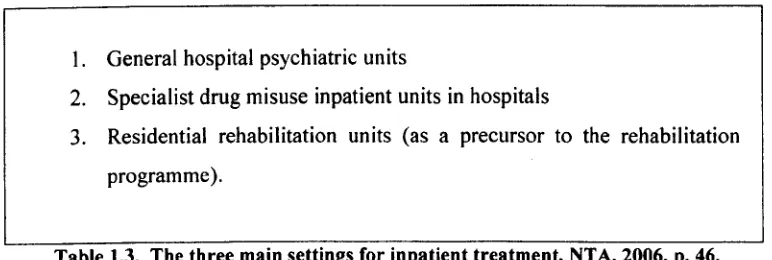
1.3 The three main settings for inpatient treatment
(NTA,2006) 30
2.1 Markova's (1982) Cartesian and Hegelian frameworks 48 3.1 Reported alcohol, tobacco and illicit drug use of male
participants. 72
3.2 Reported alcohol, tobacco and illicit drug use of female
participants. 73
3.3 An example of a coding frame from study one 78 3.4 Estimated no. of deaths per year, from obesity, alcohol
tobacco and heroin and morphine 79
3.5 Distribution of money (in millions) for health benefits
allocated to four categories from study one 80 3.6 Summary of attributions for all four categories in study one 105 4.1 An example of a coding frame for all four categories in study one 111
5.1 An example of a coding frame 152
5.2 Demographic details of interviewees by occupation, age and
ethnic origin 156
5.3 Reported alcohol, tobacco and illicit drug use of female
interviewees 157
5.4 Reported alcohol, tobacco and illicit drug use of male
interviewees 157
5.5 An example of a coding frame from the semi-structured
interviews 161
1.1
3.1
3.2
3.3.1
3.4
3.5 3.6 3.7 3.8
List of Figures
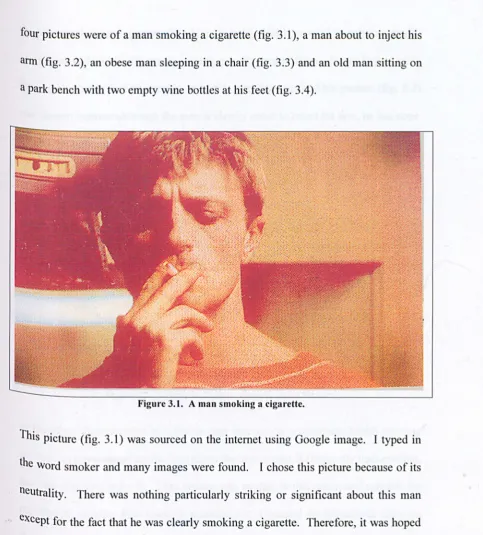
Poster of health campaign 'Heroin screws you up' A picture of a man smoking a cigarette
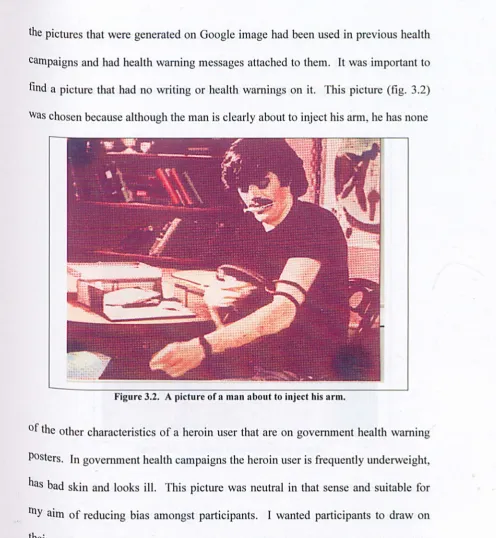
A picture of a man about to inject his arm A picture of an obese man sleeping in a chair
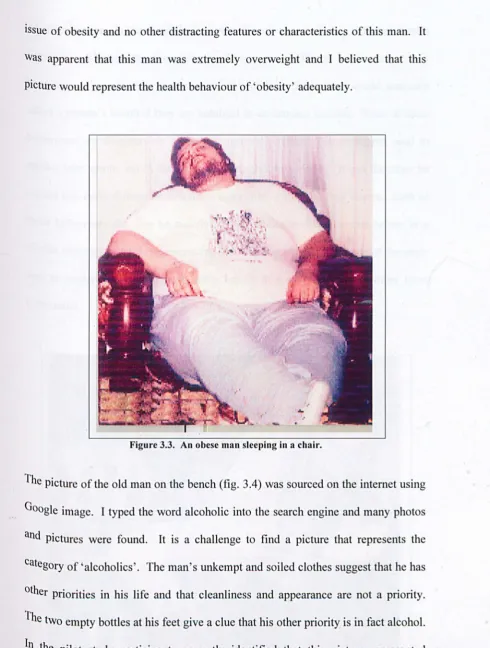
A picture of an old man sitting on a bench with dirty clothes and two empty bottles of wine
A picture of small children from the pilot study A picture of a pregnant lady from the pilot study A picture of a lady in a wheelchair from the pilot study A picture of an elderly man smiling from the pilot study
12
68
69 70
Acknowledgements
I would like to thank my supervIsor, David Marks, for his support and encouragement throughout this process. Thank you for your feedback and insights
on my work and your enthusiasm for a controversial topic. I would like to thank James Hampton for stepping in at the last minute, during David's absence and for
all his feedback and support. I would like to thank the Department of Psychology,
City University, for the opportunity to do this thesis. I would like to thank all my
Phd peers in the Psychology Department for all the fun and academic support,
particularly Kate Nicholls who was my 'wing-girl throughout. Thank you Kate for
being a true friend and a real support. I would like to thank the psychology department academics for all their valuable feedback and critical thoughts at the
annual presentations.
I would like to thank my family for all their never ending support and
encouragement and for never losing faith in me. I thank my mother (Kathleen
Corcoran) for all her financial assistance and -moral support and encouragement. I would like to thank all my dear friends who were a part of this journey and stuck by
me all the way. I would like to thank Jane and Billy for making their home, my
home. I would also like to thank Sarah for the music and all the adventures we
have had. I would like to thank my husband, Peter Mac1atchy for all of his love and support and encouragement and for never wavering in his belief in me.
I would like to thank all the participants who took part in this research, giving up
their time freely and willingly to help me out. Lastly, I would like to thank all the
clients I have worked with in the past seven years, who struggled with heroin
addiction but who showed courage and determination.
I grant powers of discretion to the University Librarian to allow the thesis to be
copied in whole or in part without further reference to the author. This permission
covers only single copies made for study purposes, subject to normal conditions of
Abstract
The aim of this PhD was to explore the social representations of heroin and heroin
users. There are an estimated 300, 000 heroin addicts in the UK today (NT A, 2008)
and despite the normalisation of other illicit drugs (Parker, Aldridge & Measham, 1998) this group remains marginalised and stigmatised in comparison to other
recreational drug users. Social representations (Moscovici, 1984) are formed
through social interaction and these shared representations allow individuals to
make sense of their social reality, providing a basis of references with which to
guide their relations to the world. Therefore a social representations approach was
used in order to gain a greater understanding of how this group is perceived within
society today.
Three studies were conducted in this research using focus groups, a media analysis
and semi-structured interviews. These studies provided the corpus of data which
was analysed using a content and thematic analysis (Joffe & Yardley, 2004). Two core social representations emerged from the data set and these were the social
representations of heroin as addictive and heroin as bad. I found that participants
distanced themselves from heroin users and distinguished between their own
recreational drug use and the behaviours of heroin users. The role of control and
responsibility were important dimensions in this process and a lack of control was
feared by most participants. The social representations showed that this drug
remains distinct from other recreational drugs and the heroin user was perceived as
an addict, a criminal and a patient at the same time. Implications for anti-drug
AA ANOVA
BMJ
CARAT
DAAT
DIP
DTTO
NA NDTMS
NTA
OA
peT
PTBRSA
SHA
SRA
Abbreviations
Alcoholics Anonymous Analysis of variance British Medical Journal
Counselling, assessment, referral, advice and through-care servIces
Drug and Alcohol Action Teams Drug Intervention Programme Drug Testing and Treatment Orders Narcotics Anonymous
National Drug Treatment Monitory System National Treatment Agency
Overeaters Anonymous Primary Care Trust Pooled Treatment Budget
The Royal Society for the encouragement of Arts, Manufactures & Commerce.
Strategic Health Authorities
Preface
Before I began this thesis I took some time to address my own attitudes to heroin
and heroin users. I am aware of the illegal status of heroin and of some of the
behaviours that are associated with heroin use. I have, however, in the course of
my personal career developed empathy for the clients I have worked with. It is important therefore to explain my background, working with this client group, and
to acknowledge how it may have influenced my attitudes. As a teenager in the
eighties I remember the media headline stories that associated intravenous heroin
use with AIDS. There were also stories about heroin users dying of overdose,
images of skinny young addicts with bad skin and dark haunted eyes. This was my
first knowledge of heroin and heroin users and at the time I was scared not only of
heroin but the people who used heroin.
I was a big Thin Lizzy fan and it came as a shock when the lead singer, Phil Lynott
died at a young age. The media attributed it to his heroin use and suddenly it
became clear to me as a young person that heroin addiction could lead to death.
Therefore, I knew it was a drug to be avoided. I didn't have much experience with
drugs myself. There was cannabis in my circle of friends and this was perceived as
something you do for a laugh. It was not serious. I knew some of my other friends used ecstasy at weekends but this was not something that interested me.
I began volunteering in a drop-in service, The Blenheim Project, in Portobello road
several years ago. It was just before I began this thesis. At this point in my life I
had not known anyone who had taken heroin and I myself had never tried heroin
either. I wanted to do this research because my primary interest was in
marginalised groups. However, I believed in order to research the field I wanted to
have some first hand experience.
I was nervous when I began this voluntary work, for the primary reason that I did
not know much about heroin use. I was concerned that some of the clients would
think I was a fraud. For me, it was like entering a new and mythical world. I was
meeting people I had only read about in the papers. These were the people you
corrupt you. I spent two years volunteering (2 shifts a week) at The Blenheim
Project and in that time I felt my whole perspective on heroin users began to
change. I learnt about the trials and tribulations of using heroin and watched as
week after week I saw people struggle with their plight. We had supervision and
in house training but my greatest learning came from listening to the clients
themselves who shared their experiences in a humbling way.
I began to work for an agency who placed me in drug and alcohol projects. This
work was part time but I began to grow in my knowledge and confidence and
found that this was a group of people I really enjoyed working with. I eventually
took a job working in a rehabilitation centre in Lewisham and facilitated weekly
groups. I was struck by the humbling efforts these clients had to make on a daily
basis to stop themselves going out in the community to use drugs. I was also
struck however by the levels of low self esteem and fear that I saw in front of me
every day. These young people were very aware of how their families and
communities perceived them and this hung heavily on their shoulders. It soon became part of my work to try to help these clients overcome their shame and to
rebuild their fragile self esteem.
For the past two years I have worked for a Housing Association, managing a unit
for chaotic heroin users who were street homeless. These clients are still using
drugs whilst they reside on the unit. My focus, with the help of a dedicated team,
is to provide interventions that will reduce the risks of drug use and seek to
motivate clients to consider detox and treatment services. I have found the work
challenging and rewarding. In the past year I have also been appointed manager of
a small aftercare project for clients leaving rehabilitation services. The focus of
this work is to support these clients to reintegrate fully into the community and to
remain abstinent.
Working with these clients has enabled me to get a closer look at this social
problem and to see for myself the day to day struggle that some of these drug users
face. The problems that these clients face are not just the addiction but the
complex world they live in, social problems, lack of self esteem, lack of education
clients face prejudice on a daily basis and sometimes this means they will avoid
accessing medical or legal support for fear of how they will be perceived. I am
still interested in this client group because they are a marginalised group. My work
has taught me however that heroin users are human beings too and there really is
Chapter one: From the sublime to the grime
1.1 The aim of the thesis
The aim of this thesis was to explore the social representations of heroin in society
today. A particular objective was to explore why heroin has become so detached
from other illicit drugs that are used recreationally? Illicit drug use is prolific
within society today despite years of government health warnings. Although heroin
is still used by only a small percentage of the UK population, an estimated 250-300,
000 persons, they are accredited and blamed for a large percentage of petty crime
(Tackling Drugs Changing Lives, 2008). In the 1980s government health
campaigns focused on heroin with the 'Heroin Screws You Up' campaigns. In the
1990s, however, the focus shifted to ecstasy with new government health warnings.
In the last ten years heroin use has risen again. My aim was to explore knowledge
of heroin within a random sample of the population, using focus groups and
semi-structured interviews. The media are a primary influence on social representations
(Farr, 1993) and for this reason I conducted a media analysis. Finally I focused on
the implications of the social representations that emerged from this research.
In this chapter I intend to briefly describe opiate use throughout the centuries and
the subsequent emergence of heroin, initially as a medicine and subsequently as a
recreational drug. I will explore the history of heroin use in the UK paying
particular attention to associations with negative imagery and stereotypes. I will
attempt to trace the shift in opinions about heroin and attitudes towards heroin users
about heroin users. Finally, I will focus on current UK drug policy and treatment
options and consider their implications for the contemporary heroin user.
It is difficult to get a clear picture of the number of heroin users in the UK today. Polydrug use is more common amongst young people (Parker, Aldridge &
Measham, 1998) and regional variations will have an impact on any attempts to
arrive at a national estimate. In the late 1960s there were approximately 3,000
known addicts in the UK. It was in this decade that conversation surrounding drug
taking began to concentrate on it as a growing social problem (Bean, 1974). It was not until the 1980s that heroin became, or was perceived as becoming, a large social
problem for many large cities in the UK (Pearson, 1987). By 1986, the national
prevalence estimate had risen sharply to a possible 100,000 heroin users
(Robertson, 1987). The number of estimated heroin addicts in the UK today is
believed, by some sources, to be 300, 000 (NT A, 2008) although this figure is not
represented in table 1.1 below.
One of the most thorough studies of adolescent drug practice was carried out by
Parker et al. (1998). They conducted a five-year survey into young peoples'
drug-taking habits in the north-west of England. From interviews and survey research
they developed a normalisation thesis. They found in their research that some
drugs (cannabis, but also nitrites, amphetamines, LSD and ecstasy) were so
pervasive and accepted, that their use was accepted by users and non-users as a
normal part of their everyday social structure. The research of Parker et al. (1998)
concluded that social conceptions of drug use had changed rapidly in the 1990s.
towards drugs (Parker & Measham, 1994). Table 1.1 shows that the use of heroin is higher than glues and anabolic steroids only. All other recreational drugs in this table far exceed the use of these three with cannabis being the most frequently used drug followed by 'any cocaine'.
User Ever Used last year Used last month
Drug
Class A
Any Cocaine 2,310,000 776,000 376,000
Cocaine powder 2,273,000 769,000 368,000
Crack cocaine 270,000 53,000 25,000
Ecstasy 2,279,000 502,000 216,000
Hallucinogens 2,968,000 338,000 84,000
LDS 1,733,000 83,000 25,000
Magic Mushrooms 2,311,000 302,000 68,000
Opiates 272,000 47,000 35,000
Heroin 203,000 39,000 23,000
Methadone 149,000 33,000 24,000
Class AlB
Amphetamines 3,655,000 426,000 176,000
Class B/C
Tranquillisers 868,000 118,000 64,000
Class C
Anabolic steroids 194,000 42,000 20,000
Cannabis 9,475,000 2,775,000 1,644,000
Not Classified
Amyl Nitrite 2,661,000 397,000 179,000
Glues 751,000 30,000 11,000
Total
Class A 4,416,000 1,082,000 513,000
Any Drug 11,075,000 3,329,000 1,990,000
Table 1.1 Estimated numbers of 16 to 59 year olds who have taken drugs m their lifetime, in
Last year and in the last month, (taken from Drug Misuse Declared, 2006 p.ll)
Notes:
1. Estimates are derived by multiplying the prevalence rate by the estimated population aged 16
to 59 in England and Wales.
2. The figures are calculated using population estimates provided by the Government Actuarial
[image:20.552.38.424.152.639.2]Despite the nonnalisation theory and the comfortable co-existence of non-users and
users, for many young people heroin is still seen as a 'hard drug' and not something
they would wish to try. In their studies Parker et al. (1998) found that most young
people see "taking hard drugs and actually injecting as anathema: a Rubicon they
will never cross" (p. 132). Popular beliefs about heroin are that it is highly
addictive and intrinsically linked to a life of crime (Robins, Compton, & Horton, 2000). Perhaps more dramatically, many still see heroin use as "the major, if not
greatest social evil of our times" (Robertson, 1987, p.43). Why then has heroin
become so detached from other illicit drugs?
1.2 A short review of the history of opium
In the midst of the current moral and legal debates about heroin it is easy to forget
that opiates, which are drugs like heroin derived from the opium poppy, have been
in use for centuries. In Galen's time opiates were allegedly used to cure such
ailments as vertigo, epilepsy, and even deafness (Scott, 1969). It was also used as a
medicine amongst the Ancient Greeks with Hippocrates referring to the opium
poppy as a narcotic painkiller and Aristotle referring to it as a hypnotic (Levinson,
2002). By the
i
h or 8th century AD the opium poppy was commonly used inChinese medicine.
Use in China became widespread and this caused great concern to the Emperor and
the authorities. The East India Company imported most of the opium for the
Chinese market from India. This was a British company and they became the main
opium suppliers to China using the opium grown in conquered lands from India.
transaction. In an attempt to stop widespread opiate use in China the Chinese
authorities introduced harsh laws but these were not affective. So in 1839 they
seized opium from British ships in Canton and spilled it all into the sea. The
British sent in troops to retaliate and the Chinese authorities were obliged to back
down (Berridge, 1996).
A similar incident in 1856 led to the second 'Opium War' and this resulted in the
British navy shelling Canton and consequently opening up other ports. As a result
the opium trade increased again with an estimated 15 million Chinese becoming
regular opium smokers. The Chinese authorities changed their approach and made
opium legal and also began to grow their own poppies. Within a few decades
Chinese opium production was greater than the Indian supplies and eventually
British sales and influence in China declined. Ironically, China eventually became
a main supplier for opium use in Europe in the twentieth century (Levinson, 2002)
It was the ramifications of drug-use in the Far East that eventually contributed to global controls. The US wanted to increase its economic importance within China
but also there was pressure from American missionaries within China and the
Philippines whose motives were mainly moral (Berridge, 1996). Afghanistan is
now accredited with supplying 80% of heroin to Europe. Since the war began
following 9/11 in the USA, Afghanistan has experienced an increasing economic
crisis for the general population. A farmer will now make more money growing
opium than other legal crops such as wheat or maize. One focus of the current war
has been the destruction of the opium poppy fields by the British and American
1.3. Opium as a medicine
Opium was used in the UK (and the rest of Europe) in medicines from the 1550s and by the 17th century drugs like laudanum a mixture of opium and alcohol -were used for all sorts of ailments including pain, insomnia, coughs, diarrhoea, period pains and for toothache and colic in babies (Berridge, 1999). This trend continued well into the 19th century with the availability of many opium-based medicines bought from grocery stores and use of opium by many famous writers and poets, such as Coleridge and De Quincey. Throughout much of the 19th century elixirs and patent medicines that were liberally laced with opiates were also on sale in most general stores in the USA (Conrad & Schneider, 1992). Grave concerns began to develop, however, as there was an augmentation in the number of deaths caused by opium overdose and this saw the emergence of the first controls on sales of opium in 1868 (Berridge, 1996).
both the USA and Britain. In 1874, again in Germany, heroin was first made from
morphine and yet again it was advertised as non-addictive. Heroin was now being
promoted as a substitute for morphine which was now believed to be addictive.
1.4 The role of the medical profession
The second half of the twentieth century saw the medical establishment form itself
into a body of increasing authority and power, moving from a loose confederation
of orthodox opinion to a powerful lobby which extended its influence into the
statutory and legal arenas, to the point where it became enshrined to an
unprecedented extent in the fabric of Western government. There were many
dimensions to this increase in medical power and influence, but none were more
ambitious, or successful, than its gradual transformation of opium from a popular
folk remedy into a controlled substance and, eventually, a professional monopoly
(Berridge, 1984).
Until the 1860s there was not and never had been such a thing as 'controlled
substance'. Broadly speaking, anyone could sell anything to anyone else and make
whatever claims for it they wished. But the notion was developing that, as public
health policies around hygiene and disease began to take effect, the supply of some
substances, such as poisons, should be brought under a tighter rein. Different
interested parties presented various suggestions as to how this should be done. The
recently formed associations of doctors - the British Medical Association and the
General Medical Council - made the case that the supply of poisons was a medical
But they faced competition from the ambitious and newly formed association of
chemists, the Pharmaceutical Society, keen to impress on government and public
alike that pharmacy was a skilled and responsible profession which could
effectively control and regulate the supply of opium by taking it out of the hands of
all its other suppliers and turning it over to the new breed of retail specialists. The
1868 Pharmacy Act marked both the successes of the pharmaceutical lobby and the
first legal step towards controlling the supply of opium. It stipulated that anyone
buying any of a list of poisons such as arsenic, cyanide or prussic acid, a list to
which opium was promptly appended, was obliged to do so from a registered
chemist, who in tum was obliged to record their name, the date and the quantity
purchased. The effect of this was slight, although it increased public confidence in
the safeguards around opium use, and led to a modest reduction in the number of
deaths by poisoning.
There has been an enduring tension in British national drug policy between medical
or legal forms of control. Home Office activities in the 1920s were concerned with
eradicating addiction completely. However the 1926 Rolleston report, which was
modelled on the 1914 Harrison Act of the USA, defined addiction absolutely as a
disease that required medical treatment. The report also legitimised maintenance
prescribing of morphine and heroin to addicts who could not otherwise function
(Berridge, 1984). Despite this report doctors still had to work within the law and
possession of heroin was still a criminal offence. What Rolleston signified,
however, was a reconciliation between legal and medical approaches. The
UK ever since. It is a balance that can shift over time as was seen in the AIDS
crisis of the 1980s.
The 'disease model of addiction' is the lasting legacy of this otherwise largely
ignored episode in medical science. The enduring belief that opiate use is a
'deviant' pleasure survives in today's official discourse, particularly terms like
'drug abusers' and 'drug misuse' which still have the hybrid qualities of clinical
diagnosis and moral judgement. The progress of the controls against opium
contributed to the preservation of the opinions of the medical profession in law.
This meant that someone caught with controlled opiate drugs was either a criminal
or a patient, depending largely on expert medical opinion.
This type of power developed in other areas at around the same time, for example,
the institution of a criminal insanity plea between 'guilty' and 'not guilty', was also
at the discretion of medical opinion. It was an extraordinary accomplishment for a
professional body which had barely existed fifty years before to become a
significant constitutional authority in areas of judgement which were, then as now,
by no means easy to distinguish from matters of opinion and intellectual fashion.
1.5 The war on drugs
There are many who argue that the war on drugs was a political crusade created by
Nixon and his supporters (O'Toole, 1999; Elwood, 1994). A campaign of this sort
provided a problem, i.e. a war on heroin, in which the president could become a
hero in the eyes of the voters. Ronald Reagan adopted the same campaign in the
relations winner for both presidents, probably most remembered for Nancy
Reagan's 'Just Say No' campaign. A declaration of war on drugs was clear proof
to the electorate of the presidents' commitment to a domestic agenda, a definite
vote winner.
It was the American press that finally launched its own attack on the use of the war
metaphor which it deemed inappropriate for understanding something as complex
as a national drug problem. The argument against this metaphor was that in order
to wage a war you must expect someone to be a winner. Bush himself eventually
conceded that this was something that would probably not happen in his lifetime
(Elwood, 1994). The war metaphor persists today in the public imagination,
however, mainly due to the lack of a suitable replacement. One of the main
impacts of this metaphor was the public perception of drug users and the drug
problem. It turned what many saw as a health and social problem into a
law-and-order problem instead. (O'Toole, 1999).
It is also crucial to consider the impact of the rhetoric of Reagan and Bush's
campaigns and the media commentary at that time. Much of the debate and
political commentary concentrated on the link between drugs and crime thus
creating the image of the drug user as a menace or threat to mainstream society.
Ivie (1974) pointed out that the rhetoric of the war on drugs has typically included
the image of a threatening other. The political advantage of this is to provide the
electorate with specific enemies that political leaders volunteer to defend the
country from. The problem of creating 'the Other' is central to this thesis, and it
are no longer involved in heroin use. Falco (cited in Elwood, 1994) argued that
"once we make drug addicts into the enemy, society has a tough time taking them
back in" (p.131).
1.6 The impact of the links with crime
There are many groups within society today that can be described as 'tentative
groups' because they are held together predominantly by a particular mindset.
Health is a good example of this. Smoking is one issue which has clearly defined
in-groups and out-groups. Obesity versus healthy eating is another. Physical
appearances or behaviours are strong indicators in both of these examples. The
eighties brought about the existence of many stereotypical images of heroin users,
mainly from the governments health campaigns such as figure 1.1 below. These
images focused mainly on the appearance of the heroin user and introduced the
association with weight loss.
Despite the changes in the working practice of most service providers in the
eighties with the onset of AIDS (see section 1.9) the Government was unwilling to
review the 1971 Misuse of Drugs Act. Despite the new approach to minimise the
harm associated with drug use this Act means many users won't present themselves
for treatment due to the fear of legal repercussions. There were also repercussions
for young people who were normally law abiding except for the occasional or
weekend use of recreational drugs. If they were caught it would lead to a criminal
conviction and they would then hold a criminal record. This could then have
serious implications for a young person's job opportunities, and perhaps totally
At first YOIl think YOIl can control heroin.
BIlt before long you'll start looking ill. losing weight and feeling like death.
Then one day you'll wake up /motr-ving that instead of you controlling heroin. it now controls you.
So. ila friend oNen you heroin, you know what to say.
HEROIN SCREWS YOU UP.
Fig. 1.1 Poster from the government campaign 'Heroin Screws you Up'.
New measures in drug policy in the late 1990s saw a shift in focus from health
issues to legal issues. This period saw the introduction of mandatory drug testing in
prisons (Criminal Justice and Public Order Act, 1994) and DTTOs that offered the
choice between imprisonment or compulsory rehabilitation treatment monitored by
regular urine tests and court reviews (Crime and Disorder Act, 1998). It was also in
the late nineties that a minimum of seven years imprisonment for any third offence
[image:29.542.32.528.26.680.2]The introduction of preventative policies and schemes and punishments for those
who are caught using illegal drugs have made little or no impression on the use of
illegal drugs in the UK. In fact there is evidence to suggest that illegal drug use is
now considered to be a 'normal' recreational activity by a whole generation of
young people (Parker et ai., 1998)
1.7 A changing society
Young (1999) examined the effects the changing job market in the 1970s and 1980s
had on society in his examination of The Exclusive Society. He argued that, "the market forces which transformed the sphere of production and consumption
relentlessly challenged our notions of material certainty and uncontested values,
replacing them with a world of risk and uncertainty; of individual choice and
pluralism and of deep-seated precariousness, both economic and ontological" (p.1).
Hobsbawm (1994) saw this shift from modernity to late modernity, following the
cultural revolution of the 1960s and 1970s, as the onset of the rise of individualism
and he argues that this brought a wide scale deconstruction of accepted values.
Everything which had seemed certain at the time, family, work and economic
security, was now coated in an aura of ambiguity. Young (1999) pointed out that,
"for the same market forces which have made precarious our identity and unsure
our future have generated a constant rise in our expectations of citizenship and,
most importantly, have engendered a widespread sense of demands frustrated and
Baumann (2001) too explored the precariousness of the late modem experience,
examining the allure of instant gratification in the absence of long-term security.
Modem consumerism is designed to provide short-term gratification to consumers
and thus creates an atmosphere of constant need. If we chart the change in the
music industry from vinyl records to music tapes to CDs and now to Ipods and
MP3 players, we can see how clever marketing also creates the belief that nothing
lasts forever but everything is replaceable. Baumann (2001) believed that in the
face of this insecurity it would seem logical to grab pleasurable opportunities where
presented as there seems no guarantee of what the future holds. He argued that "a
world saturated with uncertainty, and lives sliced into the short-lived episodes
required to bring instant gratification, aid and abet, support and reinforce each
other" (p.158).
1.8 Heroin: the poor man's drug
Parker et al. (1998) posit that heroin uptake is usually associated with poverty,
educational under-achievement and unemployment and surmise that "the least
worst scenario is that heroin 'trying' does not become accommodated within the far
larger 'recreational' drugs scene but remains predominantly associated with
'degrees' of social exclusion. The whole issue needs careful monitoring and
profiling" (p. 45-46). According to Parker et al. (1998) it is in the poorest estates
that heroin uptake is primarily found. This would suggest that it is more than
availability that is causing the rise in current heroin users. In order to understand
the latest outbreak it is crucial to understand the individual factors that contribute to
If we perceive heroin as a drug that exists amongst the poorest members of our
community then it could be viewed as a 'painkiller of the poor'. MacDonald and
Marsh (2002), looking at the rise of heroin use amongst the poorest members of
Northeast England, concluded that "it is not too difficult to understand heroin's
appeal in this context as a poverty drug; a form of self medication for the socially excluded, a drug that they find compelling because its pharmacological effects
'blank out' the day to day realities of their social exclusion" (P. 36). Goldberg
(1999) in his attempt to Demystify Drugs concurred that "much of what I have observed in the field can be best explained by the attempts of problematic
consumers to escape - escape from the past, from the present, from society, from
their feelings, from everything that passes through their heads, and from not having
any future" (p. 133).
So whilst there is research to show that contemporary heroin use is often associated
with the underclass and most socially excluded of our society, others manage to
exist in the same social environment and remain abstinent from all illicit drugs
(MacDonald et aI, 2002). Clearly it is not one factor alone that contributes to
heroin addiction but the combination of many factors that makes up the user's
individual biography. These findings merely serve as a reminder of the importance
of understanding heroin use in context and the dangers of stereotyping all heroin
users with the same characteristics. This merely leads to misunderstanding and
possibly hampers the possibility of providing the correct help and support.
It is important to note that problematic drug-use and addiction problems do not
factors such as poverty, social exclusion and co-morbid psychological problems (Gossop, Marsden, Stewart & Treacy, 2002). Further problems can emerge for those who are addicted to illegal drugs, such as, criminal involvement, social exclusion and alienation. In this thesis I am interested in exploring the effects these factors have on the participants' perceptions of heroin addicts and what impact, if any, these may have. Meyers and Miller (2001) advocated educational and employment-related services for treatment programmes in order to help ex-users tackle urgent and immediate problems in their social environment.
Many societal changes occurred in the 1980s which many believe contributed to this new outbreak of heroin use in the eighties. The end of the 1970s also saw changes in global trafficking patterns which meant a greater availability in cheap heroin coming into Britain from South East Asia (RSA 2007). There was widespread unemployment throughout the country due to a period of de-industrialisation. Jobs were no longer guaranteed, particularly for the semi-skilled or un-skilled and this led to social and economic marginalisation for a whole generation (Hutton, 1995). The Conservative Government ignored the impact of these changes in the employment market and chose to blame the victim instead (Buchanan & Young, 2000).
drug problem. Echoing the' Just Say No' campaign of the US, Thatcher launched
her own campaign which centred around the slogan 'Heroin Screws You Up' (see
fig. 1.1). However, many believe that the underlying message of both campaigns
was that heroin users threatened the fabric of society and one of the enemies in the
War on Drugs was the drug addict himself (Buchanan & Young, 2000). However,
things were about to change in a way that could not have been foreseen and were to
change the way drug workers and other professionals worked with intravenous
heroin users forever.
1.9 AIDS, the eighties and the stigmatised image
AIDS has become synonymous with deviant persons and excessive behaviours and
is most strongly associated with gay men and intravenous drugs users, namely
heroin users (Crawford, 1994). The first cases presenting with AIDS in 1981 were
identified among a group of homosexual men who had a history of sexually
transmitted diseases due to a promiscuous lifestyle. Soon other cases were
identified amongst intravenous drug users and haemophiliacs and it became
apparent that the form of transmission was through blood. In the eighties the main
focus of both the medical profession and the media was on the behaviour patterns
of those who had contracted AIDS in order to be certain how exactly transmission
occurred.
The media took a particularly moral stance on the subject and called into question
the lifestyles of those who had contracted the AIDS virus. Because of the media
perceived. Headlines such as 'Virus victims swirling in a cesspit of their own
making' and Spread of AIDS blamed on degenerate conduct' (Markova & Wilkie,
1987) helped to turn AIDS into a moral issue for all. Markova and Wilkie (1987)
argue that it is understandable that in an age of individualism it is accepted that a
person somehow deserves punishment for behaviour if it is deemed to be improper
by mainstream society.
Crawford's (1994) theories on the self and the unhealthy other show how a
post-modern society that is controlled by production and consumerism, differentiates
between an ideal healthy way of living and the unhealthy other. According to
Crawford the unhealthy other abandons Calvanistic and puritanical ideals and
adopts hedonistic behaviour resonant of the swinging sixties. The image of the
self-indulgent unproductive heroin addict has also become strongly associated with
AIDS. This mark of AIDS and other untold illnesses associated with this lifestyle
is a total inscription of otherness, as defined in Crawford's terms.
People who have AIDS face not only health challenges but social stigma as well.
Parallels can be drawn between the fear and stigma associated with tuberculosis in
the last century (Sontag, 1978) and the public reaction to AIDS today. "Similarly
today, AIDS means not only a life-threatening illness for which there is still no
cure, but also the very real possibility of public ostracism, stigma and rejection"
(Sontag, 1978, p.399). In terms of the heroin user, who may already be socially
excluded for their drug of choice, there is further rejection due to the fear of AIDS
a social reality as the illness itself. This fear, as we shall see later, is translated into
a discrimination against the at-risk groups" (Sontag, 1978, p. 399).
Sontag (1978) in her Illness as Metaphor, suggested that illness has always been used as a metaphor to support those in favour of the argument that society is corrupt
or unjust. She maintains that the use of imagery in discussing disease can be a
method of expressing concern for social order. Publicity surrounding AIDS also
demonstrates a concern for social order, for maintaining a familiar and comfortable
pattern of life. Crawford (1994) also explored the idea of how an 'at-risk'
unhealthy individual can have implications for greater society who are striving to
be healthy and therefore put off the idea of death as a probability in their lives. He
argued that health is vital to survival as being unhealthy can make the possibility of
death a bigger issue. It therefore makes sense that those who are healthy need to
protect themselves from unhealthy others. Crawford believes that one way to do
this is tfirough identity. The more distance one keeps from those who are unhealthy
the less chance one has of being touched by contagion. There seems to be even less
sympathy for those who are unhealthy due to their own behaviours (Crawford,
1994).
Markova and Wilkie (1987) identified two factors which have a strong effect on the
way public representations of AIDS are being formed today, namely, the
homosexual community and the media. The gay community is organised and
through their efforts to oppose repressive sexual legislation, has managed to forge a
more positive identity of their own. The media still has a lot of influence on the
community. Heroin users get attention in the media and regardless of whether it is intended to be negative or educational, it still interacts with the existing viewpoints of society and contributes to the formation, change and maintenance of the social representations that exist today.
The phenomenon of AIDS has a double impact on health promotion with heroin users. Firstly, it shifted the focus from a zero tolerant approach to one of harm minimisation. This saw the introduction of needle exchange programmes and a new awareness of the need to engage with this drug using group. It also meant, however, that there was a new stigma associated with heroin use. It was no longer just a moral or a legal issue, it was now a serious health issue also and the heroin user became part of the 'threatening other' (Crawford, 1994). AIDS was a key issue in shaping the drug policies of the time and a report on AIDS and Drug
Misuse states:
"We have no hesitation in concluding that the spread of HIV is a greater danger to individual and public health than drug misuse".
(Advisory Council on the Misuse of Drugs 1988: 17)
a zero tolerance approach to one of harm minimisation. New services such as
needle exchange, free condoms and practical health education were made available
in an attempt to prevent the spread of HIV / AIDS amongst intravenous heroin users.
1.10 The social image of the heroin user
Jay (2000) discussed the family of opiates, namely heroin, opium and morphine,
and recalled that heroin was once a 'medicine' whereas opium was sold by
'Chinese gangsters' (p. 51). He argued that these drugs are not just distinguished
due to their chemical differences but there are social and moral implications also.
"The drug has one name when it is the servant of progressive clinical practice, used
by medical authorities for the treatment of pain, and another when it is being used
by lay persons in the community for what some people consider to be their own
personal pleasure" (Jay, 2000,p. 52).
In the early decades of the 20th century drug addiction took on a new face, changing
from being 'a pathetic condition to a stigmatised one' (Courtwright, Joseph & Des
Jarlais, 1989). It is in the last century that heroin, in particular, was being portrayed
as a major social evil. The twentieth century has seen laws developed which are
designed to limit the availability of drugs in our society and punish those who take
part in drug taking which is deemed dangerous to themselves and to society.
Contemporary education aims to foster negative attitudes towards drugs in both
users and potential users. So what has caused this change in social attitude to both
In a society where there exists the normalisation of drug use and use is more prevalent than ever before the heroin user serves as a useful image, a negative stereotype of the 'other', in the preservation of an acceptable image of the self. Crawford (1994) described how the identity process works in this way by "protecting or reformulating self boundaries, reinforcing images or reimagening the other - is required of people as they respond to fears of contagion or stigma, as they adopt strategies to protect themselves from implication, that is, symbolic connection to 'infected' others and the negative characteristics ascribed to them" (p. 1348). In this way heroin use is not just a social crisis or a health crisis but a crisis of identity.
Crawford (1994) argued that "the language of health came to signify those middle class persons who were responsible from those who were not, those who were respectable from those who were disreputable, those who were safe from those who were dangerous, and ultimately those who had the right to rule from those who needed supervision, guidance, reform or incarceration" (p. 1349). In this way health is not only a signifier of identity but also a signifier of power.
and healthy, in fact it could be seen as a complete negation. Therefore the image of
the addict lies in conflict with this ideal image and is its antithesis. The addict is
'the Other', the unhealthy self, the one who breaks the law and doesn't contribute to
the economy or society in general. The heroin addict therefore symbolises the
complete opposite of what we should aspire to be in modem, middle class society.
Crawford (1994) explored the metaphorical layers of health and their connotations
of what it means to be a 'good, respectable and responsible' person. Crawford
identified health as the "key organising symbol for the good, moral responsible
self' (1994, p. 1347). Other studies have examined the moral components of health
(Blaxter, 1997) and identified a new moral phenomenon that is health (Crossley,
2003). In this way identity is sustained by the existence of 'the Other'. As
Crawford (1994) states "my point is that stigmatising images of the other are
founded in a social self which needs this other" (p. 1348). Therefore an identity of
a 'healthy self is sustained by the existence of an unhealthy other, the image
becomes stronger the greater the social distance.
The use of needles amongst a large percentage of heroin users is for some a
digression from the 'healthy self and creates the demarcation between the
recreational drug user and 'the Other', namely the heroin addict. One rarely hears
someone speak of a heroin user but rather the coined term 'heroin addict' is
phrased. This coined term itself reinforces the image of addiction and the negative
1.11 A different perspective of heroin
Pearson (1987) in The New Heroin Users attempted to get a true account from heroin users themselves of what the lifestyle entailed. This research introduced a discourse which highlighted the pleasure that can be achieved from using heroin. This is not an aspect of heroin use that is normally studied or reported. Ordinarily one associates heroin and the heroin user with negative images and stereotypes which focus on the negative aspects of this pursuit.
"It's just the nicest drug going, you feel just great! Just ... phoo ... blows your mind, like, you start nodding and .... "
(Eddie, 21 years, Merseyside)
(cited in Pearson, 1987, p. 26)
Much has been written on the negative features of heroin use and most of the health promotion discourse centres around the stereotype of 'inevitable decline' (Stimson, 1973). Despite this, the number of heroin users in the UK seems to have grown steadily in the last thirty years. This would suggest that there must be some positive features of this lifestyle to attract new recruits (Robertson, 1987). Many researchers have questioned this inevitable decline which is associated with a life of heroin use (Alexander, 1994; Davies, 1992; Robins, Helzer, Heselbrock & Wish,
1980). This decline is attributed mainly to the pharmaceutical properties of heroin itself and the strong hold this drug exerts over the user.
users. Zinbergs' argument was that the psycho-pharmacological effects of any
substance, including heroin in this case, occur in conjunction with the set and
setting of the individual and one should not be perceived as more influential that
another. Blackwell (1983) also investigated controlled heroin use and expounded
the importance of personal rules and social norms in the regulation of heroin use.
Shewan and Dalgamo (2005) had two main questions in their research, "(a) that
heroin is inevitably addictive, (b) that sufficient exposure to heroin leads ultimately
to intensive, prolonged and destructive use characterised by a range of negative
health and social outcomes" (p.35). Whilst acknowledging that there is little or no
empirical evidence that supports these theories, they conducted a longitudinal study
of 126 long-term heroin users. What was significant about this cohort was that they
had, at the time of the study, never been in any specialist treatment for their heroin
use.
Shewan and Dalgamo' s (2005) findings suggest that heroin should not be studied
on its pharmacological properties alone and found evidence for controlled heroin
use among their sample in Glasgow. The concept of controlled heroin use
challenges the pharmacentric model of heroin use, which suggests that the
pharmacological effect of the drug will over ride the will of the individual. Some
see this as a rhetorical ploy in the demonisation of drugs which are seen "as a form
of possession, by an evil substance rather than an evil spirit, with the victim's will
In total, what is being questioned here is the level of control the individual has
throughout their heroin using careers. Davies (1997) argued that "progress can
only be made along this route if the notion of addiction is seen for what it is;
namely, a preferred style of explanation whose primary purpose is functional. It removes blame and responsibility in a climate of moral censure" (p. 164). Davies
suggested that myths regarding the pharmacological powers of heroin coupled with
the legal and moral climate, leads to learned helplessness amongst heroin users and
an abdication of control and responsibility. It is a choice between being disliked for
your choices or pitied for your plight. Shewan and Dalgarno (2005) argue that "the
contribution of psychological factors in addiction is rarely disputed. Regarding
these factors as secondary is to neglect what would appear to be a component that is
equally as important as drug pharmacology in the addictive process" (p.46).
McSweeney and Turnbull (2007) also explored occasional and controlled heroin
u~ with a cohort of 51 heroin users and a follow-up study of 32 heroin users. They were also interested in exploring the assumption that heroin leads to inevitable
dependence and associated problems. They found that their sample contradicted
this assumption and identified many factors that enabled their cohorts to avoid total
dependence. The cohort identified the "value of being employed, having a partner,
focus, direction, support structures and non-heroin-using interests and friends as
factors insulating them from the risk of developing problematic or uncontrolled
patterns of use" (p. ix).
These findings therefore and those of Shewan and Dalgarno (2005) and Blackwell
the interaction of the drug, the set and the setting. All of these researchers
emphasised that they were not disputing the addictive nature of heroin or the
devastating effects it has on some peoples lives, they did however posit that their
cohorts are a group of heroin users who were previously under researched and
discounted.
Shewan and Dalgarno (2005) suggested the term 'unobtrusive heroin use' for the
heroin use described by the participants in their study and argue that this should
provide the starting base for future research. In fact, McSweeny and Turnbull
(2007) argued that "from a policy and practice perspective it is important to
examine this subset of users. Understanding how they use heroin can help us to
better understand the nature of dependence and it may also identify tactics for
helping dependent heroin users gain greater control over their drug use" (p. viii).
The latest government drug policies advocate in favour of drug treatment with the
aim of establishing abstinence from all illegal drug use. Harm reduction techniques
are encouraged for clients who are not ready to abstain, in an effort to reduce harm
to the heroin user and to the public at large. "Funding for drug treatment has
increased significantly since 2001 and has received substantial investment in the
last five years" (NTA, 2006a). An emphasis has been placed on new initiatives
which include 'testing on arrest' for trigger offences. People who test positive for
opiate use are encouraged to attend an initial assessment which will steer them into
treatment services. For some, this is a further example of the Governments efforts
1.12 Treatment options in the UK today
The National Treatment Agency (NTA) is a special health authority, set up in 2001
by the government, and its main focus is to develop the accessibility, capacity and
efficacy of treatment for drug misuse in England. The NT A outlines the national
strategies for supporting adults with drug addictions (NT A, 2006b) and within this
document the national strategies for supporting adults with drugs addictions are set
out. Data from the National Drug Treatment Monitoring System (NDTMS) for
2004/05 outlines that 67 per cent of individuals receiving structured drug treatment identified heroin as their primary drug of choice. Some clients reported crack
cocaine as their primary drug of choice but 13 per cent of those named heroin as
their secondary drug of choice. The document outlines guidelines for best practice
in the provision of good quality and effective drug treatment. This is provided
through the criminal justice system or the primary care system.
Under the 2005 Drugs Act new practices were introduced which include 'testing on
arrest' and 'required assessment' (NT A, 2006b, p.8). Individuals who are arrested
for trigger offences will be tested for drugs and offered a drugs assessment which
will include treatment choices through the Drug Interventions Programme (DIP).
Drug treatment is also offered in prison to inmates who have substance misuse
issues. Drug intervention programmes are provided to prison inmates through
clinical services, CARAT (counselling, assessment, referral, advice and
throughcare services) teams and the provision of rehabilitation programmes. An
individual with substance misuse issues can also access support from primary care
includes practices such as drug screening, provision of general medical services, advice and referral, triage assessments, harm reduction, methadone proscribing and medical monitoring both in the community and in detoxification services and residential rehabilitation (NT A, 2006b).
The NTA works with the local DAAT (Drug and Alcohol Action Teams) to commission appropriate drug services for their boroughs or regions (see Table 1.2). This is based on the four-tier model of commissioning. The national guidelines on Models of care are also based on the four tier model of intervention. A heroin user basically passes through this pathway of intervention if abstinence and a heroin free life is what is desired. What is noticeable in Table 1.2 is the regular use of the term 'specialised' treatments. Heroin users have a problem that needs expert intervention, in this case, medical interventions.
Tier 1
Tier 2
Tier 3
Tier 4
Definitions
Interventions include provision of drug related information and advice, screening and referral to specialised drug treatment.
Interventions include provision of drug-related information and advice, triage assessment, referral to structured drug treatment, brief psychosocial interventions, harm reduction interventions (including needle exchange) and aftercare.
Interventions include provision of community-based specialised drug assessment and co-ordinated care-planned treatment and drug specialised liaison.
Interventions include provision of residential specialised drug treatment, which is care planned and care co-ordinated to ensure continuity of care and aftercare.