2010
Service innovation framework
John TimmermanFollow this and additional works at:http://scholarworks.rit.edu/theses
This Thesis is brought to you for free and open access by the Thesis/Dissertation Collections at RIT Scholar Works. It has been accepted for inclusion in Theses by an authorized administrator of RIT Scholar Works. For more information, please [email protected].
Recommended Citation
Prepared for
The Rochester Institute of Technology College of Applied Science & Technology School of Hospitality & Service Management
Service Leadership & Innovation
JAMES W.JACOBS,JR.,PH.D.
Prepared by:
JOHN C.TIMMERMAN
November 26th, 2010
Design for Six Sigma 1.
Phases RequirementsDesign SpecificationsDesign ConceptDesign ValidationDesign Design for Culture Design Process
Quality Function Deployment Design Modeling Design Test
Change Management 2.
Processes
Characterization Design of Experiments
Failure Mode & Effects Analysis Relationship Diagrams TRIZ 3.
Analytical Methods
Brainstorming/Brainwriting Divergent/Tangent Thinking
Employee Ideas Research & Development Voice of the Customer 4.
Ideation Methods
Critical Success Factors 5.
Business Model
Strategy
Investment Metrics
6. Human Capital
Capabilities
Capacity Motivation
Culture
Collaboration
Senior Leadership
7. Environment Customers Em p lo ye
es Par
tn
er
“Innovation is the effort to create purposeful, focused
change in an enterprise‟s economic or social potential”
- Peter Drucker
Making Innovation Work
CHAPTER 1: INTRODUCTION
Purpose of the Study………5
Research Methodology………6
Chapter 2: QUALITATIVE DATA COLLECTION &ANALYSIS Interviews……….………7
Literature Review………..……….18
Thematic Analysis……..………40
Chapter 3: QUANTITATIVE MEASUREMENT &FINDINGS Survey Design………42
Survey Results………43
Survey Findings………...………..65
Chapter 4: CONCLUSIONS Key Findings……….………...………67
Conceptual Service Innovation Framework………...……..…………..69
Chapter 5: RECOMMENDATIONS Validation and Further Research……….………...……….71
Testing and Refinement…..……….………...…..…..…….……..…...74
APPENDIX A. Interview Invitation and Transcripts………...………..……76
B. Literature Review Transcripts………..………...…107
C. Survey Instrument Invitation and Questions………...………192
D. List of Figures……….……….…203
The purpose of this study is to identify critical success factors and important approaches that service companies can utilize in the design of products, services, and programs. It is
common for service companies to have design teams that are responsible for facilitating the innovation process. However, these design teams might not benefit from a systematic training and knowledge transfer process. Therefore, it is important to translate critical success factors and important approaches into a model that will serve as a common framework for both training and facilitating the innovation process.
Both qualitative and quantitative research approaches were utilized in this study that included interviews, literature searches, and an e-mail survey. The research process commenced by interviewing a diverse group of organizations to identify challenges and key factors for
implementing innovation. The second step of the study was comprised of a literature search to further explore the themes and approaches identified through the interview process. The final phase of the research process involved an e-mail survey that was administered to active senior and fellow members of the American Society for Quality (ASQ) to quantify the findings from the qualitative research to include the key themes and approaches.
The findings from the both the qualitative and quantitative findings suggest that innovation principles, methods, and tools have a broad application for service organizations in the design of products, services, and programs. Although there was directional alignment between service organizations and all other industries, certain approaches might be more important for service organizations. The service dominant key findings were used to construct a framework
Background & Significance of the Research:
The corporate infrastructure of service industries to include hospitality organizations often have design teams that are responsible for creating new programs, products, and services. It is common for the human capital of these design teams to be selected based upon business acumen, relationship skills, and rich field experience such as a hotel manager or regional director of operations. Although these candidates provide a strong baseline of operational experience which helps ensure feasibility of design, they do not always benefit from a systematic training process. Therefore, there is a protracted learning curve for new members of a design team to acquire innovation competencies and their effectiveness is sometimes determined by their individual experiences and not a systematic knowledge transfer process. The objective of this research study is to identify important practices for service design and translate these practices into a model of critical success factors and design approaches that will serve as a common framework for both training and facilitating the innovation process.
Hypothesis: There are innovation principles, methods, and tools that have broad application in the development of products, services, and programs to include service organizations.
Statement of the Problem (Research Questions):
What challenges do organizations face in implementing innovation?
Where do organizations learn how to implement and apply innovation approaches? Are there innovation approaches from other industries that can be applied to service?
Research Objective: Identify methods and tools that service organizations can apply in the design of new programs, products, and services.
The research methodology is designed to explore the subject of service innovation and test the hypothesis that innovation methods can be utilized in the design of services (Figure 1).
Research Design and Methods:
Process Approach
I. Qualitative Data Collection & Analysis.
&
II. Formulate & conceptualize the research.
1. Select the subject of interest: Service Innovation
2. Define the sub-area for literature review: Innovative methods and tools utilized to design service.
3. Conduct interviews with a diverse group of companies and practitioners to identify:
Challenges and Key Factors.
Tools and Systematic Methods.
Benchmarks, Practices and Bodies of Knowledge
4. Perform a comprehensive literature review to: Provide additional detail for the themes and
approaches discovered during the interview process. Identify new information related to terminology,
concepts, principles, theory, methods, and tools. III. Collect & Analyze Data
&
IV. Develop Themes
5. Synthesize the findings from the interviews and literature search into key themes.
V. Validate key themes and quantify the importance of methods and tools.
6. Translate themes, concepts, methods, and tools into an e-mail survey to validate and identify items of most use and
importance. VI. Operationalize the
Research
7. Translate the themes, concepts, methods, and tools into a design and development framework.
VII. Publish the Research 8. Publish the research findings: Innovation Thesis
Methodology:
The research process commenced by collecting the points of viewpoints from 27
organizations (denoted with a solid black bullet point in Figure 2 below) of which multiple businesses and departments were interviewed (denoted with a sub-bullet point). Most of the date was collected through telephone interviews ranging from 30- to 60-minutes over the period of August through September of 2010. These interviews targeted dimensions related to innovation that included challenges and key factors for implementation, effective tools and systematic methods, and benchmarks for innovation. Transcripts from the interviews are provided in Appendix A and interviewee names are not listed to ensure confidentially.
Consulting Service, Government
& Education Manufacturing
Accelper Consulting
Bottom Line Innovation
Associates, Inc.
Business Excellence
Solutions, Ltd.
Carpedia
Category One Inc.
IDEO
Mike Adams and
Company, LLC
Prophet
TARP Worldwide
The Gallup Organization:
o Talent Management
o Global Practices
The Michelli Experience
American Express
Career Education
Corporation
Cornell University
Malcolm Baldrige
National Quality Award Program
Marriott International,
Inc.
o Brand Management
o Creative
Monfort Institute
The Ritz-Carlton Hotel
Company, Performance Improvement Cadillac Corning DuPont Ecolab Electro-Motive Diesels, Inc.
Johnson & Johnson
Koyo Bearings
U.S.A. LLC
PepsiCo
Xerox Corporation
o Operations Group
o Lean Six Sigma
Challenges and Key Factors for Implementing Innovation Methods and Tools:
The first part of the interview included two questions (refer to Figure 3 below) that were
designed to stimulate a point of view related to challenges and key factors for implementing
innovation methods and tools. The questions generated a total of 205 responses of which
interviewees were able to provide multiple responses for each question.
Questions Responses
1. What challenges do organizations face in implementing innovation methods and tools?
100
2. Are there key factors that enable the effective deployment of innovation methods and tools?
105
Total 205
A thematic analysis was conducted for 100 responses related to challenges and 105 responses for
key factors. Although the phrasing of the questions was different, they both assessed the broader
dimension of implementation. Therefore, both questions were analyzed for cross-cutting themes
of which four themes represented 51% of the 205 responses (refer to Figure 4 below).
Top Four Cross-Cutting Themes Responses %
Culture: Employee attitudes, environment and involvement. 23 17%
Senior Leadership: Advocacy, risk-taking, and long-term view. 35 15%
Capabilities: Talent, training, and core competencies. 30 11%
Process: Effective methods, tools, and techniques. 16 8%
Other (capacity, collaboration, customer, investment, language, metrics, motivation, perspective, portfolio, priority, scope, strategy).
101 49%
Total 205 100%
Figure 3
Culture:
The cultural theme is comprised of employee attitudes toward innovation, the environmental
conditions for promoting innovation and the employee receptiveness toward participating in
innovation (find below verbatim comments that reflect these cultural factors).
Attitude:
“Employee attitude and how receptive are they when many already feel
overworked, is it the next corporate thing, as in flavor du jour?
“Employees’ personal opinions of themselves (I’m not creative)”
Environment:
“The single greatest pain point for organizations trying to implement
innovation tools and methods is that they do not have the proper mood and
mindset…Is the mood of the group compatible with creating?
Create a culture of sharing success stories about innovation such as sharing
victory session on web site with storytelling.”
Participation:
“Grass roots involvement in the process that creates ambassadors.”
“Creating a culture that can recognize if an idea doesn’t work with grass
roots buy-in.”
Senior Leadership:
The senior leadership theme is comprised of advocacy for innovation, risk-taking and
acceptance of failure as part of the innovation process, and a long-term view of innovation
requiring time to harvest result (find below verbatim comments that reflect these factors).
Advocacy:
“Leaders not embrace it (give a good speech but offload to training
department) – not showing-up for events related to the initiative.”
“Protecting an innovative group from organizational antibodies.”
Risk-taking:
Typical corporate management systems…built for predictability, efficiency,
and risk mitigation…innovation requires entrepreneurialism, risk-taking,
and contingency planning...”
“Leadership that creates an environment and ability to fail responsibly.”
Long-term View:
“Leadership desire for quick results, not ready to allow for an iterative
innovation process, and overall buy-in to the value of the concepts.”
“View of creating profitability for the brand’s long-term (incentive structurefor long-term success).”
Capabilities:
The capability theme is comprised of selecting the right talent for innovation, providing the
workforce with training resources for innovation and developing a core competency for
innovation (find below verbatim comments that reflect these capability factors).
Talent:
“Important to select the right profile of talent that has the natural ability to
be creative and complementing this talent with complementing members of
the design team.”
“Companies hiring in their own images”.
Training:
“Most organizations do not train individuals to be innovative, but rather to
be process conformists”.
“Training methodology should be instructor-led and hands-on vs.
self-training; it’s not just telling, training has to be experiential.”
Core Competencies:
“Use it or lose it: innovation is a skill and if it’s not practiced, it becomes
rusty and atrophies.”
“Lack of design thinking.”
Process:
The process theme is comprised of useful and effective methods, tools and techniques to
that enable the workforce and innovation team to innovate (find below verbatim comments
that reflect these process factors).
Challenges:
“Innovation processes are too cumbersome and focus on the presentation.”
“Highly structured tools can inhibit creativity and getting bogged down in
the details (first define purpose, vision, perfect customer experience).”
“PDCA (Plan, Do, Check, Act) reinforcing the shoot and aim approach.”
“Think-tanks do not help create a sense of urgency and are disconnected to
the business strategy.”
Key Factors:
“Stage launch workshops can save a couple months of work in defining
scope, outcomes, risk, and competencies.”
“Combining the art and science of innovation.”
“Experiment along the process is also part of the client change management
process.”
“Finding the starting point (point of inspirations).”
Effective Tools and Systematic Methods for Innovation:
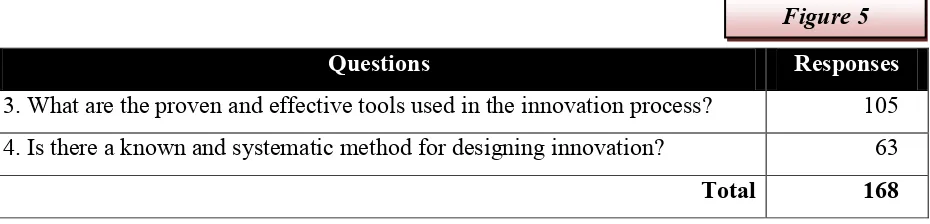
The second part of the interview included two questions (refer to Figure 5 below) that were
designed to stimulate a point of view related to effective tools and systematic methods for the
innovation process. The questions generated a total of 68 responses of which interviewees were
able to provide multiple responses for each question.
Questions Responses
3. What are the proven and effective tools used in the innovation process? 105
4. Is there a known and systematic method for designing innovation? 63
Total 168
A thematic analysis was conducted for 105 responses related to tools and 63 responses for
systematic methods. Although the phrasing of the questions was different, they both assessed the
broader dimension of innovation process and approaches. Therefore, both questions were
analyzed for macro themes that include idea generation, analytic and statistical methods, design
and process management (refer to Figure 6 below).
Macro Themes Responses %
Idea Generation 72 43%
Design and Process Management 55 33%
Analytical and Statistical Methods 41 24%
Total 168 100%
[image:14.612.76.541.269.381.2]Figure 5
Idea Generation:
The idea generation key theme is comprised of approaches that that help stimulate creativity and direction (find below in Figure 7 the Top Six Approaches and
Verbatim Examples).
Top Six Approaches & Verbatim Examples Responses %
Customer Insights (observation):
“Customer and process observations are the most powerful (see it through their eyes).”
“…identify customer pain points (real customer need).”
10 14%
Benchmarking:
o “Benchmark at the process, not industry level.”
o “Comparison of performance against others, and then determining what they do different.”
8 11%
Employee Idea and Suggestion Systems:
o “Creating employee conversations that solicit input….”
o “Idea program with a structured problem solving that is addressed by teams…”
7 10%
Voice of the Customer (questions and input):
o “Voice of the customer systems that generate and share positive and whacky ideas that stimulate innovation.”
o “Voice of customer feedback for validation.”
6 8%
Brainstorming:
o “…brain-writing and forced analogy describes the problem like an everyday problem.”
o “Spend time here - almost to the point of discomfort...”
5 7%
Innovation Networks:
o “Collaborating with key partners/suppliers…”
o “Dialog and test concept ideas with social media.”
5 7%
Other 31 43%
Total 72 100
%
Design and Process Management:
The design and process key theme is comprised of approaches that facilitate the innovation process (find below in Figure 8 the Top Four Approaches and
Verbatim Examples).
Top Four Approaches & Verbatim Examples Responses %
Design Modeling (prototyping):
o “…Creating the storyboard scene by scene to make changes and questions assumptions).”
o “Approach of defining results with change on process, system, and behavior with prototyping before
installation.”
9 16%
Design for Six Sigma (DFSS):
o “DMIAC (define, measure, analyze, improve, and control) tools for problem solving with an option for an innovation concentration with DFSS concentrated learning in an area of efficiency.”
o “DMADOV (define, measure, analyze, design, optimize, and verify).”
8 16%
Phase Gate Process/Stage Process:
o “5 Stage Gate process…We define innovation as converting ideas to dollars so it is taking the idea and commercializing it…”
o “Phase Gate Process with Phases: ideation, concept, feasibility, development, launch, post-launch
(postmortem).”
7 13%
Quality Function Deployment (QFD):
“Train innovation black belts on QFD - house of quality and design of product and process.”
QFD requirements…prioritization.”
3 5%
Other 27 49%
Total 55 100%
Analytical and Statistical Methods:
The analytical and statistical key theme is comprised of approaches for interpreting and
evaluating data (find below in Figure 9 the Top Three Approaches and Verbatim
Examples).
Top Three Approaches & Verbatim Examples Responses %
Characterization:
o “Tool to segregate the observations and quantify the problem and identify method changes.”
o “Process maps for analysis and communication.”
12 29%
Decision Criteria and Matrixes:
o “Prioritization and decision gating.”
o “Pugh matrix concept selection.”
7 17%
TRIZ:
o “TRIZ (Russian acronym for Theory of Inventive Problem Solving)
o “TRIZ (idea generation tool that gives alternative models and break a conflict).”
4 10%
Other 18 44%
Total 41 100%
Innovation Benchmarks, Best Practices and Bodies of Knowledge:
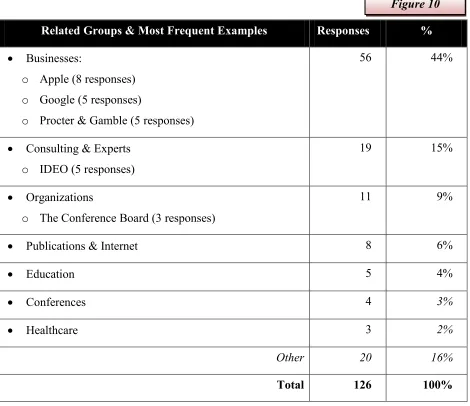
The final part of the interview included the question “5. What are sources for innovation
benchmarks, best practices, and body of knowledge?” This question was designed to identify
sources of information for innovation and role model organizations. Interviewees were able to
provide multiple responses for each question. The 126 responses were classified into seven
related and common groups with the most frequent examples for businesses, consulting/experts,
and organizations (refer to Figure 10 below).
Related Groups & Most Frequent Examples Responses %
Businesses:
o Apple (8 responses)
o Google (5 responses)
o Procter & Gamble (5 responses)
56 44%
Consulting & Experts
o IDEO (5 responses)
19 15%
Organizations
o The Conference Board (3 responses)
11 9%
Publications & Internet 8 6%
Education 5 4%
Conferences 4 3%
Healthcare 3 2%
Other 20 16%
[image:18.612.73.543.316.722.2]Total 126 100%
Methodology:
A literature search was conducted to further explore the themes and approaches identified from the interviews with 27 organizations (refer to Figure 2). The search was conducted across a robust list of sources (refer to Figure 11) and consisted of the terms “Innovation” and “Service Innovation.” The literature search of 65 sources targeted the dimensions of terminology, concepts, principles, theory, and methods/ tools (refer to Figure 12).
Information gathered from the review of literature helped provide supplementary definitions for the interview themes and additional examples of approaches. The transcripts from the literature review are provided in Appendix B of the report.
Primary Sources Date Ranges Items
Harvard Business Review 1999 to 2009 19
American Society for Quality 2003 to 2009 18
Barnes & Noble and Amazon 2001 to 2009 12
RIT Courses and Wallace Library 1998 to 2008 8
Interview Referrals 2005 to 2010 8
Total 65
Dimension Definition
Terminology
The technical or special terms used in a business, art, science, or special subject.
Concept An abstract or generic idea generalized from particular instances.
Principle A comprehensive and fundamental law, doctrine, or assumption.
Theory The analysis of a set of facts in their relationship to one another.
Method A systematic procedure, technique, or mode of inquiry employed by or proper to a particular discipline or art.
Tool Something (as an instrument or apparatus) used in performing an operation or necessary in the practice of a vocation or profession. Figure 11
Terminology:
The 65 literature sources were scanned for terminology that provide an array of perspectives for the definition of innovation (refer to Figure 13 for a sampling of the findings). Of the definitions discovered, the quote from Peter Drucker “Innovation is the effort to create purposeful, focused change in an enterprise‟s economic or social potential” provides a broad and holistic view of innovation (George, Works, & Watson-Hemphill, 2005). The central theme of the definition is highlighted in bold italics.
Definitions of Innovation
“The value added through applying creative ideas to a problem and implementing those ideas in the marketplace. ("Computer Sciences Corporation", 2007)
“An innovation is the conversion of a new idea into revenues and profits.” (Lafley & Charan, 2008)
“The successful implementation of creative ideas within and organization. (Iyer, 2007) “Introduction of something new” (Merriam-Webster Dictionary, 2010).
“Innovation is continually and efficiently developing and delivering breakthrough solutions by offering higher value to customers, achieving profitable growth for businesses, and gaining competitive advantages in the marketplace.” (Gupta, 2009) “Innovation is a new source of value in a commercial for-profit output enterprise that required a change in a business process to realize it…new ideas become embedded as business process creating value.” ("Air Products and Chemicals Inc.", 2007)
“A customer-valued solution for a customer-recognized problem.” ("Ethicon Endo-Surgery", 2007)
“Any idea or activity that materially improves the organization‟s performance is considered an innovation.” ("Hewlett-Packard", 2007)
“Innovation in critical thinking challenges conventional, historical, or traditional ideas… using cognitive processes helps us get the most from ourselves/team.” (Laman, 2007) “P&Gs managerial breakthrough was to conceive of and implement innovation as an integrated process based on the idea of customer is boss.” (Lafley & Charan, 2008) “Innovation in services is (a) change in things (products/services) which service organizations offers and (b) change in the ways in which they are created and delivered.” (Goncalves, 2007)
Capabilities:
Find enclosed below (Figure 14) concepts, principles and theories from the literature review that provide additional definition and examples for the theme of capabilities that was
previously identified from the interview process. From the analysis of the literature review, capabilities are defined as the workforce talent, training, and experience related to
innovation competencies.
Definition and Examples
Workforce Talent:
“Innovative entrepreneurs have something called creative intelligence, which enables discovery and differs from other types of intelligence. It is more than the cognitive skill of the right-brain. Innovators engage both sides of the brain as they leverage the five discovery skills to create new ideas.”
(Dyer, Gregersen, & Christensen, 2009)
“Left brain (analytical, logical, and sequential) and right brain (intuitive, values-based, and non-linear.) We can learn to expand our repertoire and act outside of our preferred styles, but this is difficult like writing upside down. To innovate
successfully, you musthire, work with, and promote people who are unlike you.” (Leonard & Straus, 1999)
Workforce Training and Experience:
“Teach creative thinking skills to include (1) systematic derangement of senses; (2) critical thinking and use of data; (3) allow time for thinking/ruminating.”
(Davila, Epstein, & Shelton, 2005)
“Experience makes the brain grow through observation and indirect experience. Working hard to play can increase our capacity to imagine and invent. Stifling play may decrease brainpower the same way deprived or abusive environments affect children in failing-to-thrive syndrome.” (Rigby, Gruver, & Allen, 2009)
NOTE: Highly related attributes are denoted withbold italics.
Capacity:
Find enclosed below (Figure 15) concepts, principles and theories from the literature review that provide additional definition and examples for the theme of capacity that was
previously identified from the interview process. From the analysis of the literature review, capacity is defined as the human resources and available time to work on innovation.
Definition and Examples Human Resources:
“If you give a good idea to a mediocre team, they‟ll screw it up. But if you give a mediocre idea to a great team, they’ll make it work.” (Catmull, 2008)
“Select small, talented, and diverse teams:
o Brooks law (adding people increases complexity).
o Bezo‟s Law of Two Pizzas (team only large enough to eat two pizzas).
o Chamber‟s Law of World-class (select best talent).”
(Davila, Epstein, & Shelton, 2005)
Available Time to Work on Innovation:
“Creating time and space in people‟s lives for reflection, ideation, and
experimentation.” (Skarzynski & Gibson, 2008)
“Blind Hog Theory of “Even a blind hog can find an acorn if he roots around
an oak tree long enough.” (George, 2003)
“Maintain threshold of 65% utilization to promote innovation and lead-time (incorporate buffer time).” (Davila, Epstein, & Shelton, 2005)
NOTE: Highly related attributes are denoted withbold italics.
Collaboration:
Find enclosed below (Figure 16) concepts, principles and theories from the literature review that provide additional definition and examples for the theme of collaboration that was previously identified from the interview process. From the analysis of the literature review, collaboration is defined as the open internal and external networks for collecting ideas and co-creating innovation.
Definition and Examples Open Networks:
“Enlarging the innovation pipeline requires:
o Involve many minds (customers, suppliers, partners).
o Sow enough seeds (it‟s a numbers game and need to generate a lot of ideas to net
a few big winners).
o Widen the front-end (broad range of opportunities, not only product, cool design,
and technology).
o Ideate around specific themes (create “aiming” points such as corporate
challenges, customer problems, or industry issues.” (Skarzynski & Gibson, 2008)
Co-creating Innovation:
“Value networks: The context within which a firm identifies and responds to customers‟ needs, solves problems, procures input, reacts to competitors, and strives for profit. “ (Christensen, 2003)
“Co-creation of value: N=1 The capacity to serve individual customers – that is, personalization and co-creation of value – will demand capabilities to work with customers to anticipate and predict their preferences on a continuous basis. R=G
Global access to resources and talent (resources, speed, scalability, innovation arbitrage.” (Prahalad & Krishnan, 2008)
NOTE: Highly related attributes are denoted withbold italics.
Culture:
Find enclosed below (Figure 17) concepts, principles and theories from the literature review that provide additional definition and examples for the theme of culture that was previously identified from the interview process. From the analysis of the literature review, culture is defined as the employee attitudes toward innovation and involvement in the innovation process.
Definition and Examples
Employee Attitudes:
“Ways to put your company on a more creative track:
o Encourage employees to take more risks.
o Encourage employees to challenge their own perceptions.
o Think positively.
o Encourage visioning.
o Employ rebels.
o Allow time for pet projects.” (Wetlaufer, 1999)
Employee Involvement: Pixar‟s Operating Principles:
o Everyone must have the freedom to communicate with anyone.
o It must be safe to offer ideas.” (Catmull, 2008)
“IDEAS concept for culture:
o Inclusive of diverse thinking and ideas.
o Decisive to eliminate organizational politics.
o External to focus on the customer.
o Agile to react and comfortable in taking calculated risks.
o Simple streamlining the process.” (Lafley & Charan, 2008)
NOTE: Highly related attributes are denoted withbold italics.
Customer:
Find enclosed below (Figure 18) concepts, principles and theories from the literature review that provide additional definition and examples for the theme of customer that was
previously identified from the interview process. From the analysis of the literature review, customer approach is defined as the understanding the customer experience, collecting consumer insights, and identifying their unspoken needs.
Definition and Examples
Understanding the Customer Experience
“Give customers a backstage pass and inform them of what’s happening in the process.” (Kelley & Littman, 2001)
“A resulting experience is:
o An event (or sequence of events), physical and or mental, which happens in the customer‟s life as a result of doing what some business proposes.
o The end-result consequence of this event for the customer.
o In comparison to a customer‟s alternative experience, superior, equal, or inferior.
o The value for the customer of their relative consequence.
o Specific and measureable: one can objectively determine if the customer experienced the events, consequence, and value compared to alternatives.” (Lanning, 2000)
Identifying Insights ad Unspoken Needs
“Ethnography is a holistic view of the customer, expose tribal knowledge, and identify customer frustrations.” (Davila, Epstein, & Shelton, 2005)
“Customer experience mapping: Developing a deep, empathic understanding
of what it feels like to be a customer at every stage of the demand chain”. (Skarzynski & Gibson, 2008)
NOTE: Highly related attributes are denoted withbold italics.
Investment:
Find enclosed below (Figure 19) concepts, principles and theories from the literature review that provide additional definition and examples for the theme of investment that was
previously identified from the interview process. From the analysis of the literature review, investment is defined as the financial resources provided to build the infrastructure and support innovation projects.
Definition and Examples
Financial Investment:
“Invest in the detection of ideas.” (Davila, Epstein, & Shelton, 2005)
“DuPont‟s $EED grant application” for provides funding based upon the merit of the idea. (Prather, 2009)
“Model of the value of design-driven innovation that creates shareholder value:
o Profits (volume, margins, profit from other products).
o Assets (brand equity, competitive position, customer loyalty, knowledge, network position).
o Investments (marginal and cumulative).” (Verganti, 2009)
“Funding for Game-Changer ideas ranges from 5- to 10-percent of Shell‟s Exploration and Production.” ("Fostering Radical Innovation at Shell", 2009)
Financial Returns:
“Pursuing an innovation strategy requires coming to terms with:
o Return on innovation.
o Rate of innovation.” (Gupta, 2009)
“Measures of innovation:
o Organic growth
o ROIC Measures”
(Davila, Epstein, & Shelton, 2005)
NOTE: Highly related attributes are denoted withbold italics.
Language:
Find enclosed below (Figure 20) concepts, principles and theories from the literature review that provide additional definition and examples for the theme of language that was
previously identified from the interview process. From the analysis of the literature review, language is defined as the shared organizational definition and framework for innovation.
Definition and Examples
Language:
“Dominant logic is the lens through which new data is interpreted.” (Prahalad & Krishnan, 2008)
“Value delivery system (determines all revenue and cost):
o Chose a value proposition.
o Provide this value proposition.
o Communicate this value proposition.”
(Lanning, 2000)
Framework:
“Three frameworks representing the domain of innovation:
o Economics of innovation.
o Category dynamics that surrounds innovation.
o Business architecture.” (Moore, 2008)
“Levels of offerings to include:
o Commodity: Charging for stuff (noise).
o Goods: Tangible things (data).
o Service: Activities you execute (information).
o Experience: Time customer spends with you (knowledge).
o Transformation: Demonstrated outcome the customer achieves (wisdom).” (Pine & Gilmore, 1999)
NOTE: Highly related attributes are denoted withbold italics.
Metrics:
Find enclosed below (Figure 21 concepts, principles and theories from the literature review that provide additional definition and examples for the theme of metrics that was previously identified from the interview process. From the analysis of the literature review, metrics is defined as the qualitative and quantitative leading indicators and result measures for innovation.
Definition and Examples
Enterprise Metrics
“Top 10 Outcome metrics (2008 McKinsey Study):
o 16% Revenue growth from new products or services.
o 13% Customer satisfaction with new products or services.
o 10% Number of ideas in the pipeline.
o 8 % R&D spending as a percentage of sales.
o 8% Percentage of sales from new products/service in a given time period.
o 8% Number of new products and services launched.
o 6% Return on investment (ROI) in new products and services.
o 6% Number of R&D projects.
o 4% Number of people actively devoted to innovation.
o 4% Profit from new products and services.”
("Innovation Metrics", 2008)
Process Metrics: “Measures:
o “Average engineering hours per project.
o Average development time.
o Employees per project.
o Ratio of delayed projects.
o Achievement of quality after launch.” (Yang & EI-Haik, 2008)
Motivation:
Find enclosed below (Figure 22) concepts, principles and theories from the literature review that provide additional definition and examples for the theme of motivation that was
previously identified from the interview process. From the analysis of the literature review, motivation is defined as the incentives, rewards, and recognition that reinforce the
importance of innovation.
Definition and Examples
Incentives and Rewards
“Nearly 40% of executives disagree to some extent with the statement that innovation metrics are aligned with individual performance incentives.” ("Innovation Metrics", 2008)
“Use metrics and incentives:
o Focus resources on valuable areas of innovation.
o Capture innovation performance and highlight gaps.
o Encourage desired behavior, results, and mitigate antibodies.” (George, Works, & Watson-Hemphill, 2005)
“The Chairman‟s Award for Excellence with winners receiving $70K in cash and
stock.” ("Air Products and Chemicals Inc.", 2007)
Recognition and Reinforcement
“Ethicon Endo-Surgery recognizes successful innovation with a wall of fame and communicates idea via web sites, newsletters, and meetings.” ("Ethicon Endo-Surgery", 2007)
“Computer Sciences Corporation administers an innovation award and call for papers…winners are recognized in weekly webcasts that are available for all employees.” ("Computer Sciences Corporation", 2007)
NOTE: Highly related attributes are denoted withbold italics.
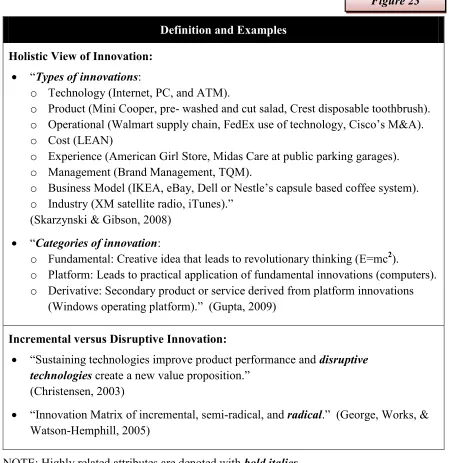
Perspective:
Find enclosed below (Figure 23) concepts, principles and theories from the literature review that provide additional definition and examples for the theme of perspective that was
previously identified from the interview process. From the analysis of the literature review, perspective is defined as the holistic view of innovation from incremental to disruptive innovation.
Definition and Examples
Holistic View of Innovation: “Types of innovations:
o Technology (Internet, PC, and ATM).
o Product (Mini Cooper, pre- washed and cut salad, Crest disposable toothbrush).
o Operational (Walmart supply chain, FedEx use of technology, Cisco‟s M&A).
o Cost (LEAN)
o Experience (American Girl Store, Midas Care at public parking garages).
o Management (Brand Management, TQM).
o Business Model (IKEA, eBay, Dell or Nestle‟s capsule based coffee system).
o Industry (XM satellite radio, iTunes).” (Skarzynski & Gibson, 2008)
“Categories of innovation:
o Fundamental: Creative idea that leads to revolutionary thinking (E=mc2).
o Platform: Leads to practical application of fundamental innovations (computers).
o Derivative: Secondary product or service derived from platform innovations (Windows operating platform).” (Gupta, 2009)
Incremental versus Disruptive Innovation:
“Sustaining technologies improve product performance and disruptive technologies create a new value proposition.”
(Christensen, 2003)
“Innovation Matrix of incremental, semi-radical, and radical.” (George, Works, & Watson-Hemphill, 2005)
[image:30.612.69.518.249.712.2]NOTE: Highly related attributes are denoted withbold italics.
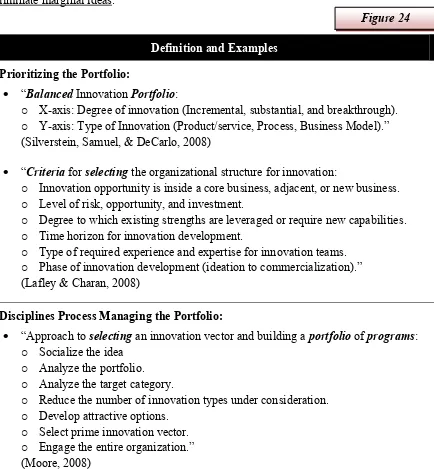
Find enclosed below (Figure 24) concepts, principles and theories from the literature review that provide additional definition and examples for the theme of portfolio that was
previously identified from the interview process. From the analysis of the literature review, portfolio is defined as the prioritization of innovation projects and a disciplined process to eliminate marginal ideas.
Definition and Examples
Prioritizing the Portfolio:
“Balanced Innovation Portfolio:
o X-axis: Degree of innovation (Incremental, substantial, and breakthrough).
o Y-axis: Type of Innovation (Product/service, Process, Business Model).” (Silverstein, Samuel, & DeCarlo, 2008)
“Criteria for selecting the organizational structure for innovation:
o Innovation opportunity is inside a core business, adjacent, or new business.
o Level of risk, opportunity, and investment.
o Degree to which existing strengths are leveraged or require new capabilities.
o Time horizon for innovation development.
o Type of required experience and expertise for innovation teams.
o Phase of innovation development (ideation to commercialization).” (Lafley & Charan, 2008)
Disciplines Process Managing the Portfolio:
“Approach to selecting an innovation vector and building a portfolio of programs:
o Socialize the idea
o Analyze the portfolio.
o Analyze the target category.
o Reduce the number of innovation types under consideration.
o Develop attractive options.
o Select prime innovation vector.
o Engage the entire organization.” (Moore, 2008)
[image:31.612.78.512.222.691.2]NOTE: Highly related attributes are denoted withbold italics.
Priority:
Find enclosed below (Figure 25) concepts, principles and theories from the literature review that provide additional definition and examples for the theme of priority that was previously identified from the interview process. From the analysis of the literature review, priority is defined as the imperative or burning platform that creates a sense of urgency for innovation..
Definition and Examples
Imperative for Innovation:
“Management practices that allow companies to be leaders in mainstream markets are the same practices that cause them to miss the opportunities offered by disruptive technologies. Well managed companies fail because they are well managed.” (Christensen, 2003)
“If diligence, persistence, and commitment are lacking, companies are unlikely to succeed at the business of innovation. – Peter Drucker”
(Drucker, 1999)
Sense of Urgency for Innovation:
Create “Burning platform for innovation.” (Davila, Epstein, & Shelton, 2005)
“Change management:
o Identify the burning platforms (shareholder value analysis).
o Concrete picture of how people‟s lives will be different.
o Change management meeting agendas.” (George, 2003)
[image:32.612.80.512.230.639.2]NOTE: Highly related attributes are denoted withbold italics.
Process:
Find enclosed below (Figure 26) concepts, principles and theories from the literature review that provide additional definition and examples for the theme of process that was previously identified from the interview process. From the analysis of the literature review, process is defined as the available and effective methods, tools, and techniques for innovation projects.
Definition and Examples
Methods, Tools, and Techniques: “Methodology of:
o Understand the market, client, technology and perceived constraints of the problem.
o Observe people in real-life situations to find what makes them tick, confuses them, what they like/dislike, and latent needs.
o Visualize the concept and delivery process.
o Evaluate and refine the prototypes in a series of quick iterations.
o Implement the concept for commercialization.” (Kelley & Littman, 2001)
“Design process with customer involvement and feedback cycles across:
o Idea generation.
o Design options.
o Prototypes.
o Pilot.
o Production.
o Release.”
(Davila, Epstein, & Shelton, 2005)
“Breakthrough innovation consists of three phases:
o Discovery: Creating or identifying high-impact market opportunities.
o Incubation: Experimenting with technology and business concepts to design a viable model for new businesses.
o Acceleration: Developing a business until it can stand on its own.” (O‟Conner, Corbett, & Pierantozzi, 2009)
Scope:
Find enclosed below (Figure 27) concepts, principles and theories from the literature review that provide additional definition and examples for the theme of scope that was previously identified from the interview process. From the analysis of the literature review, scope is defined as clearly defining the problem or framing the opportunity that innovation is intended to solve.
Definition and Examples
Defining the Problem:
“Sometimes customers are so accustomed to current conditions that they don‟t think to ask for a new solution.” (Leonard & Rayport, 1999)
“Wicked problems: (1) complex, ambiguous, cannot identify causes, (2) doesn‟t fit into one category and cannot solve with past methods, (3) each attempt of problem solving changes the understanding of the problem, (4) it is unclear to determine when the problem is solved.” (Martin, 2009)
Framing the Opportunity: Define the “Purposes:
o Identify many purposes for solving the unique, immediate problem. Don‟t ask “what‟s wrong here”, rather ask “what are we trying to accomplish here?”
o Expand the investigation to identify more expansive purposes. Develop an array of small to large purposes. Effective solutions will address both the immediate and the larger purposes.”
(Nadler & Hibino, 1998)
“Five questions to defining a value proposition:
o Once and future strategy: what timeframe for this proposition?
o To whom: The intended customer?
o What does the business want the intended customer to do?
o What are the best alternatives these customers will have?
o What then will be the customers resulting experiences?” (Lanning, 2000)
NOTE: Highly related attributes are denoted withbold italics.
Senior Leadership:
Find enclosed below (Figure 28) concepts, principles and theories from the literature review that provide additional definition and examples for the theme of senior leadership that was previously identified from the interview process. From the analysis of the literature review, senior leadership is defined as the organizational alignment and advocacy for innovation to include risk-taking and focus on long-term results.
Definition and Examples
Create Organizational Alignment and Advocacy:
“The task of organizational leadership is to create an alignment of strengths in ways that make a system‟s weaknesses irrelevant.” – Peter Drucker. (Cooperrider & Whitney, 2005)
“Jeff Immelt, CEO of GE made business leaders submit at least three Imagination Breakthroughproposals per year.” (Skarzynski & Gibson, 2008)
Promote Risk-taking and Focus on Long-Term Results: “The Leadership Role:
o Providing a long-term view for innovation via the innovation strategy/portfolio.
o Sensitizing key leaders and managers to the dynamics of innovation.
o Nurturing key creation projects.
o Managing relationships and external partners.
o Assessing innovation implications of corporate strategic initiatives.
“Failure Points: Organizational antibodies are released to kill-off innovation.” (George, Works, & Watson-Hemphill, 2005)
[image:35.612.73.516.233.662.2]NOTE: Highly related attributes are denoted withbold italics.
Strategy:
Find enclosed below (Figure 29) concepts, principles and theories from the literature review that provide additional definition and examples for the theme of strategy that was previously identified from the interview process. From the analysis of the literature review, strategy is defined as the framework for ensuring that innovation projects support profitable growth and business goals.
Definition and Examples Strategic Framework:
“Framework of innovation strategy:
o Performance (technology) from incremental to radical.
o Meaning (language) from adaptive to new meaning.
o Design and meanings: Innovating by making sense of things.
o Radical Pushes: Placing design-driven innovation in the strategy of a firm.”
“Innovation strategies:
o Quantum leaps in product performance enabled by breakthrough
technologies and product solutions (pushed by technology).
o Improved product solutions enabled by better analysis of user‟ needs (pulled
by the market).” (Verganti, 2009)
Alignment to Profitable Growth:
“P&G focused on a few key things to include a sustainable organic growth priority and organized around innovation (strategy, performance reviews, metrics/rewards, leadership development, and allocation of resources).
“Leading reasons for innovation failure is poor connection of innovation projects with revenue goals.”
(Lafley & Charan, 2008)
NOTE: Highly related attributes are denoted withbold italics.
Ideas Generation:
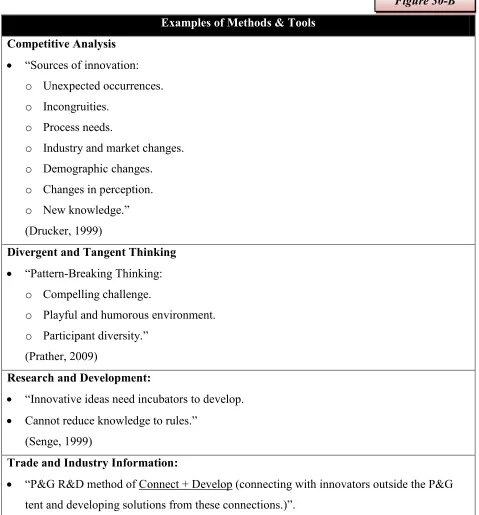
Find enclosed below (Figures 30-A) methods and tools from the literature review that provide additional definition and examples for the approach of idea generation that was previously identified from the interview process (Customer Insights/Voice of the Customer, Benchmarking, Employee Idea/Suggestion System, Brainstorming, and Innovation
Networks). From the analysis of the literature review, additional methods and tools were identified (Figures 30-B) that include Competitive Analysis, Divergent/Tangent Thinking, Research and Development, and Trade/Industry Information.
Examples of Methods & Tools Benchmarking:
“Imitators often overshadow innovators: Innovator White Castle and imitators McDonalds. Studies found of 34 of 48 innovations were copied (3/4). 97.8% of the value of innovations goes to imitators.” (Shenkar, 2010)
Brainstorming and Brainwriting:
“Six ways to kill a brainstormer: (1) The boss speaks first; (2) Round robin of everybody gets a turn; (3) Only inviting experts; (4) Off-sites can be distracting; (5) Not allowing for the silly stuff; (6) Writing down everything that shifts focus to the wrong side of the brain.” (Kelley & Littman, 2001)
Customer (Voice of the Customer & Insights):
“Ethnography (analyze the customer experience): (1) What are customers doing at each point in the consumption chain? (2) Where are your customers when they are at this point in the
consumption chain? (3) Who else is with the customer at any given link in the chain? (4) When at time of day, week or calendar are your customers at any given link in the chain? (5) How are your customers needs being addressed?” (MacMillan & McGrath, 2001)
Employee Idea/Suggestion Systems
“Appreciative inquiry is the cooperative, co-evolutionary search for the best in people, their organizations, and the world around them. It involves a systematic discovery of what gives life to an organization or a community when it is most effective and most capable in economic, ecological, and human terms.” (Cooperrider & Whitney, 2005)
Innovation Networks (partners)
“The Knowledge-brokering cycle: (1) Capturing good ideas – knowledge-brokers scavenge for ideas in the unlikeliest places; (2) Keeping ideas alive – toying with ideas and spreading them in the organization; (3) Imaging new users for old ideas – plugging in old ideas into new contexts; (3) Putting promising concepts to the test – creating valuable lessons and determining
commercial value.” (Hargadon & Sutton, 2001)
Ideas Generation (continued):
Examples of Methods & Tools Competitive Analysis
“Sources of innovation:
o Unexpected occurrences.
o Incongruities.
o Process needs.
o Industry and market changes.
o Demographic changes.
o Changes in perception.
o New knowledge.”
(Drucker, 1999)
Divergent and Tangent Thinking “Pattern-Breaking Thinking:
o Compelling challenge.
o Playful and humorous environment.
o Participant diversity.”
(Prather, 2009)
Research and Development:
“Innovative ideas need incubators to develop. Cannot reduce knowledge to rules.”
(Senge, 1999)
Trade and Industry Information:
“P&G R&D method of Connect + Develop (connecting with innovators outside the P&G tent and developing solutions from these connections.)”.
[image:38.612.65.544.147.662.2](Martin, 2009)
Analytical & Statistical Methods:
Find enclosed below (Figure 31) methods and tools from the literature review that provide additional definition and examples for the approach of analytical and statistical methods that was previously identified from the interview process (Characterization, Design Criteria and Matrixes, and TRIZ). From the analysis of the literature review, additional methods and tools were identified (Conjoint Analysis, Design of Experiments/Taguchi, Failure Mode Effects Analysis, Process Capability, Relationship Diagrams/KJ, Risk Mitigation
Matrix/Plans, and Six Hats Thinking).
Examples of Methods & Tools
Characterization: “Heuristic redefinition – Draw a picture of the system and areas to focus ideation.” (Silverstein, Samuel, & DeCarlo, 2008)
Conjoint Analysis: “Compare solution attributes.” (Silverstein, Samuel, & DeCarlo, 2008) Decision Criteriaand Matrixes (Pugh): “Pugh Matrix – Evaluation of design concepts.” (Silverstein, Samuel, & DeCarlo, 2008)
Design of Experiments and Taguchi: “Design of Experiments: Analyze input and output variable to identify the critical few.” (Silverstein, Samuel, & DeCarlo, 2008)
Failure Mode and Effects Analysis: “Anticipate what can go wrong.” (Silverstein, Samuel, & DeCarlo, 2008)
Process Capability: “Predict the performance of your new solution.” (Silverstein, Samuel, & DeCarlo, 2008)
Relationship Diagrams (KJ method): “Relations diagram illustrate cause and effect.” (Walker & Levesque, 2007)
Risk Mitigation matrix and Plans: “Risk assessment matrix: probability of occurrence in relation to the influence on the success of the project. Risk categories of business,
technological, and change management.” (Lunau et al., 2007)
Six-hats Thinking: “(1) Black – Judgment; (2) Yellow – Optimistic; (3) White – Seeks facts and information; (4) Red – Emotion, feelings, & judgment; (5) Green – Encourages creative thinking; (6) Blue – Process thinking (facilitator).”
(Silverstein, Samuel, & DeCarlo, 2008)
TRIZ: “Identify universal principles that form the basis for creative innovations and solve problem contradictions by comparing with a template of solutions.” (Prather, 2009)
Design & Process Management:
Find enclosed below (Figure 32) methods and tools from the literature review that provide additional definition and examples for the approach of design and process management that was previously identified from the interview process (Design Modeling, Design for Six Sigma, Stage Gate Process, and Quality Function Deployment). From the analysis of the literature review, additional methods and tools were identified (Axiomatic Design, Blitz sessions, Change Management, D4 Road Map, and Design Testing/Pilots). Although not directly defined as a design process, there were elements of project management found within the literature review such as the creation of charters, milestones, and action plans.
Examples of Methods & Tools
Axiomatic Design: “Axiomatic design: Structured approach for design tasks such as mapping the customer attributes to the product function domain.” (Yang & EI-Haik, 2008)
Blitz Sessions (Kaizen/GE Work-out): “(1) Discovery – Team launch, charter review, and current state alignment; (2) Assessment – Analytical study of the designated market / area; (4) Idea and solution development; (5) Piloting: Idea testing and piloting; (6) Design confirmation and presentation to management.” (Davila, Epstein, & Shelton, 2005)
Change Management: “Trust & behaviors are critical for change management.” (Senge, 1999) D4 Road Map: “(1) Define – Business case; (2) Discover – Feasibility; (3) Develop –
Preliminary and detailed design; (4) Demonstrate – Pilot/prototype; (5) Commercialize – Pre-launch and Pre-launch.” (Silverstein, Samuel, & DeCarlo, 2008)
Design for Six Sigma (DFSS): “(1) Define: Business case, project planning and scope; (2) Measure – Understanding customer requirements; (3) Analyze – Development of an optimal high-level design concept; (4) Design – Elaboration of the design details; (5) Verify – Pilot, test, complete implementation, and monitoring KPIs.” (Lunau et al., 2007)
Design Modeling (prototyping): "Prototype the idea: (1) Evaluate the shape, not the detail; (2) (2) Implement through experimenting; (3) Experimenting in real time; (4) Mock-up prototypes; (5) Multiple prototypes; (6) Video prototyping.” (Kelley & Littman, 2005)
Design Testing and Pilots: “Piloting: Build a fully functioning model to test and perfect it – Pilot charter to include study objectives and metrics.” (Silverstein, Samuel, & DeCarlo, 2008) Fast Gate Process (Phase and Stage Gate Process): (1): Confirm and validate need; (2) Develop and validate concept; (3) Develop product/service & test; (4) Testing and validation; (5) Launch.” (Davila, Epstein, & Shelton, 2005)
Quality Function Deployment: “(1)Prioritize system functions (analyze phase); (2) Prioritize design elements (design phase); (3) Prioritized process steps (design phase). Lunau et al., 2007)
Find enclosed below (Figure 33) the summary of the key themes from the qualitative analysis.
Themes Definition
Capabilities Workforce talent, training, and experience related to innovation competencies.
Capacity Human resources and available time to work on innovation.
Collaboration Open internal and external networks for collecting ideas and co-creating innovation.
Culture Employee attitudes toward innovation and involvement in the innovation process.
Customer Understanding the customer experience, collecting consumer insights, and identifying their unspoken needs.
Investment Financial resources provided to build the infrastructure and support innovation projects.
Language Shared organizational definition and framework for innovation. Metrics Qualitative and quantitative leading indicators and result measures for
innovation.
Motivation Incentives, rewards, and recognition that reinforce the importance of innovation.
Perspective Holistic view of innovation from incremental to disruptive innovation. Portfolio Prioritizing innovation projects and a disciplined process to eliminate
marginal ideas.
Priority Imperative or burning platform that creates a sense of urgency for innovation. Process Available and effective methods, tools, and techniques for innovation
projects.
Scope Clearly defining the problem or framing the opportunity that innovation is intended to solve.
Senior Leadership
Organizational alignment and advocacy for innovation to include risk-taking and focus on long-term results.
[image:41.612.74.545.156.730.2]Strategy Framework for ensuring that innovation projects support profitable growth and business goals.
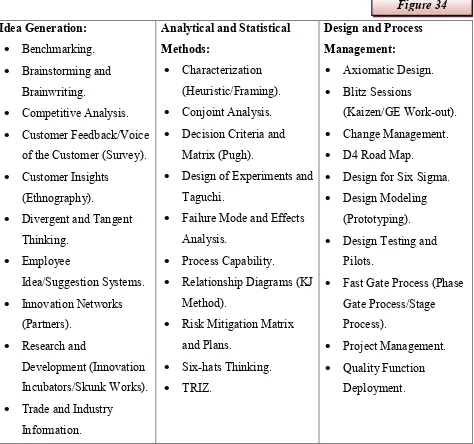
Find enclosed below (Figure 34) the summary of the key approaches from the qualitative analysis.
Idea Generation: Benchmarking. Brainstorming and
Brainwriting.
Competitive Analysis. Customer Feedback/Voice
of the Customer (Survey). Customer Insights
(Ethnography).
Divergent and Tangent Thinking.
Employee
Idea/Suggestion Systems. Innovation Networks
(Partners). Research and
Development (Innovation Incubators/Skunk Works). Trade and Industry
Information.
Analytical and Statistical Methods:
Characterization (Heuristic/Framing). Conjoint Analysis. Decision Criteria and
Matrix (Pugh).
Design of Experiments and Taguchi.
Failure Mode and Effects Analysis.
Process Capability.
Relationship Diagrams (KJ Method).
Risk Mitigation Matrix and Plans.
Six-hats Thinking.
TRIZ.
Design and Process Management:
Axiomatic Design. Blitz Sessions
(Kaizen/GE Work-out).
Change Management.
D4 Road Map.
Design for Six Sigma.
Design Modeling
(Prototyping). Design Testing and
Pilots.
Fast Gate Process (Phase Gate Process/Stage Process).
Project Management. Quality Function
[image:42.612.73.547.175.619.2]Deployment.
Survey Purpose:
The purpose of the Study is to quantify the findings from the qualitative research to include the key themes (refer to Figure 33) and approaches such as methods/tools (refer to Figure 34). The survey findings will be utilized to gauge the perception of critical success factors for innovation and measure the approaches that are perceived as most important to the innovation process.
Survey Research Brief
Intended Use of the Research: Results published in both an innovation research thesis for The Rochester Institute of Technology and potential publication. The American Society for Quality is the prime candidate for the publication of the innovation article in their Quality Progress periodical (monthly publication).
Objective of the Survey: Measure the respondent‟s experience with the concept of innovation, their perspective regarding the maturity of innovation, their personal experiences utilizing innovation approaches, and their point of view regarding the most important concepts, methods, and tools for enabling innovation.
Sampling Frame: Active members of the American Society for Quality (ASQ) who are either a senior member (10 years of professional experience or four years waved with an accredited degree) or a fellow (committee selected and senior examiner for at least five years). Senior members and fellows are the most likely panel to have experience and informed opinions regarding innovation concepts and approaches.
Sample Size: Target of 1,000 anonymous responses from the prequalified panel.
Method: E-mail survey sent to the total population of 30,244 senior and fellow members of the ASQ (584 fellows and 29,660 senior members.)
Questions: Seventeen questions that require less than 20 minutes of completion time.