A Journal of
The Journal of Youth Work: research and positive practices in work with young people
The Journal of Youth Work provides a forum for critical reflection on practice and for the dissemination of research that contributes to the development of youth work and to understanding the conditions in which young people live, rest, work and play. The Journal is concerned with the transfer of knowledge about issues that affect young people and about analysis of the circumstances that enable them to flourish. The Journal provides a forum for academics and practitioners to pose problems, consider policy and practice, and create hopeful multidisciplinary conversations. At its core, the Journal seeks to reverse age-based discrimination, to ensure that young people thrive and are regarded in a positive light by each other and by the rest of society. The Journal is therefore concerned with, for example, education, health, housing and policy fields, including interests in social and cultural capital, social psychology and a variety of other contemporary research and practice matters. Drawing often, but not exclusively from Scottish experience, the Journal is published online three times a year and contains refereed articles, research papers, policy analysis and book reviews. It is addressed to academic specialists, researchers and practitioners in a range of disciplines and to those involved in making policies affecting young people.
Editorial Board
Aileen Ackland University of Aberdeen
Annette Coburn University of Strathclyde
Bob Forsyth Consultant
Tony Jeffs University of Durham
Ken McCulloch University of Edinburgh
Jill McKay Ruchill Youth Project
Brian McGinley University of Strathclyde (Editor)
Howard Sercombe University of Strathclyde
Jim Sweeney YouthLink Scotland
Howard Williamson University of Cardiff
Books for review should be sent to the Editor, Brian McGinley, Division of Community Education, University of Strathclyde, 76 Southbrae Drive, Glasgow G13 1PP.
Design – Julie Wilson YouthLink Scotland Rosebery House 9 Haymarket Terrace Edinburgh EH12 5EZ Tel: 0131 313 2488 Fax: 0131 313 6800
Email: [email protected] Website: www.youthlinkscotland.org
Contents
Page
Editorial
Brian McGinley, University of Strathclyde 5
Outcomes for youth work: Coming of age or master’s bidding?
Brian McGinley, University of Strathclyde and
Gordon Mackie University of Strathclyde 7
Statistics and Stories: Generating Evidence of Youth Work Effectiveness
Dr. Karen McArdle, School of Education, University of Aberdeen
Sue Briggs, Senior CLD Worker 23
Speaking Evidence to Youth Work – and Vice Versa
Dr John Bamber, Senior Lecturer in Community Education, University of Edinburgh, Ann Power, Queens University Belfast and
Conor Rowley, National Youth Work Assessor, Ireland 37
Book Reviews 57
Notes on Contributors 59
EDITORIAL: SPECIAL EDITION
Welcome to the latest edition of the Journal of Youth Work; an on-line publication that is committed to discussing a range of current topics and international perspectives relating to youth work practice and young people.
This special edition has been published to coincide with, and add value to, the discussions that took place at the Youthlink Scotland’s Conference, in Youth Work Week, November 2012. The conference theme was Youth Work: Rising to the Challenge, Delivering Outcomes”. The journal is very pleased to be associated with Youthlink and to support the conference by providing academic text that stimulates debate. It is hoped that these written contributions will help to stimulate youth workers into further developing their own practice understating by reflecting and articulating on their experiences of “delivering outcomes”.
Taken together, the articles in this edition, point to the need for, and shed light on, the debate about the utility of outcomes to youth work practice. These contributions also articulate the need for the right type of, and sources of, evidence and articulate the need for practice-based solutions to inform and improve youth work practice. Again, the articles point to the need for robust research practices that are in keeping with youth work’s value base and recognise the voice of the learner.
The first article, by McGinley and Mackie, questions whether the current promotion of, and increasing reliance on, outcome-based practice is a sound way to both promote and sustain youth work practice. The concerns articulated include the intellectual and procedural rigour of outcome-based practice, its central resonance with the Scottish Government’s requirements and its questionable capacity to enhance youth work practice. They argue for youth work to be set free from government control so that youth work can work on the deep seated problems facing young people and engage with them in a way that enables them to make a contribution to society which they determine.
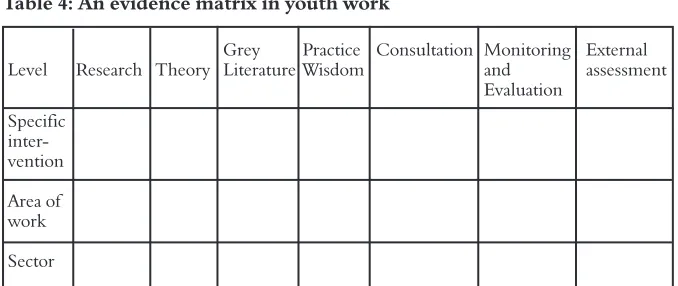
improvement. They authors suggest a mixed methods approach to data collection to develop a statistics and stories approach. They also identified three categories within the evidence relative to best evidence; qualities, impact and process and four categories of required support that included resources, feelings and legitimatisation. The final contribution cogently co-authored by Bamber, Rowley and Power, outlines the need to generate reliable “evidence” from a range of sources to create a strong knowledge base that aims to “improve rather than prove” the practice. This article makes a valuable contribution in advancing the notion of an evidence informed approach to youth work that is based on an evidence matrix, a review of academic literature, provision of a quality standards matrix and a set of resources for further reference and use. They also helpfully identify the impacts that youth work can make in the “meso” level in society, an area that is often ignored but which could provide a reliable source of evidence.
In the book review for this edition Jan Wilmington recommends a book on Emotional Intelligence, which encourages youth workers to become more self aware so that they can work more effectively with others. In keeping with the conversation in this edition, Jan recognises the importance of creating the space for critical reflection within the practice and highlights the need for the pathway to be determined from within.
Finally, I hope that these articles in this special edition add to the consideration around the need, purpose and use of evidence in youth work. In this discussion about the relevance and demands of outcomes it is very gratifying to recognise the inventiveness and courage of those youth workers who, in spite of many restrictions, including a contestable performance management system, still manage to produce appropriate and imaginative forms of evidence to enhance practice.
OUTCOMES FOR YOUTH WORK: COMING OF AGE OR
MASTER’S BIDDING?
Brian McGinley, University of Strathclyde and Gordon Mackie University of Strathclyde
Abstract
Providing evidence in youth work is a current and important debate. Modern youth work has, at least to some degree, recognised the need to produce practice information, through its various guises, with limited success as requirements and terminology have continually changed. In Scotland, the current demands for youth work to “prove” itself are through a performance management system that promotes outcome-based practice. There are some difficulties with this position because outcome-based practice lacks methodological rigour, is aligned with national governmental commitments and does not adequately capture the impact of youth work practice.
This paper argues that youth workers need to develop both a theoretical and methodological approach to data collection and management,which is in keeping with practice values, captures the voice of the young person and enhances youth work practice. Youth work should not be used as a mechanism to deliver the government’s policies but be liberated from centralist control to become a “free practice” so that some of the perennial problems, such as democratic disillusionment, partly caused by this “performance management industry”, can be effectively dealt with. The generation of evidence for youth work should enable it to freely investigate and capture its impact, within the practice, based on the learning that has taken place, the articulation of the learners’ voice with the most appropriate form of data presentation.
Introduction
The centrality of producing quality evidence for youth work has been increasingly known and accepted over time. However, youth workers have been reluctant to uncritically accept performance frameworks that do not capture what they know matters in youth work. This could be interpreted as a reluctance to become accountable but it could be equally ascertained that such reticence reflects concerns about protecting the quality of the youth work relationship and ensuing that any adopted system adequately reflects the nature of such relationships and the other purposes of youth work.
tensions between policy with its potential impact on youth work practice and seeks to uncover what is the principal role being asked of the youth worker under this type of performance management system.
As a starting point for this desk based research, it is held that the management of data is not value free and therefore it is important that evidence is collected and managed in a way that is in keeping with its intended use, in this case concomitant with youth work practice values. To this end, youth workers need to both identify and adhere to a preferred choice of theoretical positioning that is professionally justifiable. Therefore, the debate about outcomes is not just about the impact of services but are also about who owns and judges youth work practice. Central to this discussion is recognition of the tension between top down, dominant discourses and the ethical drive to ensure democratic growth and empowerment from the ‘bottom up’.
Framing the outcomes debate
Traditionally, there has been a continuous difficulty in communicating a unified sense of what youth work stands for and does. It has been particularly troublesome to those who are not involved in creating the practice including policy makers, funders and the general public. There are many reasons for this continuing situation including the complexity of the practice, the variety of its operating circumstances and the ever changing social context of, and demands upon, its operation.
As performance management systems increasingly took hold, Learning Evaluation and Planning (LEAP, 2007), was introduced in various guises from around 2001, as an attempt to develop a systematic way of determining the inputs, outputs and outcomes of community learning and development (CLD) in Scotland, including youth work. Whilst this development involved practitioners by attempting to address concerns about process and values, it was driven by national agendas and funded by central government to determine outcomes for this work. Interestingly, the LEAP performance framework was developed in tandem with a new inspection regime for CLD, which made its true nature and intention more obvious. So, it could be judged that rather than proving to be a useful tool for self-evaluation, it became a policy ploy for practice inspection and failed to produce the robust evidence to question the paucity of financial or human resources input to CLD that workers sought.
As we can identify from the above, the focus of debate shifted from an internal practice dialogue to an externally driven conversation about ‘worth’ and ‘accountability’, which are framed by systems of performance management. These drivers have seen policy advocate and support an OBP (Scottish Government 2008) that, arguably, has become increasingly part of a managerialist discourse which demands external verification, in terms of outcomes, from youth work practice. Additionally, this has evolved into a New Public Management (Pollitt & Bouchaert, 2011; Hood, 1995) quest that aims to make the public sector more ‘efficient‘by employing private sector tools such as business management techniques, of which outcomes are a part.
Not all commentators agree that the best way to make public services more effective is to employ the thinking and tools from the private sector. In fact some argue that these are fundamentally different entities that carry out divergent functions (Boston et al 1996). Therefore, to transpose key ideas from one type of organisation to the other is unsound and is perhaps based more on political ideology rather than driven by a thirst for service improvement.
management is not universally welcomed nor proven to be worthwhile in the public sector. To take this further, it may be that one of the major reasons why youth workers have not fully embraced performance management is because it fails to recognise their professionalism and value base, which shapes the way it generates the practice.
The principles and values identified by the CLD Standards Council for Scotland are:
•
Self-determination – respecting the individual and valuing the right of people to make their own choices.•
Inclusion – valuing equality of both opportunity and outcome, and challenging discriminatory practice.•
Empowerment – increasing the ability of individuals and groups to influence issues that affect them and their communities through individual and/ or collective action.•
Working collaboratively – maximising collaborative working relationships in partnerships between the many agencies, which contribute to CLD, including collaborative work with participants, learners and communities.•
Promotion of learning as a lifelong activity – ensuring that individuals are aware of a range of learning opportunities and are able to access relevant options at any stage of their life. (Standards Council 2011)As we can glean from the above statement, values are an important facet of youth work culture and practice that establish and reinforce the need for people themselves to decide the shape and extent of their learning and for this not to be prejudged or judged externally. Such values can be threatened if an outcome driven culture becomes dominant to such an extent that the “tail wags the dog”. Of course, for the youth worker, the impact of what they do is important but equally valid are the values of starting where a person is at, encouraging them to determine the nature, pace and extent of the learning and to inculcate a relationship that is neither defined nor judged in terms of a predetermined framework or on external aspirations. These encoded frameworks are much more pertinent to formal education environments in where both the direction and destination of the learning journey to be travelled are prescribed in advance and judged against preset standards. This potential disparity, between internal commitments and external demands, has potentially considerable ethical implications from analysing the ethical code of practice which would suggest that outcomes should not be externally or pre determined and that the judgements about what happens in youth work (CLD) should be a matter with the professional relationship rather than imposed from outside (see
So, while the notion of outcomes may be a useful mechanism in the predictable, linear product development world of the private sector; its value is questionable when working with people and especially young people who are developing an increased sense of self which is by its very nature is organic, fluid and unpredictable. In the latter situation it may be more helpful for participants to be encouraged to reflect on their learning in terms of journey; where they are in relation to their starting point rather than seeking destination or outcome. As we know, youth work is far from a predictable practice and outcome may not be the best rationale on which to base an assessment of this practice.
Although it may be helpful for young people to use such tools as “Step it Up’ (2003) to judge their emotional and social development, these are most productive when used in a context of voluntary, self assessed and personal use. To attempt to utilise such frameworks to assess service impact would be to ignore issues of social inequity of the person’s starting point. In fact any attempt at judgement which is either decontextualised or ahistorical ensures that the individual learning journey is viewed in isolation and any perceived problems with progress are attributed to individual pathologies. Again, a further concern of using these frameworks to judge worth is that auditors end up comparing fundamentally different things yet claim their comparability.
To explore this further, one of the questions that need to be considered in this debate is to determine what the intention of outcome-focused work is and also to establish whether this is really about performance capability, scrutiny and accountability or something else. If this is a performance issue to the extent that the Government, and its agents want to satisfy themselves that youth work is doing a good job then they are duty bound to provide a mechanism that enables youth workers to demonstrate the necessary knowledge skills and competence but it is debatable whether this should be a performance management systems based on outcomes. Yet, there is no doubt that in recent years the Scottish Government is promoting and supporting an outcome-focused practice for Community Learning and Development (CLD) (Scottish Government 2008).
If youth work is to demonstrate ‘effectiveness’ under an appropriate performance management system then it requires: a clear, agreed and workable operating framework; a helpful, proactive system of monitoring and support; an easy to use set of resources and tools; and access to reliably informed, and readily accessed, advice. Is this what is on offer?
Exploring recent Government Policy on youth work
Youth work is a complex practice that takes many different forms – detached youth work, outreach, youth clubs, mobile centres, award schemes, specific identity groups, information services and counselling services, to name but a few (Ingram, 2001:17). However, some have argued that there is a lack of “proof ” about youth work ‘effectiveness’ and that it is often at the margins of mainstream practice where successful examples of youth interventions can be found. A recent piece of research in New Zealand (Fouche, et al 2010) aimed to review over 40 pieces of international evidence on the worth and validity of youth work. Using a largely positivist and narrow epistemology, they concluded that none of the documents were valid and therefore reached the conclusions that they could not verify the outcomes of youth work. (A Select Committee concluded similarly for England and Wales). However, Bennett et al (2003:82) identify good practice in not-for profit and project based organisations but warn that autonomy can be undermined by strands of accountability based on standard assessments, evaluations and outcomes. What could be happening here is that the truths about the practice are not being revealed because the mistaken tools are being used form an inappropriate perspective, which leads to invalid conclusions. Thus, the subtleties of human flourishing are set within a policy context which is dictating the discourse and determining what questions are asked, which data is generated and which conclusion are drawn. So what is this policy context?
Selected quote from the document help to emphasise the current Government’s concentration on outcomes:
“2.2 Youth work must continue to look forward with focus and with ambition for its role. Modernising and changing, it will be right at the forefront of delivering the best possible outcomes for every young person in Scotland”.
“2.3 The outcomes we seek from youth work are the same as we seek from schools, that is, that young people become successful learners, confident individuals, effective contributors and responsible citizens, and that they make a successful transition to life after school, taking advantage of and sustaining opportunities in education, employment or training”.
“2.10 ....what we can do is to support the sector in getting the best possible value from the resources they do have. Local authorities and voluntary organisations must be able to focus on delivering the best outcomes for young people”.
“2.11 Our focus must be firmly on achieving greater opportunities, influence and outcomes for individual young people with resulting benefits for their communities and society in general”.
“2.15 We recognise that we need to work better across the Executive to promote the role and benefits of youth work and youth work methods. And how they can contribute to the successful delivery of wide-ranging policies and broad-based positive outcomes for young people”.
“The Outcome we want:For the value, unique nature, and contribution of youth work to be recognised and reflected in a broad policy context, contributing to achieving wide-ranging positive outcomes for young people”.
3.5 Each year, we commission HMIe to conduct reviews of a sample of national voluntary youth organisations. In line with other changes in inspections, HMIe is reviewing its approach to these voluntary organisation reviews. The new focus will place greater emphasis on the outcomes achieved by voluntary organisations and support to help them to continuously improve their outcomes.
Convention on the Rights of the Child (UNCRC). Third, what could be classed as a support service oriented approach by proposing partnership action to support successful transitions, help achieve their potential, enable them to make a positive contribution and to consult them along with adult stakeholders about what services should be provided. So, it could be held that the Government appears to be more interested in achieving predetermined national outcomes than encouraging self determination for local individuals and groups.
The governmental authorities promote an outcome-based practice (OBP) that is developed on good practice case studies, which have been externally judged and verified. OBP is a practice that aims to align the activities of public bodies and to focus on the impact, the improvements achieved.
From an analysis of the guidance, it is clear that this is a structural approach to integrate actions across public organisations, through community planning structures and in keeping with single outcome agreements of which sustained economic growth is the principal driver. It is a systematic approach that seeks to provide a culture of continuous improvement (Scottish Government 2009) although based on a national political agenda.
Analysing the potential impact of Performance Management on youth work
It would be foolish to deny that youth work, like other community based practice, is subject to the current social policy discourse and operating systems which are fixated, inter alia, with enhancing accountability and proving continuous improvement. Performance management in modern public services is a key driver that is used to assess performance and judge value for money. Clearly, as noted earlier in this paper, youth workers are not against justifying their practice but the systems need to be appropriate and fit for purpose. In fact youth work practice will benefit most from producing quality information that provides an empowering and professional approach based on a research based culture of continuous improvement.
meaningful reviews and inform decisions as well as providing confidence in the importance of the work being undertaken.
As much as this is important work, there is a feeling in the CLD sector, including youth work, that an “outcome industry” has been created across the public sector and that it is more complex and confusing than is recognised. Further, it is highlighted that the same terms have different meanings within different operating frameworks, which are exacerbated by a lack of synergy in information systems across inspectorates and public sector partners (Scottish Government 2008).
In light of this complexity and lack of clarity, it may be helpful to provide some further explanation of key terms. The Performance Information System is a strategic framework developed by the organisation that should give the big picture with a full set of processes and measures for producing the information. If this is not in place then any data generated will have limited use.
Performance Indicatorsare devised and used to help to assess how well a service is performing against its stated objectives. Milestonesare key parts of a plan that need be sequentially achieved so that the overall project can be completed within the agreed timescale. Targets are the expressed level of performance that the organisation is aiming to achieve and standards detail the minimum acceptable level of expected performance. Inputs are the resources that which makes the action happen. Outputsare the identifiable evidence, for example, 12 people in a class or 40 young people on a residential. Outcomesessentially equate with the impact, for example, improvement in social interactive skills or increased levels of participation and involvement. Readers will note, at this point, that these systems, processes and tools are the responsibility of the organisation to outline and prescribe. It is also the employing agency’s responsibility to make sure that the framework is workable for the practitioner and is in keeping with their professional values and not the other way round.
As part of the debate around the validity of OBP for youth work, it is relevant to ascertain any potential benefits of managing performance in this way. It could be argued that performance management systems can help to focus and direct priority work, involve youth workers more in planning and can assist practitioners to reflect on what they are doing. In addition, if a clear, consistent and workable process is outlined then it can help to establish a baseline of information, which can be built upon and subsequently helps workers to understand the impact they are making.
Again, an appropriate and inclusive performance management system could develop an agreed system of work and build support systems that measure the progress. It could also provide transparency in work allocation and in the recognition of achievements as well as engendering new ideas and confidence in the practice.
Such “management speak” presents the idea that the management of performance is a necessary, straightforward and linear process. However, the reality is somewhat different and requires a whole number of inter related processes to be in place for it to work effectively. Effective performance management can be adversely affected if there is no clear ‘strategic direction’, too many competing priorities and mixed messages about its value and use. Performance management can also be rendered ineffective when supervision is irregular or unfocused, motivation and validation is poor or its use and importance is not understood or inappropriate. Other barriers include individual work plans being unplugged from the strategic context and a distinct lack of practical and moral support for the youth worker.
To make the most of this current situation, when youth workers are practising within a performance management framework, it is important to view the inputs, outputs and outcomes not as separate entities but as an integrated relationship. The relationship between these three can be a valuable measure of performance and the process of interpretation and explanation are as important part of information management as the raw data itself. Therefore, explaining and validating the data is an important part of the youth workers contribution due to their orientations, values, knowledge and experience that can help to understand the meaning of the information and contribute to analysing the data over time.
the life of a particular project. Also, there can often be a significant delay between outputs and outcomes in that the benefits of the intervention may be only evident years after the input. It can be difficult to directly attribute change or transformation to the specific inputs or outputs of a given organisation or initiative alone. It also does not answer the question of underfunded inputs.
In order to minimise the effects of this, the data needs to be managed rigorously and thoughtfully. This can be achieved by taking time to understand how the inputs and outputs lead to outcomes and use the evidence of the links to identify which ones that are most important to measure. Another tactic to ensure validity is to use outputs as proxies of outcomes and ensure that the accompanying narrative adds value by reflecting the particular local circumstances.
Most importantly youth workers should be confident and empowered by the information that they generate to demonstrate what they know and what they do. To do this successfully, they need to understand the ways in which their work contributes to the bigger picture. Further, youth workers should not rely on this one prescribed source of information and actively supplement their knowledge with recourse to other sources of reliable information based on suitable, rigorous research methodologies that find the learners’ voice. For example, ethnography, action research, narrative and appreciative inquiry are research methodologies where the people involved are at the heart of the generative process. Such approaches enable the flexible presentation of data that both captures the learners experience and adds value to the development of youth work practice. In this way, a solid knowledge base will be built from systematic data collection, reflection and recording of experiences that will help to free the practice form over reliance on the dominant performance framework.
One of the questions that need to be considered in this debate is what is the intention of outcome-focused work and to establish whether this is an issue of performance capability, scrutiny and accountability?
shown that in recent years the Scottish Government is promoting and supporting an outcome-focused practice for Community Learning and Development (CLD) as if it is universally acceptable and unproblematic. Recognition of some of the tensions that exist between policy and youth work practice may suggest otherwise.
Tensions between policy and Youth Work practice
Traditionally youth workers have rightly guarded their relationships with young people by resisting and resenting external interference. Of course, youth work cannot walk away from its policy operating framework but it needs to take control of the data generated and ensure that its professional practice meets external requirements in a way that is appropriate and helpful.
As youth workers engage with young people in an “agenda free” manner, they know that sometimes there may be no immediately obvious outcomes but that valuable “connection” work has taken place. However, the results of these encounters and situations are difficult to explain which is, unhelpfully, not recognised by OBP and policy makers. One fear that many youth workers justifiably have is that when data is recorded it can be judged without reference to the particular context and circumstances. Also, that generated data is subsequently used for other purposes such as the basis on which decisions are made about what constitutes “successful” youth work that in turn informs the decisions about the type of youth work to be funded. As youth workers and policy makers are coming from different perspectives and have separate requirements, it is understandable that tensions will exist. In addition, the things which youth workers value and spend time developing, such as trust and respect, are hard to quantify in terms of input or outcome which may be a source of frustration within the auditor’s frame of reference. Similarly, putting a numerical value on ‘association’ or attempting to measure the depth of ‘dialogue’ is impossible and the relationship to ascertaining outcome cannot be judged with any certainty.
which young people to work with on a limited budget. This is often overcome by bids to particular sources of funding but the sustainability of these projects is questionable and it potentially skews the practice, taking it in a multitude of directions to suit current policy demands.
In spite of youth workers efforts to “bend over backwards” to work with emerging social priorities, this tension with policy may have something to do with youth work attempting to hold on to that special relationship with young people and working with them on their terms in spite of policy directives that undermine this. This fundamental principle of putting young people first is not concomitant with the policy agenda of prescriptive outcomes that demands change and seeks guarantees. As Taylor (2008) cogently posits the Government in England has, “transformed Youth Work into an agency of behavioural modification {and} it wishes to confine to the scrapbook of history the idea that Youth Work is volatile and voluntary, creative and collective – an association and conversation without guarantees.
Thus, these tensions help to demonstrate that the whole notion and purpose of a youth policy is a disputed idea with a considerable lack of ideological and operational consensus (Williamson 2008:66). In spite of this, directives and policies continue to be published which have increasingly influenced the intentions and approaches of youth work practice. Youth work practice is often required to work with issues and within structures, which it cannot control. This situation is exacerbated with a resource base which is wholly inadequate which leads to the contention that youth work maintains the status quo (Jeffs & Smith 1999) which hides “an implicit, unconscious politicised practice” that is on the side of the powerful (Taylor 2008:253). Thus, “cuddling up to government policies” and “playing the performance management game” may not have helped youth work to develop a practice that is credible and sustainable.
appropriate research methodologies which, provide honest and meaningful interpretations of the work and which expose the uncertainty, tensions and limitations placed on practice. Examples of such authentic accounts, which may be symptomatic of the decade, can be gleaned from such writings as Bradshaw (1981) and Ratcliffe & Taylor (1981).
Conclusion
In summary, there is little point in carrying out and investing in performance management if youth workers do not see it as meaningful, if it does not add to their professional practice and if it does not enhance their ability to do their job effectively. It needs to be tailor made, flexible and add value so that it is viewed by all, as worth spending the time upon. The role of the youth worker is not primarily to demonstrate the effectiveness of youth work practice, nor to demonstrate compliance with a set of national outcomes but to meet the young person where she /he is at and work on identifying and setting their goals and aspirations through developing a positive, healthy relationship that goes where it goes.
Both the processes adopted and the data that it produces must satisfy practitioners’ needs internally, to confirm and improve practice, and externally to verify and support its future direction for the benefit of the young people it serves. It must be in keeping with practice values by choosing an approach to data collection that keeps the knowledge in the hands of the learner. It would be helpful if politicians and policy makers recognised that youth work practice is different from other social practices. Youth work would benefit from being viewed as a “free practice” so that it can meet the needs of young people without having recourse to external, predetermined expectations or judgements. Youth work is different because it is about working with the latent and expressed needs of young people and not about policy and public organisations determining what young people ought to be doing or achieving.
There is a position in the youth work literature which posits that youth work has been at a cross roads for some time and is in search of renewal. Is this now the space and time wherein youth work can finally come of age, responding radically to democratic disillusionment in the name of young people or will it continue to do its master’s bidding” (Taylor 2008: 253), through responding to the challenge to satisfy outcomes or by any other such means?
References
Bennett, A. Ceislik, M., Miles, S. (2003). Researching Youth. Hampshire UK: Palgrave McMillan
Boston, J., Martin, J. Pallot, J., & Walsh, P. (1996). Public Management: The New Zealand Model. Oxford: Oxford University Press.
Davies, B. (2008). The New Labour Years, Vol.3, 1997-2007, Leicester: Youth Work Press.
Drucker, P, (1976). What results should you expect? A Users Guide to MBO. Public Administration Review.36, (1), pp. 12-18.
Ford, K., Hunter, R., Merton, B., & Walker, D. (2005). Leading and Managing Youth Work and services for young people.Leicester: The National Youth Agency.
Fouché, C., Elliott, K. Mundy-McPherson, S. Jordan, V. Bingham, T. (2010). The
Impact of Youth Work for Young People. A Systematic Review for the Health Council of New Zealand and the Ministry of Youth Development. Accessed from
http://www.myd.govt.nz/about-myd/publications/youth-work-syst-rev-final-final.pdf
Gitlin, A., & Smyth, J., (1989). Teacher Evaluation: Critical Educative and Transformative Alternatives.Lewes: Flamer.
Hood, C. (1995). The “new public management” in the 1980s: Variations on a theme. Accounting, Organizations and Society. 20, (2-3), pp.93-109.
House of Commons Education Committee (2011). Services for Young People: Third report of session 2010-11, London: The Stationary Office.
Milburn, T. et al (2003). Step it Up: Charting Young People’s Progress. Glasgow: University of Strathclyde.
Ord, J. (2007). Youth work process, product and practice. Dorset: Russell House Publishing.
Pollitt, C., & Bouchaert, G. (2011). Public Management Reform.Oxford: Oxford University Press.
Ratcliffe, R. & Taylor, T. ( 1981). Stuttering Steps in Political Education’ Schooling and Culture (9).
Scottish Government (2007). Moving Forward: A strategy for Improving Young People’s Chances through Youth Work accessed 12th October 2012 from
http://www.scotland.gov.uk/Publications/2007/03/08113759/0
Scottish Government (2007). LEAP: A manual for Learning Evaluation and Planning in Community Learning and Development: Revised edition accessed 17th October 2012 from: http://www.scotland.gov.uk/Publications/2007/12/05101807/2
Scottish Government (2008). Delivering Outcomes in Community Learning and Development. Edinburgh: Author.
Scottish Government (2009). Valuing Young People. Edinburgh: Author
Scottish Government (2009). Outcomes based approach. Accessed on 5th October 2012 from: http://www.scotland.gov.uk/Topics/Government/public-bodies/ OutcomesBasedApproach
Standards Council (2011). How is it done? Accessed on 12th October 2012 from:
http://www.cldstandardscouncil.org.uk/About_CLD/How_is_it_done_#.UHgQSm-ADuc
Spence, J. (2004). Targeting, accountability and youth work practice. Practice.16(4) pp.261-272.
Taylor, T. (2008). Young People, politics and participation: a youth work perspective,
Youth & Policy,No. 100, Summer/Autumn 2008.
Taylor, T. (2012). In Defence of youth work. Accessed on 16th October 2012 from;
http://www.indefenceofyouthwork.org.uk/wordpress/
Tyler, M., Hoggarth, L., Merton, B. (2009). Managing Modern Youth Work. Exeter: Learning Matters.
Wilson, S.J.; Lipsey, M.W. & Soydan, H. (2003). Are Mainstream Programs for Juvenile Delinquency Less Effective with Minority Youth than Majority Youth? A Meta-Analysis of Outcomes Research, Research on Social Work Practice,13, (1), 3-26.
STATISTICS AND STORIES: GENERATING EVIDENCE OF
YOUTH WORK EFFECTIVENESS
Dr. Karen McArdle, School of Education, University of Aberdeen Sue Briggs, Senior CLD Worker
Abstract
This paper describes an action research project, which sought to support Scottish Community Learning and Development (CL&D) workers (particularly grass roots workers) to generate evidence of the effectiveness of their interventions and to build confidence across the field in doing so. Whilst the project focused on CL&D workers in general, we seek here to focus on the experience of youth workers. Focus groups were held with 66 people from throughout Scotland to seek opinions on current and good practice in generating evidence. We identified a need for further continuing professional development (CPD) on statistics and stories, our phrase used to embrace quantitative and qualitative methodologies.
Introduction
This paper emanates from a project conceived by the Community Learning and Development Managers Scotland (CLDMS) network. It was funded by Education Scotland. This paper documents an action research process in which the views of Community Learning and Development (CL&D) practitioners at a range of levels within the professional field, concerning gathering the evidence of impact of professional practice, were explored. In Scotland, CL&D workers include youth workers, adult educators and community development workers. Whilst the nature of youth work appears to be self evident to many, it remains a contested field of activity, as there are many different views of its fundamental purpose. For the purposes of this paper, youth work is defined in terms of process and includes work with young people, which has distinctive features:
•
Young people choose to be involved;•
Starting where young people are starting and then seeking to motivate and support them to go beyond these starting points into new experiences and learning;•
Developing trusting relationships with young people;•
Tipping balances of power and control in young people’s favour;Our research questions focused on the broad CL&D workforce and were very practical in character, focusing on Appreciative Inquiry (AI) in that they sought to explore evidence of and examples of current and good practice. Cooperrider and Whitney (1999, 10) describe AI as the ‘co-operative search for the best in people, the organizations and the world around them.’ They go on to say that it involves the art and practice of asking questions that stimulate a system’s potential to ‘heighten positive potential.’ AI is referred to as inquiry in that it seeks for knowledge and a theory of intentional collective action to help the normative vision and will of a community (Akdere, 2005). It distinguishes itself not in its criticality but in its deliberately affirmative assumptions about people organisations and relationships. AI is concerned with community, drawing on Freirean (1998) transitive critical consciousness, which involves individuals exploring, testing and revising their own thinking and interpretation of problems through a dialogical process (Barge, 2003). So our action research process was founded on the following appreciative questions:
1. How do CL&D workers gather evidence of CL&D effectiveness? 2. Who gathers this evidence currently?
3. What are examples of good practice of generating evidence? 4. What happens to the evidence generated?
5. How can we best support CL&D workers at all levels to generate evidence
Methodology
“Action research aims to explore new ways of doing things, new ways of thinking, and new ways of relating to one another and to the world in the interest of finding those new ways that are more likely to be for the good of each person and for the good of humankind, and more likely to help us live sustainably.” (Kemmis, 2010, 425)
Gregory et al (2011) discuss the importance of multi-dimensional collaboration to move findings into practice implementation. They argue that this is best managed through action research which demands inclusivity, focusing on what does and does not work in managing change; and avoids imposition of change, preferring shared involvement in planning and implementing change that is relevant to the context and population. Sharp (2005) argues that action research is a means of breaking down the division between producing and using evidence.
We chose to adopt an action research approach to this project as we wished to explore the understandings of practitioners in the field of the purposes, methods and intent of gathering evidence and to use this as the basis for the development of educational programmes to be used by CLDMS managers and their staff to train the workforce in gathering evidence of impact. We chose to use focus groups organised across as we intended that the data we would gather would explore our research questions in depth and seek contrasting views on the processes we were exploring. The action dimension of the research consisted of developing educational programmes informed by the views of our participants and communicating with CLD managers a series of recommendations designed to improve the effectiveness of gathering evidence of outcomes of CLD practice.
Groups were held in Aberdeen, Glasgow, and Fife to cover the broad Scottish geographical spread and events were also held, where this was requested, in Angus, and pilot educational programmes in Aberdeenshire. A total of 66 people attended these and we were pleased with the geographical spread of participants. These included participants from entry levels of the professional field – people who were relatively new to the profession – to a member of senior management of a CL&D service. The majority of our participants, however, as we had hoped, were grass roots practitioners rather than managers.
1. Why does gathering evidence matter?
2. What is evidence?
3. Who gathers evidence?
4. How do you go about gathering evidence?
5. What is the best evidence you have gathered?
6. Why was it the best?
7. How did you get it?
8. What happens to the evidence?
9. What would be useful to people in gathering evidence?
10. Where should tools and guidance be held?
Characteristically sessions lasted two and a half to three hours and involved around a dozen people in each. An activity was incorporated into the process using pictures to stimulate thinking about the ‘best’ piece of evidence participants had generated. Discussion in all the groups was vibrant, enthusiastic and focused on the questions we had posed. The questions proved to be a fruitful means of gathering the data we were seeking and hence have formed the basis, along with the picture activity, described later, of the educational programme we have devised as part of this action research process. The 10 questions often overlapped in terms of the discussion they generated but we felt that they covered considerable ground and were a useful resource.
One of the key dimensions of action research is that it has a learning purpose and we decided to benchmark knowledge of gathering evidence before we engaged in the focus groups. This was done with a simple and accessible grid with which participants were invited to indicate their confidence levels in terms of gathering evidence of impact. Our simple grid showed that the research process did indeed result in a gain in confidence and knowledge about the processes involved in gathering evidence, which once again has influenced the methods we chose to use in the development of the educational dimension of this project.
Discussion
linked to gathering evidence. This frequently focused on changes to CL&D services and concerns about job losses, particularly for sessional workers, including in particular youth workers. It was difficult for participants to discuss gathering evidence of effectiveness when their effectiveness was plainly in doubt under the threat of closing of services and redundancies. This was particularly the case in the Aberdeen focus group where participants were from the North of Scotland and there had been considerable changes in CL&D provision, particularly in Aberdeen and in Shetland. Gathering the evidence was frequently linked to job security and influencing the relevant decision makers, elected members and council senior officials and funders in the voluntary sector. This is not surprising as the 2010 Lifelong Learning Survey of the CL&D workforce found that there was a 25% (LLUK, 2010) reduction in the local authority workforce from the 2008 data. Respondents did, however, recognise the value of gathering evidence to influence decision makers and referred frequently to the difficulty there is in communicating what we do. Participants referred to the perception of school teachers that youth workers drink coffee and make friends with young people rather than being engaged in an educational process. Smith (2003, 79) argues that organising youth work around ‘concepts like outcome, targets, curriculum and issue’ means there is a danger of losing relationship as a defining feature of youth work practice through a reduction in the amount of time youth workers spend with young people (Harland & Morgan, 2006). This was a view reported by participants as being held by some of their colleagues who preferred to work with young people rather than generate ‘paper’ on outcomes.
‘competing objectives, values and warrants’ where situations can pit the developmental needs of young people, ethical concerns and administrative requirements against each other. Kruger (2005) describes youth work as a dance in which activity is choreographed in advance but then during the performance the dancers play off one another to the changing tempos of the music. “Like modern dancers, competent workers study, practice, and develop the knowledge and skills that allow them to be in their experiences with youth in the most effective and responsive way. These workers sense, as well as know, when to intervene or not intervene, move closer or farther apart, raise or lower their voices, and increase or slow the pace.” (22) Some argue that youth work outcomes can be somewhat intangible in the short term and workers are unsure about how to affirm the long-.term impact of their interventions (Spence, 2004). Relationships Spence argues are important but a series of relationships with individuals and groups of young people does not sit easily with a requirement to record outcomes. This sensitivity and complexity of practice is the context in which we were exploring the ways in which CL&D workers including youth workers explore outcomes.
Evidence gathered at a range levels and by a range of organisations/ individuals
Once again it is important to mention sample bias in that our participants had self selected but it was clear to us that all members of the CL&D profession in the voluntary sector and local authorities and at all levels are gathering evidence. People at grass roots level reported the need to keep track of the number of young people attending youth clubs, for example. Managers reported the need to keep track of the outcomes of educational programmes linked to performance indicators. The quality of this evidence was reported to be highly variable with some people producing robust and high quality evidence, whilst others were reported to be using anecdotal and overly simplistic evaluative materials with scant regard for the professional purposes of evidence gathering.
improving practice, for motivation and clarification of purpose of interventions. Respondents were inclusive and distinguished between the professions or job titles of evidence gatherers and their position within the organisation. So, a wide range of people were identified reflecting the broad compass of CL&D work. It included partners such as the police, NHS workers, social workers, voluntary organisations, schools and external bodies such as Education Scotland. It also included the CL&D workers’ own organisations. The level of staff who can gather evidence included, managers, sessional and part time staff, CL&D practitioners including youth workers themselves, clerical staff and janitors/caretakers. Participants themselves were also identified as evidence gatherers in terms of artefacts such as portfolios. In fact, CL&D workers identified that everyone in the organisation and linked to it has a role to play in gathering evidence.
The reasons evidence is gathered
The ‘why’ dimension of gathering evidence included, elements of the principles of CL&D – planning and management for both long and short-term goals. Staffing appraisals were mentioned and needs analysis. Affirmation of impact was considered to be important for both professionals and participants, including the importance of reporting back to the young people and the community. The external focus of evidence gathering was not the strongest motivator. We had anticipated that gathering evidence for HMIe would be a principle motivator. Rather evidence gathering was most strongly linked to professional development of the CL&D worker and improvement of professional practice. This implies that gathering evidence is embedded in the professional profile of our respondents for internal as well as the more formal external purposes.
Methodologies and methods of gathering evidence
crunching’ when the outcomes of the work for the individual young person are much more important. There was agreement that ‘statistics and stories’ were the best means of gathering evidence in that numbers would convince local authority politicians of the importance of youth services in their constituency where the stories would capture the educational outcomes for individual young people.
Examples of good practice are highly idiosyncratic which accords with our view that a good CL&D professional is good at what s/he does because of who s/he is (McArdle: 2003). Evidence gathering methods were creative, wide-ranging and consistent with the value base and ethical standards of the CL&D profession. Youth workers were able to relate examples of significant change for participants as a result of the youth worker interventions. These were frequently told with high emotion on the part of the practitioner and frequently revolved around the significant and highly charged learning of an individual or group. For example, growth and change in behaviour from drug use to healthy habits. Respondents frequently distinguished between ‘hard’ and ‘soft’ indicators, where hard indicators are statistics and what was referred to as ‘data.’ Anecdotal evidence was not perceived as data, and we would agree with this but anecdotal evidence was a term used for the qualitative data that was frequently more than anecdote in its substance. The evidence cited by respondents included a wide range of artefacts such as CDs, photos, videos, reports, films, and achievement certificates. It also included methodologies such as case studies, narratives, reflective diaries, interviews, evaluations and peer reviews.
always positive but always empowering and inclusive; the need to be accessible to decision makers and the need to be attractive and of high quality to do justice to the intervention undertaken with participants and to the staff involved in the intervention.
How evidence is used
The evidence is used in a wide range of contexts for a wide range of purposes. The most significant finding was the expressed need for a feedback loop where information concerning evidence passes both up the line and down the line. Youth workers may generate evidence of effectiveness but did not always receive affirmation or feedback on their achievements. We were surprised at the relatively limited focus from participants on Education Scotland (formerly HMIe) purposes for evidence gathering to inform inspection of youth work practice. It was pleasing to see evidence used for reflection, continuing professional development (CPD), appraisal and improvement of practice as well as for external accounting. Our respondents were willing reflective practitioners. This reflects positively on the Education Scotland message of preparing for improvement through self-evaluation and not preparing for inspection.
CPD Needs in Gathering the Evidence
the fact that statistics gathered rarely moved beyond simple counts and percentages of young people, and a sense that numbers did not adequately express the complexity of the work undertaken in CL&D.
A need was identified for further CPD in the Stories dimension of evidence gathering. It was felt that anecdote was insufficient and it would be useful for practitioners to know how to gather evidence that was rigorous, valid and credible in a qualitative domain. Qualitative methods were frequently used by youth workers who were well aware of the ways they could illustrate achievement through certification of Youth Achievement Awards or through artefacts created by young people and it would take little in our opinion to develop an understanding of rigour and validity. It would also be useful to expand qualitative approaches to use, for example, approaches such as ethnography, narrative inquiry and phenomenology. These are accessible methodologies and are appropriate we propose to the principles and value base of CL&D.
Mixed methods is the approach to evidence gathering that comes closest to the desired interface between Statistics and Stories. We are firmly of the view that a correlation of numerical data that identifies the extent and dimensions of an intervention is important to show development and progression of services but this can be combined with the qualitative data that shows the impact in terms of the complexity of the social, cultural and economic context of the intervention and the complexity of working with people. Mixed methods is a well developed method of triangulating evidence and there is a growing body of theory and practice linked to an appropriate methodology for bringing Statistics and Stories together for analytical purposes (e.g. Denscombe, 2008; Burke Johnson et al, 2007; Teddlie & Tashakkori, 2009)
Perceptions of the ‘best’ evidence
We used a picture activity to find out the best evidence participants had gathered. They were asked to select a picture from a wide range of images; an image that best represented their best evidence. This question was the most illuminating of the questions we asked as it identified what people valued in terms of their evidence. Best evidence fell into one of three categories. These categories were Qualities of the evidence, such as robustness, honesty, fitness for purpose, credibility, unquestionable, high quality, realism, authenticity and simplicity. The second category was Impact and this included effects such as boosting morale, fitting the audience, having a demonstrable impact, strengthening partnership, providing the opportunity to reflect, and influencing politicians. The third category we have termed Process and this included involving stakeholders, provided longitudinal tracking, matched with Performance indicators, provided sense of achievement and enjoyment, and strengthened partnership.
There were no patterns in the citation of best methods. The best methods were only consistent in that they had provided considerable pleasure to participants in the affirmation of good work done. The methods included some challenging measures such as peer review, Education Scotland interviews with young people, well designed questionnaires, learning celebrations and creative approaches of evidence gathering such as employing art work, the River of Knowledge activity and employability learning plans.
When asked in more detail how they got this ‘best’ evidence, methods were not the primary topic of conversation. Rather, standards of practice were discussed such as asking the right questions, starting the process early enough, knowing participants and what they will want to say, being creative and being open and honest.
success story over and over again. Balance and fairness by the users of evidence was emphasised. Respondents did not like the fact that ‘pet’ projects ‘get trotted out again and again’. It was felt that affirmation on the basis of good evidence of all successful projects was important.
The destination of evidence
When asked what happens to the evidence, once again a balanced picture emerged of use at different levels within the organisation as well as use of evidence both within and outside of the local workplace. So, evidence was used for staff meetings, appraisals, self-evaluation and team building as well as influencing politicians, and feeding into single outcome agreements. It was recognised that evidence needs to a have a feedback loop, going up the line and feedback on the evidence coming down the line. Factors such as giving people a boost and justifying activities and enhancing motivation support the need for this feedback loop on evidence.
When asked how gathering evidence could be supported four categories of support were cited. The first category is Resources. Examples, tools and templates were desired along with examples and banks of ‘good’ evidence. A term used to summarise the resources required was Tips ‘N Tricks. The second category is dealing with Feelings. This is an interesting category as it highlights once again the anxieties that can surround the evidence gathering process. The examples of responses to what would be useful included building confidence, emphasising the importance of evidence gathering, giving feedback and making evidence make a difference to the person who provides it. The third category is Legitimisation. This category included responses such as: making time for evaluating, making time for reflection and providing a focus on the importance of evaluation. The fourth category is that well-worn category Other. Here lay responses that could not be put into categories but we do not want to lose them so they included: clarity from Education Scotland, the Scottish Government organisation, around exactly what is good practice; increased skills in evidence gathering; more access to networks such as COPAL and information on routes in the CLD Standards Council website to other sites such as that of Education Scotland.
Conclusions
across local authority and voluntary sector organisations to further increase confidence. This programme is based on the 10 questions that we asked participants. We are of the opinion that this will translate to other related areas linked to youth work such as partners, library, leisure and NHS areas as representatives of these services participated in focus groups and found the content to be equally relevant.
We were particularly pleased to find that interest in gathering evidence focused not simply on Education Scotland inspection activities, though this was considered to be very important. Gathering evidence was considered to be relevant across a number of dimensions of professional practice. This shows that the importance of gathering evidence is embedded in professional practice, which was gratifying and to be applauded, we contend.
It is clear, however, that further CPD is required for workers at all levels in gathering evidence of statistics and stories. This is linked not only to skills levels but also to confidence in the gathering of robust and convincing evidence.
References
Batsleer, J. & Davies, B. (2010). What is Youth Work? Exeter: Learning Matters.
Kemmis, S. (2006). Participatory action research and the public sphere. Educational Action Research14 (4) 459-476.
Akdere, M (2005). Appreciative Inquiry: A field study of community development. Systemic Practice and Action Research18 (1) 21-34.
Barge, J.K. (2003). Hope, Communication, and Community Building. Southern Communication Journal69 (1) 63-81.
Burke Johnson, R., Onwuegbuzie, A., Turner, L. (2007). Towards a definition of mixed methods research. Journal of Mixed Methods Research 1 112-133.
Burke Johnson, R., Onwuegbuzie, A. (2004) Mixed Methods Research: A research paradigm whose time has come. Educational Researcher 33(7) 14-26.
Desncombe, M. (2008). Communities of Practice: A research paradigm for the mixed methods approach. Journal of Mixed Methods Research2 270-283.
Kruger, M. (2005). Four Themes in Youth Work Practice. Journal of Community Psychology.33 (1) 21-29.
Gregory, S., Poland, F., Spalding, N., Sargen, K., McCulloch, J., Vicary, P. (2011). Multidimensional collaboration: Reflections on action research in a clinical context.
Educational Action Research19 (3) 363-378.
Harland, K. and Morgan, A. (2006). Youth Work in Northern Ireland: An Exploration of Emerging Themes and Challenges. Youth Studies Ireland,1 (1). 4-18. Kemmis, S. (2010). Participatory action research and the public sphere. Educational Action Research 19, (4) 417-427.
McArdle, K. and Coutts, N, (2003.) A Strong Core of Qualities – A model of the professional educator that moves beyond reflection. Studies in Continuing Education 25(2) 225-237.
Sharp, C. (2005). The improvement of public sector delivery: Supporting the evidence based practice through action research. Scottish Executive Social Research.
http://scotland.gov.uk/Publications /2005/09/2890219/02201.
Smith, M. (2003). From youth work to youth development. Youth and Policy 79 46-59.
Spence, J. (2004). Targeting, Accountability and youth work practice. Practice: Social Work in Action 16(4) 261-272.
Stoecker, S. (2013). Research methods for community change: A project based approach. Thousand Oaks, CA: Sage.
Teddlie, C. & Tashakkori, A. (2009). Foundations of Mixed Methods Research. Thousand Oaks CA: Sage.
Taylor, R., Jason, L., Keys, C.B., Suarez-Balcazar, Y., Davis, M., Durlak, J., Holtz Isenberg, D. (2006). Capturing theory and methodology in participatory research. In Jason, L., Keys, C., Suarez-Balcazar, Y., Taylor, R., Davis, M. (Eds.) Participatory community research: Theories and methods in action. Washington, DC: American Psychological Association.
SPEAKING EVIDENCE TO YOUTH WORK – AND VICE
VERSA
Dr John Bamber, Senior Lecturer in Community Education, University of Edinburgh, Ann Power, Queens University Belfast and Conor Rowley, National Youth Work Assessor, Ireland
The most acute challenge today is the need to substantiate youth work. Research can help in meeting this challenge but will have a distorting effect on the evidence base unless it is treated as one source of reliable knowledge amongst others. Distortion is most likely when particular forms of research, such as randomised control trials, are held up as the ‘gold standard’. Adherence to the standard means that only proven, evidence-based programmes should be funded. This position is extremely limited in terms of its ability to understand or to support the complex nature of youth work. An alternative is to draw appropriately from a range of sources to support judgement making. In this article we consider how such an evidence-informed approach can help workers, managers and policy makers to develop a robust and convincing case for youth work. Developing the evidence base will require a coordinated effort at worker, project, national and international levels. Regarding the latter, we will refer to a number of initiatives in the Irish context.
There are many aspects of the current accountability regime that deserve criticism, not least the counterproductive tendency to draw workers away from essential face-to-face contact as they spend more time bidding for funds and fulfilling the needs of paper-based systems. It is especially problematic when the burden falls on individual workers, often working for small agencies without the time, the expertise, the support or the resources to undertake such a task. It is worse still when accountability falls on individual sessions. Box 1 below provides one example of a report form currently being used in England (anonymous), in which the focus is on one session of 2 to 3 hours. The questions have to be completed following every single engagement with young people.
Box 1: Report form for one session in youth work
• What curriculum outcomes areas are you seeking to address (Every Child Matters – 5)?
• Were the planned objectives met? • Describe the process
• Quality of youth work (7 point scale) • Issues raised by young people?
• Actions for next session - responsibility?
• Attendance register (DoB/postcode/M-F/outcome achieved)
• New client registration forms
• Hate incident (nil return), sexual health intervention, drugs incident
Learning Outcomes
What do the young people know, understand, value or are able to do better, as a result of taking part in this youth work activity?