City, University of London Institutional Repository
Citation:
Abdelmalik, A. A., Fothergill, J. and Dodd, S. J. (2011). Electrical breakdown
strength characteristics of palm kernel oil ester-based dielectric fluids. Annual Report -
Conference on Electrical Insulation and Dielectric Phenomena, CEIDP, pp. 183-186. doi:
10.1109/CEIDP.2011.6232627
This is the unspecified version of the paper.
This version of the publication may differ from the final published
version.
Permanent repository link:
http://openaccess.city.ac.uk/3397/
Link to published version:
http://dx.doi.org/10.1109/CEIDP.2011.6232627
Copyright and reuse: City Research Online aims to make research
outputs of City, University of London available to a wider audience.
Copyright and Moral Rights remain with the author(s) and/or copyright
holders. URLs from City Research Online may be freely distributed and
linked to.
City Research Online:
http://openaccess.city.ac.uk/
[email protected]
Electrical Breakdown Strength Characteristics of
Palm kernel oil Ester-based Dielectric Fluids
A.A. Abdelmalik, J.C. Fothergill, & S.J. Dodd
University of Leicester Leicester, LE1 7RH, UK
Email: [email protected]
Abstract- Natural ester fluids have been synthesized from crude palm kernel oil for consideration as an alternative to mineral oil based insulating fluid. Chemical modification of the oil enhanced the physico-chemical properties of the fluid. This paper presents the statistical analysis of the AC electrical breakdown strength of the synthesized esters in comparison with the crude palm kernel oil sample. The breakdown test was carried out in accordance with ASTM 1816 test method using a bespoke test cell designed for small sample volume. The estimated characteristic breakdown strength of the esters, defined as the 63.2% cumulative failure probability, is significantly higher than the BS148 mineral oil. The slopes, indicating the shape parameters, are similar. The results suggest that, at least in this regard, the synthesized esters may serve as an alternative to mineral oil as a transformer fluid.
I.
I
NTRODUCTIONDielectric fluids are used in transformers to improve the dielectric strength of insulating paper and protect the live and grounded part of transformers from failure. Conventional mineral insulating oil is often used for this purpose. But environmental concern over oil spillage from transformers following insulation failure and uncertainty concerning petroleum products availability have shifted attention towards research in the development of sustainable dielectric fluid for electrical insulation. Chemical modification of seed-based oil was found to influence physico-chemical properties of the oil [1]. Earlier work has shown that side branching in hydrocarbon compounds influences the conduction mechanism due to high mobility of charges present [2]. This work reports on the statistical analysis of breakdown field of various alkyl esters of palm kernel oil.
Measurements of breakdown field vary for each specimen of a sample as the weakest link which is the most probable breakdown spot, is randomly distributed. The breakdown field measurements of insulating materials can be regarded as a random variable and the likely electrical breakdown field of an insulating material can be estimated from the distribution of the breakdown field data using statistical techniques [3]. The breakdown field of insulating materials is sometimes expressed as the mean value of measured breakdown field of a number of samples. The breakdown strength test of electrical insulation materials can be carried out under progressive stress conditions where the breakdown voltage is measured for a number of test specimens. A number of statistical analytical
tools are available for the analysis of statistical data, but the Weibull distribution is the most commonly used distribution function for statistical analysis of breakdown field data. It was reported that the Weibull distribution has wide applicability and is a type of extreme value distribution in which the system fails when the weakest link fails [4]. The cumulative probability of failure for the two-parameter Weibull distribution is given by
1 1
where F(ν) is the cumulative probability of breakdown at voltage,ν,α, the characteristic breakdown voltage is the value of ν, at which the cumulative probability of failure is (1 – exp{-1}) = 0.632, and β, is the shape parameter, which is a measure of the range of failure voltages within the distribution [3]. The behaviour of insulating fluids following synthesis can be evaluated from estimation of the characteristic breakdown strength, the shape parameter, and the confidence bounds of the distribution describing an insulating fluid. Martin et al
reported that Weibull distribution function is appropriate for the calculation of withstand voltage of ester-based transformer oils [5].
II.
E
XPERIMENTALA. Sample Preparation
An alkyl ester (PKOAE1) was synthesized from laboratory purified palm kernel oil by transesterification. Epoxy alkyl ester (PKOAE2) was then synthesized by epoxidation of PKOAE1 with an insitu peracetic acid [6]. Branched alkyl esters (PKOAE3 and PKOAE4) were then prepared using an
Table1: Sample Description
Sample Description
PPKO Purified palm kernel oil PKOAE1 Palm kernel oil methyl ester PKOAE2 Palm kernel oil epoxy methyl ester
PKOAE3 Palm kernel oil methyl ester with C-3 carbon side chain
PKOAE4 Palm kernel oil methyl ester with C-4 carbon side chain
Table 3: Weibull Parameters of the Breakdown
Samples N
Characteristic value, α (kV/mm)
PPKO 5 41
PKOAE1 10 43
PKOAE2 10 43
PKOAE3 10 43
PKOAE4 10 43
BS148 5 27
acid-catalyzed ring-opening reaction of PK anhydrides in the presence of nitrogen. Sam are summarized in Table 1. The samples degassing at reduced pressure in a va temperature of 85˚C for 2 hours. A sample o insulating oil and purified palm kernel oil w degassing in a vacuum oven at a temperatur hours.
B. Breakdown Strength
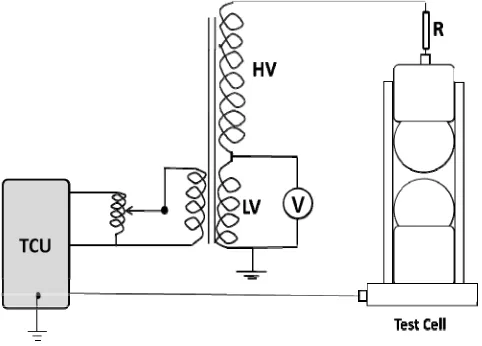
An AC voltage was applied using a 50kV ste for the breakdown test. During each experim voltage was increased manually from zer approximately 0.4 kV/s until breakdown transformer control unit (TCU) monitored the interrupted the supply voltage to the step-up tr breakdown occurred in the sample test cell ( was designed to take small sample volume sphere electrode gap of 1 mm. In compari required using the IEC 156:1995 standard des ml to 600 ml. For each of the ester samples measurements were carried out at 20 breakdowns were carried out on BS148 and P 20˚C and 30˚C respectively.
[image:3.612.50.291.350.523.2]III.
R
ESULTSANDD
ISCU Table 2 shows the analysis of the breakdowFig. 1: Schematic of electric breakdown test set breakdown test cell.
n test
95% Conf. Bound for α (kV/mm)
Shape parameter, β
95% Conf. B for β 39.92 – 42.73 23.05 13.13 – 55.3 41.96 – 43.60 28.85 19.25 – 48.32 42.18 – 43.59 33.84 22.58 – 56.68 41.48 – 45.25 12.76 8.51 – 21.37 41.51 – 44.82 14.49 9.67 – 24.27 25.83 – 28.59 15.49 8.82 – 37.17
KOAE2 and acid mple descriptions
were dried by acuum oven at of BS148 mineral was also dried by re of 85˚C for 2
ep-up transformer ment, the applied ro at a rate of n occurred. A e cell current and transformer when (fig. 1). The cell es (≈5ml) with a son, the volume signed cell is 350 s, ten breakdown
˚C, while five PPKO samples at
USSION wn test results for
PPKO, PKOAE1, PKOAE2, PKOA samples using Normal (Guassian breakdown voltage of BS148, wh 26.4 kV, with a standard deviation with the recommended breakdown Electric equipment with voltage ra [7]. Also shown in Table 2, are purified palm kernel oil and the p breakdown voltages for purified value increased to 42.6 kV fo esterification. The standard devi voltage measured for the esters and similar, indicating low dispersion data. The mean breakdown strength was compared with the minimum recommended in the literature for insulation fluid measured using sta D1816. A natural ester based diele to have a minimum mean breakdow gap) for voltage class of 345 kV a this study the mean breakdown v alkyl ester has a breakdown voltage a significant amount.
Table 3 shows that Weibull parame field data of the oil samples. The strength of the samples denoted as α β, are tabulated with their res intervals. The correlation coefficie when fitted to the Weibull functi greater than the critical correlation for 10 breakdowns [3]. This dem relationship between the two param shows a slight improvement in the strength of the alkyl ester samples This shows that alkyl ester derivativ oil have improved breakdown str electric field strength of the palm ke
Table 2: Normal Distribution parame
Samples
No. of Breakdowns
Mea ( PPKO 5 4
PKOAE1 5 4
PKOAE2 5 4
PKOAE3 5 4
PKOAE4 5 4
BS148 5 2
tup and bespoke
Bound Correlation Coefficient 1 0.981 2 0.983 8 0.947 0.937 0.948 0.941
AE3, PKOAE4 and BS148 n) statistics. The mean hich was evaluated to be n of 1.8 kV is comparable voltage of Insulating oil in ating of 345 kV and above the results obtained from processed esters. The mean oil was 40.6 kV and this llowing epoxidation and ations of the breakdown the mineral oil samples are in the breakdown voltage h of palm kernel oil samples mean breakdown voltage natural ester (as-received) andard test methods ASTM ctric fluid is recommended wn voltage of 35 kV (1 mm nd above [8]. However, in voltage for the synthesized e that exceeds this limit by eters of the AC breakdown e characteristic breakdown
α, and the shape parameter, spective 95% confidence
nts of the breakdown data ion, equation 1, are much coefficient of 0.918 monstrates a strong linear
meters. The statistical data e characteristic breakdown when compared to PPKO. ves of purified palm kernel rengths. The characteristic
ernel oil ester derivatives is
ters of the Breakdown Test
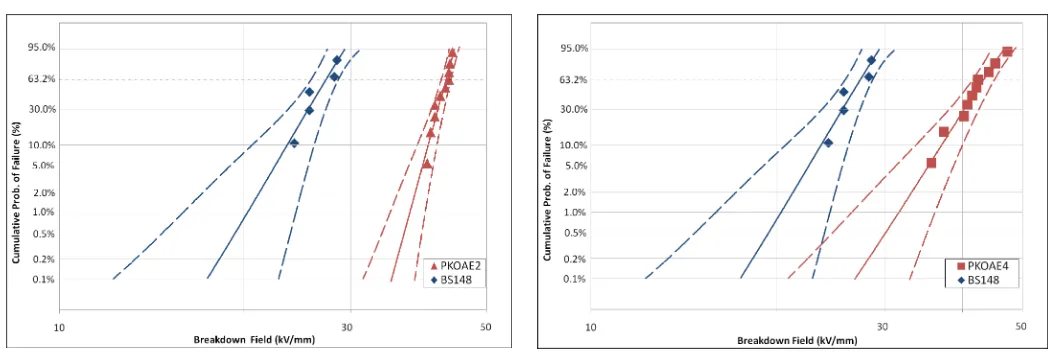
[image:3.612.51.553.617.715.2]about 37% better than BS148 mineral insulatin The high values for the fitted shape param kernel oil ester derivatives demonstrates derivative have a narrow distribution of b Figures 1 through 4 show plots of the Weib obtained from the breakdown measurements oil types at the different stages of preparatio distribution of the synthesized esters was com mineral oil (BS148). Over the full range of fa the breakdown strength of the esters is sign than the mineral oil. The results demon significant difference in the Weibull distrib epoxidation. However, the shape parameter o PKOAE2 demonstrates that the breakdown cluster around a modal value with low variab of the branched alkyl esters are more disperse for PKOAE1 and PKOAE2 suggest low d breakdown data of the samples. A decrease in PKOAE3 and PKOAE4 suggest that impu during the processing may have lead to high their breakdown data. But the β values are value of BS148.
[image:4.612.50.568.66.428.2]Figure 1: Weibull plot of PKOAE1 and Minera
Figure 2: Weibull plot of PKOAE2 and Minera
ng oil.
meter, β, of palm that the ester breakdown field. bull distributions
for the different on. The Weibull mpared to that of ailure probability, nificantly greater nstrated that no
bution following of PKOAE1 and n values tend to ability, while that ed. High β values dispersion in the n the β values for urities introduced
dispersion of the similar to the β
IV.
C
ON This work investigates the electric distributions of dielectric fluids dev palm kernel oil. The molecular st modified to improve its low tem comparison of the breakdown be mineral oil was carried out. The me the ester was significantly higher sample. The side branched carbon c any effect on the breakdown fiel viscosity and high oxidative stabil high breakdown field of the synthes alternative insulating fluid.A
CKNOWLE The authors acknowledge the Islam supporting this work under their Programme for High Technol acknowledge National Grid, UK foral oil
al oil
Figure 3: Weibull plot of PKOAE3 an
Figure 4: Weibull plot of PKOAE4 an
CLUSION
al breakdown strengths and veloped from alkyl esters of tructure of the esters was mperature performance. A haviour of the esters and ean AC breakdown field of r than that of mineral oil chain did not appear to have
ld. With the reported low lity of the esters [2,6], the sized esters makes it viable
EDGMENT
mic Development Bank for r IDB Merit Scholarship ogy. The authors also r supporting this work
nd Mineral oil
[image:4.612.42.570.255.432.2]R
EFERENCES[1] B, R. Moser, B. K. Sharma, K. M. Doll, S. Z. Erhan, 2007, Diester from Oleic Acid: Synthesis, Low Temperature Properties, and oxidation Stability, J. Amer. Oil Chem. Soc. 84, 675-680. J. Am. Oil Chem. Soc.
Vol. 84, pp. 675-680.
[2] A.A. Abdelmalik, A.P. Abbott, J.C. Fothergill, S. Dodd& R.C. Harris, Effect of Side Chains on the Dielectric Properties of Alkyl Esters Derived from Palm Kernel Oil, 17th International Conference on
Dielectric Liquid, Trondheim, Norway, 2011.
[3] IEEE Std 930-2004, IEEE Guide for the Statistical Analysis of Electrical Insulation Breakdown Data, IEEE, 2005.
[4] L.A. Dissado, J.C. Fothergill, Electrical Degradation and Breakdown in Polymers, IEE, 1992.
[5] D. Martin and Z.D. Wang, Statistical Analysis of the AC Breakdown Voltages of Ester Based Transformer Oils, IEEE Transactions on Dielectrics and Electrical Insulation, Vol. 15, No. 4, Pp. 1044-1050, 2008.
[6] A.A. Abdelmalik, A.P. Abbott, J.C. Fothergill, S. Dodd& R.C. Harris, “Synthesis of a Base-Stock for Electrical Insulating Fluid based on Palm Kernel Oil”, Industrial Crops and Products, 33, 532–536, 2011. [7] IEEE Std C57.147-2008, IEEE Guide for Acceptance and Maintenance
of Natrural Ester Fluids in Transformers, IEEE.