Distinct Contributions of Posterior Middle Temporal Gyrus and Angular Gyrus
.
White Rose Research Online URL for this paper:
http://eprints.whiterose.ac.uk/93307/
Version: Published Version
Article:
Davey, James orcid.org/0000-0003-1336-1414, Cornelissen, Piers L, Thompson, Hannah
E et al. (4 more authors) (2015) Automatic and Controlled Semantic Retrieval : TMS
Reveals Distinct Contributions of Posterior Middle Temporal Gyrus and Angular Gyrus.
Journal of neuroscience. pp. 15230-15239. ISSN 1529-2401
https://doi.org/10.1523/JNEUROSCI.4705-14.2015
[email protected]
https://eprints.whiterose.ac.uk/
Reuse
Items deposited in White Rose Research Online are protected by copyright, with all rights reserved unless
indicated otherwise. They may be downloaded and/or printed for private study, or other acts as permitted by
national copyright laws. The publisher or other rights holders may allow further reproduction and re-use of
the full text version. This is indicated by the licence information on the White Rose Research Online record
for the item.
Takedown
If you consider content in White Rose Research Online to be in breach of UK law, please notify us by
Behavioral/Cognitive
Automatic and Controlled Semantic Retrieval: TMS Reveals
Distinct Contributions of Posterior Middle Temporal Gyrus
and Angular Gyrus
James Davey,
1Piers L. Cornelissen,
2Hannah E. Thompson,
1X
Saurabh Sonkusare,
1Glyn Hallam,
1Jonathan Smallwood,
1and
X
Elizabeth Jefferies
11Deparment of Psychology and York Neuroimaging Centre, University of York, York YO10 5DD, United Kingdom, and2Department of Psychology,
Northumbria University, Tyne and Wear NE1 8ST, United Kingdom
Semantic retrieval involves both (1) automatic spreading activation between highly related concepts and (2) executive control processes
that tailor this activation to suit the current context or goals. Two structures in left temporoparietal cortex, angular gyrus (AG) and
posterior middle temporal gyrus (pMTG), are thought to be crucial to semantic retrieval and are often recruited together during semantic
tasks; however, they show strikingly different patterns of functional connectivity at rest (coupling with the “default mode network” and
“frontoparietal control system,” respectively). Here, transcranial magnetic stimulation (TMS) was used to establish a causal yet
disso-ciable role for these sites in semantic cognition in human volunteers. TMS to AG disrupted thematic judgments particularly when the link
between probe and target was strong (e.g., a picture of an Alsatian with a bone), and impaired the identification of objects at a specific but
not a superordinate level (for the verbal label “Alsatian” not “animal”). In contrast, TMS to pMTG disrupted thematic judgments for weak
but not strong associations (e.g., a picture of an Alsatian with razor wire), and impaired identity matching for both superordinate and
specific-level labels. Thus, stimulation to AG interfered with the automatic retrieval of specific concepts from the semantic store while
stimulation of pMTG impaired semantic cognition when there was a requirement to flexibly shape conceptual activation in line with the
task requirements. These results demonstrate that AG and pMTG make a dissociable contribution to automatic and controlled aspects of
semantic retrieval.
Key words:
angular gyrus; control; posterior middle temporal gyrus; semantic; transcranial magnetic stimulation
Introduction
Conceptual knowledge drives thought and behavior through a
com-bination of (1) automatic spreading activation between highly
re-lated concepts, and (2) control processes tailoring activation to suit
the current context and goals (
Badre et al., 2005
;
Whitney et al., 2012
;
Jefferies, 2013
;
Noonan et al., 2013
). On encountering words and
Received Nov. 6, 2014; revised Aug. 28, 2015; accepted Sept. 5, 2015.
Author contributions: J.D., H.E.T., S.S., and E.J. designed research; J.D., H.E.T., and S.S. performed research; G.H. and J.S. contributed unpublished reagents/analytic tools; J.D., P.L.C., and G.H. analyzed data; J.D., P.L.C., and E.J. wrote the paper.
The research was supported by Biotechnology and Biological Sciences Research Council Grant BB/J006963/1. E.J. was supported by a grant from the European Research Council (SEMBIND-283530). We thank Nafeesa Yaqoob for her contribution to experiment design, data acquisition, and preprocessing. We also thank Jeroen Visser for providing a script used to create the scrambled images.
The authors declare no competing financial interests.
This article is freely available online through theJ NeurosciAuthor Open Choice option.
Correspondence should be addressed to Elizabeth Jefferies, Department of Psychology, University of York, York YO10 5DD, UK. E-mail:[email protected].
DOI:10.1523/JNEUROSCI.4705-14.2015 Copyright © 2015 Davey et al.
This is an Open Access article distributed under the terms of the Creative Commons Attribution License Creative Commons Attribution 4.0 International, whichpermitsunrestricteduse,distributionandreproductioninany medium provided that the original work is properly attributed.
Significance Statement
We demonstrate a novel functional dissociation between the angular gyrus (AG) and posterior middle temporal gyrus (pMTG) in
conceptual processing. These sites are often coactivated during neuroimaging studies using semantic tasks, but their individual
contributions are unclear. Using transcranial magnetic stimulation and tasks designed to assess different aspects of semantics
(item identity and thematic matching), we tested two alternative theoretical accounts. Neither site showed the pattern expected for
a “thematic hub” (i.e., a site storing associations between concepts) since stimulation disrupted both tasks. Instead, the data
indicated that pMTG contributes to the controlled retrieval of conceptual knowledge, while AG is critical for the efficient automatic
retrieval of specific semantic information.
objects, we activate representations in anterior temporal lobes
(ATLs) that capture conceptual similarities extracted from
percep-tual/motor features (
Rogers et al., 2004
;
Patterson et al., 2007
).
How-ever, we know a myriad of features and associations for any given
concept; and since only some of these are relevant at any one time,
executive semantic processes are recruited to flexibly shape retrieval
toward relevant but nondominant aspects (
Thompson-Schill et al.,
1997
;
Wagner et al., 2001
;
Jefferies and Lambon Ralph, 2006
). Thus,
the ATL hub interacts with control processes supported by left
infe-rior frontal gyrus (LIFG;
Thompson-Schill et al., 1997
;
Wagner et al.,
2001
;
Badre et al., 2005
;
Noonan et al., 2013
) and other sites within
the frontoparietal “multiple-demand” executive system (
Duncan,
2010
). Greater control over conceptual retrieval is required when
there is strong competition from alternative meanings and/or when
the context only weakly cues the retrieval of relevant information
(
Badre et al., 2005
;
Bedny et al., 2008
;
Noonan et al., 2010
,
2013
;
Whitney et al., 2011b
;
Rodd et al., 2012
).
While ATL and LIFG are associated with automatic and
con-trolled semantic retrieval, respectively, the contribution of
tem-poroparietal regions remains unclear, even though posterior
middle temporal gyrus (pMTG;
Visser et al., 2012
;
Noonan et al.,
2013
) and mid-angular gyrus (AG;
Binder et al., 2009
;
Hum-phreys and Lambon Ralph, 2014
) show highly reliable responses
to semantic contrasts. Some theories propose a temporoparietal
semantic store complementing the information in ATL
(
Schwartz et al., 2011
): ATL might integrate knowledge about
concrete multimodal features, supporting the categorical
organi-zation of knowledge (
Tyler et al., 2003
;
Rogers et al., 2004
; e.g.,
apple is similar to banana), while AG and/or pMTG capture
the-matic knowledge (such that apple is linked to pie;
Schwartz et al.,
2011
;
Mirman and Graziano, 2012a
;
de Zubicaray et al., 2013
).
Alternatively, pMTG and/or AG might contribute to specific
conceptual retrieval processes as opposed to aspects of
representa-tion (
Cabeza et al., 2011
;
Humphreys and Lambon Ralph, 2014
).
Patients with semantic aphasia (SA) following left temporoparietal
stroke have deficits of controlled semantic retrieval: this
“deregu-lated” semantic cognition is also seen following LIFG damage and is
qualitatively distinct from degraded semantic knowledge seen in
se-mantic dementia (
Jefferies and Lambon Ralph, 2006
;
Noonan et al.,
2010
). However, this retrieval hypothesis remains highly
controver-sial given that both regions are often considered to underpin aspects
of semantic representation (
Martin, 2007
;
Binder et al., 2009
).
More-over, the lesions in these patients prevent the separation of pMTG
and AG, which might have dissociable functions. While these two
regions can show activation to semantic contrasts that is similar to
that in functional neuroimaging studies (
Binder et al., 2009
), a recent
meta-analysis (
Noonan et al., 2013
) showed stronger responses in
pMTG as well as LIFG to demanding semantic judgments requiring
control over conceptual retrieval compared with easier judgments
across studies. In contrast, mid-AG typically shows deactivation
rel-ative to rest, which is greater for more difficult semantic and
nonse-mantic tasks (
Seghier et al., 2010
;
Wirth et al., 2011
;
Humphreys and
Lambon Ralph, 2014
;
Humphreys et al., 2015
). These observations
are consistent with the view that AG may support automatic aspects
of retrieval, while pMTG contributes to controlled semantic
re-trieval.
To elucidate the different functional roles of these regions of
tem-poroparietal cortex, we used transcranial magnetic stimulation
(TMS) in healthy volunteers to produce focal “virtual lesions” in
pMTG and AG, and explored the impact on identity and thematic
association matching tasks. We tested the following two alternative
hypotheses: (1) that AG and/or pMTG can be characterized as a
“thematic hub”; and (2) that these sites make dissociable
contribu-tions to automatic and controlled aspects of semantic retrieval,
respectively.
Materials and Methods
Overview.We used inhibitory off-line TMS (pulses at 1 Hz for 10 min) to produce virtual lesions within left mid-AG and pMTG, and examined the effect of this stimulation on two types of word–picture matching, requir-ing either (1) object identification (e.g., is the picture a Dalmation or a corgi?) or (2) the retrieval of thematic associations (e.g., does the picture of the Dalmation go with bone or feather?). Since stimulation was deliv-ered off-line, TMS-induced disruption could not be attributed to dis-tracting jaw contractions or eye blinks following peripheral nerve stimulation. (3) We also included a control task (scrambled picture matching) and a control site (vertex) to test for nonspecific effects of TMS. Performance immediately after the application of TMS was com-pared with baseline data collected either immediately before or 30 min after stimulation, by which time inhibitory TMS effects are no longer expected to be present (Pobric et al., 2010;Whitney et al., 2011b). This design allowed the order of TMS and baseline sessions to be counterbal-anced across participants. We conducted three complementary analyses of these data. Analysis 1 provides an omnibus model comparing TMS and no-TMS trials at each site across all of the tasks. Analyses 2 and 3 examined the thematic association and identity-matching tasks, respec-tively, examining the data from pMTG and AG in more detail. In Analysis 2, we assessed the effect of strength of association within the thematic matching task, treating this predictor as a continuous variable, and con-trolling for the effects of psycholinguistic variables and nonspecific ef-fects of TMS. In Analysis 3, we examined the efef-fects of specificity on identity matching while controlling for the effects of typicality and famil-iarity plus nonspecific effects of TMS.
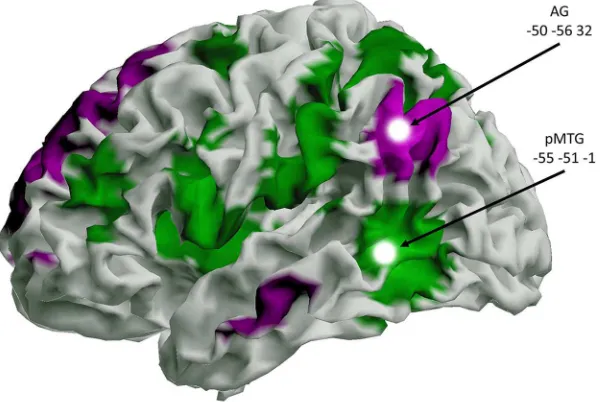
Selection of stimulation sites.Figure 1shows the stimulation sites in mid-AG and pMTG on an inflated cortical surface. These sites were taken from two complementary meta-analyses of neuroimaging data. The left mid-AG site was taken from a meta-analysis (Humphreys and Lambon Ralph, 2014) examining semantic tasks versus difficulty-matched nonse-mantic tasks and is comparable to the peak for senonse-mantics reported by
Binder et al. (2009). The pMTG site, in contrast, was a peak response in a meta-analysis examining diverse manipulations of semantic control (i.e., effects of strong competition, weak probe–target relationships, and im-poverished contextual constraints vs lower-control versions of these tasks;Noonan et al., 2013). Thus, while the response to semantic manip-ulations in neuroimaging studies often encompasses both pMTG and AG within one cluster (Binder et al., 2009), we predicted that these sites would show a functional dissociation, with a greater contribution to automatic aspects of retrieval in mid-AG and more controlled semantic processes in pMTG. These temporoparietal sites are sufficiently distant to allow their separate stimulation and thus permit dissociable effects of TMS. However, we cannot rule out the possibility that some TMS was also delivered to adjacent cortical regions. InFigure 1, these locations are superimposed on maps of resting-state connectivity, which were com-puted using the TMS sites as seeds. The maps were produced using resting-state fMRI data from the Enhanced Nathan Kline Institute Rock-land Sample (i.e., a large publicly available set of resting-state data;
Nooner et al., 2012), and reveal that our AG and pMTG sites fall within distinct networks. Stimulation of an additional site in ATL (⫺53, 0,⫺22) did not elicit any inhibitory effects and is not discussed further. In addi-tion to sites implicated in semantic cogniaddi-tion, we applied stimulaaddi-tion to a control site, the vertex, in each participant. Each of these sites was stimulated for each participant in a different session; participants had two sessions of TMS per week separated by a minimum of 24 h. The order of the sessions was counterbalanced across participants.
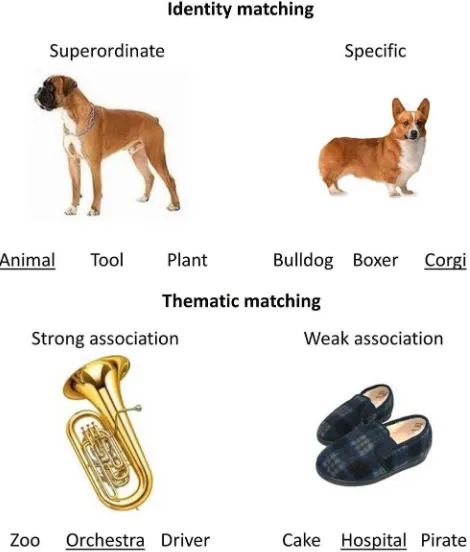
strong (e.g., a picture of an Alsatian presented with the word bone) since activation spreads rapidly and automatically between strongly re-lated concepts. In contrast, in harder thematic trials when the probe–target relationship is weaker (e.g., a picture of an Alsatian presented with the words razor wire), participants may need to identify a linking context in which the probe and target can relate to each other, and then tailor semantic retrieval toward features relevant for this context (e.g., fierce) and away from dominant but currently irrelevant associ-ations (e.g., dog as pet). A group of nine par-ticipants who did not take part in the repetitive TMS experiment rated the probe–target pairs for the strength of association on a 7 point scale (0⫽no discernible association; 7⫽extremely strong link), and these ratings were used to as-sign trials to the strong and weak association conditions used in Analysis 1. Mean associa-tion strength for the strong associaassocia-tion condi-tion was 5.46 on a 7 point scale, while the mean association strength for weak associations was 4.70. We also supplemented this categorical comparison of strong- and weak-association trials in Analysis 1 with a parametric analysis of associative strength (Analysis 2; details below). The contrast of weak versus strong associations has been used in many investigations of seman-tic control: it reliably activates pMTG along with LIFG in fMRI studies (Badre et al., 2005;
Noonan et al., 2013), and TMS to both LIFG and pMTG disrupts the retrieval of weak but not strong semantic associations (Whitney et al., 2011b), suggesting they both play a causal role in shaping semantic retrieval. Given these findings, we predicted that the disruptive effect of TMS would be inversely related to the strength of association between the probe and target concepts for pMTG but not AG.
In the identity-matching task, participants selected a target name for each probe picture. These judgments did not require participants to retrieve information about the context in which the probe objects were found or used; thus, if AG and/or pMTG specifically support thematic knowledge, this task should not show an effect of TMS (at least not above and beyond any nonspecific effects of stimulation). We varied the level of specificity at which items were identified, as follows: participants had to match a photograph of an object (e.g., a specific type of dog) to its superordinate label (animal) or to a more specific term (i.e., Alsatian). Specific-level matching requires similar representations with overlap-ping features to be distinguished (e.g., separation of the Alsatian from other breeds of dog). This task is impaired at an early stage in semantic dementia patients with ATL atrophy, as the distinguishing features of objects are lost (McClelland and Rogers, 2003;Rogers and McClelland, 2004;Patterson et al., 2007). As a result, we envisage that the stimulation of sites involved in the representation or retrieval of detailed conceptual information would likely disrupt specific-level matching more than superordinate-level matching. Identity-matching tasks also require some control over conceptual retrieval, although this might influence specific and superordinate trials in different ways. Specific trials require targets to be selected from a set of similar concepts, eliciting competition that might be stronger than that in superordinate trials (Rogers et al., 2015). However, superordinate trials involve a weaker match between the fea-tures in the picture and those activated by the target word (i.e., animal); therefore, semantic retrieval to superordinate labels might also require “shaping” to suit the demands of the task. As a consequence, we might expect stimulation to pMTG to disrupt both superordinate and specific matching if this region makes a critical contribution to different facets of semantic control, as suggested byNoonan et al. (2013).
Given the proximity of pMTG and AG to brain regions supporting aspects of visual processing and attention, we included a nonsemantic control task with perceptual and decision-making demands that are sim-ilar to the semantic judgments. The stimuli were pixelated and scrambled black-and-white photographs (initially of faces; Krieger-Redwood, 2012). Participants were asked to find targets that were identical to the probe; the distracters were the same images rotated by 180° or 270°.
Task difficulty.Since our focus is on a functional dissociation between AG and pMTG, task difficulty is not able explain the full pattern of TMS results across sites. However, tasks requiring more controlled retrieval should have longer response times (RTs) and potentially lower accuracy than more automatic semantic judgments. In line with these predictions, response efficiency in baseline sessions for all sites (i.e., RT divided by the proportion of trials correct) was poorer for weak than strong thematic associations in the absence of TMS (Table 1; efficiency for strong associ-ations⫽1361.2; efficiency for weak associations⫽1845.3;t(20)⫽17.51,
pⱕ0.001). Thematic association judgments were also more difficult than trials involving identity matching (t(41)⫽10.41,pⱕ0.001). Within the identity-matching task, superordinate trials (mean efficiency ⫽ 1158.7) were somewhat easier than specific trials overall (mean effi-ciency⫽1203.0;t(20)⫽2.34,p⫽0.030). However, as can be seen in
Table 1, specific judgments tended to be faster yet less accurate than superordinate ones.
[image:4.585.229.529.67.268.2]Participants.Eighteen right-handed participants were recruited from the University of York (York, UK; seven females; mean age, 23 years; age range, 11 years). Three additional participants with incomplete data were removed before analysis. All participants had normal or corrected-to-normal vision and met safety screening requirements for TMS. Ethical Figure 1. The two TMS sites and their differing resting-state connectivity. The MNI coordinates shown are the average stimu-lation sites used in this study. The target stimustimu-lation sites were taken from two meta-analyses focused on automatic and controlled semantic retrieval (Noonan et al., 2013;Humphreys and Lambon Ralph, 2014). These TMS stimulation sites are superimposed on an analysis of fMRI resting-state scans from an independent dataset (81 individuals from the Enhanced Nathan Kline Institute Rockland Sample; NKI-RS, first release). Connectivity from pMTG is shown in green: this includes sites linked to executive and semantic control, including inferior frontal gyrus and sulcus, and intraparietal sulcus. Connectivity from AG is shown in purple: this includes anterior temporal lobe areas implicated in semantic representation plus other parts of the default-mode network. These resting-state scans were each 5 min in duration (TR⫽2500 ms; TE⫽30 ms; 38 slices; voxel size⫽3 mm isotropic). Data were processed using DPARFS (version 2.3) toolbox (Chao-Gan and Yu-Feng, 2010), implemented in MATLAB (MathWorks). Preprocess-ing steps included slice-time correction, motion correction, normalization to MNI space usPreprocess-ing the unified segmentation approach (Ashburner and Friston, 2005), smoothing with FWHM of 4 mm, detrending, and bandpass filtering (between 0.01 and 0.10 Hz). Nuisance covariates (head motion parameters, white matter, and CSF signal) were also regressed. The connectivity patterns of the two regions of interest were explored by seeding the stimulated regions (AG and pMTG) with a sphere of 6 mm radius. The averaged time course was obtained from each ROI and the correlation analysis was performed in a voxelwise way to generate the functional connectivity of each region. The correlation coefficient map was converted intozmaps by Fisher’sr-to-ztransform to improve the normality (Rosner, 2006). Each individual’s connectivity maps for AG and pMTG were then compared against each other in a paired-samplesttest, with each contrast masked by a binarized mask of the functional connectivityz-map of the region.
approval was given by the Ethics Committee of the York Neuroimaging Centre.
Stimuli.Three hundred eighteen color photographs, collected through an internet search engine (Google), were used in the semantic tasks (with the same probes used across the different judgment types). All images were resized to 200⫻200 pixels while maintaining the aspect ratio of the initial image to prevent distortions. Two hundred sixty-two images of faces were pixelated and scrambled for the visual control task ( Krieger-Redwood, 2012). In the semantic tasks, these images were presented alongside target nouns, which were either the names of natural/man-made objects at different levels of specificity or concrete associates of the object. The distracters in the thematic matching task were associates taken from other trials (carefully selected to ensure that they were not linked to the probe).
For the thematic association trials, we gathered ratings of association strength between the target and probe from 28 participants and these were used as a continuous variable in a parametric analysis of reaction time as a function of association strength and TMS (see Analysis 2). In addition, a set of nine participants rated all of the target concepts for familiarity on a 7 point scale. For these targets, we also obtained counts of lexical frequency using the SUBTLEX-UK database (van Heuven et al., 2014) and polysemy using WordNet (Fellbaum, 1998). Thus, in Analysis 2, we were able to statistically control for the familiarity of the target concept, plus the lexical frequency of the words used to denote this concept, and the variability of the meaning of the target concept. In Analysis 3 of the identity-matching task, the same superordinate target words were repeated many times across trials. Therefore, in this analysis, we statistically controlled for conceptual variables relating to the probe as opposed to psycholinguistic variables related to the target. We collected typicality ratings for each probe concept from 15 participants, who were asked to judge on a 7 point scale whether each item (denoted by its specific verbal label) was a good example of its superordinate category using the methods ofRosch (1975). We also collected familiarity ratings, on a 7 point scale, for each probe concept from nine participants. In all cases, the participants providing these ratings did not take part in the TMS experiment.
Procedure. Structural T-1 MRI scans (3D FSPGR MRI) were coregistered to the scalp using Brainsight (Rogue Research, https:// www.rogue-research.com) to identify the stimulation targets in each participant’s brain. Scalp measurements were made to determine the location of the vertex. At the beginning of each session, each partici-pant’s active motor threshold was established, determined as the low-est stimulation intensity needed to cause a contraction of the first dorsal interosseous muscle of the right hand when stimulating left motor cortex (average motor threshold, 61%; motor threshold range, 29%; average stimulator output, 73%). TMS stimulation was deliv-ered using an 8 mm figure-of-eight coil, attached to a MagStim Rapid stimulator (The Magstim Company Ltd). Repetitive trains of TMS were delivered at 1 Hz for 10 min, changing the coil after 5 min. Stimulation intensity was set at 120% of a participant’s individual motor threshold and capped at a maximum of 75% of stimulator output. Coil orientation was adjusted to produce the most comfort-able stimulation for participants.
Tasks were presented on a Windows PC running E-prime 2.0 (Psy-chology Software Tools). Each session started with a set of 20 practice trials. Per session, there were four blocks of trials after TMS and at base-line (i.e., in the absence of TMS). The blocks were divided into mini-blocks containing 20 trials for each of the identity-matching and thematic matching conditions (with these split into 10 high-association/ low-association thematic trials and 10 superordinate/specific trials), and 10 trials for the visual control task (i.e., 50 trials in all per block; 40 trials per condition across blocks). The order of conditions and stimuli was counterbalanced across participants and experimental sessions. No trials were repeated within a session, and 7.5% of trials were repeated across sessions to ensure that there were equal numbers of trials per TMS session. Repeated trials were coded as dummy trials and removed before analysis. Tasks started with a prompt to remind the participant what feature they had to match (identity⫽match the picture with its name; association⫽match the picture to a thematically associated item; vi-sual⫽match the top picture to an identical but rotated target picture). For all tasks, the three response options appeared 900 ms before the probe image, which stayed on screen for a maximum of 3000 ms after the presentation of the response image or until the participant made their response. Participants pressed 1, 2, or 3 to indicate their selection of targets on the left, middle, and bottom of the screen.
Statistical analysis.Behavioral data were analyzed using hierarchical linear modeling in SAS version 9.3 (SAS Institute). Accuracy data were analyzed using PROC GLIMIX, but this analysis did not reveal significant effects of TMS and is not discussed further. Thus, the analyses below focus on RT, which was analyzed using PROC MIXED with maximum likelihood as the estimation method and an “unstructured” variance– covariance structure specified for the random effects. Incorrect trials were removed before analysis, as were outlying responses that fell⬎2 SDs from each participant’s mean for that condition.
Results
Analysis 1: omnibus model
[image:5.585.48.283.65.341.2]This analysis examined the effects of TMS for each site and
con-dition. It included the following three categorical fixed effects: (1)
condition, with five levels, superordinate identity matching (for
the overarching category labels animal, weapon, food, vehicle,
plant, clothes, household item, footwear, tree, instrument, and
sports equipment), specific identity matching (using the names
of individual objects), thematic association matching for strong
probe–target pairings, thematic association matching for weaker
probe–target pairings, and visual matching for meaningless
im-ages; (2) stimulation site with the four levels vertex, AG, pMTG,
and ATL (although no significant behavioral disruption was
ob-served following TMS to ATL, the data were included in the
omnibus model to optimize estimates of RT in each condition in
the absence of TMS); and (3) TMS with two levels, baseline and
post-TMS. We fitted a fully saturated model in which random
variation for the intercept was allowed for subject, target, and
Figure 2. Examples of the identity judgments at different levels of specificity, and withprobe. This allowed us to estimate pairwise comparisons of the
least squared (LS) mean reaction times, with and without TMS,
controlling for multiple comparisons, separately at each site for
each condition (a total of 26,001 observations).
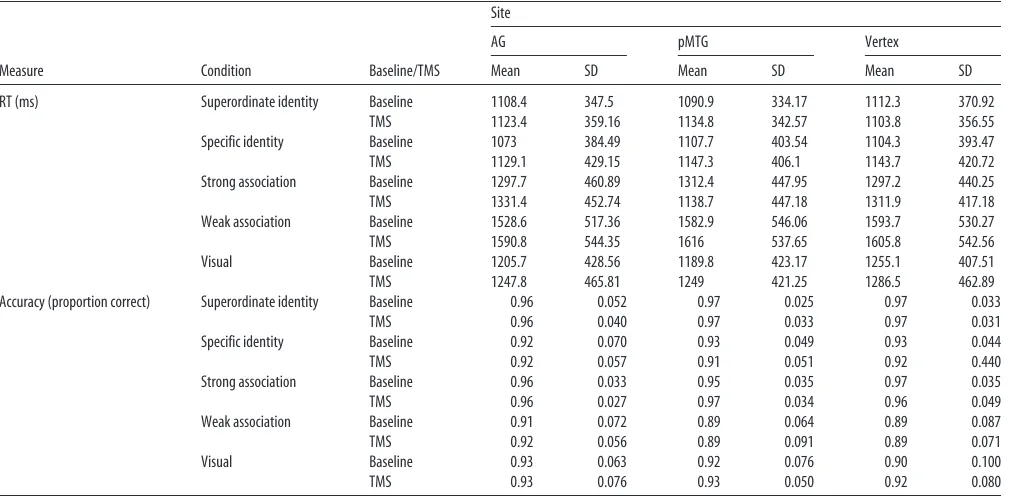
Table 1
shows the mean RT and the accuracy for each
condi-tion for each site, as a funccondi-tion of TMS.
Table 2
shows the
out-comes of the multiple pairwise comparisons derived from the
omnibus model. As expected, we found no significant TMS
ef-fects at vertex (the nonsemantic control site). AG showed
signif-icant TMS effects for specific identity matching, strong and weak
thematic associations, and visual decisions. pMTG showed
sig-nificant TMS effects for superordinate and specific identity
matching, and visual decisions, and a marginal effect for weak
thematic associations. Since TMS to both AG and pMTG
dis-rupted identity and thematic association matching, neither site
showed the profile expected for a thematic hub (i.e., specific
dis-ruption of semantic associations). However, since stimulation to
these sites disrupted visual-matching as well as semantic
deci-sions, it might be that neighboring cortical regions were also
influenced by the stimulation or that the function of pMTG/AG
is not restricted to the semantic domain but extends to visual
and/or executive aspects of cognition (a view that is compatible
with the existing literature; for comparison, see
Humphreys and
Lambon Ralph, 2014
). For this reason, we included the TMS
effect for the visual task (per participant and session) as a
covari-ate of no interest in subsequent analyses examining association
strength and specificity.
Analysis 2: association strength as a continuous variable
This analysis examined the effects of associative strength for the
thematic matching task in more detail. We fitted a fully saturated
model to estimate the fixed effects of TMS (stimulation vs no
stimulation), site (pMTG, AG), and associative strength
(mod-eled as a continuous variable) on RT, with subject and target as
random effects. This model was computed twice: first,
statisti-cally controlling for target lexical frequency, polysemy, and rated
conceptual familiarity (Analysis 2a; 3648 observations); and,
sec-ond, controlling for the effects of TMS on the visual task, by
entering the LS means estimates of this nonsemantic TMS effect,
per participant and per site, as a covariate (Analysis 2b; 4773
observations). We predicted that TMS to pMTG would only
rupt the weakest association trials, while TMS to AG might
dis-rupt stronger thematic associations.
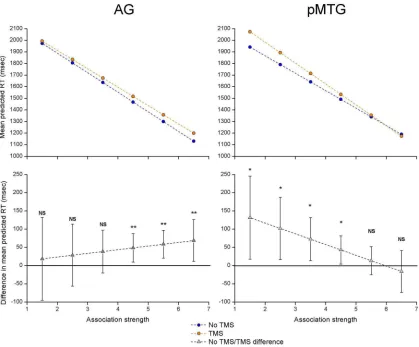
Figure 3
shows the predicted RT values at different levels of
associative strength while controlling for all other sources of
vari-ance in the model (Analysis 2a). Point comparisons were
com-puted for the LS means with and without TMS at six different
levels of associative strength (ranging from 1.5 to 6.5 on a 7 point
scale). These comparisons, corrected for multiple comparisons,
confirmed our predictions. Stimulation to pMTG caused a
spe-cific disruption for weakly associated items, while stimulation to
AG disrupted strong-association trials. These effects were
ob-served at both sites even when the disruption to the visual trials
was entered as a covariate (Analysis 2b; i.e., the disruption of
nonsemantic decisions was not sufficient to explain the
impair-ment of semantic performance;
Table 3
). This dissociation
be-tween pMTG and AG in the thematic association-matching task
is consistent with their hypothesized role in more controlled and
automatic aspects of semantic retrieval, respectively.
Table 1. RT and mean proportion correct
Measure Condition Baseline/TMS
Site
AG pMTG Vertex
Mean SD Mean SD Mean SD
RT (ms) Superordinate identity Baseline 1108.4 347.5 1090.9 334.17 1112.3 370.92
TMS 1123.4 359.16 1134.8 342.57 1103.8 356.55
Specific identity Baseline 1073 384.49 1107.7 403.54 1104.3 393.47
TMS 1129.1 429.15 1147.3 406.1 1143.7 420.72
Strong association Baseline 1297.7 460.89 1312.4 447.95 1297.2 440.25
TMS 1331.4 452.74 1138.7 447.18 1311.9 417.18
Weak association Baseline 1528.6 517.36 1582.9 546.06 1593.7 530.27
TMS 1590.8 544.35 1616 537.65 1605.8 542.56
Visual Baseline 1205.7 428.56 1189.8 423.17 1255.1 407.51
TMS 1247.8 465.81 1249 421.25 1286.5 462.89
Accuracy (proportion correct) Superordinate identity Baseline 0.96 0.052 0.97 0.025 0.97 0.033
TMS 0.96 0.040 0.97 0.033 0.97 0.031
Specific identity Baseline 0.92 0.070 0.93 0.049 0.93 0.044
TMS 0.92 0.057 0.91 0.051 0.92 0.440
Strong association Baseline 0.96 0.033 0.95 0.035 0.97 0.035
TMS 0.96 0.027 0.97 0.034 0.96 0.049
Weak association Baseline 0.91 0.072 0.89 0.064 0.89 0.087
TMS 0.92 0.056 0.89 0.091 0.89 0.071
Visual Baseline 0.93 0.063 0.92 0.076 0.90 0.100
[image:6.585.41.286.358.485.2]TMS 0.93 0.076 0.93 0.050 0.92 0.080
Table 2. Paired contrasts examining the TMS effect (no TMS vs TMS) for each site and each task separately (Analysis 1)
Site
LS mean estimate
difference Condition tValue Significance
AG ⫺18.81 Superordinate identity ⫺0.92 0.357 AG ⫺57.20 Specific identity ⴚ2.71 0.007
AG ⫺43.80 Strong association ⴚ2.13 0.034
AG ⫺64.28 Weak association ⴚ3.00 0.003
AG ⫺41.50 Visual ⴚ1.99 0.046
pMTG ⫺43.20 Superordinate identity ⴚ2.11 0.035
pMTG ⫺46.06 Specific identity ⴚ2.19 0.028
pMTG ⫺20.20 Strong association ⫺0.98 0.326 pMTG ⫺38.30 Weak association ⫺1.76 0.079
pMTG ⫺53.29 Visual ⴚ2.54 0.011
Comparing LS means for each site and task, with and without TMS. Significant effects of TMS are highlighted in bold text.
Analysis 3: identity matching at two levels of specificity
This analysis examined the effect of TMS on identity matching
in more detail. We fitted a fully saturated model to estimate
the fixed effects of TMS (stimulation vs no stimulation), site
(pMTG, AG), and specificity (superordinate vs specific), with
subject and target as random effects. This model was
com-puted twice: first, statistically controlling for concept
typical-ity and familiartypical-ity (Analysis 3a; 4368 observations); and,
second, controlling for the effects of TMS on the visual task by
entering the LS means estimates of this nonsemantic TMS
effect, per participant and per site, as a covariate (Analysis 3b;
5091 observations).
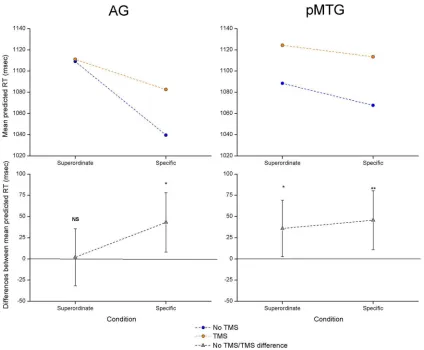
Figure 4
shows the predicted RT values for superordinate and
specific identity matching while controlling for all other sources of
variance in the model (Analysis 3a). Paired contrasts, corrected for
multiple comparisons (
Fig. 4
,
Table 4
), revealed that TMS to AG
disrupted identity matching at the specific but not at the
superordi-nate level, suggesting that this site plays a necessary role in precise
semantic retrieval that differentiates highly similar concepts that
share many features. In contrast, stimulation of pMTG elicited
sig-nificant disruption for both the specific and superordinate trials,
demonstrating a functional dissociation for these two sites on a
sec-ond task. A similar pattern was seen when the visual TMS effect for
each participant and each site was added as a covariate of no interest
(Analysis 3b). Thus, AG and pMTG appear to contribute to aspects
of semantic cognition beyond the storage and/or retrieval of
the-matic associations, even when general effects on nonsemantic visual
processing are taken into account.
Discussion
[image:7.585.84.503.61.408.2] [image:7.585.42.286.478.635.2]This study examined the following two contrasting hypotheses
about the role of AG and pMTG: (1) by one view, these sites
store semantic information about thematic associations and
events but are not critical for identity matching (compare with
Figure 3. Predicted RT values for AG and pMTG in Analysis 2a, modeling association strength as a continuous variable. The top plots show the predicted RT with and without TMS at different levels of associative strength, while the bottom plots show the difference between these conditions. Error bars represent 95% confidence intervals. NS, No significant effect of TMS; *p⬍0.05; **p⬍0.01.Table 3. Paired contrasts of the TMS effect (no TMS vs TMS) in Analysis 2, modeling associative strength as a continuous variable
Site
Associative strength
No visual covariate (Analysis 2a)
Visual covariate entered (Analysis 2b)
t Significance t Significance
AG 1.5 ⫺0.32 0.747 ⫺0.86 0.388
2.5 ⫺0.66 0.508 ⫺1.12 0.261 3.5 ⫺1.30 0.195 ⫺1.58 0.113 4.5 ⴚ2.46 0.014 ⴚ2.31 0.021
5.5 ⴚ3.02 0.003 ⴚ2.25 0.025
6.5 ⴚ2.36 0.018 ⫺1.45 0.146
pMTG 1.5 ⴚ2.26 0.024 ⴚ1.98 0.048
2.5 ⴚ2.35 0.019 ⴚ2.03 0.042
3.5 ⴚ2.42 0.016 ⴚ2.07 0.039
4.5 ⴚ2.17 0.030 ⫺1.77 0.077
5.5 ⫺0.70 0.485 ⫺0.45 0.653
6.5 0.54 0.591 0.59 0.556
Point comparisons of RT with and without TMS at different levels of associative strength. The analysis was performed twice, with and without the inclusion of the TMS effect for the visual task as a covariate. Significant effects of TMS at
the “two hub theory”;
Schwartz et al., 2011
;
Mirman and
Gra-ziano, 2012a
,
b
); and (2) alternatively, these sites support
controlled versus automatic aspects of semantic retrieval (
Jef-feries, 2013
;
Noonan et al., 2013
). TMS was applied to peaks
taken from two meta-analyses of semantic cognition
examin-ing (1) semantic over nonsemantic tasks matched for
diffi-culty (
Binder et al., 2009
; peak in mid-AG); and (2) semantic
decisions with high and low control demands (
Noonan et al.,
2013
; peak in pMTG). We measured the effects of this
stimu-lation on identity matching (at superordinate and specific
levels) and thematic matching (for weak and strong
associa-tions). The results show that AG and pMTG make dissociable
contributions to semantic cognition, which is consistent with
a theoretical model in which pMTG (alongside LIFG)
under-pins controlled aspects of semantic retrieval. In contrast, AG
(alongside ATL) supports more automatic processes that are
critical to the retrieval of specific concepts.
[image:8.585.81.505.60.410.2]Without any control over the retrieval of knowledge, semantic
processing is dominated by spreading activation between
strongly linked concepts, yet we show a high degree of flexibility
in the information we retrieve—we can selectively focus on
non-dominant aspects of meaning when required to do so by a task.
Coactivation of pMTG and LIFG has been linked to this type of
controlled semantic retrieval (
Jefferies, 2013
;
Noonan et al.,
2013
). For example, when asked to recover an unusual
the-matic association between weakly associated concepts (e.g.,
Alsatian and razor wire), dominant features/associations are
largely irrelevant (i.e., “pet”), yet we can bring these disparate
concepts together by focusing on features that are relevant to
establishing a connection (e.g., “fierce”). Studies examining
neural responses to weak over strong semantic associations,
and ambiguous over unambiguous words, implicate pMTG
and LIFG in this type of controlled shaping of semantic
re-trieval (
Badre et al., 2005
;
Whitney et al., 2011a
,
b
;
Noonan et
al., 2013
). Moreover, damage to either LIFG or posterior
tem-poral areas, including pMTG in patients with SA, is associated
with deregulated semantic retrieval that is characterized by a
tendency to retrieve dominant features and associations, even
when these are irrelevant to the current task or context (
Jef-feries and Lambon Ralph, 2006
;
Noonan et al., 2010
). Thus,
our finding that the stimulation of pMTG disrupted
judg-ments about weak but not strong thematic associations adds
Figure 4. Predicted RT values for AG and pMTG in Analysis 3a, comparing identity matching at two levels of specificity. The top plots show the predicted RT with and without TMS at different levels of specificity, while the bottom plots show the difference between these conditions. Error bars represent 95% confidence intervals. NS, No significant effect of TMS; *p⬍0.05; **p⬍0.01.Table 4. Paired contrasts of TMS effect (no TMS vs TMS) in Analysis 3 at two levels of specificity
Site Specificity
No visual covariate (Analysis 3a)
Visual covariate entered (Analysis 3b)
t Significance t Significance
AG Superordinate ⫺0.12 0.906 0.62 0.538 Specific ⴚ2.41 0.016 ⫺1.76 0.079
pMTG Superordinate ⴚ2.11 0.035 ⫺1.26 0.208
Specific ⴚ2.58 0.010 ⫺1.72 0.085
Comparisons of LS means with and without TMS for superordinate identity-matching trials (involving a category label such as “animal”), and specific-level trials. The analysis was performed twice, with and without the inclusion of the TMS effect for the visual task as a covariate. Significant effects of TMS are highlighted in bold text.
anatomical specificity to neuropsychological findings and
demonstrates causality.
We also found that stimulation of pMTG disrupted identity
matching for both specific and superordinate trials. This result is
not unexpected given that these judgments also involved
con-trolled retrieval. Specific identity matching requires selection of a
target concept from among highly similar items; therefore,
con-trol processes might have been engaged to overcome
competi-tion. Superordinate identity matching involves terms like
“animal” that have variable meanings across contexts. For these
items, automatic spreading activation is not expected to strongly
overlap with the features visible in the probe picture, and thus
control processes may be engaged to tailor retrieval from the
words to suit the demands of the task. Consistent with this
ac-count, SA patients have deficits on both identity-matching and
thematic matching tasks that reflect the control requirements of
these judgments (
Noonan et al., 2010
;
Rogers et al., 2015
). In
summary, although pMTG activation continues to be interpreted
in terms of a semantic store (
Binder et al., 2009
;
Martin et al.,
2014
), multiple studies using complementary methods have
noted responses incompatible with a role in passive storage and
suggest instead that pMTG allows for the controlled retrieval of
semantic activation (
Gold et al., 2005
;
Whitney et al., 2011b
;
Jefferies, 2013
;
Noonan et al., 2013
).
The mid-AG site demonstrated a different response profile
from pMTG; TMS to AG elicited greater disruption of strongly
related thematic associations, which is in line with the proposal
that this site contributes to more automatic forms of retrieval. AG
has several functional subdivisions (
Seghier et al., 2010
;
Noonan
et al., 2013
), as follows: dorsal AG is associated with executive
semantic processing, while the mid-AG region (our TMS target
site) is typically characterized by task-related deactivation
(
Seghier et al., 2010
;
Wirth et al., 2011
;
Humphreys and Lambon
Ralph, 2014
; i.e., it forms part of the default-mode network). This
deactivation is more pronounced for harder semantic and
non-semantic tasks (
Binder et al., 2003
;
Sabsevitz et al., 2005
;
Hum-phreys et al., 2015
), which is consistent with the view that this
region does not facilitate executively demanding aspects of
cog-nition. In contrast, it shows activation for tasks that involve the
retrieval of internal representations, including automatic
seman-tic tasks, episodic memory, numerical fact retrieval, and sentence
comprehension (
Humphreys and Lambon Ralph, 2014
).
Our observation of greater disruption for specific than
subordinate-level identity matching following AG stimulation
might also be explicable within this framework. For example,
mid-AG could contribute to the reflexive (automatic) allocation
of attention to activated concepts. Consequently, when a picture
of a corgi is presented alongside different dog names, attention
might be captured by the features of corgi that are activated in the
semantic store. If TMS to AG results in less accurate allocation of
attention, this could reduce the ability to distinguish between
similar representations (e.g., corgi and Dalmatian in specific
tri-als), but the ability to separate dogs from human-made objects in
superordinate trials would be preserved. This proposal is
consis-tent with the broader role of posterior inferior parietal regions in
reflexive attention to memory (
Corbetta et al., 2008
;
Hutchinson
et al., 2009
). Although this account is compatible with the current
data, further research is needed to confirm this interpretation.
TMS additionally disrupted a visual matching control task,
and we statistically controlled for this effect in the analysis.
Al-though our tasks and interpretation focus on the necessary
contribution of mid-AG and pMTG to semantic cognition, the
framework above does not preclude the possibility that these
brain regions also contribute to nonsemantic processes, or lie
adjacent to visual or executive regions that were influenced by
stimulation in some of the participants. Although a recent
meta-analysis examining semantic control found that pMTG made a
relatively specific contribution to semantic decisions (relative to
phonological decisions;
Noonan et al., 2013
), it lies anterior to the
visual motion-processing area MT (
Malach et al., 1995
;
Wallen-tin et al., 2011
) and immediately above ventral
occipital–tempo-ral areas coupled to the frontoparietal control system (
Duncan,
2010
;
Yeo et al., 2011
). Similarly, AG is engaged in many
nonse-mantic tasks, and there is an anterior-to-posterior transition
from stimulus-driven attention in supramarginal gyrus to
se-mantics in AG (
Humphreys and Lambon Ralph, 2014
).
TMS-induced disruption of these processes might account for effects
on the visual-matching task.
The current study focused on the functional differentiation of
pMTG and AG, yet, as noted in the Introduction, these sites are
similarly recruited by “event semantics” and “thematic
judg-ments” (
Schwartz et al., 2011
;
de Zubicaray et al., 2013
). The
two-hub account proposes that one or both of these sites
repre-sent thematic associations as opposed to the concrete features of
objects. This proposal was originally motivated by the
observa-tion that patients with temporoparietal stroke make thematic
errors in picture naming (e.g., “squirrel”
¡
“nuts”), unlike those
with ATL damage (
Jefferies and Lambon Ralph, 2006
;
Schwartz et
al., 2011
). However, this inappropriate production of
associa-tions in picture naming might reflect intact thematic knowledge
but a deficit in the ability to constrain semantic retrieval, which is
in line with these patients’ deficits in semantic control (
Jefferies
and Lambon Ralph, 2006
;
Noonan et al., 2010
). The current
find-ings are largely inconsistent with the predictions of the two-hub
account since TMS to both sites disrupted identity as well as
thematic matching, even after the nonspecific effects of TMS to
these sites was taken into account. Given that events can have very
different meanings in different contexts (e.g., kicking ball: on a
field
⫽
game vs in a greenhouse
⫽
vandalism), the contribution
of pMTG to action/event understanding might follow from its
role in shaping retrieval in line with the current context. In
con-trast, AG might play a critical role in the orientation of attention
toward specific event representations and/or maintain a focus of
attention across a sequence of interacting concepts (
Humphreys
and Lambon Ralph, 2014
).
To conclude, although semantic contrasts can activate pMTG
and mid-AG as a single cluster (
Binder et al., 2009
), we propose
that these sites should not be interpreted narrowly in terms of
supporting specific aspects of semantic knowledge—instead,
they are implicated within distinct large-scale cortical networks,
which support retrieval processes crucial for semantics and also
other aspects of cognition. Our two stimulation sites have
differ-ent functional connectivity profiles revealed by resting-state
fMRI (
Fig. 1
); mid-AG has strong connections to ATL (
Ruschel et
al., 2014
) and to posterior cingulate and ventromedial prefrontal
cortex implicated in the default mode network (
Uddin et al.,
2010
). In contrast, pMTG shows strong connectivity to LIFG,
implicated in semantic control (
Koopmans et al., 2012
). These
different patterns of connectivity support our conclusions that
mid-AG is implicated in automatic aspects of retrieval, while
pMTG contributes to controlled retrieval.
References
Ashburner J, Friston KJ (2005) Unified segmentation. Neuroimage 26:839 – 851.CrossRef Medline
Dis-sociable controlled retrieval and generalized selection mechanisms in ventrolateral prefrontal cortex. Neuron 47:907–918.CrossRef Medline
Bedny M, McGill M, Thompson-Schill SL (2008) Semantic adaptation and competition during word comprehension. Cereb Cortex 18:2574 –2585.
CrossRef Medline
Binder JR, McKiernan KA, Parsons ME, Westbury CF, Possing ET, Kaufman JN, Buchanan L (2003) Neural correlates of lexical access during visual word recognition. J Cogn Neurosci 15:372–393.CrossRef Medline
Binder JR, Desai RH, Graves WW, Conant LL (2009) Where is the semantic system? A critical review and meta-analysis of 120 functional neuroimag-ing studies. Cereb Cortex 19:2767–2796.CrossRef Medline
Cabeza R, Mazuz YS, Stokes J, Kragel JE, Woldorff MG, Ciaramelli E, Olson IR, Moscovitch M (2011) Overlapping parietal activity in memory and perception: evidence for the attention to memory model. J Cogn Neurosci 23:3209 –3217.CrossRef Medline
Chao-Gan Y, Yu-Feng Z (2010) DPARSF: A MATLAB toolbox for “pipe-line” data analysis of resting-state fMRI. Front Syst Neurosci 4:13.
CrossRef Medline
Corbetta M, Patel G, Shulman GL (2008) The reorienting system of the human brain: from environment to theory of mind. Neuron 58:306 –324.
CrossRef Medline
de Zubicaray GI, Hansen S, McMahon KL (2013) Differential processing of thematic and categorical conceptual relations in spoken word produc-tion. J Exp Psychol Gen 142:131–142.CrossRef Medline
Duncan J (2010) The multiple-demand (MD) system of the primate brain: mental programs for intelligent behaviour. Trends Cogn Sci 14:172–179.
CrossRef Medline
Fellbaum C (1998) WordNet. New York: Wiley Online Library.
Gold BT, Balota DA, Kirchhoff BA, Buckner RL (2005) Common and dis-sociable activation patterns associated with controlled semantic and pho-nological processing: evidence from FMRI adaptation. Cereb Cortex 15: 1438 –1450.CrossRef Medline
Humphreys GF, Lambon Ralph MA (2014) Fusion and fission of cognitive functions in the human parietal cortex. Cereb Cortex. Advance online publication. Retrieved 14 September 2015. doi:10.1093/cercor/bhu198.
CrossRef Medline
Humphreys GF, Hoffman P, Visser M, Binney RJ, Lambon Ralph MA (2015) Establishing task- and modality-dependent dissociations between the se-mantic and default mode networks. Proc Natl Acad Sci U S A 112:7857– 7862.CrossRef Medline
Hutchinson JB, Uncapher MR, Wagner AD (2009) Posterior parietal cortex and episodic retrieval: convergent and divergent effects of attention and memory. Learn Mem 16:343–356.Medline
Jefferies E (2013) The neural basis of semantic cognition: converging evi-dence from neuropsychology, neuroimaging and TMS. Cortex 49:611– 625.CrossRef Medline
Jefferies E, Lambon Ralph MA (2006) Semantic impairment in stroke apha-sia versus semantic dementia: a case-series comparison. Brain 129:2132– 2147.CrossRef Medline
Koopmans PJ, Boyaciog˘lu R, Barth M, Norris DG (2012) Whole brain, high resolution spin-echo resting state fMRI using PINS multiplexing at 7 T. Neuroimage 62:1939 –1946.CrossRef Medline
Krieger-Redwood K (2012) An investigation of phonological and semantic control using TMS and fMRI. In: Psychology. York, UK: University of York.
Malach R, Reppas JB, Benson RR, Kwong KK, Jiang H, Kennedy WA, Ledden PJ, Brady TJ, Rosen BR, Tootell RB (1995) Object-related activity re-vealed by functional magnetic resonance imaging in human occipital cor-tex. Proc Natl Acad Sci U S A 92:8135– 8139.CrossRef Medline
Martin A (2007) The representation of object concepts in the brain. Annu Rev Psychol 58:25– 45.CrossRef Medline
Martin A, Simmons KW, Beauchamp MS, Gotts SJ (2014) Is a single “hub,” with lots of spokes, an accurate description of the neural architecture of action semantics? Comment on “Action semantics: a unifying conceptual framework for the selective use of multimodal and modality-specific ob-ject knowledge” by van Elk, Van Schie and Bekkering. Physics Life Rev 11:261–262.CrossRef Medline
McClelland JL, Rogers TT (2003) The parallel distributed processing ap-proach to semantic cognition. Nat Rev Neurosci 4:310 –322.CrossRef Medline
Mirman D, Graziano KM (2012a) Damage to temporo-parietal cortex
de-creases incidental activation of thematic relations during spoken word comprehension. Neuropsychologia 50:1990 –1997.CrossRef Medline
Mirman D, Graziano KM (2012b) Indivdual differences in the strength of taxonomic versus thematic relations. J Exp Psychol Gen 141:601– 609.
CrossRef Medline
Noonan KA, Jefferies E, Corbett F, Lambon Ralph MA (2010) Elucidating the nature of deregulated semantic cognition in semantic aphasia: evi-dence for the roles of prefrontal and temporo-parietal cortices. J Cogn Neurosci 22:1597–1613.CrossRef Medline
Noonan KA, Jefferies E, Visser M, Lambon Ralph MA (2013) Going beyond inferior prefrontal involvement in semantic control: evidence for the ad-ditional contribution of dorsal angular gyrus and posterior middle tem-poral cortex. J Cogn Neurosci 25:1824 –1850.CrossRef Medline
Nooner KB, Colcombe SJ, Tobe RH, Mennes M, Benedict MM, Moreno AL, Panek LJ, Brown S, Zavitz ST, Li Q, Sikka S, Gutman D, Bangaru S, Schlachter RT, Kamiel SM, Anwar AR, Hinz CM, Kaplan MS, Rachlin AB, Adelsberg S, et al. (2012) The NKI-Rockland sample: a model for accel-erating the pace of discovery science in psychiatry. Front Neurosci 6:152.
CrossRef Medline
Patterson K, Nestor PJ, Rogers TT (2007) Where do you know what you know? The representation of semantic knowledge in the human brain. Nat Rev Neurosci 8:976 –987.CrossRef Medline
Pobric G, Jefferies E, Lambon Ralph MA (2010) Category-specific versus category-general semantic impairment induced by transcranial magnetic stimulation. Curr Biol 20:964 –968.CrossRef Medline
Rodd JM, Johnsrude IS, Davis MH (2012) Dissociating frontotemporal contributions to semantic ambiguity resolution in spoken sentences. Cereb Cortex 22:1761–1773.CrossRef Medline
Rogers TT, McClelland JL (2004) Semantic cognition: a parallel distributed processing approach. Cambridge, MA: MIT.
Rogers TT, Lambon Ralph MA, Garrard P, Bozeat S, McClelland JL, Hodges JR, Patterson K (2004) Structure and deterioration of semantic mem-ory: a neuropsychological and computational investigation. Psychol Rev 111:205–235.CrossRef Medline
Rogers TT, Patterson K, Jefferies E, Lambon Ralph MA (2015) Disorders of representation and control in semantic cognition: effects of familiarity, typi-cality, and specificity. Neuropsychologia. Advance online publication. Re-trieved 14 September 2015. doi:10.1016/j.neuropsychologia.2015.04.015.
CrossRef Medline
Rosch E (1975) Cognitive representations of semantic categories. J Exp Psy-chol Gen 104:192–233.CrossRef
Rosner BA (2006) Fundamentals of biostatistics, Ed 6. Belmont, CA: Thompson-Brooks/Cole.
Ruschel M, Kno¨sche TR, Friederici AD, Turner R, Geyer S, Anwander A (2014) Connectivity architecture and subdivision of the human inferior parietal cortex revealed by diffusion MRI. Cereb Cortex 24:2436 –2448.
CrossRef Medline
Sabsevitz DS, Medler DA, Seidenberg M, Binder JR (2005) Modulation of the semantic system by word imageability. Neuroimage 27:188 –200.
CrossRef Medline
Schwartz MF, Kimberg DY, Walker GM, Brecher A, Faseyitan OK, Dell GS, Mirman D, Coslett HB (2011) Neuroanatomical dissociation for taxo-nomic and thematic knowledge in the human brain. Proc Natl Acad Sci U S A 108:8520 – 8524.CrossRef Medline
Seghier ML, Fagan E, Price CJ (2010) Functional subdivisions in the left angular gyrus where the semantic system meets and diverges from the default network. J Neurosci 30:16809 –16817.CrossRef Medline
Thompson-Schill SL, D’Esposito M, Aguirre GK, Farah MJ (1997) Role of left inferior prefrontal cortex in retrieval of semantic knowledge: a reevaluation. Proc Natl Acad Sci U S A 94:14792–14797. CrossRef Medline
Tyler LK, Stamatakis EA, Dick E, Bright P, Fletcher P, Moss H (2003) Ob-jects and their actions: evidence for a neurally distributed semantic sys-tem. Neuroimage 18:542–557.CrossRef Medline
Uddin LQ, Supekar K, Amin H, Rykhlevskaia E, Nguyen DA, Greicius MD, Menon V (2010) Dissociable connectivity within human angular gyrus and intraparietal sulcus: evidence from functional and structural connec-tivity. Cereb Cortex 20:2636 –2646.CrossRef Medline
van Heuven WJB, Mandera P, Keuleers E, Brysbaert M (2014) SUBTLEX-UK: a new and improved word frequency database for British English. Q J Exp Psychol (Hove) 67:1176 –1190.CrossRef Medline
middle temporal gyrus and the ventral anterior temporal area are crucial for multimodal semantic processing: distortion-corrected fMRI evidence for a double gradient of information convergence in the temporal lobes. J Cogn Neurosci 24:1766 –1778.CrossRef Medline
Wagner AD, Maril A, Bjork RA, Schacter DL (2001) Prefrontal contribu-tions to executive control: fMRI evidence for functional distinccontribu-tions within lateral prefrontal cortex. Neuroimage 14:1337–1347.CrossRef Medline
Wallentin M, Nielsen AH, Vuust P, Dohn A, Roepstorff A, Lund TE (2011) BOLD response to motion verbs in left posterior middle temporal gyrus during story comprehension. Brain Lang 119:221–225.CrossRef Medline
Whitney C, Jefferies E, Kircher T (2011a) Heterogeneity of the left temporal lobe in semantic representation and control: priming multiple versus single meanings of ambiguous words. Cereb Cortex 21:831–844.CrossRef Medline
Whitney C, Kirk M, O’Sullivan J, Lambon Ralph MA, Jefferies E (2011b) The neural organization of semantic control: TMS evidence for a
distrib-uted network in left inferior frontal and posterior middle temporal gyrus. Cereb Cortex 21:1066 –1075.CrossRef Medline
Whitney C, Kirk M, O’Sullivan J, Lambon Ralph MA, Jefferies E (2012) Executive semantic processing is underpinned by a large-scale neural net-work: revealing the contribution of left prefrontal, posterior temporal, and parietal cortex to controlled retrieval and selection using TMS. J Cogn Neurosci 24:133–147.CrossRef Medline
Wirth M, Jann K, Dierks T, Federspiel A, Wiest R, Horn H (2011) Semantic memory involvement in the default mode network: a functional neuro-imaging study using independent component analysis. Neuroimage 54: 3057–3066.CrossRef Medline
Yeo BT, Krienen FM, Sepulcre J, Sabuncu MR, Lashkari D, Hollinshead M, Roffman JL, Smoller JW, Zo¨llei L, Polimeni JR, Fischl B, Liu H, Buckner RL (2011) The organization of the human cerebral cortex estimated by intrinsic functional connectivity. J Neurophysiol 106:1125–1165.