UNIVERSITI TEKNIKAL MALAYSIA MELAKA
BIKER COMMUNICATION DEVICE
This report submitted in accordance with requirement of the Universiti Teknikal Malaysia Melaka (UTeM) for the Bachelor Degree of Electronic Engineering
Technology (Telecommunication) (Hons.)
by
MOHAMAD SYAZWAN BIN AHMAD YUSRI B071210100
930204-02-5957
UNIVERSITI TEKNIKAL MALAYSIA
MELAKA
BORANG PENGESAHAN STATUS LAPORAN PROJEK SARJANA MUDA
TAJUK: Biker Communication Device
SESI PENGAJIAN: 2015/16 Semester 2
Saya MOHAMAD SYAZWAN BIN AHMAD YUSRI
mengaku membenarkan Laporan PSM ini disimpan di Perpustakaan Universiti Teknikal Malaysia Melaka (UTeM) dengan syarat-syarat kegunaan seperti berikut: 1. Laporan PSM adalah hak milik Universiti Teknikal Malaysia Melaka dan penulis. 2. Perpustakaan Universiti Teknikal Malaysia Melaka dibenarkan membuat salinan
untuk tujuan pengajian sahaja dengan izin penulis.
3. Perpustakaan dibenarkan membuat salinan laporan PSM ini sebagai bahan pertukaran antara institusi pengajian tinggi.
4. **Sila tandakan ( )
SULIT
TERHAD
TIDAK TERHAD
(Mengandungi maklumat yang berdarjah keselamatan atau kepentingan Malaysia sebagaimana yang termaktub dalam AKTA RAHSIA RASMI 1972)
(Mengandungi maklumat TERHAD yang telah ditentukan oleh organisasi/badan di mana penyelidikan dijalankan)
Alamat Tetap:
No. 204 Felda Teloi Kanan, 09300 Kuala Ketil,
Kedah Darul Aman.
Tarikh: _______________________
Disahkan oleh:
Cop Rasmi:
Tarikh: _______________________
DECLARATION
I hereby, declared this report entitled “Biker Communication Device” is the results of my own research except as cited in references.
Signature : ……….
Author’s Name : MOHAMAD SYAZWAN BIN AHMAD YUSRI
APPROVAL
This report is submitted to the Faculty of Engineering Technology of UTeM as a partial fulfillment of the requirements for the degree of Bachelor in Electronic Engineering Technology (Telecommunication) (Hons). The member of the supervisory is as follow:
i
ABSTRAK
Walkie-talkie ialah satu radio mudah alih yang akan berkomunikasi secara tanpa
wayar di dalam satu,laluan dan berkongsi jalur frekuensi. Setiap frekuensi yang akan digunakan ialah mesti tidak bertindih dengan frekuensi yang lain kerana hendak mengelak dari kecelaruan frekuensi. Walkie-talkie menggunakan pemancar dan litar
penerima yang menggunakan tenaga bateri.untuk menghidupkannya Terdapat beberapa komponen yang melengkapkan satu set walkie-talkie seperti sebuah
mikrofon, pembesar suara dan satu desakan untuk butang bual yang akan membuat pengguna boleh berkomunikasi dan mendengar suara. Tambahan pula, dengan kecanggihan teknologi sekarang ini dapatlah mereka bentuk atau melaksanakan rekaan terbaru yang boleh membuat pengguna boleh menggunakan ia di atas jalan raya dengan mudah. Misalnya, pengguna yang selalu menghabiskan masa di hujung minggu dengan aktiviti-aktiviti konvoi. Rekaan terbaru akan membangunkan. Peranti ini untuk penunggang bagi pastikan ia akan menjadi mudah digunakan semasa mempunyai perjalanan mereka dan ia juga boleh mengelak penunggang dari berlakunya kemalangan kerana tidak menumpukan sepenuh perhatian semasa aktiviti konvoi. Peranti ini akan dinamakan sebagai Biker Communication Device.
ii
ABSTRACT
iii
DEDICATION
Alhamdulillah, praise to the Almighty Allah S.W.T This thesis is dedicated to:
My beloved family, My Parents, My Supervisor,
My lecturers And all my friends
iv
ACKNOWLEDGEMENT
Alhamdulillah, thank you Allah because of Your Blessing and give me strength to complete and finish my final year project with successfully.
During the process to complete my project objective, I do a lot of research either by using internet, reading past year thesis, reference books and journal. With the guidance and support from peoples around me, I finally complete the project due to the time given. Here, I want to give credit to those who helped me to achieve what I had achieved in my final year project.
I would like to express my gratitude and appreciation to all those who gave me the possibility to complete this report. A special thanks to my supervisor, Mr Abdul Halim Bin Dahalan, whose help, stimulating suggestion and encouragement, helped me to coordinate my project especially in writing this report.
I would also like to acknowledge with much appreciation the crucial role of the staff of Radio Frequency Laboratory, who gave me permission to use the spectrum analyser to complete my analysis.
I also want to thanks to my beloved parents because without them, I will not be able to do well in my final year project. They did give me a lot of support, both from money and moral support to help me continue for what I had started on.
v
TABLE OF CONTENT
Abstrak i
Abstract ii
Dedication iii
Acknowledgement iv
Table of Content v
List of Tables viii
List of Figures ix
List Abbreviations, Symbols and Nomenclatures xi
CHAPTER 1: 1INTRODUCTION
1.1 Introduction 1
1.2 Background Project 2
1.3 Problem Statement 3
1.4 Objective 4
1.5 Work Scope 5
1.6 Project Significant 6
1.7 Report Organizations 6
CHAPTER 2: LITERATURE REVIEW
2.1 Introduction 8
2.2 Application of Walkie-Talkie 9
2.3 Walkie-Talkie Application upon Android Device 9
2.3.1 The Historical Overview 10
2.4 Walkie-Talkie: Vehicular Communication System 13 2.5 A Multi-Hop Walkie-Talkie Emergency Communication 14
2.5.1 Project Overview 15
2.6 New Walkie-Talkie Uses Sub miniatures Vacuum Tubes 16
2.7 Civil Digital Walkie-Talkie 17
vi
2.8.1 The Transmitter 19
2.8.2 The Receiver 19
2.8.3 Multisim Software 20
2.8.4 PCB Wizard 20
2.9 Summary 20
CHAPTER 3: METHODOLOGY
3.1 Project Overview 22
3.2 Project Implementation 22
3.2.1 Block Diagram 22
3.2.2 Gantt Chart 23
3.2.3 Flowchart of Project Implement 24
3.3 Software Implementation 25
3.4 Hardware Implementation 26
3.4.1 Hardware Requirement 26
3.5 Hardware Development 28
3.5.1 Resistor 28
3.5.2 Disc Ceramic 29
3.5.3 Electrolytic Capacitor 30
3.5.4 Transistor 31
3.6 Inductor, RF transformer and Switch 31
3.7 The Remaining Electronic Component 33
3.8 Development Circuit 33
3.8.1 Printed Circuit Board (PCB) 33
3.8.2 Testing 39
3.8.3 Analysis 40
3.9 Program Flowchart 40
3.10 Method of Collecting Data 43
CHAPTER 4: RESULT
4.1 Implementation 44
4.2 Simulation Result
4.2.1 Simulation Circuit in Multisim Software 45
4.3 Hardware Part 46
vii
4.3.2 Testing the Range 48
4.3.3 Graph of Analysis 52
4.3.4 Analysis of Several Frequencies 53
4.3.5 Type of Antenna Used 54
4.3.6 First trial to Switch ON/OFF this device 55
4.4 Discussion 57
CHAPTER 5: CONCLUSION AND FUTURE WORK
5.1 Conclusion 58
5.2 Future work 59
REFERENCES 60
viii
LIST OF TABLES
TABLES TITLE PAGE
2.1 The List of Frequency 18
3.1 Gantt Chart 23
3.2 List of the Component Required 27
3.3 Colour Code of the Resistor 28
4.1 Range Data of Transmitter 48
4.2 Range Data Measured by Spectrum Analyzer 49
ix
LIST OF FIGURES
FIGURE TITLE PAGE
1.1 Pair of Transmitter and Receiver 3
1.2 The Display of Walkie-Talkie 3
1.3 Originally Walkie-Talkie 4
1.4 Walkie-Talkie after Upgrade 4
2.1 Walkie-Talkie Architecture 10
2.2 Walkie-Talkie Flowchart 11
2.3 Walkie-Talkie Flowchart 2 12
2.4 Bypassing an obstacle by Multi-hop 15
2.5 The Transmitter Circuit 19
2.6 The Receiver Circuit 19
3.1 Block Diagram 22
3.2 Flow Chart for the project Implementation 24
3.3 Label of Disc Ceramic 29
3.4 Example of Greencap Capacitor 29
3.5 The Eclectrolytic Capacitor 30
3.6 Example of Polarized and Non-Polarized Capacitor 30 3.7 Type of the Transistor S9014, S9018 and C9015 31
3.8 Example of Inductor and 4.7uH Inductor 32
3.9 Group of Transformer 32
3.10 Circuit on the Breadboard 34
3.11 Circuit in the Multisim Software 34
3.12 Circuit in the PCB Wizard Software 25
3.13 Circuit already converts into PCB layout 35
3.14 Circuit done after Reroute 36
x
3.16 UV Exposure Process 37
3.17 The Circuit on the UV Exposure 37
3.18 Etching Process 38
3.19 PCB Development Process 38
3.20 Photoresist Stripper Process 39
3.21 Program Flow of This Device 42
4.1 Transmitter and Receiver Circuit 45
4.2 Process to Measure the Voltage and Resistance 46
4.3 The Process for Taking the Data 47
4.4 The Data from Spectrum Analyser 47
4.5 Relationship between Range of Transmitter and Receiver with Signal Strength (dBm)
52
4.6 Helical Antenna 54
4.7 Complete Circuit for this Device 55
4.8 The Transmitter and Receiver Circuit 55
4.9 The Complete Circuit with Additional of Microphone 56
4.10 The Complete Biker Communication Device 56
xi
LIST OF ABBREVIATIONS, SYMBOLS AND
NOMENCLATURE
SOS - Save Our Seamen
ID - Identification
Wi-Fi - Wireless Networking
IP - Internet Protocol
GPS - Global Positioning System
V2V - Vehicle-to-Vehicle
V2I - Vehicle-to-Infrastructure I2V - Infrastructure-to-Vehicle
CO2 - Carbon Dioxide
DWT - Digital Walkie-Talkie
ASIC - Australian Securities and Investments Commission
DTMF - Dual Tone Multi Frequency
FRS - Family Radio Service
GMRS - General Mobile Radio Service
PA - Power Amplifier
RF - Radio Frequency
RFC - Request for Comment
MHz - Mega Hertz
V - Volt
DC - Direct Current
KΩ - Kilo Ohm
PCB - Printed Circuit Board
C - Capacitor
L - Inductor
R - Resistor
1
The first chapter includes the briefing of the idea to develop this project. It will focused on the project overview and the problem statement and the objective why making this project.
1.1 Introduction
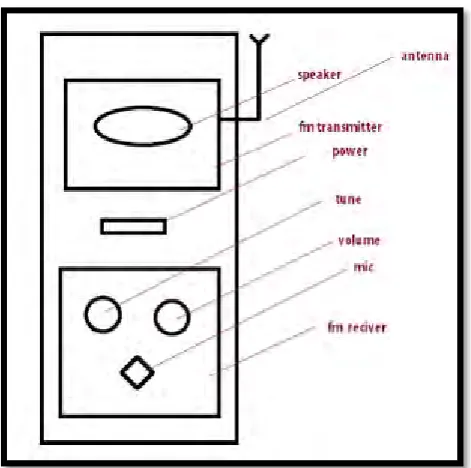
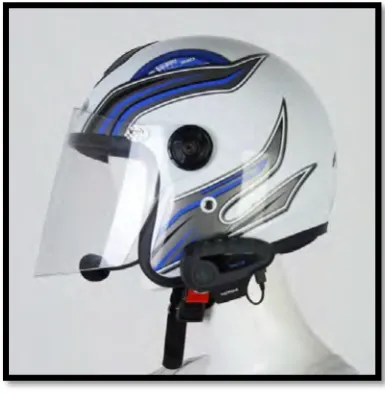
Nowadays, there are many type and brand of walkie-talkie that was produce by many companies such as Cobra, Garmin, Midland, Motorola and Uniden. Each of the walkie-talkies has their own characteristic and criteria. The channel that use by all this walkie-talkie also different depends on the purpose what there are manufactured for? Besides that, there many types of walkie-talkies in the market nowadays, but it are responsibility to develop a new walkie-talkie which can be efficiently used by the rider during their convoy activities. The basic idea for this project is want to apply this device at the helmet and can make the rider easy to use and can be more concentrate while they are riding.
INTRODUCTION
2 1.2
Background Project
3
Figure 1.1: Pair of Transmitter and Receiver
[image:18.595.200.436.426.660.2]4
1.3
Problem Statement
[image:19.595.222.413.288.478.2]The convoy activities nowadays have high risk while they are on the road. While they doing convoy activities there are someone motorcycle will break down and will make they split and become far distance and it will make the rider lost and they also can be more risk while using walkie-talkie during their journey and make them not concentrate on their riding. This will increase of the accident while convoy activities.
Figure 1.3: Originally Walkie-Talkie
[image:19.595.220.413.528.725.2]5 1.4 Objective
In this project, an improvement for the Bikers Communication Device will be implementing. The objective is very important because the achievement of the objective in completing this report. In order to make this project were successfully it must follow the objective that has been targeted. The core objective which has been designated as fundamental to the project is:
a) To study how far that range can be used between receiver and transmitter b) To develop the Bikers Communication Device that can be install at the
helmet and easy to use.
c) To implement the new device that can avoid many accidents during motorcycle convoy activities.
1.5 Work Scope
6 1.6 Project Significant
This biker communication device is using the transmitter and the receiver circuit but it already being upgrade to make sure it give the benefit to the rider and can reduce the accident while convoy activities. By using this device, the rider does not need to hold first and need to press the button when want start to talk. By using this biker communication device the rider or the user just install at the helmet and feel free when it no needs to hold this device. So that, both hand of the rider can grip fully at the handle just need push the button when want start to talk.
1.7 Report Organization
In this part, it will explain the process and the flow for completing this report and project. This report will be having a few chapters and it will be explain each of the part as below:
Chapter 1: Introduction
In this chapter it will simply briefing what is the project to be. For this part, it contains introduction, problem statement, objective, work scope, project significant and what have included in this report.
Chapter 2: Literature Review
7
Chapter 3: Methodology
In this part, it will show the method that we use for making this project. The entire step from the beginning to produce this device will include in this part.
Chapter 4: Result Expectation
For this part, it will state what the project look like and what the result will be obtain when the project already done, is it the product can achieve the target.
Chapter 5: Conclusion
8
While making this project, there are some studied and research had been done to complete this report. The information was gained by many sources such as books, articles, journals, and internet. All the information that been collected is very useful as a guide in doing this project. The collecting data is based on the past related study.
2.1 Introduction
In this chapter will describe the literature review, which related to the Biker Communication Device that will be uses during convoy activity by using receiver and the transmitter. The literature review is important which because we can learn new thing before the previous project and we also can implement the new project base on old project that will make it suitable and more easy to use. The reference from previous project will make we get more knowledge about what we want to do. Nowadays, many type of walkie-talkie at the market, as we know the many brands that produce the talkie but how many brand that provide the simple walkie-talkie that easy to use with two channel which is one for transmit and one for receive. There also, we can learn the movement of the frequency from it transmit and when it receives. Currently, most walkie-talkie use receiver and the transmitter as the medium sent data and the different is between the range that can walkie-talkie support and the channel that provide in walkie-talkie. Unfortunately, walkie-talkie is less secure due to its limitation range and the way to use it. Thus, by implement and develop Biker Communication Device it will overcome this entire problem.
LITERATURE REVIEW
9 2.2 Application of Walkie-Talkie
There are many walkie-talkies nowadays at the market and there also has much different function compare to each other. By this project, we will use more simple way to develop and implement new walkie-talkie to make it safe to use and easy to handle. This project will name it as Biker Communication Device that only uses one channel of transmission frequency to transmit and receive the data.
The development of this device will make user friendly with it and more safety while use it. This device also use the receiver and transmitter but we change the using of frequency by using one channel only and the device will install direct to the helmet. There is some research from the previous project that are using walkie-talkie and implement from it.
2.3 Walkie-Talkie Application upon Android Device