This is a repository copy of
The Decoupled Mind : Mind-wandering Disrupts Cortical
Phase-locking to Perceptual Events
.
White Rose Research Online URL for this paper:
http://eprints.whiterose.ac.uk/91766/
Version: Published Version
Article:
Baird, Benjamin, Smallwood, Jonathan orcid.org/0000-0002-7298-2459, Lutz, Antoine et
al. (1 more author) (2014) The Decoupled Mind : Mind-wandering Disrupts Cortical
Phase-locking to Perceptual Events. Journal of Cognitive Neuroscience. pp. 2596-2607.
ISSN 0898-929X
https://doi.org/10.1162/jocn_a_00656
[email protected] https://eprints.whiterose.ac.uk/ Reuse
Items deposited in White Rose Research Online are protected by copyright, with all rights reserved unless indicated otherwise. They may be downloaded and/or printed for private study, or other acts as permitted by national copyright laws. The publisher or other rights holders may allow further reproduction and re-use of the full text version. This is indicated by the licence information on the White Rose Research Online record for the item.
Takedown
If you consider content in White Rose Research Online to be in breach of UK law, please notify us by
The Decoupled Mind: Mind-wandering Disrupts Cortical
Phase-locking to Perceptual Events
Benjamin Baird
1, Jonathan Smallwood
2, Antoine Lutz
3,4,
and Jonathan W. Schooler
1Abstract
■ The mind flows in a“stream of consciousness,”which often neglects immediate sensory input in favor of focusing on intrin-sic, self-generated thoughts or images. Although considerable research has documented the disruptive influences of task-unrelated thought for perceptual processing and task perfor-mance, the brain dynamics associated with these phenomena are not well understood. Here we investigate the possibility, suggested by several convergent lines of research, that task-unrelated thought is associated with a reduction in the trial-to-trial phase consistency of the oscillatory neural signal in response to perceptual input. Using an experience sampling paradigm coupled with continuous high-density electroencephalography, we observed that task-unrelated thought was associated with a reduction of the P1 ERP, replicating prior observations that mind-wandering is accompanied by a reduction of the
brain-evoked response to sensory input. Time–frequency analysis of the oscillatory neural response revealed a decrease in theta-band cortical phase-locking, which peaked over parietal scalp re-gions. Furthermore, we observed that task-unrelated thought impacted the oscillatory mode of the brain during the initiation of a task-relevant action, such that more cortical processing was required to meet task demands. Together, these findings docu-ment that the attenuation of perceptual processing that occurs during task-unrelated thought is associated with a reduction in the temporal fidelity with which the brain responds to a stimulus and suggest that increased neural processing may be required to recouple attention to a task. More generally, these data pro-vide novel confirmatory epro-vidence for the mechanisms through which attentional states facilitate the neural processing of sen-sory input. ■
INTRODUCTION
Although in daily life we are almost continually exposed to dynamic sensory input, consciousness often spontaneously shifts away from this exogenous information toward thoughts, feelings, or images that do not arise from ongo-ing perceptual processes. One well-documented aspect of these experiences (often referred to as mind-wandering or task-unrelated thought) is that their occurrence corre-sponds to periods of time when external input is neglected (for reviews, see Smallwood, 2013; Schooler et al., 2011). Evidence using a variety of measures of task-unrelated thought and using a variety of different measures of cortical processing indicates that these periods are accompanied by an attenuation of the processing of perceptual input, a phenomenon that has been termed“perceptual de-coupling”(Barron, Riby, Greer, & Smallwood, 2011; Kam et al., 2011; Smallwood, Brown, Baird, & Schooler, 2011; Smallwood, Brown, Tipper, et al., 2011).
The brain oscillatory mechanisms underlying perceptual decoupling induced by mind-wandering remain largely unknown. Kam et al. (2011) recently demonstrated that
this decoupling already occurs at the early phase of sen-sory processing: Early cortical processing in both the visual and auditory domain, indexed by the visual P1 and auditory N1 ERPs, is reduced before reports of task-unrelated thought compared with states of task focus. This finding suggests that task-unrelated thoughts induce a form of endogenous distractor comparable to the standard effect of selective attention on sensory gating by an exter-nal distractor (Hillyard, Hink, Schwent, & Picton, 1973). The preliminary insight is important, as oscillatory mecha-nisms of selective attention on external distraction have already been extensively researched (Bonnefond & Jensen, 2013; Klimesch, 2012; Engel, Fries, & Singer, 2001; Tallon-Baudry, Bertrand, Delpuech, & Permier, 1997). Extensive evidence suggests that, whereas gamma oscillations (>30 Hz) are thought to reflect the content of attention and functional processing, slow oscillations in theta (4–7 Hz) and alpha (8–13 Hz) bands are thought to reflect top–down influences related to working mem-ory (Sauseng, Klimesch, Schabus, & Doppelmayr, 2005) and attention-related functional inhibition (Bonnefond & Jensen, 2013; Klimesch, 2012). Biases of sensory perception by attention and working memory have been shown to at least partially depend on the phase of ongoing frequency-specific oscillatory neural assemblies (Palva, Palva, & Kaila, 1University of California, Santa Barbara,2University of York,3Lyon
2005; Singer, 1999), particularly in theta and alpha bands, preceding sensory stimulation (e.g., Busch, Dubois, & VanRullen, 2009; Mathewson, Gratton, Fabiani, Beck, & Ro, 2009; Barry, de Pascalis, Hodder, Clarke, & Johnstone, 2003; Jansen & Brandt, 1991). Furthermore, accumulating evidence suggests that phase alignment and phase reset-ting of ongoing neural oscillations in these frequencies impacts the amplitude and latency of early ERP waveforms (Freunberger, Klimesch, Doppelmayr, & Höller, 2007; Gruber, Klimesch, Sauseng, & Doppelmayr, 2005; Makeig et al., 2002). This literature invites the question of whether the sensory decoupling that occurs during mind-wandering is also mediated by the phase of ongoing cortical oscilla-tions across one or more frequencies. Here we explored this possibility by analyzing the impact of task-unrelated thought on phase-locking of cortical activity to sensory stimuli during a vigilance task.
Several recent studies lend further support to the idea that cortical phase-locking is linked to task-related atten-tion. One study compared the influence of two levels of auditory distractions during an auditory discrimination task (Ponjavic-Conte, Dowdall, Hambrook, Luczak, & Tata, 2012). Relative to a white noise sound, a continuous auditory speech in the unattended ear impaired task performance and also reduced the N1 amplitude evoked by nontarget stimuli in the attended ear. Importantly, the reduction in N1 amplitude was associated with a sig-nificant reduction in the cross-trial phase consistency of theta-band neural oscillations. Of particular relevance for this study, a link between phase-locking and fluctuations in endogenous attentional state has been suggested by recent investigations examining the impact of training in focused attention meditation on phase-locking to stim-uli in sustained attention tasks. One study found that 3 months of intensive mental training in focused attention meditation enhanced theta-band phase-locking to success-fully detected T2 targets in the attentional blink (Slagter, Lutz, Greischar, Nieuwenhuis, & Davidson, 2009). Another study found that 3 months of training in focused attention meditation increased theta-band phase consistency of neural responses to both target and nontarget stimuli in a dichotic listening task (Lutz et al., 2009). Given that this style of meditation practice is thought to reduce mind-wandering (Lutz, Slagter, Dunne, & Davidson, 2008), Lutz and colleagues hypothesized that the mental training-induced increases in phase-locking were related to the capacity to sustain task-related attentional focus and a reduced tendency to engage in task-unrelated thoughts. Providing initial support for this view, another recent ex-periment found that experienced Vipassana meditators show greater theta-band phase-locking to standard stimuli presented in an auditory oddball task during meditation practice compared with an active thought baseline condi-tion (Cahn, Delorme, & Polich, 2013).
Mind-wandering has not only been associated with a reduction in perceptual processing but it also has a con-sequence for the integrity of performance. Studies have
demonstrated that task-unrelated thought is associated with longer RTs (Smallwood et al., 2012; Smallwood, Baracaia, Lowe, & Obonsawin, 2003), can lead to errors (Mrazek et al., 2012; McVay & Kane, 2009), and disrupts motor control (Kam et al., 2012). The current study there-fore also sought to understand the neural dynamics that could account for these disruptions in task performance by examining how task-unrelated thoughts influence the neural changes that occur when task-relevant actions are initiated. The investigation by Lutz et al. (2009) examining the impact of meditation training on sustained attention found not only that meditation training increased cortical phase-locking but also that it resulted in a concomitant de-crease in the extent of cortical engagement required to meet task demands, as assessed by a reduced event-related desynchronization (ERD) to target stimuli. ERD is thought to primarily reflect blocking of alpha (8–12 Hz) and beta (13–30 Hz) cortical oscillations, particularly during motor execution, and is viewed as a correlate of increased cellular excitability in thalamocortical systems during information processing (see Pfurtscheller & Lopes da Silva, 1999, for a review). Studies have linked higher ERD to less efficient processing associated with advanced age, lower IQ, or situations when greater effort is exerted on a task (see Pfurtscheller & Lopes da Silva, 1999, for a review). In line with these findings, Lutz et al. (2009) hypothesized that this mental training-related attenuation of ERD might have been attributable to reduced task-irrelevant mental processes such as task-unrelated thoughts, which could have resulted in more efficient execution of the task. In this study, we therefore evaluated the link between task-unrelated thought and ERD by examining how mind-wandering episodes influenced the oscillatory mode of the brain during the execution of task-relevant actions.
previous findings, we hypothesized that task-unrelated thought would be accompanied by a disruption of the processing of external perceptual events and that this per-ceptual decoupling would be associated with a decreased PLF to stimuli occurring in the period preceding reports of a loss of task focus. Second, we examined the influence of task-unrelated thought on neural oscillatory activity during the execution of task-relevant actions. To assess cortical engagement during task demands, we computed the event-related spectral perturbation (ERSP), which quantifies broadband event-related changes in spectral power relative to a baseline interval (Delorme & Makeig, 2004; Makeig, Debener, Onton, & Delorme, 2004). The ERSP generalizes narrow-band measures of ERD and event-related synchronization (ERS) (Pfurtscheller & Lopes da Silva, 1999). Given the previous findings outlined above, we hypothesized that, compared with being focused on the task, mind-wandering would be associated with more pronounced event-related power decreases in alpha and beta frequency in response to target stimuli.
METHODS Participants
Twenty-one participants (9 men, 12 women) completed the experiment (age range = 19–24 years) as partial ful-fillment of a course requirement. All participants were right-handed, had no history of neurological disorder, and had normal or corrected-to-normal vision. Signed informed consent was obtained from all participants before the ex-periment, and ethical approval for the study was obtained from the University of California, Santa Barbara, institu-tional review board. Data from five participants was not analyzed: two due to poor recording quality and three due to an insufficient number (n< 10) of either task focus or mind-wandering reports at experience sampling prompts.
Stimuli and Task
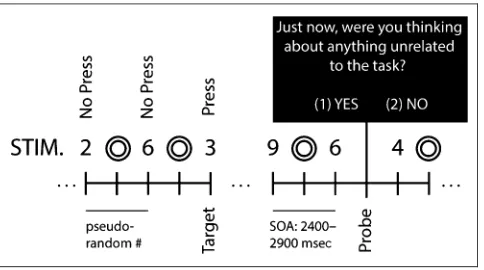
The stimuli and task were programmed in MATLAB ver-sion 7.9 (Mathworks, Inc., Natick, MA) using the Psy-chophysics Toolbox version 3.0 (Kleiner et al., 2007; Brainard, 1997). Participants engaged in an undemanding 0-back vigilance task in which they were asked to monitor a stream of visual stimuli for the presence of infrequent targets (Figure 1). This low demand task is similar to that used in previous research (Baird et al., 2012; Baird, Smallwood, & Schooler, 2011) and was selected because studies have shown that tasks with low cognitive demand are more conducive to task-unrelated thought (e.g., Baird et al., 2012; Smallwood, Nind, & OʼConnor, 2009). The visual stimuli consisted of black numeric digits between 1 and 9 subtending a vertical visual angle of approximately 0.76° and were presented serially in the center of the screen at a viewing distance of approximately 150 cm. Targets were the numeral “3”and required participants
to press the spacebar whereas nontargets consisted of the numerals 1, 2, 4, 5, 6, 7, 8, or 9 and required no response. Nontargets (n= 332/block, 1328 total) were drawn from online randomly generated lists, whereas tar-gets (n = 28/block, 112 total) were presented pseudo-randomly with a minimum gap size of 4 nontargets and a maximum gap size of 40 nontarget stimuli. All responses were made with the keyboard. Stimulus duration varied randomly between 1000 and 1500 msec and was separated by a fixation mask consisting of two concentric circles that also randomly varied in duration between 1000 and 1500 msec. A blank screen lasting 200 msec separated visual stimuli and fixation masks. The temporal jitter applied to both visual stimuli and fixation masks resulted in a variable ISI of 1400–1900 msec. Participants completed four blocks each, lasting approximately 20 min.
[image:4.612.311.553.62.197.2]At 18 different occasions throughout each block of trials (72 total), an experience sampling prompt suddenly ap-peared asking participants to report their attentional state (Figure 1). Experience sampling prompts were presented pseudorandomly with a minimum gap size of 4 nontargets and a maximum gap size of 66 nontarget stimuli. At each thought prompt, participants were asked“Just now, were you thinking about anything unrelated to the task?”and were asked to classify their attentional state using a dichot-omous (1)yesor (2)noresponse. Before the experiment, “thinking about anything unrelated to the task”was de-fined both verbally and in writing as having unrelated con-scious thoughts (e.g., thinking about a visit from a friend, an upcoming exam, or personal experiences/memories).
Electrophysiological Recordings
EEG was continuously recorded from 128 silver chloride-plated carbon fiber-coated electrodes using a Hydrocel
Geodesic Sensor Net (HCGSN; Electrical Geodesic, Inc., Eugene, OR). EEG was digitized at an online sampling rate of 500 samples/sec, amplified and analog-filtered at 0.01–200 Hz, and was referenced online to the vertex electrode (Cz). Electrode impedances were kept below 50 kΩ. Recordings were made in an electrically shielded, sound-attenuated room.
EEG Data Preprocessing
Offline EEG data analysis was conducted with MATLAB version 7.9 using the EEGLAB v9 toolbox (Delorme & Makeig, 2004) and custom scripts. Data were bandpass-filtered between 1 and 50 Hz using a two-way least squares FIR filter. An automated amplitude thresholding criterion was used to eliminate electrodes with excessive noise. Electrodes exceeding ±150μV on greater than 25% of trials were eliminated from subsequent analysis. Consistent with previous studies using 128-channel GSN (e.g., Murias, Swanson, & Srinivasan, 2007), 20 electrodes on the outer ring of the sensor net were eliminated entirely for all participants because of excessive artifact. For each partici-pant, electrode potentials were then rereferenced to the simultaneous average of all artifact-free channels, yielding average referenced potentials (Bertrand, Perrin, & Pernier, 1985).
To classify standard visual stimuli according to partici-pantsʼattentional state, EEG data were segmented into 10-sec epochs extending backwards from experience sam-pling prompts. Although it is not currently possible to de-termine the precise onset of spontaneous attentional shifts to unrelated thoughts (Smallwood, 2013), this 10 sec time window has been used in previous analyses (Braboszcz & Delorme, 2011; Christoff, Gordon, Smallwood, Smith, & Schooler, 2009) and is an attempt to maximize the num-ber of premarker events without extending the window so far back so as to capture the previous attentional state. Visual stimuli occurring in the 10-sec interval before expe-rience sampling prompts were thus categorized according to the attentional state reported by the participant at the prompt. Target stimuli were relatively infrequent in the current paradigm and occurred between approximately 12 and 30 sec before experience sampling prompts. To classify target visual stimuli according to participantʼs attentional state, we therefore categorized target stimuli occurring in a 30-sec window before an experience sampling prompt according to the attentional state reported by the participant at the prompt (mean = 37.06/participant).
Stimuli were epoched from−800 to 1600 msec and
baseline corrected at 200 msec. An amplitude thresholding criterion was then used to remove any trials with remaining artifacts in which any electrode exceeded the minimum-to-maximum threshold (±150μV). Additionally, the PLF is sensitive to the number of trials used to measure the phase-locking. For PLF analysis, we therefore equated the number of trials for the mind-wandering and task focus conditions by determining the minimum number
of artifact-free trials across conditions for each participant and then randomly removing the surplus trials from the relevant condition (e.g., Lutz et al., 2009). This resulted in an average of 69.12 artifact-free trials for each condition for each individual used for analysis.
P1 Event-related Potentials
P1 ERP contrasts were evaluated with repeated-measures ANOVA (factors Task Focus [FOCUS] and Location [LOC]) of peak deflections over parietal and parieto-occipital electrodes with corresponding 10–20 equivalents (GSN channel 61 (P1), 78 (P2), 60 (PO3), 85 (PO4)), where P1 amplitude tends to be maximal (Kam et al., 2011; Handy & Khoe, 2005; Handy, Soltani, & Mangun, 2001). The time window for detecting peak amplitude of the P1 com-ponent was 50–150 msec (e.g., Klimesch, Hanslmayr, Sauseng, Gruber, & Doppelmayr, 2007). For visualization of ERPs, we applied a 30-Hz linear low-pass filter.
Phase-locking Factor
PLF is a frequency domain measure of the synchronization of the phase of oscillatory activity at a given frequency (f) and time (t) across multiple presentations of a time-locking event (Tallon-Baudry et al., 1996). The measure has also been termed“intertrial coherence”(Delorme & Makeig, 2004; Makeig et al., 2004). Time–frequency decomposition of the PLF was computed using a version of sinusoidal wavelets that compromises between fast Fourier trans-form and Morlet wavelet decomposition (Goupillaud, Grossmann, & Morlet, 1984), in which the number of cycles used in the convolution increases slowly with fre-quency (Delorme & Makeig, 2004). This approach opti-mizes the trade-off between temporal resolution at lower frequencies and frequency resolution at higher fre-quencies, allowing for improved frequency resolution at higher frequencies compared with traditional wavelets in which the number of cycles is held constant. At each time (t)–frequency (f) point, across each trial (k), wavelet convo-lution of the signal datas(t) yields a complex vector repre-senting both the amplitude (A) and phase (φ) of the signal:
Fkðf;tÞ¼Akðt;fÞe
iφkðt;fÞ ð1Þ
The PLF is then quantified by normalizing the magnitude of each complex vector to a value of 1 (i.e., unit nor-malization) by dividing by its magnitude (the absolute value of a complex number represents the magnitude or distance from the origin in the complex 2-D Cartesian coordinate frame) and then taking the average across trials (e.g., Delorme & Makeig, 2004):
PLFðt;fÞ¼
1
n
Xk
n¼1
Fkðf;tÞ
jFkðf;tÞj
PLF is therefore an amplitude-independent measure of the cross-trial phase synchrony at a particular time–frequency point and takes values between 0 (indicating complete
absence of phase-locking) to 1 (indicatingperfect
syn-chronization across trials). Thus, a high value of PLF
would be observed when the phase of an oscillation is aligned across trials because there would be a small dif-ference between each phase and its average. An impor-tant consequence of the unit normalization is that the PLF is robust to intertrial amplitude variability because of artifact or noise, making it a particularly sensitive measure of the variability of the evoked response (Lutz et al., 2009). We estimated phase-locking at 200 linearly spaced time points from 243 msec before to 1041 msec after the time-locking visual events1and 200 log-spaced frequencies from 2.0 to 50.0 Hz, with wavelets of 2 cycles at the lowest frequency increasing linearly to 25 cycles at the highest frequency.
Following Lutz et al. (2009), to reduce the number of tests and to facilitate cross-study comparison, we eval-uated stimulus locking of cortical activity on the average PLF for narrow-band frequencies (delta, 2–4 Hz; theta, 4–7 Hz; alpha, 8–13 Hz; beta: 13–30 Hz), four spatial regions (frontal, central, parietal, occipital), and in three temporal intervals (50–150 msec, 150–300 msec, and 300–500 msec). Spatial regions were composed of GSN channels with standardized international 10–20 equivalents (Luu & Ferree, 2005), consisting of frontal (F1–F6), central (C1–C6), parietal (P1–P6), and occipital (O1–O2) electrode clusters. Temporal intervals were defined based on Lutz et al. (2009), which were derived from the latency of the classical ERP components P1/N1, N2, and P3. Statis-tical analysis of the interaction Task Focus (FOCUS) × Fre-quency (FREQ) × Spatial Location (LOC) × Time (TIME) was assessed using repeated-measures ANOVA. We ad-ditionally evaluated within-subject contrasts of the PLF during task focus and mind-wandering on a finer scale using a two-tailed parametricttest for each time and fre-quency point sampled (200 linearly spaced time points × 200 log-spaced frequencies × 4 spatial regions). All post hoc tests corrected for multiple comparisons using the false discovery rate (FDR; Benjamini & Yekutieli, 2001).
Event-related Spectral Perturbation
Broadband event-related changes in spectral power were computed by time–frequency decompositions of the EEG signal in response to nontarget and target stimuli and quantified as the baseline-normalized spectrogram or ERSP (Delorme & Makeig, 2004; Makeig et al., 2004). The ERSP generalizes narrow-band measures of ERD and ERS (Pfurtscheller & Lopes da Silva, 1999). We estimated event-related changes in spectral power at 50 linearly spaced time points from 243 msec before to 1041 msec after time-locking visual events and 100 log-spaced fre-quencies from 2.0 to 30 Hz, with wavelets of 2 cycles at the lowest frequency increasing linearly to 15 cycles
at the highest frequency. Convolution of the signal was performed using the same sinusoidal wavelet method described above for computation of the PLF. ERSP was cal-culated relative to the average baseline power within each condition using a divisive baseline of the prestimulus in-terval−243 to−50 msec. The 50 msec before the stimulus
was omitted to reduce any potential influence of the in-duced response to the stimulus on baseline estimation. Within-participant contrasts of the ERSP during task focus and mind-wandering states were evaluated for standard narrow-band frequencies (delta, 2–4 Hz; theta, 4–7 Hz; al-pha, 8–13 Hz; beta: 13–30 Hz), four spatial regions (frontal, central, parietal, occipital; see above), and two temporal intervals (250–500 msec, 500–750 msec). Temporal inter-vals were defined based on Lutz et al. (2009). Because of the relative infrequency of target stimuli in the passive vigilance paradigm, only 14 participants had enough (n> 10) artifact-free target epochs for mind-wandering and task focus states to be included in the analysis of spectral power changes in response to targets. As above, statistical tests were corrected for multiple comparisons using FDR.
RESULTS Behavioral Data
On average, participants reported mind-wandering 53% (SD = 0.15) of the time and reported being focused on the task at 47% (SD = 0.15) of experience sampling prompts. As expected, because of the undemanding nature of the task, performance accuracy was very high, as indexed by target accuracy of 97% (SD= 0.04). Mean RT to targets was 662 msec (SD= 98). RTs were significantly slower to targets before self-reports of mind-wandering (M= 0.67,SD= 0.11) compared with states of task focus (M= 0.63,SD= 0.11) [t(15) = 2.27,p< .05].
P1 ERPs
We first evaluated the effect of mind-wandering on the sensory ERP. P1 ERPs were evaluated using repeated-measures ANOVA (factors Task Focus [FOCUS] and Scalp Location [LOC]) of peak deflections (time window 50– 150 msec) over parietal and parieto-occipital electrodes. A pronounced P1 component could be observed for visual stimuli during states of task focus, which was significantly attenuated during mind-wandering (Figure 2B). Repeated-measures ANOVA revealed a significant main effect of Task Focus (F(1, 15) = 9.73,p< .01), indicating a larger P1 am-plitude during task focus compared with mind-wandering (Figure 2A).
Phase-locking Factor
as indexed by the PLF (Palva et al., 2005; Tallon-Baudry et al., 1996). PLF is a frequency domain measure that quantifies the trial-to-trial phase consistency (or the uniformity of the phase distribution) of neural oscillatory activity across multi-ple presentations of a time-locking stimulus (see Methods). We first evaluated the effect of task focus (FOCUS) on the PLF using a four-way repeated-measures ANOVA on the average PLF for standard frequency ranges (FREQ: delta, 2–4 Hz; theta, 4–7 Hz; alpha, 8–13 Hz; beta: 13–30 Hz), four spatial regions (LOC: frontal, central, parietal, occipital), and in three temporal intervals (TIME: 50–150 msec, 150– 300 msec, and 300–500 msec; see Methods). The four-way
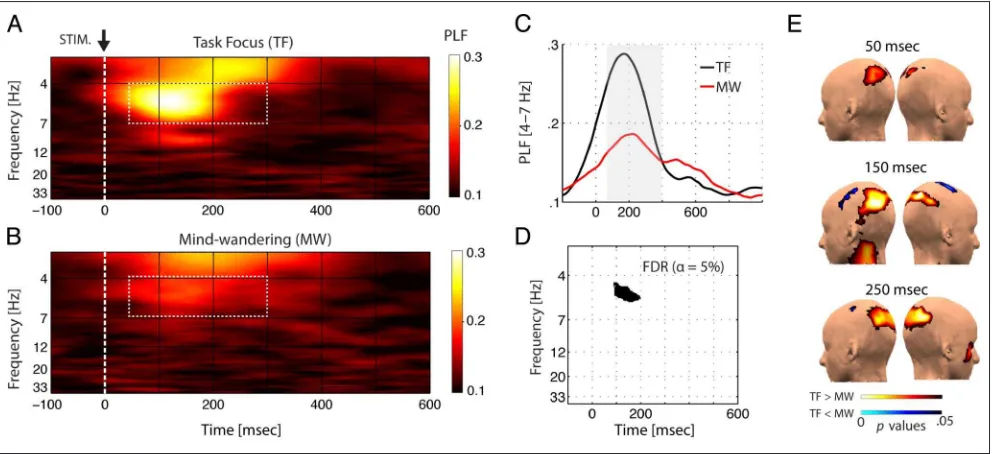
[image:7.612.162.562.61.255.2]ANOVA revealed significant main effects for FREQ (F(3, 45) = 22.97,p< .001), LOC (F(3, 45) = 13.34,p< .001), TIME (F(2, 30) = 16.12,p< .001), and FOCUS (F(1, 15) = 5.47,p< .05). More importantly, we observed a signifi-cant four-way interaction FOCUS × FREQ × LOC × TIME (F(18, 270) = 2.55,p< .05; Greenhouse–Geisser adjusted). Post hoc analysis revealed a significant reduction of PLF during mind-wandering compared with task focus during 50–150 and 150–300 msec time windows that was spe-cific to the theta-band over parietal scalp regions and peaked over parietal scalp regions in the 150–300 msec poststimulus interval (Figure 3; Table 1). We additionally
Figure 2. P1 ERPs. In line with previous studies (Kam et al., 2011), mind-wandering significantly attenuated the amplitude of the P1 (F(1, 15) = 9.73,p< .01). (A) Repeated-measures ANOVA (factors task focus and electrode location) of P1 peak deflections over parieto-occipital scalp electrodes. Error bars reflect standard errors of the mean. (B) Visualization of grand-averaged ERP time course at PO4 showing attenuation of P1 during mind-wandering (MW) compared with task focus (TF) states.
[image:7.612.65.561.433.660.2]evaluated within-subject contrasts of the PLF during task focus and mind-wandering on a finer scale using a two-tailed parametricttest for each time and frequency point sampled (200 linearly spaced time points × 200 log-spaced fre-quencies × 4 spatial regions). As displayed in Figure 3D, we found a significant cluster specific to the theta-band
over the parietal region between 150 and 200 msec (FDR-corrected,α= .05).
[image:8.612.53.550.88.192.2]Given the link between mind-wandering and behavioral response variability (Seli, Cheyne, & Smilek, 2012; Cheyne, Solman, Carriere, & Smilek, 2009; McVay & Kane, 2009), we additionally examined whether increased RT variability
Table 1. Test Statistics Comparing Task Focus and Mind-wandering States for Average Theta-band (4–7 Hz) PLF Values over All Scalp Regions and Time Windows
T1: 50–150 msec T2: 150–300 msec T3: 300–500 msec
t p (unc) t p (unc) t p (unc)
Frontal 0.297 .770 −0.294 .773 0.976 .344
Central 0.964 .351 0.759 .459 0.261 .798 Parietal 5.317** >.0001 7.269*** >.00001 0.306 .763 Occipital 2.643 .018 3.435 .004 0.892 .386
n= 16. unc = uncorrectedpvalue.
**α= .01.
***α= .001 FDR-corrected.
[image:8.612.177.549.358.734.2]across the task would be associated with a reduction in cortical phase-locking in the region of time–frequency space our analysis found to have the greatest reduction during mind-wandering. We calculated one-tailed tests of Pearsonʼsrbetween the coefficient of variability (CV = SD/Mean), a measure of RT variability independent of dif-ferences in mean RT (e.g., Cheyne et al., 2009), and theta-band phase-locking in the 150–300 msec time window over parietal scalp regions to all nontarget stimuli. We found higher CV was associated with decreased theta-band phase-locking (r(14) =−.46,p < .05), indicating that
greater RT variability across the task was associated with decreased phase-locking in the region of time–frequency space that was found to be most reduced during episodes of mind-wandering.
Finally, we examined the relationship between oscil-latory phase and the amplitude of the P1 ERP. Across all mind-wandering and task focus epochs, we found a posi-tive correlation between average theta-band PLF in the 50–150 msec time range and P1 amplitude, which reached significance at electrode P1 (r(14) = .43, p< .05; one-tailed) and was marginally significant at the other three recording sites (P2:r(14) = .33,p= .10; PO3:r(14) = .41,
p= .059; PO4:r(14) = .32, p= .11; all one-tailed). This result indicates that the amplitude of the P1 can be pre-dicted by phase-locking of theta-band oscillations within the time window of the early evoked potential.
Event-related Spectral Perturbation
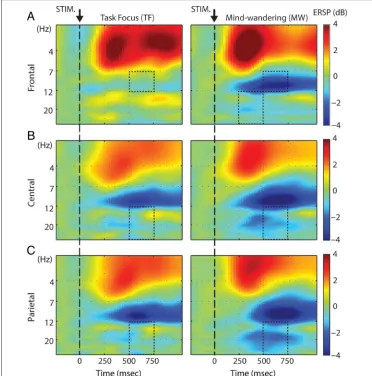
To evaluate how mind-wandering episodes influenced the oscillatory mode of the brain during the execution of task-relevant actions, we evaluated broadband event-related changes in spectral power to target stimuli by quantifying the ERSP. The four-way ANOVA evaluating the ERSP in response to target stimuli revealed significant main effects for FREQ (F(3, 39) = 56.28,p< .001), LOC (F(3, 39) = 15.25,p< .001), and TIME (F(1, 13) = 13.60,
p= .003). No main effect was observed for FOCUS (F(1, 13) = 1.57, p= .23). More importantly, we observed a
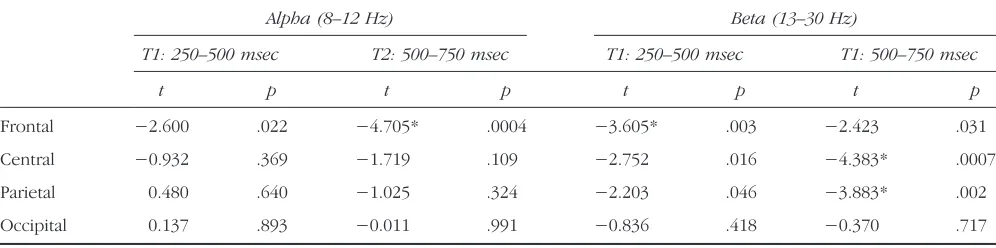
significant three-way interaction FOCUS × FREQ × TIME (F(3, 39) = 2.87, p< .05), and a marginally significant four-way interaction FOCUS × FREQ × LOC × TIME (F(9, 117) = 1.88,p= .061). Post hoc analysis revealed a significantly more pronounced event-related decrease in spectral power during mind-wandering compared with task focus over frontal scalp regions in the alpha band from 500 to 750 msec and beta band in the 250–500 msec time interval, as well as over central and parietal scalp re-gions in the beta frequency range in the 500–750 msec time interval (Figure 4; Table 2).
In contrast to target stimuli, no significant difference in ERSP was observed between mind-wandering and task fo-cus states in response to nontarget visual stimuli. The four-way ANOVA reveled no main effect of FOCUS (F(1, 15) = 0.88,p= .363) and no significant four-way inter-action (F(18, 270) = 0.399,p= .987; Greenhouse–Geisser adjusted).
DISCUSSION
[image:9.612.62.560.87.211.2]The present investigation aimed to characterize the in-fluence of task-unrelated thoughts on visual sensory processing and on task-related actions, as measured by EEG-evoked and -induced responses and behavioral mea-sures during a nondemanding vigilance task. There were four main findings. First, consistent with previous find-ings (Kam et al., 2011), we observed that task-unrelated thought was associated with a disruption of the sensory processing of external perceptual events, as indexed by a reduction of the visual P1 ERP to visual stimuli presented before reports of mind-wandering compared with states of task focus (Figure 2). Second, a refined analysis of the evoked brain response revealed that task-unrelated thought is linked to impaired cortical phase-locking of neural oscillatory activity. Specifically, we observed a sig-nificant reduction in the trial-to-trial phase consistency of theta-band neural oscillations, which peaked over the parietal scalp region, to visual events during states of task-unrelated thought compared with states of task focus
Table 2. Test Statistics Comparing Task Focus and Mind-wandering States for Average Alpha (8–12 Hz) and Beta (13–30 Hz) ERSP over All Scalp Regions and Time Windows
Alpha (8–12 Hz) Beta (13–30 Hz)
T1: 250–500 msec T2: 500–750 msec T1: 250–500 msec T1: 500–750 msec
t p t p t p t p
Frontal −2.600 .022 −4.705* .0004 −3.605* .003 −2.423 .031
Central −0.932 .369 −1.719 .109 −2.752 .016 −4.383* .0007
Parietal 0.480 .640 −1.025 .324 −2.203 .046 −3.883* .002
Occipital 0.137 .893 −0.011 .991 −0.836 .418 −0.370 .717
n= 14. unc = uncorrectedpvalue.
(Figure 3). These changes in phase-locking were also pos-itively correlated with P1 amplitude. Third, the analysis of the nonphasic brain response to target stimuli revealed a more pronounced event-related decrease in spectral power during mind-wandering compared with task focus in alpha and beta bands over frontoparietal regions. Finally, we found that increased RT variability across the task was associated with a reduction in cortical phase-locking in the region of time–frequency space exhibiting the greatest reduction during mind-wandering.
Together, these findings extend previous work docu-menting an attenuation of perceptual processing during task-unrelated thought using ERP measures (Barron et al., 2011; Kam et al., 2011; Schooler et al., 2011; Smallwood, Brown, Baird, et al., 2011; Smallwood, Brown, Tipper, et al., 2011) and reveal the brain dynamics associated with the perceptual decoupling that can occur during the mind-wandering state. The finding that task-unrelated thought was associated with impaired phase-locking is in accordance with several lines of research suggesting a relationship between phase-locking and fluctuations in task-related attention. In particular, several recent inves-tigations have examined the impact of intensive mental training in focused attention meditation on phase-locking to stimuli in sustained attention tasks. One study found that 3 months of mental training in focused attention medita-tion enhanced theta-band phase-locking to successfully detected T2 targets in the attentional blink (Slagter et al., 2009). This increase in phase-locking was particularly pro-nounced for individuals who showed the greatest reduction of resource allocation to T1 (indexed by reduced T1-elcited P3b amplitude), suggesting that meditation training may have resulted in an increased capacity to rapidly reconfigure attentional resources to targets, as reflected by increased theta phase-locking to T2. Another study found that fo-cused attention meditation training increased the phase consistency of theta-band oscillatory activity in response to both target and nontarget stimuli in a dichotic listening task (Lutz et al., 2009). Given that this style of meditation practice is thought to result in an increased capacity to maintain attentional focus and to develop a faculty that monitors consciousness for distractions and task unrelated thoughts (e.g., Lutz et al., 2008), Lutz and colleagues hypothesized that the mental training-induced increase in phase-locking was related to a reduced tendency to engage in task-unrelated thoughts. Providing initial support for this view, another recent experiment found that ex-perienced Vipassana meditators show greater theta-band phase-locking to auditory stimuli presented in an oddball task during meditation practice compared with a baseline condition in which they thought about past events (Cahn et al., 2013). By demonstrating a direct link between cor-tical signal stability and task-unrelated thought, this study provides a plausible account of the neural correlates of meditation training observed in prior investigations.
We were also interested in understanding the relation-ship between task-unrelated thought and performance.
Accumulating evidence in motor control research suggests that decreases in ERD indexes neural efficiency, such as the finding that ERD in a movement task, is lower for elite athletes compared with nonathletes (Percio et al., 2010). Similarly, Lutz et al. (2009) found that focused attention meditation training both improved behavioral perfor-mance and simultaneously decreased the extent of cortical engagement required to meet task demands, as indexed by a reduced ERD in the beta band. Lutz et al. (2009) fur-ther hypothesized that the reduction in beta-band ERD observed after meditation training might have been attrib-utable to reduced task-irrelevant mental processes such as task-unrelated thoughts, resulting in decreased effort to perform a task-relevant action when it was required. More generally, previous studies have found larger ERD for individuals with advanced age, lower IQ, and when greater effort is exerted on a task (see Pfurtscheller & Lopes da Silva, 1999 for a review). Consistent with these findings, we found that mind-wandering was associated with increased neural desynchronization in frontal alpha and widespread frontoparietal beta-band power to target stimuli that occurred in the interval before reports of off-task thoughts. One interpretation of this result is that the additional cortical processing (high ERD) during task-unrelated thought indicates that greater cortical reorgani-zation is required when processing must be reconfigured to meet the behavioral demands of the ongoing task. These findings are also generally consistent with previous results linking task-unrelated thoughts to less effective action (Mrazek et al., 2012; Smallwood et al., 2003, 2012; McVay & Kane, 2009), particularly the recent finding that mind-wandering disrupts the online adjustment of be-havior in motor control tasks as well as reduces neural sensitivity to performance feedback (Kam et al., 2012).
generation of the ERP (Yeung, Bogacz, Holroyd, & Cohen, 2004).
Second, the finding that task-unrelated thought was associated with increased neural variability of the brain response to perceptual input parallels the finding that behavioral response variability is increased during both attentional lapses in general (Cheyne et al., 2009) and mind-wandering in particular (Seli et al., 2012; McVay & Kane, 2009). Moreover, not only does the link between brain and behavior variability concur with studies of mind-wandering, but this finding is also consistent with research on the effects of meditation practice on atten-tional stability during sustained task performance. Lutz et al. (2009) examined the impact of focused attention meditation training on both neural and behavioral re-sponse variability and found that meditation training simul-taneously increased the consistency of theta-band neural oscillatory responses and decreased variability in be-havioral RTs. Furthermore, the improvement in cortical phase-locking for meditation practitioners predicted the reduction in RT variability. The present findings corro-borate this link between neural and behavioral response variability. Our results show that increased RT variability to target stimuli across the task was associated with de-creased theta-band phase-locking in the same time win-dow and scalp region that that was found to be reduced during task-unrelated thought.
Finally, the present results also add to a growing list of potential real-time markers of task-unrelated thought (Franklin, Broadway, Mrazek, Smallwood, & Schooler, 2013; Seli et al., 2012; Smallwood et al., 2012; Franklin, Smallwood, & Schooler, 2011; Smallwood, Brown, Tipper, et al., 2011; Reichle, Reineberg, & Schooler, 2010; Smallwood, McSpadden, Luus, & Schooler, 2008). Along with eye-tracking measures, our neural marker has the relative advantage that no overt behavioral response is required. A relative disadvantage, however, is that a large number of trials (n> 40) are typically needed to obtain robust measures of phase-locking (Lutz et al., 2009; Slagter et al., 2009). However, it is possible that a suitably tuned algorithm may in practice be capable of predicting task-unrelated thought by generating real-time phase-locking estimates over smaller trial counts with high enough ac-curacy to be pragmatically useful. Future studies might consider investigating how task-unrelated thought impacts phase-locking in the context of tasks in which a real-time marker of mind-wandering would be particularly im-portant (e.g., naturalistic reading) as well as whether it is possible to predict mind-wandering in real-time using neural response variability as a covert marker of task-related attention.
There are also a number of limitations that should be kept in mind when considering these results. First, the method of experience sampling requires that individuals reflect on the contents of their thoughts. Although this method takes advantage of the human capacity to report on fluctuations in conscious experience in identifying
mind–brain relationships (Lutz & Thompson, 2003), it may also create conditions that are different from those in which participants are not intermittently interrupted by experience sampling prompts. Prior studies of percep-tual decoupling have found similar results when partici-pants report the experience of task-unrelated thoughts retrospectively as when the experience is probed directly on a momentary basis (Barron et al., 2011; Smallwood, Beach, Schooler, & Handy, 2008); however, no study to date has directly quantified the neural changes that occur because of experience sampling. As a result it is possible that some of the changes observed are a consequence of the method of experience sampling that we employ. Second, our analysis of different derivatives from the EEG used different temporal windows (10 and 30 sec), which were constrained by the number of target and nontarget trials that could be obtained within a given time window in the current experimental design. This lack of temporal equivalence means that each measure may reflect neural changes that relate differentially to distinct phases of mind-wandering state or to experiences with different temporal characteristics, such as length. More generally, because we are unable to identify the moment of onset for the self-generation of mental content (Smallwood, 2013), at present it is not possible to derive basic infor-mation such as duration or frequency of task-unrelated thoughts. We thus have no a priori method of determining the ideal window size to employ in investigations such as these. As a consequence, it is important to be cautious when considering the specific temporal relationship be-tween the phase-locking and desynchronization measures and the experience of task-unrelated thought.
In summary, our findings provide novel insight into the mechanisms underlying the perceptual decoupling that occurs during mind-wandering and the implications of this process for performance. We found that task-unrelated thought was associated with decreased phase-locking of frequency-specific neural oscillatory activity, suggesting that mind-wandering disrupts the temporal fidelity with which the brain responds to a stimulus. Fur-thermore, our findings demonstrate that the generation of a task-relevant motor response during mind-wandering is associated with increased neural processing, as mea-sured by enhanced ERD of neural oscillatory activity in the alpha and beta band in frontoparietal regions. Thus, increased neural processing demands may be required to recouple attention to a task when the mind has wandered. Future work could profitably examine whether one can use the present findings to predict the occurrence of mind-wandering from the emergence of similar spatial and frequential patterns in the ongoing EEG dynamic.
Acknowledgments
Education (R305A110277) awarded to J. W. S. The content of this article does not necessarily reflect the position or policy of the U.S. Government, and no official endorsement should be inferred.
Reprint requests should be sent to Benjamin Baird, Department of Psychological and Brain Sciences, University of California, Santa Barbara, CA 93106-9660, or via e-mail: [email protected].
Note
1. This time range was determined by the epoch length and the cycles used in the wavelet convolution.
REFERENCES
Baird, B., Smallwood, J., Mrazek, M. D., Kam, J. W., Franklin, M. S., & Schooler, J. W. (2012). Inspired by distraction mind wandering facilitates creative incubation.Psychological Science, 23,1117–1122.
Baird, B., Smallwood, J., & Schooler, J. W. (2011). Back to the future: Autobiographical planning and the functionality of mind-wandering.Consciousness and Cognition, 20,
1604–1611.
Barron, E., Riby, L., Greer, J., & Smallwood, J. (2011). Absorbed in thought the effect of mind wandering on the processing of relevant and irrelevant events.Psychological Science, 22,596–601.
Barry, R. J., de Pascalis, V., Hodder, D., Clarke, A. R., & Johnstone, S. J. (2003). Preferred EEG brain states at stimulus onset in a fixed interstimulus interval auditory oddball task, and their effects on ERP components.International Journal of Psychophysiology, 47,187–198.
Benjamini, Y., & Yekutieli, D. (2001). The control of the false discovery rate in multiple testing under dependency.
Annals of Statistics, 29,1165–1188.
Bertrand, O., Perrin, F., & Pernier, J. (1985). A theoretical justification of the average reference in topographic evoked potential studies.Electroencephalography and Clinical Neurophysiology/Evoked Potentials Section, 62,
462–464.
Bonnefond, M., & Jensen, O. (2013). The role of gamma and alpha oscillations for blocking out distraction.
Communicative & Integrative Biology, 6,e22702. Braboszcz, C., & Delorme, A. (2011). Lost in thoughts:
Neural markers of low alertness during mind wandering.
Neuroimage, 54,3040–3047.
Brainard, D. H. (1997). The Psychophysics Toolbox.Spatial Vision, 10,433–436.
Busch, N. A., Dubois, J., & VanRullen, R. (2009). The phase of ongoing EEG oscillations predicts visual perception.
Journal of Neuroscience, 29,7869–7876.
Cahn, B. R., Delorme, A., & Polich, J. (2013). Event-related delta, theta, alpha and gamma correlates to auditory oddball processing during Vipassana meditation.Social Cognitive and Affective Neuroscience, 8,100–111.
Cheyne, A. J., Solman, G. J., Carriere, J. S., & Smilek, D. (2009). Anatomy of an error: A bidirectional state model of task engagement/disengagement and attention-related errors.
Cognition, 111,98–113.
Christoff, K., Gordon, A. M., Smallwood, J., Smith, R., & Schooler, J. W. (2009). Experience sampling during fMRI reveals default network and executive system contributions to mind wandering.Proceedings of the National Academy of Sciences, U.S.A., 106,8719–8724.
Delorme, A., & Makeig, S. (2004). EEGLAB: An open source toolbox for analysis of single-trial EEG dynamics including
independent component analysis.Journal of Neuroscience Methods, 134,9–21.
Engel, A. K., Fries, P., & Singer, W. (2001). Dynamic predictions: Oscillations and synchrony in top–down processing.Nature Reviews Neuroscience, 2,704–716.
Franklin, M. S., Broadway, J. M., Mrazek, M. D., Smallwood, J., & Schooler, J. W. (2013). Window to the wandering mind: Pupillometry of spontaneous thought while reading.
The Quarterly Journal of Experimental Psychology, 66,2289–2294.
Franklin, M. S., Smallwood, J., & Schooler, J. W. (2011). Catching the mind in flight: Using behavioral indices to detect mindless reading in real time.Psychonomic Bulletin & Review, 18,992–997.
Freunberger, R., Klimesch, W., Doppelmayr, M., & Höller, Y. (2007). Visual P2 component is related to theta phase-locking.
Neuroscience Letters, 426,181–186.
Goupillaud, P., Grossmann, A., & Morlet, J. (1984). Cycle-octave and related transforms in seismic signal analysis.
Geoexploration, 23,85–102.
Gruber, W. R., Klimesch, W., Sauseng, P., & Doppelmayr, M. (2005). Alpha phase synchronization predicts P1 and N1 latency and amplitude size.Cerebral Cortex, 15,
371–377.
Handy, T. C., & Khoe, W. (2005). Attention and sensory gain control: A peripheral visual process?Journal of Cognitive Neuroscience, 17,1936–1949.
Handy, T. C., Soltani, M., & Mangun, G. R. (2001). Perceptual load and visuocortical processing: Event-related potentials reveal sensory-level selection.Psychological Science, 12,
213–218.
Hillyard, S. A., Hink, R. F., Schwent, V. L., & Picton, T. W. (1973). Electrical signs of selective attention in the human brain.Science, 182,177–180.
Jansen, B. H., & Brandt, M. E. (1991). The effect of the phase of prestimulus alpha activity on the averaged visual evoked response.Electroencephalography and Clinical Neurophysiology/Evoked Potentials Section, 80,241–250. Kam, J. W., Dao, E., Blinn, P., Krigolson, O. E., Boyd, L. A.,
& Handy, T. C. (2012). Mind wandering and motor control: Off-task thinking disrupts the online adjustment of behavior.Frontiers in Human Neuroscience, 6:329. Kam, J. W., Dao, E., Farley, J., Fitzpatrick, K., Smallwood, J.,
Schooler, J. W., et al. (2011). Slow fluctuations in attentional control of sensory cortex.Journal of Cognitive Neuroscience, 23,460–470.
Kleiner, M., Brainard, D., Pelli, D., Ingling, A., Murray, R., & Broussard, C. (2007). Whatʼs new in Psychtoolbox-3.
Perception, 36,1.1–1.16.
Klimesch, W. (2012). Alpha-band oscillations, attention, and controlled access to stored information.Trends in Cognitive Sciences, 16,606–617.
Klimesch, W., Hanslmayr, S., Sauseng, P., Gruber, W. R., & Doppelmayr, M. (2007). P1 and traveling alpha waves: Evidence for evoked oscillations.Journal of Neurophysiology, 97,1311–1318.
Lutz, A., Slagter, H. A., Dunne, J. D., & Davidson, R. J. (2008). Attention regulation and monitoring in meditation.
Trends in Cognitive Sciences, 12,163.
Lutz, A., Slagter, H. A., Rawlings, N. B., Francis, A. D., Greischar, L. L., & Davidson, R. J. (2009). Mental training enhances attentional stability: Neural and behavioral evidence.Journal of Neuroscience, 29,
13418–13427.
Luu, P., & Ferree, T. (2005). Determination of the HydroCel Geodesic Sensor Netsʼaverage electrode positions and their 10-10 international equivalents. Technical Note. Eugene, OR: Electrical Geodesics, Inc.
Makeig, S., Debener, S., Onton, J., & Delorme, A. (2004). Mining event-related brain dynamics.Trends in Cognitive Sciences, 8,204–210.
Makeig, S., Westerfield, M., Jung, T. P., Enghoff, S., Townsend, J., Courchesne, E., et al. (2002). Dynamic brain sources of visual evoked responses.Science, 295,690–694. Mathewson, K. E., Gratton, G., Fabiani, M., Beck, D. M., &
Ro, T. (2009). To see or not to see: Prestimulusαphase predicts visual awareness.Journal of Neuroscience, 29,
2725–2732.
McVay, J. C., & Kane, M. J. (2009). Conducting the train of thought: Working memory capacity, goal neglect, and mind wandering in an executive-control task.Journal of Experimental Psychology: Learning, Memory, and Cognition, 35,196.
Mrazek, M. D., Franklin, M. S., Phillips, D. T., Baird, B., & Schooler, J. W. (2013). Mindfulness training improves working memory capacity and GRE performance while reducing mind wandering.Psychological Science, 24,
776–781.
Mrazek, M. D., Smallwood, J., Franklin, M. S., Chin, J. M., Baird, B., & Schooler, J. W. (2012). The role of mind-wandering in measurements of general aptitude.
Journal of Experimental Psychology: General, 141,788. Murias, M., Swanson, J. M., & Srinivasan, R. (2007). Functional
connectivity of frontal cortex in healthy and ADHD children reflected in EEG coherence.Cerebral Cortex, 17,1788–1799.
Palva, J. M., Palva, S., & Kaila, K. (2005). Phase synchrony among neuronal oscillations in the human cortex.Journal of Neuroscience, 25,3962–3972.
Percio, C. D., Infarinato, F., Iacoboni, M., Marzano, N., Soricelli, A., Aschieri, P., et al. (2010). Movement-related desynchronization of alpha rhythms is lower in athletes than non-athletes: A high-resolution EEG study.Clinical Neurophysiology, 121,482–491.
Pfurtscheller, G., & Lopes da Silva, F. H. (1999). Event-related EEG/MEG synchronization and desynchronization: Basic principles.Clinical Neurophysiology, 110,1842–1857. Ponjavic-Conte, K. D., Dowdall, J. R., Hambrook, D. A.,
Luczak, A., & Tata, M. S. (2012). Neural correlates of auditory distraction revealed in theta-band EEG.
NeuroReport, 23,240–245.
Reichle, E. D., Reineberg, A. E., & Schooler, J. W. (2010). Eye movements during mindless reading.Psychological Science, 21,1300–1310.
Sauseng, P., Klimesch, W., Schabus, M., & Doppelmayr, M. (2005). Frontoparietal EEG coherence in theta and upper alpha reflect central executive functions of working memory.International Journal of Psychophysiology, 57,
97–103.
Schooler, J. W., Smallwood, J., Christoff, K., Handy, T. C., Reichle, E. D., & Sayette, M. A. (2011). Meta-awareness,
perceptual decoupling and the wandering mind.Trends in Cognitive Sciences, 15,319–326.
Seli, P., Cheyne, J. A., & Smilek, D. (2012). Wandering minds and wavering rhythms: Linking mind wandering and behavioral variability.Journal of Experimental Psychology: Human Perception and Performance, 39,1–15.
Singer, W. (1999). Neuronal synchrony: A versatile code for the definition of relations?Neuron, 24,49–65.
Slagter, H. A., Lutz, A., Greischar, L. L., Nieuwenhuis, S., & Davidson, R. J. (2009). Theta phase synchrony and conscious target perception: Impact of intensive mental training.Journal of Cognitive Neuroscience, 21,
1536–1549.
Smallwood, J. (2013). Distinguishing how from why the mind wanders: A process-occurrence framework for self-generated mental activity.Psychological Bulletin, 139,519.
Smallwood, J., Baracaia, S. F., Lowe, M., & Obonsawin, M. (2003). Task unrelated thought whilst encoding information.
Consciousness and Cognition, 12,452–484.
Smallwood, J., Beach, E., Schooler, J. W., & Handy, T. C. (2008). Going AWOL in the brain: Mind wandering reduces cortical analysis of external events.Journal of Cognitive Neuroscience, 20,458–469.
Smallwood, J., Brown, K. S., Baird, B., Mrazek, M. D., Franklin, M. S., & Schooler, J. W. (2012). Insulation for daydreams: A role for tonic norepinephrine in the facilitation of internally guided thought.PloS One, 7,e33706.
Smallwood, J., Brown, K. S., Baird, B., & Schooler, J. W. (2011). Cooperation between the default mode network and the frontal-parietal network in the production of an internal train of thought.Brain Research, 1428,60–70.
Smallwood, J., Brown, K. S., Tipper, C., Giesbrecht, B., Franklin, M. S., Mrazek, M. D., et al. (2011). Pupillometric evidence for the decoupling of attention from perceptual input during offline thought.PloS One, 6,e18298.
Smallwood, J., McSpadden, M., Luus, B., & Schooler, J. (2008). Segmenting the stream of consciousness: The psychological correlates of temporal structures in the time series data of a continuous performance task.Brain and Cognition, 66,50–56.
Smallwood, J., Nind, L., & OʼConnor, R. C. (2009). When is your head at? An exploration of the factors associated with the temporal focus of the wandering mind.Consciousness and Cognition, 18,118–125.
Tallon-Baudry, C., Bertrand, O., Delpuech, C., & Permier, J. (1997). Oscillatory gamma-band (30-70 Hz) activity induced by a visual search task in humans.Journal of Neuroscience, 17,722–734.
Tallon-Baudry, C., Bertrand, O., Delpuech, C., & Pernier, J. (1996). Stimulus specificity of phase-locked and non-phase-locked 40 Hz visual responses in human.Journal of Neuroscience, 16,4240–4249.
Yeung, N., Bogacz, R., Holroyd, C. B., & Cohen, J. D. (2004). Detection of synchronized oscillations in the electroencephalogram: An evaluation of methods.