This is a repository copy of
Development and Characterisation of a Multi-material 3D
Printed Torsion Spring
.
White Rose Research Online URL for this paper:
http://eprints.whiterose.ac.uk/87367/
Version: Accepted Version
Proceedings Paper:
Barber, A, Culmer, P orcid.org/0000-0003-2867-0420 and Boyle, JH (2015) Development
and Characterisation of a Multi-material 3D Printed Torsion Spring. In: Dixon, C and Tuyls,
K, (eds.) Lecture Notes in Computer Science (including subseries Lecture Notes in
Artificial Intelligence and Lecture Notes in Bioinformatics). Towards Autonomous Robotic
Systems, 08-10 Sep 2015, Liverpool. Springer , pp. 44-49. ISBN 978-3-319-22415-2
https://doi.org/10.1007/978-3-319-22416-9_6
[email protected] https://eprints.whiterose.ac.uk/
Reuse
Unless indicated otherwise, fulltext items are protected by copyright with all rights reserved. The copyright exception in section 29 of the Copyright, Designs and Patents Act 1988 allows the making of a single copy solely for the purpose of non-commercial research or private study within the limits of fair dealing. The publisher or other rights-holder may allow further reproduction and re-use of this version - refer to the White Rose Research Online record for this item. Where records identify the publisher as the copyright holder, users can verify any specific terms of use on the publisher’s website.
Takedown
If you consider content in White Rose Research Online to be in breach of UK law, please notify us by
Multi-material 3D Printed Torsion Spring
Andrew Barber, Peter Culmer, and Jordan H. Boyle
School of Mechanical Engineering, University of Leeds, Leeds,LS2 9JT,United Kingdom
{el08arb,p.r.culmer,j.h.boyle}@leeds.ac.uk
Abstract. Compliant actuation methods are popular in robotics appli-cations where interaction with complex and unpredictable environments and objects is required. There are a number of ways of achieving this, but one common method is Series Elastic Actuation (SEA). In a recent version of their Unified Snake robot, Choset et al. incorporated a Series Elastic Element (SEE) in the form of a rubber torsional spring. This pa-per explores the possibility of using multi-material 3D printing to produce similar SEEs. This approach would facilitate the fabrication and testing of different spring variants and minimise the assembly required. This ap-proach is evaluated by characterizing the behavior of two printed SEEs with different dimensions. The springs exhibit predictable viscoelastic be-havior that is well described by a five element Wiechert model. We find that individual springs behave predictably and that multiple copies of the same spring design exhibit good consistency.
Keywords: Series Elastic Actuation, 3D Printing, Compliance
1
Introduction
2 Characterization of a 3D Printed Torsion Spring
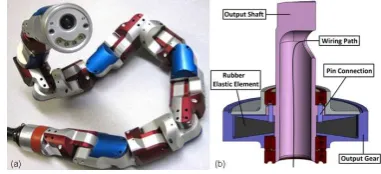
Fig. 1. (a): Unified Snake Robot [5]. (b) Cross-section of SEE [2]. Note the tapered shape of the rubber element. Bottom and top of rubber element fixed to gear output and output shaft respectively.
incorporate a range of mechanical properties (from rigid to flexible) into a single printed part [6], making it possible to print the entire SEE as an integrated unit. Of course, the viability of this approach depends on the mechanical properties of the resulting SEE. A 3D printed linear spring was successfully employed in Ref. [7] but it was not extensively characterized. Here we present the results from preliminary testing and characterization of the first 3D printed torsional SEEs.
2
Methods
2.1 Manufacture
Fig. 2. Cross section of SEE CAD model. Inner Diameter=25mm (constant), Outer Diameter=45mm(constant) (b) 3D Printed SEE. (c) diagram of 5 part Weichert model [9].
[image:3.595.157.456.417.500.2]2.2 Testing
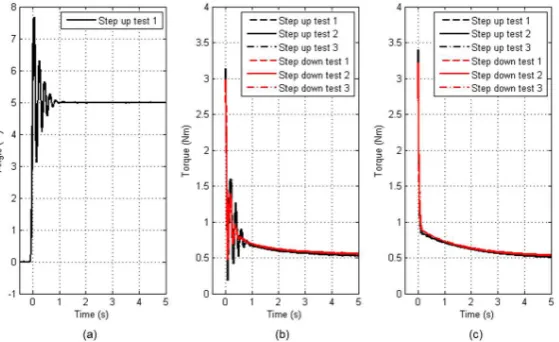
The SEEs were subjected to rotary step strain tests using an Instron E10000 [8]. One end of the SEE is fixed into the Instron’s stationary base plate and the other to the rotating chuck. Each test starts from an equilibrium position (zero input angle) followed by a “step” rotation (over 100ms) to either 5◦or 10◦which
[image:4.595.170.450.276.447.2]is held for 20 seconds before returning to zero and recording data for another 20 seconds. This is repeated three times for each spring, giving six samples of step test data (three up and three down). The time, angle and torque data are logged at a frequency of 50Hz. We observed, however, that the Instron’s control system produces an imperfect step in which the angle overshoots the set point as shown in Figure 3a. This is taken into account during characterization.
Fig. 3. (a) One sample of angle data from step test. Notice step oscillates and is therefore imperfect (b) Six samples of raw data from three iterations of 5◦ step test
for 10mm thick SEE. (c) Line of best fit for each sample. Note the strong correlation between all six tests, whether they are step up or step down results.
2.3 Characterization
4 Characterization of a 3D Printed Torsion Spring
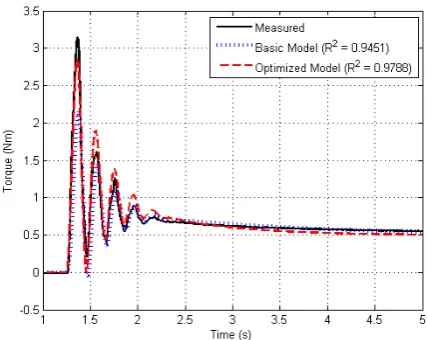
[image:5.595.195.409.258.428.2]this to calculate the spring and damper constants for the Weichert Model. The second step in our characterization was to fine-tune the model parameters based on the real angle and torque data. We implemented a function that simulates the model’s response to the actual recorded angle data for a given set of Weichert parameters before comparing this to the recorded torque data to calculate an error score. We then used Matlab’s “fminsearch” function to optimize the model parameters from the first step. This step significantly improved the model fit, as shown in Figure 4. This was done independently for each of the three experiments on each SEE and the results were used to obtain the median values and standard deviations given in Table 1.
Fig. 4.1 sample of real SEE step test data compared to basic and optimized simulation.
3
Results
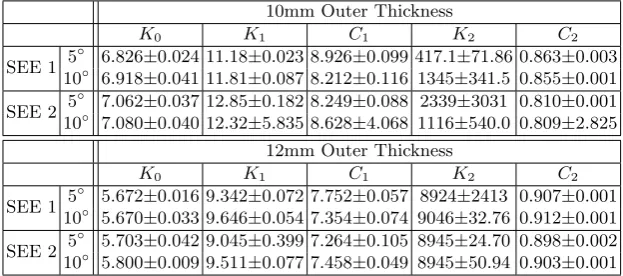
As shown in Figure 3b, the step response of a single SEE is repeatable. While there is some minor difference between the up and down steps, the three re-peats in each direction are virtually indistinguishable. Furthermore, as shown in Figure 4, the 5-element Weichert Model reproduces the SEE behavior well, particularly once the parameters have been fine-tuned. Table 1 summarizes our results for all four SEEs and demonstrates their repeatability. There are some anomalies relating toK2values, but these account for the fast adaptation which
occurs in the first 100ms and are therefore of least significance. Here we will focus on the first three parameters. The first thing to note is the repeatability of behavior for a specific SEE, as indicated by the very small standard deviation values. Furthermore, the parameters obtained from 5◦and 10◦steps on the same
Fig. 5.Simulated results for two SEE samples in response to an idealised step input that ramps up to its final value over 50ms with no overshoot. (a,c) 5◦step; (b,d) 10◦
step; (a,b) 10mm Outer Thickness. (c,d) 12mm Outer Thickness.
our computational characterization method. The second thing to note is the re-peatability across multiple copies of the same design. Comparing the parameters for SEE1 and SEE2 of each size, we can see that both copies are very similar, despite being printed several weeks apart. This suggests that multi-material 3D printing is a relatively consistent process.
As can be seen from Table 1 and Figure 5 there is a relationship between the thickness of the SEE and its performance. In particular, the spring constantsK0
and K1 decrease with increasing SEE thickness, consistent with the fact that
the material in a thicker SEE undergoes less shear strain for a given angular deflection.
Table 1. Spring and Damping Constants across all SEEs. Values given as median±
standard deviation.
10mm Outer Thickness
K0 K1 C1 K2 C2
SEE 1 5
◦ 6.826±0.024 11.18±0.023 8.926±0.099 417.1±71.86 0.863±0.003
10◦ 6.918±0.041 11.81±0.087 8.212±0.116 1345±341.5 0.855±0.001
SEE 2 5
◦ 7.062±0.037 12.85±0.182 8.249±0.088 2339±3031 0.810±0.001
10◦ 7.080±0.040 12.32±5.835 8.628±4.068 1116±540.0 0.809±2.825
12mm Outer Thickness
K0 K1 C1 K2 C2
SEE 1 5
◦ 5.672±0.016 9.342±0.072 7.752±0.057 8924±2413 0.907±0.001
10◦ 5.670±0.033 9.646±0.054 7.354±0.074 9046±32.76 0.912±0.001
SEE 2 5
◦ 5.703±0.042 9.045±0.399 7.264±0.105 8945±24.70 0.898±0.002
[image:6.595.150.462.502.640.2]6 Characterization of a 3D Printed Torsion Spring
4
Conclusion
It has been proved in this paper that torsional SEEs can be created using multi-material 3D printing. These also perform consistently as shown in Figure 3, as well as repeatedly over separate prints (Fig. 5). It has proved possible to accurately simulate their behavior, allowing responses of SEEs under different circumstances to be computationally investigated. Another point of note is that the Rollinson SEE’s single spring constant of 5.78 Nm/rad (0.101Nm/◦) [5] is
lower than the similar scale 10mm printed SEE steady state spring constant (6.826-7.080 Nm/rad) but the same as the 12mm SEE (5.67-5.8Nm/rad). This shows that while the material in these 3D printed SEEs is slightly stiffer than the original molded rubber, designs can be modified and manufactured easily and quickly to achieve desired properties. It would be worth altering other dimensions within the SEE design in future work to analyze how the performance can be altered.
References
1. Pratt, G.A., Williamson, M.M.: Series elastic actuators. In: Intelligent Robots and Systems 95.’Human Robot Interaction and Cooperative Robots’, Proceedings. 1995 IEEE/RSJ International Conference on, vol. 1, pp. 399-406. IEEE (1995)
2. Rollinson, D., Bilgen, Y., Brown, B., Enner, F., Ford, S., Layton, C., Rembisz, J., et al. Design and architecture of a series elastic snake robot. In: Intelligent Robots and Systems (IROS 2014), 2014 IEEE/RSJ International Conference on, pp. 4630-4636. IEEE (2014)
3. Boyle, J.H., Johnson, S., Dehghani-Sanij, A.A.: Adaptive undulatory locomotion of aC. elegansinspired robot. Mechatronics, IEEE/ASME Transactions on 18, no. 2, pp. 439-448.(2013)
4. Schiavi, R., Grioli, G., Sen, S., Bicchi, A.: VSA-II: A novel prototype of variable stiff-ness actuator for safe and performing robots interacting with humans. In: Robotics and Automation, 2008. ICRA 2008. IEEE International Conference on, pp. 2171-2176. IEEE (2008)
5. Rollinson, D., Ford, S., Brown, B., Choset, H.: Design and modeling of a series elastic element for snake robots. In: ASME 2013 Dynamic Systems and Control Conference, pp. V001T08A002-V001T08A002. American Society of Mechanical Engineers (2013) 6. Objet1000 Information, Stratasys Website, http://www.stratasys.com/
3d-printers/production-series/objet1000-plus
7. Kappassov, Z., et al. Semi-anthropomorphic 3D printed multigrasp hand for in-dustrial and service robots. In: Mechatronics and Automation (ICMA), 2013 IEEE International Conference on. IEEE, (2013)
8. E10000 Information, Instron Website, http://www.instron.com/en-gb/ products/testing-systems/dynamic-and-fatigue-systems/electropuls/ e10000---linear-torsion?region=United\%20Kingdom