The Effect of Service Delivery Quality on
Customer Value of e-Learning Systems
Ahmed Younis Alsabawy
Aileen Cater-Steel
Jeffrey Soar
School of Information Systems School of Information Systems School of Information Systems University of Southern Queensland University of Southern Queensland University of Southern Queensland
Toowoomba Austraila Toowoomba Austraila Toowoomba Austraila
[email protected] [email protected] [email protected]
Abstract—E-learning systems are an essential
electronic application in universities and many other training organizations. The users of e-learning expect to receive educational services with high quality and value. The role of service delivery quality in enhancing customer value is investigated in this study. Structural equation modeling was used to analyze the responses from a survey of 720 university students. The results confirmed that service delivery quality enhances customer value and in particular customer value is affected by efficiency, fulfillment, responsiveness and contact.
Keywords — e-learning systems; service delivery quality; customer value.
I. INTRODUCTION
The education sector has been radically transformed by substantial investments in Information Technology (IT) infrastructure [1]. However, E-learning systems are yet to have an approach for measuring success. Research dealing with e-learning system success issues has Service Delivery Quality (SDQ) as a critical component in creating success. Value is the main measure for assessing the benefits of IT. Research has explored issues related to measuring the value of IT. Customer value has been used broadly to measure benefits generated by IS and the success of these systems.
A. Research Problem
A major concern of senior managers is the lack of success of new IS projects and their failure in achieving expected goals [2]. This problem extends to e-learning systems. Despite considerable funds invested some organisations continue to fail to deliver the expected benefits from e-learning projects [3]. For students, the main expected benefit is enhancing academic performance, educational satisfaction, social value, and career development. E-learning systems are dependent upon digital media and telecommunications, and any shortcomings may lead to user dissatisfaction. Zeithaml [4] states: “Too many companies are performing poorly in delivering service on the web,
and a large part of this problem is the lack of complete understanding of what customers want in this medium” [4p. 135]. The problem that this study aims to explore is: Does service delivery quality of e-learning systems enhance customer value? If so, which sub-dimensions of this construct can affect customer value?
B. Study Objectives
E-learning systems are recent and advanced electronic applications, and there is ambiguity about the factors that affect the success of these types of systems. SDQ is proposed as a critical construct for enhancing the success of e-learning systems through measuring benefits. The main objective of this study is to identify the role of SDQ in enhancing customer value. The effects of sub-dimensions of SDQ in creating customer value are explored. The validity and reliability of E-S-QUAL and Re-E-S-QUAL proposed by Zeithaml et al. [5] are tested in the context of e-learning systems.
C. Significance of the Study
E-learning systems are a major and high cost infrastructure investment for universities. SDQ can assist educational institutions to achieve competitive advantage [6]. Learner services and support are an essential standard to the design, delivery and development of e-learning programs [7]. The benefits of e-learning include enhancing growth, profit, and competitive advantage. The indirect effect of e-learning benefits comes from enhancing customer value. Meeting customers’ requirements and providing them with new experiences and skills will motivate the users to re-use these educational services. This study investigates the role of SDQ in enhancing customer value, and provides educational institutions with recommendations that can assist in employing SDQ to support and improve customer value.
D. Study Hypotheses
delivery quality and customer value is reviewed, the methodology is detailed, and results of the analysis of the survey responses are provided. Following a discussion of the findings, a conclusion is provided with recommendations and limitations of the study.
II. LITERATURE REVIEW
A. Service Delivery Quality
Service quality has received substantial attention not only in the marketing field, but also in the information system literature. There has been interest in finding comprehensive measures to assess information system’s services quality. Rockart [8] highlighted the role of service quality in information system success and considered service quality to be the most important Critical Success Factor (CSF) for information system executives [8]. Service quality is related to three kinds of customers: “external customers who have experienced the firm’s services; competitors’ customers whom the firm would like to make its own; and internal customers (employees) who depend on internal services to provide their own services” [9]. Service quality was absent in IS literature until the mid-1990s. Pitt et al. [10] stated that “service rarely appears in the vocabulary of the traditional system development life cycle” [10]. Since 1995, a new trend in IS has emerged. Pitt et al. [10] proposed that IS quality should be used as a criterion in evaluating information system effectiveness. Their contribution is the first empirical study to adopt service quality as a measurement to assess IS success.
Two essential reasons were behind the acceptance of SERVQUAL by researchers [11]. Firstly, SERVQUAL is a benchmarking tool which can be used to make comparisons between companies in the same industry. Second, this measurement can be employed as a diagnostic or prescriptive tool because SERVQUAL can locate and diagnose problems in the service process.
Watson et al. [12] adopted SERVQUAL to measure information service quality. The measurements have been conducted three times (in 1993, 1994, and 1995). The result of this research is that delivering information system service quality depends on action at three levels: strategic, tactical, and operational.
Zeithaml et al. [13] developed a scale called E-S-QUAL . 11 dimensions were identified as criteria to evaluate features of web sites. The dimensions were: reliability, responsiveness, access, flexibility, ease of navigation, efficiency, assurance/trust, security/ privacy, price knowledge, site aesthetics, and customization/personalization. Zeithaml et al. [5] proposed a scale to measure quality in e-tailing. This measurement has two parts. The first part, called E-S-QUAL, is used to measure the core
services and includes four dimensions: efficiency, reliability, fulfilment, and privacy. The second part of the scale is called Re-E-SERVQUAL. There are some measurements which have been developed to evaluate e-service quality. Those scales have taken different titles, for example, WebQual, SITE-QUAL, eTailQ, PIRSITE-QUAL, and e-SELFQUAL.
Holsapple and Lee-Post [14] considered service quality, system quality and information quality, as critical elements in designing e-learning systems successfully. Five indicators used to measure service quality were: promptness, responsiveness, fairness, knowledgeability, and availability. Roca et al. [15] have extended the technology acceptance model (TAM) to study e-learning continuance intention. Perceived quality (information quality, service quality, and system quality) were added to the research model. A measure of service quality has been prepared based on the studies of [16]; [10]; and [17]. Ozkan and Koseler [18] proposed a model to evaluate e-learning system success in the higher education context, namely the Hexagonal E-learning Assessment Model (HELAM). Service quality was selected as an essential construct in this model. Four subscales were employed to measure this construct: student tracking, course/instruction authorisation, course management, and knowledgeability. Adeyinka and Mutula [19] suggested a model to evaluate WebCT system success. Service quality has been specified as an important construct. The focus of service quality concerned evaluating the support delivered by the WebCT team to students. Teaching and learning quality, as well as the quality of tutors’ interactions with students, were the main concerns of this variable.
B. Customer Value: Internal Customers
how they improved their performance by using the information system’s output.
C. Customer Value: External Customers
The roots of the term “customer value” can be found in marketing literature. Zeithaml [21] was the first researcher to use this term. In 1997, Woodruff [22] identified customer value as a source of competitive advantage. The measurements of value in IS literature focuses on perceived value which is generated from using new and advanced technology. Fiore et al. [23] investigated the impact of Image Interactivity Technology (IIT) of a web site, of telepresence, and of customer value on consumer responses toward the online retailer. Two kinds of value were used to measure this factor: instrumental value and experiential value. Yang and Jolly [24] relied on marketing literature to measure consumer-perceived value in the context of mobile data service. Four kinds of customer value were employed in this study: functional, social, monetary, and emotional. Customer value is no longer limited as the central issue in the marketing field but has been extended to include IS as well. Efforts have tended to deal with this issue in order to achieve the core purpose, namely, creating, enhancing, and delivering products with a high rate of value to customers via electronic channels.
III. RESERCH METHODLOGY
A. Measurement Instrument
A questionnaire was developed to collect the data from the study sample. The items of SDQ were adopted from Parasuraman et al. [17]. The main justification to use E-S-QUAL and E-RecS-QUAL is that the validity and reliability of this instrument has been tested. SERVQUAL is the common instrument in the marketing and IS literature, and many studies adopted it. It is worth mentioning that two items to measure the contact dimension were adopted from the study of Ong and Lai [25], and the two others were selected from Parasuraman et al.’s [17] instrument. In respect to the customer value construct, different studies were employed to select the suitable items to measure this construct. The first three items were adopted from Holsapple and Lee-Post [14], and the last two items adopted from Ledden et al. [26]. The main justification of using these items is that the five items have been used in empirical studies and their validity and reliability is established. The five items focus on the two directions of students’ value: academic value, and social value. Five-point Likert scales (1 strongly disagree as low and 5 strongly agree as high) were used in the instruments to measure the opinions of respondents about e-learning system success. Two more options were added to the scale: Don’t know, and Not applicable.
B. Study Sample and Data Collection
The research was conducted with students who use the e-learning system at the University of Southern Queensland (USQ). This group of stakeholders has constant contact with the e-learning system at USQ, and their opinions will provide a real picture about e-learning systems. The study is limited to USQ because studying many different institutions would be prohibitively costly and time-consuming. An instrument was prepared to collect the data from students enrolled in online courses. The survey was developed by using Survey Monkey and the links distributed to the students via Study Desk. The number of usable responses from the student sample was 720.
IV. ANALYSIS AND FINDINGS
A. Confirmatory Factor Analysis (CFA)
results and provide strong evidence of the validity of this construct.
In respect to customer value, the one-factor congeneric measurement model was used. Five items were employed to measure this construct. Three iterations were undertaken to reach the fit model. The indices at the first iteration were CMIN/DF 14.531, GFI 0.958, AGFI 0.873, RMR 0.032, RMSEA 0.137, P 0.000. These results show that the model does not fit. Two other iterations were conducted to improve the model. At the second iteration an item was deleted, and at the third iteration, co-variance between two items of the customer value construct was conducted to improve the model fit. The results after undertaking these iterations were CMIN/DF 2.432, GFI 0.997, AGFI 0.971, RMR 0.007, RMSEA 0.059, P 0.040. The outputs of CFA point to the validity of items in measuring the study constructs, and these items represent the constructs adequately.
B. Reliabilty and Validity
[image:4.595.317.528.289.502.2]After conducting CFA, the reliability and validity of the constructs were tested. The reliability was tested using Squared Multiple Correlation (SMC) and Cronbach Alpha. The reliability was examined by using convergent validity. Table 1 shows these indicators.
TABLE I. INDICATORS OF RELIABILTY AND VALIDITY
Constructs Items SMC Factor
Loading
Cronbach Alpha
Efficiency EFFI1 .622 .789 .819 EFFI2 .772 .878
Availability AVA2 .765 .875 .825 AVA3 .644 .803
Fulfilment FULF1 .620 .787 .759 FULF2 .547 .740
FULF3 .442 .665
Privacy PRIV2 .556 .745 .72 PRIV3 .571 .755
Responsive ness
RESP2 .301 .547 .71
RESP3 .870 .933
Contact CONT3 .691 .831 .822 CONT4 .704 .839
Customer Value
CUSV1 .502 .829 .815
CUSV2 .379 .720 CUSV3 .609 .667 CUSV4 .521 .617
As the recommended level of SMC is > 0.50 [28] a SMC value of 0.30 indicates an acceptable item [29]. Most of the indicators exceed 0.50, and were between 0.502 and 0.870. Three items were between 0.30 and 0.44, still within the acceptable range. Cronbach Alpha values indicated the reliability of the measurement model, and the values for this indicator were between 0.71 and .0825. The convergent validity is “a measure of the magnitude of the direct structural relationship
between an observed variable and latent construct” [29, p. 9-24]. As the recommended value to achieve convergent validity is 0.70, the result of 0.50 is an acceptable level [30]. The values of factor loading were between 0.547 and 0. 933 pointing to the validity of the constructs based on this indicator. The validity is supported by the construct validity. The indices of goodness of fit measures point to construct validity. The two constructs in this study have achieved a good fit and the indices provide evidences about the validity of those constructs.
C. Hypotheses Tests
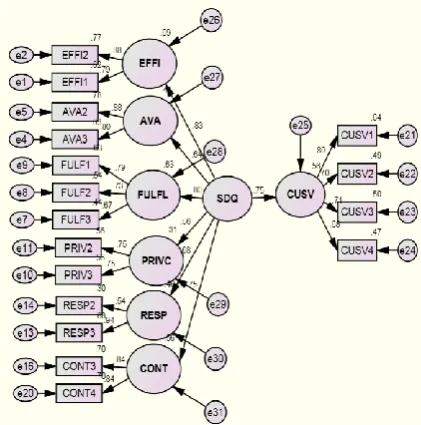
[image:4.595.65.279.411.648.2]SEM was selected to test the hypotheses. Two models of SEM have been proposed. Fig. 1 shows the first model which depends on second-order CFA to test the effect of SDQ totally on the customer value.
Figure 1. Model to test hypothesis H1
The model indices were CMIN/DF 2.013, GFI 0.964, AGFI 0.951, RMR 0.022, RMSEA 0.038, P 0.000. Based on these indices, the model has an excellent fit. Table II shows the regression weights of the first model.
TABLE II. FIRST MODEL REGRESSION WEIGHTS
Estimate S.E. C.R. P
EFFI SDQ .647 .036 18.130 *** AVA SDQ .447 .033 13.445 *** FULFL SDQ .453 .030 15.213 *** PRIVC SDQ .329 .030 10.836 *** RESP SDQ .557 .032 17.610 *** CONT SDQ .500 .029 17.301 *** CUSV SDQ .493 .029 17.235 ***
as an exogenous construct in creating customer value (the endogenous construct). The critical ratios of the indicator variables of SDQ are more than 1.96 which indicates that all these sub-dimensions significantly represent the main construct (SDQ). H1, the effect of SDQ (totally) on customer value is not rejected.
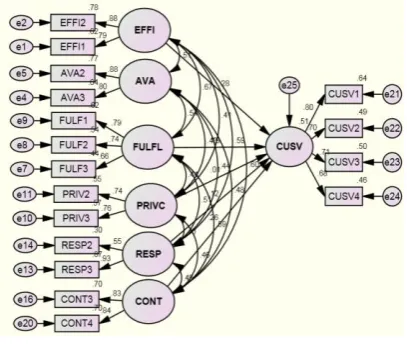
Fig. 2 shows the model to test H2, the effect of each sub-dimension of SDQ on customer value. The model indices were CMIN/DF 2.062, GFI 0.968, AGFI 0.950, RMR 0.019, RMSEA 0.038, P 0.000. These indicators point to an excellent fitting model.
[image:5.595.74.278.236.408.2]Figure 2. Model to test hypothesis H2
Table III presents the regression weights of the model constructs and variables indicators.
TABLE III. REGRESSION WEIGHTS OF SECOND MODEL
Estimate S.E. C.R. P
CUSV EFFI .237 .054 4.380 *** CUSV FULFL .202 .074 2.747 .006 CUSV PRIVC .006 .054 .114 .910 CUSV RESP .093 .040 2.340 .019 CUSV CONT .252 .055 4.621 *** CUSV AVA .024 .045 .526 .599
The results in Table III show that four sub-dimensions of SDQ significantly affect customer value: efficiency, fulfilment, responsiveness, and contact. The critical ratios of these variables are more than 1.96. However, the effects of privacy and availability dimensions on customer value were not significant. Based on the results of analysing the second model, the second hypothesis is partially supported.
V. DISCUSSION
The current study used CFA to test the measurement model of the constructs. SDQ was
measured using E-S-QUAL and
Re-E-SERVQUAL. The result of the CFA supports the reliability and validity of this instrument in measuring SDQ in the e-learning system field. The
results support the SDQ construct including the six sub-dimensions in the original measurement. However, compensation is not included in this measurement model because it is not applicable in the context of e-learning systems. The measurement of customer value in this study has been established based on the two main types of value: academic value and social value. The CFA result indicates that the two types of value are significant in measuring the customer value (students) and the reliability and validity of this measurement is confirmed.
Two models based on SEM were prepared to test the hypotheses. The first model was established based on the second-order CFA. The main purpose of this model is to examine the effect of SDQ totally on the customer value. The result indicated that SDQ plays a critical role in creating customer value. To obtain more details about the effect of sub-dimensions of SDQ on customer value, the second model of SEM is offered based on first-order CFA. The empirical test of the second model concluded that there are four sub-dimensions of SDQ that significantly impact customer value: efficiency, fulfilment, responsiveness, and contact. However, there are two variables of SDQ that have no effect on the customer value construct: privacy and system availability. The same result about those two variables was found by Parasuraman et al. [17]: the effects of system availability and privacy were insignificant on perceived value and loyalty intentions. The result of the non-significant effect of privacy is supported by Wolfinbarger and Gilly [31]. In this regard, the main justification of non-significant effect of privacy on customer value in e-learning systems is that students tend to share some information about study, comments about the materials, sharing the knowledge, and invitations to other students to study in groups.
System availability is related to correct performance of the technical functions of the system [17]. This variable has a non-significant effect on customer value. The e-learning systems are not different to traditional or electronic IS and may face technical problems. The system will not be available to students when it is temporarily suspended for maintenance. The design of the e-learning systems interface (website) may affect system availability if the site is complicated and has too much content. These sites need high speed internet connection to load pages, and this aspect may be not available on some devices used to access e-learning services, e.g. mobile phones.
in developing students’ performance and enhancing their social value from using the e-learning system.
VI. CONCLUSION AND RECOMMENDATIONS
The main recommendation to educational institutions and organisations adopting e-learning systems is that SDQ should be evaluated. This should not be limited to one stakeholder group but include different constituents such as students, academic staff, and ICT staff. The variety of opinions in evaluating SDQ is important to provide a comprehensive and true picture about the services of e-learning systems. The investigation of factors affecting customer value in the context of e-learning systems should be adopted and extended to explore the factors impacting the organisational and societal value as well.
The contribution of this study to knowledge is in providing evidence about the role of e-learning SDQ in enhancing customer value. It supports the reliability and validity of E-S-QUAL and Re-E-SERVQUAL. Recommendations on how to improve service delivery quality and identification of the important factors which affect creating and enhancing customer value have been derived from the study.
REFERENCES
[1] D. Georgina and M. Olson, "Integration of technology in higher education: A review of faculty self-perceptions,"
The Internet and Higher Education, vol. 11, pp. 1-8, 2008.
[2] Y. M. Saleh, "Information system/information technology success and evaluation an evaluation framework and general pracitioner model," PhD, School of Construction and Property Management, University of Salford Salford UK, 2002.
[3] J. Strother, "An assessment of the effectiveness of e-learning in corporate training programs," The International
Review of Research in Open and Distance Learning, vol.
3, pp. 1-17, 2002.
[4] V. A. Zeithaml, "Service excellence in electronic channels," Managing Service Quality vol. 12, pp. 135-138, 2002.
[5] V. A. Zeithaml, A. Parasuraman, and A. Malhotra, "Service quality delivery through web sites: A critical review of extent knowledge " Journal of the Academy of
Marketing Science, vol. 30, pp. 362-375, 2002.
[6] I. Roffe, "E-learning: engagement, enhancement and execution," Quality Assurance in Education, vol. 10, pp. 40-50, 2002.
[7] J. Frydenberg, "Quality standards in eLearning: A matrix of analysis," The International Review of Research in
Open and Distance Learning, vol. 3, pp. 1-15, 2002.
[8] J. F. Rockart, "The changing role of the information system executive: A critical success factors perspective,"
Sloan Management Review, vol. 24, pp. 3-13, 1982.
[9] L. Berry and A. Parasuraman, "Listening to the customer-the concept of a service-quality information system," Sloan
Management Review, vol. 38, pp. 65-76, 1997.
[10] L. Pitt, R. Watson, and C. Kavan, "Service quality: a measure of information systems effectiveness," MIS
Quarterly, vol. 19, pp. 173-187, 1995.
[11] W. J. Kettinger and C. C. Lee, "Pragmatic perspective on the measurment of information systems services quality,"
MIS Quarterly, vol. 21, pp. 223-240, 1997.
[12] R. Watson, L. Pitt, and C. Kavan, "Measuring information systems service quality: lessons from two longitudinal case studies," MIS Quarterly, vol. 22, pp. 61-79, 1998.
[13] V. Zeithaml, A. Parasuraman, and A. Malhotra, "A conceptual framework for understanding e-service quality: Implications for future reseach and managerial practice,"
Marketing Science Institute, Cambridge, MA, working
paper, 2000.
[14] C. Holsapple and A. Lee Post, "Defining, Assessing, and Promoting E Learning Success: An Information Systems Perspective," Decision Sciences Journal of Innovative
Education, vol. 4, pp. 67-85, 2006.
[15] J. Roca, C. Chiu, and F. Martínez, "Understanding e-learning continuance intention: An extension of the Technology Acceptance Model," International Journal of
Human-Computer Studies, vol. 64, pp. 683-696, 2006.
[16] W. Kettinger and C. Lee, "Perceived Service Quality and User Satisfaction with the Information Services Function,"
Decision Sciences, vol. 25, pp. 737-766, 1994.
[17] A. Parasuraman, V. A. Zeithaml, and A. Malhotra, "E-S-QUAL a multiple-item scale for assessing electronic service quality," Journal of Service Research, vol. 7, pp. 213-233, 2005.
[18] S. Ozkan and R. Koseler, "Multi-dimensional students' evaluation of e-learning systems in the higher education context: An empirical investigation," Computers &
Education, vol. 53, pp. 1285-1296, 2009.
[19] T. Adeyinka and S. Mutula, "A proposed model for evaluating the success of WebCT course content management system," Computers in Human Behavior, vol. 26, pp. 1795-1805, 2010.
[20] W. H. DeLone and E. R. McLean, "Information system success: the quest for the dependent variable " Information
System Research, vol. 3, pp. 60-95, 1992.
[21] V. Zeithaml, "Consumer perceptions of price, quality, and value: a means-end model and synthesis of evidence," The
Journal of Marketing, vol. 52, pp. 2-22, 1988.
[22] R. Woodruff, "Customer value: the next source for competitive advantage," Journal of the Academy of
Marketing Science, vol. 25, pp. 139-153, 1997.
[23] A. M. Fiore, J. Kim, and H. H. Lee, "Effect of image interactivity technology on consumer responses toward the online retailer," Journal of Interactive Marketing, vol. 19, pp. 38-53, 2005.
[24] K. Yang and L. Jolly, "The effects of consumer perceived value and subjective norm on mobile data service adoption between American and Korean consumers," Journal of
Retailing and Consumer Services, vol. 16, pp. 502-508,
2009.
[25] C. Ong and J. Lai, "Measuring user satisfaction with knowledge management systems: scale development, purification, and initial test," Computers in Human
Behavior, vol. 23, pp. 1329-1346, 2007.
[26] L. Ledden, S. P. Kalafatis, and P. Samouel, "The relationship between personal values and perceived value of education," Journal of Business Research, vol. 60, pp. 965-974, 2007.
[27] L. Hu and P. M. Bentler, "Fit indices in covariance structure modeling: Sensitivity to underparameterized model misspecification," Psychological Methods, vol. 3, pp. 424-453, 1998.
[28] R. B. Kline, Principles and Practice of Structural
Equation Modeling, 3rd ed. New York: The Guilford
Press, 2011.
[29] P. Holmes-Smith, Advanced Structural Equation
Modelling using Amos: Australian Consortium for Social
and Political Research Incorporated, Monash University, Clayton, 2011.
[30] C. L. Shook, D. J. Ketchen Jr, G. T. M. Hult, and K. M. Kacmar, "An assessment of the use of structural equation modeling in strategic management research," Strategic
Management Journal, vol. 25, pp. 397-404, 2004.
[31] M. Wolfinbarger and M. C. Gilly, "eTailQ: dimensionlizing, measuring and predicting etail quality,"