Evaluation of the Assembly Learning Grant
(Further Education) (ALG (FE))
Ymchwil gymdeithasol Social research
Evaluation of the Assembly Learning Grant (Further
Education) (ALG (FE))
Authored by Nia Bryer with input from Gareth Williams
Old Bell 3 Ltd
Views expressed in this report are those of the researcher and not necessarily those of the Welsh Government
For further information please contact: Joanne Corke
Department: Knowledge and Analytical Services Welsh Government
Cathays Park Cardiff CF10 3NQ Tel: 029 20801138
All content is available under the Open Government Licence v3.0 , except where otherwise stated.
http://www.nationalarchives.gov.uk/doc/open-government-licence/version/3/ Welsh Government Social Research, 25 March 2015
Table of contents
LIST OF TABLES ... 2
GLOSSARY OF ACRONYMS ... 3
1 BACKGROUND ... 4
2 KEY FINDINGS AND RECOMMENDATIONS ... 9
3 AN OVERVIEW OF THE ALG (FE) SCHEME IN WALES ... 16
4 FINANCIAL SUPPORT FOR ADULT LEARNERS IN THE UK ... 33
5 RATIONALE AND NEED ... 47
6 ALG (FE) DESIGN AND OBJECTIVES ... 53
7 ALG (FE) ADMINISTRATION ... 62
8 DIFFERENCE MADE ... 75
9 FUTURE ... 86
10 CONCLUSIONS AND RECOMMENDATIONS ... 93
List of tables
TABLE 3.1: CURRENT ALG (FE) AWARDING CRITERIA (2013/14) ... 18
TABLE 3.2: ALG (FE) APPLICATIONS BY ACADEMIC YEAR ... 24
TABLE 3.3: SUCCESSFUL ALG (FE) APPLICATION BY MODE OF STUDY ... 25
TABLE 3.4: SUCCESSFUL ALG (FE) APPLICATIONS BY AGE AND ACADEMIC YEAR ... 26
TABLE 3.5: SUCCESSFUL ALG (FE) APPLICATIONS BY RESIDUAL INCOME (2011/12) ... 27
TABLE 3.6: ALG (FE) RECIPIENTS BY LOCAL AUTHORITY ... 29
TABLE 3.7: SUCCESSFUL ALG (FE) APPLICATIONS BY GENDER ... 30
Glossary of acronyms
ALG (FE) Assembly Learning Grant – Further Education
ALN Additional Learning Needs
BTEC Business and Technology Education Council (Qualification) DLS Discretionary Learner Support
ELWa Education and Learning Wales
EMA Education Maintenance Allowance
ESF European Social Fund
ESRC Economic and Social Research Council
FCF Financial Contingency Fund
FE Further Education
FEI Further Education Institution
FSM Free School Meals
GCSE General Certificate of Secondary Education GNVQ General National Vocational Qualification
HE Higher Education
HEFCW Higher Education Funding Council for Wales
JSA Job Seeker’s Allowance
LC Learning Centre
LEA Local Education Authority
LLWR Lifelong Learning Wales Record
NEET Not in Education, Employment or Training NFER National Foundation for Education Research
NPD National Pupil Database
1 BACKGROUND
Introduction
1.1 Old Bell 3 Ltd, in conjunction with the Wales institute of Social and Economic Research, Data and Methods (WISERD) and Dateb, was commissioned by the Welsh Government to undertake an independent evaluation of Further Education (FE) student finance across Wales with a particular emphasis upon reviewing the Education Maintenance
Allowance (EMA) and the Assembly Learning Grant (Further Education) (ALG (FE)1) funding Schemes.
1.2 This report is the second of three reports prepared as part of this evaluation and focuses upon the ALG (FE) Scheme. The first report focused upon the EMA funding Scheme2 and the third will provide an overarching strategic report covering FE student finance across Wales.
1.3 The ALG (FE) is an administrative Scheme (i.e. a scheme not set out in regulations but which nevertheless has a statutory basis), first
introduced for the 2002/03 academic year which supports adult learners aged 19 or over in further education. The ALG (FE) is a means-tested allowance and is awarded to those students whose household income is £18,370 or below. During 2012/13, 7,445 students were supported via the Scheme – the vast majority (87 per cent) were studying on a full-time basis, with the remainder studying part-time. In all, ALG (FE) recipients form a very small proportion of all learners aged 19 and over in further education in Wales, at 4 per cent during 2012/133.
1
From Academic Year 2014/15 it will be known as the Welsh Government Learning Grant (WGLG) Further Education
2
Available at: http://gov.wales/statistics-and-research/evaluation-education-maintenance-allowance-assembly-learning-grant/?lang=en
3
According to StatsWales 183,335 learners were enrolled at further education, work-based learning and community learning providers in Wales during 2012/13.
https://statswales.wales.gov.uk/Catalogue/Education-and-Skills/Post-16-Education-and-
Evaluation Aims and Objectives
1.4 The overall aims of the evaluation were to review:
The efficiency and effectiveness of the EMA and ALG (FE) Schemes; Whether the current schemes contribute towards Welsh Government
policy commitments;
The extent to which the package of FE student support (including the Financial Contingency Fund) contributes towards the widening
participation agenda.
1.5 The specific objectives of relevance to this report, paraphrased from the research specification, were:
Exploring the extent to which ALG (FE) fits with other Welsh Government student finance support;
Reviewing student finance support in England, Scotland and Northern Ireland with a view to exploring alternative methods to the ALG (FE); Reviewing the implementation of the ALG (FE) funding Scheme
including the appropriateness of allowance levels and eligibility criteria; Evaluating the contribution made by ALG (FE) towards widening
participation and increasing retention rates;
Assessing the impact of ALG (FE) on student attainment rates, progression routes and destinations;
Exploring the achievements and dropout rates of ALG (FE) supported students;
Exploring the promotion of the ALG (FE) and how it could be targeted more effectively;
Exploring the impact of withdrawing ALG (FE), should such a decision be taken;
Exploring what would have happened in the absence of the ALG (FE), particularly in terms of decisions to study;
Making recommendations for the future delivery of FE student finance support in Wales.
Evaluation Methodology
1.6 The research for this report was carried out between December 2013 and June 2014. The methodology and work programme are presented in detail in Annex A of the Technical Appendix4. They included:
An inception and scoping stage, which involved accessing key documents, administrative data and Student Loans Company (SLC) student datasets and agreeing upon an Inception Report with the Evaluation Steering Group;
Desk research which included reviewing UK and Welsh Government policies, reviewing other FE student financial support provision and reviewing other FE student finance evaluation reports;
Developing research instruments to use with stakeholders, learning centres and students as well as policy interviewees in England, Scotland and Northern Ireland. These research instruments are presented in Annex D of the Technical Appendix;
Undertaking a package of fieldwork at 12 Welsh Further Education Institutions (FEIs) which involved interviews with staff and various focus groups with ALG (FE) recipients and non- ALG (FE) recipients; Interviewing key stakeholders and a further two FEIs5 which did not
have any ALG (FE) recipients;
Undertaking a qualitative telephone survey of 30 previous ALG (FE) recipients to explore progression.
4
See Technical Appendix available at: http://gov.wales/statistics-and-research/evaluation-education-maintenance-allowance-assembly-learning-grant/?lang=en
5 Namely the Workers Educational Association (WEA) and the Young Men’s Christian
1.7 We had hoped to be able to match SLC student records to the Widening Access Database6in order to compare students who received ALG (FE) with those who did not and to undertake a comprehensive descriptive analysis and modelling of the data. A similar comparative exercise was achieved as part of the EMA evaluation as the coverage and contents of the Widening Access Database enabled us to trace the experiences of EMA and non-EMA recipients across three cohorts of Year 11 pupils between 2004/05 and 2006/07. However, an analysis of the ALG (FE) Scheme was not possible due to a number of reasons - firstly, the small size of the ALG Scheme in terms of participants would have resulted in smaller matched samples; secondly, as the ALG (FE) Scheme supports a much wider age range of learners it would have been likely that only a small minority would have been included on the Widening Access database (given its focus on young learners) and thirdly, the last year of Lifelong Learning Wales Record (LLWR) data within the Widening Access Database is 2009/10 and (again, given the older age of ALG recipients) later years of LLWR data would be required in order to meaningfully incorporate ALG (FE) recipients into the analysis. Furthermore a relatively high proportion of ALG (FE) recipients
contained within SLC records had not given permission to share their data – making any matching exercise unfeasible and unreliable. Full details of the methods employed and the findings from this exercise are presented in Annex C of the Technical Appendix.
Structure of this Report
1.8 In this report we firstly (in Section 2) present the key findings of the research and our recommendations for the future of the ALG (FE) Scheme. We then (at Section 3) present an overview of the ALG (FE) Scheme in Wales and the policy context within which it has been operating. In Section 4, we present our review of evidence relating to
6
student finance support outside of Wales for students aged 19 and over, before setting out in Section 5 the evidence and findings regarding the rationale and need for the ALG (FE) Scheme. We then present and discuss findings in relation to the overall design and objectives of the Scheme in Section 6. In Section 7 we set out and discuss the evidence about the administration of the ALG (FE) Scheme before we turn to present the evidence that was gathered as to the difference made by the ALG (FE) Scheme in Wales and whether it offers value for money
(Section 8). We then discuss (in Section 9) the views we collected through the fieldwork on the future of the ALG (FE) Scheme in Wales and finally (in Section 10) we present our conclusions and
2 KEY FINDINGS AND RECOMMENDATIONS
2.1 The ALG (FE) Scheme, first introduced for the 2002/03 academic year supports adult learners aged 19 or over in further education. It is a means-tested allowance awarded to those students whose household income is £18,370 or below. During 2012/13, 7,445 students were supported via the Scheme – the vast majority (87 per cent) were studying on a full-time basis, with the remainder studying part-time. In all, ALG (FE) recipients form a very small proportion of all learners aged 19 and over in further education in Wales, at 4 per cent during 2012/137.
2.2 Stakeholders believed that there was a definite need for the ALG (FE) Scheme to financially support adult learners in post-compulsory
education in Wales. This case was made on the basis that adult learners tended to have greater financial commitments than their younger
counterparts and students in particular were more likely to argue that they were struggling financially whilst in education. Furthermore it was also argued that adult learners tended to benefit less from other financial support such as subsidised transport costs. Indeed other than the FCF (FE) Scheme adult learners in FE are able to access very little other financial support.
2.3 The fieldwork revealed that having two separate administrative schemes for older and young learners tended to create confusion amongst the student population – particularly for those progressing from EMA to ALG (FE). There was a strong call for the support on offer via the current administrative schemes to be better aligned in terms of eligibility criteria (including household income thresholds for awarding funding), the level of funding made available and regularity of payment. As was the case
7
According to StatsWales 183,335 learners were enrolled at further education, work-based learning and community learning providers in Wales during 2012/13.
https://statswales.wales.gov.uk/Catalogue/Education-and-Skills/Post-16-Education-and-
with the EMA Scheme, feedback also suggested that recipients of the ALG (FE) Scheme also benefited from FCF (FE) support.
2.4 The fieldwork suggested that the right students were being supported by the ALG (FE) Scheme and that as a result means testing based upon household income was deemed to be an acceptable approach for allocating funding. One key point of concern related to the perceived impact of receiving ALG (FE) support upon other UK Government financial benefits and the fear of losing such benefits – although it was found that the number of hours required for FE study had in fact a greater bearing upon this issue than the funds itself.
2.5 One key issue to emerge related to the cut off age (currently set at 25) for determining whether a student lived independently or not without the need to prove that they were doing so. Contributors to the study thought that adopting an arbitrary cut-off age to determine whether a student lived independently or not was inappropriate – some argued that any student over 19 ought to be regarded as living independently whereas others believed that all ALG (FE) applicants, regardless of their age, ought to evidence the fact that they lived independently.
2.6 It was found that the current maximum funding allowance of £1,500 was generally adequate for students living at home without any dependents but inadequate for those living independently or with other dependents. The fieldwork also revealed that the lower payment allowances available via the Scheme were inadequate and there was a desire amongst
contributors to see these amounts increased, in some cases it was thought that a single rate of allowance ought to be provided via the Scheme.
2.7 The ALG (FE) funds were viewed in the main as an essential
2.8 Despite a wide range of promotional and information dissemination methods being adopted to market the ALG (FE) Scheme, there was generally lower awareness of its existence across the FE sector. Given that relatively few learners receive funding via the Scheme it was perhaps not surprising that the study did not reveal any element of stigmatisation associated with its receipt.
2.9 Mixed experiences were reported around the application process. The main difficulties expressed by applicants related to terminology, the sourcing of original documentation and submission of original documentation by post.
2.10 The fieldwork found that the value associated with using learning grant agreements was questionable and several methods of strengthening these were offered by contributors. In terms of attendance requirements, individual colleges adopted very different interpretations of the guidance set by the Welsh Government and were generally less demanding and more flexible than the requirements imposed upon EMA funded
students.
2.11 It was found that ALG (FE) recipients would prefer to receive more regular payments than the current termly cycle and to be notified in advance of the value and date which they could expect to receive payment.
2.12 In terms of the difference made, the study found mixed evidence in terms of the impact of the ALG (FE) Scheme upon learners’ decision to enrol in further education. A fair number of recipients had only come to hear about the Scheme after they had taken the decision to enrol on their course and therefore could not have been influenced by its
availability but its existence was a crucial consideration in the decision of a minority of recipients to enrol in further education.
less pronounced than was the case for the EMA Scheme) its impact upon retention levels was greater. The research found that the Scheme was critical to a large number of students in enabling them to stay in further education and in many cases meet unanticipated costs associated with further education.
2.14 Furthermore the study did not reveal any concrete evidence either way to demonstrate whether the ALG (FE) Scheme was having an impact upon student attainment, achievement or progression into higher education.
2.15 The evaluation makes the following nine recommendations:
2.16 Recommendation 1: that the Welsh Government continues to financially support Welsh further education adult learners and that it continues to adopt the ALG (FE) Scheme as the basis for awarding such funding. It is further recommended that the ALG (FE) Scheme be
maintained as a statutory scheme with funding being awarded on the basis of applicants meeting specific eligibility requirements.
2.17 Recommendation 2: that the ALG (FE) Scheme continues to provide financial support on the basis of recipients meeting the current
be much greater as increasing the allowance rate could very well
encourage other adult learners, who would not have previously thought it worthwhile to apply for the lower value payments, to apply for support in the future. As such, and very much as a secondary option we would recommend that the ALG (FE) Scheme adopts a two-tiered payment value model – with the highest payment set at the current £1,500 rate and the lowest payment value set at around the EMA allowance rate of between £1,080 and £1,179.
2.18 Recommendation 3: that greater effort is deployed by learning centres, the SLC and the Welsh Government via SFW to raise awareness of the existence of financial support for adult learners so as to ensure those who could benefit from returning to education from low-income
households are not deterred by the perception that no support is available. We further believe that greater awareness of the Scheme could be established across the further education sector more broadly, including tutors and lecturers. Finally, if greater alignment of the Scheme with the EMA Scheme is achieved it may be possible for the ALG (FE) fund to benefit and ‘piggy-back’ from the effective EMA marketing campaigns deployed by learning centres.
2.19 Recommendation 4: that practical steps are taken to improve the ALG (FE) application process. We think these improvements could be
achieved via (a) the introduction of an on-line application process; (b) the fast-tracking of previous EMA recipient applications (in a similar manner to how returning ALG (FE) recipients are fast tracked through the process) and (c) working with learning centres to address some of the issues relating to the provision of original documentation by
2.20 Recommendation 5: that learning centres explore ways of enhancing the value of learning agreements adopted. We further recommend that learning centres communicate much more clearly what is required of students in terms of attendance policies and also adopt appropriate monitoring procedures. We would further suggest that there is a need for greater consistency across learning centres in terms of what is required of recipients in terms of attendance policies but recognise that learning centres need to have a greater degree of flexibility to accommodate lower attendance amongst particular groups of adult learners e.g. those with childcare or other caring responsibilities.
2.21 Recommendation 6: that ALG (FE) payments are made to students on a more regular basis than the current termly basis. We would suggest that payments be awarded in equal instalments on a monthly basis. We would further recommend that SLC adopts a regular payment date for each calendar month and that recipients be notified in advance (by text message if possible) of when to expect their funding and the value of the payment due.
2.22 Recommendation 7: that the Welsh Government adopts at least one key performance indicator directly for the ALG (FE) Scheme and reports upon this annually via its Programme for Government. In our view this performance indicator should reflect the aims and objectives of the Scheme and we would suggest that it could be the proportion of ALG (FE) recipients gaining a qualification at any level.
3 AN OVERVIEW OF THE ALG (FE) SCHEME IN WALES
Introduction
3.1 This section firstly presents the background to the ALG (FE) Scheme in Wales as well as its overall aims and objectives. It then goes on to discuss the Welsh policy context within which the Scheme has been operating and to outline the key developments since it was first introduced, before providing an overview of the Scheme’s take up, financial spend and the delivery model adopted for its administration.
Background
3.2 The ALG (FE) was introduced by the Welsh Government as a financial allowance to support adult learners who might otherwise experience financial difficulties when undertaking further education courses. The aim of the Scheme is to provide:
‘an incentive to students from lower-income households to remain in, or return to, further education. It aims to encourage students to gain
qualifications and help to increase their employment opportunities’8
.
3.3 It was first introduced for the 2002/03 academic year for learners studying on further education courses at both further education
institutions (FEIs) and higher education institutions (HEIs) but was later extended to include students learning at all learning centres which provided Education and Learning Wales- (ELWa-)9 or Local Education Authority- (LEA-) facilitated courses from 2003/04 onwards. The Scheme was initially made available to students aged 18 and over at the start of
8 Student Finance Wales ‘Assembly Learning Grant (Further Education) Guidance Notes
Academic Year 2013/2014’ p. 3
9
the academic year but from 2006/07 it became only available to students aged 19 years and over due to the extension of the EMA to include 18 year olds during the same academic year10.
3.4 The ALG (FE) Scheme was initially administered by Welsh Local Authorities but responsibility was transferred to the SLC from 2006/07 academic year onwards.
3.5 The ALG (FE) grant has always been available to both full and part-time students domiciled in Wales and studying at a publicly-funded learning provider in the UK. Full-time students are eligible for up to £1,500 support and part-time students are eligible for up to £750 per annum.
3.6 In order to be eligible for the ALG (FE), students must satisfy the following criteria:
Be aged 19 years or over at the start of the academic year (there are no upper age limits);
Be ordinarily resident in Wales on the first day of the first academic year of the course and have been ordinarily resident for three years prior to that date either in the UK or the European Economic Area; Be enrolled on a Welsh Government (or equivalent) approved course
which requires regular attendance at an FEI or other learning centre and involves at least 275 contact hours in each academic year.
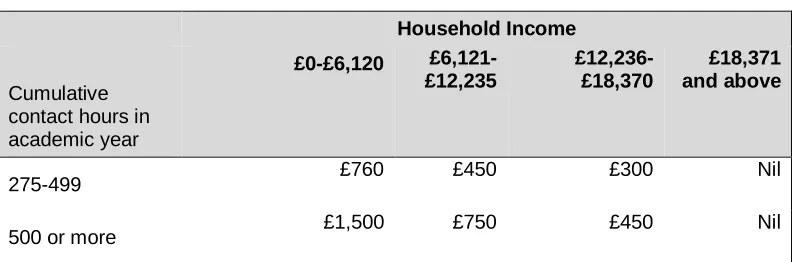
3.7 Household income is also a key criterion for awarding ALG (FE) support and students are currently able to receive funding if their household income is £18,370 or less. The amount of ALG (FE) awarded is related to both the level of household income and whether the learner studies on a full or part-time basis, as shown in Table 3.1 below. Eligible household income thresholds have increased modestly over time – for instance, in 2009/2010 and 2010/11 the threshold for any support was
10
set at £17,700 before being increased to £18,370 from September 2011 - but thresholds have remained static since 2011/12.
Table 3.1: Current ALG (FE) Awarding Criteria (2013/14)
Household Income
Cumulative contact hours in academic year
£0-£6,120
£6,121-£12,235
£12,236-£18,370
£18,371 and above
275-499 £760 £450 £300 Nil
500 or more £1,500 £750 £450 Nil Source: Student Finance Wales
3.8 The household income which is considered in the awarding of the ALG (FE) grant depends upon whether the learner is a dependent or
independent student. A student is considered to be an ‘independent’ student if they satisfy at least one of the following criteria:
Are aged 25 or over; Are responsible for a child;
Have financially supported themselves for three years or more;
Are living apart from their parents and have no contact with them, and not living under Local Authority care;
Live under Local Authority care, including with foster parents; Are, or have been, married or in a civil partnership.
3.9 Independent students are expected to provide estimated information on their expected income for the academic year in consideration as well as their partners’ income (where relevant) for the previous tax year.
3.10 Students who have previously received ALG (FE) whilst studying on a course are not eligible to receive further support via the Scheme if they study for a course at the same or a lower level of qualification.
3.11 Other than the transfer of the Scheme’s administration from Local Authorities to the Students Loans Company the only other notable change has been the recent change of the Scheme’s name. From 2013/14 academic year onwards the Scheme was renamed as the Welsh Government Learning Grant Further Education (WGLG (FE)) Scheme.
The Welsh Policy Context
3.12 The Welsh Government has been committed since the creation of the National Assembly in 1999 to widening access to learning and to tackling barriers which prevent adult learners from disadvantaged backgrounds from continuing and re-entering post compulsory education. These commitments were re-iterated in the ‘One Wales’ agreement (which set the agenda for the Welsh Government from 2007 – 2011) as well as the Welsh Government’s ‘Skills That Work for Wales: A Skills and Employment Strategy and Action Plan’ (2008). However, neither of these two documents specifically refer to the ALG (FE) Scheme or the provision of adult student finance.
3.13 Likewise in its Programme for Government (published in 2011), the current Welsh Government states a clear aim of improving further education but despite this has not set a specific performance indicator relating to the ALG (FE) Scheme or adult learners in further education more generally. It could, however, be argued that two other, broader performance indicators could reflect the contribution made by the ALG (FE) Scheme namely:
The percentage of working age adults qualified to the equivalent of two A-Levels, or an apprenticeship, and above.
3.14 The consultation document published by the Welsh Government during 2009 ‘Investing in Skills: Sector Priorities Funding, Fees Policy and Financial Support for Learners’11
does not specifically reference the ALG (FE) Scheme in any way. However it is worth noting that the
Consultation Response document did note more generally that there was:
‘broad support [from respondents to the consultation] for the alignment of thresholds and parity of esteem across financial support measures and for encouraging progression into Higher Education’12
;
‘[a view from respondents] that the system can be complex with a wide range of separate funding streams available (e.g. financial contingency funds, transport, childcare, meals and equipment subsidies) and that complexity in the system can, in itself sometimes be a barrier to engaging learners’.13
3.15 Interestingly the Consultation Response document also notes the view of respondents that ‘caution needs to be exercised in the apparent strategy to divert funding from post 19 learners to the 14-19 cohort given the fact that the size of the 16-19 cohort is reducing whilst the numbers of those aged 19 onwards wishing to access learning is increasing exponentially’.14
3.16 In Wales, full-time further education students aged 19 or over and studying at a further education college are not normally charged tuition fees or may be entitled to a reduced fee provided they satisfy particular
11 Welsh Assembly Government (October 2009) ‘Investing in Skills: Sector Priorities Funding,
Fees Policy and Financial Support for Learners’ Consultation Document
12 Welsh Assembly Government (2010) ‘Response to a consultation on Investing in Skills
Sector Priorities Funding, Fees Policy and Financial Support for Learners’ Page 4
13
Ibid, p. 29
14
criteria e.g. are from low income families, or receive benefits. Part-time students aged 19 and over are typically charged tuition fees however they may be entitled to reduced fees provided they are from low income families or are receiving benefits15.
3.17 In July 2011, Estyn16 published a thematic report on the achievement of learners in further education from deprived backgrounds17. The report recommended that the Welsh Government continue to support learners from deprived areas financially as this support was important in enabling such learners to complete their education or training. It also
recommended that providers should ensure that learners from deprived areas became aware of the support and financial assistance available to them before they applied for programmes, that they should provide learners with easier on-line access to information on their attendance, punctuality and performance (which determines whether payments are withheld) as well as making sure that the performance of learners from deprived areas was reported within providers’ self-assessment reports.
3.18 Estyn has also underlined the link between poverty and low educational attainment, stating, for instance in its annual report for 2010-1118 that students from poorer families are more likely to attain at lower levels than other students. In its latest annual report19 Estyn stated that the ALG (FE) was one financial measure available to support students financially within further education. However the report does not provide any feedback on the experiences of ALG (FE) recipients concerning how instrumental the funding has been to their decisions to attend college,
15
http://gov.wales/topics/educationandskills/learningproviders/fesupport/?lang=en 16
The education and training inspectorate for Wales.
17 Estyn (July 2011) ‘The impact of deprivation on learners’ attainment in further education
and work-based learning’ available at:
http://www.estyn.gov.uk/english/docViewer/203630.7/the-impact-of-deprivation-on-learners-attainment-in-further-education-and-work-based-learning-july-2011/?navmap=30,163,
18 Estyn (2012) ‘The Annual Report of Her Majesty’s Chief Inspector of Education and
Training in Wales 2010-2011’ available at http://www.estyn.gov.uk/english/news/annual-report-of-her-majestys-chief-inspector-of-education-and-training-in-wales-2010-2011/
19 Estyn (2013) ‘The Annual Report of HM Chief Inspector of Education and Training in Wales
how the funds were being used and what difference the funding was making to their financial standing.
3.19 Finally in terms of setting the context for this study it is important to consider some of the key findings presented in a recent NUS Wales survey of students20. The survey found that adults aged 19 and over in further education were more likely than some groups, notably students aged 18 – 21 in higher education, to be under particular financial strain. The study also found that adult FE learners (aged 19+) were the most likely of all students (i.e. across FE and HE) to have seriously
considered leaving their course, with financial difficulties being cited as the most important reason for having done so (albeit that this was also the most important reason cited by all students who seriously considered leaving their course). Over two-thirds of 19+ FE respondents to the survey agreed with a statement that they regularly worried about not having enough money to meet their basic living expenses such as rent and utility bills, while only three in ten 19+ FE respondents agreed with the statement that they were able to concentrate on their studies without worrying about finances. Finally the survey also found a strong
correlation between high course costs and low student wellbeing.
3.20 It is also worth noting that two motions relating to adult learners’ funding were tabled by two college Students’ Unions and passed at the National Union of Students’ Wales Conference held during March 201421
. One motion (proposed by Coleg Sir Gar Students’ Union) resolved to ‘lobby the Welsh Assembly to ensure they understand the difficult and
untenable positions of many existing and potential mature and/or part-time students’. The second motion (proposed by Cambria College
Students’ Union) requested that the Conference resolve to work with the SLC and Welsh Government to develop a FE funding structure in Wales
20 National Union of Students (NUS) Wales (2014) ‘Pound in your pocket’ 21
which mirrored the Advanced Learning Loan in England22 and, to an extent, the HE funding structure in general. The motion made the case that the ALG (FE) Scheme was ‘not fit for purpose’ in that the funding provided was not sufficient to support an independent student which meant that many were being ‘priced out of being able to return to or continue their education’23
.
ALG (FE) Take Up in Wales
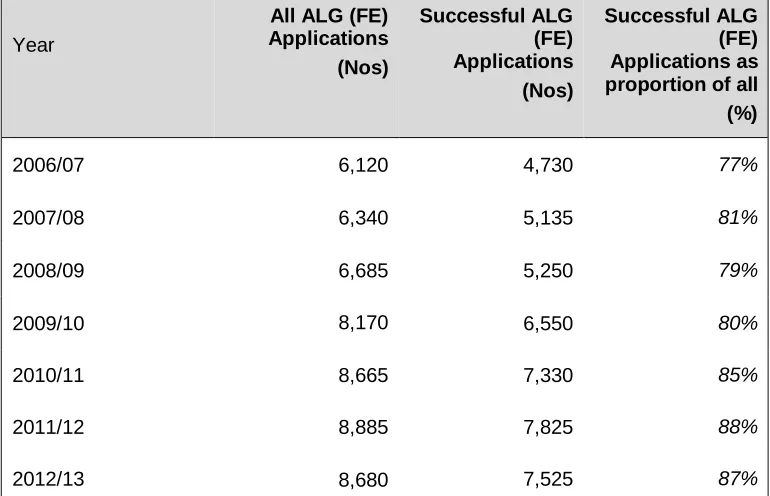
3.21 As is shown in Table 3.2 below the number of learners benefiting from the ALG (FE) Scheme increased steadily from 2005/0624 peaking at 7,825 during 2011/12. However, the number of learners supported during the last academic year (2012/13) dropped slightly to 7,525.
3.22 The number of ALG (FE) applicants has followed a similar pattern – peaking during 2011/12 at 8,885 and falling to 8,680 during 2012/13. This increase must be considered within the context of overall declining learner numbers participating in post-16 learning over the same
duration25. Application approval rates have increased modestly over the last few years (from 77 per cent during 2006/07 to 87 per cent during 2012/13) with the effect of the recession possibly accounting for an increasing number of eligible learners over this duration as household income and employment levels generally fell.
22
A loan fund for English domiciled students aged 24 or older to help with meeting the fees charged for a college or training course at Level 3 or 4.
23
http://www.nusconnect.org.uk/news/article/wales/Motions-at-NUS-Wales-conference-2014/ Accessed 14 October 2014
24
The eligibility change introduced from 2006/07 onwards (when 18 year old students became ineligible for support) makes it difficult to make any direct comparisons with take up data before 2006/07.
25
For example the total number of post-16 learners dropped by nearly 32,000 between 2007/08 (238,505) and 2009/10 (206,890). See
Table 3.2: ALG (FE) applications by academic year (Numbers and
proportions)
Year
All ALG (FE) Applications (Nos)
Successful ALG (FE) Applications (Nos)
Successful ALG (FE) Applications as proportion of all (%)
2006/07 6,120 4,730 77%
2007/08 6,340 5,135 81%
2008/09 6,685 5,250 79%
2009/10 8,170 6,550 80%
2010/11 8,665 7,330 85%
2011/12 8,885 7,825 88%
2012/13 8,680 7,525 87%
Source: Welsh Government StatsWales26 ALG (FE) Applications by LEA, academic year, mode of study and outcome of application
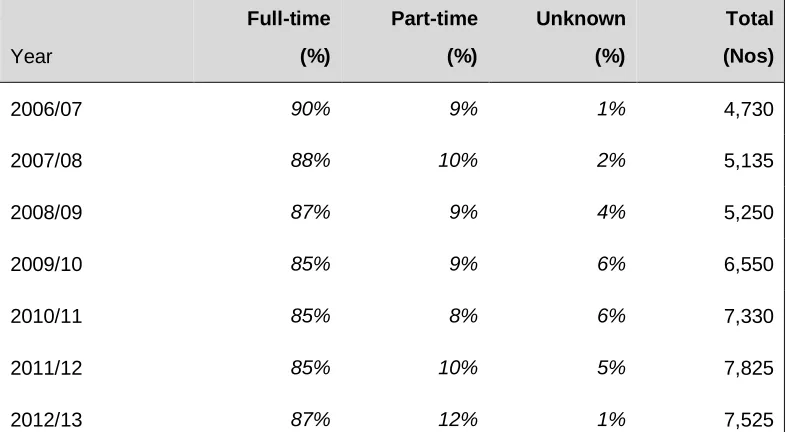
3.23 Table 3.3 shows the large majority of ALG (FE) recipients, at 87 per cent during 2012/13, are full-time students whilst 12 per cent are part-time students27, albeit that part-time students as a proportion of those in receipt of the funding has increased slightly over time.
26
https://statswales.wales.gov.uk/Catalogue/Education-and-Skills/Post-16-Education-and- Training/Student-Support/Assembly-Learning-Grants-Further-Education/ALGApplications-by-LEA-AcademicYear-Mode-Outcome Accessed 19 September 2014
27
Table 3.3: Successful ALG (FE) Application by mode of study
(Numbers and proportions)
Year
Full-time
(%)
Part-time
(%)
Unknown
(%)
Total
(Nos)
2006/07 90% 9% 1% 4,730
2007/08 88% 10% 2% 5,135
2008/09 87% 9% 4% 5,250
2009/10 85% 9% 6% 6,550
2010/11 85% 8% 6% 7,330
2011/12 85% 10% 5% 7,825
2012/13 87% 12% 1% 7,525
Source: Welsh Government StatsWales Approved applications for ALG (FE) by gender, learning, centre type and type of award
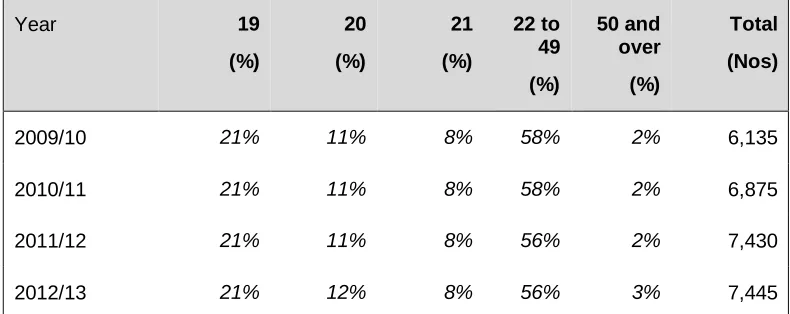
3.24 Focusing upon age, Table 3.4 shows that over the last few years on average over half of all ALG (FE) recipients have been aged between 22 and 49 years old whilst 19 year olds have consistently accounted for just over a fifth. Further analysis (not shown in Table 3.4) suggests a
significant difference between full-time and part-time ALG (FE) recipients: as a proportion of all part-time ALG (FE) recipients those aged between 22 and 49 years of age have regularly accounted for around 70 per cent of this cohort whilst part-time students aged 19 and 20 have only accounted for a very small proportion, for example at 8 per cent and 5 per cent respectively of the 910 part-time ALG (FE) recipients during 2012/13.
Table 3.4: Successful ALG (FE) applications by age and academic
year28 (Numbers and proportions)
Year 19
(%)
20
(%)
21
(%)
22 to 49
(%)
50 and over
(%)
Total
(Nos)
2009/10 21% 11% 8% 58% 2% 6,135
2010/11 21% 11% 8% 58% 2% 6,875
2011/12 21% 11% 8% 56% 2% 7,430
2012/13 21% 12% 8% 56% 3% 7,445 Source: Welsh Government First Release ‘Assembly Learning Grants Awarded to Welsh Domiciled Students in Further Education, 2012/13’ (October 2013)
3.25 Table 3.5 shows that the vast majority of ALG (FE) recipients during 2013/14 academic year were from households with a residual income of £6,120 or less, thus qualifying for the full grant of £1,500 for full-time and £750 for part-time learners. These proportions have remained fairly stable since 2008/09 – for instance during the previous academic year 81 per cent of successful full-time applications and 85 per cent of successful part-time applications received for 2012/13 were from students with a residual income of £6,120 or less29.
28
The table does not show the very small number of students whose ages were not known.
29 Welsh Government ‘First Release – Assembly Learning Grants Awarded to Welsh
Table 3.5: Successful ALG (FE) Applications by residual income
(2013/14) (Numbers and proportions)
Household Income
Mode of Study
£0-£6,120
£6,121-£12,235 £12,236-£18,370 Total number of awards
Full-time 80% 12% 8% 6,540
Part-time30 83% 11% 7% 900
Unknown31 74% 13% 13% 80
All 80% 12% 8% 7,515
32
Source: StatsWales Successful applications for Further Education Assembly Learning Grants by mode of study, residual income, academic year and measure
3.26 It is worth considering this data and the take up rate of the ALG (FE) Scheme more generally within the context of household incomes across Wales. Whilst it is important to stress the limitations of using household incomes to make like for like comparisons,33 the data available via the Family Resources Survey suggests that 28 per cent of all households in Wales have a weekly income of below £300 (equivalent to £15,600 per annum) and that 42 per cent have a weekly income below £40034
(£20,800 per annum) - a much higher rate than the 4 per cent take up of ALG (FE). In order to quality for ALG (FE) a household income would have to below £353 a week35.
3.27 Furthermore nearly all ALG (FE) recipients study at an institution in Wales – for instance 99 per cent or 7,470 of 7,525 ALG (FE) recipients
30
Due to rounding total proportion does not tally to 100%
31
It is understood from the SLC that the status of a small number of successful applications was unknown as information relating to course and mode of study had not been submitted by learning centres in time.
32
Figures are rounded to the nearest 5 therefore the sum of the column does not add to the total figure given.
33
These limitations include (a) household income surveys typically considers income from all sources (such as interest on savings and investments); (b) it is not possible to sources household income data for working age households only in Wales and (c) the sample sizes usually achieved in Wales are fairly small.
34
Department for Work and Pensions (July 2014) Family Resources Survey 2012 to 2013
35
in 2012/13 were studying at an institution in Wales, with most of the remaining one per cent at in England .
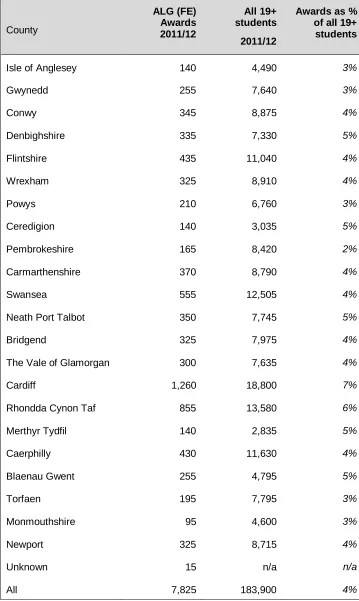
3.28 Turning to explore the take-up of ALG (FE) by local authority, Table 3.6 shows that the highest rate of take-up was across Cardiff (at 7 per cent) followed by Rhondda Cynon Taf (at 6 per cent) – compared with the Welsh average take up of 4 per cent36. The highest numbers of ALG (FE) awards was also found across these two local authority areas. The lowest rate of take up, at 2 per cent, was found across the counties of Monmouthshire and Pembrokeshire. Monmouthshire also accounted for the lowest number of ALG (FE) awards made (at 95 during 2011/12) followed by the three counties of Isle of Anglesey, Ceredigion and Merthyr Tydfil (at 140 each). Broadly, these findings are what might be expected given the relative size by population and the relative incidence of low household incomes in different parts of Wales.
36
Table 3.6: ALG (FE) recipients by local authority (Numbers and
Proportions)
County
ALG (FE) Awards 2011/12
All 19+ students
2011/12
Awards as % of all 19+ students
Isle of Anglesey 140 4,490 3%
Gwynedd 255 7,640 3%
Conwy 345 8,875 4%
Denbighshire 335 7,330 5%
Flintshire 435 11,040 4%
Wrexham 325 8,910 4%
Powys 210 6,760 3%
Ceredigion 140 3,035 5%
Pembrokeshire 165 8,420 2%
Carmarthenshire 370 8,790 4%
Swansea 555 12,505 4%
Neath Port Talbot 350 7,745 5%
Bridgend 325 7,975 4%
The Vale of Glamorgan 300 7,635 4%
Cardiff 1,260 18,800 7%
Rhondda Cynon Taf 855 13,580 6%
Merthyr Tydfil 140 2,835 5%
Caerphilly 430 11,630 4%
Blaenau Gwent 255 4,795 5%
Torfaen 195 7,795 3%
Monmouthshire 95 4,600 3%
Newport 325 8,715 4%
Unknown 15 n/a n/a
All 7,825 183,900 4%
3.29 As is shown in Table 3.7 nearly women accounted for nearly two-thirds of all ALG (FE) successful applicants during 2013/14. Interestingly men were slightly more likely than women to be studying on a full time basis whilst in receipt of ALG (FE) support (at 91 per cent compared with 85 per cent of women).
Table 3.7: Successful ALG (FE) applications by gender and mode of
study (Numbers and Proportions 2013/14)
Gender
Full time Part time Unknown Total
Female 85% 14% 1% 4,745
Male 91% 8% 1% 2,770
Total 87% 12% 1% 7,515
Source: Welsh Government StatsWales Successful ALG FE Applications by gender and Mode of Study 2013/14 (Figures as at 31 July 2014)
ALG (FE) Spend in Wales
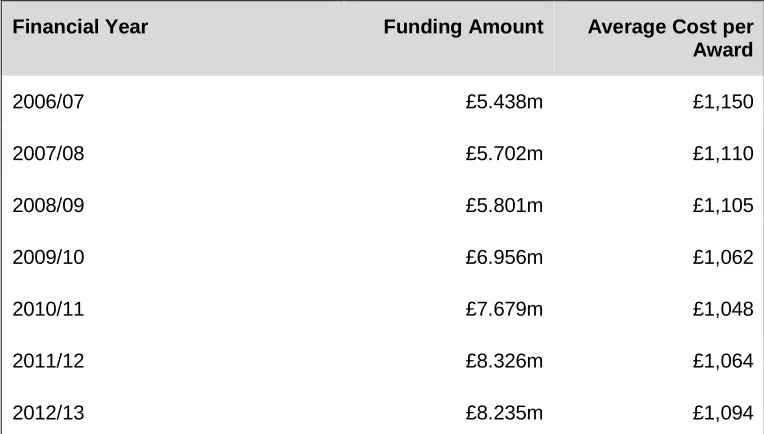
3.30 £8.2 million was spent on ALG (FE) recipients during the last academic year (2012/13), which equated to £1,094 per learner. Spend per learner has dropped slightly over the last seven year period, as shown in Table 3.8:
Table 3.8: Annual ALG (FE) Spend
Financial Year Funding Amount Average Cost per
Award
2006/07 £5.438m £1,150
2007/08 £5.702m £1,110
2008/09 £5.801m £1,105
2009/10 £6.956m £1,062
2010/11 £7.679m £1,048
2011/12 £8.326m £1,064
2012/13 £8.235m £1,094
[image:32.595.118.500.529.746.2]Delivery Model
3.31 The administration of the ALG (FE) Scheme is delegated to the Student Loans Company (SLC) via an annual Notice of Appointment with a service level agreement (SLA) agreed between the SLC and the Welsh Government and which covers both higher and further education
products. The SLA outlines the responsibilities of both the Welsh Government and the SLC. Amongst the responsibilities relating to the ALG (FE) Scheme assigned to the SLC are:
Producing application packs, including forms and guidance notes and distributing them to learning centres;
Producing various marketing materials and maintaining a customer website and customer phone line service;
Delivering annual seminars for learning centre administrators and general provision of information and training to these administrators; The accurate checking, assessing and awarding of applications; Issuing termly payments to eligible students;
Maintaining appropriate IT and business related processes for the monitoring of payments and preparation of management information.
3.32 Students apply directly to the SLC for support from the ALG (FE) Scheme using a standard application form which can be accessed directly from Student Finance Wales37 or made available via individual colleges. Together with the application form, applicants are required to submit original documentation (as opposed to photocopied documents) to evidence their identity and validate their income details.
3.33 Students who are awarded an ALG (FE) grant enter into a Learning Grant Agreement with their college and this sets out what learners need to achieve, including satisfactory attendance and learning progression in
37
order to receive payment of their termly awards. The ALG (FE) grant is paid directly to recipients on a termly basis by the SLC. Students
4 FINANCIAL SUPPORT FOR ADULT LEARNERS IN THE UK
Introduction
4.1 This section considers the current and recent provision of financial support to adult learners (aged 19 and over) undertaking further education across the UK. It is important to stress at the outset, that by comparison with the situation pertaining to those aged between 16 and 19, the systems in different parts of the UK are more diverse, with significantly less evaluation evidence available relating to the effectiveness of the different elements of support.
4.2 We consider in turn the situation in England (4.3 – 4.14), Scotland (4.15 – 4.24) and Northern Ireland (4.25 – 4.32).
England
4.3 Prior to the change of UK Government in 2010, the main form of financial support for adult learners in England was the Adult Learning Grant (ALG). This was first introduced by the Learning and Skills Council38 as a pilot in ten areas in September 2003 and rolled out nationally between 2004/5 and 2007/8. It was modelled very closely on the EMA, with learners from low income households being eligible for payments of £10, £20 or £30 per week depending on the level of household income. However, only those studying full-time for their first full Level 2 or Level 3 qualification were eligible39. By 2008/9, ALG was benefiting 30,400 learners40. However, it is important to note that receipt
38
A former Non-Departmental Public Body of the UK Government.
39
Evaluation of the Adult Learning Grant Cohort 2 (Wave 1). Centre for Research in Social Policy (CRISP) and National Centre for Social Research (NatCen) for the Department for Education and Skills and the Learning and Skills Council (October 2006) p. 1
40
of ALG did not necessarily confer fee-remission, with this depending on local policy41.
4.4 ALG was subject to fairly extensive evaluation over its lifetime, though with less attempt at using control group approaches than with EMA. The evaluations suggested:
ALG recipients were overwhelmingly younger (24 and under), with around a quarter having ‘graduated’ from EMA4243
;
ALG succeeded in reaching relatively deprived parts of the community, with strong representation of ethnic minority learners, those with a long-standing illness or disability and individuals whose parents had left school at 16 or younger44;
Learners were strongly motivated by the prospect of improving their future career prospects45;
Most learners only found out about ALG after they had decided to go ahead with their course, which by definition meant that in many cases it did not motivate learners to undertake learning which they would not otherwise have done46;
However, for a relatively small minority (estimated at between 7 – 11per cent in the first pilots47 and 13 per cent by the time of the last
evaluation48) the availability of ALG was crucial to the decision to enrol, while as many of a third of the learners suggested that the availability of (and rules surrounding) ALG influenced their decision to study full-time49, with a similar proportion saying it had contributed to their decision to study for a full qualification, rather than a modules or units50;
41
CRISP and NatCen (2006) p. vii 42
IFF (2010), p. 2
43
CRISP and NatCen (2006) p. 11: it is important to note that until September 2006, only those aged between 19 and 30 were eligible for ALG for a Level 3 qualification.
44
Ibid., p. v
45
Ibid., p. vii
46
IFF (2010), p. 3
47
CRISP and NatCen (2006) p. iv
48
IFF (2010) p. 3
49
Ibid., p. 4
50
Even so, a substantial proportion of ALG recipients undertook paid work at the same time as studying on a full-time basis51;
If additionality was relatively limited in terms of participation, there was stronger evidence of ALG supporting retention, with just under a fifth of pilot area survey respondents reporting that they would have dropped out without ALG52 and with administrative data showing significantly higher completion rates for ALG recipients than for all adults studying Level 2 or Level 3 courses (89per cent compared to 76 per cent in 2008/953);
ALG learners also were much more likely to achieve qualifications than Level 2 and 3 learners in general, with the impact being particularly pronounced at Level 2, where a study by IFF found that 81per cent of Level 2 learning aims were achieved by ALG learners compared to 56 per cent of all Level 2 learning aims54;
Learning providers were strongly of the view that ALG had a positive impact on increasing participation and improving attendance, retention and attainment55 ;
With a majority of ALG recipients living at a parental home, around 70 per cent of recipients said that ALG was used for books and course-related costs and course-course-related travel, with around two-fifths reporting it being used for bills and for leisure activities and around a fifth for rent or a mortgage56.
4.5 ALG was deployed in parallel with the Further Education Discretionary Fund, which was similar in form to the Financial Contingency Fund in Wales57, with some learners accessing both forms of support58.
51
Ibid., p.3 and CRISP and NatCen (2006) p. v: it is interesting that the proportion working part-time while studying was 59 per cent in the 2006 study and 40 per cent in the 2010 study, probably reflecting the much more difficult labour market situation in 2010.
52 Ibid. 53 Ibid. 54 Ibid., p.4 55 Ibid., p.5 56
CRISP and NatCen (2006) p. viii
57
Skills Funding Agency (SFA): Adult Learner Support 2011/12 (May 2011) p. 1
58
4.6 Following the election of the new coalition UK Government in 2010 – and the decision to withdraw EMA – the Secretary of State for Business, Innovation and Skills decided to merge the budget for the Discretionary Fund and ALG into a new 19+ Discretionary Learner Support Fund (DLS) and to devolve management of the entire fund to providers, with allocations initially determined by the number of ALG learners in
2009/1059. The aim was to create ‘a fund which is better targeted and focuses on those individuals who are financially disadvantaged and in need of support for childcare, transport, books, equipment and other ad-hoc essentials whilst in learning. The fund will align to the priorities for funding or groups to receive remission’60
.
4.7 However, in contrast to the changes to learner support for 16 – 19 year olds, these changes were not explicitly framed within a strategy to
reduce costs: the total budget for the DLS in its first year – at £96 million – was broadly equivalent to the two predecessor funds at the same level, while the overall budget for adult learner support increased from 2010/11 on61.
4.8 DLS funds are divided into three budget headings, though providers have freedom to vire between them:
Hardship funding for those aged 19 and above ‘to support vulnerable and disadvantaged learners and to remove barriers to education and transport’. Payments may cover ‘course-related costs; support with domestic emergencies and emergency accommodation; learner transport costs; examination fees; accreditation fees; registration fees; and support provided by others’62
;
59
SFA (2011) p. 1
60
Ibid.
61
SFA (2011) p. 2
Childcare for those aged 20+63, with funds focused on supporting ‘learners who are at risk of not starting learning or not continuing learning as a result of difficulty getting childcare’. This element of the package can only provide payment of the costs of registered childcare64; Residential funding of up to £4,079 if studying in London and £3,458 if studying outside London (at a college in England) ‘to support learners receiving specialist learning provision which involves a residential element or.., who cannot receive provision locally’65
.
4.9 Providers can use up to 5 per cent of the total budget to cover administrative costs. In 2011/12, the childcare strand accounted for some £42 million of expenditure, the hardship strand for £59.6 million and the residential strand for £1.7 million66.
4.10 In addition to the DLS, providers also receive funding for a ‘24+ Advanced Learning Loans Bursary Fund’67
. In practice, this Fund operates in a broadly similar way to the DLS, and providers can vire money between the funds: indeed, at the level of the individual provider the two funds may well be integrated seamlessly. However, the funds are allocated in proportion to the overall number of self-financing
students accessing Advanced Learning Loans to cover their tuition fees, in order to ensure that providers who are successful in recruiting such learners do not find their DLS under increased pressure as a result.
4.11 The existence of this Bursary Fund reflects important changes which have been introduced to the structure of fee support for further education in England since 2010. A system of Advanced Learning Loans was introduced from August 2013 for learners aged 24 and above to meet the up-front fees charged by providers for Level 3 and Level 4 courses,
63
The Care to Learn Scheme funds childcare for students in financial need in further education up to the age of 20
64
Ibid., p.87-88
65
Ibid., p. 88
66
Review of the Adult Discretionary Learner Support Fund for the Further Education Sector. Ecorys for the Department of Business, Innovation and Skills (September 2013) p.6
67
which are no longer supported by government funding68. This reflects the relatively limited funding available to FEIs and other learning providers in respect of those aged 19 and above, with the UK Government:
Fully funding only a limited range of courses, notably English and Maths ‘for those with an identified need up to and including GCSE’;
Traineeships to help progression to Apprenticeships (for 16 – 23 year olds only); qualifications and units up to and including Level 2 to help unemployed adults into work; qualifications and units up to and including Level 3 to help unemployed 19-23 year olds only into work; entry level and level 1 qualifications and first full Level 2 and Level 3 qualifications for 19 – 23 year olds only;
‘Sharing responsibility’ (with individuals and employers) for learners aged 19 and over doing entry level, Level 1 and Level 2 courses which do not qualify for full funding and Level 3 and 4 qualifications which do not qualify for full funding in the case of 19 – 23 year olds only;
Providing no funding to providers in respect of other learners who do not qualify for full funding or shared responsibility.
4.12 Although providers have been given considerable flexibility in terms of viring money between different budgets within the overall package of support for 19+ Learners, they are not allowed to transfer any resources between these budgets and the 16 – 19 Bursary Fund69
, because the two Funds are provided by different government departments70.
4.13 An initial review of the new DLS was undertaken by Ecorys in 2013. It concluded:
68 Skills Funding Statement, 2013 – 2016. Department for Business Innovation and Skills
(February 2014) p. 16-17
69
A Fund administered by learning providers on a discretionary basis and introduced at the time that EMA was abolished in England.
70
The DLS was widely valued by providers and stakeholders, who saw it as in many cases ‘a vital source of financial support for disadvantaged adult learners’71
;
The vast majority of providers strongly appreciated the flexible and discretionary nature of the fund and identified no fundamental weaknesses in the approach72;
Most providers used household income as the key criterion for eligibility, but levels varied significantly, from around £12,400 for those living independently to around £30k. In most cases, the level was set at around £15 - £16k73;
‘There was no evidence to suggest that the merger of the Adult Learning Grant with the DLS budget had impacted on learners or changed the profile of the learners accessing DLS’74
;
Almost two-thirds of learners knew they would be able to receive support before they applied for the course (suggesting higher levels of
awareness than for ALG), with half being informed of the support they would receive before registration75;
72 per cent of survey respondents reported that they had received help with fees, while around a quarter had received help with childcare or with travel. Other forms of assistance were accessed by far lower
proportions76 but the vast majority of those interviewed thought that the support had been sufficient to meet their needs77;
Levels of deadweight seemed lower than for ALG, with only 21 per cent of recipients surveyed saying they would have started the course, and 62per cent saying they would not have, without financial support78; DLS was also perceived as having a significant and positive effect on retention, with 64 per cent of survey respondents saying they would not have been able to complete the course without the support79;
71
Ecorys (2013) p. 29
72
Ibid., pp. 31-2
However, there were very significant underspends, particularly in respect of childcare80;
There was a strong case for continuing with the scheme81.
4.14 On this basis, the reform is regarded as having been successful in increasing the effectiveness of funding for adult learner support by reducing deadweight and increasing flexibility82. It is understood that the Government is not proposing to make any further major changes to the scheme before the UK General Election.
Support for Adult Learners in Scotland
4.15 Scotland appears to have the most generous system of support for adult learners within the UK. Total spend on student support in FE within the 2012/13 financial year was £97 million, a sharp increase on the previous year when spend was £86 million83, though this includes some support for students aged below 18.
4.16 In terms of fee remission, full-time students in further education do not have to pay fees for courses, provided they meet Scottish residency requirements84.
4.17 Further Education Bursaries are also available for students aged 18 to support ‘the maintenance of the bursary-holder and of any person dependent on the holder during periods of full-time attendance and during vacations; travelling expenses, necessarily incurred in...
undertaking the course of education in respect of which the bursary is
79
Ibid., p. 74
80
Ibid. p. 20
81
Ibid., p.11
82
BIS (2014) p. 24
83
SFC Corporate Publication: Annual Report and Accounts 2012/13 p.86
84
awarded; other expenses incurred, or to be incurred by the bursary-holder in taking advantage of education facilities’85
.
4.18 Maintenance payments are means-tested on a sliding scale but are relatively generous, being paid at a rate of up to £93.03 per week for those living independently and up to £73.61 per week for those living in the parental home86. For those aged 18-24, living with parents, the maximum bursary is payable where the household income is less than £24,275, but students living in households with income of less than £49,664 may receive some maintenance support87. For those living independently, full maintenance may be paid where a partner’s income is less than £20,643: above this level, the partner is expected to make a financial contribution88. In all, 22,417 students received a Bursary
maintenance payment in 2012/13, at a total cost of just over £54 million (equivalent to an average payment of £2,408)89.
4.19 In addition, bursary-holders may receive financial support for study costs and travel costs (and, with the agreement of the Scottish Funding
Council, providers can use these funds to provide communal transport services instead90). Students who are financially responsible for other adults may also be paid a dependent allowance of £53.03 per week, though this is reduced in respect of any income which the dependent earns themselves91: no more than 30 students have benefited from this each year over recent years92.
4.20 The Bursaries are administered by individual colleges and the fund is allocated to them on a cash-limited basis which means ‘students who are eligible to support from this fund are not automatically entitled to this
85
SFC Guidance: Award Assessment Guidance for FE Bursaries, Scottish Funding Council (April 2014), pp. 9-10
86 Ibid., p.7 87 Ibid., p.20 88 Ibid., p.21 89
Information provided by the Scottish Funding Council
90
Ibid., p. 13
91
Ibid., p.10
92
support’93
. However, colleges are strongly discouraged from varying the rates of maintenance support paid to individual students from those contained in the Guidance: in an attempt to manage cost pressures, the rates were frozen for a number of years after 2010 but have been increased by a small amount in the last year.
4.21 Bursaries are subject to conditions related to compliance with the
requirements of the course, conduct and progress, and, in particular, are dependent on attendance of at least 90 per cent of planned classroom hours94. Individuals are only eligible if they have not previously received bursaries for maintenance, study or travel costs (unless this was in respect of a course which enabled them to progress to the current course) and if they do not already have an advanced level
qualification95.
4.22 FE Bursaries have not been subject to any evaluation or review since 2004, when a Review recommended a simplifying of thresholds and the use of a more consistent terminology across different schemes96.
4.23 In addition to the Bursary Scheme, colleges have access to:
The Further Education Discretionary Fund, which colleges may use for any student over compulsory school leaving age to address hardship: this ‘is primarily for emergency use’ and to support students whose access or continuation in further education ‘may be inhibited by financial considerations’97
In all, in 2012/13 11,525 FE students benefited from the Discretionary Funds at a cost of £6.5 million (an average payment of around £560)98.
Further and Higher Education Childcare Funds which provide a grant of up to £1,215 to all FE students who are lone parents and who have
93
Ibid., p.2
94
Ibid., p.7
95
SFC: Award Assessment Guidance. Scottish Funding Council (April 2014) p.2-3
96
Review of Funding of Learners. Scottish Executive. (September 2004).
97
SFC Guidance: National policy: further education discretionary fund Scottish Funding Council (April 2014)
98
formal registered childcare expenses while studying (through the Lone Parents Childcare Grant which is not discretionary) and a discretionary fund to help other students who incur costs with registered childcare and where the criteria and assessment of need are the responsibility of the college99.
4.24 Again, there have not been any recent evaluations of these schemes. A consultation exercise on the whole area of student support was however undertaken by the Scottish Funding Council in 2012/13, which
suggested there was no strong drive for change from within the FE sector. It is thought unlikely there will be any significant change before the next Scottish Parliament elections.
Support for Adult Learners in Northern Ireland
4.25 In Northern Ireland, students aged over 19 from low income households may be eligible for a Further Education Award. Full-time students
studying for a vocational qualification do not pay tuition, registration or examination fees and are also entitled to maintenance grants towards living costs, on a means-tested basis. These are split into two bands, with a higher rate payable where the student is living away from the parents’ home. Students living in households with household income of less than £21,330 are entitled to a payment of £1,674 if living at the parents’ home and £2,092 if living away from the parents’ home. Allowances are payable on a tapered basis for students from households where household income is less than £38,806100.
4.26 Students have to be studying an approved course at Level 3 or below, and where a course is part of their educational progression101.
99
Further & Higher Education Childcare Funds Guidance Academic Year 2014/15, Student Awards Agency for Scotland and Scottish Funding Council, May 2014
100
Circular Number FE ()5/13) Further Education Awards 2013/14. Department for Employment and Learning. (May 2013). p. 4
101
4.27 Students following substantial part-time courses (ones which take no longer than twice the time which would be taken to complete the
equivalent full-time course, or where no equivalent exists, which involve at least eight hours of teaching and/or compulsory placements per week) may be entitled to the payment of fees (up to a maximum of £465) and a course grant for books and stationery (up to a maximum of £265).
Awards are available to those from households where the household income is below £25,000, with the maximum awards only applying to those with a household income of less than £15,000102.
4.28 In addition, full and part-time students from low-income households with dependent children in registered or approved childcare may receive childcare support. This can cover up to 100 per cent of actual childcare costs, up to a maximum of £130 per week for one child and £220 per week for two or more children for full-time students and £65 per week and £110 per week respectively for part-time students103. This support is means-tested, using the same bands as for maintenance grant (in other words, with the maxima being provided where household income is less than £21,330 and no awards being provided where household income is above £38,806104.
4.29 The FE Awards are administered by the Western Education and Library Board (WELB) on behalf of the Department for Education and
Learning105.
4.30 In addition, further support for adult learners is available through the Further Education Hardship Funds, which (in line with the Financial Contingency Fund in Wales) are available to ‘help students who are inhibited by financial considerations from accessing and participating in further education. They may also give financial help to those who, for whatever reason including physical or other disabilities face financial
102
Ibid., pp. 4-5
103
Ibid. p.5
104
Ibid., p.6
105