Remote Access Laboratories for Preparing STEM Teachers: Preliminary
Exploration
Wu Ting, [email protected] Peter R. Albion, [email protected] Andrew Maxwell, [email protected]
Alexander A. Kist, [email protected] Lindy Orwin, [email protected] Ananda Maiti, [email protected]
University of Southern Queensland Australia
Abstract: Education for Science, Technology, Engineering, and Mathematics (STEM) is acknowledged as a priority throughout the world but many K-6 teachers are inadequately prepared for it by virtue of limited exposure in their own schooling and teacher preparation. Remote Access Laboratories (RAL) offer opportunities to enhance the variety of STEM experiences available to learners and teachers in schools, especially those in remote locations. They also have potential for preparing teachers to work with STEM in their classrooms by developing relevant knowledge and self-efficacy for teaching technologies education. This paper reports some results from preliminary trials of an innovative RAL system with pre-service teachers.
STEM education
New knowledge emerging from the STEM (Science, Technology, Engineering, and Mathematics) disciplines is a powerful driver of innovation. A Queensland Government report commented that “innovation is key to economic growth and STEM is a key driver of innovation” (DETA, 2007, p. v). Nationally, it has been noted that the success of the modern Australian economy requires a workforce with sufficient STEM capability to support innovation (Australian Industry Group, 2013) and the government’s principal science advisor noted the critical importance of a workforce with STEM capability for national prosperity (Office of the Chief Scientist, 2013).
At the same time it is apparent that many young people leave school and university without appropriate STEM capability (Australian Industry Group, 2013), thereby limiting opportunities for themselves and the national economy. This situation is not confined to Australia. In the United States of America there are reported shortages of suitably equipped graduates to take up expanding employment opportunities in fields that require STEM capabilities (Wyss, Heulskamp, & Siebert, 2012) and reports exist of similar shortages in Europe.
Recognition of issues with STEM capability has turned attention toward STEM education. The Queensland report recommended that a ten year plan be initiated to enhance STEM education at all levels (DETA, 2007) and President Obama has highlighted the importance of STEM education in successive State of the Union addresses (Shchetko, 2013). However, the issues appear to be deep seated and unlikely to be resolved quickly. STEM skill shortages in the Australian workforce have been linked to limited growth and decline in related areas at university level, which is driven by declining interest in study of STEM subjects in senior secondary school that ultimately results from too little time spent on teaching science and related subjects in primary school (Office of the Chief Scientist, 2013).
(Fensham, 2008). Recommendations for reform included clarifying the purposes of science education, developing curriculum with clearer relevance, and supporting teachers to develop the knowledge and skills required to teach science more effectively.
The reasons for primary teachers’ lack of attention to science in the curriculum are likely to be complex but probably include limited knowledge of science resulting from restricted exposure in their own education, limited access to appropriate curriculum materials and associated resources, and resultant low confidence in their own ability to teach science. Self-efficacy is not the same as confidence, but comprises “beliefs in one’s capabilities to organize and execute the courses of action required to produce given attainments” and is “the most central and pervasive mechanism of personal agency” (Bandura, 1977, p. 3). It influences initiation and maintenance of behaviors in the face of challenges and is informed by prior success in an activity, awareness of success by others, verbal persuasion, and physiological and emotional status.
Self-efficacy is specific to particular domains of activity and has been studied extensively in science education using the Science Teaching Efficacy Belief Instrument (STEBI) which was developed first for serving teachers (STEBI-A) (Riggs & Enochs, 1990) and later modified for use with pre-service teachers (STEBI-B) (Enochs & Riggs, 1990). The STEBI has been used in numerous studies since it was first developed and has been used as the basis for development of similar instruments for use with teachers of mathematics and biology and for integration of computers in general teaching (Albion & Spence, 2013b).
Provision of curriculum support to teachers accompanied by appropriate professional development has been shown to increase self-efficacy for teaching science and increase the attention given to science teaching in the classroom. The first phase of a study conducted in a local school system confirmed that primary teachers spent less than the recommended time on science curriculum and had limited self-efficacy for implementing it (Albion & Spence, 2013b). A second phase of data collection following professional development based on the Primary Connections
materials developed in a national project found significantly increased levels of self-efficacy for science teaching (STEB-A) and attention to teaching science but some continuing issues with access to, and management of, relevant teaching resources (Albion & Spence, 2013a).
Australian Curriculum: Technologies
Australia has included Technologies in the general curriculum at all levels for more than 20 years (MCEETYA, 1989). Prior to that time study of technologies was mostly confined to vocational subjects in secondary school but by 1989 there was growing interest in technologies education for all to develop the technological literacy desirable for active citizenship in modern societies. From the mid-1990s the States assumed responsibility for developing curricula to address broad national guidelines but more recently the Australian Curriculum: Technologies has been developed (ACARA, 2014). It comprises two subject areas, Design and Technologies and Digital Technologies, each of which is presented through two strands addressing ‘knowledge and understanding’ and ‘processes and production skills’. The overarching idea for the entire curriculum is ‘creating preferred futures’ and other key ideas include project management, systems thinking, design thinking, and computational thinking.
Remote Access Laboratories (RALs)
In engineering curriculum, experimentation and scientific investigations play a key role in establishing the link between theory and practice. There has been considerable prior work examining methods to provide remote connectivity to these investigations, for example iLab (Harward, et al., 2008), LabShare (Lowe, Newcombe, & Stumpers, 2013), and VISIR (Tawfik, et al., 2011). These Remote Access Laboratories (RALs) offer Internet-mediated access to real equipment rather than simulated or virtual experiments, allowing remote and distance students to establish an equivalent experience, where direct access to the experiment is not possible. They respond to the cost of providing traditional laboratory teaching in engineering and science, especially for students who study at a distance and would be required to travel for access to conventional laboratory experiences.
Early RAL developments have been in universities, around electrical, electronic and computer control disciplines where the necessary knowledge is available and the experiments are amenable to remote control. As online enrolments have expanded in secondary education there has been increased interest in the provision of laboratory experiences for online secondary science students and studies have identified limitations of typical virtual and simulated experiments undertaken by students in isolation (Crippen, Archambault, & Kern, 2013). Evaluation of the use of RALs for secondary science education found that they were generally effective for data collection but less so for skills development and the collaborative activity of science (Lowe, et al., 2013).
Common benefits of hosting RAL in universities or other large organizations include greater flexibility for student access (Lindsay, 2005; Maiti, Maxwell, & Kist, 2013; Trevelyan, 2004). These activity infrastructures are typically considered client-server, where the user has little input into the design and construction of the activity, as most of the development and maintenance of these experimental activities is conducted in-house. While this maintains the technical quality of the activity, the academic utility is limited, as it is usually set and fixed at the design stage for the activity. However the “making” of the activity might be considered as equally central as the use of the activity. In doing so, this allows students to learn how to actually do things and be actively engaged (Honey & Kanter, 2013), rather than simply learn facts about a particular fixed topic (Skamp, 2008). A recent study of RAL in a Secondary school context (Lowe, et al., 2013) found that more than 50% of the students would have preferred to handle and manage the experimental activity and apparatus themselves. This supports the notion that remote access technologies can be rethought to more encompass both the “making” and the “using”.
RALfie
To facilitate this change in focus, there needs to be both a means to create authentic experimental activities and a mechanism to host and share them for other participants to use. This introduces the notion of a Peer-to-Peer (P2P) Remote Access Laboratory (P2P RAL) that would present a unified activity development environment and means to host this as a shareable internet-connected activity, alongside educational documentation and motivation to use.
The Remote Access Laboratories for fun, innovation and education (RALfie) project (Maxwell, et al., 2013) at the University of Southern Queensland (USQ) is investigating P2P RAL by developing a platform for delivery of STEM learning, combining a technical P2P RAL delivery mechanism, a community support mechanism and the use of quest based strategies to improve and drive the communication and collaboration. Experiments can be face-to-face or virtual where the equipment includes cameras, sensors, LEGO Mindstorms EV3, and other robotics. RALfie activities cover programming, connectivity and design skills, which are in line with the Australian Curriculum: Technologies, and have the potential to enhance students’ communicative skills, collaborative and problem solving skills and creativity consistent with the general capabilities of the Australian Curriculum (ACARA, 2014).
In order to establish an inquiry-based learning environment (Edelson, Gordin, & Pea, 1999), an iterative loop of ask, investigate, create, discuss, and reflect can be mapped onto tasks typically performed in online distributed systems. In this case they include check existing solutions, create own solutions, improve designs others by others, discuss in online forums. This process can be structured and facilitated through collaborative communities. In RALfie, a gamified approach is used where quests drive participants to online spaces, landing pages for the remote activities, and an environment for collaborative discourse and reflection.
RALfie and teacher preparation for STEM education
RALfie offers attractive opportunities for supporting the implementation of the Australian Curriculum: Technologies. The ability to share learning activities across sites can help to address issues with access to, and management of, teaching resources as reported for science teaching (Albion & Spence, 2013a), both making and using activities mediated by RALfie can address aspects of the curriculum, and personal success and exposure to the success of others should enhance teachers’ self-efficacy for teaching the technologies curriculum (Bandura, 1977). Hence, as a step toward making the RALfie system more widely available to teachers in schools, a study was initiated to investigate the effects of working with RALfie on pre-service teachers (PSTs).
The focus of the study is on the effect of working with RALfie on PSTs’ self-efficacy for teaching technologies, to be measured using a modified version of the STEBI-B (Enochs & Riggs, 1990). The study will use mixed methods, supplementing the quantitative data with interviews, observations, and reflections to illuminate the experiences of PSTs that may affect their self-efficacy. This paper reports some interview data from a pilot study undertaken in the first half of 2014 as a preliminary exploration to guide design of the major study, which will proceed in early 2015.
This paper addresses questions about the responses of PSTs to working with RALfie with a focus on how that might influence development of their knowledge relevant to the technologies curriculum and self-efficacy for teaching technologies. The purpose was to use the answers to guide development of RALfie activities in directions that might be more beneficial for developing PSTs capacity to implement the technologies curriculum.
Results
Participants in the pilot study were 15 PSTs who were studying a required course, Technology Curriculum and Pedagogy. The RALfie activities were conducted on campus but were structured to represent the two possible conditions, as maker, setting up and operating an activity as a host, and as user, accessing a prepared activity from a networked computer elsewhere on campus. Of the 15 PSTs, 11 participated as both maker and user; 4 participated only as user. Data presented here are from interviews conducted with one participant from each of those groups, that is, one who participated as both maker and user and one who participated only as a user. Interview data were analyzed thematically according to sources of self-efficacy information and are presented first as two cases, followed by a cross-case comparison.
Case 1: Jo
Jo is a mature woman in the final year of her preparation to be a primary school teacher. She participated in both
maker and user activities with RALfie. Her general response to the experience was positive and she stated that “at the start I was worried about using the computer program but, once we started using it, it was not that hard to use it overall…I think it improved my confidence as we were doing it. The more you use things the more confidence you get in doing it.” Although she experienced some stress when starting the activity it was reduced as she experienced initial success and her confidence grew. Despite her overall positive experience, Jo also recorded frustration, commenting that “It could be frustrating … because there are delays. The more you press the button, you’ve got to wait each time for the movement. It could be annoying.” Her response is consistent with enactive mastery experience and physiological/emotional status as sources of information affecting self-efficacy (Bandura, 1977).
more confident in creating different things to use and each of the items we made in the Maker session. Just feel more confident in looking at the curriculum and bring it back to teaching. At the start we had no idea what any of the majority of things in the Curriculum were whereas now I can teach this and this. I understand what this means.”
Jo commented on technical support that “you would need someone to help you, if you have problems with any of the connections…an opportunity to talk to other people who have used the program to see what they think and if they have any question on it and how they incorporate into their classroom and their curriculum.”
Jo noted the benefits of the distributable characteristic of RALfie, saying that it “provides those schools that cannot afford to buy materials themselves to borrow it and send it back at the end of the unit. Users can go online and it can be done anywhere in Australia as long as you got internet so it is probably easier and cheaper alternatives for schools who cannot buy them. But it provides all students with the same chance for building knowledge of learning.” She was also impressed by its capacity to engage her as a learner, saying that she liked “actually seeing it happening. So doing it and knowing that it is happening as you work, whereas some things you got to build and then you wait for loading. It is all there ready to go. You reset and you can try again.”
Participation as both maker and user was advantageous. “It is good to have both user and maker to see how it created and how to use it. You have an understanding of how to make it and how to use it. If you only did the maker, you will learn how to make them. But you won't get the benefit of actually using them and seeing them actually being used. If you only do the user, you do it on a computer but you do not get the hands-on activities actually playing with materials and connecting them up.” However, she felt the need for more exposure to both: “I suppose it gave ideas of what I can include in my teaching of technologies. But it was only a few hours so I think to get a better confidence in teaching it and using resources like that you need more time to fiddle and build and more time to use it.”
Accessing RALfie activities remotely as a user would be helpful for teachers because “knowing that there is a program set up for teachers to incorporate into the classrooms, it would be one less thing for teachers to worry about as they know that this is set up. The teachers have to do the scaffolding of technologies.”
Case 2: Daniel
Daniel is a mature man in the first year of his preparation to be a primary school teacher. He participated in only the remote user activities with RALfie and presented as very skilled in the use of the computer. He found the activity engaging and anticipated a similar response from school children, saying “you play with Lego Mindstorm kits and you are doing it remotely. For high school students it would be an amazing experience just to be able to set it up and get it working and playing with it. It is just something that would appeal to them. It is different to learning about physics how they normally would in the classroom.”
In Daniel’s view RALfie activity was somewhat peripheral to the technologies curriculum. “[RALfie] would not necessarily contribute directly to [technologies curriculum] but [RALfie] would be something on top of what they learned in class that would help their understanding.” Moreover, he thought that the remote RALfie activities would be difficult for primary school children and better suited to secondary school. Seeing children in schools where he had worked using Lego Mindstorms had encouraged him to participate in the RALfie activity but he was doubtful that he had learned anything from his user experience. He said “I am not sure I have learnt anything really. It is just a different way of presenting it. I guess that is how it contributed to the classroom as well.”
Because Daniel had only recently commenced studying education after a year of engineering and considered himself to be good at technology, he felt confident to teach technologies and did not think that working with RALfie affected that. He did think that RALfie was a good opportunity for schools to access experiments and save on related expenses. “I guess you are giving schools the opportunity to have access to all this without them actually having all this. They do not have to maintain it. They do not have to do any of this stuff. But they got the access to it online which is very good because most schools do not want to … have to worry about it.”
Cross-case analysis
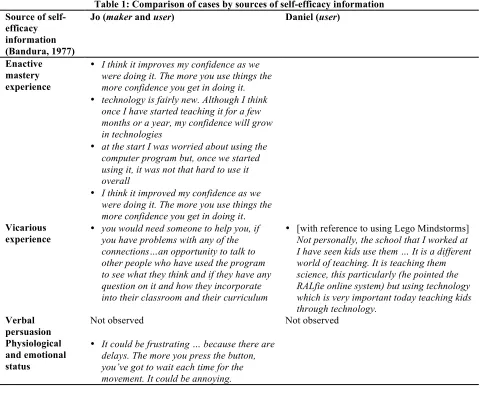
each case against the four sources of self-efficacy information. No examples of verbal persuasion were found. For the first case, Jo, there were examples for each of the other sources. For Daniel there was some indication of his self-efficacy being affected by vicarious experience, that is, seeing others engage successfully. In this case he had observed children in a school working with similar equipment but not with RALfie. The lack of apparent influence from the other sources was possibly attributable to his pre-existing high levels of confidence with technology.
Table 1: Comparison of cases by sources of self-efficacy information Source of
self-efficacy information (Bandura, 1977)
Jo (maker and user) Daniel (user)
Enactive mastery experience
• I think it improves my confidence as we were doing it. The more you use things the more confidence you get in doing it.
• technology is fairly new. Although I think once I have started teaching it for a few months or a year, my confidence will grow in technologies
• at the start I was worried about using the
computer program but, once we started using it, it was not that hard to use it overall
• I think it improved my confidence as we were doing it. The more you use things the more confidence you get in doing it.
Vicarious
experience • you would need someone to help you, if you have problems with any of the connections…an opportunity to talk to other people who have used the program to see what they think and if they have any question on it and how they incorporate into their classroom and their curriculum
• [with reference to using Lego Mindstorms]
Not personally, the school that I worked at I have seen kids use them … It is a different world of teaching. It is teaching them science, this particularly (he pointed the RALfie online system) but using technology which is very important today teaching kids through technology.
Verbal persuasion
Not observed Not observed
Physiological and emotional status
• It could be frustrating … because there are
delays. The more you press the button, you’ve got to wait each time for the movement. It could be annoying.
Discussion
Despite the lack of evidence that the user activities contributed to development of curriculum knowledge or self-efficacy for Daniel, most likely because he already had some knowledge and high self-self-efficacy, there is substantial evidence that the activities did have a positive effect on Jo’s knowledge and self-efficacy. However, it is worth noting that Jo commented on the value of experiencing the activities in both maker and user modes and on the desirability of having more time to “fiddle and build” in a playful learning mode. That is consistent with understanding of self-efficacy as developing through ongoing experiences of success with an activity (Bandura, 1977) and with Jo’s own comment that “the more you use things the more confidence you get in doing it.” Hence, the implication is that the RALfie activities should be developed to afford as many PSTs as possible the opportunity of working in both modes and allowing all students multiple opportunities to engage with RALfie activities over an extended period. Jo’s reference to “fiddle and build” is consistent with the emphasis in maker culture on tinkering (Martinez & Stager, 2013) and suggests that there is a need to encourage PSTs to take the “f for fun” in RALfie literally and approach the RALfie activities somewhat playfully.
Although Daniel thought that the RALfie activities were peripheral to the technologies curriculum, Jo did see connections. This difference may be related to their different stages in the teacher preparation program, Jo was in her final year and Daniel was just beginning, but it indicates a need to make more explicit links between the RALfie activities offered to PSTs and the Australian Curriculum: Technologies. The potential is there for links to the design and construction of experiments as makers and to the networked interaction as both makers and users. However, those links were not made explicit in the trial activities. The implication is that activities to be offered in the major project should be designed to have clear links to the curriculum and that those links should be made explicit to the PSTs as they are working with the activities.
The pilot project has been successful in demonstrating that engagement with RALfie activities has potential to develop PSTs’ knowledge of the technologies curriculum and to affect their self-efficacy for teaching technologies education through multiple sources of information. However, it has also highlighted issues related to individual differences among PSTs, the value of extended exposure to the RALfie activities for developing both knowledge and self-efficacy, and the need to make the relevance of the activities to the technologies curriculum explicit. Attention to those issues in preparation for the major project should increase its potential for success and thereby make a valuable contribution to the preparation of teachers for STEM education.
Acknowledgement
This research is supported through the Australian Government's Collaborative Research Networks (CRN) program.
References
ACARA. (2014). Australian Curriculum: Technologies. Canberra: Australian Curriculum, Assessment and Reporting Authority Retrieved from http://www.australiancurriculum.edu.au/technologies/rationale.
Albion, P. R., & Spence, K. G. (2013a). Catholic Education Office of Toowoomba Diocesan Science Education Strategy: Reporting success. Toowoomba, Australia: University of Southern Queensland.
Albion, P. R., & Spence, K. G. (2013b). Primary Connections in a Provincial Queensland School System: Relationships to Science Teaching Self-efficacy and Practices. International Journal of Environmental and Science Education, 8. doi: 10.12973/ijese.2013.215a
Australian Industry Group. (2013). Lifting our Science, Technology, Engineering and Maths (STEM) Skills. Melbourne: Australian Industry Group.
Bandura, A. (1977). Self-efficacy: Toward a unifying theory of behavioural change. Psychological Review, 84(2), 191-215. Crippen, K., Archambault, L., & Kern, C. (2013). The Nature of Laboratory Learning Experiences in Secondary Science Online.
Research in Science Education, 43(3), 1029-1050. doi: 10.1007/s11165-012-9301-6
Crippen, K. J., & Archambault, L. (2012). Scaffolded Inquiry-Based Instruction with Technology: A Signature Pedagogy for STEM Education. Computers in the Schools, 29(1-2), 157-173. doi: 10.1080/07380569.2012.658733
DETA. (2007). Towards a 10-year plan for science, technology, engineering and mathematics (STEM) education and skills in
Queensland. Brisbane: Queensland Government Retrieved from
http://education.qld.gov.au/projects/stemplan/docs/stem-discussion-paper.pdf.
Edelson, D. C., Gordin, D. N., & Pea, R. D. (1999). Addressing the challenges of inquiry-based learning through technology and curriculum design. Journal of the Learning Sciences, 8(3-4), 391-450.
Fensham, P. J. (2008). Science education policy-making : eleven emerging issues. Paris: UNESCO Retrieved from http://unesdoc.unesco.org/images/0015/001567/156700e.pdf.
Hackling, M. W., & Prain, V. (2005). Primary Connections - Stage 2 Trial: Research Report. Canberra: Australian Academy of Science.
Harward, V. J., Del Alamo, J. A., Lerman, S. R., Bailey, P. H., Carpenter, J., DeLong, K., et al. (2008). The iLab shared architecture: A Web Services infrastructure to build communities of Internet accessible laboratories. Proceedings of the IEEE, 96(6), 931-950.
Honey, M., & Kanter, D. E. (2013). Design, make, play: Growing the next generation of STEM Innovators: Routledge.
Lindsay, E. D. (2005). The impact of remote and virtual access to hardware upon the learning outcomes of undergraduate engineering laboratory classes. PhD, University of Melbourne, Melbourne.
Lowe, D., Newcombe, P., & Stumpers, B. (2013). Evaluation of the Use of Remote Laboratories for Secondary School Science Education. Research in Science Education, 43(3), 1197-1219. doi: 10.1007/s11165-012-9304-3
Maiti, A., Maxwell, A. D., & Kist, A. A. (2013). An overview of system architectures for remote laboratories Teaching, Assessment and Learning for Engineering (TALE), 2013 IEEE International Conference on Engineering Education (pp. 661-666): IEEE.
Martinez, S. L., & Stager, G. (2013). Invent to Learn: Making, Tinkering, and Engineering in the Classroom. Torrance, CA: Constructing Modern Knowledge Press.
Maxwell, A. D., Orwin, L., Kist, A. A., Maiti, A., Midgley, W., & Ting, W. (2013, 2013). An inverted remote laboratory-makers and gamers. Paper presented at the Proceedings of the 24th Annual Conference of the Australasian Association for Engineering Education (AaeE 2013), Toowoomba.
MCEETYA. (1989). The Hobart Declaration on Common and Agreed National Goals for Schooling in Australia, from http://www.mceecdya.edu.au/mceecdya/hobart_declaration,11577.html
Office of the Chief Scientist. (2013). Science, Technology, Engineering and Mathematics in the National Interest: A Strategic
Approach. Canberra: Australian Government Retrieved from
http://www.chiefscientist.gov.au/wp-content/uploads/STEMstrategy290713FINALweb.pdf.
Riggs, I. M., & Enochs, L. G. (1990). Toward the Development of an Elementary Teacher's Science Teaching Efficacy Belief Instrument. Science Education, 74(6), 625-637.
Shchetko, N. (2013). Obama calls for STEM-focused high schools in State of the Union. Retrieved from http://stemwire.org/2013/02/14/obama-calls-for-stem-focused-high-schools-in-state-of-the-union/
Skamp, K. (2008). Teaching primary science constructively (3rd edn): Thompson Learning.
Tawfik, M., Sancristobal, E., Martín, S., Gil, C., Pesquera, A., Losada, P., et al. (2011). VISIR deployment in undergraduate engineering practices Frontiers in Education Conference (FIE) (pp. T1A-1): IEEE.
Trevelyan, J. (2004). Lessons learned from 10 years experience with remote laboratories Proceedings of the iNEER International Conference on Engineering Education and Research “Progress through Partnership” (pp. 1562-3580). Olomouc and Bouzov Castle, Czech Republic.
Westerlund, J. F., Radcliffe, R. A., Smith, D. A., Lemke, M. R., & West, S. S. (2011). Profiles of U.S. science teacher candidates: Safeguards amidst the gathering storm. International Journal of Environmental and Science Education, 6(3), 213-227. Wyss, V. L., Heulskamp, D., & Siebert, C. J. (2012). Increasing middle school student interest in STEM careers with videos of