RESEARCH ARTICLE
10.1002/2017WR021780
Quantifying Surface Water, Porewater, and Groundwater
Interactions Using Tracers: Tracer Fluxes, Water Fluxes, and
End-member Concentrations
Peter G. Cook1,2 , Valentı Rodellas3 , and Thomas C. Stieglitz3,4
1National Centre for Groundwater Research and Training (NCGRT), School of the Environment, Flinders University,
Adelaide, SA, Australia,2Aix-Marseille Universite, IMeRA, Marseille, France,3CEREGE, Aix-Marseille Universite, CNRS, IRD, INRA, Coll France, CEREGE, Aix-en-Provence, France,4Centre for Tropical Water and Aquatic Ecosystem Research, James
Cook University, Townsville, QLD, Australia
Abstract
Tracer approaches to estimate bothporewater exchange(the cycling of water between surface water and sediments, with zero net water flux) andgroundwater inflow(the net flow of terrestrially derived groundwater into surface water) are commonly based on solute mass balances. However, this requires appropriate characterization of tracer end-member concentrations in exchanging or discharging water. Where either porewater exchange or groundwater inflow to surface water occur in isolation, then the water flux is easily estimated from the net tracer flux if the end-member is appropriately chosen. However, in most natural systems porewater exchange and groundwater inflow will occur concurrently. Our analysis shows that if groundwater inflow (Qg) and porewater exchange (Qp) mix completely before discharging to surface water, then the combined water flux (Qg1Qp) can be approximated by dividing the combined tracer flux by the difference between the porewater and surface water concentrations, (cp–c). IfQgandQp do not mix prior to discharge, then (Qg1Qp) can only be constrained by minimum and maximum values. The minimum value is obtained by dividing the net tracer flux by the groundwater concentration, and the maximum is obtained by dividing by (cp–c). Dividing by the groundwater concentration gives a maximum value forQg. If porewater exchange and groundwater outflow occur concurrently, then dividing the net tracer flux by (cp–c) will provide a minimum value forQp. Use of multiple tracers, and spatial and temporal replication should provide a more complete picture of exchange processes and the extent of subsurface mixing.1. Introduction
Interactions between surface water, porewater, and groundwater have been the focus of hydrological research for many decades. Flow of subsurface water into a river can be classified into (i) groundwater that discharges to the river having originally recharged the aquifer some distance from the river, and (ii) water that originated within the river itself and that entered the aquifer for a period of time before later returning to the river. The latter (usually referred to as hyporheic exchange) is important for a range of biogeochemi-cal processes and can exert an important influence on river water quality, while the former influences both river water quantity and quality (Boulton et al., 1998). Similarly, flow of subsurface waters to marine and coastal environments can be classified into (i) net discharge of terrestrially derived groundwater, which usu-ally has a relatively low salinity, and (ii) an exchange between surface water and subsurface porewaters without a net water flux in either direction, induced by wave and tidal processes (sometimes referred to as seawater recirculation; Santos et al., 2009, 2012). Similar processes also occur in freshwater lacustrine envi-ronments (e.g., Rosenberry et al., 2013; Taniguchi & Fukuo, 1996).
Quantifying the magnitudes of all of these interactions represents a major challenge. Environmental tracers are increasingly used for quantifying rates of seawater recirculation in estuarine, coastal, and marine envi-ronments (Cai et al., 2014; Santos et al., 2014; Rodellas et al., 2017), rates of hyporheic exchange in rivers (Bourke et al., 2014; Frei & Gilfedder, 2015), and net flows of terrestrial-derived groundwater to rivers, lakes, and to the ocean (Cook et al., 2006; Garcia-Solsona et al., 2010; Krabbenhoft et al., 1990). Seawater recircula-tion and hyporheic exchange fluxes usually are measured with radioactive tracers which are produced from Key Points:
Environmental tracer approaches to estimate surface water— groundwater exchange fluxes depend on appropriate characterization of end-members Extent of mixing of exchanging
porewater and groundwater prior to discharge will affect choice of end-members
Although absolute fluxes cannot always be determined, both porewater and groundwater fluxes can be constrained by tracer methods
Correspondence to: P. G. Cook,
peter.cook@flinders.edu.au
Citation:
Cook, P. G., Rodellas, V., & Stieglitz, T. C. (2018). Quantifying surface water, porewater, and groundwater interactions using tracers: Tracer fluxes, water fluxes, and end-member concentrations.Water Resources Research,54, 2452–2465. https://doi. org/10.1002/2017WR021780
Received 30 AUG 2017 Accepted 8 MAR 2018
Accepted article online 12 MAR 2018 Published online 30 MAR 2018
The copyright line for this article was changed on SEP 2018 after original online publication.
©2018. The Authors.
This is an open access article under the terms of the Creative Commons Attribution-NonCommercial-NoDerivs License, which permits use and distri-bution in any medium, provided the original work is properly cited, the use is non-commercial and no modifications or adaptations are made.
decay of parent isotopes within the geological matrix. For these tracers, concentrations within the subsur-face will always be higher than concentrations within sursubsur-face water, and so porewater exchange creates a net tracer flux into surface water, even though the net water flux is zero. The tracer flux is determined either from a surface water mass balance, or from porewater profiles. Both radon and radium have been used to estimate seawater recirculation and hyporheic exchange (Bourke et al., 2014; Cable & Martin, 2008; Cai et al., 2014; Lamontagne & Cook, 2007; Rodellas et al., 2017; Stieglitz et al., 2013). Numerous tracers have been used as part of surface water balances to calculate net groundwater inflows to surface water, including 2H,18O, helium, ion chemistry, and radioactive tracers (Cook et al., 2006; Krabbenhoft et al., 1990; Oxtobee &
Novakowski, 2002). Temperature has also been used for quantifying exchange fluxes (e.g., Loheide & Gorelick, 2006; Martin et al., 2006), but it is not discussed in this paper because the processes affecting sub-surface temperatures are very different to those affecting dissolved solutes.
Converting the tracer flux to a water flux requires dividing by the tracer end-member concentration. Charac-terization of the end-member concentration is thus a critical component of tracer-derived estimates of porewater and groundwater fluxes. Issues related to the selection of end-members for determining ground-water and poreground-water fluxes from tracer mass balances have received significant attention in the literature. However, most of these studies have examined the impact of uncertainty and temporal variation in end-members on estimates of groundwater inflow or porewater exchange (e.g., Cerda-Dome`nech et al., 2017; Genereux et al., 1993; Gonneea et al., 2013). None have considered how the existence of both porewater exchange and groundwater inflow affects the choice of members, and how the choice of end-members affects the estimated fluxes. Most previous studies have focused on the flux of interest (i.e., groundwater inflow, hyporheic exchange, or seawater recirculation), and either not explicitly considered a possible contribution from the other flux (e.g., Cook et al., 2003; Schmidt et al., 2009; Wu et al., 2004), or argued that the contribution of the other flux is small (e.g., Beck et al., 2007; Bourke et al., 2014; Trezzi et al., 2016). Other studies have claimed that their approach measures the combined porewater and groundwater flux, but without necessarily demonstrating that this is the case (e.g., Moore et al., 2008; Rodellas et al., 2017). Very few studies have explicitly evaluated both porewater and groundwater fluxes (Charette et al., 2013; Rodellas et al., 2017; Stieglitz et al., 2013). In this paper, issues related to the definition of appropriate end-member concentrations for estimating porewater exchange and groundwater fluxes using tracer approaches are explicitly examined with the aid of simple mixing models. Based on these simple models we provide advice on end-members that should be used for calculation of both groundwater and pore-water exchange fluxes.
2. Terminology
The terminology surrounding surface water—porewater exchange, seawater recirculation, hyporheic exchange, and groundwater discharge can be confusing, and also differs between the different disciplines which are involved in these studies (chiefly, marine and hydrologic communities) (Wilson et al., 2016). In this paper, we use the termporewater exchangeto refer to the cycling of water between surface water and sediments, with zero net water flux; this includes both seawater recirculation in coastal and marine environ-ments and hyporheic exchange in rivers. The termgroundwater inflowis used for the net discharge of ter-restrially derived groundwater into surface water, whilegroundwater outflowis used for surface water that enters the subsurface and does not subsequently flow back into the surface water. As we wish to discrimi-nate between porewater exchange and groundwater inflow, we deliberately avoid the term submarine groundwater discharge(SGD), which is often defined to include both porewater exchange and groundwater inflow (Burnett et al., 2003).
We also distinguish between two different groups of tracers. The first group (which we simply refer to as
3. Models of Groundwater, Porewater, and Surface Water Exchange
In river systems, porewater exchange is often conceptualized in terms of discrete zones of upwelling and downwelling, which can be relatively stable in time and space (Savant et al., 1987). According to this model, groundwater inflows will be concentrated immediately upstream and downstream of areas of porewater exchange (Cardenas & Wilson, 2007). A similar conceptualization can be applied in marine systems, where the driving forces of porewater exchange produce discrete and stable zones of upwelling and downwelling. If porewaters do not mix, but rather porewater exchange comprises flow paths with different lengths and subsurface residence times, then the porewater concentrations are likely to be highly spatially variable, depending on the travel time along the particular subsurface flow path. Considering all such flow paths, the net flux of a radiometric tracer into surface water (F; M L22T21) might be expressed
F5Qgcg1 X
tqpð Þt
c k2c
12e2kt
h i
; (1)
whereqp(t) is the flux of porewater having subsurface residence timet(L T21),Qgis the water flux due to groundwater inflow (L T21),cgis the groundwater inflow concentration (M L23),cis the tracer production rate in the subsurface (M L23 T21), kis the decay rate (T21), and cis the surface water concentration (M L23). The term in square brackets is the difference between the concentration entering at the start of a surface water flow path (c), and the concentration that ultimately discharges back into the surface water
c k2
c k2c
e2kt
, and the summation is across all such porewater exchange flow paths. FluxesQgandqp(t) are calculated as average values across the system, and so they are already normalized by their respective contributing areas. (Although porewater fluxes occur in both directions, values ofqp(t) in (1) are positive.) However, if only the tracer flux,F, is measured, then estimation of the water flux from this tracer flux would require a much more detailed understanding of the discharge patterns than is usually available, and/or extensive sampling over the discharge area. Simply dividingFbycgwill overestimate the groundwater flux (Qg) and neglect the contribution of porewater exchange (qp).
Equation (1) assumes that groundwater and porewater exchange flow paths do not mix and can be discretely sampled. In reality, some degree of mixing will occur due to hydrodynamic dispersion, and this will be enhanced if the locations of upwelling and downwelling zones change through time. Some degree of mixing will also be created by the process of sampling. In the following sections, we examine four scenarios: the first where only groundwater inflow occurs (Figure 1a), and the second where only porewater exchange occurs (Figure 1b), but porewater is completely mixed. The third scenario is where both porewater exchange and groundwater inflow occur and porewater exchange is completely mixed, but does not mix with discharging groundwater (Figure 1c). The fourth scenario is where groundwater and porewater mix in the subsurface, before discharging to the surface water (Figure 1d). Derivations supporting our analysis are presented in Appendix A. In each case, we use a simple conceptualization of water exchange between the surface water and a subsurface layer of con-stant thickness that is well-mixed, and thus assume complete mixing of porewater exchange flow paths. Similar models have been previously used in studies of porewater exchange in rivers and coastal lakes (Bourke et al., 2014; Cook et al., 2006; Morrice et al., 1997; Stieglitz et al., 2013). Although this model does not represent the complexity of porewater exchange processes, it is useful for demonstrating a number of issues. Many of these issues would remain with more complex conceptualizations. Although we are primarily interested in quantifying groundwater and porewater inflows, how groundwater outflow from surface water affects end-member concen-trations is also discussed. Some of the issues related to end-member determination for models (a) and (b) have been discussed in previous studies, but are briefly discussed here in the interests of completeness.
3.1. Groundwater Inflow Without Porewater Exchange
We initially suppose that groundwater flow represents the only source of tracer flux to surface water from sediments. If the advective flux of groundwater dominates the diffusive flux (or if the diffusive flux is sepa-rately quantified, and subtracted from the tracer flux), then the groundwater flux can be determined by dividing the tracer flux by the tracer concentration in discharging groundwater:
Qg5
F cg
: (2)
2013; McCallum et al., 2012; Tovar-Sanchez et al., 2014) or measuring the tracer concentration in groundwater actually discharging to sur-face water, usually through seepage meters or springs (Cook et al, 2003; Moore, 2006; Stieglitz et al., 2013). In the case of radiometric tracers, it is also possible to perform sediment equilibration experi-ments to estimate the tracer concentration in equilibrium with sedi-ments (Burnett & Dulaiova, 2003; Dimova et al., 2013). Since available piezometers are often located tens of meters or more from the surface water, sampling these to determine end-members requires that the tracer concentration is representative of discharging groundwaters (i.e., no further tracer additions or removals). This can be problematic for short-lived radioactive tracers (e.g., Rn, 224Ra, and223Ra), as the concentration of groundwater inflow will reflect the composition of the sediments that the water is exposed to a few days prior to dis-charging to surface waters (Schmidt et al., 2009). Measurement of end-member concentrations distant from the surface water can also be problematic for ionic tracers if other processes (e.g., evapotranspi-ration by riparian vegetation) result in concentevapotranspi-ration changes between the sampling point and the point of groundwater inflow.
Representativeness of end-member concentrations is another issue that needs careful consideration, and several studies have found large spatial variability in groundwater end-member concentrations, which can contribute to a large uncertainty in water fluxes (see summary in Cook, 2013). Groundwater inflow rates can also be highly spatially var-iable (Cey et al., 1998; Kennedy et al., 2009). Where both groundwater inflow rate and concentration vary, then the end-member concentra-tion used in equaconcentra-tion (2) should be the flux weighted mean ground-water concentration. This is difficult to determine without detailed spatial mapping of groundwater inflow rate and inflow concentration.
3.2. Porewater Exchange Without Net Groundwater Inflow or Outflow
We now suppose that porewater exchange is the only process whereby surface water and subsurface water exchange. In the case of conserva-tive tracers, the concentration within the subsurface will simply be equal to the surface water concentration, and there will be no net tracer flux, thus preventing the application of these tracers to estimate porewater exchange. For radiometric tracers, porewater exchange will result in a net tracer flux, as concentrations of these tracers in pore-water should exceed those in surface pore-water. In this case, the pore-water flux is obtained by dividing the tracer flux by the end-member concentra-tion. In fact, since we usually measure a net tracer flux, then the water flux is obtained by dividing by the difference in tracer concentration between the porewater and the overlying surface water:
Qp5
F cp2c
; (3)
whereF(M L22T21) is the net tracer flux,Q
p(L T21) is the total pore-water flux (which occurs in both directions), and cp (M L23) is the porewater tracer concentration. The problem arises becausecpis not a constant, as it depends on the residence time of porewater within the sediments (i.e.,cpwill be a function ofQp). This implies that the water flux is not proportional to the tracer flux. Four different approaches have been used for estimatingcp:
1. Assumingcpis equal to the concentration in ambient groundwater (e.g., Burnett & Dimova, 2012; Stieg-litz et al., 2013; Tait et al., 2017).
2. Performing sediment equilibration experiments for radiometric tracers, and assuming that the tracer con-centration in equilibrium with sediments equalscp(e.g., Baudron et al., 2015).
3. Directly measuring the tracer concentration in porewater, usually within a meter of the sediment-water interface (e.g., Cable & Martin, 2008; Garcia-Orellana et al., 2014; Lamontagne & Cook, 2007; Rodellas et al., 2017). Where porewater concentration profiles are obtained, then it is common to use the shallow-est measured porewater concentration, usually at 0.1–0.2 m depth (e.g., Cable & Martin, 2008; Martin et al., 2007).
4. Using seepage meters to collect samples of porewater that is actually flowing into the surface water (Michael et al., 2011).
It is clear that the concentration of porewater that is discharging to the surface water (cp) is the concentration immediately below the sediment-water interface, and this concentration should be used in equation (2). Approaches (1) and (2) are not appropriate for short timescale recirculation processes as groundwater will have a different chemical signature to porewater, and accumulation and decay rates of radiometric tracers are unlikely to be in equilibrium within the porewater. The use of seepage meters allows direct measurement of the tracer concentration in exchanging porewater, but their installation may alter fluxes across the sediment-water interface, and thus also the tracer concentration (Smith et al., 2009).
Porewater profiles for radiometric tracers inevitably display tracer concentrations that increase with depth, with the greatest gradients occurring at the shallowest depths. Cook et al. (2018) showed that the depth at which porewater end-member concentration should be measured depended upon the chosen hydrody-namic dispersivity. Hydrodyhydrody-namic dispersivity is a modeling parameter used to describe the scale length of mixing due to subsurface heterogeneity, and has been shown to increase with the scale of observation. For solute transport over a distance of 0.5–1.0 m (the typical depth of porewater profiles), the hydrodynamic dispersivity is approximately 0.005 m (Gelhar et al., 1992), which implies that the end-member concentra-tion needs to be measured within 0.01 m of the sediment surface (the depth is twice the hydrodynamic dis-persivity; Shanahan & Harleman, 1984). Collecting porewater at such shallow depths is possible, but the volume of water that can be reliably sampled is very small (Harvey & Fuller, 1998; Harvey et al., 2013) which can complicate analysis of some of the radiometric tracers. In the example presented by Cook et al. (2018), if the concentration at 0.05–0.1 m was used in equation (3) rather than that at 0.01 m, then the water flux would be underestimated by a factor of between 4 and 10.
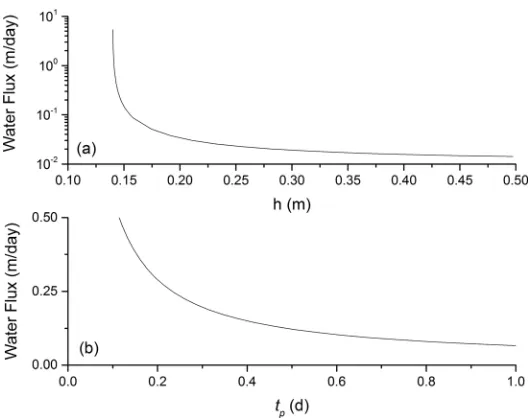
Rather than directly measuring the end-member concentration, it is also possible to relate the tracer flux to the water flux by assuming either a value for the mean residence time of the porewater (tp) or the volume of the mixing zone, hh(e.g., Cook et al., 2006; Stieglitz et al., 2013; Webster et al., 1994). If porewater exchange is driven by tidal pro-cesses, for example, then a mean value fortpcan perhaps be estimated and used to estimate the water flux (Webster et al., 1994). However, for other driving forces, such as wave action or river flows, the residence time would need to be independently determined.his similarly difficult to constrain and small errors in estimation ofhcan result in very large errors in the water flux (Figure 2). Without independent measurement of cp, it may only be possible to define a minimum value forQp(the actual flux will be equal to this minimum value when the porewater res-idence time is long; equation (A5) in Appendix A). This also allows cal-culation of a minimum value for the volume of the mixing zone (from rearrangement of equation (A3); Bourke et al., 2014).
3.3. Porewater Exchange and Groundwater Inflow/Outflow as Discrete Pathways
[image:5.630.45.309.472.681.2]If porewater exchange and groundwater inflow occur as discrete path-ways, then the relationship between tracer flux and water flux will
depend on whether the tracer flux is measured for the entire surface water system (e.g., using a tracer mass balance), or at a point (e.g., using porewater profiles). If the tracer flux is measured based on a surface water balance, then the total net tracer flux is equal to
F5Qgcg1Qp cp2c
: (4)
In this case, estimation of the water flux is difficult. For radiometric tracers, dividing the tracer flux by (cp–c) will overestimate the total water flux (Qg1Qp), whereas dividing bycgwill underestimate the total water flux, as usually (cp–c)<cg. Notice also that if porewater exchange occurs but all the tracer flux is incorrectly assumed to be driven by groundwater inflows, dividingFbycgwill overestimate the groundwater flux (Qg). For conservative tracers, dividing the tracer flux bycgwill provide an exact estimate of the groundwater flux (see equations (A6)–(A11), in Appendix A). If groundwater outflow occurs, then the net tracer flux is
F5Qp cp2c
2Qlc; (5)
whereQlis the groundwater outflow (L T
21
), and so dividing the total net tracer flux by (cp–c) will underes-timate the porewater flux,Qp(equations A12, A13).
When the tracer flux is measured using porewater profiles, the estimated flux will only capture the mecha-nism (i.e., porewater exchange or groundwater inflow) occurring at that given point. The water fluxes at each given point will be estimated by dividing by porewater or groundwater concentrations (in the pore-water exchange and groundpore-water inflow zones, respectively), as described in sections 3.1 and 3.2. An esti-mation of the total water flux will thus require including sites that cover all the mechanisms and an appropriate estimation of the relative areas of porewater exchange and groundwater inflow and/or outflow zones.
3.4. Porewater Exchange and Groundwater Inflow Mix Prior to Discharge
If groundwater inflow mixes with exchanging porewater before entering surface water, then this mixing will influence the concentration at the sediment-water interface. The mass balance of the mixing zone can be expressed
Qpc1Qgcg1chh5Qpcp1Qgcp1khhcp; (6)
whereh (L) is the depth of the subsurface mixing zone, cis the production rate within the subsurface (M T21L23),kis the radioactive decay rate (T21),his the subsurface porosity, and other parameters are as previously defined (Figure 1d). The net tracer flux into the surface water is
F5Qgcp1Qp cp2c
: (7)
Dividing by(cp– c)and substituting forcpusing (6) and rearranging then gives
F cp2c
2khh
E
E
E11Qp1Qg
F cp2c
; (8)
whereE5cg
c21 (see equations (A15)–(A20) in Appendix A). Thus, for large values of cg
c (and hence also ofE), the total water flux can be approximated by dividing the net tracer flux by(cp– c). Although this approxima-tion will overestimate the total water flux, the degree of overestimaapproxima-tion will be small (notice that these over-estimates will be less than if porewater and groundwater inflow do not mix prior to discharging to surface water; compare equations (A8) and (A17).) Of course, ifcpc, then dividing the tracer flux bycprather than(cp– c)also provides a reasonable approximation of the water flux. DividingFbycgwill overestimate
the Appendix A).The approaches described above for estimating water fluxes thus apply for conservative as well as radiometric tracers. If groundwater outflow occurs rather than groundwater inflow, dividing the total flux by(cp– c)will underestimateQp, and the degree of underestimation can potentially be large (see equa-tions (A24)–(A26)).
3.5. Comparison Between Porewater Mixing and Flow Path Models
If porewater exchange occurs along discrete flow paths that do not mix, thencpwill be highly spatially vari-able, reflecting differences in subsurface residence times of the flow paths. In the case of a single flow path, the subsurface travel time is given by (A4), and so the concentration at the discharge point will be
c0p5c
k2 c k2c
e2hQphk: (9)
In contrast, for the porewater mixing model (Figure 1b), the concentration of porewater is related to model parameters by
cp5
Qpc1chh
Qp1khh
; (10)
(see A1 in Appendix A for derivation). Minimum and maximum values of the ratio ofcptoc0pare difficult to evaluate analytically, but it can be numerically shown thatcp/c0plies between 0.75 and 1.0. Since the pore-water flux is proportional to(cp– c), the difference between calculated tracer fluxes from the two conceptu-alizations will be less than 25%, irrespective of the number of flow paths. However, this assumes that the value ofcpused by the mixing model is the mean (flux-weighted) concentration in porewater discharge. Clearly, collection of numerous samples to estimate the variability of porewater concentrations is recom-mended. Ultimately, this is likely to prove to be one of the limitations of the tracer approach.
4. Discussion
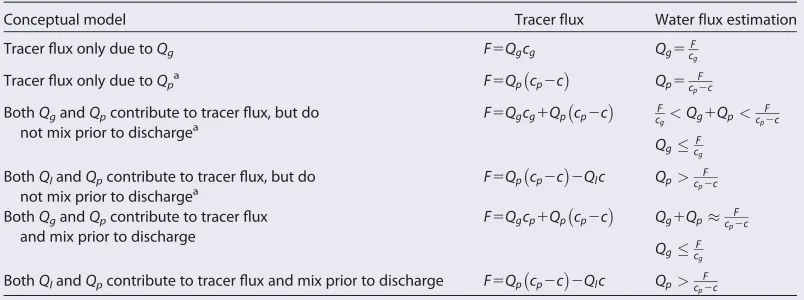
[image:7.630.183.585.589.739.2]Where either porewater exchange or groundwater inflow to surface water occur in isolation, then the water flux is easily estimated by dividing the net tracer flux by an appropriately chosen end-member concentra-tion. In the case of porewater exchange, this means measuring the tracer concentration within a few centi-meters of the surface water-porewater interface. In the case of groundwater inflow, it means measuring the tracer concentration in samples representative of groundwater actually discharging to the system (i.e., after the tracer has undergone all geochemical transformations). However, when both porewater exchange and groundwater inflow occur, absolute estimation of fluxes is more difficult (Table 1). Dividing the net tracer flux by the difference between the porewater and surface water concentration (cp–c) will provide a maxi-mum value for the combined flux (Qp1Qg) (assuming that the tracer concentration in groundwater is higher than in porewater fluids, as is commonly the case). Dividing the net tracer flux by the groundwater
Table 1
Methods for Determination of Water Fluxes for Different Conceptual Models
Conceptual model Tracer flux Water flux estimation
Tracer flux only due toQg F5Qgcg Qg5cFg
Tracer flux only due toQpa F5Qp cp2c
Qp5cpF2c
BothQgandQpcontribute to tracer flux, but do not mix prior to dischargea
F5Qgcg1Qp cp2c F
cg<Qg1Qp< F cp2c
QgcFg
BothQlandQpcontribute to tracer flux, but do not mix prior to dischargea
F5Qp cp2c
2Qlc Qp>cpF2c
BothQgandQpcontribute to tracer flux and mix prior to discharge
F5Qgcp1Qp cp2c
Qg1QpcpF2c
QgcFg
BothQlandQpcontribute to tracer flux and mix prior to discharge F5Qp cp2c
2Qlc Qp>cpF2c
a
concentration will provide a maximum value for the groundwater flux (Qg). In both cases, the maximum value will be closer to the actual flux, if porewater exchange and groundwater inflow completely mix prior to discharge. If porewater exchange and groundwater outflow occur concurrently, then dividing the net tracer flux by (cp–c) will provide a minimum value forQp, which will be closer to the true value if porewater exchange and groundwater outflow occur as discrete processes and do not mix in the subsurface.
In most natural systems, both porewater exchange and groundwater exchange will occur, and estimation of exchange fluxes is considerably simplified if ancillary data can indicate that one of these contributions is small and can be neglected. Thus, some previous studies have argued that porewater exchange is negligi-ble in comparison with groundwater inputs, based on low permeability of ocean or lake sediments, and thus assumed that the tracer flux is entirely due to groundwater inflow (e.g., Beck et al., 2007). Bourke et al. (2014) demonstrated the absence of groundwater inflow to a river based on comparison of groundwater and river levels, and hence used radon concentrations to estimate the porewater exchange flux. Some authors have argued that because radium sorbs to aquifer material at low salinities, it will not be influenced by inflow of entirely fresh groundwater and so in marine environments it is most sensitive to porewater exchange (e.g., Tait et al., 2017). Although this might be the case if fresh groundwater and porewater exchange represent discrete pathways (Figure 1c), it may be problematic where groundwater mixes with porewater exchange before discharging to surface water (Figure 1d). For most marine environments, groundwater discharges to the sea as brackish water (even in karstic springs; e.g., Garcia-Solsona et al., 2010) and thus concentrations of radium in groundwater (and thus groundwater fluxes) are not negligible (Rodellas et al., 2015; Cho & Kim, 2016). Our analysis does not consider the implications of mixing of water masses on radium sorption and desorption. If porewater exchange and groundwater have different salin-ities and mix in the subsurface prior to entering the surface water, then the relationship between radium flux and water flux becomes more complex, and the simple relationships developed in this paper cannot be applied. The effect of salinity on radium sorption remains a major unresolved issue in the many studies using radium as a tracer for these exchange processes.
A number of coastal zone studies acknowledge that porewater exchange and groundwater flows are not easily discriminated, and thus define the termsubmarine groundwater discharge(SGD) to comprise both sources (Burnett et al., 2003). However, to estimate this combined flux, they often divide the tracer flux by the groundwater concentration (e.g., McCoy et al., 2007; Swarzenski et al., 2007). Because the tracer concen-tration in porewater exchange usually will be much lower than the groundwater concenconcen-tration, this approach will generally greatly underestimate the total subsurface water flux. As shown here, if the tracer flux is divided by (cp–c), then the combined flux will be overestimated, and the degree of overestimation will depend upon the extent of subsurface mixing between groundwater inflow and porewater exchange and the difference betweencpandcg.
A possible approach for discriminating between porewater and groundwater fluxes is based on either tem-poral or spatial variations of fluxes. Yu et al. (2013) assumed that the tracer flux due to porewater exchange is constant along a river, but that groundwater inflow varies spatially. They then assume that the smallest tracer flux along the river is equal to the tracer flux from porewater exchange, and that higher tracer fluxes in other river reaches must be due to groundwater inflow. Similarly, if groundwater inflow is constant in time and porewater exchange varies (perhaps due to variations in wind speed, in the case of a lake or estu-ary), then it might be possible to discriminate between porewater and groundwater fluxes based on tempo-ral variation in the total flux. Others have tried to combine different tracers to differentiate porewater and groundwater fluxes (e.g., Colbert & Hammond, 2008; Stieglitz et al., 2013; Rodellas et al., 2017). The combi-nation of radon and a conservative tracer such as chloride would appear to have potential, particularly in riverine settings.
occurring in the subsurface, and reaction rates can vary over small spatial scales (Santos et al., 2008; Slomp & Van Cappellen, 2004). Some studies have directly used the concentration in groundwater (e.g., measured from coastal wells) as the nutrient end-member (e.g., McCutchan et al., 2003; Tait et al., 2017). This will over-estimate the mean nutrient concentration in total water exchange (and thus the nutrient flux to surface water) if the nutrient concentration in fresh groundwater is greater than in recirculated porewater (e.g., Weinstein et al., 2011). Even when porewater concentrations are used, such samples are usually collected from between 0.2 and 1 m depth (Charette, 2007; Santos et al., 2008; Rodellas et al., 2014), and so the nutri-ent concnutri-entration in exchanging porewater may still be in error, due to the potnutri-ential for biogeochemical transformations at shallower depths (Kennedy et al., 2009). If porewater and groundwater mix prior to dis-charge, then a better approach is to measure the nutrient concentration in very shallow porewater samples or from seepage meters (e.g., Gilmore et al., 2016). This should represent nutrient concentrations discharged after all biogeochemical processes have occurred, and also integrate the relative importance of porewater and groundwater sources. Of course, the concentration of nutrients in seawater needs to be subtracted from the porewater concentration, to determine the net nutrient flux.
Although the mixing models presented in this paper are idealized, they nevertheless are useful for demon-strating some of the complexities of estimating surface water-groundwater exchanges. Whether or not porewater and groundwater mix prior to discharge will depend on the nature of the surface water— groundwater system. The existence of discrete pathways for groundwater inflow is more likely in karstic or fractured rock systems. However, even in the absence of such geological heterogeneities, groundwater inflow to lakes and coastal waters tends to concentrate near the shoreline (Bokuniewicz, 2001; Genereux & Bandopadhyay, 2001; Pfannkuch & Winter, 1984), and so some separation between areas dominated by groundwater inflow and those dominated by porewater exchange will often occur (Michael et al., 2011). Mixing between groundwater inflow and porewater exchange is more likely when porewater exchange is driven by changes in surface water level (e.g., driven by tides, seiches, and wave action; Rosenberry et al., 2013) than under conditions of stable surface water level and stable bed forms, when zones of upwelling and downwelling are also likely to be stable (e.g., Savant et al., 1987). However, neither the flow path nor complete mixing model are likely to occur in reality, and the true situation probably lies somewhere in between these extremes. One of the key limitations of both of these models is that they assume that both groundwater inflow and porewater exchange are constant in time, which is not commonly the case. In river systems, changes in surface water levels give rise to bank storage exchange fluxes, which can be directed either towards or away from the river. Similarly, temporal changes in water levels in lakes and lagoons can be introduced by winds and tidal processes. The time of sampling can thus influence the exchange flux that is calculated, and sampling at different times is recommended in these systems.
5. Conclusions
Groundwater inflow and porewater exchange between surface water and underlying sediments can be esti-mated from tracer mass balances, although determining water fluxes from tracer fluxes requires careful selection of tracer member concentrations. The most appropriate method for determining these end-members will depend upon both the nature of the tracers and the nature of water exchange. If both pore-water exchange and groundpore-water inflow occur, and mix prior to discharge, then the total pore-water flux (pore-water exchange plus ground(pore-water inflow) usually can be approximated by dividing the tracer flux by the difference between the porewater and surface water concentration. If porewater exchange and groundwa-ter inflow occur without mixing prior to discharge then the total wagroundwa-ter flux can only be constrained by mini-mum and maximini-mum values. In both cases, maximini-mum estimates ofQgcan also be separately determined. If river loss mixes with porewater prior to discharge, the minimum values ofQpcan be derived. Use of multi-ple tracers, and spatial and temporal replication should provide a more commulti-plete picture of exchange processes.
Appendix A
A1. Mixing Model for Porewater Exchange Without Groundwater Inflow or Outflow
Qpc1chh5Qpcp1khhcp; (A1)
whereQp(L T21) is the water flux (both into and out of the subsurface);cpandc(M L23) are the tracer con-centrations within the subsurface and within the surface water, respectively;h(L) is the depth of the subsur-face mixing zone;cis the production rate within the subsurface (M T21L23);kis the radioactive decay rate (T21); andhis the subsurface porosity. The left-hand side of equation (A1) represents the addition of tracer to the subsurface and the right-hand side represents the losses, which must balance the inputs at steady state. The net tracer flux (F; M L22T21) from the subsurface into the surface water is then
F5Qp cp2c
: (A2)
We can calculate the relationship between water flux and tracer flux by solving (A1) and (A2) simultaneously (by elimination ofcp).
F5Qp
chh2khhc Qp1khh
(A3)
Thus, if we know the residence time of porewater (tp), then we can use the relationship between mean resi-dence time andQp:
tp5
hh
Qp
; (A4)
to develop a relationship betweenF,Qp, andtp:
F5Qp
c2kc t21
p 1k !
: (A5)
Notice that for conservative tracersc5k50 and socp5c, implying that there is no net tracer flux (F50).
A2. Porewater Exchange and Groundwater Inflow as Discrete Pathways
Suppose that porewater exchange and groundwater inflow occur as discrete pathways, but porewater is internally well-mixed. The mass balance of the porewater mixing zone is simply given by (A1). The net tracer flux into the surface water is
F5Qp cp2c
1Qgcg (A6)
and so
F cp2c
5Qp1Qg
cg
cp2c
: (A7)
Since the residence time of groundwater in the subsurface is long, radiometric tracers with short half-lives will usually be at secular equilibrium, so thatcg5c/k. Substituting forcpusing (A1) and forcusingc5kcg then gives
F cp2c
5Qp1Qg
cg
cg2c
Qp1khh
khh
>Qp1Qg: (A8)
Similarly
F cg
5Qg1Qp
cp2c
cg
(A9)
and thus,
F cg
5Qg1Qp
khh
Qp1khh
cg2c
cg
; (A10)
so
Qg
F cg
<Qg1Qp: (A11)
A3. Porewater Exchange and Groundwater Outflow as Discrete Pathways
Suppose that porewater exchange and groundwater outflow occur as discrete pathways, but porewater is internally well-mixed. The mass balance of the porewater mixing zone is given by (A1). The net tracer flux into the surface water is
F5Qp cp2c
2Qlc; (A12)
whereQl(L T21) is the rate of groundwater outflow. Thus,
F cp2c
5Qp2Ql
c cp2c
<Qp: (A13)
A4. Porewater Exchange Mixes With Groundwater Inflow
If both porewater exchange and groundwater inflow mix before discharging to surface water, then the mass balance of the mixing zone can be expressed
Qpc1Qgcg1chh5Qpcp1Qgcp1khhcp: (A14)
The net tracer flux into the surface water is
F5Qp cp2c
1Qgcp (A15)
and so
F cp2c
5Qp1Qg
cp
cp2c
: (A16)
Substituting forcpusing (A14) and recognizing thatc5cgkgives
F cp2c
5Qp1Qg
cg
cg2c
Qpccg1Qg1khh
Qg1khh
Qp1Qg: (A17)
We can also rewrite (A17) as
F cp2c
5 Qp1Qg
11 Qgc
Qgcg2c1chh2khhc !
1 khhQgc
Qgcg2c1chh2khhc
: (A18)
Thus (assumingc>kc), we get
Qp1Qg
F cp2c
Qp1Qg
111
E
1khh
E (A19)
and so
F cp2c
2khh
E
E
E11Qp1Qg
F cp2c
: (A20)
whereE5cg
c21:Thus for large values of cg
c(and hence also ofE),Qp1Qgis reasonably well constrained. DividingFbycggives
F cg
5Qp
cp2c
cg
1Qg
cp
cg
: (A21)
Substituting forcpusing (A14) and usingc5cgkthen gives
F cg
5Qg1Qp
khh
Qp1Qg1khh
cg2c
cg
(A22)
Qg
F cg
<Qg1Qp: (A23)
A5. Porewater Exchange Mixes With Groundwater Outflow
If a net groundwater flow occurs from the surface water to the groundwater, and porewater exchange and groundwater outflow completely mix within the porewater zone, then the mass balance of the mixing zone can be expressed
Qpc1Qlc1chh5Qpcp1Qlcp1khhcp; (A24)
whereQl(L T21) is the rate of groundwater outflow. The net tracer flux into the surface water is
F5Qpcp2c2Qlc (A25)
and so,
F cp2c
5Qp2Ql
c cp2c
5Qp2Ql
c cg2c
Qp1Ql1khh
khh
<Qp: (A26)
References
Baudron, P., Cockenpot, S., Lopez-Castejon, F., Radakovitch, O., Gilabert, J., Mayer, A., et al. (2015). Combining radon, short-lived radium iso-topes and hydrodynamic modeling to assess submarine groundwater discharge from an anthropized semiarid watershed to a Mediter-ranean lagoon (Mar Menor, SE Spain).Journal of Hydrology,525, 55–71. https://doi.org/10.1016/j.jhydrol.2015.03.015
Beck, A. J., Rapaglia, J. P., Cochran, J. K., & Bokuniewicz, H. J. (2007). Radium mass-balance in Jamaica Bay, NY: Evidence for a substantial flux of submarine groundwater.Marine Chemistry,106(3–4), 419–441. https://doi.org/10.1016/j.marchem.2007.03.008
Bokuniewicz, H. (2001). Toward a coastal ground-water typology.Journal of Sea Research,46(2), 99–108. https://doi.org/10.1016/S1385-1101(01)00074-0
Boulton, A. J., Findlay, S., Marmonier, P., Stanley, E. H., & Valett, H. M. (1998). The functional significance of the hyporheic zone in streams and rivers.Annual Review of Ecology and Systematics,29, 59–81.
Bourke, S. A., Cook, P. G., Shanafield, M., Dogramaci, S., & Clark, J. F. (2014). Characterisation of hyporheic exchange in a losing stream using radon-222.Journal of Hydrology,519, 94–105. https://doi.org/10.1016/j.jhydrol.2014.06.057
Burnett, W. C., Bokuniewicz, H., Huettel, M., Moore, W. S., & Taniguchi, M. (2003). Groundwater and pore water inputs to the coastal zone. Biogeochemistry,66(1/2), 3–33. https://doi.org/10.1023/B:BIOG.0000006066.21240.53
Burnett, W. C., & Dimova, N. (2012). A radon-based mass balance model for assessing groundwater inflows to lakes. In M. Taniguchi & T. Shiraiwa (Eds.),The dilemma of boundaries(pp. 55–66). Tokyo, Japan: Springer.
Burnett, W. C., & Dulaiova, H. (2003). Estimating the dynamics of groundwater input into the coastal zone via continuous radon-222 meas-urements.Journal of Environmental Radioactivity,69(1–2), 21–35. https://doi.org/10.1016/S0265-931X(03)00084-5
Cable, J. E., & Martin, J. B. (2008). In situ evaluation of nearshore marine and fresh pore water transport into Flamengo Bay, Brazil.Estuarine, Coastal and Shelf Science,76(3), 473–483. https://doi.org/10.1016/j.ecss.2007.07.045
Cai, P., Shi, X., Moore, W. S., Peng, S., Wang, G., & Dai, M. (2014). 224Ra:228Th disequilibrium in coastal sediments: Implications for solute transfer across the sediment–water interface.Geochimica et Cosmochimica Acta,125, 68–84. https://doi.org/10.1016/j.gca.2013.09.029 Cardenas, M. B., & Wilson, J. L. (2007). Exchange across a sediment-water interface with ambient groundwater discharge.Journal of
Hydrol-ogy,346, 69–80.
Cartwright, I., Hofmann, H., Sirianos, M. A., Weaver, T. R., & Simmons, C. T. (2011). Geochemical and 222Rn constraints on baseflow to the Murray River, Australia, and timescales for the decay of low-salinity groundwater lenses.Journal of Hydrology,405(3–4), 333–343. https://doi.org/10.1016/j.jhydrol.2011.05.030
Cerda-Dome`nech, M., Rodellas, V., Folch, A., & Garcia-Orellana, J. (2017). Constraining the temporal variations of Ra isotopes and Rn in the groundwater end-member: Implications for derived SGD estimates.Science of the Total Environment,595, 849–857. https://doi.org/10. 1016/j.scitotenv.2017.03.005
Cey, E. E., Rudolph, D. L., Parkin, G. W., & Aravena, R. (1998). Quantifying groundwater discharge to a small perennial stream in southern Ontario, Canada.Journal of Hydrology,210(1–4), 21–37. https://doi.org/10.1016/S0022-1694(98)00172-3
Charette, M. A. (2007). Hydrologic forcing of submarine groundwater discharge: Insight from a seasonal study of radium isotopes in a groundwater-dominated salt marsh estuary.Limnology and Oceanography: Methods,52(1), 230–239.
Charette, M. A., & Buesseler, K. O. (2004). Submarine groundwater discharge of nutrients and copper to an urban subestuary of Chesapeake Bay (Elizabeth River).Limnology and Oceanography: Methods,49(2), 376–385.
Charette, M. A., Henderson, P. B., Breier, C. F., & Liu, Q. (2013). Submarine groundwater discharge in a river-dominated Florida estuary. Marine Chemistry,156, 3–17. https://doi.org/10.1016/j.marchem.2013.04.001
Cho, H.-M., & Kim, G. (2016). Determining groundwater Ra end-member values for the estimation of the magnitude of submarine ground-water discharge using Ra isotope tracers.Geophysical Research Letters,43, 3865–3871. https://doi.org/10.1002/2016GL068805 Colbert, S. L., & Hammond, D. E. (2008). Shoreline and seafloor fluxes of water and short-lived Ra isotopes to surface water of San Pedro
Bay, CA.Marine Chemistry,108(1–2), 1–17. https://doi.org/10.1016/j.marchem.2007.09.004
Cook, P. G. (2013). Estimating groundwater discharge to rivers from river chemistry surveys.Hydrological Processes,27(25), 3694–3707. https://doi.org/10.1002/hyp.9493
Cook, P. G., Favreau, G., Dighton, J. C., & Tickell, S. (2003). Determining natural groundwater influx to a tropical river using radon, chloro-fluorocarbons and ionic environmental tracers.Journal of Hydrology,277(1–2), 74–88. https://doi.org/10.1016/S0022-1694(03)00087-8 Cook, P. G., Lamontagne, S., Berhane, D., & Clark, J. F. (2006). Quantifying groundwater discharge to Cockburn River, southeastern Australia,
using dissolved gas tracers 222 Rn and SF 6.Water Resources Research,42, W10411. https://doi.org/10.1029/2006WR004921 Acknowledgments
Cook, P. G., Rodellas, V., Andrisoa, A., & Stieglitz, T. C. (2018). Exchange across the sediment-water interface quantified from porewater tracer profiles.Journal of Hydrology, https://doi.org/10.1016/j.jhydrol.2018.02.070, in press.
Dimova, N. T., Burnett, W. C., Chanton, J. P., & Corbett, J. E. (2013). Application of radon-222 to investigate groundwater discharge into small shallow lakes.Journal of Hydrology,486, 112–122. https://doi.org/10.1016/j.jhydrol.2013.01.043
Frei, S., & Gilfedder, B. S. (2015). FINIFLUX: An implicit finite element model for quantification of groundwater fluxes and hyporheic exchange in streams and rivers using radon.Water Resources Research,51, 6776–6786. https://doi.org/10.1002/2015WR017212 Garcia-Orellana, J., Cochran, J. K., Bokuniewicz, H., Daniel, J. W. R., Rodellas, V., & Heilbrun, C. (2014). Evaluation of224Ra as a tracer for
sub-marine groundwater discharge in Long Island Sound (NY).Geochimica et Cosmochimica Acta,141, 314–330. https://doi.org/10.1016/j. gca.2014.05.009
Genereux, D. P., Hemond, H. F., & Mulholland, P. J. (1993). Use of radon-222 and calcium as tracers in a three-end-member mixing model for streamflow generation on the West Fork of Walker Branch Watershed.Journal of Hydrology,142, 167–211. https://doi.org/10.1016/ 0022-1694(93)90010-7
Garcia-Solsona, E., Garcia-Orellana, J., Masque, P., Rodellas, V., Mejıas, M., Ballesteros, B., et al. (2010). Groundwater and nutrient discharge through karstic coastal springs (Castello, Spain).Biogeosciences,7(9), 2625–2638. https://doi.org/10.5194/bg-7-2625-2010
Gelhar, L. W., Welty, C., & Rehfeldt, K. R. (1992). A critical review of data on field-scale dispersion in aquifers.Water Resources Research,28(7), 1955–1974. https://doi.org/10.1029/92WR00607
Genereux, D., & Bandopadhyay, I. (2001). Numerical investigation of lake bed seepage patterns: Effects of porous medium and lake proper-ties.Journal of Hydrology,241(3–4), 286–303. https://doi.org/10.1016/S0022-1694(00)00380-2
Gilmore, T. E., Genereux, D. P., Solomon, D. K., Solder, J. E., Kimball, B. A., Mitasova, H., et al. (2016). Quantifying the fate of agricultural nitro-gen in an unconfined aquifer: Stream-based observations at three measurement scales.Water Resources Research,52, 1961–1983. https://doi.org/10.1002/2015WR017599
Gonneea, M. E., Mulligan, A. E., & Charette, M. A. (2013). Seasonal cycles in radium and barium within a subterranean estuary: Implications for groundwater derived chemical fluxes to surface waters.Geochimica et Cosmochimica Acta,119, 164–177. https://doi.org/10.1016/j. gca.2013.05.034
Harvey, J. W., Bohlke, J. K., Voytek, M. A., Scott, D., & Tobias, C. R. (2013). Hyporheic zone denitrification: Controls on effective reaction depth€ and contribution to whole-stream mass balance.Water Resources Research,49, 6298–6316. https://doi.org/10.1002/wrcr.20492 Harvey, J. W., & Fuller, C. C. (1998). Effect of enhanced manganese oxidation in the hyporheic zone on basin-scale geochemical mass
bal-ance.Water Resources Research,34(4), 623–636. https://doi.org/10.1029/97WR03606
Hwang, D.-W., Lee, I.-S., Choi, M., & Kim, T.-H. (2016). Estimating the input of submarine groundwater discharge (SGD) and SGD-derived nutrients in Geoje Bay, Korea using 222Rn-Si mass balance model.Marine Pollution Bulletin,110(1), 119–126. https://doi.org/10.1016/j. marpolbul.2016.06.073
Kennedy, C. D., Genereux, D. P., Corbett, D. R., & Mitasova, H. (2009). Spatial and temporal dynamics of coupled groundwater and nitrogen fluxes through a streambed in an agricultural watershed.Water Resources Research,45, W09401. https://doi.org/10.1029/2008WR007397 Krabbenhoft, D. P., Bowser, C. J., Anderson, M. P., & Valley, J. W. (1990). Estimating groundwater exchange with lakes: 1. The stable isotope
mass balance method.Water Resources Research,26(10), 2445–2453. https://doi.org/10.1029/WR026i010p02445
Lamontagne, S., & Cook, P. G. (2007). Estimation of hyporheic water residence time in situ using 222 Rn disequilibrium.Limnology and Oceanography: Methods,5(11), 407–416. https://doi.org/10.4319/lom.2007.5.407
Loheide, S. P., & Gorelick, S. M. (2006). Quantifying stream-aquifer interactions through the analysis of remotely sensed thermographic pro-files and in situ temperature histories.Environmental Science and Technology,40, 3336–3341. https://doi.org/10.1021/ES0522074 Martin, J. B., Cable, J. E., Jaeger, J., Hartl, K., & Smith, C. G. (2006). Thermal and chemical evidence for rapid water exchange across the
sediment-water interface by bioirrigation in the Indian River Lagoon, Florida.Limnology and Oceanography: Methods,51(3), 1332–1341. Martin, J. B., Cable, J. E., Smith, C., Roy, M., & Cherrier, J. (2007). Magnitudes of submarine groundwater discharge from marine and
terres-trial sources: Indian River Lagoon, Florida.Water Resources Research,43, W05440. https://doi.org/10.1029/2006WR005266
McCallum, J. L., Cook, P. G., Berhane, D., Rumpf, C., & McMahon, G. (2012). Quantifying groundwater flows to streams using differential flow gaugings and water chemistry.Journal of Hydrology,416–417, 118–132.
McCallum, J. L., Cook, P. G., Brunner, P., & Berhane, D. (2010). Solute dynamics during bank storage flows and implications for chemical base flow separation.Water Resources Research,46, W07541. https://doi.org/10.1029/2009WR008539
McCoy, C. A., Corbett, D. R., Cable, J. E., & Spruill, R. K. (2007). Hydrogeological characterization of southeast coastal plain aquifers and groundwater discharge to Onslow Bay, North Carolina (USA).Journal of Hydrology,339(3–4), 159–171. https://doi.org/10.1016/j.jhydrol. 2007.03.008
McCutchan, J. H., Saunders, J. F., Pribyl, A. L., & Lewis, W. M. (2003). Open-channel estimation of denitrification.Limnology and Oceanogra-phy: Methods,1(1), 74–81. https://doi.org/10.4319/lom.2003.1.74
Michael, H. A., Charette, M. A., & Harvey, C. F. (2011). Patterns and variability of groundwater flow and radium activity at the coast: A case study from Waquoit Bay, Massachusetts.Marine Chemistry,127(1–4), 100–114. https://doi.org/10.1016/j.marchem.2011.08.001 Moore, W. S. (2006). Radium isotopes as tracers of submarine groundwater discharge in Sicily.Continental Shelf Research,26(7), 852–861.
https://doi.org/10.1016/j.csr.2005.12.004
Moore, W. S., Sarmiento, J. L., & Key, R. M. (2008). Submarine groundwater discharge revealed by 228Ra distribution in the upper Atlantic Ocean.Nature Geoscience,1(5), 309–311.
Morrice, J. A., Valett, H. M., Dahm, C. N., & Campana, M. E. (1997). Alluvial characteristics, groundwater-surface water exchange and hydro-logical retention in headwater streams.Hydrological Processes,11(3), 253–267.
Oxtobee, J. P., & Novakowski, K. (2002). A field investigation of groundwater/surface water interaction in a fractured bedrock environment. Journal of Hydrology,269(3–4), 169–193. https://doi.org/10.1016/S0022-1694(02)00213-5
Pfannkuch, H. O., & Winter, T. C. (1984). Effect of anisotropy and groundwater system geometry on seepage through lakebeds.Journal of Hydrology,75(1–4), 213–237. https://doi.org/10.1016/0022-1694(84)90051-9
Rodellas, V., Garcia-Orellana, J., Masque, P., Feldman, M., & Weinstein, Y. (2015). Submarine groundwater discharge as a major source of nutrients to the Mediterranean Sea.Proceedings of the National Academy of Sciences of the United States of America,112(13), 3926–3930. https://doi.org/10.1073/pnas.1419049112
Rodellas, V., Garcia-Orellana, J., Tovar-Sanchez, A., Basterretxea, G., Lopez-Garcia, J. M., Sanchez-Quiles, D., et al. (2014). Submarine ground-water discharge as a source of nutrients and trace metals in a Mediterranean Bay (Palma Beach, Balearic Islands).Marine Chemistry,160, 56–66. https://doi.org/10.1016/j.marchem.2014.01.007
Rosenberry, D. O., Sheibley, R. W., Cox, S. E., Simonds, F. W., & Naftz, D. L. (2013). Temporal variability of exchange between groundwater and surface water based on high-frequency direct measurements of seepage at the sediment-water interface.Water Resources Research, 49, 2975–2986. https://doi.org/10.1002/wrcr.20198
Santos, I. R., Burnett, W. C., Chanton, J., Dimova, N., & Peterson, R. N. (2009). Land or ocean? Assessing the driving forces of submarine groundwater discharge at a coastal site in the Gulf of Mexico.Journal of Geophysical Research,114, C04012. https://doi.org/10.1029/ 2008JC005038
Santos, I. R., Burnett, W. C., Chanton, J., Mwashote, B., Suryaputra, I. G. N. A., & Dittmar, T. (2008). Nutrient biogeochemistry in a Gulf of Mex-ico subterranean estuary and groundwater-derived fluxes to the coastal ocean.Limnology and Oceanography: Methods,53(2), 705–718. Santos, I. R., Eyre, B. D., & Huettel, M. (2012). The driving forces of porewater and groundwater flow in permeable coastal sediments: A
review.Estuarine, and Coastal Shelf Science,98, 1–15. https://doi.org/10.1016/j.ecss.2011.10.024
Santos, I. R., Bryan, K. R., Pilditch, C. A., & Tait, D. R. (2014). Influence of porewater exchange on nutrient dynamics in two New Zealand estu-arine intertidal flats.Marine Chemistry,167, 57–70. https://doi.org/10.1016/j.marchem.2014.04.006
Savant, S. A., Reible, D. D., & Thibodeaux, L. J. (1987). Convective transport within stable river sediments.Water Resources Research,23(9), 1763–1768. https://doi.org/10.1029/WR023i009p01763
Schmidt, A., Stringer, C. E., Haferkorn, U., & Schubert, M. (2009). Quantification of groundwater discharge into lakes using radon-222 as nat-urally occurring tracer.Environmental Geology,56(5), 855–863. https://doi.org/10.1007/s00254-008-1186-3
Shanahan, P., & Harleman, D. R. F. (1984). Transport in lake water quality modeling.Journal of Environmental Engineering,110(1), 42–57. https://doi.org/10.1061/(ASCE)0733-9372(1984)110:1(42)
Slomp, C. P., & Van Cappellen, P. (2004). Nutrient inputs to the coastal ocean through submarine groundwater discharge: Controls and potential impact.Journal of Hydrology,295(1–4), 64–86. https://doi.org/10.1016/j.jhydrol.2004.02.018
Smith, A. J., Herne, D. E., & Turner, J. V. (2009). Wave effects on submarine groundwater seepage measurement.Advances in Water Resour-ces,32(6), 820–833. https://doi.org/10.1016/j.advwatres.2009.02.003
Stieglitz, T. C., van Beek, P., Souhaut, M., & Cook, P. G. (2013). Karstic groundwater discharge and seawater recirculation through sediments in shallow coastal Mediterranean lagoons, determined from water, salt and radon budgets.Marine Chemistry,156, 73–84. https://doi. org/10.1016/j.marchem.2013.05.005
Swarzenski, P. W., Simonds, F. W., Paulson, A. J., Kruse, S., & Chris, R. (2007). Geochemical and geophysical examination of submarine groundwater discharge and associated nutrient loading estimates into Lynch Cove, Hood Canal, WA.Environmental Science and Tech-nology,41, 7022–7029. https://doi.org/10.1021/ES070881A
Tait, D. R., Maher, D. T., Sanders, C. J., & Santos, I. R. (2017). Radium-derived porewater exchange and dissolved N and P fluxes in man-groves.Geochimica et Cosmochimica Acta,200, 295–309. https://doi.org/10.1016/j.gca.2016.12.024
Taniguchi, M., & Fukuo, Y. (1996). An effect of seiche on groundwater seepage rate into Lake Biwa, Japan.Water Resources Research,32(2), 333–338.
Tovar-Sanchez, A., Basterretxea, G., Rodellas, V., Sanchez-Quiles, D., Garcıa-Orellana, J., Masque, P., et al. (2014). Contribution of groundwa-ter discharge to the coastal dissolved nutrients and trace metal concentrations in Majorca Island: Karstic vs detrital systems. Environ-mental Science and Technology,48(20), 11819–11827. https://doi.org/10.1021/es502958t
Trezzi, G., Garcia-Orellana, J., Santos-Echeandia, J., Rodellas, V., Garcia-Solsona, E., Garcia-Fernandez, G., et al. (2016). The influence of a metal-enriched mining waste deposit on submarine groundwater discharge to the coastal sea.Marine Chemistry,178, 35–45. Webster, I. T., Hancock, G. J., & Murray, A. S. (1994). Use of radium isotopes to examine pore-water exchange in an estuary.Limnology and
Oceanography,39(8), 1917–1927.
Weinstein, Y., Yechieli, Y., Shalem, Y., Burnett, W. C., Swarzenski, P. W., & Herut, B. (2011). What is the role of fresh groundwater and recircu-lated seawater in conveying nutrients to the coastal ocean?Environmental Science and Technology,45(12), 5195–5200. https://doi.org/ 10.1021/es104394r
Welch, C., Cook, P. G., Harrington, G. A., & Robinson, N. I. (2013). Propagation of solutes and pressure into aquifers following river stage rise. Water Resources Research,49, 5246–5259. https://doi.org/10.1002/wrcr.20408
Wilson, A. M., Woodward, G. L., & Savidge, W. B. (2016). Using heat as a tracer to estimate the depth of rapid porewater advection below the sediment-water interface.Journal of Hydrology,538, 743–753. https://doi.org/10.1016/j.jhydrol.2016.04.047
Wu, Y., Wen, X., & Zhang, Y. (2004). Analysis of the exchange of groundwater and river water by using Radon-222 in the middle Heihe Basin of northwestern China.Environmental Geology,45(5), 647–653. https://doi.org/10.1007/s00254-003-0914-y