Matlab code for Implementing SS-OFDM
Mohammad Alhasnawi and Ron Addie
June 19, 2018
Abstract
This report contains the matlab code used to implement an SS-OFDM system.
1
Introduction
SS-OFDM stands for Spread Spectrum Orthogonal Frequency-Division Multi-plexing of wireless communication system. An SS-OFDM system has been im-plemented in Matlab and the code for it is included in this report. A number of experiments have been carried out, for different choices of the Galois field size (f), background noise power (eta) and the size of the constellation.
In [1] an experiment using the code in this report, in whichf=1023, was de-scribed. This experiment is sufficient to convey the key features of the system. In this system it was found that if the number of users is less than or equal to1000, and the constellation size was60, all users were able to communicate simultane-ously with a low error rate (usually without error). The system implemented did not include error correction. The background noise of this system has a standard deviation of0.05, so the Shannon capacity is approximately8.65 bits/s. The implemented system was transmitting at≈ 5 bps.
2
Description of Code
experi-The script TotalBR.m creates graphs showing the total capacity of a collection of SS-OFDM systems operating simultaneously, either in the same location, or at locations separated in space geographically sufficiently to have a certain signal power loss relative to each other.
[image:2.612.111.506.278.563.2]For an explanation of how the system works, and how to interpret the exper-iments conducted by means of wholesystem.m, and how to interpret the graphs produced byTotalBR.m, please see [1].
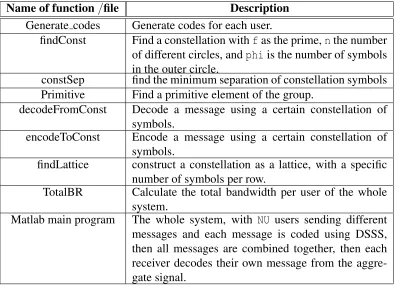
Table 1: Codes clarification
Name of function/file Description Generate codes Generate codes for each user.
findConst Find a constellation withfas the prime,nthe number of different circles, andphiis the number of symbols in the outer circle.
constSep find the minimum separation of constellation symbols Primitive Find a primitive element of the group.
decodeFromConst Decode a message using a certain constellation of symbols.
encodeToConst Encode a message using a certain constellation of symbols.
findLattice construct a constellation as a lattice, with a specific number of symbols per row.
TotalBR Calculate the total bandwidth per user of the whole system.
function codes = generate_codes(f, p) gs = f-1;
codes = zeros(gs,gs); ppowerforkloop = 1;
for k = 1:gs
ppowerforjloop = ppowerforkloop;
for j = 1:gs
codes(j,k) = ppowerforjloop;
% mod(pˆ(mod(j+k-2,gs)),f); this method leads to overflow
,→
ppowerforjloop = mod(ppowerforjloop*p,f);
end
ppowerforkloop = mod(ppowerforkloop*p,f);
end end
Listing 1: Generate codes
function signal = dsss_modulate_ho(code, msg, NoOfBits, f) chiplen = length(code);
siglen = ceil(chiplen*length(msg)/NoOfBits); signal = zeros(siglen,1);
msgInSymbols = symbolcodemsg(msg,f);
for k=1:(length(msgInSymbols));
for j=1:chiplen
% signal(chiplen*(k-1)+j,1) = gfdiv(msgInSymbols(k),code(j),f);
,→
signal(chiplen*(k-1)+j,1) = mod((code(j) +
msgInSymbols(k)), f);
,→
end end end
function msginsymbols = symbolcodemsg(msg,f)
j = ceil(log2(f-1)); % j is the maximum number of bits encoded in each symbol
,→
% sometimes only j-1 bits can be encoded
msginsymbols = zeros(1,ceil(length(msg)/(j-1))); k = 1; % where we are up to in the msg
ks = 1; % where we are up to in the symbolmsg
thresh = f - 2ˆ(j-1) - 1;
while (k<=length(msg))
% calculate the part of the next symbol due to the first j-1 binary
,→
% digits
lowbitspart = 0;
for bit = (k+(j-2)) : -1 : k
if bit<=length(msg)
lowbitspart = 2*lowbitspart + msg(bit);
else
lowbitspart = 2*lowbitspart;
end end
if lowbitspart < thresh && ((k+j-1) <= length(msg)) msginsymbols(ks) = msg(k+j-1)*2ˆ(j-1) + lowbitspart ; k = k + j;
else
msginsymbols(ks) = lowbitspart; k = k + j - 1;
end
ks = ks+1;
end
ks = ks - 1;
msginsymbols = msginsymbols(1:ks) + ones(1,ks);
end
function p = primitive(f)
for k=2:(f-1) success = true; test = k;
for j=1:(f-3)
test = mod (test*k,f);
if test==1
success = false;
break;
end end
if success p = k;
return;
end end end
function message = dsss_demodulate_ho(code, signal, f, NU) chiplen = length(code);
symbol = zeros(1,length(signal)); % for some reason we are using rows
,→
for k=1:(length(signal)/chiplen) W = 0;
for j=1:chiplen
thisest = signal(chiplen*(k-1)+j)*exp(-2*pi*i*code(j)/f);
% signalmag = abs(signal(chiplen*(k-1)+j)); % signalarg = myangle(signal(chiplen*(k-1)+j)); % signalsymbol =
mod(round(f*signalarg/(2*pi)),f);
,→
% signalsymbol = mod(signalsymbol * code(j),f); % thisest = signalmag *
exp(2*pi*i*signalsymbol/f);
,→
W = W + thisest;
% chipcode = mod((primitive*chipcode), fs); % rotation (not
,→
% used)
end
symbol(k) = mod(round(f*myangle(W)/(2*pi)),f);
end
message = bitcodemsg(symbol,f);
end
function message = dsss_demodulate_ho(code, signal, f, NU) chiplen = length(code);
symbol = zeros(1,length(signal)); % for some reason we are using rows
,→
for k=1:(length(signal)/chiplen) W = 0;
for j=1:chiplen
thisest = signal(chiplen*(k-1)+j)*exp(-2*pi*i*code(j)/f);
% signalmag = abs(signal(chiplen*(k-1)+j)); % signalarg = myangle(signal(chiplen*(k-1)+j)); % signalsymbol =
mod(round(f*signalarg/(2*pi)),f);
,→
% signalsymbol = mod(signalsymbol * code(j),f); % thisest = signalmag *
exp(2*pi*i*signalsymbol/f);
,→
W = W + thisest;
% chipcode = mod((primitive*chipcode), fs); % rotation (not
,→
% used)
end
symbol(k) = mod(round(f*myangle(W)/(2*pi)),f);
end
message = bitcodemsg(symbol,f);
end
function message = dsss_demodulate_ho(code, signal, f, NU) chiplen = length(code);
symbol = zeros(1,length(signal)); % for some reason we are using rows
,→
for k=1:(length(signal)/chiplen) W = 0;
for j=1:chiplen
thisest = signal(chiplen*(k-1)+j)*exp(-2*pi*i*code(j)/f);
% signalmag = abs(signal(chiplen*(k-1)+j)); % signalarg = myangle(signal(chiplen*(k-1)+j)); % signalsymbol =
mod(round(f*signalarg/(2*pi)),f);
,→
% signalsymbol = mod(signalsymbol * code(j),f); % thisest = signalmag *
exp(2*pi*i*signalsymbol/f);
,→
W = W + thisest;
% chipcode = mod((primitive*chipcode), fs); % rotation (not
,→
% used)
end
symbol(k) = mod(round(f*myangle(W)/(2*pi)),f);
end
message = bitcodemsg(symbol,f);
end
% Calculate the total bandwidth per user of the whole system
,→
NU = 100; Z= 1: NU; chiplen = Z; f = chiplen+1;
B= 1000000;
kappa = 1022; % an alternative notation for chip length
phi = 28; % constellation size
eta2 = 0.0025; alpha = 0.5;
logbit = log2 (1 + (sin(pi*ones(1,NU)./f)).ˆ2 .* chiplen.ˆ2 ./
((alpha*(Z-1)+eta2)));
,→
logbit(1) = log2(1+1/eta2); % correction for the case n=1
totalBRcircperim = B * Z.* logbit ./ chiplen; totalBRcircarea = B * Z.* logbit /piˆ2;
singleuserBR = B * log2 (1 + 1/eta2) * ones(1,NU); % Shannon formula
,→
newsingleuserB = B * (log2(phi)) * log2(1 + pi/(4*phi*eta2)) * ones(1,NU);
,→
totalBRnew = B * (log2(phi) / kappa) * Z .* log2(ones(1,NU) + kappa * pi * ones(1,NU) ./ (4*phi*(kappa*eta2*ones(1,NU) +
(alpha/kappa)*(Z - ones(1,NU)))));
,→ ,→
totalBRnew2 = B * log2(phi) * log2(ones(1,NU) + pi * Z.ˆ(1+alpha) ./
(4*phi*eta2*(Z + Z.ˆalpha)));
,→
figure();
subplot(2,1,1);
plot(Z,newsingleuserB, Z, totalBRnew2); title(’Total system throughput’)
ylabel(’Throughput’)
xlabel(’Number of users / chiplength’)
legend({’No sharing’, ’Sharing by DSSS-OFDM’},’Location’,’east’)
return;
% plot a diagram with different alphas
figure(); subplot(2,1,1) alpha = 0.1;
logbit = log2 (1 + piˆ2 * chiplen.ˆ2 ./ (f.ˆ2 .*(alpha*(Z-1)+eta2)));
,→
logbit(1) = log2(1+1/eta2); % correction for the case n=1
logbit = log2 (1 + piˆ2 * chiplen.ˆ2 ./ (f.ˆ2 .*(alpha*(Z-1)+eta2)));
,→
logbit(1) = log2(1+1/eta2); % correction for the case n=1
totalBRcircarea0_2 = B * Z.* logbit /(2*pi); alpha = 0.4;
logbit = log2 (1 + piˆ2 * chiplen.ˆ2 ./ (f.ˆ2 .*(alpha*(Z-1)+eta2)));
,→
logbit(1) = log2(1+1/eta2); % correction for the case n=1
totalBRcircarea0_4 = B * Z.* logbit /(2*pi); alpha = 1;
logbit = log2 (1 + piˆ2 * chiplen.ˆ2 ./ (f.ˆ2 .*(alpha*(Z-1)+eta2)));
,→
logbit(1) = log2(1+1/eta2); % correction for the case n=1
totalBRcircarea1 = B * Z.* logbit /(2*pi);
plot(Z, totalBRcircarea0_1, Z, totalBRcircarea0_2, Z, totalBRcircarea0_4, Z, totalBRcircarea1);
,→
title(’Total system bandwidth’) ylabel(’BR’)
xlabel(’Number of users’)
legend({’alpha=0.1’, ’alpha=0.2’, ’alpha=0.4’,
’alpha=1’},’Location’,’east’)
,→
% Plot the Correlation between variance of user noise vs number of users
,→
Z = 1:NU
% figure(); % subplot(2,1,1)
%correlation = plot(Z,varianceusernoise);
% title(’Correlation between variance of user noise vs number of users’)
,→
% ylabel(’variance of user noise’) % xlabel(’Number of users’)
Listing 8: TotalBR
% The whole system, with N users sending different messages and each
,→
% message is coded using DSSS, then all messages are combined together,
ML = 200; % ML: message lengths
bkgndnoisestdev = 0.05; usess = true;
if (usess)
f = 1031; % prime number, which is the size of Galois Field
,→
chiplen = f-1;% : length of chips
p = primitive(f); % the primitive element of the group
code = generate_codes(f, p);% codes for each user
phi = f/3
else
f = 1031; ML = ML*NU; NU = 1; n = 3
phi = 16;
code = ones(1,1);
end
beta = 1/sqrt(chiplen); % we reduce signal power to keep
within regulations
,→
rowcount = 10;
[const,constlength] = findLattice(rowcount); [outerconst,fullcount] = findConst(f, 1, f, true); constlength
bps = floor(log2(constlength)+0.001);
% bits per symbol (only approximate -- actually its bps sometimes and bps-1
,→
if (usess)
siglen = chiplen*ceil(ML/bps);
else
siglen = ceil(ML/bps);
end
minsep = constSep(const,constlength);
h = 0; % h = scatterplot(const,1,0,’.b’); % scatterplot(outerconst,1,0,’.b’);
,→
messages = round(rand(ML,NU)); % Generate messages
signals = zeros(siglen,NU); % Modulate message to create N signals
,→
for k=1:NU
[x,lengthinsymbols,msgInSymbols] = encodeToConst(const, outerconst, code(k,:), messages(:,k), bps, f);
,→
signals(1:length(x),k) = beta * x;
aggregatesignal = zeros(length(signals(:,1)),1);
aggregatesignal(1:length(signals(:,k))) = signals(:,1);
for k=2:NU
vec = aggregatesignal(1:length(signals(:,k))) + signals(:,k); aggregatesignal(1:length(signals(:,k))) = vec;
end
bkgndnoise =
random(’norm’,0,bkgndnoisestdev,[length(signals(:,1)),1]);
,→
phase = random(’uniform’,0,2*pi,[length(signals(:,1)),1]); bkgndnoise = bkgndnoise .* exp(i*phase);
bkgndnoise_actual_stdev = rms(bkgndnoise) aggregatesignal = aggregatesignal + bkgndnoise;
% Demodulate and decode N messages from the combined signal
decodedmessages = messages;
for k=1:NU
[dm,tnoise] = decodeFromConst(const, outerconst, code(k,:), aggregatesignal, f, h, msgInSymbols, beta);
,→
decodedmessages(:,k) = dm(1:ML);
end
totalnoise = tnoise(1:lengthinsymbols);
% Check error rate
errorcount = sum(xor(messages(1:(ML-1)),decodedmessages(1:(ML-1))))
% Estimate the standard deviation of user-noise and mean of signals
,→
meanusernoise = mean(totalnoise)
variancetotalnoise = var(abs(totalnoise)) stdevtotalnoise = sqrt(variancetotalnoise) throughput = NU * log2(constlength)
symbolstdeviation = rms(const) rmsnoise = rms(totalnoise)
Listing 9: Matlab main program