R E S E A R C H A R T I C L E
Open Access
Inhibitory effect of aqueous dandelion extract on
HIV-1 replication and reverse transcriptase activity
Huamin Han
1,2, Wen He
1,2,5, Wei Wang
1,3and Bin Gao
1,4*Abstract
Background:Acquired immunodeficiency syndrome (AIDS), which is caused by the human immunodeficiency virus (HIV), is an immunosuppressive disease that results in life-threatening opportunistic infections. The general problems in current therapy include the constant emergence of drug-resistant HIV strains, adverse side effects and the unavailability of treatments in developing countries. Natural products from herbs with the abilities to inhibit HIV-1 life cycle at different stages, have served as excellent sources of new anti-HIV-1 drugs. In this study, we aimed to investigate the anti-HIV-1 activity of aqueous dandelion extract.
Methods:The pseudotyped HIV-1 virus has been utilized to explore the anti-HIV-1 activity of dandelion, the level of HIV-1 replication was assessed by the percentage of GFP-positive cells. The inhibitory effect of the dandelion extract on reverse transcriptase activity was assessed by the reverse transcriptase assay kit.
Results:Compared to control values obtained from cells infected without treatment, the level of HIV-1 replication and reverse transcriptase activity were decreased in a dose-dependent manner. The data suggest that dandelion extract has a potent inhibitory activity against HIV-1 replication and reverse transcriptase activity. The identification of HIV-1 antiviral compounds fromTaraxacum officinaleshould be pursued.
Conclusions:The dandelion extract showed strong activity against HIV-1 RT and inhibited both the HIV-1 vector and the hybrid-MoMuLV/MoMuSV retrovirus replication. These findings provide additional support for the potential therapeutic efficacy ofTaraxacum officinale. Extracts from this plant may be regarded as another starting point for the development of an antiretroviral therapy with fewer side effects.
Background
Human immunodeficiency virus type 1 (HIV-1) is the causative agent of acquired immunodeficiency syndrome (AIDS). This disease represents a huge concern for glo-bal public health. Currently, there is no effective vaccine for HIV-1 [1]; thus, prevention and antiviral drugs are the only option to decrease morbidity and mortality in HIV-1-infected individuals. Several classes of antiretro-viral drugs have been developed targeting antiretro-viral proteins at different stages of the HIV-1 life cycle or host factors. Highly active antiretroviral therapy (HAART) [2], which typically utilizes a protease inhibitor in combination with a nucleoside and/or nonnucleoside reverse tran-scriptase inhibitor, is commonly used to treat HIV-1 infected patients. The general problems in current HIV
therapy are the constant emergence of drug-resistant HIV strains, adverse side effects and the unavailability of treatments in developing countries. Thus, developing cost-effective, highly-specific and antiresistant drugs are in urgent need.
Natural products, especially those derived from plants, have long been recognized as excellent sources of new anti-HIV-1 drugs. Some of them exhibit inhibitory activ-ity against several HIV-1 processes, including viral entry, reverse transcription, replication, integration, virus maturation, and virion budding. Some of these com-pounds have been clinically tested, with favorable results [3-8]. Limonoid and nomilin, which are isolated from the seed of Citrus bergamia, inhibit both HTLV-1 and HIV-1 reverse transcriptase (RT) activities [9]. Betulinic acid, a triterpenoid isolated from the methyl alcohol extract of the leaves of Syzigium claviflorum, and novel betulinic acid derivatives have been used as potent anti-HIV agents [10,11], and new mechanisms for these
* Correspondence: [email protected] 1
CAS Key Laboratory of Pathogenic Microbiology and Immunology (CASPMI), Institute of Microbiology, Chinese Academy of Sciences, Beijing, PR China Full list of author information is available at the end of the article
compounds have been identified [12-14]. These com-pounds have become a new class of anti-HIV drugs. Phase I and II studies have reported that single oral dose of bevirimat, derived from a betulinic acid-like compound, was well tolerated and demonstrated a dose-dependent reduction in viral load. Derivative IC9564 also competed with gp120/CD4 complexes for binding to chemokine receptors, thus acting as an entry inhibitor that can potently inhibit a broad spectrum of primary HIV-1 isolates by targeting the V3 loop of gp120. Simi-larly, Trigonostema xyphophylloides from Euphorbia-ceae and Vatica astrotricha fromDipterocarpaceaehave been shown to act as HIV-1 entry inhibitors. These compounds likely inhibit HIV-1 replication by blocking the interaction between gp120 and CD4/CCR5 or gp120 and CD4/CXCR4. Petroleum ether from Rhus chinensis
does not inhibit HIV-1 recombinant RT or HIV-1 entry into host cells, but may target new sites of HIV-1 repli-cation [15]. Shikonin from the dried root of
Lithosper-mum erythrorhizon is a pan-chemokine receptor
inhibitor [16]. Lipophosphoglycan (LPG) from
Leishma-nia donovanihas been shown to inhibit the early stage
of the HIV-1 life cycle by influencing the membrane fluidity of target cells and diminishing both the virus-cell and virus-cell-to-virus-cell fusion processes initiated by HIV-1 [17].
Taraxacum officinale, also known as the common
dandelion, has been shown to have heat clearing and detoxifying effects in addition to the ability to eliminate stagnation, remove stasis and induce diuresis for treating strangurtia. This plant is one of the common antiviral agents used in traditional Chinese medicines. Histori-cally, it has been used to treat numerous diseases, ran-ging from infectious diseases; tumors of the breast, uterus and lung; kidney disease; digestive diseases; and diabetes. Some of the traditional applications of dande-lion extract are supported by pharmacological investiga-tion. Modern pharmacological research suggests this plant has broad-spectrum antibacterial [18], anti-fungal [19], antiviral, antidiabetic, choleretic, antirheumatic, anti-inflammatory [20,21], hepatoprotective [22], diuretic [23], and tumor apoptosis-inducing properties [24-26]. However, the antiretroviral properties of this plant have not been examined until recently.
Virus cell-based fluorescence assay using pseudotype particles is an efficient and cost-effective screening sys-tem and has been used for primary screening of novel agents against HIV-1 [27-30]. Pseudotyped viruses pro-duced in this system can mimic most stages of the HIV-1 life cycle, including viral protein production, assembly, release, maturation, entry, integration and replication without producing replication-competent viruses. This approach has the potential to identify inhibitors against multiple viral and cellular functions essential for HIV
replication [30]. The level of HIV-1 replication has been assessed by the expression of reporter genes represented by the percentage of GFP-positive cells.
This study aimed to investigate thein vitroinhibitory effects of aqueous dandelion extract (DWE) on HIV-1 replication by utilizing VSV-G pseudotyped viruses to infect non-CD4 cells. Reverse transcriptase assay kit was used to detect inhibitory effect on RT enzyme activity of dandelion. These results suggest that dandelion extract has a potent inhibitory activity against HIV-1 replication and RT activity. The further investigation should include the identification of the active components in the dan-delion extract.
Methods
Cell lines and cell culture
All cell lines, the mouse fibroblast cell line (NIH/3T3), 293T human renal epithelial cell, RetroPackPT67 packa-ging cells and Phoenix Eco packapacka-ging cells were pur-chased from ATCC (Rockville, MD, USA) and grown in Dulbecco’s modified eagle medium (DMEM; GIBCO, USA) supplemented with 10% fetal bovine serum (FBS; Gibco, USA), 100 IU/ml penicillin and 100μg/ml strep-tomycin. The cells were incubated in a humidified envir-onment with 5% CO2 at 37°C. Peripheral mononuclear
blood cells (PBMCs) were purified using Ficoll density gradient centrifugation from healthy donors supplied by the Beijing Blood Bank. PBMCs were resuspended and cultured in RPMI-1640 medium supplemented with 10% FBS and 100 U/ml recombinant human IL-2 overnight before they were used in the cytotoxicity assay. Based on an informed consent, this project was approved by the Biomedical Research Ethics Committee of CAS Key Laboratory of Pathogenic Microbiology and Immunology (NO.CASPMI009).
Retroviral vector and packaging cell construction
pLNCX2 contains elements derived from the Moloney murine leukemia virus (MoMuLV) and the Moloney murine sarcoma virus (MoMuSV) and is designed for retroviral gene delivery. The pLNCX2 retroviral vector (donated by professor Huang) was chosen to insert enhanced green fluorescent protein (EGFP). The EGFP gene was amplified by PCR using the following primers: EGFP-F, CCGCTCGAGGCCGCCAC CATGGTGAG-CAAGGGCGAGGAGCT; EGFP-R, ACGCGTCGACC-TACTTGTA CAGCTCGTCCATGCCGAGAGAGT, and the fragment was inserted into the pLNCX2 retro-viral vector at the XhoI/Sal I restriction enzyme site.
subsequently infected with the retrovirus-containing supernatant in the presence of 8 μg/ml polybrene (Sigma Co., St Louis, MO) using centifugation at 1200 xg at 32°C for 90 min. Six hours after infection, the supernatant was removed and the cells were incubated in the complete medium. The expression of the pLNCX2-EGFP retroviral vector was verified by selec-tion with 100μg/ml G418 (GIBCO, USA).
The pLNCX2-EGFP-transfected RetroPack PT67 packaging cells encoding the EGFP genes were used as a stable EGFP virus-producing cell line and cultured in DMEM supplemented with 10% FBS. Retaining one plate for the continuation of the culture, the remaining cells were plated at 60-80% confluence in the desired number of culture vessels. Viral supernatants could then be harvested in 24 h intervals until the cells were no longer viable. Once the virus was harvested, all cells were discarded.
Production of pseudotyped virus and transduction
To produce single-cycle infectious virons, VSV-G pseu-dotyped HIV-1 vector stocks were prepared, concen-trated and titered as described previously [31]. The pLL3.7 plasmid (6 μg; Invitrogen, USA), belonging to the third generation of lentivirus vector system based on HIV-1, was co-transfected with pLP1 (Invitrogen, USA), pLP2 (Invitrogen, USA) and pLP/VSVG (Invitrogen, USA) into 293T cells using calcium phosphate-based transfection. After transfection (48 to 72 h), the virus-containing supernatants were harvested, passed through a 0.45 μm filter and frozen in aliquots at -80°C until use. NIH/3T3 cells were placed in each well of a six-well plate with 2 ml DMEM containing 10% FBS. The next day, the media was replaced with 2 ml of virus supernatants containing 8μg/ml of polybrene at a mul-tiplicity of infection (MOI) of 1 in the presence or absence of DWE. Zidovudine (AZT) andHerba
Artemi-siae Scopariae were used as positive control and
nega-tive control respecnega-tively. The cells were infected by spinoculation in a centrifuge at 1, 200 xg for 90 min at 32°C and incubated at 37°C overnight, followed by a change to fresh medium.
Plant material
Samples of the entire plant of Taraxacum officinale
(dried) and Herba Artemisiae Scopariae(dried) were purchased at Fenlinlvzhou medicinal store in Beijing, China in December 2010 and authenticated by ph.D Wei Li, Institute of Microbiology, Chinese Academy of Sciences. The voucher specimen of these plant materials were deposited in the CAS Key Laboratory of Patho-genic Microbiology and Immunology (CASPMI), Insti-tute of Microbiology, Chinese Academy of Sciences.
Quantification of the inhibitory effect of DWE to HIV-1 RT
The effect of DWE on HIV-1 RT activity was evaluated with the reverse transcriptase assay, coloremetric kit (Version 13.0, Roche, USA). The assay was performed according to the manufacture’s instructions by transfer-ring 20μl of recombinant HIV-1 RT and 20μl reaction buffer to microfuge tubes containing different concen-trations of DWE (2 mg/ml, 1 mg/ml, 0.75 mg/ml, 0.5 mg/ml, 0.25 mg/ml, 0.125 mg/ml) and diluted with lysis buffer. 2.5μM AZT was used as a positive control, lysis buffer without HIV-1 RT was used as one negative con-trol (concon-trol 1), lysis buffer with HIV-1 RT but no DWE was used as another negative control (control 2). After 1 h incubation at 37°C, the samples were transfered into microplate modules for 1 h incubation again at 37°C. The plate was rinsed 5 times with 250 μl of washing buffer and buffer was completely removed before adding 200μl of anti-DIG-POD working dilution. A further 1 h incubation at 37°C followed by washing 5 times with washing buffer. 200 μl ABTS substrate solution was added per well and incubated at room temperature until color development is sufficient for photometric detec-tion (10-30 min). The absorbance was read on a micro-plate reader at 405 nm and a reference wavelength of 490 nm. The assay was carried out in triplicate and repeated three times. Results were analyzed using the formula:
%relative inhibition = (RTcontrol 2−RTcontrol 1)−(RTsample−RTcontrol 1)
×100/ RTcontrol 2−RTcontrol 1
Preparation of extracts
10 g of the dried whole plant of Taraxacum officinale
and Herba Artemisiae Scopariae were respectively
soaked in water for 0.5 h at room temperature. Hot water extractions were performed at 100°C in three batches: 200 ml for 3 h, 150 ml for 2 h, 100 ml for 1 h. The mixtures were then pooled together and filtered to remove the particulate matter, concentrated to 100 ml, filtered through a 0.22μm syringe filter and lyophilized, yielding light yellow power.
Cell survival assay
100 μl of fresh serum-free DMEM containing 1/10(v/v) Cell Counting Kit-8 reagent was added to each well and incubated for an additional 4 h. After incubation, the via-bility of the NIH/3T3 cells was assayed with CCK-8 using a 96-well plate reader (DG5032, Huadong, Nanjing, China) at 450 nm. Untreated cells were served as the negative control, and wells containing the Cell Counting Kit-8 reagent and no cells were used as the blank control. Cytotoxicity was assessed by the cell survival rate. The absorbance reading from each well was used to calculate the cell survival rate. Survival rate (%) = optical density (OD) of the treated cells -OD of blank control/OD of negative control-OD of blank control × 100.
The cytotoxicity of DWE in human PBMCs was deter-mined using the trypan blue exclusion method. Briefly, PBMCs were cultured at 1.3 × 10⁶ cells/ml in a 24-well plate supplemented with 100 IU/ml IL-2 and exposed to increasing concentrations of DWE for 24 h. PBMCs without DWE treatment were used as a control. The cells were stained with 0.2% trypan blue dye, and the total cells and viable cells were counted under a light microscope.
Flow cytometry, fluorescence microscopy analysis and image acquisition
NIH3T3 cells were harvested using a trypsin/EDTA solution, washed with ice-cold PBS three times and resuspended in PBS to a final concentration of 106cells/ ml. Virus infection was measured in the absence or pre-sence of increasing concentrations of DWE. The percen-tage of EGFP-positive cells was used to calculate the infection efficiency by flow cytometry using Guava Easy-Cyte (Guava Technologies, USA). All FACS data were analyzed using FlowJo software (Tree Star, Ashland OR). Images were acquired on a ZEISS Axiovert 200 M microscope (Zeiss, Vienna, Austria) with a 40 x/0.55NA objective. The microscope and image acquisition were controlled by AxioVision software. For GFP observation, we used blue light excitation. Image processing, such as the clipping of images, was first performed in Power-Point and then converted to TIFFs.
High performance liquid chromatography(HPLC)
200 mg freeze-dried aqueous extract powder was dis-solved in 2 ml milli-Q water, and filtered through a 0.22 μm syringe filter before analysis. HPLC separation was conducted by a Shimadzu CTO-15C system equipped with a binary high pressure gradient pump, UV/Vis detector SPD-15C. Peak areas were calculated with a LC solution 15C software. Gradient elution was performed using two solvents consisting of A (0.1% (v/v) TFA in H2O) and B ((0.1%(v/v) TFA in acetonitrile). Step
gradi-ent is from 5% to 70% of B over 40 min. Total chroma-tography duration was 40 min. The flow-rate of mobile
phase was 1 ml/min. Injection volume was 25 μl. The detection wavelengths were set at 254 and 323 nm, and column temperature was room temperature. The caffeic acid and chlorogenic acid purchased from Sigma (USA) were used as the reference standards for quantitative assay. The concentrations of components present in DWE were identified by comparing chromatographic peaks with the retention time of individual standards.
Statistical analysis
Data are presented as mean ± SD. The data were statis-tically evaluated using a one-way ANOVA to compare differences between the groups. A p-value of < 0.05 was considered to be significant. The IC50 values were cal-culated using GraphPad Prism programme.
Results
Production of the VSV-G pseudotyped HIV-1 virus and 10A1 pseudotyped pLNCX2-EGFP vector
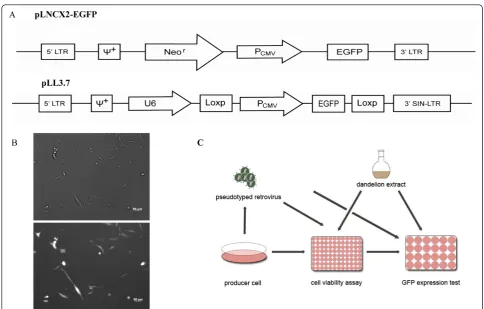
We chose EGFP as a reporter gene because its expres-sion can be easily monitored. As illustrated in Figure 1A, expression of EGFP served as an indicator of viral replication. pLNCX2-EGFP was generated by inserting the EGFP gene downstream from the CMV promoter. Virus-producing RetroPack PT67 cells were established through a ping-pong method, which uses the virus from the Eco packaging cell line to infect RetroPack PT67 cells. Finally, a stable pLNCX2-EGFP transfected Retro-Pack PT67 cell line was selected using G418. As shown in Figure 1B, high level of EGFP was observed in all Ret-roPack PT67 cells. Our experimental design was showned in Figure 1C.
In vitroeffects ofTaraxacum officinaleextracts on cell viability
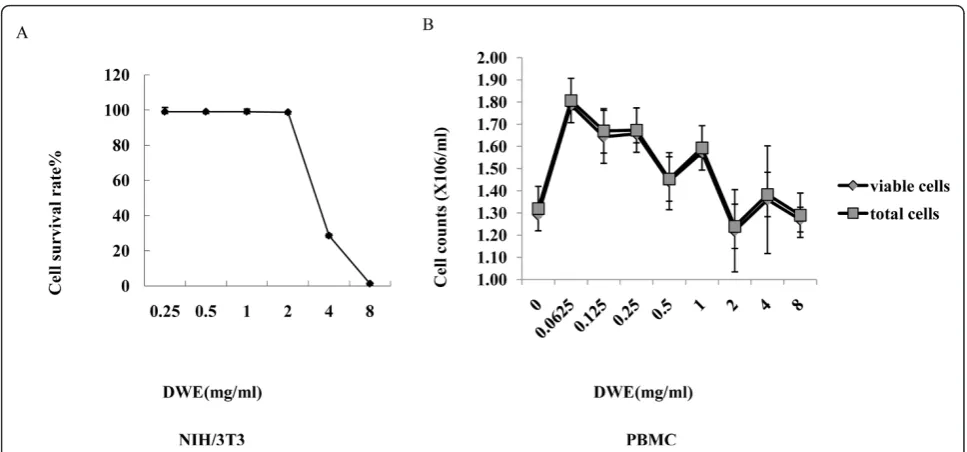
The dried whole plant ofT. officinalewas extracted with hot water, yielding DWE (17% w/w). It was important to assess whether the compounds were toxic to exclude a non-specific antiretroviral effect. We determined the effects of the extracts on cell survival in the absence of HIV-1 infection to establish a non-toxic working concentration of the DWE. The cytotoxicity of DWE in NIH/3T3 cells was evaluated using a CCK-8 assay. The experiments were repeated three times for six different concentrations (0.25 mg/ml, 0.5 mg/ml, 1 mg/ml, 2 mg/ml, 4 mg/ml, 8 mg/ml). For concentrations up to 2 mg/ml, no significant cytotoxic effects were found (Figure 2A). The concentration of 2 mg/ ml was chosen to carry out the subsequent studies based on cell viability and morphological observations.
Taraxacum officinaleextract has no toxicity in human PBMCs
concentrations of DWE (0.0625 mg/ml to 8 mg/ml). As shown in Figure 2B, PBMC viability was not decreased at concentrations up to 8 mg/ml. Compared to untreated PBMCs, both the number of total cells and the number of viable cells were significantly increased after treatment with DWE at a concentration of 0.0625 mg/ml (p < 0.05). These data indicate that DWE exhi-bits no toxicity on human PBMCs and served as a nutri-ent or stimulator at a low concnutri-entration.
Inhibitory activity ofTaraxacum officinaleextract on HIV-1 replication
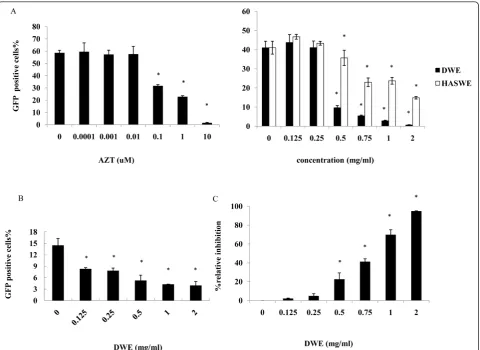
When compared to control values obtained from infected cells that were not treated with the plant extracts, DWE showed inhibitory activity that increased in a concentration-dependent manner. This was seen as a decrease of GFP-positive counts in a dose-dependent manner (see graphs in Figure 3). AZT, a reverse tran-scriptase inhibitor, was used as a positive control. As shown in Figure 4A, the 50% inhibitory concentration (IC50) of AZT for HIV-1 was 0.29 μM, which is in
accordance with previously published data. We used the
previously determined non-toxic concentration of 2 mg/ ml as the starting testing point for DWE. The maximum inhibitory effect (98%) was obtained with 2 mg/ml, and the IC50of DWE was 0.64 mg/ml, As a negative control,
the extract fromHerba Artemisiae Scopariae showed much weaker inhibitory activity with an IC50 of 1.255 mg/ml when compared to the activities ofTaraxacum
officinaleobserved. Next, we determined whether DWE
was similarly effective in the inhibition of another retro-virus unrelated to HIV-1, the 10A1-pseudotyped hybrid-MoMuLV/MoMuSV retrovirus. We found DWE also to be effective for this virus. The maximum inhibitory effect (73%) was obtained with 2 mg/ml, and the IC50of
DWE was 0.23 mg/ml (Figure 4B). The similar ability of DWE to inhibit the replication of two unrelated retro-viruses suggests that dandelion extract may target a fac-tor that is broadly required for retroviral replication.
Inhibitory effects ofTaraxacum officinaleextract on HIV-1 RT activity
[image:5.595.55.540.85.394.2]colorimetric assay where the enzyme activity is deter-mined after treatments in the presence or absence (untreated control) of different concentrations of DWE. Inhibition of DWE to the HIV-1 RT enzyme was
[image:6.595.56.540.87.313.2]evaluated based on their percent inhibition compared to a sample that does not contain DWE. As showned in Figure 4C, DWE showed potent inhibitory effect at 2 mg/ml (94.89%) with an IC50 of 0.87 mg/ml compared Figure 2Cytotoxicity assay for different cells cultured with different concentrations of DWE. (A) NIH/3T3 cell survival curves from the CCK-8 assay. The negative control was untreated cells, and the blank control contained the Cell Counting Kit-8 reagent and no cells. The curve represents the average of three independent experiments with SD bars. (B) PBMCs were incubated at 37°C in 5% CO2overnight in media supplemented with IL-2 at a concentration of 100 IU/ml. The cells were then exposed to the DWE for 24 h, and aliquots of cells were stained with trypan blue dye to determine the total numbers of cells as well as viable cells. PBMC cells, cultured in the absence of DWE were used as control. These data represent three independent experiments.
[image:6.595.56.540.459.703.2]to RT inhibitor, AZT at 2.5μM (98%), and the inhibi-tory activities were dose dependent.
Discussion
The present study demonstrates for the first time that DWE displays inhibitory effect on HIV-1 replication and RT activitiy. It has been reported that extracts contain-ing marked concentrations of chlorogenic acid inhibited HIV reverse transcriptase [32,33]. Dandelion are rich in phenolic compounds, in particular chlorogenic acid, caf-feic acid, various flavonoid glycosides such as luteolin 7-O-glucoside, luteolin and others, however, as shown in Figure 5, HPLC analysis of two Compositae plant spe-cies showed that Herba Artemisiae Scopariae extract, which contain higher contents of chlorogenic acid and caffeic acid than those in DWE (212-fold and 7-fold,
respectively), showed milder inhibitory activity on HIV-1 replication. Since DWE are mixture of components, there is a possibility that the anti-HIV-1 compound may be novel. The isolation of active components against HIV-1 RT from Taraxacum officinale is now in pro-gress. The activity exhibited by DWE gives some evi-dence to validate their effect against HIV-1.
[image:7.595.59.540.88.438.2]assays significantly reduces the safety risk encountered with replication-competent HIV-1. Taking these into account, experts emphasize the importance of developing cell-based screening systems for the rapid identification of novel anti-HIV agents [35-38]. Moreover, to explore the different mechanism of anti-HIV-1 activity, choosing an appropriate cell line is a critical step. Human CD4+ Jurkat cells are commonly used in screening anti-HIV-1 drugs [6,39,40], but other reports have indicated dande-lion root extract shows a selective induction of apoptosis through the activation of caspase-8 in human leukemia cells (Jurkat) [26]. In our study, we used VSV-G pseudo-typed HIV-1, which has a different entry pathway from wild-type HIV-1 [34], and a non-CD4 cell line. The assay used here targeted HIV-1 replication, a post-entry event. A deletion in the U3 region results in the loss of promo-ter activity following reverse transcription and integration. The only promoter that dictates the transcription of a reporter gene is the internal promoter CMV. Thus, the expression of GFP protein is a reliable indicator of HIV-1 replication [41]. It is also important to distinguish specific antiretroviral activity from non-specific inhibitor effects or DWE-mediated cytotoxicity. We combined cytotoxicity data with antiretroviral testing to solve this issue. DWE has been studied in mice, and it was reported that the administration of DWE at 1 g/kg/day for 4 weeks did not
produce adverse effects [22]. We also observed that DWE had no cytotoxic effect on primary PBMCs.
Conclusions
In conclusion, the dandelion extract showed strong activity against HIV-1 RT and inhibited both the HIV-1 vector and the hybrid-MoMuLV/MoMuSV retrovirus replication. These findings provide additional pharmaco-logical information on the potential therapeutic efficacy
of Taraxacum officinale. This could represent another
starting point for the development of an anti-retroviral therapy with fewer side effects.
This preliminary finding suggested to isolate bioactive compound from biologically active extracts for further study. Components activity tests of the plants extracts would be performed for anti-HIV-1 activities. It is desir-able to determine the effects of DWE on wild-type HIV-1 as well as to try to isolate active constituents.
Acknowledgements
We thank Bhargavi M. Boruah, Ph.D for her careful reading the manuscript and helpful discussions. This work was supported by grants 2008ZX10003-012 and 2009ZX10004-305.
Author details
1CAS Key Laboratory of Pathogenic Microbiology and Immunology (CASPMI),
[image:8.595.57.541.87.371.2]Institute of Microbiology, Chinese Academy of Sciences, Beijing, PR China.
2Graduate University of Chinese Academy of Sciences, Beijing, PR China. 3School of Life Sciences, University of Science and Technology of China,
Hefei 230027, China.4China-Japan Joint Laboratory of Molecular
Immunology and Microbiology, Institute of Microbiology, Chinese Academy of Sciences, Beijing, PR China.5Biochemistry Teaching and Research office of Hebei medical university, Shijiazhuang, PR China.
Authors’contributions
HMH performed experiments and prepared the manuscript. WH and WW performed experiments. BG designed the experiments, supervised the project. All authors read and approved the final manuscript.
Competing interests
The authors declare that they have no competing interests.
Received: 27 July 2011 Accepted: 14 November 2011 Published: 14 November 2011
References
1. Cohen J:AIDS research. Promising AIDS vaccine’s failure leaves field reeling.Science2007,318:28-29.
2. Shafer RW, Schapiro JM:HIV-1 drug resistance mutations: an updated framework for the second decade of HAART.AIDS Rev2008,10:67-84. 3. Vo TS, Kim SK:Potential Anti-HIV Agents from Marine Resources: An
Overview.Mar Drugs2010,8:2871-2892.
4. Jiang Y, Ng TB, Wang CR, Zhang D, Cheng ZH, Liu ZK, Qiao WT, Geng YQ, Li N, Liu F:Inhibitors from natural products to HIV-1 reverse
transcriptase, protease and integrase.Mini Rev Med Chem2010,
10:1331-1344.
5. Filho JR, de Sousa Falcao H, Batista LM, Filho JM, Piuvezam MR:Effects of plant extracts on HIV-1 protease.Curr HIV Res2010,8:531-544. 6. Park IW, Han C, Song X, Green LA, Wang T, Liu Y, Cen C, Yang B, Chen G,
He JJ:Inhibition of HIV-1 entry by extracts derived from traditional Chinese medicinal herbal plants.BMC Complement Altern Med2009,9:29. 7. Singh IP, Bodiwala HS:Recent advances in anti-HIV natural products.Nat
Prod Rep2010,27:1781-1800.
8. Asres K, Seyoum A, Veeresham C, Bucar F, Gibbons S:Naturally derived anti-HIV agents.Phytother Res2005,19:557-581.
9. Balestrieri E, Pizzimenti F, Ferlazzo A, Giofre SV, Iannazzo D, Piperno A, Romeo R, Chiacchio MA, Mastino A, Macchi B:Antiviral activity of seed extract from Citrus bergamia towards human retroviruses.Bioorg Med Chem2011.
10. Kashiwada Y, Hashimoto F, Cosentino LM, Chen CH, Garrett PE, Lee KH:
Betulinic acid and dihydrobetulinic acid derivatives as potent anti-HIV agents.J Med Chem1996,39:1016-1017.
11. Qian K, Yu D, Chen CH, Huang L, Morris-Natschke SL, Nitz TJ, Salzwedel K, Reddick M, Allaway GP, Lee KH:Anti-AIDS agents. 78. Design, synthesis, metabolic stability assessment, and antiviral evaluation of novel betulinic acid derivatives as potent anti-human immunodeficiency virus (HIV) agents.J Med Chem2009,52:3248-3258.
12. Kanamoto T, Kashiwada Y, Kanbara K, Gotoh K, Yoshimori M, Goto T, Sano K, Nakashima H:Anti-human immunodeficiency virus activity of YK-FH312 (a betulinic acid derivative), a novel compound blocking viral maturation.Antimicrob Agents Chemother2001,45:1225-1230.
13. Smith PF, Ogundele A, Forrest A, Wilton J, Salzwedel K, Doto J, Allaway GP, Martin DE:Phase I and II study of the safety, virologic effect, and pharmacokinetics/pharmacodynamics of single-dose 3-o-(3’, 3’ -dimethylsuccinyl)betulinic acid (bevirimat) against human immunodeficiency virus infection.Antimicrob Agents Chemother2007,
51:3574-3581.
14. Sun IC, Chen CH, Kashiwada Y, Wu JH, Wang HK, Lee KH:Anti-AIDS agents 49. Synthesis, anti-HIV, and anti-fusion activities of IC9564 analogues based on betulinic acid.J Med Chem2002,45:4271-4275.
15. Wang RR, Gu Q, Yang LM, Chen JJ, Li SY, Zheng YT:Anti-HIV-1 activities of extracts from the medicinal plant Rhus chinensis.J Ethnopharmacol2006,
105:269-273.
16. Chen X, Yang L, Zhang N, Turpin JA, Buckheit RW, Osterling C, Oppenheim JJ, Howard OM:Shikonin, a component of chinese herbal medicine, inhibits chemokine receptor function and suppresses human immunodeficiency virus type 1.Antimicrob Agents Chemother2003,
47:2810-2816.
17. Genois N, Barbeau B, Olivier M, Tremblay MJ:Inhibition of HIV-1-mediated syncytium formation and virus replication by the lipophosphoglycan from Leishmania donovani is due to an effect on early events in the virus life cycle.Clin Exp Immunol2001,124:32-42.
18. Woods-Panzaru S, Nelson D, McCollum G, Ballard LM, Millar BC, Maeda Y, Goldsmith CE, Rooney PJ, Loughrey A, Rao JR, Moore JE:An examination of antibacterial and antifungal properties of constituents described in traditional Ulster cures and remedies.Ulster Med J2009,78:13-15. 19. Odintsova TI, Rogozhin EA, Sklyar IV, Musolyamov AK, Kudryavtsev AM,
Pukhalsky VA, Smirnov AN, Grishin EV, Egorov TA:Antifungal activity of storage 2S albumins from seeds of the invasive weed dandelion Taraxacum officinale Wigg.Protein Pept Lett2010,17:522-529. 20. Koh YJ, Cha DS, Ko JS, Park HJ, Choi HD:Anti-inflammatory effect of
Taraxacum officinale leaves on lipopolysaccharide-induced inflammatory responses in RAW 264.7 cells.J Med Food13:870-878.
21. Park CM, Cha YS, Youn HJ, Cho CW, Song YS:Amelioration of oxidative stress by dandelion extract through CYP2E1 suppression against acute liver injury induced by carbon tetrachloride in Sprague-Dawley rats.
Phytother Res24:1347-1353.
22. You Y, Yoo S, Yoon HG, Park J, Lee YH, Kim S, Oh KT, Lee J, Cho HY, Jun W:
In vitro and in vivo hepatoprotective effects of the aqueous extract from Taraxacum officinale (dandelion) root against alcohol-induced oxidative stress.Food Chem Toxicol48:1632-1637.
23. Clare BA, Conroy RS, Spelman K:The diuretic effect in human subjects of an extract of Taraxacum officinale folium over a single day.J Altern Complement Med2009,15:929-934.
24. Schutz K, Carle R, Schieber A:Taraxacum–a review on its phytochemical and pharmacological profile.J Ethnopharmacol2006,107:313-323. 25. Chatterjee SJ, Ovadje P, Mousa M, Hamm C, Pandey S:The efficacy of
dandelion root extract in inducing apoptosis in drug-resistant human melanoma cells.Evid Based Complement Alternat Med2011,2011:129045. 26. Ovadje P, Chatterjee S, Griffin C, Tran C, Hamm C, Pandey S:Selective
induction of apoptosis through activation of caspase-8 in human leukemia cells (Jurkat) by dandelion root extract.J Ethnopharmacol2011,
133:86-91.
27. Lindsten K, Uhlikova T, Konvalinka J, Masucci MG, Dantuma NP:Cell-based fluorescence assay for human immunodeficiency virus type 1 protease activity.Antimicrob Agents Chemother2001,45:2616-2622.
28. Blair WS, Isaacson J, Li X, Cao J, Peng Q, Kong GF, Patick AK:A novel HIV-1 antiviral high throughput screening approach for the discovery of HIV-1 inhibitors.Antiviral Res2005,65:107-116.
29. Cao J, Isaacson J, Patick AK, Blair WS:High-throughput human immunodeficiency virus type 1 (HIV-1) full replication assay that includes HIV-1 Vif as an antiviral target.Antimicrob Agents Chemother 2005,49:3833-3841.
30. Kremb S, Helfer M, Heller W, Hoffmann D, Wolff H, Kleinschmidt A, Cepok S, Hemmer B, Durner J, Brack-Werner R:EASY-HIT: HIV full-replication technology for broad discovery of multiple classes of HIV inhibitors.
Antimicrob Agents Chemother2010,54:5257-5268.
31. al Yacoub N, Romanowska M, Haritonova N, Foerster J:Optimized production and concentration of lentiviral vectors containing large inserts.J Gene Med2007,9:579-584.
32. Chkhikvishvili ID, Kharebava GI:Chicoric and chlorogenic acids in plant species from Georgia.Applied Biochemistry and Microbiology2001,
37:188-191.
33. Kreis W, Kaplan MH, Freeman J, Sun DK, Sarin PS:Inhibition of Hiv Replication by Hyssop-Officinalis Extracts.Antiviral Research1990,
14:323-337.
34. Aiken C:Pseudotyping human immunodeficiency virus type 1 (HIV-1) by the glycoprotein of vesicular stomatitis virus targets HIV-1 entry to an endocytic pathway and suppresses both the requirement for Nef and the sensitivity to cyclosporin A.J Virol1997,71:5871-5877.
35. Zhang H, Zhou Y, Alcock C, Kiefer T, Monie D, Siliciano J, Li Q, Pham P, Cofrancesco J, Persaud D, Siliciano RF:Novel single-cell-level phenotypic assay for residual drug susceptibility and reduced replication capacity of drug-resistant human immunodeficiency virus type 1.J Virol2004,
78:1718-1729.
36. Petropoulos CJ, Parkin NT, Limoli KL, Lie YS, Wrin T, Huang W, Tian H, Smith D, Winslow GA, Capon DJ, Whitcomb JM:A novel phenotypic drug susceptibility assay for human immunodeficiency virus type 1.
37. Adelson ME, Pacchia AL, Kaul M, Rando RF, Ron Y, Peltz SW, Dougherty JP:
Toward the development of a virus-cell-based assay for the discovery of novel compounds against human immunodeficiency virus type 1.
Antimicrob Agents Chemother2003,47:501-508.
38. Westby M, Nakayama GR, Butler SL, Blair WS:Cell-based and biochemical screening approaches for the discovery of novel HIV-1 inhibitors.
Antiviral Res2005,67:121-140.
39. Daelemans D, De Clercq E, Vandamme AM:A quantitative GFP-based bioassay for the detection of HIV-1 Tat transactivation inhibitors.J Virol Methods2001,96:183-188.
40. Park IW, Han CR, Song XP, Green LA, Wang T, Liu Y, Cen CC, Song XM, Yang B, Chen GY, He JJ:Inhibition of HIV-1 entry by extracts derived from traditional Chinese medicinal herbal plants.Bmc Complementary and Alternative Medicine2009,9.
41. Dykes C, Demeter LM:Clinical significance of human immunodeficiency virus type 1 replication fitness.Clin Microbiol Rev2007,20:550-578.
Pre-publication history
The pre-publication history for this paper can be accessed here: http://www.biomedcentral.com/1472-6882/11/112/prepub
doi:10.1186/1472-6882-11-112
Cite this article as:Hanet al.:Inhibitory effect of aqueous dandelion extract on HIV-1 replication and reverse transcriptase activity.BMC
Complementary and Alternative Medicine201111:112.
Submit your next manuscript to BioMed Central and take full advantage of:
• Convenient online submission
• Thorough peer review
• No space constraints or color figure charges
• Immediate publication on acceptance
• Inclusion in PubMed, CAS, Scopus and Google Scholar
• Research which is freely available for redistribution