R E S E A R C H A R T I C L E
Open Access
Advancing scoping study methodology: a
web-based survey and consultation of
perceptions on terminology, definition and
methodological steps
Kelly K. O
’
Brien
1,2,3*, Heather Colquhoun
3,4, Danielle Levac
5, Larry Baxter
6, Andrea C. Tricco
7, Sharon Straus
7,
Lisa Wickerson
3,8, Ayesha Nayar
1, David Moher
9,10and Lisa O
’
Malley
11Abstract
Background:Scoping studies (or reviews) are a method used to comprehensively map evidence across a range of study designs in an area, with the aim of informing future research practice, programs and policy. However, no universal agreement exists on terminology, definition or methodological steps. Our aim was to understand the experiences of, and considerations for conducting scoping studies from the perspective of academic and community partners. Primary objectives were to 1) describe experiences conducting scoping studies including strengths and challenges; and 2) describe perspectives on terminology, definition, and methodological steps. Methods:We conducted a cross-sectional web-based survey with clinicians, educators, researchers, knowledge users, representatives from community-based organizations, graduate students, and policy stakeholders with experience and/or interest in conducting scoping studies to gain an understanding of experiences and perspectives on the conduct and reporting of scoping studies. We administered an electronic self-reported questionnaire comprised of 22 items related to experiences with scoping studies, strengths and challenges, opinions on terminology, and methodological steps. We analyzed questionnaire data using descriptive statistics and content analytical techniques. Survey results were discussed during a multi-stakeholder consultation to identify key considerations in the conduct and reporting of scoping studies.
Results:Of the 83 invitations, 54 individuals (65 %) completed the scoping questionnaire, and 48 (58 %) attended the scoping study meeting from Canada, the United Kingdom and United States. Many scoping study strengths were dually identified as challenges including breadth of scope, and iterative process. No consensus on
terminology emerged, however key defining features that comprised a working definition of scoping studies included the exploratory mapping of literature in a field; iterative process, inclusion of grey literature; no quality assessment of included studies, and an optional consultation phase. We offer considerations for the conduct and reporting of scoping studies for researchers, clinicians and knowledge users engaging in this methodology. Conclusions:Lack of consensus on scoping terminology, definition and methodological steps persists. Reasons for this may be attributed to diversity of disciplines adopting this methodology for differing purposes. Further work is needed to establish guidelines on the reporting and methodological quality assessment of scoping studies. Keywords:Scoping studies, Scoping reviews, Survey, Web-based, Research
* Correspondence:[email protected] 1
Department of Physical Therapy, University of Toronto, 500 University Avenue, Room 160, Toronto, Ontario M5G 1V7, Canada
2Institute of Health Policy, Management and Evaluation (IHPME), University of Toronto, 155 College Street, Suite 425, Toronto, Ontario M5T 3M6, Canada Full list of author information is available at the end of the article
Background
Scoping studies are a method to comprehensively synthesize evidence across a range of study designs.
Scop-ing studies (or reviews) may be defined as“exploratory
pro-jects that systematically map the literature available on a topic, identifying key concepts, theories, sources of
evi-dence and gaps in the research” [1]. Researchers may
undertake a scoping study to examine the extent, range and nature of research activity, determine the value of undertak-ing a full systematic review, synthesize and disseminate findings, or identify gaps in existing literature [2].
Scoping studies have become increasingly popular in health research. The number of scoping studies has in-creased immensely in the past six years with over half of scoping studies published after 2012, demonstrating their growing potential to inform research agendas, and policy and practice recommendations [3]. Despite their increasing use and abundant promise for impact on practice, policy and research, no clear criteria exist to guide and evaluate scoping study rigor or reporting. While quality criteria and reporting guidelines exist for other methodological approaches, such as systematic
re-views [4–6], and clinical practice guidelines [7], none
have been established for scoping studies. Specific guide-lines may enhance the reporting of scoping studies that address features related to breadth of purpose, evidence inclusion, and iterative nature of scoping studies that are unique from other syntheses.
In 2005, Arksey and O’Malley published a six-stage
methodological framework for conducting scoping stud-ies: identifying the research question, searching for rele-vant studies, selecting studies, charting the data, collating, summarizing and reporting the results, and consulting with stakeholders to inform or validate study findings [2]. In 2010, Levac et al. proposed recommen-dations, building on each stage of the scoping study framework, highlighting considerations for advancement, application and relevance of scoping studies in health re-search [8]. Additional recommendations for scoping study methodology have since been published, demon-strating the ongoing need and interest for advancement
of this field [9–11]. Despite the progress to date, there
remains no universal agreement on the definition or methodological steps for this approach [12].
We think it is important to address the methodological quality of this emerging method of evidence synthesis. Establishing a better understanding of current experi-ences including strengths and challenges of conducting scoping studies and exchanging knowledge and perspec-tives on terminology and methodological steps among stakeholders who share scoping study expertise is a first step to collaboratively advancing this methodology and providing a foundation for future development of meth-odological criteria in this field.
Our aim was to understand the experiences of, and considerations for conducting scoping studies from the perspective of clinicians, educators, researchers, graduate students and knowledge users with interest and experi-ence in this methodology. Primary objectives were to 1) describe experiences conducting scoping studies includ-ing strengths and challenges, and 2) describe perspec-tives on terminology, definition and methodological steps. A secondary objective was to 3) discuss consider-ations in the conduct and reporting of scoping studies. Results will increase awareness of the methodological is-sues among researchers, clinicians and members of the knowledge user community to help inform future efforts on guidance of scoping study methodology.
Methods
We conducted a web-based survey followed by a multi-stakeholder consultation meeting. For the
pur-poses of this work, we used the term ‘scoping study’
throughout in accordance with the original Arksey
and O’Malley Framework [2].
We conducted a cross-sectional web-based survey with a sample of researchers, health professionals, graduate stu-dents, policy makers and people living with chronic dis-eases in Canada, the United States and United Kingdom who possessed expertise and interest in scoping study and knowledge synthesis methodology. Individuals were invited to participate in the survey followed by a 2 day scoping study meeting to gain an understanding of the experiences, including strengths and challenges in conducting scoping studies, and obtain views on terminology, definition and methodological steps inherent to rigorous conduct of scop-ing studies.
We discussed the survey results in a multi-stakeholder scoping study consultation meeting with clinicians, academics, graduate students, representatives from community-based organizations, community members living with chronic illnesses, and policy and funding stakeholders. The goal of this meeting was to translate research evidence related to scoping study method-ology and to establish priorities for the future develop-ment of criteria in the conduct and reporting of scoping studies [13].
We received ethics approval from the University of Toronto Health Sciences Research Ethics Board (Protocol Reference #: 31214).
Participants
We used a combination of snowball and purposive sampling to identify approximately 80 researchers, clini-cians, graduate students, policy makers, and knowledge users in Canada, the United Kingdom (UK), and the United States. We asked researchers, knowledge users and collaborators for names and email addresses of indi-viduals who they felt possessed an interest and expertise in scoping study methodology. Invited individuals also provided names and contact information of potential additional invitees. This process was critical in order to mobilize diverse participants who represent both devel-opers and users of scoping studies in clinical practice, research and policy.
Given the consultative nature of this work, partici-pants were likely persons whom members of the team previously worked with in an education, research or community-based capacity. In the case of the scoping study survey, completed questionnaires were considered implied consent. In the case of the meeting consultation, consent was based on the individual accepting the invi-tation and attending the meeting. All participants were invited to provide their name to be acknowledged in the manuscript (see Acknowledgements).
Data collection
Scoping study questionnaire
We developed a scoping study questionnaire to describe the experiences, and views on scoping study terminology and methodological steps. The questionnaire was devel-oped and pre-tested by four members of the scoping study team. The questionnaire took approximately 20 min to complete and included 22 items across six domains: 1) personal information; 2) experiences conducting scoping studies; 3) strengths and challenges of conducting scoping studies; 4) opinions on scoping study terminology, 5) key considerations for methodological steps and rigor, and 6)
additional comments (see Additional file 1 – Scoping
Study Questionnaire).
We sent an initial invitation email with an overview of the purpose of the scoping study survey and a link to the questionnaire. We sent three thank you / reminder emails at 1, 2 and 4 weeks after the initial email, thank-ing those who completed the questionnaire and askthank-ing
those who had not responded to complete the
questionnaire.
Scoping consultation meeting
The 2-day scoping study consultation meeting summa-rized the state of evidence in the field of scoping studies in the context of knowledge synthesis methodology. Ses-sions included a combination of structured presentations from speakers, a panel, and large and small group dis-cussion segments to facilitate knowledge transfer and ex-change of opinions for establishing a common definition
and consensus surrounding methodological steps of scoping studies. Results from the web-based survey per-taining to terminology, definition and methodological steps were presented throughout the meeting followed
by opportunities for discussion (see Additional file 2 –
Scoping Study Meeting Agenda).
Perspectives on the scoping survey results were docu-mented at the multi-stakeholder consultation through the following methods: 1) participants were asked to submit written considerations about the new and emer-ging issues in the field of scoping study methodology; 2) participants were encouraged to express their ideas as they pertained to the scoping study survey results related to terminology, definition, and methodological steps during the meeting discussion; and 3) six graduate stu-dent rapporteurs documented the discussion throughout the meeting. Responses on the questionnaire included information on the experiences, strengths and challenges of conducting scoping studies (objective #1). Collect-ively, data pertaining to perspectives and recommenda-tions derived from the survey questionnaire and meeting sources provided the foundation for perspectives on ter-minology, definition and methodological steps (objective #2) and identifying key considerations for the conduct and reporting of scoping studies (objective #3).
Analysis
Scoping Study Questionnaire: We calculated the view, participation and completion rates of the online ques-tionnaire [16]. We analyzed quesques-tionnaire data using
de-scriptive statistics using frequencies and percent
(categorical items) and median and interquartile ranges (continuous items). We analyzed open ended response items using content analysis [17]. Three members of the core research team independently read the open-ended questions from the questionnaire to obtain an overall impression of the responses; and met to discuss overall impressions (KKO, HC, DL).
The three reviewers for the questionnaire data (KKO, HC, DL) and two reviewers for the rapporteur summar-ies (KKO and LW) met twice to discuss the findings from the content analysis and six authors (KKO, LW, DL, HC, LB, AN) reviewed a preliminary version of the key considerations for refinement.
Results and discussion
Of the 83 invitations, 63 (76 %; 63/83) viewed the ques-tionnaire, and 54 (65 %; 54/83) completed the question-naire [16]. The majority of respondents self-identified as researchers, coordinators, or managers (54 %), followed by graduate students (24 %), knowledge translation brokers (7 %), educators (4 %), community members (4 %), clini-cians (2 %), policy makers (2 %), librarians (2 %), and con-sultants (2 %). Most respondents were from Canada
(92 %;n= 50), with two participants from the UK (4 %)
and two from the United States (4 %).
The scoping meeting was attended by 48 participants comprised of researchers (42 %; 20/48), graduate student trainees (29 %; 14/48), educators (13 %; 6/48), service pro-viders (8 %; 4/48); community members (2 %; 1/48); and other professions (consultant, civil society representative and information specialist) (6 %; 3/48). The majority of meeting participants were affiliated with universities or aca-demic institutions (58 %; 28/48), followed by community-based, not-for-profit, knowledge broker/translation, and government organizations (23 %; 11/48), research organiza-tions (13 %; 6/48), and hospitals (6 %; 3/48). Most
partici-pants were from Canada (94 %;n= 45), with two from the
United States (4 %), and one from the UK (2 %). Given our recruitment strategy was primarily through snowball sam-pling, participants were knowledgeable or had an interest in the field of scoping studies.
We report the findings as derived from the scoping study questionnaire related to experiences, strengths and challenges of conducting scoping studies (objective #1), followed by collective interpretations from the survey questionnaire and meeting consultation as they relate to terminology, definition and methodological steps (ob-jective #2). We then reflect on key considerations that emerged from the scoping questionnaire and meeting consultation for moving forward (objective #3).
Experiences, strengths and challenges of conducting scoping studies
Experience with scoping studies
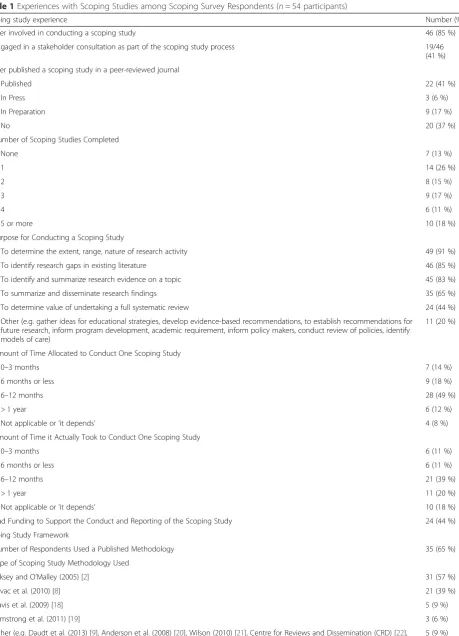
The majority of questionnaire respondents (85 %) had ex-perience engaging in a scoping study with most (87 %) hav-ing completed at least one scophav-ing study and almost half having had a scoping study published or in press in a peer-reviewed journal (46 %; 25/54) (Table 1). Roles ranged from conceptualizing and refining the research question, over-sight, conducting literature searches / reviews, scanning
titles and abstracts to determine study inclusion, data ex-traction, synthesizing the evidence, writing-up, and dissem-inating findings. Most respondents engaged in scoping studies to examine the extent, range, nature of research ac-tivity (91 %), to map a body of evidence, and to identify gaps in the field; which was similarly documented as com-mon purposes for conducting scoping studies [11] (Table 1).
Of the 46 respondents (85 %) who were involved in a scoping study, 19 (41 %) had engaged in a stakeholder consultation, 7 (37 %) of which went through Research Ethics Board (REB) review for the process. Reasons for pursuing REB review were because investigators intended
to publish results and/or conducted interviews with ‘
ex-perts’. Respondents chose not go through REB review
when the scoping study was conducted by a community organization, when there was no formal REB process available, when respondents did not plan to publish in an academic journal, when the scoping study was done to in-form a systematic review, or the consultation involved stakeholders as part of a steering committee who provided feedback throughout the study. Finally, the majority of participants utilized a framework opposed to only half of investigators in a previous review suggesting there is in-creasing appetite for adopting a more rigorous approach to this methodology [11].
Strengths and challenges of scoping studies
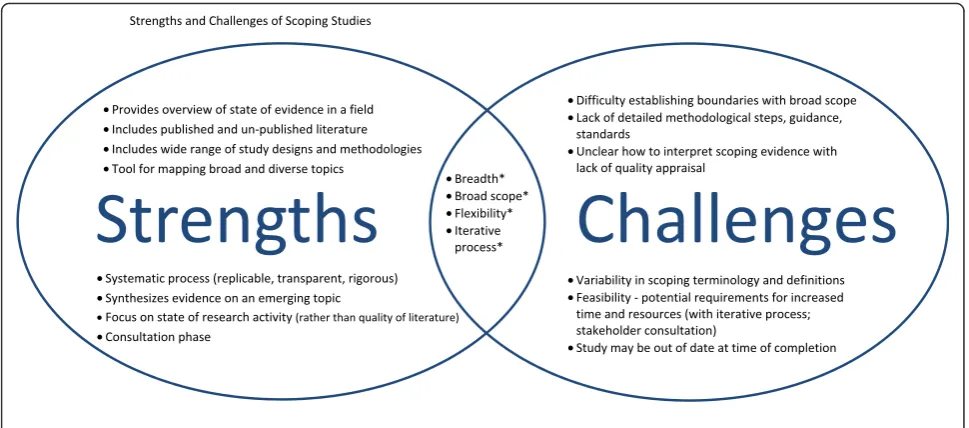
Many scoping study strengths were dually identified as challenges (Fig. 1). Respondents described the strengths of scoping studies in relation to their ability to provide an
‘overview of the state of evidence in a field’their ‘breadth’,
‘broad scope’ and ‘tool for mapping broad and diverse topics’ to inform future work. Strengths associated with
scoping study methodology included their flexibility,
inclusion of published and unpublished (grey) literature, inclusion of literature with a wide range of study designs and methodologies, and the potential to combine qualita-tive and quantitaqualita-tive synthesis approaches. Respondents highlighted the systematic process (replicable, transparent, rigorous) that provides the ability to explore and synthesize evidence on a newly emerging topic (or topic with little published evidence), using an approach that is
‘not as rigid as systematic reviews’. Additional strengths
included the ability for scoping studies to focus on the state of research activity rather than evaluate the quality of existing literature, the ability to assist policy makers to make evidence-informed decisions, and engagement of stakeholders with expertise in a given content area throughout all stages of the process.
Table 1Experiences with Scoping Studies among Scoping Survey Respondents (n= 54 participants)
Scoping study experience Number (%)
Ever involved in conducting a scoping study 46 (85 %)
Engaged in a stakeholder consultation as part of the scoping study process 19/46
(41 %)
Ever published a scoping study in a peer-reviewed journal
Published 22 (41 %)
In Press 3 (6 %)
In Preparation 9 (17 %)
No 20 (37 %)
Number of Scoping Studies Completed
None 7 (13 %)
1 14 (26 %)
2 8 (15 %)
3 9 (17 %)
4 6 (11 %)
5 or more 10 (18 %)
Purpose for Conducting a Scoping Study
To determine the extent, range, nature of research activity 49 (91 %)
To identify research gaps in existing literature 46 (85 %)
To identify and summarize research evidence on a topic 45 (83 %)
To summarize and disseminate research findings 35 (65 %)
To determine value of undertaking a full systematic review 24 (44 %)
Other (e.g. gather ideas for educational strategies, develop evidence-based recommendations, to establish recommendations for future research, inform program development, academic requirement, inform policy makers, conduct review of policies, identify models of care)
11 (20 %)
Amount of Time Allocated to Conduct One Scoping Study
0–3 months 7 (14 %)
6 months or less 9 (18 %)
6–12 months 28 (49 %)
> 1 year 6 (12 %)
Not applicable or‘it depends’ 4 (8 %)
Amount of Time it Actually Took to Conduct One Scoping Study
0–3 months 6 (11 %)
6 months or less 6 (11 %)
6–12 months 21 (39 %)
> 1 year 11 (20 %)
Not applicable or‘it depends’ 10 (18 %)
Had Funding to Support the Conduct and Reporting of the Scoping Study 24 (44 %)
Scoping Study Framework
Number of Respondents Used a Published Methodology 35 (65 %)
Type of Scoping Study Methodology Used
Arksey and O’Malley (2005) [2] 31 (57 %)
Levac et al. (2010) [8] 21 (39 %)
Davis et al. (2009) [18] 5 (9 %)
Armstrong et al. (2011) [19] 3 (6 %)
Other (e.g. Daudt et al. (2013) [9], Anderson et al. (2008) [20], Wilson (2010) [21], Centre for Reviews and Dissemination (CRD) [22], Bragge (2011) [23])
challenge included the variability in terminology and un-clear definitions of concepts of interest, which made iden-tifying the study scope difficult. The flexible and iterative process of defining (and redefining) the research question, search strategy and selection criteria required increased time and resources which was difficult to ascertain at the beginning of the study. The broad scope combined with lack of clarity around boundaries left some with an over-whelming amount of data, posing challenges for feasibility as scoping studies were often time-consuming and took longer than originally anticipated. This could place a scop-ing study at risk of quickly becomscop-ing out of date. Some re-spondents expressed challenges with the utility of a final product or outcome that was sometimes uncertain at the
outset of the study: “Sometimes it feels like a lot of work
just to identify gaps or determine that more research is needed.”
Respondents expressed challenges with the lack of de-tailed steps, guidance, standards, or methodology (particu-larly if and how to synthesize data from selected studies). They described the need for more clarification about the need and steps associated with the consultation phase. Some described difficulty finding unpublished (or grey) forms of evidence, synthesizing evidence from diverse sources with different types of data, diversity of reviewers or investigators involved, and lack of clarity of how to conduct the synthesis (or analysis) leaving some with an overwhelming amount of data if the scope was broad; and the lack of quality appraisal that resulted in the need for caution in interpretation. Some described challenges with the feasibility conducting the stakeholder consultation. Finally, respondents described challenges of reporting
results succinctly, and the difficulty publishing scoping studies with limitations in journal word counts.
Scoping terminology
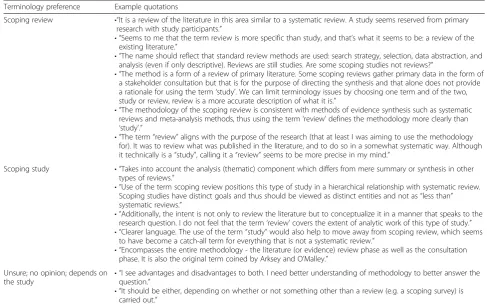
The majority of respondents preferred the term‘scoping
review’(68 %) over‘scoping study’(11 %) with remaining
respondents unsure or having no opinion suggesting ei-ther term could be appropriate, depending on the study (20 %) (Table 2).
Respondents who preferred the term ‘scoping review’
tended to focus on the literature review component of
the methodology stating ‘review’is “a more accurate
de-scription”, “consistent with methods of evidence synthesis such as systematic reviews and meta-analysis methods”.
As one respondent stated:
“the term“review”aligns with the purpose of the research….to review what was published in the literature, and to do so in a somewhat systematic way. Although it technically is a“study”, calling it a
“review”seems to be more precise in my mind.”
Respondents who preferred ‘scoping study’ did so
be-cause they “take into account the analysis (thematic)
component which differs from the mere summary or syn-thesis in other types of reviews”. Another participant
stated his/her preference in relation to the analytical dif-ference between scoping studies and other types of knowledge syntheses:
[image:6.595.56.541.87.301.2]systematic reviews…. the intent is not only to review the literature but to conceptualize it in a manner that speaks to the research question. I do not feel that the term‘review’covers the extent of analytic work of this type of study.”
Others felt that the term‘scoping study’provided clear
language that helps distinguish them from ‘scoping
re-views’that have become a “catch-all term for everything
that is not a systematic review”. Finally, scoping study
ter-minology was preferred by those who felt the term‘study’
encompassed the entire methodology, the literature (or evidence) review phase as well as the consultation phase. It was also acknowledged as the term coined by Arksey
and O’Malley, the developers of the original Scoping Study
Framework.
Defining features of scoping studies
Respondents described defining features of scoping studies, many of which were similar to strengths of the methodology (Table 1). Participants described the distinction of scoping studies from other forms of knowledge syntheses such as
lit-erature reviews, systematic or rapid reviews:“[scoping
stud-ies] are not as rigorous as systematic reviews but more distinctive in methodology”and are“less likely to be strongly influenced by opinion than a traditional literature review”.
Others struggled to distinguish scoping studies from other forms of syntheses as one participant stated:
“This is challenging to distinguish. In many aspects scoping reviews are similar to systematic reviews in methodology with the capture of the broad research question, broad eligibility criteria, no quality assessment and consultation exercise.”
Given the similarities in comprehensiveness and
sys-tematic nature,“the difference in method is not as great
as some might think”. Similarly another participant did not perceive there to be distinctions between scoping studies and other syntheses:
“I do not think that there is anything inherently distinct about scoping study methodology…I think that the‘scoping study phenomenon’is the product of a methodological title being applied widely and loosely for reasons that are completely logical given the current context of health sciences research.”
[image:7.595.53.541.99.406.2]Overall, participants described similarities between scoping and systematic reviews in relation to transpar-ency, rigor, and systematic nature, whereas the distinc-tion between scoping and literature reviews were easier
Table 2Scoping Study Terminology Preferences from Responses to the Scoping Study Questionnaire
Terminology preference Example quotations
Scoping review •“It is a review of the literature in this area similar to a systematic review. A study seems reserved from primary research with study participants.”
• “Seems to me that the term review is more specific than study, and that’s what it seems to be: a review of the existing literature.”
• “The name should reflect that standard review methods are used: search strategy, selection, data abstraction, and analysis (even if only descriptive). Reviews are still studies. Are some scoping studies not reviews?”
• “The method is a form of a review of primary literature. Some scoping reviews gather primary data in the form of a stakeholder consultation but that is for the purpose of directing the synthesis and that alone does not provide a rationale for using the term‘study’. We can limit terminology issues by choosing one term and of the two, study or review, review is a more accurate description of what it is.”
• “The methodology of the scoping review is consistent with methods of evidence synthesis such as systematic reviews and meta-analysis methods, thus using the term‘review’defines the methodology more clearly than
‘study’.”
• “The term“review”aligns with the purpose of the research (that at least I was aiming to use the methodology for). It was to review what was published in the literature, and to do so in a somewhat systematic way. Although it technically is a“study”, calling it a“review”seems to be more precise in my mind.”
Scoping study • “Takes into account the analysis (thematic) component which differs from mere summary or synthesis in other types of reviews.”
• “Use of the term scoping review positions this type of study in a hierarchical relationship with systematic review. Scoping studies have distinct goals and thus should be viewed as distinct entities and not as“less than” systematic reviews.”
• “Additionally, the intent is not only to review the literature but to conceptualize it in a manner that speaks to the research question. I do not feel that the term‘review’covers the extent of analytic work of this type of study.”
• “Clearer language. The use of the term“study”would also help to move away from scoping review, which seems to have become a catch-all term for everything that is not a systematic review.”
• “Encompasses the entire methodology - the literature (or evidence) review phase as well as the consultation phase. It is also the original term coined by Arksey and O’Malley.”
Unsure; no opinion; depends on the study
• “I see advantages and disadvantages to both. I need better understanding of methodology to better answer the question.”
to distinguish with scoping studies taking on a more sys-tematic and rigorous nature of methodology.
Methodological steps
The majority of respondents to the scoping question-naire (90 %) agreed that scoping studies should involve grey literature, and 31 % (16/54) felt that quality assess-ments of individual included studies should become a part of scoping methodology. Some respondents felt that quality assessment depends on the nature of the re-search question; for example if a question pertained to effectiveness of an intervention then quality assessment may be critical opposed to the exploration or description of an emerging topic where there may be less formulated evidence in a field.
Perspectives on terminology, definition, and methodological steps
The following results include collective interpretations of the survey results from the meeting consultation as they relate to terminology, definition and methodological steps.
Terminology
Despite our intention, no consensus was achieved related to scoping terminology. Two opposing views appeared to emerge from the meeting: individuals who align scoping
reviews(note the terminology) with other types of
system-atic reviews, and those who view scoping studies as
dis-tinct from other reviews. This may explain the lack of consensus surrounding terminology, methodological steps and positivist versus constructivist approaches (associated with reviews versus studies, respectively) to scoping the field of evidence. Others felt the distinction between
‘study’over‘review’was attributed to the higher analytical
level of synthesis of data from existing evidence (rather than reporting frequencies of literature characteristics) as well as the consultation phase that requires primary data collection and qualitative approaches to analysis, which results in a new outcome or product that is relevant and meaningful to the field; examples include a framework of existing evidence, or recommendations for future research priorities.
While the majority of questionnaire respondents (68 %) preferred the term scoping review (over study), the meet-ing provided insight to the historical development of the Scoping Study Framework from the perspective of Arksey
and O’Malley. The preference for scoping review seemed
to emerge from the methodological steps referencing
re-view of the literature, and feeling that‘scoping review’
pro-vided more legitimacy and rigor if considered in the same classification of systematic reviews, which have clear established steps and reporting criteria [24]. However, the
term‘scoping study’was intentionally chosen to distance
itself from the ‘systematic review’ specifically aimed at
determining clinical effectiveness of an intervention, to broaden awareness and inclusion of other types of evi-dence beyond the randomized controlled trial which may be traditionally favored in systematic reviews [13]. Scoping studies are intended to map a field and expose gaps in evi-dence. Developers borrowed elements from systematic re-views such as scoping studies as rigorous, systematic, replicable, and transparent while adding elements such as the iterative or flexible nature of the steps, lack of quality appraisal and addition of the consultation phase. Never-theless, results suggest scoping studies may have evolved where researchers view them as a form of knowledge
syn-thesis, hence adopting the term‘review’. Overall, the way
in which we distinguish scoping studies from other forms of reviews within the broader context of syntheses will be important for moving forward.
Challenges adopting universal terminology and a def-inition may be a reflection of the complex and diverse reasons in which someone may adopt scoping method-ology, the diversity of research questions which this
methodology may address (i.e. Arksey and O’Malley
dis-cuss four possible purposes alone), and the uptake across diverse disciplines using the methodology.
Another challenge distinguishing scoping studies from scoping reviews may be attributed to the systematic nature which both approaches adopt. Most survey respondents
believed scoping studies (and reviews) are carried out
sys-tematicallyand it is thesystematiccharacteristic that differ-entiates scoping studies (or reviews) from literature reviews. However, both terms (study and review) affiliate with similar characteristics with respect to their systematic, comprehensive and transparent nature, which may lead to difficulty in establishing how scoping studies are distin-guished from other types of reviews. Peters et al. expressed the importance of distinguishing between scoping reviews
and ‘comprehensive’ systematic reviews that also rely on
synthesizing evidence from different study designs [25]:
‘While in a scoping review the goal is to determine what
kindof evidence is available on the topic and to represent
this evidence by mapping or charting the data, comprehen-sive systematic reviews are designed to answer a series of
related but still very specific questions’(Page 8) [25].
policy). For example, scoping studies have been used to ex-plore the emerging field of HIV and aging [26]. Authors characterized the literature describing the impact of aging on the health of older adults living with HIV (e.g. types of study design, participants, interventions (if applicable), health care domains addressed) and provided recommen-dations for future HIV and aging research [26].
Definition
Meeting participants generally agreed on a working def-inition of scoping studies as proposed by Colquhoun et
al. [12] adapted to:‘a scoping study or scoping review is a
form of knowledge synthesis that addresses an explora-tory research question aimed at mapping key concepts, types of evidence, and gaps in research related to an emerging area or field by systematically and iteratively searching, selecting, summarizing and potentially synthe-sizing existing knowledge.’
Debate emerged over the extent to which data are summarized or synthesized in scoping studies, whether synthesis is a defining characteristic of scoping studies and whether this makes it distinct from a literature
re-view. For instance, the step of ‘collating the data’could
span the spectrum of pure counting of characteristics (descriptive) to a more analytical (thematic or content analysis) for variables of interest such as characteristics of interventions, outcomes, and authors conclusions. Debate also ensued over whether scoping studies should always yield recommendations for practice and policy, which require a higher level of synthesis and interpret-ation, and whether recommendations should only be de-veloped after the formal consultation phase.
Overall, results from the survey and multi-stakeholder consultation provided rich insight into the views and perspectives of scoping terminology, definition and methodological steps providing further insight into why a lack of consensus may exist. The diversity of fields in-creasingly adopting this methodology may offer some explanation to the challenges seen to date in adopting a universal term and definition. Nevertheless, for this methodology to maintain the rigor which it aspires to achieve and sustain, it is critical we consider adopting clear and consistent language that may be transferrable across disciplines.
Methodological steps
Overall, meeting participants viewed scoping studies as systematic, rigorous and transparent, while allowing for flexibility of process. The following features emerged as distinct characteristics for each of the methodological
steps: 1)research question and scoping purpose
(explora-tory, mapping, breadth); 2)search strategy and study
se-lection (iterative, inclusive of grey literature and diverse
study designs), 3) charting collating and summarizing
(involves no quality assessment of included studies, may be iterative, synthesis could range from descriptive (counting characteristics of studies) to analytical (synses of qualitative and quantitative data involving
the-matic or content analysis) and 4) consultation phase
conducted after the literature review (emerging from the field of qualitative research that involves consultation with knowledge users and community members to ad-dress the research question; an essential form of know-ledge transfer and exchange).
While ongoing consultation may occur in other types of studies or reviews (providing expertise, context and inter-pretation), the consultation phase in scoping studies was viewed as a formalized and distinct phase involving key in-formants and/or stakeholders with expertise in the field of inquiry. The consultation phase in scoping studies, if undertaken, requires formal recruitment, data collection, qualitative approaches to analysis and interpretation, and ethics board review. Consultation goes beyond integrated or end-of-study knowledge translation and exchange and involves acquiring new information, enabling investigators to formally present findings from the literature synthesis, obtaining further experiential evidence and perspectives related to the scope of inquiry, and offering interpretations and considerations for the broader field. These character-istics provide a foundation from which to support our above proposed scoping study definition and will help to inform the development of future reporting guidelines.
Key considerations in scoping study methodology
To our knowledge this is the first study to explore expe-riences and opinions on scoping study methodology from the perspectives of researchers, clinicians, commu-nity members, representatives from commucommu-nity-based organizations, and policy stakeholders with expertise and/or interest in this methodology. This work directly builds on earlier work in an attempt to offer consider-ations related to terminology, definition and guidance on the methodological steps and rigor for the conduct and reporting of scoping studies [8, 9, 11, 12].
We will now discuss key considerations for engaging in scoping study methodology that emerged from the survey and multi-stakeholder consultation with researchers, clini-cians, knowledge users and policy stakeholders.
Ongoing debate of scoping terminology, definition, and purpose: Respondents expressed the need to develop clarity and consensus on terminology, definition, and purpose of conducting a scoping study. This will help to indicate when a scoping study is appropriate (and when it is not), and provide a foundation for developing de-tailed descriptions of each methodological step in con-ducting and reporting guidance for scoping studies. In the future we might consider whether clarity around the
‘scoping review’ may help to distinguish where this methodology lies on the spectrum of knowledge synthe-ses. Scoping studies also may be referred to either a map
or syntheses, depending on whether they describe the
characteristics versus synthesize the literature [27]. We
did not specifically aim to determine how scoping study definitions and methodologies differ or align with other types of syntheses. This is an important focus of future work. Distinguishing ways in which scoping studies (or reviews) differ from other review methodologies for key dimensions including aims and approaches, structure and components; and breadth and depth, provides a strategy for clarifying the definition and purpose of this methodology [28].
Clarity of concept of interest and methodological steps: Clearly defining the concept of interest can help to es-tablish boundaries for the scope of inquiry, search strat-egy and inform the study selection process. Specific steps respondents felt required more clarity and instruc-tion included i) how to engage stakeholders throughout the process, ii) clarity around the consultation phase, iii) more detail on stage five of collating, summarizing and reporting the results, specifically how to go about the synthesis and reporting of grey literature, and how to synthesize, and report a combination of quantitative and qualitative synthesis techniques, and iv) adding a meth-odological step specific to knowledge translation of scoping study results. Piloting the process for study se-lection and data extraction can help to ensure universal understanding of the construct of interest, study selec-tion criteria, and characteristics of interest for extracselec-tion among members of the team [8]. Recently published guidelines provide detailed steps on how to define these concepts in a study and how they can help to inform the selection criteria and search strategy [25, 29]. Further insight is needed for ways to optimally present study
findings to best represent the‘mapping of evidence’(e.g.
framework, tables, and figures) within the context of journal requirements for publication.
Consultation phase: Respondents articulated the need to consider the consultation phase as distinct but com-plementary to ongoing consultation throughout the scoping process. The integrated consultative approach often is informal and does not require formal forms of data collection or analysis; the stakeholder is a member of the scoping team. Alternatively, consultation is a
for-mal stage of the Arksey and O’Malley Framework
whereby experts and key informants are formally con-sulted on the results of the literature review and provide further insight into experiential evidence, interpret what is found in the literature (strengths and gaps), and pro-vide recommendations for moving forward [2]. The con-sultation phase involves sharing findings from the literature review and gaining additional expertise or
perspectives on the construct of interest. In most cases the consultation phase will require a formal phase of re-cruitment and data collection requiring REB review. While increasing time and complexity, the consultation phase has the potential to enhance the quality and rele-vance of findings to the field [8].
Methodological quality assessment. Absence of meth-odological quality assessment was considered a distinct feature of scoping studies as the aim of this approach is to map the evidence produced in a given field rather
than seeking out the best available evidenceto answer a
question related to policy and practice [25]. However, some recommend quality assessment to determine study inclusion [9]. If the lack of quality assessment is a defin-ing feature of scopdefin-ing studies, does introducdefin-ing this component by nature no longer define it as a scoping study? Participants in this study felt that absence of methodological quality assessment as a defining feature of scoping studies requires further discussion. Methodo-logical quality may be of value in certain circumstances depending on the research question, specifically if it re-lates to determining the impact or effect of an interven-tion or program. In these instances, a systematic review may be more appropriate. Overall, the increasing num-ber of types of knowledge syntheses can result in a lack of clarity when choosing (or not choosing) to undertake a scoping study. The research question, the context of the field, and the type and level of evidence available are important considerations for choosing a scoping study over an alternate form of knowledge synthesis.
These considerations pose further inquiry and examin-ation in order to move the field forward with clarity and consensus surrounding terminology, definition and methodological steps. Strategies to enhance methodo-logical rigour that emerged from this work similarly re-flect those documented in the literature such as clearly justifying the use of scoping study methodology over other forms of knowledge syntheses, and articulating a clear and focused scoping purpose which directly links to the research question and study objectives [8, 25, 29]. In the absence of clear consensus, we recommend con-tinuing to follow the steps as outlined in the Scoping
Study Framework by Arksey and O’Malley [2] and
sup-plemented by Levac et al. [8] and Daudt and colleagues [9], while considering newly published recommendations on the methodological protocol of conducting and reporting scoping studies [25, 29].
Considerations for interpretation
This consultation was built on the foundational work by
Arksey and O’Malley who established the original Scoping
consider views of scoping study terminology, definition and steps after participants at a 2-day meeting which in-cluded a historical background and overview from Lisa
O’Malley (LOM). Four authors are rehabilitation
profes-sionals who work in areas of complex chronic disease, hence people living with chronic disease were key knowledge users involved throughout this work. These authors developed an interest in scoping study methodology after each completed a scoping study in separate areas of rehabilitation and expe-rienced similar challenges implementing the methodology. Scoping studies offered a method to comprehensively synthesize evidence across a range of study designs where a paucity of randomized controlled trials can exists in the field of rehabilitation and chronic illness.
Our approach was not without limitations. First, this is a small sample primarily from Ontario, Canada with a diver-sity of expertise in scoping studies; hence the perspectives are not fully representative of experts and people conduct-ing scopconduct-ing reviews nationally or internationally. Neverthe-less, participants represented a range of perspectives from those involved in developing the original Framework, other reporting guidelines, and participating in studies offering diverse perspectives and experiences form which to draw these considerations. Future work may consider expanding representation from other countries where the role for scoping studies is emerging. Lastly, the paper provides broad considerations for engaging in scoping study meth-odology. Next steps will be for researchers, clinicians and knowledge users to conduct a broader consultation to fur-ther advance the terminology and definition, develop a methods manual, reporting guidelines and methodological quality criteria of this budding field.
Conclusions
Overall we provide an overview of experiences, views on terminology, definition, methodological steps, and key considerations in the conduct and reporting of scoping studies. This work provides a foundation for researchers, clinicians and knowledge users to consider when think-ing about usthink-ing scopthink-ing study methodology. Results re-flect the current state of the scoping study field as it evolves and is increasingly adopted by different disci-plines. While a challenging time, it also reflects an excit-ing time and opportunities in which this methodology is being adopted by various disciplines. Further work is needed to clarify terminology and definitions in order to formulate methodological quality criteria for conducting and reporting the emerging field of scoping studies.
Additional files
Additional file 1:Scoping Study Questionnaire. (PDF 159 kb)
Additional file 2:Scoping Study Consultation Meeting Agenda. (PDF 142 kb)
Abbreviations
HIV, Human Immunodeficiency Virus; REB, Research Ethics Board.
Acknowledgements
We acknowledge all individuals who participated in the scoping study questionnaire and multi-stakeholder consultation. Some of who agreed to be acknowledged in this work include (in alphabetical order): Samantha Cheuk (McMaster University), Shaun Cleaver (University of Toronto), Lynn Cockburn (University of Toronto), Simon French (Queen’s University), Stephen J. Gentles (McMaster University), Michele Hamm (University of Alberta), Jill Hayden (Dalhousie University), Sander L. Hitzig (York University), Tanya Horsley (Royal College of Physicians and Surgeons of Canada), Emma Irvin (Institute for Work & Health), Anna Lambrinos (Health Quality Ontario), John N. Lavis (McMaster University), Erin Lillie (St. Michael’s Hospital), Zack Marshall (Memorial University), Michelle Mujoomdar (Canadian Agency for Drugs and Technologies in Health), Kate Murzin (Canadian Working Group on HIV and Rehabilitation), Stephanie Nixon (University of Toronto), Gillian Parker (Univer-sity of York), Mai Pham (Univer(Univer-sity of Guelph), Louise Rose (Univer(Univer-sity of Toronto), Sergio Rueda (Centre for Addiction and Mental Health), Anne Sales (University of Michigan), Enid Selkirk (McMaster University), Nancy Sikich (Health Quality Ontario), Henry T. Stelfox (University of Calgary), Michelle Swab (Memorial University), Stephen Tattle (Canadian Working Group on HIV and Rehabilitation), Aliki Thomas (McGill University), Anne-Marie Tynan (St. Michael’s Hospital), Saipriya Vajravelu (McMaster University), Dwayne Van Eerd (Institute for Work & Health), Julie Vaughan-Graham (University of Toronto), Lisa Waddell (Public Health Agency of Canada), Tammy C. Yates (Canadian Working Group on HIV and Rehabilitation), and Wasifa Zarin (St. Michael’s Hospital).
We acknowledge the rapporteurs from the Rehabilitation Sciences Institute (RSI) who were involved in documenting the discussion from the scoping study meeting including: Christie Welch, Lisa Wickerson, Katherine Stewart, Katie E. Mah, Alicia Hilderley and Emily S. Ho.
We acknowledge the principal knowledge users and community
collaborators in this work including the Canadian Working Group on HIV and Rehabilitation (Tammy C. Yates, Stephen Tattle, Kate Murzin). We especially thank Erin Lillie and Wasifa Zarin, St. Michael’s Hospital for their involvement in the planning and implementation of the scoping study meeting, and Jennifer Deevy for her assistance in planning the meeting. We thank the Li Ka Shing Knowledge Institute of St. Michael’s Hospital for the provision of meeting space.
Funding
This work was funded by the Canadian Institutes of Health Research (CIHR) (Grant Number: MAG-133817). David Moher (DM) is funded by a University Research Chair. Kelly K. O’Brien (KKO) is supported by a CIHR New Investiga-tor Award and Andrea Tricco (ACT) is supported by a CIHR Drug Safety and Effectiveness Network New Investigator Award in Knowledge Synthesis.
Availability of data and materials
The datasets generated during and/or analyzed during the current study are not publicly available in accordance with our study protocol that was approved by the University of Toronto, Research Ethics Board. Data may be available upon reasonable request by contacting the corresponding author.
Authors’contributions
KKO, HC, DL and LB led the conceptualization, planning and implementation of the scoping study survey and meeting which was further supported through ongoing consultation with ACT, SS, and AN. DM and LOM were collaborators and keynote speakers at the scoping study consultation meeting. KKO led the analysis which was refined by HC, DL, LB, ACT, SS, LW, and AN. LW and KKO conducted the content analysis from the scoping study meeting data. KKO drafted the original manuscript. DL, LB, HC, AN, SS, ACT, LW, DM, and LOM, reviewed and provided revisions to earlier versions of the manuscript. All authors read and approved the final manuscript.
Competing interests
The authors declare that they have no competing interests.
Consent for publication
Ethics approval and consent to participate
This study received ethics approval from the University of Toronto Health Sciences Research Ethics Board (REB) (Protocol Reference #: 31214). For the scoping study survey, completed questionnaires were considered implied consent. For the meeting consultation, consent was based on the individual accepting the invitation and attending the meeting.
Author details
1Department of Physical Therapy, University of Toronto, 500 University Avenue, Room 160, Toronto, Ontario M5G 1V7, Canada.2Institute of Health Policy, Management and Evaluation (IHPME), University of Toronto, 155 College Street, Suite 425, Toronto, Ontario M5T 3M6, Canada.3Rehabilitation Sciences Institute (RSI), University of Toronto, 500 University Avenue, Room 160, Toronto, Ontario M5G 1V7, Canada.4Department of Occupational Science and Occupational Therapy, 500 University Avenue, Room 160, Toronto, Ontario M5G 1V7, Canada.5Bouve College of Health Sciences, Department of Movement and Rehabilitation Sciences, Northeastern University, 360 Huntington Avenue, Boston, MA 02115, USA.6Community Member and Knowledge User, Halifax, Nova Scotia, Canada.7Li Ka Shing Knowledge Institute, St. Michael’s Hospital, 30 Bond Street, Toronto, Ontario M5B 1W8, Canada.8University Health Network, Toronto General Hospital, 200 Elizabeth Street, Toronto, Ontario M5G 2C4, Canada.9Ottawa Hospital Research Institute, 725 Parkdale Avenue, Ottawa, Ontario K1Y 4E9, Canada. 10
School of Epidemiology, Public Health and Preventive Medicine, Faculty of Medicine, University of Ottawa, 451 Smyth Road, Roger-Guindon Building, Ottawa, Ontario K1H 8M5, Canada.11Department of Social Policy and Social Work, University of York, Heslington, York YO10 5DD, UK.
Received: 7 January 2016 Accepted: 22 July 2016
References
1. Canadian Institutes of Health Research. A guide to knowledge synthesis. 2. Arksey H, O’Malley L. Scoping studies: towards a methodological framework.
Int J Soc Res Methodol. 2005;8(1):19–32.
3. Tricco AC, Lillie E, Zarin W, O’Brien K, Colquhoun H, Kastner M, Levac D, Ng C, Pearson Sharpe J, Wilson K, et al. A scoping review on the conduct and reporting of scoping reviews. BMC Med Res Methodol. 2016;16:15. 4. Shea BJ, Grimshaw JM, Wells GA, Boers M, Andersson N, Hamel C, Porter AC,
Tugwell P, Moher D, Bouter LM. Development of AMSTAR: a measurement tool to assess the methodological quality of systematic reviews. BMC Med Res Methodol. 2007;7:10.
5. Shea BJ, Bouter LM, Peterson J, Boers M, Andersson N, Ortiz Z, Ramsay T, Bai A, Shukla VK, Grimshaw JM. External validation of a measurement tool to assess systematic reviews (AMSTAR). PLoS One. 2007;2(12), e1350. 6. Moher D, Liberati A, Tetzlaff J, Altman DG. Preferred reporting items for
systematic reviews and meta-analyses: the PRISMA statement. PLoS Med. 2009;6(7), e1000097.
7. Brouwers MC, Kerkvliet K, Spithoff K, on behalf of the AGREE Next Steps Consortium. The AGREE Reporting Checklist: a tool to improve reporting of clinical practice guidelines. BMJ. 2016;352:i1152. doi:10.1136/bmj.i1152. 8. Levac D, Colquhoun H, O'Brien KK. Scoping studies: advancing the
methodology. Implement Sci. 2010;5:69.
9. Daudt HM, van Mossel C, Scott SJ. Enhancing the scoping study methodology: a large, inter-professional team’s experience with Arksey and O’Malley’s framework. BMC Med Res Methodol. 2013;13:48.
10. Kastner M, Tricco AC, Soobiah C, Lillie E, Perrier L, Horsley T, Welch V, Cogo E, Antony J, Straus SE. What is the most appropriate knowledge synthesis method to conduct a review? Protocol for a scoping review. BMC Med Res Methodol. 2012;12:114.
11. Pham MT, Rajic A, Greig JD, Sargeant JM, Papadopoulos A, McEwen SA. A scoping review of scoping reviews: advancing the approach and enhancing the consistency. Research Synthesis Methods. 2014;5(4):371–85.
12. Colquhoun HL, Levac D, O’Brien KK, Straus S, Tricco AC, Perrier L, Kastner M, Moher D. Scoping reviews: time for clarity in definition, methods, and reporting. J Clin Epidemiol. 2014;67(12):1291–4.
13. Scoping Study Team. Advancing the Field of Scoping Study Methodology. In: Scoping Meeting Final Report. University of Toronto; 2015. Available at: http://cuhrrc.hivandrehab.ca/docs/Scoping-Study-Meeting-Final-Report-CIRCULATED-Sept-22-15.pdf
14. Dillman DA. Mail and internet surveys: the tailored design method. Second Edition. Hoboken: John Wiley & Sons, Inc; 2007.
15. SurveyMonkey. FluidSurveys software. 2015. http://fluidsurveys.com 16. Esyenbach G. Improving the quality of web surveys: the checklist for reporting
results of Internet E-surveys (CHERRIES). J Med Internet Res. 2004;6(3), e34. 17. Hsieh HF, Shannon SE. Three approaches to qualitative content analysis.
Qual Health Res. 2005;15(9):1277–88.
18. Davis K, Drey N, Gould D. What are scoping studies? A review of the nursing literature. Int J Nurs Stud 2009;46(10):1386–1400.
19. Armstrong R, Hall BJ, Doyle J, Waters E. Cochrane Update. 'Scoping the scope' of a cochrane review. J Public Health (Oxf) 2011;33(1):147–150. 20. Anderson S, Allen P, Peckham S, Goodwin N. Asking the right questions:
scoping studies in the commissioning of research on the organisation and delivery of health services. Health Res Policy Syst 2008;6:7.
21. Wilson PM, Petticrew M, Calnan MW, Nazareth I. Disseminating research findings: what should researchers do? A systematic scoping review of conceptual frameworks. Implement Sci 2010;5:91.
22. Centre for Reviews and Dissemination, University of York, Heslington, York, YO10 5DD, UK. https://www.york.ac.uk/crd/.
23. Bragge P, Clavisi O, Turner T, Tavender E, Collie A, Gruen RL. The Global Evidence Mapping Initiative: scoping research in broad topic areas. BMC medical research methodology 2011;11:92.
24. Moher D, Liberati A, Tetzlaff J, Altman DG. Preferred reporting items for systematic reviews and meta-analyses: the PRISMA statement. J Clin Epidemiol. 2009;62(10):1006–12.
25. Peters MDJ, Godfrey CM, McInerney P, Baldini Soares C, Khalil H, Parker D. Methodology for JBI scoping reviews. In: Adelaide AE e, editor. The Joanna Briggs Institute reviewers’manual 2015. Australia: The Joanna Briggs Institute 2015; 2015. [Internet]. http://joannabriggs.org/assets/docs/sumari/ Reviewers-Manual_Methodology-for-JBI-Scoping-Reviews_2015_v2.pdf. 26. Chambers LA, Wilson MG, Rueda S, Gogolishvili D, Shi MQ, Rourke SB,
Positive Aging Review T. Evidence informing the intersection of HIV, aging and health: a scoping review. AIDS Behav. 2014;18(4):661–75.
27. Gough D, Oliver S, Thomas J. An introduction to systematic reviews, 2nd edn. Croydon: Sage Publications; CPI Group (UK) Ltd; 2016.
28. Gough D, Thomas J, Oliver S. Clarifying differences between review designs and methods. Systematic Reviews. 2012;1:28.
29. Peters MDJ, Godfrey CM, Khalil H, McInerney P, Parker D, Baldini Soares C. Guidance for conducting systematic scoping reviews. Int J Evid Based Healthc. 2015;13(3):141–6.
• We accept pre-submission inquiries
• Our selector tool helps you to find the most relevant journal
• We provide round the clock customer support
• Convenient online submission
• Thorough peer review
• Inclusion in PubMed and all major indexing services
• Maximum visibility for your research
Submit your manuscript at www.biomedcentral.com/submit