S T U D Y P R O T O C O L
Open Access
The Health Of Patients
’
Eyes (HOPE) Glaucoma
study. The effectiveness of a
‘
glaucoma personal
record
’
for newly diagnosed glaucoma patients:
study protocol for a randomised controlled trial
Marina Forbes
1*, Helen Fairlamb
2and Leon Jonker
2Abstract
Background:Glaucoma involves progressive optic nerve fibre loss, subsequently leading to irreversible and disabling visual field defects. In Europe, the prevalence of glaucoma is approximately 2.2 % of all people aged over 40 years; this equates to 12 million people. Glaucoma patients require regular lifelong follow-up, contributing to a large financial and resource burden for the National Health Service (NHS) in the UK. This study aims to determine whether providing newly diagnosed glaucoma patients with a personalised client-held eye health summary (‘glaucoma personal record’), improves patients’knowledge of their glaucoma condition. A potential long-term benefit could be improved self-management and henceforth a slower rate of deterioration.
Methods/Design:HOPE Glaucoma is a 3-year, prospective, parallel-group, pragmatic, single-centred, randomised controlled trial. An anticipated 122 adults, newly diagnosed with glaucoma (including ocular hypertension, suspected glaucoma and/or chronic open-angle glaucoma) will be recruited from a nurse-led ophthalmology outpatient clinic at a medium-sized NHS Trust. Participants will be randomly allocated to receive standard clinical care (control arm) or standard care plus a glaucoma personal record, detailing the current state of their condition (interventional arm). Participant assessments are designed to test whether provision of a glaucoma personal record 1) improves patient knowledge of glaucoma and 2) contributes to improvements in clinical outcomes, i.e. delay of visual field loss. The primary outcome measure is better client knowledge of glaucoma at the 9–12 month follow-up visit. Secondary outcome measures include the rate of visual field loss and patient-reported outcome measures on visual function (National Eye Institute VFQ–25) measured at baseline, 9–12 months, 24 months and 36 months. Estimating a 20 % drop-out rate, the study will have 90 % power to detect a mean two-point difference in glaucoma knowledge score between groups at 5 % significance - based on two-sided Mann–WhitneyUtest.
Discussion:If a glaucoma personal record is found to significantly improve glaucoma patients’knowledge of their condition, this intervention could potentially provide a low-cost, straightforward tool to educate and engage glaucoma patients. Subsequently, this could have the potential to increase patient self-management and therefore allow
glaucoma patients to prolong their sight functionality for longer. Trial registration:ISRCTN41306818, registered on 22 August 2013.
Keywords:Glaucoma, Ocular hypertension, Chronic open-angle glaucoma, Ophthalmology, Patient education, Knowledge,‘Glaucoma personal record’, Client-held eye summary, Individual record of care, Randomised trial
* Correspondence:[email protected]
1Clinical Nurse Specialist Ophthalmology, North Cumbria University Hospitals
NHS Trust, Cumberland Infirmary, Ophthalmology Department, Newtown Road, Carlisle CA2 7HY, UK
Full list of author information is available at the end of the article
Background
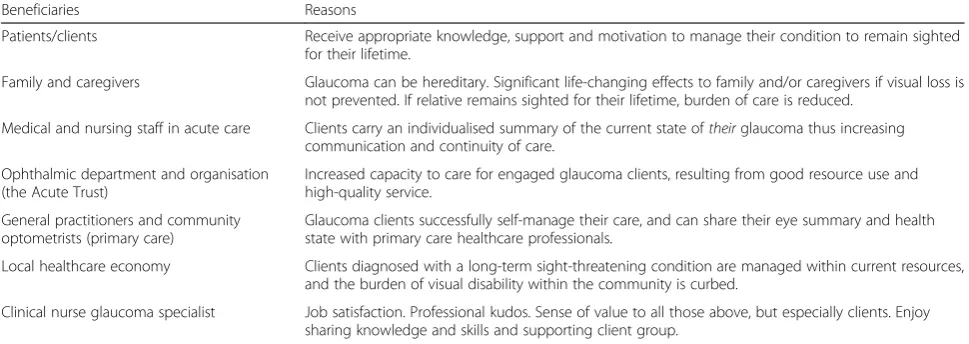
Glaucoma encapsulates a disparate group of eye diseases that are multi-factorial and individual to each patient. The common factor is progressive optic nerve fibre loss, which leads to irreversible and disabling visual field de-fects if it is not diagnosed and treated early. It is esti-mated that in Europe approximately 12 million people are affected by glaucoma, equating to 2.2 % of the popu-lation aged over 40 years [1]. These individuals require lifelong review to monitor their condition and response to topical ocular antihypertensive eye drops and/or other treatments. As the population ages, glaucoma will con-tinue to present a significant burden for our current healthcare resources [2]. Improved knowledge and un-derstanding has the potential to enhance compliance and any tool which increases patients’understanding of their glaucoma should be beneficial to all stakeholders. Beneficiaries of this research are presented in Table 1.
There are various client-held care records utilised throughout the UK healthcare services [3–5], yet there is a paucity of such records specifically designed for those with glaucoma. Previous research has recognised that clients who receive emotional support and information at the initial diagnosis of glaucoma benefit by displaying good compliance and co-operation with their care [6]. Individualised care of glaucoma patients, taking into ac-count healthcare needs and patient beliefs about illness and medicines, has also been shown to improve adher-ence to ocular hypotensive therapy and have the poten-tial to delay progression of the condition [7].
There is currently no available evidence of previous efforts to produce a client-held ‘glaucoma personal rec-ord’ for secondary care ophthalmic units and the au-thors are not aware of any research assessing whether client-held glaucoma personal records produce better health outcomes in glaucoma [8]. Clinical teams may
provide numerous resources to clients, depending on the individuals’specific needs, yet there is potential to produce a standardised summary that can be tailored to record each individual’s current appearance of their glaucoma status. This summary should add value to cli-ent care as it would be held by each individual and per-sonalised to reflect their condition. One would expect that providing glaucoma clients with their own personal
‘glaucoma personal record’or client-held eye summary, at diagnosis, may potentially help to engage them more effectively with their diagnosis and increase their understanding.
National Institute of Clinical Excellence (NICE) guide-lines on the diagnosis and management of chronic open-angle glaucoma and ocular hypertension recommend that research is required to assess “what is the clinical effectiveness and cost effectiveness of providing people with ocular hypertension (OHT), suspected glaucoma (SG) and/or chronic open-angle glaucoma (COAG) with a ‘glaucoma personal record’ compared with standard treatment?” [8]. This study aims to fulfil this require-ment by assessing the clinical effectiveness of providing patients with OHT, SG and/or COAG (henceforth col-lectively referred to as glaucoma) with an in-house de-veloped‘glaucoma personal record’, when compared with current standard best practice.
[image:2.595.56.541.560.732.2]Clinical effectiveness will primarily be measured by assessing patient knowledge concerning his/her own condition at 9–12 months, to coincide with a regular follow-up visit in clinic. Furthermore, client perception of how their glaucoma affects daily living and ophthal-mological clinical parameters will be measured annually for 3 years. The ultimate aim is to instigate methods of enhancing self-management through increased glaucoma awareness and potentially achieving deceleration of glau-coma progression in patients.
Table 1Beneficiaries of increased client understanding of their glaucoma
Beneficiaries Reasons
Patients/clients Receive appropriate knowledge, support and motivation to manage their condition to remain sighted for their lifetime.
Family and caregivers Glaucoma can be hereditary. Significant life-changing effects to family and/or caregivers if visual loss is not prevented. If relative remains sighted for their lifetime, burden of care is reduced.
Medical and nursing staff in acute care Clients carry an individualised summary of the current state oftheirglaucoma thus increasing communication and continuity of care.
Ophthalmic department and organisation (the Acute Trust)
Increased capacity to care for engaged glaucoma clients, resulting from good resource use and high-quality service.
General practitioners and community optometrists (primary care)
Glaucoma clients successfully self-manage their care, and can share their eye summary and health state with primary care healthcare professionals.
Local healthcare economy Clients diagnosed with a long-term sight-threatening condition are managed within current resources, and the burden of visual disability within the community is curbed.
Methods Trial design
This 3-year, prospective, single-centre, parallel-group, randomised, controlled clinical trial will assess the effect of graphic eye-health information provision to patients with glaucoma or risk of glaucoma.
Participants and settings
Newly referred patients attending a nurse-led ophthal-mology clinic in a medium-sized hospital in the North of England will be assessed by the chief investigator (CI), an ophthalmologic nurse specialist, for suitability using the criteria detailed below:
Inclusion criteria
– Adult (age≥18 years)
– Patients newly diagnosed with glaucoma, to include the following three presentations:
oocular hypertension (OHT): intraocular pressures (IOPs) above the normal range (more than or equal to 21 mmHg), but no signs of optic nerve fibre loss or visual field loss
osuspected glaucoma (SG): optic nerve fibre loss or visual field loss or both in presence of normal intraocular pressures
ochronic open-angle glaucoma (COAG): any combin-ation of raised intraocular pressures, optic nerve fibre loss and/or visual field loss.
oany combination of the above OHT, SG, COAG
– Both primary (cause of outflow resistance or angle closure is unknown) and secondary (outflow resistance results from another disorder) glaucoma cases can be included such as pigment dispersion syndrome (PDS) or pseudoexfoliative glaucoma (PEXF)
Exclusion criteria
– Under age (<18 years)
– Mental incapacity through inability to read, co-morbidities (e.g.severe stroke, advanced dementia) or any other contributing factor
– Inability to provide informed written consent
– Unable to speak or understand English since an interpreter is not available throughout the course of the study.
– Previous diagnosis of glaucoma
Other co-morbid ophthalmological conditions, such as cataracts and age-related macular degeneration are not
listed as exclusion criteria to ensure that the study is pragmatic.
Patients meeting the eligibility criteria will be recruited into the trial by the CI from a ‘new glaucoma’ referral clinic. Recruiting newly diagnosed adults, with little or no experience of previous glaucoma services, will reduce prior experience of secondary ophthalmic care and po-tential educational bias.
Consent
If eligible, patients will be given verbal and written infor-mation on the study by the CI during their consultation to avoid sensitisation to the objectives of the study. One key aspect of the study is to avoid priming patients about the potential benefit of education (utilising a post-test-only design). If patients are willing to participate, written informed consent will be obtained by the CI at the same consultation. There is, therefore, a limited time frame for patients to make a decision about participa-tion. However, the patient information sheet will stress that there is a‘cooling-off’ period and that patients can change their mind regarding participation at any given time. If a participant is already enrolled in another study, then he/she will be allowed to participate in this trial provided the other study does not exclude him/her from doing so.
Sample size
The anticipated patient sample size of 122 will be re-cruited over a 12-month period. Power calculations for sample size, 90 % power and 5 % significance, based on two-sided Mann–Whitney U test for the primary out-come measure, patient knowledge of glaucoma. A priori power calculations, using GPower 3.1 software, result in the following sample sizes summarized in Table 2. The calculation also takes into account a 20 % drop-out rate over the initial 9–12-month follow-up period before pa-tients return for their regular glaucoma follow-up and knowledge questionnaire visit.
Randomisation
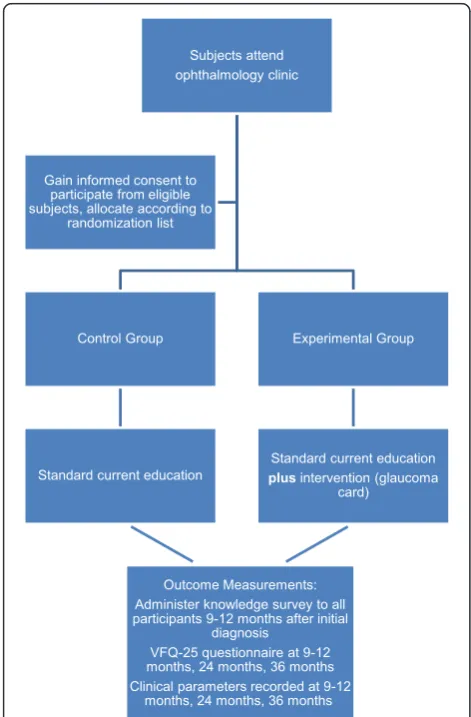
- if assigned to the intervention arm - presented with their glaucoma personal record by the CI immediately after written informed consent has been obtained. For overview of the study process, see Fig. 1.
Intervention description
Both groups will have exposure to current educational resources and materials presented at diagnosis, as is standard clinical practice. This may include an enlarged model of the eye, ocular anatomy posters, ocular coher-ence tomography sample scans, images of healthy and damaged optic nerve heads, examples of normal visual field tests and those showing glaucomatous loss, and a
glaucoma information leaflet to take away with them. The chief investigator’s contact number will also be pro-vided, as would be standard in her capacity as clinical nurse specialist in ophthalmology.
Those participants allocated to the interventional arm will, in addition to standard clinical care, be provided with their own ‘glaucoma personal record’ (Additional file 1), which will be personalised to document the current state of each participants’ glaucoma diagnosis and utilised during ophthalmologic review. Both groups of participants will be asked to complete the National Eye Institute Visual Functioning Questionnaire – 25 (VFQ-25) to gain an insight into patients’ perceptions about the impact that glaucoma may have on their daily living. The ‘glaucoma personal record’ will be adminis-tered to those participants randomised to receive the intervention by the CI immediately after the informed consent process has been completed.
Intervention development
Recent work by Waterman [10] identified the need for patients to be informed about their glaucoma, to help them understand their condition and the implications of poor medication adherence. The glaucoma personal rec-ord used in the HOPE Glaucoma trial (Additional file 1) was developed from the concept of the Spaeth-coloured glaucoma graph for diagnosed glaucoma patients and glaucoma suspects [11]. This graph provides both pa-tients and clinicians with visual information concerning current optic disc appearance. Spaeth and Paulus [11] claimed it is user-friendly because of the traffic light sys-tem. They also claimed that most patients understand that green indicates ‘safe’, yellow/amber means ‘caution’, and red means ‘danger’. They proposed that “the graph can help in patient counselling by increasing the under-standing regarding the disease status”. The work from Spaeth and Paulus inspired application of a traffic light system to visual field scoring using the Hoddap Classifi-cation [12, 13].
Although staging systems may be of limited value in clinical practice, the authors intended to put together an inexpensive yet useful ‘glaucoma personal record’. The Hoddap system has three stages, namely, early, moderate and advanced glaucomatous loss. The rate of progres-sion of visual field loss will be measured by regresprogres-sion analysis of the mean deviation from the mean, expressed in decibels per year. Since this glaucoma personal record is intended to help patients understand their current measures according to a traffic light system, best evi-dence available has to be balanced with simplicity, in order to be useful.
[image:4.595.58.291.101.164.2]The third fundamental measure obtained at regular glaucoma review appointments is intraocular pressure (IOP). Elevated IOP above 21 mmHg is considered a Table 2Sample size calculation
Mean score control group (± SD)
Mean score intervention group (± SD)
Required total sample size, n 7 (3) 8 (3) 400 (200 per group) 7 (3) 9 (3) 122 (61 per group) 7 (3) 10 (3) 58 (29 per group)
SDstandard deviation
[image:4.595.55.291.353.712.2]major risk factor in glaucoma pathology. Normal IOP is considered to be less than or equal to 20 mmHg. Apply-ing the traffic light system here means lower IOPs lie within the green ‘safe’ zone. IOPs between 21 and 30 mmHg - the amber zone - are observed with caution, al-though many other factors must be taken into consider-ation e.g. central corneal thickness, visual field loss or suspicious optic discs. Any IOP above 30 mmHg, the red zone, usually means antihypertensive treatment is re-quired as risk of glaucomatous damage or vein occlusion is considered too high to leave untreated.
The current glaucoma personal record under investi-gation is a coloured, A5-sized (or A4 if required), book-let of 16 pages. It was refined with advice from the International Glaucoma Association, who provided fi-nancial sponsorship for this study. This prototype glau-coma personal record is open to development and further refinement, depending on feedback and out-comes of this study.
Objective
This study aims to assess whether patient education, through the provision of a glaucoma personal record, re-sults in increased knowledge of their condition and whether this contributes to positive behavioural change and a reduction in the rate of visual field loss. The null hypothesis is that a patient-specific glaucoma personal record has no effect on client knowledge of glaucoma (OHT, SG or CAOG), quantified using a validated researcher-conducted survey at 9–12 months post-recruitment.
Outcome measures
Primary outcome
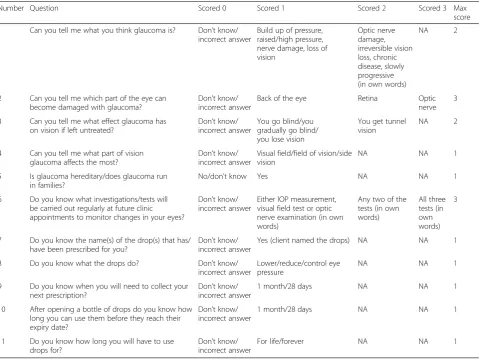
The primary outcome measure is client knowledge of glaucoma, quantified using a validated researcher-conducted survey at 6–12 months post-recruitment [8], see Table 3. This survey and scoring system was used, and validated by ophthalmic colleagues in 2009/2010“to establish the impact of educational support on clients’ knowledge of glaucoma and adherence, in preparation for a further interventional study”[9]. It provides an or-dinal score of participants’knowledge. The primary out-come measure is therefore the degree of understanding and knowledge retention of their OHT, SG, or COAG in the interventional group compared with the control group. Patients requiring ocular antihypertensive treat-ment at first presentation are eligible for inclusion in this trial; the total knowledge score achievable is either 12 for those not prescribed antihypertensive drops, or 17 for those prescribed eye drops during the course of the study. The survey will be administered by the CI when participants attend a‘glaucoma review’outpatient clinic between 6 and 12 months post-recruitment.
Secondary outcomes
The secondary, longer-term, outcome measure is rate of visual field loss. In line with clinical practice, visual field loss will be measured at least annually (more frequently if there is a clinical indication). The relative visual loss rates between control and intervention groups will also be measured annually. Visual field testing will be per-formed by standard automated perimetry (SAP) using the Humphrey Central 24–2 programme. The Hum-phrey perimeter provides print-outs with statistical ana-lyses of single field-test results, including numerical indices of reliability, and deviation from the norm of age-matched visual field analyses. The visual field indices used to identify progression of visual field loss will be mean deviation (MD) from the mean. MD represents the average difference between normal age-corrected sensitivity values and the subjects’measured values at all test points. The rate of progression of visual field loss will be measured by linear regression analysis of the MD from the mean, expressed in decibels per year (or the newer visual field index, which was not available at the start of this study).
A simple measure was selected for use in this trial. However, there are challenges to using visual field ana-lyses to detect progression. The test is subject to vari-ability in performance, even for the same patient. Modern perimetry attempts to reduce sources of error in, for example, reduced test time, continuous gaze/fix-ation monitoring. The role of the operator is crucial in assisting patients to perform the test as accurately as possible [13]. All visual field testing will be undertaken by the CI to reduce inter-assessor variability.
Trend analyses to quantify rate of visual field loss re-quire at least five tests to detect progression. This means relatively frequent testing in the first 2 years following diagnosis, especially if patients initially present with loss. The European Glaucoma Society (EGS) suggest three tests a year in the first 2 years. As such, this secondary outcome measure will take approximately 2–5 years to establish. The MD score will be documented in the
‘glaucoma personal record’ for the intervention group, and obtained from standard medical records for the con-trol group.
The patient glaucoma record will use ‘traffic light’ graphs to make it more straightforward for patients to see the status of their glaucoma for e.g. visual field loss [11]. A copy of the patient glaucoma record is available (Additional file 1).
Tertiary outcome
Participants’ demographic data will be collected and ana-lysed to compare the distribution between control and intervention groups in terms of: age, gender, postcode and highest level of education achieved. The latter two are of particular relevance as the study will assess self-education and disease awareness [15]. The control and intervention groups will also be stratified by disease diagnosis (OHT, SG and COAG), although the aforementioned primary and secondary outcome measures are based on collective data.
Other potential confounding factors that will be recorded for each participant are related to general eye health and the resulting management of the newly diagnosed glaucoma. It will be recorded if patients: have never worn glasses/lenses, wear glasses/lenses due to old age (reading and/or driving),
wear glasses since childhood or early adulthood due to con-genital visual defect. Note will also made whether patients are prescribed IOP-lowering eye drops or undergo a laser or surgical intervention during the study period.
Data collection and monitoring
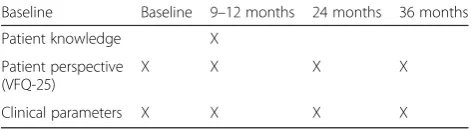
Participant follow-up will be 3 years. The estimated pri-mary completion date is September 2015 and the esti-mated study completion date is September 2017. An overview of the study timeline and recorded outcome measures are detailed in Table 4. Outcome data will be collected during clinically scheduled ophthalmology out-patient appointments with the CI and subjects will not be asked to attend any additional clinic appointments above those required for their clinical care. This design was used to increase the pragmatism of the study and improve sub-ject retention throughout the duration of the study. Out-come data will not be collected for patients that withdraw from the study or deviate from the study timeline.
[image:6.595.59.540.99.458.2]All data will be entered into a trial-specific database by a single administrator as they accumulate, access to Table 3The scoring system used to establish participants’knowledge of glaucoma and its management. Source: [9]
Number Question Scored 0 Scored 1 Scored 2 Scored 3 Max score 1 Can you tell me what you think glaucoma is? Don’t know/
incorrect answer
Build up of pressure, raised/high pressure, nerve damage, loss of vision
Optic nerve damage, irreversible vision loss, chronic disease, slowly progressive (in own words)
NA 2
2 Can you tell me which part of the eye can become damaged with glaucoma?
Don’t know/ incorrect answer
Back of the eye Retina Optic nerve
3 3 Can you tell me what effect glaucoma has
on vision if left untreated?
Don’t know/ incorrect answer
You go blind/you gradually go blind/ you lose vision
You get tunnel vision
NA 2
4 Can you tell me what part of vision glaucoma affects the most?
Don’t know/ incorrect answer
Visual field/field of vision/side vision
NA NA 1
5 Is glaucoma hereditary/does glaucoma run in families?
No/don’t know Yes NA NA 1 6 Do you know what investigations/tests will
be carried out regularly at future clinic appointments to monitor changes in your eyes?
Don’t know/ incorrect answer
Either IOP measurement, visual field test or optic nerve examination (in own words)
Any two of the tests (in own words)
All three tests (in own words)
3
7 Do you know the name(s) of the drop(s) that has/ have been prescribed for you?
Don’t know/ incorrect answer
Yes (client named the drops) NA NA 1 8 Do you know what the drops do? Don’t know/
incorrect answer
Lower/reduce/control eye pressure
NA NA 1
9 Do you know when you will need to collect your next prescription?
Don’t know/ incorrect answer
1 month/28 days NA NA 1 10 After opening a bottle of drops do you know how
long you can use them before they reach their expiry date?
Don’t know/ incorrect answer
1 month/28 days NA NA 1
11 Do you know how long you will have to use drops for?
Don’t know/ incorrect answer
For life/forever NA NA 1
which will be restricted and secure. All trial data will be pseudoanonymised by use of unique participant trial numbers. Access to the final data set will be limited to the trial administrator (HF) and statistician (LJ). A data monitoring committee will not be utilised throughout the study, but the study sponsor will audit study conduct and data quality as part of the sponsors’existing annual audit process. As the study intervention has no impact on the clinical management of glaucoma patients, there are minimal safety concerns for those involved with the HOPE Glaucoma study. Data on solicited and spontan-eously reported adverse events will not be collected.
Data analysis
Patient eligibility, recruitment and retention through the study will be presented in a CONSORT flow diagram displaying the number of eligible patients, patients approached with study information, patients recruited and randomised and patients completing study follow-up. Reasons for loss to follow-up will also be presented, where known. Participant baseline details and descriptive statistical data will be tabulated to show overall recruit demographics, and any differences in distribution (e.g. patient age, sex, level of education) will be analysed by applying one-way ANOVA or chi-squared test.
The primary outcome, the degree of difference in pa-tient knowledge about their glaucoma condition will be analysed by comparing the average scores for control pa-tients versus the average score of papa-tients received the glaucoma personal record. Statistical significance will be assessed by applying the Mann–Whitney U test. The secondary outcome, visual field loss, will be measured with a Humphrey Automated Visual Field Analyser in the ophthalmology clinic and average measurements for baseline visit and the final visit at 36 months will be compared within each group (control and intervention respectively) and also between the two groups. Depend-ing on distribution of the data, determined by Shapiro-Wilk test, the paired t test or Wilcoxon test will be applied for paired samples to determine any significant changes in visual field loss. For assessing differences be-tween the control and intervention groups, eitherttest or Mann–Whitney U test will be applied. Like visual field loss, the other secondary outcome measure - patient-related outcome measure VFQ-25 - will be presented as average scores. Any statistical differences will be assessed
by Wilcoxon test within each group and Mann–Whitney Utest between groups.
Research governance
Approval and support for this study has been obtained from the following bodies: the National Research Ethics Service (reference 12-YH-0471) and the sponsor, North Cumbria University Hospitals NHS Trust. Contact per-son for the sponsor is the R&D director, Dr Jim George. There is no provision made for non-negligent liability; the CI and other research team members are covered by standard NHS indemnity. The study is funded by a Nurse Research Grant from the International Glaucoma Associ-ation, based on the ethically approved study protocol (ver-sion 1, 19 September 2012) and supporting study documents (i.e. patient information sheet, consent form,
‘glaucoma personal record’) [16].
Publication and data-sharing policy
The study results will be presented at (inter)national sci-entific meetings and at local seminars and conferences. The results from the study will be written up and sub-mitted to a peer-reviewed journal. We intend to write a summary sheet for distribution in, e.g., ophthalmology waiting areas. This summary sheet can also be distrib-uted to participants upon request. All published data will not contain information that can identify any of the sub-jects who have participated in the study, in line with the Data Protection Act [17]. Each participant will be given a study number so that the data can be pseudoanonymised.
Discussion
The NICE Guideline Development Group published rec-ommendations for research into the clinical effectiveness of providing people with COAG with a‘glaucoma personal record’ when compared with standard treatment [8]. To the authors’knowledge, the HOPE Glaucoma study con-stitutes the first effort towards fulfilling NICE recommen-dations and the planned publication of study findings in circa 2017 will provide the first data generated by a rando-mised controlled trial on ‘glaucoma personal record’ provision. Findings will strengthen the evidence base avail-able for glaucoma management guideline development and may have a positive impact upon the future education and care of glaucoma patients.
[image:7.595.56.292.101.166.2]Strengths of the trial include the use of a time-matched control, the random allocation of the ‘glaucoma personal record’, allocation concealment to minimise selection bias, long-term recruit follow-up (36 months) and the use of validated questionnaires to capture outcome data. Due to its fairly pragmatic approach, the trial is not without limi-tations. The decision not to collect detailed data on patient co-morbidities could omit potential confounding factors throughout this trial. Other foreseeable study limitations Table 4Overview of study timeline and outcome measures
Baseline Baseline 9–12 months 24 months 36 months Patient knowledge X
Patient perspective (VFQ-25)
X X X X
Clinical parameters X X X X
include a limited patient demographic, due to recruitment from a single-centre in a rural location with a limited ethnic variety. The generalisability of trial findings may also be limited by the selection of participants from a nurse-led clinical nurse specialist new glaucoma referral clinic only. Gray et al.[9] indeed found that the depth of information provided for newly diagnosed patients varied across clinics and between individual clinicians. Despite this limitation, the use of one glaucoma practitioner throughout the dur-ation of the trial offers a means of standardising the type and quality of information and materials given to all partici-pants at diagnosis and during follow-up review. Variability in the nature of the information provided at diagnosis and in the quality of outcome measure assessment will be mini-mised, as the CI will be responsible for the provision and adaptation of care for all participants, according to the indi-vidual clinical need, and regardless of the arm to which they were allocated.
One other limitation of the trial includes the risk of bias. Due to the nature of the intervention - provision of a book-let - it is not feasible to mask participants to which arm of the study they will be allocated to. The CI is responsible for determining the suitability of participants, allocating the intervention and collecting data for the outcome measures in this trial, which introduces other sources of potential bias. The outcome assessor will not be masked to the inter-ventional group, as the assessor distributed the ‘personal glaucoma record’and clients will return with (or refer too) their record at follow-up; this increases the risk of detection bias. However, the utilisation of a second outcome assessor was deemed unworkable, and a pragmatic approach with one assessor was adopted.
The use of a‘glaucoma personal record’, such as the one produced for this trial, for those diagnosed with OHT, SG and/or COAG may provide an additional, low-cost source of information to patients and other ophthalmic health-care professionals which is easily produced and adminis-tered. Glaucoma personal records may have the potential to improve patients’understanding of their condition, help reduce patient uncertainty and potentially improve medi-cation adherence [18].
Trial status
Recruitment to the HOPE Glaucoma study began in June 2013. Recruitment is ongoing, with 85 % of the sample size achieved. The study is anticipated to reach the re-cruitment target of 122 participants in September 2014.
Additional file
Additional file 1:Glaucoma personal record.This is the study intervention;a booklet that can be personalised to contain participant’s clinical information relevant to their glaucoma. Only participants randomised to the interventional arm are provided with this booklet. (PDF 320 kb)
Abbreviations
CI:chief investigator; COAG: chronic open-angle glaucoma; HRQOL: health-related quality of life; IOP: intraocular pressure; MD: mean deviation; OHT: ocular hypertension; PDS: pigment dispersion syndrome; PEXF: pseudoexfoliative glaucoma; SAP: standard automated perimetry; SG: suspected glaucoma; VFQ-25: National Eye Institute Visual Functioning Questionnaire–25.
Competing interests
The authors declare that they have no competing interests.
Authors’contributions
MF conceived the study and is the chief investigator and project lead. HF and LJ made substantial contributions to the conception and design of the work, and contributed to ethics and grant applications. LJ will provide statistical support to the study and conduct the data analysis. MF and HF drafted this work, and LJ revised it. HF is the trial administrator. MF is the main grant holder; HF and LJ are collaborators on the grant. All authors read and approved the final manuscript.
Acknowledgments
The authors would like to thank Mr Gerard Ainsworth for critically appraising the study.
HOPE Glaucoma study is funded by a grant awarded by the International Glaucoma Association (IGA) and The Royal College of Nursing (RCN) [16]. This manuscript presents independent research funded by IGA. The views expressed in this manuscript are those of the author(s) and not necessarily those of the National Health Service (NHS) or IGA.
Author details
1Clinical Nurse Specialist Ophthalmology, North Cumbria University Hospitals
NHS Trust, Cumberland Infirmary, Ophthalmology Department, Newtown Road, Carlisle CA2 7HY, UK.2Cumberland Infirmary, R&D Department, North
Cumbria University Hospitals NHS Trust, Newtown Road, Carlisle CA2 7HY, UK.
Received: 29 August 2014 Accepted: 14 July 2015
References
1. Quigley HA, Broman AT. The number of people with glaucoma worldwide in 2010 and 2020. Br J Ophthalmol. 2006;90:262–7.
2. Caley M, Sidhu K. Estimating the future healthcare costs of an aging population in the UK: expansion of morbidity and the need for preventative care. J Public Health. 2011;33:117–22.
3. Brunero S, Lamont S, Myrtle L, Fairbrother G. The Blue Card: a hand-held health record card for mental health consumers with comorbid physical health risk. Austr Psychiatry. 2008;16:238–43.
4. Kiran T, Jayawickrama N. Hand‐held maternity records: are they an added burden? J Eval Clin Pract. 2002;8:349–52.
5. Robinson T. Empowering people to self-manage COPD with management plans and hand-held records. Nurs Times. 2010;106:12–4.
6. Lunnela J, Kääriäinen M, Kyngäs H. The views of compliant glaucoma patients on counselling and social support. Scand J Caring Sci. 2010;24:490–8. 7. Gray T, Fenerty C, Harper R, Spencer A, Campbell M, Henson D, et al.
Individualised patient care as an adjunct to standard care for promoting adherence to ocular hypotensive therapy: an exploratory randomised controlled trial. Eye. 2012;26:407–17.
8. National Institute for Health and Clinical Excellence (NICE). Glaucoma: diagnosis and management of chronic open angle glaucoma and ocular hypertension [http://www.nice.org.uk/guidance/cg85].
9. Gray TA, Fenerty C, Harper R, Lee A, Spencer AF, Campbell M, et al. Preliminary survey of educational support for patients prescribed ocular hypotensive therapy. Eye. 2010;24:1777–86.
10. Waterman H, Brunton L, Fenerty C, Mottershead J, Richardson C, Spencer F. Adherence to ocular hypotensive therapy: patient health education needs and views on group education. Patient Preference Adherence. 2013;7:55–63. 11. Spaeth GL, Paulus A. The colored glaucoma graph and its use in caring for
patients with glaucoma: a new system of management presented in three parts. J Curr Glaucoma Pract. 2010;4:83–90.
13. European Glaucoma Society. Terminology and guidelines for glaucoma. 4th ed. Savonna, Italy: Publicomm; 2014.
14. Mangione CM, Lee PP, Gutierrez PR, Spritzer K, Berry S, Hays RD. Development of the 25-list item National Eye Institute Visual Function Questionnaire. Arch Ophthalmol. 2001;119:1050–8.
15. Ozcelik F, Yiginer O, Arslan E, Serdar MA, Uz O, Kardesoglu E, et al. Association between glycemic control and the level of knowledge and disease awareness in type 2 diabetic patients. Pol Arch Med Wewn. 2010;120:399–406.
16. Royal College of Nursing - International Glaucoma Association (IGA) Research Awards 2013 [http://www.glaucoma-association.com/research/royal-college-of-nursing].
17. Data Protection Act. 1998. [http://www.legislation.gov.uk/ukpga/1998/29/ contents].
18. Zhang NJ, Terry A, McHorney CA. Impact of health literacy on medication adherence a systematic review and meta-analysis. Ann Pharmacother. 2014;48:741–51.
Submit your next manuscript to BioMed Central and take full advantage of:
• Convenient online submission
• Thorough peer review
• No space constraints or color figure charges
• Immediate publication on acceptance
• Inclusion in PubMed, CAS, Scopus and Google Scholar
• Research which is freely available for redistribution