Northern Ireland Assembly
Providing research and information services to the Northern Ireland Assembly
1
BRIEFINGNOTE13/10
EDUCATION (ADDITIONAL SUPPORT FOR LEARNING)
(SCOTLAND) ACT 2004 AND THE 2009 AMENDMENT ACT
Jennifer Betts
Research OfficerResearch and Library Services
INTRODUCTION
The Education (Additional Support for Learning) (Scotland) Act 20041 (“the 2004 Act”) introduced changes in special educational needs (SEN) legislation in Scotland. Within four years the Education (Additional Support for Learning) (Scotland) Bill 20082 (“the Bill”) was introduced to amend it.
This followed a two year evaluation from the implementation of the 2004 Act by Her Majesty’s Inspector of Education (HMIE) in Scotland. Based on the findings published in their report in November 20073, and several Court of Session judgements
concerning its interpretation, technical amendments were made to the 2004 Act in the
Education (Additional Support for Learning) (Scotland) Act 20094 (“the 2009 Act”).
This Briefing Paper looks at the 2004 Act, the rationale for its amendment and the amendments that were introduced in the Bill. It also considers concerns that have been raised around similarities in the 2004 Act and the proposals for changes to the SEN framework in Northern Ireland5.
Concerns have been raised by the ‘Children with Disabilities Strategic Alliance’ (CDSA) in evidence to the Northern Ireland Assembly’s Education Committee on 11 November 2009. The group’s main concerns with the Department of Education’s (“the
Department”) proposals are:
• A substantial erosion of the abilities of parents and children to challenge Education Authorities to provide appropriate SEN services;
• A substantial reduction in the ability of parents to appeal decisions they do not agree with;
• That the proposal not to ring-fence SEN monies in schools’ LMS budgets will result in SEN monies being used for non-SEN purposes; and
1
Education (Additional Support For Learning) (Scotland) Act 2004 available at:
http://www.uk-legislation.hmso.gov.uk/legislation/scotland/acts2004/asp_20040004_en_12
Education (Additional Support for Learning) (Scotland) Bill 2008 at:
http://www.scottish.parliament.uk/S3/bills/16-EdAddSup/b16s3-introd.pdf
3
Report on the implementation of the Education (Additional Support for Learning) (Scotland) Act 2004 (November 2007) HMIE available at:
http://www.hmie.gov.uk/documents/publication/aslr.pdf 4
Education (Additional Support For Learning) (Scotland) Act 2009 available at: http://www.uk-legislation.hmso.gov.uk/legislation/scotland/acts2009/pdf/asp_20090007_en.pdf
5
Every School a Good School: The Way Forward for Special Educational Needs and Inclusion (August 2009).
• There are key policies supporting the proposals that are as yet undrafted; for example criteria for assessments and the funding formula that effectively prevent a realistic appraisal of the proposed system6.
The Department’s consultation document7 refers to the rise in the percentage of SEN pupils with Statements from 2.5% in 1996/97 to 3.9% in 2007. Of these children, 68% are in mainstream schools or units attached to mainstream schools. Several factors led to the need for a review of SEN provision that included a changing pupil profile, with an increased number of pupils for whom English is an additional language. The document states; “This changing pupil profile, combined with the capacity of the mainstream system to respond to it, the evidence of unmet need and the bureaucracy attached to the statementing process, led to the initiation of this review.” 8
EDUCATION (ADDITIONAL SUPPORT FOR LEARNING)(SCOTLAND) ACT 2004
The 2004 Act commenced on 14 November 2005. It made key changes to how education is provided for children and young people with SEN and their parents in Scotland. The key changes in the 2004 Act:
Replaced the concept of ‘special educational needs’ with the wider and more encompassing concept of ‘additional support needs’;
Placed new duties on education authorities and others;
Gave more rights to parents;
Created new independent mediation services for parents of children with additional support needs;
Created new dispute resolution arrangements for parents in addition to mediation;
Produced a new Code of Practice for schools and professionals;
Provided better planning for the transition of pupils with ‘additional support needs’ to post-school life;
Replaced the ‘Record of Needs’ (the equivalent to a Statement in Northern Ireland) with a ‘Co-ordinated Support Plan’ or an ‘Individualised Education Plan’; and
Introduced independent Tribunals to hear appeals on a range of issues relating to ‘Co-ordinated Support Plans’.In Scotland the Record of Needs (equivalent to a Statement) was replaced by Co-ordinated Support Plans (CSP). Entitlement to CSPs in Scotland are described in the 2004 Act as being available to children with additional support needs due to one or more complex factors or multiple factors likely to continue for more than a year. Section 2 of the 2004 Act states:
(1)For the purposes of this Act, a child or young person requires a plan (referred to in this Act as a “co-ordinated support plan”) for the provision of additional support if-
…(d) those needs require significant additional support to be provided-
6
Briefing by the CDSA to the Education Committee on 11 November 2009.
7
Every School a Good School: The Way Forward for Special Educational Needs and Inclusion (August 2009).
8
ibid
(i) the education authority in the exercise of any of their other functions as well as in the exercise of their functions relating to education, or
(ii) by one or more appropriate agencies (within the meaning of section 23(2)) as well as by the education authority
themselves.
(2)(a) a factor is a complex factor if it has or is likely to have a significant adverse effect on the school education of the child or young person,
(b) multiple factors are factors which-
(i) are not by themselves complex factors, but
(ii) taken together, have or are likely to have a significant adverse effect on the school education of the child or young person.
The use of the word “significant” in relation to the level of additional support to be provided by outside agencies (Section 2(1)) and the level of adverse effect a child’s additional needs are going to have on their education (Section 2(2)) led to different criteria being used when assessing children for CSPs by different local authorities9.
The HMIE Report on the implementation of the 2004 Act10 said:
Across all authorities, most key staff, parents, partner and voluntary agencies expressed concern in relation to the term ‘significant’ and its links to eligibility for a CSP. Consistency in interpreting the legislation surrounding the criteria for a CSP varied greatly across education authorities.
…Almost all authorities wished to have clearer guidance on the criteria for a CSP in order to relieve the apparent confusion on how much support was ‘significant’ and whether the terms ‘complex’ and ‘multiple’ meant the same.
HMIE EVALUATION OF THE IMPLEMENTATION OF THE EDUCATION (ADDITIONAL SUPPORT FOR LEARNING)(SCOTLAND) ACT 2004
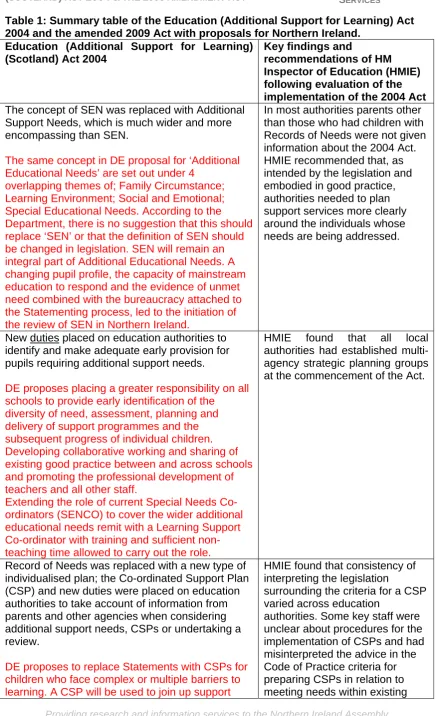
An evaluation of the implementation of the 2004 Act was conducted by HMIE over a two year period from its implementation in 2005. The findings presented in the final report11 in November 2007 are summarised in Table 1 below, with relevant proposals for the Northern Ireland12 SEN framework (shown in red). This highlights the
similarities between the 2004 Act in Scotland and the Northern Ireland proposals.
9
NDCS Scotland submission on the Amendment Bill 2008.
10
‘Report on the implementation of the Education (Additional Support for Learning) (Scotland) Act 2004 available at: http://www.hmie.gov.uk/documents/publication/aslr.pdf
11
Report on the implementation of the Education (Additional Support for Learning) (Scotland) Act 2004 (November 2007); HMIE available at:
http://www.hmie.gov.uk/documents/publication/aslr.pdf
12
Main proposals and their rationale are taken from the briefing to the Education Committee on the SEN Review from the Department on 21 October 2009.
Table 1: Summary table of the Education (Additional Support for Learning) Act 2004 and the amended 2009 Act with proposals for Northern Ireland.
Education (Additional Support for Learning) (Scotland) Act 2004
Key findings and
recommendations of HM Inspector of Education (HMIE) following evaluation of the implementation of the 2004 Act The concept of SEN was replaced with Additional
Support Needs, which is much wider and more encompassing than SEN.
The same concept in DE proposal for ‘Additional Educational Needs’ are set out under 4
overlapping themes of; Family Circumstance; Learning Environment; Social and Emotional; Special Educational Needs. According to the Department, there is no suggestion that this should replace ‘SEN’ or that the definition of SEN should be changed in legislation. SEN will remain an integral part of Additional Educational Needs. A changing pupil profile, the capacity of mainstream education to respond and the evidence of unmet need combined with the bureaucracy attached to the Statementing process, led to the initiation of the review of SEN in Northern Ireland.
In most authorities parents other than those who had children with Records of Needs were not given information about the 2004 Act. HMIE recommended that, as intended by the legislation and embodied in good practice, authorities needed to plan support services more clearly around the individuals whose needs are being addressed.
New duties placed on education authorities to identify and make adequate early provision for pupils requiring additional support needs.
DE proposes placing a greater responsibility on all schools to provide early identification of the
diversity of need, assessment, planning and delivery of support programmes and the subsequent progress of individual children. Developing collaborative working and sharing of existing good practice between and across schools and promoting the professional development of teachers and all other staff.
Extending the role of current Special Needs Co-ordinators (SENCO) to cover the wider additional educational needs remit with a Learning Support Co-ordinator with training and sufficient non-teaching time allowed to carry out the role.
HMIE found that all local authorities had established multi-agency strategic planning groups at the commencement of the Act.
Record of Needs was replaced with a new type of individualised plan; the Co-ordinated Support Plan (CSP) and new duties were placed on education authorities to take account of information from parents and other agencies when considering additional support needs, CSPs or undertaking a review.
DE proposes to replace Statements with CSPs for children who face complex or multiple barriers to learning. A CSP will be used to join up support
HMIE found that consistency of interpreting the legislation
surrounding the criteria for a CSP varied across education
authorities. Some key staff were unclear about procedures for the implementation of CSPs and had misinterpreted the advice in the Code of Practice criteria for preparing CSPs in relation to meeting needs within existing
services from education, health and social care. Where support can be provided within the school without the involvement of outside agencies, a CSP will not be issued.
The sequential stages 1 – 5 of the current Code of Practice for Statementing would be replaced by three strands; within school intervention; within school intervention with external support; and CSPs.
resources.
More rights for parents with education authorities providing new independent mediation services for all parents of children with additional support needs provided free of charge.
More rights for parents with new dispute resolution services in addition to mediation. This service is also available to parents and young people who do not have a CSP, but have additional support needs.
DE proposes that the arrangements for informal and formal appeals will remain unchanged; informally directly to the school, the ESA or through the Dispute Avoidance and Resolution Service (DARS) and formally through SENDIST. The concern of parents is that their child may not qualify for a CSP, which is effectively the
gatekeeper for accessing their statutory rights.
Most authorities had not made parents sufficiently aware of their rights under the new legislation and approaches to consulting and involving young people who lacked capacity to make their views known were not well developed.
New duties placed on agencies; for example local authorities, health boards or trusts must provide education authorities with help if asked.
DE proposes that the Education and Skills Authority (ESA) and the Regional Health and Social Care Board (RHSCB) establish Multi-disciplinary Groups (MGs) to ensure that joint education and health working is aligned and accountable to the ESA and RHSCB. The ESA and RHSCB (and Health and Social Care Trusts) will be bound by agreements to plan, commission deliver and monitor a joined up education, health and social care service.
HMIE found that the role and status of additional educational and multi-agency support plans were not always clear to parents
and schools. HMIE recommended that there should be improved opportunities for joint training of education practitioners and professional colleagues working in social services and other partner agencies. However, it was also found that multi-agency planning was beginning to have a positive effect, particularly at the pre-five (pre-school) stage.
Better planning for transition to post school with a duty placed on education authorities to ask for information from other authorities at least 12 months before a young person leaves school and for education authorities to provide information to other agencies at least 6 months before the leaving date.
DE proposes appointing Transition Co-ordinators
HMIE found that secondary school to post-school transitions arrangements were less effective in meeting the needs of young people than transition arrangements at other stages due to difficulties in co-ordinating agencies and accessing adult services. Through care and after
to strengthen the transition process and provide a co-ordinated approach with other statutory
agencies.
care planning for looked after children and disabled children were often ineffective and children’s services were not effective in helping children to make the transition from child to adult services.
All parents of children with additional support needs have the right to make placing requests to independent schools. Education authorities have to comply unless the particular school does not have the facilities to meet their needs either in the school or through other arrangements.
A new Code of Practice setting out how the new system will operate.
EDUCATION (ADDITIONAL SUPPORT FOR LEARNING) AMENDMENT BILL 2008
Based on the findings of HMIE, Court of Session rulings and an annual report from the President of Additional Support Needs Tribunals for Scotland13 reporting that of the 35 referrals it received in 2007-08, only nine progressed to an oral hearing14, the Bill15 was introduced in October 2008 to make technical amendments to the 2004 Act.
The amendment Bill addressed anomalies in the 2004 Act rather than introducing new legislation. The 2004 Act remains the primary legislation regarding Additional Support Needs (ASN) in Scotland.
The key issues identified around the implementation of the 2004 Act16 included:
Confusion around the criteria for a CSP;
Parents’ rights when requesting a placement outside their own local authority;
Variation in practice between local authorities;
Difficulties in the provision of ongoing support after compulsory education;
Parents and children not being well informed of their right to be involved indecisions; and
A lack of awareness of health and social work staff about the legislation.THE LOBBY FOR CHANGE
A group of Scottish charities17 representing children with ASN came together to form a coalition led by Govan Law Centre to push for a wider review of the 2004 Act.
13
Website at: http://www.asntscotland.gov.uk/asnts/181.25.141.html
14
Fourth Annual Report of the ‘Additional Support Needs Tribunal for Scotland 2008-09 available at: http://www.edlaw.org.uk/files/ASNT4thAnnualReport.pdf
15
Education (Additional Support for Learning) (Scotland) Bill 2008.
16
Scottish Parliament Research Paper, ‘Additional Support for Learning’ SPICe subject profile paper 08/46 15 September 2008 available at:
http://www.scottish.parliament.uk/business/research/briefings-08/SB08-46.pdf 17
The group included Govan Law Centre, NDCS, Equality and Human Rights Commission, RNIB, Barnardo’s Scotland, Capability Scotland, Enable Scotland and the National Autistic Society Scotland.
The consultation document for the draft Bill18 stated that the Scottish Government did not intend to change the “thrust or ethos” of the 2004 Act. However, the Govan Law Centre joint response19 in support of their proposal to reinstate ‘additional support’ outside the classroom, argued that a decision by Lord Wheatley20 did just that.
Lord Wheatley’s decision21 stated that:
The whole burden of the test of what constitutes additional support needs clearly refers to educational support, and further to educational support offered in a teaching environment. This in turn must refer to the educational needs of the child, and not to anything else. It cannot refer to the social and environmental needs of the appellant herself, or indeed of the child.
Govan Law Centre argues that ‘additional support’ being restricted to the educational environment is contrary to the Code of Practice22 where Chapter 2, paragraph 9 states that “Some children and young people will require additional support from agencies from outwith education services if they are to make progress.”
The section of the Govan Law Centre’s website on ASN23 said that while a CSP replaced a ‘Record of Needs’, it was not a direct equivalent. They point to significant differences in the two documents. While a Record of Needs was for children with the most severe and complex needs, eligibility for a CSP depends more on the support required to meet those needs. Crucially, significant additional support must be required from education as well as at least one of the following:
Social work (or another, non-education, council function) service;
A Health Board; and/or
Another local authority.In planning the implementation of the 2004 Act, Govan Law Centre said that the
Scottish Executive and education authorities had been planning the Act on the basis of approximately 1% of pupils requiring a CSP. This represented around half of the pupils who had a Record of Needs24.
During the Stage 3 debate on the Bill25 Margaret Smith, Liberal Democrat MSP for Edinburgh West said:
Most of the evidence that the committee took suggested that financial imperatives play a large part in many decisions. Five years on from the passage of the 2004 act, we are about 11,000 young people adrift from
18
Available at: http://www.scotland.gov.uk/Publications/2008/05/08135938/0
19
Available on NDCS website at: http://www.ndcs.org.uk/document.rm?id=3695
20
In the case of SC v. City of Edinburgh Council [2008] CSOH 60.
21
Iibid
22
Available at: http://www.scotland.gov.uk/Resource/Doc/57346/0016754.pdf
23
Available on Govan Law Centre website at:
http://www.additionalsupportneeds.org.uk/guide/csp.htm 24
Available on Govan Law Centre website at:
http://www.additionalsupportneeds.org.uk/guide/csp.htm
25
Official Report 20 May 2009 available at:
http://www.scottish.parliament.uk/business/officialReports/meetingsParliament/or-09/sor0520-02.htm#Col17576
the number of co-ordinated support plans that we expect to be in place, and many other effects of the act have not happened as expected.
Paragraph 41 of the Financial Memorandum for the Bill26 states:
The funding originally allocated to education authorities for CSPs was based on the information contained in the Financial Memorandum that accompanied the 2004 Act, which stated that “It is expected there will be around 11,200 to 13,700 CSPs at any one time. The number of new CSPs being prepared each year could range from 1,700 to 2,500. this estimate is drawn from a model based on an assumption that 50% of children who currently have Records of Needs will have such needs that require a CSP plus an additional proportion of the school population (0.2-0.6%) who will also have such needs but who do not currently have a Record.” However, the National Statistics publication “Pupils in
Scotland, 2007” shows that only 1881 pupils had a co-ordinated Support Plan (CSP) at September 2007. Education authorities have therefore already received excess funding for their work in this area.
STATISTICAL EVIDENCE
Statistics taken from the school census in Scotland27 on the integration of children into mainstream classes are shown in Table 2 below. The purpose of the particular
statistical table the information is taken from is to show the time SEN children spend in mainstream classes. However, examining the period 2005 – 2009 they also incidentally show the changes that took place over the two year transition period (November 2005 – November 2007) when children with a Record of Needs were re-assessed for a CSP and/or an Individual Education Plan (IEP).
Table 2: Integration of children with SEN into mainstream schools
All pupils in Special
Schools and those
with RoNs, CSPs
and/or IEPs in
mainstream schools.
RoN only
CSP only IEP
only
2005
34,680
11,938 both
RoN and IEP
1,512 -
21,127
2006 36,148
11,708
326
(1)24,039
2007 36,510
7,439
(1)1,881
(1)27,190
2008 38,716
5,250
(1)2,594
(1)30,752
2009
(2)44,176
-
3,201
(1)40,955
1. Irrespective of whether they have an IEP.
2. The increase in the 2009 figures is due to improved recording.
Although the 2005 figures show there were 1,512 pupils who had a Record of Needs alone, there were 11,938 pupils who had a Record of Needs and an IEP.
26
Explanatory Memorandum (containing the Financial Memorandum) available at:
http://www.scottish.parliament.uk/S3/bills/16-EdAddSup/b16s3-introd-en.pdf
27
Available at: http://www.scotland.gov.uk/Topics/Statistics/Browse/School-Education/PubPupilCensus
As can be seen from the table, the steepest rise during the period when Record of Needs were phased out and replaced by CSPs was in the number of non-statutory IEPs. These grant parents no legal right of appeal. The number of pupils who were given a non-statutory IEP alone and no statutory CSP increased from just over 21,000 in 2005 to almost 41,000 in 2009.
AMENDMENTS IN THE BILL
The coalition, led by the Govan Law Centre, briefed MSPs at each of the three Stages of the 2008 Bill and made proposals for amendments at Stage 2. Their five proposals, requiring legislative changes were:
Reinstate ‘additional support’ outside the classroom;
Provide assessments for children who need them, whether they have a CSP or not;
Make sure authorities comply with their duties to school leavers;
Allow the Tribunal to specify when a school placement should start; and
More CSPs for looked after and accommodated children, young carers andchildren with mental health issues.
All of the five proposals from the Govan Law Centre coalition were incorporated in the Bill at Stage 2. However, at Stage 3 the Government brought an amendment to remove the automatic right to assessment for young carers, children with mental health issues and sensory impaired children28.
Agreeing that looked after and accommodated children were a unique group the Minister argued that the inclusion of the other groups would categorise them as being in need of additional support when this might not be the case. The Minister undertook to set up a working group to look into the requirements of these additional groups of children and the amendment not to include them automatically as ASN was agreed.
EDUCATION (ADDITIONAL SUPPORT FOR LEARNING)(SCOTLAND) ACT 2009
The following key adjustments were made to the 2004 Act as a result of the Bill in the Education (Additional Support for Learning) (Scotland) Act 200929:
Parents of children and young people with additional support needs, whether or not they have a CSP, can make out of area placing requests;
Mediation and tribunal appeal mechanisms are available if requests are unsuccessful;
Parents of children without a CSP, but with additional support needs will have access to dispute resolution outside the formal appeals route.
The definition of additional support is clarified by specifying that it is not limited to an educational environment and requires local authorities to provide support for children under school age apart from those with a disability;
Scottish Ministers are required to provide an advocacy service available to parents and young people free of charge for Tribunal proceedings;28
Official Report 20 May 2009
29
Education (Additional Support for Learning ) (Scotland) Act 2009 available at:
http://www.england-legislation.hmso.gov.uk/legislation/scotland/acts2009/en/aspen_20090007_en.pdf
Education authorities are required to make arrangements for independent mediation services that cannot include in-house mediation;
It is automatically deemed that all looked after children and young people have additional support needs;
An education authority must provide support for a child under school age with a disability who is brought to their attention;
Authorities are placed under a duty to ensure that a summary of information is available on request and to publish information on procedures for the resolution of disputes;
Authorities have a duty to seek and take account of the young person’s views in relation to any information provided to an appropriate agency or agencies in relation to them leaving school;
What can be brought before a Tribunal is extended to include failure to provide additional support contained in a CSP to achieve their educational objectives;
For the first five years following the commencement of the 2009 Act, ScottishMinisters must report to the Scottish Parliament on what progress has been made in ensuring that sufficient information relating to children and young people with additional support needs is available to monitor the implementation of the 2009 Act and specifies the information that must be collected from educational authorities. The information must include the factors giving rise to the need for additional support, types of support provided and the cost
associated with providing the support.
IMPLICATIONS FOR NORTHERN IRELAND
For parents and interest groups in Northern Ireland the proposal to replace Statements with CSPs is the area causing most concern30.
The Department’s proposal replace Statements with CSPs is based on the 2004 Act in Scotland. Without clearly defined meanings for ‘complex’, ‘multiple’ and ‘significant’ the issue of subjectivity in the assessment process that arose in Scotland could also prove to be an issue in Northern Ireland. The consultation document31 states:
CSPs will be provided solely for those children with SEN who face complex or multiple barriers to learning which significantly, and adversely, affect (or could reasonably be expected to affect) their educational development in the long term and who require frequent access to a diversity of multi-agency services external to the school (for example, those provided by the health and social care sector and the ELB/ESA support services).
Parents fear that the threshold for a child to qualify for a CSP will be set too high. This could result in children who already have Statements failing to qualify for a CSP, or those who would have been expected to qualify for a Statement failing to do so. The consequences of a child losing their Statement without having it replaced by a CSP will mean that parents have lost their statutory right to challenge decisions of Boards/ESA or schools.
30
Evidence to the Education Committee on 11 November 2009 by Children with Disabilities Strategic Alliance (CDSA) and statements by parents and interest groups at a seminar hosted by the Assembly’s Education Committee 20 January 2010.
31
Every School a Good School: The Way Forward for Special Educational Needs and Inclusion (August 2009) (Paragraph 10.4).
Although the Department of Education have stated in the consultation document that none of the appeal mechanisms for parents will be effected by the proposals, parents and interest groups argue that there is insufficient clarity about what their legal rights will be.
It is too early to assess whether the amendments contained in the 2009 Act in Scotland have addressed the problems identified in the implementation of the 2004 Act.
However, the Department, in proposing similar changes to those introduced in the 2004 Act, have the opportunity to learn from the experience in Scotland; not least the lack of communication with parents that led to the requirement for an amendment Bill.