REVIEW
Complementary and Alternative Medicine for Management of Premature
Ejaculation: A Systematic Review
Katy Cooper, PhD,1Marrissa Martyn-St James, PhD,1 Eva Kaltenthaler, PhD,1 Kath Dickinson, MA,1 Anna Cantrell, MA,1Shijie Ren, PhD,1 Kevan Wylie, MD,2Leila Frodsham, MBChB, MRCoG,3and Catherine Hood, BA, BMBCh (oxon)4
ABSTRACT
Introduction:Premature ejaculation (PE) is defined as ejaculation within 1 minute (lifelong PE) or 3 minutes (acquired PE), inability to delay ejaculation, and negative personal consequences. Management includes behavioral and pharmacologic approaches.
Aim:To systematically review effectiveness, safety, and robustness of evidence for complementary and alternative medicine in managing PE.
Methods:Nine databases including Medline were searched through September 2015. Randomized controlled trials evaluating complementary and alternative medicine for PE were included.
Main Outcome Measures: Studies were included if they reported on intravaginal ejaculatory latency time (IELT) and/or another validated PE measurement. Adverse effects were summarized.
Results:Ten randomized controlled trials were included. Two assessed acupuncture,five assessed Chinese herbal medicine, one assessed Ayurvedic herbal medicine, and two assessed topical“severance secret”cream. Risk of bias was unclear in all studies because of unclear allocation concealment or blinding, and onlyfive studies reported stopwatch-measured IELT. Acupuncture slightly increased IELT over placebo in one study (mean difference [MD]¼0.55 minute,P¼.001). In another study, Ayurvedic herbal medicine slightly increased IELT over placebo (MD¼0.80 minute,P ¼.001). Topical severance secret cream increased IELT over placebo in two studies (MD¼8.60 minutes, P<.001), although inclusion criteria were broad (IELT<3 minutes). Three studies comparing Chinese herbal medicine with selective serotonin reuptake inhibitors (SSRIs) favored SSRIs (MD¼1.01 minutes,P¼.02). However, combination treatment with Chinese medicine plus SSRIs improved IELT over SSRIs alone (two studies; MD¼1.92 minutes,P<.00001) and over Chinese medicine alone (two studies; MD¼2.52 minutes,P<.00001). Adverse effects were not consistently assessed but where reported were generally mild. Conclusion: There is preliminary evidence for the effectiveness of acupuncture, Chinese herbal medicine, Ayurvedic herbal medicine, and topical severance secret cream in improving IELT and other outcomes. However, results are based on clinically heterogeneous studies of unclear quality. There are sparse data on adverse effects or potential for drug interactions. Further well-conducted randomized controlled trials would be valuable.Cooper K, Martyn-St James M, Kaltenhaler E, et al. Complementary and Alternative Medicine for Management of Premature Ejaculation: A Systematic Review. Sex Med 2017;5:e1ee18.
Copyright2016, The Authors. Published by Elsevier Inc. on behalf of the International Society for Sexual Medicine. This is an open access article under the CC BY-NC-ND license (http://creativecommons.org/licenses/by-nc-nd/4.0/).
Key Words:Review; Systematic; Premature Ejaculation; Complementary Therapies; Complementary Medicine
INTRODUCTION
Premature ejaculation (PE) in men is characterized by short ejaculatory latency during intercourse. PE can be lifelong (primary; present since first sexual experiences) or acquired (secondary; beginning later).1The International Society for Sexual Medicine (ISSM; 2014) defines PE as a combination of (i) ejaculation usually occurring within approximately 1 minute of vaginal penetration (for lifelong PE) or a clinically significant decrease in latency time, often to no longer than approximately 3 minutes (for acquired PE);
Received April 20, 2016. Accepted August 11, 2016.
1University of Sheffield, Sheffield, UK; 2Porterbrook Clinic, Sheffield, UK;
3Institute of Psychosexual Medicine, London, UK; 4Imperial College, London, UK
Copyright ª 2016, The Authors. Published by Elsevier Inc. on behalf of the International Society for Sexual Medicine. This is an open access article under the CC BY-NC-ND license (http://creativecommons.org/ licenses/by-nc-nd/4.0/).
http://dx.doi.org/10.1016/j.esxm.2016.08.002
(ii) inability to delay ejaculation; and (iii) negative personal con-sequences such as distress, bother, frustration, and/or avoidance of sexual intimacy.1PE also has been defined by theDiagnostic and Statistical Manual of Mental Disorders, Fifth Edition (2013) as ejaculation usually occurring within approximately 1 minute of vaginal penetration and before the individual wishes it and causing clinically significant distress.2Estimating the prevalence of PE is not straightforward because of the difficulty in defining what constitutes clinically relevant PE. Surveys have estimated the prevalence of self-reported early ejaculation as 20% to 30%3e5; however, these estimates are likely to include men who have some concern about their ejaculatory function but do not meet the current diagnostic criteria for PE.6It has been suggested that the prevalence of lifelong PE according to the ISSM and theDiagnostic and Statistical Manual of Mental Disorders, Fifth Editiondefinitions (with an ejaculatory latency of approximately 1 minute) is unlikely to exceed 4%.6Men with PE are more likely to report lower levels of sexual functioning and satisfaction and higher levels of personal distress and interpersonal difficulty than men without PE.7They also might rate their overall quality of life as lower than that of men without PE.7 In addition, their partner’s satisfaction with the sexual relationship has been reported to decrease with increasing severity of the condition.8
Management of PE can involve a range of interventions. These include systemic drug treatments such as selective serotonin reup-take inhibitors (SSRIs), tricyclic antidepressants, phosphodiesterase type 5 inhibitors, and analgesics and topical anesthetic creams and sprays that are applied directly to the penis shortly before inter-course.9,10Behavioral therapies also can be useful.6,9,11,12These can include psychosexual or relationship counseling for men and/or couples to address psychological and interpersonal issues that could be contributing to PE. Behavioral therapies also can include physical techniques to help men develop sexual skills to delay ejaculation and improve sexual self-confidence, such as the “stop-start” technique, “squeeze” technique, and sensate focus.6,9,11,12 There are sparse data on whether and for how long effectiveness is maintained after cessation of treatment (drug or behavioral) and whether repeat treatments are effective.
Many interventions currently used for PE are not approved for this use, and men might choose to self-treat, with several remedies being available through the internet. Some comple-mentary and alternative medicines (CAMs) have been evaluated in randomized controlled trials (RCTs) for the management of PE. However, there are no existing systematic reviews evaluating CAMs for management of PE. Our aim was to systematically review the effectiveness, safety, and robustness of evidence for CAM therapies in the management of PE.
METHODS
Review Methods
This work was undertaken as part of a systematic review for the UK National Institute for Health Research Health Technology
Assessment Programme, which assessed a wide range of interventions for management of PE.13The review followed the general principles recommended in the Preferred Reporting Items for Systematic Re-views and Meta-Analyses (PRISMA) statement ( http://www.prisma-statement.org/).14The review protocol is available from the Health Technology Assessment Programme website (http://www.nets.nihr. ac.uk/projects/hta/131201) and is registered on the PROSPERO database (registration number CRD42013005289). The PRISMA checklist is provided inSupplementary Appendix 3.
De
fi
nition of CAM
CAM has been defined by the Cochrane Collaboration as“a broad domain of healing resources that encompasses all health systems, modalities, and practices and their accompanying the-ories and beliefs, other than those intrinsic to the politically dominant health system of a particular society or culture in a given historical period.”15In addition, many CAM therapies are based on a traditional model of health and well-being, and many (although not all) are designed to treat the whole patient as opposed to a specific condition, whereas some (although not all) involve the use of traditional or natural therapies. Therefore, CAM is defined in this study as therapies for PE that have typically not been provided within conventional Western health care systems and that appear on the list of CAM therapies collated by the Cochrane Collaboration.15
Literature Searches
The following databases were searched from inception to September 2015: Medline; Embase; Cumulative Index to Nursing and Allied Health Literature (CINAHL); the Cochrane Library including the Cochrane Systematic Reviews Database (CDSR), the Cochrane Controlled Trials Register (CCRT), the Database of Abstracts of Reviews of Effects (DARE), and the Health Technol-ogy Assessment database; the ISI Web of Science including the Science Citation Index and the Conference Proceedings Citation IndexeScience. The Medline search strategy is provided in Appendix 1. The search strategy was designed to identify any articles tagged with the Medical Subject Headingsejaculationorpremature ejaculationplus articles whose title or abstract included one of the termspremature, early,orrapidwithin three words ofejaculationor climaxor the termejaculation praecox/precox. These were combined with search filters to identify RCTs, reviews, and guidelines. It should be noted that the search was undertaken as part of a wider project assessing different treatments for PE,13and for this reason the search was not specific to complementary therapies. The US Food and Drug Administration website and the European Medicines Agency website also were searched. Existing systematic reviews and relevant studies also were checked for eligible studies.
Eligibility Criteria
RCTs were eligible for inclusion if they compared CAM therapies for management of PE against placebo, waitlist, no treatment, or another therapy or assessed combination treatment.
Sex Med 2017;5:e1ee18
CAM is defined as therapies for PE that have typically not been provided within conventional Western health care systems and that appear on the list of CAM therapies collated by the Cochrane Collaboration.15
Studies were included if they reported intravaginal ejaculatory latency time (IELT) and/or any of the following PE outcome measurements:
- Premature Ejaculation Profile (PEP)16 - Index of Premature Ejaculation (IPE)17
- Premature Ejaculation Diagnostic Tool (PEDT)18 - Arabic Index of Premature Ejaculation (AIPE)19 - Chinese Index of Premature Ejaculatione5 (CIPE-5)20 - International Index of Erectile Function (IIEF)21
Five of these measurements (PEP, IPE, PEDT, AIPE, and CIPE) were referenced in the update of the ISSM PE guidelines.6 Of these, PEP and IPE have been validated as tools to measure changes in PE outcomes,16,17and CIPE also has been evaluated as a PE outcome measurement.20 The PEDT and AIPE have been validated as tools for diagnosing PE18,19and have been used as outcome measurements in PE trials. In addition, the IIEF was validated for measuring changes in outcomes in erectile dysfunc-tion, but some dimensions overlap with PE and have been used to measure outcomes in PE studies.21 Adverse effects also were summarized. Poorly defined outcomes, such as “percentage of patients showing improvement,”were not included in this review.
Data Extraction and Synthesis
One reviewer performed data extraction of each study; all numerical data were checked by a second reviewer. Results were presented as forest plots where data permitted, and meta-analyses were undertaken using RevMan software.22 Assessment of pub-lication bias by visual inspection of funnel plots was planned when at least 10 RCT comparisons were available.23
Assessment of Methodologic Quality of Studies
Methodologic quality of included RCTs was assessed using the Cochrane Collaboration risk-of-bias assessment criteria.24 Completeness of outcome data was considered low risk if the per-centage of randomized participants excluded from the primary analysis was smaller than 30%.25Selective reporting was considered low risk if IELT or ejaculatory latency was reported and all out-comes referred to in the study methods were reported. Overall risk of bias for each study was classed as“low”or“high”if they were rated as such for each of three key domains: allocation concealment, blinding of outcome assessment, and completeness of outcome data; otherwise, overall risk of bias was classed as“unclear.”RESULTS
Quantity of Evidence
The searches identified 2,455 citations (as part of a wider project assessing different treatments for PE). Fourteen studies
were examined at the full-text stage. Ten RCTs evaluating a complementary therapy for PE were included in the review.26e35 The PRISMA flowchart is presented in Appendix 2. The four studies excluded at the full-text stage are described below, with reasons for exclusion.
Characteristics of Included Studies
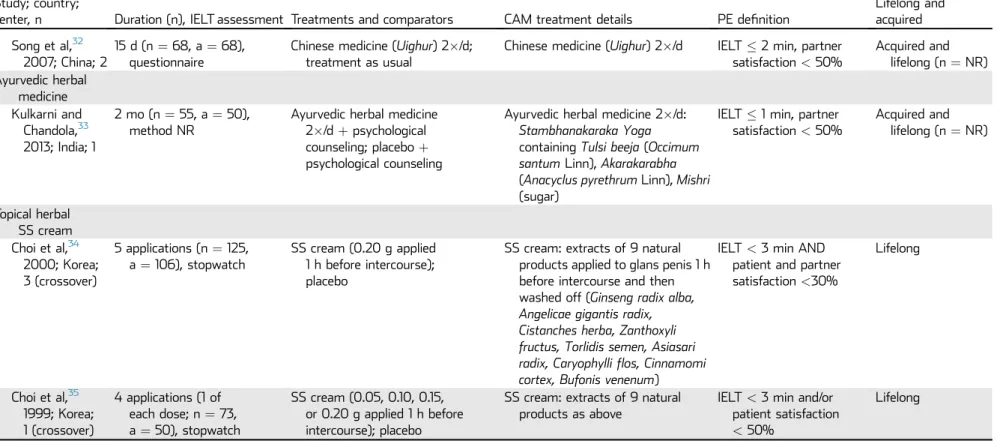
Details of the included study characteristics are presented in Table 1; details include specific acupuncture points and herbal remedies used. Two studies (one in Turkey26 and one in China27) assessed acupuncture provided daily for 4 weeks and twice weekly for 4 weeks, respectively. Each study used a set range of acupuncture points (with some overlap but some dif-ferences between studies). Five studies assessed a 2- to 8-week course of oral Chinese herbal medicine; all were conducted in China.28e32 One study conducted in India assessed Ayurvedic medicine (Indian herbal medicine) given for 2 months.33 Two Korean studies assessed four tofive treatments with “severance secret”(SS) cream,34,35an extract of nine natural products that is applied to the penis 1 hour before intercourse and washed off before intercourse. SS cream is believed to work by localized desensitizing effects to decrease penile hypersensitivity.34
The number of analyzed participants was 50 to 200 for all studies, with the mean and median numbers being 98. Com-parators included placebo (four studies),26,33e35 treatment as usual (one study),32 an SSRI (five studies),26e29,31 and/or a combination of CAM and drug treatment (three studies).28,30,31 Nine of the 10 studies assessed IELT26,28e35: five by stop-watch,26,28,29,34,35 one by questionnaire,32 and three did not report the method of IELT assessment.30,31,33 Additional outcome measurements reported included the PEDT (three studies)26,28,29, the CIPE-5 (two studies)27,32, and the IIEF (one study).31
Three studies included men with lifelong PE,30,34,35 one included men with only acquired PE,28four included men with lifelong PE and men with acquired PE,26,29,32,33and two did not report this information.27,31Participants had an IELT no longer than 1 minute (most or all the time) in two studies,28,33an IELT no longer than 2 minutes (most or all the time) in five
stud-ies,26,29e32 an IELT no longer than 3 minutes in two
studies,34,35and IELT inclusion criteria were not reported in one study.27In four studies, patient or partner satisfaction also had to be below 30% or below 50%.32e35 In some studies, the inclu-sion criteria were not consistent with the ISSM definition of PE. For example, one study of Chinese herbal medicine recruited men with acquired PE, but they had to have an IELT shorter than 1 minute in at least 50% of attempts28(whereas the ISSM widens the definition of acquired PE to IELT3 minutes36). Also, two studies of SS cream stated that participants had lifelong PE but were required only to have an IELT shorter than 3 minutes (plus patient or partner satisfaction below 30% or
50%)34,35rather than no longer than 1 minute according to the
ISSM definition of lifelong PE.6
Sex Med 2017;5:e1ee18
Table 1.Characteristics of included studies
Study; country;
center, n Duration (n), IELT assessment Treatments and comparators CAM treatment details PE definition
Lifelong and acquired
Acupuncture Sunay et al,26
2011; Turkey; 1
4 wk (n¼90, a¼90), stopwatch
Acupuncture 2/wk; paroxetine 20 mg/d; sham acupuncture 2weekly
Acupuncture 2/wk using points Zusanli (ST 36), Hegu (LI 4), Taixi (KI 3), Taichong (LR 3), Yintang (EX-HN 3), Zhongji (CV 3)
IELT2 min in>70% of attempts
Lifelong 66%, acquired 34%
Chen,272009; China; 1
4 wk (n¼111, a¼111), method NR
Acupuncture daily; citalopram 20 mg/d
Acupuncture: 2 groups of acupoints on alternate days: day 1, Xinshu (BL 15), Ganshu (BL 18), Pishu (BL 20), Shenshu (BL 23); day 2, Guanyuan (CV 4), Zhongji (CV 3), Sanyinjiao (SP 6), Taixi (KI 3), Taichong (LR 3)
NR NR
Chinese herbal medicine Li and Lu,28
2015; China; 1
4 wk (n¼120, a¼119), stopwatch
Chinese medicine (Qilinpills) 6 g 2/d; sertraline 50 mg/d; Chinese medicineþsertraline
Chinese medicine (Qilinpills) containing Chinese raspberry (fu pen zi), horny goat weed (yin yang huo),Polygonum multiflorum(he shou wu),Herba ecliptae(mo han lian),
Cynomonium(suo yang),
Astralagus(huang qi), Chinese yam (shan yao), immature tangerine peel (qing pi), mulberry fruit spike (sang shen), turmeric tuber (yu jin), Chinese red sage (dan shen), white peony root (bai shao)
IELT<1 min in>50% of attemptsþTCM definition of“secondary non-consolidated kidney qi PE”
Acquired (3 mo)
Xu et al,29 2014; China; 1
8 wk (n¼218, a¼200), stopwatch
Chinese medicine (mycelium ofCordyceps sinensis C4); sertraline 50 mg/d
Chinese medicine (mycelium of
Cordyceps sinensis C4)
IELT2 min in75% of attempts
Acquired and lifelong (n¼NR)
Xu et al,30 2012; China; 1
4 wk (n¼68, a¼68), method NR
Chinese medicine (Yimusake
50 mg/d); Chinese medicineþ trazodone 50 mg/d
Chinese medicine (Yimusake
50 mg/d)
IELT<2 min Lifelong
Sun et al,31 2010; China; 2
4 wk (n¼114, a¼114), method NR
Chinese medicine (Yimusake
1.5 g/d);fluoxetine 20 mg/d; Chinese medicineþfluoxetine
Chinese medicine (Yimusake
1.5 g/d)
IELT<2 min NR
(continued)
Se
x
Med
2017
;5:e1
e
e18
e4
C
ooper
et
Table 1.Continued
Study; country;
center, n Duration (n), IELT assessment Treatments and comparators CAM treatment details PE definition
Lifelong and acquired
Song et al,32 2007; China; 2
15 d (n¼68, a¼68), questionnaire
Chinese medicine (Uighur) 2/d; treatment as usual
Chinese medicine (Uighur) 2/d IELT2 min, partner satisfaction<50%
Acquired and lifelong (n¼NR) Ayurvedic herbal
medicine Kulkarni and
Chandola,33 2013; India; 1
2 mo (n¼55, a¼50), method NR
Ayurvedic herbal medicine 2/dþpsychological counseling; placeboþ psychological counseling
Ayurvedic herbal medicine 2/d:
Stambhanakaraka Yoga
containingTulsi beeja(Occimum santumLinn),Akarakarabha
(Anacyclus pyrethrumLinn),Mishri
(sugar)
IELT1 min, partner satisfaction<50%
Acquired and lifelong (n¼NR)
Topical herbal SS cream Choi et al,34
2000; Korea; 3 (crossover)
5 applications (n¼125, a¼106), stopwatch
SS cream (0.20 g applied 1 h before intercourse); placebo
SS cream: extracts of 9 natural products applied to glans penis 1 h before intercourse and then washed off (Ginseng radix alba, Angelicae gigantis radix, Cistanches herba, Zanthoxyli fructus, Torlidis semen, Asiasari radix, Caryophylliflos, Cinnamomi cortex, Bufonis venenum)
IELT<3 min AND patient and partner satisfaction<30%
Lifelong
Choi et al,35 1999; Korea; 1 (crossover)
4 applications (1 of each dose; n¼73, a¼50), stopwatch
SS cream (0.05, 0.10, 0.15, or 0.20 g applied 1 h before intercourse); placebo
SS cream: extracts of 9 natural products as above
IELT<3 min and/or patient satisfaction
<50%
Lifelong
a¼analyzed number; CAM¼complementary and alternative medicine; IELT¼intravaginal ejaculatory latency time; n¼randomized number; NR¼not reported; PE¼premature ejaculation; SS¼secret severance; TCM¼traditional Chinese medicine.
Se
x
Med
2017
;5:e1
e
e18
CAM
fo
r
Management
of
Pr
emature
Ejaculation
e
Studies Excluded at Full-Text Stage
Four studies were excluded at the full-text stage. Two studies of Chinese medicine were excluded because they did not report on IELT or any validated or widely used PE outcome mea-surement.36,37Two studies assessing a combination of yoga and pelvic floor exercises were excluded; one was not randomized (patients self-selected to the intervention or control group)38and the other did not report on IELT or any validated or widely used PE outcome measurement.39
Risk of Bias in Included Studies
The risk of bias within included studies is presented inTable 2. Five studies reported the method of randomization,26,28,29,32,35 whereas the otherfive did not report the method but did state that the study was randomized. Allocation concealment was
unclear in all studies. Blinding of participants and personnel was reported as being undertaken infive studies.26,29,33e35Blinding of outcome assessment was unclear in all studies except one,35which reported that this was blinded. All studies except one35 were considered at low risk of bias for completeness of outcome data, with eight studies including at least 90% of randomized patients in the primary analysis and the two studies of SS cream including 85%34and 68%,35respectively. All studies scored a low risk for selective reporting except for one that did not report on IELT.27Of the nine studies reporting on IELT, this was measured by stop-watch infive studies,26,28,29,34,35by questionnaire in one study,32 and the method of IELT assessment was not reported in three studies.30,31,33In summary, all 10 studies were classed as having an overall unclear risk of bias because of unclear reporting of allocation concealment (all 10 studies) and unclear blinding of participants and personnel (five studies).
Table 2.Risk of bias in included studies
RCT; country
Risk of bias
Random sequence generation
Allocation concealment
Blinding of participants and personnel
Blinding of outcome assessment
Completeness of outcome data*
(n/N, % included in primary analysis)
Selective reporting†
Overall risk‡
Acupuncture Sunay et al,26
2011; Turkey
Low Unclear Low (partial blinding)
Unclear Low (90/90, 100%) Low Unclear
Chen,272009; China
Unclear Unclear High Unclear Low (111/111, 100%) High (no IELT) Unclear
Chinese herbal medicine Li and Lu,28
2015; China
Low Unclear High Unclear Low (119/120, 99%) Low Unclear
Xu et al,29 2014; China
Low Unclear Low Unclear Low (200/218, 92%) Low Unclear
Xu et al,30 2012; China
Unclear Unclear High Unclear Low (68/68, 100%) Low Unclear
Sun et al,31 2010; China
Unclear Unclear High Unclear Low (114/114, 100%) Low Unclear
Song et al,32 2007; China
Low Unclear High Unclear Low (68/68, 100%) Low Unclear
Ayurvedic herbal medicine Kulkarni and
Chandola,33 2013; India
Unclear Unclear Low Unclear Low (50/55, 91%) Low Unclear
Topical herbal SS cream Choi et al,34
2000; Korea
Unclear Unclear Low Unclear Low (106/125, 85%) Low Unclear
Choi et al,35 1999; Korea
Low Unclear Low Low High (50/73, 68%) Low Unclear
IELT¼intravaginal ejaculatory latency time; SS¼secret severance.
*Completeness of outcome data was classed as low risk if fewer than 30% randomized participants were excluded from the primary analysis.
†Selective reporting was classified as low risk if IELT or ejaculatory latency was reported and all outcomes referred to in study methods were reported. ‡Overall risk of bias was classified as low or high if rated as such for each of three key domains: allocation concealment, blinding of outcome assessment, and
completeness of outcome data; otherwise, overall risk of bias was classed as unclear.
Sex Med 2017;5:e1ee18
Table 3.Effectiveness results
Studies, n Treatment Comparator Duration Reference Outcome
Participants,
n MD (95% CI),Pvalue Favors
Acu vs placebo
1 Acu 2x/wk Sham acu 4 wk Sunay 201126 IELT (stopwatch)
PEDT
60 60
MD¼0.55 (NR), .001 MD¼NR (NR), .001
Acu over sham Acu over sham Acu vs drug
2 Acu 2x/wk Paroxetine
20 mg/d
4 wk Sunay 201126 IELT (stopwatch) PEDT
60 60
MD¼ 0.28 (NR), .001 MD¼NR (NR), NS
Drug over acu Not sig (acu
vs drug)
Acu daily Citalopram
20 mg/d
4 wk Chen 200927 CIPE-5 111 MD¼1.44 (0.02 to
2.86), .05
Acu over drug
CM vs TAU
1 CM (Uighur2x/d) TAU 15 d Song 200732 IELT (questionnaire)
CIPE-5
68
68
MD¼1.57 (1.11 to 2.03), .00001
MD¼4.95 (3.34 to 6.56), .00001
CM over TAU
CM over TAU
CM vs drug
3 CM (Qilinpills 6 g 2x/d)
Sertraline 50 mg/d
4 wk Li 201528 IELT (stopwatch)
PEDT
79
79
MD¼ 0.64 (1.58 to 0.30), .18
MD¼ 0.20 (0.97 to 0.57), .61
Not sig (drug vs CM) Not sig (drug
vs CM) CM (mycelium of
cordyceps sinensis C4)
Sertraline 50 mg/d
8 wk Xu 201429 IELT (stopwatch)
PEDT
200
200
MD¼ 1.70 (2.12 to 1.28),<.01 MD¼ 3.8 (5.01 to
2.59),<.01
Drug over CM
Drug over CM
CM (Yimusake
1.5 g/d)
Fluoxetine 20 mg/d
4 wk Sun 201031 IELT (method NR)
Satisfaction (IIEF) 76
76
MD¼ 0.60 (1.01 to 0.19), .004 MD¼ 0.90 (1.43 to
0.37), .0009
Drug over CM
Drug over CM
CM + drug vs drug alone 2 CM (Qilin)þ
sertraline
Sertraline 50 mg/d
4 wk Li 201528 IELT (stopwatch)
PEDT
79
79
MD¼2.05 (0.83 to 3.27), .001 MD¼1.10 (0.46 to
1.74), .0008
Combined over drug Combined over
drug CM (Yimusake)þ
fluoxetine Fluoxetine20 mg/d
4 wk Sun 201031 IELT (method NR)
Satisfaction (IIEF) 76
76
MD¼1.90 (1.47 to 2.33),<.00001 MD¼3.00 (2.46 to
3.54),<.00001
Combined over drug Combined over
drug
(continued)
Se
x
Med
2017
;5:e1
e
e18
CAM
fo
r
Management
of
Pr
emature
Ejaculation
e
Table 3.Continued
Studies, n Treatment Comparator Duration Reference Outcome
Participants,
n MD (95% CI),Pvalue Favors
CMþdrug vs CM alone 3 CM (Qilin)þ
sertraline
CM (Qilin
6 g 2x/d)
4 wk Li 201528 IELT (stopwatch)
PEDT
80
80
MD¼2.69 (1.57 to 3.81),<.00001 MD¼1.30 (0.63 to
1.97), .0001
Combined over CM
Combined over CM
CM (Yimusake)þ fluoxetine
CM (Yimusake1.5 g/d)
4 wk Sun 201031 IELT (method NR)
Satisfaction (IIEF) 76
76
MD¼2.50 (2.08 to 2.92),<.00001 MD¼3.90 (3.32 to
4.48),<.00001
Combined over CM
Combined over CM
CM (Yimusake
50 mg/d)þ trazodone 50 mg/d
CM (Yimusake50 mg/d)
4 wk Xu 201230 IELT (method NR) 68 MD¼0.08 (0.19 to 0.35), .56
Not sig (combined vs. CM)
Ayurvedic herbal medicine vs placebo 1 Ayurvedic medþ
counselling
Placebo + counselling
2 mo Kulkarni 201333 IELT (method NR) 50 MD¼0.80 (0.32 to 1.28), .001
Ayurvedaþ counselling over placeboþ counselling Topical herbal SS cream vs placebo
2 SS cream
(0.2 g/h prior)
Placebo (crossover)
5 app Choi 200034 IELT (stopwatch) 106 MD¼8.47 (6.52 to 10.42),<.001
SS cream over placebo SS cream
(0.2 g/h prior)
Placebo (crossover)
1 app Choi 199935 IELT (stopwatch) 50 MD¼8.79 (6.41 to 11.17),<.001
SS cream over placebo
Acu¼acupuncture; app¼applications; CI¼confidence interval; CIPE¼Chinese Index of Premature Ejaculation; CM¼Chinese medicine; IELT¼intra-vaginal ejaculatory latency time; IIEF¼International Index of Erectile Function; MD¼mean difference; NR¼not reported; PEDT¼Premature Ejaculation Diagnostic Tool; TAU¼treatment as usual.
Se
x
Med
2017
;5:e1
e
e18
e8
C
ooper
et
Assessment of Effectiveness and Safety
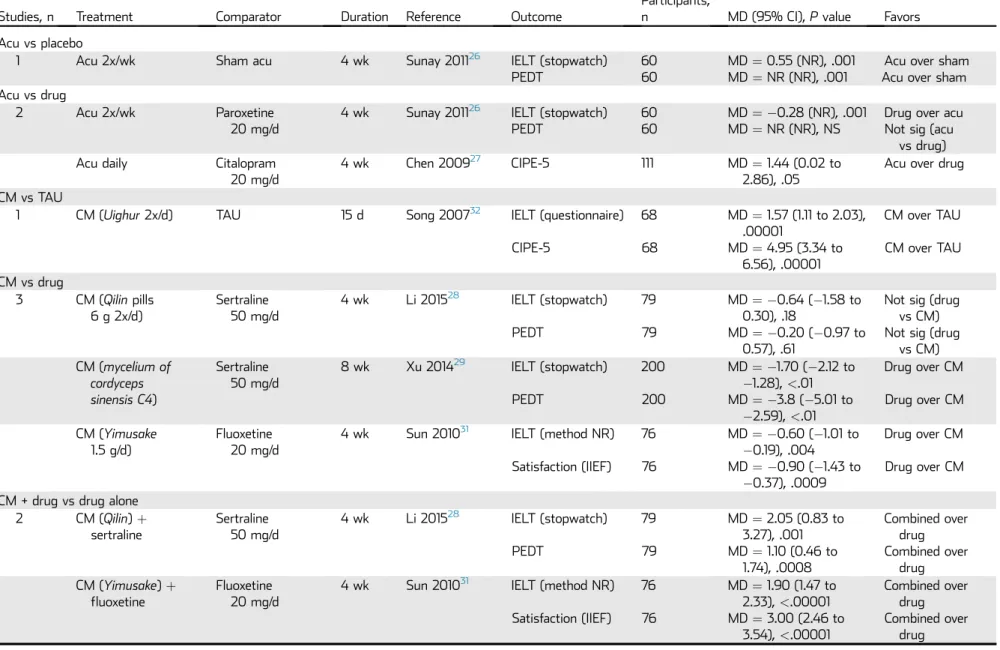
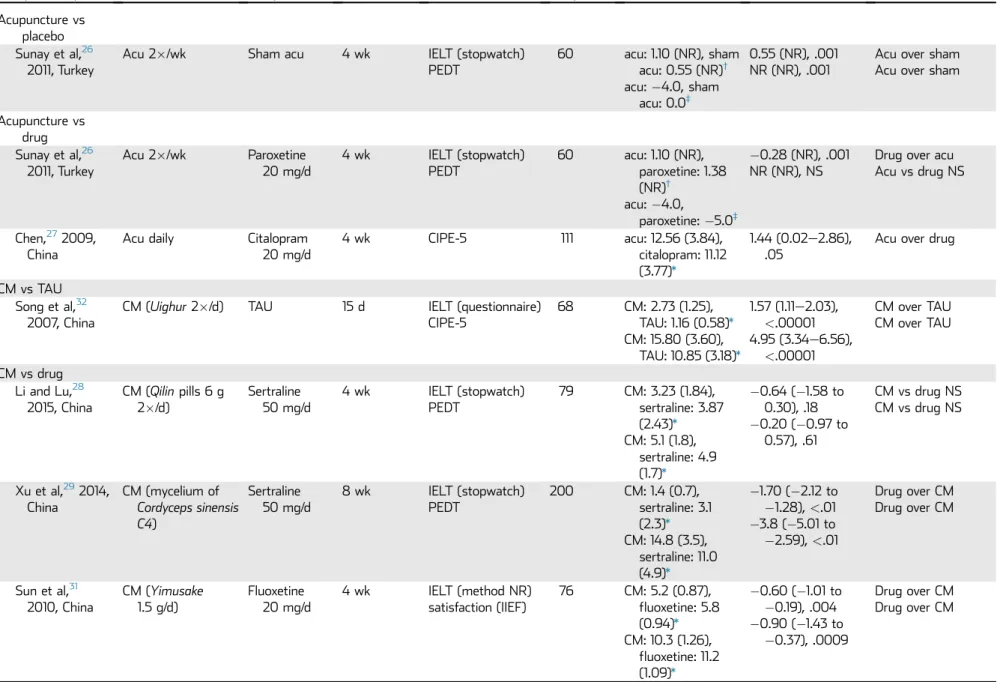
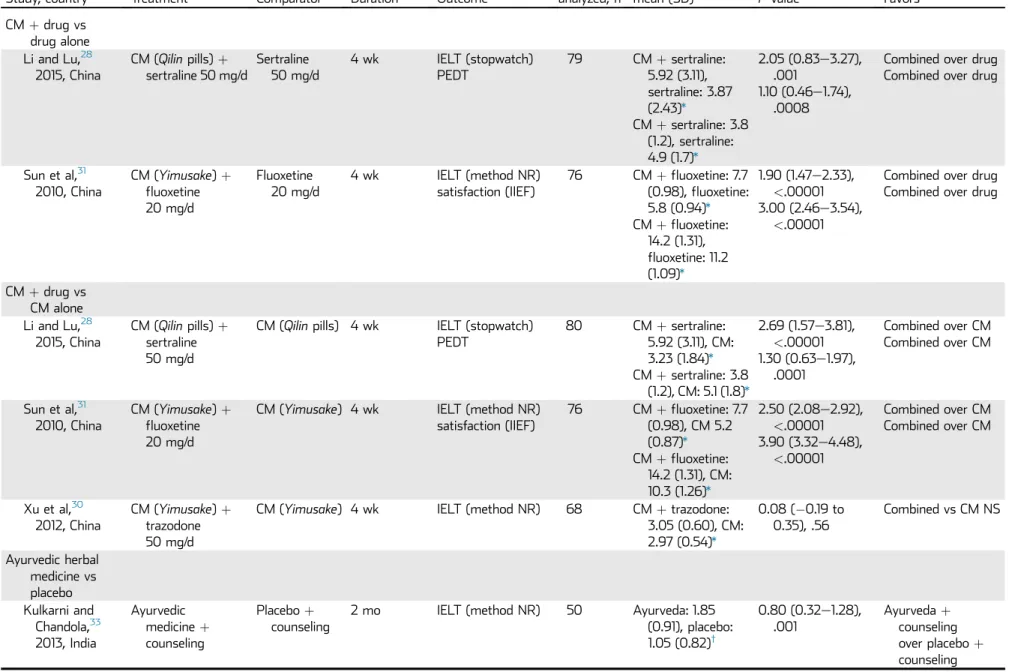
Effectiveness results are presented in Table 3 and adverse effects are presented inTable 4. Further details of effectiveness (including results data per study group) are presented inTable 5.
Acupuncture
Two RCTs (one in Turkey26 and one in China27) assessed acupuncture provided daily for 4 weeks and twice weekly for 4 weeks, respectively. Each study used a standardized range of acupuncture points for all patients. There was some overlap, but also some differences, between the acupuncture points used in the two studies (Table 1). There were no studies of
individualized acupuncture treatment (where different points are used per patient based on clinical examination).
One study compared acupuncture against sham acupuncture (N analyzed ¼ 60) and reported a small but significant improvement in stopwatch-measured IELT for acupuncture over sham (mean difference (MD)¼0.55 minute, P¼.001) and a significant improvement in PEDT score (P¼.001;Table 3).26 These two studies showed mixed results when comparing acupuncture against drug treatment with an SSRI (paroxetine or citalopram, each given daily for 4 weeks),26,27 with IELT favoring drug treatment in the one study reporting this (N¼60; MD ¼ 0.28, P ¼ .001),26 a PEDT score showing no Table 4.Adverse effects
Study, country, duration (n) Treatments AEs
Acupuncture
Sunay et al,262011, Turkey, 4 wk (n¼90, a¼90)
Acupuncture 2/wk, paroxetine 20 mg/d, sham acupuncture 2/wk
No AEs observed (although no formal evaluation of AEs)
Chen,272009, China, 4 wk (n¼111, a¼111)
Acupuncture daily, citalopram 20 mg/d NR
Chinese herbal medicine
Li and Lu,282015, China, 4 wk (n¼120, a¼119)
CM (Qilinpills 6 g 2/d), sertraline 50 mg/d, CMþsertraline
CM: no AEs reported Sertraline: mild transient AEs
(gastrointestinal discomfort in 3, headache and dizziness in 2); 1 patient receiving only sertraline discontinued because of erectile dysfunction Xu et al,292014, China, 8 wk
(n¼218, a¼200)
CM (mycelium ofCordyceps sinensis C4), sertraline 50 mg/d
CM: 7/61 (11.5%) developed mild AEs (dizziness in 2, decreased libido in 1, gastrointestinal discomfort in 4), no discontinuations
Sertraline: 52/157 (33.1) developed mild AEs (dizziness in 30, decreased libido in 12, other); 3/157 (1.9%) discontinued because of severe dizziness
Xu et al,302012, China, 4 wk (n¼68, a¼68)
CM (Yimusake50 mg/d), CMþtrazodone 50 mg/d
CM alone: no AEs
CMþtrazodone: minor AEs (headache in 2, dry mouth in 1, constipation in 1) Sun et al,312010, China, 4 wk
(n¼114, a¼114)
CM (Yimusake1.5 g/d),fluoxetine 20 mg/d, CMþfluoxetine
Number of AEs with CMþfluoxetine were not significantly different from CM orfluoxetine alone (included nausea, dizziness, headache,flushing, somnolence)
Song et al,322007, China, 15 d (n¼68, a¼68)
CM (Uighur) 2/d, treatment as usual NR
Ayurvedic herbal medicine
Kulkarni and Chandola,332013, India, 2 mo (n¼55, a¼50)
Ayurvedic medicineþcounseling, placeboþcounseling
NR
Topical herbal SS cream Choi et al,342000, Korea, 6
applications (n¼125, a¼106)
SS cream (0.20 g 1 h before intercourse), placebo
SS cream: mild burning sensation in 15% of applications, mild pain in 4% of applications, effects resolved<1 h Choi et al,351999, Korea, 4
applications (n¼73, a¼50)
SS cream (0.05, 0.10, 0.15 or 0.20 g 1 h before intercourse), placebo
SS cream: mild burning sensation in 15% of applications, mild pain in 0.04% of applications
a¼number analyzed; AE¼adverse effect; CM¼Chinese medicine; n¼number randomized; NR¼not reported; SS¼secret severance.
Sex Med 2017;5:e1ee18
Table 5.Effectiveness results including results per group
Study, country Treatment Comparator Duration Outcome
Participants analyzed, n
Results per group, mean (SD)
MD (95% CI),
Pvalue Favors
Acupuncture vs placebo Sunay et al,26
2011, Turkey
Acu 2/wk Sham acu 4 wk IELT (stopwatch)
PEDT
60 acu: 1.10 (NR), sham acu: 0.55 (NR)† acu:4.0, sham
acu: 0.0‡
0.55 (NR), .001 NR (NR), .001
Acu over sham Acu over sham
Acupuncture vs drug Sunay et al,26
2011, Turkey
Acu 2/wk Paroxetine 20 mg/d
4 wk IELT (stopwatch) PEDT
60 acu: 1.10 (NR), paroxetine: 1.38 (NR)†
acu:4.0,
paroxetine:5.0‡
0.28 (NR), .001 NR (NR), NS
Drug over acu Acu vs drug NS
Chen,272009, China
Acu daily Citalopram 20 mg/d
4 wk CIPE-5 111 acu: 12.56 (3.84),
citalopram: 11.12 (3.77)*
1.44 (0.02e2.86), .05
Acu over drug
CM vs TAU Song et al,32
2007, China
CM (Uighur2/d) TAU 15 d IELT (questionnaire) CIPE-5
68 CM: 2.73 (1.25), TAU: 1.16 (0.58)*
CM: 15.80 (3.60), TAU: 10.85 (3.18)*
1.57 (1.11e2.03),
<.00001 4.95 (3.34e6.56),
<.00001
CM over TAU CM over TAU
CM vs drug Li and Lu,28
2015, China
CM (Qilinpills 6 g 2/d)
Sertraline 50 mg/d
4 wk IELT (stopwatch) PEDT
79 CM: 3.23 (1.84), sertraline: 3.87 (2.43)*
CM: 5.1 (1.8), sertraline: 4.9 (1.7)*
0.64 (1.58 to 0.30), .18 0.20 (0.97 to
0.57), .61
CM vs drug NS CM vs drug NS
Xu et al,292014, China
CM (mycelium of
Cordyceps sinensis C4)
Sertraline 50 mg/d
8 wk IELT (stopwatch) PEDT
200 CM: 1.4 (0.7), sertraline: 3.1 (2.3)*
CM: 14.8 (3.5), sertraline: 11.0 (4.9)*
1.70 (2.12 to 1.28),<.01 3.8 (5.01 to 2.59),<.01
Drug over CM Drug over CM
Sun et al,31 2010, China
CM (Yimusake
1.5 g/d)
Fluoxetine 20 mg/d
4 wk IELT (method NR) satisfaction (IIEF)
76 CM: 5.2 (0.87), fluoxetine: 5.8 (0.94)*
CM: 10.3 (1.26), fluoxetine: 11.2 (1.09)*
0.60 (1.01 to 0.19), .004 0.90 (1.43 to
0.37), .0009
Drug over CM Drug over CM
(continued)
Se
x
Med
2017
;5:e1
e
e18
e10
C
ooper
et
Table 5.Continued
Study, country Treatment Comparator Duration Outcome
Participants analyzed, n
Results per group, mean (SD)
MD (95% CI),
Pvalue Favors
CMþdrug vs drug alone Li and Lu,28
2015, China
CM (Qilinpills)þ sertraline 50 mg/d
Sertraline 50 mg/d
4 wk IELT (stopwatch) PEDT
79 CMþsertraline: 5.92 (3.11), sertraline: 3.87 (2.43)*
CMþsertraline: 3.8 (1.2), sertraline: 4.9 (1.7)*
2.05 (0.83e3.27), .001
1.10 (0.46e1.74), .0008
Combined over drug Combined over drug
Sun et al,31 2010, China
CM (Yimusake)þ fluoxetine 20 mg/d
Fluoxetine 20 mg/d
4 wk IELT (method NR) satisfaction (IIEF)
76 CMþfluoxetine: 7.7 (0.98),fluoxetine: 5.8 (0.94)*
CMþfluoxetine: 14.2 (1.31), fluoxetine: 11.2 (1.09)*
1.90 (1.47e2.33),
<.00001 3.00 (2.46e3.54),
<.00001
Combined over drug Combined over drug
CMþdrug vs CM alone Li and Lu,28
2015, China
CM (Qilinpills)þ sertraline 50 mg/d
CM (Qilinpills) 4 wk IELT (stopwatch) PEDT
80 CMþsertraline: 5.92 (3.11), CM: 3.23 (1.84)*
CMþsertraline: 3.8 (1.2), CM: 5.1 (1.8)*
2.69 (1.57e3.81),
<.00001 1.30 (0.63e1.97),
.0001
Combined over CM Combined over CM
Sun et al,31 2010, China
CM (Yimusake)þ fluoxetine 20 mg/d
CM (Yimusake) 4 wk IELT (method NR) satisfaction (IIEF)
76 CMþfluoxetine: 7.7 (0.98), CM 5.2 (0.87)*
CMþfluoxetine: 14.2 (1.31), CM: 10.3 (1.26)*
2.50 (2.08e2.92),
<.00001 3.90 (3.32e4.48),
<.00001
Combined over CM Combined over CM
Xu et al,30 2012, China
CM (Yimusake)þ trazodone 50 mg/d
CM (Yimusake) 4 wk IELT (method NR) 68 CMþtrazodone: 3.05 (0.60), CM: 2.97 (0.54)*
0.08 (0.19 to 0.35), .56
Combined vs CM NS
Ayurvedic herbal medicine vs placebo Kulkarni and
Chandola,33 2013, India
Ayurvedic medicineþ counseling
Placeboþ counseling
2 mo IELT (method NR) 50 Ayurveda: 1.85 (0.91), placebo: 1.05 (0.82)†
0.80 (0.32e1.28), .001
Ayurvedaþ counseling over placeboþ counseling
(continued)
Se
x
Med
2017
;5:e1
e
e18
CAM
fo
r
Management
of
Pr
emature
Ejaculation
e
significant difference (P value not reported),26 and a CIPE-5 score favoring acupuncture in the other study (N ¼ 111; P ¼ .05).27 One study reported that no adverse effects were observed (although there was no formal evaluation of these),26 and the other study did not report adverse effect data (Table 4).27 In summary, the available data indicate that acupuncture might be slightly more effective than placebo (sham) in treating PE, although this is based on only one study of unclear quality.
Chinese Herbal Medicine
Five RCTs (all conducted in China) assessed a 2- to 8-week course of oral Chinese herbal medicine.28e32 Each study used the same herbal medicine(s) for all patients. There were no studies of individualized Chinese medicine (where different herbs are used per patient based on clinical examination). The specific Chinese medicines used differed among studies. One study used Qilin pills (a combination of herbs; Table 1) at a dose of 6 g twice daily28; one used mycelium ofCordyceps sinensis C429; two used Yimusake (one at 50 mg/d30and one at 1.5 g/d31); and one usedUighurtwice daily.32
Results for Chinese medicine are presented in Table 3 and Figures 1and2. One study favored Chinese medicine (Uighur) over treatment as usual (N analyzed ¼ 68),32 reporting significant differences in IELT measured by questionnaire (MD¼1.57 minutes, 95% CI¼1.11e2.03,P<.00001) and CIPE-5 score (P<.00001;Table 3andFigure 1). Three studies compared Chinese medicine against drug treatment with an SSRI (fluoxetine or sertraline, each given daily for 4e8 weeks).28,29,31 Of these, two studies significantly favored SSRIs over Chinese medicine (mycelium of Cordyceps sinensis C4 or Yimusake) for IELT (one measured by stopwatch) and PEDT and IIEF scores,29,31whereas the third study showed no signif-icant difference in stopwatch-measured IELT or PEDT score between the SSRI and Chinese medicine (Qilinpills;Table 3).28 A meta-analysis of IELT across all three studies significantly favored drug treatment with SSRIs (total N ¼ 355; pooled MD¼1.01 minutes, 95% CI¼0.18e1.84,P¼.02;Figure 1), with a high level of heterogeneity (I2¼86%,P¼.0007).
Two studies compared Chinese medicine (Qilin pills or Yimusake) plus SSRI (fluoxetine or sertraline) against SSRI alone.28,31 These studies (total N ¼ 155) significantly favored combination treatment over SSRI alone for IELT (one measured by stopwatch; pooled MD¼1.92 minutes, 95% CI¼1.51e2.32,P<.00001) with low heterogeneity (I2¼0%, P ¼ .82); PEDT and IIEF scores also favored combination treatment (P < .001 for the two comparisons; Table 3 and Figure 2).
The same two studies compared Chinese medicine (Qilinpills orYimusake) plus SSRI (fluoxetine or sertraline) against Chinese medicine alone.28,31These studies (total N¼156) significantly favored combination treatment over Chinese medicine alone for IELT (one measured by stopwatch; pooled MD ¼ 2.52,
Table 5. C ontinued Study , country Tr eatment C ompar ator Dur ation Outc ome P articipants analyzed, n R esult s per gr oup, mean (SD ) MD (95% CI), P value Favo rs Topical herbal SS cr eam vs plac ebo Choi et al, 34 2000, K o re a (c rosso ve r) SS cr eam (0.2 g 1 h bef or e coitus) Plac ebo 5 applications IEL T (stopw atch) 106 SS cr eam: 10. 92 (9. 78), plac ebo: 2. 4 5 (2. 99 ) * 8. 4 7 (6.52 e 10. 42), < .001 SS cr eam o ver plac ebo Choi et al, 35 1999, K o re a (c rosso ve r) SS cr eam (0.2 g 1 h bef or e coitus) Plac ebo 1 application IEL T (stopw atch) 50 SS cr eam: 11.06 (8.2 7), plac ebo: 2.2 7 (2.26) * 8. 79 (6 .4 1 e 11. 17), < .001 SS cr eam o ver plac ebo CI PE -5 ¼ Chi nese Inde x o f P re m atur e Ejacula tion e 5 (higher sc or e ¼ be tter ); CM ¼ Chi nese medicine; IEL T ¼ intr av agin al ejac ulatory laten cy time; IIEF ¼ Int ernational Inde x o f E rectile Functio n (h igher sc or e ¼ be tter ); MD ¼ m ean diff er en ce ; N R ¼ not re p orted; NS ¼ not sign i fi can t; PED T ¼ P rematur e Ejacula tion Diagnostic Tool (lower sc or e ¼ better; ther ef or e, sign s a re re ve rsed whe n calcul ating the MD ); SS ¼ secr et sev er anc e; T A U ¼ tr eatment as usual. *Me an after tr eatme nt. †Me an cha nge fr om baseline . ‡Me dian change fr om baseline.
Sex Med 2017;5:e1ee18
95% CI ¼ 2.13e2.91, P < .00001) with low heterogeneity (I2¼0%,P¼.76); PEDT and IIEF scores also favored com-bination treatment (P<.0001 for all comparisons). Results fa-voring combination treatment over drug or Chinese medicine alone (for IELT and PEDT) remained significant 1 month after treatment ended in the one study reporting this.28A third study (N¼68) comparing Chinese medicine (Yimusake) plus a sero-tonin antagonist and reuptake inhibitor (trazodone) against Chinese medicine alone30 showed no significant difference in IELT (measurement method not reported; MD ¼0.08, 95% CI¼ 0.19 to 0.35,P¼.56; Table 3andFigure 2).
Four of five studies reported data on adverse effects (Table 4).28e31 For patients receiving Chinese medicine alone, two studies reported that no adverse effects were observed (one of Qilin pills 6 g twice daily28 and one of Yimusake 50 mg/d30). One study reported adverse effects in 12% of patients receiving
mycelium of Cordyceps sinensis C4 (including gastrointestinal discomfort, dizziness, and decreased libido),29whereas one study reported that the number of adverse effects did not differ significantly among Chinese medicine alone (Yimusake1.5 g/d), fluoxetine alone, and combination treatment.31
In summary, across studies of Chinese medicine, one study favored Chinese medicine over treatment as usual.32 A meta-analysis of three studies favored SSRI treatment over Chinese medicine.28,29,31 Two studies favored Chinese medicine plus SSRIs over SSRIs alone or Chinese medicine alone.28,31
Ayurvedic Medicine
One RCT conducted in India (N analyzed ¼50) assessed a 2-month course of Ayurvedic medicine (Indian herbal medicine) plus psychological counseling compared with placebo plus Figure 1. Intravaginal ejaculatory latency time for Chinese medicine (CM).
Figure 2. Intravaginal ejaculatory latency time for Chinese medicine (CM) combined with drug treatment.fluox¼fluoxetine; SARI¼serotonin antagonist and reuptake inhibitor (trazodone); sert¼sertraline; SSRI¼selective serotonin reuptake inhibitor; trazo¼trazodone.
Sex Med 2017;5:e1ee18
psychological counseling.33Ayurvedic medicine showed a small but significant improvement in IELT (measurement method not reported; MD¼0.80 minute, 95% CI¼0.32e1.28,P¼.001; Table 3). Adverse effects were not reported.
SS Cream
Two crossover RCTs conducted in Korea compared SS cream against placebo.34,35 These two RCTs showed significant effects on stopwatch-measured IELT (total N ¼ 156; pooled MD¼8.60 minutes, 95% CI¼7.09e10.10,P<.001) with low heterogeneity (I2¼ 0%,P ¼.84; Table 3 and Figure 3). The two studies used a single-group crossover design in which each patient received four or five applications of SS cream and one of placebo. One study35 used different doses of SS cream; only the results for the maximum dose (0.2 g) are presented. Patients might have had less severe PE than those in some other studies because the inclusion criterion was an IELT shorter than 3 minutes (combined with low partner satisfaction in one study). Adverse effects included a mild burning sensation in 15% of patients (the two studies) and mild pain in 0.04% to 4% of patients (Table 4).
Summary
The included studies evaluated the effectiveness of acupunc-ture, Chinese herbal medicine, Ayurvedic herbal medicine, and topical SS cream in improving IELT and other outcomes. Overall risk of bias was unclear in all studies because of unclear allocation concealment and/or blinding. Studies were clinically heterogeneous and stopwatch-measured IELT was reported in only 5 of 10 studies. Acupuncture increased IELT over placebo (one study; MD¼0.55 minute, P ¼.001). Ayurvedic herbal medicine increased IELT over placebo (one study; MD¼0.80 minute, P ¼ .001). Topical SS cream improved IELT over placebo in two crossover studies (MD ¼ 8.60 minutes, P <.001), although inclusion criteria were broad (IELT <3 minutes), and there were mild irritant effects in some patients. SSRIs were more effective on IELT than Chinese herbal medi-cine (three studies; MD¼ 1.01 minutes,P ¼.02). However, combination treatment with Chinese medicine plus SSRIs improved IELT over SSRIs alone (two studies; MD ¼ 1.92 minutes,P<.00001) or Chinese medicine alone (two studies;
MD ¼ 2.52 minutes, P < .00001). Adverse effects were not consistently assessed but where reported were generally mild. There were sparse data on the potential for drug interactions.
DISCUSSION
Our systematic review is (to our knowledge) the first to evaluate CAM for PE. All studies were classed as having an overall unclear risk of bias because of limited reporting. Blinding of participants and personnel was difficult in many studies because of the nature of the interventions, although a few studies used placebo. However, because most studies included an active control group (eg, drug treatment), any placebo effect might be expected to occur in the two groups. It was not possible to conduct a formal test for publication bias or produce funnel plots because of the small number of studies in each analysis. How-ever, all but three studies were conducted in single centers,31,32,34 and single-center trials tend to show larger treatment effects than multicenter trials,40 possibly because of a lower likelihood of publication if the result is negative (publication bias), lower methodologic quality, and/or more selected patients.23
Regarding outcomes, 9 of 10 included studies assessed IELT but only five reported on stopwatch-measured IELT. Because IELT tends to be positively skewed, it has been suggested that studies should report geometric (rather than arithmetic) mean IELT.41None of the included studies reported geometric mean IELT, although two studies used the Mann-Whitney U-test for between-group differences because of non-normal distribution of data.26,29 Additional outcomes included PEDT, CIPE-5, and IIEF scores. Although it is important that clinical studies assess non-IELT outcomes in addition to IELT,42there is a need for greater agreement on which measurements are most robust. Duration of the interventions was 2 to 8 weeks in all studies (or one to five applications for SS cream). Only one study (of Chinese medicine) provided follow-up data beyond the end of treatment and reported that differences remained significant 1 month after treatment ended. For most interventions, it was not clear how long the effects might last or whether repeat treatments were effective. This is an issue for all PE treatments. An interesting point relates to the nature of CAM therapies. In clinical practice, many CAM therapies involve a holistic approach based on the patient’s overall pattern of health. It can Figure 3. Intravaginal ejaculatory latency time for secret severance (SS) cream.
Sex Med 2017;5:e1ee18
be difficult to determine how much of the treatment effect is due to the specific treatment (acupuncture, herbs) and how much is due to the patient-therapist interaction and other aspects (eg, lifestyle advice). Some researchers believe the patient-therapist interaction and other aspects of treatment should be controlled for, whereas others argue that they are a valid element of treatment.43e45A related issue is whether CAM therapies are individualized to the patient (eg, in clinical practice, two patients with PE might receive different herbal remedies or acupuncture points depending on their overall symptom picture).43,44 All studies included in this review used a standardized treatment across patients within a study (same set of acupuncture points or same Chinese herbal preparation), although treatments varied among studies. Although standardized treatment protocols increase reproducibility, effectiveness of CAM therapies could be compromised by this approach.
None of the included therapies are commonly provided for PE by Western government health services. This has implications for access and use of these therapies. Acupuncture, Chinese medi-cine, and Ayurvedic medicine might be available from private practitioners, whereas SS cream currently has limited availability outside Korea. Pragmatically, because there are so many CAM therapies available, it seems unlikely that they will all undergo further evaluation in large-scale studies. Therefore, it might be reasonable to summarize that the CAM therapies reviewed here have some (although limited) evidence for effectiveness in treating PE, and that they might provide another option for patients who favor a mind-body approach or who wish to avoid long-term pharmacologic treatment. It would need to be borne in mind that the effectiveness evidence is not conclusive, and care would need to be taken to monitor for adverse effects and to consider the potential for herb-drug interactions.
Regarding further research, it would be useful to see further RCTs in a Western setting for any of the included treatments, because all had some (limited) evidence of effectiveness in PE. It would be useful to conduct comparisons against placebo, no treatment, existing therapies (drug or behavioral treatment), and combination treatment. To increase consistency and facilitate meta-analyses, future studies should recruit men meeting the ISSM definition of PE, measure stopwatch-assessed IELT, and report additional outcomes using validated instruments. Additional areas for further study could include optimum duration of therapy and how effects might best be maintained in the long term.
CONCLUSIONS
There is preliminary evidence for effectiveness of some CAM therapies in PE. However, results are based on clinically heterogeneous, mostly single-center studies of unclear quality. Acupuncture, Ayurvedic medicine, and SS cream improved IELT and other outcomes over placebo based on limited data. Chinese herbal medicine was not as effective as SSRIs, whereas combination treatment with Chinese medicine plus SSRIs
improved outcomes over either therapy alone. Adverse effects were not consistently assessed, although where reported they were generally mild, and there were sparse data on the potential for drug interactions. Further well-conducted RCTs of all treatments would be valuable.
ACKNOWLEDGMENTS
We thank Shijie Ren and Ziyi Lin for translation of articles and Naila Dracup for updating literature searches.
Corresponding Author: Katy Cooper, PhD, ScHARR, University of Sheffield, Regent Court, 30 Regent Street, Sheffield S1 4DA, UK. Tel:þ44-0-114-222-0773; E-mail:k.l.cooper@ sheffield.ac.uk
Conflicts of Interest:Authors report no conflicts of interest.
Funding:This work was funded by the UK National Institute for Health Research Health Technology Assessment Programme (project number 13-12).
STATEMENT OF AUTHORSHIP
Category 1
(a) Conception and Design
Katy Cooper; Marrissa Martyn-St James; Eva Kaltenthaler; Kath Dickinson; Anna Cantrell
(b) Acquisition of Data
Katy Cooper; Marrissa Martyn-St James; Kath Dickinson; Anna Cantrell
(c) Analysis and Interpretation of Data
Katy Cooper; Marrissa Martyn-St James; Eva Kaltenthaler; Shijie Ren; Kevan Wylie; Leila Frodsham; Catherine Hood
Category 2
(a) Drafting the Article
Katy Cooper
(b) Revising It for Intellectual Content
Katy Cooper; Marrissa Martyn-St James; Eva Kaltenthaler; Kath Dickinson; Anna Cantrell; Shijie Ren; Kevan Wylie; Leila Frodsham; Catherine Hood
Category 3
(a) Final Approval of the Completed Article
Katy Cooper; Marrissa Martyn-St James; Eva Kaltenthaler; Kath Dickinson; Anna Cantrell; Shijie Ren; Kevan Wylie; Leila Frodsham; Catherine Hood
REFERENCES
1. Serefoglu EC, McMahon CG, Waldinger MD, et al. An evidence-based unified definition of lifelong and acquired premature ejaculation: report of the Second International Society for Sexual Medicine Ad Hoc Committee for the Definition of Premature Ejaculation.Sex Med 2014;2:41-59.
2. American Psychiatric Association. Diagnostic and statistical manual of mental disorders. 5th ed. text rev. Washington, DC: American Psychiatric Association; 2013.
Sex Med 2017;5:e1ee18
3. Laumann EO, Nicolosi A, Glasser DB, et al. Sexual problems among women and men aged 40e80 y: prevalence and correlates identified in the Global Study of Sexual Attitudes and Behaviors.Int J Impot Res 2005;17:39-57.
4. Laumann EO, Paik A, Rosen RC. Sexual dysfunction in the United States: prevalence and predictors. JAMA 1999; 281:537-544.
5. Porst H, Montorsi F, Rosen RC, et al. The Premature Ejacu-lation Prevalence and Attitudes (PEPA) survey: prevalence, comorbidities, and professional help-seeking.Eur Urol 2013; 51:816-823.
6. Althof SE, McMahon CG, Waldinger MD, et al. An update of the International Society of Sexual Medicine’s guidelines for the diagnosis and treatment of premature ejaculation (PE). Sex Med 2014;11:1392-1422.
7. Rowland DL, Patrick DL, Rothman M, et al. The psychological burden of premature ejaculation.J Urol 2007;177:1065-1070.
8. Byers ES, Grenier G. Premature or rapid ejaculation: hetero-sexual couples’ perceptions of men’s ejaculatory behavior. Arch Sex Behav 2003;32:261-270.
9. Richardson D, Goldmeier D, Green J, et al. Recommendations for the management of premature ejaculation: BASHH Special Interest Group for Sexual Dysfunction.Int J STD AIDS 2006; 17:1-6.
10. Hatzimouratidis K, Eardley I, Giuliano F, et al. Guidelines on male sexual dysfunction: erectile dysfunction and premature ejaculation. European Association of Urology.Eur Urol 2010; 57:804-814.
11. Melnik T, Althof S, Atallah AN, et al. Psychosocial in-terventions for premature ejaculation. Cochrane Database Syst Rev 2011;(8):CD008195.
12. Cooper K, Martyn-St James M, Kaltenthaler E, et al. Behavioral therapies for management of premature ejacula-tion: a systematic review.Sex Med 2015;3:174-188.
13. Cooper K, Martyn-St James M, Kaltenthaler E, et al. Interventions to treat premature ejaculation: a systematic review short report.Health Technol Assess 2015;19:1-180.
14. Moher D, Liberati A, Tetzlaff J, et al. Preferred reporting items for systematic reviews and meta-analyses: the PRISMA statement.Ann Intern Med 2009;151:264-269, W64.
15. Wieland LS, Manheimer E, Berman BM. Development and classification of an operational definition of complementary and alternative medicine for the Cochrane collaboration.Altern Ther Health Med 2011;17:50-59.
16. Patrick DL, Giuliano F, Ho KF, et al. The Premature Ejaculation Profile: validation of self-reported outcome measures for research and practice.BJU Int 2009;103:358-364.
17. Althof S, Rosen R, Symonds T, et al. Development and vali-dation of a new questionnaire to assess sexual satisfaction, control, and distress associated with premature ejaculation. J Sex Med 2006;3:465-475.
18. Symonds T, Perelman MA, Althof S, et al. Development and validation of a premature ejaculation diagnostic tool.Eur Urol 2007;52:565-573.
19. Arafa M, Shamloul R. Development and evaluation of the Arabic Index of Premature Ejaculation (AIPE). J Sex Med 2007;4:1750-1756.
20. Yuan YM, Xin ZC, Jiang H, et al. Sexual function of premature ejaculation patients assayed with Chinese Index of Premature Ejaculation.Asian J Androl 2004;6:121-126.
21. Rosen RC, Riley A, Wagner G, et al. The International Index of Erectile Function (IIEF): a multidimensional scale for assess-ment of erectile dysfunction.Urology 1997;49:822-830.
22. Cochrane Collaboration Review Manager (RevMan). London: Cochrane Collaboration; 2012.
23. Cochrane Collaboration. Cochrane handbook for systematic reviews of interventions version 5.1.0. London: Cochrane Collaboration; 2011.
24. Higgins JPT, Altman DG, Sterne JAC; on behalf of the Cochrane Statistical Methods Group and the Cochrane Bias Methods Group. Assessing risk of bias in included studies. In: Higgins JPT, ed. Cochrane handbook for systematic reviews of interventions version 5.1.0. London: Cochrane Collaboration; 2011. Available at: www.cochrane-handbook.org. Accessed July 18, 2016.
25. Wright CC, Sim J. Intention-to-treat approach to data from randomized controlled trials: a sensitivity analysis. J Clin Epidemiol 2003;56:833-842.
26. Sunay D, Sunay M, Aydogmus Y, et al. Acupuncture versus paroxetine for the treatment of premature ejaculation: a ran-domized, placebo-controlled clinical trial. Eur Urol 2011; 59:765-771.
27. Chen ZX. Control study on acupuncture and medication for treatment of primary simple premature ejaculation.Zhongguo Zhen Jiu 2009;29:13-15.
28. Li JX, Lu QG. Efficacy of Qilin pills combined with sertraline in the treatment of secondary non-consolidated kidney qi premature ejaculation. Zhong Hua Nan Ke Xue 2015; 21:443-446.
29. Xu G, Jiang HW, Fang J, et al. An improved dosage regimen of sertraline hydrochloride in the treatment for premature ejac-ulation: an 8-week, single-blind, randomized controlled study followed by a 4-week, open-label extension study. J Clin Pharm Ther 2014;39:84-90.
30. Xu JX, Gao G, Xu N, et al. Yimusake alone or combined with trazodone hydrochloride for primary premature ejaculation. Zhonghua Nan Ke Xue 2012;18:376-378.
31. Sun Z, Wang Y, Chen L, et al. Clinical study on treatment of premature ejaculation with fluoxetine hydrochloride and tamsulosin.Chinese J Androl 2010;24:43-45.
32. Song GH, Halmurat U, Geng JC, et al. Clinical study on the treatment of premature ejaculation by Uighur medicine gu-jing-mai-si-ha tablet.Chin J Integr Med 2007;13:185-189.
33. Kulkarni PV, Chandola H. Evaluation of stambhanakaraka yoga and counseling in the management of shukragata vata (premature ejaculation).Ayu 2013;34:42-48.
34. Choi HK, Jung GW, Moon KH, et al. Clinical study of SS-cream in patients with lifelong premature ejaculation.Urology 2000; 55:257-261.
Sex Med 2017;5:e1ee18
35. Choi HK, Xin ZC, Choi YD, et al. Safety and efficacy study with various doses of SS-cream in patients with premature ejacu-lation in a double-blind, randomized, placebo controlled clinical study.Int J Impot Res 1999;11:261-264.
36. Pei JT, Shi ZH. An effective combined therapy for simple premature ejaculation.Zhonghua Nan Ke Xue 2008; 14:731-733.
37. Zhang FB, Tian Y, Du LD. Xuanju compound capsule combined with erogenous focus exercise is effective for premature ejaculation. Zhonghua Nan Ke Xue 2006; 12:1139-1140.
38. Dhikav V, Karmarkar G, Gupta M, et al. Yoga in premature ejaculation: a comparative trial with fluoxetine. J Sex Med 2007;4:1726-1732.
39. Mamidi P, Gupta K. Efficacy of certain yogic and naturopathic procedures in premature ejaculation: a pilot study.Int J Yoga 2013;6:118-122.
40. Dechartres A, Boutron I, Trinquart L, et al. Single-center trials show larger treatment effects than multicenter trials: evidence from a meta-epidemiologic study. Ann Intern Med 2011; 155:39-51.
41. Waldinger MD, Zwinderman AH, Olivier B, et al. Geometric mean IELT and premature ejaculation: appropriate statistics to avoid overestimation of treatment efficacy.J Sex Med 2008; 5:492-499.
42. McMahon CG. Ejaculatory latency vs. patient-reported outcomes (PROs) as study end points in premature ejacula-tion clinical trials.Eur Urol 2007;52:321-323.
43. Fonnebo V, Grimsgaard S, Walach H, et al. Researching complementary and alternative treatments—the gate-keepers are not at home.BMC Med Res Methodol 2007; 7:7.
44. MacPherson H, Sherman K, Hammerschlag R, et al. The clinical evaluation of traditional East Asian systems of medi-cine.Clin Acu Orient Med 2002;3:16-19.
45. Relton C, O’Cathain A, Thomas KJ.‘Homeopathy’: untangling the debate.Homeopathy 2008;97:152-155.
SUPPLEMENTARY DATA
Supplementary data related to this article can be found at http://dx.doi.org/10.1016/j.esxm.2016.08.002.
APPENDIX 1. MEDLINE SEARCH STRATEGY
Medline search strategy 1. exp Ejaculation/
2. exp Premature Ejaculation/ 3. (premature$ adj3 ejaculat$).ti,ab. 4. (early adj3 ejaculat$).ti,ab. 5. (rapid adj3 ejaculat$).ti,ab.
6. (rapid adj3 climax$).ti,ab. 7. (premature$ adj3 climax$).ti,ab. 8. (ejaculat$ adj3 pr?ecox).ti,ab. 9. or/1-8.
Filter 1: Randomized Controlled Trials 10. Randomized Controlled Trials as Topic/ 11. randomized controlled trial/
12. Random Allocation/ 13. Double Blind Method/ 14. Single Blind Method/ 15. clinical trial/
16. clinical trial, phase i.pt. 17. clinical trial, phase ii.pt. 18. clinical trial, phase iii.pt. 19. clinical trial, phase iv.pt. 20. controlled clinical trial.pt. 21. randomized controlled trial.pt. 22. multicenter study.pt.
23. clinical trial.pt.
24. exp Clinical Trials as topic/ 25. or/10-24
26. (clinical adj trial$).tw.
27. ((singl$ or doubl$ or treb$ or tripl$) adj (blind$3 or mask$3)).tw.
28. PLACEBOS/ 29. placebo$.tw.
30. randomly allocated.tw. 31. (allocated adj2 random$).tw. 32. 26 or 27 or 28 or 29 or 30 or 31 33. 25 or 32
34. case report.tw. 35. letter/
36. historical article/ 37. 34 or 35 or 36 38. 33 not 37
Filter 2: Reviews 10. review.ab. 11. review.pt. 12. meta-analysis.ab.
Sex Med 2017;5:e1ee18
13. meta-analysis.pt.
14. meta-analysis.ti.
15. or/10-14
16. letter.pt.
17. comment.pt.
18. editorial.pt.
19. or/16-18
20. 15 not 19
Filter 3: Guidelines 10. guideline.pt. 11. practice guideline.pt. 12. exp Guideline/
13. health planning guidelines/ 14. 10 or 11 or 12 or 13
Sex Med 2017;5:e1ee18