A STUDY TO ASSESS THE EFFECTIVENESS OF STRUCTURED
TEACHING PROGRAMME ON LEVEL OF KNOWLEDGE AND
ATTITUDE REGARDING IMMUNIZATION AMONG THE
MOTHERS OF UNDER FIVE CHILDREN IN SELECTED
RURAL AREA AT DINDUGAL.
Reg. No. 301518201
A DISSERTATION SUBMITTED TO THE TAMILNADU
DR.MGR MEDICAL UNIVERSITY, CHENNAI,
IN PARTIAL FULFILLMENT FOR THE DEGREE OF
MASTER OF SCIENCE IN NURSING
A STUDY TO ASSESS THE EFFECTIVENESS OF STRUCTURED
TEACHING PROGRAMME ON LEVEL OF KNOWLEDGE AND
ATTITUDE REGARDING IMMUNIZATION AMONG THE
MOTHERS OF UNDER FIVE CHILDREN IN SELECTED
RURAL AREA AT DINDUGAL.
Reg. No. 301518201
EXTERNAL EXAMINER
INTERNAL EXAMINER
A DISSERTATION SUBMITTED TO THE TAMILNADU DR.MGR
MEDICAL UNIVERSITY, CHENNAI,
IN PARTIAL FULFILLMENT FOR THE DEGREE OF
MASTER OF SCIENCE IN NURSING
CERTIFICATE
This bonafide work of
301518201,
M.Sc Nursing II Year Student
from Jainee College of Nursing, Dindigul submitted in partial fulfillment
for the Degree of Master of Science in Nursing, Under the Tamilnadu
Dr.MGR Medical University, Chennai.
Prof. Mrs.K.Thilagavathi, M.Sc., (N) Ph.D.,
Principal,
Department of Psychiatric Nursing,
Jainee College of Nursing,
Dindugal.
A STUDY TO ASSESS THE EFFECTIVENESS OF STRUCTURED
TEACHING PROGRAMME ON LEVEL OF KNOWLEDGE AND
ATTITUDE REGARDING IMMUNIZATION AMONG THE
MOTHERS OF UNDER FIVE CHILDREN IN SELECTED
RURAL AREA AT DINDUGAL.
APPROVED BY DISSERTATION COMMITTEE ON ____________________ PROFESSOR IN NURSING
Research Advisor : _______________________________________ Prof.Mrs.Thilagavathi, M.Sc.,(N),(Ph.D) Principal,
Jainee College of Nursing, Dindugal .
Research Guide : ________________________________________ Mrs. Jeyasundari, M.Sc.,(N),(Ph.D),
Professor,
HOD of Child Health Nursing, Jainee College of Nursing, Dindugal.
Medical Expert : ________________________________________ Dr.Navamani Prabhakaran. M.D., DCH, Paediatric Consultant,
Managing Director, Navamani Nursing Home, Madurai.
A DISSERTATION SUBMITTED TO THE TAMILNADU
DR.MGR MEDICAL UNIVERSITY, CHENNAI,
IN PARTIAL FULFILLMENT FOR THE DEGREE OF
ACKNOWLEDGEMENT
Gratitude can never be expressed in words but it is only a deep perception, which makes the words to flow from one’s inner heart. Success of
an individual is only possible when we are being supported by others.
I express my sincere and heartfelt gratitude to God, the Almighty for His abundant strength and blessings in making this study towards its successful outcome.
I wish to express my sincere thanks to Mr.SUKUMAR Director Jainee College of Nursing Dindugal, for his support, encouragement and providing facilities for the successful completion of the study.
I express my sincere thanks to Prof.(Mrs.)THILAGAVATHI, M.Sc (N)., Ph.D., Principal cum H.O.D of Psychiatric department for her valuable support and encouragement throughout this study.
It’s Pleasure to express my sincere thanks and deep appreciation to my
esteemed guide Prof. (Mrs) JEYA SUNDARI M.Sc., (N).,Ph.D., Head of the department of Child health nursing for her valuable support, unending words, encouragement and guidance to carry out this dissertation and being my inspiration.
I wish to acknowledge my sincere thanks to all FACULTY MEMBERS of Jainee College of Nursing for their guidance and support.
I must record my grateful thanks to Dr.NAVAMANI
PRABHAKARAN, MD, DCH Consultant Padiatrician Navamani Nursing Homefor his kind validity and guidance throughout our study.
I thank the LIBRARIANS of Jainee College of Nursing for helping me with the review and library facility throughout the study.
My Special thanks to Mr.PRESIDENT., Vakkampatti for granting Permission to conduct my study.
I am grateful to all the experts who given me a valuable suggestions contributed to the refinement of the data collection tool.
Mere words cannot express our heartfelt gratitude to our precious and VALUABLE PARENTS from the moment we were born, till date, they were always there for us to guide us and care for us at any time. We have no words to express the spirit behind our progress, cherished love and warmth showered on us. We are much delighted and proud to dedicate this study to our parents, who have devoted their life for us and without them we cannot come to this status in our life.
TABLE OF CONTENTS
CHAPTER CONTENT PAGE
I INTRODUCTION 1
Need for the study 3
Statement of the problem 7
Objectives 7
Hypotheses 7
Operational definitions 8
Assumption 8
Limitation 9
Projected outcome 9
Conceptual framework 10
II REVIEW OF LITERATURE 13
III RESEARCH METHODOLOGY 21
Research approach 21
Research design 21
Setting of the study 21
Population 22
Sample size and sampling technique 22
Variables 22
Criteria for sample selection 22
Description of the tool 23
Validity 23
Reliability 23
Pilot study 23
Procedure for data collection 24
Plan for data analysis 25
CHAPTER CONTENT PAGE
IV ANALYSIS AND INTERPRETATION OF DATA 27
V DISCUSSION 52
VI SUMMARY, IMPLICATIONS,
RECOMMENDATIONS AND CONCLUSION
57
Major findings of the study 57
Implications for nursing practice 58
Implications for nursing education 59
Implications for nursing administration 59
Implications for nursing research 59
Recommendations 60
Conclusion 60
LIST OF TABLES
TABLE TITLE PAGE
1 Frequency and percentage distribution of samples on selected demographic variables
28
2 Distribution of samples according to the pre test knowledge scores of mothers regarding immunization
35
3 Distribution of samples according to the posttest knowledge scores of mothers regarding immunization.
37
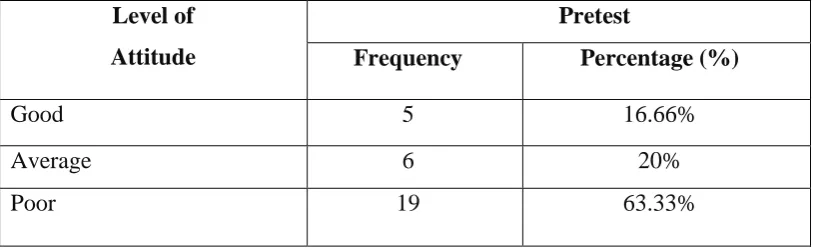
4 Distribution of samples according to the pre test attitude scores of mothers regarding immunization
39
5 Distribution of samples according to the post test attitude scores of mothers regarding immunization
41
6 Comparison of the pretest and posttest knowledge score on mothers regarding immunization.
43
7 Comparison of the pretest and posttest attitude score on mothers regarding immunization.
45
8 Relationship between post test level of knowledge and attitude among under five mothers.
47
9 Association between the post test knowledge scores on mothers regarding immunization and demographic variables
48
10 Association between the post test attitude scores on mothers regarding immunization and demographic variables
50
LIST OF FIGURES
FIGURE TITLE PAGE
1. Conceptual framework based on modified Ludwig von
bertanlanffy’s general system model 12
2. Schematic representation of the Research methodology 26 3. Distribution of samples according to the age of the
Mother
30
4. Distribution of samples according to the Religion 31 5. Distribution of samples according to the occupation of the
Mother
32
6. Distribution of samples according to the Education 33 7. Distribution of samples according to the source of
Information 34
8. Distribution of samples according to the pre test knowledge scores of mothers regarding immunization.
36
9. Distribution of samples according to the post test knowledge scores of mothers regarding immunization.
38
10. Distribution of samples according to the pretest attitude scores of mothers regarding immunization.
40
11. Distribution of samples according to the post test attitude
scores of mothers regarding immunization. 42
12. Comparison of the pre test and post test knowledge scores of mothers regarding immunization
44
13. Comparison of the pre test and post test attitude scores of mothers regarding immunization
LIST OF APPENDIX
APPENDIX TITLE
I Letter seeking experts opinion for content validity of tool content vanity
II Certificate of content validity III Certificate of Tamil Editing
IV Certificate of English Editing
V List of experts opinion for content validity
VI Tools (English)
Part A. Demographic variables Part B. Knowledge Questionnaire Part C. Attitude scale
CHAPTER – I
1
CHAPTER - I
INTRODUCTION
“What a child doesn’t receive, he can seldom later”
-James.
Vaccination is probably one of the most cost effective interventions to reduce
burden of childhood morbidity and mortality, provided used optimally and
judiciously. Currently it is estimated that immunization saves the life of 3 million
children a year but 2 million more lives could be saved by existing vaccines.
Vaccination is a cornerstone of public health, believed to save an estimated 2-3
million lives annually. Therefore, provision of childhood immunization continuous to
be an essential component in reducing morbidity and mortality worldwide. India is
one of the few courtiers where universal routine childhood immunization is provided
free of charge.
Immunization is defined as the process of inducing the immunity in an
individual against an infectious organism or agent, through the vaccination (Satish
Gupte 2002). In May 1974, the WHO officially launched a global immunization
programme known as Expanded Programme of Immunization (EPI), to protect all the
children of the world against six vaccine preventable diseases namely- Diphtheria,
Whooping Cough, Tetanus, Polio, Tuberculosis and Measles by the year 2000.
InIndia, the EPI was launched on January 1978.(K. Park). In 1990, by United Nations
Integrated Children’sEmergency Fund (UNICEF), EPI was renamed into Universal
Child Immunization and it was launched inIndia on November 19, 1985 and was
dedicated to the memory of Smt. Indira Gandhi. (K. Park) An importantcontribution
of microbiology to medicine has been immunization. By this, many vaccine
preventable have been virtually eliminated. (C. P. Baveja, 2005).
Vaccine is an immunological substance designed to confer specific protection
against a given disease. It stimulates immune system (either humoral or cell mediated)
to generate specific protection against an infectious agent. Vaccine may be prepared
from live modified organisms, inactivated or killed organisms, toxoids, or
2
immune system protects an individual against invasion by foreign bodies, specifically
microbial agents and their toxic products. (Ananthanarayan, 2004).
Today vaccination is very essential part of children health .Vaccination
programme is a key step for the preventive services of children. The field of
paediatric vaccination is growing and changing as new vaccines are becoming
available and previous diseases are being eradicated due to the complicity and
evolution of vaccine preventable diseases .A review of immunology and the principles
of vaccination provide background knowledge for information pertaining to disease
transmission and the current recommended vaccine schedule .The goal of vaccination
is to protect the population from disease and decrease the incidence of disease and
disease transmission.
Immunization is vital; it protects nearly 3/4th of children against major childhood illness. There are several diseases, which can be easily prevented by timely
vaccination as a part of routine immunization. Every child has the right to benefit
from the appropriate traditional and new life saving vaccinations. All mothers wish
good health for their children. Health workers desire all children immunized against
vaccine preventable diseases. The government wants them protected from progressive
diseases. But many vaccines do not reach a majority of infants and children.
Decreased awareness, patient compliance and cost effectiveness play a major role in
limiting the success of vaccine.
Children are innocent, trusting and full of hope. Their childhood should be
joyful and loving. Their lives should mature gradually, as they gain new experiences.
Each child is a unique person, a person whose future will be affected for better or
worse by the influences that mould his or her life during the early years. One child
will grow up to become a joy to God and parents and a blessing to others. Another
will grow up and become a menace to society. Many others will live out their lives in
fairly good ways. The future of any society depends on its children. Parents are laying
the foundation for their child’s lives. So the parents have a very key role and
opportunity to help promote the health of the children. Children who receive their
immunizations on time are healthier children.
At birth, infants have protection against certain diseases because antibodies
3
breastfed babies get the continued benefits of additional antibodies in breast milk. But
in both cases, the protection is temporary. Immunization (vaccination) is a way of
creating immunity to certain diseases by using small amounts of a killed or weakened
microorganism that causes the particular disease. Microorganisms can be viruses,
such as the measles virus, or they can be bacteria, such as pneumococcus. Vaccines
stimulate the immune system to react as if there were a real infection; it fends off the
"infection" and remembers the organism so that it can fight it quickly should it enter
the body later.
Childhood immunization require collaboration with parents, who may be
anxious about immunization safety .Many parents are worried that some vaccines are
not safe and may harm their baby or young child .They may ask their doctors or
nurses to wait or even refuse to have the vaccines .So awareness of vaccines and its
effects to all the caregivers of children or parents is an important factor to improve the
health of the child. Inspite of any barriers or difficulties in providing immunizations,
bringing children up to date at every opportunity continuous to be essential both in
preventing morbidity and mortality and in promoting worldwide eradication of
vaccine preventable diseases. Protection from vaccine preventable diseases is one of
the most crucial rights of children. So the parents must have the primary responsibility
of getting their child fully immunized and the child must not be made to suffer if the
care givers are having lack of knowledge.
NEED FOR THE STUDY
“If you have knowledge, let others light their candles at it.”(Margaret Fuller) The physical health of a child is important because it is associated with the
mental and social development of a children. Mothers are the first care providers of
their children, is needed to reduce the under five mortality rate. One of the ways to
achieve reduction of under five mortality is to educate the mothers on matters
pertaining to child care
Approximately 2.5 million children under five years of age die every years as
a result of disease that can be prevented by vaccination using currently available or
4
to 2006 estimates, around 12 million children were not immunized; Utter Pradesh
with more than 3.0 million unimmunized children tops this list.
In India 22,616 cases of pertussis were reported in 2006. In developing
countries pertussis is a major cause of infant mortality. The reported incidence for
diphtheria has been 2472(partial) and 10,231 cases in the year 2006 and 2005
respectively. Measles is the leading cause of childhood death. Every year around 3
million cases of measles are seen and about 900,000 children die because of measles
around the world .In India every 500 children die because of measles .The most
worrying factor is that the vaccines coverage against measles in India is only 66% and
even below 50% in many states. There are 8.8 million estimated deaths in children
under 5 years of age in worldwide due to haemophilus influenza in 2008. The
estimated pneumococcal deaths in Indian children aged 1-5 month per 100 000 is
between 100 and <300. An estimated 527,000 children aged <5 years die from
rotavirus diarrhea each year, with >85% of these death occurring in low income
countries of Asia and Africa.
Singh (2012) conducted a study to determine the relationship between the
literacy status and immunization coverage on Bihar. The analysis revealed a fairly low
immunization coverage (<33%) for all vaccines and it was found that literacy status of
mothers had a significant influence on the immunization level. Lack of awareness and
motivation was cited as the main reason for non-immunization. Education of mothers
improves their knowledge which in turn changes their attitude.
Each year since 1990, immunization with routine vaccines has reached more
than 70 percent of children worldwide. At the UN General Assembly special session in
2002 the international community adopted the specific target of immunizing by 2010 at
least 90 percent of children’s in each country.
This area of study has been selected because even today the mortality of under
five children is high and it is mainly due to diseases that can be prevented. Hence, the
need was felt to identify the learning needs of mothers and educate them regarding
immunization by introducing structured teaching programme and promoting health of
5
In India, Das, N. (2013) reported the immunization coverage has remained
high since 1990, but national coverage reports of 100% coverage, suggest problems
with the accuracy of those reports.4 Therefore, coverage surveys are routinely used to evaluate coverage. Surveys through the 1990s have found that only about half of the
birth cohorts are fully immunized, with individual year estimates ranging from a fully
immunized rate of 3.5% to 68%. The Rapid Household District Surveys performed
in1998/9 and again in 2002/3 show that of the 236 districts that can be currently
compared, 174 (74%) showed a decrease in infant full immunization rates.
In 2007 the UNICEF reported that Immunization coverage rates were low and
complete immunization among children aged 12-23 months was dismal at 12%
• Around 42.0% of the children received BCG.
.Only a quarter of the children received measles vaccine (24.3%) and a similar
percentage received DPT 3 (23.7%).
• There was a considerable drop in the percentage of children who received
DPT1 (37.8%) and DPT3 (23.7%). This reflects a substantial percentage of drop-outs.
Similar trend could be seen in case of children who received Polio 1 (33%) and Polio
3 (22%).
• Vaccination card was available with only 38.6% of mothers whose child
received any immunization.7
Bonu, S. Rani, M. Baker, T.D. in 2003 reported multiple reasons were cited by the
women for poor immunization. These included long distance to the nearest public
health facility, after effects of vaccination like fever, swelling, and pain and strong
belief that polio vaccine can cause sterility in their children and lack of knowledge
about the vaccination and serious consequences of vaccine preventable diseases.
In 2006-2007 the UNICEF reported that measles vaccine coverage was 90.4%
and tetanus immunization. So far the new vaccination for hepatitis B and encephalitis
coverage was less reported. The lapse in vaccination coverage is due to lack of
knowledge about the vaccine preventable diseases and its complications
The inadequately immunized children are mostly in rural areas and in urban
6
facilities and non functional health care units. Failure to immunize is important not
only to the individual child, but it also has societal and global implications for
limiting the spread of disease. According to epidemiological data, there has been a
sharp decline in disease incidence following licensure and use of each vaccines
(National Associations of Paediatrics Nurse Associates and Practitioners, NAPNAP)
2000. It is critical that health care providers know and understand incidence and
squeal associated with these vaccine preventable diseases and are able to discuss the
benefits and risk with parents.
A study was conducted to investigate the knowledge of nursing mothers about
vaccines preventable diseases, their causes and benefit of childhood vaccination
among 69 nursing mother’s ages 21-50 years with secondary education to a self
administered questionnaire .Result showed that 78.57% of mothers had identified
poliomyelitis is a disease preventable by routine childhood immunization and 85.1%
knew the organism. Tetanus was identified by only 5.7% and not agreed that
vaccination was the best prevention against them.9
WHO estimate that haemophilus influenza type b (Hib) caused over 8 million
cases of serious disease and 376,000 deaths globally in the year 2000. Hib disease had
been shown to be a significant cause of mortality and morbidity in Indian children <5
years of age. Hospital based studies showed that Hib and pneumococcus were the
most common cause of childhood bacterial meningitis. Measles continued to be an
important cause of childhood morbidity and mortality in many states in India and
between 100,000 and 160,000 children die from measles. The extremely low rates of
routine immunization in large parts of the country remain a matter of serious concern
.Inadequate routine administration of polio vaccine in, UP, Bihar, West Bengal and
some other parts has been chiefly responsible for the delay in polio eradication from
India. Sporadic outbreaks of Diphtheria and Measles have been observed in different
parts in the Northern states. The gravity of the situation calls for a more vigorous
approach.
While working in the community the investigator found that there are so many
children missed the opportunities of vaccination due to the inadequate knowledge of
mothers and are in high risk for developing communicable diseases. So the
7
to some extent. Therefore the investigator decided to undertake the study to assess the
effectiveness of planned teaching programme for mothers in a selected community at
Dindugal.
STATEMENT OF THE PROBLEM
A study to assess the effectiveness of structured teaching programme on level
of knowledge and attitude regarding immunization among the mothers of under five
children in selected rural area at Dindugal.
OBJECTIVES OF THE STUDY
To assess the Pretest level of knowledge and attitude regarding the
immunization among mothers of under five children as measured by
structured knowledge questionnaire and attitude scale.
To assess the post test level knowledge and of attitude regarding
immunization among mothers of under five children as measured by
structured knowledge questionnaire attitude scale.
To evaluate the effectiveness of structured teaching program on knowledge
and attitude regarding immunization among mothers of under five children in
term of gain in post test knowledge and attitude score.
To find the co relation between the knowledge and attitude regarding
immunization among the mother of under five children.
To find out the association between post test level of knowledge with their
selected demographic variables.
To find out the association between post test level of attitude with their
selected demographic variables.
HYPOTHESES
H1: The mean post test knowledge score is higher than the mean pre test
knowledge score regarding immunization among the mothers of under five
children.
H2: The mean post test attitude score is higher than the mean pre test attitude
8
H3: There will be significant relationship between knowledge and attitude
regarding immunization among the mothers of under five children.
H4: There will be no significant association between the post test knowledge
scores of mothers regarding immunization and selected demographic variables.
H5: There will be no significant association between the post test attitude scores
of mothers regarding immunization and selected demographic variables.
OPERATIONAL DEFINITION
1. Assess: - In the present study it is the organized systematic and continuous process
of collecting data from mothers of under five children.
2. Effectiveness: - In this study effectiveness means “Improving the knowledge
regarding immunization for mothers of under five by structured teaching programme
which may result differences between pre and post test score”.
3. Structured teaching programme:- In the present study it refers to systematically
planned teaching programme designed to provide information regarding
immunization among mothers of under five children.
4. Knowledge: - It refers to correct response of the mothers of under five to
knowledge items on immunization as achieved by knowledge score.
5. Immunization: - It refers to the process of protecting under five children against
disease like diphtheria, polio, tetanus, whooping cough, tuberculosis and measles by
following the schedule prescribed by national immunization schedule.
6. Attitude- It refers to the thoughts of under five mothers regarding immunization.
7. Under five children: - In the present study under five is defined as one whose age
is below 5 years.
ASSUMPTION
The post test score will be higher than the pre test score.
Under five children’s mother will not have adequate knowledge and attitude
9
Demographic variable of the sample may have an influence over knowledge
and attitude regarding immunization.
LIMITATION
Who are willing to participate in the study. Duration of the data collection only six weeks.
The study will be limited to mothers of under five children those who are
present at the time of data collection.
The sample size is 30 mothers of under five children.
PROJECTED OUTCOMES
The study aims at determining the effectiveness of structured teaching
programme on immunization regarding knowledge and attitude of mothers
who have under five of children.
Health teaching can help to create awareness among the people regarding the
immunization and also motivates them to have vaccine.
The findings of this study will help the nursing personnel to take steps to improve the
10
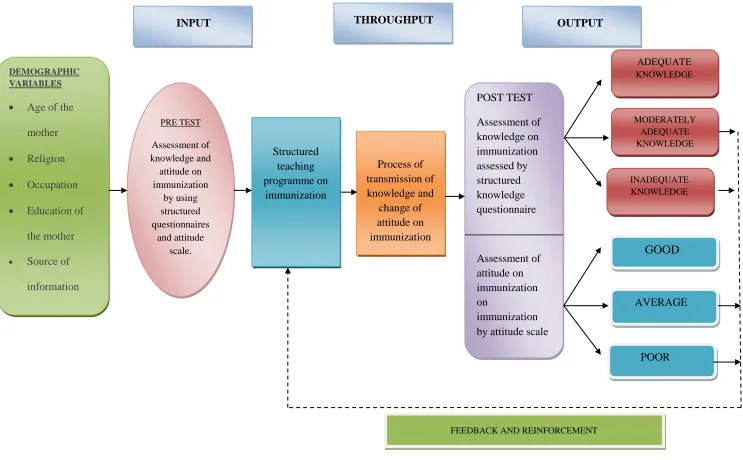
CONCEPTUAL FRAMEWORK
The conceptual framework is a group of related ideas, statements or concepts.
The term conceptual model is often used to inter change able with conceptual
framework and sometimes with grand theories that articulate a broad range of the
significant relationship among the concepts of a discipline kozeir Barbara 2005.
The conceptual framework for this study was derived from general system
model given by von Ludwig bertanlanffy 1968.According to this theory, a system is
asset of components or unites inter acting with each other with in a boundary that
filters the type and rate of exchange with the environment. All living systems are
open in that there is a continual exchange of matters, energy and information. In open
system there are varying degrees of interaction with the environment from which the
system receives input and gives back output in the form of matter energy and
information.
General system theory is useful in breaking the process in to sequential tasks
to ensure goal realization. Bertanlanffy explained that the system has 4 major aspects
1. Input
2. Throughput
3. Output
4. Feedback
INPUT
In this type of information, energy and material that enters the system from
environment, through its boundaries.
Assess the level of knowledge and attitude regarding immunization among
mothers of under five children is done by using structured knowledge questionnaire
and attitude scale.
Here input indicates the structured teaching programme regarding
11 THROUGH PUT
Refers to a process that allows the input to be changed so that, it is useful to
the system.
In this study, through put is a process of transformation of knowledge and
attitude on immunization using flash cards among mothers who have under five
children.
OUT PUT
Output is any information that leaves the system and enters the environment
through the system boundaries.
Output denotes the improved level of knowledge and attitude after structured
teaching programme on immunization among mothers who have under five children.
In this study, output is assessed by the post test conducted among mothers
regarding immunization using the same structured questionnaire.
The improved score gained by the mothers during post test indicates the
effectiveness of structured teaching programme on immunization.
If the knowledge is inadequate, a feedback can be given by administering a
structured teaching regarding various aspects to mothers who have under five
children.
12
DEMOGRAPHIC VARIABLES Age of the
mother
Religion
Occupation
Education of
the mother
Source of
information
INPUT THROUGHPUT OUTPUT
PRE TEST Assessment of knowledge and attitude on immunization by using structured questionnaires and attitude scale. Structured teaching programme on immunization Process of transmission of knowledge and change of attitude on immunization POST TEST Assessment of knowledge on immunization assessed by structured knowledge questionnaire Assessment of attitude on immunization on immunization by attitude scale
ADEQUATE KNOWLEDGE MODERATELY ADEQUATE KNOWLEDGE INADEQUATE KNOWLEDGE GOOD AVERAGE POOR
[image:24.842.55.798.46.506.2]FEEDBACK AND REINFORCEMENT
CHAPTER II
13
CHAPTER - II
REVIEW OF LITERATURE
Adeyinka (2009) A study was done for 328 mothers of children aged 12-35
months to identify the factors even in the presence of maternal illiteracy, educating
mothers about the vaccine excellent knowledge. Overall it was found that majority of
the mothers were having less knowledge regarding immunization.
Angelilio et al., (1999), several studies on the immunization status of children
have been published in various countries at different times, and comparisons with
these studies are interesting but must be made cautiously. They also stated that since
many factors may influence vaccination coverage, important differences should be
taken into account, such as prevalence of vaccine-preventable diseases, availability of
vaccination centers, level of knowledge and information about vaccination, and
different methods used to measure immunization status
Corrigall J et al., (2008), School of Public Health, University of Cape Town,
study conducted to determine the routine immunization coverage rates in children
aged 12 - 23 months by cluster survey technique. A total of 3,705 caregivers of
children aged 12 - 23 months who had been living in the Western Cape for at least 6
months. Vaccination status (1 = fully vaccinated; 0 = partially vaccinated) as recorded
on a Road-to-Health card or by history. Reasons for not vaccinating were established
from a questionnaire. The immunization coverage was 76.8% for vaccines due by 9
months and 53.2% for those due by 18 months. The reasons given for not being
immunized were clinic-related factors (47%), lack of information (27%), caregiver
being unable to attend the clinic (23%), and lack of motivation (14%). Of the clinic
factors cited, the two commonest ones were missed opportunities (34%) and being
told by clinic staff to return another time (20%). The coverage indicates that a great
deal of good work is being done, the coverage is insufficient to prevent outbreaks of
measles and other common childhood conditions, including polio. The coverage is too
low to consider not running periodic mass campaigns for measles and polio. It will
need to be sustainably improved before introducing rubella vaccine as part of the
Expanded Programme on Immunizations (EPI) schedule by increasing the knowledge
14
Grais RF et al., (2007) investigate measles mortality in three recent epidemics
in Niamey (Niger), N'Djamena (Chad), and Adamawa State (Nigeria). The three
exhaustive household retrospective mortality surveys in one neighborhood of each of
the three affected areas: Bouzouki, Niamey, Niger (April 2004, n = 26,795); Moursal,
N'Djamena, Chad (June 2005, n = 21,812); and Dong District, Adamawa State,
Nigeria (April 2005, n = 16,249), where n is the total surveyed population in each of
the respective areas. Study populations included all persons resident for at least 2
weeks prior to the study, a duration encompassing the measles incubation period.
Heads of households provided information on measles cases, clinical outcomes up to
30 days after rash onset, and health-seeking behaviour during the epidemic. The result
concluded the main outcome measures were measles attack rates (ARs) and case
fatality ratios (CFRs) by age group, and descriptions of measles complications and
health-seeking behaviour. Measles attack rates were the highest in children under 5
year old (under 5 y): 17.1% in Bouzouki, 17.2% in Moursal, and 24.3% in Dong
District. Case fatality ratios in under 5-year-olds were 4.6%, 4.0%, and 10.8% in
Bouzouki, Moursal, and Dong District, respectively. Children in these countries still
face unacceptably high mortality from a completely preventable disease.
Ibrahim H et al., (2005), conducted the study on the knowledge and practice
of physicians and nurses with regard to immunization has been assessed. A
self-administered questionnaire with 50 statements related to knowledge and practice of
vaccination was distributed among workers in 50 MOH PHCs in Riyadh city. 506
questionnaires were returned, 479 were analyzed. A response rate of almost 70%. For
most of the statements cited a correct response of knowledge & practice was obtained
from more than 80% of the sample. However for few others, correct response has
dropped to 40% or less. Experience in dealing with vaccination, and a formal training
in vaccination were not significantly associated with the responses of both physicians
and nurses. In spite of the limitations of this study it could be fairly concluded that the
overall knowledge and practices of childhood immunizations among the primary care
providers surveyed was good. Significant gaps still exist. This highlights the need for
continuous training and supervision of health care providers dealing with children
immunization.
Kapoor (2010) had stated that although immunization is one of the most
15
childhood morbidity and mortality has been great, its full potential was yet to be
reached. Through proven strategies, immunization has been made accessible to even
the most hard-to-reach and vulnerable populations since it involves clearly targeted
groups (WHO, 2013). When immunization rates are high, it is much less likely a
pathogen will be carried and transmitted from person to person. Declines in
vaccination rates allow diseases to emerge in the population again. A case in point is
the fact that Measles is now endemic in the United Kingdom, after vaccination rates
dropped below 80% (Awosika, 2012). In Nigeria in 2001, unfounded fears of the
polio vaccine led to a drop in vaccination rates and re-emergence of infection, and the
spread of polio to ten other countries (Awosika, 2012).
Kumar D et al (2008), Community based cross sectional study conducted in
India about the knowledge of ever-married women regarding maternal and child
health and to assess existing gap between awareness and practice levels of lactating
mothers among 283 ever-married women in the reproductive age. Low levels of
awareness and practice of TT immunization (74.2% awareness, 58.1% practice),
five-cleans (31.9% awareness and 14.4% practice), trained birth attendant (69.6%
awareness 39.1% practice), and post-natal care (75.4% awareness and 51.0% practice)
among lactating mothers. Knowledge regarding optimal infant and young child
feeding practices was very poor: initiation of breast-feeding within six hours (17.4%),
colostrum feeding (34.8%), exclusive breastfeeding (5.8%) and significant gaps
between knowledge and practice were observed. Highly significant difference
(P<0.001) between proportions of women aware of ICDS (59.4%) and of
beneficiaries (21.7%). High levels of awareness regarding reproductive health
parameters except for contraception: desire for two children (81.6%), legal ages at
marriages for girls (84.5%), desired birth interval of three or more years (71.7%). The
study concluded that wide gaps exist between awareness and practices related with
MCH including immunization of children due to non-adoption of knowledge into
actual practice, except some selected components lacking in both knowledge as well
as practice.
Lawrence GL, Et al (2003) from National Centre for Immunization Research
and Surveillance of Vaccine Preventable Diseases, University of Sydney, New South
Wales (i) Assess under-reporting of measles-mumps-rubella (MMR) vaccinations to
16
coverage among five-year-old children and the proportion immune to measles
infection; (iii) identify factors related to non-uptake of MMR vaccination. We
analyzed Australian Childhood Immunization Register data for a birth cohort of
approximately 64,000 children aged five years. The parents of a sample of 506
children with no Australian Childhood Immunization Register record for the second
MMR vaccination (MMR2), due at four years of age, were interviewed by telephone
to assess under-reporting to the Australian Childhood Immunization Register and
reasons for non-uptake of MMR vaccination. Results shows that parents reported that
22% (n = 111) of the surveyed 506 children had received MMR2 before their fifth
birthday, and 42% (n = 214) by approximately 5.5 years of age. After correcting for
this level of under-reporting to the Australian Childhood Immunization Register,
MMR2 coverage for the entire cohort at five years of age was 52.9% (95% CI
52.3-53.4), and increased to 84.1% (95% CI 83.4-84.8) by approximately 5.5 years of age.
This was 4.3% and 8.2%, respectively, higher than Australian Childhood
Immunization Register coverage estimates at the two ages. Based on the corrected
MMR coverage estimates, 93% of the cohort was immune to measles due to
vaccination. The most common parent-reported reason for incomplete vaccination
was lack of knowledge about the MMR vaccination schedule. Measles elimination in
Australia will require continued effort in vaccination coverage and timeliness among
pre-school children. School-entry requirements are important for MMR2 uptake.
Strategies are needed to improve reporting to the Australian Childhood Immunization
Register for more accurate measurement of coverage.
Linkins RW et al., (2006):- Conducted study to assess the attitudes of parents
of vaccinated and unvaccinated children regarding; support for immunization
registries; laws authorizing registries and mandating provider reporting and financial
worth and responsibility of registry development and implementation methods; A case
control study of parents of 815 children exempt from school vaccination requirements
and 1630 fully vaccinated children was conducted. Surveys administered to the
parents, asked about views on registries and perceived utility and safety of vaccines.
Results; Surveys were completed by 56.1% of respondents, fewer than 10% of parents
were aware of immunization registries on their communities.
Mark C. et al., (2008).Department of Child Health and The ICMR Centre of
17
problem of vaccine preventable disease and the most common preventable cause of
death among our under fives. These facts, plus the availability of a safe and effective
vaccine make measles vaccination the highest priority in the control of communicable
disease in India. The use of the pulse vaccination strategy will result in better
coverage rates than the conventional strategy of immunization in fixed health centers.
India’s annual requirement of measles vaccine is 20 million doses. The study
concluded that to prevent mortality due to measles can be prevented by economy and
uninterrupted supply, measles vaccine must be manufactured in India without any
further delay.
Mathew JL, et al., (2002):- Conducted study on 500 children under the age of
5 years belonging to a low income group. All were attending the paediatrics out patient
department of a large teaching hospital in New Delhi, India. Only 25% were found to
have received complete primary immunization as per the National Immunization
schedule (bacilli calmette – Guerin at birth, 3 doses of diphtheria, pertussis and tetanus
and oral poliovirus vaccine at 6,10 and 14 weeks and measles at 9 months). The major
reasons for non-immunization of the children were migration to a native village
(26.4%), domestic problems (9.6%). The immunization centre was located too far from
their home (9.6%) and for child was unwell when the vaccination was due (9%). The
lack of awareness and fear of side effects constituted a small minority of reasons for
non-immunization.
Menzies R et al, (2008) from National Centre for Immunization Research and
Surveillance of Vaccine Preventable Diseases, Australia, the second report on vaccine
preventable diseases and vaccination coverage in Aboriginal and Torres Strait
Islander people, brings together the relevant sources of routinely collected data on
vaccine preventable diseases--notifications, hospitalizations, deaths, and childhood
and adult vaccination coverage. As a result of continued improvements in the
collection of data on Indigenous status, this second report is considerably more
comprehensive, with data available from more jurisdictions, and more detailed
presentation, including time trends and vaccination coverage by jurisdiction.
Vaccination coverage data provide evidence of successful program delivery and
highlight some areas for improvement. For universally funded vaccines in children,
coverage is similar in Indigenous and non-Indigenous children by 24 months of age.
18
fewer children fully vaccinated at 12 months of age. More timely vaccination,
particularly within the first six months of life, is particularly important in reducing the
disproportionate burdens of disease due to pertussis and Haemophilus influenza type
b (Hib). The substantial impact of the national meningococcal C vaccination program
since 2003 is evident in this report, although the higher proportion of non-vaccine
preventable serotype B disease in Aboriginal and Torres Strait Islander people
underlines the need for a new vaccine to cover this serotype. Immunization programs
are an example of how preventive health programs in general can be enhanced to
close the gap in morbidity and mortality between Indigenous and non-Indigenous
Australians.
PARK K 2002: stated that the health problems in a country like India are
essentially linked to poverty and ove3r population which is turned lead to less
satisfactory health facilities, poor sanitary environmental conditions, and malnutrition.
India is still one among the country with high infant mortality rate (60 in 2000). Infant
mortality rate has declined slowly from 204/1000 live births by during 1911 by 1000
live births in the year 2000. India is a vast country with widely differing population.
Kerala one has low as 16/1000 live birth during the 1998.
Rahul Sharma, et al., (2008), on Do caretakers of children under five years
have sufficient knowledge regarding routine immunization (RI) to assess the
knowledge about routine immunization among Six hundred and eighty-two
caretakers of young children. caretakers accompanying children under 5 years to pulse
polio booths in November 2006. with pre-tested semi-open-ended questionnaire.
Statistical analysis: Proportions, Chi-square test. Results shows that the proportions of
respondents who had awareness about different aspects of routine immunization, such
as weekday of routine immunization (37.0%), age group for routine immunization
(49.1%), number of visits required in the first year of life (27.0%), were all low.
When asked to name the four diseases covered under the routine immunization
program in Delhi, only 268 (39.3%) could name at least three. The education level of
respondents was strongly associated with their knowledge about routine
immunization. Conclusion shows that the need of the hour is to make routine
immunization a 'felt need' of the community. Making caretakers more aware about
19
Siddiqi et al., (2010) concluded that mothers‟ knowledge about Expanded
Program on immunization (EPI) vaccination in peri-urban Karachi was quite low and
not associated with their children’s EPI coverage. Mothers‟ educational status,
however, was significantly associated with child’s coverage. This finding depicted a
better health seeking behavior of a more educated mother.
Singh MC, et al., (1994):- Conducted study on one hundred and thirty
mothers in the age group (15-44) years and 142 children aged (12-59) months were
selected in Wardha district, out of this 100 mothers and 122 children could be
contacted for evaluation of immunization coverage and assessing maternal knowledge
and practice regarding immunization 52.5% children were fully immunized and 45.1%
were partially immunized. Vaccine coverage for B.C.G. and primary doses of
DPT/OPV was 95.9% and above 85% respectively. It was 57.4% for measles and
63.04% for booster dose was 36.96% mothers had a knowledge regarding need for
immunization but a poor knowledge regarding the diseases prevented and doses of the
vaccines.7
Smith P.J, et al., (2005):- Conducted study to obtain vaccination since 1994
the NIS has monitored progress toward the Healthy people 2000 and 2010 vaccination
goals. A mail survey to vaccination providers to obtain vaccination histories used to
estimate vaccination coverage rates. Results in 2001 among infants with completed
RDD interviews, 0.3 percent were entirely unvaccinated. Together, the new non
telephone adjustment and the refinement for unvaccinated infants yielded revised
estimates that were within 1.5 percentage points of the original estimate obtained using
the 1998-2001 methodology.
Stokley et al., (2001):- Study was conducted to estimate the vaccination
coverage level of children’s living in rural and urban areas to identify statistically
significant differences. Children’s aged 19-35 months participating on the 1999
National Immunization Survey were included in the study. Statistically significant
differences in vaccination coverage levels between the rural population and their urban
counterparts were determined for individual vaccines and vaccine series. Results;
overall 18% of the children included on the 1999 NIS lived in a rural area, 46% lived
20
Topuzoglu et al., (2005):- Conducted study was conducted to determine the
coverage of the expanded programme of Immunization (EPI) of the ministry of Health
and the coverage of private vaccines in the umraniye Health District in order to
establish approaches for improving vaccination services. Thirty streets were selected at
random from each health care region, utilization of vaccination services and
vaccination status of children under the age of 5 years were determined by face to face
interviews Results, vaccination coverage was as follows. Hepatitis B third dose,
84.6%; BCG, 94.8%; DPT third dose, 90.1%; Oral polio virus (OPV) third dose,
90.0%; Measles, mumps, rubella (MMR), 13.3%;, The full vaccination rates for
children under 5 years were 68.3%.
Wood JG, et al., (2008) from National Centre for Immunization Research and
Surveillance of Vaccine Preventable Diseases Sydney, Australia conducted study on
The second dose of MMR vaccine (MMR2) is scheduled at 4 years in Australia and
the USA but earlier in some European countries. We modeled the effect on measles
elimination status and population susceptibility of shifting delivery of MMR2 from 4
years to 18 months using relevant Australian data. Susceptibility in young children
was reduced but elimination was not sustainable past 2015 if 6% of vaccinated
seroconvert became susceptible after 10 years. One-dose MMR coverage of 96% or
greater maintained elimination more effectively than modeled changes in scheduling,
suggesting that maximizing one-dose MMR coverage should be the highest priority.
Zell E.R, et al., (2000):- Conducted study on National Immunization survey
(NIS) was designed to measure vaccination coverage estimates for the US, the 50
states. The NIS includes a random-digit-dialed telephone survey and a provider record
check study. Data are weighted to account for the sample design and to reduce non
response and non coverage biases in order to improve vaccination coverage estimates.
NIS estimates are highly comparable to vaccination estimates derived from the national
Health Interview survey. The NIS allows comparisons between states and urban areas
CHAPTER III
21
CHAPTER-III
RESEARCH METHODOLOGY
The methodology of research indicates the general pattern together empirical
data for the problem under investigation.
This chapter comprises methodology for this study, the research approach
design for the study, setting, sample, technique of data collection, description of the
tool and pilot study.
RESEARCH APPROACH
The quantitative approach was used to determine the effectiveness of
structured teaching programme on knowledge and attitude regarding immunization on
among mothers of under five year children.
RESEARCH DESIGN
The research design used in this study was quasi experimental one group pre
test post test design is used to determine the effectiveness of structured teaching
programme on knowledge and attitude regarding immunization before and after the
structured teaching programme among mothers of under five children.
Diagrammatic representation of research design is as follows,
O1 X O2
O1 - Pre-test assessment on knowledge and attitude regarding immunization.
X - Intervention
O2 - Post-test assessment on knowledge and attitude regarding immunization.
SETTING OF THE STUDY
Setting is the physical location and condition in which data collection takes
place. (Polit and Hungler, 1999). The study was conducted selected community area
Vakkampatti nearby Dindugal. It is situated 3 km away from Jainee College of
22
POPULATION
A population is the entire aggregation of cases in which a researcher is
interested. (Polit and Hungler, 1999). The target population of this study included the
mothers of under five living in selected community area at Dindugal
SAMPLE SIZE
This refers to the number of items to be selected from the universe to
constitute a sample. (C.R Kothari, 2004). Sample size of this study consists of 30
mothers of underfive children living in selected community area at Dindugal.
SAMPLING TECHNIQUE
Sampling is the process of selecting a portion of the population to represent
the entire population (Polit and Hungler, 1999). Purposive sampling technique was
used to select the sample. Sample were collected, who fulfill the sampling criteria are
included in this study.
VARIABLES
INDEPENDENT VARIABLE - Structured Teaching programme regarding
immunization is the independent variable of this study
DEPENDENT VARIABLE – Knowledge and attitude regarding immunization were
the dependent variables of this study.
CRITERIA FOR SAMPLE SELECTION
INCLUSION CRITERIA
Mothers of underfive children living in Dindugal community area. Mothers those who are have first child in family
EXCLUSION CRITERIA
23
DATA COLLECTION TOOL
The tool was developed by the investigator to assess the knowledge and
attitude of the mothers of under five children regarding immunization.
DESCRIPTION OF THE TOOLS
The tool consisted of three sections.
Section-A: Demographic variables of the mother
The demographic data consisted of baseline information of mothers of under
five children regarding their age, religion, education, occupation, source of
information about obligatory vaccination.
Section-B: It consists of knowledge questionnaire on immunization; number of items
was 30 questions. The total score for the entire item was 30.
Section-C: 3 point likert scale to assess the attitude of mother with under five
children. The number of item was 15. The total score for the entire item was 40.
Scoring Procedure
Knowledge
10-20 - Inadequate knowledge 11-20 – Moderate knowledge 21-30 – Adequate knowledge
ATTITUDE
Poor < 50 % Fair 50- 65 % Good > 65 %
TESTING OF THE TOOL
CONTENT VALIDITY
Four experts from the nursing field and one expert from the medical field
evaluated the tool for content validity based on their suggestion and
24
tool was translated into Tamil and again translated into English to validate the
language.
RELIABILITY
The test retest was used to establish a reliability of structure questionnaire and
attitude scale. Reliability value r =0.7 was satisfactory.
PILOT STUDY
The pilot study was conducted in Attupatti community area. Six mothers were
selected who have under five children. The knowledge of immunization was assessed
by using structured knowledge questionnaire. The attitude was assessed by attitude
scale It was carried out the same way as a final study in order to test feasibility and
practicability.
Six mothers who met the inclusion criteria were selected by purposive
sampling method. Pre test was conducted by using structured knowledge
questionnaires and attitude scale on immunization. The structured teaching
programme was conducted on the study group by the same day followed by the pre
test. Then after one week of pre test, the post test was conducted for the same group
by using the same structured knowledge questionnaire and attitude scale.
The result was analysed based on the score obtained by the mothers, by using
descriptive and inferential statistics. The tool and the structured teaching programme
were found to be effective. The study conformed to be feasible.
DATA COLLECTION PROCEDURE
The data was collected by using Knowledge questionnaire and attitude scale in
order to identify the knowledge and attitude of immunization among the mothers of
under five children in selected rural area at Dindugal. First week survey was
conducted to identify the under five children mothers in selected area. Each week 15
subjects was planned to conduct pre test and the structured intervention was given to
25
PLAN FOR DATA ANALYSIS
After the data collection, it was organized tabulated, summarized and
analyzed. The data analysis was planned according to objective of the study, using the
descriptive and inferential statistic. The plan of data analysis was developed as
frequency and percentage, mean, standard deviation, chi-square test and paired‘t’ test
was used to evaluate the effectiveness of structured teaching programme of
immunization.
PROTECTION OF THE HUMAN RIGHTS
The research proposal was approved by the dissertation committee prior to
pilot study. Permission was obtained from the principal of the Jainee College of
nursing, head of the department of child health nursing and also oral consent was
taken from each participant before starting the data collection procedure. Assurance
26
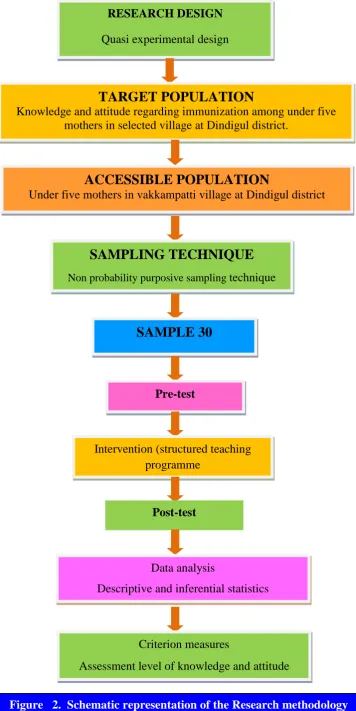
RESEARCH DESIGN
Quasi experimental design
TARGET POPULATION
Knowledge and attitude regarding immunization among under five mothers in selected village at Dindigul district.
ACCESSIBLE POPULATION
Under five mothers in vakkampatti village at Dindigul district
SAMPLING TECHNIQUE
Non probability purposive sampling technique
SAMPLE 30
Pre-test
Intervention (structured teaching programme
Post-test
Data analysis
Descriptive and inferential statistics
Criterion measures
[image:40.595.134.491.52.764.2]Assessment level of knowledge and attitude
CHAPTER IV
DATA ANALYSIS AND
27
CHAPTER – IV
ANALYSIS AND INTERPRETATION OF THE DATA
This chapter deals with the data collection in order determine the effectiveness
of structured teaching programme regarding the knowledge and attitude on
immunization among mothers of under five children.
According to the pilot statistical procedures enable researchers to Summaries,
organize, evaluate, Interpret and communicate numeric information.
The data were collected, analyzed and interpreted according to the objectives
of the study.
The objectives of the study
To assess the pre test level of knowledge and attitude regarding immunization
among the mothers of underfive children as measured by structured
knowledge questionnaire and attitude scale.
To assess the post test level of knowledge and attitude regarding immunization
among the mothers of underfive children as measured by structured
knowledge questionnaire attitude scale.
To determine the effectiveness of structured teaching programme regarding
immunization among the mothers of underfive children in terms of gain in
post test knowledge and attitude score.
To find the co relation between the knowledge and attitude regarding
immunization among the mothers of under five children.
To find out the association between post test level of knowledge with their
selected demographic variables.
To find out the association between post test level of attitude with their
28
SECTION – I
Frequency and percentage distribution of samples on selected demographic
variables
Table I
n = 30
S.No Demographic Variables Frequency Percentage (%)
1. Age of the Mother
a. 18-23years
b. 24-28 years
c. 29-33 years
03 15 12 10 50 40
2. Religion
a. Hindu b. Christian c. Muslim d. Others 17 08 05 - 56.66 26.66 16.66 -
3. Occupation
a. Not employed
b. Employed
4
26
13.33
86.66
4 Education
a. Illiterate
b. Primary education
c. Secondary education
d. Under graduate
e. Post graduate
8 9 5 5 3 26.66 30 16.66 16.66 10
5 Source of information
a. Television
b. Radio
c. Newspapers
d. Neighbor
e. Health center
f. Health card
29
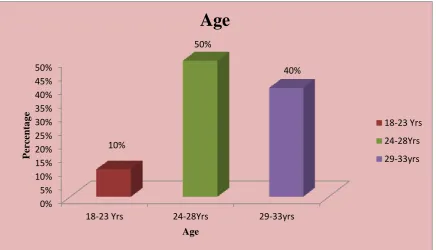
The data presented in the above table shows, the number of sample was 10
(10%) in the age group of 18-23years, 15 (50%) mothers were in the age group of
24-28 years and 12 (10%) mothers were in the age group of 29-33 years.
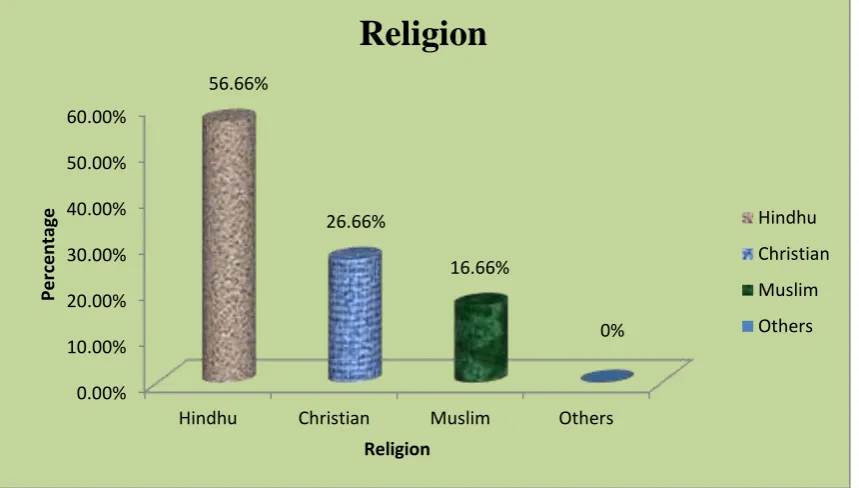
Regarding religion 17 (56.66%) mothers were Hindu, 8 (26.66%) mothers
were Christians, and 5 (16.66%) mothers were Muslims.
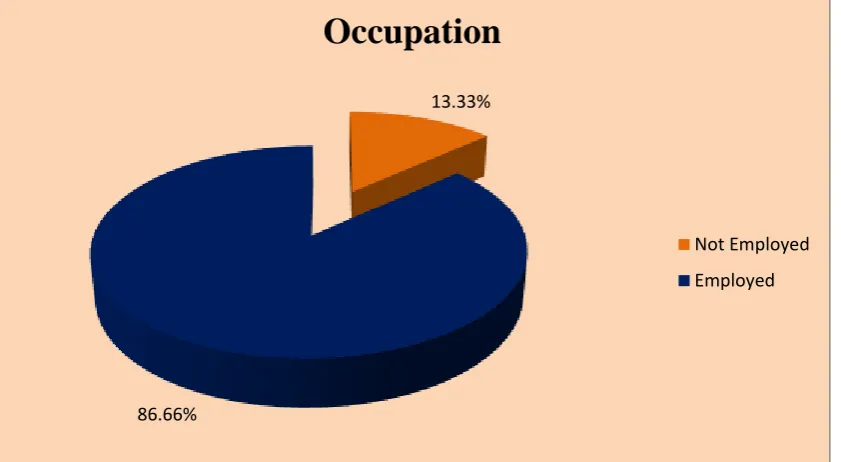
Regarding occupation, 4 (13.33%) mothers were not employed, 26 (86.66%)
mothers were employed.
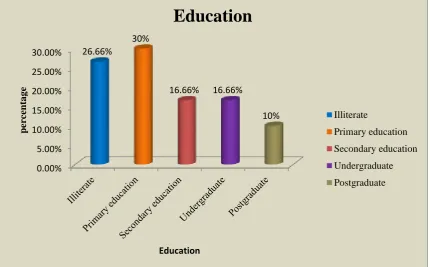
Regarding education 8 (26.66%) mothers were illiterate, 9(30%) mothers were
completed primary education, 5(16.66%) mothers were completed secondary
education, 5(16.66%) mothers were undergraduate and 3(10%) were post graduate.
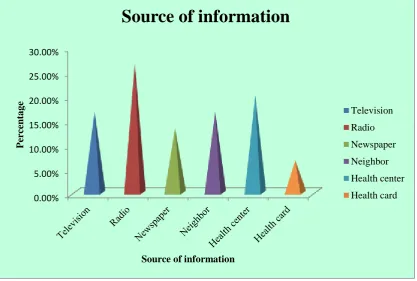
Regarding the source of information 5(16.66%) mothers got information
through television, 8(26.66%) mothers got information through radio, 4 (13.33%)
mothers got information through neighbor, 6 (20%) mothers got information through
30
Fig.3 Distribution of samples according to the age of the Mother
0% 5% 10% 15% 20% 25% 30% 35% 40% 45% 50%
18-23 Yrs 24-28Yrs 29-33yrs 10%
50%
40%
P
er
ce
nta
g
e
Age
Age
18-23 Yrs
24-28Yrs
31
Fig.4 Distribution of samples according to the Religion
0.00% 10.00% 20.00% 30.00% 40.00% 50.00% 60.00%
Hindhu Christian Muslim Others 56.66%
26.66%
16.66%
0%
Per
ce
n
tage
Religion
Religion
Hindhu
Christian
Muslim
32
Fig.5 Distribution of samples according to the occupation of the Mother
13.33%
86.66%
Occupation
Not Employed
33
Fig.6 Distribution of samples according to the Education
0.00% 5.00% 10.00% 15.00% 20.00% 25.00%
30.00% 26.66%
30%
16.66% 16.66%
10%
perc
ent
a
g
e
Education
Education
Illiterate
Primary education
Secondary education
Undergraduate
34
Fig.7 Distribution of samples according to the source of Information
0.00% 5.00% 10.00% 15.00% 20.00% 25.00% 30.00%
P
er
ce
nta
g
e
Source of information
Source of information
Television
Radio
Newspaper
Neighbor
Health center
35
SECTION-II
DISTRIBUTION OF SAMPLES ACCORDING TO THE PRE TEST
KNOWLEDGE SCORES OF MOTHERS REGARDING IMMUNIZATION
TABLE-II
(n=30)
Level of
knowledge
Pretest
Frequency Percentage (%)
Adequate Knowledge 0 0
Moderately adequate knowledge 14 46.66%
Inadequate knowledge 16 53.33%
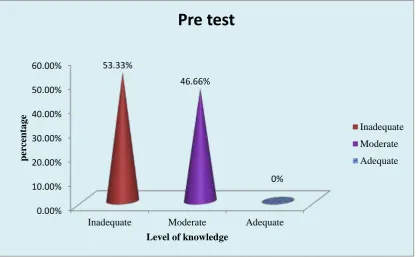
The table-II shows that the frequency and percentage distribution of samples
according to the pre test knowledge score of mothers regarding immunization. It
revealed that 16(53.33%) mothers had inadequate knowledge, and 14(46.66%)
mothers had moderately adequate knowledge about immunization.
36
Fig.8 Distribution of samples according to the pretest knowledge scores of
mothers regarding immunization.
0.00% 10.00% 20.00% 30.00% 40.00% 50.00% 60.00%
Inadequate Moderate Adequate
53.33%
46.66%
0%
perc
ent
a
g
e
Level of knowledge
Pre test
Inadequate
Moderate
37
SECTION-III
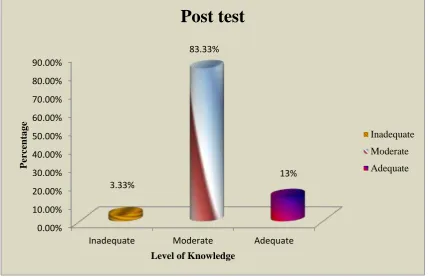
DISTRIBUTION OF SAMPLES ACCORDING TO THE POSTTEST
KNOWLEDGE SCORES OF MOTHERS REGARDING IMMUNIZATION.
TABLE-III
(n= 30)
Level of