research
Working
towards skills
Perspectives on
workforce development
Working
towards skills
Perspectives on
workforce development
Published by the
Learning and Skills Development Agency
www.LSDA.org.uk
Feedback should be sent to: Information Services
Learning and Skills Development Agency Regent Arcade House
19–25 Argyll Street London W1F 7LS. Tel 020 7297 9144 Fax 020 7297 9242 [email protected]
Registered with the Charity Commissioners
Printed in the UK
ISBN 1 85338 784 3
© Learning and Skills Development Agency 2002
1307R/07/02/4000
You are welcome to copy this publication for internal use within your organisation. Otherwise, no part of this publication may be reproduced, stored in a retrieval system, or transmitted in any form or by any means, electronic, electrical, chemical, optical,
photocopying, recording or otherwise, without prior written permission of the copyright owner.
Contents
Summary 3–4
1. Introduction 5–6
2. A rationale for developing the workforce 7–13
3. Workforce development in SMEs 14–40
Views of owner/managers in small companies 14–18
Exploring the employers’ perspective 18–28
Views of people working in SMEs 28–40
4. Learning in practice 41–42
5. Conclusions and issues 43–44
6. Developing effective support for workforce development 45–47 in SMEs
Appendix 1 Review of related workforce development initiatives 48–52
Appendix 2 Characteristics of focus group participants 53–59
Summary
The Learning and Skills Development Agency (LSDA) undertook research into workforce development to consider the relationship between corporate assessments of workers’ development needs and workforce development strategies. The project1 also looked at how learning at work is taking place.
The research involved:
• a literature review to identify the scope and extent of workforce development
• a survey of workforce development being undertaken in a sample of medium-sized and small firms
• follow-up interviews with managers in SMEs
• focus-group meetings with employees in SMEs. Key issues
• Since workforce development was identified as a priority by the third report2 of the National Skills Task Force (NSTF) it has been the focus of a great deal of attention from government bodies and employer representative.
• Although there is only limited evidence in the UK of the contribution of training to the success of individual firms, the Performance Innovation Unit (PIU) of the Cabinet Office is firmly of the opinion that there is a direct benefit to business from workforce development. This view is supported by the employers and employees consulted during the project, who appear to be developing greater awareness of the benefits of developing the workforce.
• There are many examples of interesting practice and a plethora of initiatives to support workforce development. Few of these initiatives, however, have had a significant impact on the development of the workforce in small and medium-sized enterprises. Given the increasing importance of SMEs to the economy, this balance needs to be redressed.
• Securing greater employer involvement in learning within small firms requires an emphasis on business support, rather than learning in itself. Effective support will need far greater interaction between the various providers of support to ensure that information on needs is matched by the capacity of those responsible for delivering different types of support and business solutions.
• Workers in very small companies may not perceive tangible learning needs relating to their work role. Nevertheless, the workplace as a point where people gather may provide opportunities to reach out to a wider range of non-learners and so stimulate their desire to take part in learning. Policy on adult learning cannot rely exclusively on employers. Broader labour market and economic concerns, not to mention the individual career needs of individuals, will sometimes require provision delivered away from the workplace and funded accordingly.
• A general conclusion from the project is that very small firms usually face different problems, requiring different solutions, from those faced by bigger companies. Many very small firms may not want or need to adopt more formal approaches to learning and workforce development. Further, they may not perceive that they have any business-related or human resource-related, training needs. But the study also identified a number of small firms, with fewer than 20 employees, which had adopted formal systems and approaches to human resource development (HRD), in some cases within the framework of Investors in People (IiP). As with other aspects of support for SMEs,
1
Introduction
The Learning and Skills Development Agency (LSDA) has been undertaking research into workforce development to answer the following questions:
• what is the relationship between corporate assessments of workers’ development needs and workforce development strategies?
• how is learning in the workforce taking place?
• what learning methods are being used and how effective are they?
The focus of the research was primarily on practice in small and medium-sized companies.
The project aimed to identify key features of current practice in workforce
development and suggest how this could be improved and extended. Its objectives were to:
• assess the extent and effectiveness of workforce development
• examine how priorities for workforce development are identified
• identify the types of learning that are taking place – in terms of content and delivery – and assess the effectiveness of this in relation to corporate and individual objectives
• develop criteria for good practice in supporting learning in the workforce. The research involved:
• a literature review to identify the scope and extent of workforce development
• a survey of workforce development being undertaken in a sample of medium-sized and small firms
• follow-up interviews with managers in SMEs
• focus-group meetings with employees in SMEs.
A reference group was established with membership from CBI, the Small Business Service (SBS), QCA, ICL, the National Training Organisation’s National Council (NTONC), the Institute for Employment Studies (IES), the Small Business Research Trust (SBRT), the British Chamber of Commerce, the Department for Trade and Industry (DTI), and the Department for Education and Skills (DfES). This group provided valuable advice and guidance throughout the project.
Workforce development – an emerging concept
Workforce development was identified as a priority by the third report of the National Skills Task Force. Since then, workforce development has received a great deal of attention from government bodies and employer representatives, extending beyond the DfES and DTI to the Performance and Innovation Unit (PIU) of the Cabinet Office. A review of related initiatives aimed at stimulating the demand for learning and workforce development is given in Appendix 1. At the same time as the LSDA investigation was being undertaken, the PIU led a project which focused on the development of a strategic framework for workforce development, and the
identification of a range of policy options to increase its extent and take-up.3 The extent of this interest illustrates the awareness of government and employers of the economic importance of workforce development and its contribution to business success.
However, as well as promoting workforce development there is also a need to ensure that learning in the workplace is effective. The LSDA therefore undertook research into this aspect of workforce development. The project examined the range of the learning methods being used in workforce development and their
effectiveness in developing workforce capacity. The project built upon previous research undertaken by the Further Education Development Agency (FEDA – now LSDA) on developing and sustaining employability, and work with DTI and DfEE (now DfES) on corporate universities.
There are many examples of interesting practice and a plethora of initiatives to support workforce development. However, LSDA’s previous research into work-based learning4 revealed a lack of robust examples of learning in the workplace that integrated on- and off-the-job experience, a key ingredient of learning in the
workplace. A central concern of the LSDA project was to examine how learning in the workplace is being undertaken, and the extent to which the content of the learning experience supports skills development and business success.
Identifying and disseminating good practice will not of itself bring about
2 A rationale for developing the workforce
The motivation to develop the skills of the workforce should ideally come from the value placed by companies on the development of their staff as ‘human capital’.The estimate of spend by UK employers on training is said to be £600 per employee, per year,5 which compares favourably with expenditure in other countries. However, the estimate of spend is likely to include staff replacement and opportunity costs, rather than representing the actual costs of training. The provision itself may be sporadic, inconsistent and only approximately linked to the business aims of the
company.Beneficiaries of the training are likely to be the already well-qualified, rather than people without qualifications. Both the Institute for Public Policy Research (IPPR)6 and the National Skills Task Force noted7 that those who are among the more skilled and better qualified parts of the workforce disproportionately engage in in-service training. It cites evidence from the Labour Force Survey (Spring 1998) showing that over 40% of those in professional or associated professional occupations had received training over a recent 13-week period, compared to less than 20% of craft employees and fewer than one in seven operatives.
Businesses themselves recognise these shortcomings. The emergence of the
‘corporate university’ stems from the desire of American companies, like Motorola, to systematise and streamline their company’s learning and development models. Increasing numbers of British businesses have recently established corporate
universities, although not all are branded as such. These go further than typical HRD functions in many firms, providing a range of learning experiences and some
accredited courses. At best, they enable the organisation to focus on the specific learning needs of its own staff related to the needs of the business and its particular market or sector.
Government initiatives, such as Ufi and Learndirect, and Investors in People are also aiming to improve the skills of the UK’s workforce. The Learning and Skills Council (LSC) is itself charged with developing a national framework for workforce development and issued a draft workforce development strategy8 in May 2002 for consultation with key partners; the National Training Organisations and emerging Sector Skills Councils (NTOs/SSCs)9 have been working with firms in their sectors to prepare sector workforce development plans.
Defining workforce development
There appears to be some variation in the meaning given to the term ‘workforce development’, and to the target group of beneficiaries. Early proposals from the PIU reflected current government priorities in defining workforce development as:
More recently, the PIU have defined workforce development as consisting of:
‘…activities which increase the capacity of individuals to participate effectively in the workforce, thereby improving their productivity and employability’.11 The PIU
considered the target group to be people in work, or actively seeking work, who are currently operating without Level 2 qualifications. The National Skills Task Force used the term ‘workforce development’ to distinguish young people at the entry or pre-entry stage of employment from the mature workforce. Both PIU and the National Skills Task Force were concerned with semi-skilled and unskilled workers with modest attainment in terms of formal qualifications. The National Skills Task Force, in particular, stressed the need for such workers to develop ‘intermediate skills’ and progress to craft and technician levels to support the increasingly complex skills demands of a modern economy.
Workforce development generally appears to exclude management training and development, although key and basic skills training are included in Union Learning Fund developments and ‘personal development’ is encouraged in some initiatives, such as Employee Development Schemes (EDS).
For the purpose of the LSDA investigation, workforce development was taken to mean training and development activities for the existing adult workforce, which relate to improvement of performance within current or future job roles.
What learning in the workplace?
Workforce development encompasses both job-specific training conducted by and for employers of any size, and more generic vocationally-related skills. As such, it may include:
• knowledge, skills and competencies required to perform specific tasks
• basic skills
• transferable skills:
o interpersonal skills
o reasoning and judgement
o coordinating skills
o information skills
o originating skills
• core skills
• key skills.
Workforce development may involve:
• active learning in the place of work to develop skills and competitiveness to improve performance in the current role or in a new role in the near future
• education and training undertaken by current employees leading to qualifications related to occupational knowledge and skills
• learning which is promoted by the company, and is located or marketed within companies.
Learning in the workplace is an important part of workforce development, but there are other ways in which the workforce may be developed and a wide range of methods may be used. The range includes open and distance learning (paper- or ICT-based); day, evening and block-release courses; short training courses on specific topics, like health and safety; bespoke courses for particular employers; training provided by suppliers of kit and equipment. The workplace provides a learning environment that has the potential to develop many different types of skill and knowledge, but it is not the sole location for training to improve the skills and knowledge of the workforce. The demands of the workplace, however, can provide a context around which the content of learning activities can be based.
Training as an investment
The PIU is firmly of the opinion that there is a direct benefit to business from workforce development. Its report, In demand: adult skills in the 21st century12
provides a vision for workforce development: ‘In 2010, the UK will be a society where Government, employers and individuals actively engage in skills development to deliver sustainable economic success for all’.
Nevertheless, there is only limited evidence in the UK of the contribution of training to individual firms. In a review for the PIU, Machin and Vignoles13 note that there is little evidence in the UK to prove the assumption that training is beneficial to firms and that it creates a more productive workforce. On the other hand, they review evidence from other countries, which, on balance, suggests a positive contribution from training to firms’ performance. They also note that training contributes in other ways; for example, to improving employee commitment, fostering a common firm culture, and recruiting good- quality workers.
It is important to distinguish between direct benefits to individual employers and:
• improvement to the national economy as a whole
• benefits to individuals
Employers may be inclined to invest in training because human capital theory argues that an economic return on this can be anticipated in terms of productivity gains.14 A wide range of factors may influence the extent to which a firm invests in training its employees. These may include the levels of skills required to carry out its activities, the extent to which it can continue to operate with its existing processes and technology, and the availability of requisite skills in the external labour market. However, ‘poaching’ will always be seen by some employers as cheaper than, and preferable to, investing in training: this further engenders reluctance to train,
especially in very small companies.
The incentive for workers to take part in training will also vary depending on the expected outcome of higher wage levels in the longer term.
The National Skills Task Force research report15 notes that smaller firms, particularly those employing fewer than 25 people, are less likely to provide training. The report quotes evidence from the Skill Needs in Britain survey16 showing that only 36% of firms employing fewer than 25 people provided any off-the-job training for their employees, compared to 79% of those with 25–49 employees, and 92% of those employing 200 or more.17
Ewart Keep observes that ‘there are difficulties with employer-provided training in non-work related, general or transferable skills, ie precisely those skills that might support the concept of “employability”.18 He cites DfEE-sponsored research on employers’ attitudes towards adult training which claimed that most employers provide training only if it yields business benefits, usually restricting this to job-specific skills training.Keep notes that more general training, while often
acknowledged as valuable, is mostly seen as the responsibility of either the individual or the government.
Declining capacity to train
The number of British-owned large companies and key strategic industries with the economies of scale to support the capacity to train has also declined over the last 20 years. This has had a significant impact on both initial skills development and
updating. The economic conditions of the 1980s, characterised by high youth unemployment, prompted successive governments to develop a range of
programmes aimed, in their early manifestations, at reducing the numbers of the long-term unemployed.
The levy system, which was in place up to the middle of the 1980s, required all but the smallest firms to invest in training. This interventionist approach is currently judged to be overly bureaucratic for an enterprise economy, and voluntarism has since been the main tactic to encourage employers’ commitment to training.
However, these programmes later became proxies for an initial VET system, especially when the achievement of vocational qualifications was stipulated as a prerequisite for funding for many government programmes for the unemployed during the 1990s.
These initiatives tended to carry very few direct costs to employers and provided financial support to firms to employ young people or provide a training place. Furthermore, they may have increased employers’ reliance on public subsidy for training insofar as employers were taking on the unemployed via such schemes instead of recruiting in other ways.
Lack of investment in VET
The lack of investment in vocational skills training and an absence of deep learning at initial experience levels has undoubtedly resulted in a legacy of an unskilled workforce, without the capacity to develop their skills further or transfer learning to new contexts.19 There has been a major growth in the numbers of young people remaining in education after age 16, and gaining qualifications to Level 2 or above. However, the UK still has one-third fewer people qualified to NVQ Level 2 than either France or Germany, and only half as many people qualified to Level 3 than Germany.
The implications of the lack of investment in vocational training are becoming apparent, often with disastrous results. There are severe skills shortages, for
example, in the gas installation and maintenance sector, which is characterised by a preponderance of micro businesses which do not invest in training. Similarly, in the rail industry, only one-third of 1% of employees hold a relevant vocational
qualification.20
In a fast-changing world of work, the ability to adapt and develop new learning and skills is a crucial ingredient in a successful economy. Globalisation and the
knowledge-driven economy require the UK to develop a more highly-skilled workforce in order to compete within high-value-added sectors of the world
economy, such as new technology and biotechnology. This heightens the need to upskill the current workforce.
Improving the skills of the current workforce
In its third report, the National Skills Task Force23 proposed targeted action to improve skills in the current workforce. This report was extremely influential in attracting attention to the need for a sustained policy for workforce development. It suggested that action was required in key areas, these being:
• upgrading the general education and training of those who left school prior to the 1980s
• reducing the 20% of the working population with poor basic skills.
• Income-contingent loans
• improving training for the workforce within SMEs; developing learning networks to pool training arrangements, supported by Ufi
• promotion of lifelong learning
• promoting informal learning in firms, and developing accreditation of prior learning (APL)
• promotion of best practice in management by the Small Business Service and training new managers in SMEs.
Coordinating workforce development initiatives
Although there is a great deal of interest in workforce development, coordinating the activities of government departments and other interested bodies is a major
difficulty. The PIU’s Workforce Development Project examined the effectiveness of the UK’s approach to workforce development in terms of its impact on the promotion of productivity, economic performance and opportunities for individuals to realise their potential.
‘As part of the Cabinet Office, at the centre of government, the PIU is well placed to take the wider view…It [Workforce Development] is very much a cross-boundary issue and the PIU will work with key stakeholders inside and outside government to reach its conclusions.’24
A changing employment context
The interest in workforce development is inextricably linked to the growing awareness of the link between economic competitiveness and education and training. Changes to employment patterns, occupational sectors and the
characteristics of the employment base have recently been apparent in the UK and have stimulated the need for continuous professional development (CPD) and systematic updating of the existing workforce as well as pre-service VET.
Training the current workforce
The current interest in workforce development thus can be traced to earlier concerns about the purpose and content of vocational education and training – at the pre-service phase, as young people enter the workforce for the first time, and within in-service training and upskilling for the workers of the day.
The combined demographic and structural changes in employment patterns increase the need for investment in the development of the current workforce employed in SMEs.
Many of the initiatives and support measures for workforce development have emanated from, or been targeted at, large companies. The increasing importance of small companies to the UK’s economy means that efforts to develop the workforce within small firms are also required. There are many factors which make this task difficult, including the tendency for small firms to display:
• a short-term view of development needs
• lack of resources, both cash and time, to devote to training
• fear of poaching and demands for increased wages
• absence of the right kinds of training and support
• little trades union involvement and, until recently, little take-up of Investors in People (IiP).
The problems relating to the development of the workforce are clearly more acute in small and medium-sized companies, which make up 99% of the total stock of
3
Workforce development in SMEs
While much has been written about workforce development in large companies, little information is available on the needs of SMEs in relation to developing their
workforce. The combined demographic and structural changes in employment patterns increase the need for investment in the development of the current workforce employed in SMEs. Because of this, the project undertook primary
research in the form of a postal survey of small employers and focus group meetings with employees in small firms in order to ascertain their views on workforce
development, and to identify current practice in its delivery.
Views of owner/managers of small companies
A postal survey was conducted which attempted to identify the extent of training currently being undertaken in companies. Questionnaires were sent to 2000 SMEs across England and Wales, distributed as follows:
• 500 to companies with 2–10 employees
• 1000 to companies with 11–20 employees
• 500 to companies with 21–50 employees.
The businesses covered the manufacturing, retail, repair, tourism, food, transport, telecommunications, finance, property, legal accountancy, and management sectors. Government, education and health were excluded.
Overall, 85 returns were received, giving a 4.2% return rate, with the majority of returns coming from companies with between 11 and 20 staff. Most respondents (94%) were managers, and the remainder were in personnel and training roles. The modest response rate and management role of the respondents clearly needs to be taken into account when interpreting the results of the survey. However, there are interesting findings that throw some light on the extent and effectiveness of learning in the workplace.
The survey asked a number of questions relating to employers’ views on workforce development through training and development. A large majority (90%) of
respondents agreed that training and development was necessary for business growth, 83% agreed that it leads to better productivity and only 12% agreed that workforce development was not necessary in the present circumstances.
For the majority of employers completing the survey, training for the workforce was primarily designed to meet business targets and aims. One company claimed to develop the competencies required to meet expected growth areas. Another
develops employees’ skill and knowledge to match their aptitude and the job with the aim of enhancing the firm’s capability. One company ensures that the entire
Poaching and wage increases
A relatively small percentage (15%) agreed that developing the workforce would lead to increased turnover of staff and 22% that it leads to poaching of staff. However, over a quarter of respondents (29%) of employers in companies
employing fewer than 11 staff thought that developing their workforce would lead to poaching. Overall, many respondents (48%) were unsure whether training and development would lead to demands for wage increases, although over 30% agreed and 20% disagreed with this.There was greater agreement with this statement (39%) in companies employing between 11 and 20 staff.
Most saw training and development as necessary for individual employees’ growth and over 85% agreed that it leads to better-motivated staff. Only 20% agreed that training and development disrupts work.
Who should pay?
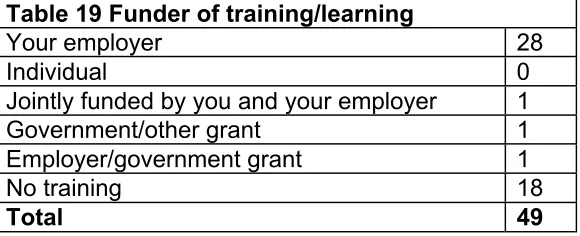
A majority (66%) thought training and development should be the responsibility of employers, with a less certain agreement that it is up to government to fund and organise workforce development (32% and 11% respectively).
Employers generally did not see their employees as having responsibility for
organising or paying for their own training. A large number of respondents disagreed with the statements that employees should fund or organise their own training and development (53% and 48% respectively). Forty-three per cent of all respondents, and 63% of respondents in firms employing between 11 and 20 staff, agreed that training and development should be provided in work time. A relatively large number of respondents gave non-committal responses to these statements.
The learning process
There was no consensus that learning is best done on the job. Forty-three per cent of respondents agreed with this statement, but a high percentage (48%) was
undecided. There was strong disagreement (43%) with the statement that workforce development should be undertaken using ICT, and 43% were undecided about this.
Who provides learning?
Training is carried out by a variety of people, some of it in-house. Colleges (50%) or training providers (64%) undertake a high percentage of training. Companies
The manager is said to provide training in many cases (65%), the employee and the supervisor less frequently overall (42% and 33% respectively). In very small firms with fewer than 11 staff, the employee or supervisor rarely provides training (6% and 9% respectively).
Among the firms that responded to the postal survey, training was mostly provided either by private training suppliers or suppliers of kit or services; or through in-house training using the firm’s own staff. The reasons for this were either that training came with the technology or supplies being used, or where a choice was available, a number of companies thought that private trainers were more flexible in terms of provision and effective in the training provided.
A third of respondents presently use training from suppliers, and 35% have used this previously. Sixty-nine per cent of current users thought this to be useful, although 31% were undecided.
There appears to be some overlap in the responsibility for the organisation of training. Seventy-eight per cent of respondents overall said that the organisation of training and development is the responsibility of line managers. A third of
respondents thought it was the responsibility of individuals and 19% the HR
department. In companies employing fewer than 11 staff, the organisation of training was seen to be the responsibility of the individual by 39% of respondents.
Modern Apprenticeships and Vocational Qualifications
Twenty-three per cent of respondents had current experience and 27% previous experience of using Modern Apprenticeships. A large majority of current users (88%) thought them useful or very useful.
Rather more respondents claimed to be users of Vocational Qualifications (53%), and 40% said they had used them previously. Only 2% were using Learndirect courses.
Priorities for workforce development
The project explored the way in which priorities for workforce development relate to corporate or individual needs.
Identifying training needs
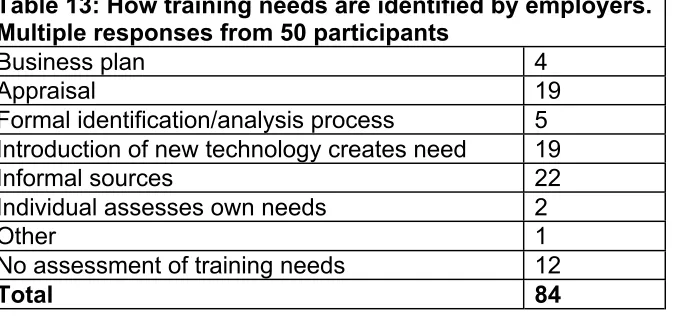
A majority of survey respondents (68%) said they identified training needs through staff appraisal. Others used either a business plan (31%) or informal sources (48%). Forty-eight per cent of all respondents said that new technology was creating the need for training.
Linking training to business aims
Many survey respondents (71%) said they tailored training and development of the workforce to fit the company’s business aims.Examples of this were given, as follows:
• breaking the business plan into tasks analysis/skill audit and needs analysis
• identifying each department’s role in business growth, then planning training
• CPD suited to the aims of the business
• enhancing the firm’s capability by developing an employee’s skill and knowledge to match their aptitude with the job
• considering the training and development needs of the company five years on
• planning staff capabilities to enable company to achieve targets
• training to keep up with advances and new developments in the product range
• developing competencies to meet expected growth areas
• apprenticeship training
• the Investors in People process ensures that company objectives are filtered down to departmental objectives which are then related to individual training objectives.
• core functions are identified first, and then the company looks for gaps in the existing skills of the workforce. Further training is then organised based on these needs
• training is dictated by changing conditions and regulations plus use of new technology
• the 3-year business development plan is updated each year and this informs the training plan.
Support for learning in the workplace
Implications of the survey findings
The respondents to the survey generally displayed positive attitudes to training and development. This may be partly explained by the relatively high numbers of
respondents involved in IiP. Although the sample is small, the views expressed may be indicative of a change in attitude of SMEs towards workforce development and involvement in training.
Exploring the employers’ perspective
In order to explore the issues raised in the postal survey, 12 SMEs were interviewed, none employing more than 64 people. Small and medium-sized
enterprises are not a homogeneous group and defy strict categorisation. That said, these face-to-face interviews with SMEs provided examples of strong commitment to learning among some quite small organisations. All claimed to make systematic attempts to identify the training needs of their employees. For example:
In a management consultancy (10 or fewer employees), company staff training needs are identified in an ad hoc way throughout the year, and also by use of an appraisal system. Opportunistic training to meet particular staff needs as they occuris provided through conferences and other events.
In a cheese-making creamery (45 employees), the quality manager’s remit covers training. Training needs are identified during regular meetings that the quality manager holds with other managers. They tend to identify very specific needs that are met internally.
In a hotel-booking agency (32 staff), one of the two partners has ‘job chats’ with senior staff on a monthly basis. There is also an annual appraisal, identifying their relatively immediate training needs and what they aspire to. The supervisors, in turn, go through a similar process with their staff.
The business plan of a graphics origination and photographic studio (64
Systematic but informal
As these examples illustrate, even smaller businesses can adopt a systematic approach to their training needs, and may see advantages in testing their approach against the Investors in People standard. Indeed, one of the smallest firms visited, a manicure salon employing nine staff, reached the Investors in People standard within a year of start-up. The owner of the business had worked in a number of blue-chip firms prior to starting her own business and introduced some of their systems and approaches to her new business.
‘I talked to them [the staff] about it (the IiP award) saying they were the most important thing in the business. The Award says I’m investing in the
business. The staff find the interviews very interesting. We have got the Award, and it's good with staff and customers…. I wanted an independent person to come in and see if there was anything we needed to tweak – IiP did that. It was also nice to have someone say we were doing the right thing. There was a value to me in getting it early, as it would have picked up any mistakes.’
The follow-up interviews show that it is by no means inevitable that small firms would not analyse their training requirements or provide training for their staff. But it is nonetheless probable that the smaller the firm, the less likely it is to engage in formal training. The requirements of many small firms, even if they are committed to training and staff development, tend to be quite specific and much of their training is of short duration and generally not accredited by formal qualifications.
Focus on the business
Owners and managers of SMEs in the follow-up interviews were clear that training and staff development had to be directed towards business needs, but most were
A museum (with 24 employees) is an Investor in People. It has a written training policy, which has two objectives:
• all staff have to have the skills and knowledge required for their job
• where possible, to enable staff to acquire new skills and knowledge to aid their personal and career development and increase job satisfaction.
The museum’s administrator prepares an annual training plan based on
Formal or informal learning?
The relative merits and disadvantages of formal and informal learning were discussed with employers during the follow-up interviews. Workers not used to, or previously unsuccessful, at formal learning leading to qualifications may be discouraged from trying again. The success of the novice learner’s first attempt at learning since getting a job is crucial to renewing his or her confidence. Learning which is delivered and assessed formally may revive unhappy memories of tests, lengthy written exercises and numeracy problems which proved difficult in the past.
Moreover, informal, in-house training may build and transmit the values of the company. A downside of this method, however, is that bad habits may be
transmitted over time, unless some measure of external evaluation or supervision is built into the process.27
How training is delivered
Training for the companies in specialist underpinning knowledge was provided by FE colleges, by trade associations (such as the Screen Printers Association
Qualification Centre), or by the trainer attached to the supplier. Often these are the only specialist courses or trainers within a company’s occupational sector or local area.
Managers and senior staff often received more (and longer) training than other staff. Management training or training by external trainers of senior staff may be delivered to one or two managers and then cascaded to other relevant staff internally. If such staff are not competent in either training methods or in new technology to a sufficient level, then specialised external trainers may be bought in.
Availability was a key factor for those companies interviewed. If there was only one specialised trainer or source of training provision in an area, the key decision-maker on training often had no alternative but to use them. Companies also tended to be conservative about the training purchased. If the results appeared satisfactory, there was no reason to change.
A broader view of training
The owner/manager of the graphics origination and photographic studio said that the firm had got involved in workforce development because of the need to multi-skill its employees and increase their flexibility. Development reviews are held to ‘expand people’s skill base and make [working] life more interesting’. The firm was:
• paying the fees of a young woman studying for a master’s degree in communications
• allowing one of its employees to complete an Advanced Modern Apprenticeship in printing, even though the framework was not really appropriate to its business
• supporting a young person through day release to gain an accountancy technician qualification.
In all three instances, the firm expected to gain some advantage from the expanded knowledge of its employees, but in no case was the training wholly specific to the person’s job.
The managing director of a screen printing and engraving firm with 32 employees said that their target was to have at least three people trained to operate each of their machines. But the firm goes beyond only addressing its business needs, acknowledging that there is a balance between individual aspiration and business need. It would not guarantee to meet every request, nor could it necessarily meet quickly those it did recognise, but if possible, it would do so: ‘The emphasis here is on developing people, pushing them to the edge of their ‘comfort zone’, rather than just training. We have several examples where people have moved in not obvious routes, eg from the shop floor to artwork.’
While the firm’s managing director stressed the need for a business justification for training and noted that most of their requirements were for training that was of short duration and non-certificated, the company was also prepared to consider
supporting activities that were less task-specific. They saw this as benefiting both the individual and the firm.
Others interviewed also supported this broader view.
The quality manager of the cheese creamery saw the value in supporting her deputy to do an ONC in food science as giving her ‘the ability to answer questions’.
The owner of the manicure salon suggested that training to meet individual interests could also be used as an inducement to staff to learn ‘the basics’. One salon
Raising morale
A common theme in many of the interviews is the importance of training and individual development to staff morale and commitment, and thus to the long-term interest of the firm. The partner in the hotel-booking agency said that many of her employees were women aged over 40 who had returned to part-time employment after raising their families. She argued that learning builds their confidence, and adds to the value they contribute through their experience of life. The firm also had two young people doing Advanced Modern Apprenticeships, which were viewed as improving their morale and encouraging them to stay with the firm.
The managing director of the screen printers gave an example of a woman in the sales office being funded to study for a diploma in supervisory management. The firm did not have an immediate need for this training, but regarded the woman as having potential and saw this support as helping to maintain her motivation. At the end of the interview, he said: ‘An outcome of training a happy workforce is that we hardly lose anyone, and have a very low absenteeism rate – less than two days per year’.
A plastic mouldings firm (17 employees) is using NVQs widely, the director arguing that training gives people a belief in themselves and the confidence to respond to challenge.
‘For example, one staff member had problems with school; he suffered from dyslexia. We took him on, but found that the standard work instructions were useless to him. We broke them down, put them in large print, etc. It took three to four times more time to train him than the others, but it gave him confidence. He went on to become a supervisor, and stayed in the firm. All we did was the right thing: we trained somebody. He’s [a] very good
example of what training can achieve. He won the training and excellence award for young people from the local TEC.’
He also said: ‘People have to enjoy what they do at work. You can’t keep the momentum going if you’re not constantly training people, communicating what needs to be done.’
Investors in People and other quality kitemarks
Although Investors in People has only recently begun to make inroads into small firms, over a quarter of the SMEs responding to the postal survey were currently involved in it. Of the 12 firms in the follow-up survey, six were recognised as Investors in People.
The graphics origination firm had decided on IiP rather than BS570/ISO9000 because they thought it would have a more significant impact on quality. It had provided the impetus to the firm for setting up its training systems. ‘It’s good if you take it on board as company culture and not just as a man with a clipboard’.
The plastic mouldings firm had decided to work towards IiP while it was also working towards ISO9000, seeing the standards as complementing one another. It was also linked to work they were doing in introducing NVQs into the firm. They obtained recognition within nine months.
‘I find it horrendously useful. We were doing a lot anyway, but one big gap was business review: IiP forced us to sit down and talk. It deals with the individuals in the company, and also looks at the company as a whole – where we are, where we want to be, and how to get there. It’s given us a formal system for appraisal, a formal system for business review, and ways of measuring developments. We’re much more aware of what training costs are.’
One of the firms was working towards IiP recognition, while another saw its value but had not made any commitment.
Even the one firm that had clearly decided against involvement did so on grounds of cost:
‘We’d love to do it… [But] it costs money, and as a small business… There’s such a lot that has been thrown at us – the extra minimum wage,
stakeholder pensions…We need bodies to deal with it all: we haven’t got them so we [the two partners] do it.’
Take-up of support
The postal survey indicated scarcely any involvement by respondents with schemes such as the Union Learning Fund or Learndirect, or in employer-led approaches such as Employee Development Schemes.
As might be expected from a mainly non-unionised group, the SMEs interviewed had no knowledge of the Union Learning Fund. Nor had information on Learndirect made any impact on these employers. While several had general sympathy with the aims of employee development schemes, none of these employers felt that such approaches were relevant to SMEs, arguing that there had to be some link between employee development and the business objectives of the firm. None considered the possibility of including such arrangements as part of their pay and benefits packages.
Modern Apprenticeships in SMEs
Only three of the SMEs employed Modern Apprentices, and two of these reported problems with the programmes. The building-hire company had taken on an 18-year-old apprentice, but the owner/manager believed that the Level 3 NVQ
requirement, particularly the need for supervisory skills, was too high for the firm’s needs. In addition, the provider assessor was unable to assess the technical skills within the workplace.
The graphics origination company had also agreed to one of its staff members
undertaking a Modern Apprenticeship; but there was a mismatch between the nature of the firm’s business and the printing framework, which was the best fit to the job role. The owner/manager did not believe that they were obtaining full value from the apprenticeship. However, he did support the idea of apprenticeship in principle, saying that off-site training prevents staff from being too narrowly focused. It benefits them by providing an overview of the industry in which they work.
The partner in the hotel-booking agency was more satisfied with the Modern Apprentices that she employed. Two of her staff members were undertaking apprenticeships – one in customer service, the other in business administration – and another apprentice would be joining in the near future. The partner felt that the training was of high quality and would contribute significantly to staff morale and retention. She also said that the apprentices were making a valuable contribution through carrying out various projects that, for example, documented the firm’s processes.
Attitudes to Modern Apprenticeships were not always negative, even among non-users. Several of the employers were favourably disposed, but did not believe that
theirbusiness could support an apprenticeship at the current time.
Qualifications in the workforce
Accreditation of work-based learning is increasingly in the form of NVQs, which provide formal recognition of learners’ competence or ability to complete a task or job to a national standard. There remains some ambivalence about NVQs among employers, as the quotation below illustrates:
Accreditation of formal learning in the workplace can be positive in terms of
motivating the learner and enabling employers to place a premium on training. The PIU Workforce Development Project Guidelines28 flag up the negative impact on investing in training that can be caused by poor certification or badly understood qualifications.
NVQs
National Vocational Qualifications (NVQs) were generally familiar to companies, and most of the follow-up interview firms used them. Views about NVQs varied. The manager of the Civil Service healthcare company thought they might ‘be useful for people with a poor education, but for others they did not teach a great deal’. The company had taken young people from school, who then undertook NVQ Level 2 in business administration, but was not happy with the recruits and found the NVQ too bureaucratic.
The Chamber of Commerce used NVQ training with newly recruited, younger staff, but felt they ‘were not related directly to staff skills’ and that experienced staff did not see the need for them. In addition, there were concerns about consistency of
standards between different providers and assessors.
Other users of NVQs were more positive, feeling that they contributed to staff morale and thus contributed to effectiveness and retention. The screen printers used NVQs and believed that they were of real value. However, the managing director also said that they did not suit everyone’s learning style and that some members of his staff preferred to obtain other qualifications. The plastic mouldings company noted that the introduction of NVQs into the firm had had a major impact on staff morale and their ability to do the job. In turn, this was seen as contributing to a significant improvement in operational effectiveness.
NVQs may not be appropriate for some companies with highly specific skills needs and processes. In the case of the cheese creamery, for example, this applied not just to cheese making, but also to their particular processes, so finding an ‘off the shelf’ qualification is problematic. This could apply to all qualifications, but may be particularly pertinent to NVQs in that they attest to skills and competences acquired and demonstrated in the workplace. If the workplace experience is highly
specialised, it is unlikely to be applicable to a sufficiently large number of people to warrant a dedicated qualification.
Cascading learning and training
Cascading learning, whereby the information gained in a formal training setting is passed on to fellow employees in the workplace appears to be fairly commonplace in SMEs. It has advantages, such as enabling learning at work for small and
medium-sized businesses where the opportunity cost of releasing all staff for formal training is prohibitive.
In the case of management training within SMEs, having both the manager and a key trainer released could result in both management and ‘training the trainer’ skills being acquiredl and then passed on to other staff at work.
Problems associated with cascade methods arise when the original training is not sound, or the person undertaking the cascading has an insufficient grasp of the issue or poor communication and training skills. The greater the number of steps in the chain required to cascade knowledge and skills within the company, the more the chances are that each person will put an interpretation on the information. Checks on learning need to be undertaken in order to ensure its quality and relevance.
Measuring effectiveness and impact of training
A key element of good workforce development, which is emphasised in Investors in People, is the evaluation of learning and development activities, and the use of this to plan further activity. The follow-up interviews asked employers how they
measured the effectiveness of training.
Some firms have in place a range of outcome measures of performance, which could be used to assess the impact of learning and development. The hotel-booking agency looked at things like calls per hour, targets hit etc. Baselines would be set and improvements measured. The screen printers would look at behavioural and motivational factors, such as levels of absenteeism and turnover/retention. They would also look at the impact on productivity and scrap rates.
The Civil Service healthcare company adopted a largely informal approach, the manager looking at the accuracy of claims being handled. He had a ‘gut feeling’ if they were right.
The manicure salon could look for the direct impact of the sales training on sales performance. With skills training, the measurement would relate to observation of the quality of the manicure and the time taken, along with informal soundings of customer feedback.
The plastic moulders used their NVQ system to measure what staff members know and how that knowledge is applied. This firm, too, looked at the scrap rate as an indicator of the general effectiveness of training. The director was in no doubt as to its effectiveness:
‘When we started in 1996, we inherited from [the previous employer] a scrap rate of 98%; we brought it down to 20% in three months. There were only three of us, but we were a dedicated group of people. Over the next period, we whittled it down to 8%. We always had a training culture, but we then took on NVQs and watched it [the scrap ration] drop regularly: last year it was 1.7%. That’s my secret for training!We probably saved about £15,000 last year.You get people aware of what they’re making, so they can almost ‘read’ the material by looking at it. Instead of getting on a slippery slope, we identify the problem and can rectify it.’
Many of the firms assessed the impact of training on individuals as part of their performance appraisal arrangements. The building-hire company interviewed its staff after training and monitored them informally during the year. The Investors in People tended to have a more structured approach:
Expenditure
Most of the firms in the follow-up interviews had training budgets, mostly ranging between 1% and 2.5% of turnover (although the management consultancy said that its budget ranged between 1% and 5%!).
Companies noted that they would not limit training to budget levels if it were necessary. ‘We treat training as an investment, not as an overhead cost. Any investment with a payback in 12 months – you do it!’ (screen printers).
They also pointed out that the budget by no means covered all their training activities. Several firms noted that the costs of travel and subsistence for external training might be met from a different budget. Others pointed out that budgets did not always include the costs of internally delivered training. Most did not calculate the benefits resulting from the ‘snowball effect’ – from training one or two members of staff, who then passed on that learning to their colleagues at no cost.
Some of the firms had no dedicated training budget. One of these notes that most of its training was in-house so a specific budget was not required; another observed: ‘as we need it [funding for training], we find it’.
Implications for support for learning in SMEs
The views of the employers interviewed indicate that generally positive attitudes to learning are held by some employers in small firms. They also reveal that employers value and use a range of different types of learning, although their tendency is to go for low-cost informal learning where possible. Sourcing the most appropriate training and learning experiences appears to be a major concern.
Views of people working in SMEs
Research into workforce development in small firms rarely asks the employees for their views on their development. The project therefore investigated what employees in small and medium-sized enterprises thought about workforce development by means of a series of focus group meetings with people who worked in small firms.29 Focus groups considered:
Six focus groups were recruited, segmented by size of company, as follows:
• two focus groups with employees of SMEs employing 2–10 staff.
• two focus groups with employees of SMEs employing 11–50 staff
• two focus groups with employees of SMEs employing 51–250 staff. Participants included:
• one group of full-time employees, and one group of full-time and part-time (excluding self-employed)
• private sector employees
• a balanced gender mix
• a mix of ages ranging from 16 to 59.
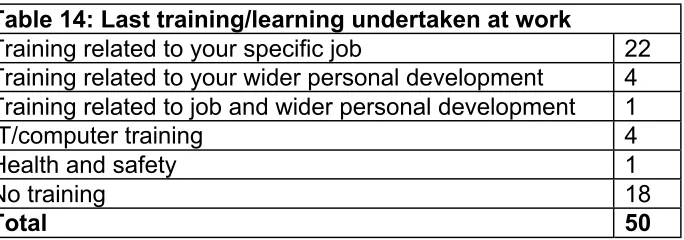
The focus group meetings lasted up to 90 minutes and participants initially completed a short questionnaire, followed by in-depth discussion about their experiences of, and attitudes towards, workforce development. Discussions concentrated on the training practices of participants’ employers and their own workforce development needs, including how training needs were being identified, and how training was delivered and funded.
The focus groups of employees in smaller firms (up to 50 employees) included people working in low-skilled occupations and in sectors and occupations covered by legislation, such as childcare.
Most participants were employed in owner/manager businesses and some were in family-run businesses, which had a distinctive approach to doing business with their own culture and working practices.
More of the individuals from businesses with 51–250 employees worked in a variety of sectors, and were employed in a wider range of occupations. The sample
included a greater mix of skill levels, and only two individuals were employed on a part-time basis.
Workforce development, work-based learning or learning in the workforce?
Employees in SMEs emphasised the need to be clear about the definition of workforce development and to differentiate between:
• specific development needs within a given workplace, and within this, training identified by employers; and the use of the workplace as a 'space' to undertake learning that employers – or employees – want to do
The primary area of discussion during the focus groups was workforce development relating to the demands of a given workplace rather than individual learning needs. In this context, a number of factors that shaped the experience and attitudes of employees towards workforce development emerged.
Factors influencing workforce development at the workplace
There was a high degree of similarity in the experiences described by participants working in micro and small businesses employing respectively 2–10 and 11–50 people. They were less likely to have their training needs formally identified by their employer, and were more likely to be trained on the job than those working in medium-sized firms employing 51–250 staff. In addition to the size of firm, other factors shaping the type of workforce development being undertaken were the type of business, occupation of employee and employment status.
More specifically, the majority of part-time workers in the group were employed in micro and smaller businesses in traditionally lower-skill sectors, such as retail, with jobs with limited training. In contrast, participants employed in businesses with 51–250 employees were mostly full-time, worked in a wider cross-section of businesses and had jobs requiring higher levels of training.
Business cultures and lack of formal training needs
Employees reported that the culture of the business often meant that formal training was not seen to be required. For instance, many employees working in retail, where good customer care is essential, did not receive any formal training. The firm’s success was attributed to the innate personality of the staff, knowing their customers and their awareness that poor service would cause long-standing customers to go elsewhere. As such, they saw no need for an external customer care course, and feared that such training could alter the genuine care to customers provided by the staff. Beverley, a part-time cashier highlighted this point, explaining: ‘Employers want to offer an old-fashioned service. We know our customers personally, so want to give them a friendly service.’
Drivers of training needs
Participants identified drivers of training needs, as being:
• business change
• the outlook of the owner/manager
Business change is an important driver for training needs which is not always
exploited. Deborah, a part-time worker in a newsagent employing six people, gave a typical example where the owner of her company was told that the firm could no longer sell mobile phone cards without an electronic machine. The owner decided to install the machine, but training on how to use it was not given to the staff. Instead, the owner put the instructions on the wall above the machine and they had to learn by trial and error.
In contrast, another employee described a situation where a need for training, resulting from a change in the business, had been met when a new computer system was installed to link them directly with a supplier. In this instance, the firm provided on-the-job computer training, delivered by the company which installed the computer system.
The outlook of the owner/manager on the firm’s growth and survival prospects emerged as critical. If the owner/manager wants to respond to a business change or opportunity, then he or she will introduce it, and training to meet new skills needs might follow. If not, there is no business change stimulating demand for new skills. An example of this was in a hairdresser’s where an employee was aware of new techniques, but the employer saw no need to introduce these, judging that their clients were not likely to want them.
Product development. Employees were aware that products change every day and that staff needed to keep their knowledge up to date. However, they tended to do this by informal means, such as learning from other workers, or on-site from product sales representatives. There is no perception of formal training need as such and staff pick up new skills as they go along, as Mat, a full-time sales assistant,
explained: ‘We’re left to our own devices. We’re all long-term employees and we’re still picking things up so we’re learning all the time. With retail, training needs are stock-led and we learn about the products and share knowledge between
ourselves.’
Legislation/health and safety
Health and safety, and other legislation are also factors which may result in the need for further training of existing staff; for example, for people working in childcare and catering.
Multi-tasking and multi-job roles
The need for broader training was exemplified by the case described where two employees in the same company were sent on health and safety training,
Time is the key constraint
Even when firms had acknowledged training needs, employees in the focus groups could not see how time to take off-the-job training could be secured. They explained that other staff would have to cover – which often put them under immense pressure – and that employing temporary staff is problematic.
Mark, a full-time shop assistant spoke for the others when he said: ‘My boss
definitely couldn’t release me, it just wouldn’t be practical. Maybe one day a month, but off-the-job training just isn’t suitable for my type of work. There’s just never any time free for training.’
Scott, a full-time sales manager, described how he would like some word-processing training, but his firm was unable to release him for training: ‘Anyone with a need for IT won’t be spared by the company. I think they feel the need isn’t as strong as it is. Sparing the time is the biggest problem, not the cost…they think people can just muddle through.’
Drivers of training needs in medium-sized firms
Training in the medium-sized firms (those employing between 50 and 250 people) appears to have similar drivers to those in the small and micro businesses, including business change, product development, health and safety/legislation and the need to introduce new technology. Multi-tasking was again mentioned, with some
employees getting on-the-job training to undertake a variety of job roles. Since none of the businesses were owner-managed, this was not cited as a key factor.
Impact of ‘poaching’ on training
Two individuals commented on the issue of poaching, noting that this can have a big impact on training activity. One stated that their firm employed contractors for the more specialist work, rather than provide staff training. Tony, a quantity surveyor, said: ‘We’re losing so many guys after they qualify as they know they can earn good money elsewhere. It’s now started to have an effect on training, and there’s a move towards taking on qualified staff.’
Identifying training needs
Almost a quarter of the focus group participants said that their employers did not make any attempt to assess their training needs. Along with other evidence from the focus groups, this indicates that in a significant number of firms, especially micro businesses, employers have little interest in developing their workforce. This may stem from the situations in which these firms find themselves, where market pressures and the nature of the jobs required do not leave much leeway for
Focus group participants who worked in smaller businesses – with fewer than 50 employees – were less likely to have their training needs recognised by their
employer than those in larger SMEs (employing 51–250 people). The former tended to work in traditionally low-skill sectors, such as retail, in jobs that required limited training, and were more likely to work part-time.
Employees in smaller firms said that there was very little formal assessment of training needs and only a small number said that they could discuss their learning needs with the owner/manager on an informal basis. Few said that their employer had a business or training plan, and none reported that their firm was involved in Investors in People.
Focus group employees working in larger firms were more likely to report that their employer had a business or training plan, and some referred to quality standards such as Investors in People and ISO9000. Individuals’ training needs were more likely to be identified by more formal mechanisms, and appraisals were highlighted most often. For some, this involved a two-way process with both the employer and the employee identifying the training and development needs; for others, the
process was more analytical and linked more closely to business objectives, as the following quotations emphasise:
‘I get broad appraisals. It’s a two-way street and I can say what training I need… its usually down to changes in technology or product-driven.’ (General manager, computer components firm)
‘Assessment of training needs is done via yearly appraisals. We have a formal training plan, which links to the business plan. The focus is on
business objectives, including new processes and services, recruitment and retention. It’s very analytical, not training for training’s sake.’ (HR manager, leisure firm)
Focus group participants were asked to say whether they thought learning from informal sources was more successful than learning delivered on a more formal basis.
Their responses reflect their personal experiences, revealing that most individuals in the smaller firms (up to 50 employees) had received little formal training and
perceived their needs as limited.
‘You learn more from watching people. It’s more likely to be specific to your work so it’s not so boring and people can correct you there and then.’ (Sue, part-time waitress)
‘I don’t want to learn outside the job. It’s with people I know and everyone knows what they’re doing, so I feel more comfortable asking them questions. Training is much more one-to-one in a family firm. When I worked in a larger company, I spent four days on a course listening to someone with 25 other people in a room – mostly learning how to speak to people. I got a
certificate, but it doesn’t make me do my job any better.’ (Sharon, full-time administrative assistant)
Lack of space
Few employees stated that their employer was likely to create a space at the
workplace where they could undertake learning – either work-related or for their own personal development. The view was that owner/managers tended to see personal learning as something that the individual should arrange.
In addition, most employees said that there would be insufficient space at their workplace to allocate a separate area for learning, even if their employer wanted to do this.
Experiences in medium-sized firms
Participants from larger firms (51–250 employees) who had experienced both formal and informal learning generally viewed both as important, depending on an
individual’s type of job and occupation. Some felt that open courses were important to generate new ideas, which could then be applied back in the workplace. More senior workers in particular felt that it was easier to concentrate when they were away from their work environment. One person had been on an intensive training course for her previous job in a post office, and felt it was essential that the training was provided off-site to enable her to absorb all the information.
Other employees preferred informal learning. Wendy, a full-time clerical worker felt this helped to improve communications between staff: ‘On-the-job training is
provided by people who have been there the longest. There’s a general team spirit of everyone helping each other out.’
In another instance, a mix of both was thought to be preferable, and NVQs were cited because they provided smaller chunks of learning combined with feedback on the job.
Resources for training
Another individual’s firm had a dedicated centre for training in first aid and health & safety with specialist equipment where employees could undertake in-house
courses.
As with the micro and smaller firms, space was at a premium, and none of the participants had access to a dedicated space to learn for their own personal development.
What training?
Given that the majority of focus group participants in the smaller firms (fewer than 50 employees) were employed in lower-skilled occupations, and in lower- skill sectors, there was little indication that they thought they had unmet training needs. This said, those working full-time were more likely to have training needs than those working part-time.
‘We got informal training when we started…where the kettle is and how to work the till.’ (part-time shop assistant)
‘We get some customer service training, but it’s on the job, nothing special really – like any other retail shop.’ (full-time shop assistant)
‘I’ve been in the job 20 years. We’ve always learnt on the job. I don’t need training as the job stays the same.’ (full-time steel fixer)
‘I could do with more product training as some of my work is quite technical. I ask, but it doesn’t happen.’ (full-time sales representative)
Working towards NVQs
Two people working in childcare either had NVQs or were working towards them. Julie, a deputy supervisor in a playgroup, wanted to update her qualifications by doing an NVQ Level 3 and was attending college one day a week. She had told her employer she would leave if they did not pay for the training, and thought she would be asked to go, on the assumption that her employer would recruit someone else. In fact, her employer said that they would pay, suggesting that they did not expect to get another qualified member of staff in the current tight labour market.