Magic Quadrant for Managed Hosting, North
America
9 April 2013 ID:G00247853
Analyst(s): Douglas Toombs, Lydia Leong, Bob Gill, Tiny Haynes, Gregor Petri
VIEW SUMMARY
Managed hosting solutions are offered on physical and virtualized infrastructures, including cloud infrastructure as a service. This market is mature, but cloud capabilities are disruptive, so vendors must be chosen with care.
Market Definition/Description
Managed hosting services are standardized, productized offerings that combine data center facilities, provider-managed computing, network bandwidth and storage capacity. Their individual components may be physical or virtual, and dedicated to a single customer or shared by many. At minimum, the provider must supply server OS management services, including guest OSs if virtualization is used. The provider may optionally supply other managed and professional services relating to the deployment and operation of the infrastructure.
Managed hosting services offer limited customization and are sold on a stand-alone basis, with no requirement to bundle them with other services (such as application development, application maintenance and data center outsourcing [DCO] services).
This Magic Quadrant focuses on the enterprise-class, managed hosting market, independent of the type of underlying infrastructure. Managed hosting services may be delivered on:
Physical servers. These are dedicated to a single customer and owned and hosted by the service provider. At minimum, server OS management must be included.
Virtualized servers. Physical servers are dedicated to a single customer and owned and hosted by the service provider; virtualization is used to provide virtual machines to the customer. At minimum, guest OS management must be included.
Utility infrastructure. This provides customers with virtual machines from a shared, multitenant environment owned and hosted by the service provider. At minimum, guest OS management must be included.
Cloud infrastructure as a service (IaaS). This provides customers with self-service — via a graphical user interface or an optional API — and compute, storage and network resources, on demand and in near real time. These resources are owned and hosted by the service provider. The offering may be multitenant ("public cloud") or single-tenant ("private cloud"). At minimum, server OS management must be included for nonvirtualized physical servers, and guest OS management must be included for virtual machines.
Many customers will choose to use multiple types of infrastructure within their managed hosting solution. When cloud IaaS is mixed with one or more of the other types of infrastructure, this is often called "hybrid hosting." Some customers will also choose to mix provider-managed and self-managed infrastructure.
Gartner separates the concept of a cloud infrastructure platform from the concept of services that are delivered on top of that platform. Managed hosting is simply one of many services that can be delivered on top of cloud IaaS, or more broadly, on an infrastructure created using a cloud management platform. In addition to server OS management, optional managed and professional services related to infrastructure operations may be offered, such as:
Management of infrastructure software at the middleware or persistence layer, such as Web server software, application servers and database servers
Management of storage, including backup and recovery Management of security
Management of network devices, such as application delivery controllers
Professional services associated with hosting, such as architecture, capacity planning, performance testing, security auditing and data center migration
Managed hosting services are typically sold on one-to-three-year contracts. Providers vary in the degree to which they allow customers to change the amount of capacity they purchase during a contract. Some allow only capacity increases, not decreases. Some require a contract addendum and extension when capacity is changed. Others are more flexible, allowing capacity changes on a monthly basis, or even a daily or hourly basis, without any contract alterations.
As noted above, managed hosting services are productized and standardized, but some providers will customize services for customers with specific needs that cannot be met by standardized offerings. Some customers choose a fully managed service in which the service provider manages the system infrastructure (computing, storage and network facilities) and application infrastructure (middleware), but not the application. Other customers prefer to select from a menu of management services; some, for instance, need only database administration services, while others want junior-level system administration tasks, such as patch management, handled for them, but to do all the complex work
EVALUATION CRITERIA DEFINITIONS Ability to Execute
Product/Service: Core goods and services offered by the vendor that compete in and serve the defined market. This includes current product and service capabilities, quality, feature sets, skills and so on, whether offered natively or through OEM agreements and partnerships as defined in the market definition and detailed in the subcriteria.
Overall Viability (Business Unit, Financial, Strategy, Organization): Viability includes an assessment of the overall organization's financial health, the financial and practical success of the business unit, and the likelihood that the individual business unit will continue investing in the product, will continue offering the product, and will advance the state of the art within the organization's portfolio of products.
Sales Execution/Pricing: The vendor's capabilities in all presales activities and the structure that supports them. This includes deal management, pricing and negotiation, presales support, and the overall effectiveness of the sales channel.
Market Responsiveness and Track Record: The vendor's ability to respond, change direction, be flexible and achieve competitive success as opportunities develop, competitors act, customers' needs evolve and market dynamics change. This criterion also considers the vendor's history of responsiveness.
Marketing Execution: The clarity, quality, creativity and efficacy of programs designed to deliver the organization's message to influence the market, promote the brand and the business, increase awareness of products, and establish a positive identification with the product, brand and organization in the minds of buyers. This "mind share" can be driven by a combination of publicity, promotional initiatives, thought leadership, word-of-mouth and sales activities.
Customer Experience: Relationships, products, services and programs that enable clients to be successful with the products evaluated. Specifically, this includes the ways customers receive technical support or account support. This can also include ancillary tools, customer support programs (and the quality thereof), availability of user groups, SLAs and so on.
Operations: The ability of the organization to meet its goals and commitments. Factors include the quality of the organizational structure, including skills, experiences, programs, systems and other vehicles that enable the organization to operate effectively and efficiently on an ongoing basis.
Completeness of Vision
Market Understanding: The vendor's ability to understand buyers' wants and needs and to translate those into products and services. Vendors that show the highest degree of vision listen and understand buyers' wants and needs, and can shape or enhance those wants and needs with their added vision.
Marketing Strategy: A clear, differentiated set of messages consistently communicated throughout the organization and externalized through a website, advertising, customer programs and positioning statements.
Sales Strategy: The strategy for selling products that uses an appropriate network of direct and indirect sales, marketing, service and communication affiliates that extend the scope and depth of market reach, skills, expertise, technologies, services and the customer base.
Offering (Product) Strategy: The vendor's approach to product development and delivery that emphasizes differentiation, functionality, methodology and feature sets as they map to current and future requirements.
Business Model: The soundness and logic of the vendor's underlying business proposition.
Vertical/Industry Strategy: The vendor's strategy to direct resources, skills and offerings to meet the specific needs of individual market segments, including vertical markets.
Innovation: Direct, related, complementary and synergistic layouts of resources, expertise or capital for investment, consolidation, defensive or pre-emptive
themselves.
Use Cases Covered by This Evaluation
This Magic Quadrant focuses on the following common use cases, independent of the type or types of infrastructure used to serve these workloads:
E-business hosting. Managed hosting for e-marketing sites, e-commerce sites, software as a service (SaaS) applications and similar modern websites and Web-based applications. These workloads are often complex, and are associated with a high rate of change in systems and application infrastructure.
Web-based business application hosting. Managed hosting for corporate intranets and Web-based applications delivered to users primarily within the enterprise. The applications may be commercial software or in-house-developed applications; workloads are often relatively light, and do not have a high rate of change.
Enterprise application hosting. Managed hosting for the infrastructure underlying large commercial software applications, such as those of Oracle, SAP and Lawson. These workloads are often complex and require specialized knowledge to operate optimally, but do not have a high rate of change.
All three use cases are typically tactical sourcing decisions that involve one application, a single group of closely related applications (such as everything associated with an enterprise's video portal) or a single division (such as the e-commerce business unit of a retailer). They are typically best served by a best-of-breed provider that has strong operational expertise with similar solutions. However, many customers expand their use of managed hosting over time, and the choice of a provider may become a strategic decision for a customer.
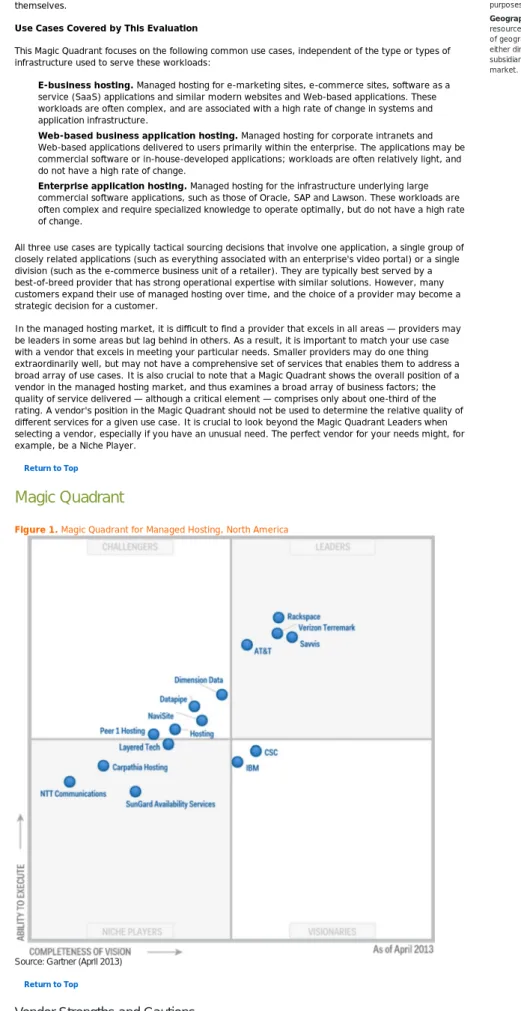
In the managed hosting market, it is difficult to find a provider that excels in all areas — providers may be leaders in some areas but lag behind in others. As a result, it is important to match your use case with a vendor that excels in meeting your particular needs. Smaller providers may do one thing extraordinarily well, but may not have a comprehensive set of services that enables them to address a broad array of use cases. It is also crucial to note that a Magic Quadrant shows the overall position of a vendor in the managed hosting market, and thus examines a broad array of business factors; the quality of service delivered — although a critical element — comprises only about one-third of the rating. A vendor's position in the Magic Quadrant should not be used to determine the relative quality of different services for a given use case. It is crucial to look beyond the Magic Quadrant Leaders when selecting a vendor, especially if you have an unusual need. The perfect vendor for your needs might, for example, be a Niche Player.
Return to Top
Magic Quadrant
Figure 1. Magic Quadrant for Managed Hosting, North America
Source: Gartner (April 2013)
Return to Top
Vendor Strengths and Cautions
AT&T
AT&T is a global communications service provider, headquartered in Dallas, Texas, with a long history of leadership in the managed hosting market. It offers managed hosting on dedicated infrastructure and public and private IaaS, and colocation and application management services, from 23 data centers in
purposes.
Geographic Strategy: The vendor's strategy to direct resources, skills and offerings to meet the specific needs of geographies outside its "home" or native geography, either directly or through partners, channels and subsidiaries, as appropriate for that geography and market.
North America, as well as from facilities in Europe and Asia.
Strengths
AT&T has a long history of providing managed hosting services. It can manage highly complex e-business infrastructures, and has particular expertise in e-commerce and enterprise application solutions. It can also manage complex enterprise application hosting, in synergy with its application management business.
AT&T is able to use its network as a differentiator for use cases where network access is a heavily weighted criterion, or where end-to-end service management with SLAs is required.
Cautions
Gartner customers frequently express frustration with AT&T's billing processes. Although AT&T provides customers with documentation on these processes, it is exceptionally long and the relevant details are hard to find, which can lead to confusion.
AT&T's operations processes are heavyweight in nature. This level of operational rigor can be beneficial from the perspective of the long-term stability of environments and the management of the complexities of change and risk, but it quickly becomes burdensome when customers want to be more agile and to move more quickly.
Return to Top
Carpathia Hosting
Carpathia Hosting is a midsize private Web hosting provider, headquartered in Sterling, Virginia, that focuses on delivering complex, compliant hosting and cloud solutions for midmarket enterprises and government customers. The company offers managed hosting on dedicated servers and private or public cloud IaaS, and can integrate with Amazon Web Services. It operates from data centers on both coasts of the U.S., in Canada, in Europe and in Asia/Pacific. It can also offer high-compliance colocation space.
Strengths
As of October 2012, Carpathia was one of only five providers serving the U.S. federal government market to have received Authority to Operate status for virtual machines for moderate (or lower) Federal Information Security Management Act (FISMA) workloads via a General Services Administration (GSA) blanket purchase agreement.
Carpathia is one of the few providers that can work with customers that need or want to use Amazon Web Services as a part of a larger overall hosting, cloud and colocation solution via Amazon Web Services' Direct Connect service.
Cautions
Carpathia's strong marketing focus on compliance use cases can put off customers looking for more general-purpose solutions.
Carpathia's InstantOn cloud solution is currently deployed only in its U.S. facilities. Carpathia's network-level SLA lags behind most of its peers in the industry, at 99.9%. Return to Top
CSC
CSC is large IT integrator and outsourcing company, headquartered in Falls Church, Virginia, that offers a broad array of IT outsourcing services, including managed hosting and cloud IaaS, as well as colocation services. It offers managed hosting services from multiple data centers in the U.S., and managed cloud services from its U.S. and international data centers.
Strengths
CSC focuses its managed hosting business on its cloud platform, which is one of a handful certified by VMware as a vCloud Datacenter Service, and which incorporates a variety of other IT operations management tools as well.
CSC has a well-designed unified portal for its cloud and hosting offerings, which also integrates detailed chargeback and billing data, as well as provisioning workflows with approval checkpoints. CSC supports a particularly broad variety of infrastructure, middleware and database choices, including non-x86-based environments such as AIX, HP-UX and IBM's iSeries (AS/400).
Cautions
CSC does not offer traditional dedicated-server managed hosting or managed hosting for applications outside North America. Its managed cloud hosting, however, is available in all of CSC's geographic regions.
CSC's sales and engagement processes for hosting and cloud are still maturing, with some Gartner clients reporting frustrations in the time it took to advance from the initial engagement to an operational state.
Return to Top
Datapipe
Datapipe is a rapidly growing, midsize private hosting provider, headquartered in Jersey City, New Jersey, which focuses on delivering high-touch services to midmarket and enterprise customers. The company offers managed hosting on dedicated servers and on its Stratosphere public and private IaaS platform, as well as on top of Amazon Web Services. It operates from data centers on both coasts of the U.S., as well as from Europe and Asia. It can also offer colocation services.
Strengths
Datapipe is one of the few providers that can engage with customers looking to move workloads to Amazon's cloud but that may not want to do this on their own, or that may need additional offerings not provided by Amazon Web Services, such as dedicated servers and colocation. Datapipe aims to deliver predictability in month-to-month billing for customers by not charging for time and materials for routine move, add and change requests that do not require new equipment — even to the point of performing a complete OS upgrade for a hosted server.
Datapipe takes an environmentally focused approach to its domestic infrastructure needs, and purchases renewable energy offset credits for all its utility power consumed in the U.S. It also utilizes geothermal and hydroelectric power at its data center in Iceland.
Cautions
Organizations requiring mostly commodity services might find it harder to get Datapipe's attention as it shifts its focus to customers for which its high-touch service levels are a competitive differentiator.
Because of Datapipe's focus on higher-touch levels of service, its prices tend to be higher than those of similarly sized competitors.
Return to Top
Dimension Data
Dimension Data is a large, global system integrator and value-added reseller headquartered in Johannesburg, South Africa, and a subsidiary of NTT in Japan. In 2011 the company acquired Santa Clara, California-based OpSource, which became the foundation for Dimension Data's global cloud business unit. The company offers managed hosting on dedicated servers, as well as public and private cloud IaaS from data centers on both coasts of the U.S., as well as in Europe, Asia, Australia and South Africa.
Strengths
The former OpSource was successful with independent software vendors (ISVs) needing a service provider to host SaaS versions of their applications. It achieved this by acquiring and building capabilities specific to the needs of ISVs.
Dimension Data has extended the OpSource platform to a larger global footprint, and has improved its software to enable customers to deploy their own on-premises private instances of the managed cloud platform.
Dimension Data has some of the highest SLAs of any provider, and will even offer high SLAs for selected enterprise applications — provided they meet certain architectural requirements for fully redundant components, clustering and so on.
Cautions
Dimension Data's managed hosting offering on dedicated infrastructure is supported from a different portal than its cloud platform, which can make management more cumbersome for customers needing to use both.
Dimension Data offers neither programmatic provisioning of "bare metal" infrastructure nor a utility hosting platform.
Return to Top
Hosting
Hosting (also known as Hosting.com) is a midsize, private Web hosting provider, headquartered in Denver, Colorado, that focuses on midsize enterprise customers. The company offers managed hosting on dedicated servers, as well as on private and public IaaS platforms. It operates from six data center locations throughout the U.S., and can also offer colocation services.
Strengths
Hosting continues to bring new business continuity and disaster recovery services to the market. Hosting takes a highly methodical and quantitative approach to measuring customer satisfaction across the entire service experience, in order to spot areas with room for improvement and direct internal investments strategically.
Hosting continues to improve its portal's capabilities and information. Improvements include the addition of an ability to add managed services to already-provisioned unmanaged infrastructure, granular levels of OS patch control and scheduling, improved monitoring of application
performance, and visibility into virtual machine storage input/output operations per second (IOPS).
Cautions
Hosting lacks any international capacity, unlike many of its peers in markets of similar size. This limits its ability to serve U.S.-based multinational corporations that would like a local provider but that also need a global reach.
Hosting is still in the process of sorting out its messaging and branding, as a result of its acquisitions during the past few years. Although this typically does not impair the quality of its service delivery, customers may see inconsistencies in messaging or operational processes from time to time.
Return to Top
IBM
IBM is a highly diversified global technology company, headquartered in Armonk, New York. It offers a broad array of IT outsourcing services, including managed hosting and cloud IaaS. IBM offers managed hosting on dedicated or shared servers, as well as on private and public IaaS platforms, from nine data centers in North America and locations throughout Europe, Asia and Latin America.
Strengths
IBM's SmartCloud Enterprise+ platform, which serves as the foundation for the evolution of its e-business hosting and Applications on Demand businesses, is used in multiple service offerings beyond managed hosting. This makes it a strategic investment for the company.
IBM is one of the few managed hosting providers that can offer infrastructure capabilities outside the x86 sector, namely for AIX/pSeries systems.
IBM is able to deliver enterprise applications like those of SAP on its cloud platform, with some term commitments for certain deployments being as short as one month.
Although IBM's SmartCloud Enterprise+ platform has promising capabilities, it has been on the market for less than one year and falls under Gartner's definition of a utility hosting platform, not cloud IaaS.
With a 99.9% SLA, IBM's SmartCloud Enterprise+ platform is on the low side, compared with other hosting offerings, and below the 99.95% typically seen in most IaaS platforms.
IBM measures SLAs at the start of a calendar month, not immediately upon provisioning a virtual machine.
Return to Top
Layered Tech
Layered Tech is a midsize, private managed hosting and cloud provider headquartered in Plano, Texas. It is refocusing on customers with complex, compliant hosting and security needs, particularly in the healthcare and government sectors and the payment card industry. The company offers managed hosting on dedicated servers and private or public cloud IaaS, as well as colocation services from three primary data centers in the U.S. It also has secondary data centers in Canada, Europe and Asia.
Strengths
Layered Tech is investing in service delivery automation capabilities that can automatically execute and track some change operations within customer environments entirely via scripted operations and that are tied into the company's ITIL-based change management framework.
Layered Tech is increasing its focus on, and services for, use cases with security and compliance needs. It backs up its offerings with guarantees that customers will pass any audit from properly sanctioned regulatory entities.
Following its acquisition of New World Apps in 2012, Layered Tech is better suited to address governmental computing needs that fall under FISMA compliance requirements.
Cautions
Layered Tech has primary data center locations in the U.S. only, which limits its capabilities for customers needing a larger international infrastructure footprint.
A significant shift in Layered Tech's messaging toward compliance might cause potential customers with more general-purpose needs to overlook it.
Return to Top
NaviSite
NaviSite is a midsize Web hosting provider, headquartered in Andover, Massachusetts, that was acquired by Time Warner Cable in 2011. It offers managed hosting on dedicated servers and private or public cloud IaaS, as well as colocation and application management services, from six data centers throughout the U.S. and three data centers in Europe.
Strengths
Although NaviSite offers a variety of infrastructure options, it encourages customers to use NaviCloud, its cloud IaaS platform, which is well-engineered for midmarket and enterprise needs. NaviSite is a strong performer in the field of hosting and cloud services for complex application management. It provides hosting solutions for applications from vendors such as Microsoft (Exchange and Dynamics) and Oracle (including PeopleSoft and Hyperion).
NaviSite is bringing desktop-as-a-service offerings to customers through a partnership with Desktone, one of the few managed hosting providers that has been willing to enter this relatively new market.
Cautions
NaviSite is rationalizing its product portfolio in light of current market needs, which might lead to shifts in product focus.
NaviSite is typically one of the more expensive providers in the managed hosting market, as it often bundles managed hosting as part of a more comprehensive suite of services.
Return to Top
NTT Communications
NTT Communications is a wholly owned subsidiary of NTT, with headquarters in Tokyo, Japan. The company offers managed hosting on dedicated servers and private or public cloud IaaS via its Verio and NTT America business units, from data centers on both U.S. coasts, as well as from data centers in Europe and Asia. It also offers colocation services from its data centers, and owns its own global Internet Protocol (IP) network.
Strengths
NTT Communications' global network can be a differentiator for use cases where global network access is a heavily weighted criterion.
NTT Communications has a solid understanding of business practices, networking and security in both Eastern and Western societies. This helps it provide additional benefits to customers expecting their hosting needs to reach into the Asia/Pacific region.
Cautions
The service offerings of NTT America and Verio are still disconnected solutions, requiring different portals and logins, among other things.
In North America, NTT Communications lags behind its peers in terms of technical innovation and expansion of services. Innovations are slow to move from the broader global NTT portfolio to its North American operations.
Return to Top
Peer 1 Hosting is a midsize Web hosting provider, headquartered in Vancouver, British Columbia, which was acquired by Cogeco Cable in January 2013. The company offers managed hosting on dedicated servers and private or public cloud IaaS, as well as colocation services, from 12 data center locations throughout North America and four in Europe. Peer 1 acquired the U.K. provider NetBenefit in 2012.
Strengths
Customers that use multiple data centers from Peer 1 do not pay transit costs across its backbone network. This may provide significant cost savings for some application and workload scenarios. Peer 1 has created the customer-focused position of "customer advocate," a role not tied to sales quotas or support metrics but dedicated to ensuring general customer satisfaction.
Cautions
Although Peer 1 has a good track record for customer service, acquisitions can have unknown effects on the parties involved as organizations work to rationalize their portfolios, sales activities, billing systems, support models and so on. Although Peer 1 indicates that nothing should change with its business strategy, customers should be especially thorough when reviewing contractual terms and conditions.
With the sole exception of Microsoft Exchange, Peer 1 does not provide support for modern enterprise applications.
Return to Top
Rackspace
Rackspace is a large, publicly traded managed hosting and cloud IaaS provider, headquartered in San Antonio, Texas, with over $1 billion in revenue. The company offers managed hosting on dedicated servers, public IaaS based on OpenStack and XenServer, and private cloud solutions based on VMware, as well as hosted Microsoft Exchange and SharePoint, cloud storage and hosted virtual desktop services. It provides these services from five data centers in the central and eastern U.S., as well as Europe and Asia.
Strengths
Rackspace is the market share leader in pure-play managed hosting, and historically has grown significantly above the market average.
Rackspace has a strong cultural focus on providing superior, high-touch customer service. It is typically an exceptionally responsive provider in both the sales process and day-to-day operations. Rackspace has made significant improvements in the past two years to target enterprise customers, including a new enterprise-focused sales force and an expansion of its professional services capabilities.
Rackspace is an extremely cost-efficient provider, with prices that are often significantly below those of comparable offerings. However, these prices depend on standardization — Rackspace's service portfolio is narrower than those of other competitors that target the midmarket and enterprises.
Cautions
Although Rackspace founded the OpenStack project for an open-source cloud management platform, and launched an OpenStack-based public cloud IaaS offering in August 2012, most of its managed hosting customers still use dedicated servers, sometimes with VMware-based virtualization. Rackspace does not have a utility hosting offering, nor does it offer the full extent of its managed services portfolio on its cloud IaaS platform.
Rackspace does not have data center infrastructure further west in the U.S. than Texas. Customers looking to build Web applications should consider latency to West Coast users before deploying. Rackspace's enterprise sales force efforts are a relatively new focus for the company. It will likely take time for the company to execute on a par with some of its more enterprise-focused peers. Return to Top
Savvis
Savvis, a CenturyLink company, is a large colocation, managed hosting and cloud IaaS provider. The company offers managed hosting on dedicated servers and private or public cloud IaaS, as well as colocation services. It operates data centers in 20 metropolitan markets throughout North America, as well as locations in Europe and Asia, many of which are near major financial exchanges.
Strengths
Savvis can handle extremely complex deals, including large-scale e-commerce and enterprise application hosting needs. It has a very broad portfolio of supported infrastructure, middleware stacks and application environments.
Through its acquisition of the IT outsourcing business of Ciber in July 2012, Savvis gained a broader set of enterprise application support skills and can start bringing new application-centric services to customers.
Savvis has consistently had one of the best end-user portals, which generally covers every product that Savvis sells, including hosting, network, cloud and colocation offerings. Resource management and utilization views across multiple hosting and cloud services help customers identify where they may have overprovisioned their infrastructure and could potentially save money.
Through its Consumer Brand Solutions, Savvis can provide complete online presence management for e-commerce and consumer packaged goods companies, including Web life cycle management, brand protection, social media engagement and more.
Cautions
Gartner clients have noted a dilution of focus and support quality within the business following the spate of acquisitions during the past two years that have led to the company's current organizational structure.
Savvis has multiple hosting and cloud IaaS offerings among its suite of services, which can leave customers unsure which line of service is best for their needs.
Return to Top
SunGard Availability Services
SunGard Availability Services is a large IT availability and business continuity provider headquartered in Wayne, Pennsylvania. It offers managed hosting on dedicated servers and a virtualized utility hosting platform, as well as colocation services from over 30 data centers throughout North America and multiple locations in Europe.
Strengths
SunGard is strong in recovery and availability services, as it can design highly available platforms to meet customers' needs, even incorporating legacy systems into plans.
SunGard is overhauling its business from the top down and sharpening its focus on service capabilities, delivery and the more customized needs of complex accounts.
Cautions
SunGard's solution engineering is improving, but its standard managed hosting SLA is still based on a rolling three-month period in which targets must be missed in two of the three months for the customer to qualify for a credit — a significantly weaker guarantee than is typical in this industry. Although SunGard supports standardized application use cases, by moving toward customized workloads it may find it challenging to generate cost synergies from standardization and automation.
Return to Top
Verizon Terremark
Verizon Terremark is the hosting and cloud business unit of Verizon. It was formed from the merger of Verizon's own hosting, colocation and cloud offerings with the assets of Terremark, a company it acquired in 2011. Verizon Terremark offers managed hosting on dedicated servers and private or public cloud IaaS, as well as colocation services, from 25 data centers throughout North America, and locations in Europe, Asia and Latin America.
Strengths
Verizon and Terremark both have long and successful histories in the managed hosting business. Customer service for historical Terremark customers has improved significantly since Verizon acquired Terremark.
Verizon Terremark is one of the few North American providers with strong Latin American capabilities, largely due to the company's NAP of the Americas peering hub in Florida, a key landing point for fiber routes from South America.
Verizon is able to use its network as a differentiator for use cases where network access is a heavily weighted criterion, and where end-to-end service management with SLAs is required. Verizon Terremark's Enterprise Cloud Managed Edition offers customers the ability to provision dedicated physical servers as well as virtual servers, with billing available in daily increments.
Cautions
Although the integration of legacy services has been completed, Verizon Terremark has yet to consolidate all its service offerings in a single portal. This means users have to sign into different portals to manage different infrastructure stacks.
Although Verizon Terremark is rewriting its SLA for high-availability managed hosting solutions, its current 99.5% availability SLA is below that of its peers.
Return to Top
Vendors Added or Dropped
We review and adjust our inclusion criteria for Magic Quadrants and MarketScopes as markets change. As a result of these adjustments, the mix of vendors in any Magic Quadrant or MarketScope may change over time. A vendor's appearance in a Magic Quadrant or MarketScope one year and not the next does not necessarily indicate that we have changed our opinion of that vendor. It may be a reflection of a change in the market and, therefore, of changed evaluation criteria, or of a change of focus by the vendor. Return to Top
Added
None Return to TopDropped
None Return to TopInclusion and Exclusion Criteria
The inclusion criteria are used to determine which vendors will be covered in this Magic Quadrant. To be included, vendors had to meet the following criteria:
They must sell managed hosting as a stand-alone service, without the requirement to bundle it with application development, application maintenance or other IT outsourcing and DCO. They must have managed hosting offerings that can be delivered on demand, with flexible contracts that allow infrastructure capacity to be changed monthly (or more often).
This service must be enterprise-class, offering 24/7 customer support (including phone support) and SLAs.
metropolitan markets, or global presence that includes at least two North American metropolitan markets, with enterprise-class data centers suitable for large-scale managed hosting. They must be among the top 15 North American providers according to Gartner's estimated market shares for managed hosting.
Products and Services Excluded From This Evaluation
This Magic Quadrant is for managed hosting only. That means the following adjacent services are explicitly excluded from evaluation:
Colocation: Although many managed hosting providers also offer colocation, the quality of colocation offerings is not evaluated in this Magic Quadrant. This Magic Quadrant should not be used to select colocation vendors.
Self-managed cloud IaaS: Many businesses want a self-provisioned, self-managed dynamically provisioned infrastructure; they want to take advantage of the cost-efficiencies of a provider's scale and automation tools, but do not want to relinquish control. If your interest is primarily in self-managed cloud infrastructure, consult "Magic Quadrant for Cloud Infrastructure as a Service."
DCO and remote infrastructure management (RIM): Although many DCO providers may manage the infrastructure for Web applications as part of a DCO contract, this Magic Quadrant evaluates only managed hosting that is sold as a stand-alone service within provider-owned data center facilities. It explicitly excludes hosting that may be part of a more general DCO or RIM contract. DCO providers are covered by "Magic Quadrant for Data Center Outsourcing and Infrastructure Utility Services, North America" and "Magic Quadrant for Data Center Outsourcing and Infrastructure Utility Services, Europe."
Application management services: While some managed hosting providers may have some expertise in understanding how best to run the infrastructure underlying specific applications, we consider that managed hosting services stop below the application layer. Application layer services are part of the application management market, for which see "Magic Quadrant for Oracle Application Management Service Providers, Worldwide" and "Magic Quadrant for SAP Application Management Service Providers, Worldwide."
Cloud management platforms: Cloud-building hardware and software — software such as BMC Cloud Lifecycle Management, Citrix CloudPlatform and OpenStack, and turnkey solutions such as HP CloudSystem Matrix — are not evaluated in this Magic Quadrant, which is restricted solely to services.
Vendors Considered but Not Included
For this Magic Quadrant we evaluated a significant number of managed hosting providers operating within North America, but were unable to include them all. Some did not qualify for this Magic Quadrant on the basis of their market shares in North America or because they failed to meet other inclusion criteria.
The following providers were considered but excluded:
Hostway, headquartered in Chicago, Illinois, provides managed hosting, cloud IaaS, colocation and shared hosting services from data centers in North America, Europe and Asia. Its cloud solutions are built on Microsoft's Hyper-V hypervisor, which enables it to bring Hyper-V replica solutions to customers using Windows Server 2012.
ViaWest is a hosting, colocation and cloud services provider based in Denver, Colorado. It has an expansive 450,000 square feet of data center capacity throughout the western U.S. The company's private and public cloud IaaS solutions are built on VMware.
Windstream is a communications service provider, headquartered in Little Rock, Arkansas, that entered the managed hosting and cloud market via its acquisition of Hosted Solutions in 2010. The company has facilities throughout the eastern U.S.
Latisys is a hosting, colocation and cloud services provider, based in Denver, Colorado, that operates from data centers in four metropolitan markets in the U.S. Its cloud offerings are based on HP's CloudSystem Matrix platform, which can support both VMware and Microsoft Hyper-V hypervisors.
Connectria is a hosting, colocation and cloud services provider based in St. Louis, Missouri that has data centers in three metropolitan markets in the U.S. It has had success meeting the needs of healthcare organizations that fall under Health Insurance Portability and Accountability Act (HIPAA) compliance, and in addition to traditional x86-based hosting and cloud solutions, the company can provide services for AIX, HP-UX, Solaris and IBM iSeries needs.
There are thousands of service providers around the world that offer managed hosting services of some type, and hundreds that focus primarily on this market or derive a significant amount of revenue from it. Many small providers can provide an excellent level of service, so do not let lack of inclusion in this Magic Quadrant deter you from evaluating such providers since we do not consider service quality when determining inclusion. Insufficient revenue and geographic presence alone could disqualify otherwise excellent providers.
Return to Top
Evaluation Criteria
Ability to Execute
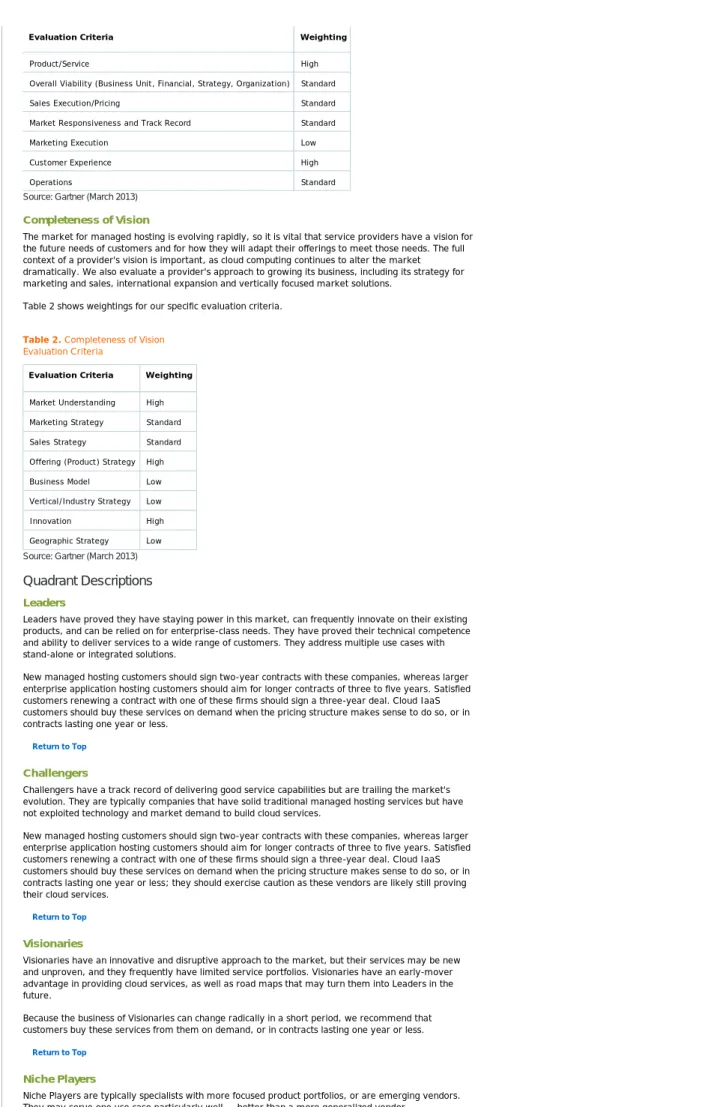
The most heavily weighted criteria for a managed hoster's ability to execute are their service offerings and service excellence, as reflected in customers' experiences with sales, support and operations. Overall business viability, as reflected in the provider's ability to serve a customer successfully over a three-year period without significant disruption, and the provider's track record, also contribute to this rating. Here, Gartner emphasizes immediate capabilities for the use cases we see most often. Table 1 shows weightings for our specific evaluation criteria.
Table 1. Ability to Execute Evaluation Criteria
Evaluation Criteria Weighting
Product/Service High
Overall Viability (Business Unit, Financial, Strategy, Organization) Standard
Sales Execution/Pricing Standard
Market Responsiveness and Track Record Standard
Marketing Execution Low
Customer Experience High
Operations Standard
Source: Gartner (March 2013)
Completeness of Vision
The market for managed hosting is evolving rapidly, so it is vital that service providers have a vision for the future needs of customers and for how they will adapt their offerings to meet those needs. The full context of a provider's vision is important, as cloud computing continues to alter the market dramatically. We also evaluate a provider's approach to growing its business, including its strategy for marketing and sales, international expansion and vertically focused market solutions.
Table 2 shows weightings for our specific evaluation criteria. Table 2. Completeness of Vision
Evaluation Criteria
Evaluation Criteria Weighting
Market Understanding High Marketing Strategy Standard Sales Strategy Standard Offering (Product) Strategy High Business Model Low Vertical/Industry Strategy Low
Innovation High
Geographic Strategy Low
Source: Gartner (March 2013)
Quadrant Descriptions
Leaders
Leaders have proved they have staying power in this market, can frequently innovate on their existing products, and can be relied on for enterprise-class needs. They have proved their technical competence and ability to deliver services to a wide range of customers. They address multiple use cases with stand-alone or integrated solutions.
New managed hosting customers should sign two-year contracts with these companies, whereas larger enterprise application hosting customers should aim for longer contracts of three to five years. Satisfied customers renewing a contract with one of these firms should sign a three-year deal. Cloud IaaS customers should buy these services on demand when the pricing structure makes sense to do so, or in contracts lasting one year or less.
Return to Top
Challengers
Challengers have a track record of delivering good service capabilities but are trailing the market's evolution. They are typically companies that have solid traditional managed hosting services but have not exploited technology and market demand to build cloud services.
New managed hosting customers should sign two-year contracts with these companies, whereas larger enterprise application hosting customers should aim for longer contracts of three to five years. Satisfied customers renewing a contract with one of these firms should sign a three-year deal. Cloud IaaS customers should buy these services on demand when the pricing structure makes sense to do so, or in contracts lasting one year or less; they should exercise caution as these vendors are likely still proving their cloud services.
Return to Top
Visionaries
Visionaries have an innovative and disruptive approach to the market, but their services may be new and unproven, and they frequently have limited service portfolios. Visionaries have an early-mover advantage in providing cloud services, as well as road maps that may turn them into Leaders in the future.
Because the business of Visionaries can change radically in a short period, we recommend that customers buy these services from them on demand, or in contracts lasting one year or less.
Return to Top
Niche Players
Niche Players are typically specialists with more focused product portfolios, or are emerging vendors. They may serve one use case particularly well — better than a more generalized vendor.
New and renewing customers of stable, narrowly focused Niche Players should sign two- or three-year contracts. New and renewing customers of emerging Niche Players whose businesses are still rapidly evolving should buy services on demand, or in contracts lasting one year or less. If you are using managed services, be wary of making short-term, tactical choices, as it can be inconvenient and expensive to change provider.
Return to Top
Context
Despite being in the media shadow of cloud computing, managed hosting remains the most appropriate solution for many organizations that want to outsource the infrastructure and IT operations
management associated with an application or website. Most organizations prefer to source this infrastructure on a flexible, pay-as-you-go basis, where capacity can be adjusted to meet demand. Consequently, in addition to offering dedicated servers, managed hosting providers frequently also offer shared and virtualized utility infrastructure platforms, or cloud IaaS. Indeed, some managed hosting providers are primarily or solely focused on delivering their solutions on cloud IaaS.
Most solutions for complex needs are hybrid, mixing different types of infrastructure to achieve cost-effectiveness and to meet the customer's availability, performance, security and IT operations requirements. Customers may, for instance, need test and staging servers hosted on an IaaS platform, their front-end Web and application servers on utility infrastructure, and their database on dedicated physical servers. This has spurred providers to develop and productize hybrid hosting services that connect colocation, traditional hosting environments and cloud IaaS within unified networking and security contexts.
Managed hosting is typically sold on a one-to-three-year contract via a consultative sales process. Buyers should expect to interact at length with the solution architects of prospective providers to achieve a solution that meets their needs. Every provider's solution will be subtly different, and service and support quality vary tremendously across the industry. Consequently, managed hosting providers should be chosen with care.
Return to Top
Market Overview
The market for managed hosting is mature, but the introduction of cloud IaaS has driven significant evolution during the past five years, with stronger emphasis on automation, flexible contracts and capacity on demand. This Magic Quadrant covers only solutions that include managed services, emphasizing complex implementations that require significant human labor on the part of the service provider, regardless of whether the underlying infrastructure platform comprises physical servers, virtualized servers, cloud IaaS or a hybrid combination. For self-managed cloud IaaS, or cloud IaaS with an emphasis on highly automated management (rather than humans performing managed services), see "Magic Quadrant for Cloud Infrastructure as a Service."
Buyers of managed hosting service should be aware of the key aspects of the market described below.
The Infrastructure Platform Is a Means to an End
Increasingly, prospective managed hosting customers approach sourcing a solution with an attitude of "I want to be in the cloud." However, for many customer needs, cloud IaaS is not the ideal solution from a technical or cost perspective. Instead, you should consider the goals you are trying to achieve. Each component of your application needs a particular level of availability, performance and security, which results in different demands on the underlying infrastructure.
You may also have scaling-related business needs, such as the ability to scale up and down quickly in response to unpredictable spikes in demand, the ability to handle seasonal needs without overbuying capacity at other times, or the ability to add extra capacity rapidly (for the launch of a new initiative or the signing of a new customer, for instance). Some scaling needs must be addressed technically — for instance, if you need to add large amounts of capacity at five minutes' notice, virtual machines are a must — but some needs, especially seasonal ones, can often be met by flexible contracting. Managed hosters may offer both nonvirtualized physical servers, as well as virtualized servers. Virtualized servers may be single-tenant (not shared with other customers), or multitenant (shared with other customers). There may be self-service provisioning for some or all of these resources. The use of virtualization or the existence of self-service do not by themselves make a service a "cloud" service. Because the word "cloud" is used inconsistently within the industry, you should simply ignore the labels used by providers. Instead, look at the technical characteristics of the service, as well as the contract language, and ensure they meet your technical needs and business goals.
The more complex your needs, the more likely it is that your best solution will be a hybrid of different infrastructure approaches.
Cloud IaaS Is Often Not a Well-Integrated Solution
Broadly, many managed hosting providers initially architected their cloud IaaS platforms primarily with a self-service model in mind — as environments the customer would self-provision and self-manage. Consequently, they did not pay sufficient attention to integration issues with their other offerings, and were unsure how to offer managed services on these platforms. As a result, many providers do not seamlessly integrate their cloud IaaS solutions with the rest of their environments. Specifically, the following are common:
The cloud IaaS solution tends to be on its own segregated technology infrastructure and LAN. It may not be located in the same data centers, or all the data centers, in which the provider offers other managed hosting services.
The provider may not have integrated customer support across all its offerings. A different and lower level of support might be provided for its cloud IaaS.
The provider may not offer the same managed services on cloud IaaS that it offers on dedicated servers or utility hosting; it might price and provide those services differently, or those services might not be available.
The portal for cloud IaaS may be segregated from the provider's main customer service portal, and features that are included for dedicated servers or utility hosting, such as systems monitoring,
may not be included or available with cloud IaaS.
Additional costs may be associated with a hybrid cloud solution, such as a requirement that the customer use a load balancer or firewall to bridge cloud and noncloud environments. Before adopting a hybrid solution that includes cloud IaaS, you must carefully investigate how the provider's service differs across the infrastructure platforms in use.
Cloud IaaS Is Evolving Rapidly
The cloud IaaS market as a whole is growing rapidly, and new providers are flooding in, often with incomplete offerings and strategies that revolve around "not being Amazon Web Services." This approach characterizes many offerings that have been launched by managed hosting providers, data center outsourcers and others that have entered this space from a related business model. Furthermore, rapid market evolution, along with the rapid evolution of technology through the stack from hardware to applications, is driving a rate and a level of change that present significant management challenges for service providers. This evolution is making it difficult for customers to decide which solutions to adopt, because providers may release new features several times a quarter and are evolving their service models.
In some cases, service providers have ended up building multiple cloud IaaS offerings, or multiple versions of the same core service, as technology has evolved and the providers have learned hard lessons about the technology and cloud IaaS business. Providers that have grown through mergers and acquisitions may have multiple cloud IaaS platforms.
The multiple infrastructure platforms used by managed hosting providers are a reflection of market and technology immaturity. The cloud IaaS platforms are usually cutting-edge implementations unburdened by the provider's legacy managed hosting systems; as a result, they may lack the functionality provided by those systems.
Gartner expects that, within the next five years, successful service providers will fully converge their infrastructure platforms and provide the following capabilities:
The ability to provision both physical servers and virtual machines from a shared pool of capacity that allows hardware components to be dedicated to a customer on an as-needed basis, or shared among customers
The ability to offer multiple infrastructure tiers, with differing levels of cost, availability, performance and security
The use of a unified management portal that can manage a physical and virtual infrastructure, with views for the provider, the customer and third parties such as resellers
A unified approach to support and manage service options across all infrastructure options Few providers offer fully converged infrastructure platforms. Even those that are well on the path to convergence frequently still support and sell a legacy managed hosting platform, along with their current infrastructure solution.
All Infrastructure Requires Management
All types of infrastructure require management. Prospective customers often assume that cloud IaaS requires less management — they think that because they are in the cloud, IT operations management functions such as patch management, backups and disaster recovery are taken care of automatically. Broadly, this is not true, although providers may bundle managed services with cloud IaaS, and are starting to automate these aspects.
Providers' approaches to managed services vary enormously. However, they can be classified broadly into "OS and below" and "everything excluding the application." We refer to these as simple managed hosting and complex managed hosting, respectively:
Simple managed hosting customers typically want to handle most operations themselves, but would like the provider to handle routine issues on a 24/7 basis, and to perform routine IT operations management tasks like patch management and backups.
Complex managed hosting customers typically want the provider to take ownership and responsibility for the infrastructure, so that they only need to deal with their application. The customer may choose to retain certain responsibilities — for instance, doing database
administration itself — but the provider essentially functions as the customer's IT operations team for this infrastructure.
Whichever solution you choose, you will need to decide what responsibilities you will retain and what will be the provider's responsibilities. You may also have some equipment that you decide to provide and manage yourself; most managed hosting providers offer a colocation option for this purpose.
Standardization Brings Benefits
Many managed hosting providers will extensively customize a customer's environment. However, the more your environment deviates from the provider's norm and blueprints, the more you pay, and the less consistent your service is likely to be. If you deviate from the standard, you don't gain the benefit of as much of the provider's automation and tools; therefore, it's more costly for the provider to serve you, and more things will be done manually, increasing the chance of error.
Standardization becomes particularly important when you consider using a provider's utility hosting or cloud IaaS platforms. These environments are highly standardized, so you can only use them if you can accept the standard way they are architected.
If you need a lot of customization in your managed hosting environment, ask the provider what the cost difference is between its standard approach and the custom approach you desire. Ask yourself if the customizations you need generate business value or are just to suit the tastes of your IT personnel. For instance, a custom file system layout that places packages in a different place from the provider's standard generates no business value, and might mean that you cannot use the provider's standard patch management approach. Even some customizations done for cost reasons may turn out to be a bad idea; for instance, a particular set of parameters for performance-tuning a server may result in more of a cost penalty for deviating from the standard configuration than you save by getting more efficiency
from the server.
Customer Service Is the Key Differentiator
Most established managed hosters have very high levels of operational reliability and excellent reactive support when customers have issues. However, providers vary significantly in their ability to respond promptly to customer requests that aren't directly related to an outage or other immediate operational emergency. Many providers are weak in responding when the customer's request is complex, or when it crosses multiple groups within the company — for instance, when a customer has a persistent problem with network performance, engineers that support network elements may point the finger at system engineers and vice versa, with no one taking responsibility for solving the problems.
Proactive support is even more of a differentiator. Some providers excel in anticipating customers' needs, and in partnering with customers to achieve their operational goals. Providers also differ widely in their ability to manage complex projects.
When evaluating your needs, consider the complexity of your environment, the frequency of changes in your environment and the scope of those changes. If you have frequent application or infrastructure changes (not content changes), you will need to work closely with your provider on a daily basis. If you have large-scale project work, such as new deployments, you will want to be sure your provider has the appropriate project management resources available. When choosing a provider, ensure you are comfortable with its implementation process, change management and project management. More than anything else, the provider's service organization is likely to determine your satisfaction with the managed hosting experience in the long term. Evaluate your prospective account team carefully.
The Vendor Landscape Is Dynamic
This is a time of great opportunity and great risk for service providers in this market. New entrants are altering the landscape, and hosters that previously had lagged behind have made bold investments in an attempt to catch or overtake other, more established competitors. Most providers are aggressively investing in innovative solutions that exploit the proliferation of technology capabilities in this market. Mergers and acquisitions have become common as vendors seek to decrease their time to market, obtain engineering expertise with new technologies, and build market share. We expect mergers and acquisitions to continue on a global basis.
Because the vendor landscape is highly dynamic, buyers of managed hosting are subject to greater sourcing risk. It is difficult to predict which vendors will be good long-term bets; neither small vendors nor large ones can be considered safe. In general, short-term contracts of one or two years are advisable.
Return to Top
© 2013 Gartner, Inc. and/or its affiliates. All rights reserved. Gartner is a registered trademark of Gartner, Inc. or its affiliates. This publication may not be reproduced or distributed in any form without Gartner’s prior written permission. If you are authorized to access this publication, your use of it is subject to the
Usage Guidelines for Gartner Services posted on gartner.com. The information contained in this publication has been obtained from sources believed to be reliable. Gartner disclaims all warranties as to the accuracy, completeness or adequacy of such information and shall have no liability for errors, omissions or inadequacies in such information. This publication consists of the opinions of Gartner’s research organization and should not be construed as statements of fact. The opinions expressed herein are subject to change without notice. Although Gartner research may include a discussion of related legal issues, Gartner does not provide legal advice or services and its research should not be construed or used as such. Gartner is a public company, and its shareholders may include firms and funds that have financial interests in entities covered in Gartner research. Gartner’s Board of Directors may include senior managers of these firms or funds. Gartner research is produced independently by its research organization without input or influence from these firms, funds or their managers. For further information on the independence and integrity of Gartner research, see “Guiding Principles on Independence and Objectivity.”