Developing a
communication
supporting classrooms
observation tool
Julie E Dockrell
1
, Ioanna Bakopoulou
2
,
James Law
3
, Sarah Spencer
4
and Geoff
Lindsay
2
1
Psychology and Human Development, Institute
of Education, University of London
2
CEDAR, University of Warwick
3
Speech and Language Sciences, Newcastle
University
4
This research report was commissioned before the new UK Government took office on 11 May 2010. As a result the content may not reflect current
Government policy and may make reference to the Department for Children, Schools and Families (DCSF) which has now been replaced by the Department for Education (DfE).
2
CONTENTS
EXECUTIVE SUMMARY ... 5
1.INTRODUCTION ... 8
1.1 Aims and Objectives ... 8
1.2 Background ... 9
1.3 Effective Oral Language Environments ... 9
1.4 Supporting Oral Language ... 11
1.5 Why Communication Supporting Classrooms? ... 12
2.WHAT WE HAVE DONE ... 13
2.1 Literature Review and Rating the Evidence Base ... 13
2.1.1 Features of the Literature Review ... 13
2.1.2 Identifying and Describing Studies ... 13
2.1.3 Rating the Evidence Base ... 14
2.2 Communication Supporting Classrooms Observation Tool Development ... 15
2.3 Interpreting the CsC Observation Tool Profile ... 16
2.4 Pilot of Communication Supporting Classrooms Observation Tool... 17
2.4.1 Selection of Settings ... 18
2.4.2 Reliability of the CsC Observation Tool ... 18
3.WHAT WE HAVE FOUND – THE FEASIBILITY STUDY ... 20
3.1 Patterns of Performance across the Environment, Opportunities and Interactions . 20 3.2 Profiles of Performance across Opportunities and Interactions ... 22
3.2.1 Language Learning Opportunities ... 23
3.2.2 Language Learning Interactions ... 24
3.3 Potential Uses of the CsC Observation Tool ... 27
3
3.3.2 Using the CsC Observation Tool to Support Training ... 27
3.3.3 Using the CsC Observation Tool as an Aid to Wider INSET Planning ... 32
3.3.4 Using the CsC Observation Tool to Monitor the Impact of Interventions ... 33
4.IMPLICATIONS FOR POLICY AND PRACTICE ... 35
5.FUTURE DEVELOPMENTS ... 38
6.CONCLUSIONS ... 39
7. REFERENCES………..40
4 ACKNOWLEDGEMENTS
5
EXECUTIVE SUMMARY
The Better Communication Research Programme (BCRP) was commissioned as part of the Better Communication Action Plan1, the government’s response to the Bercow review of services for children and young people with speech, language and communication needs2. This had recommended a programme of research ‘to enhance the evidence base and inform delivery of better outcomes for children and young people’ (p.50). This is one of 10 publications reporting the results from individual BCRP projects. These contribute to a series of four thematic reports and the main report on the BCRP overall in which we
integrate findings and present implications for practice, research and policy from the BCRP as a whole (see Appendix 1 for full details3).
This study comprised the development of a Communication Supporting Classrooms
Observation Tool (CsC Observation Tool) for Reception and Key Stage 1 classrooms. This was devised following a review of the research literature.
What we did
The evidence derived from 62 papers was rated based on the studies’ research design following specific rating criteria.
Based on the review of the literature and rating of the evidence, three main areas were considered important and were included as dimensions in the CsC Observation Tool:
o Language Learning Environment – the physical environment and learning context
o Language Learning Opportunities – the structured opportunities to support children’s language development
o Language Learning Interactions – the ways in which adults in the setting talk with children
The CsC Observation Tool was piloted in 15 schools in Reception, Year 1 and Year 2 classrooms and data were gathered in 9 of them to establish inter-rater reliability, both per item as well as a profile of the language learning environment. Thirteen classroom
1
https://www.education.gov.uk/publications/eOrderingDownload/Better_Communication.pdf 2
Bercow, J. (2008). The Bercow Report: A review of services for children and young people (0-19) with speech, language and communication needs. Nottingham: DCSF.
https://www.education.gov.uk/publications/eOrderingDownload/Bercow-Report.pdf 3Reports are accessible through the DfE’s research site
6
observations were conducted by the research team in these 9 settings and revealed that inter-rater reliability for the CsC Observation Tool was consistently high for the three dimensions.
The main study involved a feasibility study to gain a picture of language
environments across a range of different primary schools in different local authorities in Reception and Key Stage 1 classes and to investigate the possible uses of the CsC Observation Tool. A hundred and one different classrooms in 39 different schools across the North and South East of England were visited. The schools were drawn from 10 different local authorities and we observed lessons in 38 Reception classes, 35 Year One classes and 28 Year Two classes.
A case study was carried out with one speech and language therapy service in order to examine the usefulness of the CsC Framework and Observation Tool as a means of in-service training.
What we found
Significant differences were found across the three dimensions of the CsC
Observation Tool. Overall, a large number of the classrooms observed scored high on the Language Learning Environment dimension but scores for the Language Learning
Opportunities and Language Learning Interactions were lower. For all year groups, o scores for the Language Learning Environment dimension were significantly
higher than scores for Language Learning Interactions and
o scores for the Language Learning Interactions dimension were significantly higher than those for the dimension of Language Learning Opportunities.
There were no significant differences across the three year groups for the dimensions of Language Learning Opportunities and Language Learning Interactions; however, the Language Learning Environment scores differed significantly across the year groups with the Year 2 mean score being significantly lower than the mean for Reception classes.
A comparison of suburban or rural (N = 30) and urban (N = 70) classrooms showed a statistically significant difference for the dimension of Language Learning Opportunities, where classes in urban settings scored lower on this dimension.
7
Analysis of the Language Learning Interactions dimension revealed that a number of interaction behaviours occurred regularly across the observation time (using children’s names, using natural gestures, confirming, imitating, using open questioning, pacing and pausing) and certain behaviours were much less frequent (extending, modelling,
encouraging use of new words, using contrasts, supporting listening skills, encouraging turn taking, scripting, praising non-verbal communication, providing clear language choices).
The feasibility of the use of the CsC Observation Tool by practitioners was considered by carrying out observations collaboratively with practitioners, including SENCOs, speech and language therapists and teachers. In all cases, the practitioners found the tool very helpful, accessible, easy to use and, with guidance, reliable in the recording of classroom features supporting communication.
The study provided evidence for using the CsC Observation Tool: o In schools
o To support training
o To identify Local Authority INSET training
Implications for future practice, research and policy
Good classroom organisation to maximise language development needs to be complemented by the fine tuning of oral language interactions by staff
Activities to scaffold language development need to be provided in a regular and deliberate manner. These experiences should include more advanced language learning interactions that have been shown to develop oral language, including grammatical skills, vocabulary and narrative. Together, these techniques constitute high-quality verbal input by adults.
All school staff should fully understand, appreciate and develop quality use of these language learning interaction techniques.
The CsC Observation Tool and the Framework which underpins it provide
professionals with a flexible way of developing their teaching skills to support oral language.
Future work should consider using the tool to o Evaluate interventions at classroom level
o Consider the opportunities afforded to children with less well developed language
8 1. INTRODUCTION
1.1 Aims and Objectives
The Better Communication Research Programme (BCRP) was commissioned as part of the Better Communication Action Plan4, the government’s response to the Bercow review of services for children and young people with speech, language and communication needs5. This had recommended a programme of research ‘to enhance the evidence base and inform delivery of better outcomes for children and young people’ (p.50). This is one of 10 publications reporting the results from individual BCRP projects. These contribute to a series of four thematic reports and the main report on the BCRP overall in which we
integrate findings and present implications for practice, research and policy from the BCRP as a whole (see Appendix 1 for full details6).
The ‘Developing a Communication Supporting Classrooms Observation Tool’ study is one part of theBCRP. Its aim was to develop a tool to profile features of communication supporting classrooms in Reception and Key Stage 1, pilot its feasibility in classrooms and examine the flexibility and efficacy of its’ use by practitioners. The identification of the features to be included in the tool was derived from a comprehensive review of the relevant research literature to ensure that the components of the tool were informed by evidence. The study had four objectives:
1. To review the evidence base underpinning features reported to support the development of oral language in classroom contexts;
2. To identify key features from the review and develop these into a “Communication Supporting Classrooms (CsC) Framework”, an observational tool designed to profile classroom environments and learning spaces;
3. To examine the extent to which it was possible to profile schools that provided different communication environments;
4. To consider the ways in which the tool could be used to support professional development within and across schools.
4
https://www.education.gov.uk/publications/eOrderingDownload/Better_Communication.pdf 5
Bercow, J. (2008). The Bercow Report: A review of services for children and young people (0-19) with speech, language and communication needs. Nottingham: DCSF.
https://www.education.gov.uk/publications/eOrderingDownload/Bercow-Report.pdf 6 Reports are accessible through the DfE’s research site
9
The findings from the present project, together with those from other BCRP projects, contribute to both a series of thematic reports and the main report on the BCRP overall. In these we integrate findings and present implications for practice, research and policy from the BCRP as a whole.
1.2 Background
The importance of fostering good oral language skills in educational contexts is well established. Oral language skills are the cornerstone of literacy skills, both reading and writing (National Reading Panel Report, 2000; Shanahan, 2006). Moreover certain kinds of talking such as discussing, collaborating and problem solving help children with academic subjects (Resnick, Michaels & O’Connor, 2010). Establishing effective language learning environments (environments where highly focused everyday personalised and interactive teaching takes place) can provide both support for literacy (Snowling & Hulme, 2011) and the basis for managing talk to enhance learning (Resnick et al., 2010). Providing effective oral language environments which foster good communication skills is challenging, requiring practitioners who understand the ways in which children develop their receptive and
expressive language skills and are able to support their development in the classroom context. Once effective classrooms for oral language are in place schools are in a stronger position to become effective oral language environments.
1.3 Effective Oral Language Environments
Both the number of children identified with Speech, Language and Communication Needs (SLCN) and the association between social disadvantage and poor language skills have increased the demand on services, calling for a re-examination of the ways in which speech, language and communication are supported for children across health and education services (Bercow, 2008; Boyle, McCartney, Forbes & O’Hare, 2007; Lindsay, Desforges, Dockrell, Law, Peacey & Beecham, 2008; Lindsay, Desforges, Dockrell, Law & Peacey, 2010). Although many children with difficulties continue to receive individual
10
The term “Communication Friendly” was developed as a result of similar initiatives being implemented for other groups of children with special educational needs e.g. dyslexia and dyspraxia (Coffield & O’Neill, 2004). Typically, changes towards a ‘communication friendly environment’ reflect alterations to the school environment and ethos and include developing strategic approaches to raise knowledge and awareness of SLCN in all staff. Both the children’s communication charity ICAN (www.ican.org.uk) and the Communication Trust (www.thecommunicationtrust.org.uk) have created guidance in providing “communication friendly environments”. ICAN has derived, from a range of sources, general strategies that can be used to support schools become “Communication Friendly”. These include:
1. An audit of the environment (www.ican.org.uk/talkingpoint, Primary National Strategy: Speaking, Listening, Learning).
2. Improving knowledge of language development, the language skills of individuals and the language demands of the environment (Martin & Miller, 1999).
3. Adapting adult language so that it is not a barrier to learning.
4. Facilitating communicative opportunities for children to interact appropriately with a range of individuals7
5. Creating an ethos where it is acceptable ‘not to know’ and teaching children how to monitor their own understanding.
6. Raising children’s awareness of their strengths and needs.
7. Careful planning and information sharing, particularly at times of transition.
These features include factors which reflect both good pedagogy and those which are more specific to oral language skills.
The Training and Development Agency for Schools (TDA) has also focused on key systemic changes that can support language and communication (Inclusion Development Program). TDA materials were collated from a range of different sources including work done by speech and language therapists (SLTs). SLTs have also developed guidance for schools and some of these have been embedded within school training. The BCRP project
7
11
examining practice with respect to the implementation of interventions8,9 explored practice with senior SLTs and educational psychologists (EPs) in 14 English local authorities and primary care trusts. The study identified 158 different interventions used by therapy
services including training materials and packages, such as ‘Speech and Language School Resource Folders’ or ‘Communication Friendly Environment Training’ provided to schools to develop staff knowledge, attitudes and behaviours. These materials demonstrated that speech and language therapy services were responding creatively to the needs of their population. However, it was difficult to ascertain the evidence base underpinning the features identified, the criteria used to include the features or the ways in which schools could monitor language opportunities and adult-child interactions which happened in the classroom context for all learners to ensure an effective language learning environment. As such, there is a need for a tool which allows staff to profile the language learning
environment and the tool needs to be transparent in terms of the evidence base which has informed the elements included within it.
Creating effective language learning environments has two potential benefits. First, it prepares children for the more challenging demands placed on oracy as they proceed through school. Second, if classroom environments can offer effective language learning opportunities, the numbers of children currently identified with speech, language and communication difficulties should reduce and those pupils that continue to experience difficulties will be those with specific needs and require the support of specialist services. Effective language learning environments should enhance the speaking and listening skills of all children. A tool which allows staff to profile the classroom language environment has the potential to identify current practice and inform the ways in which classroom talk can be further developed to support thinking and learning.
1.4 Supporting Oral Language
Communication supporting classroom environments emphasise children’s acquisition of language through their interactions with both peers and adults. An emphasis on social interaction as a route to language gains is consistent with a social-interactionist
developmental perspective. The social-interactionist developmental perspective views
8
Roulstone, Bakopoulou, Wren, & Lindsay (2012). Exploring interventions for children and young people with speech, language and communication needs: A study of practice.Research report . London: DfE.
9
12
language acquisition as a process where both child specific factors and ‘frequent, relatively well-tuned affectively positive verbal interactions’ are considered critical for supporting language growth (Chapman, 2000, pg. 43). This perspective emphasises the importance of socially embedded, deliberately mediated interactions with more knowledgeable
conversational partners as a critical developmental mechanism for children (Justice & Ezell, 1999; Justice & Kaderavek, 2002). Within such interactions, the more knowledgeable partner, such as the teacher, fine-tunes their verbal input to scaffold the child’s
communication thereby ensuring further engagement and a gradual move towards more independent levels of using and understanding language.
Research has indicated that variations in the quality and quantity of the language that children experience in their homes (Baumwell, Tamis-LeMonda & Bornstein, 1997; Hoff, 2003; Landry, Miller-Loncar, Smith & Swank, 1997) and educational environments (Girolametto & Weitzman, 2002) partially account for individual differences in the rate of children’s language growth and later language outcomes. Adults in educational settings play a key role in supporting oral language and the development of a classroom learning environment which fosters language for thinking and learning.
1.5 Why Communication Supporting Classrooms?
The main focus of the Communication Supporting Classrooms Observation Tool (CsC Observation Tool) is to capture what is happening in the classroom in real time;
13 2. WHAT WE HAVE DONE
2.1 Literature Review and Rating the Evidence Base
2.1.1 Features of the Literature Review
Relevant published outputs related to supporting oral language were reviewed. This allowed for the identification of features in the classroom and ways of talking with children which had been demonstrated to support the development of oral language skills. A three-stage review model was used in order to identify the relevant literature. A set of inclusionary criteria were developed (see Section 2.1.2 below) in order to focus the search, identify studies which were reliable and valid and capture initiatives within the UK.
The first stage consisted of identifying studies that met the review inclusion criteria. The second stage consisted of in-depth review of the selected studies in order to identify key elements and processes involved in classroom environments which enhance language development. These features were then used to develop the Communication Supporting Classrooms Observation Tool. To contextualise the tool within current practice, we also identified elements of supportive oral language practice highlighted in Ofsted reports, Government documentation and policy documents related to SLCN. At the final stage, the studies used to develop the Communication Supporting Classrooms Observation Tool were rated on a three point scale to indicate the strength of the studies. Studies and their relative ratings can be found in Appendix 1.
2.1.2 Identifying and Describing Studies
Defining relevant studies: Inclusion criteria
The search strategy identified a selection of abstracts, which were then subject to a screening process of exclusion and inclusion criteria. This narrowed the focus of the studies and ensured that only papers relevant to the aims of the project and the target population were reviewed. The literature reviewed was from a range of sources including empirical and evidence-based studies, review of empirical studies, Ofsted reports,
Government documentations and policy documents related to SLCN. All items in the final scale were supported by an evidence base as listed in 2.1.1.
The following inclusion criteria were developed: Inclusion criteria
14
INCLUDE 2. The mean age group of the participants in the study was between two and twelve years or the documentation referred to early years and primary school settings INCLUDE 3. The paper was an empirical study, a review of empirical studies, Government documentation, policy or documentation related to SLCN
INCLUDE 4. Published in English language
INCLUDE 5. Published and within the public domain after 1984 2.1.3 Rating the Evidence Base
The evidence derived from 62 papers was rated based on the studies’ research questions and design. Studies were included if they had sufficient power (sample size) to draw reliable conclusions, appropriate designs to identify change or causality and were peer reviewed. The criteria used for the three scale rating were:
STRONG: Randomised intervention studies; quasi-experimental intervention studies measuring targeted and non-targeted variables; Population studies monitoring progress and identifying factors which predicted progress. MODERATE: Quasi-experimental intervention studies where only targeted language
variables were measured; reviews of empirical studies, typically as book chapters which reviewed a minimum of 10 studies and provided details of the studies reviewed.
INDICATIVE: Single studies without matched comparisons or non-targeted measures. OTHER: Government documentation or policies; SLCN frameworks; SLCN documentation; elements/Items contained in a standardised rating scale derived from empirical sources and influencing current practice.
Appendix 1 gives details of the evidence rating. Twenty-two papers met the rating criteria for a strong research design, 27 papers for moderate and 5 for indicative. Finally, 8 papers were included as important SLCN documentation or Government policy related to SLCN.
The review of the literature and rating of the evidence identified three main factors that support communication in the classroom. These factors were classified as following: the classroom environment, the learning opportunities and the adult-child interactions which occurred in the classroom settings. Key features within the classroom’s physical
15
organization of space and provision of materials were highlighted in the literature as
important for maximising language richness. Henceforth these items are considered within the first dimension of the Communication Supporting Classrooms Observation Tool named ‘Language Learning Environment’.
The research evidence also pointed to the importance of particular opportunities that children have throughout the day to learn and practise their language skills. These opportunities characterise a communication supporting environment and include small group work, interactive book reading and structured opportunities for high-quality verbal input among peers and adults. Henceforth these items are considered within the second dimension of the tool named ‘Language Learning Opportunities’.
The environment and opportunities may be necessary aspects of the communication supporting classroom but they are not sufficient. Exposure to particular types of oral
language exchanges and opportunities to practise and use oral language in interaction with others are associated with robust language gains by children. Specifically the quality of child-adult interactions was identified as a significant factor in the development of children’s oral language skills. Adult-child verbal interactions which are characterised by high levels of adult responsiveness have been shown to be specific supports of children’s oral language development. The adults’ role (both class teachers’ and support staff’s role) is thus central within the classroom environment and involves frequently and consistently responding to a child’s communicative acts in a way that is sensitive to the child’s developing oracy skills. Henceforth these items are considered within the third dimension of the tool named ‘Language Learning Interactions’.
2.2 Communication Supporting Classrooms Observation Tool Development
The Communication Supporting Classrooms Observation Tool (CsC Observation Tool) (see Appendix 2) was developed to profile dimensions within the classroom environments and learning spaces which support the development of oral language skills. It was designed to provide a record, at one point in time, of the opportunities afforded for children so that school staff could identify key elements, resources and practices that support
16
language, the CsC Observation Tool includes elements which refer both to effective pedagogy, teaching and learning as well as language specific aspects.
The CsC Observation Tool is divided into three dimensions:
Language Learning Environment: This dimension involves items related to the physical environment and learning context
Language Learning Opportunities: This dimension involves items related to the structured opportunities that are present in the setting to support children’s language development
Language Learning Interactions: This dimension involves items related to the ways in which adults in the setting talk with children
A ‘Guidance on Completing Communication Supporting Classrooms Observation Tool’ document is provided with the CsC Observation Tool (see Appendix 3) which gives exemplars of the items and references to published outputs which support the inclusion of the specific items in the tool.
The target group for CsC Observation Tool was the initial stage of primary school
(Reception, Year 1 and Year 2); however, given the breadth of the review and the nature of the items it was envisaged that the tool could also be used in early years settings10. As an observation tool, it was designed to be used during a regular classroom teaching session, usually during the literacy or numeracy lesson. The average length of time necessary to collect a representative sample of behaviour was established at one hour in the classroom with an additional 20 minutes prior to the observation period to become familiar with the classroom setting and available resources.
2.3 Interpreting the CsC Observation Tool Profile
The three dimensions of the CsC Observation Tool can be thought of as fulfilling different functions and need to be considered as capturing different dimensions and, perhaps, highlighting the need for collecting additional information. These functions will vary as a result of the nature of the items in the three dimensions and the representativeness of the observations.
10Research using the CsC Observation Tool in early years and nursery settings is currently being
17
The Language Learning Environment dimension can be considered an audit of the classroom environment. This dimension lists what is available within the environment; many of the items are static and are, as the literature review has shown, the infrastructure to support language learning.
The Language Learning Opportunities dimension is indicative of the opportunities which are afforded in the classroom during the observation period, which for the feasibility study of this project typically included an observation of a literacy lesson. If, for example, no interactive book reading occurs (Item 2 of Language Learning Opportunities dimension), then it is important to consider with school staff whether this occurs at other times during the school day.
Finally, the Language Learning Interactions dimension should be considered as a profile of the ways in which language is used in the classroom. These ways include techniques used by adults to acknowledge the children’s needs (such as getting down to the child’s level, pacing language used, confirming contributions), to support them in developing their language skills (such as labelling, using appropriate open-ended questions), to encourage non-verbal communication (such as praising good listening skills), to direct language learning (such as commenting), and to model language responses (such as scripting). These interactions have been shown to support language learning and as such should be considered the backbone of teaching and learning throughout the day.
Classrooms are not expected to demonstrate all items in the dimensions all the time but the overall patterns offer opportunities for the development of practice. Where gaps are
identified it is important to consider whether there are any reasons why these might not occur during the observation period or whether the gaps are typical of a more general approach to teaching and learning within that class or across the school. Patterns across classrooms and schools provide the basis for identifying features which are strengths and activities or techniques which require future training and development.
2.4 Pilot of Communication Supporting Classrooms Observation Tool
Prior to piloting, an expert advisory group was sent the CsC Observation Tool and provided feedback on the content and presentation of the tool. The advisory group included
18
From March to May 2011, the two Senior Research Fellows of the CsC Project Team piloted the CsC Observation Tool. In the first phase of piloting, the aim was to test the CsC Observation Tool in a range of different schools in order to refine it as a measurement tool, consider issues related to its use and develop a guidance document that would facilitate education staff into using it. In the second phase of piloting, we examined issues of reliability of the CsC Observation Tool.
All schools were visited by the two Senior Research Fellows of the CsC Project Team. Observations took place in Reception and Year 1 classes during a morning session and lasted for two hours in each class. In each school, observations using the CsC Observation Tool were followed by discussions with the Special Needs Co-Ordinator in order to consider issues related to the use of the tool by school staff.
2.4.1 Selection of Settings
The schools involved in the second phase of the pilot were selected based on the following criteria:
a) Exclusionary criteria – we excluded any schools with associated language unit resources, specialised centre (e.g. ICAN), Dyslexia friendly schools or schools under special measures (Ofsted).
b) We also excluded any schools which had higher than national average educational attainments or number of children on the SEN register.
Fifteen schools were visited in the second phase of the study, and data were also gathered in nine of them to establish inter-rater reliability for each dimension of the CsC Observation Tool both per item as well as a profile of the language learning environment.
2.4.2 Reliability of the CsC Observation Tool
Thirteen classroom observations were conducted in these 9 settings by the CsC team and revealed that inter-rater reliability for the CsC Observation Tool was consistently high, with greater than 83% agreement between raters for the dimension of the Language Learning Environment being achieved for 12 of the 13 observations. This was also the case for the presence of Language Learning Opportunities, where agreement between raters was higher than 71% for 11 of the 13 observations, and Language Learning Interactions, where
19
20
3. WHAT WE HAVE FOUND – THE FEASIBILITY STUDY
To trial the use of the CsC Observation Tool, 101 different classrooms in 39 different schools across the North and South East of England were observed. The schools were drawn from 10 different local authorities and we sampled Reception classes (N = 38), Year 1 classes (N = 35) and Year 2 classes (N = 28). Details of the schools visited can be found in Appendix 4 and raw scores for each dimension and item can be found in the Appendix 5. In this section we focus on:
1. Patterns across the three dimensions – Environment, Opportunities and Interactions
2. Profiles of performance across Opportunities and Interactions 3. Potential uses of the CsC Observation Tool
3.1 Patterns of Performance across the Environment, Opportunities and
Interactions
Each dimension of the CsC Observation Tool, developed based on the research evidence (see Section 3), resulted in different total numbers of scores (Language Learning
Environment = 19, Language Learning Opportunities = 25, Language Learning Interactions = 100). To account for the different numbers of items across the three dimensions,
proportion scores were created. Proportion scores were derived by dividing the actual number of observations by the total number of possible observations. These proportion scores range from 0 (not recorded) to 1 (maximum possible numbers of occurrences), where items were rated on the basis of a maximum of five occurrences.
We first examine scores across the three dimensions - Environment, Opportunities and Interactions – and then differences across the three year groups (Reception, Year One and Year Two) and location are explored. Finally in this section we consider differences on the items of the Language Learning Opportunities and Language Learning Interactions
dimensions.
21
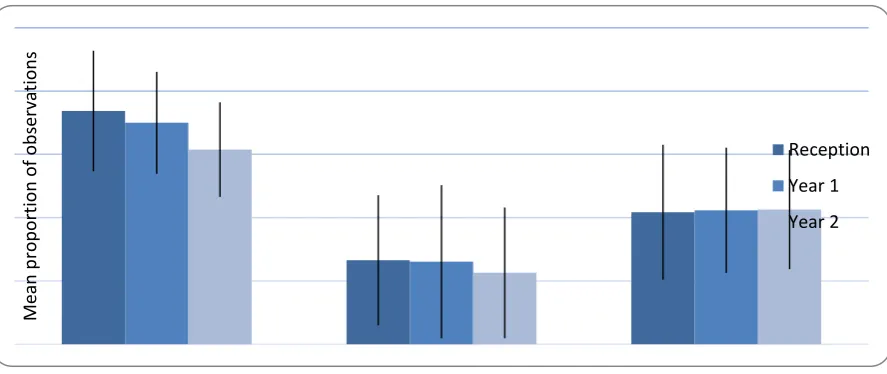
ANOVA across the dimensions with year group as the between group factor revealed a significant effect of dimension (F (2, 196) = 254.37, p < .001, ηp2 = .81), but no interaction by year group (F (4, 196) = 1.90, ns). For all year groups, scores for the Language Learning Environment dimension were significantly higher than scores for Language Learning
[image:22.595.79.523.197.384.2]Interactions (p < .001) and scores for Language Learning Interactions were significantly higher than those for Language Learning Opportunities (p < .001).
Figure 3.1: Mean (+/- SD) Proportion Score for CsC Observation Tool Dimensions for
the Three Year Groups
Three ANOVAs were computed to examine year group differences for each of the three dimensions. There were no significant differences across the three year groups for
Language Learning Opportunities (F(2, 100) = .30, ns) or Language Learning Interactions (F(2, 100) = .12, ns); however, the Language Learning Environment proportion score
differed significantly across the year groups (F(2, 100) = 4.25, p = .017, ηp2 = .08). The Year 2 mean was significantly lower than the mean for Reception classes but did not differ
significantly from Year 1 mean score (Year 2 M = 0.62, SD = 0.15; Year 1 M = 0.70, SD = 0.16; Reception M = 0.74 SD = 0.19). This result suggests that the majority of Reception classrooms put an emphasis on modifying the language environment in a way that supports oral language development, an emphasis that is not sustained later in the Year 2
classrooms we observed. These differences may reflect the classrooms sampled, aspects of teaching and learning in Year 2 or different assessment targets.
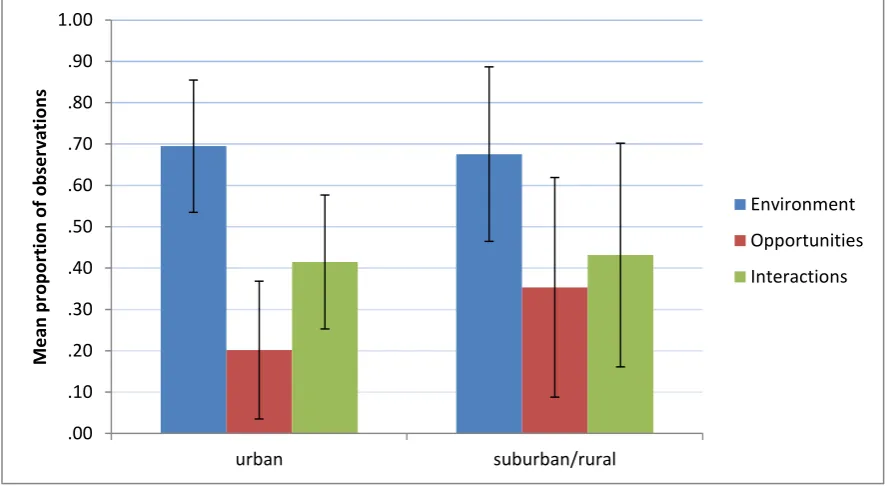
Furthermore, we examined whether suburban and urban classrooms differed in their profiles. Seventy schools were located in cities and 30 in more suburban or rural areas. Means (SDs) of the urban and suburban schools are presented in Figure 3.2 . A series of t- tests showed a statistically significant difference for the dimension of Language Learning
Me
an
p
ro
p
o
rtio
n
o
f
o
b
se
rv
at
ion
s
22
Opportunities (t (98) = -3.44, p = .001), where classes in urban settings were scoring lower on this dimension. There were no significant differences for Language Learning
[image:23.595.71.516.163.406.2]Environment or Language Learning Interactions (LLE t (98) = 0.51, ns; LLI t (98) = -.39, ns).
Figure 3.2: Mean (+/- SD) Proportion Score for CsC Observation Tool Dimensions for
Urban and Suburban Classrooms
We examined the five items which comprised the language learning opportunities to see whether there were differences across items. All five items showed the same pattern with urban environments scoring lowerer than the suburban/rural areas.
3.2 Profiles of Performance across Opportunities and Interactions
As we have shown in the section above, the settings observed typically included many of the key environmental features which have been shown to support language learning. These reflected structural features of the classroom such as signage or strategies used by the teacher to manage transitions or noise levels and use of high quality play and learning materials. The high scores on the Language Learning Environment dimension indicate the basic structural elements to support language learning were, on the whole, present. In contrast we found less evidence of Language Learning Opportunities and Language Learning Interactions.
.00 .10 .20 .30 .40 .50 .60 .70 .80 .90 1.00
urban suburban/rural
M
e
an
p
ro
p
o
rtion
o
f o
b
ser
vation
s
23 3.2.1 Language Learning Opportunities
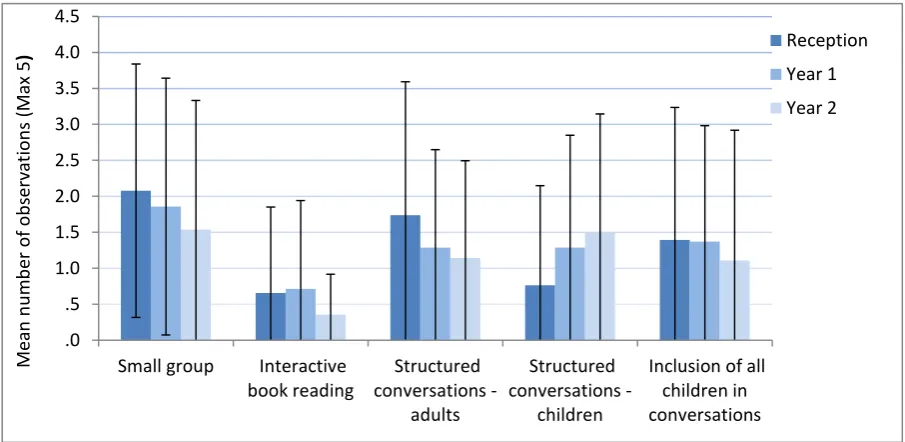
Overall, comparisons of the three dimensions indicated that structured language learning opportunities were observed least frequently but, as noted in 2.3, these differences may reflect different ways children may experience these opportunities. We considered whether this was a feature of all the opportunities identified or whether it reflected the
[image:24.595.74.527.223.444.2]presence/absence of specific opportunities. Means (SD) for Language Learning Opportunities by year group are presented in Figure 3.3.
Figure 3.3: Mean (+/- SD) of Observations (max = 5) for Language Learning
Opportunities for the Three Year Groups
A repeated measures ANOVA compared the five items of the Language Learning
Opportunities dimension across the three year groups. There was a significant effect of the type of language learning opportunities (F(4, 392) = 13.07, p < .001, ηp2 = .12), no
significant effect of year group (F(1, 98) = .30, ns) and no interaction between type of language learning opportunity and year group (F(8, 392) = 1.74, ns). Post hoc tests
revealed that small group work facilitated by adults occurred significantly more often than all other language learning opportunities (interactive book reading p <.001, inclusion of all children in small group work p <.001, structured conversations with peers p <.001, and structured conversations with adults p =.03). Interactive book reading occurred significantly less often than all of the other language learning opportunities (all ps <.001). Structured conversations with adults, structured conversations with peers and the inclusion of all children in small group work did not differ significantly from each other. Thus, while group work facilitated by adults featured across many of setttings, there was less evidence of
.0 .5 1.0 1.5 2.0 2.5 3.0 3.5 4.0 4.5
Small group Interactive book reading
Structured conversations
-adults
Structured conversations
-children
Inclusion of all children in conversations
Me
an
n
u
m
b
er
o
f o
b
se
rv
at
ion
s
(Max
5
) Reception
24
other specific structured activities to support language learning. However, it is important to note that there are large standard deviations for ‘small group worked facilitated by an adult’ such that in some classes these opportunities did not occur during the observation period. 3.2.2 Language Learning Interactions
25
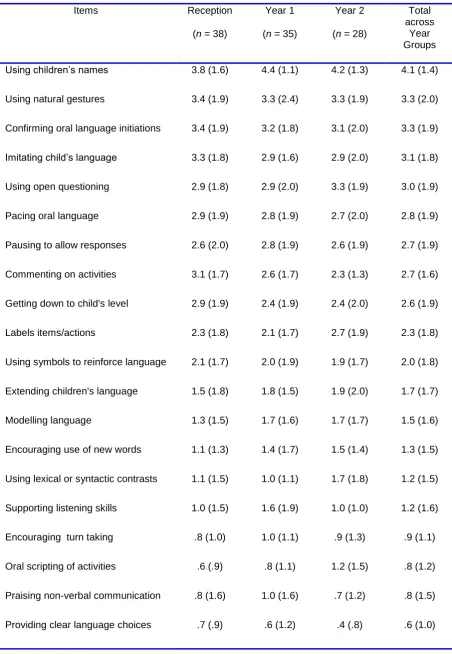
Table 3.1 Means (SD) of Language Learning Interactions by Year Group in
Descending Order of Occurrence (Max Recorded Occurrences = 5)
Items Reception
(n = 38)
Year 1
(n = 35)
Year 2
(n = 28)
Total across
Year Groups
Using children’s names 3.8 (1.6) 4.4 (1.1) 4.2 (1.3) 4.1 (1.4)
Using natural gestures 3.4 (1.9) 3.3 (2.4) 3.3 (1.9) 3.3 (2.0)
Confirming oral language initiations 3.4 (1.9) 3.2 (1.8) 3.1 (2.0) 3.3 (1.9)
Imitating child’s language 3.3 (1.8) 2.9 (1.6) 2.9 (2.0) 3.1 (1.8)
Using open questioning 2.9 (1.8) 2.9 (2.0) 3.3 (1.9) 3.0 (1.9)
Pacing oral language 2.9 (1.9) 2.8 (1.9) 2.7 (2.0) 2.8 (1.9)
Pausing to allow responses 2.6 (2.0) 2.8 (1.9) 2.6 (1.9) 2.7 (1.9)
Commenting on activities 3.1 (1.7) 2.6 (1.7) 2.3 (1.3) 2.7 (1.6)
Getting down to child's level 2.9 (1.9) 2.4 (1.9) 2.4 (2.0) 2.6 (1.9)
Labels items/actions 2.3 (1.8) 2.1 (1.7) 2.7 (1.9) 2.3 (1.8)
Using symbols to reinforce language 2.1 (1.7) 2.0 (1.9) 1.9 (1.7) 2.0 (1.8)
Extending children's language 1.5 (1.8) 1.8 (1.5) 1.9 (2.0) 1.7 (1.7)
Modelling language 1.3 (1.5) 1.7 (1.6) 1.7 (1.7) 1.5 (1.6)
Encouraging use of new words 1.1 (1.3) 1.4 (1.7) 1.5 (1.4) 1.3 (1.5)
Using lexical or syntactic contrasts 1.1 (1.5) 1.0 (1.1) 1.7 (1.8) 1.2 (1.5)
Supporting listening skills 1.0 (1.5) 1.6 (1.9) 1.0 (1.0) 1.2 (1.6)
Encouraging turn taking .8 (1.0) 1.0 (1.1) .9 (1.3) .9 (1.1)
Oral scripting of activities .6 (.9) .8 (1.1) 1.2 (1.5) .8 (1.2)
Praising non-verbal communication .8 (1.6) 1.0 (1.6) .7 (1.2) .8 (1.5)
26
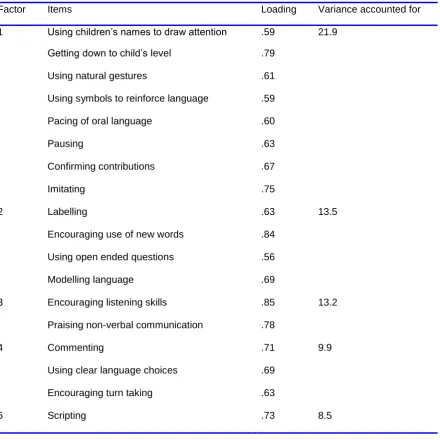
[image:27.595.80.521.229.670.2]We considered whether we could capture the differences across Language Learning Interactions by reducing the data using an exploratory factor analysis. Using a principal components analysis with varimax rotation we identified 5 factors, with eigenvalues greater than one, accounting for 67 per cent of the variance. These are presented in Table 3.2 with accepted levels of item loading.
Table 3.2 Principal Component Analysis (Varimax Rotation) for Language
Learning Interactions
Factor Items Loading Variance accounted for
1 Using children’s names to draw attention .59 21.9
Getting down to child’s level .79
Using natural gestures .61
Using symbols to reinforce language .59
Pacing of oral language .60
Pausing .63
Confirming contributions .67
Imitating .75
2 Labelling .63 13.5
Encouraging use of new words .84
Using open ended questions .56
Modelling language .69
3 Encouraging listening skills .85 13.2
Praising non-verbal communication .78
4 Commenting .71 9.9
Using clear language choices .69
Encouraging turn taking .63
5 Scripting .73 8.5
27
profile of language learning interactions and by indicating broader areas to focus on in considering language learning interactions in the classroom.
3.3 Potential Uses of the CsC Observation Tool
The aim of the project was to design an evidence informed tool to be used in schools to support children’s oral language development. Piloting, observation in 101 different classrooms and interviews and discussions with education and health professionals have allowed us to examine the data collected to consider the possible ways the CsC
Observation Tool might be used. In the following section we provide examples of the ways the tool can be used.
The following section focuses on using the CsC Observation Tool:
in schools
to support training
to Identify Local Authority INSET planning
to monitor the impact of interventions
3.3.1 Using the CsC Observation Tool in Schools
The CsC Observation Tool can be used in schools by individual teachers or groups of teachers to monitor their practice and audit their classroom environments. One SENCO commented that it would be useful to video teachers and get them to use the scale to rate the videos as a measure of professional development. Another SENCO mentioned that it had potential use with Newly Qualified Teachers and was particularly useful since it was a profile not a score. Finally it was suggested that learning support assistants (LSAs) could be included to consider the ways in which language learning opportunities were provided to children with special educational needs. By producing specific, guided feedback on the language environment, learning opportunities and adult-child interactions, areas of strength and areas for development would both be identified. Follow-up observations can be used again to identify changes to practice.
3.3.2 Using the CsC Observation Tool to Support Training
3.3.2.1 Continuing Professional Development
28
tailored feedback on supporting communication. Effective use of specific feedback has been reported to result in changes to teaching practice (Rathel, Drawsgow, & Christle, 2008; Codding et al. 2005; Myers, Simonsen, & Sugai, 2011). As more professional
development efforts are shifted from single training events to systematic, continued support for development, the CsC Observation Tool provides a framework to structure feedback and encourage discussion about both the items within the tool and classroom practice. The following case study provided by Sarah McMenamin, Principal SLT Lewisham details the use of the tool in large scale training,
3.3.2.2 Case Study – Lewisham Healthcare NHS Trust SLT Team The following case study is provided by the SLT Team in Lewisham: In 2011, as part of its local response to the National Hello campaign
(http://www.hello.org.uk), the SLT team in Lewisham Local Authority promoted a whole school approach to communication and learning – with an emphasis on adaptations to learning environments that maximise communication opportunities for children, staff and parents/carers. This included a one day conference where information about the CsC Observation Tool was presented. Following this presentation the Local Authority speech and language therapists felt the tool could be used to support training. The view was that the CsC Observation Tool was a flexible, practical tool which could enhance therapists and schools working together.
Many schools in Lewisham commission additional SLT resources to complement the core provision offered by the Mainstream SLT service. Much of the work undertaken by the enhanced SLT service is aimed at the “universal” and “targeted” population of the Needs Assessment Tool. Inherent to the outcomes of the enhanced SLT service in schools is embedding practice and building sustainability over time – targeting resources where it will achieve maximum benefit.
CsC Framework and Training
29
In September 2011, a collaborative group of 5 schools who had signed up for a 3-year enhanced SLT service requested a combined INSET for January 2012. The request was not without challenges for the SLT team. Each school was at a different stage in terms of the SLT training they had undertaken – thus all schools came to the table with different training needs and their own views on how the training should be delivered; there were also variations in access to the SLT service over time. In addition, the total number of staff from the five schools attending the INSET was estimated to be 220.
In order to accommodate participants and crystallise focus for the training the decision was made to split the training into a Foundation/KS1 INSET (120) and a KS2 INSET (100). The primary focus was to provide foundation training for the newly formed collaborative group that would be practical for school staff and enable us to begin to identify potential ways of working towards embedding practice over time.
It was evident to the SLT team that the CsC Framework provided a comprehensive review of the evidence base on which to understand interventions in language development for school age children within the classroom setting. The CsC research team was contacted to discuss the potential of using the CsC Framework in the upcoming INSET training. All five schools were engaged with the idea of using the CsC Observation Tool as a basis for the training. Thus the CsC Framework provided a common language and understanding for the conversations between SLTs and school staff in the planning and delivery of the training.
KS1 INSET training
The CsC Framework was used to underpin the Foundation/KS1 INSET with the aim of providing staff with a ‘hands-on’ experience. Prior to the in-service training the tool had been completed in a number of Lewisham classrooms, The CsC Observation Tool provided a structure for focus on different aspects of communication – the environment created and provided, the way we plan for communication and the way we actually make it happen.
In one practical activity staff took about 15 minutes to become familiar with the CsC
Observation Tool and learn how to sort and separate the different items within the tool. The informal nature of the task and discussion points enabled staff to reflect upon and share practice.
30
team and the data were used in the training as a focus point for discussion. This
personalised the training, making it immediately relevant (and of interest) to all participants on the day. It also provided a clear profile of schools and immediately removed any sense about our local circumstances being different or the tool not being applicable to us.
KS2 INSET training
For the KS2 INSET the structure of the CsC Framework was used to reflect upon practice within the classroom and inform discussion points throughout the day. KS2 school staff were receptive to the underlying evidence of the CsC Framework and were able to make links to their own practice even though the framework does not formally extend to the KS2 cohort.
The INSET focused on the three dimensions included in the CsC Observation Tool (Environment, Opportunities and Interactions) and what these might look like in the KS2 classroom. A café model was used in which staff were organised to rotate across each of the three dimensions of the CsC Observation Tool (each area on a café-style table) and school staff were encouraged to read and respond to sets of tool-based items written on tablecloths. This informal style supported joint discussion of ideas and individual and school practice across the 5 schools in KS2. School staff were given additional time to record on each the table the challenges and opportunities that each statement afforded. The
responses from each table were collected, collated and shared amongst the schools and this has become a resource for identifying areas of focus for schools and the collaborative as well as future training needs.
Outcomes and Reflections
The CsC Framework enabled the SLT team to add an all-important practical, classroom-focused element to the whole day INSET training and it proved flexible enough even within the context of training 220 participants from 5 different schools.
The CsC Framework provided the vehicle through which to start a discussion on quality of teaching and learning – for all children. For the SLT team it was important that the training was able to encompass a whole school, whole collaborative approach to support every child’s communication development and learning. It provided a valuable opportunity for joint working across the 5 schools in the collaborative and identifying areas for further
31
It also created an appetite for further peer review of classroom practice – school staff recognised that any one observation was just a snapshot and they identified the need to obtain better evidence about what was taking place in each classroom at different times of the day, for different curriculum areas and for different practitioners.
The framework within the context of the INSET has proved to be an effective resource for the identification of future training needs. SLTs have found it useful in guiding discussions around different ways of working in schools.
For SLTs and school staff, using the CsC Observation Tool as part of classroom based observations definitely became easier with practice. Initially there is a lot of information to look at and out for and it can be hard, unless you are very familiar with the framework, to find the right place to record what you are seeing. Staff reported that sometimes it was difficult to record five examples of each item on the CsC Observation Tool and it was helpful to consider in feedback that some items of the CsC Observation Tool are more relevant to certain activities/year groups. All involved needed to be aware of the ‘snapshot’ nature of the CsC Framework and that not all of the areas may be covered during one observation.
We would also strongly recommend introducing the CsC Framework to school staff in a meeting or information session prior to undertaking classroom observations. The majority of teaching staff who were observed mentioned that they appreciated being shown the CsC Observation Tool prior to their class being observed. On reflection, spending time with individual teaching staff and familiarizing them with the CsC Observation Tool supported the acceptance of the project and minimized any potential tensions of teaching practice being ‘judged’ or scrutinized.
32
For the wider SLT team the CsC Framework has informed our clinical recommendations in terms of assessment of individual children - enabling us to link specific clinical needs and make them meaningful within an educational context.
All schools expressed interest in the development of a similar tool for use within KS2. Some of the feedback from the KS2 INSET expressed confusion about the CsC Framework as it was mentioned but not formally used in the training and thus staff were interested in seeing it.
Some head teachers stated that they would be interested in using the CsC Framework as a performance measure to evaluate and support quality first teaching practice.
Next steps
Follow-up observations using the CsC Observation Tool in those classrooms the data have been collected in.
All schools have expressed an interest in a roll-out of CsC observations in all KS1 classes across the collaborative.
3.3.3 Using the CsC Observation Tool as an Aid to Wider INSET Planning
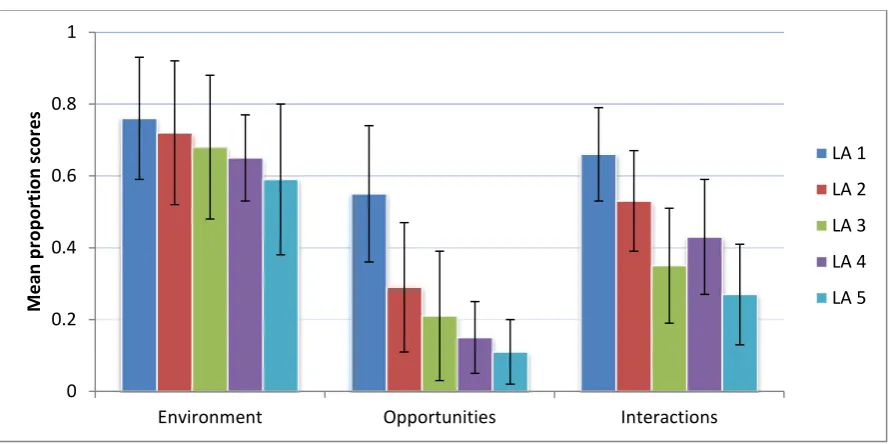
More than 10 classes were observed across five local authorities and so we were able to examine whether the CsC Observation Tool could be used to identify INSET planning or need for speech and language therapy support. This is a limited sample but provides indicative evidence of mapping differences across authorities. Figure 3.4 presents data for the three dimensions of the CsC Observation Tool across the five local authorities. All local authorities follow the pattern identified for the dimensions for the sample as a whole
(Environment > Interactions > Opportunities). There was a significant effect of local authority (F(4, 84) = 20.53, p < .001, ηp2 = .51). Local authority 1 achieved significantly higher scores than local authorities 3, 4, and 5 (all ps <.001). Local authority 2 achieved significantly higher scores than local authority 3 (p = .01) and local authority 5 (p <.001). There were no other significant differences. As the Figure 4.4 shows differences were most evident for the dimensions of Language Learning Opportunities and Language Learning Interactions; dimensions which are critical in developing pupils’ oracy skills.
33
Figure 3.4: Mean (+/- SD) of Proportion Scores for Five Different Local Authorities for
the Three Dimensions – Environment, Opportunities and Interactions
3.3.4 Using the CsC Observation Tool to Monitor the Impact of Interventions
Evaluating the impact of interventions is difficult but an important aspect of developing evidence informed practice. Collecting views of participants is subject to a number of biases so there is a need to provide objective evidence of change. The CsC Observation Tool could contribute to intervention evaluations as baseline and follow-up measures can be used to compare differences across time.
As part of the development of the tool, we were able to complete the CsC Observation Tool before and after a communication intervention in a small number of intervention and
comparison classrooms. In this section, we report the differences between these two time points as a feasibility study. These results are not to be considered as an evaluation of the intervention because the time between observations was short (2-3 months between observations), there were difficulties in implementing the training package in a timely manner in some settings and power is reduced because of the sample size (Intervention schools n = 28; Comparison classrooms n = 15). However, these data point to the ways in which the CsC Observation Tool could be used across settings to examine changes in the ways in which oral language is supported in classrooms. Pre and post measures are presented for intervention and comparison settings in Figure 3.5.
0 0.2 0.4 0.6 0.8 1
Environment Opportunities Interactions
M
e
an
p
ro
p
o
rt
io
n
sc
o
re
s
34
Figure 3.5: Mean (+/- SD) of proportion scores for intervention (I) classes and
comparison (C) classrooms
There was no statistically significant effect of the intervention (F(1, 41) = 0.16, ns) and no significant differences across time in the 43 classrooms (F(1, 41) = 0.10, ns) but the effect of dimension remains significant (F(2, 82) = 83.66, p < .001, ηp2 = .67). Both intervention and comparison classrooms showed stability in their profiles over a period of 2-3 months between observations.
.00 .20 .40 .60 .80 1.00
M
e
an
p
ro
p
o
rt
io
n
sc
o
re
s
Baseline
35
4. IMPLICATIONS FOR POLICY AND PRACTICE
We designed a tool that could be used in classrooms and we carried out a feasibility study in 101 classroom settings. In the development of the tool, the feasibility trial and the analysis of the data collected, a number of issues were raised which are relevant to professional practice and policy.
Firstly, our results have shown that, overall, a large proportion of the classrooms observed provided strong language learning environments. These were environments which captured elements of best practice and were appropriately modified to take into account children’s needs. There was, however, less evidence of children being exposed to high quality,
sensitive and consistently responsive language learning interactions. An item analysis of the CsC Observation Tool revealed that, while there were strengths in terms of acknowledging learner needs, there was less evidence of interactions to specifically develop the children’s language learning. Language learning opportunities were also less evident in our
observations. This finding highlights the need for considering not only how to organise the classroom space to maximise language enhancement but the importance of adults’ role in fine tuning their oral language and considering the activities they use with children to scaffold their development in a regular and deliberate manner.
There was also some indication from our data of differences between urban and suburban settings observed in relation to the Language Learning Opportunities provided to children, in that fewer opportunities were evident in urban settings than in suburban settings. Why this difference occurred is not clear as there were no structural differences between the classes - such as differences in the numbers of children or numbers of children with English as an additional language. While this difference may reflect a sampling bias in the classes observed, it is also worth considering what other factors might influence this result. It may, for example, be more challenging for school staff to provide language learning opportunities in areas of social disadvantage.
36
about the book, the vocabulary contained in the book and the different aspects of the narrative (for example: asking predictive questions, joining in with repetitions, story packs etc).
These observations have implications for wider planning during the day related to language learning. Children need opportunities to practise language skills. In communication
supporting environments, the focus is on children receiving multiple but also regular opportunities to experience specific linguistic concepts in diverse contexts (with adults and their peers), and classroom experiences should be organised to foster repetition and high quality language stimulation. Importantly these experiences need to include more advanced language learning interactions that have been shown to develop oral language, including grammatical skills, vocabulary and narrative. Together, these techniques constitute high-quality verbal input by adults.
An important implication of the present study is the need for all school staff to fully understand, appreciate and achieve quality use of these language learning interaction techniques. Conversations between adults and children that are characterised by high quality language learning interactions are the core of the communication supporting classroom. A classroom may have an exemplary physical environment and a deliberate provision of daily language activities; however, without adult-child interactions of sufficiently high quality and sensitivity, these efforts are not likely to result in the desired child
outcomes. Data from our study and other studies in the same field (Girolametto, Hoaken, Weitzman, & van Leishout, 2000) suggest that these language learning interactions occur less frequently than is desirable.
Observational learning (and discussion around these observations) can support practitioners in developing ways of talking with children to enhance the children’s oral language. This can be achieved by using videotapes to observe other adults modelling particular strategies while interacting with children and then rating the models’
conversational responsiveness (Ezell & Justice, 2000; Girolametto et al., 2003) or by practitioners watching videos of themselves interacting with children in their own
classrooms. This allows staff the opportunity to evaluate their own strengths and needs in using specific language learning interaction techniques. The CsC Observation Tool provides professionals with a framework for evaluating the observations.
37
could be used as a part of continuing professional development and training for teaching staff. As such the tool could support peer review of classroom practice with regular
feedback about classroom practices with teachers and other adults working in schools (such as Teaching Assistants and classroom support staff). Although there is a general concern expressed by teachers about the number of classroom observations (National Union of Teachers, 2011), the CsC Observation Tool is designed to be used as a supportive, developmental tool rather than a school/staff performance indicator. As such, if used in accordance with each school’s policy on classroom observations, the CsC Observation Tool has the potential to provide individually tailored feedback to increase effective teaching practice.
In addition the Lewisham SLT team also found the CsC Framework useful in that it was the research based and offered conceptual framework to considering the classroom
environment. This comment has been repeated in a number of settings during the feasibility study. The ways in which the dimensions are constructed allows professionals to profile the classroom environment across dimensions and consider areas of development.
The CsC Observation Tool could further be used as a whole-school resource by speech and language therapy services and school senior management teams to evaluate and support effective teaching practice for all children. Ensuring high quality language teaching and learning should reduce the numbers of children who require specialist language support. Where individual children fail to respond to systematic and regular exposure to evidence based oral language interactions additional assessments of individual children may be needed. Interventions, if appropriate, could be embedded within the educational context to meet the child’s needs.
38 5. FUTURE DEVELOPMENTS
The CsC Observation Tool provides a basis for profiling opportunities in classrooms for children’s oracy skills to be developed. One of the strengths of the tool is the flexibility in its use. Teachers, schools and professionals will wish to use it in different ways to support the development of practice. This flexibility of use was highlighted by the Lewisham case study.
It is, however, only a starting point for developing oracy skills and professionals may decide to fine tune the observations that are made: for example, professionals could focus on group activities and the ways in which language learning interaction behaviours are used in those contexts or whether there is consistency in their use by all staff. There will also be a need to consider specific additions for different areas of the curriculum. For example, when lessons in mathematics are taking place, are the questions used by teachers stretching the children’s oral skills in the vocabulary and concepts which are specific to mathematics.
The tool was developed to be applicable in Reception and Key Stage 1. The language demands and cognitive demands as well as the approaches to teaching which occur at different Key Stages will require different features to be sampled and, potentially, different features to be addressed.
39 6. CONCLUSIONS
An evidence based tool has been developed to capture aspects of the ways in which classrooms can support oral language. Of particular importance is that children have the opportunity to engage in communicative exchanges where their language is supported in a regular, sensitive and consistent manner.
In many cases, we have seen excellent teaching and learning sessions by highly skilled professionals who are committed to developing good practice. Our data indicated that in many cases the structural aspects which are important for good oral language are in place. These aspects will inevitably remain in place throughout the school day. There was less evidence from our study of children having specific opportunities to develop these skills during our observation periods or of school staff regularly fine tuning their oral language to scaffold the children’s development.
The different ways the tool could be used, from supporting professional development and practice to informing training and evaluating interventions, suggest an exciting future
development in the way we cater for children’s educational needs and a unique approach in ensuring an effective language learning environment for all children. Our study has
demonstrated that creating communication supporting classroom environments is a complex and multidimensional process. Although many educators, therapists and policymakers are aware of specific qualities of language-rich environments, putting this knowledge to work takes considerable effort. By following an evidence based approach, the present study described a process for thinking about effective language teaching and
40
REFERENCES
Baumwell, L., Tamis-LeMonda, C. S., & Bornstein, M. H. (1997). Maternal verbal sensitivity and child language comprehension. Infant Behavior and Development, 20, 247-258. Bercow, J. (2008). The Bercow Report: A review of services for children and young people
(0-19) with speech, language and communication needs. Nottingham: DCSF. Boyle, J., McCartney, E., Forbes, J., & O’Hare, A. (2007). A randomised control trial and
economic evaluation of direct versus indirect versus group modes of speech and language therapy for children with primary language impairment, Health Technology Assessment, 11(25), 1-139.
Chapman, R. (2000). Children’s language learning: An interactionist perspective. Journal of Child Psychology and Psychiatry, 41, 33-54.
Codding, R.S., Feinberg, A.B., Dunn, E.K., & Pace, G.M. (2005). The effects of immediate performance feedback on implementation of behaviour support plans. Journal of Applied Behaviour Analysis, 38, 205-219.
Coffield, M. & O’Neill, J. (2004). The Durham experience: promoting dyslexia and dyspraxia friendly schools. Dyslexia, 10, 253-264.
Crosskey, L. & Vance, M. (2011). Training teachers to support pupils’ listening in class: An evaluation using pupil questionnaires. Child Language Teaching and Therapy, 27(2), 165-182.
Ezell, H. K., & Justice, L. M. (2005). Shared storybook reading: Building young children’s language and emergent literacy skills. Baltimore, MD: Paul H. Brookes.
Girolametto, L., & Weitzman, E. (2002). Responsiveness of child care providers in interactions with toddlers and pre-schoolers. Language, Speech and Hearing Services in Schools, 33, 268-281.
Girolametto, L., Weitzman, E., & Greenberg, J. (2003). Training day care staff to facilitate children’s language. American Journal of Speech-Language Pathology, 12, 299-311. Harland, J.