E
vidence
Report 67
March 2013
Understanding Occupational
Regulation
Penny Tamkin, Linda Miller and Joy Williams
Institute for Employment Studies
Paul Casey
UK Commission for Employment and Skills
Foreword
The UK Commission for Employment and Skills is a social partnership, led by Commissioners from large and small employers, trade unions and the voluntary sector. Our ambition is to transform the UK’s approach to investing in the skills of people as an intrinsic part of securing jobs and growth. Our strategic objectives are to:
• Maximise the impact of employment and skills policies and employer behaviour to
support jobs and growth and secure an internationally competitive skills base;
• Work with businesses to develop the best market solutions which leverage greater
investment in skills;
• Provide outstanding labour market intelligence which helps businesses and people make
the best choices for them.
The third objective, relating to intelligence, reflects an increasing outward focus to the UK Commission’s research activities, as it seeks to facilitate a better informed labour market, in which decisions about careers and skills are based on sound and accessible evidence. Relatedly, impartial research evidence is used to underpin compelling messages that promote a call to action to increase employers’ investment in the skills of their people.
Intelligence is also integral to the two other strategic objectives. In seeking to lever greater investment in skills, the intelligence function serves to identify opportunities where our investments can bring the greatest leverage and economic return. The UK Commission’s third strategic objective, to maximise the impact of policy and employer behaviour to achieve an internationally competitive skills base, is supported by the development of an evidence base on best practice: “what works?” in a policy context.
Our research programme provides a robust evidence base for our insights and actions, drawing on good practice and the most innovative thinking. The research programme is underpinned by a number of core principles including the importance of: ensuring ‘relevance’ to our most pressing strategic priorities; ‘salience’ and effectively translating and sharing the key insights we find; international benchmarking and drawing insights from good practice abroad; high quality analysis which is leading edge, robust and action orientated; being responsive to immediate needs as well as taking a longer term perspective. We also work closely with key partners to ensure a co-ordinated approach to research.
This report, undertaken by the Institute for Employment Studies, further deepens our understanding of occupational regulation. Occupational regulation, also known as the more employer friendly ‘professional standards’, is an umbrella term for the ways in which minimum prescribed skill standards can be established and applied within occupations. Such schemes can be introduced on a voluntary or mandatory basis; and they can target the individual, the employer or even both.
Occupational regulation is one of a range of policy levers, which have the potential to encourage employer investment in skills and training on a collective basis. The UK Commission has already published evidence on assorted levers, each with the capability to stimulate and raise skill levels (such as employer networks, training levies, high performance working and human capital reporting) and these are available on our website.
Not only does this research complement and add to that evidence base, it also specifically builds on previous evidence published on occupational regulation. In October 2011, the UK Commission published evidence on the nature and impact of occupational regulation (A Review of Occupational Regulation and its Impact, Evidence Report 40). Taking a qualitative approach, Understanding Occupational Regulation provides insight into the design, implementation and impact of the various forms of occupational regulation, via cases studies of ten diverse occupational regulation schemes. It explores the rationale, characteristics and impact of the lever and provides useful schematic pointers to those seeking to design forms of occupational regulation.
Sharing the findings of our research and engaging with our audience is important to further develop the evidence on which we base our work. Evidence Reports are our chief means of reporting our detailed analytical work. All of our outputs can be accessed on the UK Commission’s website at www.ukces.org.uk
But these outputs are only the beginning of the process and we are engaged in other mechanisms to share our findings, debate the issues they raise and extend their reach and impact.
We hope you find this report useful and informative. If you would like to provide any feedback or comments, or have any queries please e-mail [email protected], quoting the report title or series number.
Lesley Giles
Deputy Director
UK Commission for Employment and Skills
Table of Contents
1
Introduction and background to occupational regulation ... 1
1.1 Introduction ... 2
1.2 Role of Occupational regulation in employer investment in skills ... 2
1.3 The scope of occupational regulation ... 5
1.4 Prevalence of Occupational regulation ... 9
1.5 The impact of regulation ... 10
1.6 Labour market effects of occupational regulation ... 11
1.7 Future research ... 12
1.8 Summary ... 13
2
Research methodology and approach ... 15
2.1 Introduction ... 15
2.2 Research aims and objectives ... 16
2.2.1 Research questions ... 16
2.3 Methodology ... 18
2.3.1 Phase 1: Scoping phase and development of sample frame ... 18
2.3.2 Selection of potential case studies ... 18
2.3.3 Phase 2: Case studies of occupational regulation ... 23
3
Rationale for occupational regulation ... 26
3.1 Introduction ... 27
3.2 Why schemes were introduced ... 27
3.2.1 Internal drivers ... 27
3.2.2 External drivers ... 28
3.2.3 Schemes with more than one driver ... 30
3.3 Evolution of occupational regulation schemes ... 31
3.4 Design issues ... 33
3.4.1 Roles and responsibilities in regulation ... 33
3.4.2 Engaging with employers ... 35
3.5 Conclusion ... 36
4
Characteristics of occupational regulation ... 38
4.1 Introduction ... 39
4.3 Scheme criteria and coverage ... 44
4.3.1 Regulation level: individual, firm or both? ... 44
4.3.2 Complexity of definitions of competence ... 45
4.3.3 Establishing qualifications levels ... 45
4.3.4 The role of experience ... 47
4.3.5 Testing and examination ... 48
4.4 Levels of membership ... 48
4.5 Maintaining membership ... 49
4.5.1 Codes of practice ... 50
4.6 Infringements/complaints ... 51
4.7 Benefits ... 52
4.8 Conclusions ... 53
5
Impact of occupational regulation ... 55
5.1 Introduction ... 56
5.2 Scheme recognition ... 56
5.2.1 Views on recognition by the public and customers ... 59
5.2.2 Views on recognition by other employers ... 60
5.3 Impact on the occupation ... 62
5.3.1 Skill levels ... 62
5.3.2 Improving performance ... 67
5.3.3 Raise status ... 69
5.4 Impact on Employees ... 69
5.4.1 Experience of becoming regulated ... 70
5.4.2 Forms of support ... 73
5.4.3 Scheme-related employee turnover ... 74
5.4.4 Access to jobs ... 75
5.4.5 Impact on wages ... 76
5.5 Employers’ perceptions of scheme benefits ... 77
5.5.1 Benefits of the schemes ... 78
5.5.2 Concerns ... 81
5.6 Impact on customers/clients ... 85
5.6.1 Trust, safety and confidence ... 85
5.6.2 Disbenefits ... 87
5.7 Conclusion ... 89
6
Considerations for occupational regulation design ... 91
6.2 Design and implementation ... 92
6.2.1 Voluntary/mandatory schemes ... 92
6.2.2 Scheme focus ... 94
6.2.3 The role of competence ... 96
6.2.4 The need for renewal ... 97
6.2.5 Cost considerations ... 97
6.2.6 Benefits ... 99
6.3 Lessons and learning ... 99
6.4 Models of approach ... 103
6.4.1 Voluntary occupational regulation schemes ... 103
6.5 Decision tree ... 106
6.5.1 Voluntary occupational regulation schemes ... 108
6.5.2 Mandatory occupational regulation schemes ... 109
6.6 Conclusions ... 110
7
Conclusions ... 112
7.1 Drivers ... 112
7.2 Scheme design ... 113
7.2.1 Setting entry requirements ... 114
7.2.2 Detailing membership structure ... 115
7.2.3 Behaviour ... 115
7.2.4 Benefits ... 116
7.3 Decision points ... 117
7.4 Development over time ... 117
7.5 Impact ... 119
7.6 Areas of concern... 120
7.7 Critical success factors ... 121
Table of Graphs and Charts
Table 1.1 Prevalence of occupational regulation by type ... 9
Table 2.1 Criteria for selection of case studies ... 19
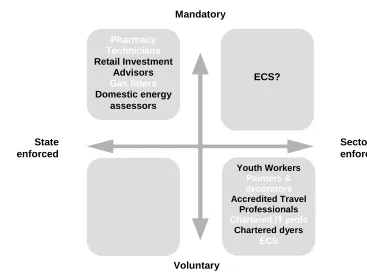
Figure 2.1 Mapping case studies onto the typology of occupational regulation ... 22
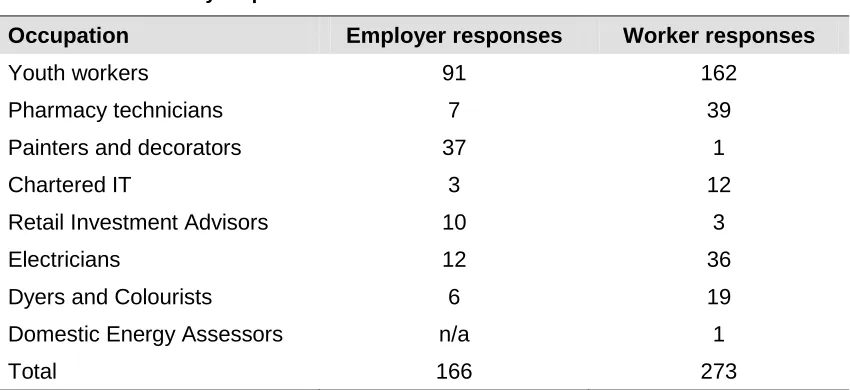
Table 2.2 Survey responses received ... 25
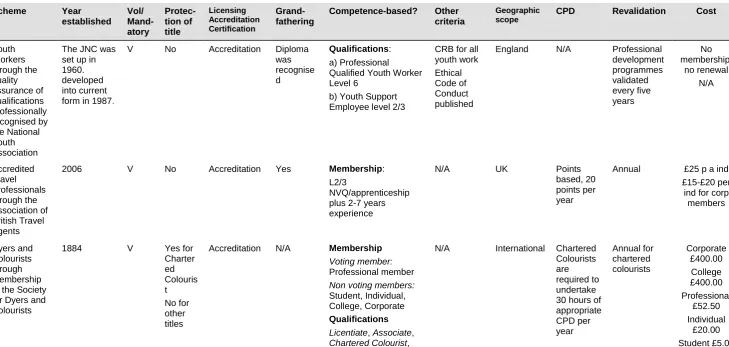
Table 4.1 Overview of schemes ... 40
Figure 5.1 Employer respondents’ views on public recognition ... 59
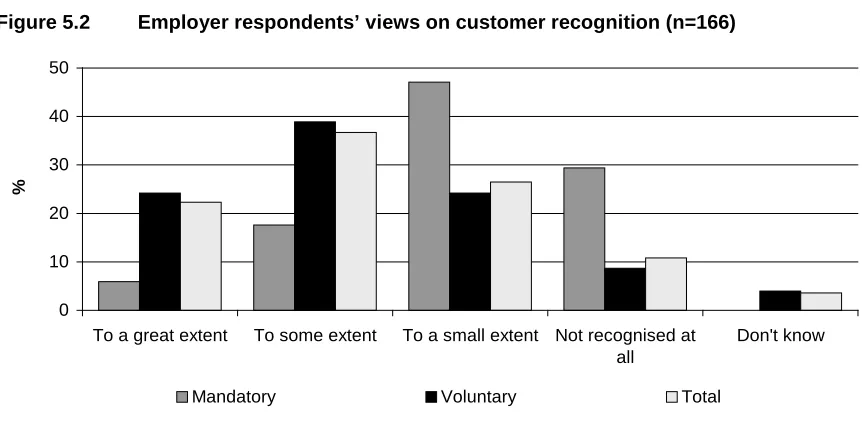
Figure 5.2 Employer respondents’ views on customer recognition ... 60
Figure 5.3 Employer respondents’ views on recognition from other employers ... 61
Figure 5.4 Respondents views that employees would possess the necessary skills in the absence of the scheme ... 63
Table 5.1 Employer survey respondents views of status benefits ... 69
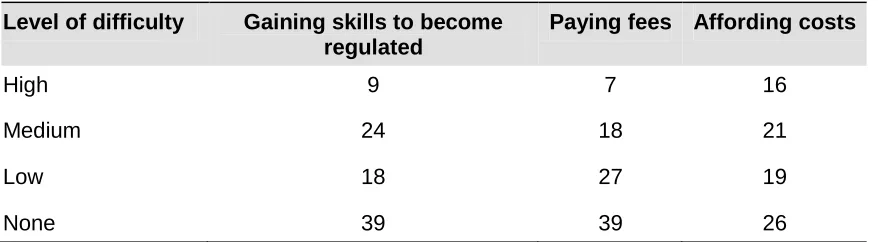
Table 5.2 Employee survey respondents’ views of difficulties experienced in becoming regulated ... 70
Figure 5.5 Employees’ level of difficulty in meeting costs to become licensed/ accredited/certificated or registered ... 71
Table 5.3 Employee survey respondents’ views on difficulties in maintaining membership ……….. 72
Table 5.4 Employee respondent’ views on difficulties in meeting CPD requirements ... 72
Table 5.5 Forms of support provided to employees in meeting the initial requirements of regulation ... 73
Table 5.6 Who covers the costs of maintaining membership/regulation? ... 74
Figure 5.6 Employers - did the introduction of the scheme/qualifications increase wage costs for your organisation? ... 77
Table 5.7 Employer and employee views on benefits of schemes ... 79
Figure 5.7 Employers’ views of benefits of regulation ... 80
Figure 5.8 Employees’ views of benefits of regulation ... 81
Table 5.8 Employer concerns over schemes ... 84
Table 5.9 Employer and employee views on benefits of schemes for customers ... 86
Table 5.10 The extent to which joining the scheme increased costs for customers ... 88
Table 5.11 The extent to which scheme introduction increased costs for customers? ... 88
Table 6.1 The benefits and disbenefits of schemes ... 93
Figure 6.1 The cost distribution of schemes ... 98
Figure 6.2 Model of voluntary schemes ... 104
Figure 6.3 Model of mandatory schemes ... 105
Figure 6.4 Decision points ... 107
Figure 7.1 Drivers impacting on scheme creation ... 113
Table 7.1 Design considerations affecting schemes ... 114
Table 7.2 Reasons for joining voluntary schemes ... 116
Executive Summary
Introduction
Occupational regulation is a policy mechanism which can raise skill levels via the introduction of minimum prescribed skills standards into an occupation or an aspect of it. Previous research published by the UK Commission for Employment and Skills suggests that occupational regulation, in certain forms, is one means by which workforce skills in the UK can be improved.1 It can do this by providing incentives for individuals or firms to invest in human capital, specific to the occupation they operate in, thereby raising skill levels.
The effect which occupational regulation can have on skill levels, however, is not necessarily consistent. Forth et al. (2011) report it is heavily contingent on the particular occupation, the type of occupational regulation established and its subsequent design, implementation and governance. Whilst there is evidence of the positive effects of introducing occupational regulation (which increase in likelihood the stricter the form of regulation applied) there is little information on schema design or the motivations for their introduction or amendment. This report addresses some of these gaps and, consequently, the aims of the research were to:
• Identify the design, implementation and administration/governance factors associated
with occupational regulation schemes.
• Use employer and stakeholder perceptions and existing evidence to explore the
impact of occupational regulation.
• Use employer and stakeholder perceptions and existing evidence to explore the
impact of unintended consequences.
• Examine key stakeholder views of the advantages and disadvantages of occupational
regulation and critical success factors.
• Identify best practice in occupational regulation.
Approach
The research aims were explored through a series of case studies of occupational regulation which were chosen to reflect different kinds of regulation, different rationales
1
J. Forth et al, A Review of Occupational Regulation and its Impact (2011), UKCES, Wath upon
Dearne. Available:
for introduction, a varied geographical and sectoral focus, as well as different kinds of jobs and different skill levels.
Of the different kinds of occupational regulation (licensing, registration, certification and accreditation), as defined by Forth et al. (2011), our case studies focus on a particular
mandatory form, which is the strictest form of legal regulation, and a voluntary form, which has no state involvement or legal backing. These are described below:
• Licensing (mandatory) – licensing (aka occupational licensing and licence to
practice) makes it unlawful to carry out specified activities without having first obtained a licence, confirming the holder as meeting prescribed standards of competence. The licensing process involves the candidate having to achieve or demonstrate a combination of or all of the following: (i) holding a specified qualification; (ii) having prescribed relevant work experience; (iii) passing a specific examination. Licenses are managed and enforced by state sanctioned regulatory bodies, government agencies, chartered or non-chartered bodies or local authorities.
The following occupations, subject to licensing, were case study exhibits for the research: Pharmacy Technicians; Retail Investment Advisors; Gas Engineers and Domestic Energy Assessors.
• Accreditation (voluntary) – this applies to situations in which a candidate may apply
to be accredited as competent, usually by a recognised professional body or industry association. However, a lack of accreditation does not stop an individual/firm practising in the occupation. There are no restrictions on their right to practice. In contrast to licensing or the other forms of occupational regulation (registration and certification), there is no state involvement; governance and administration is led by industry.
The following occupations, subject to accreditation, were case study exhibits for the research: Painters and Decorators; Chartered Dyers and Colourists; Electricians; Youth Workers; and Accredited Travel Professionals.
Rationale for introduction
In broad terms, occupational regulation schemes tend to be introduced either for predominately endogenous or exogenous reasons. Endogenous reasons refer to those issues internal to the occupation (such as labour shortages, recruitment difficulties, reacting to new or revised industry standards etc). Here regulation can provide a means to upskill an occupation, enhance status and credibility and increase levels of training. Endogenous drivers predominate in voluntary schemes.
In some cases the pressure for scheme development comes primarily from outside the occupation. Such exogenous reasons include those external issues, such as consumer safety and security, public protection, legislative changes requiring a new or higher skillset. Sometimes, both endogenous and exogenous factors together drive scheme development.
Characteristics of occupational regulation
Regulatory focus
Regulation can operate at the level of the individual (the self-employed and those in the employment of others), the firm or both, but is typically focused on the individual. In regards to firm level occupational regulation, it is possible for the organisation itself to be subject to regulation and/or the employer (such as the owner-manager, partners, board of directors) to be required to be suitably qualified in their own right. Firm level regulation may also require the employer to oversee and ensure the skills competency of those employed or contracted, even if they are not individual members of the occupational regulation scheme themselves.
Skill or qualification level
competence or because there is no existing accepted qualification which adequately covers the skill demands of the occupation.
Membership levels
The majority of, although not all, regulatory schemes require membership as a prerequisite for becoming regulated. The level of membership to be offered is therefore another factor for such schemes to consider. While some have a single membership level most offer either vertically differentiated membership (which reflects hierarchically increasing skills or experience), or horizontally differentiated membership (which reflects different, but equal, skill sets). Schemes with a membership element also need to consider how membership should be maintained. Typically this includes a regular (normally annual) renewal fee, often a requirement for evidence of Continuous Professional Development (CPD) and in some cases the need to demonstrate ongoing competence to practice (where there are frequent changes in the skill or knowledge required in the occupation).
Codes of practice and other requirements
Schemes may also expect members to adhere to a code of practice, ethical code or professional standards. They may also be required to pass entry barriers not related to skills, such as Disclosure and Barring Service (DBS) checks. Where codes of practice, ethics or professional standards exist, a complaints procedure would typically operate alongside them.
Benefits
The ability to offer a range of benefits, particularly with voluntary schemes, can help secure new entrants, retain existing members and maximise adherence to the scheme. For firms, these tend to be tangible benefits of value to firms such as reduced cost insurance. For individual members, the benefits tend to be intangible (e.g. status, knowledge transfer or networking). But they can also include offers, such as reduced prices for continuing professional development programmes.
Impact on the occupation
From our interviews with stakeholders and our online survey with employers and employees, schemes were generally seen to have:
• Raised skill levels - All stakeholders believed the schemes had raised skill levels in
• Raised standards - Where schemes had wanted to raise standards they generally
sought to persuade members of the case for change. They also sought to ensure those already in the scheme were not overly disadvantaged. Ways to do this included: either providing different grades of membership; keeping skill requirements broadly in line with levels already common in the sector; or by requiring assessment only for additional components viewed as essential.
• Improved performance - Around half of employers believed employee productivity
had improved as a result of occupational regulation (more so in mandatory schemes). However, only a quarter believed that organisational productivity had improved.
• Raised status - a key driver of regulation predominately for voluntary schemes is a
desire to raise the status of either the occupation or the individuals within it. Almost three quarters of employers believed their scheme had improved the image of the occupation and their organisation. Just over half believed their scheme helped customers identify a quality organisation
Design considerations
There are pros and cons to establishing mandatory and voluntary schemes respectively. For example:
• Voluntary schemes do not require a legal framework. Therefore, schemes are easier
to establish (subject to employer buy-in) and easier to amend to changing labour market conditions, or to abolish if no longer needed. Due to the lack of legal regulation they are also much more flexible to design. They can test the water of employer/employee ambition and engagement as well as enable organic growth.
However, voluntary schemes lack legal ‘clout’; they require more effort to build and sustain themselves than mandatory schemes. As they are dependent on members of an occupation voluntarily joining, they also have to commit considerable resources to marketing in order to attract and persuade potential members. If targeting a membership which is made up of individuals, these could be difficult to reach, therefore incurring more cost. These reasons contribute to making voluntary schemes more difficult to strategically plan for as schemes have to fight for a sustainable market share of members, possibly in the face of other competing schemes.
• Mandatory schemes, by their nature, enjoy universal engagement and compliance.
But a very strong case and justification will be required to impose mandatory occupational regulation on the workforce. It could take some time to win this argument. Lead in times for the introduction of mandatory schemes can be considerable, especially if parliamentary legislation is required. And, once established, significant changes to a scheme will be more cumbersome to make, than in a voluntary scheme, due to its formal structure and universal application.
Aside from determining whether the scheme should or could be mandatory or voluntary, the research found that certain design elements form key decision points for schemes and it is worth repeating them here:
• What is the scheme for? What is it a response to?
Scheme designers must be clear about the problem the occupational regulation scheme has been designed to solve so clarity on its purpose is essential.
• Is the membership focus to be individuals or firms in the occupation? If a
voluntary scheme, will membership be a ‘catch all’, open to all within the
occupation, or designed to appeal to a subset?
In most of the schemes examined the focus of regulatory attention was on individuals. While this makes it easy to confirm whether the individual is the holder of the specified qualification or possesses the required competences, it can mean more work for the administrating body in terms of reaching out to members. Placing the onus for compliance on firms can make the regulator’s job easier, especially with mandatory schemes. For voluntary schemes, in particular, there is an additional decision to be made, regarding whether to focus on all those in the occupation or some subset. This is often driven by a desire to either be inclusive and welcome everyone, or exclusive and set members apart in some way.
• What is the role of competence in determining entry to the scheme? How will
this be measured?
A key decision for schemes is to ensure that the skill level set is appropriate: if too high existing members may struggle to achieve the skills required and potential applicants to the scheme may be deterred; too low and skills progression is unlikely to take place (and this could feasibly hold skill levels down).
• Is there a need for regular renewal of membership and/or competence? How
often will this happen? How will ongoing competence be measured?
• How much will the scheme cost its members?
Costs vary considerably, ranging from as little as £15 per annum up to £120 for an individual; for organisations this can be from £180 to potentially much higher amounts, depending on the numbers of regulated individuals in the firm.
• What will attract potential members to join it (especially if a voluntary scheme)?
Membership benefits, both ‘hard’ and ‘soft’, can be provided to encourage existing and prospective members to remain in the scheme or join it.
Reflection on these points will help organisations identify the key issues for their occupation or sector and shape a scheme that meets the needs of the regulator and the occupation.
Lessons and critical success factors
Key lessons emerging from the research include:
• A close focus on the problem the scheme is designed to resolve is needed to ensure
the scheme is fit for purpose.
• Schemes need to consider the views of stakeholders to ensure that correct skill
requirements are established.
• ‘Grandfathering’ can help ensure that those who have been practicing in the
occupation for some time are not excluded but may not address issues of increasing competence or consumer safety.
• The timing of any launch and the timescale for any changes need to be carefully
planned in order to allow sufficient notice to potential members whilst ensuring momentum is maintained.
• Wide ranging discussions can help ensure acceptance across the occupation but can
also cause stasis.
• Conflicts of interest need to be surfaced and guarded against.
• Scheme launch require significant publicity and marketing campaigns. Where the
scheme is voluntary there needs to be a clear message regarding the potential benefits to be gained.
• Consideration needs to be given as to how standards will be promoted and
• With mandatory schemes consideration needs to be given to whether allowing
competition or a monopoly will aid the running of the scheme and the potential benefits and disbenefits of such arrangements.
Finally, the study identified some key issues to address when considering regulation and some critical success factors for schemes. There should be:
• A clear rationale for the existence of the scheme and sector support for it.
• A skill level that raises skills high enough to screen out those who lack appropriate
capability whilst not raising skills to the point that barriers to entry would exclude competent people or firms.
• For voluntary schemes especially, a clear and demonstrable case to individuals
and/or firms of the benefits of having membership.
• Sufficient administrative resources in the regulatory body to ensure the scheme runs
smoothly and to provide marketing and promotion efforts to ensure the scheme is maintained and stakeholders are fully aware of it. Marketing and promotion will be especially important for voluntary schemes.
1
Introduction and background to occupational
regulation
Summary
Occupational regulation has the potential to raise skills in the workforce by introducing minimum prescribed skill standards into an occupation or an aspect of it. There are a number of criteria which distinguish different forms of occupational regulation when considering its introduction:
• the approach taken can be mandatory or voluntary;
• it can apply to everything undertaken by an occupation (protection of title) or specific
activities of an occupation (protection of function);
• responsibility for regulation and enforcement can range from a government funded
organisation or a self-funded, employer led body;
• in terms of demonstrating minimum prescribed skill standards, requirements for new
entrants to a scheme vary; entrance can be achieved through a combination of a range of entry barriers (examinations, tests, demonstration of previous relevant work experience and/or prescribed qualifications already attained); in some circumstances ‘grandfathering’ may be appropriate;
• renewal periods and modes of renewal (e.g. via continuous professional development
or examination) also vary.
Forms of occupational regulation
Different forms of regulation have been established by Forth et al. (2011). In some cases these can apply to organisations as well as individuals:
• Licensing – practicing a specified range of activities is unlawful without a licence to
practice, which confirms competence by meeting minimum prescribed skills standards.
• Certification – there are no restrictions on the right to practice but job holders may
voluntarily apply to be certified as competent, in meeting minimum prescribed skill standards, by a state appointed regulatory body.
• Accreditation – there are no restrictions on the right to practice but job holders may
• Registration – it is unlawful to practice without prior registration with the relevant
regulatory body, although the entry barrier requirement does not include a test of skills competence.
Existing empirical and theoretical evidence
The prevalence of occupational regulation is estimated to affect at least 28 per cent of all jobs in the UK, with true figures of between one third and half of all jobs covered by some form of regulation.
The impact of occupational regulation has been much debated with positive and negative effects including higher wages, higher quality entrants to occupations, higher (or lower) quality goods/services, increased costs, reduced consumer choice, increased consumer satisfaction. A review of labour market effects in the UK suggests the weaker the form of regulation, the less likely the positive effects will be.
Evidence suggests that introducing licensing, the strictest from of occupational regulation, can increase employer investment in training, increase skill levels in the occupation, make improvements in the quality of service and provide an ongoing increase in the volume of training in an occupation.
1.1
Introduction
This report explores issues around the design, administration and implementation of occupational regulation. This is a broad term used to describe a range of measures which have the potential to positively affect skills standards within occupations. It was suggested in the UK Commission for Employment and Skills’ (herein UK Commission) review of Employer Collective Measures (Stanfield et al., 2009), that occupational regulation was one means by which skills in the UK could be improved. Follow up work (Forth et al., 2011) has explored the theory of occupational regulation, reviewed existing empirical evidence, and provided for the UK both a map of regulation and estimated the impact of the different forms of regulation.
1.2
Role of Occupational regulation in employer investment in skills
problems and fears over the poaching of developed staff (eg Keep 2006, Bosworth and Stanfield 2009, Hogarth et al., 2009). A range of policy levers can be brought to bear to address such failures. These might include training levies, inter-employer networks, human capital reporting or skills-based entry barriers, with this last option being exemplified by occupational regulation. And it is occupational regulation that forms the focus for the current research.
As mentioned, the development of a deeper understanding of occupational regulation, of which this report contributes towards, was initiated by the earlier Review of Employer Collective Measures study, which investigated the means of stimulating greater employer investment in skills. A series of wide-ranging reports were conducted for the study, from theoretical, empirical and policy perspectives2, to examine and review those policy levers which could encourage employer investment on a collective basis.
The level of detail in these research reports was limited, not least because understanding of the nature of occupational regulation, particularly in the UK, was limited itself. What was known, as Forth et al. point out, tended to be restricted to occupational licensing, the strictest form of occupational regulation. The evidence base here was predominantly from studies in the United States and focused on legal barriers to entry rather than the introduction of minimum skill standards. In terms of labour market effects, there was minimal robust evidence on the effect of such schemes on skills. The Review of Employer Collective Measures Final Report (Stanfield et al., 2009) suggested there was potential for this policy lever to be successfully extended, if there was a specific need identified, and if such a lever was introduced and supported on a voluntary basis. Statutory measures, such as occupational licensing, were found generally to be effective only where there was collective employer support for their introduction (Cox et al., 2009)
However, overall there was little appetite for ‘compelling’ employers through the introduction of levies or licences to practice on a wide scale without a significant business case being made. The evidence suggested that the effectiveness of occupational licensing policy depended on the nature of the occupation and the way in which the scheme is implemented. It recommended that occupational licensing be reviewed on a case-by-case basis to assess where and how such schemes might add value (Stanfield
2
et al., 2009). This implies there should be employer and sector support for the introduction of occupational licensing which in turn means that they recognise the (potential) benefits of such regulation.
Further to the Collective Measures study, in late 2010 the UK Commission commissioned quantitative work from the National Institute of Economic and Social Research (NIESR) to assess the extent of prevalence, within the UK, of the different types of occupational regulation which set out minimum prescribed skills standards. This entailed the development of a sophisticated conceptual definition of occupational regulation encapsulating mandatory and voluntary approaches to introducing minimum skill standards. In addition to exploring the prevalence of occupational regulation in the UK, the research also examined its impact on qualification levels, training and wages (Forth et al., 2011).
The project reported here informs a programme of work to develop a greater understanding and insight into the levers available to employers to tackle skill challenges and maximise competitive advantage for the long term. This programme of work will also inform ongoing policy development for the future delivery of investment initiatives, such as the UK Commission’s vision for Employer Ownership.
This vision looks to develop the conditions for employers to have greater control over the development of the skills they need, in order to compete in UK and international market places. The UK Commission argues that some employers do not currently maximise their investment in workforce development because they are faced by a system which appears 'bewilderingly complex and excessively centralised' (UKCES, 2011, p. 2). Employers should become the 'owners of the UK’s vocational education system' (Mayfield, 2011), most significantly through changing the funding system to be more directly led by them, so that skills and training better meets their requirements.
It is acknowledged that for each industry or sector there will be a different bundle of policy levers which might be appropriate, depending on the specific circumstances and labour market requirements therein. These have been termed Best Market Solutions; a range of policy levers, which employers in a sector can collectively deploy to raise their skills ambitions. This approach was recognised and adopted in the government’s current skills strategy, Skills for Sustainable Growth (2010).3 Understanding Occupational Regulation,
3
See pages 23-24 of Skills for Sustainable Growth, Strategy Document, Department of
Business, Innovation & Skills (2010). Available:
http://www.bis.gov.uk/assets/biscore/further-education-skills/docs/s/10-1274-skills-for-sustainable-growth-strategy.pdf [Accessed 13 March
2012].
which focuses on one such policy lever, is one of a series of projects commissioned to improve our understanding of these levers:
• Understanding Occupational Regulation;
• Understanding Training Levies;4
• Understanding Employer Networks.5
As part of its remit the UK Commission manages investment funds (The Growth and Innovation Fund,6 the Employer Investment Fund7 and the Employer Ownership of Skills pilot scheme), which are designed to provide support for employer led initiatives to generate greater employer investment in skills and training. Through these competitive funds employers can seek co-investment for innovative programmes covering training participation and infrastructure.
In its broader consideration of how occupational regulation schemes can be designed and implemented by employers, it is intended that the findings from this research will also assist the UK Commission in its practical understanding of investment applications related to occupational regulation.
1.3
The scope of occupational regulation
There are varying types of occupational regulation. Humphris et al. (20118) discuss the interplay of several dimensions:
1 The approach can be mandatory or voluntary. If the requirement for a licence is set down in statute, professions are granted such status with an Act of Parliament. In most of these cases regulation operates at a national rather than local level.9
4
The report, Understanding Training Levies (2012) is available on the UK Commission’s
website. See: http://www.ukces.org.uk/publications/er47-understanding-training-levies.
5
The report, Understanding Employer Networks (2013) is available on the UK Commission’s
website. See: http://www.ukces.org.uk/publications/er66-understanding-employer-networks
6
See: http://www.ukces.org.uk/gif/.
7
See: http://www.ukces.org.uk/ourwork/investment/eif.
8
Amy Humphris (LSE), Morris Kleiner (University of Minnesota) and Maria Koumenta (Queen
Mary, University of London) were also co-authors on the later Forth et al. (2011) report.
9
Note though that some schemes have been so widely adopted by employers (such as the JIB
and SJIB Electrotechnical Certification Scheme card) that it is, to all intents and purposes,
2 The approach can vary depending on the range of products or services that are regulated. At one end an individual with a specific job title can provide all products and services covered by that occupation (protection of title), at the other a specific job title enables the individual to undertake certain activities (known as protection of function). In this case there is no restriction on entry to a profession but there is a restriction on the activities the individual is allowed to perform as part of their job. Humphris et al. give the example that anyone can practice as an electrician and carry out electrical installations but a certified electrician has to inspect installations and certify their safety.
3 The approach can vary depending on who is responsible for regulating the occupation: an occupational body (eg the Chartered Institute of Personnel and Development for personnel and training professionals); a government organisation (eg the Department of Transport for Approved Driving Instructors or the Civil Aviation Authority for Air Traffic Controllers); or a local organisation, usually a local authority (eg Taxi drivers are licensed by local authorities). Regulatory bodies in the UK are independent of any branch of government but they work closely with government departments when reviewing occupational regulation issues.
4 Requirements for regulation vary and can include (individually or in combination) passing an industry-specific exam, test or interview; the demonstration of work practices; and/or passing a medical or criminal record check.
5 Finally, licences in the UK may be awarded for life10 may need to be renewed periodically to demonstrate continued fitness to practice (eg train drivers must undertake a Rules and Regulations update and assessment under the supervision of an accredited assessor at least biennially).
In addition, some forms of occupational regulation may not apply directly to individual employees but indirectly via requirements placed on the firms that employ those employees. An example is the Gas Safe Register which regulates businesses (for self-employed people this would be the individual engineer). The scheme requires employers
10
According to Forth et al (2011) licences for life are still granted to a wide range of occupations,
including nurses, midwives, paramedics, police officers, armed forces officers, elementary
security occupations, ophthalmic opticians, veterinarians, psychologists, teachers, solicitors,
lawyers, judges and coroners. Previously, medical doctors did not need to renew their licence,
although it is now the case that to practice medicine they are required to hold a licence to
practice which requires validation every five years and also be registered with the General
Medical Council.
to list suitably qualified engineers by the different categories of work activity that the engineer is qualified to undertake, e.g. cookers, boilers, gas fires.
The recent NIESR report (Forth et al., 2011) uses various criteria to identify four distinct kinds of occupational regulation. The first three kinds, licensing, certification and accreditation, promote skills development, to varying degrees, by requiring employees to demonstrate minimum prescribed skills competencies. The final category, registration, does not test skills competencies but concerns legal entry barriers. It is included as most of the existing literature focuses on 'standards based entry barriers rather than skills per se' (Forth et al., p3, 2011). Registration is also a possible ‘switcher’ mechanism, whereby an occupation which is subject to registration, could move to another form of occupational regulation (e.g. occupational licensing) which does require the demonstration of minimum prescribed skills. The various forms of occupational regulation, as codified by NIESR, are explained in greater detail below.
• Licensing: This is a mandatory approach and refers to situations in which it is
unlawful to carry out a specified range of activities without first having obtained a licence which confirms that the licence holder meets prescribed standards of competence. Licences can cover either protection of title or protection of function. The award of the licence to practice is typically conditional upon the job holder: (i) being able to prove that they hold specified qualifications: (ii) possessing a prescribed amount of relevant work experience; (iii) obtaining a pass in a licensing examination; or, occasionally, all three. Employees who require such licences to practice in the UK include doctors, solicitors, veterinary nurses, private security guards, gas installers, taxi drivers and heavy goods vehicle drivers. Practicing illegally risks a criminal prosecution.11 Licences can be managed at a national or local level and enforced by a dedicated regulatory body, government agency, a chartered or non-chartered body or local authority (Forth et al., p. 63).
• Certification: This is a voluntary approach and refers to situations in which there are
no restrictions on the right to practice in an occupation, but job holders may voluntarily apply to be certified as competent by a state appointed regulatory body or a government agency. Again, certification may depend on possession of appropriate qualifications, possession of relevant work experience or successfully passing a certification examination. Employees in the UK who may apply for certification include fitness instructors (who may apply to be certified by the Register of Exercise
11
A recent case highlights the perils of unlawful practicing in a profession protected by
occupational licensing: See: http://www.bbc.co.uk/news/uk-wales-south-east-wales-17509194
Professionals) and hairdressers (who may apply to be certified by the Hairdressing Council). Certification is a weaker form of regulation than licensing because it does not prohibit those without a licence from carrying out the activities. There may be protection of title in some cases too.
• Accreditation: This is a voluntary approach. The term is used to refer to situations in
which an individual may apply to be accredited as competent usually by a recognised professional body or industry association. Accreditation is analogous to certification, in that it confers a mark of competence which is recognised as such by other practitioners or consumers. In common with certification, accreditation may also bring with it a specific title or label; for example, only those personnel managers accredited by the Chartered Institute for Personnel and Development may use the letters MCIPD. However, there is no protection of either title or function. Accreditation is distinct from certification in that the accreditation process has no involvement from the state. The criteria governing accreditation and the procedures regarding enforcement are thus entirely the responsibility of the accrediting body. Sanctions against those wrongly claiming accreditation will vary according to the professional body but can result in a criminal prosecution for fraud being brought by potential employers or trading standards.12
• Registration: This is a mandatory approach and refers to situations in which it is
unlawful to practice without having first registered one‘s name and address with the appropriate regulatory body which can be occupational, governmental or local. Other conditions are sometimes also imposed, such as the requirement to not have a criminal record or been declared bankrupt. However, registration does not involve any explicit test of competence. Registration thus provides some form of legal barrier to entry, but its impact on skill levels within an occupation can be expected to be small when compared with licensing. An example in the UK is the requirement for estate agents to register with the Office for Fair Trading under regulations designed to prevent money laundering.
It is important to note that the terms ‘licence’, ‘registration’, ‘certification’, and ‘accreditation’ are widely used in different contexts. And they are often used with less rigour than as defined above with regard to occupational regulation; for example, health
12
For examples of recent cases of prosecution for fraud see the following news reports
http://www.nhsbsa.nhs.uk/2990.aspx (a case in which a HR Manager received a suspended
prison sentence for falsely claiming to be part way through a Chartered Institute of Personnel
and Development course and to hold qualifications she did not have); and
http://www.cieh.org/ehn/ehn3.aspx?id=31308, in which an electrician was fined for falsely using
professions tend to use the term registration to refer to what Forth et al. would term licensing. To maintain consistency and avoid misinterpretation, we use the Forth et al. definitions given above throughout the report, so as to distinguish between voluntary and mandatory forms of occupational regulation. Where a scheme uses a term differently to Forth et al. we use quotation marks to distinguish this from more formal usage.
1.4
Prevalence of Occupational regulation
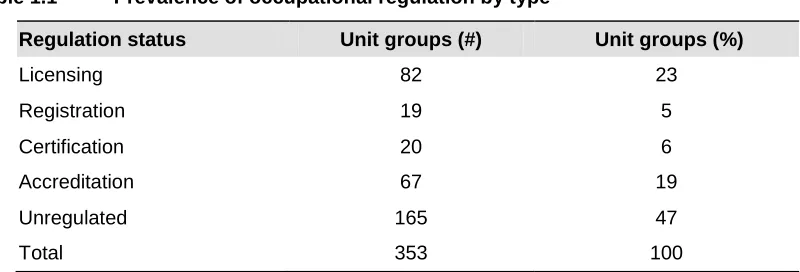
The prevalence of the different types of occupational regulation, as identified in the quantitative work conducted by Forth and his colleagues (2011, pp. 73-89), is difficult to ascertain with accuracy. Forth et al. estimate that between 14 and 31 per cent of all jobs are covered by Licensing, approximately three per cent of all jobs are covered by Certification, between two and six per cent by Registration and between 10 and 19 per cent by Accreditation (Forth et al., 2011 p. 76). They estimate the true percentage to be closer to the bottom limit. This leaves between 40 and 72 per cent of jobs unregulated (with the estimate that it is closer to the 72 per cent than the 40).
[image:25.595.94.494.451.587.2]Exploring the preponderance of regulation by unit group level of the Standard Occupational Classification (SOC) codes (2000)13 (see Table 1.4 below) suggests that nearly half of all unit groups contain jobs that are subject to some form of regulation.
Table 1.1 Prevalence of occupational regulation by type
Regulation status Unit groups (#) Unit groups (%)
Licensing 82 23
Registration 19 5
Certification 20 6
Accreditation 67 19
Unregulated 165 47
Total 353 100
Source: Forth J, et al. (2011) A Review of Occupational Regulation and its Impact, UK Commission for Employment and Skills, page 61.
At present in the UK, amongst the regulated occupations, occupational licensing, the strictest form of occupational regulation, accounts for the largest single proportion of unit groups with a regulated occupation (23 per cent of all occupational unit groups). When registration is added in, this rises to 28 per cent. Similar proportions of occupational unit
13
Occupations were mapped at unit group level using desk research information using three
dimensions: is there legal regulation of the activities of the occupation by the state or through a
delegated administrative body? If yes, does it place any restrictions on the right to practice the
occupation or component tasks, is there a requirement to demonstrate a minimum level of
competence?
groups are therefore covered by mandatory approaches (licensing and registration) and voluntary approaches (certification and accreditation, amounting to a total of 25 per cent of unit groups).
The above figures are for those unit groups which have a least one regulated occupation. The study concludes that at least 28 per cent of all jobs in the UK are covered by some form of regulation, with true figures likely to be between one third and half of all jobs. Professional jobs are the most likely to be regulated (eg doctors, accountants, veterinarians); Forth et al. (2011) estimate that 76 per cent of professional occupations are subject to some form of regulation. The next most commonly regulated group is process, plant and machine operatives (including HGV drivers, taxi drivers and others requiring transportation licences) with over half of all jobs subject to some form of regulation (58 per cent). Administrative and secretarial, personal services (eg beauticians) and elementary occupations (eg shop assistants, care employees etc) are judged to be the least regulated (less than 10 per cent). This pattern reflects in part the history of occupational regulation, with professional bodies expanding in the 19th century and self regulating through professional associations. It also reflects the changing shape of the UK economy, which has shifted towards a greater dominance of service sector occupations. In doing so, problems of information asymmetries become more pronounced - it is harder for consumers to understand the quality of service they may receive. Concerns over consumer protection have helped to gradually extend regulation to cover a larger number of occupational groups.
1.5
The impact of regulation
Where employers cannot see distinct benefits arising from more formal forms of regulation, it may be that softer forms of regulation, such as certification and accreditation, would be more likely to gain support for implementation from employers. Here, employer buy-in is critical to their effective functioning in gaining wide usage, recognition and credibility across industrial sectors. There is a long history of craft guilds in some occupations, where employers collaborate to protect quality standards of their activity and develop common training to meet their needs (eg the Fine Art Trade Guild, or indeed the Guild system more widely).
Forth et al. (2011) explore the theoretical perspectives of occupational licensing (pointing out that the dominance of literature from the USA has meant an emphasis on entry barriers and hence much of the literature has focused on licensing rather than on other forms of regulation) and note a number of relevant points:
• Gatekeepers screen entrants to ensure they meet the quality needed by the
occupation and enforcers ensure that standards are maintained.
• Licensing is run for and by incumbents and seeks to create monopoly rents by limiting
entry (thus raising prices) and low levels of enforcement thereby reducing quality (see Friedman,1962).
• Licensing tends to increase quality and cost and therefore reduces the options
available for consumers who would prefer lower quality, lower cost goods and services (see Shapiro,1986).
• Licensing deals with information asymmetries by determining and regulating for the
quality of goods/services offered. Consumers are ‘loss averse’ ie they value reduction in risk (of a negative outcome) and occupational licensing is welcomed as it reduces the likelihood of poor quality.
• Occupations can limit entry to the profession in order to signal quality: by introducing
barriers to entry they limit entry to those committed to the occupation and a quality product or service. ‘Club’ effects can also include access to discussion and dissemination of information and the growth in high performance practices.
• Licensing can limit the supply of professionals to the market and enables those in the
occupation to receive higher wages than might otherwise be the case.
1.6
Labour market effects of occupational regulation
Fernie (in Forth et al., 2011) found no evidence of wage effects of occupational regulation on earnings of security guards. Modelling the impact of regulation on five occupations14 that had either seen the introduction of regulation or a change in the kind of regulation between 2001-2010, Forth et al. (2011) found a rise in wages in one occupation (security guards) and a rise in qualification levels amongst another occupation (care employees). In the remainder no effect on wages, qualifications levels, or training was found. Forth et al. inferred that such effects were less likely the weaker the form of regulation (eg entry requirements are lower or less extensively applied).
The researchers also suggested that some forms of occupational regulation may have the potential to raise skills by providing additional incentives for individuals or organisations to invest in skill development. These incentives are potentially greatest in the case of licensing because of its universal scope within an occupation subjected to such regulation.
The limited UK, and more extensive US evidence, suggests the positive effects of introducing a licence to practice can be:
• An increase in employer investment in training, although in many cases the cost is
borne partially or fully by the employee (Cox et al., 2009).
• An increase in the skill level, and therefore competence, of individuals in a particular
occupation, leading to increased salaries for practitioners (Kleiner and Krueger, 2008).
• Improvements in the quality of the service being offered: the licence serves to
reassure clients about the competence of staff, and the licensed organisation or individual therefore attracts more clients (Cox et al., 2009). However, occupations are likely to vary in the extent to which training improves quality.
• To ensure that individuals continue to update and develop their skills by making CPD
a condition of re-licensing and therefore raising the volume of training in an occupation (Stanfield et al., 2009).
1.7
Future research
Forth et al. highlight a number of gaps in the evidence base on design, implementation and governance which, in part, this current research is intended to fill. They draw attention to the mixed evidence regarding the consequences arising from occupational
14
The occupations chosen were security guards, care employees, social care managers,
regulation – there was inconsistent evidence regarding wage increases and no evidence of any negative effects on employment.15 Should policymakers or employers wish to contemplate introducing occupational regulation, consideration of design would be crucial to understanding the likely effects of any proposed scheme (ie whether skill standards should be mandatory or voluntary, whether the scheme should be aimed at employers or individuals, whether renewal of membership should be conditional on evidence of further training etc).
This report now addresses some of those concerns. This research takes as its starting point some of the questions raised by Forth et al. These focus on the design of occupational regulation (e.g. whether a scheme should be voluntary or mandatory, at what level the skill entry barrier should be set to be accepted into a scheme, whether such regulation should be imposed on the employer or individual), issues of implementation (whether grandfathering should be allowed) and questions of governance (i.e. who regulates the scheme, how standards are monitored to ensure the scheme is fit for purpose etc).
1.8
Summary
This chapter has described the various forms of occupational regulation and their distinguishing features, the prevalence of the different forms within the UK and their labour market impact.
• A clear framework exists for describing the characteristics of the taxonomy of
occupational regulation, of which the main forms fall into either mandatory (licensing or registration) or voluntary (certification or accreditation) classification.
• Best estimates suggest that some form of regulation affects between one in four and
half the jobs in the UK.
• The impact of regulation has been difficult to ascertain and evidence is patchy.
Empirical studies have produced mixed results with regard to the effect on skill levels, increased investment in training, qualification levels, quality of service or wages. The literature indicates that the stricter the form of regulation (in terms of higher entry requirements or more extensively applied regulation) the greater the impact is expected to be.
15
There is also no evidence as far as Forth et al are aware of any impact on prices or
The existing research base leaves gaps in our understanding of design, implementation and governance of schemes. This report therefore seeks in part to address this information gap. The outputs of the study are presented in the remainder of the report:
• Chapter two describes the research methodology and approach, including the aims
and research questions, and details of the occupations which form our case studies.
• Chapter three explores the history and rationale for adopting some form of regulation
in our case study occupations and the common issues that emerge from these experiences.
• Chapter four presents the design features and characteristics that differentiate the
various schemes and identifies key questions that should be considered when designing new schemes
• Chapter five explores the implications of occupational regulation for policy makers
and employers from the experience and views of those close to schemes (employers employees and other stakeholders).
• Chapter six brings together all the findings to discuss the implications for scheme
design.
In addition to the main report, appendices 1 – 7 (in a separate document) provide the following additional information:
• Appendix 1 Case studies
• Appendix 2 Areas of questioning for different stakeholders
• Appendix 3 Example code of practice
• Appendix 4 Scheme benefits
• Appendix 5 Survey responses
• Appendix 6 Detailed summary of scheme characteristics
• Appendix 7 Discussion guides
2
Research methodology and approach
Chapter Summary
The aim of this project is to develop a deeper understanding and insight into the design, implementation and impact of forms of occupational regulation in the UK.
Case studies
This has been addressed through case studies of a broad variety of occupational regulation scheme types. Ten schemes covering different occupations are examined in total:
• four mandatory schemes (Pharmacy Technicians, Retail Investment Advisors, Gas
Engineers, Domestic Energy Assessors); and
• six voluntary schemes (Youth Workers, Painters and Decorators, Chartered IT
Professionals, Chartered Dyers and Colourists, Electricians, Travel Professionals).
Methodology and approach
In each scheme a range of qualitative and quantitative data gathering methods were used, including desk research, face-to-face and telephone interviews, reviews of documentation and surveys of individuals and employers who are engaged with such schemes.
• Stakeholders interviewed included regulators, Sector Skills Councils and other
sectoral bodies, employers, providers of learning and trade union or employee representatives.
• Online surveys were developed and distributed in a number of different ways via
regulators; 439 responses were received in total.
2.1
Introduction
If policymakers or employers believe there is a strong prima facie case for regulation of a particular occupation, the other issue is how to regulate that occupation. This raises questions about the design of the regulation (e.g. whether any skill standard should be mandatory or voluntary; at what level the skill standard should be set; whether the regulatory scheme should be aimed at employers or individuals; whether the renewal of licences should be conditional upon evidence of further training etc). (Forth et al., 2011, p151)
This study, conducted by the Institute for Employment Studies, was designed as a more qualitative follow up to the Forth et al. (2011) review. It focuses on example case studies of occupational regulation, from a range of schemes, representing different kinds of occupations and sectors. Case studies were centred on the regulatory body of the respective occupational regulation scheme and access to employers and/or individuals was sought through their assistance.
2.2
Research aims and objectives
The aim of this project is to develop a deeper understanding and insight into the design, implementation, and impact of forms of occupational regulation in the UK.
Specifically, its objectives are to:
• Identify the design, implementation and administration/governance factors associated
with occupational regulation schemes and how they affect the success of a scheme.
• Use employer and stakeholder perceptions and existing evidence to explore the
impact of occupational regulation on skill levels, employment levels, wages, product markets and progression.
• Use employer and stakeholder perceptions and existing evidence to explore the
impact of unintended consequences within a sample of occupations which are subject to regulation and neighbouring unregulated occupations.
• Examine key stakeholder views of the advantages and disadvantages of occupational
regulation and critical success factors.
• Identify best practice in occupational regulation which can be used to influence
policymaking and encourage employers to adopt more effective approaches.
2.2.1 Research questions
• What does an effective model of occupational regulation look like?
• How do the components of an occupational regulation scheme, such as the
design architecture, different implementation approaches, and different administration/governance procedures contribute to its effectiveness?
• Does the broader regulatory framework have a role in developing an effective
model?
• How has the specific model varied over time?
• How do the different types of occupational regulation differ in this respect?
• What impact do occupational regulation schemes have on the raising of skills?
• How do the different forms of occupational regulation raise skills within an
occupation? Is it an explicit objective of the regulation?
• How are entry barriers set, and at what level(s), in an occupational regulation
scheme? To what extent are employers consulted and can influence the process?
• What systems/processes are in place to monitor whether or not skill levels are
being raised within occupational regulation schemes?
• Has the quality of entrants into occupational regulation schemes increased or
decreased?
• How do the different types of occupational regulation differ in this respect?
• What are the broader intended and unintended consequences of occupational
regulation?
• What lessons can be learned in order to inform the development of better or more
effective, skills-outcome focussed and employer-led approaches to occupational regulation?
• How might employers, employees and/or self-employed people be ‘nudged’/
encouraged to participate in voluntary occupational regulation schemes?
• What are the barriers to establishing employer-led occupational regulation
schemes and how can these be addressed?
• How can such schemes be made cost effective to the scheme user and ultimately
the consumer?
2.3
Methodology
There were two key phases to the project:
• Phase 1: scoping phase and development of sample frame to identify suitable
occupational regulation schemes to pursue as case studies.
• Phase 2: case-studies of occupational regulation (desk research, incorporating
qualitative interviews and online surveys).
These phases are explored in further detail below.
2.3.1 Phase 1: Scoping phase and development of sample frame
The first step was to refine and finalise the research questions; this led to the development of an analytic framework, based on the research aims of the project and existing literature, to ensure the research covered the breadth and depth of the questions above. The establishment of the framework also guided the development of the various research tools and ensured that focus was maintained on the range of stakeholders affected by matters of design, implementation and impact.
The framework identifies the relevant key stakeholders that could be interviewed as part of a case study (namely, the regulatory body itself, employers and employees and learning providers). There are several ways in which these individuals interact with the regulatory arrangements. Employers can be directly regulated by the scheme in their own right and/or may employ regulated individuals; while employees may be directly regulated by the scheme or may work for a regulated organisation/firm. For each of these stakeholders there were three key areas of questioning: (1) on the design and administration of the scheme; (2) on its implementation; and (3) on its regulatory impact. For each stakeholder the specific questions would vary. So for example, the regulatory body might be asked detailed questions on its aims and objectives or the rational for the introduction of the scheme, or how non-compliance is dealt with. Employers might be asked, under questions of implementation, the reasons for their involvement and whether they experienced any barriers within their organisation to joining a regulatory scheme or indeed whether their employees did. Full detail of the questions is given in Appendix 2.
2.3.2 Selection of potential case studies
regulation schemes for study the following criteria were used to identify and select cases. See Table 2.1 below.
Table 2.1 Criteria for selection of case studies
Criteria for selection of case studies
Types of occupational regulation
Rationales for introducing occupational regulation
Geographical focus
Sectoral focus
Job types
Skill levels
Source: IES, 2013.
In selecting case studies we also sought schemes for which occupational regulation applies at a mix of levels (ie individual membership or firm level or both) and where there were different approaches to membership renewal. In addition, preference was given to relatively new schemes, or those where there had been a recent change, so that stakeholder interviewees would be able to comment on the development of the scheme vis-á-vis its intended rationale.
Taken together, these criteria meant that the final selection of case-studies included:
• Different types of occupational regulation: ‘Switchers’ (ie occupations which have
moved from one form of occupational regulation to another) have also been included.
• Different rationales for introducing occupational regulation: There are a number of
reasons why occupational regulation may be introduced, including: protection of the public16, health and safety, occupational up-skilling, demonstration of occupational competence, acquisition of professional recognition, establishment or maintenance of industry standards etc.
• Public/private focus: schemes regulating occupations predominately in the private
sector or in the public sector, as well as those schemes covering both types of sectors.
• Job types: a mix of managerial, professional and non professional occupational
regulation schemes.
• Skill levels: a range of occupational regulation schemes aimed at low, mid or higher
level skilled employees.
16
• Number of people subject to the regulation: A mix of activities within occupations or
whole occupations which have differing numbers of people subject to regulation.
• Time period of introduction of regulation: schemes that have been introduced or
changed, in a time peri