Programme Theory
Evaluation
Working paper 2 –Signing Up to a
Learning Agreement
Research Report DCSF-RW029
Claire Johnson, Rosie Page and Miranda Munro
Institute for Employment Studies
Activity and Learning Agreements Pilot
Programme Theory Evaluation
Working paper 2 –Signing Up to a Learning Agreement
Claire Johnson, Rosie Page and Miranda Munro
Institute for Employment Studies
The views expressed in this report are the authors’ and do not necessarily reflect those of the Department for Children, Schools and Families.
Mantell Building
University of Sussex Campus
Brighton BN1 9RF
UK
Tel. + 44 (0) 1273 686751 Fax + 44 (0) 1273 690430
www.employment‐studies.co.uk
Contents
Executive Summary v
1 Introduction 1
1.1 What is ‘programme theory evaluation’? 2
1.2 Background 3
1.3 Hypothesis and research aims 3
1.4 Methodology 4
1.5 Structure of this Working Paper 9
1.6 Acknowledgements 10
2 Young People’s Contexts 11
2.1 Experiences and attitudes towards education at 16 11 2.2 Experiences of work and learning since leaving school 15
2.3 Current circumstances 20
3 Deciding Whether to Sign a Learning Agreement 24
3.1 Engaging young people 24
3.2 Reasons for signing a Learning Agreement 26
3.3 Reasons for not signing a Learning Agreement 33 3.4 Signers’ views on why some young people decline 36 3.5 Who is likely to sign up and who isn’t? 36
4 Experiences of Learning and Support 38
4.1 Time taken for learning to begin 38
4.2 Experiences of learning 40
4.3 Contact with Connexions during the Learning Agreement 43
4.4 Support from employers 44
5 Future Plans for Learning? 47
5.1 Perceived benefits of doing learning via the Learning Agreement 47
5.2 Progression to further learning 49
5.3 Longer‐term plans 51
6 Conclusions and Implications 53
6.1 Kickstarter and door‐opener role for advisers 53
6.2 Other issues affecting sign‐up 55
6.3 A new model of engaging young people 55
7 Bibliography 58
Appendix 1: Opt‐out Letter to Young People 59
Appendix 2: Topic Guide – Interviews with LA Staff who Recruit Young People 61
Appendix 3: Topic Guide – Interviews with Participants 67
Appendix 4: Topic Guide – Interviews with Non‐participants 74
Executive Summary
Introduction and research aims
The Activity and Learning Agreements (ALA) Pilots were launched in 12 areas of England in April 2006. Activity Agreements are designed for young people (aged 16 or 17) not in employment, education or training (NEET) and operate in eight of the 12 areas. Learning Agreements are aimed at 16 to 17 year olds in jobs without training (JWT) and also operate in eight of the 12 pilots areas. Under a Learning Agreement (LA), young people take part in agreed activities, which must include undertaking a designated course. In some pilot areas they may receive a monetary bonus if they are successful (and in two areas their employers receive wage compensation). In three pilot areas neither the young person nor their employer receives any financial incentive.
This paper is part of the programme theory strand of the ALA Pilots evaluation. This is a realist evaluation method which focuses on testing some of the key ‘theories’ which underlie the ALA policy to identify which components of the policy work (or not), how, for whom, why, and in what circumstances.
The paper is based on research undertaken among a sample of young people in two Connexions Partnership areas where no financial incentive is offered. The sample was drawn purposively from young people who either signed up to or rejected a Learning Agreement (LA) between April and June 2007. The aim of this particular focused study was to gather evidence in relation to the ‘kickstart’ theory:
In Learning Agreement (LA) pilot areas where there is no financial incentive, it is the support, advice and guidance provided by the Connexions worker that will be enough to ‘kickstart’ the young person’s interest in learning and induce them to sign up to a learning agreement.
Methodology
LA. The second phase, conducted from late July to mid‐September 2007, comprised depth interviews with young people who had either signed up to the LA (24 interviews) or decided against it (16 interviews), during the preceding months.
Research with Connexions staff
Findings from the staff interviews enabled us to refine the kickstart theory by developing a model of how the LA appealed to certain groups of young people and how staff engaged with them to get them signed up. This model was then tested in research with young people.
One of the noteworthy factors arising from the adviser interviews was the use of a ‘drip‐drip approach’ to engaging young people. Advisers said they used this approach with people who were not receptive at the time of the initial call to see if their situation had changed when they called again and whether they were more receptive to learning. This suggested the timing and context of the Learning Agreement offer was important.
Advisers said the main selling points for young people were that learning through a Learning Agreement was ‘not like school’, because some young people were reported to have had poor experiences at school and did not like classroom‐based learning. Another message advisers used to promote the Learning Agreement was that it could ‘help you get on in life’. They focused on the benefits of learning, such as increased opportunity at work and increased earnings.
Young people’s contexts
Young people’s attitudes towards education and the value of qualifications were mixed. Just because some young people had left school at 16, this did not mean they felt that qualifications were unimportant. The biggest ‘pull’ factor for young people to enter the labour market at 16 was the prospect of independence and earning some money for themselves. Others were ‘pushed’ into the labour market by negative experiences of learning whereas some young people just drifted into the labour market because they could not think of anything better to do.
Adviser role: ‘kickstarter’ and ‘door-opener’
The majority of young people were already interested in doing some further learning, and were, therefore, initially pleased that the opportunity had been presented to them. Others, although not actively seeking learning opportunities, were open to the possibility and felt that it would help them to improve their job prospects over the medium term. This meant that for many signers the Connexions advisers were ‘door‐ openers’, helping them to find and apply for relevant courses, rather than providing a ‘kickstart’ for their interest in learning.
Why do young people sign a Learning Agreement?
Young people’s reasons for signing a Learning Agreement largely seemed to fit the model described by advisers. The majority of signers agreed to do a Learning Agreement because they felt that they could improve their job prospects, and they would be able to either progress within the job they were in, or move to a different type of work in which they were more interested. An important reason for signing was that the Learning Agreement was ‘different from school’. The majority did not link doing a qualification or training with a likely increase in pay.
Most signers were likely to agree that the Connexions adviser had made them confident both that they could achieve their learning aims and that doing learning was worthwhile.
The vast majority of learners did not feel their parents were an influence on their decision to take up the Learning Agreement (or not), although many reported that their parents were pleased or even ‘proud’ they were doing a course, so parents may have had an implicit influence.
Many non-signers already learning (or planning to)
The most common reasons non‐signers gave for declining a Learning Agreement were that they were already learning (or were planning to), or that they did not understand what they had turned down. In addition, three non‐signers were working with
Connexions advisers in order to find a job with training (ie NVQs) that would then have been funded through a Learning Agreement. However, the young people had not been able to secure employment in the relevant job.
Among non‐signers there was some scope for Connexions to return with the offer of the Learning Agreement at a later date. This suggests the ‘drip‐drip’ approach used by the Connexions advisers will pay off among some non‐signers over time.
Experience of learning and support
signers had not yet begun their learning after quite substantial periods of time. In some cases the young people concerned were waiting for confirmation that they had got through a required selection process to get onto their desired course. In other cases, however, it was not entirely clear to them what had caused the delay.
Connexions advisers offered tailored one‐to‐one support for signers and, for example, helped young people search for a job with training, completed application forms for courses and liaised with employers.
Support from Connexions a benefit of the Learning Agreement
Most signers regarded the main benefit of doing learning via the Learning Agreement rather than in another way as the one‐to‐one support they received from their
Connexions adviser. Some said they would not have done any learning if it had not been for their adviser, although others felt that they would have done so eventually.
The personalised nature of the support and guidance was very important, in
particular for those young people who had been ‘turned off’ school or college. It was crucial that these young people did not feel ‘forced’ into something which they felt they had already turned down by leaving education.
Others did not know they could do courses such as the ECDL, or improve their key skills without going back to do re‐sits at college. This suggests that young people in jobs without training need more Information, Advice and Guidance (IAG) about the breadth of learning options that might be available to them, particularly work‐based training that is not apprenticeships.
Although some young people had discussed possibilities for further learning beyond their LA, most preferred to take things more gradually and were unsure of their next steps.
Circumstances affect likelihood of signing a Learning Agreement
There does not seem to be a ‘type’ of young person who is more or less likely to sign a Learning Agreement. The characteristics of signers and non‐signers appear to be broadly similar. However, their experiences of work often differ, for example whether they are working in what they consider to be a ‘good job’, as do their medium‐term goals, for example to return to education or to do a job that requires a qualification.
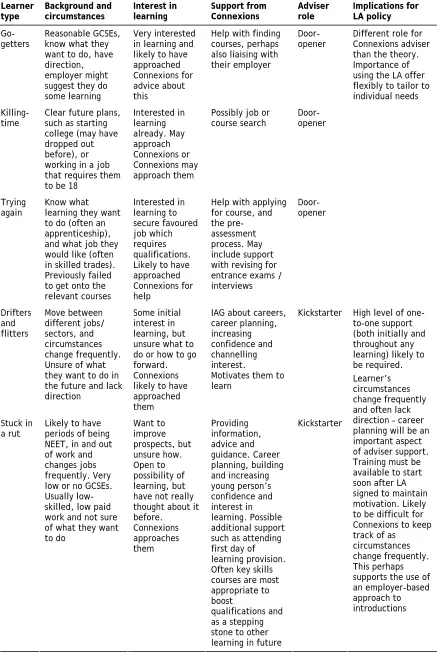
There are five types of (potential) learner into which young people broadly fit (see table below). For two types of learner the adviser’s role is as a ‘kickstarter’,
encouraging and supporting the young person to develop their interest in learning. In the other cases the adviser role is of a ‘door‐opener’, directing young people to
among non‐signers, Connexions advisers were not able to open the door to learning (ie by finding an apprenticeship). Other non‐signers might be ‘go‐getters’, but already have learning opportunities or progression available to them within their existing work.
Learner type Background and circumstances Interest in learning Adviser role
Go-getters Reasonable GCSEs, know what they want to do, have direction, employer might suggest they do
some learning
Very interested in learning and likely to have approached Connexions for advice about this
Door-opener
Killing-time Clear future plans – ie starting college (may have dropped out before), or working in a job for
which they have to be 18
Interested in learning already. May approach Connexions or Connexions may approach them
Door-opener
Trying again Know what learning they want (often an apprenticeship), and what job they would like (often skilled trades). Previously failed to
get onto a relevant course
Interested in learning to secure favoured job which requires qualifications. Likely to have approached Connexions for help
Door-opener
Drifters and
flitters sectors, and circumstances change Move between different jobs/ frequently. Unsure of what they want to do in the future and lack
direction
Some interest in learning, but unsure what to do or how to go forward. Connexions likely to have
approached them
Kickstarter
Stuck in a rut Likely to have periods of being NEET, in and out of work, and change jobs frequently. Very low or
no GCSEs. Usually low-skilled, low paid work and not sure of what
they want to do
Want to improve prospects, but unsure how. Open to possibility of
learning, but have not really thought about it before. Connexions has approached them
1
Introduction
The Activity and Learning Agreements Pilots were launched in 12 areas of England in April 2006. Activity Agreements are designed for young people (aged 16 or 17) not in employment, education or training (NEET) and operate in eight of the 12 areas. Young people have to be NEET for 20 weeks to be eligible. They receive an allowance (three variants of which are being tested in different pilot areas) and in return receive continuous support and agree to take part in tailored activities designed to help them progress towards an employment or education and training outcome. Learning Agreements are aimed at 16 and 17 year olds in jobs without training (JWT) and also operate in eight of the 12 pilots areas (ie both pilots operate in four areas and they each operate separately in four others). Under a Learning Agreement (LA), young people take part in agreed activities, which must include undertaking a designated course. If successful, young people may receive a monetary bonus (and in two areas their employers receive wage compensation).
The Department for Children, Schools and Families (DCSF) formerly the Department for Education and Skills (DfES), has commissioned the Institute for Employment Studies (IES), the Centre for Education and Industry (CEI) and the National Centre for Social Research (NatCen) to undertake the evaluation of the Activity and Learning Agreement Pilots. The evaluation of the ALA Pilots has three main strands:
■ a quantitative element, using surveys of young people to measure the impact of the pilots in comparison to a number of control areas
■ a programme theory element, focusing on testing some key aspects of the policy to identify what works or not and why
1.1
What is ‘programme theory evaluation’?
Programme theory evaluation is considered a useful tool for conceptualising programmes, guiding evaluations, planning empirical research, and analysing why programmes are successful (or not). It seeks to identify the ‘theory of change’ that lies behind an intervention and assess to what extent, why and how this change has occurred. In doing so, any unintended as well as intended outcomes are considered. The results of this type of evaluation are explanatory rather than providing a clear‐cut answer on whether a policy ‘works’, and can be fed back into the policy design in order to make improvements.
The guiding principle of this approach is that policy interventions are originally underpinned by theories. Pawson et al (2004) sum up the basic ‘if‐then’ logic of this as follows:
‘If we deliver a programme in this way or we manage services like so, then this will bring
about some improved outcome.’
Realist Synthesis: An Introduction, Pawson R, Greenhalgh T, Harvey G and
Walshe K, ESRC Research Methods Paper 2/2004 The theories that underpin interventions are informed by assumptions about a) the reasons for behaviour and b) what might cause that behaviour to change. But these theories are also mediated by individual, social and institutional effects that influence how policy is delivered. Hence, a key focus of programme theory evaluation is to examine how policy mechanisms are supposed to work and compare this to how they
do work. The evaluation can then assess whether there is any gap between the two, and if so, explore the extent, nature and causes of that gap, and resulting impacts on outcomes.
The outcome is not to provide an unequivocal answer about whether the ‘ALAs’ work, but rather to highlight the components that inform the successful operation of the policy (as well as ones that hinder it). This will help to refine the theories implicit within the policy design to better articulate what works, for whom, how, and in what circumstances, so that this learning can be embedded into any subsequent revision of the policy, or nationwide roll‐out.
1.2
Background
The theory elicitation stage presented 25 different theories and sub‐theories which were formulated based on a review of related research and in‐depth interviews with a number of key policy architects and stakeholders. These theories and sub‐theories were collated under different elements of the ALA policy: financial incentives, agreements, personalised support, flexible options, brokerage and progression. The next stage of the study entailed prioritising which theories to investigate within a programme of ‘focused studies’. In consultation with representatives from the Department for Children, School and Families (DCSF), Treasury and other key stakeholders, it was decided to prioritise research into the one‐to‐one support role of the Connexions worker in kickstarting young people’s interest in learning and encouraging them to sign up to a Learning Agreement.
1.3
Hypothesis and research aims
The theory for investigation in this Working Paper is as follows:
In Learning Agreement (LA) pilot areas where there is no financial incentive, it is the support, advice and guidance provided by the Connexions worker that will be enough to ‘kickstart’ the young person’s interest in learning and induce them to sign up to a Learning Agreement (the ‘kickstart’ theory).
This theory focuses on the young person’s view of the ‘something’ on offer within the ‘something for something’ model. It focuses on the Agreement‐only variant within the Learning Agreement pilots in order to elicit evidence about the impact of the support, advice and guidance on offer upon young people’s attitudes towards take‐up, isolated from the impact of the financial incentive. The overarching aim of this study is to ascertain how and why the support and advice on offer to the young person
persuades them to sign up to the LA (or not). Within this, we will seek to investigate the relative influences of the information, advice, support and learning options available, on young people’s decisions to participate.
The question of ‘whether’ the agreement‐only option is attractive, and to what extent (in comparison with the incentivised LA options), will be covered by the summative evaluation which includes Management Information analysis of take‐up across all variants.
1.4
Methodology
The research was conducted in two phases. The first phase, conducted in May and early June 2007, comprised discussion groups among Connexions staff delivering the LA. The second phase, conducted from late July to mid‐September 2007, comprised depth interviews with young people who had either signed up to the LA or decided against it, during the preceding months. Two Agreement‐only areas were selected for the study (Area 1 and Area 2).
1.4.1
Research among Connexions staff
Research with Connexions staff covered area managers as well as ground‐level advisers working directly with young people. Discussions were conducted in both areas during late May and early June 2007.
The aim of this stage of the study was to examine how the agreement‐only LA is promoted to young people; whether it is promoted differently to different groups of young people and if so, how and why; and what specific tactics are used by staff both to attract the initial interest of young people and to keep them engaged.
Outcomes and outputs from this phase
Findings from this stage enabled us to refine the kickstart theory by developing a model of how the LA appeals to certain groups of young people and how staff engage with them to get them signed up, independent of the influence of the incentive. This model could then be tested in research with the young people themselves. This section sets out how the theories were developed and presents the initial model of engagement based on the adviser interviews.
Engaging young people
One of the noteworthy factors arising from the adviser interviews was the use of a ‘drip‐drip approach’. Advisers said they used this approach with people who were not receptive at the time of the initial call to see if their situation had changed when they called again and whether they were more receptive to learning.
experience of working in a job without training and / or greater recognition that qualifications could help them to progress in the labour market.
Selling the offer
Advisers said the main selling points for young people were that learning through a Learning Agreement was ‘not like school’. This was important because some young people were reported to have had poor experiences at school and did not like classroom‐based learning. Another message advisers used to sell the Learning Agreement was that it could ‘help you get on in life’. They focused on the benefits of learning such as increased opportunity at work and increased earnings.
A further ‘selling point’ of the Learning Agreement for the young person was felt to be that it could be a stepping stone to further learning, for example undertaking key skills as a first step to an Apprenticeship.
Advisers said that take‐up of the Learning Agreement varied by sector, with young people in certain sectors less likely to take up the Learning Agreement, and that limited availability of provision could limit the offer. It was, therefore, important in the second stage of the project to speak to young people working in a range of sectors and from a range of geographies to capture any diversity of local learning provision available, to see how (if at all) this affected the offer from the young person’s
perspective. The availability of provision at the time it is needed was also identified as an issue. Suitable provision needs to be in place to capitalise on young people’s
interest in learning once it is ‘kickstarted’.
Developing a model of engagement
Figure 1.1 (overleaf) outlines the model of engagement that was developed as a result of discussions with Connexions advisers. It shows the importance of Connexions support, both as the catalyst to engagement and in providing stability and ongoing support throughout the process. The model shows the links advisers make between learning and the potential benefits, while also taking into account other factors that may influence whether or not an individual signs up.
The external factors (which could be a positive or negative influence) that may affect take‐up include:
■ the timing of the offer
■ the readiness and attitude of the young person to make a change
■ the young person’s parents’ views of learning
■ the young person’s employer’s views of learning
■ the availability of suitable training at the time it is needed
Figure 1.1: The model of engaging young people EXTERNAL FACTORS which can affect the influence of the advice and support provided by the LA adviser ie parents, employers, peers Connexions LA adviser approaches young person about LA, gives support, advice and guidance Young person (16-17) in a
JWT
Young person does not sign
LA
Young person signs LA
Young person feels part of something
Young person in a JWT
Young person enters learning Young person learning with a LA/ gains a qualification whilst working/ gains transferable and other skills Increase career prospects Increase earnings Buy consumer goods Further learning
Connexions LA adviser gives tailored, 1-2-1 support, advice and guidance to the young person. Connexions adviser works with provider, assessor,
parents and employers as necessary EXTERNAL FACTORS which can affect the influence of the advice and support provided by the LA adviser ie parents, employers, peers Connexions LA adviser approaches young person about LA, gives support, advice and guidance Young person (16-17) in a
JWT
Young person does not sign
LA
Young person signs LA
Young person feels part of something
Young person in a JWT
Young person enters learning Young person learning with a LA/ gains a qualification whilst working/ gains transferable and other skills Increase career prospects Increase earnings Buy consumer goods Further learning
Connexions LA adviser gives tailored, 1-2-1 support, advice and guidance to the young person. Connexions adviser works with provider, assessor,
parents and employers as necessary
1.4.2
Research among young people
The research with young people took place between late July and mid September 2007. It covered young people who had either signed up to or declined a Learning Agreement between April and June 2007, across both areas.
Generating the sample
The sample was generated with the assistance of the two Connexions areas involved, who administered a postal opt‐out to all young people who had signed up or declined the LA within the qualifying period for the research. No sampling was involved at this stage.
After the two‐week opt‐out period had elapsed, the remaining contacts were supplied to IES and stored securely in accordance with Data Protection regulations. Interviews were mainly booked by the researchers involved, over the telephone. Recruitment proceeded reasonably well for signers, but was notably slower for non‐signers.
Fieldwork
The fieldwork comprised depth interviews with young people. The vast majority of these were undertaken in person, although a small number were undertaken by telephone. This was mainly towards the end of the fieldwork period, although occasionally an interview was switched from face‐to‐face to telephone where it had not been possible to book up any more appointments in that area on the same day.
Interviews took place either in the young person’s home, or, if they preferred, an alternative neutral venue such as a local café. Interviews were recorded and
transcribed wherever possible, with the permission of respondents. Interview length varied considerably but averaged around 35 minutes for signers and 25 minutes for non‐signers. A £20 High Street gift voucher was offered as a thank‐you to each young person who took part in an interview.
Recruitment was more difficult than anticipated because there appeared to be a small number of inaccuracies in the sample, where young people who were recorded as having signed up to the LA did not appear to have done so (for example, they had not been working during the period they were supposed to have signed up, were not doing any learning or training, and claimed they had not spoken to anyone from Connexions for several months). A small number of young people recorded as non‐ signers also had little or no recollection of being approached about doing a Learning Agreement, although this may be related to the nature of their refusal, if they had declined quite quickly after a short cold‐call from Connexions.
sent out letter confirmations for all interviews, where time allowed, and also used texts to remind young people of their appointments. Some Sunday interviewing was
attempted as it was felt young people may have had more availability on a Sunday and would be less likely to cancel at the last minute. However, of the eight interviews booked for Sundays only three were actually carried out.
Achieved interviews and sample profile
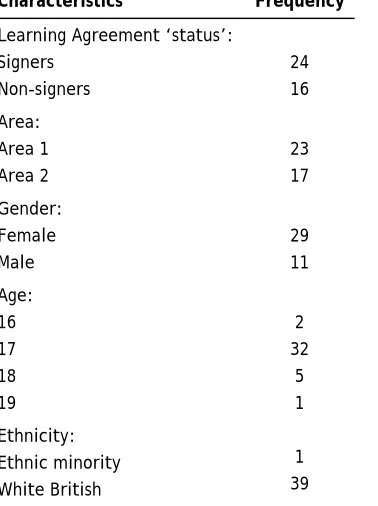
[image:20.595.217.406.276.529.2]Table 1.1 provides a profile of the characteristics of the achieved sample. All the young people’s names in this report have been changed.
Table 1.1: Characteristics and geographical composition of the achieved sample of young people
Characteristics Frequency
Learning Agreement ‘status’: Signers Non-signers 24 16 Area: Area 1 Area 2 23 17 Gender: Female Male 29 11 Age: 16 17 18 19 2 32 5 1 Ethnicity: Ethnic minority White British 1 39
1.5
Structure of this Working Paper
The remainder of this Working Paper is structured as follows:
■ Section 2 explores the educational and employment contexts for the young people who took part in this research.
■ Section 3 unpicks the decision to sign up to a Learning Agreement, taking into account first impressions, the importance of the adviser role in the decision to sign up, and influence of other factors, such as parents or employers, on the decision.
■ Section 5 explores the perceived benefits of doing learning through the LA for signers, and looks at whether the LA is helping young people to kickstart learning in the longer term.
The conclusion assesses the research findings in relation to the original hypothesis, presenting an updated version of the model (informed by young people’s
perspectives) presented earlier in this section.
1.6
Acknowledgements
2
Young People’s Contexts
In this section we examine young people’s educational and labour market contexts, in terms of experiences and attitudes towards school, and experiences of work and learning since leaving school. We also look at their current labour market
circumstances in terms of type of job, sector and pay, as these are all factors which may influence their decision to start a Learning Agreement or not. All the young people’s names presented in this report have been changed to protect anonymity.
2.1
Experiences and attitudes towards education at 16
Young people’s attitudes towards education and the value of qualifications were mixed. Just because some young people had left school at 16 did not mean they felt that qualifications were unimportant. Some had done so precisely because they felt their qualifications were enough to enable them to compete in the job market. Others felt they appreciated the value of qualifications more now that they had some
experience of working in the labour market without them, or with low grades.
2.1.1
Views on school and qualifications
Some young people (around one‐quarter of our sample) had attained reasonably good grades in their GCSEs (four or five A*‐C grades). A few had obtained nine or ten GCSEs of which none was lower than a C. Among these, many had stayed on in sixth form or started college, but later dropped out.
Most of the others had fewer qualifications or lower grades (no higher than Ds), but still felt that they had enjoyed school, mainly for the social aspects.
‘I hated school to be honest and wanted more money so I thought get out there, get a job,
earn some money.’ Alice, signer
This was not always the case, however: there were a couple of examples of young people who had done reasonably well in their GCSEs even though they reported having ‘bunked off’ for certain lessons in their final year, generally because they had disliked a particular teacher or found that subject ‘boring’ compared to other lessons.
Many of the lower‐attaining young people reflected that they learned better in a more practical and hands‐on environment than at school. A small number had already done vocational qualifications either alongside or instead of their GCSEs, for example a GNVQ in ICT, and NVQ Level 1 qualifications in Electronics, Joinery and Bricklaying. This meant that they were open to the idea of doing work‐based learning, which they felt fitted more with their preferred way of learning:
‘I wasn’t really very good with studying. I don’t like that type of work, using your brain
and everything.’ Tanya, signer
‘I never really liked school; I’ve just not been a great school person. I’m good at practical
things like making things; I built my own computer and stuff like that.’ Zac, signer
A small number of young people had encountered personal problems in their final year which had impacted on their exam performance and their feelings about school. For example, one had become ill around the time of her GCSEs and needed an
operation, while another described how his father had been seriously ill during the whole of his final year at school and this had made it difficult for him to concentrate on schoolwork and exams:
‘Me dad went into hospital for a year at the start of that year so everything didn’t seem that
important, especially not school.’ Zac, signer
Overall, there was a high degree of polarisation within signers and non‐signers, with each group fairly evenly split between those who had achieved four or five C grades or above, and those who had achieved no grades higher than a D. Only two of our sample said they had not passed any qualifications at all at school and these were both among the non‐signers group.
2.1.2
Reasons for leaving education at 16
Reasons for leaving education at 16 can loosely be categorised into ‘push’ and ‘pull’ factors according to experience of school and expectations of the labour market.
‘Pull’ factors
labour market spoke about wanting to be ‘treated like an adult’ and saw getting a job as being a key step in this transition.
‘They treat me like an adult (at work), not like school.’ Daniel, signer
‘I’m learning more about my job and the outside world rather than just education.’ Nyssa,
non‐signer
Occasionally entering the labour market was a ‘stop‐gap’ decision until they decided what type of course they wanted to do later in college, or until they reached the age of 18, when they could qualify to do particular age‐restricted jobs such as care work.
‘I didn’t go to college because I didn’t know what I wanted to do really in college. So I just
sort of took a gap year and I got jobs – like little jobs around for that whole year.’ Amy,
non‐signer
Some young people either had a formative ‘plan’ of what type of career they wanted, or wanted to ‘try out’ different jobs before they decided. Many of these young people valued work experience and/or work‐based training above gaining other
qualifications, in terms of getting a job and progressing in a career. Often they were entering occupations or sectors which have traditionally employed school‐leavers and
can provide fairly structured career paths for young people, particularly when combined with relevant work‐based training, such as construction or estate agency. One young woman working in customer services for a financial company reported:
‘At school with friends and everything, I just can’t keep my head down. I just didn’t want
to waste 2 or 3 years of learning and then not getting anything out of it. I just wanted a job
where I could settle down and progress from there. So I thought it was better for me to leave
school and look for a job.’ Nyssa, non‐signer
A substantial minority of young people had moved into jobs which they had been doing at school on a ‘part‐time and holidays’ basis, or through school work
experience. This was a tempting ‘pull factor’ for some because they already had the promise of a job, or knew they could get work fairly easily just by increasing their hours in these existing part‐time jobs.
‘She (her manager) said as soon as I turn 16 I’ve got a job, that’s why I went to that
because I knew I already had a job, just by going back.’ Tanya, signer
This was also the case for a small number who went into jobs that family or friends of family had ‘fixed up’ or found for them.
‘Push’ factors
same negative experiences. This was particularly the case where they had disliked particular teachers. Many of these young people felt that they had ‘had their fill’ of learning.
‘I just wanted to work really, college is too much like school.’ Becca, non‐signer
Drifting and exit by ‘default’
Some young people spoke of drifting out of education and into the labour market because they could not think of anything better to do. They may have been vaguely interested in doing some form of further learning, but they were uncertain about what they wanted to do or how to go about it.
A small number of young people had left education at 16 almost by default, because they had not got around to applying for college in time, or because a college course they had wanted to do had closed down and there was insufficient time for them to find a replacement.
‘My mum and dad was gonna move so I was gonna go college up there. But by the time
they decided no it was too late to apply for college here, so I just went straight into work.’
Carly, signer
Equally, a small number reported they had initially wanted to get into college but had failed their college application. This was usually to do day‐ or block‐release NVQ courses in construction subjects such as bricklaying, and tended to be because they did not have sufficiently high GCSE grades for Maths and English.
2.1.3
General attitudes towards education and qualifications
Generally young people valued ‘qualifications’ and regarded them as being an advantage in the labour market.
‘They get you through the door. Employers won’t look at you without them.’ Mandy, non‐
signer
However, some made a firm distinction between academic qualifications and work‐ based qualifications. Generally, work‐based qualifications were perceived to be more helpful because they were directly relevant to the workplace or to a particular job, and therefore could be used as ‘proof’ of skills and competence. This is consistent with previous research undertaken among young people in jobs without training
(Anderson et al. 2006) which found that many of the young people interviewed had a positive attitude towards training and intended to return to learning at some point in the future. One young woman (who had done a one‐year secretarial course after leaving school at 16) said:
‘If you haven’t got qualifications then you haven’t got any proof – qualifications will prove
Others reported that they needed to get particular qualifications if they wanted to enter a specific occupation or trade. One young man who was trying to get into an Apprenticeship as an electrician reported:
‘If you haven’t got any training they’re not going to set you on.’ Robert, signer
Many young people described how their views about the importance of qualifications had changed since entering the reality of the labour market.
‘I think they’re important because everyone wants them, but to me I’ve had lots of
experience in plumbing and that, so I can hold my own. But I’ve no – I want paperwork.’
Zac, signer
‘(Without qualifications) you just end up in a rubbish job like me.’ Joanne, non‐signer However, a significant minority of young people dismissed the importance of gaining further qualifications altogether and had seen their views confirmed more strongly by their experiences of work. These often already had reasonable GCSE results and were in a job which afforded them the opportunity to develop new skills (through on‐the‐ job, unaccredited training) as well as opportunity to take on a variety of roles or progress in terms of pay and promotion.
‘I had loads of training (in first job) and in (current job). I can take that to my next job, if
say I’m looking for another job that I want to pay more, I have all this experience, I have
training in customer services, using the phones… I have a lot of training which would help
me (more) than somebody that hasn’t done it.’ Nyssa, non‐signer
‘I know three of my mates that have gone to college and they’re still in the same job as what
I am. There’s no favour there from going to college, they’ve just got an extra grade.’ Tanya,
signer
2.2
Experiences of work and learning since leaving school
2.2.1
Going to college
Of those young people who had started college or sixth form at 16, the majority left their courses early – some after just a few days, although one left after 18 months of a two‐year course.
Reasons for leaving varied. The most common was that the course had not lived up to their expectations, in terms of the content and style of learning.
‘I went to college for a year but I didn’t enjoy it so I left. I’m going back… now I know what
I want to do.’ Jess, signer
‘I did go into college to do Hairdressing because while I were at school I did my NVQ Level
1 in Hairdressing as a short course. I wanted to carry it on but it weren’t the same, I
weren’t enjoying it as much… it were doing the same things over and over and over. And I
get bored quite easy.’ Casey, signer
The other main reasons for leaving college‐ or sixth‐form courses was lack of interest or choosing ‘the wrong course’. Previous quantitative research among 16‐18 year old early leavers from further education (FE) and work‐based learning courses has found that choosing the wrong course or the course not living up to expectations was the most common reason for early leaving (Simm et al., 2007). Some young people tended to have ‘drifted’ into the course because they could not think of anything better to do, and ‘drifted’ back out again, or else changed their mind about which subjects they were studying.
‘It was alright but my timetable was a bit awkward and I think I chose the wrong subjects
and it was too late to change, so I dropped out.’ Lisa, signer
Occasionally this was hastened by the opportunity to do a job which seemed more to their interest. For example, one young man had dropped out of A‐levels after his uncle offered him a job as a tyre fitter, with a view to doing a Level 3 Apprenticeship in Motor Vehicles Studies.
A small number had simply fallen behind with the work through difficulties with the level of the course, lack of interest in the subject, or juggling it with other
commitments such as part‐time work. One young person was advised to leave because he had fallen so far behind: ‘they just told me it would be best if I left instead of
getting kicked out’.
2.2.2
Going into work
The importance of family contacts and previous work experience
much more common for young people who had signed Learning Agreements to have found their job via family contacts or previous work experience, compared with those who had declined. This may be related to the types of job involved. For example, a number of signers were working in construction jobs; they had got the job through a family member or friend, and they had to do some form of work‐based training if they were to fully qualify in the trade. This meant that they were often more open to doing some learning. Similarly, it may be related to the more positive relationship between the young person and their employer.
Different transitions into and within the labour market
Overall, five broad groups of young people emerged from the patterns of job entry and job transition in our sample, and these are outlined below.
■ ‘Go‐getters’. These young people mainly had good or reasonable GCSEs, or had ‘topped up’ low GCSEs by doing a vocational course afterwards. Usually they were very ambitious and generally had a plan of the type of work they wanted to do and how to progress into it. Although some recognised the value of qualifications, most rated work‐based training more highly than general academic qualifications such as doing AS or A‐levels. A sub‐group of the ‘go‐getters’ were a small group, mainly of young men, who had a clear idea of the job they wanted to do (usually in a skilled trade). They were working in a relevant entry‐level construction job such as labouring, but lacked the grades to get into an Apprenticeship or relevant NVQ course.
Pen portrait: Tanya (signer)
Tanya has just turned 18. She left school at 16 with mixed GCSEs ranging from B to G. She always wanted to do care work and worked part-time in a café until she was old enough (17). She has been working for a care agency for just over a year now and they have provided her with various short courses such as first aid and manual handling. She is paid around £6.60 per hour, higher for working at weekends. She wants to do a care-related qualification and progress in care work over the next 5 years.
Pen portrait: Gary (signer)
Gary gained mixed GCSEs ranging from B to D. He left school at 16 to go into an entry-level bricklaying job which was set up for him by a friend of the family. He had always wanted to do this type of work and very much enjoys it; he has been in the same job for over a year. He is keen to become fully qualified as a bricklayer so that he can progress and earn more money. However, he has failed entry to NVQ Level 2 Bricklaying course due to his low GCSE grades for English and Maths. He would like to continue working as a bricklayer but he needs the qualification to
Pen portrait: Claire (non-signer)
Claire left school at 16. She obtained 8 GCSEs mainly at D grade. She always wanted to work in an office and did a one-year secretarial course after leaving school, which she passed. Since then she has done three different office jobs, and has recently started a new one earning £12,500 per year. In all her jobs she has used her skills and received (un-accredited) training.
■ ‘Killing time’. These young people generally had reasonable or mixed GCSEs. They usually had an idea of what they wanted to do, but had to wait until they were 18, or were working as a ‘stop‐gap’ until they could start college. Some had started college already and dropped out, but were planning to return.
Pen portrait: Leanne (signer)
Leanne left school at 16 and got mostly Ds in her GCSEs. She got a full-time job at the café where she used to work on Saturdays almost straight after leaving school. Her plan is to do care work and she knows of a specific agency which will provide her with a job and training once she is 18. Her sister did the same job. At the moment she is earning money from her waitressing job so that she can afford driving lessons, as she will need to be able to drive to do home-based care visits.
Pen portrait: Greg, (non-signer)
Greg is 17. He got reasonable GCSE results (Bs, Cs and Ds) and started A-levels in Maths and IT, and a BTEC in Business, at college. He dropped out after a few months because he had got too far behind in his coursework. Originally he started looking for a job in Accounts but found he needed better qualifications. Over the past few months he has worked in a call-centre, which he left because he didn’t like the work, and is now working part-time as a waiter. He plans to return to college in September as he would still like to become an accountant, and will be doing A and AS-levels.
■ ‘Drifters and flitters’. This group generally had mixed or low GCSE results (eg grade C to E) and were unsure of what sort of job they wanted to do. More often than not they had moved between a variety of jobs and/or sectors, or started and dropped out of college, and were lacking in career direction or just simply ‘trying out’ various options until they found something they liked.
Pen portrait: Carly (signer but then changed her mind)
■ ‘Stuck in a rut’. These young people tended to have low or very low GCSE results (eg grade Es or below) and a few had spent extended periods NEET. They
generally worked in very low‐skilled and low‐paid jobs and were unsure about what sort of job they really wanted, or – if they had an idea – how to go about getting it.
Pen portrait: Zac (signer)
Zac is 17 and left school last year. He missed a lot of his final year at school due to family
problems. Initially he was predicted to get good grades in his GCSEs but because he had missed so much coursework, he only got Ds and Es. He didn’t want to do re-sits as he disliked school. He has done lots of informal labouring work since leaving, but had no formal work. He feels he can ‘hold his own’ in various jobs like plumbing and fencing, but he has no qualifications to prove it, and doesn’t really know what sort of job he would like to do.
Pen portrait: Joanne (non-signer)
Joanne turned 17 in May. She never really liked school and stopped attending from her early teens. She was NEET for around nine months before getting a job at a local catering company, with help from Connexions. She has no qualifications, which she now regrets as she dislikes her job and is paid ‘not very much’. She has no clear idea of what sort of job she would really like.
2.2.3
Influence of parental attitudes to education and employment
Most young people reported that their parents were either positive or ambivalent about them staying on in education at 16. Some reported that their parents had been disappointed when they had dropped out of college courses, or had actively tried to encourage them to stay on:
‘They definitely saw it as a failure.’ Mandy, non‐signer
More young people said that their parents simply let them get on with it and make their own decisions, as long as they were happy.
A few reported that their parents felt it was more realistic for them to leave school, get a job and look for work‐based training than to stay on and do more academic
qualifications:
‘They thought it was better really because I’m not exactly bright so I probably wouldn’t
have got the grades I wanted even if I had stayed on at school.’ Samantha, non‐signer
There was only one young person whose family had directly influenced him to leave college, and this was only because they knew he was not enjoying his course. He had been ‘tempted’ from his A‐level course by the offer of a job from his uncle:
‘I was talking to him about leaving school and he said well why don’t you come and work
A small number who had been NEET at various points reported that their parents or wider family network had helped them by ‘looking out’ for job opportunities. Some young people who had been NEET for extended periods reported coming under pressure from their parents either to find a job or to go back into education.
2.2.4
Previous contact with Connexions
Many young people – across the full range of trajectories – had been in some prior contact with Connexions since leaving school. Ironically this tended to be less
common among the ‘go‐getters’ who generally had a clearer idea of what they wanted to do and needed less support from Connexions to make the transition into
employment – although not necessarily employment which automatically had the training they needed attached.
Most young people had previously approached Connexions for ad hoc jobsearch support such as looking at job boards in Connexions drop‐in centres or getting help to write a CV. Many of those who had experienced periods being NEET had received more ongoing support, for example a few had attended Entry to Employment (E2E) programmes which they said had helped them to get their first job.
A small number of young people had received or were still receiving Connexions support for more pastoral issues such as housing problems. One young man reported that he had received mentoring and anger management support via Connexions, while he was still at school.
This is important because it shows that Connexions already has a ready‐made profile among this group of young people, even if the young people were not being
systematically ‘tracked’ because of their status in a job without training. Most young people had positive or ambivalent attitudes towards Connexions before they were approached about doing a Learning Agreement; only a handful were negative and this tended to be because of a perceived lack of tailored support.
2.3
Current circumstances
2.3.1
Employer size and sector
Among those who were working, the vast majority were employed in small establishments employing ten or fewer staff. Included within these, some were
working in branches of larger nationwide companies, in particular in the retail sector. A couple of the young people worked in large processing centres of financial
companies and one worked at the head office of an estate agency.
The main sectors of employment were retail, office/administrative work, and catering. There was a strong gender distinction and young men tended to be working more in trades such as construction or motor vehicle repair, whereas young women worked in retail, office/ administrative work, catering and care.
The main distinction between signers and non‐signers within our sample was that non‐signers appeared more likely to be temping or to have shifted between different jobs, something which may make it more difficult for them to settle on a course because they feel less secure in their work.
2.3.2
Working hours
Young people were divided fairly equally between those contracted to work full‐time (30 hours/week or more) and those contracted to work part‐time. Among those working part‐time, the number of contracted hours ranged from a minimum of four hours per week in one job at a retail store to around 24 hours per week. However, almost all the young people who were on part‐time contracts had variable hours, and covered shifts for people off sick or on holiday. It was not uncommon for them to be in a job contracted for 16 hours/week but actually be working the equivalent of full‐ time, over 30 hours/week, on a regular basis.
Signers were fairly evenly split between full‐time and part‐time; however, non‐signers predominantly worked full‐time.
2.3.3
Pay levels
At the time of the research, the National Minimum Wage for young people aged 16 and 17 was £3.30 per hour. This rose to £4.45 per hour for people aged 18 to 21, and £5.35 per hour for those aged 22+.
quantitative element of the evaluation because it potentially impacts on the potency of the message that doing learning ‘will improve your pay’.
Young people’s living circumstances, peer groups and previous experience of employment impacted on how they felt about their level of pay. For example, one young woman who had been NEET for a few months before getting her job was initially happy just to be working and did not mind that she was working for the minimum wage of £3.30 per hour in her part‐time retail job. Since then she had obtained a second part‐time job for £4.45 per hour, to top up her weekly pay, as she realised that £3.30 per hour did not stretch very far. Another young woman was relatively happy earning £4 per hour in her part‐time job as this was all she needed to cover her outgoings and save up to pay for driving lessons – she lived at home with her family and still received a small weekly allowance to top up her earnings.
Those in relatively low‐paid jobs did compare themselves with their friends.
Although some said they earned around the same, others were conscious they earned less. Usually they were comparing themselves to friends working in large national chains, while they worked for small independents. One mentioned she had been for an interview at a nationwide supermarket chain offering £6.50 per hour, which she found ‘amazing’.
Some young people were on a ‘training wage’ – usually around £80/week for a full‐ time week. Although they were not particularly happy with this they usually accepted it as being ‘the norm’. The most recent published research into
apprenticeship pay rates found that take‐home pay averaged £114/week among 16‐18 year olds (Ullman and Deaking, 2005). Most young people expected that their pay would increase rapidly once they became fully qualified, for example one young man was told he would be earning £200/week once he achieved his NVQ Level 2. This was particularly the case for young men working in general construction jobs, who aspired to learn a trade, but less so for young women working in trainee administrative roles, where future pay progression appeared less clear‐cut.
There was evidence of pay progression, either in the same job or between different jobs. One young woman had started working in a national catering outlet on leaving school at 16, earning £3.95 per hour. Her wage had increased in each of her two subsequent jobs and, now aged 18, she was earning £5.60 per hour and working in an office‐based job. Another (aged 17) had negotiated a pay rise for herself:
‘It were £3.30 but because I were doing everything, I turned around to my manager and
says it’s not fair that I’m getting paid the least and having to do everyone else’s work. So
she went well are you thinking about leaving? I said well yeah, seriously I am. And she
went, if we give you a pay rise will you stay? I said yeah, how much, and now I’m on
2.3.4
Whether young people liked their job
There was a real mixture in terms of how much young people liked their job. This was usually influenced by the following factors:
■ whether they saw it as related to a long‐term career
■ whether they felt they had opportunities for progression/promotion
■ whether they got on with their colleagues/manager
■ whether they found the work itself interesting or enjoyable
■ whether they were happy with the amount they got paid.
3
Deciding Whether to Sign a Learning
Agreement
In this section we explore how and why young people become engaged in the Learning Agreement, including how different factors appeal – or not – to different young people. We also examine the role of various influencing factors on young people’s decisions to sign up or not, in particular the role of the Connexions adviser in this process.
3.1
Engaging young people
The majority of signers, and to a lesser extent non‐signers, were already interested in undertaking some learning prior to hearing about a Learning Agreement. This meant that for many signers the Connexions advisers were ‘door‐openers’, helping them to find and apply for relevant courses, rather than providing a ‘kickstart’ for their interest in learning. The vast majority of both signers and non‐signers had some contact with Connexions before the Learning Agreement, either at school or once they had left.
Young people were engaged in one of three ways: a ‘cold’ call from Connexions (although most young people had heard of Connexions or been helped by them in the past); going to a Connexions drop‐in centre or contacting Connexions themselves; or through an employer or work colleague.
3.1.1
‘Cold’ calling
Among the signers it seemed not to be so much ‘cold’ calling as ‘lukewarm’ calling. Nearly all the signers and non‐signer had some prior contact with Connexions, whether that was through a careers adviser at school, or at a drop‐in centre for help and advice with issues such as job search, housing or courses once they had left.
could fully explain to them what was involved. Nearly all these signers said that they were already willing and interested in doing some learning, primarily (as will be discussed later) because they wanted to improve their job prospects and / or qualifications. For example, one signer said:
‘I wanted to do it, when she spoke to me I did want to do it. I thought well you know it’s a
good opportunity to take and then I might as well go for it…’
Interviewer: ‘So it was quite good timing in the way that she phoned you up at a time when
you were thinking you might want to do it [some learning]?’
‘Yeah!’ Lucy, signer
3.1.2
Young people approach Connexions
A number of young people (both signers and non‐signers) said that they had initiated contact with Connexions and through this had found out about the Learning
Agreement. They did not approach Connexions about the Learning Agreement, but for help with finding courses or with job search. Reflecting their orientation towards working rather than learning on leaving school, more young people initially
approached Connexions for work‐related rather than learning‐related queries, and particularly for help with finding a ‘better job’ if they were already in work. However, some young people initially contacted Connexions for help finding work when they were unemployed.
Those who contacted Connexions primarily with a learning enquiry included signers and non‐signers. These young people were often interested in how they could apply to do apprenticeships and were looking for help in doing so.
3.1.3
Through an employer or work colleague
A small number of signers said they found out about the Learning Agreement primarily through their employer or work colleague. One signer who worked as an administrator in a cleaning company said that her manager had approached her and asked if she would be interested in doing a course at work.
Sometimes there was a ‘learning role model’ at work who was doing some learning alongside work and who advocated doing this to the young person. For example, one signer who worked in retail said that:
‘I found out from there because a girl who works there, was like “oh I’m doing an NVQ in
customer service and retail, you should do it as well, it’s really good”. And I was like “yeah,
I might do actually”, and then I just got into it from there.’ Sarah, Signer
Council (LSC) Train to Gain service. Young people would then have a ‘learning role model’ and the employer might already be receptive to workforce development.
One signer said his employer (who was also his uncle) had got in touch with Connexions to ask about learning and the possibility of his nephew doing an apprenticeship in motor vehicle studies.
3.2
Reasons for signing a Learning Agreement
Most signers had a positive first impression of the Learning Agreement offer. The majority of young people were already interested in doing some further learning, and were therefore initially pleased that the opportunity had been presented to them. Others, although not actively seeking learning opportunit