....
c:::
~Development
agents
:I
8spain
c
a.
0
u.
w
c
w
0
European Centre for the Development of Vocational TrainingLIBRARY
***
*
*
*
*
*
*
...
c
Cl)
E
::J
(.)
0
c
a..
0
u.
w
c
w
0
Development agents Spain
Enrique Retuerto de Ia Torre
First edition, Berlin 1988
Published by:
CEDEFOP - European Centre for the Development of Vocational Training
Bundesallee 22, D-1 000 Berlin 15
Tel. (030) 88 41 20, Telex 184 163 eucen d, Telefax (030) 88 41 22 22
The Centre was established by Regulation (EEC) No 337/75 of the Council of the European Communities
PR0VEEKSEMPLAR TIL SALG GENNEM
PUBLI KAT IONSKONTORET
8ELEGEXEMPLAR • DIESE VERC>FFENTLICHUNL ·sT ERSCHIENEN UNO WtRD VOM AMT FOR VEROFFENTLICHUNGEN VERTRIEBEN
·rlTir'PA<!>O 6ETf~ft.'\TOE 6HMOL:IEY8E:HOL:
Anr
iN Ynl-IPE~: 1,\ F11 I !>·1MQN f.K~o;;-;r:ON
,;PEClMEN CO?Y FUuLISHED BY THE OFFICE
_:OR OFFICIAL. PUBLICATIONS
EXEMPLAI RE TEMOIN DE MISE EN VENTC PAR L'OFFICE DES PUBliCATIONS
GR ISBN 92-825-8296-5 FR ISBN 92-825-8298-1 PT ISBN 92-825-8299-X
Cataloguing data can be found at the end of this publication.
Luxembourg: Office for Official Publications of the European Communities, 1988
ISBN 92-825-8297-3
Catalogue number: HX-52-88-631-EN-C
Reproduction is authorized, except for commercial purposes, provided the source is acknowledged.
CEDEFOP
European Centre for the
Development of Vocational Training
Project: Regional Development and Vocational Training
Subject: Development Agents
Country: Spain
Introduction
I. Promotion Agents for Vocational Training and Integration into Working Life
Administrative framework
Profile
Functions
Selection process
Analysis of function
Training
II. Agricultural Extension Agents
Page
1
6
8
10 11 13 19
Background and organizational framework 21
Functions 25
Profiles, status, training 30
III. Other Training Opportunities for Development
Agents 35
IV. Elements of Experience Shared with the
Benelux Countries 39
V. Proposals Concerning the Profile, Qualifi-cations and Training Programmes for
Development Agents 41
Annex 1: Questionnaire
Introduction
l. The expansion of production and income over the past
20 years in Spain has been accompanied by a clear trend towards concentration. The regions and provinces of the
interior {with the exception of Madrid, Valladolid and Zaragoza) have shown a constant decline in their popula-tion and producpopula-tion indicators.
Since 1979, family incomes in these areas have been in relative decline, this despite a marked increase in the transfers of funds from the public sector {mainly
pen-sions and unemployment benefit), to the less developed
provinces.
Exceptional cases with a long-standing agricultural
tradition such as Malaga and Almeria {southern Spain) and Gerona {northern Spain) show how exogenous factors - in these cases tourism - are of decisive importance for
development.
However, in Almeria and also in northeastern Spain
{Leri-da as well as Gerona), the entrepreneurial spirit of the local populations and the stimulating impact of factors such as information and organization, have been
But what are these agents doing in 1986? Which of them
are closest to the instruments and management base for development? These are the questions which, rather like
coordinates, will facilitate the structuring of this report.
2. Castilla y Leon and Castilla-La Mancha, regions
locat-ed in the interior, though representing only 2 of the total of 17 self-governing (autonomous) communities,
ac-count for more than one third of the national territory; at the same time, their population hardly amounts to 11% of the total population of Spain. Taking the mean na-tional value added per capita as 100, these two regions,
ranking below Andalucia and Extremadura, fail to achieve 90 points on this scale.
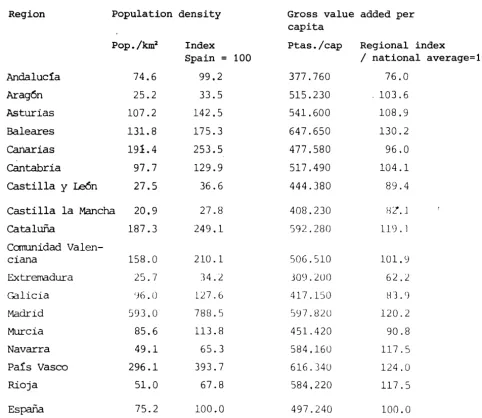
The following figure shows the comparative situation of the various regions/self-governing communities of Spain, and also sets out the social and economic framework of
reference for the activities and careers of the social development agents who are the subject of this report.
The two types of agents selected, being the most repre-sentative for deployment throughout the country and for the nature of their functions within the framework of the development of human resources, will of course be of
·3
Figure 1: Comparison between the regions of Spain on the basis of demographic and economic indicators
(1982 figures)
Region Population density Gross value added per capita
Pop./km2 Index Ptas./cap Regional index
Spain = 100 I national average=100
Andalucfa 74.6 99.2 377.760 76.0
Arag6n 25.2 33.5 515.230 . 103.6
Asturias 107.2 142.5 541.600 108.9
Baleares 131.8 175.3 647.650 130.2
Canarias 191.4 253.5 477.580 96.0
Cantabria 97.7 129.9 517.490 104.1
Castilla y Le6n 27.5 36.6 444.380 89.4
Castilla la Mancha 20.9 27.8 408.230 H?. J
Catalufu 187.3 249.1 592.280 119. 1
Comunidad
Valen-ciana 158.0 210.1 506.510 1()1. <)
Extrema.dura 25.7 ]4.2 309.200 62.2
G:::llicia <)(). () L27.6 417.150 W3. <)
Madrid 593.0 788. '.) :)<J7.82U 120.2
Murcia 85.6 113.8 451.420 90.8
Navarra 49.1 65.3 584.160 117.5
Pais Vasco 296.1 393.7 616.340 124.0
Rioja 51.0 67.8 584,220 117.5
Espafia 75.2 100.0 497.240 100.0
[image:8.572.47.529.213.631.2]Within the context of the 12 Member States of the Euro-pean Economic Community (EC), the per capita domestic
product in Spain ranks in tenth place, lagging only slightly behind that of Ireland and exceeding only the figures for Greece and Portugal.
The Spanish regions mentioned (Castilla y Leon, Castilla-La Mancha and Extremadura) rank on average at a level equal to that found in the southern part of Italy.
3. Proceeding from the hypothesis that economic and social development depends largely on the development of human resources, furthermore from the fact that in Spain
i t has traditionally been the central government authori-ties which have planned regional development and that the selfgoverning communities with their regional mandate -still of very brief historical date - have not yet had time to crystallize their own experiences, two types of
development agent have been selected for the purposes of this report, each acting at a different level in terms of promoting human resources. In the first case the agent's action is governed by the central authorities and extends
over the entire national territory (and consequently also in the regions/self-governing communities), and in the other case the agent's action is planned by and for a
5
The two types of development agent selected for this
analysis are:
a) promotion agents for vocational training and
integra-tion into working life, who are centrally managed by the National Employment Institute (Ministry of Labour and Social Security);
b) agricultural extension agents, who work in the
agri-cultural sector and are accountable to the chancellory or ministry of the respective regional government.
Each of these agents and the models which they represent
is analysed separately, and the report closes, by way of conclusion, with brief reference to what both represent in their development work and their similarities as
public officials working in this field.
This analysis is structured in three sections: the first provides a description of the functions, objectives and accountability of the agents concerned as set out by the
relevant legislation; in the second the analysis is cen-tred on the role actually played by these agents; and the third section explores the training process undergone in
connection with both development agent profiles.
The report closes, as could be expected, with a number of brief conclusions on various aspects to which the
super-ordinate authorities should attach particular importance - as much from the training viewpoint as from that of work management_ - so that each day brings further
I. Promotion Agents for Vocational Training and
Integra-tion into Working Life
1. Administrative framework
In 1985 the Ministry of Labour and Social Security pre-pared a number of studies and standards which resulted in
the launching of the National Vocational Training and Integration Plan (PLANFIP), which became a statutory
instrument with the Ministerial Orders of July 1985 and February 1986. The National Employment Institute (INEM) was commissioned with implementing the Plan.
As a result of this measure, INEM had to increase its training target figures fivefold over the corresponding
figure relating to 1984 and the preceding years. Of course, i t also had to provide for additional manpower
and develop new management approaches.
It therefore had to draw from the training opportunities market a supply of reactions and responses which would do
justice to this call for multiplying the resources for training human resources and facilitating integration into working life.
A large number of private vocational training centres subsequently joined INEM's vocational training network,
7
institute. At the same time, a huge number of special-ists with a wide range of experience and qualifications were recruited and commissioned with the task of provid-ing a wide supply of courses sufficient to cater for the entire national territory (more than 5,000 per year).
Of course, this operation harboured the risk of not only not being able to monitor the courses and the quality of the instruction but also of not being able to offer the contents or specialized know-how best suited to meet the needs of the labour markets.
It is one thing to plan global training objectives, even to reach decision on the programmes which are to be given priority (young people, the long-term unemployed, etc.), on the basis of a scheme which is well aligned with the functioning of the European Social Fund (ESF), but i t is quite another, a much more complex task, to move down to the regional and local levels. These are levels at which the demand can be more accurately assessed by those
responsible for each small unit but which remain beyond the grasp of macroeconomic information schemes and
2. Need for promotion agents for vocational training and
integration
There thus emerged a need to appoint agents on a nation-wide basis to be responsible for the many and varied tasks required by a human resource development plan as ambitious as that under review.
At the Ministry of Labour and Social Security i t was
decided that INEM should recruit the personnel concerned, assigning them the title of promotion agents for voca-tional training and integration, in order to meet the requirements set out in the PLANFIP. 370 such promotion
agents were recruited at the end of 1985, and a further 420 were recruited in February 1987.
These promotion agents are dispersed throughout Spain on the basis of a ratio proportionate to the number of
trainees envisaged by the National Vocational Training
and Integration Plan; from the functional viewpoint they are accountable to the INEM Provincial Directors.
3. Profile of the promotion agents
The profile envisaged for these promotion agents is that they should hold an intermediate or higher education
qualification, depending on whether they are to be mainly concerned with coordination and extension work (work
9
particular special functions), or with direct programme
promotion work {programmes for which i t is necessary to find experts in particular specialisms qualified to
spec-ific levels and also the centres to run such training
programmes; these must in turn be monitored with regard
to course implementation), involving a large proportion of work in the field of information and support for
self-employment, establishing a business venture, etc.
The minimum requirement 1 ) is complemented by a
require-ment for a minimum period of professional experience of six months, with preference being given to work on labour market studies, occupational structure analyses, work process analyses, curriculum design, selection and evalu-ation, occupational guidance, provision of training, etc. The last group recruited was required to have extensive knowledge or experience in the field of the new
technolo-gies.
1) In the first group recruited, trainees with a background in the social sciences predominated; in the second group, quotas were reserved for trainees having completed studies
Also considered valuable are characteristics such as ability to adjust to working with different people in different situations, clear aptitudes for communication and team work, a sense of responsibility, and practical administrative experience.
For those with higher education qualifications who are to be responsible for extension or coordination work, the qualities sought are easy-goingness and a gift for parti-cipative leadership; in this case special emphasis is placed on experience in the design and implementation of training courses for trainers or those leading to inte-gration into working life.
4. Functions
With regard to the functions to be discharged by the promotion agents, there is once again a need to distin-guish between:
4.1 Those who, irrespective of their educational and professional background, will be largely concerned with
- promoting and coordinating tests to ascertain the apti-tudes of the job-seekers;
- analysing the job opportunities offered by employers; - organizing group sessions to provide information for
job-seekers on finding employment, creating self-em-ployment opportunities and integration into working life;
ll
4.2 Those whose functions are basically the following:
- identifying job opportunities in firms and also voca-tional training requirements on the subsectors of the
employment market;
- organizing the involvement of the social agents in the
planning of training and integration activities;
- negotiating the deployment of resources and preparing
training contracts and agreements;
- carrying out follow-up and evaluation work with regard to the programmes and measures;
- participating in selecting and monitoring the (public and private-sector) vocational training centres
coop-erating in the scheme.
5. Selection of promotion agents
5.1 The candidates' curricula vitae are examined and
assessed with special importance being attached to any experience with vocational training processes (as
men-tioned in connection with the profiles), and experience in handling working groups and analysing economic and social information.
Since many of the candidates are required to work in self-governing communities where the language spoken is not Castilian Spanish (in particular in Cataluna, Comuni-dad Valenciana, the Balearic islands and Galicia),
5.2 Once pre-existing merits have been assessed, there follow psycho-technical tests to assess the suitability for meeting the requirements of the job.
5.3 Finally, those who are successful in the tests are interviewed with a view to obtaining detailed information on their experience and aptitudes on the basis of the following factors:
- personal circumstances;
- initial and continuing training (including the factors
which were determinant for the training undergone and the interest shown in this field of work);
- professional experience (with data on the career path, reasons for changing positions, aspirations, etc.); - specific preparation for the post (familiarity with and
mastery of the work techniques and processes);
- motivation and interest with regard to the new post, including the disadvantages which i t implies;
- main personality traits (the significant factors ob-served during the interview);
In conjunction with the above, a suitability diagnosis is then prepared taking into account the job content and the
13
6. Analysis of the actual function of the promotion agents for vocational training and integration
The technique used for this purpose was a survey and consultation process: a questionnaire was sent to those
interested and group meetings were held under the leader-ship of two promotion agents previously trained for this purpose. 2 )
Thirteen direct replies were rece~ved from promotion agents in the two regions/self-governing communities
Castilla y Leon and Castilla-La Mancha; the questionnaire is included in the Annex.
The replies were then summarized to show the attitudes
and reactions of the protagonists to their functions. This is undoubtedly the most informative and direct man-ner of charting out a description providing a graphic image for the purposes of this section and allowing for a comparison between that which the central administration intended from the development agents' interventions and the scope afforded them by the real environment and the government authorities.
A word of caution: the following description is not
intended to incorporate a critical judgement on the acti-vities of the public administration with regard to this subject; i t is merely an account of the actual situation facing the protagonists by virtue of which the reader can better understand the difficulties and obstacles - both real and administrative - which the Spanish public auth-orities will have to overcome in their effort to ensure that the development agent can discharge his functions in line with a predetermined plan or programme.
7. Functions to be developed
7.1 All the agents consulted mentioned that their
tasks should be related to that indicated in the PLANFIP, and by way of explanation referred to the following:
- studies on human resource training needs and the em-ployment needs identifiable on the labour market; - vocational guidance and information;
- planning and monitoring of training measures;
- support for self-employment initiatives and for occupa-tional promotion activities in general.
7.2 With regard to the time devoted to specific tasks involving technical support for development projects, the replies varied greatly, ranging from those from some
15
On the other hand, the replies c~ncerning the role of "animator" or development agent largely reported a range
of between 15 and 50% of the tot~l work time.
Liaising between institutions and social agents does not
appear to.be a task of relevance'to these promotion
agents, and the question which was intended to provide information on this point provoked a range of replies which were difficult to interpre~. By way of an initial
I
attempt to interpret them, the vie~ must be that though not yet acting as liaison agents, they do have personal contacts with authorities and/or companies, associations and cooperatives, this, however, being at the request of the latter or when such contacts form part of the
organi-zational work in launching some activity which is typical of the Institute in which they are employed.
Contacts with representatives of the workforce play a much less significant role.
7.3 When asked about their perception of social needs in
their respective areas, between 40 and 60% held the
personal view that employment needs exist and a likewise high proportion (30% on average), referred to vocational training needs; undoubtedly here i t will necessary to
Of much greater interest was the information that the need for "more collective participation in
decision-making" was recognized by the majority of those surveyed, the relative weighting being reported as ca. 10%.
The agents surveyed did not consider "citizen organiza-tion" to be a felt or expressed need.
7.4 Of particular importance will be the reaction
forth-coming from the consultations on the agents' positive contribution towards meeting these needs.
One interesting result in this respect is to note that the promotion agents in one of the regions replied by
making their potential positive action in this field conditional on action to "facilitate their carrying out the functions indicated in the Plan in whose service they are working". At the same time, their colleagues working 1n another region, regarded their activity as positive as i t "provides orientation", "provides information", "pro-motes training", "supports the organization of
training-employment arrangements", etc.
17
Undoubtedly INEM will take up this information to press for a reorientation of future training programmes for its promotion agents.
As will be seen in the next section, the second group of training promotion agents recruited by INEM undergo an
initial training programme which is much more cohesive than the ten days of ill-structured information received by some of those surveyed.
The promotion agents in the first group of 370 reported deficits in both initial training and in the guidelines forthcoming from the central departments to the terri-torial delegations responsible for their activities,
including work to pool resources and compare experiences.
It is true that the years 1985 and 1986 were trial years
for INEM, as has been stated by its management; the full accession of Spain to the EC and the application of the
Community structural funds, together with the fact that the regional communities were experiencing their first
phase of self-government, makes i t necessary to be less than incisive or radical in undertaking a critical
analy-sis.
The target figures of the National Employment Institute,
as mentioned at the outset, have increased at an extra-ordinary rate, and perhaps five years must elapse before i t is possible to have better and more cohesive analyses of the application and administration of development
7.6 Finally, reflecting through this investigation pro-ject is the fact that the promotion agents for vocational training and integration perceive, in a somewhat i l l -defined manner, the presence within their field of action of "other types of development agent".
In this connection, a large number of them referred to "street animators" or "social animators", whereas in reality the persons concerned are still ill-defined fig-ures carrying out tasks which are almost exclusively of a cultural nature within urban communities.
7.7 To extract the most salient points from the observa-tions made by the promotion agents in these two regions in the Spanish interior, the following points warrant consideration:
- a specific weight imposed by administrative tasks which prevail over others of an informative or supportive nature;
- a lack of basic information and instructions to accom-plish the task of supporting self-employment ventures and collective movements;
- little coordination and pooling of resources concerning the work of the various promotion agents assigned to different areas; this should by done by some central or regional institution;
19
At this juncture the point should once again be made about the brief time which these agents have had to gain experience and test their qualities, despite the impor-tance of the presence and potentialities of such agents from the viewpoint of both their territorial spread and also the scope of the National Plan in the service of which they are carrying out their work.
8. Specific training for promotion agents
8.1 After what was noted in the preceding section on the deficits felt by the current promotion agents for voca-tional training and integration, i t would seem useful to examine in detail the initial training programme which is currently undergone by the groups recently recruited by INEM who will have similar functions to discharge.
Undoubtedly, gaps, anomalies and inadequacies will be seen to separate this training programme from the reality of working life. Nevertheless, in terms of both duration and intensiveness, this is a programme which is the
product of that first experience and has been developed by an organization which for more than one year now has been administrating the Plan implementation.
The common modules concern:
the organization and responsibilities of INEM in the
field of promoting employment and training;
- identifying needs in relation to human resources; - work analysis and training programme design;
- administration of INEM programmes, in particular
train-ing programmes;
- evaluation and follow-up of training promotion program-mes.
8.3 For the promotion agents who will be largely con-cerned with the design and development of training schemes, emphasis is placed on themes relating to
curriculum design, training media and process evaluation.
For those who will be investigating and addressing them-selves to aspects concerning the impact of new technolo-gies on employment, emphasis is placed on aspects relat-ing to the impact and spread of new technologies among the workforce, new occupational profiles, the identifica-tion of new occupaidentifica-tions emerging on the basis of the new
information technologies, etc.
21
human resources and occupational skills; administrative procedures for launching training measures using one's own media, in conjunction with training centres cooperat-ing in the scheme, in conjunction with companies, etc.; analysis of training programmes carried out by other institutions and centres within the PLANFIP framework; follow-up and monitoring of the results of planning work; means of promoting employment and also a knowledge of administrative tools and how to handle them.
8.4 The initial course which was referred to above is of three weeks' duration, providing for five contact hours per day.
The course methodology favours participation, interaction and the development of hypotheses and practical case
studies.
The course development work and course implementation involve:
- technical experts in the methodologies of training for work or continuing training;
- technical experts in analysis and diagnosis relating to occupations and skills;
- experts in the new information technologies;
- personnel employed by the training centres cooperating in the scheme;
8.5 Aware that such a course duration is still insuffi-cient for training agents for human resource development within the INEM framework, the latter Institute has de-cided to offer supplementary seminars to be held at the request of its provincial delegations.
At the same time, there is to be a repetition and in-crease in seminars to follow-up and exchange experience.
23
II. Agricultural Extension Agents
1. Background and organizational framework
Local groups of agricultural extension agents have been set up since 1955, modelled on a mainly popular education and technical assistance scheme run with aid from North America.
The theory underlying the establishment of such groups is that the agent concerned should always form part of a team and be integrated within a specific rural environ-ment.
Thus, there developed first agencies and subsequently educational centres with a chief agent, assistant agent, house management officer and a number of specialized personnel. On the other hand, the structure -being accountable to the Ministry of Agriculture, in Madrid -moved down via the regional delegations (parallel to
those of the Ministry), the provinces, and the "counties" (territorial units smaller than the provinces, more or less homogeneous in terms of their characteristics).
At the present time their operation and funding depend on
the regional or autonomous governments. Central govern-ment bodies intervene only for pooling techniques and a number of programmes; in particular, and of special in-terest to our subject, is a centrally-run Training and
Research Centre which continually receives agents from all the regions for seminars to update technical know-how
and exchange experience (this school is located near Madrid, in San Fernando de Henares).
Throughout the 1960s, agricultural extension agents were largely engaged in the following fields: technical
assis-tance (e.g. for mechanization, seeds); technico-economic rationalization of farm holdings; the promotion of col-lective movements and a community type of farming (there still exist good examples of well-integrated cooperative projects, seldom found in western Europe: the province of Burgos is a case in point).
During the 1970s, the "model" underwent a shift towards another aspect of promotion which introduced strong ele-ments of animation and education for development. We will take a closer look at this aspect of the extension agent's work as this is still of importance today.
25
fields of work, certain types of farm were selected where the agents "abstracted" an experience and set about the task of developing and expanding on i t .
With the power now being held by the self-governing communities, the only things which differ substantially from this model are that on the one hand training
functions have been added (these were previously dis-ch~rged by a different, likewise central organization), and on the other more importance is attached to applied research (another process of fusion took place recently, involving the work of the National Agricultural Research Institute (INIA)).
To some extent this development became a mandatory one in the wake of the economic crisis of the 1970s, this in turn having ben provoked by the introduction of the new technologies.
At the present time some regions already have institu-tions developing technology (e.g. Madrid and Murcia). By contrast, one of our test regions, Castilla-La Mancha, is one of the least developed in terms of research: perhaps because of its proximity to Madrid.
3. Organization of services, functions of the agents
3.1 Under the terms of this model, the agent was to proceed from a good knowledge of the framework within which productive farm holdings and the family were to
develop; with this information he formulated an action plan which was in line with the real possibilities of the
local population. The plan also made provision for
upgrading technical and managerial skills among the farm-ing community and for continuous consultancy services. Following a model widely used in the OECD countries,
programmes were selected for providing information on business economics and the application of management
techniques (20% of the specialized agents are involved in
this type of activity), with the SEGEs being largely devoted to this function.
The material addressed in this operational area is as follows: farm accounting, group analysis and vertical
analysis, budgeting methods, financial and investment analysis.
3.2 With regard to work in the field of home economics, a support plan was developed for women tied down to
domestic duties which was to introduce them to garment-making, craft activities, providing services to promote tourism, and activities to promote and upgrade marketing.
27
of common interest and also to develop the necessary attitudes and abilities. Of course, there had to be an active training process here.
The group activities usually involved measures relating
to the land and the production infrastructure, the provi-sion of inputs, joint use of production equipment, the processing and marketing of agricultural produce,
credits, etc.
In addition, efforts were made to improve the basic community services and complementary activities (e.g.
social centres, recreation centres, child day-care cen-tres, health cencen-tres, clubs for the elderly, etc.).
3.4 With regard to young people, the key function
dis-charged by the agents is that of preparing future genera-tions of farmers for both their particular type of work and for rural life.
The alternatives open to young people in rural areas
continue to be: abandoning the farming sector, entering farming as an entrepreneur, or entering farming as a skilled worker. Each alternative has its own specific
3.5 As was pointed out in the foregoing, during the course of this decade the basic operational model is
changing and the distinction is now more one of niveau than of objectives, with the basic programmes for
com-munity development and young people of course being main-tained. ~oday, the functions covered also include
research, extension and training in the proper sense of
the term.
The philosophy of development has_ remained to a certain extent, but has evolved away from the family farm unit
(except for isolated cases such as in Cataluna, in
coop-eration with the University), and towards specialized work to upgrade the farms, and also towards non-farming work and efforts to raise incomes and the quality of
life.
Naturally, since the organizational side is now dependent on the respective self-governing community, i t is
pos-sible to proceed on a step-by-step basis in adjusting the model; depending on the characteristic features of the region concerned, the agent will be more or less a
spe-cialist and will have greater or lesser recourse to the stimulating forces of collectivism, etc.
3.6 The following figure is provided to summarize the coordinates and alternatives for shaping the work of the agents in line with the type of community in which he is engaged and the_predominant type of farm holding
29
Figure 2: Programmatic orientation of the extension agent
Holding potentially amenable to adjust-ment
!.Consolidate the continuity of the family farm
2.Undergo managerial training
3.Increase the technical resources of the holding in conjunction with a non-farming activity
Inadequate holding
l.Search for non-farming activities
2.Promote col-lectivism and manage-rial training
Part-time farm holdings More
indus-trialized community
Community with a low level of development
!.Greater emphasis on self-reliance 2.Women could
play a mora important role in farming activities
3.It is not easy to try to expand because of the shortage of manpower
l.Search for non-farming activities
2.0nly managerial training can allow young people to take up any job op-portunities available 3.Vocational
training for the manpower is important
4. The extension agent in the real-life context: pro-files, status, training
4.1 Proceeding from the conclusions of a study conducted
in 1965 which was financed by the World Bank and the FAO, there is evidence that agricultural extension agents are beginning to become more specialized professionals; for
example, the recruits now include agricultural engineers, forestry engineers and veterinarians, and these are car-rying out duties which in the initial years did not require such specific profiles.
These specialists work from the regional centres and are engaged in comparing crop varieties, technologies, etc.
They tend to have intermediate-level qualifications, and as the supply of such qualifications increases, there is an increasing demand for persons with a higher-education background.
Sociologists are also becoming involved in the community development effort, concentrating on aspects such as infrastructure and project animation.
4.2 These agents, with such an educational background and specialized skills, basically have to attend to com-munity and collective experiences (orchard projects,
31
Their activities in this field correspond to those of the promotion agent or trainer. Consequently, they have to
concern themselves with the pooling of resources, organi-zation and training. These aspects account for their
main areas of action today.
4.3 Responsibility for the organization and planning of training measures for such profiles has moved, in line with the transfer of power to the self-governing
communi-ties, to their respective government machineries.
Each regional body will undertake in the immediate future to organize training programmes jointly with the corres-ponding authorities in other regions.
This is a task which has not yet been accomplished, and much will depend here on the political negotiation
pro-cess.
The agricultural extension training centre mentioned in the foregoing, a central government institution, will
cooperate to the effect that this project makes rapid progress, by regularly and systematically organizing courses on specific techniques and subjects relating to
cooperation.
4.4 As the post of agricultural extension agent is a
Prior to starting work, they have to undergo a brief
period of training (some two weeks in duration) at the above-mentioned training centre; technical support is
provided by the self-governing communities.
The programmes for these courses are intended to be descriptive, introducing the trainee to the
administra-tive side of the corresponding services, and also the entire range of issues which the agent will face during his assignment: community development, farm structures,
agricultural structures, new agricultural and livestock-raising techniques, etc.
During this period of transition for the agricultural extension service, emphasis is moving away from obliga-tory, highly structured programmes to seminars designed to take full account of the target group and self-govern-ing community concerned.
For integrating the two sections 3 ) "agricultural exten-sion work" and "training in the agricultural sector"
within each self-governing administration, they have remained accommodated in the same directorates.
33
quently, i t can be expected that, from the technical
viewpoint, the training programmes for the agents will be decisively influenced by this integration effort.
4.5 With regard to the training methods adopted by the organization responsible for these extension agents, i t
should be pointed out that except in cases where the political context is of predominant importance, the methods applied will continue to be the same as in the previous period.
The prevailing philosophy here is thus that of adult education (as advocated by the EC, OECD, FAO, etc.), and
methodologies which can be generically assigned to the concept of "active pedagogy".
The departments in which these agents work believe that
"extension" is more than mere persuasion or induction, or even instruction and education. Instead, i t is a mix of
all these objectives.
All the self-governing communities and regions now make
Also regularly applied are the following techniques and methods: symposia, debates, seminars, group discussions, decision-making meetings, and specialized group meetings.
These techniques and methods make for easier problem identification and analysis for the agents running the
courses on cooperatives/collectivism, technical re-sources, management support, etc.
At the same time, recourse is also sometimes had to
radio, the press, the cinema and television as media and
aids for reaching a broader public. From the investiga-tions made, however, there is no evidence of a suffi-ciently well-balanced deployment of such media. It can be assumed that when regional/autonomous television and radio broadcasting becomes more widespread, greater use
will be made of these media.
The most customary approaches continue to be - in
35
III. Other Training Opportunities for Development Agents in Spain
1. On the basis of the philosophy of the "integrated development'' of resources - human, information, scienti-fic, technological and financial resources -, one Spanish association 4 ) has suggested a training scheme for "devel-opment agents" whose work project is to study low-cost techniques and experiences offering a high information output.
1.1 These development agents should be trained first and foremost in group dynamics, the preparation of natural resource inventories, gaining access to sources of tech-nological and administrative information, and project documentation and implementation, and they should acquire a thorough knowledge of the available sources of funding.
1.2 A number of experiences - some already gained, _some anticipated 5 ) - have made i t possible to profile program-mes with which such a scheme could be assembled. The
structure provides for four general modules:
4) Sociedad Espanola de Sistemas Generales (SESGE), with headquarters in Madrid.
- education for development - public health
- information for development
- information technology for development.
It also provides for a series of flexible, specific
modules, the most important being:
- energy
- agriculture and agrobusiness - bioengineering, aquaculture
- electronics and communication technologies
- construction - light industry
- tertiary-sector services - fourth-sector services.
1.3 These modules are arranged in line with the type of work carried out by the respective trainee group.
A course launched with such a structure could be composed as follows:
37
- development of practical case studies for agricultural
and livestock-production activities, alternative energy sources, waste recycling, creation of local, integrated enterprises, and the preparation of project dossiers
for financing, etc.
Both the simulation exercises and the practical casework converge in so-called "experimental zones", where popula-tion clusters, water courses, communicapopula-tion routes, etc. would be designed.
Finally, the projects are discussed in small-group, semi-nar form.
The training scheme suggested is sufficiently broad-based and flexible to be used in various situations.
As the programme has only been running for just under two years, i t will need time to be applied to other cases
before a definitive judgement can be advanced.
2. Over the past year, the Foundation for the Develop-ment of Cooperatives and Social Economics (FUNDESCOP), a private-law institution, has been developing training courses for development agents in certain provinces and
self-governing communities.
Two target groups predominate in the current course
a) development agent in rural areas, which is intended for trainees under 26 years of age and provides for 400 course hours;
b) development agent in urban areas, which has the same duration and is intended for persons over 25 years of age.
Each course is run for a group of 15 trainees, and the
respective programmes cover the thematic areas which have been examined elsewhere in this report: from the theories of development and collectivism, group leadership tech-niques, and training methodologies, to the classical
subjects such as resource administration and project funding sources and means.
These courses are supported by funding from the National Vocational Training and Integration Plan of the Ministry of Labour (PLANFIP), and therefore qualify for
co-financ-ing by the European Social Fund (ESF).
3. The same organizational/funding sources - PLANFIP and the ESF - form the basis for a wide range of training opportunities for "sociocultural development agents", or,
to use a broader term, for persons providing community services.
39
The courses concerned include training for launching and implementing projects such as the creation of initiatives
which, within a given location and social context, can develop into collective movements working towards
cultural objectives (fairs, exhibitions, etc), and others
for establishing information support networks (tourism, preventive health care, etc.).
IV. Elements of Experience Shared with the Benelux Countries
1. With regard to the functions of the agents concerned,
these are found to be carried out in Spain and in the three Benelux countries (though with a different weight-ing) by animators, advisers, agents, and in some cases
technical consultants. Likewise a shared experience is that they often assist local authorities in implementing rural rehabilitation programmes.
In the same way, the work procedures are similar with regard to the collection of social and economic data, the search for contacts with the public administration, and the approaches adopted for carrying out
advisory/con-sultancy tasks (group meetings, practical work in the field, periodic follow-up of project work, etc.).
2. The training provision for agents in the Benelux countries (in particular Belgium and the Netherlands)
(technical engineering in Spain); in Belgium, for ex-ample, a large number of these agents come from a
situa-tion of unemployment, and there is a high risk of a rapid trainee rotation insofar as the various agents are not
recruited for an indefinite period (unlike in the case of agricultural extension agents in Spain).
3. With regard to the methodologies applied in the
training, once again i t has also been the Spanish
experi-ence that agents are beginning to _make greater use of technical aids (VCRs, computers), and also of group ses-sions, which are now accounting for an increasing propor-tion of the course timetable.
The vocational training and integration agents have been invited to meetings to examine and exchange information on the positive and negative aspects of their activities;
this methodological approach is sure to be consolidated in the immediate future.
For their part, the agricultural extension agents passing
41
4. The most evident differences between the agent's
profile in Spain and the Netherlands result from the fact that in the latter country the training is less specific from the technical viewpoint but more highly structured
and formalized in terms of course programme.
Relations with the trade unions are only occasional
mat-ters in Spain, and when meetings are arranged, this is largely because they offer a possibility of bringing together all those involved in this type of work.
The differences are less marked when the comparison re-lates to Wallonia, where the alternating approach to training, work and the mutual exchange of experience makes for a genuine process.
V. Proposals Concerning the Profile, Qualifications and
Training Programmes for Development Agents
1. Taking up the approach which claims that the problems of the least developed regions should be examined not in terms of survival but of development, and also the belief
that there can be no positive economic development with-out changes at the cultural level and technical training for human resources, the conclusions to be drawn with
1.1 That training provision for those living in under-developed areas should include an element
emphasiz-ing their double role as citizens and economic agents.
1.2 That. one of the predominant objectives for the development agents should be to prevent the
out-migration of human resources trained to meet the needs of the region.
1.3 That the action of the development agents will be all the more efficient, the closer the contacts fostered with the real environment in the zone or
region; this would have the effect of spreading their dependencies and giving their work a broader base.
2. With regard to desirable profiles for these agents,
in the Spanish case i t would seem reasonable to argue in favour of a mix of the features of the vocational train-ing and integration agent and some of the features typi-cal of the agricultural extension agent.
In this way,
43
2.2 He would be in closer contact with demand for human resources depending on profile and qualification
level.
2.3 The promotion agent should disseminate experience
gained with self-employment initiatives and, more generally, address himself to identifying any means or opportunity for creating employment.
2.4 For his part, the agricultural extension agent should be more involved with the technological as-pects of development; this would enhance the value
of the training and pave the way for action of a technical, specialized nature.
2.5 Living in smaller communities and in permanent con-tact with the local people increases the
possibili-ties for the extension agent to become fully aware of the problems prevailing there.
2.6 Constant and close contact with the local
authori-ties likewise affords the extension agent a relative advantage concerning coordination work and agree-ments to offer mutual support and seek collective solutions.
Higher education training in social work (intermediate level in the social sciences) and a higher-education
diploma in sociology, economics, psychology; or, training
in agricultural engineering.
This academic training should be complemented by a
voca-tional training which provides for courses in training methodologies for those with an engineering background; and also by training modules (or a training credit sys-tem) in the techniques of developing agricultural
pro-jects to complement the existing technical knowledge.
The graduates or holders of social science diplomas could
be better suited for work in the field of promoting human resource development, in particular the more general
aspects thereof (economic and organizational aspects).
With regard to specialized vocational information and orientation measures, they should undergo additional
courses, the nature of which would depend on whether they are working in rural or urban areas. In the same way,
t~ey should also receive training in training method-ology.
45
Adaptability, sociability, sound judgement, empathy, etc. - these must undoubtedly be the most important
personali-ty traits sought to complement the professional skills by any selection process for intending agents.
4. The training programmes for both types of agent should be flexibly structured in a manner which allows
for a common body of knowledge on the following issues:
- dialectics of development/underdevelopment
- cultural factors in development
social collective movements; typology and experience - group work
business accounting and economics; tax aspects - social security
- business funding
- the environment and territorial administrative regula-tions
- processing of social and economic data
- methods, techniques and aids in vocational training - social development and education
- work analysis
- preve~tive medicine
- etc.
- transport
- markets
the various specialized services available to farmers - tourism.
As far as the training methodology to be applied in this work is concerned, knowledge of and instruction in the
following have been found to be both useful and of great interest:
- communication techniques: oral, written and audiovisual
- selection of audiovisual media and aids - group leadership techniques
selection of pedagogic methods (demonstration, enquiry, case studies, simulation, etc.)
- techniques for evaluating and following-up the training impact.
On the other hand, efforts to develop the training provi-sion for these agents should include sesprovi-sions for ex-changing and exploring findings both throughout the in-duction period and then with a periodicity of at least
four months during the first two years of work.
It would be very recommendable to involve the local
47
ANNEX 1
Questionnaire for Development Agents
1. What, in your view, should be the duties incumbent on a vocational training and integration promotion agent?
{Please specify in detail)
2. What percentage of the work that you currently carry out as a promotion agent is devoted to:
{including that in combination with PLANFIP measures)
%
- technical consultancy and assistance in connection with development projects
- liaising between institution~ and social agents - "animation" in your environment and field
of work with a view to promoting individual and collective development initiatives
- promotion of self-employment?
3. What communications channels do you use to maintain contact with the authorities?
Local Provincial Regional/
community Direct/personal
Indirect via institutions
No contact
4. As above with regard to social agents? (Please esti-mate contact frequency in %)
Personal
Institu-tional
At their request
No contact
Employers Workforce Associa-tions
5. In your view, what are the predominant needs in your field of work? (Please specify a percentage weighting)
Redistribution of wealth
Greater collective participation in the decision-making process
Subsistence
Employment: permanent
complementary or casual Vocational training
Community organization None
%
6. Some of the needs referred to above require institu-tional solutions, others solutions developed by those immediately affected. Can a promotion agent provide solutions to meet some needs? If you believe that he can, please give a brief description.
7. Your work is increasingly successful
- because of the experience you have gained
- because of the training and the instructions you have received from the organizers?
8. In the light of your present activities and informa-tion requirements, what do you lack in terms of train-ing and instructions for carrytrain-ing out your work?
9. Are other development agents active in your area? Yes/No.
If so, which organization employs them?
Thank you for your kind cooperation. The findings of this project will be summarized and linked with others from other countries for the purposes of the European Centre for the Development of Vocational Training (a centre assisting the EC Commission).
The purpose of this project is to contribute towards
49
ANNEX 2
Information Sources
1. Interviews and direct consultations:
- National Employment Institute:
Head, Training Planning and Management Department Head, Training of Teaching Personnel Department Trainers of trainers, methodology; provinces of Valladolid and Toledo
Provincial directors, Badajoz, Barcelona, Oviedo, Seville, Valencia, and Valladolid
Twelve vocational training and integration agents were consulted via the survey; communities concerned:
Castilla y Leon and Castilla-La Mancha
- Agricultural Extension Service (Ministry of Agriculture, Fisheries and Food)
Director, Training Centre, San Fernando de Henares Head, Research Department, Ministry of Agriculture
- Rafael Rodriguez Delgado, international consultant, specialist in development promotion affairs. Madrid 28028 c/ Doctor Gomez Ulla, 14
2. Studies on the corresponding development agents in the Benelux countries and Greece
3. Secondary information:
- Institute Nacional de Estadistica. Anuarios estadisticos de Espana
- Revista de Extension Agraria, passim, Madrid - Asociacionismo cooperative. Asociaci6n Formaci6n
Social. Madrid 1985
- Fundaci6n para el Desarrollo del Cooperativismo y la Economia Social. Boletin informative, passim, Madrid - "Pour une formation d'animateurs-formateurs issus de la
migration", CEDEFOP-ILO, Luxembourg 1985
- "Determinacion de necesidades de formaci6n profesional" (chapters on the primary sector and the informal
Enrique Retuerto de Ia Torre CEDEFOP Document
Luxembourg: Office for Official Publications of the European Communities 1988-55 pp.- 21,0 x 29,7 em
ES, GR, EN, FR, PT ISBN 92-825-8297-3
Catalogue number: HX-52-88-631-EN-C Price (excluding VAT) in Luxembourg: ECU 5
Venta y suscripciones • Salg og abonnement · Verkauf und Abonnement · nwM}m:u:; Kal ouviSpo~tc:;
Sales and subscriptions · Vente et abonnements · Vendita e abbonamenti Verkoop en abonnementen · Venda e assinaturas
BELGIQUE I BELGIE
Momteur beige I Belgosch Staatsblad Rue de Lowaon 4042 I Lewensestraat 4042 1000 Bruxelles I 1000 Brussel Tel 5120026
CCP I Postrekenong 000-2005502-27 Sous-dep6ts I Agentschappen Lobraorie europeenne I
Europese Boekhandel Rue de Ia Loo 244 I Wetstraat 244 1040 Bruxelles I 1040 Brussel CREDOC
Rue de Ia Montagne 34 I Bergstraat 34 Bte 11 I Bus 11
1000 Bruxelles 1 1000 Brussel DAN MARK
Schultz EF-pubhkationer Montergade 19 1116 Kobenhavn K Til (01) 14 11 95 Telecopoer (01) 32 75 11 BR DEUTSCHLAND Bundesanzeoger Verlag Breote StraBe Postfach 10 80 06 5000 Koln 1 Tel (0221)2029-0
~~~~~
Fernschreober ANZEIGER BONN 8 882 595 Telecopoerer 20 29 278
GREECE
G.C Eleftheroudakos SA lnternatoonal Bookstore 4 Nokos Street 105 63 Athens Tel 322 22 55 Telex 219410 ELEF Sub-agent for Northern Greece Molho's Bookstore The Busoness 8ookshop 10 Tsomosko Street Thessalonok• Tel 275 271 Telex 412885 LIMO ESPANA
Boletin Oficial del Estado Trafalgar 27
28010 Madrod Tel (91) 446 60 00 Mundo-Prensa Libras, SA. Castello 37
28001 Madrod
Tel (91) 431 33 99 (Lobros) 431 32 22 (Suscropcoones) 435 36 37 (Dorecco6n) Telex 49370-MPLI-E FRANCE Journal offocoel Servoce des pubhcatoons des Communautes europeennes 26. rue Desaox
75727 Paros Cedex 15 Tel (1) 45 78 61 39
IRELAND
~~~~~~~~--Government Pubhcatoons Sales Office Sun Alloance House
Molesworth Street Dublin 2 Tel 71 03 09 or by post
Government Statoonery Office EEC Section
6th floor Boshop Street Dublin 8 Tel 78 16 66 IT ALIA L1cosa Spa Voa Lamarmora. 45 Casella postale 552 50 121 Forenze Tel 57 97 51 Telex 570466 LICOSA I CCP 343 509 Subagento
Libretia SCiel1lifica Lucio de Biasio -AEIOU Voa Meravogll. 16
20 123 Molano Tel 80 76 79
Herder Editroce e L1breria Poazza Montec1toroo. 117-120 00 186 Roma
Tel 67 94 628167 95 304 L1breroa gourodoca Voa 12 Ottobre. 1721R 16 121 Genova Tel 59 56 93
GRAND-DUCHE DE LUXEMBOURG et autres pays I and other countroes Off1ce des publlcatoons offic1elles des Communautes europeennes 2. rue Mercoer
L-2985 Luxembourg Tel 49 92 81 Telex PUBOF LU 1324 b CCP 19190-81
CC bancaore BIL 8-109160031200 Sogenal 61-490226-96-26 Abonnements I Subscroptoons Messageries Paul Kraus 11. rue Chrostophe Planton L-2339 Luxembourg Tel 49 98 881 Telex 2515 CCP 49242-63 NEDERLAND
Staatsdrukkerij- en uitgeverijbedrojf Chrostoftel PlantoJnstraat
Postbus 20014 2500 EA ·s-Gravenhage Tel (070) 78 98 80 (bestellongen)
PORTUGAL lmprensa Nacional Casa da Moeda, E. P
Rua D Franc1sco Manuel de Melo. 5 1092 Losboa Codex
Tel 69 34 14 Telex 15328 INCM
Distribuidora Livros Bertrand Lda. Grupo Bertrand, SARL Rua das Terras dos Vales. 4-A Apart 37
2700 Amadora CODEX Tel 493 90 50 - 494 87 88 Telex 15798 BERDIS UNITED KINGDOM HMSO Books (PC 16) HMSO Pubhcat1ons Centre 51 None Elms Lane London SW8 5DR Tel (01) 211 77 02 Sub-agent
Alan Armstrong & Associates Ltd Arkwroght Road
Readong. Berks RG2 OSO Tel (0734) 75 17 69 Telex 849937 AAALTD G TURK lYE
Dunya super veb ofset A.S Narllbah<;:e Sokak No 15 Cagaloglu
Istanbul Tel 512 01 90 Telex 23822 dsvo-tr UNITED STATES OF AMERICA European Community Information Serv1ce
2100 M Street. NW Suote 707
Washongton. DC 20037 Tel (202) 862 9500 CANADA
Renouf Publishing Co., Ltd 61 Sparks Street Ottawa Ontaroo K1P 5Rj
Tel Toll Free 1 (800) 267 4164 Ottawa Reg1on (613) 238 8985-6 Telex 053-4936
JAPAN
D.
0
LL
w
c
European Centre for the Development of Vocational Training,W
Bundesallee 22, D-1000 Berlin 150
Tel. (030) 88 41 20, Telex 184 163 eucen d, Telefax (030) 88 41 22 22Price (excluding VAT} in Luxembourg: ECU 5
~---~---OFFICE FOR OFFICIAL PUBLICATIONS **.: .. *OF THE EUROPEAN COMMUNITIES
* *==:;;=• Of) *
* * * L-2985 Luxembourg
' " "
-ISBN 92-825-8297-3