This is a repository copy of Undrained Soil Behavior under Bidirectional Shear.
White Rose Research Online URL for this paper: http://eprints.whiterose.ac.uk/122571/
Version: Accepted Version
Proceedings Paper:
Li, Y, Yang, Y, Yu, H-S et al. (1 more author) (2016) Undrained Soil Behavior under Bidirectional Shear. In: Wang, C, Chang, D and Ameen, HK, (eds.) Geotechnical Special Publication. 4th GeoChina International Conference, 25-27 Jul 2016, Shandong, China. American Society of Civil Engineers , pp. 232-239. ISBN 978-0-7844-8008-3
https://doi.org/10.1061/9780784480083.029
© 2016, ASCE. This is an author produced version of a paper published in Geotechnical Special Publications. Uploaded in accordance with the publisher's self-archiving policy.
[email protected] https://eprints.whiterose.ac.uk/
Reuse
Unless indicated otherwise, fulltext items are protected by copyright with all rights reserved. The copyright exception in section 29 of the Copyright, Designs and Patents Act 1988 allows the making of a single copy solely for the purpose of non-commercial research or private study within the limits of fair dealing. The publisher or other rights-holder may allow further reproduction and re-use of this version - refer to the White Rose Research Online record for this item. Where records identify the publisher as the copyright holder, users can verify any specific terms of use on the publisher’s website.
Takedown
If you consider content in White Rose Research Online to be in breach of UK law, please notify us by
Undrained Soil Behavior under Bidirectional
Shear
Yao Li1, S.M.ASCE. Yunming Yang2, M. ASCE. Hai-Sui Yu3,M. ASCE. Gethin Roberts4.
1 International Doctoral Innovation Centre, The University of Nottingham Ningbo China, 199 Taikang
East Road, Ningbo, China. E-mail: [email protected]
2Associate Professor, International Doctoral Innovation Centre, Department of Civil Engineering, The
University of Nottingham Ningbo China, 199 Taikang East Road, Ningbo, China. Tel: +86 (0)574 88182407. Fax: +86 (0)574 88180175. E-mail: [email protected]
3Professor, Faculty of Engineering, The University of Nottingham, University Park, Nottingham, UK.
E-mail: [email protected]
4Professor, Department of Civil Engineering, The University of Nottingham Ningbo China, 199
Taikang East Road, Ningbo, China. E-mail: [email protected]
ABSTRACT:
In practice, the soil is subject to more than one shear stress in many cases. For instance, the soil in an embankment is subject to a static shear stress along sloping direction, and the sloping direction is usually different from the direction of an earthquake loading. Therefore, there is a necessity to investigate undrained soil behaviors under shear stresses along multiple directions. This paper employs the first commercially available bidirectional direct simple shear apparatus (VDDCSS) to investigate the soil responses of Leighton Buzzard sand under two directional shear stresses. Sand samples are first subject to a static shear stress under drained conditions along different directions from 0 to 180 , followed by a monotonic or cyclic shear stress along 0 until failure occurs. In static tests, the soil strength is the lowest when the angle between these two shear stresses is near 90 , and the strength is the highest at 0 . In addition, a smaller angle leads to a more brittle response, and a greater angle leads to a more ductile response. In dynamic tests, liquefaction resistance is decreased from the angle of 0 to 90 , and then increased from 90 to 180 .
INTRODUCTION
apparatuses have been used to investigate the effect of consolidation shear stress (c, also called initial static driving shear stress) on undrained shear behavior (Boulanger et al, 1993; DeGroot et al, 1993; Biscontin, 2001; Kammerer, 2002; Rutherford, 2012). The consolidation shear stress duplicates the stress state of the soil under a slope or foundation, and its magnitude depends on the inclination of a slope or structure weight, respectively. Static undrained shear stress represents horizontal forces like ice loading on an offshore arctic gravity structure, and cyclic undrained shear stress represents seismic loading like transverse earthquake motions.
DeGroot et al (1996), Biscontin (2001) and Rutherford (2012) have studied the effect of consolidation shear stress on clay in monotonic simple shear tests. In these monotonic tests, testing specimens are first sheared under drained condition along different directions, and then sheared under drained condition along a fixed direction. Results in these studies show that a smaller angle between consolidation shear stress and undrained shear stress leads to a higher strength and more brittle response, and a greater angle results in a lower strength and more ductile response. The lowest strength occurs in tests with angles around 90 . However, in these static loading tests, the soil studied is mainly clay.
Boulanger and Seed (1995) and Kammerer (2002) have researched on the effect of consolidation shear stress on sand in cyclic simple shear tests. In the cyclic tests, consolidation shear stresses parallel or perpendicular to cyclic direction with different magnitudes are applied on sand specimens during consolidation, followed by cyclic shear stresses. Results in these studies show that when the two stresses are parallel, liquefaction resistance usually increases with increasing consolidation shear stress. In perpendicular tests, the liquefaction resistance is decreased with the increasing consolidation shear stress.
The aim of this study is to more comprehensively investigate sand behavior in multidirectional simple shear tests. Leighton Buzzard sand Fraction B is tested, with consolidation shear stresses in different directions. More directions of consolidation shear stress, vary from 0 to 180 with an interval of 30 , are tested in both static and cyclic simple shear test.
THE BI-DIRECTIONAL SIMPLE SHEAR TESTS
Testing Facility
Variable Direction Dynamic Cyclic Simple Shear (VDDCSS) is used in this study. It is the first commercially available bidirectional direct simple shear apparatus, manufactured by GDS (Global Digital Systems) Instruments Ltd. UK.Two orthogonal shear stresses can be applied independently on a soil specimen. The secondary shear actuator that acts at 90 degrees to the primary shear actuator enables the VDDCSS to perform simple shear tests in any horizontal direction.
Testing Material and Procedure
Leighton Buzzard sand (Fraction B) is tested in this study. It has sub-rounded
particles and contains mainly quartz with some carbonate material. The Scanning electron micrograph of Leighton Buzzard sand (Fraction B) is shown in Figure 1 (a). The grading curve of the soil is shown in Figure 1 (b). Its maximum and minimum void ratios are 0.79 and 0.52 respectively.
(a) (b)
FIG. 1. (a) Scanning electron micrograph (b) Grading curve of Leighton Buzzard sand (Fraction B)
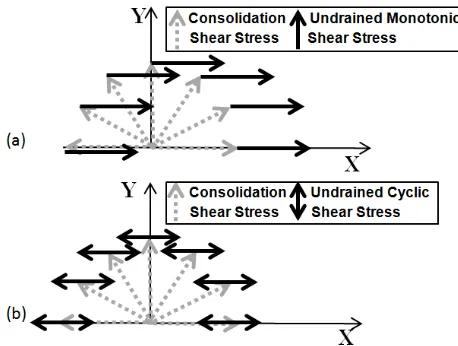
Sand specimens are prepared by dry funnel method described by Ishihara (1993). Sand specimens are anisotropically consolidated under a vertical normal stress(vc' ) of 200 kPa and a consolidation shear stress(hc), and then sheared in undrained condition by adding a secondary shear stress acting along a different direction with the first consolidationshear stress. The relative density (Dr) after consolidation is controlled approximately at 75%. The tested stress paths in monotonic and cyclic tests are described in Figure 2 (a) and (b), respectively. The direction of consolidation shear stresses varies from 0 to 180 with an interval of 30 . In undrained monotonic tests, sand specimens are sheared monotonically with the shearing speed of 0.01mm/min. In undrained cyclic tests, a frequency of 0.1Hz is used to allow for a better data acquisition. For the ease of comparing with monotonic tests, strain control is used in cyclic tests.
[image:4.612.221.450.517.690.2]
undrained monotonic shear tests (b) in undrained cyclic shear tests
In test results, the shear stress and shear strain are presented along x direction. All the tests are terminated after the effective vertical stress drops below 10 percent of the initial vertical stress. This is because the existence of shear stress prevents the effective vertical stress from reaching zero (Ishihara and Yamazaki, 1980; Kammerer, 2002).
TEST RESULTS Monotonic Tests
Tests under the Consolidation Shear Ratio (CSR, hc vc
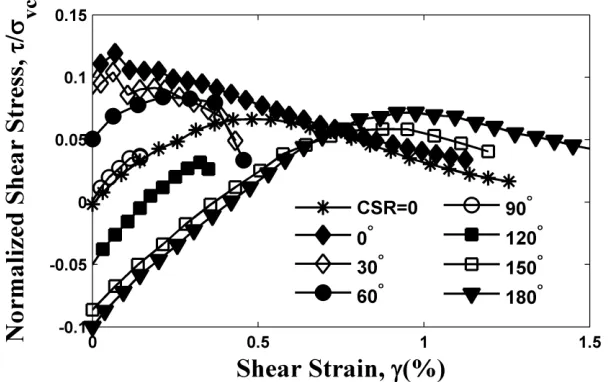
[image:5.612.144.448.349.540.2] ) of 0.05 and 0.1 are conducted with various angles of consolidation shear stresses, as shown in Figure 2 (a). A test without the consolidation shear stress is also included for comparison. Figure 3 shows the responses of shear stress for different angles of the consolidation shear stress at the CSR of 0.1. Tests with smaller angles reach the peak shear stress at an earlier stage of shearing, and show more brittle responses. Tests with angles around 90 fail at the initial stage of shearing, and these samples fail in the y direction with rapid shear strain development.
FIG. 3. Responses of shear stress for different angles of the consolidation shear stress
tests with the CSR of 0.1, the effect of angles dominates the shear responses over the effect of densification.
FIG. 4. The shear strength for tests with different magnitudes and directions of consolidation shear stress
Cyclic Tests
In the cyclic tests, three series of tests are conducted using different amplitudes of cyclic shear displacement, which are 0.025mm 0.03mm and 0.04mm. Figure 5 shows a typicalstress path of monotonic and cyclic tests under the CSR of 0.05 with the amplitude of 0.04mm. Tests with the amplitudes of 0.025mm and 0.03mm have a similar trend. It can be seen that the cyclic stress path is below that in monotonic test. Andersen (2009) reported a similar result and attributed it to the breakdown of soil structure in cyclic loading, which causes a tendency for volumetric reduction in the soil and drop of vertical stress.
[image:6.612.141.474.485.683.2]Figure 6 shows the pore water generation during shear at the amplitude of 0.04mm.
Tests with the amplitudes of 0.025mm and 0.03mm have a similar trend. PWP increases the slowest in the test without the consolidation shear stress, followed by the 0 and 180 tests. In the 90 test, PWP increases the fastest, and fails in the least cyclic number. It should be noted that all the tests except the 0 test and 180 test fail in the direction perpendicular to the cyclic shear displacement.
FIG. 6. Responses of pore water generation for different angles of the consolidation shear stress in cyclic tests with the amplitude of 0.04mm
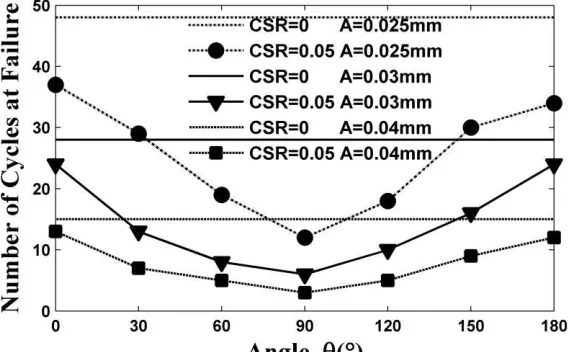
Figure 7 shows the number of cycles at failure for all the shear amplitudes with and without the consolidation shear stress. It indicates that under the same shear amplitude, the number of cycles is greater without the consolidation shear stress than that with the consolidation shear stress, and correspondingly a larger liquefaction resistance. Under the consolidation shear stress, the number of the cycle is the greatest at 00, and gradually decreases with increasing angle until 900. The number of cycles increases
again from 900 to 1800. In all the shear amplitudes, the liquefaction resistance is the smallest at 900.
[image:7.612.159.444.519.695.2]shears displacement
CONCLUSIONS
This paper investigates the impact of the consolidation shear stress on the following undrained shear strengths of sand under monotonic and cyclic loading by using the VCCDSS. The study indicates that the deviation between the consolidation shear and undrained shear has a significant effect on the undrained responses. In the monotonic loading tests, the consolidation shear stress at 00 increases the following undrained shear strength compared with that without the consolidation shear stress. But the response is more brittle in the former than in the latter. The shear strength decreases from 0 to 90 , and then increases from 90 to 180 . The impact of angle is greater at a higher consolidation shear stress. In addition, a larger angle leads to more ductile response. In the cyclic loading tests, the number of cycles at failure is also significantly affected by the deviation between the consolidation shear stress and undrained shear stress. Similar to the trend in the monotonic loading tests, under the same cyclic shear stress, the number of cycles at failure decreases from the 0 test to the 90 test, and then increases from the 90 test to the 180 test. However, the consolidation shear stress decreases the number of cycles at failure compared with that in the tests without the consolidation shear stress.
ACKNOWLEDGMENTS
This research is supported by National Natural Science Foundation of China (NSFC Contract No. 11172312/A020311) and the International Doctoral Innovation Centre (IDIC) scholarship scheme, Ningbo International Collaborative Program (Contract No. 2012D10023). These supports are appreciated. We also greatly acknowledge the support from Ningbo Education Bureau, Ningbo Science and Technology Bureau,
China’s MoST and the University of Nottingham.
REFERENCES
Andersen, K. H. (2009). "Bearing capacity under cyclic loading - offshore, along the coast, and on land." The 21st Bjerrum Lecture presented in Oslo, 23 November
2007”. Canadian Geotechnical Journal., Vol. 46 (5): 513-535.
Biscontin, G. (2001). "Modeling the Dynamic Behavior of Lightly Overconsolidated Soil Deposits on Submerged Slopes." Ph.D thesis, University of California, Berkeley.
Boulanger, R.W., and Seed, R.B. (1995). "Liquefaction of Sand under Bidirectional Monotonic and Cyclic Loading." Journal of Geotechnical Engineering., Vol. 121 (12): 870-878.
Cai, Y.Y., (2010). "An Experimental Study of Non-Coaxial Soil Behaviour Using Hollow Cylinder Testing." Ph.D thesis, The University of Nottingham, UK.
Direct Simple Shear Behavior of Cohesive Soil." Journal of Geotechnical Engineering., Vol. 122 (2): 91-98.
Dyvik, R., Berre, T., Lacasse, S., and Raadim, B. (1987). "Comparison of Truly Undrained And Constant Volume Direct Simple Shear Tests." Geotechnique., Vol. 37 (1): 3–10.
Finn, W. D. L. (1985). "Aspects of constant volume cyclic simple shear. Advances in the art of testing soils under cyclic conditions. "ASCE Convention, Detroit, 74–98. Ishihara, K. (1993). "Liquefaction and flow failure during earthquake." Geotechnique.,
Vol. 43 (3): 351–415.
Ishihara, K., and Yamazaki, F. (1980). "Cyclic Simple Shear Tests on Saturated Sand in Multi-Directional Loading." Soils and Foundations., Vol. 20 (1): 45-59.
Kammerer, A. (2002). "Undrained Response of Monterey 0/30 Sand Under Multidirectional Cyclic Simple Shear Loading Conditions." Ph.D thesis, University of California, Berkeley.
Rutherford, C. J. (2012). "Development of a Multi-Directional Direct Simple Shear Testing Device for Characterization of the Cyclic Shear Response of Marine Clays." Ph.D thesis, Texas A&M University, College Station.