Entangled Quantum States
.
White Rose Research Online URL for this paper:
http://eprints.whiterose.ac.uk/151721/
Version: Published Version
Article:
Hirsch, Flavien, Quintino, Marco Túlio, Vértesi, Tamás et al. (2 more authors) (2016)
Algorithmic Construction of Local Hidden Variable Models for Entangled Quantum States.
Physical Review Letters. 190402. ISSN 1079-7114
https://doi.org/10.1103/PhysRevLett.117.190402
[email protected] https://eprints.whiterose.ac.uk/ Reuse
Items deposited in White Rose Research Online are protected by copyright, with all rights reserved unless indicated otherwise. They may be downloaded and/or printed for private study, or other acts as permitted by national copyright laws. The publisher or other rights holders may allow further reproduction and re-use of the full text version. This is indicated by the licence information on the White Rose Research Online record for the item.
Takedown
If you consider content in White Rose Research Online to be in breach of UK law, please notify us by
Algorithmic Construction of Local Hidden Variable Models for Entangled
Quantum States
Flavien Hirsch,1 Marco Túlio Quintino,1 Tamás Vértesi,2 Matthew F. Pusey,3 and Nicolas Brunner1
1
Département de Physique Théorique, Université de Genéve, 1211 Genéve, Switzerland
2Institute for Nuclear Research, Hungarian Academy of Sciences, P.O. Box 51, H-4001 Debrecen, Hungary 3
Perimeter Institute for Theoretical Physics, 31 Caroline Street North, Waterloo, Ontario N2L 2Y5, Canada
(Received 4 December 2015; published 4 November 2016)
Constructing local hidden variable (LHV) models for entangled quantum states is a fundamental problem, with implications for the foundations of quantum theory and for quantum information processing. It is, however, a challenging problem, as the model should reproduce quantum predictions for all possible local measurements. Here we present a simple method for building LHV models, applicable to any entangled state and considering continuous sets of measurements. This leads to a sequence of tests which, in the limit, fully captures the set of quantum states admitting a LHV model. Similar methods are developed for local hidden state models. We illustrate the practical relevance of these methods with several examples.
DOI:10.1103/PhysRevLett.117.190402
Distant observers performing well-chosen local mea-surements on a shared entangled state can establish non-local correlations, as witnessed by the violation of a Bell inequality [1,2]. Quantum nonlocality is among the most counter-intuitive features of quantum physics, and is a key resource in quantum information processing [3–5].
Initially believed to be two different facets of the same phenomenon, entanglement and nonlocality are now rec-ognized as fundamentally different. Notably, there exist entangled states which cannot give rise to nonlocality considering arbitrary (nonsequential) measurements. The correlations of such states—thus referred to as “local” entangled states—can be perfectly reproduced using a local hidden variable (LHV) model, i.e., using only shared classical resources. This was first demonstrated by Werner [6], who presented a class of entangled states which admit a LHV model for arbitrary projective mea-surements. This was later extended to more general positive-operator-valued measure (POVM) [7], and other classes of states [8–11]. In particular, several works [12–15] constructed local hidden state models (LHS), a
special class of LHV model in which the hidden variable can be understood as a quantum state, naturally associated to the effect of quantum steering [12]. More generally, characterizing local entangled states would deepen our understanding of the relation between entanglement and nonlocality, as well as allow one to distinguish between useful and useless entangled states for nonlocality-based protocols.
Despite these implications, the problem of constructing local models for entangled states remains challenging, as the model should reproduce the quantum statistics for all possible measurements, i.e., a continuous set. So far, LHV (or LHS) models could be constructed for entangled states featuring a high degree of symmetry [11]. Recently, a
sufficient condition for a two-qubit state to admit a LHS was discussed[16]. However, for general states, essentially nothing is known, due to the lack of appropriate techniques for discussing the problem.
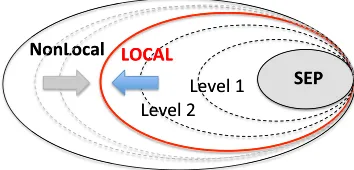
[image:2.612.348.525.543.628.2]Here we present a simple and efficient method for constructing LHV and LHS models, applicable to arbitrary local entangled states and considering continuous sets of measurements. The main idea is to map the problem of finding a local model for an entangled state (a seemingly infinite problem) to a finite (and, hence, tractable) problem, namely, to find out whether the correlations resulting from a finite set of measurements on a different entangled state admit a local decomposition. We can define a sequence of tests for determining whether a given entangled state admits a LHV (or LHS) model, which is shown to converge in the limit, and thus give a full characterization of the set of local entangled states (see Fig.1). The method can be efficiently implemented, and we construct LHV and LHS models for different classes of entangled states. In particular, we
present LHS models for a rank-3 entangled state and for a bound entangled state. We conclude by discussing further possible applications.
Preliminaries.—Consider Alice and Bob sharing an entangled quantum state ρ. Alice performs a set of measurements fMajxg (Majx≥0 and PaMajx ¼1), and
Bob performs measurementsfMbjyg. The resulting
statis-tics is given by
pðabjxyÞ ¼TrðMajx⊗MbjyρÞ: ð1Þ
The stateρ is said to be local (forfMajxg andfMbjyg) if
distribution(1) admits a Bell local decomposition
pðabjxyÞ ¼
Z
πðλÞpAðajx;λÞpBðbjy;λÞdλ: ð2Þ
That is, the quantum statistics can be reproduced using a LHV model consisting of a shared local (hidden) variableλ, distributed with densityπðλÞ, and local response functions
pAðajx;λÞandpBðbjy;λÞ. If a decomposition of the form
(2)cannot be found, the distributionpðabjxyÞviolates (at least) one Bell inequality[2]. In this case,ρis nonlocal for the setsfMajxg andfMbjyg.
Another concept of interest is that of a LHS model, associated with quantum steering[12]. Specifically, we say that ρis “unsteerable”(from Alice to Bob) if
pðabjxyÞ ¼
Z
πðλÞpAðajx;λÞTrðMbjyσλÞdλ: ð3Þ
That is, the quantum statistics can be reproduced by a LHS model, whereσλ denotes the local (hidden) quantum state and pAðajx;λÞ is Alice’s response function. If such a
decomposition cannot be found,ρis said to be“steerable” for the set fMajxg; note that one would usually consider
here a set of measurements Mbjy that is tomographically
complete, and thus focus the analysis on the set of condi-tional states of Bob’s system
σajx¼TrAðMajx⊗1ρÞ; ð4Þ
referred to as an assemblage. Note also that any LHS model can be considered as an LHV model. The converse does not necessarily hold, as there exist entangled states which are steerable but nevertheless Bell local [12,15].
The problem of testing the locality or unsteerability of a given entangled state ρ for finite sets of measurements can be solved using existing methods, such as symmetric extensions for quantum states[17], linear and semidefinite programs (SDPs) [2,18,19], and relaxing positivity [20]. Implementable for small number of measurements, these methods become computationally demanding when the number of measurements increases. Nevertheless, they are guaranteed to provide a solution in principle.
The situation is very different when considering con-tinuous sets of measurements, e.g., the set of all projective measurements. Here the methods for finite sets cannot be applied, not even in principle. One must then construct a
LHV (or LHS) model explicitly, by exhibiting the distri-butions πðλÞ and response functions pAðajx;λÞ and
pBðbjy;λÞ. This was achieved for certain classes of
entangled states by exploiting their high level of symmetry. However, when considering general states, with less (or no) symmetry, following such an approach is extremely challenging.
In the present Letter, we follow a different path and present a general method for constructing LHV and LHS models for arbitrary states. The method can be efficiently implemented and will be illustrated with examples. Before presenting the main result we start with a simple example, providing the intuition behind our method.
Illustrative example.—Consider the class of Werner states
ρWðαÞ ¼αjψ−ihψ−j þ ð1−αÞ1=4; ð5Þ
wherejψ−
i ¼ ðj01i−j10iÞ=pffiffiffi2is the singlet state and1=4 is the two-qubit maximally mixed state. In the range 1=3<α≤1=2, ρWðαÞ is entangled but unsteerable (and, hence, local) for all projective measurements [6]. Werner provided an explicit LHS model by exploiting the high symmetry of the state—ρWðαÞ is invariant under global rotations of the formU⊗U. Here we illustrate the main idea behind our method by rederiving Werner’s result, without invoking any symmetry argument.
Consider the setMof 6 projective qubit measurements with Bloch vectorsvˆx(x¼1;…;6), corresponding to an
icosahedron. By performing measurements in M on the Werner state, Alice prepares for Bob the assemblage
σjx¼TrA
1vˆx·σ~
2 ⊗1ρWðαÞ
; ð6Þ
whereσ~ denotes the vector of Pauli matrices. Using SDP techniques[19], we find that this assemblage admits a LHS model for α≲0.54.
This analysis can be extended to all projective measure-ments as follows. Consider qubit POVMs given by
Mη
jvˆ¼ ½1ηðvˆ·~σÞ=2with0<η≤1. The corresponding
Bloch vectors (with direction vˆ and norm η) thus form a “shrunken” Bloch sphere of radius η. Choosing
η¼
ffiffiffiffiffiffiffiffiffiffiffiffiffiffiffiffiffiffiffiffiffiffiffiffiffiffiffiffi
ð5þ2pffiffiffi5Þ=15 q
≈0.79, we obtain a sphere that
fits inside the icosahedron. Thus, any noisy measurement
Mηjvˆ can be expressed as a convex combination of measurements in M [21]. Because the assemblage (6) (resulting from measurements inM) admits a LHS model for α≲0.54, we get that the assemblage resulting from any possibleMηjvˆ withη≤η also admits a LHS model. Consequently, the statistics of arbitrary (but sufficiently noisy, i.e., η≤η) measurements performed on the Werner state with α≲0.54 can be simulated. Finally, notice that the statistics of noisy measurements on a given Werner state are equivalent to the statistics of projective measurements on a slightly more noisy Werner state
TrA½Mηjvˆ⊗1ρWðαÞ ¼TrA½M1jvˆ ⊗1ρWðηαÞ: ð7Þ
Hence, statesρWðαÞwithα≲0.54η≃0.43admit a LHS
model for all projective measurements. Note that by starting from a polyhedron with more (but nevertheless finitely many) vertices distributed (sufficiently evenly) over the sphere, the above procedure gives a LHS model for Werner states for α→1=2, thus converging to Werner’s model[21]. This is the optimal LHS model, becauseρWðαÞ
becomes steerable forα>1=2[12].
Constructing LHS models.—Based on the idea sketched above, we now present a general method for constructing LHS models for continuous sets of measurements, appli-cable to any local entangled state. Formally, we will make use of the following result.
Lemma 1: Consider a quantum stateχ (of dimension
d×d), with reduced states χA;B¼TrB;AðχÞ, and a finite
set of measurements fMajxg, such that the assemblage
σajx ¼TrAðMajx ⊗1χÞ is unsteerable. Then the state
ρ¼ηχþ ð1−ηÞξA ⊗χB; ð8Þ
where ξA is an arbitrary density matrix (of dimension d),
admits a LHS model for a continuous set of measurements M. The parameterηcorresponds to the“shrinking factor” ofMwith respect to the finite setfMa
jxg(and given state
ξA). Specifically, consider the continuous set of (shrunk)
measurements
Mη
a¼ηMaþ ð1−ηÞTr½ξAMa1 ð9Þ
for any Ma∈M. Thenη is the largest number such that
all Mη
a can be written as a convex combination of the
elements offMajxg, i.e.,Mηa¼PxpxMajx withPpx¼1
andpx≥0.
Proof.—The proof is based on the following relation:
TrA½Mηa⊗1χ ¼TrA½Ma⊗1ρ: ð10Þ
Because σajx is unsteerable, it follows that there exists a
LHS model forχand all (shrunk) measurementsMη
a. From
the above equality, it follows thatρadmits a LHS model for the continuous set of measurementsM. □ This allows us to get an explicit protocol for determining whether a given state ρadmits a LHS model.
Protocol 1: The problem is to determine if a target state ρ admits a LHS model for a continuous set of measurementsM. Following Lemma 1, we start by picking a finite setfMajxg(with shrinking factorη) and a density
matrix ξA. Next we solve the following SDP problem:
findq¼maxq
such that
TrAðMajx⊗IχÞ ¼
X
λ
σλDλðajxÞ ∀a; x;σλ≥0 ∀λ
ηχþ ð1−ηÞξA⊗χB¼qρþ ð1−qÞ 1
d2; ð11Þ
where the optimization variables are (i) the positive matrices σλand (ii) ad×dHermitian matrixχ[22]. This SDP must be performed considering all possible deterministic strategies for AliceDλðajxÞ, of which there areN¼ ðkAÞmA(wheremA
denotes the number of measurements of Alice andkA the
number of outcomes); henceλ¼1;…; N. If the optimiza-tion returns a maximum of q¼1, then ρ admits a LHS model for all measurements inM. Ifq<1, we have shown thatρ0¼qρþ ð1−qÞðI=d2Þ, withq≤q, admits a LHS forM.
The performance of the above protocol depends crucially on the choice of the setfMajxg. It must be chosen in a rather
uniform manner, over the continuous setM, in order to get a shrinking factor that is as large as possible. Also, the ability of the protocol to detect a larger range of unsteerable states will improve when increasing the number of measurements contained infMajxg. Computing the shrinking factor is in
general nontrivial, but we give a general procedure in[23]. Based on Protocol 1, we can define a sequence of tests for unsteerability of a given target stateρ. In the first test, we consider a finite setfMajxg1, with shrinking factorη1
and apply Protocol 1. We thus get a value ofq
1. Ifq1¼1,
we conclude thatρadmits a LHS model. On the other hand, ifq
1<1, the test is inconclusive, and we must go to the
second level. We construct now a new setfMajxg2, which
includes all measurements infMajxg1and additional ones.
By adding sufficiently new measurements, we get a new shrinking factor η2>η1. Applying Protocol 1 again, we
may get a value of q
2> q1 [24]. If q2¼1 we stop;
otherwise, we proceed to level 3, and so on.
Clearly, in each new test, the set of measurements considered provides a better approximation to M. Moreover, the sequence of tests will in fact converge in the limit. Indeed, consider any state ρ admitting a LHS model. Then, applying the method toρ, we will be able to show that there is a state ρ0, arbitrarily close to ρ, which admits a LHS model. Specifically, for anyϵ>0, the state ρ¼ ð1−ϵÞρþϵð1=d2
Þ will be detected by going to a sufficiently high level in the sequence of tests (see Supplemental Material [23]).
These ideas can be implemented on a standard computer for small sets of measurementsfMajxg. For larger sets, the
implementation becomes demanding. Nevertheless, the method provides a definite answer in principle.
Constructing LHV models.—These ideas can also be adapted to the problem of constructing LHV models.
Lemma 2: Consider a state χ (of dimension d×d), with reduced states χA;B¼TrB;AðχÞ, and finite sets of
measurements fMajxg, fMbjyg such that pðabjxyÞ ¼
TrðMajx⊗MbjyχÞis local. Then the state
ρ¼ημχþηð1−μÞχA⊗ξBþμð1−ηÞξA⊗χB
þ ð1−ηÞð1−μÞξA⊗ξB ð12Þ
arbitrary density matrices (of dimensiond), andη,μdenote the shrinking factors ofMA,MB with respect tofMa
jxg,
fMbjyg.
The proof is a straightforward extension of that of Lemma 1. We now have the following protocol.
Protocol 2: The problem is whether a target state ρ admits a LHV model for measurements inMA andMB. Following Lemma 2, we take finite setsfMajxgandfMbjyg
(with shrinking factors η and μ) and density matrices ξA
andξB. Then we solve the following linear problem:
findq¼maxq
such that
TrðMajx⊗MbjyχÞ ¼
X
λ
pλDλðabjxyÞ ∀a; b; x; y
pλ≥0 ∀λ
qρþ ð1−qÞI
d¼ημχþηð1−μÞχA⊗ξB
þμð1−ηÞξA⊗χBþ ð1−ηÞð1−μÞξA ⊗ξB; ð13Þ
where the optimization variables are (i) positive coefficients
pλand (ii) ad×dHermitian matrixχ[22]. GivenmA(mB)
measurements with kA (kB) outcomes for Alice (Bob),
one has N¼ ðkAÞmAðkBÞmB local deterministic strategies
DλðabjxyÞ, andλ¼1;…; N.
Again, this leads to a sequence of tests. In the first level, consider finite sets fMajxg1 andfMbjyg1, with shrinking
factors η1 and μ1, and apply Protocol 2. If q1¼1, we
conclude thatρadmits a LHV model. Ifq
1<1, we proceed
to the second level. We construct fMajxg2 and fMbjyg2,
including all measurements used in the first level plus additional ones. Hence we get better shrinking factors η2≥η1 and μ2≥μ1. Applying Protocol 2, we may get a
value ofq
2> q1[24]. Ifq2¼1we stop, otherwise we go
to level 3, and so on.
Here, the sequence will also converge in the limit. Indeed, consider any local state ρ. There is ρ0, arbitrarily close to ρ, which the method will show to have a LHV model (see Supplemental Material [23]). Again, imple-mentations on standard computers is possible for small sets
fMajxg andfMbjyg.
Applications.—We now illustrate the practical relevance of the above methods, by constructing LHS and LHV models for classes of entangled states for which previous methods failed. A nontrivial issue is to obtain the shrinking factor for the sets of measurements that are used. For projective qubit measurements, this can be done efficiently by exploiting the Bloch sphere geometry (see Supplemental Material[23]). Hence, we consider entangled states where (at least) one of the systems is a qubit, and focus primarily on projective measurements.
Consider first the class of two-qubit states
ρðα;θÞ ¼αjψθihψθj þ ð1−αÞI4=4; ð14Þ
that is, partially entangled statesjψθi¼cosθj00iþsinθj11i mixed with white noise. The state is entangled for α>½1þ2sinð2θÞ−1
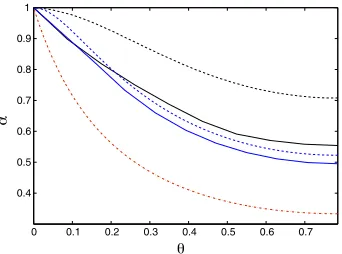
, via partial transposition [25,26]. Using Protocols 1 and 2, we find parameter ranges α, θ where the state is unsteerable and local (see Fig.2); the details are in Supplemental Material[23]. So far, relevant bounds for the locality of the above state were only given for θ¼π=4, i.e., for Werner states (5). In this case, we obtain an almost optimal LHS model (α≃0.495), and a LHV model that improves Werner’s one (α≃0.554), but that is below the model of Ref.[9]which achievedα≃0.659.
We also show that a rank-3 entangled state (i.e., on the boundary of the set of two-qubit quantum states) can admit a LHS model. Specifically, we find that the state ρ¼P3
k¼1pkjψkihψkj, where p1¼0.4, p2¼0.05, and
jψ1i ¼cosθj00i þsinθj11i, jψ2i ¼sinθj00i−cosθj11i
andjψ3i ¼ j10i, whereθ¼10−4π, admits a LHS model.
Next we discuss higher-dimensional states, of the form
ρðα; dÞ ¼αjψ− ihψ−
j þ ð1−αÞ12=2⊗1d=d; ð15Þ
i.e., a two-qubit singlet state jψ−
i mixed with higher-dimensional noise. The above state is entangled for α>ð1þdÞ−1
(via partial transposition). We obtain lower bounds onα(ford≤5) for the state to admit a LHS model; see TableI.
Moreover, we obtain a LHS model for the bound entangled state of Ref.[27]; see [23]. While these states were conjectured to be local[28], this result represents the first explicit example. Note, however, that this conjecture was recently disproven, as certain bound entangled states can lead to steering[29] and Bell nonlocality[30].
These methods can also be applied to multipartite entangled states. In particular, we could reproduce the result of Ref.[31], constructing a LHV model for a genuine tripartite entangled state.
Finally, we also applied our method considering general POVMs on the two-qubit Werner state(5). In this case, we
0 0.1 0.2 0.3 0.4 0.5 0.6 0.7
[image:5.612.353.524.513.640.2]0.4 0.5 0.6 0.7 0.8 0.9 1
FIG. 2. The stateρðα;θÞ of Eq. (14)is entangled above the dash-dotted (red) line. Our method guarantees unsteerability below the solid blue line, while the state is steerable above the dashed blue line. Moreover, we can guarantee that the state is local below the solid black line, while it is nonlocal above the dashed black line.
obtain a LHS model for visibility α≃0.36>1=3, which shows that the method can be applied in practice for general POVMs[23].
Discussion.—We discussed a procedure for constructing LHS or LHV models, applicable to any local entangled state. The method can be used iteratively, and converges in the limit. We illustrated its practical relevance.
We believe these methods will find further applications, in particular for exploring the relation between entanglement and nonlocality. First, we note that a simplified version of our method was recently used to demonstrate the effect of postquantum steering[32]. More generally, the method can be applied to systems of arbitrary dimension, considering POVMs, and multipartite systems. Here the main technical difficulty consists in obtaining shrinking factors for sets of measurements beyond projective qubit ones.
We thank Joe Bowles, Daniel Cavalcanti, Leonardo Guerini, Rafael Rabelo, Denis Rosset, and Paul Skrzypczyk for discussions. We acknowledge financial support from the Swiss National Science Foundation (Grant No. PP00P2_138917 and Starting Grant Device Independent Approach to Quantum physics (DIAQ)) and the Hungarian National Research Fund OTKA (K111734). Research at Perimeter Institute is supported in part by the Government of Canada through NSERC and by the Province of Ontario through MRI.
Note added.—Recently, we became aware of the related work and complementary results by Cavalcanti and colleagues[33].
[1] J. S. Bell, On the Einstein-Poldolsky-Rosen paradox, Physics1, 195 (1964).
[2] N. Brunner, D. Cavalcanti, S. Pironio, V. Scarani, and S. Wehner, Bell nonlocality,Rev. Mod. Phys.86, 419 (2014). [3] A. Acín, N. Brunner, N. Gisin, S. Massar, S. Pironio, and V. Scarani, Device-Independent Security of Quantum Cryptography Against Collective Attacks,Phys. Rev. Lett. 98, 230501 (2007).
[4] R. Colbeck, Ph.D. thesis, University of Cambridge, 2007.
[5] S. Pironio, A. Acín, S. Massar, A. Boyer de la Giroday, D. N. Matsukevich, P. Maunz, S. Olmschenk, D. Hayes, L. Luo, T. A. Manning, and C. Monroe, Random numbers certified by Bell’s theorem, Nature (London) 464, 1021 (2010).
[6] R. F. Werner, Quantum states with Einstein-Podolsky-Rosen correlations admitting a hidden-variable model,Phys. Rev. A40, 4277 (1989).
[7] J. Barrett, Nonsequential positive-operator-valued measure-ments on entangled mixed states do not always violate a Bell inequality,Phys. Rev. A65, 042302 (2002).
[8] M. L. Almeida, S. Pironio, J. Barrett, G. Tóth, and A. Acín, Noise Robustness of the Nonlocality of Entangled Quantum States,Phys. Rev. Lett.99, 040403 (2007).
[9] A. Acín, N. Gisin, and B. Toner, Grothendieck’s constant and local models for noisy entangled quantum states,Phys. Rev. A 73, 062105 (2006).
[10] F. Hirsch, M. T. Quintino, J. Bowles, and N. Brunner, Genuine Hidden Quantum Nonlocality, Phys. Rev. Lett. 111, 160402 (2013).
[11] R. Augusiak, M. Demianowicz, and A. Acín, Local hidden variable models for entangled quantum states,J. Phys. A47, 424002 (2014).
[12] H. M. Wiseman, S. J. Jones, and A. C. Doherty, Steering, Entanglement, Nonlocality, and the Einstein-Podolsky-Rosen Paradox,Phys. Rev. Lett.98, 140402 (2007). [13] J. Bowles, T. Vértesi, M. T. Quintino, and N. Brunner,
One-Way Einstein-Podolsky-Rosen Steering, Phys. Rev. Lett. 112, 200402 (2014).
[14] S. Jevtic, M. J. W. Hall, M. R. Anderson, M. Zwierz, and H. M. Wiseman, Einstein-Podolsky-Rosen steering and the steering ellipsoid,J. Opt. Soc. Am. B32, A40 (2015). [15] M. T. Quintino, T. Vértesi, D. Cavalcanti, R. Augusiak, M.
Demianowicz, A. Acín, and N. Brunner, Inequivalence of entanglement, steering, and Bell nonlocality for general measurements,Phys. Rev. A92, 032107 (2015).
[16] J. Bowles, F. Hirsch, M. T. Quintino, and N. Brunner, Sufficient criterion for guaranteeing that a two-qubit state is unsteerable,Phys. Rev. A93, 022121 (2016).
[17] B. M. Terhal, A. C. Doherty, and D. Schwab, Symmetric Extensions of Quantum States and Local Hidden Variable Theories,Phys. Rev. Lett.90, 157903 (2003).
[18] M. F. Pusey, Negativity and steering: A stronger Peres conjecture,Phys. Rev. A88, 032313 (2013).
[19] P. Skrzypczyk, M. Navascués, and D. Cavalcanti, Quantify-ing Einstein-Podolsky-Rosen SteerQuantify-ing,Phys. Rev. Lett.112, 180404 (2014).
[20] H. Anwar, S. Jevtic, O. Rudolph, and S. Virmani, Smallest state spaces for which bipartite entangled quantum states are separable,New J. Phys.17, 093047 (2015).
[21] J. Bowles, F. Hirsch, M. T. Quintino, and N. Brunner, Local Hidden Variable Models for Entangled Quantum States Using Finite Shared Randomness, Phys. Rev. Lett. 114, 120401 (2015).
[22] Note that χ does not need to be positive, but should only define a valid assemblage (Protocol 1), or a valid probability distribution (Protocol 2), for the considered sets of measurementsfMajxg(andfMbjyg).
[23] See Supplemental Material at http://link.aps.org/ supplemental/10.1103/PhysRevLett.117.190402 for tech-niques to compute shrinking factors, details about the iterative procedure, proof of the convergence of the method. [24] Note that value ofq
2depends on both the shrinking factorη2
[image:6.612.51.297.90.136.2]and the visibility (of χ) given the measurements fMajxg. TABLE I. Bounds on the steerability of the states (15), as a
function of dimensiond. The state is entangled forα≥αENT, and unsteerable forα≤αLHS.
d 2 3 4 5
αENT 0.33 0.25 0.20 0.16
Hence, increasing the shrinking factor does not necessarily imply thatq
2> q1.
[25] A. Peres, Separability Criterion for Density Matrices,Phys. Rev. Lett.77, 1413 (1996).
[26] M. Horodecki, P. Horodecki, and R. Horodecki, Separability of mixed states: Necessary and sufficient conditions,Phys. Lett. A223, 1 (1996).
[27] P. Horodecki, Separability criterion and inseparable mixed states with positive partial transposition,Phys. Lett. A232, 333 (1997).
[28] A. Peres, All the Bell inequalities, Found. Phys.29, 589 (1999).
[29] T. Moroder, O. Gittsovich, M. Huber, and O. Gühne, Steering Bound Entangled States: A Counterexample to
the Stronger Peres Conjecture,Phys. Rev. Lett.113, 050404 (2014).
[30] T. Vértesi and N. Brunner, Disproving the Peres conjecture: Bell nonlocality from bipartite bound entanglement, Nat. Commun. 5, 6297 (2014).
[31] G. Tóth and A. Acín, Genuine tripartite entangled states with a local hidden-variable model, Phys. Rev. A 74, 030306(R) (2006).
[32] A. B. Sainz, N. Brunner, D. Cavalcanti, P. Skrzypczyk, and T. Vértesi, Postquantum Steering, Phys. Rev. Lett. 115, 190403 (2015).
[33] D. Cavalcanti, L. Guerini, R. Rabelo, and P. Skrzypczyk, preceding Letter, General Method for Constructing Local-Hidden-Variable Models for Entangled Quantum States,
Phys. Rev. Lett.117, 190401 (2016).