http://eprints.whiterose.ac.uk/141513/
Version: Accepted Version
Article:
Gent, Ian Philip, Jefferson, Christopher Anthony and Nightingale, Peter William
orcid.org/0000-0002-5052-8634 (2017) Complexity of n-Queens Completion. Journal of
Artificial Intelligence Research (JAIR). pp. 815-848. ISSN 1076-9757
https://doi.org/10.1613/jair.5512
[email protected] https://eprints.whiterose.ac.uk/ Reuse
Items deposited in White Rose Research Online are protected by copyright, with all rights reserved unless indicated otherwise. They may be downloaded and/or printed for private study, or other acts as permitted by national copyright laws. The publisher or other rights holders may allow further reproduction and re-use of the full text version. This is indicated by the licence information on the White Rose Research Online record for the item.
Takedown
If you consider content in White Rose Research Online to be in breach of UK law, please notify us by
Complexity of
n
-Queens Completion
Ian P. Gent [email protected]
Christopher Jefferson [email protected]
Peter Nightingale [email protected]
School of Computer Science, University of St Andrews, St Andrews, Fife KY16 9SX, UK
Abstract
Then-Queens problem is to placenchess queens on annbynchessboard so that no two queens are on the same row, column or diagonal. Then-Queens Completion problem is a variant, dating to 1850, in which some queens are already placed and the solver is asked to place the rest, if possible. We show that n-Queens Completion is both NP-Complete and #P-Complete. A corollary is that any non-attacking arrangement of queens can be included as a part of a solution to a largern-Queens problem. We introduce generators of random instances forn-Queens Completion and the closely related Blockedn-Queens and Excluded Diagonals Problem. We describe three solvers for these problems, and empirically analyse the hardness of randomly generated instances. For Blocked n-Queens and the Excluded Diagonals Problem, we show the existence of a phase transition associated with hard instances as has been seen in other NP-Complete problems, but a natural generator for
n-Queens Completion did not generate consistently hard instances. The significance of this work is that then-Queens problem has been very widely used as a benchmark in Artificial Intelligence, but conclusions on it are often disputable because of the simple complexity of the decision problem. Our results give alternative benchmarks which are hard theoretically and empirically, but for which solving techniques designed for n-Queens need minimal or no change.
1. Introduction
The n-Queens problem is to place n chess queens on an n by n chessboard so that no
two queens are on the same row, column or diagonal. This puzzle dates to 1848, and only two years later a variant was introduced by Nauck (1850) in which some number of queens are pre-placed and the solver is asked to place the rest, if possible. This is the n
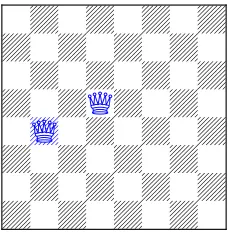
-Queens Completion problem and Figure 1 shows the first known instance studied. We will show that the n-Queens Completion problem is NP-Complete and #P-Complete, discuss
solvers for the problem, and empirically analyse randomly generated instances. The n
-Queens Completion problem may be one of the simplest NP-Complete problems to explain to people who understand the rules of chess. The problem is “Given an n×n chessboard
on which some queens are already placed, can you place a queen in every remaining row so that no two queens attack each other?”
The n-Queens problem has an extraordinary history for such an apparently
0Z0Z0Z0Z
Z0Z0Z0Z0
0Z0Z0Z0Z
Z0Z
Q
Z0Z0
0
L
0Z0Z0Z
[image:3.612.249.363.102.218.2]Z0Z0Z0Z0
0Z0Z0Z0Z
Z0Z0Z0Z0
Figure 1: This is the first published instance of then-Queens Completion problem, by Nauck
(1850). The reader may enjoy attempting to place 6 more queens on the chess-board so that no two queens attack each other. Is it possible? If so, how many different ways are there to do it? The answers to these questions are given below in Figure 12.
studying the problem.1 The generalisation ton-Queens has attracted the interest of many
other mathematicians, whose results are surveyed by Bell and Stevens (2009). The first paper to describe backtracking search on computer, presented in 1958, does so for the n-Queens
problem (Walker, 1960). Since then it has been used as an example and/or benchmark problem in many classic AI papers, for example at least six with more than 400 citations on Google Scholar at time of writing (Golomb & Baumert, 1965; Bitner & Reingold, 1975; Mackworth & Freuder, 1985; Minton, Johnston, Philips, & Laird, 1992; Selman, Levesque, & Mitchell, 1992; Crawford, Ginsberg, Luks, & Roy, 1996).
The complexity of then-Queens problem is often misunderstood. The decision problem
is solvable in constant time since there is a solution for alln >3so is only NP-hard if P=NP.
A witnessing solution can be constructed easily (Bell & Stevens, 2009) but note that the witness (a set ofn queens) requiresnlognbits to specify but this is not polynomial in the
size of the input, which is onlylognbits. Then-Queens problem has often been incorrectly
called NP-hard, even in well-cited papers (Mandziuk, 1995; Martinjak & Golub, 2007; Shah-Hosseini, 2009; Nakaguchi, Kenya, & Tanaka, 1999, each with at least 29 citations). The counting version of the problem, i.e. to determine how many solutions to n-Queens there
are, is sequence A000170 of the Online Encyclopedia of Integer Sequences (Sloane, 2016). The sequence is currently known only to n= 27, for which the number of solutions is more
than2.34×1017. No approach better than optimised exhaustive search seems to be known:
e.g. then= 27total was counted using a massively parallel search using FPGAs (Preußer,
2016). Hsiang, Hsu, and Shieh (2004) show that solving then-Queens counting problem is
“beyond the #P-class”. Bell and Stevens (2009) states that this means that there is no closed form expression innfor the number of solutions, but Chaiken, Hanusa, and Zaslavsky (2015)
claim to give one.2 Cadoli and Schaerf (2006) studied the n-Queens Completion problem
without studying its decision or counting complexity. The most closely related work to ours is by Martin (2007), who proves a rather different generalisation of n-Queens to be
NP-complete, the key difference being that some squares can be marked as stopping attacks. In particular, this means that solutions to Martin’s problem need not be solutions to the
n-Queens problem, unliken-Queens Completion.
We are contributing to a rich literature on the complexity of puzzles and games. One of the earliest results in the area is that generalised chess is EXPTIME-complete (Fraenkel & Lichtenstein, 1981). Amongst other games to have been proved NP-complete or harder are the card solitaire games Klondike (Longpré & McKenzie, 2009), Freecell (Helmert, 2003) and Black Hole (Gent, Jefferson, Kelsey, Lynce, Miguel, Nightingale, Smith, & Tarim, 2007), the Sudoku puzzle (Takayuki & Takahiro, 2003), video games like Pac-Man (Viglietta, 2014), and casual games such as Minesweeper (Kaye, 2000), Candy Crush Saga and Bejeweled (Walsh, 2014; Guala, Leucci, & Natale, 2014). Many other games are surveyed by Kendall, Parkes, and Spoerer (2008) and by Demaine and Hearn (2009). In each case, the complexity-theorist must define a generalised class of instances. Unlike some of the examples above, this step is completely natural forn-Queens Completion.
Because of the ease of finding a solution, the n-Queens problem has been subject to
re-peated controversy in AI over whether it should be used as a benchmark at all. For example a sequence of papers argued the point in the pages of SIGART Bulletin in the early 1990s (Sosic & Gu, 1990; Johnson, 1991; Bernhardsson, 1991; Gu, 1991; Valtorta, 1991), and then in 2014 the issue was raised again in a blog post by Smet (2014). We resolve this issue in the sense that, as an NP- and #P-Complete problem, n-Queens Completion does provide
a valid benchmark problem. Similarly, the Quasigroup Completion Problem (which is to complete a partially filled latin square) is NP-Complete (Colbourn, 1984) and is a challeng-ing and popular benchmark (Gomes & Selman, 1997), whereas constructchalleng-ing a latin square from scratch is trivial. A very closely related problem, “Blocked n-Queens”, has previously
been used for benchmarking without complexity guarantees (Namasivayam & Truszczynski, 2009). Our results show as a corollary that Blocked n-Queens is NP-Complete and
#P-Complete. We explore the practical difficulty of these problems, and a new variant, the Excluded Diagonals Problem. For Blockedn-Queens and the Excluded Diagonals Problem,
we show the existence of a phase transition associated with hard instances, but we were not able to generate consistently hard instances for the n-Queens Completion problem.
The remainder of this paper is structured as follows. We introduce a number of basic terms and concepts in Section 2. We give definitions of a sequence of problems in Sec-tion 3, where the first problem isn-Queens Completion, and the last is a variant of Boolean
Satisfiability (SAT) that is NP- and #P-Complete, with the Excluded Diagonals Problem at an intermediate stage. The proof proceeds by a sequence of polynomial reductions in Section 4, starting with the last problem and ending with n-Queens Completion. Finally,
we present an empirical study of random n-Queens Completion, Blocked n-Queens, and
Excluded Diagonals Problems in Section 5.
2. Background and Definitions
We will represent a queen as an ordered pair of integers. Since these represent coordinate positions in a grid, we will use vector notation where appropriate, although we will not use any significant vector algebra. Given a queen represented by an ordered pair (α, β), the
valueα represents the queen’s column, and β its row on the chessboard. The values α+β
and α−β represent the two diagonals the queen is on. It may not be intuitively obvious
that chessboard diagonals correspond to sums and differences, but consider moving one square along the two orthogonal diagonals: in one direction the sum of the coordinates does not change, while in the other direction the difference does not change. To avoid possible confusion about which direction is which, we follow Bell and Stevens (2009) in simply calling
α+β the ‘sum-diagonal’ andα−β the ‘difference-diagonal’.
Definition 1. A queen q is a pair of integers (α, β) with 0 ≤ α, 0 ≤ β. For the rest of these definitions we assume q= (α, β)and where appropriate a second queen q1 = (α1, β1).
• The “column of q”, written col(q), is α. The “row of q”, written row(q), is β. The
“sum-diagonal ofq” isα+β or equivalentlycol(q) + row(q). The “difference-diagonal
ofq” isα−β or equivalentlycol(q)−row(q).
• The “size of q”, written kqk is defined by kqk def= max(α, β) = max(col(q),row(q)). We say that q “fits on board size n” iff kqk< n. We extend this to sets of queens, so
that kQkdef= maxq∈Q(kqk). As normal, we write |Q|for the number of elements inQ.
• We say that “q attacks q1” if they are not equal and any of the row/column/sum-diagonal/difference-diagonal is the same in qandq1; i.e. qattacks q1 iff q6=q1 and any of α=α1, β =β1, α+β =α1+β1, or α−β =α1−β1.
• Given an integer i, we write iq def= (iα, iβ) for the product of i and q. We write q+q1 def= (α+α1, β+β1). We extend these notations to sets of queensQ and Q1 in
the natural ways: iQdef= {iq|q∈Q},Q+q1 def
= {q+q1|q∈Q},Q+Q1
def
= {q+q1|
q∈Q,q1 ∈Q1}.
Problem 1 (n-Queens). Problem: hni where n is an integer ≥ 1. Solution: A set
Q of queens which all fit on board size n such that: |Q| = n; and for any two distinct queens q1,q2 ∈ Q, q1 does not attack q2. If, additionally, for any two distinct queens
(α1, β1),(α2, β2)∈Q, both α1+β16=α2+β2 modn andα1−β1 6=α2−β2 modn, thenQ
is said to be a “modular” solution to the n-Queens problem.
The modular n-Queens problem can be thought of as the n-Queens with the top and
bottom edges of the board identified, and similarly the left and right edges identified, so the board forms a torus. Bell and Stevens (2009, Thm. 6) give the following result of Pólya. In terms of chessboards it says that we can obtain a solution to then×m-Queens by taking a
standard m-Queens solution and replacing each empty square with an n×nempty board,
and replacing each queen with a copy of a solution to the modular n-Queens problem. It
Theorem 2 (Pólya). If we have a modular solution Q1 to the n-Queens problem, and any
solution Q2 to the m-Queens problem, then Q1 +nQ2 is a solution to the n×m-Queens
problem.
In Theorem 2 the same modular solution isn-embedded at each one ofm positions. We
will need to embed distinct sets of queens to create one board so we define embedding at a
single position.
Definition 3. Given any queen q1, a set of queens Q2, and a natural number n (where
kQ2k< n), then-embedding of Q2 at position q1 is defined as nq1+Q2.
3. A Sequence of Problems
In order to prove thatn-Queens Completion is both NP-Complete and #P-Complete, we will
use a sequence of parsimonious reductions as described by Papadimitriou (1994, Chapter
18). A parsimonious reduction maps instances of one problem to another such that the number of solutions is exactly preserved and the reduction can be computed in polynomial time.
In this section we define n-Queens Completion and three increasingly general problems
that generalise n-Queens Completion. We also define a restricted form of 1-in-3-SAT that
is NP-Complete and #P-Complete. The proof (in the following section) is a sequence of four parsimonious reductions, starting with restricted 1-in-3-SAT and ending withn-Queens
Completion.
For each problem we define the parameters and the space of solutions. There is de-liberately no distinction made between the decision form of the problem (does a solution exist?) and the counting form (how many solutions are there?). When it is important, the distinction will usually be clear from context (for example, whether we are discussing NP-Completeness or #P-Completeness).
Problem 2(n-Queens Completion). Problem: M2 =hn, Pi where nis an integer and
P is a set of queens that all fit on board sizenand no two queens inP have the same column or row as each other. Solution: A set S2 of queens which is a solution to the n-Queens
Problem forn and such that P ⊆S2.
Note that this definition of n-Queens Completion does not require the input set P of
queens to be mutually non-attacking, but does insist that they are all on separate rows and columns. This choice makes some cases in our later proofs easier, but makes no significant difference to solving complexity: if two queens in P attack each other on a diagonal, the
answer ‘no’ can be given trivially.
We next generalise n-Queens Completion by allowing restrictions that queens may only
appear in a subset of the rows and columns (and must appear in each specified row and column).
Problem 3. Problem: M3 =hn, P, C, Ri where hn, Pi is an instance of Problem 2, and
C, R are sets of integers such that |R| = |C| and for any queen (α, β) ∈ P, α 6∈ C and
β 6∈R. Solution: A set S3 of queens such that: |S3|=|C|+|P|; P ⊆S3; no two queens
The reason that we exclude elements of P from C and R is to simplify later proofs.
We next generalise Problem 3 by giving sets of sum-and difference-diagonals that must not appear. Unlike the row and column restrictions of Problem 3, there may be diagonals which are permitted but contain no queen in a given solution.
Problem 4 (Excluded Diagonals). Problem: M4 = hn, C, R, D−, D+i, where M3 =
hn,{}, C, Riis an instance of Problem 3 and D−, D+ are sets of integers with D−⊆ {−(n− 1), . . . , n−1},D+⊆ {0, . . . ,2n−2}. Solution: A set of queens S4 which is a solution to
M3 and additionally: for any queen (α, β)∈S4 we haveα−β6∈D−, α+β6∈D+.3
Each of the problems above has a board size parameter n. We assume that the size of
the encoding of a problem instance to a Turing machine input has size bounded below byn
and polynomial in n.
Our next problem class contains a set of instances of Problem 4, and ignores constraints between problems except for the sum-diagonals. Two queens placed within different sub-problems in the set are allowed to have the same row, column, or difference-diagonal, but
not the same sum-diagonal. Thus we can compose instances of Problem 4 with control over
their interactions.
Problem 5. Problem: A setM5 ={M4,a|0≤a <|M5|}, where eachM4,a is an instance
of Problem 4 with D+={}. Solution: A set S
5 ={S4,a|0≤a <|M5|}, where each S4,a
is a solution to M4,a, and additionally: for any {S4,a, S4,b} ⊆ S5, and any (αa, βa)∈ S4,a, (αb, βb)∈S4,b, we have αa+βa6=αb+βb.
We will use a restriction of the 1-in-3-SAT problem, in which all literals are positive, no variable occurs in the same clause twice, and no variable occurs in more than three clauses.
Problem 6 (Restricted 1-in-3-SAT). Problem: A pair M6 =hV, Ci where C is a set (of
clauses) such that each c ∈ C is a set of size 3 of variables, c = {vi, vj, vk}; and where
V = {v | ∃c ∈ C . v ∈ c} is the set of all variables that are contained in any clause. Each variable v ∈V occurs in at most three clauses in C. Solution: A truth assignment
S6 :V → {true,false}such that for allc={vi, vj, vk} ∈C,S6 maps exactly one ofvi, vj, vk
to true and the other two to false.
Theorem 4. Restricted 1-in-3-SAT is NP-Complete and #P-Complete.
Proof. Porschen, Schmidt, Speckenmeyer, and Wotzlaw (2014, Lemma 4) prove that this
problem is NP-Complete. The #P-Completeness of 1-in-3-SAT limited to positive literals (Monotone 1-in-3-SAT) is a corollary of Creignou and Hermann’s (1996) general results. This does not apply to the restriction on variable occurrences, so we must prove that Restricted 1-in-3-SAT is #P-Complete.
We will give a parsimonious reduction of Monotone 1-in-3-SAT to Restricted 1-in-3-SAT. Let nx be the number of occurrences of variable x. We will create new variables that we
3. Note that the setsD−, D+
force to be true and false, specifically {tx
i, f3i−2x , f3i−1x , f3ix |i= 1. . .⌈2nx/3⌉}. For eachiwe
add the three clauses
{txi, f3i−2x , f3i−1x },{txi, f3i−1x , f3ix},{txi, f3ix, f3i−2x }
If sometx
i were false, then exactly three variable occurrences in the set of pairs{f3i−2x , f3i−1x },
{fx
3i−1, f3ix} and {f3ix, f3i−2x } would have to be true, which is impossible since each literal
occurs twice. So these clauses force each tx to be true and each fx to be false, using only
three occurrences of each tvariable and two of eachf. For each occurrence of variable xin
the original clause set we introduce two new variablesxi and x¯i. We create the clauses:
{x1,x¯1, f1x},{x2,x¯2, f2x}, . . . ,{xnx,x¯nx, f
x nx},
{x¯1, x2, fnxx+1},{x¯2, x3, f
x
nx+2}, . . . ,{x¯nx−1, xnx, f
x 2nx−1}
Since eachf is false, the first line of clauses ensures that eachxi andx¯itake opposite values,
while the second line of clauses ensures that all variablesxi take the same value. Note that
the clauses use at most two occurrences of each xi and x¯i, leaving one xi to be used for a
positive occurrence of x in the original clause set. We construct a clause set by replacing
the ith (necessarily positive) occurrence of variable x in the original clause set with the
variable xi, and then adding the clauses introduced above. A solution in which all xi are
true corresponds with xbeing true in the original, while a solution in which all xi are false
corresponds withx being false. This reduction is parsimonious because all values of xi and ¯
xi in the new problem are uniquely determined by the value of x in the original while all
t variables are true and all f variables false. This uses at most three occurrences of each
new variable and all are positive. Finally note that the translated problem has no variable repeated in a single clause: this is by inspection in all the new clauses, and for the translated versions of original clauses, note that every literal in every clause is replaced by a different variable.
4. A Sequence of Reductions
We will give a series of reductions from Problem 6 to Problem 2. Each reduction will be polynomial. Each will also be parsimonious, i.e. the number of solutions to the reduced prob-lem will be the same as the number of solutions to the original, thus simultaneously proving Problem 2 to be NP-complete and #P-complete. If we were interested in NP-completeness alone, we could use a simpler non-parsimonious reduction from 3-SAT to Problem 5 (as described in Section 4.4), but we are not aware of a way to simplify the sequence of reduc-tions from Problem 5 to Problem 2. Therefore the proof of NP-completeness alone would be almost as complex as the proof of both properties together.
4.1 Filling in the Gaps: Reduction from Problem 3 to n-Queens Completion
190Z0Z0Z0Z0Z0Z0Z0Z0Z0Z
18Z0Z0Z0Z0Z0ZqZ0Z0Z0Z0
170ZqZ0Z0Z0Z0Z0Z0Z0Z0Z
16Z0Z0Z0ZqZ0Z0Z0Z0Z0Z0
150Z0Z0l0Z0Z0Z0Z0Z0Z0Z
14Z0Z0Z0Z0Z0Z0Z0Z0l0Z0
130Z0Z0Z0ZqZ0Z0Z0Z0Z0Z
12ZqZ0Z0Z0Z0Z0Z0Z0Z0Z0
11
0Z0Z0Z0Z0Z0Z0ZqZ0Z0Z
10
Z0Z0l0Z0Z0Z0Z0Z0Z0Z0
9
0Z0Z0Z0Z0Z0Z0Z0l0Z0Z
8
l0Z0Z0Z0Z0Z0Z0Z0Z0Z0
7
0Z0l0Z0Z0Z0Z0Z0Z0Z0Z
6
Z0Z0Z0Z0Z0l0Z0Z0Z0Z0
5 0Z0Z0Z0Z0Z0Z0l0Z0Z0Z
4 Z0Z0Z0Z0Z0Z0Z0Z0Z0l0
3 0Z0Z0Z0Z0Z0ZqZ0Z0Z0Z
2 Z0Z0Z0Z0ZqZ0Z0Z0Z0Z0
1 0Z0Z0ZqZ0Z0Z0Z0Z0Z0Z
0 Z0Z0Z0Z0Z0Z0Z0Z0ZqZ0
0 1 2 3 4 5 6 7 8 9 10 11 12 13 14 15 16 17 18 19
m
[image:9.612.196.407.98.309.2]m
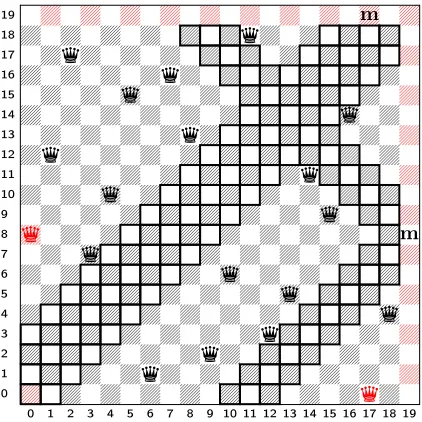
Figure 2: The solution Q19 to the 19-Queens problem with an additional column and row
marked in red. Two squares (17,19) and (19,8) on the additional column and row are marked with ‘m’, and are not on the same or adjacent diagonals to each other. Also emphasised are squares (0,0), (0,8) and (17,0). A number of squares are outlined to show that no queen is placed on the diagonal (0,0) to (18,18) or either adjacent diagonal and that no queen is on the diagonals or adjacent diagonals of squares (17,19) and (19,8).
Definition 5. We define the following sets of queens, illustrated in Figures 2 and 3.
Q19
def
= {(0,8),(1,12),(2,17),(3,7),(4,10),(5,15),(6,1),(7,16),(8,13),(9,2),
(10,6),(11,18),(12,3),(13,5),(14,11),(15,9),(16,14),(17,0),(18,4)}
An
def
= {(i,2imodn)|0≤i < n}
Bn
def
= {(2imodn, i)|0≤i < n}
Next we observe some properties of Q19 that will be used in later proofs.
Observation 6. Q19 is a solution to the 19-Queens problem. It has no queen on
difference-diagonals 1, 0 or -1. For the queens (0, y),(x,0), consider the pairs (19, y)and (x,19): that is, inQ19consider(19,8)and(17,19)(marked with ‘m’ in Figure 2). Their
sum-/difference-diagonals are not within 1 of each other, (0,0)or any queen in Q19.
12Z0Z0Z0L0Z0Z0Z 110Z0Z0Z0Z0Z0ZQ 10Z0Z0ZQZ0Z0Z0Z
9 0Z0Z0Z0Z0Z0L0
8 Z0Z0L0Z0Z0Z0Z
7 0Z0Z0Z0Z0ZQZ0
6 Z0ZQZ0Z0Z0Z0Z
5 0Z0Z0Z0Z0L0Z0
4
Z0L0Z0Z0Z0Z0Z
3
0Z0Z0Z0ZQZ0Z0
2
ZQZ0Z0Z0Z0Z0Z
1
0Z0Z0Z0L0Z0Z0
0
L0Z0Z0Z0Z0Z0Z
0 1 2 3 4 5 6 7 8 9 10 11 12
12Z0Z0Z0Z0Z0ZQZ
110Z0Z0Z0Z0L0Z0
10Z0Z0Z0ZQZ0Z0Z
9 0Z0Z0L0Z0Z0Z0
8 Z0ZQZ0Z0Z0Z0Z
7 0L0Z0Z0Z0Z0Z0
6 Z0Z0Z0Z0Z0Z0L
5 0Z0Z0Z0Z0ZQZ0
4
Z0Z0Z0Z0L0Z0Z
3
0Z0Z0ZQZ0Z0Z0 2
Z0Z0L0Z0Z0Z0Z
1
0ZQZ0Z0Z0Z0Z0 0
L0Z0Z0Z0Z0Z0Z
[image:10.612.157.450.99.239.2]0 1 2 3 4 5 6 7 8 9 10 11 12
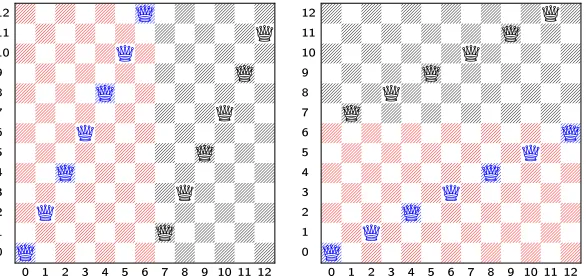
Figure 3: Two modular solutions A13 (left) and B13 (right) to the 13-Queens problem as
defined in Definition 5 with each queen in A13 at (i,2i mod 13) and in B13 at
(2i mod 13, i) (right.) The first seven columns on the left have no two queens
in adjacent rows, while the first seven rows on the right have no two queens in adjacent columns. The two solutions are mirror images along the diagonal (0,0)-(12,12), and also use exactly the same sets of both sum- and difference-diagonals.
Miguel, & Spracklen, 2017) and Minion (Gent, Jefferson, & Miguel, 2006) from a model available online.4 Further Savile Row/Minion searches show that there is no n < 19 for
which a solution to n-Queens can have all the properties of Observation 6.
Lemma 7. If n= 1 mod 6 or n= 5 mod 6 then An and Bn are modular solutions to the
n-Queens problem, and use the same sets of sum-/difference-diagonals as each other.
Proof. Bell and Stevens (2009, Thm. 9) prove thatAnis a modular solution to then-queens
problem for n = 1 mod 6 or n = 5 mod 6. As Bn is symmetrically equivalent to An
(reflected about the longest difference-diagonal), this implies Bn is modular as well.
Because(x, y)∈Aniff(y, x)∈Bn, the sets of sum-diagonals inAnandBnare the same.
Asn is odd, the difference-diagonals ofAn are
i−2i|i∈ {1..n−12 } ∪
i−(2i−n) |i∈
{n+12 ..n} , which simplifies to
−i|i∈ {1..n−12 } ∪
n−i|i∈ {n+12 ..n} ={−n−12 ..n−12 }.
Because (x, y) ∈ An iff (y, x) ∈ Bn the difference-diagonals of An are the negation of the
difference-diagonals ofBn, therefore the difference-diagonals ofAnandBnare the same.
Lemma 8 (Rivin and Zabih). Suppose we have a solution Q to the n-Queens problem, a subset of queens P ⊆Q, and a set of queens P1 which uses the same set of rows, columns,
sum-diagonals and difference-diagonals as P. Then (Q\P)∪P1 is also a solution to the
n-Queens problem.
Proof. This result is due to Rivin and Zabih (1992, Thm. 2.4). SinceP1uses the same rows,
columns and diagonals asP, no queen inQ\P can attack any queen in P1.
The following lemma proves that if two queens are not in the same row, not in the same column, not on the same diagonal, and not on two adjacent diagonals in the same direction, then: if we multiply these two queens bynand add to each one any queen that fits on board
size nthen the resulting two queens will not attack each other.
Lemma 9. Consider any two queens q1,q2 which both fit on board size n, and two queens
q3,q4 of any size. Then: if the columns (respectively rows) of q3,q4 are different, then the columns (rows) of q1 +nq3 and q2 +nq4 are different. Also: if the sum-diagonals (respectively difference-diagonals) ofq3,q4 differ by more than one, then the sum-diagonals (difference-diagonals) of q1 +nq3 and q2 +nq4 are different. If all the just-mentioned properties hold forq3,q4 then q1+nq3 does not attack q2+nq4.
Proof. Let each qi = (αi, βi). For columns, suppose α3 6= α4. Since 0 ≤ α1, α2 < n,
α1+nα3 6=α2+nα4, so the columns of q1+nq3 and q2+nq4 are different. The case of
rows is similar. For sum-diagonals, suppose that |(α3 +β3)−(α4 +β4)| ≥ 2. The range
of sum-diagonals on a board of size nis from 0 to 2n−2, so|(α1+β1)−(α2+β2)|<2n.
But|n(α3+β3)−n(α4+β4)| ≥2n. Hence the sum-diagonals ofq1+nq3 andq2+nq4are
different. The case of difference-diagonals is similar, since their range is−(n−1)to n−1,
so |(α1−β2)−(α1 −β2)| < 2n. If all these cases apply then q1+nq3 does not attack
q2+nq4, by definition of not attacking.
We can now provide a reduction from Problem 3 to Problem 2. This reduction takes an instance of Problem 3 and n′-embeds it at location (0,0) of a large board based on
Figure 2 (where n′ is defined as part of the construction). The other queens in Figure 2
are also replaced with chessboards of queens, which ensure the problem is a valid instance of Problem 2 and block the rows and columns required of the copy of Problem 3 in the bottom-left corner. To solve the constructed instance of Problem 2, queens must be placed within the embedded instance of Problem 3 and nowhere else, hence a solution of Problem 2 maps back to Problem 3 very easily.
Definition 10 (Reduction from Problem 3 to Problem 2). Given an instance of Problem 3,
M3 =hn3, P3, C, Ri, we construct an instance of Problem 2, M2=hn2, P2i as follows:
• If a pair of queens {q1,q2} ⊆P3 attack each other, then we simply drop R andC and
setn2 =n3, P2 =P3. Otherwise:
1. If n3 mod 3 = 2 then set n′ = 2n3+ 1, otherwise set n′ = 2n3−1, so Lemma 7 may
be applied.
2. Form the set of queensQ1 =An′+n′(Q19\ {(17,0)}). SetQ2 =Q1∪(Bn′+n′(17,0)).
That is, n′-embed a copy of An′ at position q for every q ∈ Q19, except for queen (17,0), for which we n′-embed a copy ofB
n′.
3. Set C′ = C∪ {col(q) | q ∈ P3}, R′ = R∪ {row(q) | q ∈ P3}. Set Q3 = {q | q ∈
Q2,col(q)6∈C′,row(q)6∈R′}. That is, we remove queens from Q2 if they are in one
of the columns inC, rows inR, or one of the same rows or columns as a queen inP3.
This can only remove queens from the copy ofAn′ that isn′-embedded at(0,8)or the
4. Put the columns in C′ in ascending order α
0 < α1 < . . . < α|C′|−1. Form the set of
queens QC = {(i,2αi) | 0 ≤ i < |C′|}. Similarly order the rows β0 < β1 < . . . <
β|R′|−1 inR′ and set QR={(2βi, i)|0≤i <|R′|}.
5. Set n2= 19n′+|C′|, P2=Q3∪(QC+n′(19,8))∪(QR+n′(17,19))∪P3.
We will now prove that the construction in Definition 10 is correct, and explicitly show how to map from solutions of Problem 2 to Problem 3 and vice-versa.
Lemma 11. If S2 is a solution to M2, then S3 ={q|q∈S2 &kqk< n3} is a solution to
M3.
Proof. No queens in S3 attack each other since S2 is a solution. Certainly P3 ⊆ P2 by
construction and P2 ⊆ S2 since S2 is a solution. Since kP3k < n3 this gives us P3 ⊆ S3.
It remains to show that |S3|=|C|+|P3|, and for every q∈S3\P3, both col(q) ∈C and
row(q) ∈R. For a given column α∈C, we haveα < n3, and there must beqα ∈S2 with col(qα) = α, and this has row(qα) = β+jn′ for some 0 ≤ β < n′ and 0 ≤ j ≤ 19. We
will show that j = 0 and β ∈R. The only possible nonzero value of j is 8, since all other
rows are excluded by copies of An′: the possible values ofβ forj= 8 are the rows occupied
by queens deleted at step 3, i.e. the rows {2α |α ∈ C′} by construction of An′. But each
of these is excluded by one of the queens in QC +n′(19,8)added at step 5, specifically by (i,2αi) +n′(19,8) if αi is the ith element in C′ in ascending order. So we have j = 0. To
checkβ ∈R, first note that all rows outsideR′ are excluded by queens fromBn′+n′(17,0),
and rows from queens in P3 are excluded by P3 ⊆P2. So β ∈R′\ {row(q) |q∈P3}=R.
That is, we have shown that for all columns α ∈ C there is a queen (α, β) ∈ S3 with
β ∈ R. This gives |S3| ≥ |C|+|P3|. But n′−(|C|+|P3|) possible columns are ruled out
by queens remaining from An′+n′(0,8), so|S3| ≤n′−(n′−(|C|+|P3|)) =|C|+|P3|. So
|S3|=|C|+|P3| as required, and no queens in S3\P3 can use a column not in C or row
not in R.
Lemma 12. If S3 is a solution toM3, then S2 =S3∪P2 is a solution toM2.
Proof. We note thatS2=S3∪(QC+n′(19,8))∪(QR+n′(17,19))∪Q3. We will prove that
no two queens within one of these four subsets attack each other, and that no queen in one subset attacks any queen in the other subsets.
First we consider attacks within one of the subsets. S3 is a solution to M3, so no two
queens in it attack each other. By Lemma 7,An′ is a modular solution to n′-Queens, so by
Theorem 2, Q1 is a subset of a solution to 19n′-Queens (Q1 ∪An′+n′(17,0) is a solution
to 19n′-Queens). Lemma 7 applies since n′ is constructed to be = 1 or = 5 mod 6, and
with Lemma 8 shows that Q2 is a solution to 19n′-Queens, and Q3 ⊆ Q2, so no queens in
Q3 can attack each other. Attacks within QC +n′(19,8) are equivalent to attacks within
QC. The queens in QC are (i,2αi), with i = 0,1,2, . . . and αi strictly increasing with i.
Queens within QC are trivially on different rows and columns; the sum-diagonal i+ 2αi
is strictly increasing with i; and finally 2αi+1 −2αi ≥ 2 so i+ 1−2αi+1 < i−2αi, so
the difference-diagonals are strictly decreasing withi. So no queens within QC attack each
other. The case ofQR+n′(17,19)is similar, with the queens being {(2βi, i)|0≤i <|R′|}
Now we consider attacks between queens in different subsets. By the properties of Q19
in Observation 6, and from Lemma 9, no queen inQC +n′(19,8)attacks any queen in the
rest of S2 except possibly queens in An′+n′(0,8). But any queen in An′+n′(0,8)on the
same row as a queen in QC+n′(19,8)is not in Q3 by step 3. The case of QR+n′(17,19)
is similar. The only remaining case is a queen in S3 attacking a queen in Q3. Again, we
use Observation 6 and Lemma 9 to show that no queen inS3 can be on the same diagonal
as any queen in Q3. Finally, all queens in S3 must be in a column in C′ and a row in R′,
but the queens in those columns and rows were removed at step 3 to formQ3, so no attack
along a row or column is possible.
Theorem 13. The reduction of Definition 10 is a parsimonious reduction from Problem 3 to Problem 2.
Proof. From Lemma 11 and Lemma 12, and the fact that the maps defined in those lemmas
are inverses of each other, since ifS2 =S3∪P2, we haveS3={q|q∈S2 &kqk< n3}.
4.1.1 Including Arbitrary n-Queens Partial Solutions
Lemma 12 has simple corollaries that show any set of nonattacking queens can be found as
a part of a solution to a largern-Queens problem. While a brief detour from our complexity
results, we find the result attractive and it may help illuminate the structure of then-Queens
problem. For example, it shows thatno local arrangement of nonattacking queens can cause
global unsolvability for all n. First we define inclusion of a set of queensP within a larger
set Q. Inclusion is an embedding with the additional requirement that no queens that are
not part of P occur in that subgrid ofQ.
Definition 14. IfP is a set of queens withkPk< n, we say thatP is n-includedat location
(x, y)in a set of queensQifP+ (x, y)⊆Qandthere does not exist a queenqwithkqk< n such that q6∈P andq+ (x, y)∈Q.
Corollary 15. For any set of queensP, where n=kPk, with no two queens inP attacking each other, P may be n-included at (0,0)in a solution of the n2-Queens problem for some
n2.
Proof. Set M3 = hn, P,{},{}i, and construct an n-Queens Completion problem M2 =
hn2, P2i as in Definition 10. P is a solution of M3, therefore (by Lemma 12) P2 is a
so-lution of M2 that n-includes P at position (0,0). All solutions of M2 = hn2, P2i are also
solutions of the n-Queens problem M1 =hn2i so the corollary holds.
Not only can we includeP at(0,0), it can also be included at an arbitrary position on a
larger grid simply by applying Corollary 15 toP+ (i, j)for any position(i, j). Furthermore,
we can include as many copies of P as we want in a single solution to a larger n-Queens,
and do so in exponentially many different ways. First, consider the four sets P + (0,0), P+ (0,1),P+ (1,0),P+ (1,1). AssumingP is non-empty, these four sets are distinct and
all includeP. Second, consider the set of kqueensK={(3i, i)|0≤i < k}. The queens in K are all on different rows and columns and their sum-diagonals all differ by more than one
from each other, as do their difference-diagonals. By Lemma 9 we can (n+ 1)-include any
P′. There are 4k ways of constructingP′. By applying Corollary 15 toP′ we have 4k ways
of includingk copies ofP in a solution to a larger n-Queens problem.
4.2 Ruling out Diagonals: Reduction from Problem 4 to Problem 3
Definition 16 (Reduction from Problem 4 to Problem 3). For the instance of Problem 4
M4 = hn, C, R, D−, D+i, set QD− = {(6n−3−d,3n−1−2d) | d ∈ D−}, set QD+ = {(2n−2−d, n+ 2d)|d∈D+}, and setM
3 =h7n−3, QD−∪QD+,{c+ 3n−2|c∈C}, Ri.
The reduction is illustrated in Figure 4. The key point of this construction is that the difference-diagonal of (6n−3−d,3n−1−2d) is 3n−2 +d, and the sum-diagonal of (2n−2−d, n+ 2d) is3n−2 +d. The offset of3n−2 in both cases explains why we shift
the setC by3n−2 inM3.
First we confirm that M3 is a well-defined instance of Problem 3, assuming M4 is itself
well-defined. The range of possible values ofD−is−(n−1). . . n−1, and hence the extreme
possible placements for queens in QD− are (7n−4,5n−3) and(5n−2, n+ 1);D+ ranges
from0 to2n−2, so the extreme possible placements for queens inQD+ are(0,5n−4)and
(2n−2, n). These certainly have no overlap with the setsRand{c+ 3n−2|c∈C}, and all
fit on the board size7n−3ofM3. No queen inQD−∪QD+ is on the same row or column as
any other: the only non-trivial observation necessary is that ifnis odd (even), then queens
inQD− are all on even (odd) rows and QD+ on odd (even) rows. So M3 is well-defined.
Lemma 17. If S4 is a solution to M4, then S3 = (S4 + (3n−2,0))∪QD− ∪QD+ is a solution to M3.
Proof. Within each subset of S3, no pair of queens attack each other. In the case of S4+ (3n−2,0) this is because S4 is a solution, and in the other subsets by construction. We
also noted above that queens in QD− and QD+ are on different rows from each other, and
their columns and diagonals are far apart. So we only need to consider potential attacks between QD− ∪QD+ and S4 + (3n−2,0). But if (α, β) ∈ S4 then α −β 6∈ D− and so
(6n−3−(α−β),3n−1−2(α−β))6∈QD−, therefore (α+ 3n−2, β) is not attacked by
any queen in QD−. Similar reasoning applies forQD+. Finally we note that constraints on
columns and rows in S3 are obeyed because they are in M4.
Lemma 18. If S3 is a solution to M3, then S4 ={(α−3n+ 2, β) |(α, β)∈S3, β < n} is
a solution to M4.
Proof. No two queens inS4 attack each other sinceS3 is a solution. They all come from the
firstnrows ofS3, so the range ofα−3n+ 2 is0to n−1, so kS3k< n. The constraints on
membership ofC andRare satisfied since they are inM3. For anyd∈D−, a queen inQD−
is on difference-diagonal3n−2 +d, so no queen in S3 is on that diagonal, hence no queen
inS4 is on difference-diagonal d. Similarly for diagonals inD+, so the diagonal constraints
inM4 are obeyed.
Theorem 19. The reduction of Definition 16 is a parsimonious reduction from Problem 4 to Problem 3.
Proof. From Lemma 17 and Lemma 18, and the fact that the maps defined in those lemmas
170Z0Z0Z0Z0Z0Z0Z0Z0Z0Z0Z0ZQ
16l0Z0Z0Z0Z0Z0Z0Z0Z0Z0Z0Z0Z
150Z0Z0Z0Z0Z0Z0Z0Z0Z0Z0Z0L0
14ZqZ0Z0Z0Z0Z0Z0Z0Z0Z0Z0Z0Z
130Z0Z0Z0Z0Z0Z0Z0Z0Z0Z0ZQZ0
12Z0l0Z0Z0Z0Z0Z0Z0Z0Z0Z0Z0Z
110Z0Z0Z0Z0Z0Z0Z0Z0Z0Z0L0Z0
10Z0ZqZ0Z0Z0Z0Z0Z0Z0Z0Z0Z0Z
9
0Z0Z0Z0Z0Z0Z0Z0Z0Z0ZQZ0Z0
8
Z0Z0l0Z0Z0Z0Z0Z0Z0Z0Z0Z0Z
7
0Z0Z0Z0Z0Z0Z0Z0Z0Z0L0Z0Z0
6
Z0Z0ZqZ0Z0Z0Z0Z0Z0Z0Z0Z0Z
5
0Z0Z0Z0Z0Z0Z0Z0Z0ZQZ0Z0Z0
4
Z0Z0Z0l0Z0Z0Z0Z0Z0Z0Z0Z0Z
3 0Z0Z0Z0Z0Z0Z0Z0Z0Z0Z0Z0Z0
2 Z0Z0Z0Z0Z0Z0Z0Z0Z0Z0Z0Z0Z
1 0Z0Z0Z0Z0Z0Z0Z0Z0Z0Z0Z0Z0
0 Z0Z0Z0Z0Z0Z0Z0Z0Z0Z0Z0Z0Z
[image:15.612.173.432.97.286.2]0 1 2 3 4 5 6 7 8 9 10 11 12 13 14 15 16 17 18 19 20 21 22 23 24
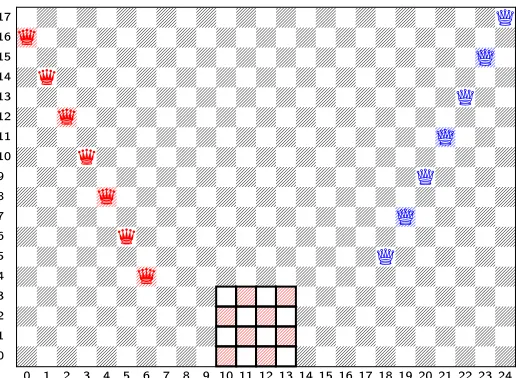
Figure 4: Ruling out the diagonals of the 4×4 square in bottom centre of the grid by
Definition 16. A n×n square has 2n−1 diagonals in each direction. In this
example we see 7 queens from (0,16) to (6,4) ruling out the sum-diagonals, and 7 queens from (18,5) to (24,17) ruling out the difference-diagonals. For example, the queen at (4,8) rules out the sum-diagonal 12, while the queen at (21,11) rules out the difference-diagonal 10. Note that none of these queens attack any squares in the 4×4 square except those in the intended diagonal, and also that no two
of the 14 queens attack each other. Therefore we can use any subset of these 14 queens to rule out exactly and only a selected set of diagonals in the4×4square.
4.3 Arrangement of Gadgets: Reduction from Problem 5 to Problem 4
The reduction from Problem 5 to Problem 4 is relatively straightforward. Since an instance of Problem 5 is made up of multiple instances of Problem 4 with interacting sum-diagonals, it is enough to lay those instances out on the same long diagonal of a larger grid, separated enough that their rows, columns, and difference-diagonals do not have any effect on each other. Apart from combining the separate subproblems correctly, we must ensure that no queens can be wrongly placed in any square off the intended long diagonal. To do this, we exclude all sum-diagonals which do not intersect with any of the instances. Figure 5 gives a high-level illustration of the reduction.
Definition 20(Reduction from Problem 5 to Problem 4). LetM5={M4,a |a= 0,1,2. . . k− 1} be an instance of Problem 5 where k =|M5|and each M4,a =hna, Ca, Ra, D−a,{}i. We
M0 M1 M3 M2 M4 Key
Instance of Problem 4
Ruled out by sum-diagonal constraint Ruled out by row or column constraint
0 1 2 3 4 5 6 7 8
[image:16.612.126.471.90.272.2]0 1 2 3 4 5 6 7 8
Figure 5: A schematic view of the reduction from Problem 5 to Problem 4 in Definition 20 for an instance of Problem 5 containing 5 instances M0 to M4 of Problem 4. Each square shown represents an n′ ×n′ cell, where n′ is the size of the largest
subproblem. The instances M0 to M4 are placed on the long sum-diagonal, from
n′(0,8)for M0 ton′(8,0)for M4, indicated by red outlines. Green areas indicate
that all cells on odd-numbered rows and odd-numbered columns are disallowed. Sum-diagonals that are not on the long diagonal are excluded, and this is indicated by the grey areas. The additional rows, columns and diagonals excluded within each red cell are not shown.
n×ngrid and define the instance Problem 4 as M4 =hn, C, R, D−, D+i, where:
αa
def
= 2n′a
βa def= 2n′(k−1−a)
n def= n′(2k−1)
C def= [
0≤a<k
{c+αa|c∈Ca}
R def= [
0≤a<k
{r+βa |r∈Ra}
D− def= [
0≤a<k
{d+αa−βa|d∈Da−}
D+ def= {0,1,2, . . .2n′(k−1)−1} ∪ {2n′k,2n′k+ 1, . . .4n′k−2}
The definition of D+ is very different from the others, which are simple aggregations.
reason for this is to exclude queens at positions which cannot be excluded by either C orR
but which cannot be allowed: these are seen as grey cells in Figure 5. The well-definedness of M4 is straightforward, given the well-definedness of each componentM4,a.
Lemma 21. If S5 = {S4,a | 0 ≤ a < k} is a solution to M5, then S4 = S0≤a<k(S4,a+ (αa, βa)) is a solution toM4.
Proof. The queenqa= (α, β)∈S4,amaps toq4,a = (α+αa, β+βa)∈S4. First we show no
two queens inS4 attack each other. Two queens inS4 mapped from the sameS4,aboth have
the same offset(αa, βa), so cannot attack each other since no queens inS4,a do. For queens
not from the same S4,a, first consider columns, rows and difference-diagonals, and queens
qa∈S4,a,qb ∈S4,b,a=6 b. Lemma 9 applies with (in terms of that lemma)n=n′,q1 =qa, q2 = qb, q3 = (2a,2(k−1−a)), q4 = (2b,2(k−1−b)), so qa and qb can only possibly
attack each other along sum-diagonals. Note that the sum-diagonal for qa is α+β, while q4,a has sum-diagonalα+αa+β+βa=α+β+ 2n′a+ 2n′(k−1−a) =α+β+ 2n′(k−1).
Thus the sum-diagonal in S4 is the constant 2n′(k−1)plus the value of the sum-diagonal
inS4,a. So two sum-diagonals inS4 are equal iff the corresponding sum-diagonals are equal
inS5. Since S5 is a solution, that is not the case, so no two sum-diagonals in S4 are equal.
Hence no two queens in S4 attack each other.
We must also show that all restrictions based onC,R,D−,D+ are obeyed byq4,a. For
C note that α ∈Ca since S5 solves M5, and so α+αa ∈C, as required. The case of R is
similar. The difference-diagonal of q4,a is (α+αa)−(β +βa). But α−β 6∈ D−a because
D−a represents the forbidden difference-diagonals of M4,a. Therefore (α+αa)−(β+βa)6∈
{d+αa−βa | d ∈ D−a}. We need to check that we cannot have (α+αa)−(β+βa) ∈
{d+αb−βb |d∈D−b }for someb6=a, i.e. the difference(α+αa)−(β+βa)−(d+αb−βb)
cannot be zero. Rearranging we have α−β −d+ 2n′(a−b−(k−1−a) + (k−1−b)) = α −β−d+ 4n′(a−b). |α−β −d| ≤ 2n′ and |4n′(a−b)| ≥ 4n′, so the sum cannot
be zero. Therefore the difference-diagonal of q4,a is not in D−. The sum-diagonal of q4,a
is (α+αa) + (β +βa) = α + 2n′a+ (β + 2n′(k−1−a)) = α+β + 2n′(k−1). But
0 ≤α+β ≤2(n′−1)so 2n′(k−1)≤ α+β+ 2n′(k−1)< 2n′k, so the sum-diagonal of
q4,a is not inD+.
Lemma 22. If S4 is a solution to M4, then S5 ={S4,a |0≤a < k} where S4,a={(α, β)| 0≤α, β < n′,((α, β) + (α
a, βa))∈S4} is a solution to M5.
Proof. The key point is to show that all queensq∈S4 are of the formq= (α+αa, β+βa)
with 0 ≤ α, β < n′, for some a. The construction of C and R gives q = (α+αa, β+βb)
with 0 ≤ α, β < n′, but we have to show that a = b. The sum-diagonal d of q is d =
α+αa+β +βb = α +β + 2n′a+ 2n′(k−1−b) = α+β+ 2n′(k−1 + (a−b)). But
0 ≤ α+β ≤ 2n′−2, so if a < b then d < 2n′(k−1)−1, while if a > b then d≥ 2n′k.
In either case d ∈ D+, so we must have a = b. All of α ∈ C
a, β ∈ Ra, α−β 6∈ D−a
now follow immediately from the corresponding facts for S4. We have kS4,ak< na because
each max(Ca∪Ra) < na. Certainly no two queens in anyS4,a can attack each other since
none in S4 do. Finally, no two queens in S4,a,S4,b can be on the same sum-diagonal since
Theorem 23. The reduction of Definition 20 is a parsimonious reduction from Problem 5 to Problem 4.
Proof. From Lemma 21 and Lemma 22, and the fact that the maps defined in those lemmas
are inverses of each other.
4.4 Gadgets for Clauses and Variables: Reduction from 1-in-3-SAT to Problem 5
For an instance M6 =hV, Ci of Restricted 1-in-3-SAT, we will construct an instanceM5 =
{Ga}of Problem 5. Recall that eachGa=hna, Ca, Ra, Da−,{}iis an instance of Problem 4.5
We assume that V = {vi | i = 0,1, . . .|V| −1} and C = {ci | i = 0,1, . . .|C| −1}. The
ordering of both variables and clauses is arbitrary but must be fixed before the reduction is performed. We introduce the notationGa⊕δa, which can be thought of as shiftingGabyδa
places along thex-axis.
Definition 24. For an integer δa ≥0 and Ga =hna, Ca, Ra, D−a,{}i, we define Ga⊕δa
def
=
hna+δa,{c+δa|c∈Ca}, Ra,{d+δa|d∈Da−},{}i.
Lemma 25. A set of queens Qa is a solution toGa iff Qa+ (δa,0)is a solution to Ga⊕δa
Proof. The addition of (δa,0) does not affect attacks between two queens, so we only have
to consider the other properties ofQa+ (δa,0), and each is easy. Qafits on board size naiff
Qa+ (δa,0)fits on sizena+k(δa,0)k=na+δa. For queen (α, β)∈Qa, we haveα∈Ca iff
α+δa= col((α, β) + (δa,0))∈ {c+δa|c∈Ca}, and similarly forRa. Finally,(α−β)6∈D−a
iffcol((α, β) + (δa,0))−row((α, β) + (δa,0)) =α−β+δa6∈ {d+δa |d∈D−a}.
G0: A gadget for a SAT variable. A copy of the same gadget G0 is used for each SAT
variable in a problem. Each copy of G0 has two solutions, and we will arrange that one
solution will indicate that the corresponding SAT variable should be true, while the other solution will indicate that the SAT variable should be false. The gadgetG0 is illustrated in
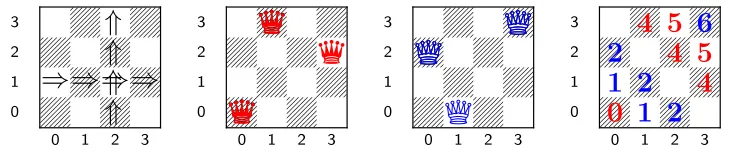
Figure 6 and defined in Definition 26. G0 has only two solutions, as can be checked by a very
small search. The two solutions are{(0,0),(1,3),(3,2)}, which we call the ‘red solution’, and
{(0,2),(1,0),(3,3)}, the ‘blue solution’. These use disjoint sets of sum-diagonals. These are
respectively {0,4,5} (the ‘red diagonals’) and {1,2,6} (the ‘blue diagonals’). The gadget G0 was found by a search using Savile Row (Nightingale et al., 2017) and Minion (Gent
et al., 2006) from a model available online.6
For a variable vi in a clause c we will use one red diagonal and one blue diagonal from
theith copy of G0. We will write dr
i,c for the red diagonal being used, and dbi,c for the blue
diagonal, and dx
i,c for a diagonal of indeterminate colour (i.e. x ∈ {b, r}). Note that in
Restricted 1-in-3-SAT, vi occurs in at most three clauses, and no more than once in any
clause. Because of this, for any given variable v, the valuedx
v,c determines the values c and
x.
5. We use the letterGinstead ofM4for gadgets inM5to avoid proliferation of subscripts and to emphasise that these are gadgets, which will be used to encode different parts of a 1-in-3-SAT instance.
3
0Z0Z
2Z0Z0
10Z0Z
0Z0Z0
0 1 2 3
⇒⇒⇒⇒
⇒
⇒
⇒
⇒
30l
q
0Z
2
Z0Z
q
1
0Z0Z
0
l
q
0Z0
0 1 2 3
3
0Z0L
Q
2
L
Q
0Z0
1
0Z0Z
0
Z
Q
Z0
0 1 2 3
3
0Z0Z
2Z0Z0
10Z0Z
0Z0Z0
0 1 2 3
[image:19.612.116.482.102.183.2]1
1
2
2
2
6
0
4
4
4
5
5
Figure 6: Illustration of the4×4gadgetG0. The first diagram shows a board with arrows
barring the second row and third column. The second and third boards show the only two ways that three queens can be placed in the remaining squares with no two queens attacking each other. The first, red, solution will be used to indicate that the corresponding SAT variable is true, with the second, blue, solution for false. The final board shows that the red and blue solutions occupy disjoint sets of sum-diagonals. Each square is labelled with the sum-diagonal it is on, with diagonals 0, 4, and 5 being red and 1, 2, and 6 being blue. The other sum-diagonal (3) is not used in either solution.
Definition 26 (Gadget G0). We define G0 def= h4,{0,1,3},{0,2,3},{},{}i. For a variable
vi where 0 ≤ i < |V|, we define δvi
def
= 21i. (We sometimes write δi for δvi to avoid the
double subscript.) Each variable vi is associated with one copy of G0 named G0i, which is
defined as follows: G0i def= G0⊕δvi.
We allocate red and blue diagonals as follows. If vi occurs in clauses c1< c2 < c3, then
for c1 we set dri,c1 def
= 0, db
i,c1 def
= 1; for c2 we set dri,c2 def
= 4, db
i,c2 def
= 2; and for c3 we set
dr i,c3
def
= 5, db
i,c3 def
= 6. If vi occurs in fewer than three clauses we simply define the relevant
subset of the dx i,c.
G1, G2, G3: Three gadgets for a 1-in-3-SAT clause. Now we present the gadgets
associated with a clause c = {vi, vj, vk}, namely Gc1, G2c, G3c. G1c will ensure that at least
one of the G0
i,G0j and G0k takes its red solution, while G2c and G3c will each ensure that at
least one of them (different in each case) takes its blue solution. Combined they will force
exactly one of G0i, G0j and G0k to take its red solution: thus variables assigned true in SAT
will correspond precisely with G0 gadgets using their red solutions. The gadgets G1c, G2c
and G3
c will vary from clause to clause, unlike G0, where the gadgets are the same for each
variable. For a variable v∈ {vi, vj, vk} and colour x∈ {b, r}we definecolvx
def
= δv+dxv,c: all
columns inG1
c,G2c,G3c will be of this form. The rows in G1c,G2c,G3c will also be of standard
form, drawn from {7a|a∈0,1,2}={0,7,14}.
Definition 27 (GadgetG1c). Suppose we have a clausec={vi, vj, vk} of Restricted
1-in-3-SAT where i < j < k, so also δi < δj < δk.
• G1 c
def
= hcolb
k+ 1, C1, R1, D−1,{}i where: C1 = {colbi, coljb, colkb}, R1 = {0,7,14}, and
D1−={colb
Key
Possible position of queen
Ruled out by difference-diagonal constraint
[image:20.612.138.479.91.221.2]Ruled out by row or column constraint 0 … 7 … 1 4 … … … …
Figure 7: Illustration ofG1
c showing the seven positions where queens may be placed.
Key
Possible position of queen
Ruled out by row or column constraint 0 … 7 … … … … 0 … 1 4
Interaction on sum-diagonal between two gadgets
Figure 8: Illustration ofG2
c andG3c and their interaction through one sum-diagonal(colrj+0).
GadgetG1
c is illustrated in Figure 7. There are three solutions ofG1c, and each solution
places a queen in row 0 at a different column. G1c interacts with the three relevant G0
gadgets through the position of the queen on row 0. For example, if the queen is placed at
(colb
j,0) then the G0 gadget for variable vj is forced to take its red solution. G1c does not
directly interact with any other gadget.
Definition 28 (Gadgets G2c and G3c). Suppose c = {vi, vj, vk} where i < j < k, so δi <
δj < δk.
• G2 c
def
= hcolr
j+ 1, C2, R2,{},{}iwhere: C2 ={colir, colrj}, andR2={0,7}.
• G3c def= hcolr
k+ 1, C3, R3,{},{}i where: C3 ={colrj, colkr}, andR3 ={0,14}.
Gadgets G2c and G3c are illustrated in Figure 8. Both these gadgets have two solutions.
[image:20.612.97.520.288.442.2]of the G0 gadgets to take its blue solution. G2
c and G3c cannot both use the specific pair
(colr
j,0)because both have the same sum-diagonal. Taken together, G2c andG3c have three
solutions, each of which forces two G0 gadgets to take their blue solutions.
It is natural to ask whether we could encode 3-SAT clauses using only G1
c (adapted to
use blue diagonals for the positive literals and red diagonals for negative literals), making
G2c andG3c redundant. 3-SAT with at most 3 occurrences of each variable is NP-complete.
However, a 3-SAT clause c is allowed to be satisfied by more than one of its literals. In
this case the correspondingG1
c gadget would have more than one solution, so the reduction
would not be parsimonious. Supposing we wished to prove only NP-Completeness we could use the simpler reduction from 3-SAT. However, we know of no way to simplify the other three reductions in Definitions 10, 16, and 20.
The sum-diagonals for row 0 in G1c areδi+dbi,c,δj+dbj,c,δk+dbk,c, in each case a blue
sum-diagonal from the relevantG0 gadget. Similarly, the sum-diagonals for row 0 inG2 c,G3c
areδi+dri,c,δj +drj,c,δk+drk,c, each a red sum-diagonal from the relevant G0.
The separations of 7 between rows and 21 between columns were chosen to make the
following simple arithmetical fact true:
Observation 29. Suppose that we have integers a1, a2, c1, c2, d1, d2 with 0 ≤ a1, a2 ≤ 2, 0 ≤d1, d2 ≤6, and suppose that 21(c1−c2)±7(a1−a2)±(d1−d2) = 0. Then c1 = c2,
a1=a2 and d1 =d2.
Proof. Ifc1 6=c2 then|21(c1−c2)| ≥21, while| ±7(a1−a2)±(d1−d2)| ≤(2−0)7 + 6 = 20 <21. This makes it impossible to make the sum equal to zero unless c1 = c2, and also
7(a1−a2)±(d1−d2) = 0. By similar reasoning, we must havea1 =a2 since ifa16=a2 then
|7a1−7a2| ≥7, and|d1−d2| ≤ 6<7. Since we have c1 =c2,a1 =a2, we must also have
d1=d2.
Before presenting the reduction itself, we prove (for all three gadget types) that the possible locations of the queens do not attack each other diagonally.
Lemma 30. Within each ofG1
c, G2c,G3c, where the gadget has columns Ci and rowsRi, the
difference-diagonals α−β with α ∈ Ci, β ∈ Ri are all distinct. The same applies for the
sum-diagonals α+β.
Proof. We can deal with both cases at once by writing ± where necessary. For v1, v2 ∈
{i, j, k}, x ∈ {b, r}, a1, a2 ∈ {0,1,2} we have α = colvx1, β = 7a1. This makes α±β =
δv1 +d
x
v1,c±7a1. If two sum-/difference-diagonals within one G
1
c, G2c, or G3c are the same
then we have (since values of x and c are fixed within a clause): 0 = 21(v1−v2)±7(a1−
a2) +dxv1,c−d
x
v2,c. Observation 29 givesv1 =v2 anda1=a2. In each gadget G
1
c,G2c,G3c the
value ofvandauniquely determinesα andβ. Thus the value ofα±β uniquely determines α and β, which can only happen if all sum-/difference-diagonals are distinct.
Definition 31(Reduction from Restricted 1-in-3-SAT to Problem 5). Consider an instance
M6 =hV, Ci of Restricted 1-in-3-SAT. For a clause c={vi, vj, vk} ∈C we will write M5,c
for the instance of Problem 5, M5,c
def
= {G0i, G0j, G0k, G1c, G2c, G3c}. For the reduction of the entire instance M6 we set:
M5
def
= [
c∈C
Each G0
v can occur in the union up to three times, if v is in three clauses. However,
each copy is identical sinceG0v does not depend onc, so in the final set M6, eachG0v occurs
exactly once.
Lemma 32. The possible sum-diagonals in M5 are all of the form δv +dxv,c + 7a with 0≤a≤2, and additionally: a= 0 inG0v;x=bin G1c; and x=r in G2c, G3c. Furthermore, if δv1 +d
x1
v1,c1 + 7a1 = δv2 +d
x2
v2,c2 + 7a2, then we have all of v1 = v2, c1 = c2, x1 = x2,
a1=a2.
Proof. The first statement follows from a straightforward case analysis. In G0
v the possible
values are exactly δv +dxv,c. In each of G1c, G2c, G3c we have C ⊆ {colxi, colxj, colkx}, R ⊆
{7a | 0 ≤ a ≤ 2}, and so the sum-diagonal is colx
v + 7a = δv +dxv,c+ 7a. In G1c, x = b
and in G2
c, G3c, x = r, as required by the statement. For the second statement, suppose
21(v1−v2) + 7(a1−a2) + (dxv11,c1 −d
x2
v2,c2) = 0. Observation 29 applies to immediately give
v1 =v2,a1=a2, and alsodxv11,c1 =d
x2
v2,c2 =d
x2
v1,c2. By construction ofG
0, for a given variable
v1, the values c and x are uniquely determined from the value of dvx1,c. Hence c1 =c2 and
x1 =x2.
Lemma 33. For a clausec={vi, vj, vk}fromM6, M5,c has exactly three solutions. In one,
G0i takes its red solution and G0j, G0k take their blue solutions; in a second G0j is red and
G0i, G0k blue; and in the thirdGk0 is red andG0i, G0j blue.
Proof. We work by case analysis on where the queen in row 0 in G1c is placed. This can be
one of the pairs (colb
i,0), (colbj,0), or(colbk,0). In each case we will construct a solution set
of queens S4(G) for each G∈M5,c, and show thatS5,c={S4(G)|G∈M5,c} is the unique
solution toM5,c for that case. In the case for(colbx,0), the corresponding gadgetG0xwill use
its red solution and the other twoG0 their blue solutions.
First consider the case (colb
i,0) ∈ S4(G1c). This has the sum-diagonal colib = dbi,c+δi,
the same value as a blue sum-diagonal of G0i, so we set S4(G0i) to its red solution. The
other two pairs in S4(G1c) must use the columns coljb and colkb. However, the pair (colbk,7)
is excluded by D1−. Hence we set S4(G1c) = {(colib,0),(coljb,7),(colkb,14)}. Now consider
G2c. The columns available in row 0 are colr
i and colrj. But the pair (colir,0)has the
sum-diagonal colr
i = dri,c +δi, and this is the same value as one red sum-diagonal of G0i, and
we are using the red solution for G0i so we cannot use the pair (colr
i,0) in G2c. So we set
S4(G2c) = {(colrj,0),(colri,7)}. But the sum-diagonal value of (colrj,0)is the same as a red
diagonal in G0
j, so we set S4(G0j) to its blue solution. Now consider G3c. The pair (colrj,0)
is disallowed because it is on the same sum-diagonal as the pair (colr
j,0)∈S4(G2c). Hence
we set S4(G3c) = {(colrk,0),(colrj,14)}. The sum-diagonal value of (colrk,0)forces us to set
S4(G0k) to its blue solution.
The above has defined S5,c completely for this case, and shown that there were no
alternative choices at any point. This establishes uniqueness, but it is still necessary to show thatS5,c is indeed a solution toM5,c, i.e. that eachS4(G) is a solution to Gand that
there are no sum-diagonal clashes between gadgets. The values S4(G0v) are already known
and column. Lemma 30 shows that no two queens can be placed on the same difference- or sum-diagonal withinG1c,G2c,G3c. Also S4(G1c) correctly does not contain the pairs(colbk,7)
and (colb
i,14) which are disallowed by D1−. We now consider sum-diagonals from different
gadgets. From Lemma 32, if two sum-diagonals have the same value of δv+dxv,c+ 7a, they
have the same values of v, c, x, a. We only have to consider a= 0, since from Lemma 32, G0 only has a= 0,G2c and G3c do not share a non-zero value of a, andG1c does not share a
value ofxwithG2
c, G3c. Fora= 0the only cases of duplicate values ofδv+dxv,care: between
G0v and G1c,G2c, G3c; and the value δj +drj,c between G2c and G3c. The construction of S5,c
above avoided using any of these sum-diagonals twice, and thus is indeed a solution. We omit details of the cases (colb
j,0) and (colbk,0) in G1c, which force G0j and G0k
(re-spectively) to take their red solutions with the other copies of G0 blue. The case (colb k,0)
is exactly similar to the case above except that D1− rules out the pair(colb
i,14). There is a
slight difference for the pair (colb
j,0) inG1c: the solution of G1c is fixed by the exclusion of
both diagonals inD−1, while the solutions ofG2
c andG3c are unique because (colrj,0)cannot
be used in either since it has the same sum-diagonal as the red solution toG0 j.
Lemma 34. For any truth assignment S6 which solves M6 then S5 is a solution to M5,
where S5 ={S4(G) |G∈M5}; and where S4(G0i) is the red solution iff S6(vi) =true and
the blue solution otherwise; and where values of S4(G1), S4(G2), S4(G3) are set as in the
proof of Lemma 33.
Proof. BecauseS6 is a solution to M6 =hV, Ci, for any clausec={vi, vj, vk} ∈C we know
that S6 assigns exactly one of the literals in c to true. Hence exactly one of S4(G0i) is red
and the other two are blue, and, by Lemma 33, the values of S4(G1c), S4(G2c), S4(G3c) are
well-defined solutions and unique. It remains to show that for any two gadgetsG, G′ ∈M5,
and any two queens q 6= q′, q ∈ S4(G), q′ ∈ S4(G′), the sum-diagonals of q and q′ are
different. Lemma 32 shows that ifqandq′ have the same sum-diagonals, then they have the
same values (in terms of that lemma) ofv1 and v2, and ofc1 and c2, that is they arise from
the same combination of clause and variable. Hence eitherG=G′ =G0
v or G, G′ ∈M5,c, or
both. In either case, their sum-diagonals must be different according to Lemma 33. Finally we note that S5 is well defined and unique because each S4(G0i) is forced to be either the
red or blue solution by the truth value ofvi, even if vi appears in no clauses.
Lemma 35. For any solution S5 ={S4(G)|G∈M5} toM5, then S6 is a solution to M6,
where S6(vi) = true iff S4(G0i) is the red solution and S6(vi) =false iff S4(G0i) is the blue
solution.
Proof. S6is well defined since eachG0i can only take its red or blue solution. From Lemma 33,
exactly one variable from each clause in M6 is set to true by S6.
Theorem 36. The reduction of Definition 31 from Restricted 1-in-3-SAT to Problem 5 is a parsimonious reduction.
Proof. From Lemma 34 and Lemma 35, and the fact that the maps defined in those lemmas
are inverses of each other.