ACES- El CENTER
El CENTER IF UCEllENCE
RESEARCH GRANTS
&
WORKING PAPER SERIES
Explaining Euroskepticism as a Function of Regional
Representation
Anna Olsson
Ph.D. Candidate Department of Government
School of Public Affairs American University 4400 Massachusetts Ave., NW
Abstract
Recent scholarship has suggested that nation-states will gradually fade away in favor of regions and super-regions as the main actors within a European Union
characterized by strong regional identities. At the same time, recent developments have shown that citizen support for European integration is essential for any future
development of the Union. The puzzle inspiring this paper is the finding that the greatest support for the EU increasingly stems from minority nationalist regions seeking to bypass their central states to achieve their policy goals at the EU level. This paper empirically tests this suggestion, while shedding light on the relationship between the quality of representation of regional interests at the EU level and positive citizen attitudes towards the EU. In particular, it finds two explanations for cross-regional variation in the
Introduction
After half a century of formal integration, Europe remains an amalgam of multinational states. From Scotland to Wales, Catalonia to Corsica, and Flanders to Brittany, strong regional and ethnoterritorial identities seek greater voice, greater resources, and greater autonomy-
if
not outright independence and statehood. Given the rise in regional assertiveness, it is no surprise that interest and speculation in a 'Europe of the Regions' has grown. In brief, the nowcfamiliar suggestion is that nation-states will fade away in favor of regions and super-regions that can survive and thrive within the EU and in the global economy. This vision is reinforced by the increasing tendency of both the EU and the regions to try to by-pass the central state.(Downs 2002, 172)
Today a number of paradoxes characterize the European Union (EU). First, one can
observe the trend of a simultaneously centralizing and decentralizing EU, with power shifting
vertically from the member states to the EU level, and from the EU level to the regional level.
Second, there are contradicting trends of Euroskepticism and Europhoria, both among and within
EU member states. Third, one can observe contradicting trends of state nationalism characterized
by Euroskepticism and xenophobia, and minority nationalism characterized by Europhoria and
openness, can be observed (Keating 2001). Fourth, there is a trend of diminishing focus on
sovereignty among regions and ethnoterritorial minorities, breaking the traditional linkage
between nationalism/regionalism and protectionism (Keating 1996). Fifth, an increased emphasis
on minority protection initiated at the EU-level is occurring, often contradicting state level
policies.
What these five paradoxes and contradictions have in common is that they involve a new
political mobilization of regions and regional minority nationalisms at the EU level. This leads
one to the greatest paradox of all: the suggestion that the populations in minority nationalist
referendum in Ireland on the ratification of the Lisbon Treaty, leading to the failure thereof-that
any further integration of Europe is heavily contingent on public support for the EU project.
Subsequently, these trends underscore the vast practical value of analyzing the puzzle ofEU
support among regional minority nationalisms.
Inspired by this puzzle, the purpose of this paper is to seek a basic explanation to the
variation in attitudes toward European integration at the sub-national, or regional level, by
empirically answering the following questions: Is there greater support for E~ropean integration in regions dominated by minority nationalisms than in other regions within and across the EU
member states? Is there greater support for European integration at the regional level in federal
member states or in unitary member states? Finally, can variation in support for European
integration at the sub-national level be explained by variation in the quality of representation of
regional interests in Brussels? I thus seek to establish whether a cultural explanation, embodied
by the question of different levels regional identity, or an institutional explanation, embodied by
the question of established sub-national institutions as agents of regional mobilization, or a
combination thereof, is more viable in explaining Euroskepticism.
Research on European integration and the development of the EU has traditionally fallen
under the umbrella of studies in international relations, treating the EU mainly as an international
organization (Slocum and van Langenhove 2004). Pursuant to deeper European integration and a
recent wave of regional integration, the popularity of social constructivism in the scientific study
of regional integration has increased, as has the tendency to look upon the EU as a single polity
(Downs 2002; Hettne 2002; Keating, Loughlin, and Deschouwer 2003; Loughlin 2001; Risse
2004; Slocum and van Langenhove 2004). In recent years the EU has transformed into a political
fields to question the relationship between nation and state, centralization and decentralization,
and even the existence of the nation-state itself in a future Europe (Biersteker 1999; Guibernau
1999; Keating 2001; Keating, Loughlin, and Deschouwer 2003). Montserrat Guibernau looks
upon the EU as "a living laboratory in which experiments about new ways to understand
sovereignty, territoriality and identity are currently being tested" (Guibernau 1999, 149). These
words illustrate the essence of the difficulty and delight of studying the EU today: the field is at
an intersection where a number of academic disciplines, literatures, and themes meet, interact,
and engage in numerous theoretical debates. The research questions of this paper are placed
squarely in this intersection, and thus operate on the border of a number of different literatures.
The connection between public approval of government institutions and democratic
legitimacy has long been established by political scientists. At the same time, scholars argue that
adequate democratic representation of EU citizens at all levels is of fundamental importance for
the democratic legitimacy of the EU (Schmidt 2004, Thomassen and Schmitt 1997). Not
surprisingly, given its effect of slowing down the pace of European integration in recent years,
the study of public attitudes toward European integration-and in particular the phenomenon
referred to as Euroskepticism-has received a lot of scholarly attention. 1 Multiple studies
confirm that the level of public support for the EU varies both within and among member states,
but most scholarly work has focused on explanations at the individual or at the member state
level. This paper thus first and foremost makes a contribution to the scholarly literature on
Euroskepticism, as it finds evidence of systematic variation in public attitudes toward European
integration at a level that has largely been overlooked in the member state and individual level
analyses conducted by scholars so far.
1
In addition, as sub-national regions have resumed an increasingly important role in the
EU governance system in recent years, the research questions can be placed within a large
literature on European integration in general, and within a growing scholarly literature on what
has been labeled a "Europe of the Regions" in particular. Whereas the concept of a Europe of the
Regions dates back to the 1920s, it resurged in the 1960s as a way to promote a federal Europe.
More recently the importance of the regional level of governance within the EU has increased
since the early 1990s, when the regions were given a consulting role in the decision making
process through the creation of the Committee of the Regions and through the introduction of the
principle ofsubsidiarity (Treaty on European Union 1992). Recent scholarship has emphasized
the role of regional elite mobilization in Brussels as a political tool of achieving change, as the
number of regional information offices in Brussels has continued to increase drastically,
doubling in size from 140 in1995 to over 280 in 2007 (CoR 2007; Mamadouh 2001; Marks et al.
1996, Moo re 2007). It thus appears likely that regions of all kinds, whether or not they are
granted any greater political influence through direct incorporation in the EU decision-making
process in the near future, will continue to attempt influencing this process in alternative ways.
This is likely to spur another wave of research on regionalism in the EU. This surge in
decentralization and regional integration has given rise to a whole literature on what has been
named the "new regionalism" (Hettne 2002; Keating 1998). Although the new regionalism is
seen as a world-wide phenomenon, nowhere else has regionalization been as extensive as in
Europe, which has consequently come to serve as a paradigm for this concept (Hettne 2002;
Keating 2004). The new regionalism literature stresses the importance of local and regional
the role of collective identities in facilitating social change (Keating 1998, 2004; Keating, Loughlin, and Deschouwer 2003).
The new regionalists' emphasis on the role of identity implicates an overlap with the ethnicity and national identity literatures within comparative politics. The question of regional minority nationalism-the main inspiration for this paper-is located where these literatures intersect. One scholar in particular, Michael Keating, has dominated the minority nationalism literature (Keating 1988, 1996, 1998,2001, 2004; Keating and Hooghe 2001; Keating, Loughlin, and Deschouwer 2003; Keating and McGarry 2001). He defines minority nationalism as
involving "the denial of exclusive claims on the part of the state nationalism and the assertion of national rights of self determination for groups within it" (Keating 1996, 18). Keating initiated the theoretically and empirically useful distinction between ethnic and civic minority nationalism (Brubaker 2004; Keating 1996; Newman 2000). Finally, he coined the term "New Minority Nationalisms," also called regional nationalisms, as "post-nation-state in inspiration, addressing a world in which sovereignty has ceased to be absolute and power is dispersed" (Keating 1996, 53).
toward European integration than their nonminority compatriots. Although many scholars have
identified the phenomenon, no one to date has conducted such a quantitative empirical analysis.
Based on the above research questions, and supported by findings in the scholarly
literature on the new regionalism and minority nationalism in the EU, I will test the following
hypotheses:
Hypothesis I: The stronger an individual's regional identity is, the greater the likelihood of
supporting European integration, all else being equal.
The logic behind the first hypothesis, and thus behind the main research question, is
broad agreement in recent scholarly literature on regionalism and minority nationalism in the
EU, agreement that a deepened European integration has provided incentives to minority
nationalist and regionalist groups to rethink their policy stance on European integration,
switching from a protectionist, anti-European position to an outward-looking, pro-European
position, thus seeking to bypass their states, to achieve their policy goals at the EU level (Downs
2002; Keating 1996, 2004). In their article on party response to European integration, Gary
Marks and Carole Wilson build on the cleavage theory ofLipset and Rokkan and extend their
center-periphery dimension with a distinction between territorially dispersed and territorially
concentrated peripheral minorities (Lipset and Rokkan 1967; Keating 1988; Marks and Wilson
2000). They argue that political parties representing the former are likely to oppose all central
authorities, whereas political parties representing the latter tend to support European integration
because it "can facilitate decentralization of authority from the central state to their region or
ethno-territorial nation" (Marks and Wilson 2000, 438). Based on this, one might expect that the
existence of a minority nationalist or regionalist party will lead to a more positive attitude toward
European integration. Thus a positive relationship between the dependent variable, support for
status is assumed, expecting a greater support for European integration in regions dominated by
minority nationalisms than in other regions.
Hypothesis 2: Support for European integration is more likely in federal member states than in
unitary member states, all else being equal.
The literature has indicated a positive relationship between attitudes toward the EU and a
federal type of government. Some scholars hypothesize that regions resembling federal units
tend to be more positive toward the EU because they have the institutional means in place to
represent their interests within the complex European governance structure (Bullman 200 I).
Thus, based on existing research, the third independent variable of interest, federalism, is
assumed to have a positive relationship with the dependent variable.
Hypothesis 3: Support for European integration is stronger in regions whose interests are better
represented at the EU level.
There is obviously a very large literature on political representation, and the
representation of regional interests in the European Union has most conunonly been analyzed
within the theoretical context of pluralism and lobbying, much because the lack of formal, direct
representation of regions within the institutional structure of the EU has resulted in the use of
informal ways to influence EU policy (Hooghe 1995; Keating 2001; Keating and Hooghe 2001;
Mamadouh 2001; Marks, Haesly, and Mbaye 2002; Marks et al. 1996; Nielsen and Salk 1998).
The quantitative part of the analysis, testing the first two hypotheses, uses cross-sectional
individual and aggregate level survey data, collected through Eurobarometer survey 65.2 (EB
characteristics, as 29,170 citizens from all EU member-states and the candidate states are interviewed in face-to-face interviews. The population universe for the surveys was all persons aged 15 and over, and the samples of all surveys were designed as multi-stage probability samples in the single countries. The fact that identical surveys were simultaneously conducted in all EU member-states vastly increases the comparability of the data across member-states. Moreover, the fact that each individual interviewed was not only coded on the country in which the interview took place, but also on the region in which the interview was conducted, makes the data extraordinarily useful for the purposes of this analysis. In addition to this, the datasets have been widely used in scholarly analysis since their release.2 After dropping all interviews with respondents outside the EU 15, and a small number of respondents who were not coded on the variable "region," a total of 15,403 individuals remained in the analysis sample. Further, data was missing on one or more of the variables included in this analysis for additional respondents, which were consequently dropped from the analysis sample. The final analysis samples for each of the dependent variables were additionally reduced to 14,704, 14,839, and 13,131,
. 1 3
respective y.
To attempt to explain the variation in Euroskepticism at the regional level that is tested in the first two hypotheses, and consequently to test the third hypothesis-that support for
European integration is stronger in regions whose interests are better represented at the EU level-a qualitative component was added to the analysis. To control for both variation caused by institutional factors and by cultural factors, the quality of repr~sentation was evaluated by examining the activities and goals of a number of sub-national representation offices in Brussels.
2 For more details about the Eurobarometer Surveys, see the survey code books and documentation, available
through the web site of the Inter-university Consortium for-Political and Social Research (ICPSR), at
htto:/ /www .icpsr. umich.edu/.
To capture differences between federal and unitary member states, on one hand, and between
strong identity (minority nationalist) regions and weak identity regions, on the other hand, cases
were selected that reflect both these dimensions. Between May I and June 11, 2008, forty
face-to-face interviews were conducted with the directors (in a few cases deputy directors) of the
regional representation offices from three member states: Germany, the United Kingdom, and
Sweden4 The interviews were conducted in the native languages of the interviewees, they lasted
between 34 and 90 minutes (with an average length of just under one hour), and with only two of
the 42 existent regional offices from the selected member states declining an interview, the
response rate was very high5 Due to the limited scope of this paper, however, only a select
number of interviews have been analyzed, and thus only preliminary findings of these interviews
will be presented here.
Methodology
For the first part of the paper, the use of quantitative methodology, particularly regression
analysis, was especially suitable, considering the nature of the data used in this analysis:
large-scale survey data representing the populations of all EU member states. Also, since the previous
use of multivariate regression analysis in the research on the topic of this paper has been limited,
such analysis may lead to insights that would otherwise be lost. To test the first two hypotheses
described above, and to answer the research questions of this paper, the independent variables
were regressed on each of the three dependent variables. In the case of the first two dependent
variables-satisfaction with EU membership, and EU image-(here called SatEUMem and
EUimage respectively) I estimated ordinallogit models, and in the case of the third dependent
4
The interview questionnaire can be found in Appendix D. 5
The director of one UK regional office did not want to participate, and another interview with a UK regional office
variable-relative satisfaction with EU democracy--(here called SatEUDem) I estimated a
logistic model6
The three regression equations to be estimated can be summarized in the following
. 7
equatiOn:
Y; ~ Po + P1federalism; + P2regionallD;+ P3representation; + P4minorityregion; +
P5minorityxregionaliD; + p6male; + p7age; + Pseducation; + e;
where
Y 1 ~ Assessment of own country's membership in the EU as a "generally good thing," a "neither good nor bad thing," or a "bad thing" (2, I ,0)
Y 2 ~ Assessment of whether the EU conjures up a "very positive," a "fairly
positive," a "neutral," a "fairly negative," or a "very negative" image (scale: 4 ~ very positive to 0 ~ very negative)
Y 3 ~ Relative satisfaction with how democracy works in the EU compared
to own country, coded one if satisfaction with democracy in the EU is greater than satisfaction with democracy in one's own country, and zero otherwise
federalism~ level of federalism, coded on an index ranging from 10 c~ most federal) to 0
c~ least federal)
regional ID~ regional identity, coded one if the respondent is more attached to their region than to their country, and zero otherwise
representation~ Assessment of whether or not the respondent agrees with the statement "My
voice counts in the EU" (scale: 2 ~agrees; I ~ DK; and 0 ~disagrees)
minority region~ region identified as predominantly minority nationalist (1,0)
minorityxregionaliD ~interaction term between minority region and regional identity
male~ Sex(l,O)
age~ Age in years
education~ Age when stopping full-time education
6
The choice of the ordinallogit for the first two regression model is motivated by the fact that the dependent
variable is an ordinal variable, and the choice of the logistic model for the third regression model is motivated by the fact that the dependent variable is a binary variable.
7 Initially I intended to include both country and region dummy variables, but this proved to be unsuitable due to
The construct "support for European integration," which can also be seen as the antithesis
of Euroskepticism, is operationalized by three separate dependent variables based on three
different questions from the EB 65.2 because they capture slightly different variations of
respondents' attitudes toward European integration. The first question asked whether the
respondent sees one's country's EU membership as a good thing, a bad thing, or a neither good
nor bad thing, and answers were coded two if the respondent answered "a good thing," one if the
respondent answered "neither good nor bad," and zero if the respondent answered "a bad thing."8
The second question asked the respondent whether the EU conjures up a very positive, fairly
positive, neutral, fairly negative, or a very negative image, and the variable was re-coded to a
five-point categorical scale ranging from 4 (very positive) to 0 (very negative). The third
question asked, in two parts, whether the respondent was satisfied with the way democracy
works in the EU and in one's own country. With answer options ranging from one (very
satisfied) to four (not at all satisfied), the direction of the scale was reversed on both questions;
then the a new binary variable was generated and coded one if the respondent was more satisfied
with democracy in the EU than with democracy in one's own country, and zero otherwise.
In addition to the dependent variables, the EB 65.2 was also used as a source for five
independent variables. First, to operationalize the key independent variable "regional identity," a
two-part question asking about the degree of attachment to one's region and to one's country was
used to create a binary variable, coded one if the respondent reported being more attached to
their region than to their country, and zero otherwise. Second, to operationalize the control
variable "representation," a question asking respondents whether they agree or not with the
statement "My voice counts in the European Union" was used to create an ordinal variable coded
two if the respondent agreed, one if the respondent did not know, and zero if the respondent
8
disagreed. Finally, three questions asking about the respondent's sex, age, and age when
stopping full-time education were used to create control variables for sex, a variable for age in
years, and a variable for education.9
In addition to the variables based on the individual level survey data, three independent
variables were coded at the aggregate, regional level. First, to operationalize the key independent
variable "federalism," an ordinal variable was created that assigned different scores on a
zero-to-ten point federalism scale, based on the regional governance index used by Marks, Haesly and
Mbaye (2002).10 Second, a binary variable was generated, indicating whether or not a respondent
was interviewed in a region dominated by minority nationalism. The main reason for including
this variable in addition to the variable "regional identity" was on one hand to create a broader
category of individuals that are likely to have a strong regional identity, and on the other hand to
enable the inclusion of an interaction term identifying individuals who are both residents of a
minority nationalist region, and express a strong regional identity themselves. The decision on
whether a region should be classified as a region dominated by a minority nationalism was based
on previous analyses of regional secessionism and minority nationalism in Europe, and carefully
assessed in each case. This resulted in identifYing 37 of 155 regions dominated by minority
nationalisms, dispersed among nine of the fifteen EU member states included in the analysis.11
9
Although I initially intended to include a variable based on the respondent's answer to a question about household income, I decided against this since the response rate was so low that it would have decreased my sample size by
almost half.
10
Marks, Haesly, and Mbaye rate each EU member state, and in cases of asymmetric federalism-such as in the UK
and Spa in-each sub-state region, on three dimensions of federalism: constitutional federalism, the role of the
regions in the central government, and the presence of regional elections. The methodology of this measure can be reviewed in its entirety in Appendix B of their 2002 article '"What Do Subnational Offices Think They Are Doing in Brussels?"
11
Finally, to control for the presence of non-minority respondents in regions coded as minority
nationalist regions, an interaction term was generated from the regional identity variable and the
variable minority region.
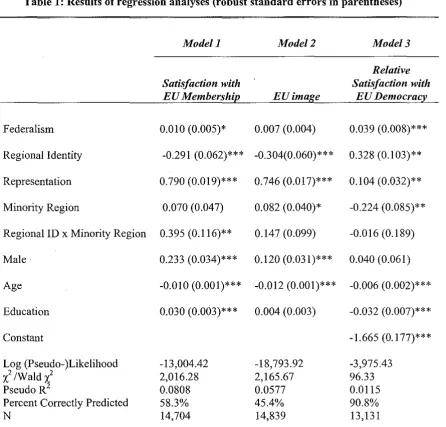
Results I: Cultural and Institutional Causes for Variation in Euroskepticism among Regions12 Table I displays the effects of each of the independent variables on each of the three
dependent variables, and based on these results, the following conclusions can be drawn.
Overall, the results of the tbree different regressions were mixed, which is somewhat surprising
considering the fact that they were chosen to represent the same overarching construct: support
for European integration. All key independent variables were statistically significant at least at
tbe 5 percent level in at least two of the models, and all control variables at least at the I percent
level in at least two of the modelsn Looking at the individual coefficients of the independent
variables across the models, however, the results are mixed.
First, the results suggest that respondents interviewed in member states and regions witb
higher levels of federalism were-as expected-more likely to be satisfied with their country's
(Cordell and Wolff2004). In France, the largely Gennan-speaking Alsace and the autonomy-seeking Bretagne were selected (Corde11 and Wolff2004; Lynch 1996). Tn Germany, the autonomy-seeking Bavaria, in which a number of regionalist parties exist, was selected (Anderson 1999; Bullman 2001; Day 1988; Gerstenlauer 1995). In Italy, the northern regions PiemonteNalle d'Aosta, Liguria, Lombardia, Veneto, Friuli-Venezia/Giuha, and Emilia-Romagna were selected, motivated by their inclusion in the autonomy-seeking larger region Padania (Desideri 1995; Loughlin 2001 b). Furthermore in Italy, the largely Germ an-speaking region Trentino was included, as well as the autonomy-seeking region Sardegna (Cordell and Wolff2004). Jn Spain, the linguistically distinct regions Catalufia, Galicia, and Pais Vasco (the Basque country) were selected (Folch-Serra and Nogue-Font 2001; Keating 1996; Keating, Loughlin, and Deschouwer 2003; Morata 1995). In addition, all Spanish regions in which a regionalist political party was present-Andalucia, Aragon, Asturias, Baleares, Canarias, Cantabria, Castilla Leon, Valencia, Extremadura, Navarra, and Rioja-were selected (Day 1988). Finally, in the United Kingdom, Scotland and Wales were selected, motivated by linguistic distinction and autonomy-seeking, and Northern Ireland was selected based on its
characteristic as the only large-scale religious minority nationalist region in the EU (Cordell and Wolff2004; Keating 1996; Keating and Jones 1995; Loughlin 2001; Lynch 1996; Newman 1996; McGarry 2001; Newman 1996).
12 The descriptive statistics of the analysis sample can be found in Appendix B.
13 The regressions were estimated using robust standard-errors, since several of the variables showed signs of
EU membership than not, and more likely to be relatively more satisfied with EU democracy
than with democracy in their home country, all else equal, and the first null hypothesis can thus
be rejected. The practical significance of this result is minute, however, since the magnitude of
the positive relationship is very small. Second, against expectation, respondents whose regional
identity is stronger than the identity with their home country are less likely than others to be
satisfied with their country's EU membership, are less likely to have a positive EU image, while
at the same time being relatively more satisfied with EU democracy than with democracy in their
home country, all else equal. These contradictory findings may be a result of varying reasons for
feeling affinity towards one's region, which will be discussed below. A similar contradiction can
be found in the coefficients for the variable minority region, which indicate that respondents
from a minority region are more likely to have a positive EU image than respondents from
non-minority regions, while being less likely to be relatively more satisfied with EU democracy than
with democracy in their home country, all else equal. It is noteworthy that the coefficients on
regional identity and minority region have the opposite signs in model two and three. A possible
reason for this is that not everyone expressing a strong regional identity lives in a minority
region, while not everyone living in a minority region has a strong regional identity. The
interaction term, which captures the effects on the dependent variables by respondents that both
have a strong regional identity and live in a minority region, confirms this suggestion. The
findings indicate that respondents with these traits tend to be more satisfied with their country's
EU membership than others, and the relationship has a relatively large magnitude, while being
significant at the 1 percent level. Based on this last finding, the second null hypothesis can be
[Table I about here]
Whereas the results in Table I are useful for assessing the statistical significance and the
positive or negative direction of the various effects, the magnitudes of the coefficients estimated
with logistic models are due to the nonlinearity of the models not easily interpreted. A commonly
suggested more direct approach for interpretation is to examine the predicted probabilities of an
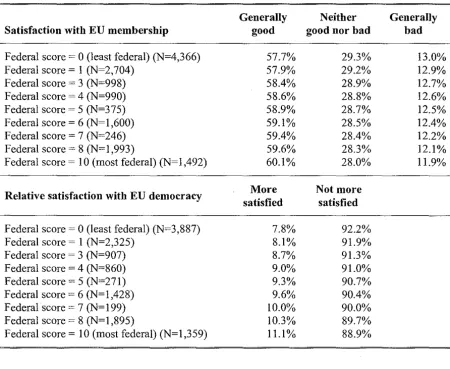
event for different values of the independent variables (Long 1997). First, Table 2 displays the
predicted probabilities of the different levels of satisfaction EU membership, and the relative
satisfaction with EU democracy, for each of groups of respondents living in states/regions with
different levels of federalism.
[Table 2 about here]
These results confirm the patterns from Table I, suggesting that as the level of federalism
increases, the probability of considering one's country's EU membership a good thing increases,
while the probability of considering one's country's EU membership a bad thing decreases.
Despite the steadiness of this trend, however, the differences between the two extremes of
perfect centralism and perfect federalism are a mere 2.4 and 1.1 percentage points. Similarly, the
results suggest that an increase in the level of federalism is resulting in a linear increase in the
probability of being more satisfied with democracy in the EU than with democracy in one's
home country, however once again with a very small actual change of 2.4 percentage points
between the lowest and the highest level of federalism.
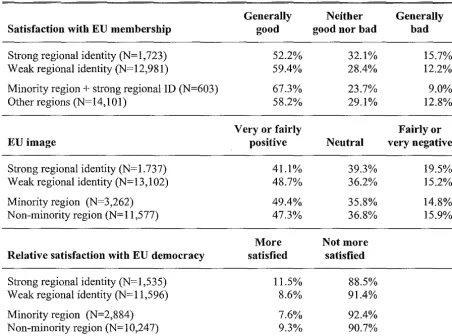
The predicted probabilities of the dependent variables for respondents with different
levels ofregional identity, and living in minority versus non-minority regions, displayed in Table
categories are greater than in Table 2. Most significantly, the probability of thinking that one's country's EU membership is a generally good thing is more than nine percentage points greater among respondents from minority regions whose regional attachment is stronger than the attachment to their country, than among other respondents. This corresponds to the large magnitude of the only statistically significant positive coefficient of this category, and suggests that this measure may in fact be the best proxy for the purpose of capturing the characteristics that the literature on pro-European minority nationalist regions is referring to.
[Table 3 about here]
matters for EU citizens, and the quality of this representation, in particular of the representation
of regional interests, will be examined in the next part of this paper.
Results II: The Quality of Regional Representation as a Cause of Variation in Euroskepticism
This part of the paper will present some initial findings from the collection of data
through forty interviews with the directors of regional representation offices in Brussels in May
and June 2008. The interview data is very rich hut the scope of this paper does not allow for
more elaborate analysis at this time. As mentioned in the data section cases from three EU
member states were selected along two dimensions-one one hand to control for intstitutional
factors, by choosing one federal, one semi-federal, and one unitary member state, and on the
other hand to control for cultural factors, by choosing member states two out of three of which
harbor minority nationalist regions. In the following, some of the patterns that have been
identified so far will be presented briefly.
Three general trends were identified, with similarities across virtually all forty regions
that were part of the study. First, regarding the question of whether the regions actually have any
influence over EU legislation, the interviewees overwhelmingly feel that this is the case, and
many provided concrete examples of this. With the exception of some of the largest and most
influential regions, however, most interviewees added that you cannot achieve anything alone,
and that one of the most important strategies to achieve influence over legislation is to team up
with other regions. In fact, one of the most surprising overall findings of the interviews was the
density of the system of cross-regional co-operation and networks that have developed in
Brussels over the past decade. Another interesting finding was that virtually all interviewees feel
-
.
their region in ways that the Permanent Representations (representing the member state
govermnents in the Council) from their countries cannot. A slightly different pattern
characterized the German regions, however, as all of the interviewees pointed out that they had a
complementary representative role rather than a competitive one in relation to the Permanent
Representation. Likewise, some of the regions with a stronger regional identity deviated from the
general pattern by expressing a more independent representational role beside their Permanent
Representations. These patterns were supported by different levels and frequencies of
cooperation between the regional offices and the Permanent Representations. Finally, virtually
all the regions focus their lobbying-although some of them were resistant to using this term, the
description of what they do clearly indicated that it is lobbying-on the same two EU
institutions: the Commission and the Parliament. The only exceptions were, once again, some
strong identity regions from Germany and the UK, which included the Council in either first or
second place. Interestingly, but maybe not surprisingly, only one single interviewee mentioned
the Committee of the Regions, and when asked about it, others stated quite blatantly that it is not
important, because it does not have any real decision-making power.
In addition to these general trends of relative similarities across regions, a few patterns of
striking differences among regions were identified. Relevant for the research questions asked in
this paper, although regions feel that they represent their constituents, this cannot be expected to
automatically lead to greater citizen satisfaction with European integration. Rather, to contribute
to more positive attitudes towards European integration, the regional goals achieved in Brussels
must be communicated to the constituents at home. There is if fact great variation in the extent to
which the regional offices do this, or even think that it is their task to do this. Some regions go as
admit that the regional elites back home like to take the credit for these achievements without
necessarily mentioning that they were made possible thanks to the EU. Although most
interviewees agree that it is an important task of theirs to bring Europe closer to the elites at
home (often by bringing these elites to Brussels), some believe that it is then the elites' choice
whether or not to "market" the EU at home, while others actively pursue this goal on their own.
Conclusion
When interpreting the results of the quantitative analysis displayed in Tables I through 3,
it is important to keep in mind that the shown effects of the independent variables on the three
dependent variables representing EU-attitudes should not be interpreted as causal, but rather as
mere associations, mainly due to the possible existence of confounding variables. One possible
omitted variable that may confound the results is the household income, which was excluded
from the analysis due to the low response rate, although the education variable at the individual
level probably captures some of the same effects. Another set of variables that might have
contributed to increasing the explanatory power of the model are regional level socioeconomic
variables, such as the economic wealth of the regions, the annual economic growth of the
regions, the unemployment rates in the regions, and the inflow into the regions of financial
support from the EU through the regional/structural funds. The use of such aggregate level
regional data may be more suitable for an analysis at the aggregate, rather than the individual
leveL
Conducting multiple regression analysis using variables that have not been analyzed in a
similar manner in earlier research poses specific difficulties, since there are no precedents as to
I
research is to utilize quantitative analysis to a larger extent when examining questions like the
ones posed in this paper, extending the knowledge of what factors are associated with support for
European integration. Considering the failed ratification process of the Treaty Establishing a
Constitution for Europe, the currently frozen ratification process of the Lisbon Treaty, as well as
the consistently declining turnout rates in EP elections, citizen support for the EU is of utmost
importance to its legitimacy. These circumstances thus indicate a vast practical value for future
analyses of questions like the ones posed in this paper. The evidence of variation in
Euroskepticism at the regional level provided in this paper, along with the indications of the
increasing importance of regional actors in Brussels provided by the interviews and other data,
should also be seen as a prompt to conduct further analysis of the connection between regional
representation and Euroskepticism. Yet another suggestion for future research is to compare the
relationship between regional minority nationalism and support for European integration over
time, adding a time-series component to the analysis. Although such an analysis could provide
additional knowledge of the change in this relationship, and thus enhance the possibility of
finding causal relationships, the largest problem with such an analysis would yet again be the
limited availability of data, since the consecutive survey results are not based on panel surveys
References
Anderson, Jeffrey J. 1999. Germany: Between Unification and Union. In Regional Integration
and Democracy: Expanding the European Experience, edited by J. J. Anderson. New
York: Rowman & Littlefield, p. 171-192.
Biersteker, Thomas J. 1999. Locating the Emerging European Polity: Beyond States or State? In
Regional Integration and Democracy, edited by J. J. Anderson. New York: Rowman & Littlefield, p. 21-43.
Brubaker, Rogers. 2004. Ethnicity Without Groups. Cambridge: Harvard University Press.
Bullman, Udo. 2001. Gennany: Federalism under Strain. In Subnational Democracy in the
European Union: Challenges and Opportunities, edited by J. Loughlin. New York:
Oxford University Press, p. 83-116.
Committee of the Regions. 2007. Associations/Bureaux de Representation Regional et Communale a Bruxelles: Repertoire. Bruselles: Comite des Regions de'! Union Europeenne.
Cordell, Karl, and Stefan Wolff, eds. 2004. The Ethnopolitical Encyclopedia of Europe. New York: Palgrave Macmillan.
Council and Commission of the European Communities. 1992. Treaty on European Union.
Day, Alan J., ed. 1988. Political Parties of the World. 3rd Edition ed. Chicago: St. James Press.
Desideri, Carlo. 1995. Italian Regions in the European Community. In The European Union and
the Regions, edited by B. Jones and M. Keating. Oxford: Clarendon Press, p. 65-87.
Downs, William M. 2002. Regionalism in the European Union: Key Concepts and Project Overview. Journal of European Integration 24 (3): 171-177.
Folch-Serra, Mireya, and Joan Nogue-Font. 2001. Civil Society, Media, and Globalization in Catalonia. In Minority Nationalism and the Changing International Order, edited by M. Keating and J. McGarry. New York: Oxford University Press, p. 155-178.
Gerstenlauer, Hans-Georg. 1995. German Liinder and the European Community. In The
European Union and the Regions, edited by B. Jones and M. Keating. Oxford: Clarendon
Press, p. 191-213.
Hendriks, Frank. 2001. Belgium: Federalism and Subnational Democracy in a Divided Country. In Subnational Democracy in the European Union: Challenges and Opportunities, edited by J. Loughlin. New York: Oxford University Press, p. 289-316.
Hettne, Bjom. 2002. The Europeanisation of Europe: Endogenous and Exogenous Dimensions.
Journal of European Integration 24 (4): 325-340.
Hooghe, Liesbet. 2007. "What Drives Euroskepticism? Party-Public Cueing, Ideology and Strategic Opportunity." European Union Politics 8 (!): 5-12.
Hooghe, Liesbet. 1995. Belgian Federalism and the European Community. In The European
Union and the Regions, edited by B. Jones and M. Keating. Oxford: Clarendon Press, p.
135-165.
Keating, Michael. 1988. State and Regional Nationalism: Territorial Politics and the European
State. New York: Harvester Wheatsheaf.
~~-. 1996. Nations Against the State: The New Politics of Nationalism in Quebec, Catalonia
and Scotland. New York: St. Martin's Press.
~~-. 1998. The New Regionalism in Western Europe. Northhampton, MA: Edward Elgar.
~~-.. 2001. Plurinational Democracy: Stateless Nations in a Post-Sovereignty Era. New York: Oxford University Press.
~~-. 2004. European Integration and the Nationalities Question. Politics & Society 32 (3):
367-388.
Keating, Michael, and Liesbet Hooghe. 2001. Bypassing the nation-state? Regions and the EU policy process. In European Union. Power and Policy-Making, edited by J. Richardson. New York: Routledge, p. 239-256.
Keating, Michael, and Barry Jones. 1995. Nations, Regions, and Europe: The UK Experience. In
The European Union and the Regions, edited by B. Jones and M. Keating. Oxford:
Clarendon Press, p. 89-113.
Keating, Michael, John Loughlin, and Kris Deschouwer. 2003. Culture, Institutions and
Economic Development: A Study of Eight European Regions. Northhampton, MA:
Edward Elgar.
Keating, Michael, and John McGarry, eds. 2001. Minority Nationalism and the Changing
International Order. New York: Oxford University Press.
Lipset, Seymor Martin, and Stein Rokkan, eds. 1967. Party Systems and Voter Alignments: Cross National Perspectives. New Y ark: Free Press.
Long, J. Scott. 1997. Regression Models for Categorical and Limited Dependent Variables, Advanced Quantitative Techniques in the Social Sciences Series. Thousand Oaks, CA: Sage Publications.
Loughlin, John. 2001. Subnational Democracy in the European Union. New York: Oxford University Press.
- - - . 200la. "The United Kingdom: From Hypercentralization to Devolution." In Subnational Democracy in the European Union: Challenges and Opportunities, edited by J. Loughlin. New York: Oxford University Press, p. 37-60.
- - - . 200lb. "Italy: The Crisis of the Second Republic." In Subnational Democracy in the European Union: Challenges and Opportunities, edited by J. Loughlin. New Y ark: Oxford University Press, 211-228.
Lynch, Peter. 1996. Minority Nationalism and European Integration. Cardiff: University of Wales Press.
Mamadouh, Virginie. 2001. The Regions in Brussels: Subnational Actors in the Supranational Arena. Tijdschrifl voor Economische en Sociale Geografie 92 (4): 478-487.
Marks, Gary, Richard Haesly, and Heather A. Mbaye. 2002. "What Do Subnational Offices Think They Are Doing in Brussels?" Regional and Federal Studies 12(3): 1-23. Marks, Gary, and Carole J. Wilson. 2000. The Past in the Present: A Cleavage Theory of Party
Response to European Integration. British Journal of Political Science 30 (3): 433-459. Marks, Gary, Franvois Nielsen, Leonard Ray, and Jane E. Salk. 1996. Competencies, Cracks, and
Conflicts. Regional Mobilization in the European Union. Comparative Political Studies
29 (2): 164-192.
McGarry, John. 2001. Globalization, European Integration, and the Northern Ireland Conflict. In
Minority Nationalism and the Changing International Order, edited by M. Keating and J. McGarry. New York: Oxford University Press, p. 295-324.
Moore, Carolyn. 2007. A Europe of the Regions vs. the Regions in Europe: Reflections on Regional Engagement in Brussels. Paper read at European Union Studies Association Biennial Conference, I 7-19 May, at Montreal, Canada.
Newman, Saul. 1996, Ethnoregional Conflict in Democracies: Mostly Ballots, Rarely Bullets. Westport: Greenwood Press.
- - - . 2000. Nationalism in Postindustrial Societies: Why States Still Matter. Comparative
Politics 33 (!): 21-41.
Nielsen, Francois, and Jane Salk. 1998. "The Ecology of Collective Action and Regional Representation in the European Union." European Sociological Review 14 (3): 231-254.
Papacostas, Antonis. 2006. Eurobarometer 65.2: The European Constitution, Social and Economic Quality of Life, Avian Influenza, and Energy Issues. March-May 2006. Brussels, Belgium: TNS Opinion & Social [producer]. Cologne, Germany: Zentralarchiv fur Empirische Sozialforschung/Ann Arbor, M!: Inter-University Consortium for
Political and Social Resarch [distributors].
Risse, Thomas. 2004. Social Constructivism and European Integration. In European Integration
Theory, edited by A. Wiener and T. Diez. Oxford: Oxford University Press, p. 159-176.
Schmidt, Vivien. 2004. "The European Union: Democratic Legitimacy in a Regional State?"
Journal of Common Market Studies 42 (5): 975-997.
Schmitt-Egner, Peter. 2002. The Concept of'Region": Theoretical and Methodological Notes on Its Reconstruction. Journal of European Integration 24 (3): 179-200.
Slocum, Nikki, and Luk van Langenhove. 2004. The Meaning of Regional Integration: Introducing Positioning Theory in Regional Integration Studies. Journal of European
Integration 26 (3): 227-252.
Thomassen, Jacques, and Hermann Schmitt. 1997. "Policy Representation." European Journal of
Political Research 32 (2): 165-184.
Figures and Tables
Table 1: Results of regression analyses (robust standard errors in parentheses)
Model] Model2 Model3
Relative Satisfaction with Satisfaction with EU Membership EUimage EU Democracy
Federalism 0.010 (0.005)* 0.007 (0.004) 0.039 (0.008)***
Regional Identity -0.291 (0.062)*** -0.304(0.060)*** 0.328 (0.103)**
Representation 0. 790 (0.0 19)*** 0.746 (0.017)*** 0.104 (0.032)**
Minority Region 0.070 (0.047) 0.082 (0.040)* -0.224 (0.085)**
Regional ID x Minority Region 0.395 (0.116)** 0.147 (0.099) -0.016 (0.189)
Male 0.233 (0.034)*** 0.120 (0.031 )*** 0.040 (0.061)
Age -0.010 (0.001)*** -0.012 (0.001)*** -0.006 (0.002)***
Education 0.030 (0.003)*** 0.004 (0.003) -0.032 (0.007)***
Constant -1.665 (0.177)***
Log (Pseudo-)Likelihood -13,004.42 -18,793.92 -3,975.43
i
/Waldi
2,016.28 2,165.67 96.33Pseudo R2 0.0808 0.0577 O.oJ15
Percent Correctly Predicted 58.3% 45.4% 90.8%
N 14,704 14,839 13,131
Table 2: Predicted probabilities by Federalism Status for the Ordered Logit and Logistic Models
Generally Neither Generally Satisfaction with EU membership good good nor bad bad
Federal score= 0 (least federal) (N=4,366) 57.7% 29.3% 13.0%
Federal score= I (N=2,704) 57.9% 29.2% 12.9%
Federal score = 3 (N=998) 58.4% 28.9% 12.7%
Federal score= 4 (N=990) 58.6% 28.8% 12.6%
Federal score= 5 (N=375) 58.9% 28.7% 12.5%
Federal score= 6 (N=J,600) 59.1% 28.5% 12.4%
Federal score = 7 (N=246) 59.4% 28.4% 12.2%
Federal score= 8 (N=J ,993) 59.6% 28.3% 12.1%
Federal score= 10 (most federal) (N=J,492) 60.1% 28.0% 11.9%
Relative satisfaction with EU democracy More Not more satisfied satisfied
Federal score= 0 (least federal) (N=3,887) 7.8% 92.2%
Federal score= I (N=2,325) 8.1% 91.9%
Federal score = 3 (N=907) 8.7% 91.3%
Federal score= 4 (N=860) 9.0% 91.0%
Federal score= 5 (N=271) 9.3% 90.7%
Federal score= 6 (N=J,428) 9.6% 90.4%
Federal score= 7 (N=J 99) 10.0% 90.0%
[image:57.617.80.530.125.494.2]Table 3: Predicted probabilities by Regional Identity and Minority Region Status for the Ordered Logit and Logistic Models
Generally Neither Generally Satisfaction with EU membership good good nor bad bad
Strong regional identity (N=l,723) 52.2% 32.1% 15.7% Weak regional identity (N= 12,981) 59.4% 28.4% 12.2%
Minority region+ strong regional ID (N=603) 67.3% 23.7% 9.0%
Other regions (N=14,101) 58.2% 29.1% 12.8%
Very or fairly Fairly or
EU image positive Neutral very negative
Strong regional identity (N= 1. 73 7) 41.1% 39.3% 19.5% Weak regional identity (N=l3,102) 48.7% 36.2% 15.2%
Minority region (N=3,262) 49.4% 35.8% 14.8%
Non-minority region (N=11,577) 47.3% 36.8% 15.9%
More Not more Relative satisfaction with EU democracy satisfied satisfied
Strong regional identity (N= 1 ,535) 11.5% 88.5% Weak regional identity (N=l1,596) 8.6% 91.4%
Minority region (N=2,884) 7.6% 92.4%
Appendix A
The Cleaning of the Survey Analysis Sample from Eurobarometer 65.2 (2006) Cleaning step
Original sample size NotEU15
EUI5 sample size No region stated
N
29,170 -13,722 15,448 -45 Missing values on other independent variables Missing values on DV SatEUMem
-201 -498 Analysis sample size DV SatEUMem
Missing values on DV EUimage Analysis sample size DV EUimage Missing values on DV SatEUDem Analysis sample size DV SatEUDem
14,704 -363 14,839 -2,071 13,131 Appendix B
Descriptive Statistics of the Analysis Sample
Variable N Mean
Satisfaction with EU Membership 14,704 1.4185
EU Image 14,839 2.3450
Relative satisfaction with EU democracy 13,131 0.0916
Federalism 15,403 3.6278
Regional identity 15,403 0.1158
Representation 15,403 0.8430
Minority region 15,403 0.2090
Sex 15,403 0.4548
Age 15,403 48.0701
Education 15,202 18.4727
Std. Dev. Min
0.7412 0 0.9526 0 0.2885 0 3.5535 0 0.3199 0 0.9440 0 0.4066 0 0.4980 0 18.1892 15 5.7741 0
Appendix C
Eurobarometer 65.2: Variables and questions
QAlla
QA13
Generally speaking, do you think that (OUR COUNTRY)'s membership of the European Union is a good thing, a bad thing, or neither good nor bad?
In general, does the European Union conjure up for you a very positive, fairly positive, neutral, fairly negative, or very negative image?
QA15a 4 Please tell me for each statement, whether you tend to agree or tend to disagree: "My voice counts in the European Union."
QA34a On the whole are you very satisfied, fairly satisfied, not very satisfied or not at all satisfied with the way democracy works in (OUR COUNTRY)?
QA34b And how about the way democracy works in the European Union?
QA35 _ 2 People may feel different degrees of attachment to their town or village, to their region, to their country or to Europe. Please tell me how attached you feel to ... your regwn.
QA35 3 People may feel different degrees of attachment to their town or viiiage, to their region, to their country or to Europe. Please tell me how attached you feel to ... (OUR COUNTRY).
D8 How old were you when you stopped full-time education?
DlO [Gender]
AppendixD
Interviews with directors of regional offices in Brussels: Interview questions
A. General questions
I. When did [this region] open an office here in Brussels?
2. Why was this office established at that particular time?
3. At that time, to what extent do you think that institutional developments within the EC/EU affected the incentives for your region to open an office in Brussels?
4. Can you provide some basic information about the resources of the office:
a. What is the number of staff?
b. What is currently the size of the annual budget?
c. Beside staff and budget resources, what types of resources are important for the operations of this office?
B. Purpose/policy orientation
5. What do you perceive as being the main purpose of[this region's] presence in Brussels? What are some secondary purposes?
6. What influence do you perceive that you have on EU legislation through the activities of this office?
7. What influence do you perceive that this office has on the allocation of funds to the regions through the Cohesion Policy?
8. What kinds of strategies do you employ to achieve this influence?
9. [Ask only NUTS2-level regions!] Considering that [this region] is part of a NUTS!-region, which also has an office here in Brussels, do you think that [this office] performs any functions that the higher level office does not? Please elaborate.
10. Similarly, do you think that this office perfonns any functions that the UK Permanent Representation and the UK government do not perform? Please elaborate.
12. How about in the past five years?
13. How and by whom is this office instructed on what policy issues to focus on?
C. Effects of enlargement I the Lisbon Agenda
14. How did the 2004 enlargement affect your goals and your strategies to achieve these goals?
15. How has the Lisbon Agenda, with its focus on competitiveness, growth, and job creation, affected your region, and in particular the allocation of funds to your region?
16. How have your priorities changed as a result of the Lisbon Agenda?
D. Interaction with EU institutions and other regional offices and organizations
17. Which EU institutions does this office interact with most frequently? With what purposes?
[If not volunteered, ask about the interaction with:]
Commission (specific DGs?)
EP (specific Committees?)
MEPs from [this region]
Council (and COREPER)
CoR
18. To what extent does this office cooperate with other regional offices to achieve its goals? What is the type and depth of this cooperation? Does it focus on specific issues?
19. Do you see this region as competing with other regions for regional funds? If so, is it competing primarily with other British regions, or with other regions within the EU overall?
20. To what extent does this office participate in the activities oftrans-regional organizations to achieve its goals?
21. To what extent does this office cooperate with the UK Permanent Representation to achieve its goals?
E. Constituency linkage/representation
23. If you consider this office to have a representative role, whose interests does it represent?
24. To what extent and by what means does this office communicate directly with its constituents in [this region]? (for example through direct mail or rallies)
25. To what extent and by what means does this office communicate indirectly with its constituents in [this region)? (for example through the media)
26. To what extent does this office attempt to communicate its policy achievements to the constituents in [this region]?
27. To what extent does this office attempt to increase the awareness of EU politics in [this region]?
28. Has the institutional development of the EU contributed to better representation of citizens from [this region] today? What could be better?
29. Does this office contribute significantly to better representation of citizens from [this region)? How?
F. Concluding questions
30. Do you generally feel that [your region] has benefitted from the UK's EU membership? If no, why not? If yes, in what ways?