Rochester Institute of Technology
RIT Scholar Works
Theses
Thesis/Dissertation Collections
2007
Captivated In Time
Melissa S. Newcomb
Follow this and additional works at:
http://scholarworks.rit.edu/theses
This Thesis is brought to you for free and open access by the Thesis/Dissertation Collections at RIT Scholar Works. It has been accepted for inclusion in Theses by an authorized administrator of RIT Scholar Works. For more information, please [email protected].
Recommended Citation
Rochester Institute
ofTechnology
AThesis Submittedto the
Faculty
ofTheCollegeof
Imaging
ArtsandSciencesIn
Candidacy
fortheDegreeofMASTER OF FINE ARTS
"Captivated InTime"
Melissa S.Newcomb
(Approval Page)
Chief Advisor:
Luvon Sheppard
Luvon Sheppard
(Signature)
Date:
Associate Advisor:
Alan Singer
Alan Singer
(Signature)
Date:
Associate Advisor
:
Tom Lightfoot
Tom Lightfoot
(Signature)
Date:
Department Chairperson:
Don Arday
Don Arday
(Signature)
Date:
I,Melissa Newcomb, hereby deny permission to the RIT Library of the
Rochester Institute of Technology to reproduce my print thesis or
dissertion in whole or in part.
DEDICATION:
Idedicatethis thesis tomy
family
fortheir support,love,
and encouragementthroughoutmylife.
Many
ofthepiecesaretitledand remembered as special people inmylifewho
have beena greatinspirationtome andmy
family,
and willliveoninthis
body
of work. Ialsodedicate andthankmycommitteeLuvon
Sheppard,
AlanSinger,
andTomLightfoot fortheir encouragement,time,and supportinthe
TableofContents
I. Introduction/Proposal
II. Personal Background
III. Historical Information relatingtosubject
IV. ConceptandDevelopmentof work
V. Developmentand research ofArtists
VI. ProcessandProduction
VII. ConclusionandThesis Exhibition
Introduction
Proposal
Thepurpose ofthis thesisistoexplore and create a series of portraits ofdolls.
Withthis themeinmind,Iwill exploretheideaof perfectioninthe
design,
construction,and representation ofdolls. Inthe
history
ofdollmaking,dollmakers misunderstoodgirls'
imaginations. {Madeto
Play
House,
59)
Eventually,
designers begantoquestionwhat adollshouldlook
like,
whatitshouldrepresent,and what roleitshouldplayinthelivesof children. Womenandtheirexperiences withtextilesbeganmakingdollssoftand
not
brittle,
orsharpbecause itwas morelikehandling
a realbaby. Dollswere soft,portable,
durable,
andsafe, notbrittleorsharp,turning
themintoamore realisticformsimilartoa realbaby.
In revisiting mychildhoodmemories,IrememberhowpassionateIwas aboutmy
dolls
(they
weremycompanionsgrowingup),andanincreasing
presencethateventuallycametolife inmyownimagination. Inreality, thesedollswereonlyartificial objects
thatgenerateddelusionsof
life,
butplayed animportantpartinmychildhood identity. Iwas
learning
howtobea motherby
nurturing andattendingto thecare ofthis object,perfectineverydetail. Itwas onlynaturalto thinkitwasreal.
Ina series of portraitsIwillbereconstructing dollsas objects ofimperfection
by
recombiningfragmentsofdollsfrom mypastalongwith childhoodimagestoformnew
identities. Thedolls become disfigured
bodies,
and arecreationoflife. Iwillthereforebereconstructing thesedollstosuggest animage ofinventiontoexpressshape,andmy
Ina series of photo realisticpaintings, Iwanttoreflect uponmymemoriesas a
child andmy relationshipwithdolls. Thepaintings willbereconstructions ofdollson
canvas with various sections combined andlayeredtocreate a wholethatworks
together,
although notcompletelyfit
together,
but is still recognizable and understood. Thepaintings ofdollswilleventuallyevolveinto dollhousesconstructedina similarformat
and patternthroughscale andlayering. Theprocess willbethe use ofdigital
photographs,oldphotographs,and
drawings,
historicalresearchondollsandofmypastmemories. I havestartedtolookatEllen Phelan's DollpaintingsthathavetherealismI
wantto achieve, andtheuse of
lighting
inthephotographsby
Laurie SimmonsandCindy
Sherman. Iwill continuetovisitMargaret Strong'scollection of
Dolls, Dollhouses,
andminiatures atThe
Strong
Museum.My
approach andtechniquewill referto thework ofDavid
Hockney,
PhotoRealism,
andExpressionism. Inthecontinuation ofmyresearchI'Captivated InTime"
Melissa Newcomb
When Iwasgrowing uppart ofmytimewas spentplayingoutsidewith
friends,
butmost ofthetimeIplayed withmydolls and pretended
they
were real. Iwas inafantasy
world,where Icould re-createmylife inmyimagination,
withmyownstoryandeverythingwas perfect.
My
childhoodwithdollswas animportantaspectofmyidentity
inthatIcould create alifewithartificial objectsin myimaginationthrough
interaction,
and pretendtoplayroles such asthatof mother andteacher.
During
that timemychildhoodfeltperfect andreal,but itwasn'treality, Iwasjusta childpretendingand
practicingtobean adult. Miriam Formaner Brunellsaid,"Theportrayaloflove between
adolland agirl,which often straddledtheboundaries betweenmaternalloveand
romantic
love,
wasreciprocal, communicative,andpassionate."
(Formanek-Brunell
24)
Overtimemy interactionandcollectionofdollsgrewuntilI reachedan agewhenI left
thembehindtoexplore newinterests andchallenges.
Thedollsofmypasthavenow re-enteredmy life intheformofmyartwork. As
Igrewfromchildhoodtoadulthood whileIwasnolonger playingwithdollsIwas still
collectingotherthingssuchas
fabrics,
china,jewelry,
andhousehold itemsthatyouwouldseeinadoll house.
My
artworkhasprovidedmewiththeopportunitytoreflectuponmymemories as a child andmyrelationshipwithdolls makingthema partofmy
lifeonce again.
My
childhood was atimewhenI washappy
just playingandpretendingtolivetheperfectlifeIhadcreatedinmymind;a placethatIcould control.
Reflecting
Thedolls have becomeeven more meaningfulto me
today
because
they
helpedme reopenmychildhood memories.
The re-discoveryofmypastbeganwhenIvisitedmygrandparent's attic where
some ofmy
mothers'
dollsthatIusedtoplaywith,were packedawayin boxes.
Seeing
themagain caused metoreflect onmychildhood. Thedolls' worn outdressesand
matteddown hairmadethemappear old andneglected,butnot
long
agothey
were cleanandbeautiful.
Seeing
theirconditionbotheredmebecause itwas asthoughthey
hadservedtheirpurpose and were nowforgotten. Thisreactionledmetodocumentthedolls
intheatticthroughdigitalphotos andtheimages broughtthedolls backtolife. Imade
themappear perfect again
by
re-dressingandre-composingthemintonewidentities.When Iwas a child adollwas something Isavedmy weeklyallowanceforand so
I tookgreat care and alotoftimechoosingoneamong manyatthe
toy
store. As IreopenedthepastIreflected on whoIwasas a child andIcould seehowmuchIhave
changed as anindividual. Iviewedtheir
faces,
tangledhair,
and wrinkledclothingofthedolls
differently
as a child. Nowthey
are nolonger mybabies,
justobjectsthathavegotten old and out-dated. Ifeltemotionallyandphysicallyconnectedto theminthat
worldthatdoesn'texist anymore. Iwantedto
bring
thatworldandthefeeling
backthroughmypaintings and photographs. Iwantedto
bring
thedollsbacktolife.Nowas an adulttherealityhassetinnobodyandnothingisperfect. IthinkI
try
toachievethatperfectionbutmyattemptshavenevermetmystandards. Things worry
memore,andthingsIthought tobebeautiful as a child areviewed
differently
now. Ihaveoutgrowntheplay Ienjoyed so much as alittle girl andthedolls haveoutgrown
thembutnowthefeelingsnolongerexist unlesssomethingtriggers my memorylike
settingthemoutfor display. Newdollsare
being
madethatare more realisticthanwhatwas available whenIwas a child. The sad part
is,
with newtechnology
othertoysarebeing
producedlimiting
theinterestindollswithinthemarketplace. Childrenare nolongerplayingwithdollsas much as
they
usedto,
preventingchildrenfromusingtheirimaginationandpreparingthemformotherhood.
Society
ischangingaswell,encouraginggirlstopursue otherinterests. I was encouraged and shownhowtocarefor
my
baby
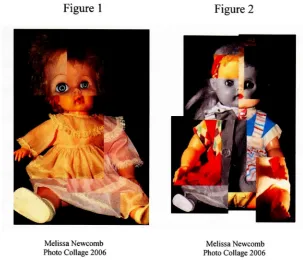
dolls. I was proudthatsomeday Icouldbea mother.Shownin figure 1 and
2,
1havere-assembled adollusinglayerstocreate areconstruction ofthedollwith various sizedfragmentstorepresent a section of memory.
Intheproduction ofmanyimagesofthedoll forthefinalreconstructedimageeach
fragment hadadifferentscale, size,and color.
Combining
themcreated a unique andvery appealingphysicalform.
Eventually,
I cameto theconclusionthat theseimageswerethe
beginning
stage and sketchesforthepaintings. Thepaintingsthatgrew out oftheinitial contactwithmypast, the
body
formythesis,
have ledto adeeperunderstandingof whoI wasandwhoI have become.
In reflectinguponthis timeinmychildhoodthroughmyartI am
looking
forthecompassion,
beauty,
andperfectionin lifethatI don'tthinkreallyexists, but Ican createinapainting. Thepaintingscanlasta
long
timetoshowtheappearance ofthedollsalwaysstayingthe same, andneverchanging. Thedollsthenremainperfectthrough
Figure 1 Figure2
Melissa Newcomb Photo Collage 2006
Melissa Newcomb PhotoCollage 2006
Iamfreein paintingtoexaggeratefacialfeaturesmakingthemappear more
perfect andappealingandmakingsome areas moredetailedandfinishedthanother areas.
Idressthemand almostplaywiththemagain asI restorehow
they
were. Itleavesroomforwhoever viewsthepaintingsto
bring
to theworktheirownthoughts,
memories,andcompassion
they
mayhave feltgrowingup. Otherviewers whomay have a similarconnection withtheirdollsmayalsofeeltheconnectionIhaveexpressedthroughmy
paintings. Herethedollsalways liveon assomethingperfect even thoughthedollsare
really agingovertime. Here
they
are ondisplay
tobelookedat and enjoyedfortheirbeauty
as somethingthatalthough outdated appear so perfect.Atthesametime thedollsare fragmented because
they
don'tquitebelong
theway mylife hasgone, it istheprocessI gothrough to seekthatunified whole of
perfect
life;
purity;an abstractionofreality.Inmost ofmypaintings,I exaggeratetheeyes ofthedolltoconfronttheviewer.
Thefabricattachedto thedoll inthepaintings adds anillusionof realto theartificial.The
dollsappeartobereal sotheviewercan
identify
withthematerial and recognize whatitis,
andthepaintedfabric saysthisis justa painting. Thepaintedfabricmay lookrealbutit's justmadetolookthat way,reallyit's justanabstraction,acopyofsomethingthat
doesexist. Intricatedetails likestrands of
hair,
eyelashes,andfoldsthatare painted(along
with subtle pieces of realfabric)
are visiblefromadistance.Inthe
beginning
thefocuswasjustontheobjectitself"thedoll",
whichexplainsthebackgroundarea offlatcolor. Otherelementshadnotbeen includedyetbecausethe
research andthoughtbehindtheworkwasjust
beginning
toevolve.Eventually
thepaintings starttohavea placeintimewherethespacehasa moredetailedenvironment, a
roomthatseems small comparedtoa real roomthatwouldbe solargeinlife.
Every
partofthedoll iscovered, wrapped,and packaged. Someofthecoverings aretransparentso
you seethrough
them,
butnothing is behindthefabric,
justpurecolor,lightand shadow.Thepaintings areautobiographical because
they
are aboutmylife. I'mnot afraidofthe
dolls,
Ifeel at easelooking
atthem. Somedollsare sold with alabelor name andsome arenot,
leaving
theownertoinventa name orlabelgivingthedoll itsownidentity
andpersonality. In my
life,
dolls hadanidentity
basedonmy imagination. Inmyworkeachrepresentationhasan
identity
basedonmyinterpretation,
involvementandthought.Each doll hasastoryofitsown andis dressedand presentedinamannerthatrepresents
one was played with morethananother. The paintingshave varioussections of unfitted
partsthataretobeplayedwithintheviewers mind. Ileave itopenfortheviewerto
resolvehow
they
fittogetherbasedontheirownthoughtsandmemories. Perhapsthisrekindles memories ofdolls
they
oncehadandhowthey
relatedto them. Theseunfittedparts couldbemoved aroundbutIhaveplacedthemincertain spotsinthepainting
because,
whileIfeelthebody
isinterchangeable,
thefaceshould remainthesame. Thebody
imagecan changebutthefaceistheconstant stable point ofthepainting. Ileavethe
body
sections sotheviewer candressthem. Asfortheface:Iwantittoremainthesame;becausetheface describesthecharacter ofthedoll. Tome, it isthemost perfect
part ofthedoll anddoesn'tneedtobechanged.
Allofthesepaintingshavean
identity,
whichhas been informedby
myidentity,
butasobjects
they
do havealifeoftheirown.Thepaintings communicatethrough thedetailsand exaggerations ofthedollsappearance.
They
haveaface,
andeverything isrecognizablebutmaynot always
belong
together, they
areputtogetherasifthey
do fitandmakeupa perfect object.
They
are puttogether thiswaybecause it's howIviewdollsandit'smy wayofcommunicating how Ifeelabout perfectionthroughplacement
andarrangement.
The
history
ofdollmakingissoimportant intheevolution ofmypaintings. Indollmaking,maleinventorsusedhardsubstanceslike sheetmetal and woodtomake
dolls. Thewooddollsandmetaldollswouldconveya
beauty
thatappealedtoAmericanconsumers.
However,
becausethey
were not soft andpliabledollswerebecoming
too muchlikemachines,andthey
weretoo controlled, childrenwere notabletousetheirimaginationsor evenhavea companion. (Tosa
16)
"Inthenineteenth
Century
thedolltookon aformalidentity
as atoy. Somewereinclined
tobeheavy
or awkwardtohandlebecause
ofthematerials andtechniquesusedinmanufacturebut itswhat appealedto thenineteenthcenturymiddle class
child."
(Tosa
20)
"Withdolls,
childrenlearnedabouttherealities oflife,
and customs and mannerswere often
directly
learnedthroughplay. Withdolls children are abletopractice and actoutthelessonsof adultlife."(Tosa
21)
Iremember as a childactingouttheseroles andpretendingtobethemotherfigure. "Inthepast children were
highly
encouragedtoemulatetheadultfemalesaroundthem." (Tosa21)1emulatedtherole of anadult
during
playwithmydolls. SowhenIreadthe
history
on childrenbeing
encouragedto takeonthese roles, Ifelta connection andknewI wasintheright placeresearchingandpainting
dolls.
"Izannah
Walker,
MarthaChase,
andElla Smithwerethedollmakers who usedthe textilestockinet since itwas
lightweight,
elastic, washable,anddurable."(Formanek-Brunell
68)
Thedoll hadtobe lightweightsothatchildren couldhandlethemmoreeasily. "Thedollsweretobesafe andharmless.Whilesomefemale and maledoll
inventors aimedfornaturalism,women were more
likely
torefertosoftdolls forthetouchbecauseof someinthepastthathadrigidity, thosestuffed withhorse
hair,
andsaw-dust."
(Formanek-Brunell
72)
Intheend children preferredthesoftdolls.In
trying
toachievetherealisminadoll,
Chaseusedimagesof real childreninordertopaintthree-dimensionalportraits ofdollfaceswithherownoilpaints. Dolls
startedto lookmore realisticthanever since closeattentionwas paidtoproportions. I
think thiswasaveryimportantpointin history. Dollswerealso madetobewashableto
stopthespread of germstochildren. "The doll
industry
wasbooming
and alwayschangingtomeetupto thestandards oflife."
(Formanek-Brunell
72)
Thecreation ofthedoll
being
softis somethingItry
toachieveinmypaintings.Theuse ofthesmoothtexturedcanvas and
blending
of colortoalmost ablurrepresentsthemas soft.Althoughsome edgesin mypaintings appeartobesharpand almostlikea
cutout,it'sonlytomakethemcomeforward. Thishelpselaborate ontheactuallookof
plastic or skin asverysoft, adelicatetexture thatappears onthefacesofmypaintings.
Thesharper edgehelps definethecontours oftheform. Thedoll isreally onlya
representation ofsomethingelse whetherit isawoman, man, child, orbaby. Surrounded
intheworld
by
adults, a childonlyperforms actionsofplaywith adollthatimitatesactions carried out
by
thechild's mother.Itwas aboutdressing
thedollwithwhateveroutfitthatwas appropriatefortheevent oftheday. (Formanek-Brunell
22)
"All Childrentalk to their
toys;
the toysbecomeactorsinthegreatdramaoflife,
brought downtosize
by
thecamera obscura oftheiryoungminds, andtheirchildrendemonstratedthroughplaytheirgreatcapacity forabstraction andtheirenormous
imaginativepowers."
(Tosa
22) "Everything
becomesa creativeexpression, toysofferthechild anintroductionto art,orratherto thepractical applicationofart, and no work of
art, howeverperfect, will give riseinan adultto thesame enthusiasmthesamecertainty."
(
Tosa23) Relating
tomyown experience withdolls,
I enjoy watchingother childrenrelatetotheirdollsasthough
they
werereal.Margaret
Woodbury Strong
hada passionforcollecting,and nowTheStrong
Museum
today
honors hercollectionsinRochester,
NewYork. Herincreasing
interestwascollecting
dolls,
dollhouses,
andtoys. When IvisitedhercollectionI wasoverwhelmed withtheamount of objects. Eachdollwasdifferentand wornfrom
being
held
by
itsoriginal owners. Eachdollappearedtobestaringat methrough thecases asthough
they
weretelling
methatthey
allhadalifewhich was seenthrough theireyesandtheagingoftheir clothing,
face,
andhair. Thedoll housesIfoundthemostfascinating
wereextremely
detailed,
andtheminiature objectsdisplayed hadahighsociety,almostrich,lookto them. Asa childthisplace wouldhave beena
fantasy
land. I sawsimilaritiestomypaintingsbecausethedollsin mypaintings wouldlookrealwithoutthe
detail. Itwasamazingtosee whatwasrealinthe past,andhow
they
are presenttoday.Ialso realizedthatIwasn'tjusta painterbutadollpainter, a subjectthathasbeenand
stillremainspopularamong manyartists. Artist'shave influencedmeandinspiredmeto
pursue somethingthathasa great
legacy,
history,
and continuestolive ontoday.Inthework ofpainterEllen
Phelan,
while she portraysdollsdifferently
thanIdo,
some ofthethoughtsbehindtheworkarealmostthesame. "Herimagesofdollsconvey
morehumorandvulnerabilityof
being
alivethroughtheirvariousposes."
(Armstrong
14)
Herpaintingsaredonethroughobservationby
workingfrom life. Iobservethroughmyphotographs. Howeverherworkissimilarinthatshe achieves a sense ofrealism,
andherimagesemphasizetheideaof
being
"gazedupon, tobeplayed with."(Armstrong
25)
Thesense ofrealismissomething I'mimproving
uponin mypaintings, andtobe"gazedupon, andtobeplayed
with"
isone ofthemajorideasI amworkingwithin my
paintings. Allthefragmentsaremoveableand notpermanentlyattached so
they
canpotentiallybeplayed with. I alreadyfeelasthoughI'm playingwiththepiecesbecause
they
arein blockformatandI'mbuilding
uponthemwith paintlikea child wouldplaywithblocks. Thedoll'seyes are enlarged sothatthedollappearstobemakingdirecteye
contact withthevieweremphasizingarelationship betweenthedollandtheviewer
throughmypaintings.
IreferredtoEllen'sworkinthe
beginning
stages ofmaking myowndollpaintings. Iwasinterested in herapproachbecause itwasthesame subject matter and
only
dealing
with afew different ideas behindthedoll. Ifind hersubtleapproachand almostfoggy,
blurriness,
and"atmospherichaze"orrenderingthem"visually
distant"quiteinteresting. Theobjectsbecomethese"figuresstranded intime."
(Armstrong
14)
The
feeling
and physical appearance ofthedolls inthepaintingsprovidemewitha senseof past and also present. Thedollsare not whatwesee
today they
are of adifferenttime. Eachonehasa presence intheplacement andtherolethey
playonthesurfaceofthepainting. Ellenstates: "Whenyouplaywith
dolls,
they
are animatedby
theprojection ofimagination. Asopposedto thematerial projected
by
achild, thematerialIwasprojectingwas
adult."
(Armstrong 15)
Shealso states: "It reallyhadtodowith emotionalrelationshipsbetweenmenandwomen,mothers and
daughters,
genderdefinitionandhowitcomesabout, thefemalesense of
self."
(Armstrong 13)
Inawaytheserelationships are about women and whatitsliketobeafemaleandit happens alittle in
mypaintings and couldbe interpreted ina similarway,onlyitwasn'tsomething Iwas
trying
toachieve.Iwasreflectingmoreuponmemoriesfromchildhooduptomyadult life.Ibegintoplaywithdolls
by dressing
thedollsinfabrics, by
attachingfabricsandattachingsquareor rectangular canvasesintheshape ofblocksthatcanbemoveable and
played withmentallywhileplayingwiththemsince
they
werenotpermanentlyattached.Ellenmakesadistinction betweenthechild'simaginationandheradult
imagination.
Thedistinction inmyworkisthatbecausetheactualdolls haveaged
they
nolongerlooktheway Ihavepresentedtheminthepaintings. Ihavepresentedthem theway
they
lookedinmyimaginationwhilegrowingup.
However, they
aredisplayedasthemainfocuswith subtleintroductionsoftexturedwall-paper andfabricwhich makethemappeartobe
on
display
withthemajorityofthebackgroundsappearing veryflat. Asa childmydollswere not on
display,
butplayedwithand appreciated.Now,
I viewthedollsas afragmentoftime thatis lostandI'm
bringing
thembackby
playingwiththecanvasesandattachingtheclothingas Idid inmychildhoodfantasieswiththedolls.
Figure3 isanimageofEllen Phelan'sworkthatIreferredtoandFigure4isone
ofthefirstpaintingsI did
by
attachingthefabricand canvas'sto thesurface.Here Iwastrying
tostrivefortheideaof realnessmuchlikeEllen Phelandid.Figure3 Figure 4
EllenPhelan XIX. TravelingCostume,1987. RichardArmstrong(pg 16)
MelissaNewcomb "AFragmentofTime(Cindy)"
2006
[image:18.538.106.470.364.609.2]InFigure4 Ikeptthe
background
flatandsimple, Ididn'twanttoincludeanythingthatwoulddetract fromthefocusonthedoll. Ipaintedthebackground blueto
complimentthepinkdressandfleshtoneswithintheplastic oftheface. Insome areasthe
paintis loosegivinga more expressivequalitywhere other areas aretighterand more
realisticlooking. Iwantedittobeaboutthefabricandtheassociation ofreal versus
artificial. From adistanceone might ask whetherthatlaceispainted or real. The
materialdidn't havemuch perspective and some ofthefabric looked justplacedwhere
other areas created anillusionas it foldedandbendedaroundtheedges. Ineverintended
forthis tohappeninthefirstpainting,butitwasworkingsuccessfully.
Icontinuedtowork ontwoother paintingsthatwouldbecomemore complex asI
startedtoadd more canvases andfabric. Istartedto thinkabout
breaking
outofthesquare and rectangularformatwhich isthemoretraditionalshape of a painting. Istarted
toputthecanvasestogether
by layering
as Ididwiththephotographicimages intheverybeginning.ItwaslikeI was
building
andconstructingthedoll againusing myownprocesslikea childwouldas
they
builtthingsout ofblocks.Asaresult,Iproduced animagethatwascut out andbegantoplaywiththespace
arounditwherethenegative spacebecamea part ofthepainting. Iattachedthepieces
togetherinthebackwithstrips of woodthatwere stapledintothecanvastohold it
together. After workingonitfora while Ibeganto starteliminatingpiecesthatdidn't
quitefittogether. These scrappiecesjust became extrasthatwere laidonthefloorofmy
studio. Iwasthen
thinking
whatifIwanttoremovethesepieces and movethem around,playwiththem? SoIstartedto thinkof an alternative. Itwasbroughttomyattentionto
try
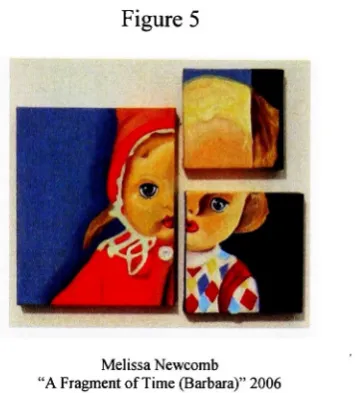
workingwithVelcro andIlikedtheideaofusingamaterial Icould removeifneeded.Figure 5isthepaintingwhere Istartedto thinkabout
breaking
awayfromthetraditional shape of a canvas.Intheprocess ofthispaintingthe
background
color [image:20.538.224.402.173.370.2]changedtwice. Ifound withthefirstcolorthatitwastoodark
because
itgavethedollan eeriefeel. I foundputtinginaflatcolorhelpedbring
outtheeyes ofthedollwhich becamemore alive and real.Figure 5
Melissa Newcomb "A FragmentofTime(Barbara)"
2006
As Icontinuedintothe thirdpainting Idecidedtogobackto the traditionalformat butnot
forgetting
whatIjustcompletedin Figure5,
becauseIknew itwas something Iwouldgobacktoor elaborate oninthepaintingstocomeinthisseries. Iknewwhenthe
paintingwastakenout ofthe traditionalformatwiththenegative spacecomingthrough
and around eachsection,itexaggeratedthefactthat theseparated partsdidn'treally
belong
together,
thatthey
wereparts ofdifferent dolls. Whenattachedtoatraditionalsquare or rectangularbase itwas easiertoresolve atthisstageofmyprocess. Thepieces wereputtogether
by
arrangement andalignmenttocomposea compositionthatfittogetherand worked. I feltmore comfortablebecause itwasthe typical size and shape of
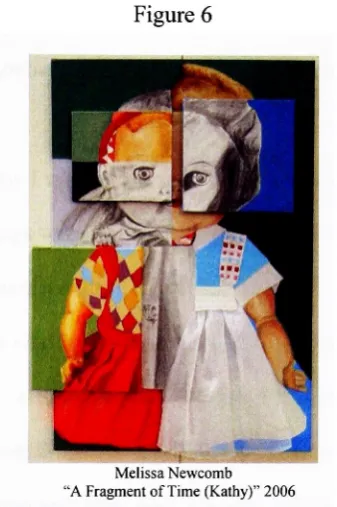
acanvas. Infigure
6,
1startedto thinkaboutdifferentsized canvasandaddingmoreintothemain canvas. I alsotried towork alittle largeras Iwas
feeling
more confident andcomfortable withthissubject matter. Inthispainting Ithoughtalotmore aboutthe
arrangement ofthecanvas ahead oftimebefore attachingthemwithVelcro. I also
startedto thinkmore aboutdepthandhowI could achieveitusing differentthicknesses
[image:21.538.202.371.175.429.2]of woodfortheframeandgoinglargerthanwhatIhadusedbefore.
Figure 6
Melissa Newcomb "A FragmentofTime(Kathy)"
2006
I also startedto thinkaboutthefinishedqualitiesofapaintingandwhycouldn'tit be
blackand whitewithno color? When reflectinguponmy memorymost oftheimagesare
a shade ofblackand white andonlyafew incolors. So I startedtoexperiment with
drawing
onthecanvas aswellaspaintingbutnotdeveloping
everysection ofthepainting. Somesections were a sketch and remainedthatway. Otherareas went alittle
further butwould remain anunderpainting. Inthedrawnareas Iexperimented with
pencil andlighter
fluid,
thelighter fluidallowedthedrawing
penciltomove easiergivingtheimagemore
fluidity
and apainterlyfeel.Then,
I sawthatsome oftheareas whichhadonetransparentlayerof painthadeven more of an attractivequalitythan themore
finishedareas. SinceIwasworkingwith
fabric,
thetransparency
ofthelighter fluidwithpencil,andthesubtletransparentpainted areasIstartedto ask,whatifIincluded fabric
thatwastransparent? ThisiswhenIstartedto
bring
in fabricthatyou could seethroughwhich added another element ofdepthon
top
of what wasbehindthisfabric.Whilethinking
aboutthe transparent material,Iwasthinking
about some paintingsIdid inthepast withdollswrappedincellophane andthework ofRosenquistwho also didpaintings
ofdollswrappedinplastic.
I was
thinking
abouthowIwantedmyviewerstoreallysee andfeelaboutthesepieces. Idiscoveredthepaintings werefullof colorandlifeandIwantedthem tobe
enjoyedbecause
they
were almost a portrait ofmylife.The memoryofmychildhoodcouldbeconnected with others whohadsimilardolls. Each paintinghadan
identity,
andwas perfectedtomystandards. Itturnedoutwhengoingthrough theprocess of
reconstructingthedollas a wholetheimageresultedintoanalmost perfectdoll.The
workwas
becoming
very excitingandattractiveto people,andIknew intheendsomethingwonderful wasgoingtohappenwithinthesepieces.
In researchingtheworkofChuck Closeandvisitingan exhibition ofhisworkin
Buffalo Iwasamazed
by
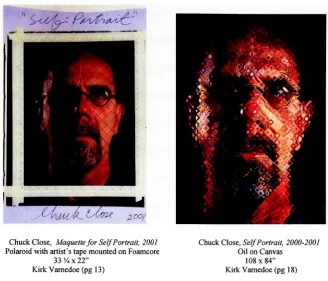
hisprocess. The scale,detailand colorwerejust incredibletoseeinperson. Figure 7isanexampleofhowhe beginshiswork witha photographthat
isgridded and numbered. Thenhere-representsthecolorintotheblock hegridded off
onhiscanvas as shownin figure8. 1find hisapproach similartomine sincehestarts with
aphotograph, andblocks itoffingrids asIdo.
Figure 7 Figure 8
"
S>-^c/fc>^
P^yf^^^
ZOO/
ChuckClose, MaquetteforSelfPortrait,2001
Polaroidwith artist'stapemounted onFoamcore 33%x22"
KirkVamedoe(pg 13)
ChuckClose,SelfPortrait,2000-2001 OilonCanvas
108x
84"
Kirk Vamedoe(pg 18)
He maynotbeworkingwiththedollasthesubjectmatter,but he isstillworkingwith
theportrait ofsomebodyandrecreating itinaveryrealisticbutexpressive way. Each
block is justcolorthatisveryexpressive andfree.
Stepping
backitall comestogetherasa wholewhichhappensinall ofmywork. However Idonotbreakupthesurface as
muchbutIdousethephotograph asmysketch,ashedoes. Irelatedtohisworkthe
mostbecauseofhisapproachandthoughtprocess. Ididnot gridmycanvas outperfectly,
however it didtakealotofthought. Before
touching
thecanvaswith abrushandpaint,itwas sketchedoutinpencilandmeasuredout astowheretheblocksweregoingtobe
placed. Insomeform it didtakeonthedimensionof a gridinthe
beginning
stages.While IwasworkingonthedollpaintingsIwas also
thinking
aboutdollhouses
andhowImightliketoincludeadollhouse inthis
body
of work. I startedworkingwithcut-out papers such as wallpaper,actual doll housewood, windows,anddoors. I
received permissiontophotographthedoll house
furniture
and miniaturesina store. Ialsohadphotographs ofthedoll housesIhad seen atthe
Strong
MuseumthatIusedasreferences. Thedollsanddoll housesat
Strong
werekept incasesthatcaused abitof aglareinthephotographs. Ifound it
interesting
intheglasscoveringof alltheseobjectsthatmyreflection was
being
capturedintheimagethrough theglare. Idecidedtobring
myselfintothe
imagery
ofthedollhouseusingchildhood photographs. IexperimentedwithimagesofmychildhoodthatItransferredonto paperusing acetone. Iusedthe
transfersinthedollhouse behindwindows. Ididn'tputmychildhoodimagesanyplace
elsebecauseIwantedtheroomtobeviewed and appreciatedforthedetailsand patterns.
Adding
images ofmychildhoodinthewindows was subtle and appealing. Theacetonetransfershadanaged appeal. Atthispointthedoll housewasatwo dimensionalpiece.
Eachroom wasitsown separateblock. So manyideaswere possible withthedoll house
but itwasgoinginanotherdirectionfromthedollpaintingsandwasfartoocomplexto
bring
togetherwiththem atthispoint.However,
itismynext projecttopursue afterthecompletion ofmythesiswork. Ifoundthedollhousevaluableinthegrowth and process
ofthesepaintings.
Thewall paperfromtheoriginaldollhouseideawasincluded inthesubsequent
dollpaintings. Iwas
thinking
aboutthisalongwithpatterns andfabrics ingeneral. Ibegan
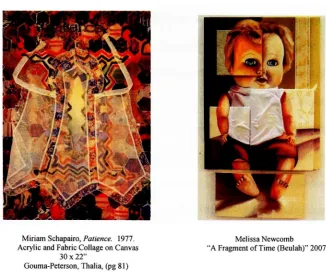
looking
atthework ofMiriamSchapiroas showninfigure9.Asa resultIbegantousewallpaperinthebackgroundas showninfigure 10
alongwithshadowstomakethedoll looklike itwas sitting. Thewall paper addedto the
threedimensional quality ofthispaintingandinsomeareas appearedtolook likea
drawing.
Figure9 Figure 10
MiriamSchapairo,Patience. 1977.
AcrylicandFabric CollageonCanvas 30x22"
Gouma-Peterson, Thalia,(pg 81)
Melissa Newcomb "AFragmentofTime(Beulah)"
2007
Intheareas where wall-paper wasattached, thepatternwasverysubtle and softwhich
appearstosome people as a sketch. Ichosewall-paperthatwas subtle and softbutnever
thoughtitwould appear as adrawing. Ihadmovedonfrom workingwithaflatcolorin
thebackgroundto
bringing
indifferentshades of color andusing shadows and wall-papertogive a more realisticfeelto the dollanditsenvironment. Itwas
finally
time tostartincluding
a place wheremymemoriesstemmedfrom becausethepaintings weredeveloping
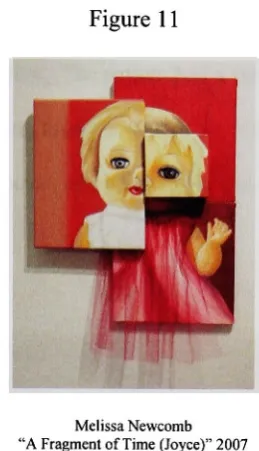
andIwasgrowing intheprocess.In consideringallthesenewthingsIalsowentbacktoplayingwiththecut-out
shape ofthedollinFigure 1 1 especially
focusing
on areasthatappearedtolookmorefinishedover others.The colorsinthispaintingwereveryrich,vibrantandhada
romanticqualityto thembecauseofthe transparentdark
burgundy
coloredfabricthatliesoverthepainted surface. Thepainted areaunderneaththefabricwascomingthroughand
[image:25.538.108.435.55.328.2]italmostlooked like itwas part ofthefabric but itneededtobemoretransparent. I
wantedthepaintingandtherealityofthefabrictoworktogether. The fabricIhad
originallychosen wastooflatand opaque. Thepaintingoriginallyhada pink
backgroundthatwas subtle,likethecolorIrememberinmybedroom as a child. I
changedthecolortoa
deep,
rich redbecause it'sa colorI enjoynowbutwas mixed withthepinkIremembergrowingup. The fabricIwasworkingwithdidn'thavethe
transparency
ortranslucency
likethefinalpiece offabricI added. Ichose a pieceofmaterialthatwould work withthecolors inthepaintingand was subtle andnot
heavy,
flat,
and opaque astheoriginal piece Ihadchosen. The paintingcametogether throughcolor,fabricchoice and arrangement perfectly. Ratherthangluingthe
fabric,
whichIhaddone inFigure 10 wheretheglue camethrough thefabric givingita wet
look,
Idecidedtoactually
try
tosewitthrough thecanvastoattachthefabricanditworked. Thisgavethepainting somethingmorerealtolookat,and allowed metodressthedoll ina more
permanent way.
Idecided itwastimetodoamuchlargerpainting. The scale couldbevery
empowering. This paintingwouldbethepaintingthatwould
bring
all oftheworkIhadalreadycompleted
together;
itwouldbecomethefocalpoint.I didn'trefertoanyartistswhileworkingonthispainting Ijust letitbe freeandhappenwith whatIhadalready
learnedandresearched. Istartedto
develop
thefaceofthedollanditwas obviousmyskillshadimprovedwiththedetailandaccurate proportionsand color ofthedoll's face.
AsIcontinued withthispaintingtherewasalotto thinkaboutbecauseofthe
scale. The largercanvasesthatwere
being
attached wereheavier. Insteadofusingblackand whitedrawingslikeIdid inone ofthepreviouspieces,Itooka monochromatic color
schemeintwoofthe canvases,andtherest ofthecanvases attachedto thesurfacewould
be in fullcolor.
Figure 1 1
Melissa Newcomb "A FragmentofTime(Joyce)"
2007
Thetwopieces worked
together,
butremained a workinprogressthrough thestages ofthedevelopmentofthepaintingas a whole.Thebackgroundcolor wouldchange, and
evenbegantogetdarkerincolor, andthiswas notsomethingthatwasworking forme. I
wasactually
having
nightmares aboutit becausesomethingjustwasn'tfitting
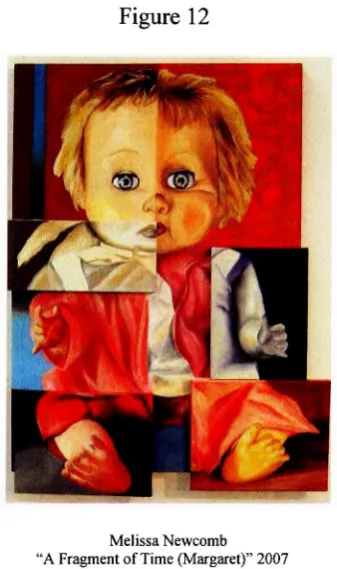
together.So Ichangedthecolortored. Thewholepainting begantoworktogetherandbecame
morebalancedas shownin Figure 12.
Ialso decidedtoleave someof whatwastherebeforeas a simplelinethatran
downone side ofthepainting.Itappearedtometobeanopeningof what wouldbenext.
Itlooked liketwodoorsopening andtheviewbehindthem. Ithenwasquestioning
whethertoaddfabric butIhadrenderedthepaintingsostronglytoa completed stageit
wasn't needed. Ididneedtoincludesome other elementlikethewall-paper or a pattern.
[image:27.538.223.353.91.317.2]I
decided,
ratherthanattachthewall-paperitneededtobemorecontrolled,and so Idecided
topaint a patternthatlooked likewall-paper.Inthedarkersection ofthepainting it lookedalmostlikevelvet.The darkglazesI
usedinthepattern wereveryattractive. Thepatternhadaveryelegant and romantic
aspect andbroughtthewholepaintingtogether. Outofall ofthepaintings Ifeltthemost
attachedto thisone
because
ofthescale,andbecauseI could seehowmyskillshad [image:28.538.206.375.229.514.2]developedand grown.
Figure 12
Melissa Newcomb
"A FragmentofTime(Margaret)"
2007
Therewas still anotherpainting Iwasworkingonalongsidethisone whichis
shown inFigure 13. Inthispainting Iused more of a cut-out oftherectangular/square
shape of atraditionalcanvas. Ialso wantedtoexperiment withpaintingon anotherkind
offabricotherthan canvas,soI stretchedfabricover woodframesanddidan outlined
tracing
ofthedolls lower half. ItturnedoutIdidnotlikethewaythepaint moved onthefabricandonlyfilledcolorinthebackgroundgivingthedoll a cut out shape almostlikea
paperdoll.Itwasverysimple and minimalmakingitattractive andappealing. Idid
however
develop
thedoll's facemorebutwasabletobring
the twohalvestogetherby
usingan orangefabric. Thefabricpickedupthecolorinthedoll's facethatwasdraped
[image:29.538.192.354.149.425.2]overthelower halfandbroughtthesectionstogether.
Figure 13
'?
Melissa Newcomb "A FragmentofTime(Kay)"
2007
This paintingwasnot one ofmyfavoritesatfirst because it didn't lookas complete as all
theothers. Howeverit didn'thavetobecompleted. Itwas openfortheviewerto
completeintheirown mind. The paintingwasdifferentfromtheothersbecause itwas
the
beginning
of wherethesepaintingscouldleadtonext. Itbecamea great piecetocompletetheseries andleavethatthoughtopen.
Along
thesidewall ofmystudiolay
aboutfiveto six canvas'sthatwere extrapiecesthatdidnotfit into all ofthepaintingsIhadcompleted. Iwas
thinking
aboutincluding
themwiththeotherwork,eitherhanging
thembelowthepaintings orjustlaying
themontheflooralongwith scraps of wall-paper andfabric. The layoutwouldhavetheappearance ofmystudio orhow dollsanddollclothes mightlookina child's
room. Iplayed withthearrangement ofthemalongwiththearrangement ofthepaintings
onthewallsbeforetheinstallationoftheshow andIhadnot cometoafinaldecisionas
tohoweverythingwas goingtobepresented. I would resolveitinthespaceIwas given.
Inthe
hanging
oftheshowIdecidedtoeliminatetheideaofincluding
theextracanvasesontheflooralongwith scraps offabricand wallpaper. After seeingthespaceandthe
paintings
hung,
they
all stoodontheirownandaddingthematerials onthefloor detractedfromthework. Plusthegalleryfloorwasbricksotherewere allthesefragmentsinthe
flooranditwastoo distracting.Itendedup
being
a greatdecision inthepresentation oftheworkshownin Figure 15.
Along
withthepaintingsIhad been workingon abookthatincludeda nicelayoutof some ofmyphotos wherethedollswere wrapped inplastic. Ididsome research asto
whatIwantedthe title tobebecause Iwantedittosuggestthebookwasjustaboutthe
images,
andnottext. Ialsowantedatitlethatwould representmythesis. I cameupwiththe word"Captivate"withthreeotherwordsthatwoulddefine it ina subtleway:
Beauty,
Charm,
andDelight. Thebookwhichis shownin Figure 14 becamea great success. Itwas greattowork withanotherdesignerwhohelpedwiththelayoutanddesignand
printingofthebook. Inthe end, thebookkeptthe titlewiththeotherthreewords onthe
nextpage,
Beauty,
Charm,
andDelightwhich saideverythingitneededto.Figure 14
Melissa Newcomb
"Captivate"
(Digital PrintedBook)2007
Whenitwastime toinstalltheshow eachpaintingneeded atitleandIdecidedto
givethemallthesame
title,
butdistinguishing
themby
namesofpeople who were a partofmy
life,
past and present. IdidnottellanyonethisandIwashoping family
memberscomingto theshow wouldbe honoredortouched
by
thenames.Each paintingwastitled [image:31.538.199.390.62.206.2]"AFragmentofTime (andthename)."
Figure 15
MelissaNewcomb,MasterofFineArtsThesis Exhibition.(2007)
)
During
theOpening
myfamily
didnoticethenames ofthepaintings andthey
were sotouched. Severalpeopletoldme whichpaintings
they
could relatetomore orwhich onesweretheirfavorite. Ifound it
interesting
andexcitingtoseetheviewers [image:31.538.192.396.380.550.2]relateto thework. Itwas a great crowd andsomething Iwill alwaysremember. Somany
people enjoyedtheshow andthework.
Evenaftertheclosingofthe thesis showIcontinuedtoreceive comments and
feedbackonthe work, anditwas goodtoheartheimpact it hadon people. Itwasmy
goal allalongtomake an impressionon people andhavesomething
they
could relatetoandremember withintheirown experiences. Itwas a wonderful
journey
upto thispointand so much waslearnedand rememberedalongtheway.
Iseethisworkcontinuingon afterthecompletion ofmyeducation. I amalready
thinking
aboutmyideas foradollhouseproject andhowIplantoexecutetheideas alongwith someotherplansforthefuture. Ithinkinthesuccess and growththroughmyyears
being
educated, thiswas a greatendingas a student.Thisbody
ofwork wassodeep
andmeaningfultomeineveryaspect ofmylife andIwas
happy
tobeableto sharethiswitheveryone. Thedollswillliveoninthesepaintings and
they
will alwaysbepresent andrealtome and Ihopeothers will remembertheminsuch away.
They
will remain assomethingcaptivatedintime.
Bibliography:
Armstrong,
Richard. Ellen Phelan From The LivesOf
Dolls. Massachusetts:University
Gallery,
Fine ArtsCenter,
University
ofMassachusettsAt
Amherst,
1992.Carter,
CurtisL. Dolls InContemporary
Art A MetaphorOf
PersonalIdentity. Wisconsin: The PatrickandBeatriceHaggerty
MuseumofArtMarquetteUniversity,
1993.Desmonde,
Kay. AllColour Book ofDolls. New York: Crescent Books Adivision ofCrown Publishers Inc. 1 974.Formanek-Brunell,
Miriam. Made ToPlay
House. Maryland: The John HopkinsUniversity
Press,
1998.Guare,
John. Chuck Close LifeandWork. New York: ThamesandHudsonInc,
1995.Gouma-Peterson,
Thalia.Miriam SchapiroShaping
The FragmentsOf
ArtAnd Life. NewYork:Harry
N.Abrams,
Inc. 1999.Livingstone,
Marco.Pop
Art AContinuing
History. New York:Harry
N.Abrams,
Inc. 1990.Schorr,
Collier. Laurie Simmons Photographs 1978/79. New York: Skarstedt FineArt,
2002.Tosa,
Marco. ClassicDolls. New York: Abbeville Press.Udall,
Sharyn R.. O 'KeeffeandTexas. Texas: The Marion KooglerMcNay
ArtMuseum,
1998.Vamedoe,
Kirk. Chuck CloseBlood,
SweatandTears.Library
ofCongress,
2002.Yassin, Robert,
Steinem, Gloria, Brach, Paul, Schapiro,
Miriam. Miriam Schapiro WorksonPaper. Arizona: Tuscon MuseumofArt,
1998.