Distributional Consequences of Climate
Change Impacts on the Power Sector:
Who gains and who loses?
Dirk Rübbelke and Stefan Vögele*
No. 349, May 2011
Abstract
Climate change tends to negatively affect the power sector, inter alia, by causing cooling problems in power plants and impairing the water supply required for hydro-power generation. In future, when global warming is expected to increase, autonomous adaptation to climate change via international electricity markets inducing reallocations of power generation may not be sufficient to prevent supply disruptions. Furthermore, the consequent changes of supply patterns and electricity prices might cause an undesirable redistribution of wealth both between individual power suppliers and between suppliers and consumers. This study ascertains changes in European power supply patterns and electricity prices caused by ongoing global warming as well as related redistribution of wealth for different climate change scenarios. Our results confirm that autonomous adaptation in the power sector should be complemented by planned public adaptation in order to preserve energy security and to prevent undesired distributional effects.
Keywords: adaptation, climate change, hydroelectric power, nuclear power, redistribution of wealth, vulnerability
* Dirk Rübbelke is an Economist at the Basque Centre for Climate Change (BC3) and Research Professor at IKERBASQUE, Basque Foundation for Science in Bilbao (email: [email protected]).
Stefan Vögele is a researcher at Forschungszentrum Jülich GmbH, Institute of Energy and Climate Research – Systems Analysis and Technology Evaluation (IEK-STE), Jülich, Germany, email: [email protected].
Acknowledgement: We thank Christian Egenhofer for helpful comments.
CEPS Working Documents are intended to give an indication of work being conducted within CEPS’ research programmes and to stimulate reactions from other experts in the field. The views expressed in this paper are those of the authors and do not necessarily represent any institution with which they are affiliated.
ISBN 978-94-6138-098-2
1. Introduction ... 1
2. Climate Change and Energy Security ... 3
3. Methodology and Scenarios ... 7
4. Results ... 11
5. Conclusions ... 14
Literature ... 16
List of Figures Figure 1. Change in rents and market equilibrium induced by a shock on the supply side ... 4
Figure 2. Changes in individual suppliers’ rents ... 5
Figure 3. Electricity generation in Europe ... 7
| 1
Distributional Consequences of Climate
Change Impacts on the Power Sector:
Who gains and who loses?
CEPS Working Document No. 349/May 2011
Dirk Rübbelke and Stefan Vögele
1.
Introduction
The vulnerability of energy supply infrastructure to climate change is an important topic in the literature on the adaptation to climate change, since all (economic) activity requires the input of energy.1 Consequently, this infrastructure (generation as well as distribution) is
critical for the functioning of economies, and adaptation of the energy systems to climate change – in turn – is crucial for their maintenance.
In the recent past, recurring disruptions of energy supply induced by extreme weather events have been observed.2 An obvious connection between weather extremes and energy
supply is found in the hydropower sector. Hydroelectric power is the major source of electricity for 26 countries from the Sahel to southern Africa, and the secondary source for an additional 13 countries (Showers, 2002: 639). Due to drought, several areas in these countries from a wide range of climates were negatively affected by power shortages in the 1980s and 1990s.
The effect of extreme weather patterns, which are supposed to occur more frequently in future due to ongoing climate change,3 on energy supply systems is also observable from the
Brazilian blackout in 2009. Some 40% of the Brazilian National Interconnected System’s load was interrupted in the course of an automatic disconnection of a transmission line as a consequence of adverse weather patterns (Ordacgi Filho, 2010). Furthermore, in 2005 Hurricane Katrina in the Gulf of Mexico caused a gross peak oil supply loss of 1.5 mb/d (IEA, 2007: 37). Due to shortages in oil supply, the US Environmental Protection Agency even relaxed pollution standards nationwide, so that lower grades of gasoline were allowed to be used. This gasoline was expected to be imported from Europe (Mouawad et al., 2005). Extreme weather patterns can also negatively affect the power generation in fossil fuel and nuclear power plants (see e.g. Koch & Vögele, 2009; Kopytko & Perkins, 2011; Mideksa & Kallbekken, 2010; Flörke et al., 2011). Such plants require water for cooling processes; about 43% of the EU’s water demand is used as cooling water by power authorities (EUREAU, 2009: 21). The availability of cooling water is sharply reduced during heat waves and droughts. As Förster & Lilliestam (2010) show, power generation could be severely constrained by typical climate impacts such as increasing river temperatures and decreasing
1 “From a thermodynamic point of view, energy and matter are the fundamental factors of production.
Every process of production is, at root, a transformation of these factors” (Baumgärtner et al., 2001: 366).
2 “The relevance of adding extreme events to the analysis is almost trivial: our serious worry about
climate change is entirely based upon their possible occurrence” (van den Bergh, 2004: 392).
3 Itteilag (2008) states that peak electricity demand in the US, typically for summertime air
stream flow. According to the IPCC (2008), the frequency of periods characterized by water shortages and by high water temperatures will increase in Europe and other parts of the world in future. Although all thermal power plants are negatively affected by high ambient temperatures, nuclear power plants are especially vulnerable (Linnerud et al., 2011: 150).4
Yet, the problem of cooling water shortage is not only to be expected in future, since such shortcomings have already occurred in the past. During recent years, the rivers that supply the water used to cool many of Europe’s nuclear plants warmed up so often during summer heat waves that plant managers had to cut back power output and/or to release damagingly hot water back into the rivers. A severe heat wave in 2003, for example, which raised summer temperatures by 3 to 5˚C in most of southern and central European countries and which was accompanied by significant annual precipitation deficits (IPCC, 2008: 845), impaired the generation of electricity in more than 30 nuclear power plant units in Europe because of resulting limitations in the possibilities to discharge cooling water (IAEA, 2004). Some nuclear power plants got exemptions from legal requirements to be able to continue their operating activities. As a result of the cooling problems of the nuclear power plants in 2003, France as the biggest electricity exporter had to import electricity from Great Britain to be able to supply enough electricity to Italy and other countries (UCTE, 2004). In 2006, a nuclear power plant in Spain had to shut down due to rising temperatures in the river supplying the plant’s cooling water and in France the government approved requests to allow plants to discharge cooling water at above normal temperatures. Also in 2009 a summer heat wave caused cooling water shortages in France. As a consequence the French nuclear power generation level dropped significantly. France had – as in the heat wave in 2003 – to import electricity from the UK during the 2009-summer. Altogether a third of the nuclear power stations of the biggest European electricity exporter France was put out of action (Pagnamenta, 2009). Some German nuclear power plants had to reduce their electricity generation due to a summer heat wave in 2010. In order to protect the stability of the power grid, a concept for preventing the breakdown of the power supply and for limiting negative impacts on the environment was elaborated.
Currently nuclear power has a share of about 28% in the electricity supply of the EU, while the respective share of hydro power is about 12% (EUROSTAT, 2010). So disruptions in the use of both nuclear and hydro-power plants may have significant impacts on the electricity supply system. In our analysis of the potential impacts of ongoing climate change on power supply in Europe, we will focus on these two important subsectors of energy generation. As the aforementioned negative climate-induced impacts on power supply imply, the adaptation to these impacts took place autonomously via the European electricity market (for different types of adaptation, see e.g. Fankhauser, Smith & Tol, 1999). International trade of electricity made it possible that the loss of power-generation capacity in one subsector or plant location of the European energy system was replaced by an increase in generation capacity in another sector/location, e.g. a decline in French nuclear power generation was compensated for by a rise in British supply of electricity. Yet, due to ongoing climate change, such autonomous adaptation might not be sufficient anymore in the future and advance strategic policy intervention might be required to reduce vulnerabilities of the European energy system. Yet, as Seo (2011: 825) stresses, “[a]daptation measures that should be publicly coordinated for the provision have not received a proper attention up until now.” Due to the long lifetime of infrastructures and the magnitude of investments in the electricity
4 Greis et al. (2009) investigate a specific conventional steam/gas power plant site in Germany and
DISTRIBUTIONAL CONSEQUENCES OF CLIMATE CHANGE IMPACTS ON THE POWER SECTOR |3
sector, especially in this sector, public adaptation strategies should be developed at an early stage.5
In order to demonstrate the potential necessity for public adaptation strategies in the European electricity sector, we conduct an analysis of the autonomous short-term adaptation of this sector, i.e. we investigate short-term and temporary changes in power generation and national import-export balances for electricity induced by extreme climatic conditions. Yet beyond, we analyse distributional impacts of such autonomous adaptation, i.e. we also regard redistribution of consumer and producer rents in order to identify the main losers and potential beneficiaries of climate change-induced energy insecurity. Potentially undesired redistribution of wealth, either between consumers and producers or between individual countries, can be identified and public adaptation strategies to prevent such adverse developments can be launched in advance.
In detail we proceed as follows. In section 2, we discuss different aspects of energy security that will be relevant for our subsequent analysis of the consequences of future power supply disruptions and explain, from an ex-post perspective (see Löschel et al., 2010 for a discussion of ex-post and ex-ante perspectives on energy security), how disruptions in energy supply might affect rents of agents acting on the markets for energy. In section 3, we present the methodology of and the scenarios regarded in our analysis. In section 4, the results concerning electricity generation, trade and distributional effects are displayed and discussed. Section 5 puts these results in a broader context and draws some conclusions.
2.
Climate Change and Energy Security
According to the IEA (2007: 12), energy insecurity “stems from the welfare impact of either the physical unavailability of energy, or prices that are not competitive or overly volatile.” Conveying this idea inversely, Bohi & Toman (1996: 1) state that “[e]nergy security refers to the loss of economic welfare that may occur as a result of a change in the price or availability of energy.” In general, the change in availability of energy influences the price of energy via market interaction and vice versa, i.e. price and availability changes are interrelated. Via the price mechanism demand (supply) for energy is equalized to the supply (demand), except for extraordinary and rare cases where energy is indeed physically unavailable (e.g. due to embargos or wars). If we therefore focus on the normal cases, energy (in-)security is mostly an issue of price changes and not of complete unavailability of energy. As Helm (2002: 176) points out: “The complementarity of energy with the rest of the economy means that customers will typically want stable and predictable prices, in line with their investments in durables, housing and capital stock at a point in time”.6 Expressed in welfare terms, which is
of major importance in both definitions of energy (in-)security above, consumers of energy perceive energy insecurity because they suffer welfare losses which might be either due to 1) higher total energy expenses caused by rising energy prices, 2) sharp rises in energy prices (volatility) or, in some rare cases, 3) the unavailability of energy supply.
The consequences of energy (in-)security on the utility levels of energy suppliers is more complex. Let us consider the change in their rents from an ex-post perspective and by
5 See, e.g. Guthrie (2006) for the influence of public regulations on investment behaviour in the
electricity sector.
6 According to the findings of choice experiments conducted by Longo et al. (2008), consumers are
focusing on price level aspects (ignoring the influence of price volatility itself on welfare) in the simplified illustration of Figure 1.
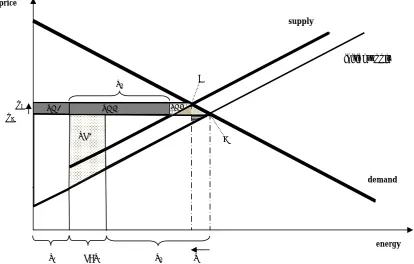
Figure 1. Change in rents and market equilibrium induced by a shock on the supply side
We assume that there is a temporary loss in energy supply by the amount L caused, e.g. by extreme-event-related problems in the generation process. Let us temporarily suppose that there are linear energy demand and supply functions for the regarded economy. Initially, i.e. before there is this supply side shock, the initial supply curve (thin line fading to the short bold line intersecting the axis of ordinates) and the demand curve intersect in A. The loss in energy supply by L (see the associated marginal prices in this supply range) causes a modification of the supply curve. Since the cheapest supply options still prevail (left hand side of the lost supply range), the new supply curve coincides with the old one in the respective supply range. Beyond this low-cost range, the new supply curve is located above the old one; it is depicted by the bold line passing through the new market equilibrium B. The decline in consumer-rent, due to higher market prices for energy and the cutback in energy consumption, is depicted by the (light, medium and dark) grey shaded area. The medium and dark grey areas reflect the loss in consumer rents caused by the increase in the market price for energy. The light grey area stands for the loss resulting from the shrinking of the level of consumed energy.
In contrast the suppliers obtain additional rents due to the increase in the market price for energy and these additional rents are depicted by the dark grey shaded area. The medium-grey triangle also depicts additional revenues due to higher energy prices, but these are immediately sapped by higher supply cost: the loss L in supply has to be partly replaced by alternative supply at higher cost. This loss due to higher supply cost is depicted by the area between the new and the initial supply curve up to the new quantity (associated with B) of energy sold on the market. Finally, below the light grey shaded triangle, there is a striped
Shift (=L) L R (loss in initial supply)
price
initial supply
supply
demand
energy
A B
pB
DISTRIBUTIONAL CONSEQUENCES OF CLIMATE CHANGE IMPACTS ON THE POWER SECTOR |5
area, which depicts supplier rent losses due to the decline in energy sold on the market. The overall change of supplier rents depends on the slope of the supply function.
Let us next have a closer look at the distribution of supplier rents and how they might become affected by energy supply disruptions causing energy insecurity to rise. We now assume that, before the shock, energy had been supplied by three companies. An individual energy providing company i (i=1,2,3) had initially a supply Si (see Figure 2). Let us
[image:7.595.87.502.313.577.2]furthermore assume that only the supply of the second company collapses, while the other two companies’ supply remains unchanged (it is neither reduced nor can it be augmented; their marginal supply cost will neither change). Let us further assume that, due to the loss in the second company’s supply, a fourth company will enter the market and will supply additional energy, but at higher marginal costs than the other companies on the market. As we can observe from Figure 2, the first and third company will obtain a gain in their rents by the dark grey areas RG1 and RG3, respectively. RG1 and RG3 are equal to the rise in the market price (pB-pA) multiplied by supplied quantities S1 and S3, respectively.
Figure 2. Changes in individual suppliers’ rents
The entrant to the market, i.e. the fourth company, will now supply the amount L-R=S2-R, i.e.
it will sell an amount of energy that is equal to the difference between the second supplier’s former supply S2=L minus the reduction R in total sales on the market. Of course, by entering
the market the entrant gains additional rents (grided area RG4) which he could not materialize in the initial situation when competitor 2, who could supply energy at a lower price before, was still on the market. Consequently, the only energy supplier suffering from the loss of low-cost energy supply capacity is supplier 2, whose own supply and rents cease to exist. Supplier 2’s loss in rents is equal to the dotted area RL2 in Figure 2. The other suppliers take advantage at the expense of the consumers who have to pay a higher energy price. The sum of total supplier rents and total consumer rents declines after the break-down
S1 L=S2 S3 R
price
initial supply
supply
demand
energy
A B
RG1
RL2
RG3 RG4
S3
pB
of company 2’s supply, since supply cost of energy have been increased and energy sales shrank.
In contrast to this case, there may be situations without real impairments of energy supply but where rumours about crises or shortages are spread in order to induce a price increase on the energy markets while supply cost remain actually unaffected. Then suppliers’ profits tend to be augmented (as long as price-elasticities of demand are moderate), while the consumers will lose consumer rents. Consequently, the suppliers acquire additional rents at the expense of the consumers, while total rents (sum of supplier and consumer rents) decline as the consumption of energy shrinks due to rising market prices.
A national government might try to reduce vulnerability of its economy with respect to international energy supply disruptions (e.g. stop in the delivery of gas via international pipelines for political reasons) by supporting domestic energy supply. This could be done by raising the price of imported energy via a tax which will encourage domestic supply and mitigate dependency on foreign supply. “The difference between the domestic price and the expected price of imports reflects the risk premium - the greater this risk or the greater the risk aversion, the greater will be this premium” (Markandya & Pemberton, 2010: 1611). Of course, such policies would also affect consumer rents as well as domestic and foreign energy suppliers’ profits in different ways.
From this discussion we can observe that the consumers of energy always suffer from energy-insecurity related price effects, while individual suppliers might take advantage of partial shortages or even from rumours about shortages in the short-run. Therefore, from the consumers’ point of view energy security with respect to certain forms of energy like oil might even be considered as a global or international public good.7 From an economic
perspective it is irrelevant where a country’s consumers acquire their oil which is due to its fungibility. As Crane et al. (2009: 14) point out, “[d]isruptions of supplies or jumps in demand anywhere in the world will be distributed across the world market.” Yet, with respect to electricity supply interrelations between regional shortages, price effects and redistribution of rents are different from those related to oil supply, amongst other things because electricity is not traded in global but in regional networks, i.e. there is a limited fungibility of electricity.
Since energy is used in every process within an economy, energy prices will cause the prices of all commodities and services to increase. “Price shocks may prevent the economy from performing to its full potential, the reason being that the sudden change of relative prices of production input factors may lead to temporarily increased unemployment or the obsolescence of production capital” (Löschel et al., 2010: 1666). Possible macroeconomic effects of energy price shocks are discussed, e.g. by Bohi & Toman (1993), and they may negatively affect both consumers and suppliers of energy.
After this rather general description of changes in consumer and producer rents caused by supply side shocks, we more specifically consider rent redistributions in Europe, which are caused by electricity shocks exerted by climate change-related extreme weather events, in the subsequent sections.
7 Egenhofer (2007) discusses the EU’s ’trilemma’ in the shape of potentially conflicting objectives for
3.
M
In our a to arise We focu are maj changes power t statistic between power p (e.g. ga change Figure 3 France, strongly France h In recen by wate was als take th evaluate sites wh and ana Figure 3 Remarks: Spain, F Poland, MK: The SE: Swed
Source: E
DIST
Methodolo
analysis, the from chan us on electr jor electrici s in air/wa the vulnera s of the IA n water ava plants to cli as and coal is usually n
3 gives an Spain, Ger y based on hydro powe nt years, nu er scarcity a
o the reaso e different e the situat here power alyzed in m
3. Electricity
: AT: Austria, FR: France, GB
SI: Slovenia, S e former Yugo den, NO: Norw Entso-E (2011)
TRIBUTIONAL
ogy and S
e impacts o ges in air a icity supply ty sources ater tempera
ability of e AEA (2008).
ailability an imate chang -power pla not available
overview o rmany and n nuclear p er is one of uclear power
and increas on why the characteri tion at the d r plant had more detail.
generation i
BE: Belgium, B: United Kin SK: Slovakia, oslav Republi way, PT: Portu .
L CONSEQUEN
Scenarios
of global wa and water te
y stemming in Europe ature and w ach power In the case nd electricit ge can be as ants) specif
e.
of the struc UK are Eur power gene the main pi r in France, es in the te electricity p
stics of riv different po cooling pr
in Europe
CH: Switzerla ngdom, HR: C HU: Hungary ic of Macedon ugal, IE: Irelan
NCES OF CLIMA
arming on E emperature g from nucle
and becau water availa
plant to cl e of hydro ty productio ssessed quit fic informat
cture of elec ropean cou eration. In illars of the , Germany a
mperature production vers regard ower plant roblem in re
and, CZ: Czec Croatia, IT: Ita
y, BA: Bosnia nia, AL: Alban
nd.
ATE CHANGE
European e e as well as
ear and hyd use they rev ability in th limate chan power ther on. Therefo te well. In co
tion about
ctricity pro untries wher
countries l e electricity and Spain f
of rivers us of hydro-p ding water sites using ecent years
ch Republic, D aly, LU: Luxe a/Herzegovina
nia, GR: Greec
IMPACTS ON T
lectricity su changes in dro-power p vealed a hi he past. In nge can be re is a very ore the vuln ontrast, for their vulne
duction in re the electr like Austria supply syst faced coolin sed for cool power plan
availability g data of the are identif
DE: Germany, embourg, NL: a, ME: Monte ce, BG: Bulga
THE POWER S
upply are su n water ava
plants becau gh vulnera the case of assessed b y strong cor nerability of other powe erability to Europe. Cu ricity produ a, Switzerla tem. ng problems ling. Water ts was redu y into acco e IAEA (20 fied as criti
DK: Denmark Netherlands enegro, RS: Se ria, RO: Rom
SECTOR |7
In order to assess the impacts of climate change on nuclear power plants in Europe we use an approach introduced by Koch & Vögele (2009) (see also Rübbelke & Vögele, 2011). Like in other thermal power plants, in nuclear power plants only a part of the energy input is converted to electricity. The rest of the energy is transformed to heat. That part of heat which is not used for district heating has to be disposed either to the air or by using cooling water. As shown in Koch & Vögele (2009) and Rübbelke & Vögele (2011), the demand for freshwater of a thermal power plant can be assessed by
(
) (
)
EZ AS
c h
KW
Q elec
total
F ⋅
⋅ ⋅
⋅ − ⋅ − ⋅ − ⋅ ⋅ ⋅ =
ϑ
ω
β
α
η
η
1 1
1 6 . 3
(1)
where QF: cooling water demand [m3]
KW: installed capacity [kW]
h: operation hours [hours]
3.6 factor to convert kWh to megajoules
ηtotal: total efficiency [%]
ηelec: electric efficiency [%]
: share of waste heat not discharged by cooling water [%]
: share of waste heat released into air [%]
: correction factor accounting for the effects of changes in air temperature and humidity within a year [–]
: water density [t/m3]
c: specific heat capacity of water [MJ/t K].
AS: permissible temperature increase of the cooling water [K]
EZ: densification factor [–]
Equation (1) describes the links between use of fuels, energy conversion, production of waste heat and demand for cooling water. Based on information on the electricity produced in a period (KW.h) and data on efficiencies, the amount of total waste heat can be calculated. In
Equation (1) the amount of waste heat that has to be removed by using cooling water results from total waste heat (KW.h. 3.6.(1-ηtotal)/ηelec) multiplied by different correction factors
accounting for, e.g., the share of waste heat released into the air. The first part of the denominator in Equation (1) describes how much energy is absorbed if one m3 of water is
heated up by one degree centigrade and the second part (AS) of the denominator depicts the degrees centigrade the water is heated. The return water results from waste heat divided by the heating up potential of the water which is calculated by multiplying heat capacity and permissible temperature increase. For the calculation of the freshwater demand it has to be taken into account that, if a cooling tower is used, additional water will be necessary to avoid an increase in salinity caused by water evaporation. By using EZ as densification factor we take this aspect into account.
DISTRIBUTIONAL CONSEQUENCES OF CLIMATE CHANGE IMPACTS ON THE POWER SECTOR |9
freshwater which is needed to prevent the build-up of minerals and sediments in the cooling cycle.
The impacts of cooling water shortages and limitations on the increase in water temperature can be assessed by transforming equation (1) to
(
)
EZh
AS c Q
KW
elec total
F
⋅ ⋅ − ⋅ − ⋅ ⋅ − ⋅ ⋅
⋅ ⋅ ⋅ =
ϖ
β
α
λ
η
η
ϑ
) 1 ( 1 1
6 . 3
(2)
Assuming limitations in the available amount of cooling water ( F
Qmax) and a lower
permissible temperature increase of the cooling water
(
AS
max), the capacity has to be
reduced to
(
)
EZh
AS c Q
KW
elec total
F
⋅ ⋅ − ⋅ − ⋅ ⋅ − ⋅ ⋅
⋅ ⋅ ⋅ =
ϖ
β
α
λ
η
η
ϑ
) 1 ( 1 1
6 . 3
max max
max (3)
where KWmax: usable capacity [kW]
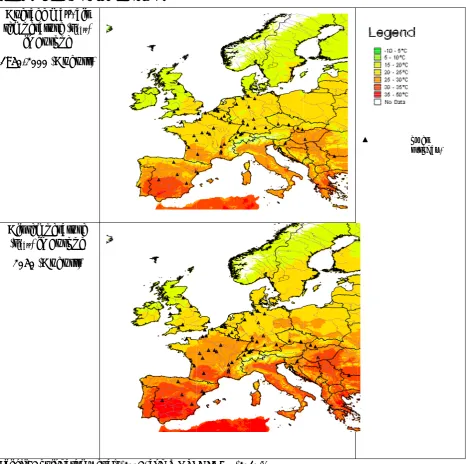
Figure 4 Averag temper in E 1950-20 Air tem (tmax)
2050
Source: G
The dat (caused increase air and
μ
sT = +
where
4. Air temper
ge max. air rature (tmax)
Europe 000 (August mperature in Europe (August) Govindasamy
ta of the cli d by change es in the wa water temp
( 1 γ β α
μ
α
T e − + − +Ts: stream
Tα: a
μ: e
α: m
γ: st : a
rature in Eur
)
t)
y et al. (2003
imate scena es in air tem
ater temper perature is a
)
m water tem
air temperat stimated m maximum st teepest slop air temperat rope
) and WORL
ario are use mperature) o
rature for in assessed by
mperature [°C
ture [°C] minimum str
tream temp pe of the fun ture at the in
LDCLIM (201
ed to assess on the wate ndividual p using follo C] ream tempe perature [°C nction [°] nflection po 10).
s the impac er demand ower plant owing equat ( erature [°C] C]
oint [°C]
cts of highe of power p
sites. The i tion:
(4)
DISTRIBUTIONAL CONSEQUENCES OF CLIMATE CHANGE IMPACTS ON THE POWER SECTOR |11
(see Mohseni et al., 1998; Webb et al., 2003; Morrill et al., 2005; Pedersen & Sand-Jensen, 2007 and WWF, 2009).
The parameters for the air/water temperature relationship are derived from the literature (Morrill et al., 2005 and WWF, 2009): The minimum stream temperature is assessed to be 0°C, the maximum stream temperature 29°C, the steepest slope 0.14 and the air temperature at the inflection point 16.5°C. For each power plant site, specific data on air temperature is extracted from the climate model. The data are inserted in equation (4) in order to calculate the power plant site specific water temperatures.
Due to a lack of data and in order to limit the complexity of our study, we assume that all nuclear power plants have the same efficiency. In addition, we assume a densification factor of 3 for all power plants with closed-circuit cooling system. These assumptions have been chosen in accordance with DOE/NETL (2007) and World Nuclear Association (2010).
The ‘Reference’ scenario describes the situation without climate change and the scenario ‘Climate Change/Slight Water Scarcity’ refers to the situation with changes in air and water temperature. In accordance with Umweltbundesamt (2008), we assumed for this scenario a reduction in runoff of rivers of up to 10%. The impacts on the electricity supply of a more serious water scarcity are analyzed in the third scenario (“Climate Change/More Serious Water Scarcity”). Here we assumed a reduction runoff of rivers of up to 25%.
With an optimization approach implemented in GAMS, we assess the cost-optimal use of the existing power plants for each country in Europe taking electricity import and export capacities into account. Based on electricity prices calculated for each country and information on the variable costs of the different power plants (including fuel costs), country-specific producer surpluses are identified. The producer surpluses are used as indicators identifying those countries where the electricity suppliers will benefit or suffer from climate change.
4.
Results
In our calculations, in the “Climate Change/Slight Water Scarcity” scenario during the peak load time in summer, the available capacity of nuclear power plants will be reduced by 6 GW and the available capacity of hydro-power plants by 12 GW due to the assumed increases in air and water temperature and decreases in water availability. In the scenario “Climate Change/More Serious Water Scarcity”, the capacity that is unavailable will rise in total by another 19 GW.
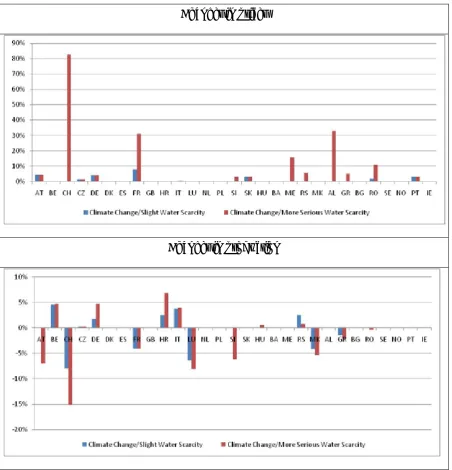
Climate change will have impacts not only on the production levels but also on the electricity prices. Gas and coal power plants will be used to compensate supply gaps. Because the production cost of these power plants are higher than the ones of nuclear and hydro-power plants, electricity prices will increase. In the “Climate Change/Slight Water Scarcity” scenario, the prices for electricity increase in Belgium, France, Germany, Great Britain, Hungary, Portugal, Romania and Slovakia. The price effects in this scenario are relatively small. The changes in prices are significantly higher in the climate change scenario with higher water scarcity. In this scenario, the electricity prices in Switzerland, for example, rise by 80% because expensive gas-fired power plants would be put into operation. In the reference scenario, only ‘cheap’ hydro and nuclear-power plants were employed in this country. With the need to raise the use of gas-fired power plants, also in other European countries the electricity prices are expected to increase significantly (Figure 5).
production decreases because of limitations in the use of nuclear and hydro-power plants caused by limitations in their availability and the induced increases in domestic electricity generation costs. These countries will tend to augment their imports of electricity or reduce their exports.
Figure 5. Changes in electricity prices and generation
Changes in prices
Changes in production
prices in well as German domesti Figure 6 Figure 7 hand, th the redu supplier Figure 7 Remarks: Figure 8 our scen change. DIST
nduces a lo France, bec ny will imp
ic power pl
6. Electricity
S
7 shows the he increase uction in d rs’ rents in
7. Changes in
Sw
: Green: incre
8 gives an nario the el . In contras
RIBUTIONAL C
ower deman cause other ort less elec lants.
production i
Switzerland
e changes in in prices c domestic su Switzerland
n the supplie
witzerland
eases in supp
overview o lectricity su t, the suppl
CONSEQUENC
nd of other r countries ctricity from
in Switzerlan
d
n the suppl causes an au
pply dimin d will increa
rs’ rents of S
pliers’ rents;
of the suppl uppliers in
liers’ rents
CES OF CLIMAT
countries f can supply m France an
nd and Germ
liers’ rents i ugmentatio nishes supp ase by 190%
Switzerland a
orange: decr
liers’ rents Germany w
of e.g. Aus
TE CHANGE IM
for electricit y additiona nd Switzerla
many (2030)
in Switzerla on of suppli pliers’ rents % and the re
and German
reases in sup
in the indiv will belong strian, Britis
MPACTS ON TH
ty produced l electricity and and wi
Germ
and and Ge iers’ rents. O
. All in all ents in Germ
ny
German
ppliers’ rents
vidual Euro to the bene sh and Span
HE POWER SE
d in Switze y in a cheap
ill extend th
many
ermany. On On the othe the change many by 9%
ny
.
opean coun eficiaries of nish suppli
ECTOR |13
erland as per way. he use of
n the one er hand, es in the %.
decreas electrici climate slight w the elec Figure 8
5.
C
Nuclear combat the nuc power p drought Consequ sources ongoing Autono inducin location to asce supplier extreme We foun e.g. in A patterns but pric than 80 the degr While E some Eu and nu warmin scenarioe due to ch ity exports. change-rela water scarcit
tricity price
8. Impacts of
Conclusion
r energy is global war lear power plants are li t and heat uently, wh – which w g climate ch omous adap ng a tempor
ns. In order ertain induc
rs and cons e weather p nd that stro Austria, Fra
s as well as ces tend to r
% and in F ree of globa European co uropean su uclear powe ng, as can b
o implies a
hanges in t In Switzer ated water ty, because e will remai
f climate chan
ns
frequently rming (see e sector is ne ikely to be i t waves. S ile represen were in the
hange. ptation in th
rary realloc to assess cl ced rent r sumers, we patterns (he ong decline ance and Sw
in import a rise signific rance by m al warming, onsumers w uppliers mig er. The ch be easily ob a decline in
the electric rland the ch scarcity. Th
in this scen in almost on
nge on suppl
y regarded e.g. Apergis egatively af impaired by uch incide nting option
focus of ou
he energy se cation of po limate chan redistributio e considered eat waves a es in electric witzerland. B
and export b cantly in so more than 30
, the real eff will through ght gain fro ange in su bserved from
n respectiv
ity supply hange in su hey only de
nario the Sw n the level o
iers’ rents
as a vehicl s et al., 2010
ffected by c y climate ch nces also i ns for clim ur analysis
ector takes p ower gener nge impacts ons both b d temporar and drough city generat
By means o balances, lo me Europe 0% in one o
fects might hout lose w om the clim uppliers’ re m the Swiss ve rents, w
curve and uppliers’ re ecline in the wiss produc of the refere
le to reduc 0). Yet, there climate chan hange-relate
interfere w mate change
– at the sam
place via in ration amon
on power s between po y autonom ht) for differ
tion due to of changes i ocal electrici an countrie of our scena
be even str welfare due mate-change
ents depend s case, whe while strong
a decline ents depend e climate ch
ction will b ence scenari
ce CO2 emi
e is also a re nge, since c ed extreme w with
mitigation me time req
nternational ng differen supply patt ower supp mous adapta rent climate climate cha in European ity shortage es, e.g. in Sw
arios. Howe ronger.
to the rise i induced di ds on the ere a moder ger global
in the capa ds on the e hange scena be reduced io. issions and everse inter cooling proc weather ev -power gen n, these two quire adapt
l electricity t sectors an terns in Eur
liers and b ation in resp e change sc ange tend t n power ge es can be ov witzerland b
ever, depen
in electricity isruptions o severity o rate climate
warming t
DISTRIBUTIONAL CONSEQUENCES OF CLIMATE CHANGE IMPACTS ON THE POWER SECTOR |15
augment these rents. The latter is due to the fact that electricity prices will increase much more in the case of strong global warming and the Swiss suppliers can therefore usurp additional rents at the expense of the consumers of electricity.
Hence, besides the possibility that solely autonomous adaptation via reallocation of power generation might become insufficient to prevent power supply disruptions caused by ongoing climate change and rising severity of associated extreme events in future, there is a second reason for also executing advance strategic public policy intervention concerning adaptation (which complements autonomous adaptation) in the electricity sector: the short-term, temporary reallocation of power generation might cause an undesired redistribution of wealth.
Such strategic public policy intervention concerning adaptation could either target the affected power sector itself or it may (also) address the upstream water supply sector. In the latter case, an improvement of the management of water supply is an option. Yet, many European river basins supplying cooling water are transnational and therefore an international coordination is required in many cases. Improvements in the power sector itself could be attained, e.g. by increasing power plant efficiencies. These measures (improvement in the management of water supply and augmentation of power plant efficiencies) tend to have positive consequences for the hydro and nuclear-power supply and consequently may help to prevent both power supply disruptions as well as potentially undesired welfare redistributions (which could be perceived to arise e.g. if large rents are redistributed from consumers to individual suppliers whose supply cost have not or only slightly increased). Another option to prevent power supply disruptions is the diversification of the sources of supply. The augmentation of the use of such power plants that do not require cooling systems (e.g. photovoltaic installations) could contribute to the mitigation of adverse effects of climate change on the electricity supply system. However, the option of raising the use of expensive photovoltaic installations does not prevent those undesired rent redistributions between consumers and producers we discussed in this paper. However, it might affect the redistribution of suppliers’ rents among nations.
Furthermore, in order to mitigate unfairness perception ex post, those rents which governmental decision-makers consider to be unfairly usurped by the suppliers at the expense of consumers could be (partly) taxed away and the revenues could be employed for public measures mitigating global warming or helping to adapt to it. In this manner, beneficiaries of (higher electricity prices induced by) climate change could take their share in financing climate policies.
Yet, such a tax scheme should be designed with care, because it may adversely as well as positively affect suppliers’ incentive structures. On the one hand, it should not yield disincentives for suppliers to provide sufficient power reserve capacities. The price is an indicator for scarcity and a high price provides incentives for raising investments in the supply infrastructure. On the other hand, a tax levied on rents acquired only due to temporary climate change effects provides disincentives for suppliers to usurp additional rents by manipulating prices via strategically reducing power supply in summer peak-load periods.
Literature
Apergis, N., J.E. Payne, K. Menyah and Y. Wolde-Rufael (2010), “On the Causal Dynamics between Emissions, Nuclear Energy, Renewable Energy, and Economic Growth”,
Ecological Economics, Vol. 69, No. 11, pp. 2255-2260.
Baumgärtner, S., H. Dyckhoff, M. Faber, J. Proops and J. Schiller (2001), “The Concept of Joint Production and Ecological Economics”, Ecological Economics, Vol. 36, No. 3, pp. 365-372.
Bohi, D.R. and M.A. Toman (1993), “Energy Security: Externalities and Policies”, Energy Policy, Vol. 21, No. 11, pp. 1093-1109.
Bohi, D.R. and M.A. Toman (1996), The Economics of Energy Security, Kluwer Academic Publishers, Boston/Dordrecht/London.
Crane, K., A. Goldthau, M. Toman, T. Light, S.E. Johnson, A. Nader, A. Rabasa and H. Dogo (2009), Imported Oil and U.S. National Security, RAND Corporation, Santa Monica, Arlington and Pittsburgh.
DOE/NETL (2007), Estimating Freshwater Needs to Meet Future Thermoelectric Generation Requirements, Pittsburgh.
Egenhofer, C. (2007), “Integrating Security of Supply, Market Liberalisation and Climate Change”, in M. Emerson (ed.), Readings in European Security, Volume 4, Centre for European Policy Studies, Brussels, pp. 79-96.
ENTSO-E (2011), “NTC Values“, 02/03/2011 (https://www.entsoe.eu/resources/ntc-values/ntc-matrix).
EUREAU (2009), EUREAU Statistics Overview on Water and Wastewater in Europe 2008, Brussels.
EURELECTRIC (2009), Statistics and Prospects for the European Electricity Sector, 37th Edition
EURPROG 2009, Brussels.
EUROSTAT (2010), Electricity Statistics – Provisional Data for 2009
(http://epp.eurostat.ec.europa.eu/portal/page/portal/product_details/publication?p _product_code=KS-QA-10-014).
Fankhauser, S., J.B. Smith and R.S.J. Tol (1999), “Weathering Climate Change: Some Simple Rules to Guide Adaptation Decisions”, Ecological Economics, Vol. 30, No. 1, pp. 67-78. Flörke, M., E. Teichert and I. Bärlund (2011), “Future Changes of Freshwater Needs in
European Power Plants”, Management of Environmental Quality, Vol. 22, No. 1, pp. 89-104.
Förster, H. and J. Lilliestam (2010), “Modelling Thermoelectric Power Generation in View of Climate Change”, Regional Environmental Change, Vol. 11, No. 1, pp. 211-212.
Govindasamy, B., P.B. Duffy and J. Coquard (2003), “High-resolution Simulations of Global Climate, Part 2: Effects of Increased Greenhouse Cases”, Climate Dynamics, Vol. 21, Nos. 5-6, pp. 391-404.
DISTRIBUTIONAL CONSEQUENCES OF CLIMATE CHANGE IMPACTS ON THE POWER SECTOR |17
Guthrie, G. (2006), “Regulating Infrastructure: The Impact on Risk and Investment”, Journal of Economic Literature, Vol. 44, No. 4, pp. 925-972.
Helm, D. (2002), “Energy Policy: Security of Supply, Sustainability and Competition”, Energy Policy, Vol. 30, No. 3, pp. 173-184.
IAEA (2004), Operating Experience with Nuclear Power Stations in Member States in 2003,
International Atomic Energy Agency, Vienna.
IAEA (2008), Operating Experience with Nuclear Power Stations in Member States in 2007,
International Atomic Energy Agency, Vienna.
IEA (2007), Energy Security and Climate Policy – Assessing Interactions, OECD/International Energy Agency, Paris.
IPCC (International Panel on Climate Change) (2008), Climate Change 2007: Impacts, Adaptation and Vulnerability, Cambridge: Cambridge University Press.
Itteilag, R.L. (2008), “Global Cooling: Electricity Peak-shaving Techniques to Offset Climate Change”, Strategic Planning for Energy and the Environment, Vol. 28, No. 1, pp. 55-68. Koch, H. and S. Vögele (2009), “Dynamic Modeling of Water Demand, Water Availability
and Adaptation Strategies for Power Plants to Global Change”, Ecological Economics, Vol. 68, No. 7, pp. 2031-2039.
Kopytkoa, N. and J. Perkins (2011), “Climate Change, Nuclear Power, and the Adaptation– Mitigation Dilemma”, Energy Policy, Vol. 39, No. 1, pp. 318-333.
Linnerud, K., T. Mideksa and G. Eskeland (2011), “The Impact of Climate Change on Nuclear Power Supply”, Energy Journal, Vol. 32, No. 1, pp. 149-168.
Longo, A., A. Markandya and M. Petrucci (2008), “The Internalization of Externalities in the Production of Electricity: Willingness to Pay for the Attributes of a Policy for Renewable Energy”, Ecological Economics, Vol. 67, No. 1, pp. 140-152.
Löschel, A., U. Moslener and D.T.G. Rübbelke (2010), “Indicators of Energy Security in Industrialised Countries”, Energy Policy, Vol. 38, No. 4, pp. 1665-1671.
Markandya, A. and M. Pemberton (2010), “Energy Security, Energy Modelling and Uncertainty”, Energy Policy, Vol. 38, No. 4, pp. 1609-1613.
Mideksa, T. and S. Kallbekken (2010), “The Impact of Climate Change on the Electricity Market: A Review”, Energy Policy, Vol. 38, No. 7, pp. 3579–3585.
Mohseni, O., H.G. Stefan and T.R. Erickson (1998), “A Nonlinear Regression Model for Weekly Stream Temperatures”, Water Resources Research, Vol. 34, No. 10, pp. 2685-2692. Morrill, J.C., R.C. Bales and M.H. Conklin (2005), “Estimating Stream Temperature from Air
Temperature: Implications for Future Water Quality”, Journal of Environmental Engineering, Vol. 131, No. 1, pp. 139-146.
Mouawad, J., S. Romero, R.W. Dalton B. Goodman and V. Bajaj (2005), “Hurricane Katrina: The Oil Supply; Gas Prices Surge as Supply Drops”, The New York Times, 1 September. Ordacgi Filho, J.M. (2010), “Brazilian Blackout 2009”, PAC World, March 2010 Issue.
Pagnamenta, R. (2009), “France Imports UK Electricity as Plants Shut”, The Times, 3 July. Pedersen, N.L and K. Sand-Jensen (2007), “Temperature in Lowland Danish Streams:
Rübbelke, D. and S. Vögele (2011), “Impacts of Climate Change on European Critical Infrastructures: The Case of the Power Sector”, Environmental Science & Policy, Vol. 14, No. 1, pp. 53-63.
Seo, S.N. (2011), “An Analysis of Public Adaptation to Climate Change Using Agricultural Water Schemes in South America”, Ecological Economics, Vol. 70, No. 4, pp. 825-834. Showers, K.B. (2002), “Water Scarcity and Urban Africa: An Overview of Urban-Rural Water
Linkages”, World Development, Vol. 30, No. 4, pp. 621-648. UCTE (2004), August 2003 - Monthly Provisional Values, Brussels.
Umweltbundesamt (2008), Impacts of Climate Change on Water Resources - Adaption Strategies for Europe, Dessau.
van den Bergh, J. (2004), “Optimal Climate Policy is a Utopia: From Quantitative to Qualitative Cost-benefit Analysis”, Ecological Economics, Vol. 48, No. 4, pp. 385-393. Webb, B.W., P.D. Clack and D.E. Walling (2003), “Water-air Temperature Relationships in a
Devon River System and the Role of Flow”, Hydrological Processes, Vol. 17, No. 15, pp. 3069-3084.
WORLDCLIM (2010), Global Climate Data, June (http://www.worldclim.org).
World Nuclear Association (2010), Cooling Power Plants, August (http://www.world-nuclea.org/info/cooling_power_plants_inf121.html).
WWF (2009), Die mögliche Wirkung des Klimawandels auf Wassertemperaturen von Fliessgewässern, Frankfurt am Main.
CENTRE FOR EUROPEAN POLICY STUDIES, Place du Congrès 1, B‐1000 Brussels, Belgium Tel: 32 (0)2 229 39 11 • Fax: 32 (0)2 219 41 51 • www.ceps.eu • VAT: BE 0424.123.986
ABOUT CEPS
Founded in Brussels in 1983, the Centre for European Policy Studies (CEPS) is widely recognised as the most experienced and authoritative think tank operating in the European Union today. CEPS acts as a leading forum for debate on EU affairs, distinguished by its strong in-house research capacity, complemented by an extensive network of partner institutes throughout the world.
Goals
• Carry out state-of-the-art policy research leading to innovative solutions to the challenges
facing Europe today,
• Maintain the highest standards of academic excellence and unqualified independence
• Act as a forum for discussion among all stakeholders in the European policy process, and
• Provide a regular flow of authoritative publications offering policy analysis and
recommendations,
Assets
• Multidisciplinary, multinational & multicultural research team of knowledgeable analysts,
• Participation in several research networks, comprising other highly reputable research
institutes from throughout Europe, to complement and consolidate CEPS’ research expertise and to extend its outreach,
• An extensive membership base of some 132 Corporate Members and 118 Institutional
Members, which provide expertise and practical experience and act as a sounding board for the feasibility of CEPS policy proposals.
Programme Structure
In-house Research Programmes
Economic and Social Welfare Policies Financial Institutions and Markets
Energy and Climate Change
EU Foreign, Security and Neighbourhood Policy Justice and Home Affairs
Politics and Institutions Regulatory Affairs Agricultural and Rural Policy
Independent Research Institutes managed by CEPS
European Capital Markets Institute (ECMI) European Credit Research Institute (ECRI)
Research Networks organised by CEPS
European Climate Platform (ECP) European Network for Better Regulation (ENBR)
European Network of Economic Policy Research Institutes (ENEPRI) European Policy Institutes Network (EPIN)