This is a repository copy of
Caring in prison: the intersubjective web of professional
relationships
.
White Rose Research Online URL for this paper:
http://eprints.whiterose.ac.uk/83234/
Version: Accepted Version
Article:
Nolan, G and Walsh, E (2012) Caring in prison: the intersubjective web of professional
relationships. Journal of Forensic Nursing, 8 (4). 163 - 169. ISSN 1556-3693
https://doi.org/10.1111/j.1939-3938.2012.01142.x
[email protected]
https://eprints.whiterose.ac.uk/
Reuse
Unless indicated otherwise, fulltext items are protected by copyright with all rights reserved. The copyright
exception in section 29 of the Copyright, Designs and Patents Act 1988 allows the making of a single copy
solely for the purpose of non-commercial research or private study within the limits of fair dealing. The
publisher or other rights-holder may allow further reproduction and re-use of this version - refer to the White
Rose Research Online record for this item. Where records identify the publisher as the copyright holder,
users can verify any specific terms of use on the publisher’s website.
Takedown
If you consider content in White Rose Research Online to be in breach of UK law, please notify us by
Caring in prison: The intersubjective web of professional
relationships
Greg Nolan, DCouns, MEd, BA, Cert Ed (QTS), Adv Dip Guidance & Counselling, MBACP (Sen Acc), UKRC (Reg Ind Practitioner), FHEA1and Elizabeth Walsh, PhD, MSc, BSc (Hons), RN2
1 Teaching Fellow, Programme Manager Professional Doctorate in Health and Social Care, School of Healthcare, University of Leeds, Leeds, UK
2 Senior Lecturer Offender Health, School of Healthcare, University of Leeds, Leeds, UK
Keywords
Clinical supervision; emotional labor; forensic nursing; intersubjectivity; prison.
Correspondence
Elizabeth Walsh, PhD, MSc, BSc (Hons), RN, Senior Lecturer Offender Health, School of Healthcare, University of Leeds, Leeds LS2 9UT, UK.
Tel:+44 (0) 113 3436293; E-mail: [email protected]
Colored figures can be found in the online version of this article.
Received: November 9, 2011; accepted: April 11, 2012
doi: 10.1111/j.1939-3938.2012.01142.x
Abstract
In this paper, we present a synthesis of two doctoral theses where links are made between the intersubjective, relational dynamics seen in clinical super-vision, and applied in practice to a framework for emotional labor in prison nurses. We explore the nature of intersubjectivity, from nursing and psy-chotherapeutic perspectives, and discuss the way in which it impacts on and influences relationships between nurses, prisoner patients, prison officers, and organizations within prison healthcare settings. The impact of this intersubjec-tivity is illustrated through the exploration of an intersubjective web that is cre-ated and informs interaction between the key actors within the prison nurse’s practice, i.e., prison officers, prisoner patients, and the organization. We sug-gest that by being cognizant of the intersubjective web that influences these interactions, a more meaningful understanding of practice and relationships can be achieved. This deeper understanding can then be utilized to develop practitioners both professionally and personally. We conclude by promoting regular, formal clinical supervision as an ideal space within which to explore the way in which this intersubjective web influences relationships, impacts on emotional labor, and subsequently patient care and staff well being.
In this paper, we present a synthesis of ideas from two PhD theses, where following a shared interest in clinical supervision, links were made between the intersubjec-tive, relational dynamics present in clinical supervision (Nolan, 2008a, b) and applied in practice to a framework for emotional labor as experienced by prison nurses in HM Prison Service (Walsh, 2009). It is not our intention to provide detailed information regarding these in this paper, as further information can be obtained in Walsh (2009) and Nolan (2008a). Rather we aim to utilize our models of intersubjectivity and emotional labor as vehi-cles to support the development of both practice and the workforce through clinical supervision.
Emotional labor is known to impact on professional burnout (Huynh, Alderson, & Thompson, 2008) and is a significant cause of workplace stress (Mann, 2004). Clin-ical supervision is one way of managing the effects of
emotional labor on prison nurses (Walsh, 2009) and as such we suggest that effective, regular clinical supervi-sion is a useful mechanism to support nurses in managing this stress. Through our work described in this paper, we acknowledge the value of clinical supervision as a space to understand and appreciate the intersubjective web of relationships in prison healthcare. Through deeper un-derstanding of this web of relationships, we suggest that practitioners can gain a better understanding of their re-actions to both patients and colleagues, which, in turn, will promote better working relationships.
Caring in prison G. Nolan and E. Walsh
relationship in prison, while being mindful of the emo-tional labor of prison nurses. We then provide an alter-native approach to reflecting on practice in prison health-care, which takes account of both the emotional labor of prison nurses (using the framework identified) and an understanding of the complex intersubjective web of rela-tionships they work with. Clinical supervision is discussed and promoted as a space in which this web can be ex-plored to identify intersubjective relations impacting on emotional labor, thus enabling prison nurses to truly un-derstand their practice and the impact of it on their own mental well-being.
A sense of identity, who we think and feel we are, is built up through social relationships and learning to be in relationship with “other.” What we think and feel is built up from relational experiences and remembered events as a “felt sense” (Gendlin, 1997, 2003), contained in sounds and smells triggering “embodied” memories (Rothschild, 2000). These collected elements of memory affect how we function moment-by-moment in daily life.
Ideas from relational psychoanalysis and psychother-apy (Aron & Harris, 2005; Mitchell & Aron, 1999; Stern, 2008, Stern, 2010; Suchet, Harris, & Aron, 2007) and neuroscience (Cozolino, 2002, 2006; Gallese, 2009; Ginot, 2007; Lepage & Theret, 2007) recognize that the way we perceive meaning is intersubjectively influenced when with others: I look you in the eyes and commu-nicate with you, my thoughts and emerging actions are affected by your responses, but also by retained memo-ries of previous experiences and relationships.
Psychoanalyst Benjamin (1990, p. 33) sees “intersub-jectivity” as recognition that our subjective perceptions are in relational proximity, and they are affected by feel-ings about their relationship with us, and us about them. There is a continual breakdown and repair of mutual-ity that is directly affected by the thoughts and fears that we have about ourselves, described by Benjamin as “in-trapsychic fantasies”—in other words, we imagine what others think and feel about us and then act accordingly.
Writings and research on intersubjectivity (Benjamin, 2005; Stolorow, 2005; Stolorow, Atwood & Brandchaft, 1994) see meanings in relationships as always exist-ing in a social context, each with differexist-ing life histories and worldviews. Research from the Boston Change Pro-cess Study Group (2010) at Harvard University explores the nature of cocreated meanings, when one is subject moment-by-moment to being influenced by the presence of “other.”
Stolorow (2005) sees the degree of interpersonal at-tunement as being dependant on our communicated re-sponse to the meanings derived from our prior experi-ences. I experience you, and you me, with memories of previous relationships and events, some of which may be
in my conscious awareness, others not. It is these ele-ments of instinctive in-the-moment reactions that have a direct impact on the outcome of a particular encounter.
Making sense of these interpersonal responses, or “dy-namics,” can be helped by the use of visual represen-tation, illustrated in the diagrams below (A–D), (Nolan, 2008a; 2008b). A relational interplay of intersubjective processes can be tracked within the intersubjective space, where we experience the other person, the “analytic third” (Ogden, 1994) and a region of focused attention, notated below as the fourth. In illustrating this concept, consider what would appear to be a simple interaction between nurse and offender/patient. Color figures can be found in the online version of this article.
A: Relational frame
Each person is contained in a field of influence, a bound-aried space as a projection of “self” which the “other” senses and perceives, a three-dimensional “bubble” containing the em-bodied “presence” of each. The interacting bubbles create a “third” element (in purple); focused attention defines a minibub-ble “fourth,” seen as the area of bright yellow.
In our example, an offender (left bubble) is with a nurse (right bubble), each aware of the other’s presence (overlap). The nurse begins to talk (small circle), the offender replies (second small circle) creating a focused area of attention between them (bright overlap).
B: Precomplex frame
The “other” brings a preexisting “presence” or remembered event (broken line) to the frame, generating reactions, feelings, and thoughts. In this frame, the offender recalls previous expe-riences when with a nurse, the memory of which informs/affects the ways in which he continues his response. The nurse responds accordingly.
C: Complex frame with “populated dyad”
Additional “presences,” introduced by the other’s narrative, feed a complex “fourth,” adding complexity. To continue us-ing our example of the nurse offender/patient interaction, an-other previous memory intrudes, perhaps triggered by a word or phrase from the nurse, adding to the offender’s evaluation of what to say, or do, next.
D: Reflection and insight
Moving in and out of focused engagement, observing at the time or on subsequent reflection, can enable insight and under-standing. In this situation, the nurse senses a change in his or her emotional perception of the offender, considers how best to respond, and then reengages with the encounter.
Each of these stages (A–D) might occur in a mo-ment, sometimes not in either person’s conscious aware-ness. The encounter may develop purposefully, or not; the nurse may or may not be fully aware of how re-sponses might be perceived. If the nurse is at ease with the encounter, then reflection in-the-moment would al-low clear evaluation—if not, then reactions might be not fully understood and feelings may remain unprocessed, the containment of which contributing to stress. Talking about such an encounter afterward in collegial discussion or in clinical supervision would enable reflection on the event and time to consider any contributing factors that were unrecognized at the time. The diagrammatic “tool” illustrated here helps in seeing influences and factors that might have affected the encounter.
However, our illustration does not take account of the nurses’ own processes. For example, they may have had a disagreement with their partner that morning, an alter-cation with their line manager, or retained a memory of
a previous encounter that had proved problematic. They may also need to be mindful of the expectations and ethos of the institution. Any of which might potentially impact on this scenario.
Reflection and insight (D above) shows a moment of “potential space” in which to think (Kounios et al., 2008; Kounios & Beeman, 2009; Ogden, 1997), and provides an opportunity to avoid “abandonment” of communication and breakdown in the relationship. Such a space where these ways of thinking might be provided is within clini-cal supervision or in group debriefing meetings following an incident. However, thinking in such terms is a chal-lenge when three or more people might be interacting in the prison context, where the environment does not often lend itself to providing space and time to reflect, especially in moments of crisis and emergency.
Intersubjectivity and emotional labor:
A prison nursing perspective
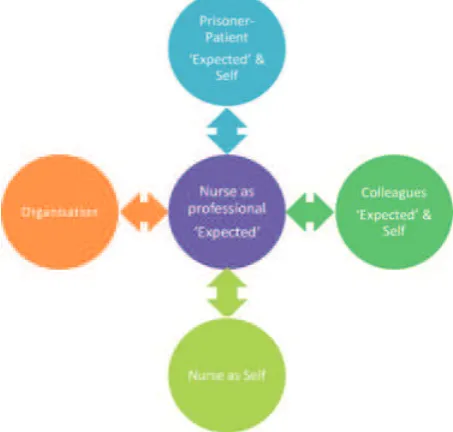
According to Pierson (1999), the relationship between nurse and patient is an intersubjective process between individuals. Therefore, consideration of the concept of in-tersubjectivity is essential as it constitutes an integral el-ement of nursing practice. Previous work exploring the nature of emotional labor in prison nurses highlighted three key relationships as having a significant impact on the emotion work of prison nurses, with a fourth, in-terpersonal relationship, that can cause professional and personal disease (Walsh 2009). Emotional labor is de-fined by Mann (2004) as having three components “the faking of emotion that is not felt and/or the hiding of emotion that is felt, and the performance of emotion management in order to meet expectations within a work environment” (p. 208). Mann continues to note that emotional labor can be a significant source of work stress, and effective management of it, is of particular impor-tance for those in the caring and counseling professions. Zapf (2002) also discusses the way in which emotional work is linked to high levels of burnout and its im-pact on psychological well-being. In their concept anal-ysis of emotional labor, Huynh, Alderson, and Thomp-son (2008) noted the correlation between emotional la-bor and professional burnout, and highlighted the need for nurses to have time and support to reflect on their practice to understand their emotional labor. Since 2009, a framework for the emotional labor of prison nurses has been further developed to make the “intranurse” rela-tionship more explicit. See Figure 1 below.
Caring in prison G. Nolan and E. Walsh
Figure 1. Framework for emotional labor Walsh (2009).
nurse will have an intersubjective element to them. The relationship with custodial personnel and prisoner pa-tients is impacted upon by the way in which each party to that relationship views themselves and the other, while being influenced by their own previous experiences. This is also true to some extent of the more abstract external relationship where the nurse engages with the organiza-tional norms and expectations regarding practice. Nurses’ responses to the organization will be based on their own prior experiences of it, and indeed others.
Of importance here is the way in which these relation-ships, with their intersubjective influences, impact on the internal, intrapersonal relationship that nurses have with themselves, which we suggest is at the heart of the dis-sonance that prison nurses experience on a regular ba-sis. We suggest that this internal relationship is akin to the concept of the internal supervisor, where, as iden-tified above, nurses inner professional voices supervise their own personal views and motivations. For exam-ple, when caring for challenging prisoners, who have a history of offending behavior that nurses find difficult to deal with, they may find it difficult to provide non-judgmental care, or indeed care at all. However, their in-ner professional supervisor may well be in conflict with their personal thoughts and feelings, which can lead to high levels of emotional labor, stress, burnout, and subse-quently impact on mental well-being.(see Walsh & Fresh-water, 2009).
In considering the nature of emotional labor in prison nursing, it is clear that the relationships between nurse, prisoner, and prison officer are not only subjected to
in-Figure 2. The intersubjective web of emotional labor.
fluence through intersubjectivity on one level, but in a “web” of interacting levels. This is particularly true when both nurse and prison officer are working together with the prisoner patient, within the context of the prison en-vironment. We term this an intersubjective web, as illus-trated in Figure 2. Such a structure can help visualize underlying meanings to behaviors and reactions, particu-larly in a critical incident debriefing.
The intersubjective web: A reflection
on practice
Having worked in a residential wing treatment room for many years, Jane felt as though she was able to deal with any difficult prisoner patient who came to her for care. However, one prisoner had recently assaulted a close colleague, leaving her feeling quite bitter and angry with him. Providing a caring approach to him, which is what she expected of herself as a nurse, was proving too difficult, and she engaged with him on a distanced, profes-sional level, with no sense or feeling of any connection. Jane had always prided herself on her ability to care for any prisoner, re-gardless of the offence; however, this particular prisoner stirred up feelings of anger and hatred. Her expectations of herself as a professional were tested and the internal supervisor, which qui-etly questioned her behavior and feelings toward this patient, became louder as she attempted to interact with him. As she was treating him, she felt hostility both personally toward him and reciprocated by him. A prison officer colleague was standing out-side her treatment room at the time, and, sensing that tensions were rising, intervened to curtail the prisoner’s behavior toward Jane.
If this interaction is viewed through exploring the emo-tional labor Jane experienced, the relationship between
[image:5.595.69.296.75.291.2]her, the prisoner and the prison officer, and the organi-zational policies and culture could easily be unpacked to expose conflict and dissonance. However, in viewing the episode of practice through the lens of emotional labor
and intersubjectivity, a more complex picture emerges that takes account of the effects and affects of each actor. We suggest that this would have lead to a better awareness of the way in which all involved, behaved, and impacted upon one another. Being aware of the way in which this intersubjective web impacts on thoughts and feelings is crucial in addressing practice behavior, identifying sup-port required by the nurse and further learning that may be required.
Reflection on difficult practice experiences will often allow a deeper understanding of a situation to emerge; however, informal reflection, which often takes place immediately following difficult interactions, rarely pro-vides space for nurses to consider the intersubjective lations. Indeed, in our experience, the intrapersonal re-lationship (i.e., the internal supervisory rere-lationship) is rarely explored in any depth. We suggest that this is as a consequence of what Menzies-Lyth (1988) refers to as a defense against anxiety. However, it is not without appro-priate and adequate reflection on practice that a changed perspective is enabled. Without this change in perspec-tive, practice remains stagnant.
If we consider the way in which intersubjectivity im-pacts on the relationships that result in high levels of emotional labor for prison nurses, regular opportunity is required to reflect on both relationships and inter-subjective space. An understanding of the complex web of interactions in these relationships will enable prison nurses to manage and work with the dissonance they face. The space available to nurses to reflect on and understand this intersubjective web is found in clini-cal supervision. It is well documented that there are barriers to engaging in clinical supervision, particularly in the prison setting, where reflecting on practice can be challenging both in terms of resources and inclina-tion, where defenses against anxiety are commonplace, (see Menzies-Lyth, 1988), and where prizing open prac-tice through reflection can feel threatening (Walsh & Freshwater, 2009).
In areas where engaging in clinical supervision is a challenge, consideration of the impact of relationships and intersubjective spaces could form part of more infor-mal reflection on practice and take place during regular interactions between staff where peer support is a cen-tral focus. We suggest that informal reflection occurs reg-ularly between practitioners during breaks in the work-ing day, as they talk with one another to make sense of their experiences. Utilizing this space more effectively to consider relationships and the influence of
intersubjec-tivity is recommended where clinical supervision is not possible.
Clinical supervision
The relationships identified as underpinning the emo-tional labor of prison nurses are clearly influenced by intersubjectivity. Therefore, if there is effective under-standing of how this intersubjective web is created, and its subsequent impact on practice, its effects can be man-aged to protect the mental health of the nurse and pro-mote practice development. A clear understanding of the complexity of emotional projection can lead to clearer thinking while receiving emotional information and un-derstanding the impact of external issues on emotional responses. For example, if we return to the care and man-agement of a challenging prisoner patient, with whom nurses have difficulty caring for due to offending behav-ior, an understanding of the intersubjective processes oc-curring at all three levels of the external relationships could assist the nurses in understanding and managing their own internal relationships.
We suggest that one way of promoting insight and un-derstanding of the complex emotional arena of caring in prison, and the impact of intersubjectivity on practice, is through regular, formal clinical supervision. Various def-initions of clinical supervision exist, all of which iden-tify support for the practitioner, the development of prac-tice, and the maintenance of standards as central. Cassedy (2010) defines clinical supervision in nursing as “a reg-ular and formal agreement to engage in a professional working relationship, facilitated by the supervisor to sup-port the supervisee to reflect on practice, with the aim of developing quality care, accountability, personal compe-tence, and learning” (p. 5). Bond and Holland (2010) sug-gest that “clinical supervision is regular, protected time for facilitated, depth reflection on complex issues in-fluencing clinical practice. It aims to enable the super-visee to achieve, sustain, and creatively develop a high quality of practice through the means of focused support and development” (p. 15).
Caring in prison G. Nolan and E. Walsh
supervision, to make meaning from their interactions with others.
Implications for practice
In this paper, we have presented an alternative approach to understanding the emotional labor of prison nurses through exploring and utilizing the notion of intersub-jectivity. This “intersubjective web of emotional labor” can be utilized as a tool in clinical supervision by prison nurses who wish to explore the emotional labor of their practice in order to gain insight and new perspectives, while obtaining support for their own mental well-being. The use of the intersubjective web of emotional labor in reflecting on practice can provide a deeper understand-ing of the nature of the relationships with which prison nurses engage, which impact on the emotional labor of their work. Through understanding how relationships are influenced by intersubjectivity, nurses can gain a better insight into the rationale for their practice and the conse-quences of it on their own well-being. New insights into practice will enable the development of practice through provision of effective support of the workforce, through clinical supervision.
References
Aron, L., & Harris, A. (Eds.) (2005).Relational psychoanalysis, (Vol.2) innovation and expansion. Hillsdale, NJ: The Analytic Press.
Boston Change Process Study Group (BCPSG). (2010).Change in psychotherapy: A unifying paradigm. New York: Norton. Benjamin, J. (1990). An outline of intersubjectivity: The
development of recognition.Psychoanalytic Psychology 7(Suppl), 33–46.
Benjamin, J. (2005). From many into one: Attention, energy, and the containing of multitudes.Psychoanalytic Dialogues, 15(20), 185–201.
Bond, M., & Holland, S. (2010).Skills of clinical supervision for nurses. Berkshire: McGraw Hill.
Cassedy, P. (2010).First steps in clinical supervision. Berkshire: McGraw Hill.
Cozolino, L. J. (2002).The neuroscience of psychotherapy. New York: W. W. Norton.
Cozolino, L. J. (2006).The neuroscience of human relationships: Attachment and the developing social brain. New York: W. W. Norton.
Gallese, V. (2009). Mirror neurons, embodied simulation, and the neural basis of social identification.Psychoanalytic Dialogues,19(5), 519–536.
Gendlin, E. T. (1997).Experiencing and the creation of meaning: A Philosophical and psychological approach to the subjective. Evanston, IL.: North Western University Press.
Gendlin, E. T. (2003).Focusing: How to gain direct access to your body’s knowledge. London: Rider.
Ginot, E. (2007). Intersubjectivity and neuroscience: Understanding enactments and their therapeutic significance within emerging paradigms.Psychoanalytic Psychology,24(2), 317–332.
Huynh, T., Alderson, M., & Thompson, M. (2008). Emotional labour underlying caring: An evolutionary concept analysis.Journal of Advanced Nursing,64(2), 195–208.
Lepage, J.-F., & Theret, H. (2007). The mirror neuron system: Grasping others’ actions from birth?Developmental Science, 10(5), 513–523.
Kounios, J., & Beeman, M. (2009). TheAha!moment: The cognitive neuroscience of insight.Current Directions in Psychological Science,18(4), 210–216.
Kounios, J., Fleck, J. I., Green, D. L., Payne, L., Stevenson, J. L., Bowden, E.M., Jung-Beeman, M. (2008). The origins on insight in resting-state brain activity.Neuropsychologia, 46, 281–291.
Mann, S. (2004). People-work: Emotion management, stress and coping,British Journal of Guidance and Counselling,32(2), 205–221.
Menzies-Lyth, I. (1988).Containing anxiety in institutions Selected Essays (Volume 1). London: Free Association Books.
Mitchell, S. A., & Aron, L. (Eds.) (1999).Relational psychoanalysis: The emergence of a tradition. Hillsdale, NJ: Analytic Press.
Nolan, G.J.C. (2008a).Mirrors and echoes: Meaning-moments in counselling supervision. Unpublished Doctoral Thesis, University of Manchester, UK.
Nolan, G.J.C. (2008b). Researching supervision:
Intersubjectivity and complex dynamics.BAPPS eNewsletter, http://www.supervision.org.uk/
BAPPSnewsletters/Newsl spring08.htm Ogden, T. (1994). The analytic third: Working with
intersubjective clinical facts.International Journal of Psycho-Analysis,75, 3–20.
Ogden, T. (1997). Reverie and interpretation.Psychoanalytic Quarterly,66(4), 567–595.
Pierson, W. (1999). Considering the nature of
intersubjectivity within professional nursing,Journal of Advanced Nursing,30(2), 294–302.
Rothschild, B. (2000).The body remembers. New York: W. W. Norton.
Stern, D. B. (2008). “One never knows, do one?”: Commentary on paper by the Boston Change Process Study Group.Psychoanalytic Dialogues,18(2), 168–196. Stern, D. N. (2010).Partners in thought: Working with
unformulated experience, dissociation and enactment. Hove: Routledge.
Stolorow, R. D. (2005). The contextuality of emotional experience.Psychoanalytic Psychology,22(1),
101–106.
Stolorow, R., Atwood, G., & Brandchaft, B. (Eds.) (1994)The intersubjective perspective. Northvale, NJ: Aronson.
Suchet, M., Harris, A., & Aron, L. (Eds.) (2007).Relational psychoanalysis, (Vol.3). New voices.Mahwah, NJ: The Analytic Press.
Walsh, E. (2009). The emotional labor of nurses working in Her Majesty’s (HM) Prison Service.Journal of Forensic Nursing,5(3), 143–152.
Walsh, E., & Freshwater, D. (2009). The mental wellbeing of prison nurses in England and Wales. Journal of Research in Nursing,14(6),
553–564.
Zapf, D. (2002). Emotion work and psychological well-being. A review of the literature and some conceptual