Dunsmore, A. (2002) Investigating effective inspection of object-oriented
code. PhD thesis, University of Strathclyde.
http://eprints.cdlr.strath.ac.uk/2
683
/
Strathprints is designed to allow users to access the research
output of the University of Strathclyde. Copyright © and Moral
Rights for the papers on this site are retained by the individual
authors and/or other copyright owners. Users may download
and/or print one copy of any article(s) in Strathprints to facilitate
their private study or for non-commercial research. You may not
engage in further distribution of the material or use it for any
profitmaking activities or any commercial gain. You may freely
distribute the url (http://eprints.cdlr.strath.ac.uk) of the Strathprints
website.
SUBMITTED TO THE DEPARTMENT OF COMPUTER AND
INFORMATION SCIENCES,
UNIVERSITY OF STRATHCLYDE, GLASGOW
FOR
THE DEGREE OF DOCTOR OF PHILOSOPHY.
By
Alastair Peter Dunsmore
Due acknowledgement must always be made of the use of any material contained
in, or derived from, this thesis.
Since the development of software inspection over twenty-five years ago it has become established as an effective means of detecting defects. Inspections were originally developed at a time when the procedural paradigm was dominant but, with the Object-Oriented (OO) paradigm growing in influence and use, there now exists a lack of guidance on how to apply inspections to OO systems. Object-oriented and procedural languages differ not only in their syntax but also in a number of more profound ways - the encapsulation of data and associated functionality, the common use of inheritance, and the concepts of polymorphism and dynamic binding. These factors influence the way that modules (classes) are created in OO systems, which in turn influences the way that OO systems are structured and execute. Failure to take this into account may hinder the application of inspections to OO code. This thesis shows that the way in which the object-oriented paradigm distributes related functionality can have a serious impact on code inspection and, to address this problem, it develops and empirically evaluates three code reading techniques.
The results from an investigation into the characteristics of “hard to find” defects, in combination with a literature review and an industrial survey, revealed that one of the main difficulties affecting the inspection of OO code was the inherent delocalisation that occurred – OO features distributing closely related information throughout a system. From this, a systematic, abstraction-driven reading technique was developed, focusing on constructing abstract specifications, and evaluated by an empirical study. The results from this led to the development and evaluation of two further reading techniques – one based on a checklist and the other based on a more dynamic approach centered on the route that a use-case takes through a system – along with a refinement of the original systematic technique.
I would like to thank Dr. Marc Roper and Dr. Murray Wood for their excellent supervision. Their comments, criticisms, and advice have helped guide and shape the development of this thesis. Without their experience and scathing wit, this thesis would never have reached completion.
Through my time in the department, several individuals have provided encouragement and feedback on the work contained within this thesis. I would like to thank Fraser Macdonald, James Miller, and Douglas Kirk for their comments and encouragement through the course of the thesis. I would also like to thank the support personnel within the department - Ian Gordon, Gerry Haran, and Kenny Forte - for providing technical assistance.
Finally, I would like to acknowledge the encouragement and support given to me over many years by my parents, Helen and Peter, and many friends (Monty, Sam, Gordon, Stuart and Claire). Without it I would have failed long ago. I would also like to say a special thanks to my girlfriend Claire, for her patience and for pushing me over the final finishing line.
From the work carried out in this thesis there have been a number of publications. These are:
• M. Roper and A. Dunsmore, Problems, Pitfalls and Prospects for OO Code Reviews,
7th European International Conference on Software Testing, Analysis and Review,
EuroSTAR99, 1999.
• A. Dunsmore, M. Roper, and M. Wood, The role of comprehension in software inspection, Journal of Systems and Software, 52, pp. 121-129, 2000.
• A. Dunsmore, M. Roper, and M. Wood, Object-Oriented Inspection in the Face of Delocalisation, appeared in Proceedings of the 22nd International Conference on Software Engineering 2000, pp. 467-476, June 2000.
• A. Dunsmore, M. Roper, and M. Wood, M., Systematic Object-Oriented Inspection – An Empirical Study, appeared in Proceedings of the 23rd International Conference on Software Engineering 2001, pp. 135-144, May 2001.
• A. Dunsmore, M. Roper, and M. Wood, M., Practical Code Inspection for Object-Oriented Systems, in proceedings of the 1st Workshop on Inspection in Software Engineering, published by Software Quality Research Lab, McMaster University, pp.
49-57, July 2001.
• A. Dunsmore, M. Roper, and M. Wood, Further Investigations into the Development
and Evaluation of Reading Techniques for Object-Oriented Inspection, appeared in
Proceedings of the 24th International Conference on Software Engineering 2002, pp.
Contents
1 INTRODUCTION 1
1.1 OVERVIEW 1
1.2 CONTRIBUTION OF THESIS 3
1.3 THESIS OUTLINE 3
2 SOFTWARE INSPECTION AND OBJECT-ORIENTED PITFALLS 5
2.1 INSPECTION 5
2.1.1 The Inspection Process 5
2.1.2 Reading Techniques 10
2.1.2.1 Ad-hoc 10
2.1.2.2 Checklist 10
2.1.2.3 Step-wise Abstraction 12
2.1.2.4 Scenario-Based Reading 12
2.1.2.5 Perspective-Based Reading 13
2.1.2.6 Summary 15
2.2 OBJECT-ORIENTED PROBLEMS AND PITFALLS FOR INSPECTION 15
2.3 CURRENT STATE OF OBJECT-ORIENTED INSPECTION 18
2.4 SUMMARY 20
3 INVESTIGATION OF OBJECT-ORIENTED CODE INSPECTION 22
3.1 EXPERIMENTAL SOFTWARE METHODOLOGY 22
3.2 AN EXPERIMENT INVESTIGATING OBJECT-ORIENTED CODE INSPECTION 25
3.2.1 Introduction 25
3.2.2 Experimental Goals and Hypotheses 25
3.2.3 Experimental Plan 25
3.2.4 Experimental Procedures 31
3.2.5 Experiment Results 32
3.2.6 Experimental Design Lessons 39
3.2.7 Summary 40
3.3 SURVEY OF OBJECT-ORIENTED DEFECT-DETECTION APPROACHES 40
3.3.1 Survey Design 40
3.3.2 Survey Results 44
3.3.3 Summary 48
3.4 THE PROBLEM OF DELOCALISATION 49
3.5 INADEQUACY OF CURRENT INSPECTION APPROACHES 52
3.6 WAYS TO IMPROVE OBJECT-ORIENTED INSPECTION 55
3.7 CONCLUSIONS 56
4 SYSTEMATIC, ABSTRACTION BASED OBJECT-ORIENTED CODE INSPECTION 57
4.1 SYSTEMATIC INSPECTION 58
4.2 AN EMPIRICAL STUDY OF SYSTEMATIC OBJECT-ORIENTED INSPECTION 62
4.2.1 Introduction 62
4.2.2 Experimental Goals and Hypotheses 62
4.2.3 Experimental Plan 64
4.2.4 Experimental Procedures 68
4.2.5 Experimental Results 68
4.2.6 Experimental Design Lessons 83
4.3 CONCLUSIONS 87
5 DEVELOPMENT AND EVALUATION OF THREE TECHNIQUES FOR OBJECT-ORIENTED CODE INSPECTION 88
5.1 THREE INSPECTION READING TECHNIQUES 88
5.1.1 Checklist 89
5.1.2 Use-case 92
5.1.3 Systematic 96
5.2 EMPIRICAL EVALUATION 98
5.2.1 Introduction 98
5.2.2 Experimental Goals and Hypotheses 98
5.2.3 Experimental Plan 99
5.2.4 Experimental Procedures 103
5.2.5 Experimental Results and Analysis 104
5.2.6 Interpretation of Results 118
5.3 CONCLUSIONS 121
6 CONCLUSIONS AND FUTURE WORK 123
6.1 THESIS SUMMARY 123
6.2 LESSONS FOR THE INSPECTION OF OBJECT-ORIENTED CODE 125
6.2.1 The Problem of Delocalisation 125
6.2.2 Reading Technique Overhead 127
6.2.3 Chunking 128
6.3 ADVICE ON PRACTICAL OBJECT-ORIENTED CODE INSPECTION 129
6.4 FUTURE WORK 131
6.4.1 Replication Guidance 133
6.5 CONCLUSIONS 135
BIBLIOGRAPHY 136
A EXPERIMENT ONE MATERIAL 144
A.1 LIBRARY PROBLEM STATEMENT 144
A.2 EXPERIMENTAL MATERIAL 146
A.2.1 Inspection Defect Form 147
A.2.2 Inspection Instructions 148
A.2.3 Program Specification 149
A.2.4 Library System - Class Hierarchy Diagram 151
A.2.5 Code – Group A 152
A.2.6 Code – Group B 154
A.2.7 Defects – Group A 157
A.2.8 Defects – Group B 159
A.3 RAW EXPERIMENTAL RESULTS 162
A.4 EXAMPLE OUTPUT OF C5.0 (RULE INDUCTION SYSTEM) 165
A.5 ALL OUTPUT FROM C5.0 168
B INDUSTRIAL SURVEY 174
C EXPERIMENT TWO MATERIAL 179
C.1 HOTEL PROBLEM STATEMENT 179
C.2 AD-HOC INSPECTION MATERIAL 182
C.2.1 Gym Extension 182
C.2.1.1 Inspection Instructions 182
C.2.1.2 Inspection Introduction/Extension Specification 183
C.2.1.3 Class Diagram 185
C.2.1.4 Booking.java 186
C.2.1.6 List of Defects 189
C.2.1.7 Web Page 190
C.2.2 Conference Room Extension 191
C.2.2.1 Instructions 191
C.2.2.2 Inspection Introduction/Extension Specification 192
C.2.2.3 Class Diagram 194
C.2.2.4 ConferenceRoom.java 195
C.2.2.5 Function.java 196
C.2.2.6 FunctionDate.java 197
C.2.2.7 Delegate.java 198
C.2.2.8 List of Defects 199
C.2.2.9 Web Page 200
C.2.3 Ad-hoc Questionnaire 201
C.3 AD-HOC RAW RESULTS 203
C.3.1 Group A – Gym Code 203
C.3.2 Group B – Conference Code 205
C.4 SYSTEMATIC LECTURE MATERIAL 207
C.5 SYSTEMATIC INSPECTION MATERIAL 218
C.5.1 Web Page - Week 10 - Conference Room 218
C.5.2 Web Page - Week 10 - Gym Extension 219
C.5.3 Blank Method Specification Sheets – ConferenceRoom 220
C.5.4 Blank Method Specification Sheets – Gym 226
C.5.5 Systematic Questionnaire 228
C.6 SYSTEMATIC RAW RESULTS 231
C.6.1 Group A – Conference Code 231
C.6.2 Group B – gym Code 233
C.7 ALL OUTPUT FROM C5.0 235
C.7.1 Ad-hoc Output 235
C.7.2 Systematic Output 238
D EXPERIMENT THREE MATERIAL 244
D.1 AIRLINE PROBLEM STATEMENT 244
D.2 LECTURE MATERIAL 246
D.3 EXPERIMENTAL MATERIAL 274
D.3.1 Class Diagram 275
D.3.2 Code 276
D.3.3 Defects with the Code 278
D.3.4 Checklist 281
D.3.4.1 Instructions 281
D.3.4.2 Technique Instructions 282
D.3.4.3 Checklist 283
D.3.4.4 Web Material 284
D.3.5 Systematic 294
D.3.5.1 Instructions 294
D.3.5.2 Technique Instructions 295
D.3.5.3 Reservation.java Blank Method Specification sheets 296
D.3.5.4 reservationCollection Blank Method Specification Sheets 298
D.3.5.5 Web Material 301
D.3.6 Use-case 306
D.3.6.1 Instructions 306
D.3.6.2 Technique Instructions 307
D.3.6.3 Blank Scenario sheet 309
D.3.6.4 Web Material 310
Introduction
1.1 Overview
This thesis shows that the way in which the object-oriented paradigm distributes related functionality can have a serious impact on code inspection and, to address this problem, it develops and empirically evaluates three code reading techniques.
Software inspection has, over the last twenty-five years, established itself as an effective and efficient technique for finding defects. Inspections were originally introduced in the late 1970’s by Fagan [30] as a "formal, efficient, and economical method of finding errors
in design and code". The effectiveness of inspections has been established through a large
number of controlled experiments and industrial case studies. Fagan [31] reported that it was possible for inspection to find between 60-90 percent of all defects and that the feedback obtained from the inspections was proving useful in helping programmers avoid making the same mistakes. Russell [82] reported savings of nearly 33 hours of maintenance due to every hour spent on inspection.
Inspections, as originally defined by Fagan [30], usually involve four or more people and are made up of several phases: (1) an introduction, where participants are presented with a general overview of the area being addressed; (2) preparation, where individual participants try to understand the artifact under inspection; (3) group inspection, where participants get together as a group and attempt to find as many defects as possible; (4) rework, where defects found are dealt with by the designer or implementor of the artifact; and (5) follow-up, where all issues and concerns are verified as being dealt with.
In inspection, the focus for detecting defects has moved away from being a group activity to being part of an inspector’s individual preparation for the group phase [53], [72], [94]. This refocus has lead to the reading technique (a set of guidelines used by inspector’s to acquire a deep understanding of the inspection artifact) becoming a key aspect of the inspection process. Adequate support for inspectors, via the reading techniques, is necessary to help them be efficient and effective in their search for defects.
In spite of their broad application, there is a significant lack of information indicating how inspections should be applied to object-oriented code. Until recently, most of the research carried out in connection with reading techniques, and inspection in general has related to inspections carried out with procedural languages, the predominant paradigm used when inspections were originally proposed. The last ten years have seen the object-oriented paradigm growing in influence and use – particularly since the introduction of C++ and Java. Laitenberger et al. [48] commented that "over the past decade
object-oriented development methods have replaced conventional structured methods as the
embodiment of software development, and are now the approach of choice in most new
software development projects".
The lack of guidance on how to apply inspections to object-oriented code is disturbing. Object-oriented languages differ from procedural ones in a number of profound ways – the encapsulation of data and associated functionality, the common use of inheritance, and the concepts of polymorphism and dynamic binding – to name but a few. These factors influence the way that modules (classes) are created in object-oriented systems, which in turn influences the way that object-oriented systems are structured and execute. The key features of the object-oriented paradigm may have a significant impact on the ease of understanding of program code and failing to adapt to this paradigm may inhibit the effective application of inspections to object-oriented systems.
1.2 Contribution of thesis
The work presented in this thesis makes the following contributions to the area of object-oriented code inspection:
• An investigation of the issues that confound object-oriented code inspection and the identification of three significant issues to be addressed: chunking, reading strategy and dealing with the distribution of functionality (described in Chapter 3 as the problem of ‘delocalisation’).
• The development of three different reading techniques for the inspection of object-oriented code – a systematic, abstraction driven technique, a use-case based approach and a modified checklist – that attempt to address the problems of reading strategy and delocalisation.
• Two controlled empirical experiments to investigate the effectiveness of the three reading techniques developed specifically for object-oriented code.
• A set of lessons, based on the results of the three controlled experiments that can be used to guide current object-oriented code inspection.
1.3 Thesis Outline
The remainder of this thesis is structured in the following way:
Chapter 2: Review of Software Inspection and Object-Oriented Pitfalls
The thesis begins with a review of the relevant literature, discussing the basic principles behind inspection, the different reading techniques that are available to inspectors, the problems caused by object-oriented characteristics, and the current work in the area of object-oriented inspection.
Chapter 3: Investigation of Object-Oriented Code Inspection
Chapter 4: Systematic, Abstraction Based Object-Oriented Code Inspection
A systematic, abstraction based reading technique that attempts to address some of the issues raised from the first experiment is presented and then evaluated by a controlled experiment. The results show no statistical difference in defect detection between systematic and ad-hoc reading techniques, although further analysis of the results show that the systematic technique appears to offer some potential benefits, that with refinement, could help address the problem of delocalisation.
Chapter 5: Further Investigating Reading Techniques for Object-Oriented Code
Inspection
Three reading techniques are developed to further investigate the issues concerning object-oriented code inspection - an updated version of the systematic technique, a more traditional checklist technique modified to focus more on object-oriented characteristics, and a use-case driven approach which takes a more dynamic view. This is followed by a controlled experiment that compares the defect detection rates of the three reading techniques. The results suggest that each reading technique has the potential to deal with different defect types.
Chapter 6: Conclusions and Future Work
Software Inspection and Object-Oriented
Pitfalls
Much research has been carried out in the area of software inspection since Fagan's original description in 1976. There have been many variations proposed on the traditional inspection process that he first described. Tools have been created to help inspectors find more defects and co-ordinate their efforts in more cost-effective ways. Defect detection aids (e.g. reading techniques) have been defined for different software development artifacts (requirements, code, etc.).
This chapter provides a brief introduction to inspection by describing Fagan's original inspection process. It shows how the focus of detecting defects has moved away from being a group activity to one that is carried out by the individual inspector. This refocus makes the reading technique used by the inspector to help prepare and find defects within an inspection artifact one of the key parts of the inspection process. An overview is presented of the various reading techniques currently available for individual inspectors. This is followed by a review of the literature highlighting the problems that may be caused by object-oriented characteristics, and how these characteristics might have an impact upon code inspection. This chapter concludes with a summary of the current work in the area of object-oriented inspection.
2.1 Inspection
2.1.1 The Inspection Process
Fagan originally defined his inspection process in 1976 [30], later updating it in 1986 [31]. Inspections, as originally discussed by Fagan [30], are a "formal, efficient, and economical
method of finding errors in design and code". Fagan went on to define an error, or as is
now commonly termed, a defect, as “any condition that causes a malfunction or that
precludes the attainment of expected or previously specified results”. As an example, a
Inspections can be carried out at many of the stages in the software development process. As well as being used for code documents, inspections are applied to a wide range of artifacts including software requirements, design documents, test plans, and test cases [8], [31], [70], [93].
Code inspections are non-execution based, i.e. the inspector is never allowed to execute or compile the code during the inspection. This allows inspection to be applied to code documents long before tests are designed or even run [36]. It has also been found that if the code is executed and tested before an inspection, the motivation of the inspectors may be reduced and make the inspection process appear redundant [82], [96]. Humphrey [40], in the Personal Software Process (PSP), states that as part of the process to ensure a quality product, inspections should take place before the first compile or test. Taking the opposite view, Gilb and Graham [36] and Strauss and Ebenau [90] consider sending code to a compiler as one of the many different entry criteria that have to be passed before an inspection can begin. The reason for the clean compilation check is that it is cheaper for the compiler (or other automatic tools) to find those kinds of defects, than the more expensive inspector.
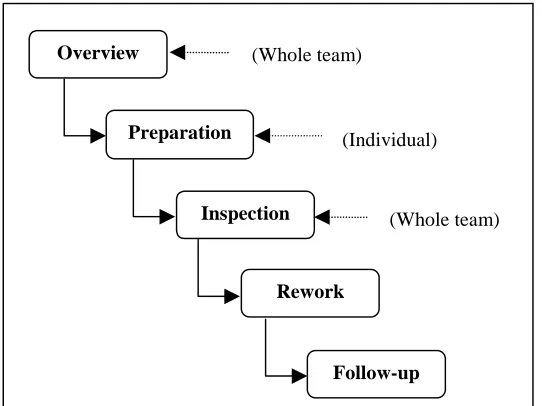
In Fagan’s original description of inspection [30], there should, under ideal conditions, be four people in an inspection team, each having a specific role. These roles include the Moderator (a competent programmer, sometimes from a different project, to manage the inspection team and offer guidance), Designer (person who produced the program design), Coder / Implementor (person who translated the design into code), and Tester (person responsible for testing the product). In Fagan’s original inspection process [30] he defines five main steps (shown in Figure 2.1):
1. Overview – The designer uses this phase to present all the participants involved in the inspection with a general overview of the area being addressed, followed by more specific information on the artifact to be inspected. For code inspections, the overview phase is considered optional.
2. Preparation – This phase is carried out individually. Participants should understand the artifact under inspection using the design documentation. The inspection team are aided in this process by the use of ranked distributions of error types based on recent inspections, as well as checklists containing clues on finding these errors. 3. Inspection – All participants in the inspection group get together. The moderator
inspection. With the design of the artifact under inspection understood (in the previous preparation phase), the main objective in this phase is to find defects. This occurs as the “reader”, chosen by the moderator (usually the coder) takes the team through the inspection artifact. Once a defect is found, no attempt should be made by the inspectors to find a solution. Defects are noted by one of the group members given the task of being meeting scribe (either the tester or someone with no other task).
4. Rework – All the defects noted in the inspection report from the previous phase are resolved by the designer or implementor.
[image:16.595.194.465.336.539.2]5. Follow-up – All issues and concerns are verified as being followed-up. If more than 5% of the material inspected has in some form had to be reworked, the inspection team should regroup and carry out a full re-inspection of the material.
Figure 2.1 – The five steps in Fagan’s original inspection process
Since Fagan's original inspection process, there have been many variations attempting to improve the performance of inspections. Active Design Reviews [69] were originally created to ensure complete coverage of design documents and advocate several small, focused inspection meetings rather than one large meeting involving a lot of people. In each of these smaller meetings, inspectors are assigned a specific role to look for different types of defect. In N-Fold Inspections [83] not one, but many parallel inspections are performed by different teams on the same artifact. The assumption is that a single inspection team will only find a fraction of the defects, and that multiple teams will not significantly duplicate each other’s efforts. Phased Inspections [45] divide the normal
Overview
Preparation
Follow-up Rework
Inspection
(Individual)
inspection into several smaller phases. These phases can be carried out by one or more inspectors. Each phase focuses on one specific type of defect (compared to more traditional inspections, which look for all types of defect in one big inspection). If more than one inspector is involved, they meet to create one definitive defect list. Phases are carried out in sequence, meaning that the next phase is not reached until the previous one has been completed. Sample-Driven Inspections [92] is a method designed to reduce the effort during an inspection session by concentrating the inspection effort on the software artifacts that contain the most defects. The defect searching is divided into two parts. A pre-inspection occurs where samples of the artifacts are inspected to estimate which artifacts contain the most faults. Secondly, the main inspection is carried out on the selected artifacts. These alternative processes have varied such elements as the number of steps in the inspection process, the number of inspectors, and the roles of inspectors. Although each variation has made alterations to the inspection process or altered characteristics of the phases, the inspection phases of preparation, inspection, and rework/follow-up from Fagan's original description have remained [50].
There have been many reports on the successes achieved through the use of inspections. Fagan [31] commented that inspection was detecting between 60 to 90 percent of defects. Ackerman et al. [1] reported that inspections were two to ten times more efficient at defect removal than testing. Russell [82], based on 2.5 million lines of high-level code, found that if inspection was correctly implemented, then approximately one defect was found for every man-hour invested. Russell claims this was two to four times faster than detecting defects by testing. Reports by Weller [96], Grady and Slack [37], have also supported the use of inspection, detailing improvements to the process and suggestions for achieving widespread use.
other verbal or written media (e.g. electronic mail, telephone). It was found that meetings help reduce the number of false positives (potential defects which turn out not to be actual defects). Land et al. [53] found that the strength of inspection meetings is not in finding defects, but discriminating between true defects and false positives. They found that only a small number of extra defects were found by inspectors when working in a group. Porter and Johnson [72] found that far more issues are generated by individual defect detection compared to group-based defect detection, but this comes at the cost of higher rates of false positives and defect duplication. The current goals of the group aspect of inspection are now for the inspectors to agree upon a final list of defects based upon those found individually, and to reduce the number of false positives in the final report [51]. The main focus for the preparation phase of inspection is now the detection of defects [51], [73].
Porter and Votta [74] found that defect detection results have less to do with the particular inspection process used, and have more to do with the techniques and technology supporting individual inspectors. Giving support to individual inspectors to find defects may increase their effectiveness.
With the re-emphasis of the defect detection part of the inspection process on the individual preparation phase, there has been a shift in inspection research. Basili [9] pointed out that reading was by far the most important activity for successful individual defect detection. Basili also highlighted the lack of research examining the technologies that underlie the reading process. One reason for this lack of research was that until recently, much of the research into inspection has been focused on the inspection process [73], [79]. Adequate support for the defect detection activity of inspectors (i.e. reading strategies) has the potential to dramatically improve the effectiveness and efficiency of inspection [51]. The more the inspector can understand the material to be inspected, the greater the chance of finding defects [79].
2.1.2 Reading Techniques
Laitenberger and DeBaud [50] described a reading technique as a “series of steps or
procedures whose purpose is for an inspector to acquire a deep understanding of the
inspected software product”. In Fagan's original inspection process he suggested the use of
checklists [30]. As well as checklists, another popular technique in industry has been ad-hoc inspection [27], [36]. With the emphasis of defect detection being placed on the preparation phase of inspection [51], [73] and a realisation that reading is important for defect detection, there has been a renaissance in the development of reading techniques. The following describes some of the more prominent reading techniques currently available.
2.1.2.1 Ad-hoc
One of the simplest reading techniques, ad-hoc, provides no support for inspectors, i.e. no guidelines or direction. Inspectors have to rely on their own knowledge and experience, reading the inspection artifact, whether they are specifications or code, in their own preferred way. Although the ad-hoc approach offers no guidance to inspectors, it is considered to be a reading technique [50], [71].
A strength of the ad-hoc technique is that more experienced inspectors have the freedom to use their knowledge and abilities to find defects, free from any technique overhead that may intrude upon their thinking. The main weakness of the ad-hoc technique is that with no support, the performance of the less experienced inspectors may suffer, since they do not have the experience to guide them.
2.1.2.2 Checklist
can be seen in Figure 2.2. Checklists, along with ad-hoc reading are still thought of as the most frequently used defect detection methods [36], [73]. Checklists have been used to inspect many different documents, including design, specification, and code.
[image:20.595.150.486.421.668.2]Although checklists have been well promoted [31], [40], there are several weakness which have been identified. Laitenberger et al. [50] summarised a list of the weaknesses of the checklist technique from the literature. Firstly, that the questions are often too general or based upon checklists created from the defect experience of others. Similarly, Tervonen [91] commented that one of major problems facing checklists is their generality, that they are not sufficiently tailored to a particular development method or phase in a specific project. Second, instructions guiding inspectors on how to use a checklist are rarely available, i.e. it is often unclear when and based on what information an inspector is to answer a particular checklist question. Finally, the questions of a checklist are often limited to the detection of defects which belong to particular defect types. Since the defect types are based on past information [19], inspectors may not focus on defect types not previously detected and, therefore may miss whole classes of defects (a problem only slightly reduced by the constant revision that should occur with checklists).
Figure 2.2 - C++ Checklist, from Humphrey [40] Initialisation Check variable and parameter initialisation:
• At program initiation
• At start of every loop
• At function/procedure entry
Calls Check function call formats:
• Pointers
• Parameters
• Use of ‘&’
Strings Check that all strings are
• identified by pointers and
• terminated in NULL.
Pointers Check that:
• pointers are initialised NULL,
• pointers are deleted only after new, and
• new pointers are always deleted after use. Output Format Check the output format:
• Line stepping is proper.
• Spacing is proper. Logic
Operators
2.1.2.3 Step-wise Abstraction
The step-wise abstraction reading strategy offers more structured and focused instructions on how to read code. The technique was based on the step-wise abstraction technique of reading developed in the late 70's by Linger, Mills and Witt [59]. In step-wise abstraction, the aim is to start with the simplest components in the code, understand them, and abstract out a higher level description of their functionality [3]. This process is repeated, combining higher and higher levels of functionality, until a final description of the code is obtained. This final description is then compared with the original specification. This way any differences between the original specification and the derived specification highlight potential defects. Stepwise abstraction has been most commonly used as a code reading technique by the Cleanroom community [84] (the Cleanroom development method is a technical and organisational approach to developing software with certifiable reliability).
Based upon evidence from the literature, Laitenberger et al. [51] believed that inspectors utilising the step-wise abstraction technique were forced into a more rigorous examination of the code than using either the ad-hoc or checklist reading techniques.
2.1.2.4 Scenario-Based Reading
The scenario reading strategy was created by Porter et al. [70] to address a perceived lack of effectiveness in the use of ad-hoc and checklist methods for Software Requirements Specifications (SRS). The work builds on the inspection process Active Design Reviews by Parnas and Weiss [69], who argued for the need for different and specific roles for inspectors to systematically inspect a document. Porter et al. described a scenario as a "collection of procedures that operationalise strategies for detecting particular classes of
defects". Each inspector is given one scenario, which differs from the scenarios given to
the other inspectors in the inspection team. Each scenario contains a set of questions and instructions informing the inspector how to perform the inspection of the SRS. Multiple inspectors are required to obtain a reasonable level of coverage from the document. The scenarios generated by Porter et al. [70] were derived from available defect classes.
terms of its inputs, files, enquiries, and outputs). In perspective-based reading by Basili et
al. [8], the inspection artifact is inspected from the perspective of different stakeholders.
Each of these reading techniques provide a generic process for inspecting requirements documents, although the material generated by the processes for use in inspections are target specific (to a particular development environment).
The last of these techniques, Perspective-based reading, has continued to be refined and has been implemented not just for requirements documents but for code documents as well.
2.1.2.5 Perspective-Based Reading
Perspective-based reading (PBR), first presented by Basili et al. [8], evolved from the work carried out on scenarios. PBR, compared to the Scenario technique, offers a more detailed set of instructions (scenarios) for inspectors. The perspective-based scenarios are an algorithmic set of instructions informing inspectors how to read an artifact under inspection. Inspectors understand the artifact by constructing an appropriate abstraction defined by the scenario. Laitenberger and DeBaud [47] claim that a focused understanding of the document obtained through the use of PBR should be more effective than either an ad-hoc or a checklist based reading technique. Ad-hoc and checklist based reading techniques are thought of as non-systematic in nature [73]. They do not offer a set of concrete reading instructions, meaning that inspectors’ experience has a significant impact on the number of defects found [47].
The PBR technique continues to be refined, giving better instructions on the creation and content of scenarios [48]. A PBR scenario contains three parts. The first explains to inspectors their interest/perspective on the inspection artifact. The second part consists of a set of activities that inspectors have to perform. This allows them to extract the required information out of the inspection artifact. In the final part, inspectors then apply a series of questions to this information to verify its correctness. An example of a code scenario for the C programming language is shown in Figure 2.3, created by Laitenberger et al. [51]. In an inspection, each inspector has a different scenario to allow the artifact to be looked at from different views, e.g. analyst, maintainer, tester, etc. By following the scenario the inspectors should build up an understanding of the artifact. Although the early work on PBR was carried out on requirements documents [8], some of the more recent work has focused on C code documents [47], [51].
experienced inspectors were more likely to revert to their more traditional or previously learned techniques.
Figure 2.3 – The tester scenario for C code documents, from Laitenberger et al. [51]
An experiment by Laitenberger et al. [51], investigated the effectiveness and cost per defect ratio of PBR compared to checklists for C code documents. The results showed that two-person inspection teams were more effective using PBR than checklists. Applying PBR was found to increase subjects understanding of the code, but was found to require greater effort from inspectors. This improved understanding was also found to have helped to reduce the cost of defects for PBR compared to checklists during the meeting phase. With a greater understanding in the meeting, it took less effort on the inspectors’ behalf to explain the defect they had found to the other inspectors, as well as taking less effort to resolve false positives. It should be noted however, that the checklist used during the experiment was a general one, based upon an existing checklist [66] and books on C programming [23], [43]. This goes against the currently available advice [36], [40], which states that checklists are most effective when based upon historical data.
Tester Scenario
Assume you have the role of a tester. As a tester you have to ensure that the functionality implemented in the code is correct.
In doing so, take the code document and determine the functions that are implemented in this code module. Determine the dependencies among these functions and document them in the form of a call graph.
Starting with the functions at the leaves of the call graph, determine for each function, a set of test cases that allow you to stimulate the operation of the function. The set of test cases should allow you to check each branch of the function as well as the loops. Document some of the test cases.
Assume you are executing the function with your test cases as input values (mental simulation). Verify whether each function behaves according to its specification and the comments given in the code. If differences occur, check whether there is a defect or not. Document each defect you detect on the defect report form.
While following the instructions, ask yourself the following questions:
1. Do you have the necessary information to identify a test case (e.g., are all constant values and interfaces defined)?
2. Are branch conditions used in a correct manner?
3. Can you generate test cases for each branch and each loop? Can you traverse all branches by using specific test cases?
Although most of the experiments investigating the effectiveness of using PBR have been positive, there has recently been one experiment (based upon a lab package by Basili
et al. [10]) investigating its effectiveness and efficiency with relation to requirements
documents [78]. The results showed that there was no significant difference in the defect coverage of the three perspectives, suggesting that a combination of multiple perspectives may not result in a higher defect coverage compared to reading with only one perspective. This contradicts the earlier work on PBR. Regnell et al. [78] provide no other reasons for the results, other than to highlight certain threats to the validity of the experiment. The threats included the setting may not be realistic, the perspectives may not be optimal, subjects may not be motivated or trained enough, and the number of subjects may be too small.
2.1.2.6 Summary
Reading techniques have evolved from offering no support and minimal guidance to inspectors into detailed task driven processes that encourage inspectors to attain a good understanding of the artifact under inspection. More recent reading techniques have also introduced the notion of inspecting artifacts from different views (perspectives). This allows inspectors to focus on different aspects and different defect types in greater detail.
The increased understanding promoted by recent reading techniques is achieved through clear, unambiguous instructions that guide the inspector in extracting and querying the required information from the inspected artifact. It is the development of this good understanding of the code that is key to a successful inspection. The main drawback to these more process driven techniques is the extra work required to be done by the inspector.
2.2 Object-Oriented Problems and Pitfalls for Inspection
software quality assurance personnel are anxiously awaiting some kind of guidance and
quantitative data on the use of inspections with object-oriented projects".
There is a significant body of literature developing that suggests that the characteristic features of the paradigm can make object-oriented code more difficult to understand compared to the procedural equivalent – an issue that has direct impact on code inspection. Much of this literature centres on experience gathered from the software maintenance domain. The problems encountered in maintenance can apply equally to the task of inspection - both require sections of code to be read and understood (it is assumed that inspection performance is closely related to comprehension – see [26], [51], [79]).
According to Gamma et al. [35], the structure of an object-oriented program at run-time is vastly different to that of its code structure, "In fact, the two structures [run-time and
compile-time] are largely independent. Trying to understand one from the other is like
trying to understand the dynamism of living ecosystems from the static taxonomy of plants
and animals, and vice-versa." Where the code structure is frozen at compile-time, the
run-time structure consists of rapidly changing networks of communicating objects. This makes it very difficult to understand one from the other.
Dependencies exist in all code, but their number are increased by object-oriented languages [17], [97]. Wilde and Huitt [97] described a dependency in a software system as “A direct relationship between two entities in the system X → Y such that a programmer modifying X must be concerned about possible side effects in Y”. Wilde and Huitt
suggested that using polymorphism and inheritance hierarchies dramatically increases the kinds of dependencies that need to be considered. Some of the dependencies they highlighted include Class, Methods, Message, Class-to-Variable, Method-to-Class-to-Variable, Method-to-Message, and Method-to-Method. Chen et al. [17] described three kinds of dependencies found in object-oriented languages, message dependence (relationship between a method and its callers), class dependence (inheritance, aggregation and association relationships) and declaration dependence (relationship between classes (types) and objects (variables)).
that more than one class needs to be looked at (especially in the case of a class which is part of a deep inheritance hierarchy) in order to fully understand how one small fragment of code works. Wilde and Huitt suggested that tracing these dependencies is vital for effective software maintenance [97]. Lejter et al. [55] claimed that dynamic binding (along with inheritance) made object-oriented programs much more difficult to maintain and understand. This view is also supported by Crocker and von Mayrhauser [20].
The structure of object-oriented programs differs from that of conventional programs [97]. Method sizes may be very small as a natural consequence of good object-oriented design [57], [98]. Daly et al. [22] found that unconstrained use of inheritance may result in understanding difficulties. When investigating the difficulties experienced programmers encountered learning and using the Smalltalk programming language, Nielsen and Richards [67] found that the distributed nature of the code caused problems when attempting to understand a system. Together with inheritance, this distribution may result in traversing up and down inheritance hierarchies and across class boundaries in an attempt to locate where the work is carried out and build up a complete understanding of the task. This problem is illustrated in Figure 2.4.
Figure 2.4 - Chain of message invocations
Many of the problems that have been mentioned have also created difficulty for other areas of software engineering outside of software maintenance, such as comprehension [54], component reuse [32], testing [65], [42], and visualisation [54]. Each area has had to re-evaluate how it achieves its objectives, and in many cases redesign its processes. Binder [13] in his review of testing for object-oriented software highlighted that most believe the features of object-oriented systems (inheritance, polymorphism, abstract super classes,
work done
encapsulation) will require the development of new approaches to be able to achieve adequate levels of testing.
2.3 Current state of Object-Oriented inspection
[image:27.595.120.528.300.573.2]With the rise in popularity of object-orientation, the research community has turned to adapting inspections to this new paradigm and its particular artifacts. So far, the work carried out has focused on the inspection of object-oriented requirements and design artifacts. Although some initial work has been positive, there has been a lack of research regarding how the key features of the object-oriented paradigm may impact on the inspection of object-oriented code.
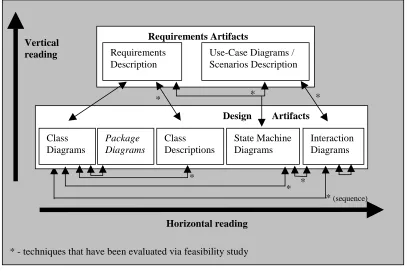
Figure 2.5 – Reading techniques in Traceability-Based Reading (TBR),
from Travassos et al. [93]
Travassos et al. [93] found that there was a lack of guidance on how to inspect object-oriented design documents and carried out a preliminary investigation. The main focus was on designs described by UML diagrams. They developed a technique called Traceability-Based Reading (TBR) that evolved from the experience gathered from the development of reading techniques for requirements documents [70]. TBR is a two step process. The first step involves the correctness and consistency checks on requirements
Requirements Artifacts
Design Artifacts
* - techniques that have been evaluated via feasibility study Requirements Artifacts
Horizontal reading
* (sequence)
* Design Artifacts
* *
Class Diagrams
Package Diagrams
Class Descriptions
State Machine Diagrams
Interaction Diagrams
* *
* Requirements Description
Use-Case Diagrams / Scenarios Description Vertical
documents that have traditionally occurred. This is described as horizontal reading. The second step is described as vertical reading, and differs from the traditional process, in that requirements documents are compared with design documents to ensure consistency. This is illustrated in Figure 2.5, based on a diagram by Travassos et al. [93].
An experiment carried out using TBR found encouraging, but not conclusive results. Horizontal and vertical reading were found on average to highlight different types of defect. Vertical reading found slightly more defects concerning omission and inconsistency (between diagrams and requirements), where horizontal reading found more defects concerning ambiguity and inconsistency (between diagrams). An important finding was that the technique forced more focus on semantic information (an understanding of the meaning of the document), similar to the focus encouraged by the scenarios of PBR. In its current state, the technique relies too much on syntactic information, making sure that certain words and attributes in one diagram appear in their correct location elsewhere. Another drawback is that the technique was found to be time consuming.
Laitenberger and Atkinson [48] presented an adaptation of Perspective-Based Reading (PBR) for any object-oriented development artifact. They provided a generally applicable definition of the technique, describing instructions on how to generate PBR scenarios. An experiment [49] was carried out to investigate the effectiveness of PBR for UML design documents in comparison to checklists. The results of the experiment showed that PBR scenarios help improve inspectors understanding of the inspection artifacts. This was found to reduce the cost of defects in the group phase (as a collation exercise) for PBR in comparison to checklists. The checklists used were designed along the lines discussed by Chernak [19], but the questions, due to the lack of other such checklists for object-oriented design documents that could be reused, were developed from scratch.
The majority of research carried out in the area of object-oriented inspection has so far been aimed at the development of reading techniques to help inspectors find defects in requirements and design documents. These techniques have tried to address a perceived lack of reading guidance, but have not fully investigated how the key features of the object-oriented paradigm impact upon code inspections. Tervonen [91] has found that existing object-oriented checklists are focused primarily on design issues and are therefore not suitable for code inspection.
Laitenberger et al. [50], code inspections are still the most commonly occurring in industry and, as such, this makes the improvement of reading techniques for code documents a high priority [51]. This takes on even greater importance when taking into consideration the lack of research regarding how the key features of the object-oriented paradigm may impact on the inspection of code.
2.4 Summary
Inspections are an effective method used to find defects in many different documents generated throughout the lifetime of a software project. Recently, the focus for detecting defects has moved away from the group inspection activity. Instead, the focus for detecting defects is the preparation phase, where the individual inspector reads the artifact in preparation for the group phase (which is now used for defect collation).
With the focus for detecting defects in inspection moved to the preparation phase, the reading technique used by the inspector to help prepare and find defects within an inspection artifact has become one of the key aspects of the inspection process. Adequate support for inspectors is necessary to help them be as efficient and as effective as possible.
Reading techniques have evolved from offering no support and minimal guidance to inspectors (e.g. ad-hoc and checklist) into detailed task driven processes that encourage inspectors to attain a good understanding of the artifact under inspection (e.g. scenarios and perspective-based reading). It is the development of this good understanding of the code that is key to helping inspectors increase their effectiveness.
Within the last decade, the object-oriented programming paradigm has grown both in influence and use. Many of the key characteristics of objectoriented languages -inheritance, dynamic binding, polymorphism, and small methods complicate matters. Many of these characteristics lead to closely related information being distributed throughout the code, significantly impacting upon the ease of understanding.
Investigation of Object-Oriented Code
Inspection
This chapter presents an investigation of how the object-oriented paradigm impacts on the inspection of object-oriented code. It begins with an overview of experimentation and highlights what is considered best practice for preparing and running a software engineering experiment in the context of inspection. A controlled experiment is then presented that investigates how the object-oriented paradigm impacts on the inspection of object-oriented code. A detailed analysis of the characteristics of the ‘hard to find’ defects, together with the results of a small-scale survey of software engineering professionals, suggests that ‘delocalisation’ - the distribution of closely related information throughout the code - is a major problem. The chapter concludes by looking at how current reading techniques for code inspection deal with the problem of delocalisation, and highlights chunking, reading strategy, and ‘localising the delocalisation’ as areas that need to be addressed.
3.1 Experimental Software Methodology
Empirical research in the context of software engineering is conducted to help evaluate, predict, understand, control and improve the software development process or product [5].
In software engineering experimentation there are a variety of methods a researcher can utilise in order to gather information and evaluate their notions and hypotheses. Methods available include interviews, questionnaires, observation, case studies, and controlled experiments [24].
A significant amount of research has been carried out investigating various aspects of inspection, e.g. process [45], [69], reading strategy [51], [70], tool development [62], [77], numbers of inspectors [73], [96], the need for group meetings [72], [94], etc. Much of this research has been achieved by designing and running empirical studies.
of results from similar experiments and establishes a context for cross-experiment analysis. This issue has become more important with the ever-growing amounts of experimental data and the desire to compare experimental results [63]. The scheme is also a good guide to designing experiments. There are four parts to the experimental characterisation scheme. They are, (1) the goals and hypotheses that motivate an experiment, (2) the plan to conduct the experiment, (3) the procedures to be used during the experiment, and lastly, (4) the results which detail the raw data collected during the experiment and any analysis carried out. The following briefly summarises each:
1. Goals and Hypotheses
The goals and hypotheses should be used to quantify the expected outcomes of an experiment, and be used to aid in the design and running of the experiment [5]. To help focus the development of the goals and hypotheses the Goal Question Metric (GQM) paradigm can be used as described by Solingen and Berghout [87] (originally developed by Basili and Weiss [4] and augmented by Basili and Rombach [6]). The GQM shifts the emphasis away from metrics to goals. The goals create a focus for the important issues of an experiment. These goals are then specified in more detail by defining questions, which in turn suggest the appropriate metrics to be measured. With the goals for an experiment stated explicitly, the data collected and the evaluation of that data are based on well-specified rationale.
2. Plan
The plan for the experiment details all the design decisions made. The plan includes the goals and hypotheses already generated, along with such elements as subjects used, material used, e.g. code, diagrams, and defects inserted in code. All of these have to be justified within the frame of the goals of the experiment. The variables being investigated by the experiment are usually detailed in the plan. There are two kinds of variables, independent and dependent. Independent variables are those that are believed to have an influence on the result of the experiment, e.g. reading strategy or code to which reading strategies are applied. Dependent variables measure the effects of the manipulation of the independent variables, e.g. number of defects found by subjects or time taken.
effect. Threats to external validity limit the ability to generalise any results from an experiment to a wider population, e.g. representative subjects, code and defects used, or process used.
3. Experimental Procedures
The procedures to be used during an experiment include details of how the experiment will proceed. A timetable is given describing what events will occur, e.g. lectures, training, assessments, and when they will occur. Also detailed here is the material that will be available for each part of the experiment, e.g. code documents, forms, and questionnaires.
4. Results
The results section contains a detailed description of the raw data collected during the experiment, the results of any statistical analysis based on the raw data, and an interpretation of these results.
Having a detailed collection of resources allows for repeated experiments (replication). Replication allows for the verification and validation of previous results, building up a supportive body of knowledge and understanding, which can be used to justify the usefulness of techniques and new methodology. As discussed by Basili et al. [7], "In
examining and adapting reading techniques, we go through a systematic process of
evaluating the candidate process and refining its implementation through lessons learned
from previous experiments and studies".
In many cases students in the university environment are used to evaluate initial theories and techniques [39]. There are several reasons for this, (1) they are a relatively cheap resource, (2) there are usually a sufficiently large number of students, and (3) it is cheaper for a technique to fail in the lab using students than out in industry with industrialists. This style of development follows an iterative approach. A technology can be tested with students to explore initial ideas and theories. The technology can go through several revisions, each time being refined by the results of the previous experiment before being evaluated in industry.
3.2 An Experiment investigating Object-Oriented Code Inspection
3.2.1 Introduction
The object-oriented programming paradigm has grown both in influence and use. Many of the key characteristics of object-oriented languages - inheritance, dynamic binding, polymorphism, and small methods complicate matters. With a lack of research regarding how the object-oriented paradigm may impact on the software inspection process, a controlled experiment was designed to investigate how the characteristics of object-oriented code effect code inspection.
The experiment was motivated by a question posed by Laitenberger and De Baud [50]: “How can inspection, a static analysis process, ensure the quality of artifacts involving the
use of such non-static features as dynamic binding?”. What are the issues that arise when
reading and understanding object-oriented program code with the aim of detecting defects? What are the ‘hard to find’ defects, and why are they so hard to find?
3.2.2 Experimental Goals and Hypotheses
The goal of the experiment was to investigate the possible link between defect characteristics and ease of detection. To do this, the experiment was designed to be a qualitative investigation. This did not require the generation of specific hypotheses, since no statistical analysis was required.
3.2.3 Experimental Plan
The experiment was based on a code inspection exercise that was solely concerned with the effort of the individual - no group component was carried out. As the experiment focused on the number of actual defects found by subjects, the number of false positives generated by the inspectors was not investigated (defects listed by subjects during the inspection that were not actual defects).
To inspect the code, subjects used the ad-hoc reading strategy. “Ad-hoc does not mean
that inspection participants do not scrutinise the inspected product systematically. The
word ‘Ad-hoc’ only refers to the fact that no support is given to them. In this case defect
detection fully depends on the skill, the knowledge, and the experience of the inspector
which may compensate for the lack of reading support” [50].
A copy of all the material used in the final experiment can be found in Appendix A.
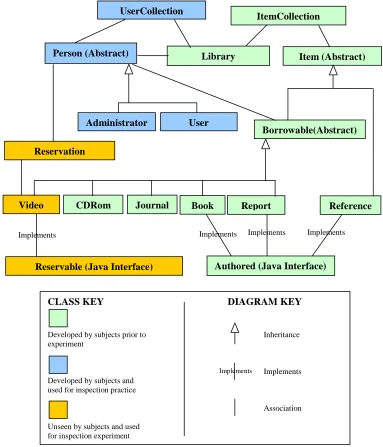
Figure 3.1 – Class hierarchy diagram for library system
Subjects
Subjects were participants in a 3rd year Honours Computer Science Software Engineering course run at the University of Strathclyde. 47 subjects were participating in the class. Subjects had previous experience with the programming languages of Scheme, C, C++, Eiffel, and Java (the three months preceding the experiment). The subjects had
ItemCollection
Library Item (Abstract)
Borrowable(Abstract) (Abstract) Reservation
CDRom Journal Report Reference
Video
Reservable (Java Interface)
Book
Implements Implements Implements Implements
Authored (Java Interface) UserCollection
Person (Abstract)
User Administrator
CLASS KEY DIAGRAM KEY
Developed by subjects prior to Inheritance experiment
Implements Developed by subjects and
used for inspection practice
Association
Unseen by subjects and used for inspection experiment
limited knowledge of Software Requirement Specification (SRS) document inspection, and no experience with code inspections.
Prior to the experiment, subjects were given a problem statement describing a simple library system (the original problem statement can be found in Appendix A.1). The library system has a number of different items that can be borrowed, e.g. books, reports, CDRoms and also contains reference material that cannot be borrowed. Subjects were given six weeks to derive a semi-formal specification and design for the system. Once this was completed, subjects were provided with a design prepared by the course lecturer (the class hierarchy for the system is shown in Figure 3.1). From this, subjects were given a further 6 weeks to code the library system using Java. The experiment took place after the coding of the system was complete.
For the inspection exercise, two groups of subjects were created, group A and group B, where subjects in each group were of approximately equal ability (based on previous programming courses). This was done to allow two groups of defects to be seeded, increasing the number of defects investigated.
Code
The language chosen for the experiment was Java. This was for two reasons, (1) the language had to be object-oriented, (2) the subjects had been using Java in the months preceding the experiment in the software engineering course.
The code presented to the subjects for inspection was approximately 200 lines in length. This was chosen as a maximum limit. Fagan [31] suggested that a maximum of 125 non-commentary source statements per hour are read. Weller [96], from information gathered from over 400 inspections, suggested no more than 200 lines of code per hour. Gilb and Graham [36] suggested at most one and a half pages (approximately 90 lines of code) per hour. Although there is no clear consensus on inspection rates, the literature generally agrees that inspecting too much code reduces the effectiveness of code inspections. A maximum of 100 lines of code per hour was chosen for the inspection, bearing in mind the subjects were 3rd year Computer Science students, not professional inspectors.
functionality entailed the implementation of a video class and the need for a reservation class (in order to be able to reserve a video for a specific date). The subjects had not previously seen any code or design for the extension.
Defects
The experiment required a selection of defects to be seeded in the code. The review of the literature presented in Chapter 2.2 highlighted potential problem areas that may be used as the basis for some seeded defects in object-oriented code: dynamic binding, polymorphism, small methods, and inheritance. There is, however, currently very little material in the literature discussing oriented code inspections or typical defect categories for object-oriented code.
Duncan et al. [25] carried out a review of testing techniques and taxonomies which highlighted that only a small amount of work had been carried out in the area of fault classification for the object-oriented paradigm, and that there was a lack of experiments to show what faults were commonly occurring. Extrapolating from a category of classification for non-object-oriented code, Duncan et al. suggested that potential sources of object-oriented faults might be in instance variables, methods, modules and classes implemented but not used within the program, incorrect state models, incorrect messages, branching errors, algorithmic, and logical faults. They also highlighted that preliminary work on object-oriented systems suggested that the majority of faults occurred in the interface between objects and not intra-object.
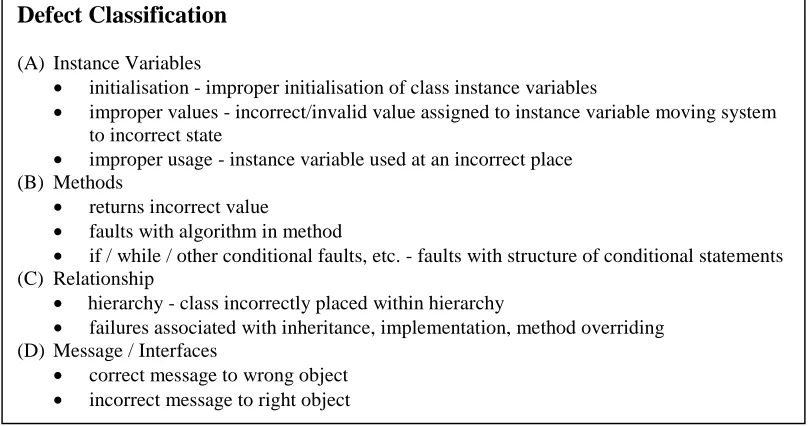
Figure 3.2 – Defect Classification for object-oriented code based on literature review
From these sources of information, a list was drawn up of all possible defects suggested for object-oriented code. Taking into account any overlap between defect types, these were abstracted and narrowed down to a list of four groups of defect type. These four groups, along with illustrative sub-classifications are shown in Figure 3.2. The classification is an approximation only, and in many cases, defects can fall into one or more of the groups.
For the experiment, the defects created fitted into the derived categorisation (Figure 3.2). Some of the defects used were naturally occurring, i.e. were identified in the code during development by the course lecturer, the others were seeded in the code based on the information gathered from the literature review. Two sets of defects were prepared for the experiment to maximise the number of possible defects seeded. Ten defects were present in the code given to group A and ten defects were present in the (same) code given to group B. One defect was present in both groups, with three other defects being similar in nature, but the syntax varying between the groups. 30% of the defects seeded were general defects (based upon historical experience of the course lecturer) and the remaining 70% were related to object-oriented code characteristics. A full list of the defects present in group A and group B can be found in Appendix A.2.7 and Appendix A.2.8.
Data Collection
Data from the inspections was collected via a defect report form (an example can be found in Appendix A.2.1). When a subject found a defect in the code they would record the time
Defect Classification
(A) Instance Variables
• initialisation - improper initialisation of class instance variables
• improper values - incorrect/invalid value assigned to instance variable moving system to incorrect state
• improper usage - instance variable used at an incorrect place (B) Methods
• returns incorrect value
• faults with algorithm in method
• if / while / other conditional faults, etc. - faults with structure of conditional statements (C) Relationship
• hierarchy - class incorrectly placed within hierarchy
• failures associated with inheritance, implementation, method overriding (D) Message / Interfaces
• correct message to wrong object
it was discovered, its location in the code, and a textual description that accurately described the defect. The defect report form was tested during the initial training phase of the experiment.
Data Analysis
Since the goal for the experiment was exploratory in nature, the results were investigated through the analysis of the qualitative information gathered.
Threats To Experimental Validity
An empirical study can be distorted by influences that may affect the experimental variables without the knowledge of the researcher. This possibility should be minimised as much as possible. Possible threats to internal validity included:
• Selection effects that may occur through variations in the natural performance of individual subjects. As part of an earlier exercise in the class, the subjects had been split into 12 groups of roughly average ability. For the inspection exercise, groups 1 to 6 were then assigned to group A, and groups 7 to 12 were assigned to group B. This should have minimised much of the possible effect.
• Plagiarism was not a concern as the experiment was carried out under exam conditions.
• The learning curve for the subjects associated with the programming language used (in this case Java). Prior to this class subjects had previously used the object-oriented languages of Eiffel and C++. To reduce any possible effect due to the use of a new language, earlier sections of the class had the subjects (in groups of 3 or 4) code a small program (approximately 8 pages in length). This was followed later by a more substantial library system. The average number of classes created for this task was 21 (ranges of 13 - 40) with an average length of 2755 lines of code (ranges of 1200 - 4500). The ranges vary so much due to some groups implementing a full graphical interface. The code used for the inspection exercise proper was an extension to this system.
![Figure 2.2 - C++ Checklist, from Humphrey [40]](https://thumb-us.123doks.com/thumbv2/123dok_us/1730137.126445/20.595.150.486.421.668/figure-c-checklist-from-humphrey.webp)