Energy-aware Occupancy
Scheduling
Boon-Ping Lim
July 2017
A thesis submitted for the degree of
Doctor of Philosophy of
Except where otherwise indicated, this thesis is my own original work.
Acknowledgments
I am sincerely grateful to the many people who have contributed in some way to the completion of this thesis. My PhD supervisory panel and collaborators, Sylvie Thiébaux, Menkes van den Briel, Hassan Hijazi, Christfried Webers and Pascal Van Hentenryck have been extremely supportive during these past four years.
Pascal pointed us to optimisation problems in the smart building space, seeding the topic of this thesis. Working on a cross-diciplinary research topic is never easy. Even more so when I started with nearly zero background in HVAC and optimisa-tion. Sylvie has provided invaluable insights and immense guidance on my research. She has given me the freedom to explore various research topics, pushed me to test my limits and connected me to the right people whenever I stumbled into obsta-cles. Meanwhile, she knew when to pull me back on track and help me stay focus throughout each milestone. I enjoyed our time spent together writing papers and she was instrumental in helping me crank out the papers that we published together, one in particular with only a few hours to spare before the deadline! I love our conversations and her company throughout the regular discussion meetings and our trips together to AAAI’15, CP’16, CSIRO Newcastle etc. Beyond research, I greatly appreciate her close personal support over the years. She taught me to treat life from different perspectives, from lifestyle, food, music to relationships, which significantly differ due to the distinct cultural differences between us. I think the decision of writ-ing an email to her for a PhD position back in May 2012 might be one of the most life-changing decisions I have made. She was and remains my best role model as a scientist, mentor and teacher.
Menkes sparked my interest on mixed integer programming. He taught me to spend more time on understanding a problem, instead of formulating a solution quickly with an existing model at hand. He inspired me to create simple models that work efficiently. He taught me that all models are wrong, hence developing one that is useful, is more essential than solving all problems at once in a single model. I’d definitely have a rough time without him in my supervisory panel, simply because I feel comfortable debugging a model with him and asking him silly questions, and then things work out pretty well! The office atmosphere has changed ever since his departure to start a company. I still think fondly of the funny sounds and finger gestures he made to cheer-up everyone on the floor.
Despite him not being on my supervisory panel, I have worked closely with Hassan on non-linear programming and robust optimisation. He struck me as a passionate researcher when he came to me a day before the conference deadline, and said to me:“Hey Boon Ping, I’ve a better idea to model the solution!”. It was impossible to re-run large-scale experiments within a day, but indeed his attitude
helpful in providing career advice and suggestions many times during my PhD study. I enjoyed very much the long chats we had periodically after each milestone.
I am indebted to all of them because without their help this thesis would never have been completed.
I like to thank all current and past students/co-researchers in Data61/CSIRO, formerly NICTA, particularly those that I have had the pleasure of spending my time with: Paul Scott, Terrence Mak, Buyu Liu, Jing Cui, Ksenia Bestuzheva, Kar-Wai Lim, Swapnil Mishra, Arthur Maheo, Cody Christopher, Franc Ivankovic, Frank Su, Fazlul Hasan Siddiqui, Karsten Lehmann, Alan Lee and Felipe Maldonado Caro. Thanks to Jun-Yong Kwak for generously sharing his research data. A special word of thanks goes to Phil Kilby, Patrik Haslum, Alban Grastien, Andreas Schutt, Tommaso Urli, Marian-Andrei Rizoiu, Enrico Scala, Dan Gordon, Carletton Coffrin, Michael Norrish, Lexing Xie, MiaoMiao Liu and Cheng-Soon Ong. Their generous shar-ings on technical knowledge in optimisation, planning and scheduling, large neigh-bourhood search, constraint programming, energy systems, machine learning and research skills in general have been invaluable. Furthermore, I would miss all the great fun we had playing foosball, literally every day, and board games every Mon-day. I still get a laugh when I reminisce about us confusing, tricking and bluffing each other while playing Avalon. After working for 7 years, it was a tough deci-sion opting out of climbing the corporate ladder and to follow my childhood dream. However, I have certainly appreciated and enjoyed doing research throughout my stay at ANU/Data61. Each person listed has played some role in my time here.
Additionally, I’d like to thank the Malaysian community in Canberra, especially Ayeli de Marillac and Yee-Harn Teh, for making my stay here so much more enjoy-able and homely. I also thank my friends back home, especially Ligin Lem, Swee-Kean Chiam, Siew-Kiang Tan, Sok-Hooi Teng, Shiek-Wei Tan, Sheau-Horng Ng, Zhu Ying, Pitt Ong and Chin-Chee Cheah, for providing the support and friendship that I needed. We were in touch, literally, 24/7 through whatsapp, messenger, telegram, wechat and LINE. These past several years have not been an easy ride, both academ-ically and personally. Without their constant encouragement, I would not have gone this far.
I would also like to thank Ettikan K. Karuppiah, Eiichi Muramoto, Poh-Kit Chong and Chia-Ching Ooi for playing an important role during the application stage of my PhD position. They wrote me reference letters, reviewed my statement of purpose and advised me about how to survive in a PhD program. Over the years I was comfortably settling in my corporate job, Chia-Ching and Poh-Kit were constantly nagging me about when I would pursue a PhD. It is great that I have eventually fulfilled my word after more than 10 years!
Abstract
Buildings are the largest consumers of energy worldwide. Within a building, heating, ventilation and air-conditioning (HVAC) systems consume the most energy, leading to trillion dollars of electrical expenditure worldwide each year. With rising energy costs and increasingly stringent regulatory environments, improving the energy ef-ficiency of HVAC operations in buildings has become a global concern. From a short-term economic point-of-view, with over 100 billion dollars in annual electric-ity expenditures, even a small percentage improvement in the operation of HVAC systems can lead to significant savings. From a long-term point-of-view, the need of fostering a smart and sustainable built environment calls for the development of innovative HVAC control strategies in buildings.
In this thesis, we look at the potential for integrating building operations with room booking and occupancy scheduling. More specifically, we explore novel ap-proaches to reduce HVAC consumption in commercial buildings, by jointly optimis-ing the occupancy scheduloptimis-ing decisions (e.g. the scheduloptimis-ing of meetoptimis-ings, lectures, exams) and the building’s occupancy-based HVAC control. Our vision is to integrate occupancy scheduling with HVAC control, in such a way that the energy consump-tion is reduced, while the occupancy thermal comfort and scheduling requirements are addressed. We identify four unique research challenges which we simultaneously tackle in order to achieve this vision, and which form the major contributions of this thesis.
Our first contribution is an integrated model that achieves high efficiency in energy reduction by fully exploiting the capability to coordinate HVAC control and occu-pancy scheduling. The core component of our approach is a mixed-integer linear programming (MILP) model which optimally solves the joint occupancy scheduling and occupancy-based HVAC control problem. Existing approaches typically solve these subproblems in isolation: either scheduling occupancy given conventional con-trol policies, or optimising HVAC concon-trol using a given occupancy schedule. From a computation standpoint, our joint problem is much more challenging than either, as HVAC models are traditionally non-linear and non-convex, and scheduling mod-els additionally introduce discrete variables capturing the time slot and location at which each activity is scheduled. We find that substantial reduction in energy con-sumption can be achieved by solving the joint problem, compared to the state of the art approaches using heuristic scheduling solutions and to more naïve integrations of occupancy scheduling and occupancy-based HVAC control.
Our second contribution is an approach that scales to large occupancy scheduling and HVAC control problems, featuring hundreds of activity requests across a large number of offices and rooms. This approach embeds the integrated MILP model into Large Neighbourhood Search (LNS). LNS is used to destroy part of the schedule and
MILP is used to repair the schedule so as to minimise energy consumption. Given sets of occupancy schedules with different constrainedness and sets of buildings with varying thermal response, our model is sufficientlyscalableto provide instantaneous and near-optimal solutions to problems of realistic size, such as those found in uni-versity timetabling.
The third contribution is anonlineoptimisation approach that models and solves the online joint HVAC control and occupancy scheduling problem, in which activ-ity requests arrive dynamically. This online algorithm greedily commits to the best schedule for the latest activity requests, but revises the entire future HVAC control strategy each time it considers new requests and weather updates. We ensure that whilst occupants are instantly notified of the scheduled time and location for their re-quested activity, the HVAC control is constantly re-optimised and adjusted to the full schedule and weather updates. We demonstrate that, even without prior knowledge of future requests, our model is able to produce energy-efficient schedules which are close to the clairvoyant solution.
Our final contribution is a robustoptimisation approach that incorporates adap-tive comfort temperature control into our integrated model. We devise a robust model that enables flexible comfort setpoints, encouraging energy saving behaviors by allowing the occupants to indicate their thermal comfort flexibility, and providing a probabilistic guarantee for the level of comfort tolerance indicated by the occupants. We find that dynamically adjusting temperature setpoints based on occupants’ ther-mal acceptance level can lead to significant energy reduction over the conventional fixed temperature setpoints approach.
Contents
1 Introduction 1
1.1 Problem Addressed . . . 2
1.2 Contributions . . . 4
1.2.1 Integrating HVAC Control with Occupancy Scheduling . . . 4
1.2.2 Scaling to Large Problems . . . 6
1.2.3 Handling Online Requests . . . 7
1.2.4 Enabling Adaptive Temperature Control . . . 8
1.3 Potential Integration with Building Management Systems . . . 9
1.4 Summary . . . 11
1.5 Thesis Outline . . . 12
2 Background - Occupancy-based HVAC Control 13 2.1 Zone-based HVAC Systems . . . 14
2.1.1 HVAC Zoning System . . . 14
2.1.2 Variable Air Volume (VAV)-based HVAC Systems . . . 16
2.2 Occupancy-based Control Strategies . . . 19
2.2.1 ON/OFF Control . . . 19
2.2.2 PID Control . . . 20
2.2.3 Rule-based Control . . . 20
2.2.4 Model Predictive Control . . . 21
2.3 Building Thermal Network Modeling . . . 23
2.3.1 RC Model . . . 23
2.3.2 Building Energy Software Simulation . . . 26
2.4 Occupancy Modeling . . . 27
2.4.1 Fixed Schedule . . . 27
2.4.2 Sensor-based Occupancy Detection . . . 27
2.4.3 Occupancy Prediction . . . 28
2.4.4 Meeting/Timetable Scheduling . . . 29
2.5 Thermal Comfort . . . 31
2.5.1 Fixed Comfort Setpoints . . . 31
2.5.2 Adaptive Comfort Setpoints . . . 32
3 Background - Optimisation 35 3.1 Mixed Integer Programming . . . 35
3.2 Large Neighbourhood Search . . . 37
3.3 Online Optimisation . . . 39
3.4 Robust Optimisation . . . 41
4 Integrating HVAC Control with Occupancy Scheduling 45
4.1 Introduction . . . 45
4.2 Occupancy-Based HVAC Control . . . 47
4.2.1 VAV System and Objective Function . . . 47
4.2.2 Temperature and Air Flow Bounds . . . 49
4.2.3 Building Thermal Dynamics . . . 50
4.2.4 MILP Relaxation . . . 53
4.3 Occupancy Scheduling . . . 55
4.4 Experiments . . . 56
4.4.1 Impacts of Room Selections and Time Allocations . . . 57
4.4.2 Usefulness of Standby Mode . . . 60
4.4.3 Joint Model vs Simpler Models . . . 62
4.4.3.1 Insights to HVAC Controls: Joint Model vs. Heuristics-based Model . . . 63
4.4.3.2 Experiment Results . . . 65
4.5 Related Work . . . 66
4.6 Conclusion and Future Work . . . 68
5 Scaling to Large Problems 69 5.1 Introduction . . . 69
5.2 Large Neighborhood Search . . . 71
5.2.1 Initialization Phase . . . 71
5.2.2 Destroy & Repair . . . 71
5.2.3 LNS Parameter Tuning . . . 72
5.3 MIP Model . . . 74
5.3.1 Initialization Phase . . . 74
5.3.2 Model Reduction . . . 75
5.3.2.1 Removing Symmetries in Meetings . . . 75
5.3.2.2 Simplifying The Building Thermal Dynamics Model . . 76
5.3.3 Summary of Model Equations . . . 76
5.4 Experiments . . . 77
5.4.1 MIP vs. LNS . . . 77
5.4.2 Combining MIP with LNS . . . 77
5.4.3 Large-scale Experiments . . . 82
5.5 Related Work . . . 87
5.6 Conclusion and Future Work . . . 88
6 Handling Online Requests 91 6.1 Introduction . . . 91
6.2 Online HVAC-Aware Occupancy Scheduling . . . 92
6.2.1 Scheduling Model . . . 92
6.2.2 HVAC Control Model . . . 94
6.2.3 Online LNS . . . 95
Contents xv
6.3 Experiments . . . 100
6.3.1 Problem Sets . . . 100
6.3.2 Online vs. Offline Scheduling . . . 101
6.3.3 Model Feasibility . . . 102
6.4 Related Work . . . 103
6.5 Conclusion and Future Work . . . 105
7 Enabling Adaptive Temperature Control 107 7.1 Introduction . . . 107
7.2 Adaptive Temperature Control . . . 109
7.3 Cumulative Temperature Violation . . . 112
7.3.1 Maximum Temperature Deviation Aware (MTDA) Approach . . 113
7.3.2 Outdoor Temperature Aware (OATA) Approach . . . 114
7.4 Experiments . . . 115
7.4.1 Impacts of Adaptive Temperature Control . . . 116
7.4.2 Energy Savings of Adaptive Temperature Control . . . 118
7.4.3 Effects to Thermal Comfort . . . 119
7.4.4 Model Feasibility . . . 125
7.5 Related Work . . . 125
7.6 Conclusion and Future Work . . . 128
8 Conclusion 131 8.1 Key Learnings . . . 132
8.2 Future Research . . . 133
8.3 Summary . . . 134
A HVAC Model Comparison 135 A.1 Model Abstractions . . . 135
A.2 Model Comparison . . . 137
A.3 Simulation Using Energy+ . . . 137
A.4 Learning RC Model . . . 139
A.5 Results . . . 140
A.5.1 Room Temperature Gap during HVAC Off . . . 140
A.5.2 HVAC Control: Our model vs. Energy+ model . . . 142
A.5.3 Energy Consumption & Schedule Ranking . . . 142
List of Figures
1.1 Electricity consumptions of commercial offices and universities by end
use in the United States (left) & Australia (right). . . 1
1.2 Integrated HVAC control and occupancy scheduling. . . 5
1.3 Potential integration with building management system & room book-ing systems . . . 10
2.1 Occupancy-based HVAC control . . . 13
2.2 Typical office floor layout . . . 15
2.3 VAV-based HVAC system . . . 16
2.4 Dual maximum VAV setpoints control logic . . . 17
2.5 Construction element layers . . . 24
2.6 Lumped parameter construction element . . . 24
2.7 Adaptive comfort model for buildings with centralized HVAC and non-opening windows adapted from De Dear et al. [1998] . . . 32
4.1 HVAC control & occupancy scheduling: existing approaches vs. our approach . . . 45
4.2 VAV-based HVAC system with two zones . . . 47
4.3 Zone . . . 51
4.4 Lumped-RC Network . . . 52
4.5 Room temperature dynamics . . . 58
4.6 Energy consumption of different building types with meetings held at different time of the day . . . 59
4.7 Energy consumption of 9 rooms with different facing and layout at LRHC building. . . 60
4.8 HVAC control with (S) and without (N) standby mode. Our standby mode enables the HVAC to self activate outside business hours (eg. before 6 a.m.) for pre-cooling. This results in the reduction of energy consumption, compared to the HVAC control without standby mode. . 61
4.9 HVAC control with different scheduling approaches . . . 64
5.1 The process flow of grouping identical meetings with similar properties. 75 5.2 Typical performance of MIP (2 hours) and LNS (15 minutes) on two benchmark instances. . . 78
5.3 Large neighbourood search - initial schedule . . . 79
5.4 Large neighbourood search - iteration 1: destroy & repair steps . . . 80
5.5 Large neighbourood search - iteration 2: destroy & repair steps . . . 81
5.6 Large neighbourood search - iteration 3: destroy & repair steps . . . 83
5.7 Parameter configurations as determined by SMAC. . . 84
5.8 Performance improvement of MIP and LNS over heuristic solution (HS). MIP and LNS runtime 15 minutes. . . 84
5.9 MIP optimality gap (top) and HS/LNS/MIP solution values (botton) . 86 6.1 Online scenario . . . 93
6.2 Online scheduling scenario - Session 1 . . . 96
6.3 Online scheduling scenario - Session 2 . . . 97
6.4 Online scheduling scenario - Session 3 . . . 98
6.5 Online scheduling scenario - Session 4 . . . 99
6.6 Offline scheduling scenario . . . 100
6.7 Online vs. offline scheduling . . . 102
6.8 Time flexibility vs. energy savings . . . 103
6.9 Solution feasibility . . . 104
7.1 Adaptive temperature control . . . 110
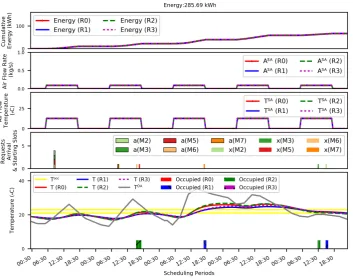
7.2 Solution examples . . . 117
7.3 Energy savings from adaptive temperature control . . . 120
7.4 MTDA approach - energy savings (Medium Deviation) . . . 121
7.5 MTDA approach - energy savings (High Deviation) . . . 121
7.6 Effects to thermal comfort with adaptive temperature control - MTDA approach . . . 122
7.7 Effects to thermal comfort with adaptive temperature control - OATA approach . . . 123
7.8 MTDA approach - temperature deviation vs robustness to thermal comfort . . . 124
7.9 MTDA approach - solution feasibility . . . 125
7.10 OATA approach - solution feasibility . . . 126
7.11 MTDA approach - solution feasibility (Medium Deviation) . . . 126
7.12 MTDA approach - solution feasibility (High Deviation) . . . 126
A.1 Energy+’s VAV-based HVAC system . . . 137
A.2 Building (left) and room layout (right) . . . 138
A.3 Energy+’s VAV-based HVAC system . . . 138
A.4 Learning RC model . . . 139
A.5 Room temperature during HVAC off . . . 141
A.6 HVAC control: our model vs. Energy+ model - Zone 1 . . . 142
A.7 HVAC control: our model vs. Energy+ model - Zone 2 . . . 143
List of Tables
2.1 Existing energy-aware meeting/timetable scheduling approaches . . . . 29
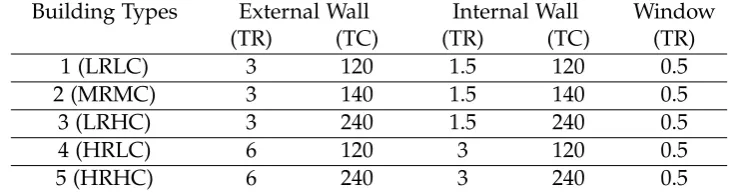
4.1 Total thermal resistance (TR)mW2Kand thermal capacitance (TC)mK J2K of the walls and the window for five types of zones. The zones differ by a high (H), medium (M) and low (L) value for their thermal resis-tance (R) and capaciresis-tance (C). R and C of each wall can be derived by dividing TR and multiplying TC with area size respectively. . . 57
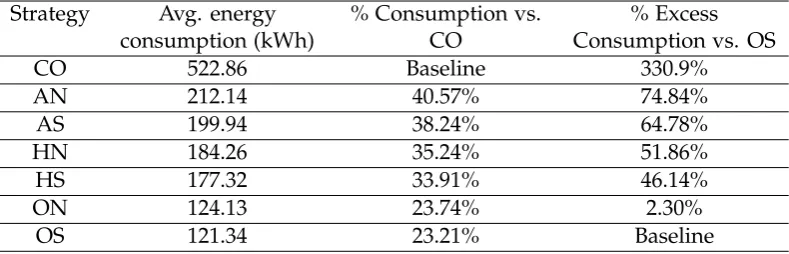
4.2 Comparison of conventional approach (CO) with arbitrary (A), heuris-tic (H), and optimal (O) scheduling strategies over HVAC with (S) and without (N) standby mode. . . 65
4.3 A detailed breakdown by meeting size using different strategies. . . 65
A.1 Model abstractions and their impacts . . . 136
A.2 Occupancy schedules . . . 139
A.3 Model abstractions and potential future works . . . 145
List of Publications
Patent
Thiébaux, S.; Lim, B. P.; Van Hentenryck, P.; and van denBriel, M., 2017.
Con-trolling operation of energy-consuming devices. US 2017/0003043 A1.
Publications
Lim, B. P.; Hijazi, H.; Thiébaux, S.;and van denBriel, M., 2016. Online hvac-aware
occupancy scheduling with adaptive temperature control. In International Confer-ence on Principles and Practice of Constraint Programming (CP), 683–700. Springer.
Lim, B. P.;van denBriel, M.; Thiébaux, S.; Backhaus, S.;andBent, R., 2015a.
Hvac-aware occupancy scheduling. In AAAI Conference on Artificial Intelligence (AAAI), 4249–4250.
Lim, B. P.;van denBriel, M.; Thiébaux, S.; Bent, R.;andBackhaus, S., 2015b. Large
neighborhood search for energy aware meeting scheduling in smart buildings. In
Integration of AI and OR Techniques in Constraint Programming (CPAIOR), 240–254. Springer.
Other Paper
Lim, B. P.;van denBriel, M.; Thiébaux, S.; Backhaus, S.; andBent, R., 2015.
Hvac-aware occupancy scheduling. InAAAI Workshop: Artificial Intelligence for Cities.
Nomenclature
Acronyms
AHU Air handling unit
BAS Building automation system
BMS Building management system
CP Constraint programming
DCV Demand-controlled ventilation
HVAC Heating, ventilation and air conditioning
LNS Large neighbourhood search
MILP Mixed-integer linear programming
MINLP Mixed-integer non-linear programming
MIP Mixed-integer programming
MPC Model predictive control
MTDA Maximum temperature deviation aware
OATA outdoor temperature aware
OBC Occupancy-based control
PMV Predicted mean vote
PPD Predicted percentage of dissatisfied
RC Resistance-Capacitance
RINS Relaxation induced neighourhood search
SMAC Sequential model-based algorithm configuration
VAV Variable-Air-Volume
General
∆t Discrete time interval for scheduling & HVAC control
τi Start time of online sessioni
I Set of online sessions
K Set of time steps
L Set of locations/zones
M Set of meetings
pp Number of attendee
zl,k Binary variable which indicates if a location is occupied
HVAC
α Indoor air quality safety factor
β Fan power coefficient
∆H Enthalphy
aOA Outdoor air flow rate (kg/s)
aSA Supply air flow rate (kg/s)
C Thermal capacitance(kJ/m2K1)
Cpa Heat capacity of air (kJ/kg·K)
e Energy consumption (kWh)
p Power consumption (kW)
pCond Air-conditioning power consumption (kW)
pFan Fan power consumption (kW)
pHeat Heating power consumption (kW)
Qp Total occupant internal heat gain (kW)
qp Occupant internal heat gain (W)
Qs Solar heat gain (kW)
R Thermal resistance (m2k/W)
T Temperature (◦C)
T∅ Unoccupied room temperature (◦C)
Nomenclature xxv
Tg Occupied room temperature (◦C)
TOA Outdoor air temperature (◦C)
TSA Supply air flow temperature (◦C)
Tu Maximum temperature deviation (◦C)
w Binary variable which indicates if the HVAC standby mode is active
Scheduling
am Activity request for meetingm
dm Meeting duration for meetingm
Ks Set of timesteps fall within standard operating hours
Km Set of feasible start time steps for meetingm
Lm Set of feasible locations for meetingm
Pm List of attendees
xm,l,k Binary variable which indicates if meetingmis scheduled to start in location
lat time stepk
yl,d Binary variable which indicates if a locationlis occupied at a dayd
C(M) Set of attendee conflict sets
Superscripts
CA Conditioned air: air being supplied by air handling unit (AHU)
f Feasible
OA Outdoor air
RAR Return air ratio
s Standard hour
SA Supply air: air leaving the VAV box
Subscripts
d Specific day
i Specific online session
k Specific time step
l Specific location/zone
Chapter1
Introduction
Buildings are the largest consumer of energy worldwide, accounting for around 40% of the world’s energy supply [MacDonald, 2004]. Within a building, heating, ven-tilation and air-conditioning (HVAC) systems consume the most energy, leading to trillion dollars of electrical expenditure worldwide each year.
Recent statistics show that, in the United States, offices and universities expend about 31% of the total electricity consumption in the commercial building sector.1
This is equivalent to 387 billion kWh of electricity per annum [Energy Informa-tion AdministraInforma-tion, 2012]2. Amongst that, nearly 40% of the consumption is used for space heating, cooling and ventilation.
Similar consumption patterns are shown in Australia. Both office and university buildings utilise approximately 12 billion kWh of electricity per annum. HVAC is responsible for a substantial portion of the energy used - approximately 46% of the total building electricity consumption [Pitt and Sherry, 2012]. Figure 1.1 illustrates a breakdown of the electricity consumption in commercial offices and universities in the United States and Australia. While these graphs reflect only statistics from two countries, they epitomize the end-use split of electricity consumption in most
Figure1.1:Electricity consumptions of commercial offices and universities by end use in the United States (left) & Australia (right).
1Commercial buildings consist of buildings used for education, food sales, food service, healthcare,
lodging, mall & mercantile, office, public assembly, public order and safety, religious worship, service, warehouse and storage and others.
2See Table E5 at https://www.eia.gov/consumption/commercial/data/2012/c&e/pdf/e5.pdf
commercial offices and universities worldwide.
With rising energy costs and increasingly stringent regulatory environments, proving the energy efficiency of HVAC operations in buildings has become an im-portant issue. From a short-term economic point-of-view, with over 100 billion dol-lars in annual electricity expenditures even a small percentage improvement in the operation of HVAC systems can lead to significant savings. From a long-term point-of-view, the need of fostering a smart and sustainable built environment calls for the development of innovative HVAC control strategies in these buildings.
1
.
1
Problem Addressed
There are substantial opportunities to reduce the HVAC energy consumption in com-mercial offices and universities, given their significant energy consumption.
In conventional building operations, HVAC systems run according to a pre-defined occupancy schedule. They maintain a minimum air flow rate to ensure prescribed indoor air quality standards, and keep the zone temperature within a pre-defined comfort range using real-time temperature measurements in a reactive
manner. One weakness of this control logic is that it ignores occupancy dynamics: it treats unoccupied zones of the building in the same way as occupied ones, which results in substantial energy waste.
Recent studies have shown that energy consumption can be significantly im-proved by adopting more complex control strategies that exploit measured or pre-dicted occupancy information [Agarwal et al., 2010; Erickson and Cerpa, 2010; Erick-son et al., 2009; Goyal and Barooah, 2013; Goyal et al., 2013; West et al., 2014]. For instance, modelpredictivecontrol strategies determine supply air flow rate and tem-perature over longer time horizons in such a way as to optimise energy consumption, whilst remaining within air flow and temperature bounds that reflect the predicted occupancy of various building zones [Goyal et al., 2013]. These strategies are natu-rally capable of pre-cooling zones if this reduces consumption or if it is necessary to meet the comfort bounds.
Another body of recent research has investigated theproactivecontrol ofoccupancy
§1.1 Problem Addressed 3
and schedule meetings to take place back-to-back in as few rooms as possible [Pan et al., 2012; Majumdar et al., 2012].
In this thesis, we go an important step beyond existing work: we look at the potential for integrating building operations with room booking and occupancy scheduling, and combine the benefits of both research trends above. More specif-ically, we explore a new way of reducing HVAC consumption in commercial build-ings, by jointly optimising the occupancy scheduling decisions and the building’s occupancy-based HVAC control.
As mentioned before, existing work considers either one or the other subprob-lem: either scheduling occupancy given conventional control policies, or HVAC con-trol using a given occupancy schedule. From a computational standpoint, the joint problem is much more challenging than either, as HVAC models are traditionally non-linear and non-convex, and scheduling models additionally introduce discrete variables capturing the time slot and location at which each meeting is scheduled. This problem is regarded as a non-linear hybrid discrete-continuous problem, which is challenging to solve and optimise. A core aspect of this research will thus be to design models that are amenable to optimisation, while being sufficiently accurate.
The key research question we tackle in this context poses a substantial challenge but can be expressed concisely:
Can we design optimisation methods that integrate occupancy scheduling with HVAC control, in such a way that the HVAC consumption is reduced, while the occupancy thermal comfort and scheduling requirements are addressed?
In answering this question, we will provide a holistic approach that improves the energy efficiency of HVAC operations in buildings over state-of-the-art mechanisms. This will allow the HVAC systems to operate more efficiently and at lower cost. Building occupants will benefit through effective controls that assure their thermal comfort, while reducing their carbon footprint.
We identify four unique research challenges that should be simultaneously ad-dressed in order to achieve our goal, which form the motivations for the work in this thesis:
1. The integrated model should be computationally efficientand achieve optimal energy reduction by fully exploiting the capability to coordinate HVAC control and occupancy scheduling.
2. Given sets of occupancy schedules with different constrainedness and sets of buildings with varying thermal response, the model should be sufficiently
scalable to provide instantaneous and near-optimal solutions to control and scheduling problems of realistic size.
4. The model should enableflexibleandrobustcontrol and scheduling, by consid-ering the dynamics of external weather and occupants’ thermal comfort prefer-ences.
When combined, these parts deliver a novel mechanism that is efficient, scalable, flexible and robust forenergy-aware occupancy schedulingin commercial buildings.
1
.
2
Contributions
1.2.1 Integrating HVAC Control with Occupancy Scheduling
The first key contribution of this thesis is an integrated model that solve ajointHVAC control and occupancy scheduling problem [Lim et al., 2015a]. Existing approaches typically solve these subproblems in isolation. A naïve combination would be to schedule occupancy in a first phase using existing methods, and then control HVAC based on this occupancy schedule. In contrast, we model and solve the jointHVAC control and occupancy scheduling problem. This results in an integrated approach whose benefits exceed the naïve superposition of both of its parts, as the schedul-ing fully exploits the capabilities of the underlyschedul-ing occupancy-based HVAC control across available times and locations.
In more detail, the joint problem we consider is that of deciding the respective times and locations (rooms) of a set of meetings or similar activities, as well as the HVAC supply air temperature and air flow rate for each zone and time, in such a way as to optimise the overall HVAC consumption over a long time horizon. The schedule complies with the HVAC and building dynamics models, and with comfort and air flow rate bounds that depend on the scheduled zone occupancy. It also satisfies typical meeting scheduling constraints, including constraints on meetings times, on meeting locations (e.g. room capacity, equipment availability), and on participant attendance conflicts.
Figure 1.2 illustrates the integration of HVAC control and occupancy scheduling in a building. To achieve this, the joint model we develop consists of three core-components:
1. A HVAC control model that simulates the physical HVAC system and allows controlling its operations,
2. a building thermal model that simulates the thermal dynamics based on inter-nal and exterinter-nal heat gains, and
3. an occupancy scheduling model that incorporates the occupancy activities, preferences and requirements.
§1.2 Contributions 5
Figure1.2: Integrated HVAC control and occupancy scheduling.
HVAC control, which is a crucial component for occupancy-based HVAC control. This model incorporates fan, air-conditioning and heating operations of each zone in the building, and estimates the energy consumption as a function of the HVAC control inputs (i.e. the conditioned air temperature, outdoor temperature, supply air temperature and flow rate).
We adopt a lumped resistance-capacitance (RC)-network to model the building thermal dynamics. This model incorporates building thermal resistance, thermal ca-pacitance, solar gain, internal heat gain and enthalpy into the estimation of zone temperature fluctuation. As buildings with different build-up (such as walls’ mate-rials, windows’ facing etc.) possess different indoor climate conditions, we consider buildings with different thermal resistances and thermal capacitance. This allows us to demonstrate the energy-efficiency of different building types, and showcase the importance of picking the right rooms and times for energy savings.
Our scheduling model takes a list of meeting requests consisting of meeting time windows, duration of the meeting, list of attendees, and optionally a preferred room. We consider schedules with smaller size and constrainedness in the initial stage of our work, demonstrating the benefit of our model over existing approaches. We then introduce schedules with higher complexity and constrainedness to showcase the scalability of the model.
such a way as to minimise HVAC consumption.
Our initial model consists of a mixed-integer non-linear programming (MINLP) model. What makes this especially challenging is the presence of bilinear terms in the HVAC control, which involves non-linear non-convex constraints. To address the challenges caused by the presence of non-linear HVAC control constraints, we relax them in a principled way using McCormick’s relaxation to obtain a mixed-integer linear (MILP) model guaranteed to provide a lower bound on the objective function. Given the highly-constrained nature of meeting scheduling with HVAC control, solving the integrated problem as a MILP seems to be a reasonable choice. MILP easily manages the interaction between meeting scheduling and the impact it has on HVAC energy consumption.
As a further refinement, we then introduce a HVAC standby mode for operating out of business hours in our integrated model. In conventional operations, the HVAC is turned off outside of business hours (typically 6pm-6am) and restarts early in the morning to ensure that building temperature is comfortable by start of business. With our standby mode, the HVAC can decide to re-activate at night if this results in reduced consumption. Perhaps surprisingly, we show that in certain circumstances, anticipating an early morning meeting by activating the HVAC at night to cool the supply air whilst the outside temperature is still low, can reduce consumption over waiting for the pre-defined HVAC turn on time. This feature also greatly improves thefeasibility of the solution by activating the HVAC over night to achieve targeted occupied room temperature on the next day.
Our results show that the integrated model achieves substantial reduction in energy consumption compared to the state of the art approaches using heuristic scheduling solutions and to more naïve integrations of meeting scheduling and occupancy-based HVAC control. The MILP model developed is efficient enough for occupancy-based HVAC control, and can be used in a range of applications. Once built, such a schedule can be used in any building equipped with an occupancy-based HVAC controller by simply complementing the occupancy forecast [Mamidi et al., 2012] with the occupancy information captured in the schedule. Our approach can even be used with a conventional HVAC control system by constraining the bounds on supply air flow rate/temperature and the temperature setpoints to be those found in the optimal solution to the joint problem.
1.2.2 Scaling to Large Problems
§1.2 Contributions 7
This motivates our next step where we expand our integrated model to solve large-scale problems. Our second contribution in this thesis is a Large Neighbour-hood Search (LNS) approach that is capable of handling hundreds of incoming meet-ing requests across a large number of offices/rooms [Lim et al., 2015b]. The scale of control and scheduling problems grow exponentially with the number of meetings and locations. The exact method using MILP is typically too expensive for such large scale instances. Hence, to tame the problem complexity further and scale to large problems, we combine the MILP model with LNS.
LNS is a technique for finding good or near-optimal solutions via iterative opti-misation through multiple destroy and repair steps in smaller neighbourhoods. LNS is used in the destroy step to remove all meetings in a small number of randomly selected zones. MILP is used in the repair step to solve the resulting subproblem and repair the schedule to near-optimality within a limited runtime. This hybrid model allows us to easily navigate through the solution space and escape local minima.
One crucial criteria of this approach is the need of identifying optimal LNS pa-rameters that govern the behavior of the LNS heuristics. There are two key param-eters to tune: (a) the number of rooms to destroy, and (b) the MIP runtime limit for the repair step. One important decision when implementing the destroy step is determining the amount of destruction. If too little is destroyed the effect of a large neighbourhood is lost and if too much is destroyed then the approach turns into repeated re-optimisation. Another important decision is whether the repair step should be optimal or not. An optimal repair will be slower than a heuristic, but may potentially lead to high quality solutions in a few iterations.
There are numerous values that these parameters can take on. As a result, some parameter tuning will be essential in achieving good performance overall. We use the sequential model-based algorithm configuration (SMAC) methodology [Hutter et al., 2011] on an independent set of problems to optimise the parameters of the number of rooms to destroy and the MILP run time. Specifically, we generate problem instances with different degrees of constrainedness and train the parameters to achieve the best quality for all input scenarios.
What we find in our experiments is that this approach is reasonably responsive and fast in providing near-optimal solutions. Given benchmark sets of different complexity and constrainedness, the model outperforms the MILP model in terms of (a) solution optimality given a time limit, and (b) solution feasibility of the HVAC control and occupancy scheduling.
1.2.3 Handling Online Requests
of meeting requests were made within 1 day before the actual meeting day [Kwak et al., 2013]. Thus, the ability to handle impromptu requests is crucial. Moreover, the ability to update HVAC controls following a change in forecast is also essential.
Our online algorithm greedily optimises and commits to the times and locations for the latest requests, leaving the rest of the current meeting schedule fixed but re-vising the entire future HVAC control strategy. This ensures that whilst participants are instantly notified of the scheduled time and location for their requested activity, the HVAC control is constantly re-optimised and adjusted to the full schedule and weather updates.
As in the offline case, we formulate the online model using mixed-integer pro-gramming (MIP), and combine MIP with large neighbourhood search (LNS) so as to scale to problem with large number of online requests and building zones. Given the relatively smaller number of meetings in online scheduling compared to offline scheduling (while the search space remains large in terms of the number of building zones), this hybrid model is highly efficient in finding near-optimal solutions. Our experiments demonstrate that the quality of the online solution is, on average, within 1% of that of the solution returned by the clairvoyant offline HVAC-aware algorithm [Lim et al., 2015b].
1.2.4 Enabling Adaptive Temperature Control
The final contribution of this thesis explores adaptive temperature control in our joint HVAC control and scheduling model [Lim et al., 2016]. Existing approaches typically assume fixed comfort bounds on the occupied zone temperature. In the fixed comfort bounds model, when a zone is occupied, the zone temperature must lie within standard cooling and heating setpoints (e.g. 21◦C-23◦C). We introduce the notion of thermal comfort flexibility by departing from these fixed comfort bounds. Instead of keeping the room temperature within standard setpoints, the occupants are encouraged to conserve energy by accepting some temperature deviation from the default setpoints. To achieve this, we formulate adaptive temperature models that leverage occupants’ thermal comfort flexibility and outdoor temperature, and use them in a principled way to decide occupants’ schedules and optimise HVAC control.
ro-§1.3 Potential Integration with Building Management Systems 9
bust optimisation approach. In particular, we adopt the ellipsoidal uncertainty sets approach, and provide a probabilistic guarantee to the thermal comfort satisfaction level indicated by the occupants. Our experiments show that, when occupants are reasonably flexible, the integration of adaptive temperature control generates higher energy savings than the fixed temperature control approach.
As an additional advantage, adaptive temperature control reduces the constrained-ness of our online scheduling and control problem. This can make the problem solv-able when fixed temperature bounds cannot be met, which often occurs for instance when a late request needs to be scheduled in the immediate future in a room whose current temperature is far away from the comfort band. In our experiments, adaptive temperature control solves a large number of instances that are unsolvable under the fixed temperature control model.
1
.
3
Potential Integration with Building Management Systems
We have developed a working prototype for the mathematical models discussed in Section 1.2. In this section, we explore the potential of integrating this prototype with building management systems (BMS).
This is motivated by the fact that today’s BMS tend to look at the building sub-systems such as HVAC control, lighting control, blind control, plug load control in isolation, not exploiting the complementary functions of the various subsystems to minimise energy consumption. BMSs also tend to be rigid, not exploiting the wealth of information on existing and future building occupancy and the forecast energy load of the building. A significant opportunity lies in integrating room and occupancy scheduling into the BMS. Research has been conducted to develop inte-grated and intelligent BMS systems in smart buildings [Honeywell, 2016; Building-IQ, 2014b,a; Yan, 2012; Smith et al., 2011; Klee and Gigot, 2011], however none of these systems consider integrating occupancy scheduling with building operations. Indeed, the BMS at reservation times should be capable of determining which rooms are most adequate from an energy-efficiency standpoint given the expected room oc-cupancy, the predicted temperature profile of the building’s zones and the forecast outdoor weather.
Figure 1.3 illustrates how our software prototype can be integrated to the existing BMS system. This figure shows the input (label A), process (labels B & C) and output (label D) of the integrated system. Our system receives the following as inputs:
1. a set of occupancy requests including time windows, duration, attendee list, and optionally their temperature flexibility, preferred locations and facilities required from the occupancy management system (A1). These system can be either a room booking system, a meeting appointment system or a timetabling system, and
Figure1.3:Potential integration with building management system & room booking systems
These inputs allow us to calculate and configure appropriate constant values and constraints for the scheduling model (B1), the building thermal dynamic model (B2) and the HVAC model (B3). We then run our integrated model (C) to identify the opti-mal HVAC control and the best occupancy schedule that maximise energy efficiency while meeting occupant comfort needs.
The outputs consist of
1. An occupancy schedule (D1), given time and location of each request, and the projected total HVAC consumption,
2. the HVAC control settings (D2), given the zones temperature setpoints, the zone’s supply air flow rate and temperature over the scheduling horizon.
The occupancy schedule and the projected total HVAC consumption can be de-livered to the occupancy management system. This information allows building oc-cupants to track their schedule and the overall HVAC consumption of the buildings. Currently, building occupants do not usually pay attention to when and wherethey use HVAC. Due to the lack of informed decision about energy savings, the selections of venue and time for an activity are often determined by their preferential choice. Now, with the energy consumption information provided, they are given an option to make an environmental friendly decision according to their schedule.
§1.4 Summary 11
application programming interface of the BMS, thus this information can be used di-rectly by constraining the comfort temperature of each zone based on our occupancy schedule. On the other hand, if the HVAC control allows a more fine-grained control, the optimal supply air flow rate/temperature generated by our model can be used as setpoints.
1
.
4
Summary
To summarise, the core research question we tackle is that how to design optimisa-tion methods that integrate occupancy scheduling with HVAC control, in a way that maximises energy savings whilst ensuring the comfort level necessary for occupants. We address this question in four parts that come together to form a complete solu-tion: the formulation of a joint HVAC control and occupancy scheduling model, the development of a scalable joint model to solve large problems, the introduction of an online joint model that is capable of coping with impromptu meeting requests, and the integration of adaptive temperature control that further improves on the energy savings.
We contribute to knowledge in the area of energy-aware occupancy scheduling:
• We formulate an integrated HVAC control and occupancy scheduling model using MILP, which produces efficient solutions compared to existing approaches, and can be used in a range of applications,
• We develop a scalable model that combines MILP and LNS, and demonstrate that this hybrid model can effectively tackle large-scale HVAC control and meeting scheduling problems,
• We determine an online control and scheduling strategy based on a greedy algorithm that commits to the best schedule for the latest activity requests and notifies the occupants immediately, whilst simultaneously optimising the HVAC control parameters,
• We establish a robust optimisation model which enables adaptive temperature control and provides a probabilistic guarantee to the level of comfort tolerance indicated by the occupants.
1
.
5
Thesis Outline
This thesis is structured as follows:
Chapter 2 provides a non-technical introduction to occupancy-based HVAC con-trol. It dedicates sections to discussing all related background: the concept of zone-based HVAC systems, building thermal model, occupancy-zone-based control strategies, occupancy modeling and adaptive temperature control.
Chapter 3 provides necessary background for the optimisation techniques that have been used to formulate our model. These include mixed integer programming (MIP), large neighbourhood search (LNS), online optimisation, and robust optimisa-tion.
Chapter 4 introduces the joint HVAC control and occupancy scheduling prob-lem, and develops an integrated model using MIP. We compare this model with the state-of-the-art occupancy-based HVAC control and heuristic-based occupancy aware scheduling, and show the corresponding experimental results.
Chapter 5 describes the LNS formulation, which integrates the MIP model with the LNS heuristics. We also discuss the automatic parameter tuning and our key observations.
Chapter 6 extends the integrated model to support online scheduling and control, and compares its effectiveness with the clairvoyant offline model.
Chapter 7 investigates the potential of adopting adaptive temperature control. We formalise the adaptive temperature control model based on robust optimisation method, experiment with different flexible setpoints control settings and demonstrate a further reduction of energy consumption compared to existing fixed temperature model.
Chapter2
Background - Occupancy-based
HVAC Control
This chapter provides a comprehensive review on occupancy-based HVAC control, which is the state-of-the-art HVAC control mechanism that optimises energy savings based on occupancy presence in buildings. This control mechanism essentially sets the context and motivation for our problem. Figure 2.1 provides a detailed break-down of different aspects in occupancy-based HVAC control. These include zone-based HVAC system, occupancy-zone-based control strategy, building thermal network modeling, occupancy modeling and thermal comfort control.
In the following sections, we describe in turn the zone-based HVAC system that allows zone-based control, including the HVAC zoning concept, the Variable Air Volume (VAV)-based HVAC system and its operations. Next, we introduce different types ofoccupancy-based control strategies, from traditional strategies, such as On/Off control, proportional-integral-derivative (PID) control, rules-based control that pro-vide coarse-grained control based on static occupancy schedules, to advanced control strategies, such as model predictive
Figure2.1: Occupancy-based HVAC control
control that perform finer-grained control based on the prediction and control of oc-cupancy dynamics in future horizon. We then discuss variousbuilding thermal network modeling techniques that are used to model building thermal dynamics. These tech-niques are important to calculate temperature dynamics in each zone and provide as an input to the feedback control system. Following that, we devote a section on
occupancy modeling and discuss how occupancy dynamics are being gathered, mod-eled and even proactively controlled to benefit the occupancy HVAC control system. These include using fixed schedule, sensor-based occupancy detection, occupancy prediction and energy-aware occupancy scheduling. Lastly, we talk about thermal comfortcontrol using fixed setpoints and adaptive setpoints.
2
.
1
Zone-based HVAC Systems
A zone-based HVAC system provides heating, ventilation and air-conditioning to different parts of a building based on pre-defined building zones. Thermostats are installed at all building zones to measure and feedback zone temperature to the HVAC system. Such zoning systems enable precise control of zone temperature based on occupancy and lead to large savings on energy bills.
There are essentially two types of zone-based HVAC systems: Constant Air Vol-ume (CAV)-based systems and Variable Air VolVol-ume (VAV)-based systems. CAV-based systems provide a constant air flow rate to all building zones but vary the air flow temperature to meet the thermal loads of each zone. VAV-based systems, on the other hand, vary the air flow at a constant temperature (around 13◦C) and heat up this cold air to a designated temperature based on the heat gains or losses within the thermal zone served. Due to its greater energy savings potential, the VAV-based sys-tem is commonly preferred to the CAV-based syssys-tem in mid-to-large size buildings [Sekhar, 1997; Yao et al., 2007].
In our work we focus on VAV-based HVAC systems, which serve over 30% of the commercial and institutional building floor space in the United States [Energy Infor-mation Administration, 2012]. These buildings are generally large buildings with a lot of rooms and open spaces with different heating and cooling needs. With VAV-based systems, we demonstrate how energy savings can be achieved by scheduling occupant activities and regulating air flow rate and air flow temperature in advance, in such a way that the VAV-based system is optimised to provide thermal comfort while conserving energy. In the following, we provide an overview of the HVAC zoning system and explain how a VAV-based system operates.
2.1.1 HVAC Zoning System
§2.1 Zone-based HVAC Systems 15
Figure2.2: Typical office floor layout
enables individual control of zones’ temperatures. Specifically, the building zones are designed by subdividing each floor into core and perimeter thermal zones.
Figure 2.2 shows a layout of office space consisting of multiple perimeter and core thermal zones. The cubicles area and offices are arranged around the outer walls (a.k.a the perimeter zones) of the building, and a number of meeting and utilities rooms are co-located at the inner part of the building (a.k.a the core zone) with no outside exposure.
The perimeter zones have at least one wall or window exposed to the outside temperatures. These zones experience different heating or cooling loads based on outdoor conditions. Heat is lost from the heated spaces of the building when the outside air is colder, whilst heat is transferred to the cooler spaces of the building when the outside air is warmer. On top of that, these areas gain or lose heat at a varying rate. For example, the side of a building that is exposed to the sun has more heat gain than the sides that are shaded. The sun position, wall insulation, window build-up and blind shading all effect the heat gain and heat loss of the perimeter zones. Hence, apart from ventilation, these perimeter spaces require either heating or cooling. On the other hand, interior or core zones are unaffected by outdoor conditions and experience more or less constant loads. These zones gain heat from the interior load resulting from the presence of occupants, lights, and equipment. These spaces generally require less heating load but more cooling load.
[image:41.595.119.518.100.391.2]on many factors such as occupant density, activity level of occupants (active or pas-sive work tasks), heat produced by equipment, type and level of lighting, and ex-ternal solar gains. Since different spaces have varying rates of heat gain and heat loss, it is impossible for a HVAC system that delivers a constant volume of air at the same temperature to each corner of a building to provide similar comfort conditions. Therefore, heating and cooling must be supplied at varying rates to different zones of the building. To cater for such complex scenarios, VAV-based HVAC systems capable of providing zone-based control have become a de-facto solution.
2.1.2 Variable Air Volume (VAV)-based HVAC Systems
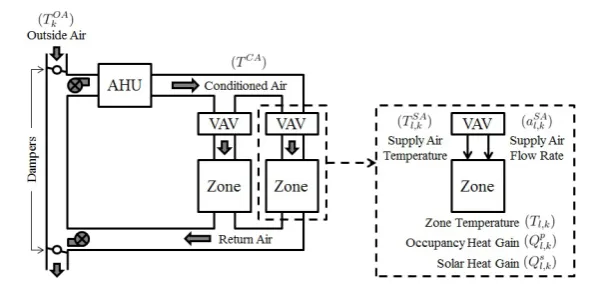
VAV-based HVAC systems [ASHRAE, 2016] control air from a supply duct and vary the supply air flow and air temperature to each zone based upon the temperature in the building zone. This system is frequently associated to ”zone control“ due to its capability to maintain precise temperature control based on multiple setpoints in individual zones. This system is adopted in our model and the physical model is explained in detailed in Chapter 4. Figure 2.3 shows a schematic of a VAV-based HVAC system connected to two building zones.
Figure2.3: VAV-based HVAC system
The main components are the central air handling unit (AHU), supply fan and VAV units. The AHU admits a mixture of outside air and return air and conditions it to a pre-set conditioned air temperature, usually 12.8◦C. The conditioned air1 is then
distributed through the supply air duct to a network of VAV units in the building. A VAV unit is a small metal box located in the supply air duct just before the outlet of each zone. This terminal unit is also called a VAV terminal, VAV box or outlet box. The VAV unit is equipped with a few essential components:
1Theconditioned airis sometimes referred to ”supply air“ in other literature. However, following
Goyal et al. [2013], we denote asconditioned airthe cold air distributed by the air handling unit to the
supply duct prior to reaching the VAV unit, and assupply airthe cold air or re-heated air that flows
§2.1 Zone-based HVAC Systems 17
a) a temperature sensor that monitors each zone temperature,
b) an air flow sensor that monitors the volume of supply air into the zone,
c) an air damper that modulates between open and closed positions to regulate the volume of supply air into the zone,
d) an actuator that adjusts the air damper,
e) the reheat coils that heat up cold conditioned air passing through the air damper into the zone, and
f) a VAV controller that controls and coordinates all the above operations amongst the VAV components and the AHU.
Figure2.4: Dual maximum VAV setpoints control logic
Each VAV unit receives conditioned air from the central AHU at the same tem-perature. As the conditioned air temperature is constant, the supply air flow rate and supply air temperature into each zone must vary to meet the rising and falling heat gains or losses within the thermal zone served. Figure 2.4 shows a schematic representation of a ”dual maximum“ setpoints control logic used at the VAV units. Each zone has a pre-defined heating setpoint and a pre-defined cooling setpoint. In this control sequence, at peak cooling the VAV controller opens the air damper until the supply air flow reaches a pre-defined upper limit. This allows the VAV unit to discharge the maximum amount of cold air2into the zone and bring down the zone temperature. As the cooling requirement decreases, the controller modulates the air damper position to decrease the air flow into the zone. When the zone temperature falls between the cooling and heating setpoints, the system enters a deadband mode and is neither heating nor cooling. During this time, the air damper is set to open
2Ideally the air temperature is similar to the temperature of the conditioned air, or the outdoor air if
at a minimum controllable level to allow the minimum amount of air flow into the zone. In the case when a zone temperature falls below the heating setpoint, the sys-tem moves into heating mode. The control sequence is broken into two phases. In the initial phase of heating, the air flow will remain at the minimum air flow rate and the reheat coils in the VAV are turned on to add heat to the cold conditioned air up to a designated supply air temperature. If additional heating is required, the air flow rate will increase until it reaches a maximum supply air flow rate. Reheat is typically added to a few perimeter rooms or zones. Although it may seem that heating air that may have been previously cooled is wasteful, using reheat in a few locations may be more economical when both heating and cooling is required from a centralised air supply.
As each VAV unit regulates its air flow rate independently, the volume of con-ditioned air delivered by the central AHU varies according to the demands of the VAV units in the system. This means that the supply fan in the central AHU must vary its output in order to meet the needs of all the VAV units. If the air dampers of most VAV units are fully opened, the conditioned air required for the entire system is high. If most VAV unit dampers are closed, the conditioned air required for the system is much less. Hence the speed of supply fan is regulated to meet the changing demands of the system and to maintain a constant static pressure in the supply duct.
Most VAV systems and the AHU are coordinated and controlled through a cen-tralized building automation system (BAS). Each VAV unit can send information and receive instructions from the BAS, allowing more complex control and optimisation of the HVAC operations. Alternately, the BAS can continually poll each individual VAV controllers, looking for information such as damper position, room temperature, supply air flow rate, and supply air temperature. It can also send remote control in-structions to each individual VAV units, such as controlling the damper position, supply air flow rate and supply air temperature into each zone.
Overall, the main advantage of a VAV-based HVAC system is its capability to en-sure occupant comfort and avoid energy waste. Indeed, a building with many VAV zones raises the chances of thermal comfort satisfaction with zone-specific temper-ature setpoints control. Having many VAV zones also reduces the chance of over-cooling or overheating which lowers fan speeds and lowers the central conditioning requirement, both of which result in lower energy use.
However, the main issue is that configuring a truly “high performance” VAV system, including determining the optimal start/stop of the system, detecting zone occupancy, varying air flow of each zone, optimising fan-pressure optimisation, resetting conditioned-air temperature, optimising zone ventilation etc., is an ex-tremely challenging problem [Murphy, 2011]. The research and development of these zone-based optimal control strategies has been an ongoing concern in the fields of
§2.2 Occupancy-based Control Strategies 19
2
.
2
Occupancy-based Control Strategies
The need for comfort control arises because buildings are occupied. In practice, however, in the majority of buildings the indoor conditions are either pre-defined or reactive based on temperature sensors. A standard practice is to preset building tem-perature at a comfortable range, for instance between 20◦C to 24◦C during standard operating hours regardless of its occupancy. This practice incurs high energy cost and causes a waste of energy used to heat up or cool down vacant zones.
The goal of occupancy-based HVAC control is to use occupancy information to reduce energy use – over conventional control algorithms – while maintaining ther-mal comfort and indoor air quality. This control strategy regulates the indoor cli-mate of a building based on either pre-defined, measured or predicted occupancy information. In this section, we discuss various control strategies used to perform occupancy-based control, ranging from conventional control strategies using pre-defined occupancy schedules to advanced control strategies that predict occupancy flow over a control horizon. Conventional controls such as on/off control, PID con-trol and rule-based concon-trol are the most commonly used concon-trol mechanisms in ex-isting commercial buildings, whilst model predictive control (MPC) is becoming the de facto control strategy in new buildings due to its advanced features that yield higher energy savings.
Based on the occupancy information, these control mechanisms are used for the dynamic control of the demand-side of the HVAC system, including VAV dampers position control, heating coil control, supply air temperature control, supply air flow rate control and room temperature control. They are also used at the supply side of the HVAC system for controlling the conditioned air temperature set point of an AHU, the chilled water temperature setpoint, the outdoor air ventilation rate and setpoint, the outdoor air damper control, the return air damper control and the supply duct pressure control. As the basic principle of these mechanisms are different, they can accept different level of occupancy details, thereby leading to different granularity of control.
2.2.1 ON/OFF Control
HVAC is off. During the weekends, when the HVAC is turned on, the zone status is changed to “occupied” mode for a few hours (for eg. 2 hours or 5 hours). For the rest of the days, the occupancy mode is always set to “unoccupied”. Although the on/off controller is simple to implement, it fails to react quickly to dynamic processes with time lags, such as HVAC control. The HVAC processes controlled using an on/off controller display large swings from the temperature setpoints.
2.2.2 PID Control
The PID controllers modulate controlled variables based on error dynamics to achieve accurate control of a HVAC process [Xu et al., 2009; Gruber et al., 2015]. They calcu-late an error rate based on the difference between a desired setpoint and a measured control variable, and apply a correction to the control variable based on the following proportional, integral, and derivative terms:
ut =KPet+KI
Z t
0 eτdτ
+KDdet dt.
ut is the control variable at step t, KP, KI and KD are non-negative coefficients for
the proportional (P), integral (I) and derivative (D) terms. Paccounts for the present value of the error rate. Based on the model, the control output is directly proportional to the current error rate. I accounts for the past values of the error rate. The integral of the error rate will accumulate over time and impact the control output. Daccounts for the future trend of the error rate based on its current rate of change. Using this formulation, the value of the control variable is being adjusted, with an objective to minimise the error rate over time. Note that some systems require only one or two terms to provide appropriate control. This can be achieved by setting the other term(s) to zero. In the absence of the respective terms, a PID controller is called a PI, PD, P or I controller.
PID controllers are effective to develop a supervisory control strategy for HVAC control, such as controlling the position of a damper, or the air temperature setpoint [Xu et al., 2009]. For occupancy-based control, the occupancy of each zone and the total occupancy can be given as an input to the control model. This occupancy infor-mation can be retrieved from a pre-defined schedule, or measured using occupancy sensors. Generally, the PID controllers return promising results. The drawback of this model is that KP, KI and KD require tunings. Thus, they are not resilient to
disturbance and the performance of the controllers degrade when the operating con-ditions vary from the tuning concon-ditions.
2.2.3 Rule-based Control
§2.2 Occupancy-based Control Strategies 21
measurements to turn off the HVAC system, while the controller in Dhummi et al. [2011] modulates the supply air flow rate and the zone temperature setpoints in each zone based on measured occupancy. Goyal et al. [2013] defines a set of rules to control zone temperature setpoints during occupied and unoccupied periods. Their controller is designed such that the temperature setpoints are allowed to fluctuate within a larger range when the measured occupancy is zero, and are tightened when the measured occupancy is more than one. Furthermore the controller calculates the minimum supply air flow rate based on the number of occupants in the zone. The decision of temperature setpoints is crucial as a wider range will reduce energy consumption in general, since the controller may be able to reduce reheating during low thermal load conditions and reduce the air flow during high thermal load condi-tions. Too wide a range, however, will lead to discomfort of the occupants. Therefore, for these types of controllers, the conditions and actions are usually associated with numerical parameters (e.g. threshold values) that need to be chosen. A good perfor-mance of the rule-based controllers critically depends on a good choice of rules and associated parameters.
2.2.4 Model Predictive Control
Unlike conventional control mechanisms, MPC is an advanced method which uses a system model to predict the future states of the system and generates a control vector that minimises a certain cost function over the prediction horizon in the presence of disturbance and constraints. The optimisation model can be formulated in general form as follows:
min f xt→t+N|t,ut→t+N|t
subject to xt+k+1|t = g xt+k|t,ut+k|t
k = [0, 1, . . . ,N−1]
xt+k|t ∈ X
ut+k|t ∈U
wherext+k|tdenotes(t+k)th predicted state of the system at stept. ut+k|trepresents
the exogenous input to the system, calculated at stept. The HVAC system’s state tra-jectories are explored based on initial states and predicted disturbances (i.e. inputs) to the system, and a cost-minimising control strategy is identified until time t+N. Only the decision for time step tis executed. The prediction horizon is then shifted forward and the process is repeated all over again to calculate the optimal control signal.